

Here's something you might be interested in.
Ask a Hipster — Advice you didn't know you needed
Big Screen — Movie commentary
Blurt — Music's inside track
Booze News — San Diego spirits
Classical Music — Immortal beauty
Classifieds — Free and easy
Close to Home — What it’s like on the street where you live
Cover Stories — Front-page features
Drinks All Around — Bartenders' drink recipes
Excerpts — Literary and spiritual excerpts
Feast! — Food & drink reviews
Feature Stories — Local news & stories
Fishing Report — What’s getting hooked from ship and shore
From the Archives — Spotlight on the past
Golden Dreams — Talk of the town
The Gonzo Report — Making the musical scene, or at least reporting from it
Letters — Our inbox
Movies@Home — Local movie buffs share favorites
Movie Reviews — Our critics' picks and pans
Musician Interviews — Up close with local artists
Neighborhood News from Stringers — Hyperlocal news
News Ticker — News & politics
Obermeyer — San Diego politics illustrated
Outdoors — Weekly changes in flora and fauna
Overheard in San Diego — Eavesdropping illustrated
Poetry — The old and the new
Reader Travel — Travel section built by travelers
Reading — The hunt for intellectuals
Roam-O-Rama — SoCal's best hiking/biking trails
San Diego Beer — Inside San Diego suds
SD on the QT — Almost factual news
Sheep and Goats — Places of worship
Special Issues — The best of
Street Style — San Diego streets have style
Surf Diego — Real stories from those braving the waves
Theater — On stage in San Diego this week
Tin Fork — Silver spoon alternative
Under the Radar — Matt Potter's undercover work
Unforgettable — Long-ago San Diego
Unreal Estate — San Diego's priciest pads
Your Week — Daily event picks
Can faith melt ICE?
Church and state and the state of the stranger
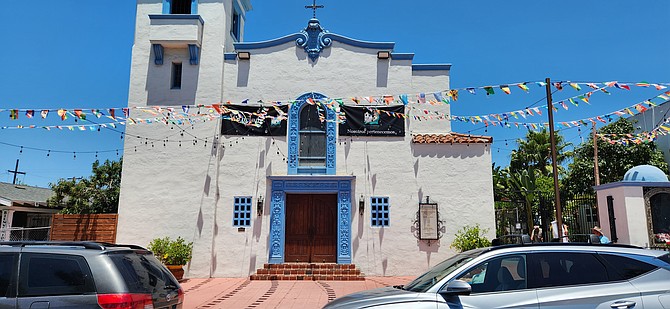
The website for Our Lady of Guadalupe parish describes the church this way: “Founded in 1917, Our Lady of Guadalupe is a Jesuit parish in San Diego, whose mission is to accompany, inspire, and educate especially Mex-ican-Americans in their journeys with the Blessed Virgin and her Di-vine Son.” Since its inception, it has been San Diego’s immigrant church. Perhaps you have seen it as you drive north through Barrio Logan on the 5, standing with unmissable dignity down there below the rush of traffic, its sun-dappled white stucco walls trimmed with Marian blue. If it’s Sunday morning, perhaps you have seen vendors with their pots of tamales and cobbed corn for the parishioners just out of Mass. Perhaps you have even noticed that the front doors of the church are closed — odd for a Sunday.
Those doors are not locked, but they will be, once the next Mass begins. Our Lady of Guadalupe Pastor Father Scott Santarosa says that in this summer of ICE, it’s wise — if not imperative— for the church to be extra prepared for a visit, even during Sunday Mass. The Trump administration is challenging state sanctuary laws — San Diego County is one of four in America so designated — which under President Biden protected people in hospital, schools, and churches from being arrested. So Father Scott locks the doors, and stations a staff member by the side door with instructions to close both it and the side gate should ICE arrive.
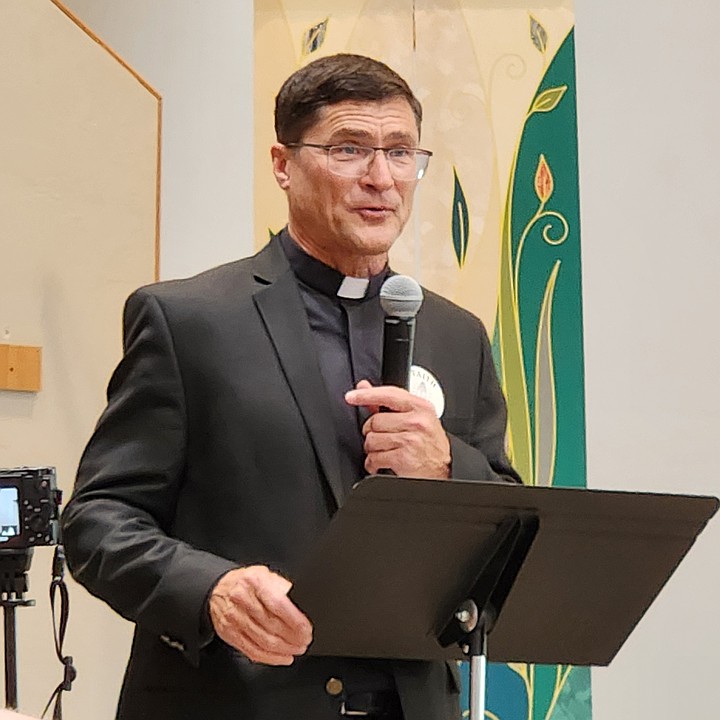
Fr. Scott Santarosa
I sought out Father Scott after June 20th, International Refugee Day, when members of the Catholic Diocese of San Diego joined other faith leaders and organizations to bear witness to the plight of migrants by occupying the carpeted corridors outside the immigration courtrooms on the fourth floor of the Edward Schwartz Federal Building. The headline I read that day declared, “ICE agents scatter when Bishop Pham, other clergy visit immigration court.” Father Scott was among them.
Father Scott is a Jesuit: young, vibrant, philosophically turned, and comfortable stressing Christ’s teaching in any situation. He’s been the pastor of Our Lady of Guadalupe since 2022. He had been serving at the Dolores Mission in LA’s Boyle Heights, but requested a new assignment to a “low-income, Spanish-speaking parish” in San Diego. Now, he’s happily ensconced: “I love it," he told me.
Father Scott has undocumented people in his flock. His response to their palpable anxiety over their possible arrest and removal is, “We see you in your fear, that alienation, from your lives. You can’t live one thing outside the church and live something else inside the church.” He tells them that during Mass, “you can offer [the fear] to God and move on — in some way.”
Last July, San Bernardino’s Bishop Alberto Rojas waived the obligation to attend Mass for parishioners who felt their appearance was dangerous. A similar edict has not been levied by San Diego’s bishop. Father Scott said it was great to have people’s fear of assembly recognized as a reality. But, he said, “It’s a terrific loss, because now more than ever, they need to come to Mass.” And so far, they are still coming, even though, he said, some of them have quit going to the grocery store, buying gas, shopping for clothes, or congregating in bars or backyards.
He said he’s even “weaving the message” into his homilies. One way is to bring the kids to the front and ask them to play a game: “Who is my neighbor?” A relative? Yes. A longtime friend? Yes. A person who’s just moved in? Yes. (These new arrivals, he said, may be undocumented.) He instructs the kids that “some people believe this person is not your neighbor,” and they want them gone. But remember, “Jesus is calling us to be a neighbor to everybody, to see everyone with love and compassion.”
If ICE does ever question a parishioner or church official, the person will hand the agent the wallet-sized “red card” produced by the Immigrant Legal Resource Center. On one side, it states, “I don’t have to speak to you, show you papers, give you permission to search my home or my belongings—based on my Fourth and Fifth Amendment rights.” The other side, in Spanish, details the rights of citizens, green-card and visa holders, asylum seekers, the temporarily protected, and arrivals who are due a status hearing.
(Other helpful options are available from the San Diego County Office of Immigrant and Refugee Affairs. If a family member is detained, the county office provides resources for child care, kids’ safe transportation to school and home, food supplements, and strategies to secure cars, pets, property, bank accounts, healthcare files, and power of attorney.)
Church and state
The Church has a mandated mission to minister to the alien, the outsider, and the vulnerable. Does Father Scott think we can expect California and, for that matter, the nation to do the same? Father Scott paused, spun in a half-circle in his chair, and vigorously rubbed his short-cropped black hair. He said the Church’s moral foundation is no different than the foundations of our civil, criminal, and regulatory laws. After all, he said, this country is built on “Judeo-Christian values, that is, the common good.” Because that good is common to church and state, “I don’t think it’s honest to do that kind of splitting.”
Does he think of the Church’s support of migrants as resistance? He responded by noting that on the Feast of Corpus Christi, he led a procession through the barrio, a yearly event. “There’s no protection outside as you have in the church,” he said. “Let’s say ICE shows up and surrounds 400 people. They can see it’s a National Eucharistic Pilgrimage. It’s a practice of faith.” Such a public gathering is “a conservative and traditional Catholic thing’ that he believes will warn ICE agents, “Here is a border they cannot cross.”
A multi-faith ministry
Soon after the June 20th confrontation, the San Diego diocese undertook a “new court-accompaniment ministry,” spearheaded again by the newly installed Catholic Bishop, Michael Pham. This effort included “training sessions” at the San Diego Catholic Pastoral Center, with invitations extended to the laity from Catholic, Episcopalian, Lutheran, Jewish, Nazarene, and Islamic traditions, non-faith-based activists, and members of the San Diego Organizing Project to “walk with the vulnerable.” I attended the ministry’s kick-off and a training session, but before that, I asked two local religious leaders what in their faiths compelled them to “welcome the stranger.”
Iman Taha Hassane heads the Islamic Cultural Center in Clairemont. At his desk in the domed-and-spired mosque, which houses a school and prayer hall, Iman Taha wore a summery guayabera and a white-knitted kufi. He told me that a majority of the county’s 100,000 Muslims (of which 20 percent are Arabs) have concentrated in neighborhoods as they have fled myriad Middle East conflicts: the Soviet war in Afghanistan, the Gulf and Iraq Wars, civil strife in Somalia and Syria, the fall of Kabul to the Taliban, and ethnic battles in Mauritania, Senegal, and Sudan.
The Qur’an, he said, “tells stories of the prophets — from Noah, Abraham, Jesus, Moses, David, Solomon, and the last, Muhammad. Nearly all of the them migrated during their lives. Why? Because of religious persecution, themselves or their disciples. God,” he continued, “said the earth belongs to everyone.” It is a principle that “wherever you are, if you are not able to survive, go and look for another place where you can find food, safety, where you can prosper. And, when others show you kindness, show kindness to them.”
Kathleen Owen, a retired Unitarian Universalist clergywoman, told me that as a court witness, she caught the stench of a Catch-22: Some migrants show up for hearings because they believe their asylum case is not illegal but constitutionally legitimate; they trust they won’t be detained. Yet out of fear of being deported, many don’t appear. Thus, if they miss their date, they’re subject to arrest and automatic exile. As for the Unitarian’s commitment to the “other,” she said in an email: “Influenced by the world’s sacred scriptures, nature, and our experience of humanity, Unitarian Universalists draw from our heritages of freedom, reason, hope and courage, building on the foundation of Love. Love is at the center of our shared values and it is living our values that call us to aid the stranger.”
A refugee bishop
At the training session, I listened to some 50 volunteers ask questions about parking, recording ICE arrests, and the “purposeful complexity of immigration law.” Afterwards, I asked Bishop Pham, a refugee from Vietnam, about his own story. He graciously replied, “I was eight years old when the North Vietnamese took over the South. For a couple of years, we had only one meal a day — we had to eat barley. It was hard to chew. If I stayed in Vietnam, I would not have had the type of education I got here.” He said that though the Catholic church was shuttered, “people sought permission to celebrate Christmas” and often re-ceived it or did so clandestinely. The North Vietnamese “wanted us to follow them. They were afraid if the churches were open, it would mean the rise of protest,” that is, an opposition to an atheistic communism.
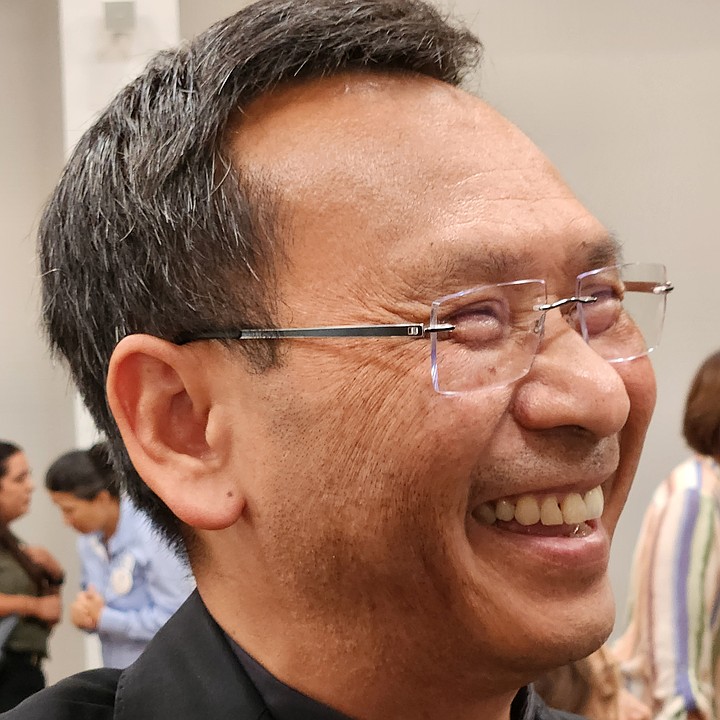
Bishop Pham
He overflows with gratitude for America. “All the opportunities to grow and express myself are here. The things that you have provided for us [Vietnamese] as a country,” and I sensed a quiver in his voice as he recalled his journey from engineer to seminarian to priest and Bishop. Diversity and harmony are key words for Pham. America, he insisted, is “a witness to the world that we can come together.” As for his installation, it was “God’s gift to me for growing up here in San Diego for 40 years.”
The harrowing hallway
On the day I attend an accompaniment, there are a dozen ICE agents haunting the hallway outside the eight immigration courtrooms on the fourth floor of the Schwartz Building. Dressed in park-ranger green, the agents bulge with wraparound bulletproof vests marked POLICE-ICE, their belts adorned with key sets, Tasers, spray vials, hidden zip ties, note-books, and other leatherette pouches. Polished badges dangle from neck chains. All sport tight ball caps; the women, in a pod of three, clip their hair back. Many wear black gaiters; so fully swathed, only their Target tennis shoes and eyes — hyper-wary and piercing — reveal any personhood.
Tension from two sources hums under the hallway’s fluorescent lights. One is the agents’ intimidating presence; the other is Detention Resistance, an “Abolitionist Collective” consisting of a dozen protestors who prefer anonymity. Since 2018, they have documented ICE’s alleged rough treatment of the arrestees — who, they maintain, “have been criminalized by the state.” There are other protesters here, their T-shirts emblazoned with lefty battle cries. And there is the Faith force, which tallies about 20 between leaders and volunteers.
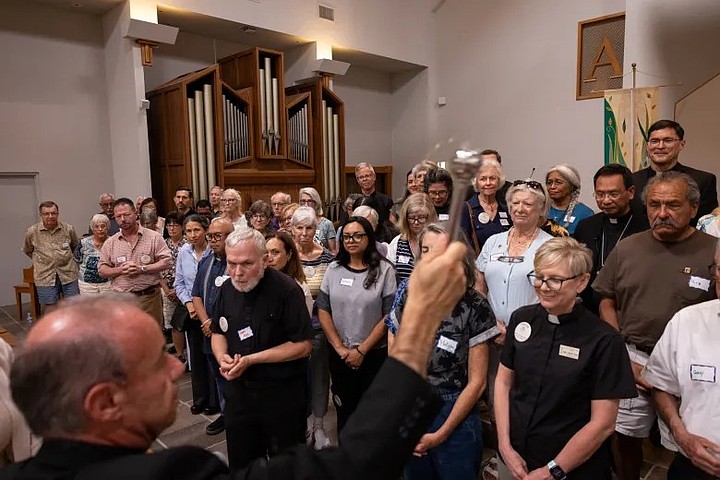
Diocesan blessing of volunteers before accompaniment.
In the waiting room, a monitor lists the day’s cases: for example, USA v. Marco Sanchez Avila, 8:30 am. Everyone waits until decision time. A courtroom door opens, and client and lawyer emerge, smiling. The man is temporarily safe: case continued. Hope buoys, and the vigil restarts. Nothing happens, quiet chatter, nothing happens, nodding off, nothing hap-pens, slump and sigh, then BOOM! The door of Judge Amelia Anderson’s courtroom pops open and ICE swarms. So, too, do the Resistance folks. I learn later that a hallway ICE designee carries a list with photos of the day’s defendants and is “tipped off” by the government attorney to arrest the person. The judge has dismissed his case: a plea for asylum at the border or right now at the hearing. This means his claim to remain in the U.S. will be heard again, but because the court fears his flight, he needs to be detained.
The target is a dark-skinned, twentyish man who is taken aback by the sudden melee. He is Mustafa Malik, an Afghani, and he is accompanied by his attorney, Maria Chavez of PANA, Partnership for the Advancement of New Americans. The organization represents Muslim refugees.
The agents and the resistors jostle down the hallway toward the elevator bay like paparazzi chasing a celebrity convict. Shouts of “Be gentle,” “We’re filming you,” and “Stop pushing” firework the air. One elevator door opens, and ICE boards only Malik. The resistors explode. “Hey, he has a right to counsel! Let her go with him!” The doors shut. “That’s a power trip!” a woman hollers. “ICE’s tactic is to separate people from their attorneys. Instill fear.” Another cries, “This is not only happening in San Diego, but all over the country!” A minute later, Attorney Chavez — who’s escorted many detainees to the basement (one man’s arm was nearly broken “in retaliation for her advocacy,” an activist tells me) — rides down another elevator and spends the next three hours with Malik in the holding cell where he must wait for ICE to bus him to Otay Mesa Detention Center.
In the aftermath, confusion reigns. Why has Malik been detained? No one knows. Frustrated supporters return to as we were, their sense of powerlessness deflating all. Twenty minutes later, a Portuguese man goes in for his hearing while his lawyer tries to Zoom in from Orlando, Florida. The judge disallows the proceeding (she needs prior notice) and sets another date. The government attorney wants to “dismiss the case without prejudice.” The judge reit-erates her continuance. Moments later in the hallway, the man is frog-marched to the eleva-tor. Another sardine to be packed into the already overstuffed Otay Mesa (13 detainees occupy cells with 8 beds) while he waits for a follow-up hearing. The Portuguese man may get a “credible fear” interview — his plea was, “Don’t send me home; I’ll be tortured and killed” — but such cases these days are rarely successful.
As the Faith group assembles in the lobby for a debrief, I think about one volunteer, Susan, whose spiritual care captured the purpose of the mission. In the courtroom, she consoled a woman, the wife of a man facing removal for overstaying his visa. Susan had never met the woman and did not speak Spanish, but her handholding and hugs assuaged the stranger’s fear. Later, there were tears of joy: His case was continued. Another Faith participant says he put a hand on a detainee and whispered in his ear, “God go with you.” To end the day, Father Scott addresses a prayer to God: “All things work through your way to glory, somehow, though it might not be clear how.”
Outside, the Detention Resistance members voice their exasperation. One wiry-haired young man who says he’s done jail time for the cause and “fought Nazis in the street” says ICE’s mandate feels like “some real scary fascist shit.” Another says it’s heartening to see potential deportees assent to voluntary removal instead of going to the border holding tank — and then, perhaps, to a gulag in El Salvador. “It’s a form,” she says, “of ‘You can’t fire me; I quit.’” In a sense, voluntary removal was the de facto request half the migrants chose today: they didn’t bother to show.
Private prisons and profit
Before leaving, I ask Maria Chavez about Malik’s case. Though he was born in Afghanistan, he received permanent residency as a guest worker in Italy before coming to America. Chavez intends to get him behind the welcoming shield of the Italians, and not under the beheading swords of the Taliban. He opted for voluntary departure, but must be “processed” at Otay Mesa — a scary thought, she says.
According to ICE’s own data, only 10 percent of the 1350 migrants held at Otay Mesa — which is run by CoreCivic, a private prison company — have been convicted of a crime or a misdemeanor. What’s more, of that 90 percent without convictions, 84 percent have no ICE threat-level classification. Apparently, they need to be sequestered to prevent flight, or so they say. There may be other motives at work.
By a perverse financial leverage, with Congress abetting the prison industry with billions for ICE, detention of those facing deportation is now nearly fully privatized. Consequently, CoreCivic, whose stock price has been flat since 2000, may be a good bet as they fill triple deck bunk beds with bodies waiting for a hearing or a plane elsewhere. CoreCivic operates 43 prisons in the U.S; its total revenue in 2024 was $2 billion. The cost of an adult detainee at Otay Mesa is $157 per day; with 1350 detainees, that’s more than $211,000 per day—$6.3 million per month. All taxpayer funded. God and his earthly agents have their work cut out for them.
Here's something you might be interested in.
Can faith melt ICE?
Church and state and the state of the stranger

Can faith melt ICE?
Church and state and the state of the stranger
The website for Our Lady of Guadalupe parish describes the church this way: “Founded in 1917, Our Lady of Guadalupe is a Jesuit parish in San Diego, whose mission is to accompany, inspire, and educate especially Mex-ican-Americans in their journeys with the Blessed Virgin and her Di-vine Son.” Since its inception, it has been San Diego’s immigrant church. Perhaps you have seen it as you drive north through Barrio Logan on the 5, standing with unmissable dignity down there below the rush of traffic, its sun-dappled white stucco walls trimmed with Marian blue. If it’s Sunday morning, perhaps you have seen vendors with their pots of tamales and cobbed corn for the parishioners just out of Mass. Perhaps you have even noticed that the front doors of the church are closed — odd for a Sunday.
Those doors are not locked, but they will be, once the next Mass begins. Our Lady of Guadalupe Pastor Father Scott Santarosa says that in this summer of ICE, it’s wise — if not imperative— for the church to be extra prepared for a visit, even during Sunday Mass. The Trump administration is challenging state sanctuary laws — San Diego County is one of four in America so designated — which under President Biden protected people in hospital, schools, and churches from being arrested. So Father Scott locks the doors, and stations a staff member by the side door with instructions to close both it and the side gate should ICE arrive.
Fr. Scott Santarosa
I sought out Father Scott after June 20th, International Refugee Day, when members of the Catholic Diocese of San Diego joined other faith leaders and organizations to bear witness to the plight of migrants by occupying the carpeted corridors outside the immigration courtrooms on the fourth floor of the Edward Schwartz Federal Building. The headline I read that day declared, “ICE agents scatter when Bishop Pham, other clergy visit immigration court.” Father Scott was among them.
Father Scott is a Jesuit: young, vibrant, philosophically turned, and comfortable stressing Christ’s teaching in any situation. He’s been the pastor of Our Lady of Guadalupe since 2022. He had been serving at the Dolores Mission in LA’s Boyle Heights, but requested a new assignment to a “low-income, Spanish-speaking parish” in San Diego. Now, he’s happily ensconced: “I love it," he told me.
Father Scott has undocumented people in his flock. His response to their palpable anxiety over their possible arrest and removal is, “We see you in your fear, that alienation, from your lives. You can’t live one thing outside the church and live something else inside the church.” He tells them that during Mass, “you can offer [the fear] to God and move on — in some way.”
Last July, San Bernardino’s Bishop Alberto Rojas waived the obligation to attend Mass for parishioners who felt their appearance was dangerous. A similar edict has not been levied by San Diego’s bishop. Father Scott said it was great to have people’s fear of assembly recognized as a reality. But, he said, “It’s a terrific loss, because now more than ever, they need to come to Mass.” And so far, they are still coming, even though, he said, some of them have quit going to the grocery store, buying gas, shopping for clothes, or congregating in bars or backyards.
He said he’s even “weaving the message” into his homilies. One way is to bring the kids to the front and ask them to play a game: “Who is my neighbor?” A relative? Yes. A longtime friend? Yes. A person who’s just moved in? Yes. (These new arrivals, he said, may be undocumented.) He instructs the kids that “some people believe this person is not your neighbor,” and they want them gone. But remember, “Jesus is calling us to be a neighbor to everybody, to see everyone with love and compassion.”
If ICE does ever question a parishioner or church official, the person will hand the agent the wallet-sized “red card” produced by the Immigrant Legal Resource Center. On one side, it states, “I don’t have to speak to you, show you papers, give you permission to search my home or my belongings—based on my Fourth and Fifth Amendment rights.” The other side, in Spanish, details the rights of citizens, green-card and visa holders, asylum seekers, the temporarily protected, and arrivals who are due a status hearing.
(Other helpful options are available from the San Diego County Office of Immigrant and Refugee Affairs. If a family member is detained, the county office provides resources for child care, kids’ safe transportation to school and home, food supplements, and strategies to secure cars, pets, property, bank accounts, healthcare files, and power of attorney.)
Church and state
The Church has a mandated mission to minister to the alien, the outsider, and the vulnerable. Does Father Scott think we can expect California and, for that matter, the nation to do the same? Father Scott paused, spun in a half-circle in his chair, and vigorously rubbed his short-cropped black hair. He said the Church’s moral foundation is no different than the foundations of our civil, criminal, and regulatory laws. After all, he said, this country is built on “Judeo-Christian values, that is, the common good.” Because that good is common to church and state, “I don’t think it’s honest to do that kind of splitting.”
Does he think of the Church’s support of migrants as resistance? He responded by noting that on the Feast of Corpus Christi, he led a procession through the barrio, a yearly event. “There’s no protection outside as you have in the church,” he said. “Let’s say ICE shows up and surrounds 400 people. They can see it’s a National Eucharistic Pilgrimage. It’s a practice of faith.” Such a public gathering is “a conservative and traditional Catholic thing’ that he believes will warn ICE agents, “Here is a border they cannot cross.”
A multi-faith ministry
Soon after the June 20th confrontation, the San Diego diocese undertook a “new court-accompaniment ministry,” spearheaded again by the newly installed Catholic Bishop, Michael Pham. This effort included “training sessions” at the San Diego Catholic Pastoral Center, with invitations extended to the laity from Catholic, Episcopalian, Lutheran, Jewish, Nazarene, and Islamic traditions, non-faith-based activists, and members of the San Diego Organizing Project to “walk with the vulnerable.” I attended the ministry’s kick-off and a training session, but before that, I asked two local religious leaders what in their faiths compelled them to “welcome the stranger.”
Iman Taha Hassane heads the Islamic Cultural Center in Clairemont. At his desk in the domed-and-spired mosque, which houses a school and prayer hall, Iman Taha wore a summery guayabera and a white-knitted kufi. He told me that a majority of the county’s 100,000 Muslims (of which 20 percent are Arabs) have concentrated in neighborhoods as they have fled myriad Middle East conflicts: the Soviet war in Afghanistan, the Gulf and Iraq Wars, civil strife in Somalia and Syria, the fall of Kabul to the Taliban, and ethnic battles in Mauritania, Senegal, and Sudan.
The Qur’an, he said, “tells stories of the prophets — from Noah, Abraham, Jesus, Moses, David, Solomon, and the last, Muhammad. Nearly all of the them migrated during their lives. Why? Because of religious persecution, themselves or their disciples. God,” he continued, “said the earth belongs to everyone.” It is a principle that “wherever you are, if you are not able to survive, go and look for another place where you can find food, safety, where you can prosper. And, when others show you kindness, show kindness to them.”
Kathleen Owen, a retired Unitarian Universalist clergywoman, told me that as a court witness, she caught the stench of a Catch-22: Some migrants show up for hearings because they believe their asylum case is not illegal but constitutionally legitimate; they trust they won’t be detained. Yet out of fear of being deported, many don’t appear. Thus, if they miss their date, they’re subject to arrest and automatic exile. As for the Unitarian’s commitment to the “other,” she said in an email: “Influenced by the world’s sacred scriptures, nature, and our experience of humanity, Unitarian Universalists draw from our heritages of freedom, reason, hope and courage, building on the foundation of Love. Love is at the center of our shared values and it is living our values that call us to aid the stranger.”
A refugee bishop
At the training session, I listened to some 50 volunteers ask questions about parking, recording ICE arrests, and the “purposeful complexity of immigration law.” Afterwards, I asked Bishop Pham, a refugee from Vietnam, about his own story. He graciously replied, “I was eight years old when the North Vietnamese took over the South. For a couple of years, we had only one meal a day — we had to eat barley. It was hard to chew. If I stayed in Vietnam, I would not have had the type of education I got here.” He said that though the Catholic church was shuttered, “people sought permission to celebrate Christmas” and often re-ceived it or did so clandestinely. The North Vietnamese “wanted us to follow them. They were afraid if the churches were open, it would mean the rise of protest,” that is, an opposition to an atheistic communism.
Bishop Pham
He overflows with gratitude for America. “All the opportunities to grow and express myself are here. The things that you have provided for us [Vietnamese] as a country,” and I sensed a quiver in his voice as he recalled his journey from engineer to seminarian to priest and Bishop. Diversity and harmony are key words for Pham. America, he insisted, is “a witness to the world that we can come together.” As for his installation, it was “God’s gift to me for growing up here in San Diego for 40 years.”
The harrowing hallway
On the day I attend an accompaniment, there are a dozen ICE agents haunting the hallway outside the eight immigration courtrooms on the fourth floor of the Schwartz Building. Dressed in park-ranger green, the agents bulge with wraparound bulletproof vests marked POLICE-ICE, their belts adorned with key sets, Tasers, spray vials, hidden zip ties, note-books, and other leatherette pouches. Polished badges dangle from neck chains. All sport tight ball caps; the women, in a pod of three, clip their hair back. Many wear black gaiters; so fully swathed, only their Target tennis shoes and eyes — hyper-wary and piercing — reveal any personhood.
Tension from two sources hums under the hallway’s fluorescent lights. One is the agents’ intimidating presence; the other is Detention Resistance, an “Abolitionist Collective” consisting of a dozen protestors who prefer anonymity. Since 2018, they have documented ICE’s alleged rough treatment of the arrestees — who, they maintain, “have been criminalized by the state.” There are other protesters here, their T-shirts emblazoned with lefty battle cries. And there is the Faith force, which tallies about 20 between leaders and volunteers.
Diocesan blessing of volunteers before accompaniment.
In the waiting room, a monitor lists the day’s cases: for example, USA v. Marco Sanchez Avila, 8:30 am. Everyone waits until decision time. A courtroom door opens, and client and lawyer emerge, smiling. The man is temporarily safe: case continued. Hope buoys, and the vigil restarts. Nothing happens, quiet chatter, nothing happens, nodding off, nothing hap-pens, slump and sigh, then BOOM! The door of Judge Amelia Anderson’s courtroom pops open and ICE swarms. So, too, do the Resistance folks. I learn later that a hallway ICE designee carries a list with photos of the day’s defendants and is “tipped off” by the government attorney to arrest the person. The judge has dismissed his case: a plea for asylum at the border or right now at the hearing. This means his claim to remain in the U.S. will be heard again, but because the court fears his flight, he needs to be detained.
The target is a dark-skinned, twentyish man who is taken aback by the sudden melee. He is Mustafa Malik, an Afghani, and he is accompanied by his attorney, Maria Chavez of PANA, Partnership for the Advancement of New Americans. The organization represents Muslim refugees.
The agents and the resistors jostle down the hallway toward the elevator bay like paparazzi chasing a celebrity convict. Shouts of “Be gentle,” “We’re filming you,” and “Stop pushing” firework the air. One elevator door opens, and ICE boards only Malik. The resistors explode. “Hey, he has a right to counsel! Let her go with him!” The doors shut. “That’s a power trip!” a woman hollers. “ICE’s tactic is to separate people from their attorneys. Instill fear.” Another cries, “This is not only happening in San Diego, but all over the country!” A minute later, Attorney Chavez — who’s escorted many detainees to the basement (one man’s arm was nearly broken “in retaliation for her advocacy,” an activist tells me) — rides down another elevator and spends the next three hours with Malik in the holding cell where he must wait for ICE to bus him to Otay Mesa Detention Center.
In the aftermath, confusion reigns. Why has Malik been detained? No one knows. Frustrated supporters return to as we were, their sense of powerlessness deflating all. Twenty minutes later, a Portuguese man goes in for his hearing while his lawyer tries to Zoom in from Orlando, Florida. The judge disallows the proceeding (she needs prior notice) and sets another date. The government attorney wants to “dismiss the case without prejudice.” The judge reit-erates her continuance. Moments later in the hallway, the man is frog-marched to the eleva-tor. Another sardine to be packed into the already overstuffed Otay Mesa (13 detainees occupy cells with 8 beds) while he waits for a follow-up hearing. The Portuguese man may get a “credible fear” interview — his plea was, “Don’t send me home; I’ll be tortured and killed” — but such cases these days are rarely successful.
As the Faith group assembles in the lobby for a debrief, I think about one volunteer, Susan, whose spiritual care captured the purpose of the mission. In the courtroom, she consoled a woman, the wife of a man facing removal for overstaying his visa. Susan had never met the woman and did not speak Spanish, but her handholding and hugs assuaged the stranger’s fear. Later, there were tears of joy: His case was continued. Another Faith participant says he put a hand on a detainee and whispered in his ear, “God go with you.” To end the day, Father Scott addresses a prayer to God: “All things work through your way to glory, somehow, though it might not be clear how.”
Outside, the Detention Resistance members voice their exasperation. One wiry-haired young man who says he’s done jail time for the cause and “fought Nazis in the street” says ICE’s mandate feels like “some real scary fascist shit.” Another says it’s heartening to see potential deportees assent to voluntary removal instead of going to the border holding tank — and then, perhaps, to a gulag in El Salvador. “It’s a form,” she says, “of ‘You can’t fire me; I quit.’” In a sense, voluntary removal was the de facto request half the migrants chose today: they didn’t bother to show.
Private prisons and profit
Before leaving, I ask Maria Chavez about Malik’s case. Though he was born in Afghanistan, he received permanent residency as a guest worker in Italy before coming to America. Chavez intends to get him behind the welcoming shield of the Italians, and not under the beheading swords of the Taliban. He opted for voluntary departure, but must be “processed” at Otay Mesa — a scary thought, she says.
According to ICE’s own data, only 10 percent of the 1350 migrants held at Otay Mesa — which is run by CoreCivic, a private prison company — have been convicted of a crime or a misdemeanor. What’s more, of that 90 percent without convictions, 84 percent have no ICE threat-level classification. Apparently, they need to be sequestered to prevent flight, or so they say. There may be other motives at work.
By a perverse financial leverage, with Congress abetting the prison industry with billions for ICE, detention of those facing deportation is now nearly fully privatized. Consequently, CoreCivic, whose stock price has been flat since 2000, may be a good bet as they fill triple deck bunk beds with bodies waiting for a hearing or a plane elsewhere. CoreCivic operates 43 prisons in the U.S; its total revenue in 2024 was $2 billion. The cost of an adult detainee at Otay Mesa is $157 per day; with 1350 detainees, that’s more than $211,000 per day—$6.3 million per month. All taxpayer funded. God and his earthly agents have their work cut out for them.
Comments