

Here's something you might be interested in.
Ask a Hipster — Advice you didn't know you needed
Big Screen — Movie commentary
Blurt — Music's inside track
Booze News — San Diego spirits
Classical Music — Immortal beauty
Classifieds — Free and easy
Close to Home — What it’s like on the street where you live
Cover Stories — Front-page features
Drinks All Around — Bartenders' drink recipes
Excerpts — Literary and spiritual excerpts
Feast! — Food & drink reviews
Feature Stories — Local news & stories
Fishing Report — What’s getting hooked from ship and shore
From the Archives — Spotlight on the past
Golden Dreams — Talk of the town
The Gonzo Report — Making the musical scene, or at least reporting from it
Letters — Our inbox
Movies@Home — Local movie buffs share favorites
Movie Reviews — Our critics' picks and pans
Musician Interviews — Up close with local artists
Neighborhood News from Stringers — Hyperlocal news
News Ticker — News & politics
Obermeyer — San Diego politics illustrated
Outdoors — Weekly changes in flora and fauna
Overheard in San Diego — Eavesdropping illustrated
Poetry — The old and the new
Reader Travel — Travel section built by travelers
Reading — The hunt for intellectuals
Roam-O-Rama — SoCal's best hiking/biking trails
San Diego Beer — Inside San Diego suds
SD on the QT — Almost factual news
Sheep and Goats — Places of worship
Special Issues — The best of
Street Style — San Diego streets have style
Surf Diego — Real stories from those braving the waves
Theater — On stage in San Diego this week
Tin Fork — Silver spoon alternative
Under the Radar — Matt Potter's undercover work
Unforgettable — Long-ago San Diego
Unreal Estate — San Diego's priciest pads
Your Week — Daily event picks
Now Streaming: EBONY AND IVORY (2024)
If it’s true that there’s nothing quite as diseased as a laugh-free comedy, that puts Ebony and Ivory on par with amoebic dysentery.
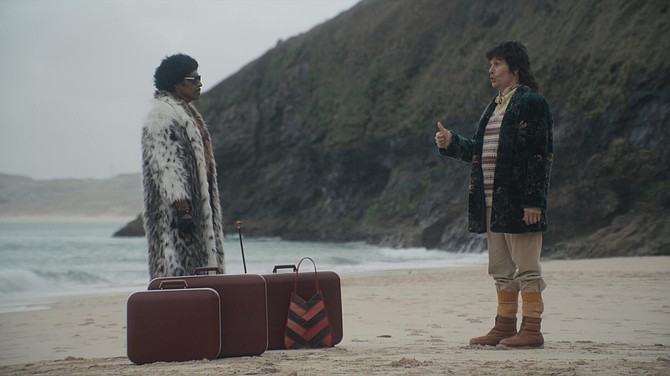
Imperfect harmony.
EBONY AND IVORY (2025) Written, Produced, & Directed by Jim Hosking / Cinematographer: Mårten Tedin (1.85:1) / Design: Felicity Hickson / Editor: Nick Armstrong & Mark Burnett / Composer: Andrew Hung / Acted by: Sky Elobar, Gil Gex, and Carl Solomon / USA / Distributor: Drafthouse Film / Length: 88 mins.
Are you familiar with the infinite monkey theorem? An infinite number of monkeys randomly banging on a keyboard for an infinite amount of time will eventually type the complete works of William Shakespeare. If the same holds true for movies, Jim Hosking’s Ebony and Ivory is the cinematic equivalent of the indolent monkey theorem.
Scotland, 1981. Two of music’s undisputed legends, Paul McCartney (Sky Elobar) and Stevie Wonder (Gil Gex) unite to record the titular duet, a sugary hosanna to race relations. As written, these two are vacuums, void of both talent and personality. One wonders if they have ever heard a song, let alone written and performed one. If it’s true that there’s nothing quite as diseased as a laugh-free comedy, that puts Ebony and Ivory on par with amoebic dysentery. There's more complexity and visual style to be found in the Draft House Films logo than in anything that follows in this inert two-hander.
The comic rationale behind Wonder rowing his little boat to shore instead of grabbing an Uber at the airport is known only to Hosking. The first five minutes pass with no dialogue, only background music. Much of the film's discussion consists of one character repeating what the other one has just said. It's when the music ends and the call-and-response exchanges take over that trouble begins. And visually, large portions would play just as well on radio as they don't on film. Hosking is the student assigned a 2500-word essay who goes on about how much he really, really, really, really likes filming in Scotland because it's a very, very beautiful, beautiful, sunny gorgeous beautiful place to work.
Hosking's idea of funny is bringing two musical geniuses together to write a commercial for vegetarian ready meals. He has no feel for character growth or shading: one screams, the other whimpers. For 88 minutes. Without variation. Without modulation. Two three-year-olds in the back seat singing the echo game during a family vacation car trip couldn’t be more annoying.
Gex delivers all of his dialogue at the same volume, at times pausing as though every word. Ended. With. A. Period. There’s a lot to be said for a comedy that targets the hippest ones in the room, but Hosking works so far inside as to be out. Why would Stevie Wonder carry his luggage to shore if he’s blind? Why would Paul show off a green beer mug to Stevie Wonder if Stevie Wonder is blind? Because somewhere inside Hosking, one can hear the sound of one voice laughing: his own. Zero Stars
Here's something you might be interested in.
Now Streaming: EBONY AND IVORY (2024)
If it’s true that there’s nothing quite as diseased as a laugh-free comedy, that puts Ebony and Ivory on par with amoebic dysentery.

Now Streaming: EBONY AND IVORY (2024)
If it’s true that there’s nothing quite as diseased as a laugh-free comedy, that puts Ebony and Ivory on par with amoebic dysentery.
Imperfect harmony.
EBONY AND IVORY (2025) Written, Produced, & Directed by Jim Hosking / Cinematographer: Mårten Tedin (1.85:1) / Design: Felicity Hickson / Editor: Nick Armstrong & Mark Burnett / Composer: Andrew Hung / Acted by: Sky Elobar, Gil Gex, and Carl Solomon / USA / Distributor: Drafthouse Film / Length: 88 mins.
Are you familiar with the infinite monkey theorem? An infinite number of monkeys randomly banging on a keyboard for an infinite amount of time will eventually type the complete works of William Shakespeare. If the same holds true for movies, Jim Hosking’s Ebony and Ivory is the cinematic equivalent of the indolent monkey theorem.
Scotland, 1981. Two of music’s undisputed legends, Paul McCartney (Sky Elobar) and Stevie Wonder (Gil Gex) unite to record the titular duet, a sugary hosanna to race relations. As written, these two are vacuums, void of both talent and personality. One wonders if they have ever heard a song, let alone written and performed one. If it’s true that there’s nothing quite as diseased as a laugh-free comedy, that puts Ebony and Ivory on par with amoebic dysentery. There's more complexity and visual style to be found in the Draft House Films logo than in anything that follows in this inert two-hander.
The comic rationale behind Wonder rowing his little boat to shore instead of grabbing an Uber at the airport is known only to Hosking. The first five minutes pass with no dialogue, only background music. Much of the film's discussion consists of one character repeating what the other one has just said. It's when the music ends and the call-and-response exchanges take over that trouble begins. And visually, large portions would play just as well on radio as they don't on film. Hosking is the student assigned a 2500-word essay who goes on about how much he really, really, really, really likes filming in Scotland because it's a very, very beautiful, beautiful, sunny gorgeous beautiful place to work.
Hosking's idea of funny is bringing two musical geniuses together to write a commercial for vegetarian ready meals. He has no feel for character growth or shading: one screams, the other whimpers. For 88 minutes. Without variation. Without modulation. Two three-year-olds in the back seat singing the echo game during a family vacation car trip couldn’t be more annoying.
Gex delivers all of his dialogue at the same volume, at times pausing as though every word. Ended. With. A. Period. There’s a lot to be said for a comedy that targets the hippest ones in the room, but Hosking works so far inside as to be out. Why would Stevie Wonder carry his luggage to shore if he’s blind? Why would Paul show off a green beer mug to Stevie Wonder if Stevie Wonder is blind? Because somewhere inside Hosking, one can hear the sound of one voice laughing: his own. Zero Stars