

Here's something you might be interested in.
Ask a Hipster — Advice you didn't know you needed
Big Screen — Movie commentary
Blurt — Music's inside track
Booze News — San Diego spirits
Classical Music — Immortal beauty
Classifieds — Free and easy
Close to Home — What it’s like on the street where you live
Cover Stories — Front-page features
Drinks All Around — Bartenders' drink recipes
Excerpts — Literary and spiritual excerpts
Feast! — Food & drink reviews
Feature Stories — Local news & stories
Fishing Report — What’s getting hooked from ship and shore
From the Archives — Spotlight on the past
Golden Dreams — Talk of the town
The Gonzo Report — Making the musical scene, or at least reporting from it
Letters — Our inbox
Movies@Home — Local movie buffs share favorites
Movie Reviews — Our critics' picks and pans
Musician Interviews — Up close with local artists
Neighborhood News from Stringers — Hyperlocal news
News Ticker — News & politics
Obermeyer — San Diego politics illustrated
Outdoors — Weekly changes in flora and fauna
Overheard in San Diego — Eavesdropping illustrated
Poetry — The old and the new
Reader Travel — Travel section built by travelers
Reading — The hunt for intellectuals
Roam-O-Rama — SoCal's best hiking/biking trails
San Diego Beer — Inside San Diego suds
SD on the QT — Almost factual news
Sheep and Goats — Places of worship
Special Issues — The best of
Street Style — San Diego streets have style
Surf Diego — Real stories from those braving the waves
Theater — On stage in San Diego this week
Tin Fork — Silver spoon alternative
Under the Radar — Matt Potter's undercover work
Unforgettable — Long-ago San Diego
Unreal Estate — San Diego's priciest pads
Your Week — Daily event picks
Redwood music
Whenever I’m in a spot of natural beauty, my mind turns to the great music that has been inspired by nature
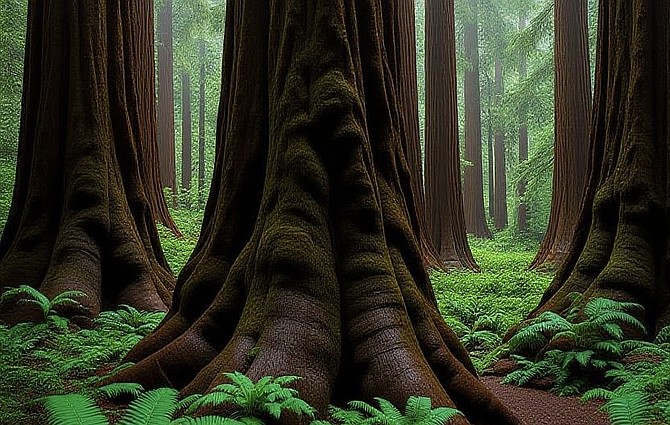
Image created by Grok AI
I spent this week at The Big Sur Lodge in the Pfeiffer Big Sur State Park. My kids and I wandered along the scenic coastline, trekked through the redwoods, and skipped rocks in the river.
How long have humans been skipping rocks for entertainment? Ten thousand years? More? Maybe someday, someone will write the history of skipping rocks, but for now, it remains a viable option for passing an afternoon.
Whenever I’m in a spot of natural beauty, my mind turns to the great music that has been inspired by nature. The most famous pieces are well-known to all classical music lovers. They include Ludwig Beethoven’s Symphony No. 6, Claude Debussy’s La Mer, and Ralph Vaughan Williams’s The Lark Ascending.
There are other pieces, not quite as famous, but still worth recalling. These would include The Hebrides by Felix Mendelssohn, “Forrest Murmurs” from Siegfried by Richard Wagner, Appalachian Spring by Aaron Copland, and Ma Vlast by Bedřich Smetana.
Then we get to some more obscure pieces that reward seeking out, such as Sea Drift by Frederick Delius, George Butterworth’s On the Banks of Green Willow, The Forgotten Rite by John Ireland, and Ferde Grofé’s Grand Canyon Suite.
Sea Drift is a setting of Whitman's poems. On the Banks of Green Willow is Butterworth’s depiction of an idealized English countryside. The Forgotten Rite is Ireland’s homage to his beloved Channel Islands. And The Grand Canyon Suite is the only significant piece of music inspired by the American West, unless you count Giacomo Puccini’s The Girl of the Golden West.
Video:
The Forgotten Rite

Vaughan Williams' Lark Ascending may be his best known nature work, but he has numerous others. His first symphony is A Sea Symphony, another setting of Whitman's poems about the sea. His Symphony No. 3 is entitled “Pastoral." His Symphony No. 7 is titled “Sinfonia Antartica." Then there are pieces such as Flos Campi (flower of the field) and In the Fen Country.
Clearly, Britain in the early 20th Century was fortunate to produce featured several native sons who set the natural elements of their homeland to music. The United States, unfortunately, did not have any such period. The American West was too remote for a composer of significant stature to explore. Classical music is a civilized activity. (When the American West was brought to civilization via the phenomenon of Exhibition Trees, many claimed the trees to be a hoax. Giant sequoias were too incredible to be true.) European naturalism was expressed in art and music, while American naturalism was expressed through the writings of authors such as Henry David Thoreau and John Muir.
Still: as I walked through the redwoods on this occasion, the words of Muir didn’t come to mind; a specific piece of music did. That piece of music was the second movement of Anton Bruckner’s Symphony No. 5, specifically, the string chorale that arrives about three minutes into the music. This music is quietly majestic, just like a redwood forest.
Video:
Bruckner: Sympthony No. 5

Here's something you might be interested in.
Redwood music
Whenever I’m in a spot of natural beauty, my mind turns to the great music that has been inspired by nature

Redwood music
Whenever I’m in a spot of natural beauty, my mind turns to the great music that has been inspired by nature
Image created by Grok AI
I spent this week at The Big Sur Lodge in the Pfeiffer Big Sur State Park. My kids and I wandered along the scenic coastline, trekked through the redwoods, and skipped rocks in the river.
How long have humans been skipping rocks for entertainment? Ten thousand years? More? Maybe someday, someone will write the history of skipping rocks, but for now, it remains a viable option for passing an afternoon.
Whenever I’m in a spot of natural beauty, my mind turns to the great music that has been inspired by nature. The most famous pieces are well-known to all classical music lovers. They include Ludwig Beethoven’s Symphony No. 6, Claude Debussy’s La Mer, and Ralph Vaughan Williams’s The Lark Ascending.
There are other pieces, not quite as famous, but still worth recalling. These would include The Hebrides by Felix Mendelssohn, “Forrest Murmurs” from Siegfried by Richard Wagner, Appalachian Spring by Aaron Copland, and Ma Vlast by Bedřich Smetana.
Then we get to some more obscure pieces that reward seeking out, such as Sea Drift by Frederick Delius, George Butterworth’s On the Banks of Green Willow, The Forgotten Rite by John Ireland, and Ferde Grofé’s Grand Canyon Suite.
Sea Drift is a setting of Whitman's poems. On the Banks of Green Willow is Butterworth’s depiction of an idealized English countryside. The Forgotten Rite is Ireland’s homage to his beloved Channel Islands. And The Grand Canyon Suite is the only significant piece of music inspired by the American West, unless you count Giacomo Puccini’s The Girl of the Golden West.
Video:
The Forgotten Rite
Vaughan Williams' Lark Ascending may be his best known nature work, but he has numerous others. His first symphony is A Sea Symphony, another setting of Whitman's poems about the sea. His Symphony No. 3 is entitled “Pastoral." His Symphony No. 7 is titled “Sinfonia Antartica." Then there are pieces such as Flos Campi (flower of the field) and In the Fen Country.
Clearly, Britain in the early 20th Century was fortunate to produce featured several native sons who set the natural elements of their homeland to music. The United States, unfortunately, did not have any such period. The American West was too remote for a composer of significant stature to explore. Classical music is a civilized activity. (When the American West was brought to civilization via the phenomenon of Exhibition Trees, many claimed the trees to be a hoax. Giant sequoias were too incredible to be true.) European naturalism was expressed in art and music, while American naturalism was expressed through the writings of authors such as Henry David Thoreau and John Muir.
Still: as I walked through the redwoods on this occasion, the words of Muir didn’t come to mind; a specific piece of music did. That piece of music was the second movement of Anton Bruckner’s Symphony No. 5, specifically, the string chorale that arrives about three minutes into the music. This music is quietly majestic, just like a redwood forest.
Video:
Bruckner: Sympthony No. 5