

Here's something you might be interested in.
Ask a Hipster — Advice you didn't know you needed
Big Screen — Movie commentary
Blurt — Music's inside track
Booze News — San Diego spirits
Classical Music — Immortal beauty
Classifieds — Free and easy
Close to Home — What it’s like on the street where you live
Cover Stories — Front-page features
Drinks All Around — Bartenders' drink recipes
Excerpts — Literary and spiritual excerpts
Feast! — Food & drink reviews
Feature Stories — Local news & stories
Fishing Report — What’s getting hooked from ship and shore
From the Archives — Spotlight on the past
Golden Dreams — Talk of the town
The Gonzo Report — Making the musical scene, or at least reporting from it
Letters — Our inbox
Movies@Home — Local movie buffs share favorites
Movie Reviews — Our critics' picks and pans
Musician Interviews — Up close with local artists
Neighborhood News from Stringers — Hyperlocal news
News Ticker — News & politics
Obermeyer — San Diego politics illustrated
Outdoors — Weekly changes in flora and fauna
Overheard in San Diego — Eavesdropping illustrated
Poetry — The old and the new
Reader Travel — Travel section built by travelers
Reading — The hunt for intellectuals
Roam-O-Rama — SoCal's best hiking/biking trails
San Diego Beer — Inside San Diego suds
SD on the QT — Almost factual news
Sheep and Goats — Places of worship
Special Issues — The best of
Street Style — San Diego streets have style
Surf Diego — Real stories from those braving the waves
Theater — On stage in San Diego this week
Tin Fork — Silver spoon alternative
Under the Radar — Matt Potter's undercover work
Unforgettable — Long-ago San Diego
Unreal Estate — San Diego's priciest pads
Your Week — Daily event picks
An escape from Vietnamese re-education camp to San Dego
Beat with electrical wire after eight nights in the cage

One cigarette in particular she pulled out, saying very quickly, “There’s an important letter in this one. Be careful!”
The Reader has started this series of its best stories from the past 52 years — 2600 cover stories and some remarkable interior features — to help make up for the loss of its physical edition, which was once large enough to hold whole oceans of print. These stories will feature all the original illustrations and photos (plus easy-to-read typography), and will include new background information about the authors — some of it taken from personal correspondences.
^^^^^^^^^^^
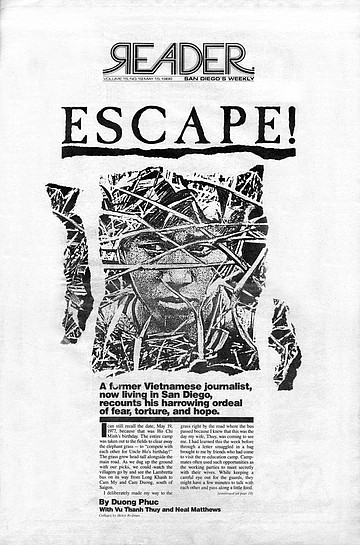 I opened the door of my box and stepped outside. Lying close to the ground, I crawled for a short distance past the meeting rooms of the camp commander.
I can still recall the date, May 19, 1977, because that was Ho Chi Minh’s birthday. The entire camp was taken out to the fields to clear away the elephant grass — to “compete with each other for Uncle Ho’s birthday.” The grass grew head-tall alongside the main road. As we dug up the ground with our picks, we could watch the villagers go by and see the Lambretta bus on its way from Long Khanh to Cam My and Cam Duong, south of Saigon.
I deliberately made my way to the grass right by the road where the bus passed because I knew this was the day that my wife, Thuy, was coming to see me. I had learned this the week before through a letter smuggled in a bag brought to me by friends who had come to visit the re-education camp. Campmates often used such opportunities as the working parties to meet secretly with their wives. While keeping a careful eye out for the guards, they might have a few minutes to talk with each other and pass along a little food
It was about noon then, and the sun was hot. A bus from Long Khanh stopped at the Cam Duong crossroads just in front of a small shop that sold drinks. Some of the passengers got off. Although they were a good distance away, I could make out Thuy in a brown shirt with a small basket in her hand. Even though I had known beforehand that she was coming, the feelings that rushed through me stopped me in my tracks and made me numb.
Thuy walked next to the trench dug beside the road during the war years. Her eyes searched the fields, and I knew she wouldn’t be able to pick me out from among the many men chopping grass there. I turned to look for the guards and saw one in a jungle helmet standing on a small mound overlooking the prisoners. With my pick trailing behind me, I crossed a little clearing and headed in Thuy’s direction, realizing I could not avoid notice by the guard on the hill.
When I reached a place near her, with only a short stretch of grass between us, she finally recognized me. She froze, and we simply stared at each other, too deeply touched to say or do anything, though it had been two years now that we had been separated.
A look of alarm came into her eyes. I turned around to see the guard coming down the hill. Tossing my pick aside, I ran up to Thuy, leaping into the trench below her. Thuy sat down on the edge of the highway. Her lips moved as she tried to speak. Once more she glanced fearfully up behind me.
“Here’s some food for you,” she said finally.
She pushed a burlap bag down into the trench. Then she took a package of Vam Co brand cigarettes from her pocket. One cigarette in particular she pulled out, saying very quickly, “There’s an important letter in this one. Be careful!”
I shoved the cigarettes into my pocket, asking, “How’s the girl?”
“Fine,” she nodded.
I reached up and touched her hand. “How about Mama? You okay? Try to keep going.”
“Don’t worry,” she smiled. “We’re all right. We have everything we need. My parents send us things from America. But you need to take care of yourself.”
Just then, there was a noise behind me. A friend from the labor unit whispered, “Quick! The guard!”
Thuy stood up. “I’ll come back,” she promised, moving hastily across the road back toward the crossing. I took the bag of food and was about to skip into the tall grass when I heard the guard shout.
“Get up! Give me that bag!” I stood up and carefully climbed out of the trench. The guard grabbed the bag, his eyes bulging. “Who gave you permission?”
Then he emptied out the bag before us. Two small cans and some plastic sacks with lump sugar, salt, and sesame seeds fell to the ground. Glancing around, I could see that all my friends had stopped working and were watching everything that happened. From far off, Cadre Binh, the commander of the camp guards, was running over. As soon as he reached me, he lashed out and slugged me in the face. I crumpled to the ground and received a hard kick in the ribs.
“Get up!” he barked. “Take off your clothes and empty your pockets!”
I struggled to my feet, pretending to be in great pain. As I slowly stood up, I tried to think of a way to get rid of the cigarette that Thuy had showed me. I took my time removing my shirt.
Cadre Binh turned to the guard, “See if there’s anything in the bag!” he ordered.
The guard opened the cans and dumped out their contents of dried meat, and he ripped open the bag of salt. While they were engaged in their search, I slipped the cigarette from my pocket and tossed it as far behind me as I could.
I removed my clothes and left them on the ground. Binh picked them up and checked them carefully along the hems and the pockets. He found the Vam Co cigarettes. Just then, I heard another guard call from behind me.
“Hey Binh! Look at this!”
The guard bent down to pick up the cigarette I had thrown away and which he had broken by stepping on. From inside the cigarette, he pulled out a thin piece of paper. Binh stomped over to him, snatched the paper from his hands, and read it. I grew anxious, thinking to myself, “What did Thuy write?”
Binh came back to me, his eyes wide in anger and amazement and his lips trembling furiously. Grabbing the gun from the guard, he pointed it in my chest, shouting, “You plot against the revolution?”
I thought fast. It would not have made sense for him to shoot me right then and there, so I set myself up in a defensive position.
Binh approached me and slammed the rifle butt in my face. I jerked out of the way, and it hit me on the shoulder, knocking me to the ground.
I heard Binh tell the others, “Tie him up and take him back to camp!”
One of the guards pulled me up by the hair, made me dress, then thrust my hands behind my back and tied them together with electrical wire. “Move!” he shouted.
He escorted me back to camp just as the gong sounded to mark the end of morning labor. The guard shoved me down beside the hog pen as he stepped into the barracks, which served as the camp director’s office. A moment later, Tuat, the squad’s political commissar, came out to me. He had beady eyes and a dark face, but this time it was pale with rage. Without saying a word, he untied the wire that bound my hands and handcuffed me to the hog pen, then he left.
My campmates were returning from their labor detail. I recognized my friends from the secret meeting we held daily: Ky, Nyhia, Nguyen, Ta Anh, and Luu Khoung were all looking at me fearfully. Ta paused by the barbed wire and made a meaningless gesture.
Long after lunchtime, I was still standing there hungry and in pain. Nobody came to bother me. Probably, they were working out the best way to deal with me. I tried to stay calm, closing my eyes and trying not to think, to prepare myself for what was to come.
Suddenly, I remembered that Thuy had promised to meet me later in the field. I felt a sharp pain in my stomach that spread to my whole body. A nausea gripped me from fear and anxiety. If Thuy came back, the cadres would surely catch her. I was not aware of what exactly she had written in her note, but apparently it had been serious or they would not have treated me as they did.
I was already considered a very dangerous prisoner. The Communists divided the prisoners into groups according to how dangerous to the revolution they were considered to be. I had been a journalist, both as a civilian for Saigon radio and as an army officer for the government. I was part of the “political war,” which included the propaganda machine that the North Vietnamese so hated. Therefore, I was considered most resistant to re-education and would inevitably be moved to a prison in the north for long-term detention.
As afternoon labor time approached, I saw Cadre Binh coming through the compound gate with Ta Anh following behind carrying a large backpack. I recognized my bag containing my blanket and personal items. Ta Anh used to sleep next to me, so it was likely that they had “volunteered” him to bring out my things for the search. They walked over in my direction.
“Lay out the blanket,” ordered Binh, “and spread everything out on it.”
Ta Anh pulled out each item and set everything out on the blanket. Among my belongings were pictures of my family and the letters Thuy had sent me over the past two years.
Binh went off some distance to talk with Commissar Tuat. Ta Anh continued his task of exposing my belongings. Without looking at me, he whispered, “Back at the field, Binh called the team together and read your wife’s note aloud. She told you to get ready to escape. She has made the connections with a boat that will be leaving next month. The false papers and a hiding place are ready for you in Saigon.”
He looked over at the two cadres who were still busy talking, then turned back to me. “It’s dangerous for you now. Try to get out. They’re going to give it to you like they did to Ngo Nghia.” I knew that Ngo Nghia had been a prisoner who was caught while trying to escape from another camp the year before. He was executed in front of all the prisoners at the camp as a warning to any others who might attempt an escape.
As he got up, I said quickly, “My wife told me she was coming back this afternoon. When you go out there, try to warn her to get away before they catch her.”
“It’ll be bad if she should come back,” Ta Anh mumbled in agreement. “I’ll do what I can. You must keep cool.” He turned back to the two cadres and showed them my belongings, then headed back to camp.
Binh and Tuat inspected each item on the blanket. When they were finished, they took the pictures and letters and returned to their office.
They left me standing beside the hog pen until evening. When the afternoon labor time was over, Tuat came and unlocked my handcuffs, then took me to the office. The camp leader was already there. On the desk in front of him was my file from the time I first entered the camp, in June of 1975.
The camp leader questioned me about my past history. I repeated the same story I did every time I’d been interrogated: I was a journalist, then a lieutenant in the army who worked as a war reporter for the South Vietnamese government. I had worked in Laos and Cambodia, and I had participated as part of the first delegation from the South to enter the North and receive prisoners of war at the Hanoi Hilton in 1973. I didn’t have to repeat the fact that our delegation had cowritten a popular book, One Day in Hanoi, about our treatment in the North. It had skewered the Hanoi regime. That was in my file.
In the end, the camp leader handed me a blank piece of paper and a pen. “Write down your entire scheme to escape from here,” he commanded. “If you are honest, we will be lenient with you. But if you lie, the revolution will deal with you accordingly. Do you understand?” I wrote enough to fill up three pages, neither admitting to the crime of opposing the revolution nor denying it.
Afterward, they locked me into a metal box that was old and rusted, a relic from the war used by American soldiers for shipping equipment. This conex box, as they were called, was next to the fence where the cadres dried their food. These strongboxes were used as jail cells by both sides. There was only enough room for one person to lie down. It had no actual lock but was held shut by a stiff wire threaded through two holes and twisted on the outside, then locked by a metal ring passed between the twisted wire. The floor on the conex box was wet, filthy, and cold. I stayed in that miserable lockup for nine days.
Early in the morning on the first day, the guard opened the box so that I might walk to the latrine. I looked around to memorize the area and the position of the barbed wire fence around the camp. I was determined to flee – if I didn’t, they would execute me the same way they did Ngo Nghia. My problem was to get ahold of some metal object with which I could break the lock of my cage. What I needed was a piece of metal firm enough to slip in between the wires and twist until they broke.
All I could find next to the latrine were two long nails, too short to be of any help then. Still, I placed them in my pocket, just in case they might come in handy sometime.
On the second day, right after opening the cage for me to go to the latrine, Tuat pulled me into the camp office. This time, there was a strange cadre present, a man who appeared to be of higher rank than the regular camp cadres. Tuat stood at attention. “Reporting, comrade!” he barked, and promptly left the office.
The new cadre seemed to be a professional in the art of interrogation. He strode back and forth in front of me. After a question, he slapped me in the face. I put up with the beating all morning, repeating my answers over and over. He wanted me to reveal the names of any other prisoners who were plotting to escape, the organization that was making false papers, and the address I had planned to flee to in Saigon. I took the blows, responding firmly each time, “I don’t know.” Finally, he picked up an old board spiked with rusty nails and hit me with it on the back and shoulders.
Before returning me to my cage, he said to me, “We arrested your wife last night. If you tell us the truth, you’ll both be released. If not, your wife will get the beating in your place.”
Those words struck me harder than the beatings I had received. I grew dizzy and lowered my eyes so the cadre would not see my outrage and to keep myself from laying into him.
Commissar Tuat came in and took me back to the conex box around twilight. I lay down and dropped off to sleep. When I awoke it was quite late, and I was up for the rest of the night, feeling hurt and thinking of Thuy in some squalid jail with no one to look after our daughter, little An. I like to think of myself as a man who can deal with any situation. But this time I wanted to collapse in my helplessness.
The next few days were repetitions of the first two, with the same questions asked, and the beatings harder and carried out in different ways. Once the cadre got very violent and thrust a big farmer’s pipe in my face. I rolled over, pretending to have passed out in order to avoid further blows. Another time, Tuat said to me, “The Revolution has cracked tougher nuts than you. Wait until we take you ‘to the field.’ Then you’ll be on your knees.”
I knew for certain that no matter what I told them, they would still “take me to the field,” as they had Ngo Nghia. They kept pushing me to divulge my plot to escape and the names of the people making the false papers, which they suspected I knew. In fact I knew none of these things, but here and there I pretended to let out some information to make them believe I knew something so the interrogation might drag on longer. When they decided I had nothing more to say, they would take me out and deal with me as they wished.
I still had not found the metal piece I needed to break the cage’s lock. But I had strong faith that somehow I would escape, and I felt my body and spirit were fit enough for it. I pretended to be ill and made myself limp when I walked. They thought I had been in the box too long, so that one of my legs had become numb. At times when the interrogations had become too intense, I feigned blacking out, but once they came and poured the water from a farmer’s pipe on my face, pulled me up by the hair, and continued their beating.
During the eighth night in the cage, it rained hard and my box was flooded. I was drenched and sat up shivering all through the night. The next morning when the guard opened the door for me, I caught sight of a short piece of metal someone had thrown beside the fence near the cage. When I came back from the latrine, I asked permission to hang up my wet clothes on the fence to dry. I went right to the spot where the metal strip lay, removed my clothes, and hung them right above that spot. I was wearing only shorts when I entered the office and presented myself to the cadre for what would be my last beating, this time with electrical wire.
On the way back, I asked to pick up my clothes by the fence. The guard stood a few steps away. I pretended to drop my shirt over the metal strip, and I rolled it up into my shirt and took it back into the conex box. It wasn’t until the guard had gone that I could take a close look at the strip. It was a brace for the back seat of a bicycle, and the right size to fit in the wire of my cage. This made me feel better, and I thought about my escape that night, before it was too late. I also knew that if they caught me, I would be shot on sight.
It rained again that night. I began working on my cage around midnight. I slipped the brace into the wire and, with my hands on both ends, twisted it around. The door beat against the frame of the cage. The rain was pounding loudly on the roof and that made me work boldly and with all my strength. After an hour or so, the ring of wire started to twist with the brace. I pulled hard a few times, and the wire finally snapped. I fell back in my cage, exhausted. Although the rain was cold, I was covered with sweat.
The rain stopped as morning approached. I opened the door of my box and stepped outside. Lying close to the ground, I crawled for a short distance past the meeting rooms of the camp commander. When I reached the manioc fields, I got up and ran, bent low between two furrows of manioc, heading for the paths I used to take to the fields to work. I could still recognize the path in the dark. I raced across a clearing leading to the stretch of elephant grass and continued running to the trench, where nine days earlier my wife and I had met. I jumped into the trench and lay there, tired and anxious, my heart pounding.
I had gotten out of the camp, but it was not over yet. The further away I ran, the better it would be for me. The people living around the camp were Catholics who had come from the North in 1954. I figured they would be willing to help me.
It was beginning to get light out. I could hear people talking on the road. I leaped up onto the road and, standing erect, walked back toward the village of Long Giao. Along the way I met several people with shoulder poles heading for the market.
Daylight had come by the time I arrived in the market. In the distance, I could make out a Lambretta bus stopped beside the stalls. Suddenly, I spotted the jungle helmets of guards around the bus. Frightened, I turned off the road and went down to a house, circled around behind it, and discovered a small path through the village. I could not allow myself to be seen in the market at that hour. The soldiers waiting for the bus to Long Khanh may have been from another camp and thus did not recognize me, but after living in a cage for nine days with my face unshaven, my hair unkempt, and my clothes dirty and ragged, it would not have been difficult for them to pick me out as an escaped prisoner.
I quickened my pace down the road behind the market and went to the next hamlet. There was someone chanting prayers in one of the houses. I charged inside. A woman was saying the rosary, and she looked up at me, startled. I spoke to the point. “Aunt, I’ve just escaped from a re-education camp!”
She got up hastily. “Jesus and Mary! Oh Lord! Well, where do you plan to go?”
“I don’t know. Is there a bus that runs straight to Saigon?”
“You have to go to the main road and take a Lambretta to Long Khanh. From there, the buses go to Saigon. You’ll have to leave at once. It’s not safe to stay around here!”
“I have no money, Aunt. Could you please…”
She was hesitant and afraid. “I only have a piaster for you to take the Lambretta. Take it for now. Go in peace! Oh, my! God protect you!”
I took the money with a “thanks” and headed back to the road. There was no other way. When I got to Long Khanh, I could decide what to do next. I stood beside the road trying to look inconspicuous and waved down a passing bus. It stopped a little farther down the road. I ran and jumped on board, sitting down beside a woman without looking at anyone else. The Lambretta driver gunned the engine just as I spotted a guard from my camp sitting in a corner of the same bench. His eyes nearly popped out when he saw me.
“Oh! Oh! You!” he gasped. Then he charged forward, grabbing me by the shoulders, hollering, “Stop the bus! Stop!”
I jerked out of his grasp and, with all the strength I had, landed a hard punch in his face before I rolled out of the Lambretta. My head hit the road. I heard the bus brake sharply, and the guard was shouting. Bolting up, I sprinted back to the hamlet, jumping through a barbed wire fence and slipping into someone’s garden. The occupant of the house was doing her laundry. She jumped when she saw me and raised her hand in the sign of the cross.
“Oh my God!”
I ran past her into the house, saying, “Let me hide here. They’re after me.”
I found a low bed and squeezed underneath, pressing myself as close as I could to the wall. I lay there flat against the ground. I could hear my own breathing and the sound of my heart pounding. Soon I also heard footsteps and the guard asking, “Did you see a prisoner go by here?”
The woman’s voice trembled. “No! I didn’t see anyone!”
The footsteps ran off in another direction. A moment later, the woman was whispering above me. “Come out. They’re gone.”
I got out from under the bed, and before I could thank her she took my arm and stammered, “I pity you boys in the prison camps. But please pity me, too! I can’t keep you here. It’s dangerous!
Her face was pale, and her hand shook on my arm. “All right, I won’t bother you. Do you have some men’s clothing so I can change?”
The woman looked at my old battered military uniform and shook her head. She was at the point of tears. “You have to go now! Go now!”
Letting go of me, she stepped back. I ran out front as she prayed behind me: “May the powers above protect you. May God forgive me.”
At that point I did not know where to go. I was certain that the guard was somewhere in the neighborhood and that before long the area would be surrounded. Suddenly I heard a church bell in the distance. I ran back to the woman, whose eyes grew wide as she saw me. She clasped her hands in front of her breast, praying softly, “Oh God! Oh God! Oh God!”
“Point me the way to the church,” I said.
“Go this way,” she answered, indicating the left. “When you come to the crossing, turn right. Go straight to the field, and you’ll see the roof of the church.”
I thanked her quickly and patted her on the back. In a flash, I was out the gate and heading in the direction she had shown me. I went straight to the church. I had interrupted their prayers, and some of the people in the back pews had turned to look at me. I dashed forward, asking in a loud voice, “Where’s the priest? Please tell me where…”
They were stunned, but no one answered. Even the people up front turned to look, and their chanting grew softer. Finally one young man in the front pews stood up and came over to me.
“Father’s in the rectory behind the church. Go this way.”
I ran forward, glancing briefly at the statue of Jesus high on the wall, then bolted out the side door and around the back. The rectory door was ajar, so I pushed it open and went inside. It was a rather large structure with many rooms. I went to the room in back next to the bathroom. It was simply furnished with a small bed, desk and chair, and a closet for the priest’s vestments. Looking around, I decided that the safest place to hide still seemed to be under the bed, so I maneuvered myself down and over to the wall.
Shortly afterward I heard someone enter the room. From underneath the bed, I saw the bottom edge of a black cassock. I was worried that if I came up at just that moment I might frighten him. A dog came in, stuck its muzzle under the bed and barked loudly. There being no other way, I crawled out and stood expectantly before the priest. He was only momentarily taken aback.
“I’m an escaped prisoner.” I told him. “The guards were getting close, so I had to come here. Please help me, Father. Let me hide some place temporarily, then I’ll go away. Help me! If they catch me, they’ll shoot me!”
“All right,” he answered in a gruff voice. “You can stay here.”
He was an old man, perhaps over 80. His face was lined and his voice was weak. He said not another word but slowly went over to his closet, removed his vestments, then dressed and left for church to conduct Mass.
I thought possibly because of his age he had not fully grasped the seriousness of my plight. The camp guards were right then surrounding and searching the area. The church would likely be the first place they would consider. I decided to look for a hiding place more secure than the empty room I was in. I gazed carefully at the closet, which stood taller than my head, the top part being glass with wood below. The priest’s cassocks and long robes were hung there. I opened the closet and stepped in. Then I sat down and scrunched up as small as I could, so I would not be seen from the outside. I pulled in my legs and shoulders and leaned my head back against the wall, and in that position I fell asleep.
When I awoke, I heard the old priest cough. Assuming he did not know where I was, I opened the door and stepped out. I stopped short, however, when I saw another person with him. She was a middle-aged woman and showed no surprise at my appearance. Perhaps Father had told her about me already.
“How can you lie in there?” Father asked. “Take my bed and rest.”
“Please let me stay in the closet, Father,” I pleaded. “I’m afraid they’ll come and search in here.”
He nodded and informed me that they had searched the houses along the main road already. They had come to the church but had not entered the rectory. He then asked the maid if she had something for me to eat. “Follow her inside and have dinner,” he told me.
The maid responded quickly. “No, let me bring it in here,” she said. “There are many people coming and going inside.”
He assented and went out. All this time he never asked how long I intended to stay and how I planned to get out.
The maid brought me a big bowl of rice and some hot vegetable soup. When I finished eating, I went back inside the closet and lay with my legs doubled up and my head back. I tried to get some sleep. It was dark when I awoke. I heard talking inside the room – the old priest and another man. I raised my head to peer up through the glass. The light was dim, but I could make out the figure of a young priest having dinner with the old pastor. They were talking about the parish. I assumed the younger priest was the assistant. He looked to be about 40 years old, with an intelligent and ruggedly handsome face. His voice was deep and clear, as compared to the slow, pleasant speech of the pastor. I felt hopeful that if I explained my predicament to the younger priest, he might help me to find a way out.
They never referred to me during the course of their meal. Perhaps the young priest was still unaware of my presence and only the maid had been told.
After they were done eating, the young priest left. I guessed he slept in the adjoining room. The older priest came up to my hiding place and called me out to eat. He had left me some pieces of pork and a dish of vegetables. I ate with his bowl and chopsticks. The maid returned, and the three of us discussed my escape. The pastor suggested that early the next morning I leave on the five o’ clock Lambretta to Long Khanh. If I went early from there, I could catch a bus to Ho Nai, and there I would be safe. He gave me money for the fare. The maid advised me to slip the money secretly to the driver, as there were too few seats for all the people who wanted to ride, and bribes were required. “But you will have to bathe, shave, and change your clothes first,” she said. The pastor gave me some of his clothes. They were tight, but I could wear them. I slept on the pastor’s bed that night while he stayed in the living room.
The church bell woke me the next morning, and I quickly prepared for my escape. The old priest was nowhere around. He may have been getting ready for Mass. Nor was the maid there to say goodbye. I went past the bathroom, opened the back door, and walked around to the front. It was beginning to get light out. I looked for a way to the main road to catch the Lambretta.
It wasn’t long before I saw the bus coming. But I could see the heads of the passengers dotted with jungle helmets, so I stepped off the road and hid in the trees. I felt that if I took the bus, one of them might recognize me, or in any event the bus might stop at a checkpoint between here and Long Khanh. I traced my steps back to the rectory and went to the back door, but it was locked. Hearing noises in the bathroom, I swung myself up to look in the opening and saw the young priest brushing his teeth.
“Father, open the back door for me,” I begged.
Dropping to the ground, I waited by the door. I heard the lock click, and the door opened. The priest stuck his head out and looked at me in surprise. “Who are you? What do you want?”
“I’m an escaped prisoner. I’ve been hiding in the priest’s room since yesterday.” As I spoke I tried to slip past the door. The priest reached out and pushed me by the shoulders back outside. I lunged at the door but heard the lock click again.
“The old pastor let me hide in his closet!” I shouted, pounding on the door. “He gave me money for the bus this morning, but I missed it and came back. Please open up for me!” There was no response, only the sound of footsteps receding into the house.
I walked around the front and knocked on the door but was met with silence. I did not know where to find the maid. There was nowhere else for me to go but back out to the church. Since it was early, only the first few rows of pews were occupied. Father was in the confessional. I went straight to him, knelt down, and whispered into the screen. “I couldn’t go. Please let me go back to your room.”
He stood up and strode around the confessional, without looking at me. Quickly he left the church and entered the rectory, with me following behind. As he left me in his room, I heard him lock the door from the outside. I went directly to my closet.
After Mass he came back, and I heard his voice along with that of another person. He said he was feeling tired and asked the person to drive him to the hospital in Ho Nai the next day.
I lay there in the closet until noon. The maid knocked on the door and handed me a bowl of sticky rice. She never said a word, but her face showed worry and fear. I remained in the closet all day. At night, the young priest came again to have dinner with the pastor. They talked again about things in the parish. Neither mentioned me. The young priest talked about working with the parishoners, his voice deep and active, as it had been the previous night. He probably had no idea that I was hiding there, two steps away.
After they finished supper, the pastor called me out to eat. He spoke concisely, saying that in the morning, he would be going by car to Ho Nai. I was to go along with him but not speak with the driver.
Very early the next day, just as he had said, a La Dalat model car was waiting outside the rectory. I sat next to the old pastor in the back seat. Another man sat in the front with the driver. The car pulled out of Long Giao parish and went without incident to Ho Nai, about 40 kilometers northeast of Saigon. Along the way, the pastor sat half asleep and never spoke to anyone. I, too, remained quiet the whole way. Only the two in front talked a little in soft voices. The pastor must have advised them ahead of time.
We stopped in front of Sao Mai hospital. I got out and tried to say a few words of farewell to the pastor, but no sound would come from my lips. Father took my hand gently. “Go in peace,” he said in his slow, tired way. “God will protect you.”
I knew then that if I said anything, I would cry. I just nodded and turned, moving quickly alongside the road toward the market. Suddenly it occurred to me that I did not know the priest’s name. I ran back to the car, panting. He looked at me expectantly.
“Father, I don’t know your name.”
For the first time, I saw him smile.
“Trac. What’s yours?”
I gave him my name, and this time I could not hold back my tears.
Part 2
I wasted no time heading for the market. I had to try and find my wife’s cousin, Phi, who used to live in the village of Ho Nai. In the midday sunlight, I felt very exposed; it was obvious that I didn’t belong there. The clothes given to me by Father Trac were tight and looked strange compared to what other people were wearing. I was very, very afraid as I walked toward Phi’s house. I felt that everyone around me knew I was an escaped prisoner.
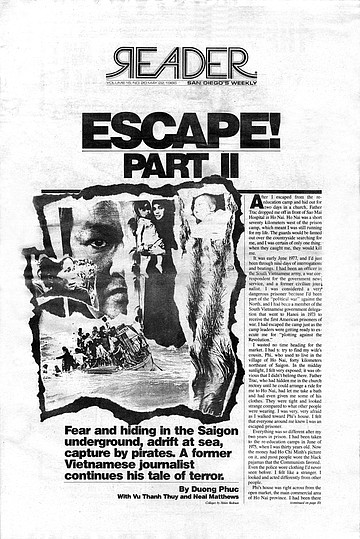 The pirates laid the old man on the ground and proceeded to work on the teeth with a hammer. When that method proved ineffective, they began prying at his mouth with a screwdriver. Finally they found a large pair of pliers and wrenched the teeth out.
Everything was so different after my two years in prison. I had been taken to the re-education camp in June of 1975, when I was 30 years old. Now the money had Ho Chi Minh’s picture on it, and most people wore the black pajamas that the Communists favored. Even the police wore clothing I’d never seen before. I felt like a stranger. I looked and acted differently from other people.
Phi’s house was right across from the open market, the main commercial area of Ho Nai province. I had been there once, and I still remembered where Phi lived. The house was built in two parts divided by a large cemented yard. The back part was the family living quarters. The front part was Phi’s grocery store.
When I entered the store, I saw that nothing had changed – except for the addition of a big red Communist flag over the door and a large picture of Ho Chi Minh on the wall. Phi was standing behind the counter, talking to a customer. She stopped talking when she saw me, her eyes widening with astonishment. She glanced at the door, then said something in a low voice to the customer. When the person was gone, I approached her and said, “Sister Phi, how are you?”
She tapped her head in a gesture of confusion and did not answer. Instead she asked me, “And you? How are you?”
Our formal conversation sounded lost in this embarrassing situation. I thought I should be direct. I told her briefly about my escape. My wife, Thuy, had come to visit me at the camp on May 19, but we had had only a few minutes together in a ditch beside the field of elephant grass where I was working. A camp guard caught us, but Thuy managed to get away. She had told me she would be returning later that night. The bag of food Thuy brought me was thoroughly searched by the guards, and when they inspected a pack of cigarettes she gave me, they found a note from her. The note told me to get ready to escape, because she had paid for a seat for herself, our daughter An, and me on a boat that would be secretly leaving southern Vietnam very soon. When the guards read that, they became furious. They locked me up in a small box for nine days and beat me during intense interrogations every day, trying to learn about my escape plans (I had none), and who was involved in organizing the escape boat (I did not know). They even told me that Thuy had been arrested, but I thought this was just a ploy to make me talk. I was sure that as soon as they finished interrogating me, they would kill me. That’s why I had found a way to escape the camp. Now, just three days after I’d broken the wire lock on my cage and run away under the cover of darkness, I was headed to Saigon, where Thuy lived.
I told Phi, “I need a hiding place here, in Ho Nai, before I can find a way to Saigon. Could you help me?”
She did not answer but took me through the back to her house. She served me some food at the kitchen table. “I don’t mind risking myself to help you,” she said, “but I am not sure I could convince my family to take the risk.”
I told her I had to leave this area because it was too close to the re-education camp. I knew they’d still be searching for me. My only plan was to get to Thuy in Saigon. Phi thought I should just get on a bus to Saigon, but I was afraid to do that. I had no identification papers, which everyone was required to carry at all times, and the bus would go through many checkpoints. I then remembered that Thuy had an aunt whose family had moved to this area after the fall of Saigon. Her husband used to be the chief of the department of social services in another city. They moved here pretending to be farmers so that he could avoid being sent to the re-education camps. They now farmed rice, and Phi knew where they lived. We decided that I should go there until I could find a safe way to reach my wife in Saigon.
Phi took me to the farm, which was about an hour’s walk outside of Ho Nai. Thuy’s uncle Trac and her aunt Chi lived there with their three children. I asked them please to let me stay, because I had nowhere else to go. I told them that if I were captured, I would be executed.
Aunt Chi looked stricken, but Uncle Trac seemed calm. “You can stay here,” he said. “But understand that we are all in a dangerous situation. You must be ready, at any time, to get away from this house whenever someone comes. I will show you where to hide then.”
They lived in a very small bamboo house, with a palm frond roof. Inside there was only enough room his would allow me to get away through the back door.
Uncle Trac led me to the back of the house, through the rice field and a stand of elephant grass, and then down into a wooded valley. He told me to run and hide here immediately if I saw someone coming toward the house and to wait for him.
During my two-month stay at Uncle Trac’s, I worked in the rice fields, just like a farmer. It was very pretty in the spring and summer, a dry rice farm of bright green nestled on the plains. I tried to help with the work, but I wasn’t a very good farmer.
About a week after I arrived, Trac’s daughter went to Saigon to try to contact Thuy. She located Thuy’s best friend, Binh Minh, who, like Thuy, was part of a support group made up of the wives of men who were in prison. The Communists jailed fewer women than men, mostly those who had been in the South Vietnamese military. There were support groups like this all over the country, and the women would help each other keep track of their husbands as they were moved from one prison to another.
Binh Minh informed Trac’s daughter that Thuy had been arrested when she came back to see me a second time at the re-education camp, not knowing that I had been locked up because of her note.
This news hit me like a hammer to the head. The cadre who was interrogating and beating me in the prison camp had told me Thuy had been arrested, but I had hoped he was lying. They had caught her because they thought she was trying to help me escape. Now she was being held by the police in Long Giao, 110 kilometers northeast of Saigon where, I imagined, she was being harshly interrogated. My first impulse was to go on a suicide mission to rescue her. But how would I get identification papers, and how would I get a weapon?
I did not know what to do, but my mind and heart ached to do something. I thought about going to Saigon to contact old friends, especially the old soldiers still at large; then perhaps there could be some way of rescuing Thuy. I dared not discuss that idea with Uncle Trac and Aunt Chi, for fear they would stop me. I only told them I would like to go to Saigon just for one day to see what it was like.
Uncle Trac quietly looked at me for a moment. He seemed suspicious of my intentions and showed understanding in his look. He spoke gently, “I suggest that you come to the church and pray. May God tell you the right course of action.”
Early the next morning, I went with Uncle Trac’s family to the church. It was a long way across many rice fields. The rising sun illuminated the fields in a pink mist, and the distant peal of the church bell made me a little less nervous as we walked.
The church was small and crowded. It was in a small Catholic village and everybody knew each other, saying hello, and shaking hands. I was a stranger there, but instead of making me feel safely anonymous, it only made me more afraid of being recognized. This was the first time I had appeared in a crowd in public. I felt as if someone were watching me from behind and that the police were ready to pounce on me and take me at gunpoint to hell.
I went straight down to the very end of the last pew and sat with my back to the wall. This fear of being watched from behind was to haunt me for all the time I was part of the underground in Vietnam. Wherever I was, I always tried to get beside a wall to cut off at least one angle of attack. Many years after, even now, this strange haunted feeling of being watched is still with me and has become a part of my character.
At the Mass, where I first experienced that feeling, I felt a contradictory mix of sweetness and pain, for there was a wonderful sensation of freedom in being able to say Mass after two years in prison. My ears heard the prayers, but my mind was with Thuy, who was in jail and probably being mistreated. I stayed on my knees praying for her, asking God for a clear mind to make the right decision. I knelt with my head down, my eyes closed, and my face in my palms, submerged in my thinking until I realized that my palms were full of tears.
After the Mass, I went right home without waiting for Uncle Trac’s family. I got a hoe and walked straight into the rice field and started working furiously. I understood now that I should not make any decision yet regarding Thuy’s predicament.
Binh Minh came out to the farm from Saigon a few days later. The only thing I could do was ask her to go to Long Giao and try to contact Thuy, bring her some food, and tell her where I was. She did make the effort, but she was unable to see Thuy. Binh Minh was such a true friend. She’d been a journalist too, as had Thuy, and throughout our ordeal, she helped with organization and as a go-between. She later died of hunger and thirst on the sea when she tried to escape Vietnam in 1978.
I was living from day to day, just waiting. I was confused, frightened, depressed, and I had no plan. Binh Minh visited me many times and she didn’t know what to do, either. I had to wait for a miracle.
One day in July, I was on the roof of the hut, repairing a hole in the palm fronds, when I saw a woman across the rice fields. It was Thuy! My heart suddenly felt like a sharp needle was jabbing though it. A sensation of hot and cold ran up and down my spine, but at the same time, I felt strangely numbed, emotionally and physically. I feared that she was an illusion.
Thuy hurried along the trail, wearing a peasant hat and the brown outfit worn by women farmers. I jumped from the roof of the hut and lost my footing, falling down onto the ground. I ignored the hurt and ran to Thuy. When I approached her, I saw that she was very thin and pale. My heart lit up, I started to pant, and I felt a deep mixture of painful affection and joy.
Thuy felt the same way, standing quietly and staring at me. We looked at each other’s eyes, each other’s face, and on down to each other’s feet, not saying a single word, not even hello. When I opened my arms to reach for Thuy’s shoulders, I saw Binh Minh behind her, holding my two-year old daughter, hurrying toward us and motioning for us to get inside the house.
Thuy stayed overnight. We stayed up talking and never went to sleep. I told her all about my escape from the re-education camp and asked what had happened to her. “I got caught that afternoon when I came back to see you again,” she said. “They set up a trap with about 20 soldiers along the trail to your camp. I’d felt something was wrong, but it was too late to go back.”
Her eyes filled with rage and her lips started trembling. “After searching me and confiscating everything I had, they drove me the 20 kilometers to the police station, because I was a civilian. I asked them to send a note to a friend asking her to pick up little An from the babysitter and take care of her, but they said that with parents like us, An would be better off in an orphanage. They also told me that you and I would never see each other again.”
Thuy was jailed for two months in the Xuan Loc police station, 90 kilometers northeast of Saigon. Every day she had either to be interrogated about the plan to help me escape or she had to do hard labor in the fields. They accused her of working for the CIA against the Revolution in attempting to liberate the prisoners in the camp. Thuy kept denying all the accusations. Her story was that she was so lonely, so desperate, that she attempted a suicide mission in order for us to be together. After two months of interrogation, they told her that she would be transferred to a long-term jail by the following week.
A few days later they called her in again and informed her I had escaped. “At first, I did not believe them,” she told me. “I thought that you had been executed. Then they said they would release me if I signed papers confirming that I would turn you in whenever I saw you. I signed all the probation papers, and I’ll have to check in with the police and divulge my activities every week. It was my only hope to be free and see little An again.
“I took buses to Saigon. I thought they would try and follow me in order to find you, so I changed buses along the way. Instead of going straight home and reporting to the local police as required for the intense probation I was on, I went to Binh Minh’s workplace, an embroidery shop. She was so shocked to see me. ‘Oh God, did you escape?’ she asked. I learned from her that you were safe, and I asked her to help me see you and An. She had me wait in a coffee shop while she picked up An from another friend. Since then, wherever she goes, she too has to make sure that no one is following her.”
Thuy asked me not to tell An that I was her father. She said this was necessary because the police always went after the children to find out information about their parents. An had been two months old when I was sent to prison, now she was two and a half years old. She called me uncle. It was very hard sometimes, not being able to act like her father. I had to lie to her. But it was safer that way.
We decided that I should go to Saigon and hide out until arrangements could be made for us to leave the country by boat. Thuy went back to Saigon the next day to make contact with a Catholic priest that she knew. He had connections with a secret organization that produced fake identification papers. In Vietnam, everyone has to carry a small ID card, and the police can demand to see it any time. Without ID, I could not return to Saigon. It took a few weeks, but Thuy finally succeeded. She had to pay about 300 Vietnamese piasters – equal to a year’s salary for the average government worker – to get me a voter’s identification card and a permit for moving between towns. This permit was required even to go 15 miles to a neighboring city. By strict agreement between the organization and the priest, Thuy never knew anything about the organization. During my two years hiding out in Saigon, she had to go to the priest many times, because the government changed the ID forms regularly.
My new name was Le Van Bao. I adopted a disguise by wearing fake glasses with powerless lenses and by changing my hairstyle. I didn’t want anyone to recognize me in Saigon, but this would be difficult, since I had appeared on television as a reporter, and a lot of people knew my face.
My farewell to Trac and Chi was very sad. Aunt Chi gave me ten ears of boiled corn, stuffed in a plastic bag. She was moved to tears when she told me to be careful living in Saigon. Uncle Trac tried to be calm. I knew he was a strong man and did not want to show his emotions. When I tried to find the words to show them my gratitude, Uncle Trac cut me off. “Do not thank us,” he said. “Just remember that no human can avoid God’s will, no matter how strong and skilled he is. Keep praying and listen to God.”
I tried to swallow my emotion, lowered my head to show respect for them, and got stuck in my words. They had let me stay with them, regardless of the danger to themselves. They offered their farm as a sanctuary if I needed a place to hide out again. Even though I had papers now, they knew I’d have to deal with a lot of trouble in Saigon.
City of Red Flags and Black Pajamas
Entering my hometown of Saigon for the first time after my escape from prison, I felt very afraid of being arrested on sight, regardless of my ID papers. Besides this fear, I felt a painful bitterness in seeing that my beloved Saigon had changed so much. It had become a city with more red flags and propaganda banners than businesses.
From Ho Nai, Binh Minh took me on a small Honda motorcycle through downtown Saigon straight to a hiding place in Cholon, Saigon’s Chinatown. I lived in a tiny room in the attic of a very small wooden house. The room was narrow, dark, and very hot, with only enough space for a reed mat laid on the floor. The one tiny window was kept closed most of the time. I dared to open it only late at night for some fresh air, after turning off the light. For months I did not see the sunlight. My meals were brought up to me by the lady owner of the house, who was a friend of Thuy’s mother.
I stayed in a series of such hideaways as Thuy and I attempted to escape Vietnam. It was a terrible time. I was afraid to go out, even though I had papers.
Thuy lived in the same house where she and I lived as husband and wife before I was jailed in the re-education camp. Being on probation, she had to check in with the police every week and turn in her daily activities log for inspection.
I had to change hideaways often because the police conducted irregular house-to-house searches. Everywhere in the country, they did this. For no particular reason, they would search a certain neighborhood this week and another neighborhood the next week, so I had to keep moving. But there was one time, in the evening, when they suddenly searched the area in which I was hiding. I had to get away and was unable to contact Thuy’s friends for another place. I had to wander the streets with nowhere to go. Late at night I went into a churchyard and ducked under the stairs to wait out the night. I stayed on the flooded floor, wet, frightened, and desperately waiting for the day.
In the morning I stayed through all the Masses then went to a movie to get some sleep in the darkness before going to the next scheduled hiding place for the night.
Since the police were keeping a close watch on Thuy, she asked Binh Minh or Tuong Vi to arrange new places for me. Tuong Vi was another friend in Thuy’s support group. She had been a journalist, too, and later on, after Binh Minh died on the sea, she became the one who did most of the hard work leading to our survival.
I saw Thuy often, but always through Binh Minh or Tuong Vi. Every time we wanted to see each other, we had to inform them, and they arranged it. Thuy couldn’t come to my place, and I couldn’t go to her house, so sometimes we met at a movie, in the darkness of the theater, sometimes at the river. One time I was almost caught in a small coffee shop beside the Saigon River. It was the first time I was confronted by the police and had my ID checked. I had rendezvoused with several friends to discuss an escape by boat from Vietnam. Thuy had ten thin gold leaves with her to give to the organizer, through Tuong Vi. The meeting included Binh Minh, Vi, Bao Hoang, and Duyen of our support group.
The police suddenly broke into the café, blocked all the exits, and began checking everyone’s IDs and searching their bodies. To be caught with gold or U.S. dollars was a grave crime under Communist law. Our table was on the balcony above the river, so Thuy quickly pushed the bag of gold leaves through a hole in the wooden floor. They fell into the water below. I was frightened but had nowhere to run, so I withstood the search. They kept us, along with other customers, locked in the café for an hour while they gave us a lecture on “revolutionary morals” before letting us go. At the time, the Communists were pressing a campaign for “erasing imperialist and American culture” by confiscating and burning all books and musical cassettes published under the former government of South Vietnam. The Communists did not allow couples, even spouses, to display loving acts in public, even hand-holding or sitting too close together. They called these acts violations of tradition and revolutionary morals. I was lucky that day to be not with just one woman, but many. That’s why they let us go and kept other couples.
Late that day we came back to the café and waded into the shallow water beneath the balcony and searched for hours before we found Thuy’s bag of gold.
After about a year with the different false ID cards, I felt more confidence. At first, I had thought that the Communists were very organized, following me, following Thuy, and they could find out a lot of information about us. But after a year, I reevaluated their system. The police were very inefficient and relied almost entirely on informants, and many of the officers were corrupt and just wanted to make money. So Thuy and I started meeting more often, and then we moved in together.
This was in the house of my elder brother. Our parents had died when we were very young. My brother was a judge in the former regime and as a result was now in jail. We lived with my sister-in-law and her four children. One of the children, Duong Hoa, later escaped Vietnam with us. His mother asked me to take him out of the country before he got drafted into the Communist army so he would have a better future. It was common for families in Vietnam to arrange for their young sons to escape by boat. Often there wasn’t enough money for the whole family to buy passage, and besides, the wife usually had to wait behind for her jailed husband to be released.
As far as the police knew, Thuy was still living at her house, but she and I and An were actually living together just like a family. That’s why we had a second daughter with us when we escaped Vietnam.
All this time, we were attempting to get on a boat to flee our country. We made many trips from Saigon to Vang Tau and other cities at the mouth of the Mekong Delta, and although we were prepared to escape on twenty different occasions, we actually got onto a boat only two times. We said goodbye to our relatives and friends so many times and had so many farewell dinners, it almost became embarrassing. Finally, we stopped saying goodbye and just left.
Before each trip, we had to pay about ten gold leaves to the organizers, and after each trip fell apart, it took a long time to reorganize another one. Since the fall of Saigon in April of 1975, we had no income at all. Thuy could not find any job because of her background as a reporter for the Voice of Freedom, a U.S. funded radio station. She had to sell all of her jewelry and our possessions before she started getting support from her parents, who had left Vietnam just after the fall and who now lived in Texas. Like many refugees, they were sending money to someone in France, who would have the money converted into gold. In Saigon, a person whom Thuy didn’t know would bring her gold leaves that weighed about one and a half ounces. Each of these leaves was worth about $400.
This gold was already in Vietnam. The people who were wealthy before 1975, especially the businessmen, always kept their wealth in the form of diamonds or gold leaves hidden somewhere at home. After the fall, they became desperate to transfer their wealth overseas. They knew that the secret organizations that arranged the escape boats would only accept gold in payment for passage, so these rich Vietnamese businessmen set up a system to sell their gold to the boat people. The wealthy people had relatives in France or other countries who were the go-betweens. Thuy’s parents, as well as the relatives of other Vietnamese wishing to buy passage on the boats, would give American dollars to the relatives of these businessmen. Those relatives would then send a coded message by telegram to the owners of the gold in Vietnam, authorizing the payment in gold to Thuy or other people. Of course, the payment in gold was always at a somewhat lower value than the dollars received. This way of transferring wealth between people and between countries was based totally on trust and it seldom failed, since it worked to everyone’s mutual benefit.
We lost a lot of money on our first few escape attempts, but not later, because I wouldn’t allow it. Unlike the other boat people, I had to leave the country or I’d be shot as an escaped prisoner. I fired a gun once to scare a person into believing I was serious about getting our gold back. I had no choice. It was the first and last time I fired a gun during our ordeal. It had been lent to me by an old soldier friend who had escaped the re-education camps. I didn’t want to use guns to threaten people, but if I lost gold, I had no way to leave the country. The man gave me back my gold the next day.
The escape attempts were all the same. We had to trust whoever we were dealing with because we had no choice. There was a meeting two or three days ahead of time at one of the organizers’ houses in Saigon, where we would receive instructions on taking the bus to Vung Tu, finding the safe house we were assigned to, and waiting there until dark. All the boat people were divided into family groups and were transported through the delta by small boats to the larger boat offshore.
A guide would take us through the river channels. During the risky trip through the delta, the strict rule was to lie as low as possible on the floor of the small boat, as the boat did not have any cabin or cover. Lying flat, we watched the black sky lighted only by the stars. The night chosen for the departure was always the darkest night of the month, without moonlight.
Although we could not see anything, we understood that we were in an extremely dangerous situation. Silence was the greatest requirement on the boat. Small children were usually given light tranquilizers so they would sleep through the night. The overloaded boat usually swayed on the river. When it ran fast, waves of water poured inside. We often choked on the water, trembling in the cold and wet.
The engine was sometimes suddenly turned off, and a frightening silence took over. The boat handler would paddle the boat into the dense brush along the shore or under thick trees. Without seeing what was happening, we all understood that there must be Communist patrol boats somewhere in the area and the escape boat had to wait until the way was cleared. It took several hours to make our way out to the big boat offshore. We climbed aboard the big boat only twice, because the Communist patrol boats were good at catching the small boats in the delta. When that happened, a signal would alert all of the other small boats, and we would have to turn back. Many people stopped trying to leave after four or five aborted trips. After our tenth failure, we too thought of giving up, but I knew that only bullets awaited me if I didn’t leave.
I was the one who had to throw him over the side.
In February of 1979, we made it all the way out to a big boat. Thuy, our daughter An, my nephew, and I climbed aboard, but 35 people crammed onto a fishing boat makes it seem anything but big. It was fourteen meters long and two meters wide and was so crowded we couldn’t move. We were caught up in a storm almost immediately, and two days after we set out, the engine broke down. The person who was supposed to be a mechanic turned out to know almost nothing about engines. He had lied about being a mechanic because he had no money to buy a seat on the boat and mechanics could ride for free. We drifted aimlessly for 15 days.
Thuy was six months pregnant at the time. The storm had broken the boat’s water container, so we had no fresh water. The dried food we brought along was useless. We assumed that we would all die. Thuy just lay there and couldn’t move. I felt that I was the strongest man on the boat, so I had to do something. I rigged up a pot with a pipe in it and boiled seawater. The steam condensed in the pipe, and enough water dripped out for everyone to have about a pint a day. But it only worked for a couple of days because we ran out of things to burn to keep the fire going. Our clothing had provided fuel for the fire, and that was all soon gone.
We saw 22 ships of various nationalities, and we signaled them, but none stopped to help us. We felt hopeless. In that situation, you only help your own family. I had my pregnant wife, my four-year-old daughter and my nephew to worry about. On the fifteenth day, a 25-year old man died of thirst. He was the brother of someone I knew, and he sat next to me on the boat. So, I was the one who had to throw him over the side. Most of the other people were too close to death to even notice. The two crewmen and I said a prayer for him, then I dropped him over. After that, everyone just wanted to die.
That same afternoon, we were arrested by the Vietnamese Coast Guard. We had been pushed by the wind and current back toward Vietnam. When we saw them coming, Thuy, An, and my nephew were lying on the cabin, exhausted by thirst, hunger, and the ocean. I crawled to them, held them all in my arms, and said, “We are going to land. There will be water and food. You must not worry about being arrested.” Logically, I should have realized that I was being brought back to a firing squad, but at that moment, I had no thought of the danger of being recaptured. I only felt relieved that my wife and my daughter and I weren’t going to die on the sea.
Some of the Coast Guard crewmen laughed at us. They told us we were lucky to be captured and that they had caught a lot of people like us. They towed us back to the coast to a fishing village called Vinh Chau, in Bac Lieu province. The men were forced to pull the boat ashore at a Buddhist temple. I’ve wondered how we could be strong enough after our ordeal to help unload all the exhausted women and children, but we had no choice. The soldiers had guns, and they forced us.
They searched us and confiscated our valuables, gold and diamonds, and our papers. They took everything, including my wedding ring. We had to fill out some forms with our names and addresses (Thuy used her real name, but I used my fake one), and by the time we were finished, it was dark. They’d given us some water so that we would be strong enough to walk to the police station, where we would be held for what we thought would be a long time.
It was so dark you could hardly see the person walking beside you. We walked on narrow paths between the rice fields, and those unable to walk rode on a wagon pulled by a cow. I quietly slipped up onto the wagon and kept myself flat on the floor to talk to Thuy.
“You must run away before we arrive at the jail,” she whispered. “They’ll find out you are an escaped prisoner, and then they will kill you.”
“I can’t leave you,” I pleaded. Before I could protest further, she gripped my hand firmly and forced me to go, saying, “If you stay, they will kill you, and then we will all die. You’re our only hope for living.”
I felt guilty, leaving behind my pregnant wife and my daughter and my nephew. They needed my help. I didn’t want to leave, but she convinced me. She gave me her wedding ring, which she had hidden from the soldiers, to use as money if I needed it.
When the wagon stopped in front of the house the police used, the guard got down to open the gate. At that time, I touched Thuy’s hand goodbye, slipped off the wagon and ducked behind a bush. I knew this was risky and there were guards behind me, but I gambled that they wouldn’t be able to see me in the dark. When everyone had been taken through the gate, I got up and started walking toward a light on the road to the village. I had no plan at all. I had never been in this area before and had no idea where to go. Plus, after 15 days on the sea, I felt very unbalanced on the land and exhausted from hunger. I could barely walk, much less run. I made it to a market, which was empty, and I couldn’t stand up anymore, so I lay down and fell into a fitful sleep.
Suddenly I was jerked to my feet by someone pulling on my arms. It was the policeman in charge of the market area, and he recognized right away that I was an escaped boat person. I don’t know how long I was asleep, but it was still dark. The policeman knew I was supposed to be at the police station, and I thought it was all over now, but I was lucky. He wanted money. I was also lucky to have the ring Thuy had given me. I gave it to him. Then he showed me the way to the bus station. I realized that he wanted to get me out of town before I got caught again, because I might tell on him. He had to help me escape now. He walked with me to the bus station, and he even gave me ten piasters for bus fare. He wanted me to leave his town as soon as possible. “If you are arrested, you must not say that you saw me,” he commanded. “Understand? That’s for your own good.”
I was very scared waiting for the bus. I had no shoes, and I was wearing one of Thuy’s blouses because we had burned my shirt on the boat. My skin was charred from the sun, my hair was a mess, I was unshaven. I tried to hide myself by sitting in the back of the station, but people still stared at me.
The bus went to Can Tho, a city close to Saigon, where I had some friends. The wife of a reporter friend who was then in prison helped me with money and clothes. I took a bath, went to a barber shop, and then made my way to my brother’s house in Saigon.
Thuy, An, and my nephew were held by the police for two months. Thuy was eight months pregnant at the time, and she did not admit anything about her background or her probation. The local police couldn’t check on her because the communications system was very bad after 1975, and Vinh Chau was 500 kilometers from Saigon. She wasn’t about to help them by confessing to who she was and who she was married to. The jail became overcrowded with more and more prisoners who had tried to leave Vietnam, so they let the women and children go.
We waited for four months after Thuy gave birth to our second daughter, and then on October 19, 1979, we joined 77 other people on a tiny boat off Ving Tau. Though we eventually succeeded in escaping Vietnam, I sometimes wonder if, had we known what awaited us on the water, we would have still undertaken the journey.
We were headed southwest toward Malaysia, but the engine quit after two days at sea, and we drifted for eight days. Sixteen merchant ships passed us by in that period without stopping to help us. On the tenth day, we were attacked by the first of three pirate boats. They were fishermen from Thailand, and we knew right away from their guns and their faces that they didn’t intend to help us either. They jumped down into our boat and beat the man who was in charge, then took everyone’s jewelry and money. Watches, rings, everything. Gold leaves were hard to carry and conceal, so many boat people had them made into rings. Thuy had one gold leaf and many rings, which the pirates stole. I lost my wristwatch.
The second group of pirates showed up that same afternoon. They became angry when they saw that there was nothing left to rob from us. They tried to kill us all by ramming their much larger boat into ours, but they only succeeded in destroying the cabin before a third pirate boat came and stopped them. The two pirate crews conferred with each other and then tied a rope to our boat and towed it to tiny Ko Kra Island, off the coast of Thailand in the Gulf of Siam.
For 21 days, hundreds of pirates took turns landing on the island to torture the men and rape the women. In all, the boat people eventually numbered 157 persons, after three more boats were towed in by the pirates. It was a living nightmare, something I could not have believed if I hadn’t experienced myself.
It was late at night when we got to the island. On the way, we had talked about our plight, and we realized that the women were the main targets. We numbered 50 men, 20 women, and 11 children. The women became very frightened. We knew we had to do something to protect them, but we were very confused and didn’t want to do anything that would make the pirates angry.
We planned to find a way to hide the women when we got to wherever they were taking us. The children would be taken care of by the men. We tried to assure the women not to worry about the children. I told Thuy, “This time it’s your turn to run away. You must find a safe place to hide. I’ll protect you at any price. Don’t worry about the kids, I’ll take care of them. Just worry about yourself.”
The pirates pulled us up onto a beach orfcoral rubble and moved us into a large cave, where they searched everyone thoroughly for valuables. Then they left, after giving us water and fish that they had cooked on their boat. I had no idea what was going on. We were just alive and on land, that’s all I knew.
The next morning, about 40 pirates came in a group, and they laughed and joked about us, but nobody understood what they were saying. They drank a kind of wine and smoked opium in pipes. That first day, they didn’t rape anybody. But that night they came back with guns. They shot into the air several times and were very belligerent. As soon as we saw them coming, Thuy jumped into a hole in a rock, and I sat on top to help hide her. She was one of only three women to escape the whole ordeal.
The pirates separated all the men from the women, husbands from wives, brothers from sisters, and then each pirate took the woman he wanted. They went off into the rocks, some very close by, and we could hear the women screaming and crying. Some of the girls were only twelve years old. The men could do nothing. It was at once both sad and terrifying.
The three other groups of boat people who arrived in the coming days met similar fates. There were twenty-one people in the second group, sixteen men, four women and one child. This group had been attacked by pirates ten times already. One young man had been thrown overboard and drowned while the pirates searched the ship. The four women were raped as soon as they landed on the island. The third group of boat people consisted of twenty-four men, eight women and five children. The fourth and last group originally numbered thirty-four people, but only eighteen survived to reach the island; fourteen men, three women and one child.
The pirates moved us all to the other side of the island on the third day, where there was jungle and grass. I guess they wanted a more comfortable place to enjoy the women. It was very pretty and peaceful, which only made the episode that much more horrible. As soon as we got there, almost all of the women tried to find a place to hide. I helped Thuy and two other women find a place in the brush, but when the pirates set fire to the bushes, trying to flush the women out, the four of us fled to the highest part of the island. The women pressed themselves into the rocks at a place where they could look down at whoever was approaching. At night they were drenched by rain and dew and held on to each other, shivering to try to keep warm. They hid in the most dangerous possible place, so that the pirates would never believe that women could make it up there. If the women had been found there, they decided there were two means of averting further shame: if only one pirate came, they planned to combine their strength and try to push him off the cliff; if more than one came, the women needed to take only one step and would tumble down the cliff onto the jagged rocks below. The second method was the more likely to be used, since the pirates rarely went hunting alone.
I cared for my two daughters, aged four months and four years, and for my nephew. I brought food and water up to Thuy and the two women as often as I could. There were many days that I could not bring then anything due to the intense scrutiny of the pirates. Thuy and the other two women had to endure thirst and hunger until I could sneak away and be sure I wasn’t followed. Meanwhile, the pirates rampaged in subhuman glee.
There was the girl, P., twelve years old, who hid in a crevice in the side of the wooded mountain. She was terrified of the rats, the snails, and the centipedes, and even of the ghosts she thought she saw. After fifteen days alone, she couldn’t contain herself any longer and left her hiding place, only to be raped on the spot by four pirates.
There was the woman, B., 22 years old, who smeared feces over her body in hopes of preserving her virginity. She stank so badly she herself vomited, but the pirates still took and raped her, beating her cruelly because of the smell.
There was T., 19, who had been on a boat with 34 people who were thrown into the sea by the pirates. Sixteen of them drowned. T swam for hours before she reached the island. Just as she climbed onto shore, nearly collapsing from exhaustion, she found the pirates waiting. They rushed up to her and raped her, despite pleas that brought tears to the eyes of those around her.
The men were mostly helpless before the pirates’ wrath. Tran Minh Duc was beaten and hanged nearly till death when he refused to take the pirates to where the women were hiding. Pretending to be ignorant of the women’s whereabouts, he had led the pirates around in circles in the jungle so that they found no one.
One gang was called the “red-boat-pirates” because of the crimson color of their boat. There were 28 of them, the cruelest, most viscous, and largest of the pirates being twice as big as the average Vietnamese man. They brought terror everywhere they appeared, raping by day, ready to kill anyone they didn’t like the looks of, and taking anything they could find. They weren’t simply interested in valuables. They took anything, including clothing and ordinary articles. Anything they couldn’t take with them they destroyed.
One man, L., had three gold teeth broken out of his mouth by this gang. He was forced to open his mouth and show his teeth even as he wept and explained how the teeth were bad and the gold was only an outer layer and that consequently the teeth were of no real value. The pirates would not listen but laid him on the ground and proceeded to work on the teeth with a hammer. When that method proved ineffective, they began prying at his mouth with a screwdriver. Finally they found a large pair of pliers and wrenched the teeth out. L. held his mouth and screamed as blood spilled for an entire day. The pirates picked up the bloody gold teeth, dropped them in their bag and, screeching with laughter, took L.’s 15-year-old daughter and raped her.
We felt so completely alone and utterly separated from the world. As far as we knew, no one who could help us even knew the island existed. The pirates continued to give us fish and rice, just to keep us alive for their pleasures.
Unbeknownst to us, after almost three weeks of living hell, an oil company helicopter strayed over the island by accident and saw us. He contacted the United Nations High Commissioner for Refugees, and officer Theodore Schweitzer flew out in a helicopter from Songkhla refugee camp in southern Thailand. When he dropped food and medicine, we knew we were saved. He came out the next day in a police boat, and the pirates were so brazen and unafraid of the police that they stood and watched as we were loaded onto the police boat. But there were too many of us, so Schweitzer had to hire one of the pirate boats to take us all to the refugee camp in Thailand.
We stayed ten months in the refugee camp in Thailand. Thuy and I wrote an open letter describing the piracy and sent it to newspapers all over the world. Theodore Schweitzer and some U.S. embassy employees in Bangkok also helped distribute the letter, which helped bring international action against the pirates. The women victims of our group, with the support and protection of Schweitzer, filed charges against the pirates in Thai courts. When we left Thailand in September 1980, the defendants had not yet been sentenced.
We first arrived in Dallas, Texas, and lived with Thuy’s parents for eight months, then we moved to San Diego in May of 1981. San Diego was where Tuong Vi lived. She had escaped Vietnam six months before we had. She was one of our best friends, and she had been willing to share life and death through our most perilous times. Tuong Vi is now the godmother of our third daughter, the first American in the family, born last August. Her name is Binh Minh.
Finally we are able to live in a free land, after so many challenges that seemed impossible to meet. There are still a lot of struggles in starting a new life, but the price of freedom is never too high. We’d believed in destiny, and we’d believed in our faithful love. And God had protected us.
About Duong Phuc
Much more than distance and time separates Duong Phuc’s home in peaceful San Diego from his former home in South Vietnam. The cultural separation is of glacial proportions, and 41-year-old Phuc, like many of his fellow refugees, has only survived rather than thrived after being severed from his roots. But to the Vietnamese boat people, survival is the ultimate triumph.
When Phuc and his family finally stepped onto American soil in September of 1980, they entered a new life of contradictory realities. “In this country, I got very strange feelings,” Phuc recalls. “I thought, finally, I’m here in the land I had almost died trying to get to, after many years of jail, hiding, dealing with the sea, and with the pirates. But I felt just like a stranger here. I had to adapt to life here because I was not allowed to live like a human being in my country. We had paid such a high price for our freedom. But we are free in a country that does not belong to us, and we continue to dream about someday returning home.”
Although Phuc and his fellow refugees still feel fundamentally connected to Vietnam, they have begun to create a hybrid culture in this country. Their children are more American than Vietnamese in attitude and outlook, regardless of how hard their parents try to instill in them the old ways. The adults tell and re-tell the story of their experiences in crossing the seas to freedom, and these stories have become the Flood myths of an ascendant culture.
The children of the refugees are once removed from these legends, but for Phuc and his wife Thuy, coming of age during the Vietnam War and living through the most harrowing escape from a land that was no longer theirs are still very much in the realm of painful reality. They had met as journalists covering the war in the battlefields. They lost friends and family to death and separation, and now they live with a kind of permanent gnawing. Although they have been able to provide reasonably well for themselves – Thuy works as a news assistant at the San Diego Union, and Phuc has held a series of social-service jobs – their real work has been directed toward helping to rescue some of the 10,000 boat people who continue to leave Vietnam every year.
Their years of effort in that endeavor are culminating this month in Phuc’s trip to Singapore, where he will meet up with the Cap Anamur II, a transport ship that has been plying the Gulf of Siam in search of boat people. A group of French physicians, Medecins Du Monde, and a West German humanitarian organization, Cap Anamur, began operating the ship in April of 1985. The San Diego-based Boat People S.O.S. Committee, which Phuc and Thuy became actively involved in shortly after their arrival in the U.S., has provided financial assistance for the rescue efforts. Hundreds of refugees have been rescued and resettled in the United States and Europe. But, Phuc asks, “Why should only the French and Germans do the job? We Vietnamese should be doing it ourselves. At least, we should be contributing more than money.”
Phuc will be the first Vietnamese boat person to return to the scene of his ordeal to try to help his countrymen. He was chosen for several reasons: his active role in Boat People S.O.S. Committee, which is providing financial support for the six-week trip; his experience, as a boat person, which may come into play when helping other boat people; and his skills as a journalist. A cameraman will also be on board, and together they will be producing written and taped reports on the rescue activities. “Thuy convinced me that this trip will be a real opportunity to help the boat people,” Phuc explains.”After what happened to us, I always wanted to go back to sea. I had been ignored and abandoned in desperate conditions at sea by 36 different ships. Now I want to be on the rescue ship. It is very meaningful to me and to all of us who survived.”
Read part two of this story
Originally published May 15 and 22, 1986
Here's something you might be interested in.
An escape from Vietnamese re-education camp to San Dego
Beat with electrical wire after eight nights in the cage

An escape from Vietnamese re-education camp to San Dego
Beat with electrical wire after eight nights in the cage
One cigarette in particular she pulled out, saying very quickly, “There’s an important letter in this one. Be careful!”
The Reader has started this series of its best stories from the past 52 years — 2600 cover stories and some remarkable interior features — to help make up for the loss of its physical edition, which was once large enough to hold whole oceans of print. These stories will feature all the original illustrations and photos (plus easy-to-read typography), and will include new background information about the authors — some of it taken from personal correspondences.
^^^^^^^^^^^
I opened the door of my box and stepped outside. Lying close to the ground, I crawled for a short distance past the meeting rooms of the camp commander.I can still recall the date, May 19, 1977, because that was Ho Chi Minh’s birthday. The entire camp was taken out to the fields to clear away the elephant grass — to “compete with each other for Uncle Ho’s birthday.” The grass grew head-tall alongside the main road. As we dug up the ground with our picks, we could watch the villagers go by and see the Lambretta bus on its way from Long Khanh to Cam My and Cam Duong, south of Saigon.
I deliberately made my way to the grass right by the road where the bus passed because I knew this was the day that my wife, Thuy, was coming to see me. I had learned this the week before through a letter smuggled in a bag brought to me by friends who had come to visit the re-education camp. Campmates often used such opportunities as the working parties to meet secretly with their wives. While keeping a careful eye out for the guards, they might have a few minutes to talk with each other and pass along a little food
It was about noon then, and the sun was hot. A bus from Long Khanh stopped at the Cam Duong crossroads just in front of a small shop that sold drinks. Some of the passengers got off. Although they were a good distance away, I could make out Thuy in a brown shirt with a small basket in her hand. Even though I had known beforehand that she was coming, the feelings that rushed through me stopped me in my tracks and made me numb.
Thuy walked next to the trench dug beside the road during the war years. Her eyes searched the fields, and I knew she wouldn’t be able to pick me out from among the many men chopping grass there. I turned to look for the guards and saw one in a jungle helmet standing on a small mound overlooking the prisoners. With my pick trailing behind me, I crossed a little clearing and headed in Thuy’s direction, realizing I could not avoid notice by the guard on the hill.
When I reached a place near her, with only a short stretch of grass between us, she finally recognized me. She froze, and we simply stared at each other, too deeply touched to say or do anything, though it had been two years now that we had been separated.
A look of alarm came into her eyes. I turned around to see the guard coming down the hill. Tossing my pick aside, I ran up to Thuy, leaping into the trench below her. Thuy sat down on the edge of the highway. Her lips moved as she tried to speak. Once more she glanced fearfully up behind me.
“Here’s some food for you,” she said finally.
She pushed a burlap bag down into the trench. Then she took a package of Vam Co brand cigarettes from her pocket. One cigarette in particular she pulled out, saying very quickly, “There’s an important letter in this one. Be careful!”
I shoved the cigarettes into my pocket, asking, “How’s the girl?”
“Fine,” she nodded.
I reached up and touched her hand. “How about Mama? You okay? Try to keep going.”
“Don’t worry,” she smiled. “We’re all right. We have everything we need. My parents send us things from America. But you need to take care of yourself.”
Just then, there was a noise behind me. A friend from the labor unit whispered, “Quick! The guard!”
Thuy stood up. “I’ll come back,” she promised, moving hastily across the road back toward the crossing. I took the bag of food and was about to skip into the tall grass when I heard the guard shout.
“Get up! Give me that bag!” I stood up and carefully climbed out of the trench. The guard grabbed the bag, his eyes bulging. “Who gave you permission?”
Then he emptied out the bag before us. Two small cans and some plastic sacks with lump sugar, salt, and sesame seeds fell to the ground. Glancing around, I could see that all my friends had stopped working and were watching everything that happened. From far off, Cadre Binh, the commander of the camp guards, was running over. As soon as he reached me, he lashed out and slugged me in the face. I crumpled to the ground and received a hard kick in the ribs.
“Get up!” he barked. “Take off your clothes and empty your pockets!”
I struggled to my feet, pretending to be in great pain. As I slowly stood up, I tried to think of a way to get rid of the cigarette that Thuy had showed me. I took my time removing my shirt.
Cadre Binh turned to the guard, “See if there’s anything in the bag!” he ordered.
The guard opened the cans and dumped out their contents of dried meat, and he ripped open the bag of salt. While they were engaged in their search, I slipped the cigarette from my pocket and tossed it as far behind me as I could.
I removed my clothes and left them on the ground. Binh picked them up and checked them carefully along the hems and the pockets. He found the Vam Co cigarettes. Just then, I heard another guard call from behind me.
“Hey Binh! Look at this!”
The guard bent down to pick up the cigarette I had thrown away and which he had broken by stepping on. From inside the cigarette, he pulled out a thin piece of paper. Binh stomped over to him, snatched the paper from his hands, and read it. I grew anxious, thinking to myself, “What did Thuy write?”
Binh came back to me, his eyes wide in anger and amazement and his lips trembling furiously. Grabbing the gun from the guard, he pointed it in my chest, shouting, “You plot against the revolution?”
I thought fast. It would not have made sense for him to shoot me right then and there, so I set myself up in a defensive position.
Binh approached me and slammed the rifle butt in my face. I jerked out of the way, and it hit me on the shoulder, knocking me to the ground.
I heard Binh tell the others, “Tie him up and take him back to camp!”
One of the guards pulled me up by the hair, made me dress, then thrust my hands behind my back and tied them together with electrical wire. “Move!” he shouted.
He escorted me back to camp just as the gong sounded to mark the end of morning labor. The guard shoved me down beside the hog pen as he stepped into the barracks, which served as the camp director’s office. A moment later, Tuat, the squad’s political commissar, came out to me. He had beady eyes and a dark face, but this time it was pale with rage. Without saying a word, he untied the wire that bound my hands and handcuffed me to the hog pen, then he left.
My campmates were returning from their labor detail. I recognized my friends from the secret meeting we held daily: Ky, Nyhia, Nguyen, Ta Anh, and Luu Khoung were all looking at me fearfully. Ta paused by the barbed wire and made a meaningless gesture.
Long after lunchtime, I was still standing there hungry and in pain. Nobody came to bother me. Probably, they were working out the best way to deal with me. I tried to stay calm, closing my eyes and trying not to think, to prepare myself for what was to come.
Suddenly, I remembered that Thuy had promised to meet me later in the field. I felt a sharp pain in my stomach that spread to my whole body. A nausea gripped me from fear and anxiety. If Thuy came back, the cadres would surely catch her. I was not aware of what exactly she had written in her note, but apparently it had been serious or they would not have treated me as they did.
I was already considered a very dangerous prisoner. The Communists divided the prisoners into groups according to how dangerous to the revolution they were considered to be. I had been a journalist, both as a civilian for Saigon radio and as an army officer for the government. I was part of the “political war,” which included the propaganda machine that the North Vietnamese so hated. Therefore, I was considered most resistant to re-education and would inevitably be moved to a prison in the north for long-term detention.
As afternoon labor time approached, I saw Cadre Binh coming through the compound gate with Ta Anh following behind carrying a large backpack. I recognized my bag containing my blanket and personal items. Ta Anh used to sleep next to me, so it was likely that they had “volunteered” him to bring out my things for the search. They walked over in my direction.
“Lay out the blanket,” ordered Binh, “and spread everything out on it.”
Ta Anh pulled out each item and set everything out on the blanket. Among my belongings were pictures of my family and the letters Thuy had sent me over the past two years.
Binh went off some distance to talk with Commissar Tuat. Ta Anh continued his task of exposing my belongings. Without looking at me, he whispered, “Back at the field, Binh called the team together and read your wife’s note aloud. She told you to get ready to escape. She has made the connections with a boat that will be leaving next month. The false papers and a hiding place are ready for you in Saigon.”
He looked over at the two cadres who were still busy talking, then turned back to me. “It’s dangerous for you now. Try to get out. They’re going to give it to you like they did to Ngo Nghia.” I knew that Ngo Nghia had been a prisoner who was caught while trying to escape from another camp the year before. He was executed in front of all the prisoners at the camp as a warning to any others who might attempt an escape.
As he got up, I said quickly, “My wife told me she was coming back this afternoon. When you go out there, try to warn her to get away before they catch her.”
“It’ll be bad if she should come back,” Ta Anh mumbled in agreement. “I’ll do what I can. You must keep cool.” He turned back to the two cadres and showed them my belongings, then headed back to camp.
Binh and Tuat inspected each item on the blanket. When they were finished, they took the pictures and letters and returned to their office.
They left me standing beside the hog pen until evening. When the afternoon labor time was over, Tuat came and unlocked my handcuffs, then took me to the office. The camp leader was already there. On the desk in front of him was my file from the time I first entered the camp, in June of 1975.
The camp leader questioned me about my past history. I repeated the same story I did every time I’d been interrogated: I was a journalist, then a lieutenant in the army who worked as a war reporter for the South Vietnamese government. I had worked in Laos and Cambodia, and I had participated as part of the first delegation from the South to enter the North and receive prisoners of war at the Hanoi Hilton in 1973. I didn’t have to repeat the fact that our delegation had cowritten a popular book, One Day in Hanoi, about our treatment in the North. It had skewered the Hanoi regime. That was in my file.
In the end, the camp leader handed me a blank piece of paper and a pen. “Write down your entire scheme to escape from here,” he commanded. “If you are honest, we will be lenient with you. But if you lie, the revolution will deal with you accordingly. Do you understand?” I wrote enough to fill up three pages, neither admitting to the crime of opposing the revolution nor denying it.
Afterward, they locked me into a metal box that was old and rusted, a relic from the war used by American soldiers for shipping equipment. This conex box, as they were called, was next to the fence where the cadres dried their food. These strongboxes were used as jail cells by both sides. There was only enough room for one person to lie down. It had no actual lock but was held shut by a stiff wire threaded through two holes and twisted on the outside, then locked by a metal ring passed between the twisted wire. The floor on the conex box was wet, filthy, and cold. I stayed in that miserable lockup for nine days.
Early in the morning on the first day, the guard opened the box so that I might walk to the latrine. I looked around to memorize the area and the position of the barbed wire fence around the camp. I was determined to flee – if I didn’t, they would execute me the same way they did Ngo Nghia. My problem was to get ahold of some metal object with which I could break the lock of my cage. What I needed was a piece of metal firm enough to slip in between the wires and twist until they broke.
All I could find next to the latrine were two long nails, too short to be of any help then. Still, I placed them in my pocket, just in case they might come in handy sometime.
On the second day, right after opening the cage for me to go to the latrine, Tuat pulled me into the camp office. This time, there was a strange cadre present, a man who appeared to be of higher rank than the regular camp cadres. Tuat stood at attention. “Reporting, comrade!” he barked, and promptly left the office.
The new cadre seemed to be a professional in the art of interrogation. He strode back and forth in front of me. After a question, he slapped me in the face. I put up with the beating all morning, repeating my answers over and over. He wanted me to reveal the names of any other prisoners who were plotting to escape, the organization that was making false papers, and the address I had planned to flee to in Saigon. I took the blows, responding firmly each time, “I don’t know.” Finally, he picked up an old board spiked with rusty nails and hit me with it on the back and shoulders.
Before returning me to my cage, he said to me, “We arrested your wife last night. If you tell us the truth, you’ll both be released. If not, your wife will get the beating in your place.”
Those words struck me harder than the beatings I had received. I grew dizzy and lowered my eyes so the cadre would not see my outrage and to keep myself from laying into him.
Commissar Tuat came in and took me back to the conex box around twilight. I lay down and dropped off to sleep. When I awoke it was quite late, and I was up for the rest of the night, feeling hurt and thinking of Thuy in some squalid jail with no one to look after our daughter, little An. I like to think of myself as a man who can deal with any situation. But this time I wanted to collapse in my helplessness.
The next few days were repetitions of the first two, with the same questions asked, and the beatings harder and carried out in different ways. Once the cadre got very violent and thrust a big farmer’s pipe in my face. I rolled over, pretending to have passed out in order to avoid further blows. Another time, Tuat said to me, “The Revolution has cracked tougher nuts than you. Wait until we take you ‘to the field.’ Then you’ll be on your knees.”
I knew for certain that no matter what I told them, they would still “take me to the field,” as they had Ngo Nghia. They kept pushing me to divulge my plot to escape and the names of the people making the false papers, which they suspected I knew. In fact I knew none of these things, but here and there I pretended to let out some information to make them believe I knew something so the interrogation might drag on longer. When they decided I had nothing more to say, they would take me out and deal with me as they wished.
I still had not found the metal piece I needed to break the cage’s lock. But I had strong faith that somehow I would escape, and I felt my body and spirit were fit enough for it. I pretended to be ill and made myself limp when I walked. They thought I had been in the box too long, so that one of my legs had become numb. At times when the interrogations had become too intense, I feigned blacking out, but once they came and poured the water from a farmer’s pipe on my face, pulled me up by the hair, and continued their beating.
During the eighth night in the cage, it rained hard and my box was flooded. I was drenched and sat up shivering all through the night. The next morning when the guard opened the door for me, I caught sight of a short piece of metal someone had thrown beside the fence near the cage. When I came back from the latrine, I asked permission to hang up my wet clothes on the fence to dry. I went right to the spot where the metal strip lay, removed my clothes, and hung them right above that spot. I was wearing only shorts when I entered the office and presented myself to the cadre for what would be my last beating, this time with electrical wire.
On the way back, I asked to pick up my clothes by the fence. The guard stood a few steps away. I pretended to drop my shirt over the metal strip, and I rolled it up into my shirt and took it back into the conex box. It wasn’t until the guard had gone that I could take a close look at the strip. It was a brace for the back seat of a bicycle, and the right size to fit in the wire of my cage. This made me feel better, and I thought about my escape that night, before it was too late. I also knew that if they caught me, I would be shot on sight.
It rained again that night. I began working on my cage around midnight. I slipped the brace into the wire and, with my hands on both ends, twisted it around. The door beat against the frame of the cage. The rain was pounding loudly on the roof and that made me work boldly and with all my strength. After an hour or so, the ring of wire started to twist with the brace. I pulled hard a few times, and the wire finally snapped. I fell back in my cage, exhausted. Although the rain was cold, I was covered with sweat.
The rain stopped as morning approached. I opened the door of my box and stepped outside. Lying close to the ground, I crawled for a short distance past the meeting rooms of the camp commander. When I reached the manioc fields, I got up and ran, bent low between two furrows of manioc, heading for the paths I used to take to the fields to work. I could still recognize the path in the dark. I raced across a clearing leading to the stretch of elephant grass and continued running to the trench, where nine days earlier my wife and I had met. I jumped into the trench and lay there, tired and anxious, my heart pounding.
I had gotten out of the camp, but it was not over yet. The further away I ran, the better it would be for me. The people living around the camp were Catholics who had come from the North in 1954. I figured they would be willing to help me.
It was beginning to get light out. I could hear people talking on the road. I leaped up onto the road and, standing erect, walked back toward the village of Long Giao. Along the way I met several people with shoulder poles heading for the market.
Daylight had come by the time I arrived in the market. In the distance, I could make out a Lambretta bus stopped beside the stalls. Suddenly, I spotted the jungle helmets of guards around the bus. Frightened, I turned off the road and went down to a house, circled around behind it, and discovered a small path through the village. I could not allow myself to be seen in the market at that hour. The soldiers waiting for the bus to Long Khanh may have been from another camp and thus did not recognize me, but after living in a cage for nine days with my face unshaven, my hair unkempt, and my clothes dirty and ragged, it would not have been difficult for them to pick me out as an escaped prisoner.
I quickened my pace down the road behind the market and went to the next hamlet. There was someone chanting prayers in one of the houses. I charged inside. A woman was saying the rosary, and she looked up at me, startled. I spoke to the point. “Aunt, I’ve just escaped from a re-education camp!”
She got up hastily. “Jesus and Mary! Oh Lord! Well, where do you plan to go?”
“I don’t know. Is there a bus that runs straight to Saigon?”
“You have to go to the main road and take a Lambretta to Long Khanh. From there, the buses go to Saigon. You’ll have to leave at once. It’s not safe to stay around here!”
“I have no money, Aunt. Could you please…”
She was hesitant and afraid. “I only have a piaster for you to take the Lambretta. Take it for now. Go in peace! Oh, my! God protect you!”
I took the money with a “thanks” and headed back to the road. There was no other way. When I got to Long Khanh, I could decide what to do next. I stood beside the road trying to look inconspicuous and waved down a passing bus. It stopped a little farther down the road. I ran and jumped on board, sitting down beside a woman without looking at anyone else. The Lambretta driver gunned the engine just as I spotted a guard from my camp sitting in a corner of the same bench. His eyes nearly popped out when he saw me.
“Oh! Oh! You!” he gasped. Then he charged forward, grabbing me by the shoulders, hollering, “Stop the bus! Stop!”
I jerked out of his grasp and, with all the strength I had, landed a hard punch in his face before I rolled out of the Lambretta. My head hit the road. I heard the bus brake sharply, and the guard was shouting. Bolting up, I sprinted back to the hamlet, jumping through a barbed wire fence and slipping into someone’s garden. The occupant of the house was doing her laundry. She jumped when she saw me and raised her hand in the sign of the cross.
“Oh my God!”
I ran past her into the house, saying, “Let me hide here. They’re after me.”
I found a low bed and squeezed underneath, pressing myself as close as I could to the wall. I lay there flat against the ground. I could hear my own breathing and the sound of my heart pounding. Soon I also heard footsteps and the guard asking, “Did you see a prisoner go by here?”
The woman’s voice trembled. “No! I didn’t see anyone!”
The footsteps ran off in another direction. A moment later, the woman was whispering above me. “Come out. They’re gone.”
I got out from under the bed, and before I could thank her she took my arm and stammered, “I pity you boys in the prison camps. But please pity me, too! I can’t keep you here. It’s dangerous!
Her face was pale, and her hand shook on my arm. “All right, I won’t bother you. Do you have some men’s clothing so I can change?”
The woman looked at my old battered military uniform and shook her head. She was at the point of tears. “You have to go now! Go now!”
Letting go of me, she stepped back. I ran out front as she prayed behind me: “May the powers above protect you. May God forgive me.”
At that point I did not know where to go. I was certain that the guard was somewhere in the neighborhood and that before long the area would be surrounded. Suddenly I heard a church bell in the distance. I ran back to the woman, whose eyes grew wide as she saw me. She clasped her hands in front of her breast, praying softly, “Oh God! Oh God! Oh God!”
“Point me the way to the church,” I said.
“Go this way,” she answered, indicating the left. “When you come to the crossing, turn right. Go straight to the field, and you’ll see the roof of the church.”
I thanked her quickly and patted her on the back. In a flash, I was out the gate and heading in the direction she had shown me. I went straight to the church. I had interrupted their prayers, and some of the people in the back pews had turned to look at me. I dashed forward, asking in a loud voice, “Where’s the priest? Please tell me where…”
They were stunned, but no one answered. Even the people up front turned to look, and their chanting grew softer. Finally one young man in the front pews stood up and came over to me.
“Father’s in the rectory behind the church. Go this way.”
I ran forward, glancing briefly at the statue of Jesus high on the wall, then bolted out the side door and around the back. The rectory door was ajar, so I pushed it open and went inside. It was a rather large structure with many rooms. I went to the room in back next to the bathroom. It was simply furnished with a small bed, desk and chair, and a closet for the priest’s vestments. Looking around, I decided that the safest place to hide still seemed to be under the bed, so I maneuvered myself down and over to the wall.
Shortly afterward I heard someone enter the room. From underneath the bed, I saw the bottom edge of a black cassock. I was worried that if I came up at just that moment I might frighten him. A dog came in, stuck its muzzle under the bed and barked loudly. There being no other way, I crawled out and stood expectantly before the priest. He was only momentarily taken aback.
“I’m an escaped prisoner.” I told him. “The guards were getting close, so I had to come here. Please help me, Father. Let me hide some place temporarily, then I’ll go away. Help me! If they catch me, they’ll shoot me!”
“All right,” he answered in a gruff voice. “You can stay here.”
He was an old man, perhaps over 80. His face was lined and his voice was weak. He said not another word but slowly went over to his closet, removed his vestments, then dressed and left for church to conduct Mass.
I thought possibly because of his age he had not fully grasped the seriousness of my plight. The camp guards were right then surrounding and searching the area. The church would likely be the first place they would consider. I decided to look for a hiding place more secure than the empty room I was in. I gazed carefully at the closet, which stood taller than my head, the top part being glass with wood below. The priest’s cassocks and long robes were hung there. I opened the closet and stepped in. Then I sat down and scrunched up as small as I could, so I would not be seen from the outside. I pulled in my legs and shoulders and leaned my head back against the wall, and in that position I fell asleep.
When I awoke, I heard the old priest cough. Assuming he did not know where I was, I opened the door and stepped out. I stopped short, however, when I saw another person with him. She was a middle-aged woman and showed no surprise at my appearance. Perhaps Father had told her about me already.
“How can you lie in there?” Father asked. “Take my bed and rest.”
“Please let me stay in the closet, Father,” I pleaded. “I’m afraid they’ll come and search in here.”
He nodded and informed me that they had searched the houses along the main road already. They had come to the church but had not entered the rectory. He then asked the maid if she had something for me to eat. “Follow her inside and have dinner,” he told me.
The maid responded quickly. “No, let me bring it in here,” she said. “There are many people coming and going inside.”
He assented and went out. All this time he never asked how long I intended to stay and how I planned to get out.
The maid brought me a big bowl of rice and some hot vegetable soup. When I finished eating, I went back inside the closet and lay with my legs doubled up and my head back. I tried to get some sleep. It was dark when I awoke. I heard talking inside the room – the old priest and another man. I raised my head to peer up through the glass. The light was dim, but I could make out the figure of a young priest having dinner with the old pastor. They were talking about the parish. I assumed the younger priest was the assistant. He looked to be about 40 years old, with an intelligent and ruggedly handsome face. His voice was deep and clear, as compared to the slow, pleasant speech of the pastor. I felt hopeful that if I explained my predicament to the younger priest, he might help me to find a way out.
They never referred to me during the course of their meal. Perhaps the young priest was still unaware of my presence and only the maid had been told.
After they were done eating, the young priest left. I guessed he slept in the adjoining room. The older priest came up to my hiding place and called me out to eat. He had left me some pieces of pork and a dish of vegetables. I ate with his bowl and chopsticks. The maid returned, and the three of us discussed my escape. The pastor suggested that early the next morning I leave on the five o’ clock Lambretta to Long Khanh. If I went early from there, I could catch a bus to Ho Nai, and there I would be safe. He gave me money for the fare. The maid advised me to slip the money secretly to the driver, as there were too few seats for all the people who wanted to ride, and bribes were required. “But you will have to bathe, shave, and change your clothes first,” she said. The pastor gave me some of his clothes. They were tight, but I could wear them. I slept on the pastor’s bed that night while he stayed in the living room.
The church bell woke me the next morning, and I quickly prepared for my escape. The old priest was nowhere around. He may have been getting ready for Mass. Nor was the maid there to say goodbye. I went past the bathroom, opened the back door, and walked around to the front. It was beginning to get light out. I looked for a way to the main road to catch the Lambretta.
It wasn’t long before I saw the bus coming. But I could see the heads of the passengers dotted with jungle helmets, so I stepped off the road and hid in the trees. I felt that if I took the bus, one of them might recognize me, or in any event the bus might stop at a checkpoint between here and Long Khanh. I traced my steps back to the rectory and went to the back door, but it was locked. Hearing noises in the bathroom, I swung myself up to look in the opening and saw the young priest brushing his teeth.
“Father, open the back door for me,” I begged.
Dropping to the ground, I waited by the door. I heard the lock click, and the door opened. The priest stuck his head out and looked at me in surprise. “Who are you? What do you want?”
“I’m an escaped prisoner. I’ve been hiding in the priest’s room since yesterday.” As I spoke I tried to slip past the door. The priest reached out and pushed me by the shoulders back outside. I lunged at the door but heard the lock click again.
“The old pastor let me hide in his closet!” I shouted, pounding on the door. “He gave me money for the bus this morning, but I missed it and came back. Please open up for me!” There was no response, only the sound of footsteps receding into the house.
I walked around the front and knocked on the door but was met with silence. I did not know where to find the maid. There was nowhere else for me to go but back out to the church. Since it was early, only the first few rows of pews were occupied. Father was in the confessional. I went straight to him, knelt down, and whispered into the screen. “I couldn’t go. Please let me go back to your room.”
He stood up and strode around the confessional, without looking at me. Quickly he left the church and entered the rectory, with me following behind. As he left me in his room, I heard him lock the door from the outside. I went directly to my closet.
After Mass he came back, and I heard his voice along with that of another person. He said he was feeling tired and asked the person to drive him to the hospital in Ho Nai the next day.
I lay there in the closet until noon. The maid knocked on the door and handed me a bowl of sticky rice. She never said a word, but her face showed worry and fear. I remained in the closet all day. At night, the young priest came again to have dinner with the pastor. They talked again about things in the parish. Neither mentioned me. The young priest talked about working with the parishoners, his voice deep and active, as it had been the previous night. He probably had no idea that I was hiding there, two steps away.
After they finished supper, the pastor called me out to eat. He spoke concisely, saying that in the morning, he would be going by car to Ho Nai. I was to go along with him but not speak with the driver.
Very early the next day, just as he had said, a La Dalat model car was waiting outside the rectory. I sat next to the old pastor in the back seat. Another man sat in the front with the driver. The car pulled out of Long Giao parish and went without incident to Ho Nai, about 40 kilometers northeast of Saigon. Along the way, the pastor sat half asleep and never spoke to anyone. I, too, remained quiet the whole way. Only the two in front talked a little in soft voices. The pastor must have advised them ahead of time.
We stopped in front of Sao Mai hospital. I got out and tried to say a few words of farewell to the pastor, but no sound would come from my lips. Father took my hand gently. “Go in peace,” he said in his slow, tired way. “God will protect you.”
I knew then that if I said anything, I would cry. I just nodded and turned, moving quickly alongside the road toward the market. Suddenly it occurred to me that I did not know the priest’s name. I ran back to the car, panting. He looked at me expectantly.
“Father, I don’t know your name.”
For the first time, I saw him smile.
“Trac. What’s yours?”
I gave him my name, and this time I could not hold back my tears.
Part 2
I wasted no time heading for the market. I had to try and find my wife’s cousin, Phi, who used to live in the village of Ho Nai. In the midday sunlight, I felt very exposed; it was obvious that I didn’t belong there. The clothes given to me by Father Trac were tight and looked strange compared to what other people were wearing. I was very, very afraid as I walked toward Phi’s house. I felt that everyone around me knew I was an escaped prisoner.
The pirates laid the old man on the ground and proceeded to work on the teeth with a hammer. When that method proved ineffective, they began prying at his mouth with a screwdriver. Finally they found a large pair of pliers and wrenched the teeth out.Everything was so different after my two years in prison. I had been taken to the re-education camp in June of 1975, when I was 30 years old. Now the money had Ho Chi Minh’s picture on it, and most people wore the black pajamas that the Communists favored. Even the police wore clothing I’d never seen before. I felt like a stranger. I looked and acted differently from other people.
Phi’s house was right across from the open market, the main commercial area of Ho Nai province. I had been there once, and I still remembered where Phi lived. The house was built in two parts divided by a large cemented yard. The back part was the family living quarters. The front part was Phi’s grocery store.
When I entered the store, I saw that nothing had changed – except for the addition of a big red Communist flag over the door and a large picture of Ho Chi Minh on the wall. Phi was standing behind the counter, talking to a customer. She stopped talking when she saw me, her eyes widening with astonishment. She glanced at the door, then said something in a low voice to the customer. When the person was gone, I approached her and said, “Sister Phi, how are you?”
She tapped her head in a gesture of confusion and did not answer. Instead she asked me, “And you? How are you?”
Our formal conversation sounded lost in this embarrassing situation. I thought I should be direct. I told her briefly about my escape. My wife, Thuy, had come to visit me at the camp on May 19, but we had had only a few minutes together in a ditch beside the field of elephant grass where I was working. A camp guard caught us, but Thuy managed to get away. She had told me she would be returning later that night. The bag of food Thuy brought me was thoroughly searched by the guards, and when they inspected a pack of cigarettes she gave me, they found a note from her. The note told me to get ready to escape, because she had paid for a seat for herself, our daughter An, and me on a boat that would be secretly leaving southern Vietnam very soon. When the guards read that, they became furious. They locked me up in a small box for nine days and beat me during intense interrogations every day, trying to learn about my escape plans (I had none), and who was involved in organizing the escape boat (I did not know). They even told me that Thuy had been arrested, but I thought this was just a ploy to make me talk. I was sure that as soon as they finished interrogating me, they would kill me. That’s why I had found a way to escape the camp. Now, just three days after I’d broken the wire lock on my cage and run away under the cover of darkness, I was headed to Saigon, where Thuy lived.
I told Phi, “I need a hiding place here, in Ho Nai, before I can find a way to Saigon. Could you help me?”
She did not answer but took me through the back to her house. She served me some food at the kitchen table. “I don’t mind risking myself to help you,” she said, “but I am not sure I could convince my family to take the risk.”
I told her I had to leave this area because it was too close to the re-education camp. I knew they’d still be searching for me. My only plan was to get to Thuy in Saigon. Phi thought I should just get on a bus to Saigon, but I was afraid to do that. I had no identification papers, which everyone was required to carry at all times, and the bus would go through many checkpoints. I then remembered that Thuy had an aunt whose family had moved to this area after the fall of Saigon. Her husband used to be the chief of the department of social services in another city. They moved here pretending to be farmers so that he could avoid being sent to the re-education camps. They now farmed rice, and Phi knew where they lived. We decided that I should go there until I could find a safe way to reach my wife in Saigon.
Phi took me to the farm, which was about an hour’s walk outside of Ho Nai. Thuy’s uncle Trac and her aunt Chi lived there with their three children. I asked them please to let me stay, because I had nowhere else to go. I told them that if I were captured, I would be executed.
Aunt Chi looked stricken, but Uncle Trac seemed calm. “You can stay here,” he said. “But understand that we are all in a dangerous situation. You must be ready, at any time, to get away from this house whenever someone comes. I will show you where to hide then.”
They lived in a very small bamboo house, with a palm frond roof. Inside there was only enough room his would allow me to get away through the back door.
Uncle Trac led me to the back of the house, through the rice field and a stand of elephant grass, and then down into a wooded valley. He told me to run and hide here immediately if I saw someone coming toward the house and to wait for him.
During my two-month stay at Uncle Trac’s, I worked in the rice fields, just like a farmer. It was very pretty in the spring and summer, a dry rice farm of bright green nestled on the plains. I tried to help with the work, but I wasn’t a very good farmer.
About a week after I arrived, Trac’s daughter went to Saigon to try to contact Thuy. She located Thuy’s best friend, Binh Minh, who, like Thuy, was part of a support group made up of the wives of men who were in prison. The Communists jailed fewer women than men, mostly those who had been in the South Vietnamese military. There were support groups like this all over the country, and the women would help each other keep track of their husbands as they were moved from one prison to another.
Binh Minh informed Trac’s daughter that Thuy had been arrested when she came back to see me a second time at the re-education camp, not knowing that I had been locked up because of her note.
This news hit me like a hammer to the head. The cadre who was interrogating and beating me in the prison camp had told me Thuy had been arrested, but I had hoped he was lying. They had caught her because they thought she was trying to help me escape. Now she was being held by the police in Long Giao, 110 kilometers northeast of Saigon where, I imagined, she was being harshly interrogated. My first impulse was to go on a suicide mission to rescue her. But how would I get identification papers, and how would I get a weapon?
I did not know what to do, but my mind and heart ached to do something. I thought about going to Saigon to contact old friends, especially the old soldiers still at large; then perhaps there could be some way of rescuing Thuy. I dared not discuss that idea with Uncle Trac and Aunt Chi, for fear they would stop me. I only told them I would like to go to Saigon just for one day to see what it was like.
Uncle Trac quietly looked at me for a moment. He seemed suspicious of my intentions and showed understanding in his look. He spoke gently, “I suggest that you come to the church and pray. May God tell you the right course of action.”
Early the next morning, I went with Uncle Trac’s family to the church. It was a long way across many rice fields. The rising sun illuminated the fields in a pink mist, and the distant peal of the church bell made me a little less nervous as we walked.
The church was small and crowded. It was in a small Catholic village and everybody knew each other, saying hello, and shaking hands. I was a stranger there, but instead of making me feel safely anonymous, it only made me more afraid of being recognized. This was the first time I had appeared in a crowd in public. I felt as if someone were watching me from behind and that the police were ready to pounce on me and take me at gunpoint to hell.
I went straight down to the very end of the last pew and sat with my back to the wall. This fear of being watched from behind was to haunt me for all the time I was part of the underground in Vietnam. Wherever I was, I always tried to get beside a wall to cut off at least one angle of attack. Many years after, even now, this strange haunted feeling of being watched is still with me and has become a part of my character.
At the Mass, where I first experienced that feeling, I felt a contradictory mix of sweetness and pain, for there was a wonderful sensation of freedom in being able to say Mass after two years in prison. My ears heard the prayers, but my mind was with Thuy, who was in jail and probably being mistreated. I stayed on my knees praying for her, asking God for a clear mind to make the right decision. I knelt with my head down, my eyes closed, and my face in my palms, submerged in my thinking until I realized that my palms were full of tears.
After the Mass, I went right home without waiting for Uncle Trac’s family. I got a hoe and walked straight into the rice field and started working furiously. I understood now that I should not make any decision yet regarding Thuy’s predicament.
Binh Minh came out to the farm from Saigon a few days later. The only thing I could do was ask her to go to Long Giao and try to contact Thuy, bring her some food, and tell her where I was. She did make the effort, but she was unable to see Thuy. Binh Minh was such a true friend. She’d been a journalist too, as had Thuy, and throughout our ordeal, she helped with organization and as a go-between. She later died of hunger and thirst on the sea when she tried to escape Vietnam in 1978.
I was living from day to day, just waiting. I was confused, frightened, depressed, and I had no plan. Binh Minh visited me many times and she didn’t know what to do, either. I had to wait for a miracle.
One day in July, I was on the roof of the hut, repairing a hole in the palm fronds, when I saw a woman across the rice fields. It was Thuy! My heart suddenly felt like a sharp needle was jabbing though it. A sensation of hot and cold ran up and down my spine, but at the same time, I felt strangely numbed, emotionally and physically. I feared that she was an illusion.
Thuy hurried along the trail, wearing a peasant hat and the brown outfit worn by women farmers. I jumped from the roof of the hut and lost my footing, falling down onto the ground. I ignored the hurt and ran to Thuy. When I approached her, I saw that she was very thin and pale. My heart lit up, I started to pant, and I felt a deep mixture of painful affection and joy.
Thuy felt the same way, standing quietly and staring at me. We looked at each other’s eyes, each other’s face, and on down to each other’s feet, not saying a single word, not even hello. When I opened my arms to reach for Thuy’s shoulders, I saw Binh Minh behind her, holding my two-year old daughter, hurrying toward us and motioning for us to get inside the house.
Thuy stayed overnight. We stayed up talking and never went to sleep. I told her all about my escape from the re-education camp and asked what had happened to her. “I got caught that afternoon when I came back to see you again,” she said. “They set up a trap with about 20 soldiers along the trail to your camp. I’d felt something was wrong, but it was too late to go back.”
Her eyes filled with rage and her lips started trembling. “After searching me and confiscating everything I had, they drove me the 20 kilometers to the police station, because I was a civilian. I asked them to send a note to a friend asking her to pick up little An from the babysitter and take care of her, but they said that with parents like us, An would be better off in an orphanage. They also told me that you and I would never see each other again.”
Thuy was jailed for two months in the Xuan Loc police station, 90 kilometers northeast of Saigon. Every day she had either to be interrogated about the plan to help me escape or she had to do hard labor in the fields. They accused her of working for the CIA against the Revolution in attempting to liberate the prisoners in the camp. Thuy kept denying all the accusations. Her story was that she was so lonely, so desperate, that she attempted a suicide mission in order for us to be together. After two months of interrogation, they told her that she would be transferred to a long-term jail by the following week.
A few days later they called her in again and informed her I had escaped. “At first, I did not believe them,” she told me. “I thought that you had been executed. Then they said they would release me if I signed papers confirming that I would turn you in whenever I saw you. I signed all the probation papers, and I’ll have to check in with the police and divulge my activities every week. It was my only hope to be free and see little An again.
“I took buses to Saigon. I thought they would try and follow me in order to find you, so I changed buses along the way. Instead of going straight home and reporting to the local police as required for the intense probation I was on, I went to Binh Minh’s workplace, an embroidery shop. She was so shocked to see me. ‘Oh God, did you escape?’ she asked. I learned from her that you were safe, and I asked her to help me see you and An. She had me wait in a coffee shop while she picked up An from another friend. Since then, wherever she goes, she too has to make sure that no one is following her.”
Thuy asked me not to tell An that I was her father. She said this was necessary because the police always went after the children to find out information about their parents. An had been two months old when I was sent to prison, now she was two and a half years old. She called me uncle. It was very hard sometimes, not being able to act like her father. I had to lie to her. But it was safer that way.
We decided that I should go to Saigon and hide out until arrangements could be made for us to leave the country by boat. Thuy went back to Saigon the next day to make contact with a Catholic priest that she knew. He had connections with a secret organization that produced fake identification papers. In Vietnam, everyone has to carry a small ID card, and the police can demand to see it any time. Without ID, I could not return to Saigon. It took a few weeks, but Thuy finally succeeded. She had to pay about 300 Vietnamese piasters – equal to a year’s salary for the average government worker – to get me a voter’s identification card and a permit for moving between towns. This permit was required even to go 15 miles to a neighboring city. By strict agreement between the organization and the priest, Thuy never knew anything about the organization. During my two years hiding out in Saigon, she had to go to the priest many times, because the government changed the ID forms regularly.
My new name was Le Van Bao. I adopted a disguise by wearing fake glasses with powerless lenses and by changing my hairstyle. I didn’t want anyone to recognize me in Saigon, but this would be difficult, since I had appeared on television as a reporter, and a lot of people knew my face.
My farewell to Trac and Chi was very sad. Aunt Chi gave me ten ears of boiled corn, stuffed in a plastic bag. She was moved to tears when she told me to be careful living in Saigon. Uncle Trac tried to be calm. I knew he was a strong man and did not want to show his emotions. When I tried to find the words to show them my gratitude, Uncle Trac cut me off. “Do not thank us,” he said. “Just remember that no human can avoid God’s will, no matter how strong and skilled he is. Keep praying and listen to God.”
I tried to swallow my emotion, lowered my head to show respect for them, and got stuck in my words. They had let me stay with them, regardless of the danger to themselves. They offered their farm as a sanctuary if I needed a place to hide out again. Even though I had papers now, they knew I’d have to deal with a lot of trouble in Saigon.
City of Red Flags and Black Pajamas
Entering my hometown of Saigon for the first time after my escape from prison, I felt very afraid of being arrested on sight, regardless of my ID papers. Besides this fear, I felt a painful bitterness in seeing that my beloved Saigon had changed so much. It had become a city with more red flags and propaganda banners than businesses.
From Ho Nai, Binh Minh took me on a small Honda motorcycle through downtown Saigon straight to a hiding place in Cholon, Saigon’s Chinatown. I lived in a tiny room in the attic of a very small wooden house. The room was narrow, dark, and very hot, with only enough space for a reed mat laid on the floor. The one tiny window was kept closed most of the time. I dared to open it only late at night for some fresh air, after turning off the light. For months I did not see the sunlight. My meals were brought up to me by the lady owner of the house, who was a friend of Thuy’s mother.
I stayed in a series of such hideaways as Thuy and I attempted to escape Vietnam. It was a terrible time. I was afraid to go out, even though I had papers.
Thuy lived in the same house where she and I lived as husband and wife before I was jailed in the re-education camp. Being on probation, she had to check in with the police every week and turn in her daily activities log for inspection.
I had to change hideaways often because the police conducted irregular house-to-house searches. Everywhere in the country, they did this. For no particular reason, they would search a certain neighborhood this week and another neighborhood the next week, so I had to keep moving. But there was one time, in the evening, when they suddenly searched the area in which I was hiding. I had to get away and was unable to contact Thuy’s friends for another place. I had to wander the streets with nowhere to go. Late at night I went into a churchyard and ducked under the stairs to wait out the night. I stayed on the flooded floor, wet, frightened, and desperately waiting for the day.
In the morning I stayed through all the Masses then went to a movie to get some sleep in the darkness before going to the next scheduled hiding place for the night.
Since the police were keeping a close watch on Thuy, she asked Binh Minh or Tuong Vi to arrange new places for me. Tuong Vi was another friend in Thuy’s support group. She had been a journalist, too, and later on, after Binh Minh died on the sea, she became the one who did most of the hard work leading to our survival.
I saw Thuy often, but always through Binh Minh or Tuong Vi. Every time we wanted to see each other, we had to inform them, and they arranged it. Thuy couldn’t come to my place, and I couldn’t go to her house, so sometimes we met at a movie, in the darkness of the theater, sometimes at the river. One time I was almost caught in a small coffee shop beside the Saigon River. It was the first time I was confronted by the police and had my ID checked. I had rendezvoused with several friends to discuss an escape by boat from Vietnam. Thuy had ten thin gold leaves with her to give to the organizer, through Tuong Vi. The meeting included Binh Minh, Vi, Bao Hoang, and Duyen of our support group.
The police suddenly broke into the café, blocked all the exits, and began checking everyone’s IDs and searching their bodies. To be caught with gold or U.S. dollars was a grave crime under Communist law. Our table was on the balcony above the river, so Thuy quickly pushed the bag of gold leaves through a hole in the wooden floor. They fell into the water below. I was frightened but had nowhere to run, so I withstood the search. They kept us, along with other customers, locked in the café for an hour while they gave us a lecture on “revolutionary morals” before letting us go. At the time, the Communists were pressing a campaign for “erasing imperialist and American culture” by confiscating and burning all books and musical cassettes published under the former government of South Vietnam. The Communists did not allow couples, even spouses, to display loving acts in public, even hand-holding or sitting too close together. They called these acts violations of tradition and revolutionary morals. I was lucky that day to be not with just one woman, but many. That’s why they let us go and kept other couples.
Late that day we came back to the café and waded into the shallow water beneath the balcony and searched for hours before we found Thuy’s bag of gold.
After about a year with the different false ID cards, I felt more confidence. At first, I had thought that the Communists were very organized, following me, following Thuy, and they could find out a lot of information about us. But after a year, I reevaluated their system. The police were very inefficient and relied almost entirely on informants, and many of the officers were corrupt and just wanted to make money. So Thuy and I started meeting more often, and then we moved in together.
This was in the house of my elder brother. Our parents had died when we were very young. My brother was a judge in the former regime and as a result was now in jail. We lived with my sister-in-law and her four children. One of the children, Duong Hoa, later escaped Vietnam with us. His mother asked me to take him out of the country before he got drafted into the Communist army so he would have a better future. It was common for families in Vietnam to arrange for their young sons to escape by boat. Often there wasn’t enough money for the whole family to buy passage, and besides, the wife usually had to wait behind for her jailed husband to be released.
As far as the police knew, Thuy was still living at her house, but she and I and An were actually living together just like a family. That’s why we had a second daughter with us when we escaped Vietnam.
All this time, we were attempting to get on a boat to flee our country. We made many trips from Saigon to Vang Tau and other cities at the mouth of the Mekong Delta, and although we were prepared to escape on twenty different occasions, we actually got onto a boat only two times. We said goodbye to our relatives and friends so many times and had so many farewell dinners, it almost became embarrassing. Finally, we stopped saying goodbye and just left.
Before each trip, we had to pay about ten gold leaves to the organizers, and after each trip fell apart, it took a long time to reorganize another one. Since the fall of Saigon in April of 1975, we had no income at all. Thuy could not find any job because of her background as a reporter for the Voice of Freedom, a U.S. funded radio station. She had to sell all of her jewelry and our possessions before she started getting support from her parents, who had left Vietnam just after the fall and who now lived in Texas. Like many refugees, they were sending money to someone in France, who would have the money converted into gold. In Saigon, a person whom Thuy didn’t know would bring her gold leaves that weighed about one and a half ounces. Each of these leaves was worth about $400.
This gold was already in Vietnam. The people who were wealthy before 1975, especially the businessmen, always kept their wealth in the form of diamonds or gold leaves hidden somewhere at home. After the fall, they became desperate to transfer their wealth overseas. They knew that the secret organizations that arranged the escape boats would only accept gold in payment for passage, so these rich Vietnamese businessmen set up a system to sell their gold to the boat people. The wealthy people had relatives in France or other countries who were the go-betweens. Thuy’s parents, as well as the relatives of other Vietnamese wishing to buy passage on the boats, would give American dollars to the relatives of these businessmen. Those relatives would then send a coded message by telegram to the owners of the gold in Vietnam, authorizing the payment in gold to Thuy or other people. Of course, the payment in gold was always at a somewhat lower value than the dollars received. This way of transferring wealth between people and between countries was based totally on trust and it seldom failed, since it worked to everyone’s mutual benefit.
We lost a lot of money on our first few escape attempts, but not later, because I wouldn’t allow it. Unlike the other boat people, I had to leave the country or I’d be shot as an escaped prisoner. I fired a gun once to scare a person into believing I was serious about getting our gold back. I had no choice. It was the first and last time I fired a gun during our ordeal. It had been lent to me by an old soldier friend who had escaped the re-education camps. I didn’t want to use guns to threaten people, but if I lost gold, I had no way to leave the country. The man gave me back my gold the next day.
The escape attempts were all the same. We had to trust whoever we were dealing with because we had no choice. There was a meeting two or three days ahead of time at one of the organizers’ houses in Saigon, where we would receive instructions on taking the bus to Vung Tu, finding the safe house we were assigned to, and waiting there until dark. All the boat people were divided into family groups and were transported through the delta by small boats to the larger boat offshore.
A guide would take us through the river channels. During the risky trip through the delta, the strict rule was to lie as low as possible on the floor of the small boat, as the boat did not have any cabin or cover. Lying flat, we watched the black sky lighted only by the stars. The night chosen for the departure was always the darkest night of the month, without moonlight.
Although we could not see anything, we understood that we were in an extremely dangerous situation. Silence was the greatest requirement on the boat. Small children were usually given light tranquilizers so they would sleep through the night. The overloaded boat usually swayed on the river. When it ran fast, waves of water poured inside. We often choked on the water, trembling in the cold and wet.
The engine was sometimes suddenly turned off, and a frightening silence took over. The boat handler would paddle the boat into the dense brush along the shore or under thick trees. Without seeing what was happening, we all understood that there must be Communist patrol boats somewhere in the area and the escape boat had to wait until the way was cleared. It took several hours to make our way out to the big boat offshore. We climbed aboard the big boat only twice, because the Communist patrol boats were good at catching the small boats in the delta. When that happened, a signal would alert all of the other small boats, and we would have to turn back. Many people stopped trying to leave after four or five aborted trips. After our tenth failure, we too thought of giving up, but I knew that only bullets awaited me if I didn’t leave.
I was the one who had to throw him over the side.
In February of 1979, we made it all the way out to a big boat. Thuy, our daughter An, my nephew, and I climbed aboard, but 35 people crammed onto a fishing boat makes it seem anything but big. It was fourteen meters long and two meters wide and was so crowded we couldn’t move. We were caught up in a storm almost immediately, and two days after we set out, the engine broke down. The person who was supposed to be a mechanic turned out to know almost nothing about engines. He had lied about being a mechanic because he had no money to buy a seat on the boat and mechanics could ride for free. We drifted aimlessly for 15 days.
Thuy was six months pregnant at the time. The storm had broken the boat’s water container, so we had no fresh water. The dried food we brought along was useless. We assumed that we would all die. Thuy just lay there and couldn’t move. I felt that I was the strongest man on the boat, so I had to do something. I rigged up a pot with a pipe in it and boiled seawater. The steam condensed in the pipe, and enough water dripped out for everyone to have about a pint a day. But it only worked for a couple of days because we ran out of things to burn to keep the fire going. Our clothing had provided fuel for the fire, and that was all soon gone.
We saw 22 ships of various nationalities, and we signaled them, but none stopped to help us. We felt hopeless. In that situation, you only help your own family. I had my pregnant wife, my four-year-old daughter and my nephew to worry about. On the fifteenth day, a 25-year old man died of thirst. He was the brother of someone I knew, and he sat next to me on the boat. So, I was the one who had to throw him over the side. Most of the other people were too close to death to even notice. The two crewmen and I said a prayer for him, then I dropped him over. After that, everyone just wanted to die.
That same afternoon, we were arrested by the Vietnamese Coast Guard. We had been pushed by the wind and current back toward Vietnam. When we saw them coming, Thuy, An, and my nephew were lying on the cabin, exhausted by thirst, hunger, and the ocean. I crawled to them, held them all in my arms, and said, “We are going to land. There will be water and food. You must not worry about being arrested.” Logically, I should have realized that I was being brought back to a firing squad, but at that moment, I had no thought of the danger of being recaptured. I only felt relieved that my wife and my daughter and I weren’t going to die on the sea.
Some of the Coast Guard crewmen laughed at us. They told us we were lucky to be captured and that they had caught a lot of people like us. They towed us back to the coast to a fishing village called Vinh Chau, in Bac Lieu province. The men were forced to pull the boat ashore at a Buddhist temple. I’ve wondered how we could be strong enough after our ordeal to help unload all the exhausted women and children, but we had no choice. The soldiers had guns, and they forced us.
They searched us and confiscated our valuables, gold and diamonds, and our papers. They took everything, including my wedding ring. We had to fill out some forms with our names and addresses (Thuy used her real name, but I used my fake one), and by the time we were finished, it was dark. They’d given us some water so that we would be strong enough to walk to the police station, where we would be held for what we thought would be a long time.
It was so dark you could hardly see the person walking beside you. We walked on narrow paths between the rice fields, and those unable to walk rode on a wagon pulled by a cow. I quietly slipped up onto the wagon and kept myself flat on the floor to talk to Thuy.
“You must run away before we arrive at the jail,” she whispered. “They’ll find out you are an escaped prisoner, and then they will kill you.”
“I can’t leave you,” I pleaded. Before I could protest further, she gripped my hand firmly and forced me to go, saying, “If you stay, they will kill you, and then we will all die. You’re our only hope for living.”
I felt guilty, leaving behind my pregnant wife and my daughter and my nephew. They needed my help. I didn’t want to leave, but she convinced me. She gave me her wedding ring, which she had hidden from the soldiers, to use as money if I needed it.
When the wagon stopped in front of the house the police used, the guard got down to open the gate. At that time, I touched Thuy’s hand goodbye, slipped off the wagon and ducked behind a bush. I knew this was risky and there were guards behind me, but I gambled that they wouldn’t be able to see me in the dark. When everyone had been taken through the gate, I got up and started walking toward a light on the road to the village. I had no plan at all. I had never been in this area before and had no idea where to go. Plus, after 15 days on the sea, I felt very unbalanced on the land and exhausted from hunger. I could barely walk, much less run. I made it to a market, which was empty, and I couldn’t stand up anymore, so I lay down and fell into a fitful sleep.
Suddenly I was jerked to my feet by someone pulling on my arms. It was the policeman in charge of the market area, and he recognized right away that I was an escaped boat person. I don’t know how long I was asleep, but it was still dark. The policeman knew I was supposed to be at the police station, and I thought it was all over now, but I was lucky. He wanted money. I was also lucky to have the ring Thuy had given me. I gave it to him. Then he showed me the way to the bus station. I realized that he wanted to get me out of town before I got caught again, because I might tell on him. He had to help me escape now. He walked with me to the bus station, and he even gave me ten piasters for bus fare. He wanted me to leave his town as soon as possible. “If you are arrested, you must not say that you saw me,” he commanded. “Understand? That’s for your own good.”
I was very scared waiting for the bus. I had no shoes, and I was wearing one of Thuy’s blouses because we had burned my shirt on the boat. My skin was charred from the sun, my hair was a mess, I was unshaven. I tried to hide myself by sitting in the back of the station, but people still stared at me.
The bus went to Can Tho, a city close to Saigon, where I had some friends. The wife of a reporter friend who was then in prison helped me with money and clothes. I took a bath, went to a barber shop, and then made my way to my brother’s house in Saigon.
Thuy, An, and my nephew were held by the police for two months. Thuy was eight months pregnant at the time, and she did not admit anything about her background or her probation. The local police couldn’t check on her because the communications system was very bad after 1975, and Vinh Chau was 500 kilometers from Saigon. She wasn’t about to help them by confessing to who she was and who she was married to. The jail became overcrowded with more and more prisoners who had tried to leave Vietnam, so they let the women and children go.
We waited for four months after Thuy gave birth to our second daughter, and then on October 19, 1979, we joined 77 other people on a tiny boat off Ving Tau. Though we eventually succeeded in escaping Vietnam, I sometimes wonder if, had we known what awaited us on the water, we would have still undertaken the journey.
We were headed southwest toward Malaysia, but the engine quit after two days at sea, and we drifted for eight days. Sixteen merchant ships passed us by in that period without stopping to help us. On the tenth day, we were attacked by the first of three pirate boats. They were fishermen from Thailand, and we knew right away from their guns and their faces that they didn’t intend to help us either. They jumped down into our boat and beat the man who was in charge, then took everyone’s jewelry and money. Watches, rings, everything. Gold leaves were hard to carry and conceal, so many boat people had them made into rings. Thuy had one gold leaf and many rings, which the pirates stole. I lost my wristwatch.
The second group of pirates showed up that same afternoon. They became angry when they saw that there was nothing left to rob from us. They tried to kill us all by ramming their much larger boat into ours, but they only succeeded in destroying the cabin before a third pirate boat came and stopped them. The two pirate crews conferred with each other and then tied a rope to our boat and towed it to tiny Ko Kra Island, off the coast of Thailand in the Gulf of Siam.
For 21 days, hundreds of pirates took turns landing on the island to torture the men and rape the women. In all, the boat people eventually numbered 157 persons, after three more boats were towed in by the pirates. It was a living nightmare, something I could not have believed if I hadn’t experienced myself.
It was late at night when we got to the island. On the way, we had talked about our plight, and we realized that the women were the main targets. We numbered 50 men, 20 women, and 11 children. The women became very frightened. We knew we had to do something to protect them, but we were very confused and didn’t want to do anything that would make the pirates angry.
We planned to find a way to hide the women when we got to wherever they were taking us. The children would be taken care of by the men. We tried to assure the women not to worry about the children. I told Thuy, “This time it’s your turn to run away. You must find a safe place to hide. I’ll protect you at any price. Don’t worry about the kids, I’ll take care of them. Just worry about yourself.”
The pirates pulled us up onto a beach orfcoral rubble and moved us into a large cave, where they searched everyone thoroughly for valuables. Then they left, after giving us water and fish that they had cooked on their boat. I had no idea what was going on. We were just alive and on land, that’s all I knew.
The next morning, about 40 pirates came in a group, and they laughed and joked about us, but nobody understood what they were saying. They drank a kind of wine and smoked opium in pipes. That first day, they didn’t rape anybody. But that night they came back with guns. They shot into the air several times and were very belligerent. As soon as we saw them coming, Thuy jumped into a hole in a rock, and I sat on top to help hide her. She was one of only three women to escape the whole ordeal.
The pirates separated all the men from the women, husbands from wives, brothers from sisters, and then each pirate took the woman he wanted. They went off into the rocks, some very close by, and we could hear the women screaming and crying. Some of the girls were only twelve years old. The men could do nothing. It was at once both sad and terrifying.
The three other groups of boat people who arrived in the coming days met similar fates. There were twenty-one people in the second group, sixteen men, four women and one child. This group had been attacked by pirates ten times already. One young man had been thrown overboard and drowned while the pirates searched the ship. The four women were raped as soon as they landed on the island. The third group of boat people consisted of twenty-four men, eight women and five children. The fourth and last group originally numbered thirty-four people, but only eighteen survived to reach the island; fourteen men, three women and one child.
The pirates moved us all to the other side of the island on the third day, where there was jungle and grass. I guess they wanted a more comfortable place to enjoy the women. It was very pretty and peaceful, which only made the episode that much more horrible. As soon as we got there, almost all of the women tried to find a place to hide. I helped Thuy and two other women find a place in the brush, but when the pirates set fire to the bushes, trying to flush the women out, the four of us fled to the highest part of the island. The women pressed themselves into the rocks at a place where they could look down at whoever was approaching. At night they were drenched by rain and dew and held on to each other, shivering to try to keep warm. They hid in the most dangerous possible place, so that the pirates would never believe that women could make it up there. If the women had been found there, they decided there were two means of averting further shame: if only one pirate came, they planned to combine their strength and try to push him off the cliff; if more than one came, the women needed to take only one step and would tumble down the cliff onto the jagged rocks below. The second method was the more likely to be used, since the pirates rarely went hunting alone.
I cared for my two daughters, aged four months and four years, and for my nephew. I brought food and water up to Thuy and the two women as often as I could. There were many days that I could not bring then anything due to the intense scrutiny of the pirates. Thuy and the other two women had to endure thirst and hunger until I could sneak away and be sure I wasn’t followed. Meanwhile, the pirates rampaged in subhuman glee.
There was the girl, P., twelve years old, who hid in a crevice in the side of the wooded mountain. She was terrified of the rats, the snails, and the centipedes, and even of the ghosts she thought she saw. After fifteen days alone, she couldn’t contain herself any longer and left her hiding place, only to be raped on the spot by four pirates.
There was the woman, B., 22 years old, who smeared feces over her body in hopes of preserving her virginity. She stank so badly she herself vomited, but the pirates still took and raped her, beating her cruelly because of the smell.
There was T., 19, who had been on a boat with 34 people who were thrown into the sea by the pirates. Sixteen of them drowned. T swam for hours before she reached the island. Just as she climbed onto shore, nearly collapsing from exhaustion, she found the pirates waiting. They rushed up to her and raped her, despite pleas that brought tears to the eyes of those around her.
The men were mostly helpless before the pirates’ wrath. Tran Minh Duc was beaten and hanged nearly till death when he refused to take the pirates to where the women were hiding. Pretending to be ignorant of the women’s whereabouts, he had led the pirates around in circles in the jungle so that they found no one.
One gang was called the “red-boat-pirates” because of the crimson color of their boat. There were 28 of them, the cruelest, most viscous, and largest of the pirates being twice as big as the average Vietnamese man. They brought terror everywhere they appeared, raping by day, ready to kill anyone they didn’t like the looks of, and taking anything they could find. They weren’t simply interested in valuables. They took anything, including clothing and ordinary articles. Anything they couldn’t take with them they destroyed.
One man, L., had three gold teeth broken out of his mouth by this gang. He was forced to open his mouth and show his teeth even as he wept and explained how the teeth were bad and the gold was only an outer layer and that consequently the teeth were of no real value. The pirates would not listen but laid him on the ground and proceeded to work on the teeth with a hammer. When that method proved ineffective, they began prying at his mouth with a screwdriver. Finally they found a large pair of pliers and wrenched the teeth out. L. held his mouth and screamed as blood spilled for an entire day. The pirates picked up the bloody gold teeth, dropped them in their bag and, screeching with laughter, took L.’s 15-year-old daughter and raped her.
We felt so completely alone and utterly separated from the world. As far as we knew, no one who could help us even knew the island existed. The pirates continued to give us fish and rice, just to keep us alive for their pleasures.
Unbeknownst to us, after almost three weeks of living hell, an oil company helicopter strayed over the island by accident and saw us. He contacted the United Nations High Commissioner for Refugees, and officer Theodore Schweitzer flew out in a helicopter from Songkhla refugee camp in southern Thailand. When he dropped food and medicine, we knew we were saved. He came out the next day in a police boat, and the pirates were so brazen and unafraid of the police that they stood and watched as we were loaded onto the police boat. But there were too many of us, so Schweitzer had to hire one of the pirate boats to take us all to the refugee camp in Thailand.
We stayed ten months in the refugee camp in Thailand. Thuy and I wrote an open letter describing the piracy and sent it to newspapers all over the world. Theodore Schweitzer and some U.S. embassy employees in Bangkok also helped distribute the letter, which helped bring international action against the pirates. The women victims of our group, with the support and protection of Schweitzer, filed charges against the pirates in Thai courts. When we left Thailand in September 1980, the defendants had not yet been sentenced.
We first arrived in Dallas, Texas, and lived with Thuy’s parents for eight months, then we moved to San Diego in May of 1981. San Diego was where Tuong Vi lived. She had escaped Vietnam six months before we had. She was one of our best friends, and she had been willing to share life and death through our most perilous times. Tuong Vi is now the godmother of our third daughter, the first American in the family, born last August. Her name is Binh Minh.
Finally we are able to live in a free land, after so many challenges that seemed impossible to meet. There are still a lot of struggles in starting a new life, but the price of freedom is never too high. We’d believed in destiny, and we’d believed in our faithful love. And God had protected us.
About Duong Phuc
Much more than distance and time separates Duong Phuc’s home in peaceful San Diego from his former home in South Vietnam. The cultural separation is of glacial proportions, and 41-year-old Phuc, like many of his fellow refugees, has only survived rather than thrived after being severed from his roots. But to the Vietnamese boat people, survival is the ultimate triumph.
When Phuc and his family finally stepped onto American soil in September of 1980, they entered a new life of contradictory realities. “In this country, I got very strange feelings,” Phuc recalls. “I thought, finally, I’m here in the land I had almost died trying to get to, after many years of jail, hiding, dealing with the sea, and with the pirates. But I felt just like a stranger here. I had to adapt to life here because I was not allowed to live like a human being in my country. We had paid such a high price for our freedom. But we are free in a country that does not belong to us, and we continue to dream about someday returning home.”
Although Phuc and his fellow refugees still feel fundamentally connected to Vietnam, they have begun to create a hybrid culture in this country. Their children are more American than Vietnamese in attitude and outlook, regardless of how hard their parents try to instill in them the old ways. The adults tell and re-tell the story of their experiences in crossing the seas to freedom, and these stories have become the Flood myths of an ascendant culture.
The children of the refugees are once removed from these legends, but for Phuc and his wife Thuy, coming of age during the Vietnam War and living through the most harrowing escape from a land that was no longer theirs are still very much in the realm of painful reality. They had met as journalists covering the war in the battlefields. They lost friends and family to death and separation, and now they live with a kind of permanent gnawing. Although they have been able to provide reasonably well for themselves – Thuy works as a news assistant at the San Diego Union, and Phuc has held a series of social-service jobs – their real work has been directed toward helping to rescue some of the 10,000 boat people who continue to leave Vietnam every year.
Their years of effort in that endeavor are culminating this month in Phuc’s trip to Singapore, where he will meet up with the Cap Anamur II, a transport ship that has been plying the Gulf of Siam in search of boat people. A group of French physicians, Medecins Du Monde, and a West German humanitarian organization, Cap Anamur, began operating the ship in April of 1985. The San Diego-based Boat People S.O.S. Committee, which Phuc and Thuy became actively involved in shortly after their arrival in the U.S., has provided financial assistance for the rescue efforts. Hundreds of refugees have been rescued and resettled in the United States and Europe. But, Phuc asks, “Why should only the French and Germans do the job? We Vietnamese should be doing it ourselves. At least, we should be contributing more than money.”
Phuc will be the first Vietnamese boat person to return to the scene of his ordeal to try to help his countrymen. He was chosen for several reasons: his active role in Boat People S.O.S. Committee, which is providing financial support for the six-week trip; his experience, as a boat person, which may come into play when helping other boat people; and his skills as a journalist. A cameraman will also be on board, and together they will be producing written and taped reports on the rescue activities. “Thuy convinced me that this trip will be a real opportunity to help the boat people,” Phuc explains.”After what happened to us, I always wanted to go back to sea. I had been ignored and abandoned in desperate conditions at sea by 36 different ships. Now I want to be on the rescue ship. It is very meaningful to me and to all of us who survived.”
Read part two of this story
Originally published May 15 and 22, 1986