

Here's something you might be interested in.
Ask a Hipster — Advice you didn't know you needed
Big Screen — Movie commentary
Blurt — Music's inside track
Booze News — San Diego spirits
Classical Music — Immortal beauty
Classifieds — Free and easy
Close to Home — What it’s like on the street where you live
Cover Stories — Front-page features
Drinks All Around — Bartenders' drink recipes
Excerpts — Literary and spiritual excerpts
Feast! — Food & drink reviews
Feature Stories — Local news & stories
Fishing Report — What’s getting hooked from ship and shore
From the Archives — Spotlight on the past
Golden Dreams — Talk of the town
The Gonzo Report — Making the musical scene, or at least reporting from it
Letters — Our inbox
Movies@Home — Local movie buffs share favorites
Movie Reviews — Our critics' picks and pans
Musician Interviews — Up close with local artists
Neighborhood News from Stringers — Hyperlocal news
News Ticker — News & politics
Obermeyer — San Diego politics illustrated
Outdoors — Weekly changes in flora and fauna
Overheard in San Diego — Eavesdropping illustrated
Poetry — The old and the new
Reader Travel — Travel section built by travelers
Reading — The hunt for intellectuals
Roam-O-Rama — SoCal's best hiking/biking trails
San Diego Beer — Inside San Diego suds
SD on the QT — Almost factual news
Sheep and Goats — Places of worship
Special Issues — The best of
Street Style — San Diego streets have style
Surf Diego — Real stories from those braving the waves
Theater — On stage in San Diego this week
Tin Fork — Silver spoon alternative
Under the Radar — Matt Potter's undercover work
Unforgettable — Long-ago San Diego
Unreal Estate — San Diego's priciest pads
Your Week — Daily event picks
Side street speedsters pose problem in El Cajon
Will speed humps work where roundabouts haven't?
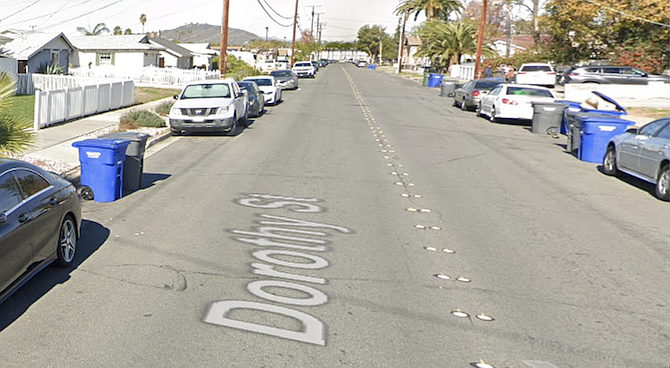
Dorothy Street to get speed bumps?
El Cajon drivers have found a way to avoid idling at certain busy intersections and stoplights: just take a side street. They use Dorothy Street to cut from Jamacha to Washington, avoiding the intersection of those two major arteries They rely on Bostonia Street to get from Greenfield Drive to Broadway, thus skirting the Greenfield at 2nd street stoplights. And they take Graves Avenue from Broadway to Ballantyne Ave to avoid the stoplights on those roads.
Tech helps their side street sojourns. Traffic apps like Waze and Google Maps often reroute drivers through neighborhood streets to avoid congestion. The trouble is, those drivers too often treat the side streets like the busy thoroughfares they're avoiding. And while the resultant crashes have mostly involved parked cars, some of these side streets lack sidewalks. That makes pedestrian safety an issue.
Paul Garibay, who lives on Dorothy Street, has seen the results of side streeting: a car landed on its roof less than 200 feet from a stop sign his neighbors had gotten the city to install. He recently told the city council. “To gain enough speed to hit two parked cars and flip over in the middle of the street in the middle of the night — yeah.” More speed than is appropriate for the time and place.
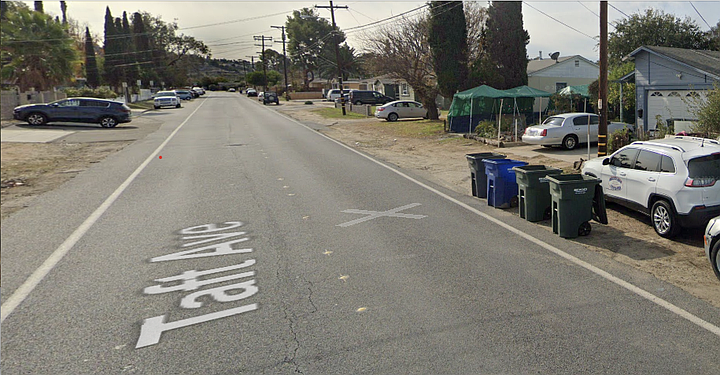
Pedestrians vulnerable on Taft Ave. because of no sidewalks
Garibay also described being in a minor accident at Dorothy and Washington only two nights before. “There are a lot of accidents that haven’t been reported on that intersection, but speed is the biggest problem,” he said. “We can get at least a stoplight there. That’s going to be a tremendous help.”
The first step convincing city officials to install traffic calming measures like stoplights or stop signs is often a groundswell of complaints from residents. Garibay went door to door to drum up support from others in the area, which resulted in so many calls to the city, officials went out to see for themselves. “You sat there and looked at car after car after car just coming in at a flying speed,” Garibay said.
It’s a problem that neighbors on Taft Ave. have been complaining about for years. Last year — after repeated car crashes in a front yard — they created a petition to get speed bumps.
Now, a report by councilmembers Steve Goble and Phil Ortiz has prompted the city to beta test traffic control devices on Dorothy and Taft, including speed humps — which are longer and gentler than speed bumps. According to the report, the city has already tried roundabouts and street striping to narrow traffic lanes and slow vehicles, but those measures haven't stopped speeders on the many cut-through streets. And temporary speed trailers and motor officer details work only as long as enforcement measures are present.
“I do know the city installed stop signs on Taft, and we had flashing lights put on them, and residents still run the stop signs and they complained about the lights,” said Councilmember Michelle Metschel. “So, I’m hoping the speed bumps and the time and effort and money we put into this” works, because there are a lot of other streets that could use them. “This is just a beginning.”
Mayor pro tem Gary Kendrick who helped write the city’s speed hump policy, said that they're a really good idea for certain streets. However, “You wouldn’t want them on a very busy street – Washington probably wouldn’t qualify. And you can’t have them on curves.” Their ability to slow traffic can also interfere with emergency services like fire and police.
Even with the measures, “Crashes keep occurring," councilmember Goble said. “This is a reluctant proposal because we don’t like speed humps and speed bumps, especially when it comes to first responders." Ortiz said the problem, which has gotten worse in the last four or five years, requires changing the culture, “not just cut-throughs, but speeding.”
Here's something you might be interested in.
Side street speedsters pose problem in El Cajon
Will speed humps work where roundabouts haven't?

Side street speedsters pose problem in El Cajon
Will speed humps work where roundabouts haven't?
Dorothy Street to get speed bumps?
El Cajon drivers have found a way to avoid idling at certain busy intersections and stoplights: just take a side street. They use Dorothy Street to cut from Jamacha to Washington, avoiding the intersection of those two major arteries They rely on Bostonia Street to get from Greenfield Drive to Broadway, thus skirting the Greenfield at 2nd street stoplights. And they take Graves Avenue from Broadway to Ballantyne Ave to avoid the stoplights on those roads.
Tech helps their side street sojourns. Traffic apps like Waze and Google Maps often reroute drivers through neighborhood streets to avoid congestion. The trouble is, those drivers too often treat the side streets like the busy thoroughfares they're avoiding. And while the resultant crashes have mostly involved parked cars, some of these side streets lack sidewalks. That makes pedestrian safety an issue.
Paul Garibay, who lives on Dorothy Street, has seen the results of side streeting: a car landed on its roof less than 200 feet from a stop sign his neighbors had gotten the city to install. He recently told the city council. “To gain enough speed to hit two parked cars and flip over in the middle of the street in the middle of the night — yeah.” More speed than is appropriate for the time and place.
Pedestrians vulnerable on Taft Ave. because of no sidewalks
Garibay also described being in a minor accident at Dorothy and Washington only two nights before. “There are a lot of accidents that haven’t been reported on that intersection, but speed is the biggest problem,” he said. “We can get at least a stoplight there. That’s going to be a tremendous help.”
The first step convincing city officials to install traffic calming measures like stoplights or stop signs is often a groundswell of complaints from residents. Garibay went door to door to drum up support from others in the area, which resulted in so many calls to the city, officials went out to see for themselves. “You sat there and looked at car after car after car just coming in at a flying speed,” Garibay said.
It’s a problem that neighbors on Taft Ave. have been complaining about for years. Last year — after repeated car crashes in a front yard — they created a petition to get speed bumps.
Now, a report by councilmembers Steve Goble and Phil Ortiz has prompted the city to beta test traffic control devices on Dorothy and Taft, including speed humps — which are longer and gentler than speed bumps. According to the report, the city has already tried roundabouts and street striping to narrow traffic lanes and slow vehicles, but those measures haven't stopped speeders on the many cut-through streets. And temporary speed trailers and motor officer details work only as long as enforcement measures are present.
“I do know the city installed stop signs on Taft, and we had flashing lights put on them, and residents still run the stop signs and they complained about the lights,” said Councilmember Michelle Metschel. “So, I’m hoping the speed bumps and the time and effort and money we put into this” works, because there are a lot of other streets that could use them. “This is just a beginning.”
Mayor pro tem Gary Kendrick who helped write the city’s speed hump policy, said that they're a really good idea for certain streets. However, “You wouldn’t want them on a very busy street – Washington probably wouldn’t qualify. And you can’t have them on curves.” Their ability to slow traffic can also interfere with emergency services like fire and police.
Even with the measures, “Crashes keep occurring," councilmember Goble said. “This is a reluctant proposal because we don’t like speed humps and speed bumps, especially when it comes to first responders." Ortiz said the problem, which has gotten worse in the last four or five years, requires changing the culture, “not just cut-throughs, but speeding.”
Comments