

Here's something you might be interested in.
Ask a Hipster — Advice you didn't know you needed
Big Screen — Movie commentary
Blurt — Music's inside track
Booze News — San Diego spirits
Classical Music — Immortal beauty
Classifieds — Free and easy
Close to Home — What it’s like on the street where you live
Cover Stories — Front-page features
Drinks All Around — Bartenders' drink recipes
Excerpts — Literary and spiritual excerpts
Feast! — Food & drink reviews
Feature Stories — Local news & stories
Fishing Report — What’s getting hooked from ship and shore
From the Archives — Spotlight on the past
Golden Dreams — Talk of the town
The Gonzo Report — Making the musical scene, or at least reporting from it
Letters — Our inbox
Movies@Home — Local movie buffs share favorites
Movie Reviews — Our critics' picks and pans
Musician Interviews — Up close with local artists
Neighborhood News from Stringers — Hyperlocal news
News Ticker — News & politics
Obermeyer — San Diego politics illustrated
Outdoors — Weekly changes in flora and fauna
Overheard in San Diego — Eavesdropping illustrated
Poetry — The old and the new
Reader Travel — Travel section built by travelers
Reading — The hunt for intellectuals
Roam-O-Rama — SoCal's best hiking/biking trails
San Diego Beer — Inside San Diego suds
SD on the QT — Almost factual news
Sheep and Goats — Places of worship
Special Issues — The best of
Street Style — San Diego streets have style
Surf Diego — Real stories from those braving the waves
Theater — On stage in San Diego this week
Tin Fork — Silver spoon alternative
Under the Radar — Matt Potter's undercover work
Unforgettable — Long-ago San Diego
Unreal Estate — San Diego's priciest pads
Your Week — Daily event picks
Snatchers, scammers, and more at San Diego Comic-Con 2025
It's not all fun and games with collectibles, cosplayers, and celebrities
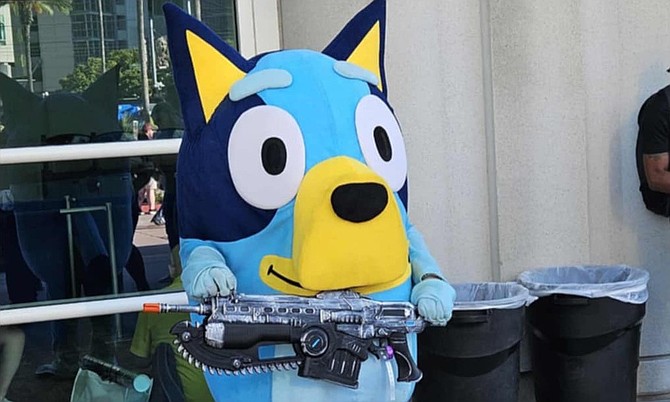
Bluey the Crime Dog needs to do better in the fight against the phone snatchers.
Another San Diego International Comic-Con has come and gone, bringing with it massive crowds, fantastic cosplayers, celebrated celebrities, and also, sex, theft, and scams. Just ask the three people who reported their phones snatched right outside the convention center. And that's just for starters.
For veteran comic book dealer Jamie Newbold, owner of SoCal Comics in Clairemont, 2025 marked his third-best year in more than half a century of selling at the annual comic con. His booth — loaded with vintage back issues carefully stored in short and long boxes, and advertised via a backdrop displaying his finest offerings — was busy from Wednesday’s preview night until the very last hour on Sunday. But according to Newbold, himself a former San Diego police officer, that final Sunday afternoon is when thieves like to make their move. He calls it "the witching hour," when dealers are tired, shorthanded, and focused on packing up.
Newbold said Comic-Con theft crews are “always young males… often working in twos and threes,” who rely on distraction. One member engages the dealer on one side of the booth, while the others swipe merchandise from the other side, often hiding their booty in the oversized bags that attendees receive upon entry into the con — what Newbold calls “grand theft bags.”
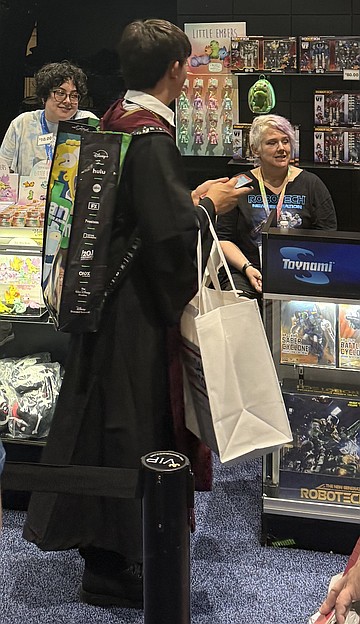
Giving new meaning to the term "bagman."
This year, the witching hour brought a duo: one guy, wearing a green hat, tried to tuck comics into his waistband while another distracted a staffer. “I had singled these guys out earlier,” Newbold said. "You only have to watch their hands. Their hands do all the thievery. I told him, ‘Hey, put the book back.’ That got everybody’s attention… Then I told my guys, ‘Keep an eye on them.’” His staff members formed a perimeter — one hovering over the comic book bandits, another ready to block them if they ran, and a third filming the interaction. When the man in the green hat noticed the camera, “he knew he was busted."
In the Gaslamp Quarter, men waved cardboard signs reading “BUYING BADGES,” offering cash to departing attendees, then reselling the passes on Craigslist and OfferUp for hundreds of dollars more than their original purchase price. While the act of reselling badges itself isn’t always prosecuted, original-badge owners risk being blackballed from future cons, and the badge buyer risks removal from the event.
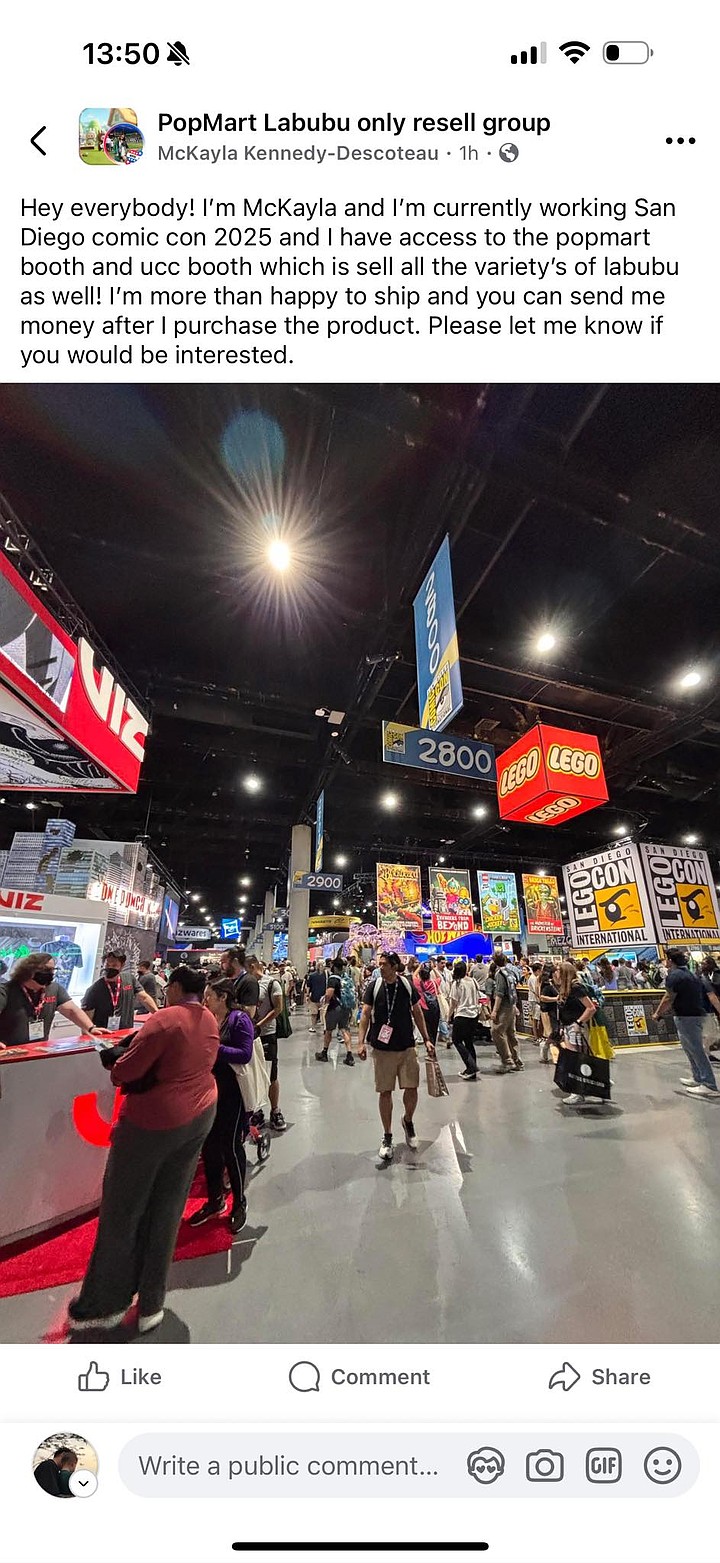
Online, on Labubu collector forums and discussion threads, users warned one another about supposed sellers claiming they were working the PopMart booth at the convention. The alerts cautioned fans of the toys against sending money to random individuals who claimed they could access the rare, sold-out Con exclusives.
Law enforcement also made its presence felt during Comic-Con weekend. From July 24–26, the San Diego Human Trafficking Task Force ran a three-day undercover operation, arresting 13 people for solicitation of sex. California Attorney General Rob Bonta said the arrests sent “a clear message” that demand fuels human trafficking.

But not everyone was convinced that this kind of crime was a Comic-Con problem. “Would never imagine THIS is an issue at Comic-Con," Bernardo G. wrote underneath a KUSI Facebook post. "They may be horny nerds, but I don’t think it would get so bad that they’d have to put up a sign about it.”
Not all the law-bending had to do with people — some of it was plastered across the city skyline. The San Diego Union-Tribune reported that several companies wrapped downtown buildings in giant Comic-Con-themed advertisements without obtaining the required city permits. Reactions ranged from admiration to cynicism. “Out of all the laws being broken in SD, I am the least worried about this. I think they look cool for Comic-Con,” wrote Della Garcia. James S. added, “Probably it’s the cost of doing business. They factor the fine in. Even after the fine, they’re making money.”
Amid the cosplay and collectibles, the National Center for Missing & Exploited Children (NCMEC) brought a real-life mystery into the spotlight. Forensic artist Joe Mullins reconstructed the face of “John San Diego Doe 2004,” a boy found dead more than 20 years ago. The hope was that the visibility of Comic-Con could spark a lead in the cold case.
Here's something you might be interested in.
Snatchers, scammers, and more at San Diego Comic-Con 2025
It's not all fun and games with collectibles, cosplayers, and celebrities

Snatchers, scammers, and more at San Diego Comic-Con 2025
It's not all fun and games with collectibles, cosplayers, and celebrities
Bluey the Crime Dog needs to do better in the fight against the phone snatchers.
Another San Diego International Comic-Con has come and gone, bringing with it massive crowds, fantastic cosplayers, celebrated celebrities, and also, sex, theft, and scams. Just ask the three people who reported their phones snatched right outside the convention center. And that's just for starters.
For veteran comic book dealer Jamie Newbold, owner of SoCal Comics in Clairemont, 2025 marked his third-best year in more than half a century of selling at the annual comic con. His booth — loaded with vintage back issues carefully stored in short and long boxes, and advertised via a backdrop displaying his finest offerings — was busy from Wednesday’s preview night until the very last hour on Sunday. But according to Newbold, himself a former San Diego police officer, that final Sunday afternoon is when thieves like to make their move. He calls it "the witching hour," when dealers are tired, shorthanded, and focused on packing up.
Newbold said Comic-Con theft crews are “always young males… often working in twos and threes,” who rely on distraction. One member engages the dealer on one side of the booth, while the others swipe merchandise from the other side, often hiding their booty in the oversized bags that attendees receive upon entry into the con — what Newbold calls “grand theft bags.”
Giving new meaning to the term "bagman."
This year, the witching hour brought a duo: one guy, wearing a green hat, tried to tuck comics into his waistband while another distracted a staffer. “I had singled these guys out earlier,” Newbold said. "You only have to watch their hands. Their hands do all the thievery. I told him, ‘Hey, put the book back.’ That got everybody’s attention… Then I told my guys, ‘Keep an eye on them.’” His staff members formed a perimeter — one hovering over the comic book bandits, another ready to block them if they ran, and a third filming the interaction. When the man in the green hat noticed the camera, “he knew he was busted."
In the Gaslamp Quarter, men waved cardboard signs reading “BUYING BADGES,” offering cash to departing attendees, then reselling the passes on Craigslist and OfferUp for hundreds of dollars more than their original purchase price. While the act of reselling badges itself isn’t always prosecuted, original-badge owners risk being blackballed from future cons, and the badge buyer risks removal from the event.
Online, on Labubu collector forums and discussion threads, users warned one another about supposed sellers claiming they were working the PopMart booth at the convention. The alerts cautioned fans of the toys against sending money to random individuals who claimed they could access the rare, sold-out Con exclusives.
Law enforcement also made its presence felt during Comic-Con weekend. From July 24–26, the San Diego Human Trafficking Task Force ran a three-day undercover operation, arresting 13 people for solicitation of sex. California Attorney General Rob Bonta said the arrests sent “a clear message” that demand fuels human trafficking.
But not everyone was convinced that this kind of crime was a Comic-Con problem. “Would never imagine THIS is an issue at Comic-Con," Bernardo G. wrote underneath a KUSI Facebook post. "They may be horny nerds, but I don’t think it would get so bad that they’d have to put up a sign about it.”
Not all the law-bending had to do with people — some of it was plastered across the city skyline. The San Diego Union-Tribune reported that several companies wrapped downtown buildings in giant Comic-Con-themed advertisements without obtaining the required city permits. Reactions ranged from admiration to cynicism. “Out of all the laws being broken in SD, I am the least worried about this. I think they look cool for Comic-Con,” wrote Della Garcia. James S. added, “Probably it’s the cost of doing business. They factor the fine in. Even after the fine, they’re making money.”
Amid the cosplay and collectibles, the National Center for Missing & Exploited Children (NCMEC) brought a real-life mystery into the spotlight. Forensic artist Joe Mullins reconstructed the face of “John San Diego Doe 2004,” a boy found dead more than 20 years ago. The hope was that the visibility of Comic-Con could spark a lead in the cold case.