

Here's something you might be interested in.
Ask a Hipster — Advice you didn't know you needed
Big Screen — Movie commentary
Blurt — Music's inside track
Booze News — San Diego spirits
Classical Music — Immortal beauty
Classifieds — Free and easy
Close to Home — What it’s like on the street where you live
Cover Stories — Front-page features
Drinks All Around — Bartenders' drink recipes
Excerpts — Literary and spiritual excerpts
Feast! — Food & drink reviews
Feature Stories — Local news & stories
Fishing Report — What’s getting hooked from ship and shore
From the Archives — Spotlight on the past
Golden Dreams — Talk of the town
The Gonzo Report — Making the musical scene, or at least reporting from it
Letters — Our inbox
Movies@Home — Local movie buffs share favorites
Movie Reviews — Our critics' picks and pans
Musician Interviews — Up close with local artists
Neighborhood News from Stringers — Hyperlocal news
News Ticker — News & politics
Obermeyer — San Diego politics illustrated
Outdoors — Weekly changes in flora and fauna
Overheard in San Diego — Eavesdropping illustrated
Poetry — The old and the new
Reader Travel — Travel section built by travelers
Reading — The hunt for intellectuals
Roam-O-Rama — SoCal's best hiking/biking trails
San Diego Beer — Inside San Diego suds
SD on the QT — Almost factual news
Sheep and Goats — Places of worship
Special Issues — The best of
Street Style — San Diego streets have style
Surf Diego — Real stories from those braving the waves
Theater — On stage in San Diego this week
Tin Fork — Silver spoon alternative
Under the Radar — Matt Potter's undercover work
Unforgettable — Long-ago San Diego
Unreal Estate — San Diego's priciest pads
Your Week — Daily event picks
Now Streaming: DELEGATION (2023)
What kind of karmic retribution must the Lord have earmarked for someone low enough to steal from a Holocaust museum?
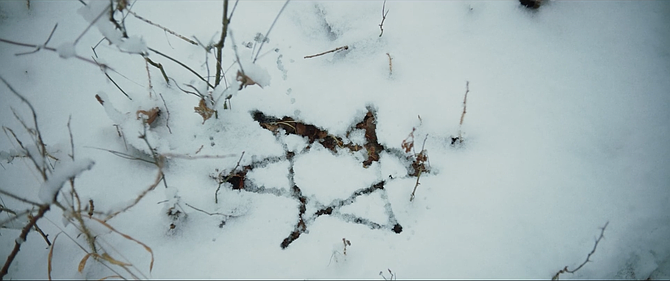
The handwriting is in the snow.
DELEGATION (2023) Writer & Director: Asaf Saban / Cinematographer: Bogumil Godfrejów (2.35:1) / Design: Ewa Mroczkowska / Editor: Michal Oppenheim / Composers: Gal Aviram & Assaf Talmudi / Acted by: Yoav Bavly, Naomi Harari, Leib Levin, Alma Dishi, Ezra Dagan, Karolina Bruchnicka, Aviv Buchler, & Lech Dyblik / Countries: Israel, Poland, & Germany / Distributor: Greenwich Entertainment / Not Rated / Length: 101 mins.
How old were you when the concept of the Holocaust first began to take hold? I was in third grade and new to Chicago’s West Rogers Park neighborhood when Ma first took me to Tel-Aviv Bakery. As we left, I could barely wait to get back inside the car to ask why the people behind the counter had numbers written on their arms? The drive home was filled with difficult questions topped by even more baffling answers, none moreso than, “They’re still alive” in response to my earnest, “How did it make them lucky?”
Video:
Trailer: DELEGATION

The Holocaust is arguably the one chapter in world history better left to documentarians, starting with Alain Resnais’ Night and Fog and Marcel Ophuls’ The Sorrow and The Pity. With rare exceptions — Agnieszka Holland’s Europa Europa and Atom Egoyan’s Remember come to mind — narrative cinema been unable to resist the urge to sensationalize, or worse yet, sentimentalize, Hitler’s atrocities. With that in mind, there’s a strong case to be made for Asaf Saban’s Delegation.
From a distance, the students horsing around at the baggage carousel appear stoked to be spending their winter break majoring in rest and relaxation. But this getaway isn’t of the fun-in-the-sun or hitting-the-slopes variety. It’s a class trip, and our group of Israeli high schoolers has just deplaned in Poland for what is referred to as a “delegation,” an educational tour of various Holocaust sites, ending with a stopover at Auschwitz.
No one said it was going to be a vacation. First stop: one of the largest Jewish cemeteries in existence, accommodating over 200,000 graves. That number is tough enough for adults to wrap their minds around; what impact can the Holocaust possibly have on a group of technologically-connected 17-year-olds made numb from the glut of violence that today passes for entertainment?
Sing-alongs are better suited to overnight camp than a pilgrimage to the ashes of a concentration camp. So in order to ease the students into their quest to “never forget,” they are shown Jewish-themed films and/or fictionalized accounts of the Holocaust (Fiddler on the Roof, Escape From Sobibor, and the inevitable Schindler’s List) screened on the bus’s video system.
Filmmaker Asaf Saban takes his time sorting through characters, shuffling the deck, deciding which members of the group are going to be his river cards. Beneath a backdrop of tombstones, Frisch (Yoav Bavly) and "Nitz" Nitzan (Naomi Harari) provide their own dialogue track for an out-of-earshot quarrel between the good-looking yet callow Ido (Leib Levin) and his soon-to-be ex. One can tell by their interplay that Frisch and Nitz would be a dynamite couple themselves, were it not for her infatuation with Ido. If it’s beginning to sound like Gidget Goes Gdańsk, there's a reason: watching the guileless teenagers of today trying to connect with a historical subject so large is precisely the point.
There is one survivor in the crowd. Frisch’s zayde, Josef (Ezra Dagan). Josef relates first-hand his experiences throughout the course of the trip, generally as a way to kill time on the bus. His stories of the death camp extend as far back as his memory allows. The 86-year-old relies on notes; losing his place makes it impossible to get back on track. Einat (Alma Dishi), one of the teachers, has the audacity to call “Cut!” on Zaide’s rolling set, politely suggesting he give his reminiscences a kick in the ass and get to the action.
Before the class is allowed to explore the city unchaperoned, students are first shown a video on the perils of revealing their Jewishness in the presence of a culture predisposed to hating them. Step one: stick together — no one is allowed to venture off on their own. No sooner is the point made than Nitz breaks from the pack.
Frisch needs to lose his virginity — when he pisses a Star of David in the snow, he wishes it was Nitz’s handwriting — and Ido has some growing up to do. Of our three centers of attention, Nitz is the puzzle without a clear solution. At day’s end, the students powwow with their teachers to talk about their experiences. When it's Nitz's turn, she screams and runs out.
Her next act defies logic. What kind of karmic retribution must the Lord have earmarked for someone low enough to steal from a Holocaust museum? Perhaps, Nitz reasoned, with all the footwear on display in The Little Shoes from Auschwitz exhibit, no one would notice the absence of one weathered slipper?
Nitz brings it to a shoe store, where she proceeds to photograph the Holocaust relic juxtaposed against a display of new shoes, as though her inspiration for swiping the souvenir had something to do with a class art project. Even Ido questions her decision, but what would a Holocaust movie be without guilt? Overcome by the enormity of her error, Nitz makes a middle-of-the-night run to a public trash can, only to return a few quick-cuts later to retrieve her ill-gotten footwear. The next day, Nitz returns to the scene of the crime and returns the shoe.
The irony is forever getting lost on the students: the day finds them crammed into the same train carriage that once carried generations of Jews to their deaths; that night, the group squeezes into a hotel closet to avoid being caught out after curfew. Ditto the film’s most powerful moment: Frisch provoking a fist fight with Ido under the gate that reads “Arbeit Macht Frei.”
In the end, what is the one commonality that binds our trio for life? This is their last time out of uniform; tomorrow they enlist. Just when the viewer thought the end goal of this crusade was peace, love, and understanding, we get a dose of the Holocaust as recruitment tool: one student confesses he wasn't sure if he wanted to join a combat unit, but after the class trip, he understood how important it is. ****
Now streaming. Watch it here!
Here's something you might be interested in.
Now Streaming: DELEGATION (2023)
What kind of karmic retribution must the Lord have earmarked for someone low enough to steal from a Holocaust museum?

Now Streaming: DELEGATION (2023)
What kind of karmic retribution must the Lord have earmarked for someone low enough to steal from a Holocaust museum?
The handwriting is in the snow.
DELEGATION (2023) Writer & Director: Asaf Saban / Cinematographer: Bogumil Godfrejów (2.35:1) / Design: Ewa Mroczkowska / Editor: Michal Oppenheim / Composers: Gal Aviram & Assaf Talmudi / Acted by: Yoav Bavly, Naomi Harari, Leib Levin, Alma Dishi, Ezra Dagan, Karolina Bruchnicka, Aviv Buchler, & Lech Dyblik / Countries: Israel, Poland, & Germany / Distributor: Greenwich Entertainment / Not Rated / Length: 101 mins.
How old were you when the concept of the Holocaust first began to take hold? I was in third grade and new to Chicago’s West Rogers Park neighborhood when Ma first took me to Tel-Aviv Bakery. As we left, I could barely wait to get back inside the car to ask why the people behind the counter had numbers written on their arms? The drive home was filled with difficult questions topped by even more baffling answers, none moreso than, “They’re still alive” in response to my earnest, “How did it make them lucky?”
Video:
Trailer: DELEGATION
The Holocaust is arguably the one chapter in world history better left to documentarians, starting with Alain Resnais’ Night and Fog and Marcel Ophuls’ The Sorrow and The Pity. With rare exceptions — Agnieszka Holland’s Europa Europa and Atom Egoyan’s Remember come to mind — narrative cinema been unable to resist the urge to sensationalize, or worse yet, sentimentalize, Hitler’s atrocities. With that in mind, there’s a strong case to be made for Asaf Saban’s Delegation.
From a distance, the students horsing around at the baggage carousel appear stoked to be spending their winter break majoring in rest and relaxation. But this getaway isn’t of the fun-in-the-sun or hitting-the-slopes variety. It’s a class trip, and our group of Israeli high schoolers has just deplaned in Poland for what is referred to as a “delegation,” an educational tour of various Holocaust sites, ending with a stopover at Auschwitz.
No one said it was going to be a vacation. First stop: one of the largest Jewish cemeteries in existence, accommodating over 200,000 graves. That number is tough enough for adults to wrap their minds around; what impact can the Holocaust possibly have on a group of technologically-connected 17-year-olds made numb from the glut of violence that today passes for entertainment?
Sing-alongs are better suited to overnight camp than a pilgrimage to the ashes of a concentration camp. So in order to ease the students into their quest to “never forget,” they are shown Jewish-themed films and/or fictionalized accounts of the Holocaust (Fiddler on the Roof, Escape From Sobibor, and the inevitable Schindler’s List) screened on the bus’s video system.
Filmmaker Asaf Saban takes his time sorting through characters, shuffling the deck, deciding which members of the group are going to be his river cards. Beneath a backdrop of tombstones, Frisch (Yoav Bavly) and "Nitz" Nitzan (Naomi Harari) provide their own dialogue track for an out-of-earshot quarrel between the good-looking yet callow Ido (Leib Levin) and his soon-to-be ex. One can tell by their interplay that Frisch and Nitz would be a dynamite couple themselves, were it not for her infatuation with Ido. If it’s beginning to sound like Gidget Goes Gdańsk, there's a reason: watching the guileless teenagers of today trying to connect with a historical subject so large is precisely the point.
There is one survivor in the crowd. Frisch’s zayde, Josef (Ezra Dagan). Josef relates first-hand his experiences throughout the course of the trip, generally as a way to kill time on the bus. His stories of the death camp extend as far back as his memory allows. The 86-year-old relies on notes; losing his place makes it impossible to get back on track. Einat (Alma Dishi), one of the teachers, has the audacity to call “Cut!” on Zaide’s rolling set, politely suggesting he give his reminiscences a kick in the ass and get to the action.
Before the class is allowed to explore the city unchaperoned, students are first shown a video on the perils of revealing their Jewishness in the presence of a culture predisposed to hating them. Step one: stick together — no one is allowed to venture off on their own. No sooner is the point made than Nitz breaks from the pack.
Frisch needs to lose his virginity — when he pisses a Star of David in the snow, he wishes it was Nitz’s handwriting — and Ido has some growing up to do. Of our three centers of attention, Nitz is the puzzle without a clear solution. At day’s end, the students powwow with their teachers to talk about their experiences. When it's Nitz's turn, she screams and runs out.
Her next act defies logic. What kind of karmic retribution must the Lord have earmarked for someone low enough to steal from a Holocaust museum? Perhaps, Nitz reasoned, with all the footwear on display in The Little Shoes from Auschwitz exhibit, no one would notice the absence of one weathered slipper?
Nitz brings it to a shoe store, where she proceeds to photograph the Holocaust relic juxtaposed against a display of new shoes, as though her inspiration for swiping the souvenir had something to do with a class art project. Even Ido questions her decision, but what would a Holocaust movie be without guilt? Overcome by the enormity of her error, Nitz makes a middle-of-the-night run to a public trash can, only to return a few quick-cuts later to retrieve her ill-gotten footwear. The next day, Nitz returns to the scene of the crime and returns the shoe.
The irony is forever getting lost on the students: the day finds them crammed into the same train carriage that once carried generations of Jews to their deaths; that night, the group squeezes into a hotel closet to avoid being caught out after curfew. Ditto the film’s most powerful moment: Frisch provoking a fist fight with Ido under the gate that reads “Arbeit Macht Frei.”
In the end, what is the one commonality that binds our trio for life? This is their last time out of uniform; tomorrow they enlist. Just when the viewer thought the end goal of this crusade was peace, love, and understanding, we get a dose of the Holocaust as recruitment tool: one student confesses he wasn't sure if he wanted to join a combat unit, but after the class trip, he understood how important it is. ****
Now streaming. Watch it here!
Comments