

Here's something you might be interested in.
Ask a Hipster — Advice you didn't know you needed
Big Screen — Movie commentary
Blurt — Music's inside track
Booze News — San Diego spirits
Classical Music — Immortal beauty
Classifieds — Free and easy
Close to Home — What it’s like on the street where you live
Cover Stories — Front-page features
Drinks All Around — Bartenders' drink recipes
Excerpts — Literary and spiritual excerpts
Feast! — Food & drink reviews
Feature Stories — Local news & stories
Fishing Report — What’s getting hooked from ship and shore
From the Archives — Spotlight on the past
Golden Dreams — Talk of the town
The Gonzo Report — Making the musical scene, or at least reporting from it
Letters — Our inbox
Movies@Home — Local movie buffs share favorites
Movie Reviews — Our critics' picks and pans
Musician Interviews — Up close with local artists
Neighborhood News from Stringers — Hyperlocal news
News Ticker — News & politics
Obermeyer — San Diego politics illustrated
Outdoors — Weekly changes in flora and fauna
Overheard in San Diego — Eavesdropping illustrated
Poetry — The old and the new
Reader Travel — Travel section built by travelers
Reading — The hunt for intellectuals
Roam-O-Rama — SoCal's best hiking/biking trails
San Diego Beer — Inside San Diego suds
SD on the QT — Almost factual news
Sheep and Goats — Places of worship
Special Issues — The best of
Street Style — San Diego streets have style
Surf Diego — Real stories from those braving the waves
Theater — On stage in San Diego this week
Tin Fork — Silver spoon alternative
Under the Radar — Matt Potter's undercover work
Unforgettable — Long-ago San Diego
Unreal Estate — San Diego's priciest pads
Your Week — Daily event picks
Movie review: CHEECH AND CHONG'S LAST MOVIE (2024)
A clueless Virginia Grahame, host of the embryonic daytime gabfest Girl Talk, introduced her audience to “Cheech & Kong.” ¡Fuchi capesta!
Dave's home.
CHEECH AND CHONG’S LAST MOVIE (2024) David Bushell / Writer: None credited / Cinematographer: Michael Alden Lloyd (2.35:1) / Editor: Brett Mason / Composer: Dave Palmer / Visual Effects: Jeff Foster / Cast: Cheech Marin, Tommy Chong, Lou Adler / Guest Stars: Bobo Brazil, Don Cornelius, Ed Sullivan, Virginia Graham, Agnes Moorehead / Distributor: Still Smokin’ / Rated R / 120 mins.
Are you old enough to remember using a gatefold album cover, or in the case of Cheech and Chong’s Last Movie, the cover of a Scrabble box, to rid your lid of seeds and stems? (I haven’t seen a seed since making San Diego my home 25 some years ago.) If so, have I got a documentary for you!
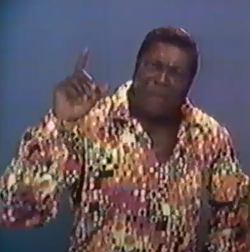
By the time he was seven, Richard “Cheech” Marin had borne witness to three murders. But life wasn’t all blood and gristle for a kid growing up in South Central. Show business came to his neighborhood in the form of pro wrestler Bobo Brazil. Classes would grind to a temporary halt and schoolrooms would empty whenever Bobo stopped to pick up his clothes at the local laundry. (Ah, sweet memories of youth. Performing on a card at Chicago’s International Amphitheater, the crowd greeted the then designated loser with pelted garbage and chants of, “Hobo! Hobo!")
A taste of Bobo Brazil:
Video:
"That is the way I buy!"
Tommy Chong, the Chinese-Canadian half of the duo, turned on to Ornette Coleman and pot on the same night. The next day, he quit school, certain that he was going to make a living playing the blues. He formed a group with friends that was good enough to catch the attention of Diana Ross. The supreme lead singer of The Supremes introduced the band to Berry Gordy, who signed them on the spot. The Vancouvers had one charted hit (Does Your Mama Know About Me?) before splitting up.
Back in the States, the Vietnam draft stuck a sizable foot in Cheech’s path. If it was a choice between war or Canada, he knew which direction to take. It was in Vancouver, at the height of the war, where the boys first met. Their long, strange trip together began in nightclubs before the creation of four Grammy-nominated comedy LPs on which they christened their own genre: hard rock comedy. What was the key to their success? Overheard on The View: “We stole a little something from Charlie Chaplin,” Chong told the yentas roundtable. “The character he played was someone that everybody could look down on.” C&C didn’t care who looked down or up at them, just so the bong was packed. Live performances draw huge crowds and big bucks, with none of the overhead of rock concerts. (Would you believe Cheech & Chong opened for The Stones?) Their comedy was apolitical, “All for one and one for high!” as Chong put it.
Then came Up in Smoke. The studio suits reasoned that a running dialogue between two marijuana-marinated birdbrains would amount to nothing more than radio with pictures, and therefore had no chance of making the leap from vinyl to celluloid. But record producer Lou Adler came to their rescue, offering the boys $25,000 to split between them. Adler signed the picture, though it was Chong who did the lion’s share of the directing. The movie took in $104 million on a $2 million investment, with Adler pocketing a staggering 90% of the profits. It wasn’t until their third (and best) feature, Nice Dreams, rolled along, that both C&C finally saw million dollar paydays.
Video:
Trailer: CHEECH AND CHONG'S LAST MOVIE
There’s nothing more delightfully cringeworthy than a couple of mellowed out hippies — especially those making their living spreading the gospel of cannabis — coming face to face with Hollywood’s old guard. Ed Sullivan stopped just short of rolling a really big spliff before handing the duo their Grammy for Best Comedy Album. With Agnes Moorhead by her side, a clueless Virginia Grahame, host of the embryonic daytime gabfest Girl Talk, introduced her audience to “Cheech & Kong.” ¡Fuchi capesta! And here’s something very few comedians can lay claim to: Cheech & Chong made the generally cadaveric Don Cornelius laugh so hard it derailed the Soul Train.
For a while, C&C would write the script, while the job of directing went to the team’s regular editor, Thomas K. Avildsen. But according to Cheech, his partner’s ego “was out of proportion to his actual talent.” As a result, for Things Are Tough All Over, he demanded more creative control. (In all fairness, the division of power seemed equally split: Chong played Jerry Lewis to Cheech’s Dean Martin.) But Chong was the director, and he'd be damned if Cheech was going to call “cut” on his set. Wasn't it enough that Cheech was the star of the show, with most of the gags centered around his character? And who was always in the driver's seat? Cheech!
The press hated on C&C more than any comedian since Lewis and his partner first set the box office ablaze in the early '50s. As Chong tells it, the scribblers didn't understand how much intelligence was required to pull off a really dumb joke. And he never realized that his bruised partner thought the joke was on him. It’s about this time in the picture where their drive down memory lane went off course, taking out a few hundred mile markers with it. Cheech remains a bitter son of a gun, telling Chong to his face that the two should have shared director’s credit. Chong, tired of making “amiable messes,” wanted to make focused movies. (Like Cheech & Chong's: The Corsican Brothers?) The division of power proved to be the shiv that split the two apart.
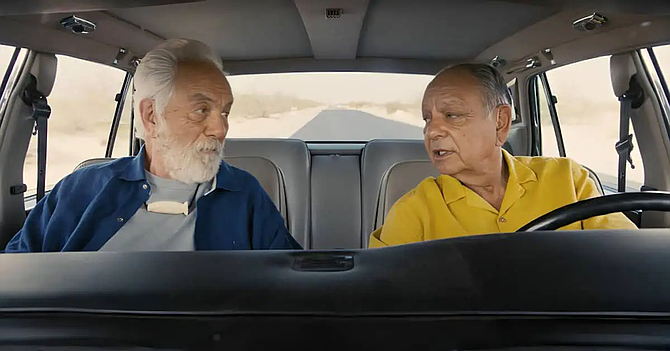
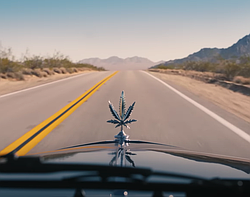
The documentary was a financially wise move on their part. Why air dirty laundry for the financial benefit of media outlets and bloggers when there’s more money to be made in producing your own tell-all biodoc? (At one point, Chong asks, “Is this a documentary or a movie?") Still, I’ll cop to exiting the auditorium with a tinge of regret; I was banking on the boys reuniting for one last paraquat-free smokeout rather than a fact-focused overview. And a drive through the middle of the desert, during which the pair realize they didn't have any weed, was not the clothesline on which to hang this plot. Not that I’m completely disappointed — driving has always been a key element in their best work, and they do pick up a few amusing hitchhikers along the way. But was it really too late to add another freeform chapter to the lives of comedy’s most revered potheads — all grown up now — and change the title of this to Cheech and Chong’s First Documentary? ****
Here's something you might be interested in.
Movie review: CHEECH AND CHONG'S LAST MOVIE (2024)
A clueless Virginia Grahame, host of the embryonic daytime gabfest Girl Talk, introduced her audience to “Cheech & Kong.” ¡Fuchi capesta!

Movie review: CHEECH AND CHONG'S LAST MOVIE (2024)
A clueless Virginia Grahame, host of the embryonic daytime gabfest Girl Talk, introduced her audience to “Cheech & Kong.” ¡Fuchi capesta!
Dave's home.
CHEECH AND CHONG’S LAST MOVIE (2024) David Bushell / Writer: None credited / Cinematographer: Michael Alden Lloyd (2.35:1) / Editor: Brett Mason / Composer: Dave Palmer / Visual Effects: Jeff Foster / Cast: Cheech Marin, Tommy Chong, Lou Adler / Guest Stars: Bobo Brazil, Don Cornelius, Ed Sullivan, Virginia Graham, Agnes Moorehead / Distributor: Still Smokin’ / Rated R / 120 mins.
Are you old enough to remember using a gatefold album cover, or in the case of Cheech and Chong’s Last Movie, the cover of a Scrabble box, to rid your lid of seeds and stems? (I haven’t seen a seed since making San Diego my home 25 some years ago.) If so, have I got a documentary for you!
By the time he was seven, Richard “Cheech” Marin had borne witness to three murders. But life wasn’t all blood and gristle for a kid growing up in South Central. Show business came to his neighborhood in the form of pro wrestler Bobo Brazil. Classes would grind to a temporary halt and schoolrooms would empty whenever Bobo stopped to pick up his clothes at the local laundry. (Ah, sweet memories of youth. Performing on a card at Chicago’s International Amphitheater, the crowd greeted the then designated loser with pelted garbage and chants of, “Hobo! Hobo!")
A taste of Bobo Brazil:
Video:
"That is the way I buy!"
Tommy Chong, the Chinese-Canadian half of the duo, turned on to Ornette Coleman and pot on the same night. The next day, he quit school, certain that he was going to make a living playing the blues. He formed a group with friends that was good enough to catch the attention of Diana Ross. The supreme lead singer of The Supremes introduced the band to Berry Gordy, who signed them on the spot. The Vancouvers had one charted hit (Does Your Mama Know About Me?) before splitting up.
Back in the States, the Vietnam draft stuck a sizable foot in Cheech’s path. If it was a choice between war or Canada, he knew which direction to take. It was in Vancouver, at the height of the war, where the boys first met. Their long, strange trip together began in nightclubs before the creation of four Grammy-nominated comedy LPs on which they christened their own genre: hard rock comedy. What was the key to their success? Overheard on The View: “We stole a little something from Charlie Chaplin,” Chong told the yentas roundtable. “The character he played was someone that everybody could look down on.” C&C didn’t care who looked down or up at them, just so the bong was packed. Live performances draw huge crowds and big bucks, with none of the overhead of rock concerts. (Would you believe Cheech & Chong opened for The Stones?) Their comedy was apolitical, “All for one and one for high!” as Chong put it.
Then came Up in Smoke. The studio suits reasoned that a running dialogue between two marijuana-marinated birdbrains would amount to nothing more than radio with pictures, and therefore had no chance of making the leap from vinyl to celluloid. But record producer Lou Adler came to their rescue, offering the boys $25,000 to split between them. Adler signed the picture, though it was Chong who did the lion’s share of the directing. The movie took in $104 million on a $2 million investment, with Adler pocketing a staggering 90% of the profits. It wasn’t until their third (and best) feature, Nice Dreams, rolled along, that both C&C finally saw million dollar paydays.
Video:
Trailer: CHEECH AND CHONG'S LAST MOVIE
There’s nothing more delightfully cringeworthy than a couple of mellowed out hippies — especially those making their living spreading the gospel of cannabis — coming face to face with Hollywood’s old guard. Ed Sullivan stopped just short of rolling a really big spliff before handing the duo their Grammy for Best Comedy Album. With Agnes Moorhead by her side, a clueless Virginia Grahame, host of the embryonic daytime gabfest Girl Talk, introduced her audience to “Cheech & Kong.” ¡Fuchi capesta! And here’s something very few comedians can lay claim to: Cheech & Chong made the generally cadaveric Don Cornelius laugh so hard it derailed the Soul Train.
For a while, C&C would write the script, while the job of directing went to the team’s regular editor, Thomas K. Avildsen. But according to Cheech, his partner’s ego “was out of proportion to his actual talent.” As a result, for Things Are Tough All Over, he demanded more creative control. (In all fairness, the division of power seemed equally split: Chong played Jerry Lewis to Cheech’s Dean Martin.) But Chong was the director, and he'd be damned if Cheech was going to call “cut” on his set. Wasn't it enough that Cheech was the star of the show, with most of the gags centered around his character? And who was always in the driver's seat? Cheech!
The press hated on C&C more than any comedian since Lewis and his partner first set the box office ablaze in the early '50s. As Chong tells it, the scribblers didn't understand how much intelligence was required to pull off a really dumb joke. And he never realized that his bruised partner thought the joke was on him. It’s about this time in the picture where their drive down memory lane went off course, taking out a few hundred mile markers with it. Cheech remains a bitter son of a gun, telling Chong to his face that the two should have shared director’s credit. Chong, tired of making “amiable messes,” wanted to make focused movies. (Like Cheech & Chong's: The Corsican Brothers?) The division of power proved to be the shiv that split the two apart.
The documentary was a financially wise move on their part. Why air dirty laundry for the financial benefit of media outlets and bloggers when there’s more money to be made in producing your own tell-all biodoc? (At one point, Chong asks, “Is this a documentary or a movie?") Still, I’ll cop to exiting the auditorium with a tinge of regret; I was banking on the boys reuniting for one last paraquat-free smokeout rather than a fact-focused overview. And a drive through the middle of the desert, during which the pair realize they didn't have any weed, was not the clothesline on which to hang this plot. Not that I’m completely disappointed — driving has always been a key element in their best work, and they do pick up a few amusing hitchhikers along the way. But was it really too late to add another freeform chapter to the lives of comedy’s most revered potheads — all grown up now — and change the title of this to Cheech and Chong’s First Documentary? ****