

Here's something you might be interested in.
Ask a Hipster — Advice you didn't know you needed
Big Screen — Movie commentary
Blurt — Music's inside track
Booze News — San Diego spirits
Classical Music — Immortal beauty
Classifieds — Free and easy
Close to Home — What it’s like on the street where you live
Cover Stories — Front-page features
Drinks All Around — Bartenders' drink recipes
Excerpts — Literary and spiritual excerpts
Feast! — Food & drink reviews
Feature Stories — Local news & stories
Fishing Report — What’s getting hooked from ship and shore
From the Archives — Spotlight on the past
Golden Dreams — Talk of the town
The Gonzo Report — Making the musical scene, or at least reporting from it
Letters — Our inbox
Movies@Home — Local movie buffs share favorites
Movie Reviews — Our critics' picks and pans
Musician Interviews — Up close with local artists
Neighborhood News from Stringers — Hyperlocal news
News Ticker — News & politics
Obermeyer — San Diego politics illustrated
Outdoors — Weekly changes in flora and fauna
Overheard in San Diego — Eavesdropping illustrated
Poetry — The old and the new
Reader Travel — Travel section built by travelers
Reading — The hunt for intellectuals
Roam-O-Rama — SoCal's best hiking/biking trails
San Diego Beer — Inside San Diego suds
SD on the QT — Almost factual news
Sheep and Goats — Places of worship
Special Issues — The best of
Street Style — San Diego streets have style
Surf Diego — Real stories from those braving the waves
Theater — On stage in San Diego this week
Tin Fork — Silver spoon alternative
Under the Radar — Matt Potter's undercover work
Unforgettable — Long-ago San Diego
Unreal Estate — San Diego's priciest pads
Your Week — Daily event picks
Building the Future: How ‘Project Crypto’ Sparks the Next Wave of On-Chain Apps
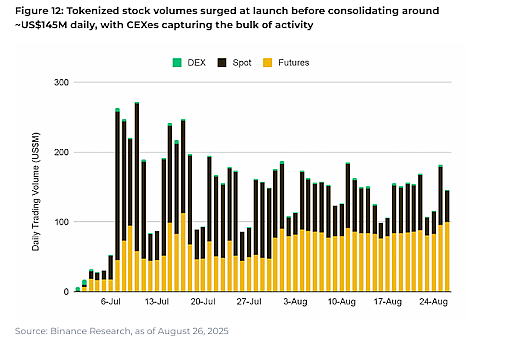
As noted in a recent white paper published by Binance Research, 10 Charts Shaping 2025, one key crypto trend as of late has been the rapid rise in equity tokenization, or the trading of digital versions of stocks on the blockchain. As seen in the chart below, in early July there was a massive increase in daily tokenized stock volumes.
Factors driving this big increase included improvements in issuer infrastructure, plus the launch of new trading venues. Although daily volume, as well as the market value of all tokenized equities, around $350 million, have leveled off since taking off in July, this consolidation is reminiscent of the user adoption patterns of DeFi in its early stages.
Like tokenized equities, adoption of DeFi spiked, then consolidated, but then continued to grow, supported by steady user growth. Moreover, following a recent development related to “regulatory clarity” in the United States, user adoption of tokenized equities and other assets could soon accelerate.
‘Project Crypto’ Lays the Groundwork
On July 31, 2025, at the “American Leadership in the Digital Finance Revolution” conference, U.S. Securities and Exchange Commission Chairman Paul Atkins unveiled “Project Crypto,” a game plan for updating securities rules for the modern age. As Atkins put it, “To achieve President Trump’s vision of making America the crypto capital of the world, the SEC must holistically consider the potential benefits and risks of moving our markets from an off-chain environment to an on-chain one.”
Arguably, this speech was given at just the right moment. As seen from the aforementioned jump in tokenized equity trading volumes, and from recent efforts by some major cryptocurrency companies to offer such services stateside, as currently, tokenized securities only trade on platforms located outside the United States.
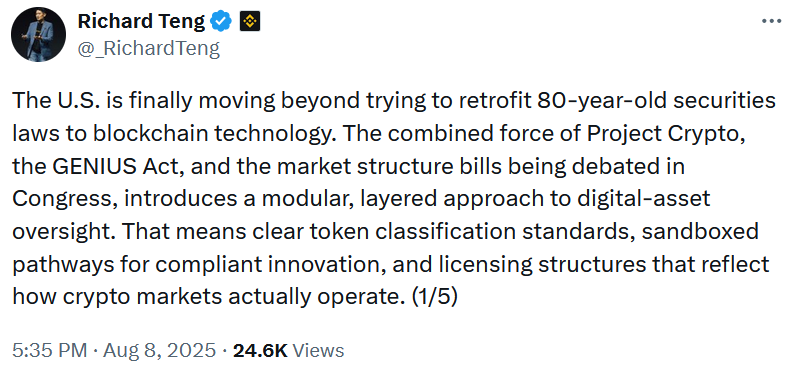
Binance CEO Richard Teng weighed in on the unveiling of Project Crypto, “The U.S. is finally moving beyond trying to retrofit 80-year-old securities laws to blockchain technology. The combined force of Project Crypto, the GENIUS Act, and the market structure bills being debated in Congress, introduces a modular, layered approach to digital-asset oversight. That means clear token classification standards, sandboxed pathways for compliant innovation, and licensing structures that reflect how crypto markets actually operate.”
Alongside plans to fast-track the development and launch of tokenized securities in the U.S., Atkins’ plan also calls for an overhaul of regulations that have limited the ability for platforms known as “super apps” to develop/operate within the United States. “Super Apps,” very popular in jurisdictions like China, integrate financial and social features within a single ecosystem.
“The unified licensing approach reflecting full-stack platform models (the ‘super-app license’) recognizes the convergence happening in crypto services: trading, payments, lending, and custody offered under one roof. A unified licensing regime gives platforms a clear compliance path while improving user protections. This is how you enable innovation without compromising oversight,” said Teng.
Opening the Door to Tokenization Adoption
While Atkins’ speech perhaps came at the right time, as seen from crypto price action around the time of the speech, the “Project Crypto” announcement was received with little fanfare. Yet while the market may not have regarded it as a “big deal,” one sell-side analyst firm certainly did.
On Aug. 4, 2025, analysts at Bernstein released a research note, arguing that “Project Crypto” represented “the boldest and most transformative crypto vision ever laid out by a sitting SEC chair.”
Bernstein’s statement was mostly in reference to how the sweeping plan seeks to reshore crypto-related activities that have grown largely offshore, due to the U.S. Federal Government’s enforcement-based approach to crypto under the prior Biden administration.
That said, Bernstein also noted how “Project Crypto” stands to be the final piece necessary in order for tokenized security exchanges to launch in the United States, given how both Wall Street and Big Tech have already been gearing up for such a moment.
What This Means for On-Chain Assets and Tokenization Moving Forward
Although Atkins’ speech has laid out a grand vision and has further conveyed how the SEC under the current Trump administration seeks to foster the growth of America’s blockchain economy, the speech was scant in terms of providing details or a concrete timeline on when innovations like tokenized exchanges or “Super Apps” would arrive in the United States.
Still, even if it is a slow and steady road towards the launch of such products, the impact of this on the existing tokenized asset market stands to be massive. As detailed in the Binance Research report, while on-chain holders of tokenized equities tripled between July and August 2025, this figure stands at a relatively small 66,500.
The total market capitalization of tokenized equities, $349 million, pales in comparison to the total market value of the U.S. stock market, which is around $62.8 trillion.
Hence, even if “Project Crypto” in the immediate future leads only to a small amount of U.S adoption of tokenized equities and other assets, this could still represent tremendous growth for this segment of the blockchain economy. For instance, if only 1% of global equities become tokenized, that would still represent a market worth $1.3 trillion.
Here's something you might be interested in.
Building the Future: How ‘Project Crypto’ Sparks the Next Wave of On-Chain Apps

Building the Future: How ‘Project Crypto’ Sparks the Next Wave of On-Chain Apps
As noted in a recent white paper published by Binance Research, 10 Charts Shaping 2025, one key crypto trend as of late has been the rapid rise in equity tokenization, or the trading of digital versions of stocks on the blockchain. As seen in the chart below, in early July there was a massive increase in daily tokenized stock volumes.
Factors driving this big increase included improvements in issuer infrastructure, plus the launch of new trading venues. Although daily volume, as well as the market value of all tokenized equities, around $350 million, have leveled off since taking off in July, this consolidation is reminiscent of the user adoption patterns of DeFi in its early stages.
Like tokenized equities, adoption of DeFi spiked, then consolidated, but then continued to grow, supported by steady user growth. Moreover, following a recent development related to “regulatory clarity” in the United States, user adoption of tokenized equities and other assets could soon accelerate.
‘Project Crypto’ Lays the Groundwork
On July 31, 2025, at the “American Leadership in the Digital Finance Revolution” conference, U.S. Securities and Exchange Commission Chairman Paul Atkins unveiled “Project Crypto,” a game plan for updating securities rules for the modern age. As Atkins put it, “To achieve President Trump’s vision of making America the crypto capital of the world, the SEC must holistically consider the potential benefits and risks of moving our markets from an off-chain environment to an on-chain one.”
Arguably, this speech was given at just the right moment. As seen from the aforementioned jump in tokenized equity trading volumes, and from recent efforts by some major cryptocurrency companies to offer such services stateside, as currently, tokenized securities only trade on platforms located outside the United States.
Binance CEO Richard Teng weighed in on the unveiling of Project Crypto, “The U.S. is finally moving beyond trying to retrofit 80-year-old securities laws to blockchain technology. The combined force of Project Crypto, the GENIUS Act, and the market structure bills being debated in Congress, introduces a modular, layered approach to digital-asset oversight. That means clear token classification standards, sandboxed pathways for compliant innovation, and licensing structures that reflect how crypto markets actually operate.”
Alongside plans to fast-track the development and launch of tokenized securities in the U.S., Atkins’ plan also calls for an overhaul of regulations that have limited the ability for platforms known as “super apps” to develop/operate within the United States. “Super Apps,” very popular in jurisdictions like China, integrate financial and social features within a single ecosystem.
“The unified licensing approach reflecting full-stack platform models (the ‘super-app license’) recognizes the convergence happening in crypto services: trading, payments, lending, and custody offered under one roof. A unified licensing regime gives platforms a clear compliance path while improving user protections. This is how you enable innovation without compromising oversight,” said Teng.
Opening the Door to Tokenization Adoption
While Atkins’ speech perhaps came at the right time, as seen from crypto price action around the time of the speech, the “Project Crypto” announcement was received with little fanfare. Yet while the market may not have regarded it as a “big deal,” one sell-side analyst firm certainly did.
On Aug. 4, 2025, analysts at Bernstein released a research note, arguing that “Project Crypto” represented “the boldest and most transformative crypto vision ever laid out by a sitting SEC chair.”
Bernstein’s statement was mostly in reference to how the sweeping plan seeks to reshore crypto-related activities that have grown largely offshore, due to the U.S. Federal Government’s enforcement-based approach to crypto under the prior Biden administration.
That said, Bernstein also noted how “Project Crypto” stands to be the final piece necessary in order for tokenized security exchanges to launch in the United States, given how both Wall Street and Big Tech have already been gearing up for such a moment.
What This Means for On-Chain Assets and Tokenization Moving Forward
Although Atkins’ speech has laid out a grand vision and has further conveyed how the SEC under the current Trump administration seeks to foster the growth of America’s blockchain economy, the speech was scant in terms of providing details or a concrete timeline on when innovations like tokenized exchanges or “Super Apps” would arrive in the United States.
Still, even if it is a slow and steady road towards the launch of such products, the impact of this on the existing tokenized asset market stands to be massive. As detailed in the Binance Research report, while on-chain holders of tokenized equities tripled between July and August 2025, this figure stands at a relatively small 66,500.
The total market capitalization of tokenized equities, $349 million, pales in comparison to the total market value of the U.S. stock market, which is around $62.8 trillion.
Hence, even if “Project Crypto” in the immediate future leads only to a small amount of U.S adoption of tokenized equities and other assets, this could still represent tremendous growth for this segment of the blockchain economy. For instance, if only 1% of global equities become tokenized, that would still represent a market worth $1.3 trillion.
Comments
This article was submitted by a client of the San Diego Reader.