

Here's something you might be interested in.
Ask a Hipster — Advice you didn't know you needed
Big Screen — Movie commentary
Blurt — Music's inside track
Booze News — San Diego spirits
Classical Music — Immortal beauty
Classifieds — Free and easy
Close to Home — What it’s like on the street where you live
Cover Stories — Front-page features
Drinks All Around — Bartenders' drink recipes
Excerpts — Literary and spiritual excerpts
Feast! — Food & drink reviews
Feature Stories — Local news & stories
Fishing Report — What’s getting hooked from ship and shore
From the Archives — Spotlight on the past
Golden Dreams — Talk of the town
The Gonzo Report — Making the musical scene, or at least reporting from it
Letters — Our inbox
Movies@Home — Local movie buffs share favorites
Movie Reviews — Our critics' picks and pans
Musician Interviews — Up close with local artists
Neighborhood News from Stringers — Hyperlocal news
News Ticker — News & politics
Obermeyer — San Diego politics illustrated
Outdoors — Weekly changes in flora and fauna
Overheard in San Diego — Eavesdropping illustrated
Poetry — The old and the new
Reader Travel — Travel section built by travelers
Reading — The hunt for intellectuals
Roam-O-Rama — SoCal's best hiking/biking trails
San Diego Beer — Inside San Diego suds
SD on the QT — Almost factual news
Sheep and Goats — Places of worship
Special Issues — The best of
Street Style — San Diego streets have style
Surf Diego — Real stories from those braving the waves
Theater — On stage in San Diego this week
Tin Fork — Silver spoon alternative
Under the Radar — Matt Potter's undercover work
Unforgettable — Long-ago San Diego
Unreal Estate — San Diego's priciest pads
Your Week — Daily event picks
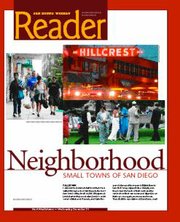
Neighborhood: small towns of San Diego
Del Dios, Ocean Beach, Borrego Springs, and 29 others
Fallbrook
by Laura McNeal
I often feel in downtown Fallbrook that I have walked through a door into the past, the door I have been looking for all my life. It happens at Jerry’s Barber Shop most often. +more
Clairemont
by Thomas Larson
As one of San Diego’s hubs, Clairemont is supremely accessible, lying between I-5 and I-805/163, south of San Clemente Canyon and north of Mission Valley; it’s also supremely in-between. +more
Imperial Beach
by Bill Manson
You’ll sit next to off-duty Customs and Border Patrol guys, nurses, teachers, actors, trailer-park retirees, long-bearded musicians, eccentrics, and even the odd millionaire. +more
Rolando
by Ernie Grimm
Almost all of the houses in Rolando are less than 1500 square feet. Those that are larger have had additions that mar the quaint symmetry Mr. Daley and his cohorts crafted so carefully. They sit centered on modest-sized lots, evenly spaced from each other. +more
Pacific Beach
by Jeannette De Wyze
Strolling down Garnet when it’s closed to cars and swollen with throngs of young men and women dressed in skimpy clothing who’ve gone through hell to find a parking space, I feel smug. I live a mile north of Crystal Pier, so I can walk or bicycle. I never have to worry about parking. +more
Normal Heights
by Abe Opincar
Over at the Normal Heights Community Planning Committee, well-intentioned activists fret that housing costs are driving immigrants and other low-income minorities from the neighborhood. Most of us, I think, would like to preserve the diversity we enjoy and admire. We’re not sure if it’s possible to maintain it. +more
Mission Valley
by Patrick Brassell
I spent today running from mall to mall, from Fenton Marketplace to Rio Vista Center to Park in the Valley to Mission Valley Center to Mission Valley West to Fashion Valley. I’m exhausted but high, as if I just ran the Rock ’n’ Roll Marathon. I’m not the only one. +more
Southeast San Diego
by Brian Lawless
Although on any given day I don’t usually come in contact with gangs, violence, or drugs, subconsciously I am aware that they are near, and I think that most people in Southeast San Diego are conscious of that fact. I still feel safe in the neighborhood though. +more
La Jolla
by Jonathan Saville
La Jolla is a shoreline and a mountain. Not a big mountain — only 822 feet of it — but it is a lush beauty spot, the higher the lusher. There isn’t much solitude left, for Mount Soledad has been built over from all directions. But on the side overlooking the Pacific, the narrow, winding streets, the thick foliage, the estates hidden behind elaborate grills, and the ever more stupendous views make a trip up the mountain an inspiring experience. +more
Del Dios
by Linda Nevin
Though it’s still green, shady, secluded, these days you can’t miss Del Dios. Blaring yellow signs on Del Dios Highway warn frustrated commuters that they can’t turn left, can’t roar down the hill and use dreamy, bucolic Lake Drive and Del Dios as a speedway shortcut home. +more
Ocean Beach
by Geoff Bouvier
I’ll take the charming anachronism over the “in thing” any day. Just give me the Flat Earth Society, Elizabethan countesses surfing the Internet, and long-haired hippies on Wall Street. +more
Lakeside
by Greg Finley
Lakeside has a reputation of being just another old-fashioned country town inhabited by a bunch of tobacco-chewing, horse-riding, “sheep-luvin’ ” hicks, not to mention being racist, perverted, and generally ignorant. But although the rodeo might be the town’s main attraction, Lakeside has more to offer. +more
Little Italy
by Sue Greenberg
All menus speak Italian, but the real language is gesture. Waiting lists of the weary on the sidewalk’s double-width lean on cement benches, pizza box aloft, admire hues of remaining views, scoop gelato. +more
San Marcos
by Leslie Ryland
Looking for a representative cross-section of San Marcos residents? Try the 24 Hour Fitness in the Vons center at San Marcos Boulevard and Rancho Santa Fe Road any weekday morning around 6:30. +more
South Mission Hills
by Dave Good
The subculture of South Mission Hills is not all that obvious. Most of my neighbors are Hispanic. Central-Mexico Hispanic, as my Mexican-American friends are quick to point out. Somehow, they’ve gotten a toehold on Reynard Way, a cheap-rent zone below the luxe homes on the hill. +more
Mission Hills
by Matthew Lickona and Deirdre Lickona
Every newlywed couple should have such a love nest: oodles of style, worn around the edges, reasonable rent. +more
El Cajon
by Joe Deegan
As squatters suddenly began appearing on ranches in Cajon Valley in the 1860s, so tent communities of homeless people are likely to pop up in various places in El Cajon today. One did recently behind the Gold Coast Apartments on Ballantyne Street. +more
Poway
by Alana Firl
Poway: “The City in the Country.” I was born and raised in Poway, and I can tell you that the slogan has never been accurate. +more
Borrego Springs
by Larry McCaffery
Cats, small dogs, and toddlers don’t last long here (the howl of coyotes can be heard almost every night from my deck). However, my wife and I have discovered that the enormous scorpions who regularly show up in our house make wonderful pets. +more
Barrio Logan
by Dorothy Kronick and Daniel Muñoz Jr.
Barrio Logan is a mixture of homes, markets, Mexican restaurants, and a lot of small businesses that are not exactly environmentally friendly. It is registered as one of the ten most polluted communities in California. Perkins Elementary is probably the only elementary school that has monitors on its rooftops to collect and gauge pollution. +more
Hillcrest
by Fred Moramarco
While Hillcrest is well-known as San Diego’s gay community, two of its lesser-known distinctions are that it is a mecca for the divorced and a haven for ex–New Yorkers. Since I was both, it seemed perfect for me. +more
Downtown
by Matt Potter
The insides of historic buildings have been gutted and their legacies shredded, replaced by high-priced designer versions of history. Tourists and conventioneers crowd the sidewalks, marching into trendy “theme” restaurants. Rum-and-Cokes have been replaced by flavored martinis favored by patrons who were born well after 1975. +more
Bonita
by Bill Salisbury
The southern hills were first to go: Corky McMillin built large houses on lots decidedly not zoned for horses. Corky did retain bridle paths, but now where the paths crossed roadways, vehicles of a swelling population menaced horse and rider. +more
Coronado
by Daniel Ridge
Like La Jolla and Del Mar, Coronado is the land of plenty, where presidents vacation and celebrities live. But beyond all that, beyond the consumerism and conservatism that once drove me mad as a teenager, Coronado is still just a sleepy town. +more
Chula Vista
by Susan Luzzaro
Approximately 300 acres owned by the Port Authority, 100 owned by out-of-town investors, and 30 owned by the City of Chula Vista are being studied now — convention centers, hotels, restaurants, office buildings, high-density, high-rise housing have been bandied about. What’s to become of Chula Vista’s insular gem? +more
Solana Beach
by Jennifer Ball
I always used to say that no house in Solana Beach is completely up to code. That endears me to a city. But with the recent gentrification driven by high housing prices, I’ve had to stop. Admittedly, Solana Beach is a town with a schism. +more
Point Loma
by Mary Montgomery
Point Loma’s essence is found in a blur of military installations, dilapidated restaurants that have been around so long they are considered classy, million-dollar ocean-view homes, and lampposts placed directly in the middle of streets that virtually all dead-end in canyons or gullies. +more
Oceanside
by Ken Leighton
While housing values have skyrocketed, Oceanside’s economy seems mired in a swamp of small-minded politics and semper fi inertia. +more
College Area
by Jay Allen Sanford
7-Eleven stopped selling Brillo pads and liquor stores quit carrying single-rose stems sealed in versatile glass tubes. +more
Encinitas
by Gabrielle Clifford
These are the people who remember the days of bicycling to work, when there were no stop signs on Highway 101 and when newcomers were immediately noticed, none of which are in the too-distant past. Things are not nearly the same, but needless to say they are still agreeable. +more
La Mesa
by Ken Kuhlken
For serious hiking, Cowles Mountain is maybe ten minutes by car from our home, and for strolling, Lake Murray’s even closer. But why drive at all when our part of La Mesa, which newcomers call “the Village,” is surrounded by three pretty hills? +more
Mira Mesa
by Josh Board
When Challenger Junior High School was built across the street from my house, I was bummed to be losing my favorite canyon. It was a canyon where my friends and I played cowboys and Indians, caught lizards and king snakes, and watched fires rage. +more
Here's something you might be interested in.
Neighborhood: small towns of San Diego
Del Dios, Ocean Beach, Borrego Springs, and 29 others

Neighborhood: small towns of San Diego
Del Dios, Ocean Beach, Borrego Springs, and 29 others
Fallbrook
by Laura McNeal
I often feel in downtown Fallbrook that I have walked through a door into the past, the door I have been looking for all my life. It happens at Jerry’s Barber Shop most often. +more
Clairemont
by Thomas Larson
As one of San Diego’s hubs, Clairemont is supremely accessible, lying between I-5 and I-805/163, south of San Clemente Canyon and north of Mission Valley; it’s also supremely in-between. +more
Imperial Beach
by Bill Manson
You’ll sit next to off-duty Customs and Border Patrol guys, nurses, teachers, actors, trailer-park retirees, long-bearded musicians, eccentrics, and even the odd millionaire. +more
Rolando
by Ernie Grimm
Almost all of the houses in Rolando are less than 1500 square feet. Those that are larger have had additions that mar the quaint symmetry Mr. Daley and his cohorts crafted so carefully. They sit centered on modest-sized lots, evenly spaced from each other. +more
Pacific Beach
by Jeannette De Wyze
Strolling down Garnet when it’s closed to cars and swollen with throngs of young men and women dressed in skimpy clothing who’ve gone through hell to find a parking space, I feel smug. I live a mile north of Crystal Pier, so I can walk or bicycle. I never have to worry about parking. +more
Normal Heights
by Abe Opincar
Over at the Normal Heights Community Planning Committee, well-intentioned activists fret that housing costs are driving immigrants and other low-income minorities from the neighborhood. Most of us, I think, would like to preserve the diversity we enjoy and admire. We’re not sure if it’s possible to maintain it. +more
Mission Valley
by Patrick Brassell
I spent today running from mall to mall, from Fenton Marketplace to Rio Vista Center to Park in the Valley to Mission Valley Center to Mission Valley West to Fashion Valley. I’m exhausted but high, as if I just ran the Rock ’n’ Roll Marathon. I’m not the only one. +more
Southeast San Diego
by Brian Lawless
Although on any given day I don’t usually come in contact with gangs, violence, or drugs, subconsciously I am aware that they are near, and I think that most people in Southeast San Diego are conscious of that fact. I still feel safe in the neighborhood though. +more
La Jolla
by Jonathan Saville
La Jolla is a shoreline and a mountain. Not a big mountain — only 822 feet of it — but it is a lush beauty spot, the higher the lusher. There isn’t much solitude left, for Mount Soledad has been built over from all directions. But on the side overlooking the Pacific, the narrow, winding streets, the thick foliage, the estates hidden behind elaborate grills, and the ever more stupendous views make a trip up the mountain an inspiring experience. +more
Del Dios
by Linda Nevin
Though it’s still green, shady, secluded, these days you can’t miss Del Dios. Blaring yellow signs on Del Dios Highway warn frustrated commuters that they can’t turn left, can’t roar down the hill and use dreamy, bucolic Lake Drive and Del Dios as a speedway shortcut home. +more
Ocean Beach
by Geoff Bouvier
I’ll take the charming anachronism over the “in thing” any day. Just give me the Flat Earth Society, Elizabethan countesses surfing the Internet, and long-haired hippies on Wall Street. +more
Lakeside
by Greg Finley
Lakeside has a reputation of being just another old-fashioned country town inhabited by a bunch of tobacco-chewing, horse-riding, “sheep-luvin’ ” hicks, not to mention being racist, perverted, and generally ignorant. But although the rodeo might be the town’s main attraction, Lakeside has more to offer. +more
Little Italy
by Sue Greenberg
All menus speak Italian, but the real language is gesture. Waiting lists of the weary on the sidewalk’s double-width lean on cement benches, pizza box aloft, admire hues of remaining views, scoop gelato. +more
San Marcos
by Leslie Ryland
Looking for a representative cross-section of San Marcos residents? Try the 24 Hour Fitness in the Vons center at San Marcos Boulevard and Rancho Santa Fe Road any weekday morning around 6:30. +more
South Mission Hills
by Dave Good
The subculture of South Mission Hills is not all that obvious. Most of my neighbors are Hispanic. Central-Mexico Hispanic, as my Mexican-American friends are quick to point out. Somehow, they’ve gotten a toehold on Reynard Way, a cheap-rent zone below the luxe homes on the hill. +more
Mission Hills
by Matthew Lickona and Deirdre Lickona
Every newlywed couple should have such a love nest: oodles of style, worn around the edges, reasonable rent. +more
El Cajon
by Joe Deegan
As squatters suddenly began appearing on ranches in Cajon Valley in the 1860s, so tent communities of homeless people are likely to pop up in various places in El Cajon today. One did recently behind the Gold Coast Apartments on Ballantyne Street. +more
Poway
by Alana Firl
Poway: “The City in the Country.” I was born and raised in Poway, and I can tell you that the slogan has never been accurate. +more
Borrego Springs
by Larry McCaffery
Cats, small dogs, and toddlers don’t last long here (the howl of coyotes can be heard almost every night from my deck). However, my wife and I have discovered that the enormous scorpions who regularly show up in our house make wonderful pets. +more
Barrio Logan
by Dorothy Kronick and Daniel Muñoz Jr.
Barrio Logan is a mixture of homes, markets, Mexican restaurants, and a lot of small businesses that are not exactly environmentally friendly. It is registered as one of the ten most polluted communities in California. Perkins Elementary is probably the only elementary school that has monitors on its rooftops to collect and gauge pollution. +more
Hillcrest
by Fred Moramarco
While Hillcrest is well-known as San Diego’s gay community, two of its lesser-known distinctions are that it is a mecca for the divorced and a haven for ex–New Yorkers. Since I was both, it seemed perfect for me. +more
Downtown
by Matt Potter
The insides of historic buildings have been gutted and their legacies shredded, replaced by high-priced designer versions of history. Tourists and conventioneers crowd the sidewalks, marching into trendy “theme” restaurants. Rum-and-Cokes have been replaced by flavored martinis favored by patrons who were born well after 1975. +more
Bonita
by Bill Salisbury
The southern hills were first to go: Corky McMillin built large houses on lots decidedly not zoned for horses. Corky did retain bridle paths, but now where the paths crossed roadways, vehicles of a swelling population menaced horse and rider. +more
Coronado
by Daniel Ridge
Like La Jolla and Del Mar, Coronado is the land of plenty, where presidents vacation and celebrities live. But beyond all that, beyond the consumerism and conservatism that once drove me mad as a teenager, Coronado is still just a sleepy town. +more
Chula Vista
by Susan Luzzaro
Approximately 300 acres owned by the Port Authority, 100 owned by out-of-town investors, and 30 owned by the City of Chula Vista are being studied now — convention centers, hotels, restaurants, office buildings, high-density, high-rise housing have been bandied about. What’s to become of Chula Vista’s insular gem? +more
Solana Beach
by Jennifer Ball
I always used to say that no house in Solana Beach is completely up to code. That endears me to a city. But with the recent gentrification driven by high housing prices, I’ve had to stop. Admittedly, Solana Beach is a town with a schism. +more
Point Loma
by Mary Montgomery
Point Loma’s essence is found in a blur of military installations, dilapidated restaurants that have been around so long they are considered classy, million-dollar ocean-view homes, and lampposts placed directly in the middle of streets that virtually all dead-end in canyons or gullies. +more
Oceanside
by Ken Leighton
While housing values have skyrocketed, Oceanside’s economy seems mired in a swamp of small-minded politics and semper fi inertia. +more
College Area
by Jay Allen Sanford
7-Eleven stopped selling Brillo pads and liquor stores quit carrying single-rose stems sealed in versatile glass tubes. +more
Encinitas
by Gabrielle Clifford
These are the people who remember the days of bicycling to work, when there were no stop signs on Highway 101 and when newcomers were immediately noticed, none of which are in the too-distant past. Things are not nearly the same, but needless to say they are still agreeable. +more
La Mesa
by Ken Kuhlken
For serious hiking, Cowles Mountain is maybe ten minutes by car from our home, and for strolling, Lake Murray’s even closer. But why drive at all when our part of La Mesa, which newcomers call “the Village,” is surrounded by three pretty hills? +more
Mira Mesa
by Josh Board
When Challenger Junior High School was built across the street from my house, I was bummed to be losing my favorite canyon. It was a canyon where my friends and I played cowboys and Indians, caught lizards and king snakes, and watched fires rage. +more