

Here's something you might be interested in.
Ask a Hipster — Advice you didn't know you needed
Big Screen — Movie commentary
Blurt — Music's inside track
Booze News — San Diego spirits
Classical Music — Immortal beauty
Classifieds — Free and easy
Cover Stories — Front-page features
Drinks All Around — Bartenders' drink recipes
Excerpts — Literary and spiritual excerpts
Feast! — Food & drink reviews
Feature Stories — Local news & stories
Fishing Report — What’s getting hooked from ship and shore
From the Archives — Spotlight on the past
Golden Dreams — Talk of the town
The Gonzo Report — Making the musical scene, or at least reporting from it
Letters — Our inbox
Movies@Home — Local movie buffs share favorites
Movie Reviews — Our critics' picks and pans
Musician Interviews — Up close with local artists
Neighborhood News from Stringers — Hyperlocal news
News Ticker — News & politics
Obermeyer — San Diego politics illustrated
Outdoors — Weekly changes in flora and fauna
Overheard in San Diego — Eavesdropping illustrated
Poetry — The old and the new
Reader Travel — Travel section built by travelers
Reading — The hunt for intellectuals
Roam-O-Rama — SoCal's best hiking/biking trails
San Diego Beer — Inside San Diego suds
SD on the QT — Almost factual news
Sheep and Goats — Places of worship
Special Issues — The best of
Street Style — San Diego streets have style
Surf Diego — Real stories from those braving the waves
Theater — On stage in San Diego this week
Tin Fork — Silver spoon alternative
Under the Radar — Matt Potter's undercover work
Unforgettable — Long-ago San Diego
Unreal Estate — San Diego's priciest pads
Your Week — Daily event picks
Baja California Sur – like Leucadia of the ’70s
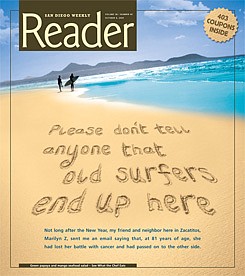
Please don't tell anyone that old surfers end up here
Not long after the New Year, my friend and neighbor here in Zacatitos, Marilyn Z, sent me an email saying that, at 81 years of age, she had lost her battle with cancer and had passed on to the other side.
Marilyn went on to say that when she left her beloved home in Baja to see an oncologist in New York, he told her that although things looked bad, she still had two treatment options: chemo or radiation.
“Which would you recommend for your wife?” Marilyn asked.
“Well, my wife and I are divorced, I pay her huge sums in alimony, and I hate her dearly. So for her I would recommend both.”
“Then I don’t want either,” Marilyn said.
“Good choice,” the doctor replied.
It was the first time I had ever received an email from the other side, the first time I had ever heard such a thing was possible, but it didn’t surprise me at all that it had come from Marilyn. She was always capable of surprises. I once watched her march bravely into surf higher than her head (she was only five feet tall), just for the pleasure of feeling the ocean toss her around. When people asked Marilyn why she painted her house in Zacatitos an outrageous purple and lime-green, she told them, “Because you can’t do that in the U.S.!” For her, Baja was a chance to get a little more fun out of life at a time when most people her age were resigned to the slow daily death of TV and trips to Walmart. Her courage was rewarded with a youthful, irreverent humor and a house full of friends to enjoy it with.
Besides sharing her cache of cold beer with me, when I had no means to keep a beer cold, and allowing me to beat her at Scrabble on peaceful Sunday afternoons, Marilyn taught me some of the fundamentals of surviving in Baja: where to buy drinking water safe enough for a gringo’s weak stomach; where to find good emergency medical care; where to get sopa de mariscos at Mexican — not tourist — prices; and where to get the best deal on Pacifico by the case. She told me her philosophy for living in Mexico was the same as living anywhere else: “Don’t hurt anybody, and try to help somebody if you can.”
And, she said, “Be sure to pay your property tax in January.”
So before the end of the month, I took my angelic friend’s advice and drove the 10 kilometers of dusty road into San José del Cabo to pay my annual tax.
At 500 pesos, or less than $50 per year, the property tax in Baja California Sur is so cheap that even unrepentant surfers like me, who squandered their youth on the beaches of San Diego, can afford to retire here with some hope of squandering their old age in a similar way. You might think of this place as another chance at the Leucadia of the ’70s, the place and decade my wife and I met. It’s beautiful, it’s peaceful, and it’s still fairly cheap.
And don’t tell anybody, but the surf here is better than Leucadia ever was. Most of San Diego County doesn’t get a south swell, which is why the surf is so poor in the summer. This place faces south, and in the winter, when the north swells arrive, you can drive over to the Pacific side in an hour. This place lacks the crowds of California, the violence and racial tension of Hawaii, and you can get here in just about any vehicle with a thousand miles of abuse left in it. If the Mexicans deported us and shut down the border, we would have to hire coyotes to smuggle us back in.
It’s not uncommon to see California’s newly arrived surf refugees, like dust-bowl Okies, camped along Baja’s beaches in broke-down, rusted-out vans, with an old gray-muzzled dog and a patched-up longboard. To ex-wives and the IRS, they might as well be dead. Their past may have been ugly, but for the first time in a long time they have a future.
As surfers who watched the California coastline ravaged in our lifetimes, we might prefer that people back in the U.S. go right on thinking Mexico is too dangerous for them to live here. Some surfers here will resent my even talking about how good conditions are, for fear the crowds will become as intolerable as they are in California. And maybe they’re right. If Americans prefer to keep their misconceptions about Mexico, maybe it’s better things stay that way. But the truth is, except for those bad border towns, most of Baja is a more tranquil place than the typical American city. The gun violence taken for granted in the U.S. as a constitutional right simply doesn’t exist here in Los Cabos.
A friend of mine who lives in Northern California, but spends half the year in Baja, was asked by somebody at home, “Isn’t it dangerous to go to Mexico?” And my friend said, “Yes, it is. You have to pass right through L.A.”
When my wife and I read a gruesome story about a man from Carlsbad who murdered his parents and fled, possibly to Baja, we were shocked. “That guy better be careful. Doesn’t he know it’s dangerous down here?”
Of course, our family and friends in the States think my wife and I are crazy for moving here. They watch way too much news on TV and think drug lords in black Escalades sweep through the streets every day, shooting and beheading people. When a friend heard we were moving to Mexico, he asked, “What in the hell inspired that? Insanity?”
“We just felt like somebody needed to move in the other direction,” I said.
This misconception of Mexico being more dangerous than the U.S. hurts Mexico, which depends on the tourist business for about one-third of its revenue. Every time Lou Dobbs, or any of the other angry and embittered commentators on TV news, opens his scowling mouth, a few more Mexicans lose their jobs. This is a very real problem here. The American media’s neurotic insistence on portraying Mexico as a more dangerous place than the United States serves no purpose other than to prop up Americans’ damaged self-confidence. It hurts hardworking people.
The good thing is, Mexicans always find a way to survive. If the hotel where you worked as a tour guide lays you off after the flu panic, you wash cars in the supermarket parking lot. If you lose your job as a waiter after the American banking crisis, you sell ice cream on the street. If your back gives out after 40 years of laying block, you bag groceries for tips. All Mexicans work.
I took the beach road into San José and stopped along a stretch of white sand and turquoise-colored water to drink a Pacifico in honor of Marilyn Z. Though she wasn’t a fisherman, she was the first to tell me about a beautiful and bizarre-looking beast called a roosterfish that favors this coast. It has a huge silvery dorsal fin like an Aztecan headdress and an attitude like a guard dog. It attacks a feathered lure with ferocity totally inappropriate for such a tranquil place, and it fights to the death. A surfer friend of mine who likes to troll for fish from his paddleboard, trailing a lure from a line strapped to his ankle, was nearly pulled from his board and dragged underwater by a roosterfish before the 40-pound test line snapped.
A person could live in the American suburbs, quiet as a casket, and never know such a remarkable creature existed.
At La Choya, I stopped for a minute to watch a crew of Mexican block-layers at work. Marilyn told me once, “Stop at any job site in Mexico and breathe the air. It smells of fabric softener.” And she’s right. The smell is like a gift of love from the workers’ wives, who would never let their men, no matter how humble, go to work in dirty clothes.
Laying block is one of the hardest, most tedious jobs imaginable. But all of Mexico is built of block, and somebody has to do the work. People everywhere who work in crews enjoy a camaraderie that makes the difficult labor more tolerable, and it warms my heart to see how these workers laugh and joke with each other to pass the time. At one point in my life, I worked as hard as they do. I don’t miss that work because I know what it does to your body, and I have the surgery scars to prove it, but I do miss the camaraderie.
All over Mexico you can see older men who have spent a lifetime doing block work. Many of them drag one foot — what neurosurgeons call “foot drop” — as a result of permanent damage to the sciatic nerve. In the U.S., a worker lucky enough to have medical insurance would have surgery to relieve the pain and pressure on the nerve, which results from a herniated spinal disc. In Mexico, the workers often wait until the pain goes away on its own, a sign the sensory nerve has died. But it’s also a sign the motor nerve has died as well, and the muscle will soon atrophy.
Sometimes, when it’s hot and the afternoon is long, at these job sites you can hear the maestro singing to his young workers, teaching them how it’s possible to make the day pass a little easier. Mexicans have a relationship with work you don’t see much in the U.S. anymore. Just watching is an antidote for the anger and pessimism Americans suffer from these days. All the good qualities of character that Americans pride themselves on — honesty, hard work, love of family — can be found in the Mexican people. Mexicans are the kind of people many Americans think they are themselves but haven’t truly been for a long time.
My Mexican friend Francisco told me, “When I was growing up, Americans who came here were happy, fun-loving people. I thought I wanted to be like Americans. Now they are angry and afraid. What happened?”
I couldn’t really answer him. But I could as easily have asked why Mexico has to export 10 percent of its population to another country in order for them to earn a living. Mexico has its problems, too.
I started the truck and started to pull out onto the rutted road, when I heard a rooster crow. I slammed on the brakes, thinking the rooster was in front of me, where I couldn’t see it. Then I realized it was the ringtone on my Mexican cell phone. It was my mother, back in the U.S. After two years, she’s finally accepted the notion that I live in another country, and that if she wants to call me, she has to enter the correct international code. Now she calls me all the time.
Today, she was concerned about the quality of food here. “Do they have good beef?” she wanted to know. Once again, I explained that everything Americans know about raising cattle west of the Mississippi they learned from the Mexicans. Even the word cowboy comes from vaquero. The Mexicans taught us that in a desert you don’t raise cattle the way they do in England, on 40 acres of irrigated pastureland, but on 4000 acres of near wasteland. The American cowboy may be the very image of Americans, but everything about him, from his hat to his chaps and saddle, came from Mexico. Without Mexicans, the American cowboy on a horse would look and act more like Prince Charles than John Wayne. And yes, Mexico has very good beef.
“But do they know how to butcher it?” my mother asked.
After a while, I parked outside the municipal office, in front of the fire station, where the firemen were selling T-shirts and empanadas to help pay for the cost of fighting fires. Then I took my place in line at the municipal office. It wasn’t a long line.
The municipal government in Los Cabos knows it needs to collect more property taxes in order to provide the basic services its citizens expect, like garbage collection, street repair, and a fireworks display every time Mexico wins a futbol match at the world cup. But Mexicans see that in California, where property taxes are one hundred times as high as they are here, the government still can’t balance its budget. When things get that bad, not even a movie-star governor can help you. So what would be the point of raising taxes?
To encourage people to pay property taxes on time, the municipal government of Los Cabos offers a 10 percent discount if you pay in the month of January. We Americans like to pay our tax in January, not because we care so much about the $5 discount, but because that’s the way we are. We like to do things on time, or earlier if possible, because it allows us the illusion that we have things under control.
Mexicans are more accustomed to living with uncertainty. They don’t trust control and aren’t fooled by 10 percent discounts. They know very well they can get a 100 percent discount simply by not paying the property tax at all, and the government, understaffed and underfunded, as a good government should be, won’t have the resources to collect.
When my turn finally came, I handed the clerk my receipt from last year’s taxes, showing my name and property number. The clerk was a tall young man with coffee-colored skin and black hair. He looked at my receipt and asked in Spanish, “Where do you come from?”
“Santa Cruz de Los Zacatitos,” I replied.
He nodded patiently. “No, before that.”
“Well, California.” But I knew as soon as I opened my mouth, it was the wrong thing to say to a Mexican. In the time of the Jesuit and Franciscan padres, there had been an Alta California and a Baja California. Now, in Mexico, there is a Baja California, and a Baja California Sur. In the U.S. we have appropriated the name “California” for ourselves, as if we possess the only California that matters, the one with the 37 million people. Those unfortunate souls who live below the Tijuana Sloughs can call their land whatever amuses them, but certainly not California. That is why Americans refer to Baja California as simply Baja, which often annoys Mexicans, even though they are too well mannered to show it. And that is why Mexicans sometimes refer to Alta California as “that state to the north,” as if the misunderstanding created by the Treaty of Guadalupe Hidalgo, which left Mexico without half its land, will be straightened out in due time, if they only have the patience to wait. And Mexicans do have the patience to wait.
The young clerk chose not to correct my poor sense of history by bringing up the subject of the Mexican-American War, in which American soldiers invaded San José del Cabo and established a garrison near the very place I was now standing and later killed one Mexican soldier, Lieutenant José Antonio Mijares, a hero who died defending his country and whose name is now borne by the boulevard out front, more commonly known as “hotel row,” where a hundred or more beefy, sunburned Americans now wandered timidly, ready to scatter at the sound of gunshots or the sight of a black Escalade.
“No,” the clerk said. “I mean before that.”
Now I was lost. I had no idea what he meant. This is the most frightening thing about being an immigrant, this moment when all communication falls apart. The problem wasn’t language — I understood his words well enough. Rather, I suspected, it was a failure to bridge some cultural gap. Was he ridiculing my immigrant status? Implying I might be an illegal alien? No, he looked too sincere. Was he a Mexican evangelical, of which there are many, trying to tempt me into a religious discussion about where we come from and where we are going? No, he had no time for such nonsense. Besides, gringos are the world’s greatest exporters of evangelism, from Mormons to Mary Kay Cosmetics. It would be like trying to sell bananas to a Panamanian, and this young man looked too smart for that.
It’s disturbing to have somebody ask you where you come from and not be able to answer them, and it’s a question that is more confusing the older you get. If you’ve been to a lot of places, and lived in many of them, then you might have come from any one. The question raises vague anxieties about who you really are. In any case, wherever I came from, it was a place so different from this young man that we couldn’t understand each other.
Just then my cell phone rang. I slapped at my pants pockets, trying to remember where I’d put it. But this time it really was a rooster out on the street.
The clerk smiled at my confusion and raised his palm in a way that said he would clear up our misunderstanding in a moment. He took my 500 pesos, punched a few keys on his computer, and the receipt began printing out. It was a beautiful piece of paper, with an image of the lovely 300-year-old mission up the street, and a four-color municipal seal. The clerk handed me the receipt. He pointed with his pen to a line at the top, which indicated that the property owner was me, Steven Sorensen. Then he pointed to the line at the bottom, which indicated that he had been the clerk waiting on me. His name was Elisio Sorenson Orantes.
At the look of surprise on my face, Elisio laughed with delight. “My grandfather came from Sweden,” he said.
“And my great-grandfather came from Denmark,” I said.
“We are both Vikings with the same name!” he said.
We shook hands under the glass window, and as I looked more closely, I saw that, in spite of his dark skin, this young man had a nose much like my father, and a receding hairline like my nephew, and greenish-blue eyes eerily like my own. In spite of our differences in country, age, language, and culture, we had much in common. This man was my relative. His ancestors and mine had rowed a boat together across the North Sea for the heathen pleasure of kicking English asses, stealing their wine, and giving their women red-haired babies. And now, after all this time, we were compadres once again.
When we think we are different from other people, we are often mistaken. And when we think we are better than other people, we are always foolish.
Here's something you might be interested in.
Baja California Sur – like Leucadia of the ’70s
Please don't tell anyone that old surfers end up here

Baja California Sur – like Leucadia of the ’70s
Please don't tell anyone that old surfers end up here
Not long after the New Year, my friend and neighbor here in Zacatitos, Marilyn Z, sent me an email saying that, at 81 years of age, she had lost her battle with cancer and had passed on to the other side.
Marilyn went on to say that when she left her beloved home in Baja to see an oncologist in New York, he told her that although things looked bad, she still had two treatment options: chemo or radiation.
“Which would you recommend for your wife?” Marilyn asked.
“Well, my wife and I are divorced, I pay her huge sums in alimony, and I hate her dearly. So for her I would recommend both.”
“Then I don’t want either,” Marilyn said.
“Good choice,” the doctor replied.
It was the first time I had ever received an email from the other side, the first time I had ever heard such a thing was possible, but it didn’t surprise me at all that it had come from Marilyn. She was always capable of surprises. I once watched her march bravely into surf higher than her head (she was only five feet tall), just for the pleasure of feeling the ocean toss her around. When people asked Marilyn why she painted her house in Zacatitos an outrageous purple and lime-green, she told them, “Because you can’t do that in the U.S.!” For her, Baja was a chance to get a little more fun out of life at a time when most people her age were resigned to the slow daily death of TV and trips to Walmart. Her courage was rewarded with a youthful, irreverent humor and a house full of friends to enjoy it with.
Besides sharing her cache of cold beer with me, when I had no means to keep a beer cold, and allowing me to beat her at Scrabble on peaceful Sunday afternoons, Marilyn taught me some of the fundamentals of surviving in Baja: where to buy drinking water safe enough for a gringo’s weak stomach; where to find good emergency medical care; where to get sopa de mariscos at Mexican — not tourist — prices; and where to get the best deal on Pacifico by the case. She told me her philosophy for living in Mexico was the same as living anywhere else: “Don’t hurt anybody, and try to help somebody if you can.”
And, she said, “Be sure to pay your property tax in January.”
So before the end of the month, I took my angelic friend’s advice and drove the 10 kilometers of dusty road into San José del Cabo to pay my annual tax.
At 500 pesos, or less than $50 per year, the property tax in Baja California Sur is so cheap that even unrepentant surfers like me, who squandered their youth on the beaches of San Diego, can afford to retire here with some hope of squandering their old age in a similar way. You might think of this place as another chance at the Leucadia of the ’70s, the place and decade my wife and I met. It’s beautiful, it’s peaceful, and it’s still fairly cheap.
And don’t tell anybody, but the surf here is better than Leucadia ever was. Most of San Diego County doesn’t get a south swell, which is why the surf is so poor in the summer. This place faces south, and in the winter, when the north swells arrive, you can drive over to the Pacific side in an hour. This place lacks the crowds of California, the violence and racial tension of Hawaii, and you can get here in just about any vehicle with a thousand miles of abuse left in it. If the Mexicans deported us and shut down the border, we would have to hire coyotes to smuggle us back in.
It’s not uncommon to see California’s newly arrived surf refugees, like dust-bowl Okies, camped along Baja’s beaches in broke-down, rusted-out vans, with an old gray-muzzled dog and a patched-up longboard. To ex-wives and the IRS, they might as well be dead. Their past may have been ugly, but for the first time in a long time they have a future.
As surfers who watched the California coastline ravaged in our lifetimes, we might prefer that people back in the U.S. go right on thinking Mexico is too dangerous for them to live here. Some surfers here will resent my even talking about how good conditions are, for fear the crowds will become as intolerable as they are in California. And maybe they’re right. If Americans prefer to keep their misconceptions about Mexico, maybe it’s better things stay that way. But the truth is, except for those bad border towns, most of Baja is a more tranquil place than the typical American city. The gun violence taken for granted in the U.S. as a constitutional right simply doesn’t exist here in Los Cabos.
A friend of mine who lives in Northern California, but spends half the year in Baja, was asked by somebody at home, “Isn’t it dangerous to go to Mexico?” And my friend said, “Yes, it is. You have to pass right through L.A.”
When my wife and I read a gruesome story about a man from Carlsbad who murdered his parents and fled, possibly to Baja, we were shocked. “That guy better be careful. Doesn’t he know it’s dangerous down here?”
Of course, our family and friends in the States think my wife and I are crazy for moving here. They watch way too much news on TV and think drug lords in black Escalades sweep through the streets every day, shooting and beheading people. When a friend heard we were moving to Mexico, he asked, “What in the hell inspired that? Insanity?”
“We just felt like somebody needed to move in the other direction,” I said.
This misconception of Mexico being more dangerous than the U.S. hurts Mexico, which depends on the tourist business for about one-third of its revenue. Every time Lou Dobbs, or any of the other angry and embittered commentators on TV news, opens his scowling mouth, a few more Mexicans lose their jobs. This is a very real problem here. The American media’s neurotic insistence on portraying Mexico as a more dangerous place than the United States serves no purpose other than to prop up Americans’ damaged self-confidence. It hurts hardworking people.
The good thing is, Mexicans always find a way to survive. If the hotel where you worked as a tour guide lays you off after the flu panic, you wash cars in the supermarket parking lot. If you lose your job as a waiter after the American banking crisis, you sell ice cream on the street. If your back gives out after 40 years of laying block, you bag groceries for tips. All Mexicans work.
I took the beach road into San José and stopped along a stretch of white sand and turquoise-colored water to drink a Pacifico in honor of Marilyn Z. Though she wasn’t a fisherman, she was the first to tell me about a beautiful and bizarre-looking beast called a roosterfish that favors this coast. It has a huge silvery dorsal fin like an Aztecan headdress and an attitude like a guard dog. It attacks a feathered lure with ferocity totally inappropriate for such a tranquil place, and it fights to the death. A surfer friend of mine who likes to troll for fish from his paddleboard, trailing a lure from a line strapped to his ankle, was nearly pulled from his board and dragged underwater by a roosterfish before the 40-pound test line snapped.
A person could live in the American suburbs, quiet as a casket, and never know such a remarkable creature existed.
At La Choya, I stopped for a minute to watch a crew of Mexican block-layers at work. Marilyn told me once, “Stop at any job site in Mexico and breathe the air. It smells of fabric softener.” And she’s right. The smell is like a gift of love from the workers’ wives, who would never let their men, no matter how humble, go to work in dirty clothes.
Laying block is one of the hardest, most tedious jobs imaginable. But all of Mexico is built of block, and somebody has to do the work. People everywhere who work in crews enjoy a camaraderie that makes the difficult labor more tolerable, and it warms my heart to see how these workers laugh and joke with each other to pass the time. At one point in my life, I worked as hard as they do. I don’t miss that work because I know what it does to your body, and I have the surgery scars to prove it, but I do miss the camaraderie.
All over Mexico you can see older men who have spent a lifetime doing block work. Many of them drag one foot — what neurosurgeons call “foot drop” — as a result of permanent damage to the sciatic nerve. In the U.S., a worker lucky enough to have medical insurance would have surgery to relieve the pain and pressure on the nerve, which results from a herniated spinal disc. In Mexico, the workers often wait until the pain goes away on its own, a sign the sensory nerve has died. But it’s also a sign the motor nerve has died as well, and the muscle will soon atrophy.
Sometimes, when it’s hot and the afternoon is long, at these job sites you can hear the maestro singing to his young workers, teaching them how it’s possible to make the day pass a little easier. Mexicans have a relationship with work you don’t see much in the U.S. anymore. Just watching is an antidote for the anger and pessimism Americans suffer from these days. All the good qualities of character that Americans pride themselves on — honesty, hard work, love of family — can be found in the Mexican people. Mexicans are the kind of people many Americans think they are themselves but haven’t truly been for a long time.
My Mexican friend Francisco told me, “When I was growing up, Americans who came here were happy, fun-loving people. I thought I wanted to be like Americans. Now they are angry and afraid. What happened?”
I couldn’t really answer him. But I could as easily have asked why Mexico has to export 10 percent of its population to another country in order for them to earn a living. Mexico has its problems, too.
I started the truck and started to pull out onto the rutted road, when I heard a rooster crow. I slammed on the brakes, thinking the rooster was in front of me, where I couldn’t see it. Then I realized it was the ringtone on my Mexican cell phone. It was my mother, back in the U.S. After two years, she’s finally accepted the notion that I live in another country, and that if she wants to call me, she has to enter the correct international code. Now she calls me all the time.
Today, she was concerned about the quality of food here. “Do they have good beef?” she wanted to know. Once again, I explained that everything Americans know about raising cattle west of the Mississippi they learned from the Mexicans. Even the word cowboy comes from vaquero. The Mexicans taught us that in a desert you don’t raise cattle the way they do in England, on 40 acres of irrigated pastureland, but on 4000 acres of near wasteland. The American cowboy may be the very image of Americans, but everything about him, from his hat to his chaps and saddle, came from Mexico. Without Mexicans, the American cowboy on a horse would look and act more like Prince Charles than John Wayne. And yes, Mexico has very good beef.
“But do they know how to butcher it?” my mother asked.
After a while, I parked outside the municipal office, in front of the fire station, where the firemen were selling T-shirts and empanadas to help pay for the cost of fighting fires. Then I took my place in line at the municipal office. It wasn’t a long line.
The municipal government in Los Cabos knows it needs to collect more property taxes in order to provide the basic services its citizens expect, like garbage collection, street repair, and a fireworks display every time Mexico wins a futbol match at the world cup. But Mexicans see that in California, where property taxes are one hundred times as high as they are here, the government still can’t balance its budget. When things get that bad, not even a movie-star governor can help you. So what would be the point of raising taxes?
To encourage people to pay property taxes on time, the municipal government of Los Cabos offers a 10 percent discount if you pay in the month of January. We Americans like to pay our tax in January, not because we care so much about the $5 discount, but because that’s the way we are. We like to do things on time, or earlier if possible, because it allows us the illusion that we have things under control.
Mexicans are more accustomed to living with uncertainty. They don’t trust control and aren’t fooled by 10 percent discounts. They know very well they can get a 100 percent discount simply by not paying the property tax at all, and the government, understaffed and underfunded, as a good government should be, won’t have the resources to collect.
When my turn finally came, I handed the clerk my receipt from last year’s taxes, showing my name and property number. The clerk was a tall young man with coffee-colored skin and black hair. He looked at my receipt and asked in Spanish, “Where do you come from?”
“Santa Cruz de Los Zacatitos,” I replied.
He nodded patiently. “No, before that.”
“Well, California.” But I knew as soon as I opened my mouth, it was the wrong thing to say to a Mexican. In the time of the Jesuit and Franciscan padres, there had been an Alta California and a Baja California. Now, in Mexico, there is a Baja California, and a Baja California Sur. In the U.S. we have appropriated the name “California” for ourselves, as if we possess the only California that matters, the one with the 37 million people. Those unfortunate souls who live below the Tijuana Sloughs can call their land whatever amuses them, but certainly not California. That is why Americans refer to Baja California as simply Baja, which often annoys Mexicans, even though they are too well mannered to show it. And that is why Mexicans sometimes refer to Alta California as “that state to the north,” as if the misunderstanding created by the Treaty of Guadalupe Hidalgo, which left Mexico without half its land, will be straightened out in due time, if they only have the patience to wait. And Mexicans do have the patience to wait.
The young clerk chose not to correct my poor sense of history by bringing up the subject of the Mexican-American War, in which American soldiers invaded San José del Cabo and established a garrison near the very place I was now standing and later killed one Mexican soldier, Lieutenant José Antonio Mijares, a hero who died defending his country and whose name is now borne by the boulevard out front, more commonly known as “hotel row,” where a hundred or more beefy, sunburned Americans now wandered timidly, ready to scatter at the sound of gunshots or the sight of a black Escalade.
“No,” the clerk said. “I mean before that.”
Now I was lost. I had no idea what he meant. This is the most frightening thing about being an immigrant, this moment when all communication falls apart. The problem wasn’t language — I understood his words well enough. Rather, I suspected, it was a failure to bridge some cultural gap. Was he ridiculing my immigrant status? Implying I might be an illegal alien? No, he looked too sincere. Was he a Mexican evangelical, of which there are many, trying to tempt me into a religious discussion about where we come from and where we are going? No, he had no time for such nonsense. Besides, gringos are the world’s greatest exporters of evangelism, from Mormons to Mary Kay Cosmetics. It would be like trying to sell bananas to a Panamanian, and this young man looked too smart for that.
It’s disturbing to have somebody ask you where you come from and not be able to answer them, and it’s a question that is more confusing the older you get. If you’ve been to a lot of places, and lived in many of them, then you might have come from any one. The question raises vague anxieties about who you really are. In any case, wherever I came from, it was a place so different from this young man that we couldn’t understand each other.
Just then my cell phone rang. I slapped at my pants pockets, trying to remember where I’d put it. But this time it really was a rooster out on the street.
The clerk smiled at my confusion and raised his palm in a way that said he would clear up our misunderstanding in a moment. He took my 500 pesos, punched a few keys on his computer, and the receipt began printing out. It was a beautiful piece of paper, with an image of the lovely 300-year-old mission up the street, and a four-color municipal seal. The clerk handed me the receipt. He pointed with his pen to a line at the top, which indicated that the property owner was me, Steven Sorensen. Then he pointed to the line at the bottom, which indicated that he had been the clerk waiting on me. His name was Elisio Sorenson Orantes.
At the look of surprise on my face, Elisio laughed with delight. “My grandfather came from Sweden,” he said.
“And my great-grandfather came from Denmark,” I said.
“We are both Vikings with the same name!” he said.
We shook hands under the glass window, and as I looked more closely, I saw that, in spite of his dark skin, this young man had a nose much like my father, and a receding hairline like my nephew, and greenish-blue eyes eerily like my own. In spite of our differences in country, age, language, and culture, we had much in common. This man was my relative. His ancestors and mine had rowed a boat together across the North Sea for the heathen pleasure of kicking English asses, stealing their wine, and giving their women red-haired babies. And now, after all this time, we were compadres once again.
When we think we are different from other people, we are often mistaken. And when we think we are better than other people, we are always foolish.
Comments