

Here's something you might be interested in.
Ask a Hipster — Advice you didn't know you needed
Big Screen — Movie commentary
Blurt — Music's inside track
Booze News — San Diego spirits
Classical Music — Immortal beauty
Classifieds — Free and easy
Cover Stories — Front-page features
Drinks All Around — Bartenders' drink recipes
Excerpts — Literary and spiritual excerpts
Feast! — Food & drink reviews
Feature Stories — Local news & stories
Fishing Report — What’s getting hooked from ship and shore
From the Archives — Spotlight on the past
Golden Dreams — Talk of the town
The Gonzo Report — Making the musical scene, or at least reporting from it
Letters — Our inbox
Movies@Home — Local movie buffs share favorites
Movie Reviews — Our critics' picks and pans
Musician Interviews — Up close with local artists
Neighborhood News from Stringers — Hyperlocal news
News Ticker — News & politics
Obermeyer — San Diego politics illustrated
Outdoors — Weekly changes in flora and fauna
Overheard in San Diego — Eavesdropping illustrated
Poetry — The old and the new
Reader Travel — Travel section built by travelers
Reading — The hunt for intellectuals
Roam-O-Rama — SoCal's best hiking/biking trails
San Diego Beer — Inside San Diego suds
SD on the QT — Almost factual news
Sheep and Goats — Places of worship
Special Issues — The best of
Street Style — San Diego streets have style
Surf Diego — Real stories from those braving the waves
Theater — On stage in San Diego this week
Tin Fork — Silver spoon alternative
Under the Radar — Matt Potter's undercover work
Unforgettable — Long-ago San Diego
Unreal Estate — San Diego's priciest pads
Your Week — Daily event picks
To Ota, with a Sensei and a Nisei
**** 1/2 (Excellent to Extraordinary)
4529 Mission Bay Drive (at Bunker Hill Street), Pacific Beach, 858-270-5670.
HOURS: Saturday--Monday 5:30--10:30 p.m., Tuesday--Friday 11 a.m.--2 p.m. and 5:30--10:30 p.m.
PRICES: Sushi and sashimi $25--$35 for full dinner (plus tip, tax, beverages). Prix-fixe omakase sushi or sashimi arrays are $27 (to feed one fully). Special dinners can go much higher. Some sakes are very steep.
CUISINE AND BEVERAGES: Pristine, sea-fresh, creative sushi and sashimi in the pure Japanese style. (Menu of cooked Japanese dishes is less interesting.) Large selection of sakes.
PICK HITS: Omakase prix-fixe menus of sushi or sashimi. ç la carte: uni (sea urchin roe); toro (fatty tuna belly); ama ebi (sweet shrimp with flash-baked heads); aji sashimi (whole Spanish mackerel); full four-course lobster sashimi (raw, "dynamite," fried head, and lobster miso); "sushi sundae" (uni and toro over a mound of Japanese potato); sea snail over burnt sugar (occasional special); chawan mushi (a custard soup from the cooked-dish menu); any nightly specials.
NEED TO KNOW: In the corner of a mini-mall marked with a 7-Eleven sign on the east side of the street (easiest approach from the south), opposite Rubio's. Crowded parking lot, but spots open quickly. Don't bother with Americanized "party rolls" (e.g., California Roll, or any roll with cream cheese!), but watch other diners to spot off-menu extravaganzas. Expansion into new second dining room (with door to/from parking lot) makes wheelchair access possible, although space is still tight. Very loud when crowded. Reservations essential (you may still have to wait for a table). Call one month ahead for Ota-San's own counter station. Quality is best late in the week (Wednesday or Thursday--Saturday) when Ota is present. Call ahead to order takeout.
Dramatis Personae:
Masayuki Shimabukuro, Hanshi (aka "Shima Sensei"), martial arts master/teacher
"Samurai Jim," "hapi-hapi" nisei Japanese swordsmanship student
Masako S., Jim's mom
Naomi W., gaijin food critic
Vocabulary: Sensei is a Japanese martial arts master and teacher. (Remember 1961's Yojimbo, with those top-knotted ninnies following Toshiro Mifune around, whining, "Sensei, sensei?") Itamei is a sushi chef. Issei is a first-generation Japanese immigrant. Nisei is second generation. Hapi-hapi is Hawaiian for half-Caucasian, half-Asian or Islander. Nihonjin means "Japanese people." (Jin means "people.") Gaijin means "foreign." (In Chinese, gwei means foreign; in Yiddish it's goy; in Romansch (Gypsy) it's gajo, with a soft j, pronounced "gazho." Weird, huh?)
Opening Shot: the Jikishin-Kai dojo in Clairemont Mesa.
The sensei (a vigorous, youthful-looking man in his 50s) is chatting with student Jim after a swordsmanship class. "You must go eat at Sushi Ota," says Shima Sensei. "I know Ota personally, he is the most professional sushi chef here. You know, when people visit San Diego from Japan, that is where they eat. When nihonjin eat there, they get completely different food from gaijin."
"In what way different?" Jim asks.
"My favorite dish there is lobster sashimi. The back half is chopped-up raw lobster meat. The front half is still moving. Shows that the meat is really fresh."
Jim (aside): "My people are such savages..."
Cut to: Split-screen, Jim and Naomi at their computers a few miles apart.
Jim emails Naomi his conversation with Shima Sensei and Naomi realizes there's an amazing learning opportunity here, a chance to discover whether or not the long-standing rumor is true that at Ota, Japanese patrons get very different food from Americans. (Cut to the chase.)
Fade In: A table at Sushi Ota, in the new back room that has expanded the premises.
Jim's mother Masako has joined us to serve as translator, if necessary. She is a tiny, dainty-featured live wire with shoulder-length black hair and four-inch heels that raise her height to about 4'9". Shima Sensei is wearing a Hawaiian shirt, signifying relaxation mode, a side of his strict teacher that Jim has never encountered before. Naomi is secretly nervous -- will she seem like a foreign savage? Masako and Shima confer over the drink list, speaking in Japanese, and order a bottle of sake, Toko Yama ("Man's Mountain"), a strong, smooth blend with a flavor reminiscent of Thailand's Mekong brand rice-based whisky. Naomi orders her usual half-bottle of Nigori, "Japanese fizzy water," unfiltered sake with the texture of a milkshake -- baby-food sake, but reliably palatable.
On the table is a plastic-laminated half-sheet with photos displaying three omakase menus (one for sushi, two for sashimi). This is relatively new and very welcome. With sashimi, the center of your extravaganza can either be lobster or aji, Spanish mackerel. The two isseis discuss the issue of "omakase." "It means, 'I trust you, please take care of me and feed me whatever you want,'" says Shima Sensei. These arrays are the equivalent of impersonal prix-fixe tasting menus. "If you want an omakase dinner made just for you," says Masako, "it's best to find a sushi chef you like and trust, and go regularly, always sitting at his station, until he learns your tastes. At that point, he can do a true omakase for you. For instance, that chef will know better than to give me some disgusting roll with cream cheese. I like little rolls with small rice, I don't like fat rolls with big rice. He'll know that."
Choosing a chef to trust is another important issue. "I will only eat sushi from chefs who are trained in Japan," says Shima Sensei. "There, it is a very long and disciplined education, like martial arts...."
Flashback: Naomi, ten years younger, in San Francisco at the counter of the neighborhood sushi restaurant (one of the best in the city). A journeyman sushi chef is meticulously assembling a caterpillar roll as he responds to her question.
Chef: "First you work as an apprentice, 10 or 12 years before you become even a journeyman and are allowed to make sushi and sashimi. First few years, you only make rice, learn all about rice -- the differences in brands, how old it is, where it was grown, because you will cook and season it a little differently depending on those things. This is why at some American sushi bars the rice is not right -- too soft, too hard, with too much or too little sushi-su, the sweet rice vinegar for seasoning. When you understand rice, then they let you touch fish -- more years learning to handle fish, cut fish, and then how to judge its quality and buy it. When a Japanese sushi apprentice finally qualifies as a journeyman, it means his fish should be safe to eat. Then he can work at a sushi counter until the itamae [the master chef] tells him that he has learned enough to be a master chef himself." Chef inserts two radish sprouts into the head of the hilariously realistic-looking "caterpillar" and hands it over the counter to Naomi, who oohs and aahs and giggles at the little vegetable-sprig "palps."
Dissolve back to Sushi Ota, Shima Sensei speaking:
"...But here in America, anybody can call himself a sushi chef and open a restaurant. To eat raw fish from somebody who wasn't properly trained..." Shima shudders dramatically.
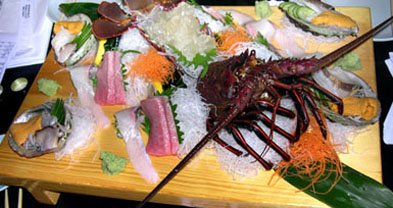
Masako and Shima confer again in Japanese. Voiceover, Naomi: "For Jim, this is the equivalent of my mom talking Yiddish -- code language that only grownups speak." Shima communicates with the waitress. Some minutes later, an amazing platter appears, covered with all manner of raw seafood in various shapes and colors. At its center is the front half of a local spiny lobster, waving its feelers, and behind that is the chopped raw lobster meat, to be dipped in soy sauce and enjoyed. The meat is firm and faintly sweet and tastes only like itself. Jim blows lightly on the carapace, and it wriggles and jiggles all over. "It responds to sake breath," he says.
Voiceover, Naomi: "It's not that I'm callous about the feelings of the lobster, but I know it's already totally dead. It's just that its autonomic nervous system doesn't recognize that fact yet. I remember dissecting a formaldehyde-soaked specimen in Zoology 101. I had so little food money, the waste of a lobster infuriated me. It's an elegantly constructed critter but neurologically primitive -- it shimmies even after it's thoroughly dead. In my travels, I've seen freshly beheaded chickens and rattlesnakes do that, too." Naomi contemplates the animated lobster and mutters, "I wish I could sa-shimmy like my lobster Kate."
I don't know whether or not gaijin patrons routinely get the head when they order lobster sashimi or if they get just the meat -- or perhaps the meat decorated with a head that's already completed its dance routine and gone to its final rest. Looking over the rest of the selections, I later realized that what we actually had was an expanded version of the omakase sashimi dinner. Four seashells on the platter cradled pretty arrangements of exquisite golden uni (sea urchin roe), amazingly sweet, along with toothsome baby white abalone with that sexy, buttery-flavored undertone that's brought it to the endangered list. "In Japan, we have no more of these," said Shima Sensei ruefully. "All eaten." "In California, too," I said. "These were probably farm raised in Baja. I hope so, anyway."
The plate also held hamachi, sliced thicker than usual, with a velvety texture, and chopped Mirugai, giant clam, chewy-soft bursts of sunlight-on-the-sea. And there were slices of toro, precious fatty-belly tuna, the Kobe beef of the ocean. I closed my eyes in bliss, savoring this satin-textured delicacy. The sensei and the nisei's mom noticed. Masako translated Shima's Japanese: "'She really does love our food.'" Apparently, I'd won the Issei Seal of Approval -- my pink belt in Japanese food appreciation, awarded by the master.
Now that I'd proved myself somewhat civilized, the gentle lessons in Japanese cuisine began in earnest. "Shima's from Osaka. That's where all the Japanese gourmets come from," Masako said. "I'm from Tokyo. In Tokyo, we spend our money on clothes. Osakans spend it in restaurants."
I noticed that Masako had added a little wasabi to her shallow saucer of soy sauce and mixed it into a slurry, while Shima had left his soy pure. "When we eat sashimi," Shima said, "we put a little wasabi on the fish, not into the soy sauce, and then we dip the fish into the soy. Osakans don't mix them together. And when we eat sushi from a great chef like Ota-san, we don't dip it into anything. It's already seasoned the way the chef wants it to taste, so adding anything only makes it less perfect."
After that, we were still hungry, and I was still curious to taste delicacies I might not know to order. Masako took another brief look at the menu. "When I go to Japanese restaurants," she said, "I always ask for the Japanese menu, but I don't even look at it. I just get it so they understand that I know Japanese food. Then I order whatever I want." She and Shima Sensei conferred again, glancing at the specials board posted above our table. (Jim and I saw it and begged for the Kumamoto oysters.) Our second course started with a round of those oysters (precious little guys from way up the coast) in a mixture of lemon juice and hot sauce. Next came squid rings dusted with sesame seeds.
Then -- ta-da! -- aji -- a whole, small Spanish mackerel. The head-and-skeleton piece of the small fish was bent around a chopstick into a curve resembling a sailboat's sails swelling from the mast in a stiff breeze. On the plate was a heaplet of chopped green herbs and ginger, to mix into the soy sauce, and slices of the raw fish. This mixture was very much to my taste, a clean foil to the rich fattiness of the mackerel. I noticed that the soy sauce seemed thinner and less salty than at many Japanese restaurants -- more like the imported Cantonese "light soy" I use at home.
They say there are no second acts in American lives, but there are second and third acts in sashimi, using the other parts of the same species. "We Nihonjin use up everything," said Masako. "We don't let anything edible go to waste." First came the lobster back shell, concealing two versions of cooked diced lobster -- one plain, the other thinly robed with a subtle "dynamite" gratin sauce that was a bit spicy and not too gooey.
Then came the skeleton and head of the mackerel, flash-baked crunchy like an ama ebi head, resembling potato chips made of fish bones. The rib cage was great, but I especially had eyes for the head. I offered it to the Sensei, the honored guest. "Nah, I eat it at home all the time," he said. Masako declined on the same grounds. Jim didn't want it, so I took it happily. It's the honored guest's portion because the head has lush soft bits in the cheeks that resemble the best aquatic KFC you ever tasted.
The final course was the last bit of the lobster flesh and carapace in a wonderfully soothing light miso soup. It was better than any dessert and will send you out with a warm belly into a chilly night.
We paid the bill and adjourned to the parking lot, and we talked and talked in two languages until concluding with hugs all around, bows all around, and a flurry of arigatos.
What did I learn? The full service of aji and of lobster were revelations. Otherwise, I was surprised by the lack of really scary or outré offerings, but I don't think Shima Sensei and Masako were trying to spare me. (Jim had already briefed them that I've eaten guinea pig in Ecuador and fried grasshoppers in Oaxacan restaurants, so am not easily intimidated by food.) A bigger surprise was the choice of an all-sashimi dinner (rather than sushi) for what Japanese would order at a no-limits dinner at Ota. But our neighbors at nearby tables, including many Japanese groups, were eating some pretty-looking sushi that I'd happily try, too -- not big Americanized party rolls, but elegant little nigiri with understated garnishes of various colors.
At other occasions at Ota, I've simply kept my eyes peeled for what other diners are eating and pointed at anything that looked interesting, e.g., a large sea snail cooked over burning sugar. That tactic works as well. You wish that the restaurant were a little more comfortable and a lot quieter. (It was a quartet of American males who were making most of the noise during that packed Friday night, conversing in athletic-arena shouts.) And getting a seat at Ota, whether counter or table, is sort of a pain (even with a reservation you have to wait awhile in the parking lot). But once you've done it, once is not nearly enough. This is a master at work, a Sensei of Sushi.
Here's something you might be interested in.
To Ota, with a Sensei and a Nisei

To Ota, with a Sensei and a Nisei
**** 1/2 (Excellent to Extraordinary)
4529 Mission Bay Drive (at Bunker Hill Street), Pacific Beach, 858-270-5670.
HOURS: Saturday--Monday 5:30--10:30 p.m., Tuesday--Friday 11 a.m.--2 p.m. and 5:30--10:30 p.m.
PRICES: Sushi and sashimi $25--$35 for full dinner (plus tip, tax, beverages). Prix-fixe omakase sushi or sashimi arrays are $27 (to feed one fully). Special dinners can go much higher. Some sakes are very steep.
CUISINE AND BEVERAGES: Pristine, sea-fresh, creative sushi and sashimi in the pure Japanese style. (Menu of cooked Japanese dishes is less interesting.) Large selection of sakes.
PICK HITS: Omakase prix-fixe menus of sushi or sashimi. ç la carte: uni (sea urchin roe); toro (fatty tuna belly); ama ebi (sweet shrimp with flash-baked heads); aji sashimi (whole Spanish mackerel); full four-course lobster sashimi (raw, "dynamite," fried head, and lobster miso); "sushi sundae" (uni and toro over a mound of Japanese potato); sea snail over burnt sugar (occasional special); chawan mushi (a custard soup from the cooked-dish menu); any nightly specials.
NEED TO KNOW: In the corner of a mini-mall marked with a 7-Eleven sign on the east side of the street (easiest approach from the south), opposite Rubio's. Crowded parking lot, but spots open quickly. Don't bother with Americanized "party rolls" (e.g., California Roll, or any roll with cream cheese!), but watch other diners to spot off-menu extravaganzas. Expansion into new second dining room (with door to/from parking lot) makes wheelchair access possible, although space is still tight. Very loud when crowded. Reservations essential (you may still have to wait for a table). Call one month ahead for Ota-San's own counter station. Quality is best late in the week (Wednesday or Thursday--Saturday) when Ota is present. Call ahead to order takeout.
Dramatis Personae:
Masayuki Shimabukuro, Hanshi (aka "Shima Sensei"), martial arts master/teacher
"Samurai Jim," "hapi-hapi" nisei Japanese swordsmanship student
Masako S., Jim's mom
Naomi W., gaijin food critic
Vocabulary: Sensei is a Japanese martial arts master and teacher. (Remember 1961's Yojimbo, with those top-knotted ninnies following Toshiro Mifune around, whining, "Sensei, sensei?") Itamei is a sushi chef. Issei is a first-generation Japanese immigrant. Nisei is second generation. Hapi-hapi is Hawaiian for half-Caucasian, half-Asian or Islander. Nihonjin means "Japanese people." (Jin means "people.") Gaijin means "foreign." (In Chinese, gwei means foreign; in Yiddish it's goy; in Romansch (Gypsy) it's gajo, with a soft j, pronounced "gazho." Weird, huh?)
Opening Shot: the Jikishin-Kai dojo in Clairemont Mesa.
The sensei (a vigorous, youthful-looking man in his 50s) is chatting with student Jim after a swordsmanship class. "You must go eat at Sushi Ota," says Shima Sensei. "I know Ota personally, he is the most professional sushi chef here. You know, when people visit San Diego from Japan, that is where they eat. When nihonjin eat there, they get completely different food from gaijin."
"In what way different?" Jim asks.
"My favorite dish there is lobster sashimi. The back half is chopped-up raw lobster meat. The front half is still moving. Shows that the meat is really fresh."
Jim (aside): "My people are such savages..."
Cut to: Split-screen, Jim and Naomi at their computers a few miles apart.
Jim emails Naomi his conversation with Shima Sensei and Naomi realizes there's an amazing learning opportunity here, a chance to discover whether or not the long-standing rumor is true that at Ota, Japanese patrons get very different food from Americans. (Cut to the chase.)
Fade In: A table at Sushi Ota, in the new back room that has expanded the premises.
Jim's mother Masako has joined us to serve as translator, if necessary. She is a tiny, dainty-featured live wire with shoulder-length black hair and four-inch heels that raise her height to about 4'9". Shima Sensei is wearing a Hawaiian shirt, signifying relaxation mode, a side of his strict teacher that Jim has never encountered before. Naomi is secretly nervous -- will she seem like a foreign savage? Masako and Shima confer over the drink list, speaking in Japanese, and order a bottle of sake, Toko Yama ("Man's Mountain"), a strong, smooth blend with a flavor reminiscent of Thailand's Mekong brand rice-based whisky. Naomi orders her usual half-bottle of Nigori, "Japanese fizzy water," unfiltered sake with the texture of a milkshake -- baby-food sake, but reliably palatable.
On the table is a plastic-laminated half-sheet with photos displaying three omakase menus (one for sushi, two for sashimi). This is relatively new and very welcome. With sashimi, the center of your extravaganza can either be lobster or aji, Spanish mackerel. The two isseis discuss the issue of "omakase." "It means, 'I trust you, please take care of me and feed me whatever you want,'" says Shima Sensei. These arrays are the equivalent of impersonal prix-fixe tasting menus. "If you want an omakase dinner made just for you," says Masako, "it's best to find a sushi chef you like and trust, and go regularly, always sitting at his station, until he learns your tastes. At that point, he can do a true omakase for you. For instance, that chef will know better than to give me some disgusting roll with cream cheese. I like little rolls with small rice, I don't like fat rolls with big rice. He'll know that."
Choosing a chef to trust is another important issue. "I will only eat sushi from chefs who are trained in Japan," says Shima Sensei. "There, it is a very long and disciplined education, like martial arts...."
Flashback: Naomi, ten years younger, in San Francisco at the counter of the neighborhood sushi restaurant (one of the best in the city). A journeyman sushi chef is meticulously assembling a caterpillar roll as he responds to her question.
Chef: "First you work as an apprentice, 10 or 12 years before you become even a journeyman and are allowed to make sushi and sashimi. First few years, you only make rice, learn all about rice -- the differences in brands, how old it is, where it was grown, because you will cook and season it a little differently depending on those things. This is why at some American sushi bars the rice is not right -- too soft, too hard, with too much or too little sushi-su, the sweet rice vinegar for seasoning. When you understand rice, then they let you touch fish -- more years learning to handle fish, cut fish, and then how to judge its quality and buy it. When a Japanese sushi apprentice finally qualifies as a journeyman, it means his fish should be safe to eat. Then he can work at a sushi counter until the itamae [the master chef] tells him that he has learned enough to be a master chef himself." Chef inserts two radish sprouts into the head of the hilariously realistic-looking "caterpillar" and hands it over the counter to Naomi, who oohs and aahs and giggles at the little vegetable-sprig "palps."
Dissolve back to Sushi Ota, Shima Sensei speaking:
"...But here in America, anybody can call himself a sushi chef and open a restaurant. To eat raw fish from somebody who wasn't properly trained..." Shima shudders dramatically.
Masako and Shima confer again in Japanese. Voiceover, Naomi: "For Jim, this is the equivalent of my mom talking Yiddish -- code language that only grownups speak." Shima communicates with the waitress. Some minutes later, an amazing platter appears, covered with all manner of raw seafood in various shapes and colors. At its center is the front half of a local spiny lobster, waving its feelers, and behind that is the chopped raw lobster meat, to be dipped in soy sauce and enjoyed. The meat is firm and faintly sweet and tastes only like itself. Jim blows lightly on the carapace, and it wriggles and jiggles all over. "It responds to sake breath," he says.
Voiceover, Naomi: "It's not that I'm callous about the feelings of the lobster, but I know it's already totally dead. It's just that its autonomic nervous system doesn't recognize that fact yet. I remember dissecting a formaldehyde-soaked specimen in Zoology 101. I had so little food money, the waste of a lobster infuriated me. It's an elegantly constructed critter but neurologically primitive -- it shimmies even after it's thoroughly dead. In my travels, I've seen freshly beheaded chickens and rattlesnakes do that, too." Naomi contemplates the animated lobster and mutters, "I wish I could sa-shimmy like my lobster Kate."
I don't know whether or not gaijin patrons routinely get the head when they order lobster sashimi or if they get just the meat -- or perhaps the meat decorated with a head that's already completed its dance routine and gone to its final rest. Looking over the rest of the selections, I later realized that what we actually had was an expanded version of the omakase sashimi dinner. Four seashells on the platter cradled pretty arrangements of exquisite golden uni (sea urchin roe), amazingly sweet, along with toothsome baby white abalone with that sexy, buttery-flavored undertone that's brought it to the endangered list. "In Japan, we have no more of these," said Shima Sensei ruefully. "All eaten." "In California, too," I said. "These were probably farm raised in Baja. I hope so, anyway."
The plate also held hamachi, sliced thicker than usual, with a velvety texture, and chopped Mirugai, giant clam, chewy-soft bursts of sunlight-on-the-sea. And there were slices of toro, precious fatty-belly tuna, the Kobe beef of the ocean. I closed my eyes in bliss, savoring this satin-textured delicacy. The sensei and the nisei's mom noticed. Masako translated Shima's Japanese: "'She really does love our food.'" Apparently, I'd won the Issei Seal of Approval -- my pink belt in Japanese food appreciation, awarded by the master.
Now that I'd proved myself somewhat civilized, the gentle lessons in Japanese cuisine began in earnest. "Shima's from Osaka. That's where all the Japanese gourmets come from," Masako said. "I'm from Tokyo. In Tokyo, we spend our money on clothes. Osakans spend it in restaurants."
I noticed that Masako had added a little wasabi to her shallow saucer of soy sauce and mixed it into a slurry, while Shima had left his soy pure. "When we eat sashimi," Shima said, "we put a little wasabi on the fish, not into the soy sauce, and then we dip the fish into the soy. Osakans don't mix them together. And when we eat sushi from a great chef like Ota-san, we don't dip it into anything. It's already seasoned the way the chef wants it to taste, so adding anything only makes it less perfect."
After that, we were still hungry, and I was still curious to taste delicacies I might not know to order. Masako took another brief look at the menu. "When I go to Japanese restaurants," she said, "I always ask for the Japanese menu, but I don't even look at it. I just get it so they understand that I know Japanese food. Then I order whatever I want." She and Shima Sensei conferred again, glancing at the specials board posted above our table. (Jim and I saw it and begged for the Kumamoto oysters.) Our second course started with a round of those oysters (precious little guys from way up the coast) in a mixture of lemon juice and hot sauce. Next came squid rings dusted with sesame seeds.
Then -- ta-da! -- aji -- a whole, small Spanish mackerel. The head-and-skeleton piece of the small fish was bent around a chopstick into a curve resembling a sailboat's sails swelling from the mast in a stiff breeze. On the plate was a heaplet of chopped green herbs and ginger, to mix into the soy sauce, and slices of the raw fish. This mixture was very much to my taste, a clean foil to the rich fattiness of the mackerel. I noticed that the soy sauce seemed thinner and less salty than at many Japanese restaurants -- more like the imported Cantonese "light soy" I use at home.
They say there are no second acts in American lives, but there are second and third acts in sashimi, using the other parts of the same species. "We Nihonjin use up everything," said Masako. "We don't let anything edible go to waste." First came the lobster back shell, concealing two versions of cooked diced lobster -- one plain, the other thinly robed with a subtle "dynamite" gratin sauce that was a bit spicy and not too gooey.
Then came the skeleton and head of the mackerel, flash-baked crunchy like an ama ebi head, resembling potato chips made of fish bones. The rib cage was great, but I especially had eyes for the head. I offered it to the Sensei, the honored guest. "Nah, I eat it at home all the time," he said. Masako declined on the same grounds. Jim didn't want it, so I took it happily. It's the honored guest's portion because the head has lush soft bits in the cheeks that resemble the best aquatic KFC you ever tasted.
The final course was the last bit of the lobster flesh and carapace in a wonderfully soothing light miso soup. It was better than any dessert and will send you out with a warm belly into a chilly night.
We paid the bill and adjourned to the parking lot, and we talked and talked in two languages until concluding with hugs all around, bows all around, and a flurry of arigatos.
What did I learn? The full service of aji and of lobster were revelations. Otherwise, I was surprised by the lack of really scary or outré offerings, but I don't think Shima Sensei and Masako were trying to spare me. (Jim had already briefed them that I've eaten guinea pig in Ecuador and fried grasshoppers in Oaxacan restaurants, so am not easily intimidated by food.) A bigger surprise was the choice of an all-sashimi dinner (rather than sushi) for what Japanese would order at a no-limits dinner at Ota. But our neighbors at nearby tables, including many Japanese groups, were eating some pretty-looking sushi that I'd happily try, too -- not big Americanized party rolls, but elegant little nigiri with understated garnishes of various colors.
At other occasions at Ota, I've simply kept my eyes peeled for what other diners are eating and pointed at anything that looked interesting, e.g., a large sea snail cooked over burning sugar. That tactic works as well. You wish that the restaurant were a little more comfortable and a lot quieter. (It was a quartet of American males who were making most of the noise during that packed Friday night, conversing in athletic-arena shouts.) And getting a seat at Ota, whether counter or table, is sort of a pain (even with a reservation you have to wait awhile in the parking lot). But once you've done it, once is not nearly enough. This is a master at work, a Sensei of Sushi.
Comments