

Here's something you might be interested in.
Ask a Hipster — Advice you didn't know you needed
Big Screen — Movie commentary
Blurt — Music's inside track
Booze News — San Diego spirits
Classical Music — Immortal beauty
Classifieds — Free and easy
Close to Home — What it’s like on the street where you live
Cover Stories — Front-page features
Drinks All Around — Bartenders' drink recipes
Excerpts — Literary and spiritual excerpts
Feast! — Food & drink reviews
Feature Stories — Local news & stories
Fishing Report — What’s getting hooked from ship and shore
From the Archives — Spotlight on the past
Golden Dreams — Talk of the town
The Gonzo Report — Making the musical scene, or at least reporting from it
Letters — Our inbox
Movies@Home — Local movie buffs share favorites
Movie Reviews — Our critics' picks and pans
Musician Interviews — Up close with local artists
Neighborhood News from Stringers — Hyperlocal news
News Ticker — News & politics
Obermeyer — San Diego politics illustrated
Outdoors — Weekly changes in flora and fauna
Overheard in San Diego — Eavesdropping illustrated
Poetry — The old and the new
Reader Travel — Travel section built by travelers
Reading — The hunt for intellectuals
Roam-O-Rama — SoCal's best hiking/biking trails
San Diego Beer — Inside San Diego suds
SD on the QT — Almost factual news
Sheep and Goats — Places of worship
Special Issues — The best of
Street Style — San Diego streets have style
Surf Diego — Real stories from those braving the waves
Theater — On stage in San Diego this week
Tin Fork — Silver spoon alternative
Under the Radar — Matt Potter's undercover work
Unforgettable — Long-ago San Diego
Unreal Estate — San Diego's priciest pads
Your Week — Daily event picks
Valley Center will never be the same
Country living, past tense
When I was young, I often became carsick as the family station wagon swerved back and forth on the grade that climbed into Valley Center.
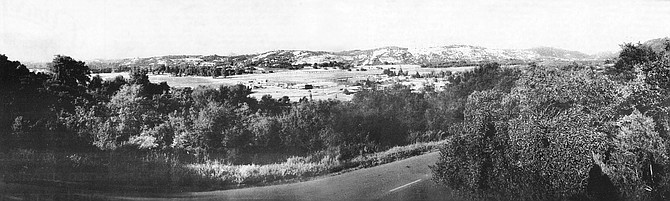
A few years back, from the tops of several hills in Valley Center, one could see the Pacific Ocean some twenty miles away in the west. If it were clear, Mt. Palomar would be visible to the northeast, each ridge looking like the finger of a giant’s hand buried under the mountain. The surrounding hills in this high chaparral ecosystem were a dusty green color much of the year. The coloring was a subtle combination of sage, oaks, manzanita, some less prominent plants, and gray, lichen-covered boulders. Eventually the rains would come, washing the flora on the hills into a darker green, making the brush look deceptively plush and soft.
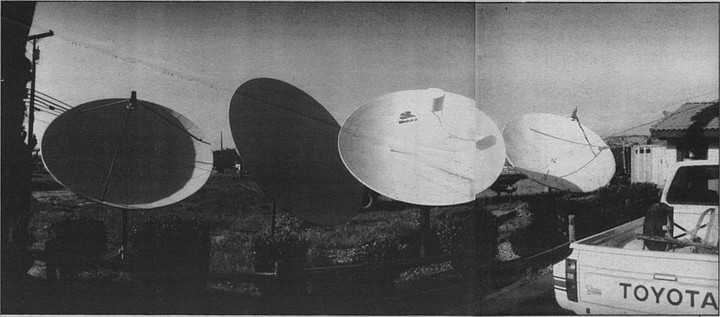
Satellite dishes in Valley Center. The grove at Mac Tan and Valley Center roads will probably be replaced with housing of greater density.
As I looked out on this scene as a child almost two decades ago, I looked hard among the hills, hoping to see Indians or wild animals. At that time, deer moved throughout the area in herds numbering as many as fifteen, bobcats menaced ranchers, and golden eagles would glide over valleys to their aeries on a remote ridge.
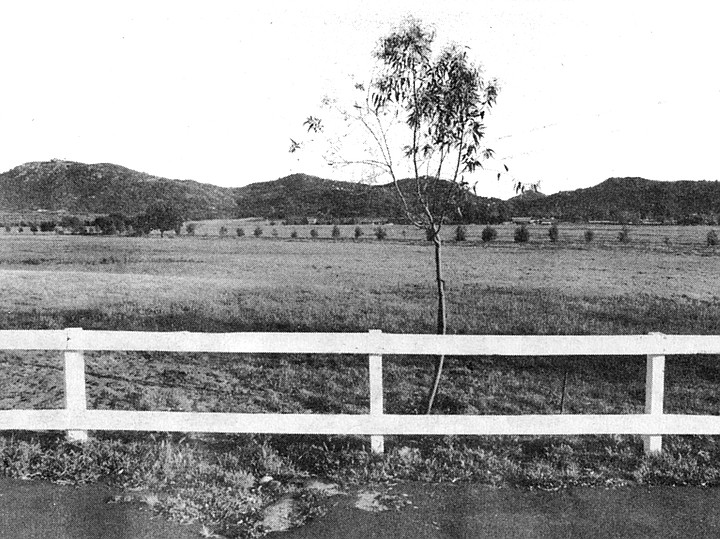
I suspect that the residents of this new neighborhood would soon encourage the demise of these ranches, just as the residents of Valley Parkway Mobile Homes made life difficult for the Songer Ranch in Escondido.
Today, climbing these hills to a valley some 1300 feet above sea level reveals few of these sights. The hills around Valley Center are either the dark green of well-watered avocados or are striped with rows of new trees terraced up the hillside. A home in one of these groves has a private feeling. Being hidden from the eyes of the world, but still having the room to expose one’s self to the earth and sky — that's the attractive feature of the homes in this “unspoiled” area. Although the orchestration of plants into rows isn’t nature’s way, growing food is compatible with the countryside in a way housing developments aren’t.
But even this tenuous connection to nature is being threatened, ironically, by nature herself. Weather changes have brought increased rainfall to Southern California. This has been great for the trees, which vividly respond to rain, but bad for the Metropolitan Water District, which can’t sell as much water as it had anticipated.
The result will be an increase in pumping costs that will make its way to the Valley Center Municipal Water District. As it is, increasing water bills have forced some land-owners to stop growing fruit and start trying to turn their land into mobile home estates, a fancy term for trailer parks. Unless a grower has a well, he’s in for a rough time. As one local citrus grower says, "Next year we’ll be growing houses instead of avocados.”
I’ve wanted to make acorn mush since Mrs. Johnson took her kindergarten class over to some boulders in an area now known as Adams Park. Underneath some large oaks lie the boulders with holes worn into them. According to Mrs. Johnson, these holes were made by Indians as they ground acorns into meal for their mush.
The park is a quarter mile or so from the intersection of Valley Center Road and Cole Grade Road, the center of activity in Valley Center, but the Indians have since disappeared into a canyon along the northeastern edge of town. Through this canyon runs what’s left of the San Luis Rey River, where most of the Luiseno Indians lived. Those who weren’t already settled there were moved into the area shortly after California was opened up to claim-staking after the Mexican-American War.
The Euro-Americans took the Indians and the land by surprise. Being somewhat nomadic, these Indians found the idea of land ownership frivolous: “We don’t own the land, the land owns us.” Well, I guess we showed them. The Indian now, like the white man, has his own land, but it certainly isn’t his land by choice.
Spaniards came to what is known as Pala, five miles north of Valley Center, with plans for building a mission to introduce the gospel to the Indians. Whatever else the two cultures shared, the mission appears to be one of the most enduring contributions. Since 1816 the mission has held a fiesta which has brought people together for one of the biggest events in North County. The music, brightly dressed dancers, aromas of food cooking, flowing wine, bullfights, and horse races created a scene of old California that would live in the memory of Abel Davis with Governor Pio Pico himself as the main character.
As Davis mentions in his memoirs (entitled Valley Center), one day around 1883 he was admiring Pico’s horse at the fiesta at the Pala mission. He was stroking the bay’s shoulder when the governor himself walked up and complimented the young Davis on his “fine hand for horses.” At this time, a local gentleman named Louis Wolfe proposed a race between the bay and a gray he had brought back from Kentucky just to race Pico, who suggested a wager of ten head of cattle. Wolfe agreed and Davis took a place right beside the finish line, where a crowd was gathering. As the horses started, it looked like the gray had the jump, but the bay was soon running side by side with the gray down the stretch. It was a good match, and by the time they crossed the finish line Davis was sure the race had ended in a dead heat. The judge had a different opinion, though, and decided in favor of Wolfe. At this, Pico just laughed, congratulated the victor, and told him to come pick up his winnings any time and they'd have a fiesta of their own.
Although Pio Pico attempted to insure that the Mexican land grants would be honored in the peace treaty negotiations in the 1840s, few of the many Mexican descendants living in California today own land. Most of them are laborers. The conditions in which these men and women live is something less than lower class by U.S. standards. Many of the workers live in shacks or little more than a windbreak. No electricity, no trash service, no septic tanks, but they are usually able to get access to a faucet at the end of a row of trees in the grove. The last week of November, the body of an illegal alien was found near the Valley Center grade. The sheriff’s blotter in a local paper reported that the cause of death was probably a drug overdose; the word in the grove is that the Mexican died of exposure.
Despite the poverty some of these people live in. I have found them to be as generous and as gracious hosts as I imagine Governor Pico to have been. Last summer I retrieved a few cases of cold beer out of the walk-in cooler for some migrant workers who came into the Pala Vista market where I worked. The man buying the beer was so thankful for the extra cold beer that he offered an invitation to dinner. Making the arrangement wasn’t too easy with my broken Spanish and his broken English, but I think our smiles, patience, good intentions, and heavy use of the word “amigo” helped us find some common ground. “Ah, viernes . . . that’s Friday. Yeah, I don’t work that night, I mean: no trabajo en la noche de viernes. Oh yeah, uh . . . carne asada es muy bueno con cerveza, uh . . . yeah. I like beer, I mean cerveza . . . er . . . uh . . . ?que hora comenzatnos? ?Quarto media? So early? ?Tan temprano? ?Tu casa no tiene electricidad? No problemo."
At 4:30 on Friday I sat in my car at the end of a dirt road, waiting for Alfonso and Alfredo to lead me to their place. A few minutes late, my friends came spreading dust in a well-used pickup. We waved “Hola” and took off down some grove roads that finally led to a clearing among the citrus trees. In the clearing stood a shack that had two rooms the size of a tool shed with three cots in each room, and a little trailer that had once been white but now was in the process of returning to earthen rust and dust.
Alfonso unloaded a roast that had been cut into thin slabs. Alfredo grabbed a case of beer, and I broke out some ice and a case of Schlitz Malt tails that I had brought. About eight Mexican men of all ages gathered around the junked ice box in the middle of the camp and started talking so rapidly that I couldn't catch half of what was being said, except that it was funny. My host asked if I liked hot salsa: I said I like salsa hot, but not too hot. Alfonso sent a boy who couldn't have been older than fifteen to get some lemons, but all the fruit within arm’s reach had been picked, so he started knocking lemons out of the top branches by throwing a beer bottle at the fruit. Soon half of one of these lemons was added to half an onion, three tomatoes, and some jalapeños, all being ground in a pan with the bottom of a jar. We cooked the meat and heated the tortillas over a fire pit in the center of camp, slapped it together, and made carne asada. So simple, just drip some fresh salsa over a taco just off the fire; no dishes to wash, just streamlined eating.
We'd soon eaten everything.
More and more people arrived, some women and children. I learned that many of them w ere planning to spend the winter in Mexico, where they'd been sending their pay all summer. A few were staying here all winter. One old man was spending Christmas at the camp, leaving his nine children behind in Mexico. His face had such lines in those sunset shadows; the creases were probably from the work in the sun, but I imagined it was the estrangement from his family.
Soon there was music. A shy man gave in to the crowd and sang Rosa Maria. By this time the night had fallen and we were in the middle of a full-blown fiesta. Suddenly some headlights came swinging through the grove; everyone stopped talking and looked toward the road. It took me a moment to understand why an approaching car should stop all conversation, singing, and laughter, then I realized that these people were illegal aliens. A border patrol raid could mean another difficult and oftentimes dangerous border crossing. There had been a raid in the local market a couple weeks before. It was an easy job for the border patrol —just wait outside any afternoon and six or seven illegals are bound to come out carrying their sacks of tortillas, peppers, lard, and beer. This particular day one illegal tried to hide in the produce section, but the patrol came in and caught him. too.
The headlights were switched off, the car door opened, and the silence around the campfire disappeared.
Our new guest was somebody's cousin or everybody's cousin, I couldn’t quite make out which. By this time they had me singing Jambalaya. All I could remember was one verse and the chorus, but my hosts were too happy to care.
In Valley Center the problems begin with water. More rain than usual has fallen recently; growers are buying less water and people are starting to conserve. The decreasing demand for water has reduced the generation of sufficient funds for the operating costs of the Metropolitan Water District, which sells Valley Center its water. To compensate, the Metro District has raised its fees. Valley Center follows by passing those increases along in the form of rate hikes, one in January of this year and one to come in July. Depending upon the pumping charges, the increases could range from fourteen to thirty-two percent. Whether the increases are contrived or unavoidable can be known only by those at the top. wherever that may be. For the families of North County who have relied on the groves as sources of income and buffers to maintain privacy and a pleasant, uncongested environment, the increases in the water rates may turn their groves into very' expensive luxuries.
Not all growers would suffer by selling. Along with water rates, the price of property has also been on the rise. This offers a chance to get out of a thankless and risky business. The great risk in agriculture is primarily that of natural disaster. In order to bring in a little more money and to become “the market” on a crop, growers will hold fruit on the trees for as long as is safe, and sometimes longer. A strong Santa Ana could knock a crop off the trees. A cold spell could freeze the fruit to the point where it is no longer edible. The grower takes these and other risks while the brokers take avocados at thirty-nine cents, juggle them around, and sell them for seventy-nine cents only ten miles away, all at no risk.
As a tough business gets tougher, growers are considering their options, and many feel that the best choice is to get out. One grove at the comer of Mac Tan Road and Valley Center Road has been left idle for a couple of seasons. The owner wants to put in a trailer park. After letting the land go for so long, the loss sustained, unless the land were developed, would be staggering. If it is developed, the action will mark another step toward the end of Valley Center as a rural town.
The community plan and county supervisor recognize the need for low-income housing, which this trailer park would be. Unfortunately, across the street sits a chicken ranch, a small herd of cattle, and a herd of goats. I suspect that the residents of this new neighborhood would soon encourage the demise of these ranches, just as the residents of Valley Parkway Mobile Homes made life difficult for the owners of the Songer Ranch in Escondido. The Songer Ranch has been a working stockyard for at least thirty years, run by the same family. In the late 1960s a trailer park was built next door. The new folks in town became annoyed by the scent of the country air and they complained. Being protected by a grandfather clause in the zoning laws, the Songers have been able to stay on. but their tenure has not been without troubles. The city’s health and safety department has inspected compost piles, gas tanks, and animals to the point that some of the inspectors themselves admit to being tired of the senseless frequency. Police officers have given Songer instructions to hose down his driveway, put trucks and tractors in barns, and generally made requests of him that are not made of other citizens.
The grove at Mac Tan and Valley Center roads will probably be replaced with housing of greater density than Valley Center is accustomed to having. There are, no doubt, other landowners who haven’t yet publicly expressed their desire to make their land pay off. Should these land developments transpire, the words of the community plan will be prophetic, though certainly not surprising: “The agricultural base of the community has shifted over the years as urban sprawl pushed out agriculture in other nearby areas.”
Until now, growth in Valley Center has been slowed by a septic tank moratorium initiated in October of 1980. A high water table combined with heavy rains had caused the failure of several septic systems, and the San Diego County Department of Public Health responded by imposing the moratorium and closing several businesses in the latter part of 1980. Four years later the moratorium is still in effect, while the Valley Center Municipal Water District struggles to plan a sewer; state funding is expected to arrive by this summer, and federal assistance by October. With outside funding likely, the plans are nearly completed. The sewer system has the support of most of the citizens, whose choices placed them in a tough position regardless of which way they went. To oppose the sewer could only put the community in stasis at best; some buildings under the septic moratorium would be condemned without long-term solutions to their problems. To support a sewer would open up the valley to an explosion in construction and population. Aloha Valley Center.
When I was young, I often became carsick as the family station wagon swerved back and forth on the grade that climbed into Valley Center. A small child, I couldn’t always see which direction the road would turn next. My ungrounded, unprepared equilibrium would be taken advantage of as the road unexpectedly twisted, tossing peanut butter and bile up the back of my throat. I must have thought that the difficult access would keep my home secluded: Valley Center, a lousy place to get to, but a nice place to be. In the mid-Seventies this began to change with the construction of an improved three-lane grade. The county is now making further plans to improve access and circulation to the town of about 9000, a town with no traffic lights in sight. Among the plans are the widening of the Valley Center grade and a bridge, which should help circulation, and an improved intersection at Lilac and Old Castle roads, which should make for safer access to I-15.
As the county goes into action to improve circulation, I have doubts that all the new residents will drive out of the valley to work. Once the agricultural industry is moved out, some new industries will need to be introduced. What will all these people do fora living? If farming is no longer able to coexist with suburbia, the new industries will probably not maintain the rural/ agricultural atmosphere the present community plan desires. Nor will they need to.
I used to ride my horse at night to the top of one of the hills above Valley Center. When the weather was clear I could see the lights randomly scattered on the valley floor. Tonight from the same view I see my house as a light in the twinkling grid taking shape along the roads of the valley. As the drive to Escondido grows shorter and shorter each year. I’m shopping at the new stores by Lyle Songer’s ranch out on East Valley Parkway. My family moved here and I stayed for many of the same reasons hundreds are moving here today. The only difference is that I lived here while it was still country and not a rurally landscaped housing development of two-acre plots. Looking at myself, I’m part criminal, part victim, and a not-so-innocent bystander whose testimony can only incriminate himself.
Here's something you might be interested in.
Valley Center will never be the same
Country living, past tense

Valley Center will never be the same
Country living, past tense
When I was young, I often became carsick as the family station wagon swerved back and forth on the grade that climbed into Valley Center.
A few years back, from the tops of several hills in Valley Center, one could see the Pacific Ocean some twenty miles away in the west. If it were clear, Mt. Palomar would be visible to the northeast, each ridge looking like the finger of a giant’s hand buried under the mountain. The surrounding hills in this high chaparral ecosystem were a dusty green color much of the year. The coloring was a subtle combination of sage, oaks, manzanita, some less prominent plants, and gray, lichen-covered boulders. Eventually the rains would come, washing the flora on the hills into a darker green, making the brush look deceptively plush and soft.
Satellite dishes in Valley Center. The grove at Mac Tan and Valley Center roads will probably be replaced with housing of greater density.
As I looked out on this scene as a child almost two decades ago, I looked hard among the hills, hoping to see Indians or wild animals. At that time, deer moved throughout the area in herds numbering as many as fifteen, bobcats menaced ranchers, and golden eagles would glide over valleys to their aeries on a remote ridge.
I suspect that the residents of this new neighborhood would soon encourage the demise of these ranches, just as the residents of Valley Parkway Mobile Homes made life difficult for the Songer Ranch in Escondido.
Today, climbing these hills to a valley some 1300 feet above sea level reveals few of these sights. The hills around Valley Center are either the dark green of well-watered avocados or are striped with rows of new trees terraced up the hillside. A home in one of these groves has a private feeling. Being hidden from the eyes of the world, but still having the room to expose one’s self to the earth and sky — that's the attractive feature of the homes in this “unspoiled” area. Although the orchestration of plants into rows isn’t nature’s way, growing food is compatible with the countryside in a way housing developments aren’t.
But even this tenuous connection to nature is being threatened, ironically, by nature herself. Weather changes have brought increased rainfall to Southern California. This has been great for the trees, which vividly respond to rain, but bad for the Metropolitan Water District, which can’t sell as much water as it had anticipated.
The result will be an increase in pumping costs that will make its way to the Valley Center Municipal Water District. As it is, increasing water bills have forced some land-owners to stop growing fruit and start trying to turn their land into mobile home estates, a fancy term for trailer parks. Unless a grower has a well, he’s in for a rough time. As one local citrus grower says, "Next year we’ll be growing houses instead of avocados.”
I’ve wanted to make acorn mush since Mrs. Johnson took her kindergarten class over to some boulders in an area now known as Adams Park. Underneath some large oaks lie the boulders with holes worn into them. According to Mrs. Johnson, these holes were made by Indians as they ground acorns into meal for their mush.
The park is a quarter mile or so from the intersection of Valley Center Road and Cole Grade Road, the center of activity in Valley Center, but the Indians have since disappeared into a canyon along the northeastern edge of town. Through this canyon runs what’s left of the San Luis Rey River, where most of the Luiseno Indians lived. Those who weren’t already settled there were moved into the area shortly after California was opened up to claim-staking after the Mexican-American War.
The Euro-Americans took the Indians and the land by surprise. Being somewhat nomadic, these Indians found the idea of land ownership frivolous: “We don’t own the land, the land owns us.” Well, I guess we showed them. The Indian now, like the white man, has his own land, but it certainly isn’t his land by choice.
Spaniards came to what is known as Pala, five miles north of Valley Center, with plans for building a mission to introduce the gospel to the Indians. Whatever else the two cultures shared, the mission appears to be one of the most enduring contributions. Since 1816 the mission has held a fiesta which has brought people together for one of the biggest events in North County. The music, brightly dressed dancers, aromas of food cooking, flowing wine, bullfights, and horse races created a scene of old California that would live in the memory of Abel Davis with Governor Pio Pico himself as the main character.
As Davis mentions in his memoirs (entitled Valley Center), one day around 1883 he was admiring Pico’s horse at the fiesta at the Pala mission. He was stroking the bay’s shoulder when the governor himself walked up and complimented the young Davis on his “fine hand for horses.” At this time, a local gentleman named Louis Wolfe proposed a race between the bay and a gray he had brought back from Kentucky just to race Pico, who suggested a wager of ten head of cattle. Wolfe agreed and Davis took a place right beside the finish line, where a crowd was gathering. As the horses started, it looked like the gray had the jump, but the bay was soon running side by side with the gray down the stretch. It was a good match, and by the time they crossed the finish line Davis was sure the race had ended in a dead heat. The judge had a different opinion, though, and decided in favor of Wolfe. At this, Pico just laughed, congratulated the victor, and told him to come pick up his winnings any time and they'd have a fiesta of their own.
Although Pio Pico attempted to insure that the Mexican land grants would be honored in the peace treaty negotiations in the 1840s, few of the many Mexican descendants living in California today own land. Most of them are laborers. The conditions in which these men and women live is something less than lower class by U.S. standards. Many of the workers live in shacks or little more than a windbreak. No electricity, no trash service, no septic tanks, but they are usually able to get access to a faucet at the end of a row of trees in the grove. The last week of November, the body of an illegal alien was found near the Valley Center grade. The sheriff’s blotter in a local paper reported that the cause of death was probably a drug overdose; the word in the grove is that the Mexican died of exposure.
Despite the poverty some of these people live in. I have found them to be as generous and as gracious hosts as I imagine Governor Pico to have been. Last summer I retrieved a few cases of cold beer out of the walk-in cooler for some migrant workers who came into the Pala Vista market where I worked. The man buying the beer was so thankful for the extra cold beer that he offered an invitation to dinner. Making the arrangement wasn’t too easy with my broken Spanish and his broken English, but I think our smiles, patience, good intentions, and heavy use of the word “amigo” helped us find some common ground. “Ah, viernes . . . that’s Friday. Yeah, I don’t work that night, I mean: no trabajo en la noche de viernes. Oh yeah, uh . . . carne asada es muy bueno con cerveza, uh . . . yeah. I like beer, I mean cerveza . . . er . . . uh . . . ?que hora comenzatnos? ?Quarto media? So early? ?Tan temprano? ?Tu casa no tiene electricidad? No problemo."
At 4:30 on Friday I sat in my car at the end of a dirt road, waiting for Alfonso and Alfredo to lead me to their place. A few minutes late, my friends came spreading dust in a well-used pickup. We waved “Hola” and took off down some grove roads that finally led to a clearing among the citrus trees. In the clearing stood a shack that had two rooms the size of a tool shed with three cots in each room, and a little trailer that had once been white but now was in the process of returning to earthen rust and dust.
Alfonso unloaded a roast that had been cut into thin slabs. Alfredo grabbed a case of beer, and I broke out some ice and a case of Schlitz Malt tails that I had brought. About eight Mexican men of all ages gathered around the junked ice box in the middle of the camp and started talking so rapidly that I couldn't catch half of what was being said, except that it was funny. My host asked if I liked hot salsa: I said I like salsa hot, but not too hot. Alfonso sent a boy who couldn't have been older than fifteen to get some lemons, but all the fruit within arm’s reach had been picked, so he started knocking lemons out of the top branches by throwing a beer bottle at the fruit. Soon half of one of these lemons was added to half an onion, three tomatoes, and some jalapeños, all being ground in a pan with the bottom of a jar. We cooked the meat and heated the tortillas over a fire pit in the center of camp, slapped it together, and made carne asada. So simple, just drip some fresh salsa over a taco just off the fire; no dishes to wash, just streamlined eating.
We'd soon eaten everything.
More and more people arrived, some women and children. I learned that many of them w ere planning to spend the winter in Mexico, where they'd been sending their pay all summer. A few were staying here all winter. One old man was spending Christmas at the camp, leaving his nine children behind in Mexico. His face had such lines in those sunset shadows; the creases were probably from the work in the sun, but I imagined it was the estrangement from his family.
Soon there was music. A shy man gave in to the crowd and sang Rosa Maria. By this time the night had fallen and we were in the middle of a full-blown fiesta. Suddenly some headlights came swinging through the grove; everyone stopped talking and looked toward the road. It took me a moment to understand why an approaching car should stop all conversation, singing, and laughter, then I realized that these people were illegal aliens. A border patrol raid could mean another difficult and oftentimes dangerous border crossing. There had been a raid in the local market a couple weeks before. It was an easy job for the border patrol —just wait outside any afternoon and six or seven illegals are bound to come out carrying their sacks of tortillas, peppers, lard, and beer. This particular day one illegal tried to hide in the produce section, but the patrol came in and caught him. too.
The headlights were switched off, the car door opened, and the silence around the campfire disappeared.
Our new guest was somebody's cousin or everybody's cousin, I couldn’t quite make out which. By this time they had me singing Jambalaya. All I could remember was one verse and the chorus, but my hosts were too happy to care.
In Valley Center the problems begin with water. More rain than usual has fallen recently; growers are buying less water and people are starting to conserve. The decreasing demand for water has reduced the generation of sufficient funds for the operating costs of the Metropolitan Water District, which sells Valley Center its water. To compensate, the Metro District has raised its fees. Valley Center follows by passing those increases along in the form of rate hikes, one in January of this year and one to come in July. Depending upon the pumping charges, the increases could range from fourteen to thirty-two percent. Whether the increases are contrived or unavoidable can be known only by those at the top. wherever that may be. For the families of North County who have relied on the groves as sources of income and buffers to maintain privacy and a pleasant, uncongested environment, the increases in the water rates may turn their groves into very' expensive luxuries.
Not all growers would suffer by selling. Along with water rates, the price of property has also been on the rise. This offers a chance to get out of a thankless and risky business. The great risk in agriculture is primarily that of natural disaster. In order to bring in a little more money and to become “the market” on a crop, growers will hold fruit on the trees for as long as is safe, and sometimes longer. A strong Santa Ana could knock a crop off the trees. A cold spell could freeze the fruit to the point where it is no longer edible. The grower takes these and other risks while the brokers take avocados at thirty-nine cents, juggle them around, and sell them for seventy-nine cents only ten miles away, all at no risk.
As a tough business gets tougher, growers are considering their options, and many feel that the best choice is to get out. One grove at the comer of Mac Tan Road and Valley Center Road has been left idle for a couple of seasons. The owner wants to put in a trailer park. After letting the land go for so long, the loss sustained, unless the land were developed, would be staggering. If it is developed, the action will mark another step toward the end of Valley Center as a rural town.
The community plan and county supervisor recognize the need for low-income housing, which this trailer park would be. Unfortunately, across the street sits a chicken ranch, a small herd of cattle, and a herd of goats. I suspect that the residents of this new neighborhood would soon encourage the demise of these ranches, just as the residents of Valley Parkway Mobile Homes made life difficult for the owners of the Songer Ranch in Escondido. The Songer Ranch has been a working stockyard for at least thirty years, run by the same family. In the late 1960s a trailer park was built next door. The new folks in town became annoyed by the scent of the country air and they complained. Being protected by a grandfather clause in the zoning laws, the Songers have been able to stay on. but their tenure has not been without troubles. The city’s health and safety department has inspected compost piles, gas tanks, and animals to the point that some of the inspectors themselves admit to being tired of the senseless frequency. Police officers have given Songer instructions to hose down his driveway, put trucks and tractors in barns, and generally made requests of him that are not made of other citizens.
The grove at Mac Tan and Valley Center roads will probably be replaced with housing of greater density than Valley Center is accustomed to having. There are, no doubt, other landowners who haven’t yet publicly expressed their desire to make their land pay off. Should these land developments transpire, the words of the community plan will be prophetic, though certainly not surprising: “The agricultural base of the community has shifted over the years as urban sprawl pushed out agriculture in other nearby areas.”
Until now, growth in Valley Center has been slowed by a septic tank moratorium initiated in October of 1980. A high water table combined with heavy rains had caused the failure of several septic systems, and the San Diego County Department of Public Health responded by imposing the moratorium and closing several businesses in the latter part of 1980. Four years later the moratorium is still in effect, while the Valley Center Municipal Water District struggles to plan a sewer; state funding is expected to arrive by this summer, and federal assistance by October. With outside funding likely, the plans are nearly completed. The sewer system has the support of most of the citizens, whose choices placed them in a tough position regardless of which way they went. To oppose the sewer could only put the community in stasis at best; some buildings under the septic moratorium would be condemned without long-term solutions to their problems. To support a sewer would open up the valley to an explosion in construction and population. Aloha Valley Center.
When I was young, I often became carsick as the family station wagon swerved back and forth on the grade that climbed into Valley Center. A small child, I couldn’t always see which direction the road would turn next. My ungrounded, unprepared equilibrium would be taken advantage of as the road unexpectedly twisted, tossing peanut butter and bile up the back of my throat. I must have thought that the difficult access would keep my home secluded: Valley Center, a lousy place to get to, but a nice place to be. In the mid-Seventies this began to change with the construction of an improved three-lane grade. The county is now making further plans to improve access and circulation to the town of about 9000, a town with no traffic lights in sight. Among the plans are the widening of the Valley Center grade and a bridge, which should help circulation, and an improved intersection at Lilac and Old Castle roads, which should make for safer access to I-15.
As the county goes into action to improve circulation, I have doubts that all the new residents will drive out of the valley to work. Once the agricultural industry is moved out, some new industries will need to be introduced. What will all these people do fora living? If farming is no longer able to coexist with suburbia, the new industries will probably not maintain the rural/ agricultural atmosphere the present community plan desires. Nor will they need to.
I used to ride my horse at night to the top of one of the hills above Valley Center. When the weather was clear I could see the lights randomly scattered on the valley floor. Tonight from the same view I see my house as a light in the twinkling grid taking shape along the roads of the valley. As the drive to Escondido grows shorter and shorter each year. I’m shopping at the new stores by Lyle Songer’s ranch out on East Valley Parkway. My family moved here and I stayed for many of the same reasons hundreds are moving here today. The only difference is that I lived here while it was still country and not a rurally landscaped housing development of two-acre plots. Looking at myself, I’m part criminal, part victim, and a not-so-innocent bystander whose testimony can only incriminate himself.
Comments