

Here's something you might be interested in.
Ask a Hipster — Advice you didn't know you needed
Big Screen — Movie commentary
Blurt — Music's inside track
Booze News — San Diego spirits
Classical Music — Immortal beauty
Classifieds — Free and easy
Close to Home — What it’s like on the street where you live
Cover Stories — Front-page features
Drinks All Around — Bartenders' drink recipes
Excerpts — Literary and spiritual excerpts
Feast! — Food & drink reviews
Feature Stories — Local news & stories
Fishing Report — What’s getting hooked from ship and shore
From the Archives — Spotlight on the past
Golden Dreams — Talk of the town
The Gonzo Report — Making the musical scene, or at least reporting from it
Letters — Our inbox
Movies@Home — Local movie buffs share favorites
Movie Reviews — Our critics' picks and pans
Musician Interviews — Up close with local artists
Neighborhood News from Stringers — Hyperlocal news
News Ticker — News & politics
Obermeyer — San Diego politics illustrated
Outdoors — Weekly changes in flora and fauna
Overheard in San Diego — Eavesdropping illustrated
Poetry — The old and the new
Reader Travel — Travel section built by travelers
Reading — The hunt for intellectuals
Roam-O-Rama — SoCal's best hiking/biking trails
San Diego Beer — Inside San Diego suds
SD on the QT — Almost factual news
Sheep and Goats — Places of worship
Special Issues — The best of
Street Style — San Diego streets have style
Surf Diego — Real stories from those braving the waves
Theater — On stage in San Diego this week
Tin Fork — Silver spoon alternative
Under the Radar — Matt Potter's undercover work
Unforgettable — Long-ago San Diego
Unreal Estate — San Diego's priciest pads
Your Week — Daily event picks
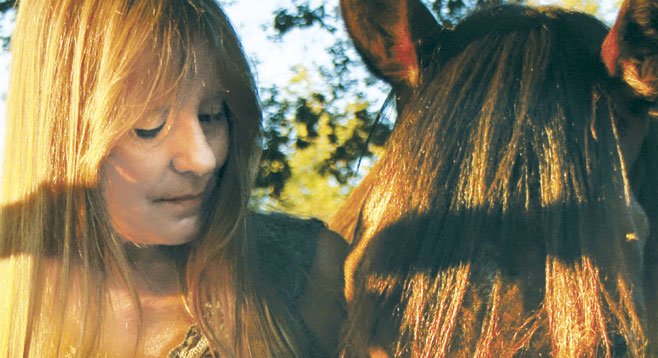
Saddlehorn Ranch West in Jamul – for retired thoroughbreds
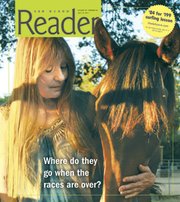
Where do they go when the races are over?
And where do they go — not after the gates spring open — but after the race is run, after all their races are run? After the society matrons’ $1000 hats are back in the closet, after the losing pari-mutuel tickets have been picked up by the infield “stoopers,” after the last $7 beer has been drunk — where do they go? What happens to these well-bred equines, these well-oiled machines of flesh and blood, of suspensory ligaments and sesamoid joints — where, exactly, do they end up after Del Mar?
In search of a clearer vision of the golden years of a Thoroughbred racehorse, I accompanied Karen Groebli one morning as she showed me around a succession of far-flung ranches. It’s among these bosky patches of San Diego–style ruritania that Groebli runs Tijuana River Valley Animal Rescue, an operation that focuses on horses, including 30 or so Thoroughbreds off the track.
According to Groebli, the overwhelming majority of Thoroughbred racehorse owners are responsible and committed to lifelong stewardship of these animals. The reason is money. Few racehorse owners make much, however, which means that for most the lure isn’t riches but the prestige of ownership, coupled with a plain old love of horses. Money is also the root of other, less-celebrated proclivities, including, e.g., the relinquishment of horses whose presence in the barn no longer makes economic sense.
“To some owners and trainers, racehorses, once they no longer make them any money, are disposable,” Groebli said. “It costs a minimum of $100 a day to keep a horse in training at the track. Some of the less conscientious owners will tell a trainer, ‘Get rid of this horse.’ There’s a little black market out there, well-connected people, go-betweens who can dispose of horses.”
But before one can discuss the end of a Thoroughbred, it is necessary to examine its beginnings.
The life cycle of the Thoroughbred racehorse is more complex than it might appear to outsiders, folks whose notion of racing’s “back side” is the well-muscled hindquarters of an often-truculent, four-legged athlete. This prized beast — whose forebears’ characteristics (“conformation” to the cognoscenti) came to a place of standardization in England around 1800 — is not only the heart of a multi-billion-dollar business, but the object of an intense love affair, the fire of which drives men and women to become racehorse owners, despite the slim chance they’ll turn a profit. Which leads us to a question: How does one go about becoming the owner of a Thoroughbred racehorse?
According to the United Pegasus Foundation, one of the nation’s largest horse-retirement ranches, approximately 34,000 Thoroughbreds are born each year in the United States. Many, if not most, are bred explicitly for racing. Some owners are themselves breeders, people in California, Florida, and Kentucky (to name the most important states) who await the outcome of a mare’s 11-month gestation. If all goes well, the result is a spindly foal typically born from January through June. Other owners, either as individuals or parts of syndicates, buy directly from breeders or from auctions, the latter events held in locales such as Fairplex Park up in Pomona, Ocala, Florida, and Keeneland, Kentucky.
No matter how one acquires a young Thoroughbred, in order to run it, you’ve got to register it with the Jockey Club, founded in 1894 and headquartered in Lexington, Kentucky. Once you have the requisite paperwork, the next step — done at the track — is a lip tattoo; this equine ink serves, among other things, as a safeguard against racehorse identity theft. (In recent years, the collection of DNA samples has been introduced.)
Horses of racing age (two and up) are often acquired via the claim box, where trainers, usually representing owners, will, before the start of a claiming race, agree to buy a certain horse for a specified claiming price. At Del Mar, this price may be as high as $100,000 or as low as $8000. Once the gates are sprung, the horse — no matter how or even if the horse finishes — is now the responsibility of the new owner. It’s a calculated gamble: Is the horse sound? Can it win, or even race again? Because the connections aren’t required to divulge veterinary records, it comes down to trust, intuition, and the ability to judge a horse on sight.
It’s at the bottom-most rungs of the claiming ladder where abuses are most likely to occur. This has led certain animal-rights groups to allege that the picture of a wizened horse grazing in a verdant, white-fenced pasture is too often fictional. To be fair, horse racing has a dark side to its “back side.” A few callous (or simply indifferent) owners and trainers make decisions that result in sub-idyllic retirements for some Thoroughbreds. For the least fortunate ruminants, gloomier destinations may await, including, in extreme cases, Canadian or Mexican slaughterhouses. It’s in those plants, most horse-welfare advocates lament, that “old” (though some are as young as three) racehorses suffer the worst of the worst outcomes.
That journey sometimes starts when an owner finds that he has a surplus horse, often a Thoroughbred who’s not paying his way because he’s too slow to win or too unsound to race again. According to several anonymous insiders, the owner will then direct the trainer to dump the horse. The trainer, in turn, asks around to locate someone who can take the unwanted horse. In the classic “kill/buy” scenario, the first stop is often a horse auction in Riverside or San Bernardino County, held in places such as Chino, Corona, Mira Loma, or Ontario. After being offloaded to a complex of pens and corrals, the Thoroughbred (along with other horses of various breeds and backgrounds) is sold to the highest bidder — the notorious “kill buyer” — seldom for more than $600. In some instances, the next stop is a feedlot in Arizona or New Mexico, although some horses are resold at a smaller local auction before being sent across state lines. Eventually, unless the kill buyer can make more by selling the horse for an alternate use or a horse-rescue group steps in, the abattoir awaits across the border, where horse slaughter is legal.
As it turns out, traditional Thoroughbred “tats” make them fairly easy to monitor, at least when an effort is made, and it’s by checking tattoos at livestock auctions that horse rescuers have intervened. When they find an ex-racehorse up for sale (unsound older horses and used-up broodmares are typical), they’ll pay at least the going price; it’s a ransom, of sorts. But people in Thoroughbred circles say the worst outcomes for ex-racehorses are rare these days; the major Southern California tracks, Del Mar, in particular, are cited as exemplars, facilities that take the proverbial high road when it comes to equine welfare.
One well-connected insider provided statistics that bear this out. According to a woman who operates under deep cover in her (unofficial) capacity as a Thoroughbred retirement activist, 2000–3000 horses have left Del Mar’s oval since October 2007. From that group, only 5 have been documented as having reached the clutches of a kill buyer, and in those cases, there were intermediate stops, twists, and turns on the way. Thus, during Del Mar’s brief seaside meet, one is unlikely to see a horse whose last race will be followed by tragedy.
I spoke with Del Mar CEO Joe Harper, whose affection for racing as a way of life, as an entity beyond the balance sheet, is palpable. “You know, I didn’t get into it because I wanted to be in the racetrack business; it was because I loved horses.” Of Thoroughbred retirement, he says, “Most end up on a farm, living out their days pleasantly. The possibility [of slaughter] always exists, and I can’t say it never happens, but if we find out, we’ll find a way to stop it.”
Harper also stresses that the economic pressures that can pave the road to the kill buyer aren’t present at Del Mar. “I worry about the smaller tracks in other parts of the country, where they run a lot of cheap claimers. But the owners here are fairly well-to-do, and they understand the game.”
Among those who don’t understand is Frank Price, a small-time breeder in Aguanga and proprietor of RaceHorseDreams.com. Soliciting the unwary and naive via glossy internet pics of pretty yearlings in pretty pastures, Price’s website states:
Ask yourself this…Can I Afford Only $1.50 Per Day?…Find 5 friends. Everybody can each own 2% of the racing dream and it will only cost each of you $1.50 per day. Think about it…That’s less than a beer…a great opportunity to join the exciting Thoroughbred Racing business. Where else can you find such a deal? What are you waiting for? Step up to our barn before your opportunity has left the gate.
Earlier this year, long before they could reach the starting gate, three of Price’s two-year-old “dreams” were found abandoned at a farm in Bonsall. At first, they were in good hands, boarded at Santa Ysabel’s sprawling E.A. Ranches. However, as months passed, Price failed to pay his boarding fees; eventually he was served with a summons for a small-claims lawsuit. He reluctantly forked over $7500, then contracted with well-known horse shipper R.D. Hubbard to have the trio moved to another barn. When Karen Groebli got wind of what had transpired — it’s called “abandonment” among equinophiles — she retrieved the horses and tailored them to her operation. (Price did not return telephone calls soliciting comment.)
Until a few years back, abandonment and other issues related to Thoroughbred retirement didn’t generate a lot of buzz. Naysayers point out that equine senior citizens, even the most eminent, were not always treated with such reverence. Their poster horse is named “Ferdinand.”
Foaled in Kentucky in 1983, Ferdinand’s first start was at Del Mar in September 1985. He was a standout, amassing $3,777,978 in earnings with eight wins from 29 starts; victories included the 1986 Kentucky Derby and the 1987 Breeder’s Cup Classic. Retired to stud in 1989, his get — his offspring — saw scant success, and he was sold to a Japanese breeding outfit in 1994. In 2002 (the precise date has never been determined) he met his demise at the slaughterhouse, his well-muscled loins destined for pet food. Discomfited and embarrassed, if not shocked, by Ferdinand’s unseemly denouement and the uproar that followed, horse-racing insiders began to train a spotlight on the behind-the-scenes bogeymen of horse racing: the kill buyer and the abattoir. In 2003, federal legislation was introduced, but eventually defeated.
Regardless of the bill’s failure to pass (many horse-welfare boosters blame crafty propaganda by slaughterhouse owners), the spotlight was now trained on this once-dim corner of racing: breeders, owners, trainers, and track operators had come to the conclusion that the traditional blind eye, the blissful ignorance that had permeated the industry, did few men — and no horses — any good. No one in the game, least of all the men and women whose love of Thoroughbreds transcended purse money and graded stakes wins, wanted this sort of publicity.

Madeline Auerbach: “The whole picture
of horse retirement has changed.”
The heavy hitters of the equine welfare world, those who’ve made lives out of raising funds and awareness, say that, for the most part, racing people (or “connections,” as they’re often called in the horseplayers’ world) go to extraordinary lengths to care for Thoroughbred retirees. Madeline Auerbach is one of the insiders, someone whose name is immediately recognizable by anyone who scans the Daily Racing Form’s past performances (or “PPs” as they’re known). As owner of the celebrated turf sire Unusual Heat, she’s been inside the breeding shed, the place where studs impregnate broodmares and — if all goes better than well — champion Thoroughbreds are created. On any given Del Mar race card, you’ll find her boy’s progeny, many under the wing of conditioner Barry Abrams.
According to Auerbach, well-publicized on-track injuries in recent years have spurred the industry to pay more attention to equine retirement. The best known of these incidents was the fatal on-track breakdown of the filly Eight Belles at the 2008 Kentucky Derby at Churchill Downs, where the three-year-old was euthanized behind a screen erected to shield the crowd and a nationwide television audience. Auerbach says, “The whole picture of horse retirement has changed in the three years since Eight Belles.”
In 2007, she founded the California Retirement Management Account, or CARMA, a not-for-profit organization which raises and distributes grants to horse-retirement and rescue operations. According to its website, the group is “dedicated to the goal of providing funding for the rehabilitation, retraining and/or retirement of Thoroughbred horses that have raced in California.”
To that end, the group — whose board of directors includes such racing luminaries as jockeys Mike Smith (of Zenyatta fame) and Gary Stevens (seen in the movie Seabiscuit) — has established a program under which owners donate one-third of one percent of purse money to the cause. On May 1, 2011, Magna Entertainment — owner of Santa Anita, Gulfstream Park in Florida, Pimlico in Maryland (site of the Preakness), and many other racetracks — announced that it would match all contributions. (Del Mar doesn’t currently match.)
As for Thoroughbred slaughter, Auerbach maintains that, at least for horses on the major SoCal circuit, it’s a thing of the past. “As a society, we’ve evolved.” Although she acknowledges that an “informal underground network” once existed to secrete discarded Thoroughbreds from the track to the cannery, she’s confident that the surreptitious trade no longer exists in California. She says this is due less to legislation than wilting pressure and intense opprobrium, the most effective approach being self-policing by the industry. (California’s statutory ban on in-state slaughter was enacted in 1998 pursuant to ballot Proposition 6.)
Auerbach takes issue with those who, in the name of horse welfare, would like to abolish horse racing. “They want all horses to roam free.” Groups such as People for the Ethical Treatment of Animals (PETA), she says, are ignorant about the intrinsic nature of the horse and the relationship that has bonded horse and man for thousands of years. “Horses have driven civilization. Next to the dog, the horse is man’s best friend.”
New equine careers aren’t always idyllic, though; according to racing insiders, a small number of Thoroughbreds (there’s no accurate count) end up “retrained” in an apocryphal array of what some call “illegal sports.” Apparently, the organizers run in the same circles as folks who set up cockfights and dogfights. Alluding to the Mexican rodeo, or charreada, my contact tried her best to be circumspect: “It’s centered around a certain rural Southern California subculture. There are backyard rodeos, often on small ranches, where they have events like ‘tripping.’” (In tripping, or mangana, a rider on horseback attempts to bring down another horse, usually a filly, by roping its front legs; catastrophic, often fatal injuries are common and the practice has been illegal in California since 1994.) “They also wager on match races where the horses run down dry riverbeds. The horses are all hyped up on amphetamines. No vets, of course.”
No matter how infrequent the worst-case endings, Karen Groebli, a native San Diegan who first visited the track as a toddler, has made it part of her mission to end such incidents by intervening before these bad-luck Thoroughbreds disappear. I asked her how common “unpleasant retirements” are nowadays. “It’s declined,” she admitted, “but the issue is still out there.”
I prodded Groebli: “Why should people be concerned about this?” Noting that in Europe horse meat is considered a delicacy, I asked why the racing industry had, along with its most ardent critics, decided to crack down on the slaughter of racehorses. One reason, she said, is gastronomic. “They’re full of drugs. There’s a lifetime of buildup of things like Lasix and ‘Bute’; it’s unhealthy to eat them.” (Both drugs are ubiquitous in American Thoroughbred racing. Lasix, the trade name for Furosemide, is a powerful diuretic used to control bleeding; “Bute” is short for Butazolidin, the trade name for Phenylbutazone, a non-steroidal anti-inflammatory, similar to over-the-counter painkillers popped daily by humans.)
Groebli, like many in the racehorse-retirement herd, toes a fine line. Both an activist and a racing insider, she’s at once a booster and a critic of the industry. Sure, she’s vocal, but as a longtime member of the tony Del Mar Turf Club — where membership is by referral only and the dress code draconian — she’s comfortable rubbing elbows with the mega-wealthy, if perhaps a bit put off by the drunken gaggles of big-hat, opening day types. She’s also a well-schooled horseplayer who’s fond of trifectas.
I met Natural Touch in the southernmost reaches of South Bay, where he’d recently begun a year-long rehab stint in an 80-by-80 corral at South Coast Farms; it’s a ranch just a few furlongs north of Mexico, where Groebli leases a patch of flatland for some of her 40 rescue horses, "almost 3/4 of which are off-track thoroughbreds."
Natural Touch is one of the lucky ones, and, if his ease with my petting is any indication, he’s a pretty happy gelding. Foaled at Golden Eagle in 2001, he’s an affectionate, relaxed brown (bay, to be precise) who raced 55 times around the West Coast, including twice at Del Mar in 2008, accumulating $181,331 in earnings. His lifetime past performances display seven wins along with 12 seconds, 13 thirds and 9 fourths — 41 times in the money, if you count superfectas. Given that out of the thousands of Thoroughbreds foaled each year, many never even make it to the starting gate, and even fewer win a single race, it’s not a bad record at all. Along the way, he’d been claimed five times. At the end of his career, his owners were Gary and Cecil Barber and his trainer was Peter Miller, connections familiar to Del Mar horseplayers. But by March 13, 2009, when he finished eighth out of nine runners in a $10,000 claimer at Santa Anita, he was done. His running line that day read “no factor.”
Some time later he was purchased by Sarah Arena, a 20-year-old who hoped he’d make a good jumper. But he soon turned up lame with right-front suspensory problems and was given up to Groebli — “relinquished” is the term she uses. Using her own, rapidly dissipating funds, she paid $600 for him. This was enough to buy a couple of months of board and feed, unless, that is, the ten-year-old needed vet care, which most ex-racehorses seem to much of the time.
After I toured her barn down in the Tijuana River Valley, Groebli chauffeured me through the winding roads of East County to Saddlehorn Ranch West in Jamul. There she leases another couple of acres, oak-studded hillsides where her horses roam in the strong East County sun. The last stop was Groebli’s own 2.5-acre spread, also in Jamul, where she lives cheek-by-jowl with four more Thoroughbreds. One of them is a descendant of Secretariat; he never won a race but he does have Big Red’s telltale ruddiness.
I asked Groebli what sorts of trainers were more (or less) likely to be implicated in leading a racehorse to slaughter. She replied that you won’t find big-name trainers like Bob Baffert connected, even peripherally, to the dark side of the back side. However, smaller barns that can ill afford to carry the burden of caring for non-productive equine athletes are sorely tempted to take the easy way out. Kill buyers are a touchy topic in racing for good reason. Even as their ranks have thinned, their customers shunned by most horsemen and banned by most tracks, the fact that they’re still (allegedly) operating gravely concerns animal rights’ advocates.
All but the most cynical acknowledge that the industry has cracked down big-time on horsemen who would steer their charges to a kill buyer. Magna Entertainment, the biggest player of all, has implemented a stringent ban on owners and trainers found to have involvement in horse slaughter. Some horse-welfare advocates maintain that the industry hasn’t done enough. Even the most optimistic, including Auerbach, lament that Thoroughbreds still manage to “slip through the cracks.” It’s hard to calculate exactly how many, but some say that whatever the number, it’s far too high.
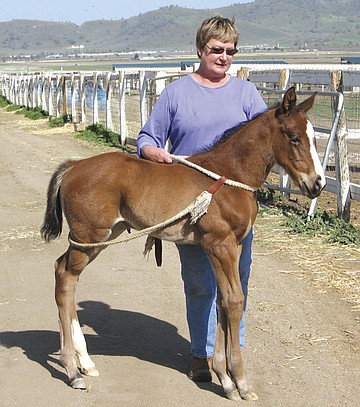
Priscilla Clark runs a horse retirement farm.
“I’ve seen the most dastardly things, the most
flagrant abuse. Anybody can see it. It’s not hidden.”
In the summer of 2008, a group of 40 broodmares slipped through the proverbial cracks, though they were saved just before the finish line. It happened when Ben Warren, who runs a large breeding operation in Hemet, and whose horses can be found at Del Mar (as well as Hollywood Park and Santa Anita) gave the horses away to what (he says) he believed to be “good homes”; the recipient was a man identified as Dave Quinn. The mares ended up on a ranch in Phoenix, destined, allege some, for auction and eventually a Mexican slaughterhouse. Before the animals could be offered up to kill buyers, Priscilla Clark of Tranquility Farm, a prominent horse-retirement facility in Tehachapi, intervened and bought the horses. Warren, who denied culpability, was never charged with a crime.
When it comes to the slaughter of Thoroughbreds, Clark, who owns and manages Tranquility, minces no words. “I’ve seen the most dastardly things, the most flagrant abuse. Anybody can see it. It’s not hidden at night, underground with troglodytes. It’s done in front of God and everyone. It’s an entrenched system. There are people who troll the track whose service is to remove unwanted horses. They’re dealers.”
Clark, whose 100-plus racing retirees include stars such as Buddy Gil, Geronimo, and Lenny from Malibu, alleges that racehorse slaughter has not declined. “The owners, the trainers, the racetrack operators — many are in denial.”
She quips: “It’s ‘Don’t ask, don’t tell.’ ‘Out of sight, out of mind.’”
Moreover, Clark notes, passing a law isn’t tantamount to enforcing it; since the enactment of California’s horse-slaughter ban over a decade ago, there’s never been a prosecution.
Others in racing disagree with this assessment. Melody Conlon, a trainer since 1997, says that, due to heightened awareness among Thoroughbred owners, the one-way trip to the kill buyer is no longer a retirement option in the major Southern California racing circuit. The horses one sees at Del Mar (and Hollywood Park and Santa Anita) are so closely monitored that there’s little chance they’ll end up in a Canadian or Mexican processing plant. (The last American horse slaughterhouses were shuttered years ago.)
No one with whom I spoke is uniformly critical of the horse-racing industry. Even the most strident — those at the angry, activist end of the equine-retirement movement — are generous with praise for owners who give more than a damn. Priscilla Clark says, “There are wealthy people who have been absolutely heroic, people like Madeline Auerbach; the Ammermans; Gary Biszants; Ann and Jerry Moss; Valerie Naify; the Rathers; the Siegels. They’ve given much more than their fair share. And CARMA has been a lifesaver.”
Every racehorse-rescue advocate says the same thing: funding is the key. To that end, a group of local ranches, veterinary practices, and others formed the San Diego Equine Safety Net Coalition in January 2010. Along with Groebli’s operation, the county’s equine refuges include Blue Apple Ranch in Ramona, FalconRidge Equine Rescue in Valley Center, and Horses of Tir Na Gog near Pine Valley.
Given the existence of horse-rescue operations, one might think there’s an oversupply of Thoroughbred racehorses; but it’s not that simple. Madeline Auerbach says that, when the economy slumps, the horse-racing industry — as entertainment — is impacted hard. She notes that, during the past four or five years, each breeding season (January through June) has seen a 20 percent or greater decline in foals from the prior season. “Mare owners will leave the mares empty for a year, because the market is soft.”
As the result of the recent horse shortage at California Thoroughbred venues, track operators have been forced to reduce field size and/or cut racing days from the calendar. Take Del Mar, for example. The boutique summer meet had for decades consisted of a 43-day calendar, with only Tuesdays dark, but beginning in 2010, Del Mar (formally, the Del Mar Thoroughbred Club) has operated sans Mondays — except for Labor Day — conducting 37 days of racing.
Even if the meet’s shorter nowadays, Del Mar continues to get high marks from every stripe of Thoroughbred enthusiast, including trainers, who are arguably the most important two-legged animals on the grounds. For a trainer’s perspective on a Thoroughbred’s golden years, I looked up Bruce Headley, an old-time horseman with a 46-horse stable headquartered at Santa Anita. Dubbed “Cowboy Bruce” by talking heads at Television Games Network (TVG), he’s been characterized by other horse-racing types as a traditionalist who brings horses along patiently and treats his charges with ample respect.
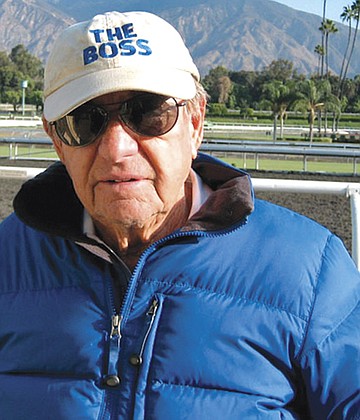
Famed trainer Bruce Headley: “I don’t think abuse
and slaughter are a big deal these days.”
Headley said, “I’ve been in the game since 1948. I took out my trainer’s license in 1959.”
I asked him if he knew anything about the new guys, the younger trainers. Had he heard anything about how they handle the horses on their way out? With nary a trace of rancor, Headley expounded. “I treat my horses right. As far as the other trainers, I don’t know; I don’t talk to them. They’re smart guys. They’re bartenders and lawyers. They’re linemen for the county, like Doug O’Neill. They can pass the trainer’s exam — it’s mostly about drugs and regulations. But they don’t know how to ride a horse or saddle a horse. They don’t know how to shoe or trim hooves. When I was coming up, I did everything myself. These days, they just hire out. They don’t ask for advice, and I don’t give any. I just do my own thing. But I don’t think abuse and slaughter are a big deal these days.”
Consistent with his role as a rugged remnant, Headley, when it comes to moving Thoroughbreds off the track, blazes his own trail. “I don’t go in for the CARMA setup where they take part of the purse. I just find good homes for my horses myself, and it’s always worked out well. If somebody needs a good jumper or a pleasure horse, my horses are real well broken. I let ’em down slowly after they come off the track, so they’re pretty nice to ride.”
I asked Madeline Auerbach and the others about the different sorts of retirement available to Thoroughbreds. What about horses no longer viable on the track but still valuable off it? Perhaps best known is the prominent role that ex-racehorses play in the local horse-show world. Under the auspices of groups such as the Greater San Diego Hunter Jumper Association, retrained horses, outfitted with English tack and usually piloted by preteen and teenage girls (along with a smattering of boys and adults) go on to ribbon-winning careers. You’ll find “old” racehorses, some well into their teens themselves, at venues such as Del Mar Horse Park.
Then there’s the Western side of the equestrian scene: out in the corrals and arenas of Lakeside and Ramona, Thoroughbreds can be seen alongside quarter horses used as reining and cutting horses and barrel-racers. Still others are exported to Canada to work in four-horse teams in chuck-wagon races, while a handful of the smaller, well-bred types can be found on the polo fields of Rancho Santa Fe. These days, former racers may find homes as therapy horses for autistic kids, mentally disabled adults, and the like. There are even prison programs in which inmates are said to learn empathy via picking hooves and mucking stalls.
But perhaps the largest contingent of local retired racehorses end up as simple pleasure horses, ambling along the trails of Poway and a dozen other horse-centric exurbs; some, including the old and broken down, find owners who want nothing more than to have what Auerbach calls a “lawn ornament,” whose only responsibilities are to nuzzle noses and keep the Bermuda grass in check.
Here's something you might be interested in.
Saddlehorn Ranch West in Jamul – for retired thoroughbreds
Where do they go when the races are over?

Saddlehorn Ranch West in Jamul – for retired thoroughbreds
Where do they go when the races are over?
And where do they go — not after the gates spring open — but after the race is run, after all their races are run? After the society matrons’ $1000 hats are back in the closet, after the losing pari-mutuel tickets have been picked up by the infield “stoopers,” after the last $7 beer has been drunk — where do they go? What happens to these well-bred equines, these well-oiled machines of flesh and blood, of suspensory ligaments and sesamoid joints — where, exactly, do they end up after Del Mar?
In search of a clearer vision of the golden years of a Thoroughbred racehorse, I accompanied Karen Groebli one morning as she showed me around a succession of far-flung ranches. It’s among these bosky patches of San Diego–style ruritania that Groebli runs Tijuana River Valley Animal Rescue, an operation that focuses on horses, including 30 or so Thoroughbreds off the track.
According to Groebli, the overwhelming majority of Thoroughbred racehorse owners are responsible and committed to lifelong stewardship of these animals. The reason is money. Few racehorse owners make much, however, which means that for most the lure isn’t riches but the prestige of ownership, coupled with a plain old love of horses. Money is also the root of other, less-celebrated proclivities, including, e.g., the relinquishment of horses whose presence in the barn no longer makes economic sense.
“To some owners and trainers, racehorses, once they no longer make them any money, are disposable,” Groebli said. “It costs a minimum of $100 a day to keep a horse in training at the track. Some of the less conscientious owners will tell a trainer, ‘Get rid of this horse.’ There’s a little black market out there, well-connected people, go-betweens who can dispose of horses.”
But before one can discuss the end of a Thoroughbred, it is necessary to examine its beginnings.
The life cycle of the Thoroughbred racehorse is more complex than it might appear to outsiders, folks whose notion of racing’s “back side” is the well-muscled hindquarters of an often-truculent, four-legged athlete. This prized beast — whose forebears’ characteristics (“conformation” to the cognoscenti) came to a place of standardization in England around 1800 — is not only the heart of a multi-billion-dollar business, but the object of an intense love affair, the fire of which drives men and women to become racehorse owners, despite the slim chance they’ll turn a profit. Which leads us to a question: How does one go about becoming the owner of a Thoroughbred racehorse?
According to the United Pegasus Foundation, one of the nation’s largest horse-retirement ranches, approximately 34,000 Thoroughbreds are born each year in the United States. Many, if not most, are bred explicitly for racing. Some owners are themselves breeders, people in California, Florida, and Kentucky (to name the most important states) who await the outcome of a mare’s 11-month gestation. If all goes well, the result is a spindly foal typically born from January through June. Other owners, either as individuals or parts of syndicates, buy directly from breeders or from auctions, the latter events held in locales such as Fairplex Park up in Pomona, Ocala, Florida, and Keeneland, Kentucky.
No matter how one acquires a young Thoroughbred, in order to run it, you’ve got to register it with the Jockey Club, founded in 1894 and headquartered in Lexington, Kentucky. Once you have the requisite paperwork, the next step — done at the track — is a lip tattoo; this equine ink serves, among other things, as a safeguard against racehorse identity theft. (In recent years, the collection of DNA samples has been introduced.)
Horses of racing age (two and up) are often acquired via the claim box, where trainers, usually representing owners, will, before the start of a claiming race, agree to buy a certain horse for a specified claiming price. At Del Mar, this price may be as high as $100,000 or as low as $8000. Once the gates are sprung, the horse — no matter how or even if the horse finishes — is now the responsibility of the new owner. It’s a calculated gamble: Is the horse sound? Can it win, or even race again? Because the connections aren’t required to divulge veterinary records, it comes down to trust, intuition, and the ability to judge a horse on sight.
It’s at the bottom-most rungs of the claiming ladder where abuses are most likely to occur. This has led certain animal-rights groups to allege that the picture of a wizened horse grazing in a verdant, white-fenced pasture is too often fictional. To be fair, horse racing has a dark side to its “back side.” A few callous (or simply indifferent) owners and trainers make decisions that result in sub-idyllic retirements for some Thoroughbreds. For the least fortunate ruminants, gloomier destinations may await, including, in extreme cases, Canadian or Mexican slaughterhouses. It’s in those plants, most horse-welfare advocates lament, that “old” (though some are as young as three) racehorses suffer the worst of the worst outcomes.
That journey sometimes starts when an owner finds that he has a surplus horse, often a Thoroughbred who’s not paying his way because he’s too slow to win or too unsound to race again. According to several anonymous insiders, the owner will then direct the trainer to dump the horse. The trainer, in turn, asks around to locate someone who can take the unwanted horse. In the classic “kill/buy” scenario, the first stop is often a horse auction in Riverside or San Bernardino County, held in places such as Chino, Corona, Mira Loma, or Ontario. After being offloaded to a complex of pens and corrals, the Thoroughbred (along with other horses of various breeds and backgrounds) is sold to the highest bidder — the notorious “kill buyer” — seldom for more than $600. In some instances, the next stop is a feedlot in Arizona or New Mexico, although some horses are resold at a smaller local auction before being sent across state lines. Eventually, unless the kill buyer can make more by selling the horse for an alternate use or a horse-rescue group steps in, the abattoir awaits across the border, where horse slaughter is legal.
As it turns out, traditional Thoroughbred “tats” make them fairly easy to monitor, at least when an effort is made, and it’s by checking tattoos at livestock auctions that horse rescuers have intervened. When they find an ex-racehorse up for sale (unsound older horses and used-up broodmares are typical), they’ll pay at least the going price; it’s a ransom, of sorts. But people in Thoroughbred circles say the worst outcomes for ex-racehorses are rare these days; the major Southern California tracks, Del Mar, in particular, are cited as exemplars, facilities that take the proverbial high road when it comes to equine welfare.
One well-connected insider provided statistics that bear this out. According to a woman who operates under deep cover in her (unofficial) capacity as a Thoroughbred retirement activist, 2000–3000 horses have left Del Mar’s oval since October 2007. From that group, only 5 have been documented as having reached the clutches of a kill buyer, and in those cases, there were intermediate stops, twists, and turns on the way. Thus, during Del Mar’s brief seaside meet, one is unlikely to see a horse whose last race will be followed by tragedy.
I spoke with Del Mar CEO Joe Harper, whose affection for racing as a way of life, as an entity beyond the balance sheet, is palpable. “You know, I didn’t get into it because I wanted to be in the racetrack business; it was because I loved horses.” Of Thoroughbred retirement, he says, “Most end up on a farm, living out their days pleasantly. The possibility [of slaughter] always exists, and I can’t say it never happens, but if we find out, we’ll find a way to stop it.”
Harper also stresses that the economic pressures that can pave the road to the kill buyer aren’t present at Del Mar. “I worry about the smaller tracks in other parts of the country, where they run a lot of cheap claimers. But the owners here are fairly well-to-do, and they understand the game.”
Among those who don’t understand is Frank Price, a small-time breeder in Aguanga and proprietor of RaceHorseDreams.com. Soliciting the unwary and naive via glossy internet pics of pretty yearlings in pretty pastures, Price’s website states:
Ask yourself this…Can I Afford Only $1.50 Per Day?…Find 5 friends. Everybody can each own 2% of the racing dream and it will only cost each of you $1.50 per day. Think about it…That’s less than a beer…a great opportunity to join the exciting Thoroughbred Racing business. Where else can you find such a deal? What are you waiting for? Step up to our barn before your opportunity has left the gate.
Earlier this year, long before they could reach the starting gate, three of Price’s two-year-old “dreams” were found abandoned at a farm in Bonsall. At first, they were in good hands, boarded at Santa Ysabel’s sprawling E.A. Ranches. However, as months passed, Price failed to pay his boarding fees; eventually he was served with a summons for a small-claims lawsuit. He reluctantly forked over $7500, then contracted with well-known horse shipper R.D. Hubbard to have the trio moved to another barn. When Karen Groebli got wind of what had transpired — it’s called “abandonment” among equinophiles — she retrieved the horses and tailored them to her operation. (Price did not return telephone calls soliciting comment.)
Until a few years back, abandonment and other issues related to Thoroughbred retirement didn’t generate a lot of buzz. Naysayers point out that equine senior citizens, even the most eminent, were not always treated with such reverence. Their poster horse is named “Ferdinand.”
Foaled in Kentucky in 1983, Ferdinand’s first start was at Del Mar in September 1985. He was a standout, amassing $3,777,978 in earnings with eight wins from 29 starts; victories included the 1986 Kentucky Derby and the 1987 Breeder’s Cup Classic. Retired to stud in 1989, his get — his offspring — saw scant success, and he was sold to a Japanese breeding outfit in 1994. In 2002 (the precise date has never been determined) he met his demise at the slaughterhouse, his well-muscled loins destined for pet food. Discomfited and embarrassed, if not shocked, by Ferdinand’s unseemly denouement and the uproar that followed, horse-racing insiders began to train a spotlight on the behind-the-scenes bogeymen of horse racing: the kill buyer and the abattoir. In 2003, federal legislation was introduced, but eventually defeated.
Regardless of the bill’s failure to pass (many horse-welfare boosters blame crafty propaganda by slaughterhouse owners), the spotlight was now trained on this once-dim corner of racing: breeders, owners, trainers, and track operators had come to the conclusion that the traditional blind eye, the blissful ignorance that had permeated the industry, did few men — and no horses — any good. No one in the game, least of all the men and women whose love of Thoroughbreds transcended purse money and graded stakes wins, wanted this sort of publicity.
Madeline Auerbach: “The whole picture
of horse retirement has changed.”
The heavy hitters of the equine welfare world, those who’ve made lives out of raising funds and awareness, say that, for the most part, racing people (or “connections,” as they’re often called in the horseplayers’ world) go to extraordinary lengths to care for Thoroughbred retirees. Madeline Auerbach is one of the insiders, someone whose name is immediately recognizable by anyone who scans the Daily Racing Form’s past performances (or “PPs” as they’re known). As owner of the celebrated turf sire Unusual Heat, she’s been inside the breeding shed, the place where studs impregnate broodmares and — if all goes better than well — champion Thoroughbreds are created. On any given Del Mar race card, you’ll find her boy’s progeny, many under the wing of conditioner Barry Abrams.
According to Auerbach, well-publicized on-track injuries in recent years have spurred the industry to pay more attention to equine retirement. The best known of these incidents was the fatal on-track breakdown of the filly Eight Belles at the 2008 Kentucky Derby at Churchill Downs, where the three-year-old was euthanized behind a screen erected to shield the crowd and a nationwide television audience. Auerbach says, “The whole picture of horse retirement has changed in the three years since Eight Belles.”
In 2007, she founded the California Retirement Management Account, or CARMA, a not-for-profit organization which raises and distributes grants to horse-retirement and rescue operations. According to its website, the group is “dedicated to the goal of providing funding for the rehabilitation, retraining and/or retirement of Thoroughbred horses that have raced in California.”
To that end, the group — whose board of directors includes such racing luminaries as jockeys Mike Smith (of Zenyatta fame) and Gary Stevens (seen in the movie Seabiscuit) — has established a program under which owners donate one-third of one percent of purse money to the cause. On May 1, 2011, Magna Entertainment — owner of Santa Anita, Gulfstream Park in Florida, Pimlico in Maryland (site of the Preakness), and many other racetracks — announced that it would match all contributions. (Del Mar doesn’t currently match.)
As for Thoroughbred slaughter, Auerbach maintains that, at least for horses on the major SoCal circuit, it’s a thing of the past. “As a society, we’ve evolved.” Although she acknowledges that an “informal underground network” once existed to secrete discarded Thoroughbreds from the track to the cannery, she’s confident that the surreptitious trade no longer exists in California. She says this is due less to legislation than wilting pressure and intense opprobrium, the most effective approach being self-policing by the industry. (California’s statutory ban on in-state slaughter was enacted in 1998 pursuant to ballot Proposition 6.)
Auerbach takes issue with those who, in the name of horse welfare, would like to abolish horse racing. “They want all horses to roam free.” Groups such as People for the Ethical Treatment of Animals (PETA), she says, are ignorant about the intrinsic nature of the horse and the relationship that has bonded horse and man for thousands of years. “Horses have driven civilization. Next to the dog, the horse is man’s best friend.”
New equine careers aren’t always idyllic, though; according to racing insiders, a small number of Thoroughbreds (there’s no accurate count) end up “retrained” in an apocryphal array of what some call “illegal sports.” Apparently, the organizers run in the same circles as folks who set up cockfights and dogfights. Alluding to the Mexican rodeo, or charreada, my contact tried her best to be circumspect: “It’s centered around a certain rural Southern California subculture. There are backyard rodeos, often on small ranches, where they have events like ‘tripping.’” (In tripping, or mangana, a rider on horseback attempts to bring down another horse, usually a filly, by roping its front legs; catastrophic, often fatal injuries are common and the practice has been illegal in California since 1994.) “They also wager on match races where the horses run down dry riverbeds. The horses are all hyped up on amphetamines. No vets, of course.”
No matter how infrequent the worst-case endings, Karen Groebli, a native San Diegan who first visited the track as a toddler, has made it part of her mission to end such incidents by intervening before these bad-luck Thoroughbreds disappear. I asked her how common “unpleasant retirements” are nowadays. “It’s declined,” she admitted, “but the issue is still out there.”
I prodded Groebli: “Why should people be concerned about this?” Noting that in Europe horse meat is considered a delicacy, I asked why the racing industry had, along with its most ardent critics, decided to crack down on the slaughter of racehorses. One reason, she said, is gastronomic. “They’re full of drugs. There’s a lifetime of buildup of things like Lasix and ‘Bute’; it’s unhealthy to eat them.” (Both drugs are ubiquitous in American Thoroughbred racing. Lasix, the trade name for Furosemide, is a powerful diuretic used to control bleeding; “Bute” is short for Butazolidin, the trade name for Phenylbutazone, a non-steroidal anti-inflammatory, similar to over-the-counter painkillers popped daily by humans.)
Groebli, like many in the racehorse-retirement herd, toes a fine line. Both an activist and a racing insider, she’s at once a booster and a critic of the industry. Sure, she’s vocal, but as a longtime member of the tony Del Mar Turf Club — where membership is by referral only and the dress code draconian — she’s comfortable rubbing elbows with the mega-wealthy, if perhaps a bit put off by the drunken gaggles of big-hat, opening day types. She’s also a well-schooled horseplayer who’s fond of trifectas.
I met Natural Touch in the southernmost reaches of South Bay, where he’d recently begun a year-long rehab stint in an 80-by-80 corral at South Coast Farms; it’s a ranch just a few furlongs north of Mexico, where Groebli leases a patch of flatland for some of her 40 rescue horses, "almost 3/4 of which are off-track thoroughbreds."
Natural Touch is one of the lucky ones, and, if his ease with my petting is any indication, he’s a pretty happy gelding. Foaled at Golden Eagle in 2001, he’s an affectionate, relaxed brown (bay, to be precise) who raced 55 times around the West Coast, including twice at Del Mar in 2008, accumulating $181,331 in earnings. His lifetime past performances display seven wins along with 12 seconds, 13 thirds and 9 fourths — 41 times in the money, if you count superfectas. Given that out of the thousands of Thoroughbreds foaled each year, many never even make it to the starting gate, and even fewer win a single race, it’s not a bad record at all. Along the way, he’d been claimed five times. At the end of his career, his owners were Gary and Cecil Barber and his trainer was Peter Miller, connections familiar to Del Mar horseplayers. But by March 13, 2009, when he finished eighth out of nine runners in a $10,000 claimer at Santa Anita, he was done. His running line that day read “no factor.”
Some time later he was purchased by Sarah Arena, a 20-year-old who hoped he’d make a good jumper. But he soon turned up lame with right-front suspensory problems and was given up to Groebli — “relinquished” is the term she uses. Using her own, rapidly dissipating funds, she paid $600 for him. This was enough to buy a couple of months of board and feed, unless, that is, the ten-year-old needed vet care, which most ex-racehorses seem to much of the time.
After I toured her barn down in the Tijuana River Valley, Groebli chauffeured me through the winding roads of East County to Saddlehorn Ranch West in Jamul. There she leases another couple of acres, oak-studded hillsides where her horses roam in the strong East County sun. The last stop was Groebli’s own 2.5-acre spread, also in Jamul, where she lives cheek-by-jowl with four more Thoroughbreds. One of them is a descendant of Secretariat; he never won a race but he does have Big Red’s telltale ruddiness.
I asked Groebli what sorts of trainers were more (or less) likely to be implicated in leading a racehorse to slaughter. She replied that you won’t find big-name trainers like Bob Baffert connected, even peripherally, to the dark side of the back side. However, smaller barns that can ill afford to carry the burden of caring for non-productive equine athletes are sorely tempted to take the easy way out. Kill buyers are a touchy topic in racing for good reason. Even as their ranks have thinned, their customers shunned by most horsemen and banned by most tracks, the fact that they’re still (allegedly) operating gravely concerns animal rights’ advocates.
All but the most cynical acknowledge that the industry has cracked down big-time on horsemen who would steer their charges to a kill buyer. Magna Entertainment, the biggest player of all, has implemented a stringent ban on owners and trainers found to have involvement in horse slaughter. Some horse-welfare advocates maintain that the industry hasn’t done enough. Even the most optimistic, including Auerbach, lament that Thoroughbreds still manage to “slip through the cracks.” It’s hard to calculate exactly how many, but some say that whatever the number, it’s far too high.
Priscilla Clark runs a horse retirement farm.
“I’ve seen the most dastardly things, the most
flagrant abuse. Anybody can see it. It’s not hidden.”
In the summer of 2008, a group of 40 broodmares slipped through the proverbial cracks, though they were saved just before the finish line. It happened when Ben Warren, who runs a large breeding operation in Hemet, and whose horses can be found at Del Mar (as well as Hollywood Park and Santa Anita) gave the horses away to what (he says) he believed to be “good homes”; the recipient was a man identified as Dave Quinn. The mares ended up on a ranch in Phoenix, destined, allege some, for auction and eventually a Mexican slaughterhouse. Before the animals could be offered up to kill buyers, Priscilla Clark of Tranquility Farm, a prominent horse-retirement facility in Tehachapi, intervened and bought the horses. Warren, who denied culpability, was never charged with a crime.
When it comes to the slaughter of Thoroughbreds, Clark, who owns and manages Tranquility, minces no words. “I’ve seen the most dastardly things, the most flagrant abuse. Anybody can see it. It’s not hidden at night, underground with troglodytes. It’s done in front of God and everyone. It’s an entrenched system. There are people who troll the track whose service is to remove unwanted horses. They’re dealers.”
Clark, whose 100-plus racing retirees include stars such as Buddy Gil, Geronimo, and Lenny from Malibu, alleges that racehorse slaughter has not declined. “The owners, the trainers, the racetrack operators — many are in denial.”
She quips: “It’s ‘Don’t ask, don’t tell.’ ‘Out of sight, out of mind.’”
Moreover, Clark notes, passing a law isn’t tantamount to enforcing it; since the enactment of California’s horse-slaughter ban over a decade ago, there’s never been a prosecution.
Others in racing disagree with this assessment. Melody Conlon, a trainer since 1997, says that, due to heightened awareness among Thoroughbred owners, the one-way trip to the kill buyer is no longer a retirement option in the major Southern California racing circuit. The horses one sees at Del Mar (and Hollywood Park and Santa Anita) are so closely monitored that there’s little chance they’ll end up in a Canadian or Mexican processing plant. (The last American horse slaughterhouses were shuttered years ago.)
No one with whom I spoke is uniformly critical of the horse-racing industry. Even the most strident — those at the angry, activist end of the equine-retirement movement — are generous with praise for owners who give more than a damn. Priscilla Clark says, “There are wealthy people who have been absolutely heroic, people like Madeline Auerbach; the Ammermans; Gary Biszants; Ann and Jerry Moss; Valerie Naify; the Rathers; the Siegels. They’ve given much more than their fair share. And CARMA has been a lifesaver.”
Every racehorse-rescue advocate says the same thing: funding is the key. To that end, a group of local ranches, veterinary practices, and others formed the San Diego Equine Safety Net Coalition in January 2010. Along with Groebli’s operation, the county’s equine refuges include Blue Apple Ranch in Ramona, FalconRidge Equine Rescue in Valley Center, and Horses of Tir Na Gog near Pine Valley.
Given the existence of horse-rescue operations, one might think there’s an oversupply of Thoroughbred racehorses; but it’s not that simple. Madeline Auerbach says that, when the economy slumps, the horse-racing industry — as entertainment — is impacted hard. She notes that, during the past four or five years, each breeding season (January through June) has seen a 20 percent or greater decline in foals from the prior season. “Mare owners will leave the mares empty for a year, because the market is soft.”
As the result of the recent horse shortage at California Thoroughbred venues, track operators have been forced to reduce field size and/or cut racing days from the calendar. Take Del Mar, for example. The boutique summer meet had for decades consisted of a 43-day calendar, with only Tuesdays dark, but beginning in 2010, Del Mar (formally, the Del Mar Thoroughbred Club) has operated sans Mondays — except for Labor Day — conducting 37 days of racing.
Even if the meet’s shorter nowadays, Del Mar continues to get high marks from every stripe of Thoroughbred enthusiast, including trainers, who are arguably the most important two-legged animals on the grounds. For a trainer’s perspective on a Thoroughbred’s golden years, I looked up Bruce Headley, an old-time horseman with a 46-horse stable headquartered at Santa Anita. Dubbed “Cowboy Bruce” by talking heads at Television Games Network (TVG), he’s been characterized by other horse-racing types as a traditionalist who brings horses along patiently and treats his charges with ample respect.
Famed trainer Bruce Headley: “I don’t think abuse
and slaughter are a big deal these days.”
Headley said, “I’ve been in the game since 1948. I took out my trainer’s license in 1959.”
I asked him if he knew anything about the new guys, the younger trainers. Had he heard anything about how they handle the horses on their way out? With nary a trace of rancor, Headley expounded. “I treat my horses right. As far as the other trainers, I don’t know; I don’t talk to them. They’re smart guys. They’re bartenders and lawyers. They’re linemen for the county, like Doug O’Neill. They can pass the trainer’s exam — it’s mostly about drugs and regulations. But they don’t know how to ride a horse or saddle a horse. They don’t know how to shoe or trim hooves. When I was coming up, I did everything myself. These days, they just hire out. They don’t ask for advice, and I don’t give any. I just do my own thing. But I don’t think abuse and slaughter are a big deal these days.”
Consistent with his role as a rugged remnant, Headley, when it comes to moving Thoroughbreds off the track, blazes his own trail. “I don’t go in for the CARMA setup where they take part of the purse. I just find good homes for my horses myself, and it’s always worked out well. If somebody needs a good jumper or a pleasure horse, my horses are real well broken. I let ’em down slowly after they come off the track, so they’re pretty nice to ride.”
I asked Madeline Auerbach and the others about the different sorts of retirement available to Thoroughbreds. What about horses no longer viable on the track but still valuable off it? Perhaps best known is the prominent role that ex-racehorses play in the local horse-show world. Under the auspices of groups such as the Greater San Diego Hunter Jumper Association, retrained horses, outfitted with English tack and usually piloted by preteen and teenage girls (along with a smattering of boys and adults) go on to ribbon-winning careers. You’ll find “old” racehorses, some well into their teens themselves, at venues such as Del Mar Horse Park.
Then there’s the Western side of the equestrian scene: out in the corrals and arenas of Lakeside and Ramona, Thoroughbreds can be seen alongside quarter horses used as reining and cutting horses and barrel-racers. Still others are exported to Canada to work in four-horse teams in chuck-wagon races, while a handful of the smaller, well-bred types can be found on the polo fields of Rancho Santa Fe. These days, former racers may find homes as therapy horses for autistic kids, mentally disabled adults, and the like. There are even prison programs in which inmates are said to learn empathy via picking hooves and mucking stalls.
But perhaps the largest contingent of local retired racehorses end up as simple pleasure horses, ambling along the trails of Poway and a dozen other horse-centric exurbs; some, including the old and broken down, find owners who want nothing more than to have what Auerbach calls a “lawn ornament,” whose only responsibilities are to nuzzle noses and keep the Bermuda grass in check.
Comments