

Here's something you might be interested in.
Ask a Hipster — Advice you didn't know you needed
Big Screen — Movie commentary
Blurt — Music's inside track
Booze News — San Diego spirits
Classical Music — Immortal beauty
Classifieds — Free and easy
Cover Stories — Front-page features
Drinks All Around — Bartenders' drink recipes
Excerpts — Literary and spiritual excerpts
Feast! — Food & drink reviews
Feature Stories — Local news & stories
Fishing Report — What’s getting hooked from ship and shore
From the Archives — Spotlight on the past
Golden Dreams — Talk of the town
The Gonzo Report — Making the musical scene, or at least reporting from it
Letters — Our inbox
Movies@Home — Local movie buffs share favorites
Movie Reviews — Our critics' picks and pans
Musician Interviews — Up close with local artists
Neighborhood News from Stringers — Hyperlocal news
News Ticker — News & politics
Obermeyer — San Diego politics illustrated
Outdoors — Weekly changes in flora and fauna
Overheard in San Diego — Eavesdropping illustrated
Poetry — The old and the new
Reader Travel — Travel section built by travelers
Reading — The hunt for intellectuals
Roam-O-Rama — SoCal's best hiking/biking trails
San Diego Beer — Inside San Diego suds
SD on the QT — Almost factual news
Sheep and Goats — Places of worship
Special Issues — The best of
Street Style — San Diego streets have style
Surf Diego — Real stories from those braving the waves
Theater — On stage in San Diego this week
Tin Fork — Silver spoon alternative
Under the Radar — Matt Potter's undercover work
Unforgettable — Long-ago San Diego
Unreal Estate — San Diego's priciest pads
Your Week — Daily event picks
Driving after midnight in Poway, you will be stopped
Nighttime patrol is never monotonous

"Basically,” says Aaron Meleen, a deputy sheriff traffic investigator working the night shift in Poway, “we don’t have much going on right now.” It’s a Monday evening, the onset of his 12½-hour shift, and we’re strapped in his shock-worn Crown Vic, bouncing out of the station onto Civic Center Drive. The cruiser’s front compartment is a mélange of computer screen, keyboard, gun rack, intercom, dash-mounted radar scope, and handheld devices such as a cell phone and a clip-on video camera. Meleen, 27, sports a slicked-back hairstyle, short sidewalls with pronounced sideburns — a bit Guido, a bit Presley. Perhaps it’s the holstered gun or his cockpit of electronic gear that makes him seem unruffled. What will surprise me is just how fast he can Jekyll-and-Hyde that peace officer’s calm to an arresting tough.
Soon the radio dispatcher’s got his ear. The car’s GPS screen blips a code, brackets an address: fellow deputy Darrin Smith and his partner are at a “family disturbance,” two minutes away. Before Meleen can explain his night’s tasks, mostly stopping drivers for vehicle violations, we’re on our way, the Crown Vic responding with giddy-up enthusiasm. Pulling into an apartment complex, he says, “You’re welcome to come along but hang back a little. If you see any guns, let me know. It’s always nice to have an extra pair of eyes.”
We start moving toward #22. Evening’s falling. Up the stairs, inside, a man, drunk and sailor-mouthed, is on the couch. One look at me, and he says, “Who the hell are you?” I say nothing. “You have to ask permission to enter my home!” I start to ask, then Meleen says, “Calm down, dude. He’s a citizen ridealong.” Darrin Smith and Meleen are on either side of him. Another deputy stands in a doorway, keeping a woman (his wife?) at bay in a back room. Such blocking cops call “command presence.” I learn later the man’s been drinking all day, and he and the woman have been arguing for hours. A neighbor, sick of it, called in the complaint.
The man, a Mexican national, gets up. He’s pissed, an “I know my rights” guy. His face is the red of Tabasco. Whatever anger he had toward the woman he now spews at the cops. Meleen again tells him to cool it. The man tenses. He drops another F-bomb, then adds, as if it’s admissible: “There’s a citizen here. A ridealong who’s witnessing everything.” Odd. He thinks the police are harassing him. It’s just the opposite.
Meleen is tree-tall neutral. “Are you going to relax?” he says, his voice escalating, but the man is narrating his own drama: “If this was being videotaped, would you be justified? No, you would be not.” He pauses. “It’s pathetic. Your reasoning, your logic is pathetic.”
Meleen and Smith stand him up, but he starts moving against them. Suddenly, Smith kicks at the man’s ankle, and he goes down, the two cops pushing-and-holding his fall. The third cop is on him while the man screams into the carpet, “I’m not doing anything.” The three pull his feet up behind him and handcuff him. It’s over in five seconds, and then he’s on his feet. Marched down the stairs, he stops muttering in the caged backseat of a cruiser.
Night has arrived, and Meleen is unwinding beside his Crown Vic, the motor’s heat welcome in the cool air — overnight low in the mid-40s. He tells me why they arrested the man. “People who’ve been drinking all day can’t control themselves; they don’t have a cool head. We have to find out what’s happening. Has anyone gotten physical, or is this just a verbal argument? It’s not against the law to argue with your spouse.” Meleen says they cuffed him “for his safety and for our safety.” The arrest is lawful: penal code 148, resisting a peace officer. What I didn’t see, Meleen says, is that the man, in pulling away, bumped Smith. That triggered Smith to initiate the balletic takedown.
In a domestic quarrel, Meleen’s job is to sort out the “dominant aggressor.” While the man stews, the other deputies talk to the woman. Two sides to every story. It’s him, they determine. We return to the Poway station, where Smith will take three hours to book the man, transport him to “CJ,” San Diego’s downtown central jail, and document the incident in writing. (There are two rooms on the back side of the Poway sheriff’s station: Prisoner Holding and Report Writing.) The man’s rage deflated, order settles. Together, the three deputies huddle, share dread, recharge. Out alone, each has a gun and a car to protect him, though confronting drunkards or stoners intensifies the unpredictable, especially at night.
Driving After Midnight in Poway, You Will Be Stopped
Every night in Poway, three to five deputies work patrol: breaking up barroom melees, arresting burglars, bringing in guys on warrants, busting drug dealers. Meleen and 25-year veteran Mark Tally work traffic: collisions, hit-and-runs, speeding, DUIs. Back on the road, Meleen says, “I write a lot of tickets, trying to educate people, get their behavior to change.”
As the night progresses, he eyes the speeders. He watches headlights, sees them raise up as the car races or tilt down as it brakes. In his radar class, Meleen passed his nighttime “visual estimation of speed” test with flying colors. “I got each one right.”
Five years on the force, Meleen likes traffic and the night. After doing day patrol for two years in San Marcos, an opening in Poway in traffic came up. He tested, passed easily, and got the assignment. Four months on night shift, four months on day shift, that’s his duty. Twelve-and-a-half hour shifts, four days a week. He prefers nights, because fewer cars are on the road and there’s more of the people — read DUIs — “we’re looking for.” Most shifts, he racks up 100 miles in his Crown Vic, the side doors emblazoned with the emblem “Poway: the City in the Country.”
He’s memorized Poway’s nighttime-drivers’ behavior, where stop signs are run, where the dim-bulbs do 55 in a 35 mph zone. The later it gets, the drunker they are. “We have a saying: the only people out at 2:00 a.m. are drunks and cops.” He likes to “hide in the open,” sometimes hovering near Jimmy’s, next to Poway Fun Bowl, waiting for a driver to leave. Police call it “criminal profiling,” but he’s working off the likelihood that a kid in a hoodie hanging out behind a closed store, or a driver leaving a bar and weaving over the median, are worth momentarily detaining.
The entrée violation is a burnt-out license-plate light. We pull out from the station and within 30 seconds Meleen spots one. Quick pursuit, flashing lights, high-beam side-mounted spotlights. It’s almost Hollywood. Tonight, he’ll stop a dozen or more people, let most of the sober go with a warning, arrest the DUI drivers, run a few field sobriety tests, and conduct himself with each motorist (in my hearing) as graciously as if it were Thanksgiving dinner.
“Do I assume every person has been drinking? Absolutely not.” But he does look for “watery, red, droopy eyes,” an open container on the floor, smells of “an alcoholic beverage.” (Meleen can detect the odor of booze when he gets to the rear bumper.) He listens for slurred speech, notices the guy who fumbles with an ID. “It’s all a matter of building your case.”
After Meleen makes a vehicle stop for a burnt-out brake light, we head to the Poway Business Park. During the day 17,000 people work in some 500 businesses on this 900-acre site. Late evening, it’s duskily lighted, with yards and lots, fenced and locked.
I ask him to verbalize what he’s looking for. He doesn’t think about it, he says; it’s just “beat knowledge.” Except for a graveyard cleaning crew, there shouldn’t be anyone out. Street racers like the business park for the same reason burglars do: it’s unoccupied. But Meleen and company have dispersed them in recent months. Now, he’s checking parking lots to confirm there are no car engines idling; no one’s cutting a hole in a fence; nobody’s slowly rolling by to case the joint for a break-in. It’s all about absence, what’s not supposed to be happening. For the bad guy, it’s also about absence — making sure no cruiser is creeping by.
At one point, I remark to Meleen that his viewpoint, what he sees night-in, night-out in Poway, is distorted. Sure, most citizens are law-abiding and cooperate with him, the public servant, but the public he serves is not those with whom he deals. And they are a menacing lot. Most of us don’t see this grimy side of life except in stylized form on TV; we don’t encounter potheads and drunks, a malicious-spirited lot. Most of what’s dangerous in our neighborhoods exists behind a fog of protection. By arresting the bad guys, cops are constantly clearing the streets and, paradoxically, creating that fog. “That’s why we do it,” Meleen says. “We want to protect [those] people who don’t know how to [protect themselves] or don’t really want to see what’s going on.”
You’re Home But You Can’t Remember How You Got There
Over the past 20 years, the U.S. crime rate has fallen. The rate of night-prevalent crimes — business break-ins, vandalism, domestic violence, sexual assault and rape (66 percent occur after dark), vehicle theft (72 percent) — has also dropped. What’s more, the percentage of deaths involving vehicle wrecks and alcohol, more common at night, has fallen from 60 percent of all fatalities in 1982 to 37 percent in 2008.
Meleen says that despite these drops, crimes against peace officers keep rising. That explains his chest bulk, a front-to-back bulletproof shield he wears under his shirt. He is more aware of such violence at night because of its unexpectedness. Nowadays, people are more desperate than ever, meth-heads in particular, looking to fight cops. Is it any wonder why the police act when they feel threatened?
Consequently, with nighttime stops, Meleen is wary. He does a driver-side approach. But he hangs back if the guy, for example, “is a parolee who’s just murdered his wife and thinks I’m stopping him because I know he did it.” In that event, or if the vehicle is stolen, he draws his gun and awaits backup. Every driver he’s ordered out and onto the ground has complied. So far, he’s never had to fire.
Some nights, Meleen and the other traffic deputy Mark Tally get off at 4:30 a.m., then have to show up at court in downtown San Diego by 8:00 or 10:00. Tally says that he’ll doze at home first, then rack out on a couch in the “officer waiting room” beside the courtroom. “It’s the worst part of night shift,” Meleen says. That and missing family events, NFL football, and seeing his wife, sometimes for four days at a time. She’s at work when he clocks in, and she’s in the last throes of sleep when he climbs into bed. After court, Meleen may go back to sleep, but if it’s mid-afternoon, he just has to “suck it up” and go in at 4:00 p.m. Remembering rolling home once following such a stint, Meleen says, “Do you ever drive home at 5:00 in the morning and you can’t remember how you got there?”
If Meleen appears fuzzy, his sergeant reminds him that he can rack out at the station or take the day (night) off. It’s the deputy’s call. Otherwise, Meleen “loves being up at night. I sleep better during the day. I can get four hours of sleep and work a night shift okay.”
Again, the radio interrupts. “Subject wandering near the Garden Center on Vista View. Subject’s got a backpack or a bedroll. Subject is heavyset, with a beard, greenish/tan shorts. Subject seen carrying a stick.” Sounds harmless. But Meleen guns the Crown Vic. “This is a suspicious-person call.”
A dark drive. We stop. Doors open and shut. Meleen says, “I’m going to look over…” and his flashlight finds a pile. It’s moving, a man’s wasted look in the beam. Meleen jumps. I jump. We both drop back. “Hey, man, what’s up?” Meleen says. The man grumbles to his feet. He’s half-asleep. Another question, and the man is bitching, resisting. Meleen pulls the man’s hands behind his back to cuff him. Now the man’s pissed. When asked, he shoots back his name, Jesse, a dart of pride in it.
“Why are you staying over here, man?” Meleen asks. “Over here” is behind a stand of manzanita, underneath a date palm.
“I was just sleeping, dude. There is no why,” the guy says. “Your ‘why’ must produce a certain [garbled expletive] answer — ”
“What?” Meleen says, as in, explain that again, this time civilly.
“I have no why. I’m just trying to sleep.”
And so it goes. Meleen’s curiosity, Jesse’s defensiveness; Meleen’s query about drugs; Jesse’s blue denial; Meleen’s asking about sharp objects in his pockets; Jesse’s saying he didn’t do nothing, he’s totally sober, he’s a victim. The logic of the lawbreaker: his behavior is all the cops’ fault.
They run his California ID card and find a warrant for his arrest.
“Get these cuffs off,” Jesse says.
“No way,” Meleen says.
“You feel threatened by me?”
“Absolutely,” Meleen counters. “You already pulled away from me once.”
Meleen dons a pair of gloves (“He’s got fleas,” Meleen tells me later; the guy lives in his car), and the pocket-emptying humiliation ensues: Jesse’s worldly possessions — letters, car registration, the police warrant, wallet, candy wrappers — are tossed onto the lighted black trunk of the cruiser, the engine still purring. (Meleen says if he turned the Crown Vic off, the computers and gizmos inside would be dead in a half-hour.) Jesse hangs his head. His feet are in stubby golf socks. He wants his shoes. He can’t have them, not in central jail. Meleen tells him he’ll put everything in his car, parked somewhere else. I catch a glimpse of Jesse’s photo ID: that picture captured a better time. Now he’s puffy-faced, insolent, his middle-parted hair falling aside his downcast eyes. He’s put into the backseat and the insolence stops.
Eventually, we herd Jesse downtown, where he’s photographed and answers medical queries (“No, I don’t feel like killing myself”) and offers another critique of Meleen’s arresting style (“You’re gang-related, man”). He disappears into the jail fortress, those sliding/locking doors as final as hell’s gate. As we drive out, Meleen says, “I guess I’m off his Christmas card list.” I sense a kind of unbridgeable despair in Meleen for having to tend this diseased wing of the flock. There’s something stupid and sad about these petty criminals.
We hustle back to Poway at 88 mph. Meleen’s needed for a field sobriety test, his specialty. As passionate as he is about arresting drunk drivers (he was honored by Mothers Against Drunk Driving last year for his 67 DUI arrests), he’s sympathetic to the times. “We have a lot of people who are economically challenged,” he says. “To escape the problems of home life or financial debt, they go to the bar and drink or buy a six-pack and drink at home.” The tragedy is, when you’re arrested for a DUI, “now you have a whole new set of worries” to add to the ones that got you there.
Working Dawn to Dawn
In a bright-lighted room at San Diego Gas & Electric’s metro headquarters on 33rd Street, a crew of linemen assemble at a bit past 9:00 p.m. for a “tailgate,” a quick confab about tonight’s project: replacing an aging two-ton metal 12-kilovolt transformer, corroded within by sprinkler water, with a new two-ton stainless-steel 12-kilovolt transformer. The crew, many in blue work shirts and already a bit (to my glance) bleary-eyed, is composed of four journeyman linemen — supervisor Mike Taylor; foreman Willie Major; veteran Ismael Blas; “infant” lineman, the rawest with only five years, Nate Fairman — and a crane operator, Carlos Rivera. Each man has been up since 5:00 a.m. and at least two, by working all night and into tomorrow, will be hitting what the company prescribes as the wall: 30 hours straight.
They’re friendly, joking about catnaps, honoring seniority. Major talks the most; the other guys defer. With a meat-packer’s shoulders and narrow glasses, he’s got some 20 years under his hard hat. Good-humored, he runs the show. Nothing moves until he says so.
The unflappable Mike Taylor, with a stubbly red beard, is higher up the ladder. He holds back, observes Major and the crew, looks for signs of drooping: “Complacency,” he tells me, “moving not as they usually do, not sharp. Anytime the communication starts breaking down, I’ll talk with them. I’ll make the decision: go home and rest.” Taylor also notes that linemen have a “true brotherhood: You never want,” because of fatigue, “to put yourself or your brother in danger.”
Major says this outage, a set of medical offices where it’s likely no one’s at work, has been planned to least inconvenience the customers. “Marketing” schedules the optimal time and notifies residents. Invariably, Major warns, not everyone reads the handout. Once in Pacific Beach he showed up for a quick change-out at an apartment building. As he was back-beeping his truck in, an irate man came at him, cursing a blue streak. Major agreed with him, then “destroyed him with kindness.” He calmed the savage surfer, who “by the time I was done came back and apologized.”
Night work for this crew is sweet: double-time union wages, International Brotherhood of Electrical Workers, Local 465. This crew is not composed of “trouble-men,” who sign up for night emergencies, where, after a day’s work, they’re called to freakish power outages, such as Mylar balloons stuck in the wires. These linemen are scheduled in advance, so they know, “there goes the weekend.” But no one squawks. Midnight comes with the territory. Like lawyers, they qualify for — and remain in — the trade by toiling 50–70 hours a week for much of their career.
Major says that today, after his shift ended, he “rested” but didn’t fall asleep. He knows how to pace himself. “Nate here,” he points at Fairman, “is a new journeyman,” a lineman-to-be, who’s “conditioning himself to work these long hours.” If guys get tired, they tell the super. No problem. “But I’ve never seen in 20 years,” Major says, “anybody pull themselves completely out.” Part of the code. Be there for your buddies.
The five-man crew, in three noisy, massive trucks, one with a crane, caravan south on I-5 to the site. They caution-tape the transformer and a relay station across the street, where the line runs underground. The relay station, under metal plates, has a “feed” coming in and a “load” going out. They measure the voltage at the old transformer, then de-energize, or turn off, the hookups at the relay station using a “shotgun” or “hot stick” — a fiberglass pole. The few lights in the medical offices flick off. To guard against undetected voltage, the crew grounds the relay station to make sure it’s dead. Next, after checking there’s no voltage at the old transformer, they de-cable it, and Rivera, commanding a 50-foot boom, lifts the old transformer off and lowers the new one in its place. A concrete platform is also changed out. (In the midst of all this, the sprinkler system starts and sprays the crew.) Finally, the men re-cable the transformer and re-energize the relay station. All these “un”s and “re”s are shouted in a lineman jargon of commands and numbers and acronyms within a well-lighted and safety-conscious three hours.
In terms of lasting, the crew sings the same song. They don’t necessarily like night work; it throws them off; they miss their families. At home, the phone rings consistently: “call-outs” come, and any normal sleep cycle is shot.
The secret to lasting, they say, is that the job and the crew changes daily. Willie Major will work all night, then work above ground, on the poles, all day. “Just that difference alone will keep me awake. It’s never monotonous.” I ask him about finding time to spend the vast sums he’s making. “The wife and I are into our savings mode,” which finances their five-week Las Vegas vacations. But he knows his limits. “If I haven’t paid the sleep gods their due respect, I’ll shut myself down.”
Between shifts, Ismael Blas says he “just rests, watches a movie.” He may doze, but he knows the phone’s going to ring, or he’s due at 9:00 p.m. Working outdoors is key for Blas. “If you sit and look at a screen for six hours, it’ll wear you out.”
The final hurdle for the journeyman, after years of schooling and apprenticeship, arrives just prior to graduation, when the man’s family is called in for a final “topping out.” The family is reminded that the lineman is always on call. He might go in on Monday and not come home until Thursday. Before he signs up, he can back out if either he or the wife says no. No disgrace.
Bidding post-midnight goodbye to Taylor, I learn why he, awake-wise, is on top of the heap. Up since 5:00 a.m., he’s supervising another job at 1:00 a.m. He’ll get home around 6:00, just as his wife, a nurse, leaves for her 12-hour shift and just as their nine-month-old is waking up, the onset of Taylor’s (other) day shift. “That’s affected my sleep more than my job,” he says with a doleful laugh. In its wake, I think I see a suppressed yawn. “It’s built-in,” he continues, realizing he’ll be up 38 hours straight. “If you’re a lineman, you’re used to very little sleep.”
Sundown on the U.S.–Mexico Border
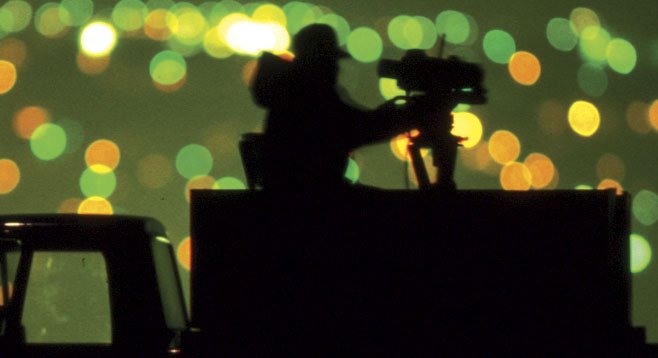
Halfway up one of the foothills of the San Ysidro Mountains and roughly two miles east of the Otay Mesa border crossing sits a Jeep Wrangler and a thermal imaging night scope, both pointed toward the U.S.–Mexico border. Under a darkening, foggy sky, I’ve been driven up here by a Border Patrol agent to meet two National Guardsmen on swing shift. The pair maneuver a small, tripod-mounted camera, unassuming yet formidable. Its hawk-eye’s view encompasses several miles of border fence and what’s been (until lately) a torrent of nighttime entries by illegals from Mexico. The National Guard has been at this and three other locations in the nearby hills, 24/7, since last August. It’s part of a federally funded “force multiplier” as the Border Patrol hires more agents and shuts down nearly every unlawful way in.
I’m inside the Jeep’s cab, doors open, leaning forward with the steeply tilted terrain. A cold spring wind rifles through the cab. Of the pair of guardsmen, one is younger, the other a bit older, their duty coated in helmet, camouflage clothing, and individual body armor, all in that overwashed green-and-white.
We’re surveying the vast border region below us by eye and on a computer screen, the eye of the infrared camera. “It can be pitch black out here,” says the younger soldier, “and we can watch [on the screen] the body heat” of a person or vehicle moving beside or getting through the fences. On the computer a joystick moves the live image side to side, pulls back, and goes in close.
We’ve all seen these x-ray–like scope images courtesy of the Iraq and Afghanistan wars: a warehouse in the scope bull’s eye, a countdown, an explosion. The night image has two moods: white hot and black hot. White hot means heat sources — “the heat of the body goes out your head” — show up in light grays, while black hot means the heat sources show up in dark grays. By day, “intruders” who get through and hide behind a bush or in a gulch are unseen by the scope. At night, they’re easily spotted, which, unluckily for them, is when the majority try and get over.
In the dark, the younger soldier explains, “we see real large heat spots right along the fence.” People are burning garbage or just congregating. Once a person crosses, his crouching-and-running posture, clearly visible on the scope, gives him away. One conveyance they see in the dark is the ultralight: a winged glider with a motor, a fan at its back, and a seated flier, which launches from Tijuana and swoops over the fence to a rough landing. “A lawn chair with wings,” the older soldier says. Night flyers bring drugs, drop their load, and head back — in two minutes flat. Agents in Jeeps and vans, positioned all across Otay Mesa, move lightning-quick for the capture.
National Guard–assisted surveillance is effective. Since last August, on the day shift they’ve caught 125 illegals, on the swing shift, 1300, and on the graveyard, 1100. It’s a “game of chess,” the older one says, while the younger soldier calls it “cat and mouse. The other side compensates and so do we.” Mexican smugglers have spotters, the older soldier explains. “They know we’re up here, and we prefer that. It’s a deterrent; they know we’re waiting. We’d love to deter more, because it’s a dangerous trek. You can get stuck in the hills, run out of food and water, and die. We don’t want that.”
As night descends, I take a breath and take in our field general’s view: dark ridge lines, parallel border fences, and the switched-on lights of Tijuana. The tableau is like the Persian encampment before the battle of Marathon.
My escort, Border Patrol agent Jerome Conlin, drives us down the crater-filled road we came up on, the yellow-light glare of Donovan state prison off to the right. At 39, Conlin is a Border Patrol spokesman and a swing-shifter. He’s adept at his dual tasks, being media and lookout savvy. His new wife accepted with her vows (“I didn’t want her to become a divorce statistic”) that she would play second fiddle to his changing shifts. On swing, he works until midnight; sometimes, he goes to bed as soon as he’s home, or later, at 4:00 a.m., because of other duties. On graveyard, he says, “to get more than six hours of sleep during the day is difficult. I prefer swing.” He misses those evening rites — a drink in a bar, an NFL game, New Year’s Eve.
What I find curious, as we head through an automatic gate, which opens the new 17-foot-tall secondary U.S. border fence, is that the farther south in San Diego you go, the less welcoming it is. Any place one is taken to by an official government tour guide possesses this otherworldliness. The bottom of the county feels on edge. Yes, much is above board: Brown Field, the Otay Mesa port of entry, the expansive warehouses. But a few of those warehouses are not what they seem. Inside, the Border Patrol has uncorked the end hatches of 38 tunnels in the past decade.
Border security has boomed since 9/11, the big construction years, 2007–2009. Along the 60-mile border in San Diego County the number of agents has almost doubled to 2600. Plus there’re 14 miles of new secondary fence from the ocean to the San Ysidro Mountains. As a result, there were 42 percent fewer illegal crossings along the county’s border in 2010 than in 2009.
Conlin drives and talks while I gawk at this 50-yard-wide strip, hazily lit by citrine-yellow stadium lights on poles. Heading west, we see the old, or primary, fence on our left — composed of helicopter landing mats left over from the Vietnam War. The numbered sections are about six feet high, flimsy and unmoored, rarely stopping vehicles from busting through. Also on our left are the light poles and, every quarter-mile, camera towers. Every half-mile or so is a Border Patrol Jeep on the all-weather road, stationary or moving, its lights off.
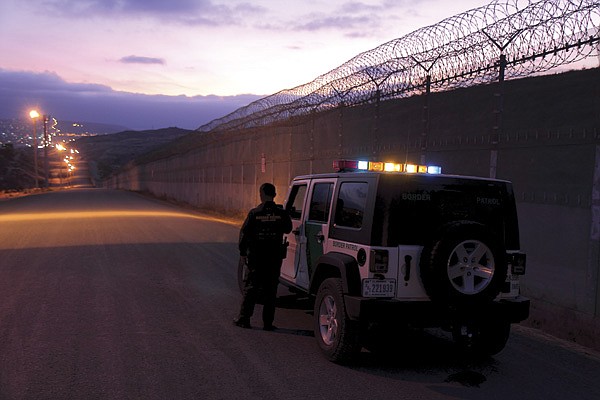
Early evening border patrol between the old and new fences at San Ysidro
On our right is the menacing new fence, a “climb-proof” wall of steel sections, perforated for a blurry see-through, with two rolls of razor-sharp concertina wire stacked on each other on top. Without the concertina wire, groups of five or ten illegals used to vault both fences, Conlin says, “in a minute, a minute 15.” Not so on the new fence. Instead, there are small cut-out rectangles, rewelded slices that illegals chopped open with an ax and a saw, then, bent back, snuck through. This break-in requires three or four minutes, enough time to catch most incursions.
Six years in, Conlin has learned to track illegals at night. He often patrols in East County, out by Tecate, “where the real action is,” he says. There, he’ll find “foot signs. And when I come upon a group — if they run, I shine my light [a powerful floodlight beam] on them. That disrupts their night vision. Individuals see the light and run. They have no night-vision capability.” Blinded and disoriented, Conlin and crew collar them quickly. If some get away, he’ll call in “our midnight guys,” who use dogs to hunt the group down.
Conlin says the “real art of tracking” came by doing it at night. Illegals, he says, are much better adapted to the dark than patrol agents are. They — especially the coyotes — carry no flashlights and move stealthily because they’re surefooted and can adjust their sight.
Just before we traverse Smuggler’s Gulch — a steep-sloped canyon once nearly indefensible against unlawful entry but now blocked by a half-mile, 180-foot-deep earthen berm and topped with a new road and fence — Conlin points out a shantytown bivouacked along the polluted Tijuana River. We drive by Border Patrol agents, who, relieved only for meals and a pit stop, sit in their darkened vehicles on “still watch,” deterring, for now, the inevitable dash from there to here.
Here's something you might be interested in.
Driving after midnight in Poway, you will be stopped
Nighttime patrol is never monotonous

Driving after midnight in Poway, you will be stopped
Nighttime patrol is never monotonous
"Basically,” says Aaron Meleen, a deputy sheriff traffic investigator working the night shift in Poway, “we don’t have much going on right now.” It’s a Monday evening, the onset of his 12½-hour shift, and we’re strapped in his shock-worn Crown Vic, bouncing out of the station onto Civic Center Drive. The cruiser’s front compartment is a mélange of computer screen, keyboard, gun rack, intercom, dash-mounted radar scope, and handheld devices such as a cell phone and a clip-on video camera. Meleen, 27, sports a slicked-back hairstyle, short sidewalls with pronounced sideburns — a bit Guido, a bit Presley. Perhaps it’s the holstered gun or his cockpit of electronic gear that makes him seem unruffled. What will surprise me is just how fast he can Jekyll-and-Hyde that peace officer’s calm to an arresting tough.
Soon the radio dispatcher’s got his ear. The car’s GPS screen blips a code, brackets an address: fellow deputy Darrin Smith and his partner are at a “family disturbance,” two minutes away. Before Meleen can explain his night’s tasks, mostly stopping drivers for vehicle violations, we’re on our way, the Crown Vic responding with giddy-up enthusiasm. Pulling into an apartment complex, he says, “You’re welcome to come along but hang back a little. If you see any guns, let me know. It’s always nice to have an extra pair of eyes.”
We start moving toward #22. Evening’s falling. Up the stairs, inside, a man, drunk and sailor-mouthed, is on the couch. One look at me, and he says, “Who the hell are you?” I say nothing. “You have to ask permission to enter my home!” I start to ask, then Meleen says, “Calm down, dude. He’s a citizen ridealong.” Darrin Smith and Meleen are on either side of him. Another deputy stands in a doorway, keeping a woman (his wife?) at bay in a back room. Such blocking cops call “command presence.” I learn later the man’s been drinking all day, and he and the woman have been arguing for hours. A neighbor, sick of it, called in the complaint.
The man, a Mexican national, gets up. He’s pissed, an “I know my rights” guy. His face is the red of Tabasco. Whatever anger he had toward the woman he now spews at the cops. Meleen again tells him to cool it. The man tenses. He drops another F-bomb, then adds, as if it’s admissible: “There’s a citizen here. A ridealong who’s witnessing everything.” Odd. He thinks the police are harassing him. It’s just the opposite.
Meleen is tree-tall neutral. “Are you going to relax?” he says, his voice escalating, but the man is narrating his own drama: “If this was being videotaped, would you be justified? No, you would be not.” He pauses. “It’s pathetic. Your reasoning, your logic is pathetic.”
Meleen and Smith stand him up, but he starts moving against them. Suddenly, Smith kicks at the man’s ankle, and he goes down, the two cops pushing-and-holding his fall. The third cop is on him while the man screams into the carpet, “I’m not doing anything.” The three pull his feet up behind him and handcuff him. It’s over in five seconds, and then he’s on his feet. Marched down the stairs, he stops muttering in the caged backseat of a cruiser.
Night has arrived, and Meleen is unwinding beside his Crown Vic, the motor’s heat welcome in the cool air — overnight low in the mid-40s. He tells me why they arrested the man. “People who’ve been drinking all day can’t control themselves; they don’t have a cool head. We have to find out what’s happening. Has anyone gotten physical, or is this just a verbal argument? It’s not against the law to argue with your spouse.” Meleen says they cuffed him “for his safety and for our safety.” The arrest is lawful: penal code 148, resisting a peace officer. What I didn’t see, Meleen says, is that the man, in pulling away, bumped Smith. That triggered Smith to initiate the balletic takedown.
In a domestic quarrel, Meleen’s job is to sort out the “dominant aggressor.” While the man stews, the other deputies talk to the woman. Two sides to every story. It’s him, they determine. We return to the Poway station, where Smith will take three hours to book the man, transport him to “CJ,” San Diego’s downtown central jail, and document the incident in writing. (There are two rooms on the back side of the Poway sheriff’s station: Prisoner Holding and Report Writing.) The man’s rage deflated, order settles. Together, the three deputies huddle, share dread, recharge. Out alone, each has a gun and a car to protect him, though confronting drunkards or stoners intensifies the unpredictable, especially at night.
Driving After Midnight in Poway, You Will Be Stopped
Every night in Poway, three to five deputies work patrol: breaking up barroom melees, arresting burglars, bringing in guys on warrants, busting drug dealers. Meleen and 25-year veteran Mark Tally work traffic: collisions, hit-and-runs, speeding, DUIs. Back on the road, Meleen says, “I write a lot of tickets, trying to educate people, get their behavior to change.”
As the night progresses, he eyes the speeders. He watches headlights, sees them raise up as the car races or tilt down as it brakes. In his radar class, Meleen passed his nighttime “visual estimation of speed” test with flying colors. “I got each one right.”
Five years on the force, Meleen likes traffic and the night. After doing day patrol for two years in San Marcos, an opening in Poway in traffic came up. He tested, passed easily, and got the assignment. Four months on night shift, four months on day shift, that’s his duty. Twelve-and-a-half hour shifts, four days a week. He prefers nights, because fewer cars are on the road and there’s more of the people — read DUIs — “we’re looking for.” Most shifts, he racks up 100 miles in his Crown Vic, the side doors emblazoned with the emblem “Poway: the City in the Country.”
He’s memorized Poway’s nighttime-drivers’ behavior, where stop signs are run, where the dim-bulbs do 55 in a 35 mph zone. The later it gets, the drunker they are. “We have a saying: the only people out at 2:00 a.m. are drunks and cops.” He likes to “hide in the open,” sometimes hovering near Jimmy’s, next to Poway Fun Bowl, waiting for a driver to leave. Police call it “criminal profiling,” but he’s working off the likelihood that a kid in a hoodie hanging out behind a closed store, or a driver leaving a bar and weaving over the median, are worth momentarily detaining.
The entrée violation is a burnt-out license-plate light. We pull out from the station and within 30 seconds Meleen spots one. Quick pursuit, flashing lights, high-beam side-mounted spotlights. It’s almost Hollywood. Tonight, he’ll stop a dozen or more people, let most of the sober go with a warning, arrest the DUI drivers, run a few field sobriety tests, and conduct himself with each motorist (in my hearing) as graciously as if it were Thanksgiving dinner.
“Do I assume every person has been drinking? Absolutely not.” But he does look for “watery, red, droopy eyes,” an open container on the floor, smells of “an alcoholic beverage.” (Meleen can detect the odor of booze when he gets to the rear bumper.) He listens for slurred speech, notices the guy who fumbles with an ID. “It’s all a matter of building your case.”
After Meleen makes a vehicle stop for a burnt-out brake light, we head to the Poway Business Park. During the day 17,000 people work in some 500 businesses on this 900-acre site. Late evening, it’s duskily lighted, with yards and lots, fenced and locked.
I ask him to verbalize what he’s looking for. He doesn’t think about it, he says; it’s just “beat knowledge.” Except for a graveyard cleaning crew, there shouldn’t be anyone out. Street racers like the business park for the same reason burglars do: it’s unoccupied. But Meleen and company have dispersed them in recent months. Now, he’s checking parking lots to confirm there are no car engines idling; no one’s cutting a hole in a fence; nobody’s slowly rolling by to case the joint for a break-in. It’s all about absence, what’s not supposed to be happening. For the bad guy, it’s also about absence — making sure no cruiser is creeping by.
At one point, I remark to Meleen that his viewpoint, what he sees night-in, night-out in Poway, is distorted. Sure, most citizens are law-abiding and cooperate with him, the public servant, but the public he serves is not those with whom he deals. And they are a menacing lot. Most of us don’t see this grimy side of life except in stylized form on TV; we don’t encounter potheads and drunks, a malicious-spirited lot. Most of what’s dangerous in our neighborhoods exists behind a fog of protection. By arresting the bad guys, cops are constantly clearing the streets and, paradoxically, creating that fog. “That’s why we do it,” Meleen says. “We want to protect [those] people who don’t know how to [protect themselves] or don’t really want to see what’s going on.”
You’re Home But You Can’t Remember How You Got There
Over the past 20 years, the U.S. crime rate has fallen. The rate of night-prevalent crimes — business break-ins, vandalism, domestic violence, sexual assault and rape (66 percent occur after dark), vehicle theft (72 percent) — has also dropped. What’s more, the percentage of deaths involving vehicle wrecks and alcohol, more common at night, has fallen from 60 percent of all fatalities in 1982 to 37 percent in 2008.
Meleen says that despite these drops, crimes against peace officers keep rising. That explains his chest bulk, a front-to-back bulletproof shield he wears under his shirt. He is more aware of such violence at night because of its unexpectedness. Nowadays, people are more desperate than ever, meth-heads in particular, looking to fight cops. Is it any wonder why the police act when they feel threatened?
Consequently, with nighttime stops, Meleen is wary. He does a driver-side approach. But he hangs back if the guy, for example, “is a parolee who’s just murdered his wife and thinks I’m stopping him because I know he did it.” In that event, or if the vehicle is stolen, he draws his gun and awaits backup. Every driver he’s ordered out and onto the ground has complied. So far, he’s never had to fire.
Some nights, Meleen and the other traffic deputy Mark Tally get off at 4:30 a.m., then have to show up at court in downtown San Diego by 8:00 or 10:00. Tally says that he’ll doze at home first, then rack out on a couch in the “officer waiting room” beside the courtroom. “It’s the worst part of night shift,” Meleen says. That and missing family events, NFL football, and seeing his wife, sometimes for four days at a time. She’s at work when he clocks in, and she’s in the last throes of sleep when he climbs into bed. After court, Meleen may go back to sleep, but if it’s mid-afternoon, he just has to “suck it up” and go in at 4:00 p.m. Remembering rolling home once following such a stint, Meleen says, “Do you ever drive home at 5:00 in the morning and you can’t remember how you got there?”
If Meleen appears fuzzy, his sergeant reminds him that he can rack out at the station or take the day (night) off. It’s the deputy’s call. Otherwise, Meleen “loves being up at night. I sleep better during the day. I can get four hours of sleep and work a night shift okay.”
Again, the radio interrupts. “Subject wandering near the Garden Center on Vista View. Subject’s got a backpack or a bedroll. Subject is heavyset, with a beard, greenish/tan shorts. Subject seen carrying a stick.” Sounds harmless. But Meleen guns the Crown Vic. “This is a suspicious-person call.”
A dark drive. We stop. Doors open and shut. Meleen says, “I’m going to look over…” and his flashlight finds a pile. It’s moving, a man’s wasted look in the beam. Meleen jumps. I jump. We both drop back. “Hey, man, what’s up?” Meleen says. The man grumbles to his feet. He’s half-asleep. Another question, and the man is bitching, resisting. Meleen pulls the man’s hands behind his back to cuff him. Now the man’s pissed. When asked, he shoots back his name, Jesse, a dart of pride in it.
“Why are you staying over here, man?” Meleen asks. “Over here” is behind a stand of manzanita, underneath a date palm.
“I was just sleeping, dude. There is no why,” the guy says. “Your ‘why’ must produce a certain [garbled expletive] answer — ”
“What?” Meleen says, as in, explain that again, this time civilly.
“I have no why. I’m just trying to sleep.”
And so it goes. Meleen’s curiosity, Jesse’s defensiveness; Meleen’s query about drugs; Jesse’s blue denial; Meleen’s asking about sharp objects in his pockets; Jesse’s saying he didn’t do nothing, he’s totally sober, he’s a victim. The logic of the lawbreaker: his behavior is all the cops’ fault.
They run his California ID card and find a warrant for his arrest.
“Get these cuffs off,” Jesse says.
“No way,” Meleen says.
“You feel threatened by me?”
“Absolutely,” Meleen counters. “You already pulled away from me once.”
Meleen dons a pair of gloves (“He’s got fleas,” Meleen tells me later; the guy lives in his car), and the pocket-emptying humiliation ensues: Jesse’s worldly possessions — letters, car registration, the police warrant, wallet, candy wrappers — are tossed onto the lighted black trunk of the cruiser, the engine still purring. (Meleen says if he turned the Crown Vic off, the computers and gizmos inside would be dead in a half-hour.) Jesse hangs his head. His feet are in stubby golf socks. He wants his shoes. He can’t have them, not in central jail. Meleen tells him he’ll put everything in his car, parked somewhere else. I catch a glimpse of Jesse’s photo ID: that picture captured a better time. Now he’s puffy-faced, insolent, his middle-parted hair falling aside his downcast eyes. He’s put into the backseat and the insolence stops.
Eventually, we herd Jesse downtown, where he’s photographed and answers medical queries (“No, I don’t feel like killing myself”) and offers another critique of Meleen’s arresting style (“You’re gang-related, man”). He disappears into the jail fortress, those sliding/locking doors as final as hell’s gate. As we drive out, Meleen says, “I guess I’m off his Christmas card list.” I sense a kind of unbridgeable despair in Meleen for having to tend this diseased wing of the flock. There’s something stupid and sad about these petty criminals.
We hustle back to Poway at 88 mph. Meleen’s needed for a field sobriety test, his specialty. As passionate as he is about arresting drunk drivers (he was honored by Mothers Against Drunk Driving last year for his 67 DUI arrests), he’s sympathetic to the times. “We have a lot of people who are economically challenged,” he says. “To escape the problems of home life or financial debt, they go to the bar and drink or buy a six-pack and drink at home.” The tragedy is, when you’re arrested for a DUI, “now you have a whole new set of worries” to add to the ones that got you there.
Working Dawn to Dawn
In a bright-lighted room at San Diego Gas & Electric’s metro headquarters on 33rd Street, a crew of linemen assemble at a bit past 9:00 p.m. for a “tailgate,” a quick confab about tonight’s project: replacing an aging two-ton metal 12-kilovolt transformer, corroded within by sprinkler water, with a new two-ton stainless-steel 12-kilovolt transformer. The crew, many in blue work shirts and already a bit (to my glance) bleary-eyed, is composed of four journeyman linemen — supervisor Mike Taylor; foreman Willie Major; veteran Ismael Blas; “infant” lineman, the rawest with only five years, Nate Fairman — and a crane operator, Carlos Rivera. Each man has been up since 5:00 a.m. and at least two, by working all night and into tomorrow, will be hitting what the company prescribes as the wall: 30 hours straight.
They’re friendly, joking about catnaps, honoring seniority. Major talks the most; the other guys defer. With a meat-packer’s shoulders and narrow glasses, he’s got some 20 years under his hard hat. Good-humored, he runs the show. Nothing moves until he says so.
The unflappable Mike Taylor, with a stubbly red beard, is higher up the ladder. He holds back, observes Major and the crew, looks for signs of drooping: “Complacency,” he tells me, “moving not as they usually do, not sharp. Anytime the communication starts breaking down, I’ll talk with them. I’ll make the decision: go home and rest.” Taylor also notes that linemen have a “true brotherhood: You never want,” because of fatigue, “to put yourself or your brother in danger.”
Major says this outage, a set of medical offices where it’s likely no one’s at work, has been planned to least inconvenience the customers. “Marketing” schedules the optimal time and notifies residents. Invariably, Major warns, not everyone reads the handout. Once in Pacific Beach he showed up for a quick change-out at an apartment building. As he was back-beeping his truck in, an irate man came at him, cursing a blue streak. Major agreed with him, then “destroyed him with kindness.” He calmed the savage surfer, who “by the time I was done came back and apologized.”
Night work for this crew is sweet: double-time union wages, International Brotherhood of Electrical Workers, Local 465. This crew is not composed of “trouble-men,” who sign up for night emergencies, where, after a day’s work, they’re called to freakish power outages, such as Mylar balloons stuck in the wires. These linemen are scheduled in advance, so they know, “there goes the weekend.” But no one squawks. Midnight comes with the territory. Like lawyers, they qualify for — and remain in — the trade by toiling 50–70 hours a week for much of their career.
Major says that today, after his shift ended, he “rested” but didn’t fall asleep. He knows how to pace himself. “Nate here,” he points at Fairman, “is a new journeyman,” a lineman-to-be, who’s “conditioning himself to work these long hours.” If guys get tired, they tell the super. No problem. “But I’ve never seen in 20 years,” Major says, “anybody pull themselves completely out.” Part of the code. Be there for your buddies.
The five-man crew, in three noisy, massive trucks, one with a crane, caravan south on I-5 to the site. They caution-tape the transformer and a relay station across the street, where the line runs underground. The relay station, under metal plates, has a “feed” coming in and a “load” going out. They measure the voltage at the old transformer, then de-energize, or turn off, the hookups at the relay station using a “shotgun” or “hot stick” — a fiberglass pole. The few lights in the medical offices flick off. To guard against undetected voltage, the crew grounds the relay station to make sure it’s dead. Next, after checking there’s no voltage at the old transformer, they de-cable it, and Rivera, commanding a 50-foot boom, lifts the old transformer off and lowers the new one in its place. A concrete platform is also changed out. (In the midst of all this, the sprinkler system starts and sprays the crew.) Finally, the men re-cable the transformer and re-energize the relay station. All these “un”s and “re”s are shouted in a lineman jargon of commands and numbers and acronyms within a well-lighted and safety-conscious three hours.
In terms of lasting, the crew sings the same song. They don’t necessarily like night work; it throws them off; they miss their families. At home, the phone rings consistently: “call-outs” come, and any normal sleep cycle is shot.
The secret to lasting, they say, is that the job and the crew changes daily. Willie Major will work all night, then work above ground, on the poles, all day. “Just that difference alone will keep me awake. It’s never monotonous.” I ask him about finding time to spend the vast sums he’s making. “The wife and I are into our savings mode,” which finances their five-week Las Vegas vacations. But he knows his limits. “If I haven’t paid the sleep gods their due respect, I’ll shut myself down.”
Between shifts, Ismael Blas says he “just rests, watches a movie.” He may doze, but he knows the phone’s going to ring, or he’s due at 9:00 p.m. Working outdoors is key for Blas. “If you sit and look at a screen for six hours, it’ll wear you out.”
The final hurdle for the journeyman, after years of schooling and apprenticeship, arrives just prior to graduation, when the man’s family is called in for a final “topping out.” The family is reminded that the lineman is always on call. He might go in on Monday and not come home until Thursday. Before he signs up, he can back out if either he or the wife says no. No disgrace.
Bidding post-midnight goodbye to Taylor, I learn why he, awake-wise, is on top of the heap. Up since 5:00 a.m., he’s supervising another job at 1:00 a.m. He’ll get home around 6:00, just as his wife, a nurse, leaves for her 12-hour shift and just as their nine-month-old is waking up, the onset of Taylor’s (other) day shift. “That’s affected my sleep more than my job,” he says with a doleful laugh. In its wake, I think I see a suppressed yawn. “It’s built-in,” he continues, realizing he’ll be up 38 hours straight. “If you’re a lineman, you’re used to very little sleep.”
Sundown on the U.S.–Mexico Border
Halfway up one of the foothills of the San Ysidro Mountains and roughly two miles east of the Otay Mesa border crossing sits a Jeep Wrangler and a thermal imaging night scope, both pointed toward the U.S.–Mexico border. Under a darkening, foggy sky, I’ve been driven up here by a Border Patrol agent to meet two National Guardsmen on swing shift. The pair maneuver a small, tripod-mounted camera, unassuming yet formidable. Its hawk-eye’s view encompasses several miles of border fence and what’s been (until lately) a torrent of nighttime entries by illegals from Mexico. The National Guard has been at this and three other locations in the nearby hills, 24/7, since last August. It’s part of a federally funded “force multiplier” as the Border Patrol hires more agents and shuts down nearly every unlawful way in.
I’m inside the Jeep’s cab, doors open, leaning forward with the steeply tilted terrain. A cold spring wind rifles through the cab. Of the pair of guardsmen, one is younger, the other a bit older, their duty coated in helmet, camouflage clothing, and individual body armor, all in that overwashed green-and-white.
We’re surveying the vast border region below us by eye and on a computer screen, the eye of the infrared camera. “It can be pitch black out here,” says the younger soldier, “and we can watch [on the screen] the body heat” of a person or vehicle moving beside or getting through the fences. On the computer a joystick moves the live image side to side, pulls back, and goes in close.
We’ve all seen these x-ray–like scope images courtesy of the Iraq and Afghanistan wars: a warehouse in the scope bull’s eye, a countdown, an explosion. The night image has two moods: white hot and black hot. White hot means heat sources — “the heat of the body goes out your head” — show up in light grays, while black hot means the heat sources show up in dark grays. By day, “intruders” who get through and hide behind a bush or in a gulch are unseen by the scope. At night, they’re easily spotted, which, unluckily for them, is when the majority try and get over.
In the dark, the younger soldier explains, “we see real large heat spots right along the fence.” People are burning garbage or just congregating. Once a person crosses, his crouching-and-running posture, clearly visible on the scope, gives him away. One conveyance they see in the dark is the ultralight: a winged glider with a motor, a fan at its back, and a seated flier, which launches from Tijuana and swoops over the fence to a rough landing. “A lawn chair with wings,” the older soldier says. Night flyers bring drugs, drop their load, and head back — in two minutes flat. Agents in Jeeps and vans, positioned all across Otay Mesa, move lightning-quick for the capture.
National Guard–assisted surveillance is effective. Since last August, on the day shift they’ve caught 125 illegals, on the swing shift, 1300, and on the graveyard, 1100. It’s a “game of chess,” the older one says, while the younger soldier calls it “cat and mouse. The other side compensates and so do we.” Mexican smugglers have spotters, the older soldier explains. “They know we’re up here, and we prefer that. It’s a deterrent; they know we’re waiting. We’d love to deter more, because it’s a dangerous trek. You can get stuck in the hills, run out of food and water, and die. We don’t want that.”
As night descends, I take a breath and take in our field general’s view: dark ridge lines, parallel border fences, and the switched-on lights of Tijuana. The tableau is like the Persian encampment before the battle of Marathon.
My escort, Border Patrol agent Jerome Conlin, drives us down the crater-filled road we came up on, the yellow-light glare of Donovan state prison off to the right. At 39, Conlin is a Border Patrol spokesman and a swing-shifter. He’s adept at his dual tasks, being media and lookout savvy. His new wife accepted with her vows (“I didn’t want her to become a divorce statistic”) that she would play second fiddle to his changing shifts. On swing, he works until midnight; sometimes, he goes to bed as soon as he’s home, or later, at 4:00 a.m., because of other duties. On graveyard, he says, “to get more than six hours of sleep during the day is difficult. I prefer swing.” He misses those evening rites — a drink in a bar, an NFL game, New Year’s Eve.
What I find curious, as we head through an automatic gate, which opens the new 17-foot-tall secondary U.S. border fence, is that the farther south in San Diego you go, the less welcoming it is. Any place one is taken to by an official government tour guide possesses this otherworldliness. The bottom of the county feels on edge. Yes, much is above board: Brown Field, the Otay Mesa port of entry, the expansive warehouses. But a few of those warehouses are not what they seem. Inside, the Border Patrol has uncorked the end hatches of 38 tunnels in the past decade.
Border security has boomed since 9/11, the big construction years, 2007–2009. Along the 60-mile border in San Diego County the number of agents has almost doubled to 2600. Plus there’re 14 miles of new secondary fence from the ocean to the San Ysidro Mountains. As a result, there were 42 percent fewer illegal crossings along the county’s border in 2010 than in 2009.
Conlin drives and talks while I gawk at this 50-yard-wide strip, hazily lit by citrine-yellow stadium lights on poles. Heading west, we see the old, or primary, fence on our left — composed of helicopter landing mats left over from the Vietnam War. The numbered sections are about six feet high, flimsy and unmoored, rarely stopping vehicles from busting through. Also on our left are the light poles and, every quarter-mile, camera towers. Every half-mile or so is a Border Patrol Jeep on the all-weather road, stationary or moving, its lights off.
Early evening border patrol between the old and new fences at San Ysidro
On our right is the menacing new fence, a “climb-proof” wall of steel sections, perforated for a blurry see-through, with two rolls of razor-sharp concertina wire stacked on each other on top. Without the concertina wire, groups of five or ten illegals used to vault both fences, Conlin says, “in a minute, a minute 15.” Not so on the new fence. Instead, there are small cut-out rectangles, rewelded slices that illegals chopped open with an ax and a saw, then, bent back, snuck through. This break-in requires three or four minutes, enough time to catch most incursions.
Six years in, Conlin has learned to track illegals at night. He often patrols in East County, out by Tecate, “where the real action is,” he says. There, he’ll find “foot signs. And when I come upon a group — if they run, I shine my light [a powerful floodlight beam] on them. That disrupts their night vision. Individuals see the light and run. They have no night-vision capability.” Blinded and disoriented, Conlin and crew collar them quickly. If some get away, he’ll call in “our midnight guys,” who use dogs to hunt the group down.
Conlin says the “real art of tracking” came by doing it at night. Illegals, he says, are much better adapted to the dark than patrol agents are. They — especially the coyotes — carry no flashlights and move stealthily because they’re surefooted and can adjust their sight.
Just before we traverse Smuggler’s Gulch — a steep-sloped canyon once nearly indefensible against unlawful entry but now blocked by a half-mile, 180-foot-deep earthen berm and topped with a new road and fence — Conlin points out a shantytown bivouacked along the polluted Tijuana River. We drive by Border Patrol agents, who, relieved only for meals and a pit stop, sit in their darkened vehicles on “still watch,” deterring, for now, the inevitable dash from there to here.
Comments