

Here's something you might be interested in.
Ask a Hipster — Advice you didn't know you needed
Big Screen — Movie commentary
Blurt — Music's inside track
Booze News — San Diego spirits
Classical Music — Immortal beauty
Classifieds — Free and easy
Close to Home — What it’s like on the street where you live
Cover Stories — Front-page features
Drinks All Around — Bartenders' drink recipes
Excerpts — Literary and spiritual excerpts
Feast! — Food & drink reviews
Feature Stories — Local news & stories
Fishing Report — What’s getting hooked from ship and shore
From the Archives — Spotlight on the past
Golden Dreams — Talk of the town
The Gonzo Report — Making the musical scene, or at least reporting from it
Letters — Our inbox
Movies@Home — Local movie buffs share favorites
Movie Reviews — Our critics' picks and pans
Musician Interviews — Up close with local artists
Neighborhood News from Stringers — Hyperlocal news
News Ticker — News & politics
Obermeyer — San Diego politics illustrated
Outdoors — Weekly changes in flora and fauna
Overheard in San Diego — Eavesdropping illustrated
Poetry — The old and the new
Reader Travel — Travel section built by travelers
Reading — The hunt for intellectuals
Roam-O-Rama — SoCal's best hiking/biking trails
San Diego Beer — Inside San Diego suds
SD on the QT — Almost factual news
Sheep and Goats — Places of worship
Special Issues — The best of
Street Style — San Diego streets have style
Surf Diego — Real stories from those braving the waves
Theater — On stage in San Diego this week
Tin Fork — Silver spoon alternative
Under the Radar — Matt Potter's undercover work
Unforgettable — Long-ago San Diego
Unreal Estate — San Diego's priciest pads
Your Week — Daily event picks
Reader writers on our country this July 4th
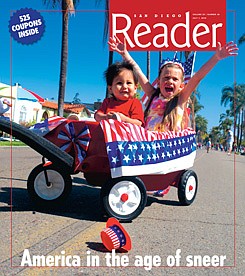
America in the age of sneer
I grew up in a religion that loved everything I would be taught to disdain in graduate school: America, authority, marriage, motherhood, and divine revelation. My father was a history-reading intellectual who treated me like an equal and encouraged ambition as well as faith, so I saw no reason, until I left Utah for Syracuse University in 1988, to question what feminists called the Patriarchy and I had always called Brother Smith or Bishop Fraser. I used to wonder what the angry women in my classes would say if they knew I possessed a document called a Patriarchal Blessing, a set of prophecies about my life that had been given to me when I was 12 by a man we literally and reverently called the Patriarch.
I knew what the feminists would think. They would think I was stupid. I was the only nondrinking, churchgoing BYU graduate in the creative writing program, so I kept the Patriarch and my blessing, which promised me children who would be a source of joy and satisfaction to me —“if I lived worthy” — to myself. (They might also have noticed the grammatical error and suggested that a real seer would have said “worthily.”)
That first term, I had a sad-seeming, very remote professor who summarized the mood of literature studies at that time: “We are living,” he said, “in the age of the sneer.”
It was not just the whole social structure of the country that was under attack in my classes — men were evil, America was evil, the middle class had ludicrous values — but the whole idea of reading literature for enlightenment. Though it was still possible, in an independent study class, to do close readings of Wallace Stevens poems, it was more fashionable to talk about tropes and the male gaze and the need to deconstruct the canon I had traveled two thousand miles to revere. From the remote professor, I took a course in 20th-century authorship, and we spent our time on the fifth floor of the Hall of Languages investigating not the artistic work of Ernest Hemingway and Gertrude Stein but the way the author was defined by him (or her) self and society. Not the thing itself, but the maker of the thing, who was, we saw now, a construction and a sham, no more authentic than the Wizard of Oz.
I remember in particular a summer afternoon on Westcott Street. I was in love with the houses on Euclid and Westcott, with the entire sagging and genteel neighborhood, the rows and rows of old bungalows and wood-shingled, two-story Victorian houses where the afternoon sun fell on hardwood floors and wavy, leaf-stroked panes of glass. I loved the wide wooden porches, the sidewalks cracked and buckled by the roots of maples and oaks, the grass that grew unbidden and untended, irises and tulips and daffodils and overgrown roses, the way it all looked and felt like the America I had been looking for all my life. I was sitting on the porch with a friend who had grown up in a place called (oh, the poetry of this!) Manchester-by-the-Sea, Massachusetts, though she always deleted the “by-the-Sea” part because she found it pretentious. She had attended private schools and was ashamed of this, too, had spent her summers on an island in Maine that was picturesque beyond description. She looked out at the porches and trees, the whole green-gilded leafy world, and said, “I look at America now and I just see blood.” She saw the natives swimming out to greet Columbus and being sickened, converted, and slaughtered to make way for Catholic parishes and Protestant New England towns. This was the version of our history as we were told now to see it: America corrupt from the very beginning, a heritage we should neither revere nor perpetuate.
I remember thinking, but not saying, that I loved it still. I couldn’t consistently see the blood. I knew it all ought to be spoiled for me, the grandeur of upstate New York and New England, the wood and stone houses, the steepled towns, all built on stolen land by people who believed in their own spiritual superiority, but to me it was still the realization of some early, earnest, hopeful faith — misguided, certainly, as most faith is, but not universally malicious.
When I left Euclid and Westcott and returned to Utah with my degree in advanced sneering, I still wanted what I had always wanted: to marry and read novels and have children and live on a street with sidewalks buckled by trees whose leaves cast blurry shadows on my porch. I wanted to live in that neighborhood Curious George rides through on his bicycle when he gets his paper route. I wanted children in my house to wear baseball uniforms and stir sugar into lemonade they would sell for a quarter at the park and hold sparklers at dusk on the Fourth of July. I wanted to stand at the edge of a parade as a horse clops by holding a rider who’s holding an American flag and not sneer at it.
This hope was all that survived the deconstruction of America and God; gone, by 1990, was my belief in divine revelation, priesthood, and the Patriarch. Gone, soon thereafter, was my faith in the literal resurrection, heaven, hell, outer darkness, forgiveness, Joseph Smith, the golden plates, eternal marriage, missionary work, and prayer. What remained were novels, which I still loved, and Tom, the man I loved even more than novels, who had a formless, sunny faith in the unseen that turned out to be less brittle than mine.
It’s hard to forget, though, a very old, dark-suited man laying his hands on your head and speaking as if for God when he says that you’ll have, if you live worthy, children who will be a source of joy and satisfaction to you. During a miscarriage and four long years of infertility, I never stopped wondering if God was pointing out the truth of that conditional “if.” I had turned my back on the faith that had promised me not just kids but satisfying kids, and then I had married a cheerful, nonpracticing Presbyterian. The deal was off.
Then, at the end of those four years, the test stick turned blue. One boy was born and then another, as if, after all, it wasn’t a matter of deserving, but of grace. The baseball uniforms, the lemonade, the spilled sugar on my hands, the sparklers on pink evenings, I got to have it, in spite of Columbus and my disbelief.
“Two boys,” as Sam used to say when he was three and Hank was one and I was hauling them around on my hips. “Two boys,” I would say back, astonished.
I think that’s why I get up at 5:00 a.m. on the Fourth of July and carry two wooden chairs to the corner of Fifth Street and Orange Avenue in Coronado. No one in my family loves the parade enough to explain the way I sit there at dawn and knit, holding our place, beginning the vigil that lasts until noon. Everyone tires of the horses and the flags and the clowns and the antique cars and the marching bands and the Navy commanders, and they usually leave long before the end of the three-hour parade. But I like to get a good seat. I like to feel, for a little while, the excitement of the believers, who wouldn’t think to sneer at the perpetuation of a battered myth, who can feel unsullied joy at finding themselves in the neighborhood Curious George rides through on his paper route. I sit there in the early-morning mist and knit beneath a sky that seems, for whole minutes at a time, the source of unconditional revelation.
—Laura McNeal
How Do You Sell America to a Cynical 13-Year-Old?
I moved to La Mesa in 2003. For my first four years here, I attended the Flag Day parade that ran down La Mesa Boulevard. Brought the kids, had ’em take their hats off when the flag went by, marveled at the Helix High marching band, reveled in the enduring glories of small-town America, etc. But every year, it seemed as if the parade was a little bit dowdier, a little bit less about the flag and the republic for which it stands, and a little bit more about the local Corvette Club and Jazzercise team. Every year, the tiny band of WWII vets got smaller, while the Vietnam vets inspired conflicting feelings. Brave men who served their country, yes. But the cause?
Eventually, I stopped going, thereby making myself part of the problem. Of course, that’s not how it feels on parade day. On parade day, it feels like this: “How the hell am I supposed to make my kids appreciate all that living in America has done for them? This is the water they swim in; I’m supposed to tell them to be grateful that it’s wet? Hopefully, time and experience will enlighten them, and God knows I’ll keep yammering on about the goods of political and religious liberty. But standing on the sidewalk and watching the mayor roll past in a convertible? How is that going to help? And while I’m on the subject of the mayor…”
But this isn’t about the mayor. It’s about my kids — the Americans of tomorrow. The humorist P.J. O’Rourke once suggested, “If you want to learn the truth about yourself, try telling your wife she’s fat.” There’s another way, less violent but perhaps even more alarming: have children.
My oldest son is 13 now, and his automatic, pervasive cynicism is a little bit heartbreaking. Of course, it’s cheap — he’s 13, how could it be anything else? And of course it’s a cover for emotional insecurity — it’s hard out there for a pubescent dude. But it’s more than that, too: it’s instinctive, and it’s corrosive. The kid is ready for the world to end. The system is that broken; people are that venal; the world is that fallen.
I am forever arguing with him about this — about appreciating the good in others, however imperfectly realized; about improving the world by improving himself, etc., etc. But there are ways in which I’m just like him. Say “America” to me, and my mind slips off to something like this: “Why has government been instituted at all?” asks Alexander Hamilton in Federalist Paper No. 15. No, it’s not because man is a social animal. It’s not because together we can achieve something greater than we could ever achieve alone, if only we will organize and harmonize our efforts. It’s “because the passions of men will not conform to the dictates of reason and justice, without constraint.” Got that? One of the Founding Fathers is explaining that we have government because life is nasty, brutish, and short, and we need a nanny. And looking around, who could argue with him?
Even better: government needs a nanny, too! Take it, Federalist Paper 51: “In framing a government which is to be administered by men over men, the great difficulty lies in this: you must first enable the government to control the governed; and in the next place oblige it to control itself.” Amen to that. The American Experiment: better nannying through division of powers.
A few letters later, Hamilton reels off another gem: “Money is, with propriety, considered as the vital principle of the body politic; as that which sustains its life and motion.” It’s all about the money, folks! It’s right there in the founding! No wonder we consume 24 percent of the world’s energy with only 5 percent of the population! Let’s have a parade! And oh, look — my son finds civic virtue suspect.
And yet — America has given me so much, the way a parent gives so much. (Pedantic parenthetical: hence, “patriot” from the Latin patria — fatherland.) Like a parent, it has a claim on my love, and on my son’s love, too. I have to help him find a middle way between flag-waving and cynicism. I’m hoping it looks something like this: a month ago, I was driving home from somewhere with my father and my son. As usual, Dad had brought a book along, and along the way, the author mentioned the siege at Waco, Texas. “What’s Waco?” asked my son. Oh, Lordy.
“Well, son, Waco was a complicated, nightmarish tragedy, one that pitted U.S. citizens against their own government. Dozens died, including women and children. Following the conflict, the Bureau of Alcohol, Tobacco, and Firearms made ‘dynamic entry,’ an option of last resort.” I tried to give my son a sense of why both sides might blame the other. His reply: “But because it’s the government, there’s nothing you can do if they’re wrong.”
“No, that’s wrong. You can sue the government. That’s why the judiciary is a separate branch. We have the rule of law here.” My son was silent. No snarky comeback; I was getting through! Yay, America!
But, of course, it’s not that simple, and Dad, who didn’t know about Son’s newfound cynicism, wasn’t about to let me get too rosy. He told a story about a woman who had only just now won a court settlement from the government on behalf of her father, a Vietnam vet who was dying of throat cancer brought on by his wartime exposure to government-deployed Agent Orange. (See what I mean about conflicting feelings?) She’d spent decades fighting for justice.
I winced and whispered something to Dad about not feeding the beast in the backseat.
Dad clued in. “Of course, the man did finally get justice.”
“Right,” I answered. “It can be horribly difficult. But it’s possible.”
—Matthew Lickona
America Likes a Bubble Butt
I’m 5'2", and I weigh approximately 135 pounds. This is a good 25 pounds heavier than I was, say, 15 years ago, when I graduated from college.
All of it went to my ass.
I go through phases where I run a few miles at a time, several days a week, either prepping for bikini season or for a visit from my 5'4", 100-pound mother (who, at 65, works out at the gym four days a week and runs the other three days). But no matter what I do, my backside remains. Luckily, the bigger it is, the more my husband likes it. He’s one of those guys. It’s no surprise, then, that I married him immediately upon my return from a two-year, self-imposed isolation in Japan — the land of the flat butt.
This morning, while out for a jog, I passed a man, 50–60 years old, pushing a cart full of aluminum cans and plastic bottles. I paid him no mind until he called out, “Look at that! Girl, you don’t need to jog!”
Only then did I wave, smile, and think, This is why I love my country.
I had lived in Brooklyn for ten years when I decided to move to Japan to teach English. I was fed up with the cement, the trains, the pressure to be hipper than hip, and most especially the men who, shall I say…overappreciated…my form — out loud, every day, and to such an extent that, depending on my mood, I sometimes answered “Fuck you” to a simple “Hello.” But it’s a bit more complicated than that; after 18 years in Boise, Idaho, where my “bubble butt” vied with my frizzy Afro for top spot on my list of insecurities, it was those same Brooklyn males who made me believe I was All That. And I really did believe it. Until I moved to Japan.
The Japanese town where I lived was tiny, and futile as it was, I tried everything I could to keep from standing out:
I was on time everywhere I went.
I rode my bike with my knees turned inward, just the way every Japanese woman does, in an effort to appear modest, I suppose, even while wearing pants and even while on the exercise bike at the gym.
In public Japanese bathrooms, it’s an embarrassment to hear anyone do anything, so many stalls are equipped with a button you can press to cover up any noises you happen to make. The first such button I encountered read, “sound of flushing,” and being yet unfamiliar with the courtesies of Japanese restroom etiquette, I assumed it was the actual flusher. Imagine my surprise when the stall was filled with the sound of flush, but nothing happened. I later discovered that even when there is no “sound of flushing” button, the modest thing to do is to flush the toilet first and then quickly do your business while the sound of rushing water hides your noises. I don’t mean to be crass, only to make you understand that I became quite Japanese in my effort to pretend that when I was in the stall, I was doing nothing at all.
When I laughed, I covered my mouth in yet another subtle show of modesty, though occasionally I forgot and guffawed with my head thrown back and my mouth open. Most people looked away forgivingly.
That’s the thing about the Japanese. They do not stare if you do something wrong, and if they do, they are so discreet about it that you don’t notice. Because of this, I did for a while believe that I had done such a great job of blending in that people no longer noticed me.
Then one day, I caught a schoolkid making fun of my ass. To the delight of his friends, he bent forward, arched his back, and walked with his tiny little butt sticking out behind him. I might not have caught on, except that when his friends saw me looking, they all quickly shut their mouths. For a few harsh days I wallowed in insecurity. I wore only clothes that covered my behind. When I heard people laughing, I just knew they were laughing at the size of my rear end, and my only defense was, Please. Where I come from, this is good stuff. I never said this out loud to anyone, but I whispered it in a one-two step-rhythm everywhere I went You got the good stuff, girl. You got the good stuff, girl.
The worst part about it was that I was a grown woman, and I thought I’d left all my insecurities back in my 20s. So much for that. I’ve since come to terms with the fact that I’m not one of those people who doesn’t need anyone’s approval or praise to know I’m a beautiful woman. Clearly, I do.
And I’m all right with it.
So, here’s to you, old man with the cart full of recyclables. And here’s to the outspoken males of Brooklyn, New York. But most of all, here’s to my husband, who, when I ask, “Does my butt look big in this?” replies, “Yep. And I like it.”
—Elizabeth Salaam
My Two Lives in the USA
I once heard a Catholic priest say that when you tell God that you’ll accept “anything but…” you will almost surely get the thing you are trying to avoid.
When my wife finished medical school and residency at UCSD, I knew we would probably have to leave San Diego. I told her, “As long as we don’t end up in the South.” So, after 45 years in San Diego, I ended up in Valdosta, Georgia, a town of 50,000 souls, 15 miles north of the Florida border.
Why did we leave paradise? My reluctant exit came down to money. We couldn’t afford much of a house when the median price was $460,000 and four years of med school and five years of residency meant debt. In Valdosta, we found a 4000-square-foot house for $150,000. I love San Diego, but not enough to be one of its homeless.
The first thing you notice about this part of the country is the humidity. It’s not always humid, but the humidity is always a threat, waiting to spring on you and ruin a perfectly good day. I arrived for good on the July Fourth weekend, 2004, and it was hot and sticky — the middle of the longest season, summer. It doesn’t get cooler at night either. And humidity means bugs. Lots of them.
The social climate is also a radical departure, and not all bad. Southerners are polite; I still can’t get used to everyone addressing me as “Sir.” Car horns are only used in emergencies. To honk at a vehicle in traffic is an obscenity. The middle finger is never seen. After living here for a year, I visited San Diego and had a driver flip me off after five minutes in my rental car.
The language spoken is a variant of English called “Southern.” It makes use of what was a new pronoun for me, “y’all” (which is both singular and plural), and it bends every vowel — “Thank y’all for hay-elpin’ me,” meaning “Thank you for helping me.” Dinner is “supper.” Mom and Dad are “Momma” and “Daddy.” (“My momma and daddy had me over for supper.”) I always thought phrases such as “fifty cent” were unique to black dialect, but here everyone drops the s on cents (“Here’s your change, four dollars and twenty cent”). Some add a t to words such as once. (“Ah trahed that oncet,” meaning “I tried that once.”)
Most Southerners are friendly, to a fault. In fact, they never stop talking. If you drop off clothes at the cleaners, chances are you’ll hear a long story from the clerk about a stain she couldn’t remove.
If you want to eat healthy in the Deep South, you have to eat at home. Restaurants focus on fried foods and fatty meats such as ribs. My kids are terrified of any place that advertises “Home-cooking just like Momma’s.” Most breakfast menus include grits. Restaurant salads consist of a bowl of iceberg lettuce with dressing dumped on top. Which leads to another phenomenon: people here are bigger — horizontally. Call us Californians superficial, but in general we tend not to let ourselves go. In the South it seems most people just give up. I was surprised the first time I saw photos of a high school homecoming court in the local paper and the queen candidates were all heavyset girls. Of course, not everyone is fat, but the standard is different. It’s not uncommon to see a petite college-age girl holding hands with a huge fellow who looks…well-fed.
One quickly learns that there was never a Civil War. Instead, there was a “War Between the States.” Yet Southerners are fiercely loyal to the United States of America. While there are a few Confederate battle flags at memorials and on bumper stickers, American flags are everywhere. These people love their country and are vocal about it.
I thought the South was overwhelmingly conservative. It is not. There are a lot of Democrats here, and Obama stickers are seen on many cars — most of them near the university (no surprise). However, even the liberals are careful about how they express themselves. It’s a phenomenon I call reverse political correctness. Being conservative isn’t as important as appearing conservative. It’s okay to be liberal, so long as you don’t talk about it.
The people here are also religious. There is one classic-rock station I can pick up from Tallahassee. There are three country stations, two news-talk stations, one rap station, and everything else is gospel. Some gospel stations feature white preachers, and a few cater to black listeners. I nearly fell over the first time I heard a radio ad tell me that a car dealership was “open Sunday after church.” Church attendance is de rigueur. Southerners dress up, no matter how hot it is, and go. There are more churches here in Valdosta than I’ve ever seen in one place, yet only one of them is Catholic.
But that’s just church. The real religion of the South awakens every fall as football season begins. There are people who do not speak to each other because one is a Florida State fan and the other a University of Georgia fan. Since a front license plate is not required, many cars have a front plate with a G logo that resembles the Green Bay Packer G, except that it is red and black. The two local high schools have packed houses for every game. The radio stations give the coaches their own weekly shows.
I’ve had the experience of living in two extremely different cultures of America, West Coast and Southern. The residents of each locale are convinced they are in the best place in the world to live. I’m still trying to figure it all out.
—Robert Kumpel
This Land Is Your Land
A job search had taken me to Europe, and on the morning of July 20, 1969, I showed up in a beer hall in Frankfurt, Germany, to see the television broadcast of a real-time space odyssey. For the next several hours, I watched in awe as American astronauts Neil Armstrong and Buzz Aldrin, my astronauts, walked on the moon. “One small step for a man, one giant leap for mankind,” said Armstrong, sending chills up my spine. I couldn’t help exclaiming my excitement — and exposing my accent. When the drinking clientele heard the Ami in their midst, they wanted to buy him rounds. Their Gemütlichkeit (cordiality) beat the hell out of the flak many Europeans were giving me over the Vietnam War. A “giant leap for mankind,” transcending human conflict, was receiving deserved adulation.
I saw where all the toasts were going; the hangover wouldn’t be far behind. So I left as quickly and politely as I could. But I had learned how powerful patriotic feelings can be. For months afterward, whenever I pictured Armstrong bouncing on the lunar surface, those same feelings came back. They would always choke me up, in much the same way that my uncle, who’d had polio as a child, would begin a muffled sobbing over anything emotional.
A turning point took place on that summer trip. Long before becoming moon-walk day, July 20 was my mother’s and brother’s birthday, and I started to long for my own country, for my hometown of Riverside (100 miles up the road), and for my old family home.
My parents still lived in Riverside, on the edge of the much-maligned Santa Ana River bottom. Their sloping backyard was filled with old pepper trees and a view of Mount Baldy in the distance. It was nothing like Austria’s Inn River valley, where snow-capped peaks hover overhead, where in the mid-1960s I’d lived for a year as a student, but the Riverside outskirts were the hallowed ground I grew up on. In the late 1940s, my mother had sought refuge there from an oppressive Los Angeles, where both she and my father grew up.
When I returned to California from Germany, I entered the second year of a graduate program at the Claremont Graduate University only 30 miles away from home. Teaching would become my career. One day, after a seminar, I went back to student housing and found a letter saying that Pat, a college friend, had been killed in Vietnam. I went to see my graduate advisor to unload my guilt. “It always feels bad,” said the professor, “to know that someone else is fighting your wars for you.” (The classic James Fallows article, “What Did You Do in the Class War, Daddy?” hadn’t yet appeared.)
I didn’t know what to say, or to think and feel. I had been drafted only a year and a half earlier but classified 4F at the Los Angeles induction center for, of all things, an allergy to bee stings. My friend who died had graduated from his college Army ROTC program as a lieutenant. Pat knew all along that he’d spend the next four years in active service. Why couldn’t I at least have hidden from Army doctors the several episodes of anaphylactic shock I’d suffered?
Sometimes on weekends, I’d go home to see the family and to visit friends and a long-time sweetheart. But the old stomping grounds didn’t seem the same, and the old relationships were now grating. It was the loneliest period of my life. To allay anxieties about the war, some of my graduate-school chums and I would laugh at a scene in the long Arlo Guthrie song called “Alice’s Restaurant.” Arlo sings that he was sitting on a Group W bench with other draftees about to be rejected for committing crimes. On the bench, there were “mother-rapers” and “father-stabbers.” When they asked Arlo what his crime was, he answered “littering. And they all moved away from me on the bench there.”
But the lightheartedness didn’t help. To make it worse, two of Pat’s and my college friends showed up for a visit. Of course, we rehashed his life and death. The friends waxed so eloquent about his hero status that it seemed they were happy he’d died. To me, his death was the waste of a wonderful human life, caused by reckless foreign policy and a government that took advantage of young men. We argued bitterly. A concept that kept coming up was patriotism — and my lack of it — as I kept asking how my friends were going to help stop a war that was damaging us all.
The friends left the next day without saying goodbye. Afterward, with a cooler head, I reflected on their patriotism. They were sincere about defending Americans’ freedom, homes, and ways of life. I hoped someday as a teacher to help students develop their freedom and their homes and to improve their ways of life. But my friends’ feelings had seemed just as powerful as what I’d felt after seeing Armstrong and Aldrin walk on the moon. Today, I take a more evenhanded approach. I know Pat went to Vietnam to fight for his country and that the friends I’d argued with saw in his death how valiant he was.
On the Fourth of July, I always try to do two things. I attend our family reunions whenever I can, in beautiful places such as Morro Bay, Lake Tahoe, Joshua Tree, Yosemite, Grass Valley, Flagstaff, and the eastern slopes of the Cascades in Washington state. And I listen to patriotic music, including the corniest (take that, cutting-edgers) I can find, like Lee Greenwood singing, “I won’t forget the men who died” and “there ain’t no doubt I love this land.” I listen to Guthrie too. Not Arlo anymore, but his controversial father Woody. “This land is your land, this land is my land.” Simple stuff.
—Joe Deegan
Where My Kids Learned How to Fly
This past school year, while my oldest daughter took a science class in Serra Mesa, I spent Monday mornings at Murray Ridge Park with my younger children. My father’s name is Murray, so the kids call the park “Grandpa Ridge.” Week after week, we stopped at a picnic table to devour a snack of donut holes and then raced to the swings and slides. My four-year-old would beg to be pushed high enough to catch the moon, while my little boys rode the gaudy green frog and the scratched, smiling duck, shouting to be heard above the murmur of traffic on the nearby 805. My older girls always made straight for the jungle gym, where they could perch on top to watch hummingbirds flash back and forth among the eucalyptus trees.
On one of these mornings, as I watched my toddler make his first solo voyage down a slide, it struck me that many of the finest moments of my life have happened in America’s public parks.
In Aurora, Colorado, a sprawling suburb east of Denver where I grew up, the best thing about summer was the Del Mar Park pool. Every possible morning, I would gulp down a bowl of Lucky Charms and sprint out the door for the mile-long bike ride up busy Sixth Avenue to the park. It’s hard to fathom, now, the freedom enjoyed by the children of the late ’70s and early ’80s. No cell phones, no bike helmets. A dollar in my pocket to cover pool admission and some red licorice from the snack bar. Sometimes my friend Pauline would meet me there, but most of the time I played Marco Polo and diving-for-pennies with kids I didn’t know, more free-range children congregating at that chlorine-scented paradise to share bottles of Coppertone and cans of Orange Crush.
Del Mar was my family’s Fourth of July park: like hundreds of other Aurora families, we trekked there every year to lie on a picnic blanket under the fireworks sky. While we waited for twilight to fade, we’d clutch sizzling sparklers in fingers sticky with watermelon juice. It was simultaneously the longest and shortest night of the year — that endless wait for the fireworks to begin, and then suddenly they were over, and it was time for a sleepy hike through the crowds to a parking lot that felt a hundred miles away.
The Del Mar Park parking lot was probably five times bigger than the tiny city park that became my daily refuge when my first child was a baby. We lived in Queens, New York, then, in a Greek neighborhood called Astoria, just across the East River from Manhattan. Every weekday morning, I tucked my one-year-old into a baby sling and walked the three blocks to the playground, with a quick stop on the way to pick up scones or éclairs at the Italian bakery. It was at that bakery that I met another young mother who was to become my best friend; we bonded over pastries on a green park bench, while our toddlers bumbled around on the kiddie slide. Later, we’d walk together to St. Joseph’s Church, where parts of Robert De Niro’s Bronx Tale were filmed (yes, in Queens), and attend noon Mass.
I made other friends at that little park, 20-something mothers like me — and yet all of us so different: natives of France, Israel, Korea, Jamaica, Pakistan, Baltimore. None of us had yards for our children to play in. That tiny park was our backyard, and nothing short of a downpour or an Arctic-level freeze could deter us from congregating there with our little ones.
After the second baby, my husband and I moved to a bigger apartment on Long Island, trading Astoria’s asphalt playground for a sandy, windblown stretch of park on the North Shore. We hunted horseshoe crabs at the water’s edge and watched seagulls drop oysters onto the parking lot to crack them open. When I pushed the children in the swings there, they felt as if they were sailing over the water.
Another baby later, we left New York for the foothills of the Blue Ridge Mountains. There, in a small town west of Charlottesville, Virginia, our neighborhood park was perched on top of a steep hill overlooking train tracks. There, too, the children loved to swing high with their faces toward the drop-off, soaring into the humid air while a train whistled toward the old ConAgra factory below. The birds we counted there were cardinals and chickadees, not the hummingbirds and scrub jays we’ve come to love since our move to San Diego four years ago. Virginia’s honeysuckle breezes have given way to the jasmine-scented air of Balboa Park and that spicy eucalyptus fragrance at Grandpa Ridge. “Push me higher, Mommy!” urges the four-year-old, reaching her feet up into a sky the same vivid blue as the water in the Del Mar Park pool. This is my America, these far-flung playgrounds, these public parklands where my children have learned how to fly.
—Melissa Wiley
Times Square Was Almost Deserted
I didn’t set out to “discover America” — I just wanted a cheap ride to Connecticut.
My underemployment on downtown’s grindhouse theater row didn’t leave much money for a visit to my New England hometown. Recalling ads spotted in the Reader, I contacted a company called Auto Driveaway, which provided cars to be driven out of state and delivered directly to their owners. No rental fee, and in fact the company filled the first tank of gas for you — no paycheck either, but the ride was free to any aspiring vagabond with a clean driver’s license.
Another classified ad put me in touch with a young Australian guy named Marc, looking to split the cost on a ride out east. Emboldened by the brashness of youth, we agreed to the hookup on the phone, met at the Auto Driveway lot, signed a bunch of papers, and off we headed for the far coast, two longhaired 20-year-old strangers piloting an unfamiliar car, with few ducats and nary a clue.
Marc and I bonded quickly over our mutual love of rock and roll and comics. He was visiting the U.S. for the first time, so I felt compelled to serve as his tour guide, rambling about whatever applicable minutiae came to mind as we cruised, mostly relating to pop-culture factoids I was familiar with rather than the genuine historical info and context that I lacked.
Of course, my only “expertise” was in music, so the bulk of my narration had to do with what bands came from where and which cities were name-checked in various songs. Luckily (very luckily, as it turned out), I had stuffed around 200 vinyl albums in the trunk, to store at my folks’ house in Connecticut, and the record jackets often served as a sort of mobile musical atlas.
With barely enough money for low-grade gas and lowbrow eateries, we gravitated toward kitschy roadside Americana, like the world’s tallest thermometer in Baker, California; “The Thing” of Dragoon, Arizona; the glitzy (and free!) lights of Las Vegas; the half-buried Cadillac Ranch cars in Amarillo, Texas; Tulsa’s spider-leg Volkswagen; Roswell’s Flying Saucer Café; Robert Johnson’s “Crossroads Blues” intersection in Clarksdale, Mississippi (where the guitarist said the Devil bought his soul); the Indian Muffler Man of Asheville, North Carolina; and anyplace else where admission was cheap and the natives chatty.
Marc frequently caught me by surprise with his foreign preconceptions about various locales along our southerly route. For instance, the only thing he knew about Austin, Texas, was that the Wonder Wart-Hog comic was created there — handily, I had a cassette tape with one of the Roky Erickson albums in the trunk, which I used to (slightly) broaden his education.
I remember Marc asking about tornadoes as we drove into Tennessee, but my own encounters with natural disaster had been limited to a few New England hurricanes and the ’79 Imperial Valley ’quake. Late in the afternoon, listening to the umpteenth radio spin of Pink Floyd’s “Another Brick in the Wall (Part II),” my neck hairs started buzzing as the announcer broke in with an ominous weather warning — “Several tornadoes have reportedly touched down…”
Almost immediately, we spotted three funnel-shaped clouds, dancing haphazardly back and forth across a horizon line that could have been anywhere from a mile to 20 miles away. I was behind the wheel, and a sudden gust of wind jerked the car partly into the next lane. I don’t think Marc and I exactly looked at each other — I was too intent on keeping the car on the road — but we definitely came to an instant unspoken consensus that “We’ve gotta get the hell outta Tennessee.”
The ensuing darkness made us even more apprehensive, as the wind grew ever more chaotic, the car periodically rocking this way and that, as if slammed by rolling waves. Or colliding vehicles. Every few miles, we passed downed trees and twisted highway signs, clear indications of the terror we’d narrowly avoided.
We lived to tell, and to this day I’m convinced it was the heavy vinyl albums that kept us on the road, while so many other cars and high-profile trailer trucks were forced to pull over and wait out the night of the twisters.
As we approached New England, Marc was really looking forward to seeing Times Square, although our timetable would only allow us an hour to cruise in and out of NYC. We landed on 42nd Street and Broadway on the afternoon of Wednesday, April 2, 1980 — just as the infamous NYC transit strike went into effect, grounding all subway and bus lines throughout the five boroughs. In addition, a severe storm alert had just been issued. Radio warnings to “stay home” were ringing in our ears as we rolled slowly along.
Times Square was almost deserted.
It was eerie, having the street to ourselves and a handful of other cars and taxis. On the sidewalks were maybe a dozen people, even though all the porno palaces, bars, and electronics stores seemed to be fired up and open for business.
The place felt like a postapocalyptic movie set. I pulled over, and we gawked at the high-tech ghost town for a moment, before Marc began to complain. “This is Times Square? Where is everybody?”
I assured him that anybody can visit Times Square and see thousands of people milling about, with bejeweled Broadway patrons and purple velvet pimps battling for sidewalk turf alongside screaming boomboxes, steaming pretzel carts, smoking manholes, and flaming manwhores.
But he might be the only guy from Australia ever to witness Times Square as empty as a condemned amusement park.
A couple of hours later, I was dropping Marc off at his Connecticut destination in downtown Bridgeport, where he said a relative was meeting him. Our shared American adventure seemed to call for more than just a shrug and a goodbye handshake, so we ended up hugging each other, lightly, a bit reluctantly, in that stiff and sexually neutral way that men do.
An hour after that, I was at my folks’ house in East Lyme, Connecticut (home of the Lyme disease tick), eating so much homechow that my innie turned into an outtie. While unpacking my travel bag, I discovered that Marc had stolen my last $50 from the zip pocket, I’m guessing within moments of our awkward man-hug.
Fuck you, Marc. And welcome to America.
—Jay Allen Sanford
A Fierce Patriot
We sat as patiently as is possible for four little girls who know they’re about to receive gifts. Dad always packed our presents deep in the big suitcase, where they were less likely to be bumped and broken; digging out such treasures took time.
This was the first time Dad had come home from Japan, which added an element of surprise to the usual suspense. I’d begun to associate the names of distant locales with the relics Dad brought back for us: shell necklaces from Hawaii, eel-skin wallets from Korea, the candy/toy combo Kinder eggs from Germany. I liked to imagine him standing in some knickknack store in a foreign land, mulling over what to get. Thinking of us.
He finally unfolded a lovely printed stole (for Mom) to reveal four embroidered silk change-purses, each a different color. There was no fighting over who would get which; no two had the same favorite.
Aside from the diversity of our rewards for being such good girls for Mommy while Daddy was away, everything about my father’s homecoming was as uniform as his dress whites. For all his love of being on the road for work or pleasure, Dad’s favorite thing about traveling abroad was coming home. Upon his return from Europe or Asia, he always said, “I want to kiss the ground every time my plane lands in America.”
It was always “America,” and that made sense. For two New Yorkers with daughters who’d attended grade schools in Florida, Texas, Alaska, Rhode Island, and San Diego, home could not be limited to just one town.
“If you guys were born anywhere else in the world, you’d be second-class citizens,” Dad said. His “Never Take Your Rights for Granted” speech was usually delivered during his first dinner back. “There is no country on Earth where women have the opportunities you have here. In Latin countries, it’s known that husbands have mistresses, and wives are expected to close their eyes to it. In Asia, women may rule the roost behind the scenes, because they run the household or whatnot, but in public they’re walking behind the men, and they’re carrying all the bags coming home from the store — the guy’s not carrying anything.”
One of Dad’s coworkers, a Korean-American woman, was never allowed to travel with him to Korea, because the Korean military officers would “never give her the respect a man would get in that situation.” Dad often told us that here we could be whatever we wanted.
My father is a fierce patriot. His grandparents arrived in the Land of Opportunity via Ellis Island, as did my mother’s. When illustrating how hard work pays off in our country, Dad would tell us about Vince, a Vietnamese coworker. “It took a lot of balls to do what he did, coming over here,” he said, his voice swelling with admiration. “To leave a crummy situation with nothing and come over here on a raft; he couldn’t even speak English. Now his whole family’s going to school. They’re working their asses off. Vince said, ‘What are the rules over here? You study real hard and you can do well in life? Okay!’” Vince worked in Anaheim, washing dishes at Disneyland and putting himself through school. He eventually worked his way into a government position as a computer scientist. “There’s millions of these stories in America,” Dad said. “If you’re in India, and you’re in a certain caste, you couldn’t break out of that caste, ever.”
Now that all his girls have become women, Dad continues to find ways to remind us how fortunate we are to be citizens of the Land of the Free. He recently attended a naturalization ceremony downtown. He sat in the back and watched as immigrants from all over the world became American citizens. As Dad described the people’s faces, each reciting the same oath, his own eyes grew wet with emotion. “There are people who risk their lives to have what we have,” he said, sniffing back tears.
Soon, Dad is leaving town to spend a month at a base bordering North and South Korea, a flashpoint for military aggression. But despite the anxiety, tension, and the gravity of the situation over there, I will think of Dad standing in a knickknack store, thinking of his girls. I wonder what he’ll bring home for me this time.
—Barbarella
I Can’t Push the Shopping Cart Past America Anymore
The thing is, I’m not a fan of this country. I have my reasons and they are political. Nowadays, political conversation is toxic, boring, nobody changes their mind, and besides, at this stage of the game, it’s like arguing whether it would have been better to fly business class or coach while your TWA Flight 800 crashes into the Atlantic Ocean.
But the assignment is to write about my relationship to the country and how it has grown or changed, and since the state of my relationship has to do with what this country has done to other countries, and to its own citizens, the problem becomes, from a technical point of view, how to write about that without turning this into an unreadable screed. Be warned, I did not fully succeed.
I’ll start from here. The primordial problem between me and the USA is that I believed. I was in the fourth grade, and I believed this was a democratic country, believed the FBI was my friend, believed we were helping other countries to be free and all the rest. I believed while trailing behind my mother in a Texas grocery store, pushing our shopping cart past the Colored Only drinking fountain.
This is what patriotism does to you. It splits the brain. One part acknowledges the fact that Americans enslaved and later segregated and exploited millions of people for 325 years, and at the same time another brain part genuinely believes this is the freest country in the world. Neither part is aware there’s a conflict between those two thoughts.
As I grew up, my relationship to America lay dormant. I was 16 years old in 1960, and Eisenhower was president. I lived in La Mesa with my parents and siblings, attended Grossmont High School, and was busy with the job of being a teenager. But at night, and way into the night, I’d read history, usually American history. It was fun for me; still is.
That’s where I learned the U.S. acted like other great powers, that we cheated and lied and oppressed, often as a matter of policy, and I felt outraged. The bastards had lied to me. But it was an intellectual outrage. My life was about high school and deciding what to do on Friday night.
That changed with Vietnam. For me, that war was wrong, so in-your-face wrong I couldn’t push the grocery cart past it. I came to see that it wasn’t just Vietnam, but that my country had been acting in the same thuggish way from its beginning.
The U.S. has lied its way into war at least four times: the Mexican-American War, the Spanish-American War, Vietnam, and Iraq 2.
Not counting foreign CIA operations, or the times our government assisted and/or directed foreign coups, or the obliteration of American Indians, not counting tangential conflicts that occurred during the Spanish-American War, World War I, World War II, Korea (1950–’53), Vietnam, Afghanistan, Iraq 1, or Pakistan — and that, by the way, is a big, big number — not counting all that, since 1890 the United States has invaded, or to use a favored propaganda term, intervened, or, put more simply, has had boots on the ground in:
Argentina, once; Chile, once; Haiti, four times; Nicaragua, five times; Kingdom of Hawaii, once; China, four times; Korea, twice (1894-’95) (1904-’05); Panama, eight times; Philippines, twice; Samoa, once; Honduras, five times; Dominican Republic, three times; Cuba, three times (1906–’09) (1912) (1917–’33); Mexico, twice; Russia, once; Guatemala, twice; Turkey, once; El Salvador, twice; Grenada, once; Lebanon, once; Thailand, once; plus the ongoing Iraq operation.
We tell ourselves we are so rich, so powerful, so number one, yet 40 million Americans are on food stamps. We owe, in the form of U.S. treasury notes, the Chinese government $900 billion. We narrowly averted the greatest financial collapse in history. The Fed lent out $2 trillion and refused to say whom they lent it to. Behemoth banks and corporations sucked up hundreds of billions of dollars of public money to cover their greed, and with very few exceptions, nobody resigned, nobody went to jail, nobody was fired, and there is still no understandable accounting showing how much public money was spent, who got what, for what purpose, under what terms, and now, almost two years later, the same players are doing the same things.
Americans, by the millions, walked past the drinking fountain that says Colored Only, still believing they lived in the richest, greatest, freest, most powerful, most democratic, most number-one country in the world.
On the other hand, I believe the country is going to crash. Maybe the world will quit loaning us money, maybe our government will sink under the weight of its own corruption, but something is going to happen that will end this. There’ll still be a US of A, but in name only.
I no longer have a relationship with the USA. I have an arrangement. They do what they do. I plan to spend the rest of my life going on beautiful walks, looking at beautiful birds. I’m going to listen to more live music. I’m going to spend more time at the beach, more time in the countryside. I want to get good at Tai Chi.
—Patrick Daugherty
Hard Work, Simple Pleasures
Horns blare, men yell. I haven’t even reached the baggage claim at JFK Airport, and I can hear the familiar hurried energy of New York City. This is the arrival point for my visit home to Connecticut. As I pick my way through the jumbled maze of roads leading out of the airport, I yearn for the wide, clearly signed freeways of California.
The maze begins to clear as I hit Westchester County. The gray concrete of the city gives way to more green — trees, lawns, gardens. An hour from the airport, I drive up windy Route 35 to my hometown of Ridgefield, Connecticut. The woods thicken. I think back to my Irish Nanna asking my mom if there were bears in these woods; the New England forest looked like untamed wilderness to her. As I near the town, I notice the old clapboard homes with “year built” plaques hanging near the front doors — 1864, 1810, 1769. I’m traveling in the area where our country began.
I reach the town fountain, and across Main Street sits Keeler Tavern, 1713. A Revolutionary War cannonball remains lodged in the tavern’s exterior wall, a kitschy monument to the Battle of Ridgefield. Farther down the street stands a brass marker where Benedict Arnold was shot off his horse. The town center is bustling, in a sort of small-country-town way. People saunter out of a French bakery across the street from the Town Hall. Everyone appears to have shopped at Talbots, Ann Taylor, or Lands’ End. Not much flash or skin. A family picnics in the gazebo on Ballard Green, the downtown park. A few joggers run past the three church steeples that soar high above the main thoroughfare.
Passing Town Hall conjures up memories of the year our family made our own Fourth of July parade. Dressed up as immigrants and a Lady Liberty, we marched down Main Street to Town Hall, waving American flags at passersby. The first selectwoman greeted us for pictures.
There was one official parade that marched down Main Street each year: The Memorial Day parade. It instilled in our impressionable young minds love of our American history, thankfulness for our military, love of country. It’s a small-town parade: a colonial troop with fife and drum, Daughters of the American Revolution, the high school band, a few troops of Boy Scouts and Girl Scouts, a large contingent of World War II veterans. My father, a member of that generation, always stood when they walked by, cheering as they passed. Many were longtime friends, and I distinctly remember the pride on his face as he watched, a pride tempered by his sadness at never being allowed to fight. One of Dad’s legs is shorter than the other. When a doctor saw him limping out of the enlistment office, it ended Dad’s dreams of heading off to war. “The two guys I went to enlist with,” Dad always told us, “didn’t come home.”
His love and willingness to sacrifice for country wore off on us kids. He lived through the Great Depression. His family was the only one on their Yonkers, New York, street not to lose their house. My grandfather worked as a day laborer during those dark days. The whole experience made my father frugal and a hard worker. To Dad, America is a place where with hard work, prudence, and satisfaction with the simple pleasures of life, anyone could make a living, even someone who never went to college. Dad saw all eight of his children through college and never made more than $13.50 an hour.
My mom’s road to America began in rural Ireland, County Mayo, in a thatched-roof home with no indoor plumbing. The family cooked over an open fire. Their greyhound, because of his value to the family as a rabbit-catcher, was given the warmest spot in the house to sleep, right by the fire. America was the land of opportunity for Mom’s father. Having lost his pub-cum-bike shop to the Depression, he left for America and found work running an elevator in a bank in New York City. Ten years later, in 1947, when she was 13, Mom and one of her brothers came over on a troop ship. She remembers being frightened the whole trip. Her brother Jack was too seasick to emerge from his bed until they reached New York.
In New York, Mom enrolled in the Academy of the Sacred Heart of Mary. Her mother worked at Gimbels making salads to help pay the tuition. Mom also worked after school. The nuns at the academy were keen on having students lose their accents, to help them avoid discrimination. Today, only a hint of a brogue comes out of her lips, and only when she’s around other Irishmen. Though she speaks lovingly of the old sod, America is her home.
My visit back to the homestead is a surprise for my parents, who now are in their golden years. As I pull into the driveway, I see Dad bent low, digging in his garden. Mom is scraping old paint off the back porch. I smile to myself as I see them — my parents — still working hard.
After hugs and greetings, we go inside for tea and homemade corn muffins. Hard work, simple pleasures, faith, and family. That’s life in America for Mom, Dad, and me. ■
—Mary Grimm
Here's something you might be interested in.
Reader writers on our country this July 4th
America in the age of sneer

Reader writers on our country this July 4th
America in the age of sneer
I grew up in a religion that loved everything I would be taught to disdain in graduate school: America, authority, marriage, motherhood, and divine revelation. My father was a history-reading intellectual who treated me like an equal and encouraged ambition as well as faith, so I saw no reason, until I left Utah for Syracuse University in 1988, to question what feminists called the Patriarchy and I had always called Brother Smith or Bishop Fraser. I used to wonder what the angry women in my classes would say if they knew I possessed a document called a Patriarchal Blessing, a set of prophecies about my life that had been given to me when I was 12 by a man we literally and reverently called the Patriarch.
I knew what the feminists would think. They would think I was stupid. I was the only nondrinking, churchgoing BYU graduate in the creative writing program, so I kept the Patriarch and my blessing, which promised me children who would be a source of joy and satisfaction to me —“if I lived worthy” — to myself. (They might also have noticed the grammatical error and suggested that a real seer would have said “worthily.”)
That first term, I had a sad-seeming, very remote professor who summarized the mood of literature studies at that time: “We are living,” he said, “in the age of the sneer.”
It was not just the whole social structure of the country that was under attack in my classes — men were evil, America was evil, the middle class had ludicrous values — but the whole idea of reading literature for enlightenment. Though it was still possible, in an independent study class, to do close readings of Wallace Stevens poems, it was more fashionable to talk about tropes and the male gaze and the need to deconstruct the canon I had traveled two thousand miles to revere. From the remote professor, I took a course in 20th-century authorship, and we spent our time on the fifth floor of the Hall of Languages investigating not the artistic work of Ernest Hemingway and Gertrude Stein but the way the author was defined by him (or her) self and society. Not the thing itself, but the maker of the thing, who was, we saw now, a construction and a sham, no more authentic than the Wizard of Oz.
I remember in particular a summer afternoon on Westcott Street. I was in love with the houses on Euclid and Westcott, with the entire sagging and genteel neighborhood, the rows and rows of old bungalows and wood-shingled, two-story Victorian houses where the afternoon sun fell on hardwood floors and wavy, leaf-stroked panes of glass. I loved the wide wooden porches, the sidewalks cracked and buckled by the roots of maples and oaks, the grass that grew unbidden and untended, irises and tulips and daffodils and overgrown roses, the way it all looked and felt like the America I had been looking for all my life. I was sitting on the porch with a friend who had grown up in a place called (oh, the poetry of this!) Manchester-by-the-Sea, Massachusetts, though she always deleted the “by-the-Sea” part because she found it pretentious. She had attended private schools and was ashamed of this, too, had spent her summers on an island in Maine that was picturesque beyond description. She looked out at the porches and trees, the whole green-gilded leafy world, and said, “I look at America now and I just see blood.” She saw the natives swimming out to greet Columbus and being sickened, converted, and slaughtered to make way for Catholic parishes and Protestant New England towns. This was the version of our history as we were told now to see it: America corrupt from the very beginning, a heritage we should neither revere nor perpetuate.
I remember thinking, but not saying, that I loved it still. I couldn’t consistently see the blood. I knew it all ought to be spoiled for me, the grandeur of upstate New York and New England, the wood and stone houses, the steepled towns, all built on stolen land by people who believed in their own spiritual superiority, but to me it was still the realization of some early, earnest, hopeful faith — misguided, certainly, as most faith is, but not universally malicious.
When I left Euclid and Westcott and returned to Utah with my degree in advanced sneering, I still wanted what I had always wanted: to marry and read novels and have children and live on a street with sidewalks buckled by trees whose leaves cast blurry shadows on my porch. I wanted to live in that neighborhood Curious George rides through on his bicycle when he gets his paper route. I wanted children in my house to wear baseball uniforms and stir sugar into lemonade they would sell for a quarter at the park and hold sparklers at dusk on the Fourth of July. I wanted to stand at the edge of a parade as a horse clops by holding a rider who’s holding an American flag and not sneer at it.
This hope was all that survived the deconstruction of America and God; gone, by 1990, was my belief in divine revelation, priesthood, and the Patriarch. Gone, soon thereafter, was my faith in the literal resurrection, heaven, hell, outer darkness, forgiveness, Joseph Smith, the golden plates, eternal marriage, missionary work, and prayer. What remained were novels, which I still loved, and Tom, the man I loved even more than novels, who had a formless, sunny faith in the unseen that turned out to be less brittle than mine.
It’s hard to forget, though, a very old, dark-suited man laying his hands on your head and speaking as if for God when he says that you’ll have, if you live worthy, children who will be a source of joy and satisfaction to you. During a miscarriage and four long years of infertility, I never stopped wondering if God was pointing out the truth of that conditional “if.” I had turned my back on the faith that had promised me not just kids but satisfying kids, and then I had married a cheerful, nonpracticing Presbyterian. The deal was off.
Then, at the end of those four years, the test stick turned blue. One boy was born and then another, as if, after all, it wasn’t a matter of deserving, but of grace. The baseball uniforms, the lemonade, the spilled sugar on my hands, the sparklers on pink evenings, I got to have it, in spite of Columbus and my disbelief.
“Two boys,” as Sam used to say when he was three and Hank was one and I was hauling them around on my hips. “Two boys,” I would say back, astonished.
I think that’s why I get up at 5:00 a.m. on the Fourth of July and carry two wooden chairs to the corner of Fifth Street and Orange Avenue in Coronado. No one in my family loves the parade enough to explain the way I sit there at dawn and knit, holding our place, beginning the vigil that lasts until noon. Everyone tires of the horses and the flags and the clowns and the antique cars and the marching bands and the Navy commanders, and they usually leave long before the end of the three-hour parade. But I like to get a good seat. I like to feel, for a little while, the excitement of the believers, who wouldn’t think to sneer at the perpetuation of a battered myth, who can feel unsullied joy at finding themselves in the neighborhood Curious George rides through on his paper route. I sit there in the early-morning mist and knit beneath a sky that seems, for whole minutes at a time, the source of unconditional revelation.
—Laura McNeal
How Do You Sell America to a Cynical 13-Year-Old?
I moved to La Mesa in 2003. For my first four years here, I attended the Flag Day parade that ran down La Mesa Boulevard. Brought the kids, had ’em take their hats off when the flag went by, marveled at the Helix High marching band, reveled in the enduring glories of small-town America, etc. But every year, it seemed as if the parade was a little bit dowdier, a little bit less about the flag and the republic for which it stands, and a little bit more about the local Corvette Club and Jazzercise team. Every year, the tiny band of WWII vets got smaller, while the Vietnam vets inspired conflicting feelings. Brave men who served their country, yes. But the cause?
Eventually, I stopped going, thereby making myself part of the problem. Of course, that’s not how it feels on parade day. On parade day, it feels like this: “How the hell am I supposed to make my kids appreciate all that living in America has done for them? This is the water they swim in; I’m supposed to tell them to be grateful that it’s wet? Hopefully, time and experience will enlighten them, and God knows I’ll keep yammering on about the goods of political and religious liberty. But standing on the sidewalk and watching the mayor roll past in a convertible? How is that going to help? And while I’m on the subject of the mayor…”
But this isn’t about the mayor. It’s about my kids — the Americans of tomorrow. The humorist P.J. O’Rourke once suggested, “If you want to learn the truth about yourself, try telling your wife she’s fat.” There’s another way, less violent but perhaps even more alarming: have children.
My oldest son is 13 now, and his automatic, pervasive cynicism is a little bit heartbreaking. Of course, it’s cheap — he’s 13, how could it be anything else? And of course it’s a cover for emotional insecurity — it’s hard out there for a pubescent dude. But it’s more than that, too: it’s instinctive, and it’s corrosive. The kid is ready for the world to end. The system is that broken; people are that venal; the world is that fallen.
I am forever arguing with him about this — about appreciating the good in others, however imperfectly realized; about improving the world by improving himself, etc., etc. But there are ways in which I’m just like him. Say “America” to me, and my mind slips off to something like this: “Why has government been instituted at all?” asks Alexander Hamilton in Federalist Paper No. 15. No, it’s not because man is a social animal. It’s not because together we can achieve something greater than we could ever achieve alone, if only we will organize and harmonize our efforts. It’s “because the passions of men will not conform to the dictates of reason and justice, without constraint.” Got that? One of the Founding Fathers is explaining that we have government because life is nasty, brutish, and short, and we need a nanny. And looking around, who could argue with him?
Even better: government needs a nanny, too! Take it, Federalist Paper 51: “In framing a government which is to be administered by men over men, the great difficulty lies in this: you must first enable the government to control the governed; and in the next place oblige it to control itself.” Amen to that. The American Experiment: better nannying through division of powers.
A few letters later, Hamilton reels off another gem: “Money is, with propriety, considered as the vital principle of the body politic; as that which sustains its life and motion.” It’s all about the money, folks! It’s right there in the founding! No wonder we consume 24 percent of the world’s energy with only 5 percent of the population! Let’s have a parade! And oh, look — my son finds civic virtue suspect.
And yet — America has given me so much, the way a parent gives so much. (Pedantic parenthetical: hence, “patriot” from the Latin patria — fatherland.) Like a parent, it has a claim on my love, and on my son’s love, too. I have to help him find a middle way between flag-waving and cynicism. I’m hoping it looks something like this: a month ago, I was driving home from somewhere with my father and my son. As usual, Dad had brought a book along, and along the way, the author mentioned the siege at Waco, Texas. “What’s Waco?” asked my son. Oh, Lordy.
“Well, son, Waco was a complicated, nightmarish tragedy, one that pitted U.S. citizens against their own government. Dozens died, including women and children. Following the conflict, the Bureau of Alcohol, Tobacco, and Firearms made ‘dynamic entry,’ an option of last resort.” I tried to give my son a sense of why both sides might blame the other. His reply: “But because it’s the government, there’s nothing you can do if they’re wrong.”
“No, that’s wrong. You can sue the government. That’s why the judiciary is a separate branch. We have the rule of law here.” My son was silent. No snarky comeback; I was getting through! Yay, America!
But, of course, it’s not that simple, and Dad, who didn’t know about Son’s newfound cynicism, wasn’t about to let me get too rosy. He told a story about a woman who had only just now won a court settlement from the government on behalf of her father, a Vietnam vet who was dying of throat cancer brought on by his wartime exposure to government-deployed Agent Orange. (See what I mean about conflicting feelings?) She’d spent decades fighting for justice.
I winced and whispered something to Dad about not feeding the beast in the backseat.
Dad clued in. “Of course, the man did finally get justice.”
“Right,” I answered. “It can be horribly difficult. But it’s possible.”
—Matthew Lickona
America Likes a Bubble Butt
I’m 5'2", and I weigh approximately 135 pounds. This is a good 25 pounds heavier than I was, say, 15 years ago, when I graduated from college.
All of it went to my ass.
I go through phases where I run a few miles at a time, several days a week, either prepping for bikini season or for a visit from my 5'4", 100-pound mother (who, at 65, works out at the gym four days a week and runs the other three days). But no matter what I do, my backside remains. Luckily, the bigger it is, the more my husband likes it. He’s one of those guys. It’s no surprise, then, that I married him immediately upon my return from a two-year, self-imposed isolation in Japan — the land of the flat butt.
This morning, while out for a jog, I passed a man, 50–60 years old, pushing a cart full of aluminum cans and plastic bottles. I paid him no mind until he called out, “Look at that! Girl, you don’t need to jog!”
Only then did I wave, smile, and think, This is why I love my country.
I had lived in Brooklyn for ten years when I decided to move to Japan to teach English. I was fed up with the cement, the trains, the pressure to be hipper than hip, and most especially the men who, shall I say…overappreciated…my form — out loud, every day, and to such an extent that, depending on my mood, I sometimes answered “Fuck you” to a simple “Hello.” But it’s a bit more complicated than that; after 18 years in Boise, Idaho, where my “bubble butt” vied with my frizzy Afro for top spot on my list of insecurities, it was those same Brooklyn males who made me believe I was All That. And I really did believe it. Until I moved to Japan.
The Japanese town where I lived was tiny, and futile as it was, I tried everything I could to keep from standing out:
I was on time everywhere I went.
I rode my bike with my knees turned inward, just the way every Japanese woman does, in an effort to appear modest, I suppose, even while wearing pants and even while on the exercise bike at the gym.
In public Japanese bathrooms, it’s an embarrassment to hear anyone do anything, so many stalls are equipped with a button you can press to cover up any noises you happen to make. The first such button I encountered read, “sound of flushing,” and being yet unfamiliar with the courtesies of Japanese restroom etiquette, I assumed it was the actual flusher. Imagine my surprise when the stall was filled with the sound of flush, but nothing happened. I later discovered that even when there is no “sound of flushing” button, the modest thing to do is to flush the toilet first and then quickly do your business while the sound of rushing water hides your noises. I don’t mean to be crass, only to make you understand that I became quite Japanese in my effort to pretend that when I was in the stall, I was doing nothing at all.
When I laughed, I covered my mouth in yet another subtle show of modesty, though occasionally I forgot and guffawed with my head thrown back and my mouth open. Most people looked away forgivingly.
That’s the thing about the Japanese. They do not stare if you do something wrong, and if they do, they are so discreet about it that you don’t notice. Because of this, I did for a while believe that I had done such a great job of blending in that people no longer noticed me.
Then one day, I caught a schoolkid making fun of my ass. To the delight of his friends, he bent forward, arched his back, and walked with his tiny little butt sticking out behind him. I might not have caught on, except that when his friends saw me looking, they all quickly shut their mouths. For a few harsh days I wallowed in insecurity. I wore only clothes that covered my behind. When I heard people laughing, I just knew they were laughing at the size of my rear end, and my only defense was, Please. Where I come from, this is good stuff. I never said this out loud to anyone, but I whispered it in a one-two step-rhythm everywhere I went You got the good stuff, girl. You got the good stuff, girl.
The worst part about it was that I was a grown woman, and I thought I’d left all my insecurities back in my 20s. So much for that. I’ve since come to terms with the fact that I’m not one of those people who doesn’t need anyone’s approval or praise to know I’m a beautiful woman. Clearly, I do.
And I’m all right with it.
So, here’s to you, old man with the cart full of recyclables. And here’s to the outspoken males of Brooklyn, New York. But most of all, here’s to my husband, who, when I ask, “Does my butt look big in this?” replies, “Yep. And I like it.”
—Elizabeth Salaam
My Two Lives in the USA
I once heard a Catholic priest say that when you tell God that you’ll accept “anything but…” you will almost surely get the thing you are trying to avoid.
When my wife finished medical school and residency at UCSD, I knew we would probably have to leave San Diego. I told her, “As long as we don’t end up in the South.” So, after 45 years in San Diego, I ended up in Valdosta, Georgia, a town of 50,000 souls, 15 miles north of the Florida border.
Why did we leave paradise? My reluctant exit came down to money. We couldn’t afford much of a house when the median price was $460,000 and four years of med school and five years of residency meant debt. In Valdosta, we found a 4000-square-foot house for $150,000. I love San Diego, but not enough to be one of its homeless.
The first thing you notice about this part of the country is the humidity. It’s not always humid, but the humidity is always a threat, waiting to spring on you and ruin a perfectly good day. I arrived for good on the July Fourth weekend, 2004, and it was hot and sticky — the middle of the longest season, summer. It doesn’t get cooler at night either. And humidity means bugs. Lots of them.
The social climate is also a radical departure, and not all bad. Southerners are polite; I still can’t get used to everyone addressing me as “Sir.” Car horns are only used in emergencies. To honk at a vehicle in traffic is an obscenity. The middle finger is never seen. After living here for a year, I visited San Diego and had a driver flip me off after five minutes in my rental car.
The language spoken is a variant of English called “Southern.” It makes use of what was a new pronoun for me, “y’all” (which is both singular and plural), and it bends every vowel — “Thank y’all for hay-elpin’ me,” meaning “Thank you for helping me.” Dinner is “supper.” Mom and Dad are “Momma” and “Daddy.” (“My momma and daddy had me over for supper.”) I always thought phrases such as “fifty cent” were unique to black dialect, but here everyone drops the s on cents (“Here’s your change, four dollars and twenty cent”). Some add a t to words such as once. (“Ah trahed that oncet,” meaning “I tried that once.”)
Most Southerners are friendly, to a fault. In fact, they never stop talking. If you drop off clothes at the cleaners, chances are you’ll hear a long story from the clerk about a stain she couldn’t remove.
If you want to eat healthy in the Deep South, you have to eat at home. Restaurants focus on fried foods and fatty meats such as ribs. My kids are terrified of any place that advertises “Home-cooking just like Momma’s.” Most breakfast menus include grits. Restaurant salads consist of a bowl of iceberg lettuce with dressing dumped on top. Which leads to another phenomenon: people here are bigger — horizontally. Call us Californians superficial, but in general we tend not to let ourselves go. In the South it seems most people just give up. I was surprised the first time I saw photos of a high school homecoming court in the local paper and the queen candidates were all heavyset girls. Of course, not everyone is fat, but the standard is different. It’s not uncommon to see a petite college-age girl holding hands with a huge fellow who looks…well-fed.
One quickly learns that there was never a Civil War. Instead, there was a “War Between the States.” Yet Southerners are fiercely loyal to the United States of America. While there are a few Confederate battle flags at memorials and on bumper stickers, American flags are everywhere. These people love their country and are vocal about it.
I thought the South was overwhelmingly conservative. It is not. There are a lot of Democrats here, and Obama stickers are seen on many cars — most of them near the university (no surprise). However, even the liberals are careful about how they express themselves. It’s a phenomenon I call reverse political correctness. Being conservative isn’t as important as appearing conservative. It’s okay to be liberal, so long as you don’t talk about it.
The people here are also religious. There is one classic-rock station I can pick up from Tallahassee. There are three country stations, two news-talk stations, one rap station, and everything else is gospel. Some gospel stations feature white preachers, and a few cater to black listeners. I nearly fell over the first time I heard a radio ad tell me that a car dealership was “open Sunday after church.” Church attendance is de rigueur. Southerners dress up, no matter how hot it is, and go. There are more churches here in Valdosta than I’ve ever seen in one place, yet only one of them is Catholic.
But that’s just church. The real religion of the South awakens every fall as football season begins. There are people who do not speak to each other because one is a Florida State fan and the other a University of Georgia fan. Since a front license plate is not required, many cars have a front plate with a G logo that resembles the Green Bay Packer G, except that it is red and black. The two local high schools have packed houses for every game. The radio stations give the coaches their own weekly shows.
I’ve had the experience of living in two extremely different cultures of America, West Coast and Southern. The residents of each locale are convinced they are in the best place in the world to live. I’m still trying to figure it all out.
—Robert Kumpel
This Land Is Your Land
A job search had taken me to Europe, and on the morning of July 20, 1969, I showed up in a beer hall in Frankfurt, Germany, to see the television broadcast of a real-time space odyssey. For the next several hours, I watched in awe as American astronauts Neil Armstrong and Buzz Aldrin, my astronauts, walked on the moon. “One small step for a man, one giant leap for mankind,” said Armstrong, sending chills up my spine. I couldn’t help exclaiming my excitement — and exposing my accent. When the drinking clientele heard the Ami in their midst, they wanted to buy him rounds. Their Gemütlichkeit (cordiality) beat the hell out of the flak many Europeans were giving me over the Vietnam War. A “giant leap for mankind,” transcending human conflict, was receiving deserved adulation.
I saw where all the toasts were going; the hangover wouldn’t be far behind. So I left as quickly and politely as I could. But I had learned how powerful patriotic feelings can be. For months afterward, whenever I pictured Armstrong bouncing on the lunar surface, those same feelings came back. They would always choke me up, in much the same way that my uncle, who’d had polio as a child, would begin a muffled sobbing over anything emotional.
A turning point took place on that summer trip. Long before becoming moon-walk day, July 20 was my mother’s and brother’s birthday, and I started to long for my own country, for my hometown of Riverside (100 miles up the road), and for my old family home.
My parents still lived in Riverside, on the edge of the much-maligned Santa Ana River bottom. Their sloping backyard was filled with old pepper trees and a view of Mount Baldy in the distance. It was nothing like Austria’s Inn River valley, where snow-capped peaks hover overhead, where in the mid-1960s I’d lived for a year as a student, but the Riverside outskirts were the hallowed ground I grew up on. In the late 1940s, my mother had sought refuge there from an oppressive Los Angeles, where both she and my father grew up.
When I returned to California from Germany, I entered the second year of a graduate program at the Claremont Graduate University only 30 miles away from home. Teaching would become my career. One day, after a seminar, I went back to student housing and found a letter saying that Pat, a college friend, had been killed in Vietnam. I went to see my graduate advisor to unload my guilt. “It always feels bad,” said the professor, “to know that someone else is fighting your wars for you.” (The classic James Fallows article, “What Did You Do in the Class War, Daddy?” hadn’t yet appeared.)
I didn’t know what to say, or to think and feel. I had been drafted only a year and a half earlier but classified 4F at the Los Angeles induction center for, of all things, an allergy to bee stings. My friend who died had graduated from his college Army ROTC program as a lieutenant. Pat knew all along that he’d spend the next four years in active service. Why couldn’t I at least have hidden from Army doctors the several episodes of anaphylactic shock I’d suffered?
Sometimes on weekends, I’d go home to see the family and to visit friends and a long-time sweetheart. But the old stomping grounds didn’t seem the same, and the old relationships were now grating. It was the loneliest period of my life. To allay anxieties about the war, some of my graduate-school chums and I would laugh at a scene in the long Arlo Guthrie song called “Alice’s Restaurant.” Arlo sings that he was sitting on a Group W bench with other draftees about to be rejected for committing crimes. On the bench, there were “mother-rapers” and “father-stabbers.” When they asked Arlo what his crime was, he answered “littering. And they all moved away from me on the bench there.”
But the lightheartedness didn’t help. To make it worse, two of Pat’s and my college friends showed up for a visit. Of course, we rehashed his life and death. The friends waxed so eloquent about his hero status that it seemed they were happy he’d died. To me, his death was the waste of a wonderful human life, caused by reckless foreign policy and a government that took advantage of young men. We argued bitterly. A concept that kept coming up was patriotism — and my lack of it — as I kept asking how my friends were going to help stop a war that was damaging us all.
The friends left the next day without saying goodbye. Afterward, with a cooler head, I reflected on their patriotism. They were sincere about defending Americans’ freedom, homes, and ways of life. I hoped someday as a teacher to help students develop their freedom and their homes and to improve their ways of life. But my friends’ feelings had seemed just as powerful as what I’d felt after seeing Armstrong and Aldrin walk on the moon. Today, I take a more evenhanded approach. I know Pat went to Vietnam to fight for his country and that the friends I’d argued with saw in his death how valiant he was.
On the Fourth of July, I always try to do two things. I attend our family reunions whenever I can, in beautiful places such as Morro Bay, Lake Tahoe, Joshua Tree, Yosemite, Grass Valley, Flagstaff, and the eastern slopes of the Cascades in Washington state. And I listen to patriotic music, including the corniest (take that, cutting-edgers) I can find, like Lee Greenwood singing, “I won’t forget the men who died” and “there ain’t no doubt I love this land.” I listen to Guthrie too. Not Arlo anymore, but his controversial father Woody. “This land is your land, this land is my land.” Simple stuff.
—Joe Deegan
Where My Kids Learned How to Fly
This past school year, while my oldest daughter took a science class in Serra Mesa, I spent Monday mornings at Murray Ridge Park with my younger children. My father’s name is Murray, so the kids call the park “Grandpa Ridge.” Week after week, we stopped at a picnic table to devour a snack of donut holes and then raced to the swings and slides. My four-year-old would beg to be pushed high enough to catch the moon, while my little boys rode the gaudy green frog and the scratched, smiling duck, shouting to be heard above the murmur of traffic on the nearby 805. My older girls always made straight for the jungle gym, where they could perch on top to watch hummingbirds flash back and forth among the eucalyptus trees.
On one of these mornings, as I watched my toddler make his first solo voyage down a slide, it struck me that many of the finest moments of my life have happened in America’s public parks.
In Aurora, Colorado, a sprawling suburb east of Denver where I grew up, the best thing about summer was the Del Mar Park pool. Every possible morning, I would gulp down a bowl of Lucky Charms and sprint out the door for the mile-long bike ride up busy Sixth Avenue to the park. It’s hard to fathom, now, the freedom enjoyed by the children of the late ’70s and early ’80s. No cell phones, no bike helmets. A dollar in my pocket to cover pool admission and some red licorice from the snack bar. Sometimes my friend Pauline would meet me there, but most of the time I played Marco Polo and diving-for-pennies with kids I didn’t know, more free-range children congregating at that chlorine-scented paradise to share bottles of Coppertone and cans of Orange Crush.
Del Mar was my family’s Fourth of July park: like hundreds of other Aurora families, we trekked there every year to lie on a picnic blanket under the fireworks sky. While we waited for twilight to fade, we’d clutch sizzling sparklers in fingers sticky with watermelon juice. It was simultaneously the longest and shortest night of the year — that endless wait for the fireworks to begin, and then suddenly they were over, and it was time for a sleepy hike through the crowds to a parking lot that felt a hundred miles away.
The Del Mar Park parking lot was probably five times bigger than the tiny city park that became my daily refuge when my first child was a baby. We lived in Queens, New York, then, in a Greek neighborhood called Astoria, just across the East River from Manhattan. Every weekday morning, I tucked my one-year-old into a baby sling and walked the three blocks to the playground, with a quick stop on the way to pick up scones or éclairs at the Italian bakery. It was at that bakery that I met another young mother who was to become my best friend; we bonded over pastries on a green park bench, while our toddlers bumbled around on the kiddie slide. Later, we’d walk together to St. Joseph’s Church, where parts of Robert De Niro’s Bronx Tale were filmed (yes, in Queens), and attend noon Mass.
I made other friends at that little park, 20-something mothers like me — and yet all of us so different: natives of France, Israel, Korea, Jamaica, Pakistan, Baltimore. None of us had yards for our children to play in. That tiny park was our backyard, and nothing short of a downpour or an Arctic-level freeze could deter us from congregating there with our little ones.
After the second baby, my husband and I moved to a bigger apartment on Long Island, trading Astoria’s asphalt playground for a sandy, windblown stretch of park on the North Shore. We hunted horseshoe crabs at the water’s edge and watched seagulls drop oysters onto the parking lot to crack them open. When I pushed the children in the swings there, they felt as if they were sailing over the water.
Another baby later, we left New York for the foothills of the Blue Ridge Mountains. There, in a small town west of Charlottesville, Virginia, our neighborhood park was perched on top of a steep hill overlooking train tracks. There, too, the children loved to swing high with their faces toward the drop-off, soaring into the humid air while a train whistled toward the old ConAgra factory below. The birds we counted there were cardinals and chickadees, not the hummingbirds and scrub jays we’ve come to love since our move to San Diego four years ago. Virginia’s honeysuckle breezes have given way to the jasmine-scented air of Balboa Park and that spicy eucalyptus fragrance at Grandpa Ridge. “Push me higher, Mommy!” urges the four-year-old, reaching her feet up into a sky the same vivid blue as the water in the Del Mar Park pool. This is my America, these far-flung playgrounds, these public parklands where my children have learned how to fly.
—Melissa Wiley
Times Square Was Almost Deserted
I didn’t set out to “discover America” — I just wanted a cheap ride to Connecticut.
My underemployment on downtown’s grindhouse theater row didn’t leave much money for a visit to my New England hometown. Recalling ads spotted in the Reader, I contacted a company called Auto Driveaway, which provided cars to be driven out of state and delivered directly to their owners. No rental fee, and in fact the company filled the first tank of gas for you — no paycheck either, but the ride was free to any aspiring vagabond with a clean driver’s license.
Another classified ad put me in touch with a young Australian guy named Marc, looking to split the cost on a ride out east. Emboldened by the brashness of youth, we agreed to the hookup on the phone, met at the Auto Driveway lot, signed a bunch of papers, and off we headed for the far coast, two longhaired 20-year-old strangers piloting an unfamiliar car, with few ducats and nary a clue.
Marc and I bonded quickly over our mutual love of rock and roll and comics. He was visiting the U.S. for the first time, so I felt compelled to serve as his tour guide, rambling about whatever applicable minutiae came to mind as we cruised, mostly relating to pop-culture factoids I was familiar with rather than the genuine historical info and context that I lacked.
Of course, my only “expertise” was in music, so the bulk of my narration had to do with what bands came from where and which cities were name-checked in various songs. Luckily (very luckily, as it turned out), I had stuffed around 200 vinyl albums in the trunk, to store at my folks’ house in Connecticut, and the record jackets often served as a sort of mobile musical atlas.
With barely enough money for low-grade gas and lowbrow eateries, we gravitated toward kitschy roadside Americana, like the world’s tallest thermometer in Baker, California; “The Thing” of Dragoon, Arizona; the glitzy (and free!) lights of Las Vegas; the half-buried Cadillac Ranch cars in Amarillo, Texas; Tulsa’s spider-leg Volkswagen; Roswell’s Flying Saucer Café; Robert Johnson’s “Crossroads Blues” intersection in Clarksdale, Mississippi (where the guitarist said the Devil bought his soul); the Indian Muffler Man of Asheville, North Carolina; and anyplace else where admission was cheap and the natives chatty.
Marc frequently caught me by surprise with his foreign preconceptions about various locales along our southerly route. For instance, the only thing he knew about Austin, Texas, was that the Wonder Wart-Hog comic was created there — handily, I had a cassette tape with one of the Roky Erickson albums in the trunk, which I used to (slightly) broaden his education.
I remember Marc asking about tornadoes as we drove into Tennessee, but my own encounters with natural disaster had been limited to a few New England hurricanes and the ’79 Imperial Valley ’quake. Late in the afternoon, listening to the umpteenth radio spin of Pink Floyd’s “Another Brick in the Wall (Part II),” my neck hairs started buzzing as the announcer broke in with an ominous weather warning — “Several tornadoes have reportedly touched down…”
Almost immediately, we spotted three funnel-shaped clouds, dancing haphazardly back and forth across a horizon line that could have been anywhere from a mile to 20 miles away. I was behind the wheel, and a sudden gust of wind jerked the car partly into the next lane. I don’t think Marc and I exactly looked at each other — I was too intent on keeping the car on the road — but we definitely came to an instant unspoken consensus that “We’ve gotta get the hell outta Tennessee.”
The ensuing darkness made us even more apprehensive, as the wind grew ever more chaotic, the car periodically rocking this way and that, as if slammed by rolling waves. Or colliding vehicles. Every few miles, we passed downed trees and twisted highway signs, clear indications of the terror we’d narrowly avoided.
We lived to tell, and to this day I’m convinced it was the heavy vinyl albums that kept us on the road, while so many other cars and high-profile trailer trucks were forced to pull over and wait out the night of the twisters.
As we approached New England, Marc was really looking forward to seeing Times Square, although our timetable would only allow us an hour to cruise in and out of NYC. We landed on 42nd Street and Broadway on the afternoon of Wednesday, April 2, 1980 — just as the infamous NYC transit strike went into effect, grounding all subway and bus lines throughout the five boroughs. In addition, a severe storm alert had just been issued. Radio warnings to “stay home” were ringing in our ears as we rolled slowly along.
Times Square was almost deserted.
It was eerie, having the street to ourselves and a handful of other cars and taxis. On the sidewalks were maybe a dozen people, even though all the porno palaces, bars, and electronics stores seemed to be fired up and open for business.
The place felt like a postapocalyptic movie set. I pulled over, and we gawked at the high-tech ghost town for a moment, before Marc began to complain. “This is Times Square? Where is everybody?”
I assured him that anybody can visit Times Square and see thousands of people milling about, with bejeweled Broadway patrons and purple velvet pimps battling for sidewalk turf alongside screaming boomboxes, steaming pretzel carts, smoking manholes, and flaming manwhores.
But he might be the only guy from Australia ever to witness Times Square as empty as a condemned amusement park.
A couple of hours later, I was dropping Marc off at his Connecticut destination in downtown Bridgeport, where he said a relative was meeting him. Our shared American adventure seemed to call for more than just a shrug and a goodbye handshake, so we ended up hugging each other, lightly, a bit reluctantly, in that stiff and sexually neutral way that men do.
An hour after that, I was at my folks’ house in East Lyme, Connecticut (home of the Lyme disease tick), eating so much homechow that my innie turned into an outtie. While unpacking my travel bag, I discovered that Marc had stolen my last $50 from the zip pocket, I’m guessing within moments of our awkward man-hug.
Fuck you, Marc. And welcome to America.
—Jay Allen Sanford
A Fierce Patriot
We sat as patiently as is possible for four little girls who know they’re about to receive gifts. Dad always packed our presents deep in the big suitcase, where they were less likely to be bumped and broken; digging out such treasures took time.
This was the first time Dad had come home from Japan, which added an element of surprise to the usual suspense. I’d begun to associate the names of distant locales with the relics Dad brought back for us: shell necklaces from Hawaii, eel-skin wallets from Korea, the candy/toy combo Kinder eggs from Germany. I liked to imagine him standing in some knickknack store in a foreign land, mulling over what to get. Thinking of us.
He finally unfolded a lovely printed stole (for Mom) to reveal four embroidered silk change-purses, each a different color. There was no fighting over who would get which; no two had the same favorite.
Aside from the diversity of our rewards for being such good girls for Mommy while Daddy was away, everything about my father’s homecoming was as uniform as his dress whites. For all his love of being on the road for work or pleasure, Dad’s favorite thing about traveling abroad was coming home. Upon his return from Europe or Asia, he always said, “I want to kiss the ground every time my plane lands in America.”
It was always “America,” and that made sense. For two New Yorkers with daughters who’d attended grade schools in Florida, Texas, Alaska, Rhode Island, and San Diego, home could not be limited to just one town.
“If you guys were born anywhere else in the world, you’d be second-class citizens,” Dad said. His “Never Take Your Rights for Granted” speech was usually delivered during his first dinner back. “There is no country on Earth where women have the opportunities you have here. In Latin countries, it’s known that husbands have mistresses, and wives are expected to close their eyes to it. In Asia, women may rule the roost behind the scenes, because they run the household or whatnot, but in public they’re walking behind the men, and they’re carrying all the bags coming home from the store — the guy’s not carrying anything.”
One of Dad’s coworkers, a Korean-American woman, was never allowed to travel with him to Korea, because the Korean military officers would “never give her the respect a man would get in that situation.” Dad often told us that here we could be whatever we wanted.
My father is a fierce patriot. His grandparents arrived in the Land of Opportunity via Ellis Island, as did my mother’s. When illustrating how hard work pays off in our country, Dad would tell us about Vince, a Vietnamese coworker. “It took a lot of balls to do what he did, coming over here,” he said, his voice swelling with admiration. “To leave a crummy situation with nothing and come over here on a raft; he couldn’t even speak English. Now his whole family’s going to school. They’re working their asses off. Vince said, ‘What are the rules over here? You study real hard and you can do well in life? Okay!’” Vince worked in Anaheim, washing dishes at Disneyland and putting himself through school. He eventually worked his way into a government position as a computer scientist. “There’s millions of these stories in America,” Dad said. “If you’re in India, and you’re in a certain caste, you couldn’t break out of that caste, ever.”
Now that all his girls have become women, Dad continues to find ways to remind us how fortunate we are to be citizens of the Land of the Free. He recently attended a naturalization ceremony downtown. He sat in the back and watched as immigrants from all over the world became American citizens. As Dad described the people’s faces, each reciting the same oath, his own eyes grew wet with emotion. “There are people who risk their lives to have what we have,” he said, sniffing back tears.
Soon, Dad is leaving town to spend a month at a base bordering North and South Korea, a flashpoint for military aggression. But despite the anxiety, tension, and the gravity of the situation over there, I will think of Dad standing in a knickknack store, thinking of his girls. I wonder what he’ll bring home for me this time.
—Barbarella
I Can’t Push the Shopping Cart Past America Anymore
The thing is, I’m not a fan of this country. I have my reasons and they are political. Nowadays, political conversation is toxic, boring, nobody changes their mind, and besides, at this stage of the game, it’s like arguing whether it would have been better to fly business class or coach while your TWA Flight 800 crashes into the Atlantic Ocean.
But the assignment is to write about my relationship to the country and how it has grown or changed, and since the state of my relationship has to do with what this country has done to other countries, and to its own citizens, the problem becomes, from a technical point of view, how to write about that without turning this into an unreadable screed. Be warned, I did not fully succeed.
I’ll start from here. The primordial problem between me and the USA is that I believed. I was in the fourth grade, and I believed this was a democratic country, believed the FBI was my friend, believed we were helping other countries to be free and all the rest. I believed while trailing behind my mother in a Texas grocery store, pushing our shopping cart past the Colored Only drinking fountain.
This is what patriotism does to you. It splits the brain. One part acknowledges the fact that Americans enslaved and later segregated and exploited millions of people for 325 years, and at the same time another brain part genuinely believes this is the freest country in the world. Neither part is aware there’s a conflict between those two thoughts.
As I grew up, my relationship to America lay dormant. I was 16 years old in 1960, and Eisenhower was president. I lived in La Mesa with my parents and siblings, attended Grossmont High School, and was busy with the job of being a teenager. But at night, and way into the night, I’d read history, usually American history. It was fun for me; still is.
That’s where I learned the U.S. acted like other great powers, that we cheated and lied and oppressed, often as a matter of policy, and I felt outraged. The bastards had lied to me. But it was an intellectual outrage. My life was about high school and deciding what to do on Friday night.
That changed with Vietnam. For me, that war was wrong, so in-your-face wrong I couldn’t push the grocery cart past it. I came to see that it wasn’t just Vietnam, but that my country had been acting in the same thuggish way from its beginning.
The U.S. has lied its way into war at least four times: the Mexican-American War, the Spanish-American War, Vietnam, and Iraq 2.
Not counting foreign CIA operations, or the times our government assisted and/or directed foreign coups, or the obliteration of American Indians, not counting tangential conflicts that occurred during the Spanish-American War, World War I, World War II, Korea (1950–’53), Vietnam, Afghanistan, Iraq 1, or Pakistan — and that, by the way, is a big, big number — not counting all that, since 1890 the United States has invaded, or to use a favored propaganda term, intervened, or, put more simply, has had boots on the ground in:
Argentina, once; Chile, once; Haiti, four times; Nicaragua, five times; Kingdom of Hawaii, once; China, four times; Korea, twice (1894-’95) (1904-’05); Panama, eight times; Philippines, twice; Samoa, once; Honduras, five times; Dominican Republic, three times; Cuba, three times (1906–’09) (1912) (1917–’33); Mexico, twice; Russia, once; Guatemala, twice; Turkey, once; El Salvador, twice; Grenada, once; Lebanon, once; Thailand, once; plus the ongoing Iraq operation.
We tell ourselves we are so rich, so powerful, so number one, yet 40 million Americans are on food stamps. We owe, in the form of U.S. treasury notes, the Chinese government $900 billion. We narrowly averted the greatest financial collapse in history. The Fed lent out $2 trillion and refused to say whom they lent it to. Behemoth banks and corporations sucked up hundreds of billions of dollars of public money to cover their greed, and with very few exceptions, nobody resigned, nobody went to jail, nobody was fired, and there is still no understandable accounting showing how much public money was spent, who got what, for what purpose, under what terms, and now, almost two years later, the same players are doing the same things.
Americans, by the millions, walked past the drinking fountain that says Colored Only, still believing they lived in the richest, greatest, freest, most powerful, most democratic, most number-one country in the world.
On the other hand, I believe the country is going to crash. Maybe the world will quit loaning us money, maybe our government will sink under the weight of its own corruption, but something is going to happen that will end this. There’ll still be a US of A, but in name only.
I no longer have a relationship with the USA. I have an arrangement. They do what they do. I plan to spend the rest of my life going on beautiful walks, looking at beautiful birds. I’m going to listen to more live music. I’m going to spend more time at the beach, more time in the countryside. I want to get good at Tai Chi.
—Patrick Daugherty
Hard Work, Simple Pleasures
Horns blare, men yell. I haven’t even reached the baggage claim at JFK Airport, and I can hear the familiar hurried energy of New York City. This is the arrival point for my visit home to Connecticut. As I pick my way through the jumbled maze of roads leading out of the airport, I yearn for the wide, clearly signed freeways of California.
The maze begins to clear as I hit Westchester County. The gray concrete of the city gives way to more green — trees, lawns, gardens. An hour from the airport, I drive up windy Route 35 to my hometown of Ridgefield, Connecticut. The woods thicken. I think back to my Irish Nanna asking my mom if there were bears in these woods; the New England forest looked like untamed wilderness to her. As I near the town, I notice the old clapboard homes with “year built” plaques hanging near the front doors — 1864, 1810, 1769. I’m traveling in the area where our country began.
I reach the town fountain, and across Main Street sits Keeler Tavern, 1713. A Revolutionary War cannonball remains lodged in the tavern’s exterior wall, a kitschy monument to the Battle of Ridgefield. Farther down the street stands a brass marker where Benedict Arnold was shot off his horse. The town center is bustling, in a sort of small-country-town way. People saunter out of a French bakery across the street from the Town Hall. Everyone appears to have shopped at Talbots, Ann Taylor, or Lands’ End. Not much flash or skin. A family picnics in the gazebo on Ballard Green, the downtown park. A few joggers run past the three church steeples that soar high above the main thoroughfare.
Passing Town Hall conjures up memories of the year our family made our own Fourth of July parade. Dressed up as immigrants and a Lady Liberty, we marched down Main Street to Town Hall, waving American flags at passersby. The first selectwoman greeted us for pictures.
There was one official parade that marched down Main Street each year: The Memorial Day parade. It instilled in our impressionable young minds love of our American history, thankfulness for our military, love of country. It’s a small-town parade: a colonial troop with fife and drum, Daughters of the American Revolution, the high school band, a few troops of Boy Scouts and Girl Scouts, a large contingent of World War II veterans. My father, a member of that generation, always stood when they walked by, cheering as they passed. Many were longtime friends, and I distinctly remember the pride on his face as he watched, a pride tempered by his sadness at never being allowed to fight. One of Dad’s legs is shorter than the other. When a doctor saw him limping out of the enlistment office, it ended Dad’s dreams of heading off to war. “The two guys I went to enlist with,” Dad always told us, “didn’t come home.”
His love and willingness to sacrifice for country wore off on us kids. He lived through the Great Depression. His family was the only one on their Yonkers, New York, street not to lose their house. My grandfather worked as a day laborer during those dark days. The whole experience made my father frugal and a hard worker. To Dad, America is a place where with hard work, prudence, and satisfaction with the simple pleasures of life, anyone could make a living, even someone who never went to college. Dad saw all eight of his children through college and never made more than $13.50 an hour.
My mom’s road to America began in rural Ireland, County Mayo, in a thatched-roof home with no indoor plumbing. The family cooked over an open fire. Their greyhound, because of his value to the family as a rabbit-catcher, was given the warmest spot in the house to sleep, right by the fire. America was the land of opportunity for Mom’s father. Having lost his pub-cum-bike shop to the Depression, he left for America and found work running an elevator in a bank in New York City. Ten years later, in 1947, when she was 13, Mom and one of her brothers came over on a troop ship. She remembers being frightened the whole trip. Her brother Jack was too seasick to emerge from his bed until they reached New York.
In New York, Mom enrolled in the Academy of the Sacred Heart of Mary. Her mother worked at Gimbels making salads to help pay the tuition. Mom also worked after school. The nuns at the academy were keen on having students lose their accents, to help them avoid discrimination. Today, only a hint of a brogue comes out of her lips, and only when she’s around other Irishmen. Though she speaks lovingly of the old sod, America is her home.
My visit back to the homestead is a surprise for my parents, who now are in their golden years. As I pull into the driveway, I see Dad bent low, digging in his garden. Mom is scraping old paint off the back porch. I smile to myself as I see them — my parents — still working hard.
After hugs and greetings, we go inside for tea and homemade corn muffins. Hard work, simple pleasures, faith, and family. That’s life in America for Mom, Dad, and me. ■
—Mary Grimm
Comments