

Here's something you might be interested in.
Ask a Hipster — Advice you didn't know you needed
Big Screen — Movie commentary
Blurt — Music's inside track
Booze News — San Diego spirits
Classical Music — Immortal beauty
Classifieds — Free and easy
Cover Stories — Front-page features
Drinks All Around — Bartenders' drink recipes
Excerpts — Literary and spiritual excerpts
Feast! — Food & drink reviews
Feature Stories — Local news & stories
Fishing Report — What’s getting hooked from ship and shore
From the Archives — Spotlight on the past
Golden Dreams — Talk of the town
The Gonzo Report — Making the musical scene, or at least reporting from it
Letters — Our inbox
Movies@Home — Local movie buffs share favorites
Movie Reviews — Our critics' picks and pans
Musician Interviews — Up close with local artists
Neighborhood News from Stringers — Hyperlocal news
News Ticker — News & politics
Obermeyer — San Diego politics illustrated
Outdoors — Weekly changes in flora and fauna
Overheard in San Diego — Eavesdropping illustrated
Poetry — The old and the new
Reader Travel — Travel section built by travelers
Reading — The hunt for intellectuals
Roam-O-Rama — SoCal's best hiking/biking trails
San Diego Beer — Inside San Diego suds
SD on the QT — Almost factual news
Sheep and Goats — Places of worship
Special Issues — The best of
Street Style — San Diego streets have style
Surf Diego — Real stories from those braving the waves
Theater — On stage in San Diego this week
Tin Fork — Silver spoon alternative
Under the Radar — Matt Potter's undercover work
Unforgettable — Long-ago San Diego
Unreal Estate — San Diego's priciest pads
Your Week — Daily event picks
Why Wild Bill Wins at Addison
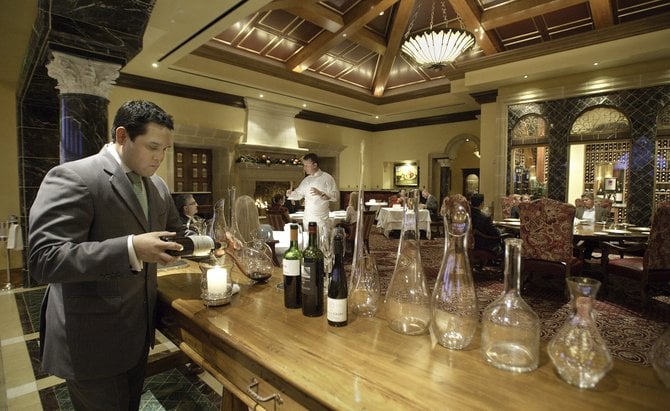
Master sommelier Jesse Rodriguez has won numerous wine-list awards.
Yes, I know. When I reviewed Addison in December 2006, shortly after its opening, I swore, “I wouldn’t go back there if somebody paid me — and somebody does.” Service conformed to some vulgar idea of “classy” (maybe that of real estate baron Doug Manchester, owner of this resort): rigid, graceless, excessive, and authoritarian. Sour was the flavor du jour at that meal, running all through the main menu after blasting off unforgettably with a sadistic “amuse” of a bowl of extra-sour yogurt dotted with unsweetened tart gooseberries and puckery quince. Later, Maria Hunt of the Union-Tribune ventured there, several times, and went to print nearly a year after I did, once the service was finally ready for prime time. Her review meals (which she mostly loved) had the opposite problem: an omnipresent “sweet profile” that grew wearisome before she reached dessert.
Since then, Addison has won numerous honors and awards, most recently a prestigious Relais et Chateaux Grand Chef award to chef William (“Wild Bill”) Bradley, plus numerous wine-list awards for its redoubtable master sommelier Jesse Rodriguez, an alumnus of the French Laundry. Plus five diamonds and five stars from travel specialists AAA and Forbes/Mobil.
What with the recession, I’ve reviewed few serious high-end restaurants this year or last, but if there’s any season for a splurge, the December holidays are it. I decided to go back to Addison in light of so much acclaim. Maybe my initial review was unjust; maybe I’d hit Chef Bradley at some bad juncture and he’d recovered, or he’d made a great leap forward.
Addison (named for old-time architect Addison Mizner) is hard to find, high in the wooded hills overlooking Carmel Valley, on a two-lane road with a “gatekeeper,” politely checking that you do have some business entering the Grand’s exalted realm, and then a series of speed bumps to impede your progress toward your hoped-for culinary nirvana. The restaurant isn’t in the hotel proper but several more minutes up the road in a splendid building of its own, with valet parking in its courtyard and a fireplace by the bench in front, where you can warmly await the rest of your party if you’re not up for lounging in the bar. The dining room is wheelchair-accessible but a bit of a walk over the lobby’s beautifully patterned slick marble if, say, your shiny new shoes pinch your toes. Most of the patrons we saw that Thursday night were not seriously dolled up, except for a volubly hebephrenic group in black suits and chic black cocktail dresses, incessantly shrieking their joy at somebody’s birthday.
The dining room, with comfortable leather banquettes in the corners, has well-spaced tables, handsome wood floors that peek out from thick carpeting, high ceilings with a large craftsmanly wooden chandelier, and awful faux-Cézanne still lifes here and there. And a whole passel of waiters and bussers, trying to be helpful. The atmosphere brings to mind a two-star provincial French restaurant striving strenuously for its third star in the Guide Michelin.
My dear friend Sam, a tablemate at the first dinner, volunteered for the retry. Once seated, we were offered a glass of champagne. I don’t know whether it’s free or not, but I get no kick from champagne; we passed. (When I called the next day to find out the price, if any, and to ask a few other questions, I got stuck for over ten minutes in hold-hell and gave up.) Then you can choose between still or sparkling bottled water (no charge).
You get not just one “amuse” but two. Our first was a tasty minimound of cold smoked-salmon rillettes wearing a top knot of citrus crème fraîche. A few minutes later came a small gougère, a light pastry shell bursting with a warm splash of mild melted cheese, perhaps loosened by crème fraîche or butter. The rather chilly waiter told us to eat it all in one bite. I disobeyed, enjoying it slowly in four well-savored bites. (It’s just gougère, after all, a standard French treat — not some high-tech gastro-experiment that might really require following the server’s orders.)
The menu is brief: four dishes each for first appetizer, second appetizer, entrée, and dessert. You can order three courses for $85 (plus small surcharges for some dishes, such as baby scallops) or four for $98. There are also chef’s tastings offering seven ($140) or ten ($225) courses for the whole table.
Both our first-course appetizers were ethereal, amazing, topped with “foams” as though to emphasize their airiness. Calamari “Grillé” (slices of squid bodies, no tentacles) was the best squid either Sam or I had ever tasted, astonishing us with their velvety tenderness. It was hard to believe they’d been grilled, since they were barely cooked. They were paired with lush black agnolotti colored with squid ink and filled with a deliciously salty purée of kalamata-style black olives and, perhaps, butter, with a few odd (very odd!) shreds of raw lettuce afloat in the engaging soi-disant “bouillabaisse” sauce — which is pinkish, salty, a little tart, and thickened with beurre monté, slowly beaten-in butter. It bears no clear resemblance to bouillabaisse fish-broth, except in the color and some distant connection with fish.
Foamier yet was the sauce crowning a quartet of baby sea scallops cooked to a barely done, melt-in-the-mouth stage, each one topped with a small green “tile,” apparently a baby spinach leaf that may have undergone some kitchen magic to create its unusual semifirm texture. Under that, two scallops bore a sprinkle of tiny black caviar; the other pair offered a trace of some sexy golden cream, totally mysterious. In the center-bottom of the plate was a thin layer of smooth, buttery spinach puree of a dark-jade color, surrounded by pale foam — presumably based on miso, because that’s what the menu says, but it neither looks nor tastes like the assertive Japanese soup.
So these are why Wild Bill wins all those awards. They’re among the very best dishes you’ll find in San Diego or probably anywhere else. But you get no sopping-bread to enjoy the last drops of the sauces. Instead, you’re served a crisp lemon-Parmesan bread stick (one per person). You do get a tablespoon — without which I might well have reverted to my time in South Asia and used my fingers to wipe out the bowls!
After that pair of five-star dishes, the second round of appetizers was fine but not divine. Yes, still highly superior — but the Sugar Plum Fairy was delicately dancing onto the stage. “Foie Gras Deux Façon” offered both seared foie gras (well-crisped, with delicate, nearly rare interior) and a soft creamy mousse, plus some small, crisp “crackers” of brik (the menu spells it “brick”), Tunisia’s sturdier answer to filo, to spread the mousse on. But the typical fruity accompaniment to the seared liver here took form as a thick, ultrasweet jam made of black raisins. Clever, yes, but cloying.
“Petite Crevettes” brought a small casserole dish containing eight small, tender shrimp, a few small blobs of uni, and a flurry of snipped green scallion tops surrounded by a modicum of creamy-textured sauce vermouth, which proved on the sweet side, with undertones hinting of vanilla, perhaps. The bread for this course — which didn’t much call for a sopping-bread — was a miniature brioche roll (one per person, again), served with a ramekin of room-temperature butter. The waiter told us the butter’s pedigree when he brought it, but we couldn’t hear him because the happy banshee party had just commenced squealing at length over some hilarious…something.
After these courses and the double-amuse, Sam and I felt replete with sublime flavors and actually enough food. But we soldiered on to the entrées, and now the Sugar Plum Fairy came stomping to center stage wearing army boots. “Barbecued canard” had medium-rare seared duck breast in a sweet glaze, served with an even sweeter mound of “candied red cabbage” topped with nasty little pieces of overcooked duck leg that chewed up into quacker sawdust. These elements were plated over a thin slick of sauce albufera, basically, a velouté (“velvet”) sauce, mixed with meat glaze. But don’t look to Addison for the “luxe, calme, et velouté” that Charles Baudelaire didn’t exactly promise. The sauce was overwhelmed by the syrupy ooze from the cabbage.
“Lamb Rack Persillé” was a surprise. The meat was disguised as a Chinese green squash, like a luffa, a thick chartreuse cylinder. “Our chef doesn’t believe in putting anything on the plate that can’t be eaten,” said the waiter. Hence, the lamb rib meat was boned and rolled, and instead of the classic sprinkling of minced parsley and garlic, it was coated in a thick, smooth parsley sauce. Like the duck, it was medium rare. (I actually prefer good lamb French-style, a bit rarer. Rent a DVD of Claude Chabrol’s superb Le Boucher for a great roast lamb recipe along with elegant thrills and chills.)
The menu in its typical Frenglish promised a “cassoulet de endive” (sic, sic, sic!). The appalling “fractured French” throughout the menu — starting with calamari (plural) grillé (singular) and then petite (singular) crevettes (plural) reads like some “Continental” restaurant menu in, say, Des Moines, circa 1957. If Addison can’t hire somebody to edit the French, why not drop the pretensions and go with English all the way?
In whatever language, the Belgian endive “cassoulet” bears no relationship to the beany Gascon cassoulet. The endives were shredded (other than a single raw leaf on the side of the plate, with a few drops of thin, sweet dressing) and cooked into syrupy preserves. The plate also held a dollop of what looked like Meaux coarse-ground country mustard. No, it was puréed pistachios. Good, but I’d have preferred mustard to fight the sugar-power.
We’d also been tempted by ris de veau panés (whew! finally, a French noun-adjective agreement!). These come with gingerbread and orange-glazed carrots. That makes 75 percent of the entrées sweet, with the probable exception of loup de mer (Atlantic sea bass, aka branzino) with chorizo, prawns, and clams “à la nage” (a light fish broth). But who knows, maybe “Wild Bill” throws sugar or fruit into the nage too.
The wine list is achy-breaky for a penurious oenophile. So much I wanted, so little I could afford. Instead of the $150 Chateau Grillet (the mother of all great Viogniers) or a $200-plus Meursault Goutte d’Or, one of several on the list, I finally dredged up a decent 2005 Calera Viognier for $40 for our appetizers (light and bright). It comes in a screw-top bottle. The never-smiling waiter didn’t quite sneer at it. Sam, ever the gentleman, treated us both to a Côte de Nuits Burgundy (around $100) for the entrées. It was terrific, of course.
I truly didn’t want dessert but succumbed to the realization that at these prices, I’d likely pass this way but once — so better put Addison through its paces now. To clean my palate, I ordered an espresso even before dessert. It had some crema but was otherwise faintly burned tasting. (Machine may need cleaning.) Sam shared his much better French-press coffee with me during the final ordeal-by-sweetness. Meanwhile, a server showed up with an array of four or five cheeses, and we still had some wine to go with them. In hindsight, I’d recommend a cheese course rather than dessert.
Before our “real” desserts arrived, another little gift course appeared, offering Meyer lemon sorbet paired with apple-cider granita (chopped, flavored ice). Perfect, just the palate cleanser we wanted. Can we go home yet?
No, still had to try the coconut custard, topped with shards of dark chocolate and pistachios. The custard was thick, a bit sludgy, with insufficient coconut flavor, and didn’t hold a candle to all those Thai coconut-mango-rice or coconut-poached-banana desserts around town. The best part was a scoop of toasted coffee ice cream on the side. Sam and I both enjoyed and admired the praline terrine, salted caramel mousse atop a crackly thin nut crust with amaretto syrup. On our way out, a server pressed another petit cadeau on Sam, a wrapped pair of caramels. I escaped my gift by slipping through a side door off the dining room right into the parking lot, craving fresh air and weary of it all. I do like playing the sybarite now and then, but in this case (unlike, say, at Westgate or Grant Grill) the luxe felt a little oppressive, the calme was shattered by our partying neighbors, and the volupté was mainly in the first course.
How can my humble opinion dare oppose all those awards? I’d guess it’s because I eat like a middle-class person on a little splurge, dining from the regular menu rather than a chef-tasting menu with the sommelier’s recommended wines. Or because, on my Reader budget, I could afford only one meal for two on this revisit, and the menu changes often. (Gone, for instance, was the earlier roast-chicken entrée with black-truffle dumplings — that wouldn’t have been oversweet, I’d bet.) But the various institutions that bestow awards are unlikely to inflict tight financial strictures on their tasters, and perhaps not anonymity either. A ten-course chef’s tasting dinner with perfectly matched wines? That’s bound to be exquisite, even more so if the chef knows that he’s cooking for the AAA or Forbes/Mobil.
Face it, this review is just the latest food report from your old free pal, the Reader, where EdBed works for the hip and hungry looking for sustenance, while I mainly aim at the overstressed middle class craving a bit of culinary bliss without blowing the mortgage. So, yes, Addison’s appetizers are awesome — but the menu goes downhill from there due to that “sweet profile” that Maria Hunt cited. I wonder whether — on the $85 three-course meal — they’d let you order two appetizers and skip to a cheese course instead of dessert? ■
Addison
★★★★ (Excellent)
The Grand Del Mar, 5200 Grand Del Mar Way (turn off from Carmel Country Road), Carmel Valley, 858-314-1900, addisondelmar.com
HOURS: Tuesday–Saturday 5:30–9:00 p.m.
PRICES: Three courses for $85, four courses for $98 (your choices on both menus); seven-course chef’s tasting dinner $140, ten courses $225, both available only for the whole table.
CUISINE AND BEVERAGES: Highly creative French-based California cuisine with global flavors, local vegetables, top-quality proteins. Vast award-winning international wine list includes first-growth Bordeaux, Bourgognes, rarities like Chateau Grillet. Many choices by the glass and/or half-bottle, nearly everything at high markups over retail, with hardly anything (even half-bottles) under $50. Corkage starts at $25.
PICK HITS: Don’t miss appetizers of calamari “grillé,” baby sea scallops. Also, foie gras, petite crevettes; praline terrine dessert. Good gambles: confit of pork salée (salt pork) appetizer; ris de veau panés (sweetbreads) with gingerbread; loup de mer (Atlantic sea bass) entrées; cheese course to finish your wine.
NEED TO KNOW: Hard to find, well past hotel entrance (watch for signs and speed bumps). Free valet parking. Dressy-casual on up; jackets not required. Can be noisy when festive parties are present. No vegetarian dishes; vegetarian dinner may be available by request when reserving.
Here's something you might be interested in.
Why Wild Bill Wins at Addison

Why Wild Bill Wins at Addison
Master sommelier Jesse Rodriguez has won numerous wine-list awards.
Yes, I know. When I reviewed Addison in December 2006, shortly after its opening, I swore, “I wouldn’t go back there if somebody paid me — and somebody does.” Service conformed to some vulgar idea of “classy” (maybe that of real estate baron Doug Manchester, owner of this resort): rigid, graceless, excessive, and authoritarian. Sour was the flavor du jour at that meal, running all through the main menu after blasting off unforgettably with a sadistic “amuse” of a bowl of extra-sour yogurt dotted with unsweetened tart gooseberries and puckery quince. Later, Maria Hunt of the Union-Tribune ventured there, several times, and went to print nearly a year after I did, once the service was finally ready for prime time. Her review meals (which she mostly loved) had the opposite problem: an omnipresent “sweet profile” that grew wearisome before she reached dessert.
Since then, Addison has won numerous honors and awards, most recently a prestigious Relais et Chateaux Grand Chef award to chef William (“Wild Bill”) Bradley, plus numerous wine-list awards for its redoubtable master sommelier Jesse Rodriguez, an alumnus of the French Laundry. Plus five diamonds and five stars from travel specialists AAA and Forbes/Mobil.
What with the recession, I’ve reviewed few serious high-end restaurants this year or last, but if there’s any season for a splurge, the December holidays are it. I decided to go back to Addison in light of so much acclaim. Maybe my initial review was unjust; maybe I’d hit Chef Bradley at some bad juncture and he’d recovered, or he’d made a great leap forward.
Addison (named for old-time architect Addison Mizner) is hard to find, high in the wooded hills overlooking Carmel Valley, on a two-lane road with a “gatekeeper,” politely checking that you do have some business entering the Grand’s exalted realm, and then a series of speed bumps to impede your progress toward your hoped-for culinary nirvana. The restaurant isn’t in the hotel proper but several more minutes up the road in a splendid building of its own, with valet parking in its courtyard and a fireplace by the bench in front, where you can warmly await the rest of your party if you’re not up for lounging in the bar. The dining room is wheelchair-accessible but a bit of a walk over the lobby’s beautifully patterned slick marble if, say, your shiny new shoes pinch your toes. Most of the patrons we saw that Thursday night were not seriously dolled up, except for a volubly hebephrenic group in black suits and chic black cocktail dresses, incessantly shrieking their joy at somebody’s birthday.
The dining room, with comfortable leather banquettes in the corners, has well-spaced tables, handsome wood floors that peek out from thick carpeting, high ceilings with a large craftsmanly wooden chandelier, and awful faux-Cézanne still lifes here and there. And a whole passel of waiters and bussers, trying to be helpful. The atmosphere brings to mind a two-star provincial French restaurant striving strenuously for its third star in the Guide Michelin.
My dear friend Sam, a tablemate at the first dinner, volunteered for the retry. Once seated, we were offered a glass of champagne. I don’t know whether it’s free or not, but I get no kick from champagne; we passed. (When I called the next day to find out the price, if any, and to ask a few other questions, I got stuck for over ten minutes in hold-hell and gave up.) Then you can choose between still or sparkling bottled water (no charge).
You get not just one “amuse” but two. Our first was a tasty minimound of cold smoked-salmon rillettes wearing a top knot of citrus crème fraîche. A few minutes later came a small gougère, a light pastry shell bursting with a warm splash of mild melted cheese, perhaps loosened by crème fraîche or butter. The rather chilly waiter told us to eat it all in one bite. I disobeyed, enjoying it slowly in four well-savored bites. (It’s just gougère, after all, a standard French treat — not some high-tech gastro-experiment that might really require following the server’s orders.)
The menu is brief: four dishes each for first appetizer, second appetizer, entrée, and dessert. You can order three courses for $85 (plus small surcharges for some dishes, such as baby scallops) or four for $98. There are also chef’s tastings offering seven ($140) or ten ($225) courses for the whole table.
Both our first-course appetizers were ethereal, amazing, topped with “foams” as though to emphasize their airiness. Calamari “Grillé” (slices of squid bodies, no tentacles) was the best squid either Sam or I had ever tasted, astonishing us with their velvety tenderness. It was hard to believe they’d been grilled, since they were barely cooked. They were paired with lush black agnolotti colored with squid ink and filled with a deliciously salty purée of kalamata-style black olives and, perhaps, butter, with a few odd (very odd!) shreds of raw lettuce afloat in the engaging soi-disant “bouillabaisse” sauce — which is pinkish, salty, a little tart, and thickened with beurre monté, slowly beaten-in butter. It bears no clear resemblance to bouillabaisse fish-broth, except in the color and some distant connection with fish.
Foamier yet was the sauce crowning a quartet of baby sea scallops cooked to a barely done, melt-in-the-mouth stage, each one topped with a small green “tile,” apparently a baby spinach leaf that may have undergone some kitchen magic to create its unusual semifirm texture. Under that, two scallops bore a sprinkle of tiny black caviar; the other pair offered a trace of some sexy golden cream, totally mysterious. In the center-bottom of the plate was a thin layer of smooth, buttery spinach puree of a dark-jade color, surrounded by pale foam — presumably based on miso, because that’s what the menu says, but it neither looks nor tastes like the assertive Japanese soup.
So these are why Wild Bill wins all those awards. They’re among the very best dishes you’ll find in San Diego or probably anywhere else. But you get no sopping-bread to enjoy the last drops of the sauces. Instead, you’re served a crisp lemon-Parmesan bread stick (one per person). You do get a tablespoon — without which I might well have reverted to my time in South Asia and used my fingers to wipe out the bowls!
After that pair of five-star dishes, the second round of appetizers was fine but not divine. Yes, still highly superior — but the Sugar Plum Fairy was delicately dancing onto the stage. “Foie Gras Deux Façon” offered both seared foie gras (well-crisped, with delicate, nearly rare interior) and a soft creamy mousse, plus some small, crisp “crackers” of brik (the menu spells it “brick”), Tunisia’s sturdier answer to filo, to spread the mousse on. But the typical fruity accompaniment to the seared liver here took form as a thick, ultrasweet jam made of black raisins. Clever, yes, but cloying.
“Petite Crevettes” brought a small casserole dish containing eight small, tender shrimp, a few small blobs of uni, and a flurry of snipped green scallion tops surrounded by a modicum of creamy-textured sauce vermouth, which proved on the sweet side, with undertones hinting of vanilla, perhaps. The bread for this course — which didn’t much call for a sopping-bread — was a miniature brioche roll (one per person, again), served with a ramekin of room-temperature butter. The waiter told us the butter’s pedigree when he brought it, but we couldn’t hear him because the happy banshee party had just commenced squealing at length over some hilarious…something.
After these courses and the double-amuse, Sam and I felt replete with sublime flavors and actually enough food. But we soldiered on to the entrées, and now the Sugar Plum Fairy came stomping to center stage wearing army boots. “Barbecued canard” had medium-rare seared duck breast in a sweet glaze, served with an even sweeter mound of “candied red cabbage” topped with nasty little pieces of overcooked duck leg that chewed up into quacker sawdust. These elements were plated over a thin slick of sauce albufera, basically, a velouté (“velvet”) sauce, mixed with meat glaze. But don’t look to Addison for the “luxe, calme, et velouté” that Charles Baudelaire didn’t exactly promise. The sauce was overwhelmed by the syrupy ooze from the cabbage.
“Lamb Rack Persillé” was a surprise. The meat was disguised as a Chinese green squash, like a luffa, a thick chartreuse cylinder. “Our chef doesn’t believe in putting anything on the plate that can’t be eaten,” said the waiter. Hence, the lamb rib meat was boned and rolled, and instead of the classic sprinkling of minced parsley and garlic, it was coated in a thick, smooth parsley sauce. Like the duck, it was medium rare. (I actually prefer good lamb French-style, a bit rarer. Rent a DVD of Claude Chabrol’s superb Le Boucher for a great roast lamb recipe along with elegant thrills and chills.)
The menu in its typical Frenglish promised a “cassoulet de endive” (sic, sic, sic!). The appalling “fractured French” throughout the menu — starting with calamari (plural) grillé (singular) and then petite (singular) crevettes (plural) reads like some “Continental” restaurant menu in, say, Des Moines, circa 1957. If Addison can’t hire somebody to edit the French, why not drop the pretensions and go with English all the way?
In whatever language, the Belgian endive “cassoulet” bears no relationship to the beany Gascon cassoulet. The endives were shredded (other than a single raw leaf on the side of the plate, with a few drops of thin, sweet dressing) and cooked into syrupy preserves. The plate also held a dollop of what looked like Meaux coarse-ground country mustard. No, it was puréed pistachios. Good, but I’d have preferred mustard to fight the sugar-power.
We’d also been tempted by ris de veau panés (whew! finally, a French noun-adjective agreement!). These come with gingerbread and orange-glazed carrots. That makes 75 percent of the entrées sweet, with the probable exception of loup de mer (Atlantic sea bass, aka branzino) with chorizo, prawns, and clams “à la nage” (a light fish broth). But who knows, maybe “Wild Bill” throws sugar or fruit into the nage too.
The wine list is achy-breaky for a penurious oenophile. So much I wanted, so little I could afford. Instead of the $150 Chateau Grillet (the mother of all great Viogniers) or a $200-plus Meursault Goutte d’Or, one of several on the list, I finally dredged up a decent 2005 Calera Viognier for $40 for our appetizers (light and bright). It comes in a screw-top bottle. The never-smiling waiter didn’t quite sneer at it. Sam, ever the gentleman, treated us both to a Côte de Nuits Burgundy (around $100) for the entrées. It was terrific, of course.
I truly didn’t want dessert but succumbed to the realization that at these prices, I’d likely pass this way but once — so better put Addison through its paces now. To clean my palate, I ordered an espresso even before dessert. It had some crema but was otherwise faintly burned tasting. (Machine may need cleaning.) Sam shared his much better French-press coffee with me during the final ordeal-by-sweetness. Meanwhile, a server showed up with an array of four or five cheeses, and we still had some wine to go with them. In hindsight, I’d recommend a cheese course rather than dessert.
Before our “real” desserts arrived, another little gift course appeared, offering Meyer lemon sorbet paired with apple-cider granita (chopped, flavored ice). Perfect, just the palate cleanser we wanted. Can we go home yet?
No, still had to try the coconut custard, topped with shards of dark chocolate and pistachios. The custard was thick, a bit sludgy, with insufficient coconut flavor, and didn’t hold a candle to all those Thai coconut-mango-rice or coconut-poached-banana desserts around town. The best part was a scoop of toasted coffee ice cream on the side. Sam and I both enjoyed and admired the praline terrine, salted caramel mousse atop a crackly thin nut crust with amaretto syrup. On our way out, a server pressed another petit cadeau on Sam, a wrapped pair of caramels. I escaped my gift by slipping through a side door off the dining room right into the parking lot, craving fresh air and weary of it all. I do like playing the sybarite now and then, but in this case (unlike, say, at Westgate or Grant Grill) the luxe felt a little oppressive, the calme was shattered by our partying neighbors, and the volupté was mainly in the first course.
How can my humble opinion dare oppose all those awards? I’d guess it’s because I eat like a middle-class person on a little splurge, dining from the regular menu rather than a chef-tasting menu with the sommelier’s recommended wines. Or because, on my Reader budget, I could afford only one meal for two on this revisit, and the menu changes often. (Gone, for instance, was the earlier roast-chicken entrée with black-truffle dumplings — that wouldn’t have been oversweet, I’d bet.) But the various institutions that bestow awards are unlikely to inflict tight financial strictures on their tasters, and perhaps not anonymity either. A ten-course chef’s tasting dinner with perfectly matched wines? That’s bound to be exquisite, even more so if the chef knows that he’s cooking for the AAA or Forbes/Mobil.
Face it, this review is just the latest food report from your old free pal, the Reader, where EdBed works for the hip and hungry looking for sustenance, while I mainly aim at the overstressed middle class craving a bit of culinary bliss without blowing the mortgage. So, yes, Addison’s appetizers are awesome — but the menu goes downhill from there due to that “sweet profile” that Maria Hunt cited. I wonder whether — on the $85 three-course meal — they’d let you order two appetizers and skip to a cheese course instead of dessert? ■
Addison
★★★★ (Excellent)
The Grand Del Mar, 5200 Grand Del Mar Way (turn off from Carmel Country Road), Carmel Valley, 858-314-1900, addisondelmar.com
HOURS: Tuesday–Saturday 5:30–9:00 p.m.
PRICES: Three courses for $85, four courses for $98 (your choices on both menus); seven-course chef’s tasting dinner $140, ten courses $225, both available only for the whole table.
CUISINE AND BEVERAGES: Highly creative French-based California cuisine with global flavors, local vegetables, top-quality proteins. Vast award-winning international wine list includes first-growth Bordeaux, Bourgognes, rarities like Chateau Grillet. Many choices by the glass and/or half-bottle, nearly everything at high markups over retail, with hardly anything (even half-bottles) under $50. Corkage starts at $25.
PICK HITS: Don’t miss appetizers of calamari “grillé,” baby sea scallops. Also, foie gras, petite crevettes; praline terrine dessert. Good gambles: confit of pork salée (salt pork) appetizer; ris de veau panés (sweetbreads) with gingerbread; loup de mer (Atlantic sea bass) entrées; cheese course to finish your wine.
NEED TO KNOW: Hard to find, well past hotel entrance (watch for signs and speed bumps). Free valet parking. Dressy-casual on up; jackets not required. Can be noisy when festive parties are present. No vegetarian dishes; vegetarian dinner may be available by request when reserving.