

Here's something you might be interested in.
Ask a Hipster — Advice you didn't know you needed
Big Screen — Movie commentary
Blurt — Music's inside track
Booze News — San Diego spirits
Classical Music — Immortal beauty
Classifieds — Free and easy
Close to Home — What it’s like on the street where you live
Cover Stories — Front-page features
Drinks All Around — Bartenders' drink recipes
Excerpts — Literary and spiritual excerpts
Feast! — Food & drink reviews
Feature Stories — Local news & stories
Fishing Report — What’s getting hooked from ship and shore
From the Archives — Spotlight on the past
Golden Dreams — Talk of the town
The Gonzo Report — Making the musical scene, or at least reporting from it
Letters — Our inbox
Movies@Home — Local movie buffs share favorites
Movie Reviews — Our critics' picks and pans
Musician Interviews — Up close with local artists
Neighborhood News from Stringers — Hyperlocal news
News Ticker — News & politics
Obermeyer — San Diego politics illustrated
Outdoors — Weekly changes in flora and fauna
Overheard in San Diego — Eavesdropping illustrated
Poetry — The old and the new
Reader Travel — Travel section built by travelers
Reading — The hunt for intellectuals
Roam-O-Rama — SoCal's best hiking/biking trails
San Diego Beer — Inside San Diego suds
SD on the QT — Almost factual news
Sheep and Goats — Places of worship
Special Issues — The best of
Street Style — San Diego streets have style
Surf Diego — Real stories from those braving the waves
Theater — On stage in San Diego this week
Tin Fork — Silver spoon alternative
Under the Radar — Matt Potter's undercover work
Unforgettable — Long-ago San Diego
Unreal Estate — San Diego's priciest pads
Your Week — Daily event picks
2454 clinical trials in San Diego
My life as a medical research volunteer
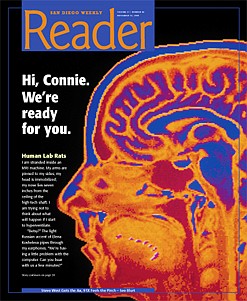
Human Lab Rats
I am stranded inside an MRI machine. My arms are pinned to my sides; my head is immobilized; my nose lies seven inches from the ceiling of the high-tech shaft. I am trying not to think about what will happen if I start to hyperventilate.
“Betsy?” The light Russian accent of Elena Kosheleva pipes through my earphones. “We’re having a little problem with the computer. Can you bear with us a few minutes?”
She could get me out, but she doesn’t want to. The brain-imaging machine costs her boss $1500 per hour, and she has just a few more tests to run on me, research volunteer number 39, in a study called “How do sleeping pills affect pain in the brain?” The breezy confidence of her tone is undermined by a plea. She only recently graduated from UCSD, and this is her first full-time job.
“Sure,” I say.
But I am not sure. I cannot turn my head. The walls are getting way too close. My only diversion is the screen of the offending laptop, visible through angled mirrors. Screen savers flash onto the screen each time Kosheleva reboots: island sunsets, Alpine skiers, then “fatal error.” Palm trees. Skiers. Crash. Again and again. Sweat trickles from behind my ear down the back of my neck. I try deep breathing, but there does not seem to be enough room for my lungs to expand fully.
My journey to the lab began with the want ads for medical research volunteers in the Reader. Here, you learn that the same condition that makes you suffer also makes you valuable: Worry too much? Are you…tired of dealing with dry eyes, allergic to milk, afraid to show your feet, self-conscious, constipated, shy? Are you smoking too much pot, a heavy drinker who wants to stop, a heavy drinker who does not want to stop? In some cases, you don’t even have to have a disease. All they want is your 18-to-45-year-old healthy body to test the safety of a drug or other therapy that, until now, has been tested only in animals.
If national Harris Poll figures are any indication, 10 percent of the people aged 18 to 65, or about 90,000 San Diegans, have participated in or will participate in a clinical trial, experiments that test new treatments for a disease. That means 90 percent haven’t. They either do not qualify or are happy to let someone else do it.
So who are these people who make up the 10 percent? How desperate do they have to be? How far are they willing to go for the chance of treatment or compensation or the chance to help in the “development of new medical advancement for those who need it most,” as one advertisement read? And can we trust them?
These questions first occurred to me during my years in pharmaceutical marketing. In those days, one of my jobs was to turn study findings into value propositions. The job was made easier because the data came in the form of comforting, faceless numbers, as in “less than 0.2 percent of people” taking a particular drug experienced arrhythmia, dry mouth, or death, or “85 percent of people experienced significant improvement in their symptoms.”
It wasn’t until I moved to San Diego and was confronted by the weekly catalog of clinical research ads that it dawned on me how close to home these people could be. Curiosity took hold. What would it take to be one of them?
Turns out insomnia and back pain would do just fine. I had both in the wake of an accident a year ago. My doctor did what he could, but I still hurt and I was still tired.
The ads began to speak directly to me. “Not sleeping?” “Lower back pain?” Maybe there was something new I could try. I combed the Reader, then craigslist, and then clinical trial websites for studies that addressed at least one of my problems without much risk and without a lot of inconvenience. Before long, I was auditioning for my first job as a human guinea pig.
Human guinea pigs are essential to the livelihoods of thousands of people right here in San Diego. As of June, 2454 clinical trials were preparing to recruit subjects, were in the process of recruiting, or had just closed in San Diego, according to a count on clinicaltrials.gov, a clearinghouse for trials conducted nationally. This represents about 25 percent of trials in California and virtually equals the number listed for the entire state of Connecticut. It does not even reflect all the opportunities in San Diego because not all sponsors list studies with clinicaltrials.gov.
All the players are here: more than 500 biotech companies (many of them partners with the large pharmaceutical firms that fund most drug studies), doctors, hospitals, academic institutions, nurses, recruiters, study coordinators, middlemen. All, however, are ultimately dependent on those willing to volunteer their bodies, minds, and time.
My role in the San Diego research economy is not top of mind when Kosheleva interviews me during the telephone “prescreen.” I just want her to pick me. I’d already been rejected from my first study choice. It had seemed perfect: a treatment for insomnia that did not involve drugs or anything invasive, and I could bring home up to $350 for my trouble. All I had to do was meet the criteria, one of which was to fall between the ages of 18 and 50. I lied. What difference would a few months make? And it was all fine, we had made our first appointment, and then the recruiter said, “Just bring an ID with you.” I later learned that not all recruiters card volunteers. But I confessed, and we canceled the appointment.
So I tell the truth to Kosheleva. She asks me about my sleeping patterns, whether I am using antidepressants or anti-anxiety medications, how much alcohol I consume, and whether or not I can handle the confinement of an MRI machine or, more specifically, a functional MRI machine, one that can take moving images of the brain, videos, while the brain is involved in specific functions.
The idea behind this study is that pain and sleep problems often go hand in hand. Addressing one problem may help the other. But it will also help UCSD researchers in a quest to understand how the machine itself can be used as a tool to match patients with the right treatment for anxiety, depression or, in this case, pain.
The first brain scan will shoot a video of the blood flow to the amygdala and the insula, parts of my brain that are involved in processing emotions, anxiety, and pain perception. The second scan will take images of the same areas after one week of taking an insomnia drug, eszopiclone, better known as Lunesta.
I might receive a placebo, a sugar pill, as some call imposter drugs used for comparison in clinical research. But I have an equal chance of receiving Lunesta, an FDA-approved drug, to see if it helps me sleep. Either way, the study will be relatively quick and easy: only three visits of about three hours each, a couple of brain scans, and a week of taking pills.
The brain scans do not loom large as a problem. Over the past year I have had two MRIs. They weren’t fun, but they were over quickly. The pay, $275, is not bad — about $30 per hour if I get through all three sessions. I will also receive a picture of my brain.
But I am not yet in. The final judge will be the lead investigator, Dr. Martin Paulus, professor of psychiatry, Department of Psychiatry and the Laboratory of Biological Dynamics and Theoretical Medicine at UCSD. Kosheleva tells me she will email me shortly to let me know if I have made it to the next round, the assessment.
Google “human guinea pig,” and you’ll find plenty of reasons to have second thoughts about this line of work. Over the past few years, a steady stream of articles and columns has raised old and new ethical questions triggered by the increasing concentration of trials in the hands of industry and has assailed the lack of independent oversight.
The primary focus remains on the pharmaceutical industry, which, in 2006, spent a reported $55 million on research and development. About two-thirds of research-and-development funds are spent on clinical trials, making them the most expensive element of the R&D process, particularly when you consider that only one in five drugs that goes into these trials is actually approved by the FDA.
As recently as the early 1990s, academic institutions conducted over 80 percent of the clinical research for new pharmaceutical products. Today, more than 70 percent of trials are conducted in company-owned clinics or subcontracted to clinical research organizations, physicians, or hospitals. Academic institutions typically use their own internal review boards to oversee the rights and safety of human volunteers. For studies conducted in the private sector, this responsibility is assumed by companies called central internal review boards. These are paid directly or indirectly by the pharmaceutical companies sponsoring the research.
Among the lowlights: controversy over Eli Lilly’s reliance on homeless alcoholics to test its products in the 1990s. In 2006, SFBC International, then one of the country’s largest clinical research organizations, was charged with extensive violations of research volunteer rights, including paying undocumented workers to participate in clinical trials. Then there are the six volunteers at a British research site who in 2006 suffered multiple organ failure and lapsed into comas after being injected with a drug intended to treat leukemia and autoimmune diseases. Until that time, the drug had been tested only in animals. One man has reportedly since been diagnosed with cancer, and new safety guidelines for testing high-risk drugs are in place in Europe.
In the summer of 2005, controversy hit closer to home when Matt Potter raised questions on these pages regarding the testing in San Diego of PolyHeme, a blood substitute intended for use in trauma victims. Study sponsors did not appear to follow guidelines intended to inform the public and ensure that the risk was spread over a representative group, not just the poorest. These guidelines were established because guinea pigs in this study could not give permission; they were unconscious. Results of the nationwide trial, announced in late 2007, show a significantly higher death rate among people who had received PolyHeme than those who had received blood.
The fact remains that clinical trials represent the only way for millions to receive new drugs and procedures that can help them. Those willing to go first do not fall into convenient, easy-to-peg niches. Surveys of research volunteers identify a mix of factors that go into the decision to sign on for studies, including money, referrals from trusted doctors or friends, access to free or cutting-edge treatment, and the desire to help others while helping themselves.
The relative importance of each factor is not always clear. One 2005 survey conducted by Harris Interactive reports that 72 percent of adults would be “very likely” to consider a trial if they had a terminal illness. However, only about 5 percent of cancer patients in the United States, terminal or not, participate in clinical trials.
Money will have more impact on the decision of an unemployed or uninsured person than it might on someone like Lisa, a 37-year-old mother of two and one of several local lab rats willing to share their insights.
“My husband thought I was crazy. He thinks trials are a really risky thing to do,” she says.
This might be something any husband would say, but it has particular resonance coming from a man who works for a local drug-discovery company. His livelihood is tied to the successful outcomes of human trials involving drugs his company develops. So is Lisa’s, for that matter. At her company, she tests new drug formulations on animals, but the winners among them go on to be tested in humans.
We chat while blood flows from her forearm into one of four vials. Nearby, her study coordinator takes notes. The vials will go to a lab, and in a week or so she will find out if she makes it into her second clinical trial. This is Lisa’s assessment, and she wants in.
“It worked last time. It made a huge difference.” The test drug, a synthetic hormone, has been available since the ’70s and is used to treat endometriosis, a condition in which tissue similar to the lining of the uterus grows outside the womb, causing intense pain.
“I was going to the emergency room once a month for pain meds. There was nothing I could do. I couldn’t walk. I couldn’t eat. My husband would have to take care of me. I would have to take time off from work.”
She came across the first study when she was researching her surgical options. In that study, the hormone was delivered via a vaginal ring. The idea behind both studies is that if the drug is delivered locally, instead of in its current pill form, the side effects would be less severe. These side effects include hair loss or growth in undesirable areas, weight gain, voice changes, loss of libido, and a host of others.
For the four months of the first study, Lisa had little or no pain. She still feels better than she used to. This time, the company wants to test the drug in a vaginal suppository. The potential downside of participating in the trial? She might get the placebo while other study participants get the real drug. But Lisa is philosophical about that.
“If you have a good local delivery system, this drug could make a huge difference to a lot of women. If I can be part of it, I want to be. I will be as happy about this product getting to market as any of the products I work on at my company.”
Questions More Invasive Than Needles
I arrive for my own assessment with the kind of rejection anxiety usually triggered by job interviews. But I relax when Kosheleva meets me on the walkway outside the maze of UCSD research offices off Villa La Jolla Drive. An armload of papers jiggles as she shakes my hand, and a few tendrils of brown hair slip out of her ponytail.
On the way to her office, Kosheleva tells me I am patient 39 of the 40 she must recruit. I represent the last lap before the finish line. But before either of us can get too excited, there are some hurdles to clear.
She leads me through a door into a cubbyhole crowded with desks, computers, and chairs full of slumping students staring intently at monitors. Through another door, we enter a room the size of a closet, and the pile of papers and folders in Kosheleva’s hands are suddenly stacked on the table in front of me, an imposing four inches. Hurdle number one.
On the plus side, two vouchers worth a total of $75 lie next to the stack, and these will be mine as soon as I fill out the papers and submit to the physical scheduled for later on. Even if I am found unsuitable for the study, I get to keep this money.
Later, I learn that one way would-be guinea pigs scam the system is to say whatever it takes in the prescreen so they can make the assessment. They get a free physical and the first installment of their money, knowing from the outset that they will not make the cut.
But I am still an innocent, so I smile at the vouchers and get ready to dig into the pile of questionnaires in front of me. My answers, Kosheleva explains, will assess my mental health. I later learn that Lunesta is not recommended for use in people with depression or dependencies on drugs or alcohol.
“Look at these first, and let me know if you have any questions,” Kosheleva instructs, tapping the top of the pile. “These” turn out to be informed consent documents. My signature means I know what I am getting into. This is when I realize that there are actually two studies, the main one, “How sleeping pills affect pain in the brain,” and something called “Genetic polymorphism and human behavior,” which involves an extra blood draw and one questionnaire.
The first document gets my attention with the word “pain.” This study will involve pain applied via a “small ceramic plate, about the size of a credit card,” as part of the experiment. It won’t be enough to damage my skin. I am looking for a little more reassurance than this, and I find it when I read the part that says I can stop the experiment at any time. A final warning tells me I may feel some restlessness or fatigue when filling out questionnaires.
I glance at the stack in front of me as it dawns on me just how long it might take to get through it. But I am not going to back out now. I sign this form and then, barely reading, the other one too. What is one more vial of blood, one more questionnaire?
Two hours later, I’ve given blood, passed a Breathalyzer, and submitted to an EKG and a full physical conducted by Dr. Paulus, an intense but considerate man who seems to wear his long title casually. He is unhurried and patient. I like this man, and I like Kosheleva.
However, I have only reduced the stack of questionnaires by half. It isn’t just the size of the stack, it is the questions themselves, all multiple choice or rating scales and all designed to make a happy, well-adjusted person reassess every aspect of her life and personality. “Do you enjoy social situations?” “Do people find you cold?” “Are you confident?” “Were you afraid of the dark as a child?” “Did you have a favorite blanket or stuffed toy?” Other questions probe for emotional, physical, or sexual abuse.
To top it all off, Kosheleva asks many of the same questions in person. She does this with the help of a student. He reads along while Kosheleva asks me about the events that most transformed my life and what I felt then.
This strikes me as being more invasive than the needle in my vein or the probing of Dr. Paulus’s fingers around my ears, neck, and abdomen. I look at the young, preoccupied faces staring at me over the stacks of paper, pens in the air waiting for my response, and although I have answered everything with slow, searching honesty up to this point, I can go no further. I mumble something about weddings and graduations, and soon after, I’m on my way, $75 richer. Kosheleva promises to contact me to let me know if I have made it to the next round.
“If the compensation is not enough, it’s not worth it to me.”
My assessment was a breeze, as these things go. Some require days, even weeks, to complete. During this period, the guinea pig may give up blood, urine, and bits of flesh and answer questions or be monitored over time to see if her sleep patterns/hot flashes/behavior or other chronic problems meet the criteria for the study. It is the first time a guinea pig really considers just how far she will go in this process. To a large degree, the answer hinges on what is motivating the guinea pig to enroll in the first place.
“I check the money first. Sad but true,” says Alice, a 22-year-old San Diego State graduate who is finishing up course work and looking for a job. “If the compensation is not enough for the hours I have to devote, then it is not worth it to me.” She just completed an outpatient study that earned her $1000 for taking an oral contraceptive over seven months. Her career earnings: $1475.
“I’m looking for that one pill that will work,” says Alan, 55, an insomniac who lives at the opposite end of the economic spectrum. He is an executive for a multinational company whose family’s combined annual income exceeds $250,000, not including the money he earns from clinical trials, which can range from as little as $300 to ten times that, depending on the study.
“I don’t even keep the money. It goes straight into my kids’ savings accounts. They like it when I do studies.”
He is in the middle of his 18th clinical trial and, like Lisa, is motivated first by medical need but says that doing clinical trials helps him in other ways.
“My mother told me when I was young that I should always give blood, that it is something God gives us. There’s kind of a spiritual aspect to all of this, and I like that part of it.”
For Connie, 55, a retired government employee and avid knitter, guinea pigging represents potential treatment and hobby.
“I’ve gotten kind of hooked on them now because I’m learning about myself and different health issues.”
So far, Connie has participated in three trials, two of which dealt with menopause, and is in the process of setting up her next one.
For Laura, the motivation is entirely personal. “I don’t have a lot to lose. If I keep getting sicker, then my body will not do what I ask of it.”
Her 23-year-old body has served notice to her more than once. For most of her life she has suffered from lupus, a disease in which her own immune system attacks her kidneys, lungs, stomach, skin, and other vital organs. The 13 medications she takes help some symptoms but come with side effects of their own. Good days are when she is able to function even when she feels sick. Bad days might require hospitalization.
In this trial, Laura is testing Orencia, a drug that treats rheumatoid arthritis, to see if it can help lupus patients as well. There is no placebo. Either it will work or it won’t.
“I talked it over with my doctor when we talked about increasing my medications this past winter,” Laura says. “I’ve been down most of the treatment roads but not this one.”
Laura selected this trial over another one because the side effects of the other test drug concerned her. In this, she is like most volunteers — her tolerance for risk and discomfort guides how far she will go. But sometimes the limits of a lab rat are not intuitive. Connie, for example, participated in two studies that required blood draws, physicals, painful insertions of tubes into her uterus, and the removal of tissue from her cervix for examination, but she nixed the trial that wanted her to wear a bracelet for a month. It looked like a hospital wristband with a device that measured her “tossings and turnings” at night.
“It was ugly. You know those bands they give you at the hospital with that floppy flap? Well, it looked like that with a watch on it. It was goofy.”
Alan, the executive, will take experimental sleep drugs; he will spend nights in labs where study coordinators attach wires to his chin, scalp, chest, legs, and other parts of his body; and he (and his wife) will put up with any temporary loss of sex drive that may occur with a sleep drug. He won’t, however, do anything that interferes with his job.
“If I was to take a lot of time out of my day, I lose money.”
With the exception of Alice, the San Diego State student, no one in this group professes to care much about the money they get for guinea pigging. But Alice is not alone.
“I was in the waiting area of the clinic for the study I’m doing now,” says Alan. “There were a couple of people there. I moved away because of the body odor and dirty ashtray smell, but I heard their conversation. One guy said, ‘I have to get $500 a month from this.’ ”
Big-Money Trials
The big money, of course, is in the higher-risk drug trials, the ones that test experimental drugs in humans for the first time. These studies, called phase I trials, require small numbers of volunteers to establish safety, identify side effects, and determine dosage. Phase I volunteers must be “healthy subjects” so underlying disease won’t impact results. Phases II and III involve increasingly larger numbers of research volunteers and test the efficacy and safety of the drugs in people with the disease they are supposed to treat.
Studies like the one I’m in are called phase IV studies. They are conducted on drugs that are already on the market to gather more information about them. This information can be used in any number of ways, from exploring new uses to providing material for journal articles that keep the company’s name and products in front of the physicians who prescribe them.
Studies in phases II through IV offer at least a shot at medical benefit for the volunteer. Not so with phase I.
“The only reason to be in a phase I study is the money,” says David Forster, vice president of compliance for the Seattle-based Western Institutional Review Board, one of the firms hired to monitor human-subject safety and rights for several studies going on in San Diego. His job is to make sure that lab rats are not overcompensated.
“What you don’t want is a huge amount of money for something that is really risky, where people make choices that are not in their best interest.” Compensation for a typical phase I study with a two-week stay at a clinic comes out to “about $10 an hour.”
“It beats working at Burger King,” says Bob Helms, retired guinea pig and editor of Guinea Pig Zero (guineapigzero.com), a jobzine for human-study volunteers and an anthology of lab-rat stories. A Philadelphia native, he started volunteering in 1995, when he was on unemployment, and for the next eight years averaged $10,000 to $15,000 annually, earning his living as a healthy human subject and, in the process, gaining a national reputation as a professional guinea pig.
Helms’s site was the forerunner of jalr.org (Just Another Lab Rat), gpgp.net (Guinea Pigs Get Paid), and biotrax.com. All are resources for serious lab rats, many of whom report similar stories — a job loss, the need to earn more money, and the discovery that their bodies can earn the most serious of them upwards of $25,000 each year. The sites not only provide study listings and basic translations of medical and labspeak, some offer critiques and ratings of research labs all over the country, including, in at least one case, a San Diego study site.
The phase I experience can be intense. Volunteers may be “confined” in a clinic or other study site for anywhere from two weeks to more than a month. They are continually examined, dosed, and measured. They may be sleep deprived, their diets may be controlled, they may have tubes inserted into any number of orifices, depending upon what the drug is supposed to do or what side effects it may cause. Volunteers may undergo biopsies, procedures in which tissue samples are extracted and examined. They will suffer intermittent discomfort, and they will almost certainly be bored.
They are supposed to know all this before they start, and they do, if they’ve read their informed-consent agreement before signing it.
Who Pays if I Get Sick?
When I get home from the assessment, I take a closer look at my informed consent documents. I’m seeing things I missed before. For one thing, I’m not sure I understand who pays if I get sick as a result of anything associated with the trial. For another, my genes (thanks to the second consent form) can be used for commercial purposes if the opportunity arises. It is embarrassing, and unsettling, to realize I didn’t get all my questions answered before I signed. It doesn’t make me feel better when I find out I’m not unique.
“I’ve known guys that were more interested in The Jerry Springer Show than what was going on in their bodies,” says Helms.
“I’m looking at the forms differently now,” says Connie. “Before, I was kind of gullible and relying on what they were saying. I just went in there and said, ‘Lucky me, I’m going to get help with my hot flashes.’ ”
Informed consent is what separates the modern-day guinea pig from the 399 unknowing participants in the infamous United States Public Health Service’s study of untreated syphilis in African-American men. Although informed consent may be waived, as it was in the PolyHeme trial, or for the military if the president approves it, the vast majority of U.S. participants must sign off.
The form lists everything that will be done to you and reminds you that you can quit at any time for any reason. You also learn who takes care of you if something goes wrong with the study.
“There have been two occasions when I’ve seen a document with an arbitration clause, and that was a red flag,” says Alan, the executive. He did not want to get sick during a trial and have to negotiate who pays for what. He did not sign.
“This is kind of a gray area. The boundaries are not always well defined,” says Dr. William Koltun, an obstetrician and gynecologist who operates the Medical Center for Clinical Research on Friars Road. He derives virtually all of his income from conducting clinical trials for pharmaceutical firms.
“In the past, investigators were always indemnified by the pharmaceutical company,” Koltun says. “Today, companies are much more concerned that [research] sites have insurance of their own. I still think in the end, if the [experimental] product is responsible for the injury or the problem, then the pharmaceutical company is going to pay for the care. If the care of the patient or administration of the drug were found to be the issue, then the doctor would be responsible.”
This is more or less the case for me, as Dr. Paulus explains when I contact him. I rest easier, but I still feel dumb.
A $100 Voucher and Seven Little White Pills
The assessment turns up no knock-out factors, and a couple of weeks later, on a mild Monday afternoon, I am once again sitting across from Kosheleva. This time we are outside the functional MRI lab, playing a game a little like chicken. Kosheleva places the hot ceramic square described in the consent form to my forearm and lets it heat up until I cannot stand it another second or the machine hits a preset threshold between discomfort and potential injury. The point is to establish my personal pain scale, so when she does the same thing in the lab, the pain will be within the range I can tolerate. Each time I feel the square heat up, I press one of four buttons on a small black plastic square wired to her laptop. Button number one is for warm but not painful, button number four is extremely painful. The middle buttons capture everything in between. My confidence in myself is restored; there is nothing here I can’t stand.
We move on to another game. In this one, sets of three black ovals or three human faces displaying happiness, anger, or sadness flash on the computer screen. I am to press a button to show which face or oval is not like the others. A similar one follows, using X’s and O’s. Then it is time to go into the lab and play the games for real.
Blasts of cold air swirl around the tech and Kosheleva as they secure me to the tray that will slide into the cavity of the functional MRI machine. The tech straps a head coil around my head so it cannot move and clips a monitor to my left index finger and another to my chest. Kosheleva fits the black box with the buttons under my right fingers; then she places a black rubber bulb next to it.
“If you need to get out, just squeeze this. We’ll come get you.”
Earplugs come next, then earphones.
“Ready?”
The upper half of my body slides into the machine. All I can move are my fingers and my legs, which remain outside. Above me, the view in the angled mirrors is blank. I sense the departure of Kosheleva and the tech who will be operating the controls from somewhere outside the walls of the lab. I am alone.
For the next 20 minutes the machine pings, pounds, chirrups, and knocks like a giant squirrel trying to break into my skull. At intervals, Kosheleva or the tech give a quick instruction or explanation. The squirrel goes crazy while the little plate heats up on my arm during the pain test, but I can push the buttons and do my job. No big deal.
“Now we’ll just set up for the next tests, like the ones I showed you before.”
That’s when the computer crashes. As each minute passes, I realize that I am not okay with confinement after all. The two regular MRIs I’d had were either much shorter or they were flukes.
“While we’re waiting we’ll take the picture of your brain. This one will be yours,” says the tech. She means well, but I feel like a fretful two-year-old, and no amount of candy, or brain photography, is going to placate me.
When we resume, I no longer care which faces or symbols match. I only care that the buttons on the black box are sticking. It takes every ounce of patience that I have to press them correctly. I tell Kosheleva about the buttons.
“Just do the best you can. It will be fine.” Then she introduces a new wrinkle. Instructions will appear at intervals, and I am to obey them. It is no longer enough to match X’s and O’s, I must do it before a buzzer sounds or after it sounds. It doesn’t matter what the instructions say because the buzzer never goes off when they say it will, and I never know how long I will have to press the correct button, which sticks.
Afterward, Kosheleva swears that the sticky buttons and the computer crash are not part of the study. The only frustrating part is supposed to be the buzzer. I get no points for lasting as long as I did, only a grateful and sympathetic smile from Kosheleva, another $100 voucher, and a bottle of seven little white pills, one for each night. I also receive a seven-page “sleep diary” for recording my sleep patterns until I return for my next scan on the following Monday.
Post-Trial Wrap-Up
Sometimes guinea pigs wonder if they are going to make it through the study. Side effects are one issue, as Lisa found after she started her first trial.
“In the first month of the trial, I thought of abandoning ship,” she says. “I was agitated, depressed. There was a definite disinterest in intercourse.” Her voice lightens. “I didn’t lose my hair, though, and then it mellowed out.”
Laura, the young woman with lupus, has had five infusions of Orencia and “is not doing very well at all.” She is experiencing new lupus symptoms.
“Trying to tell whether it’s just the natural progression of my illness or whether it’s actually the Orencia that’s making me worse is almost impossible. If it seems like it’s the drug that’s making me sicker, then we’ll have to stop it.”
Other times, the problems are related not to the drug. For one thing, there are all those other guinea pigs, like the two smelly guys who talked money in the waiting room of Alan’s current study site.
“I think it discourages educated types and stay-at-home spouses who could help. They are scared off by some of the clientele. I’ve seen many times when people have appointments for assessments. They come in, see street people, and they leave,” Alan says.
Alice, the San Diego State student, and Connie, the woman who is “hooked” on doing trials, each participated in different studies conducted by the same investigator.
“I was at ease there,” says Connie. “I liked the doctor — he gave me a good history about the whole menopause area and how this research fits in.” Best of all, “They always knew it was me. They came out and said, ‘Hi, Connie, we’re ready for you.’ ”
To Alice, involved in an oral-contraceptive trial with a large number of volunteers, the same staff seemed rushed and impersonal.
“Every time I went in, the nurses and coordinators were hustling and bustling in the hallways. I could tell they were multitasking in the extreme.”
She also felt that answers to her questions were not necessarily complete.
“I felt they answered just to appease me.” She preferred the two studies she’d done in academic settings where “there was more one-on-one” attention.
Guinea pigs should not expect their experience as research subjects to be the same as it is when they are patients in their own doctor’s office, says Forster, of the Western Institutional Review Board. “The main goal of research is to produce information that is valuable to future patients…not to provide the volunteers with medical care. The research does not have a primary goal of benefiting them.”
My Heart Races and My Muscles Feel Heavy
It happens 15 minutes after I take the first of the little white pills on Monday night. A tingling starts in my cheeks and forehead. My lips feel as though they’ve been shot with Novocain. My heart races, but my muscles feel heavy, inert. I lie in the dark next to my husband Ed, trying to be quiet and trying not to be scared. When I fall asleep an hour later, it is like stumbling into a bottomless hole. I know nothing until the next morning, when I wake to a bleary and exhausted mate whose ears still reverberate from a snoring marathon on my side of the bed.
“You should have woken me up,” I tell him. He peers at me through bloodshot eyes.
“I tried.”
This is bad, but not as bad as the next 11 hours. It is more than a hangover. I cannot open my eyes all the way. I weep or nearly weep whenever Ed asks for a decision or even simple information. Do I want pancakes or cereal for breakfast? Will I be going out later? It all seems overwhelming. Focus is impossible. I crawl through the day, canceling commitments and avoiding my office while my husband, gulping down caffeine to keep him going, does the taxes.
The routine on Tuesday night is the same. First the pill, then my face goes numb, and the next morning I can barely get myself out of bed.
“Something is wrong with you,” Ed says. He’s worried now, and so am I. I skip the pill on Wednesday night, and the next morning, I feel better. By that night, the world has come back into balance.
The surprise is that I also feel crushed. I have failed in my first attempt at guinea pigging.
“You could always just say you took it,” says my husband. His voice is neutral, but the subtext is clear. He does not want me to take any more pills and will say anything he thinks will make me feel okay about it.
The thought weasels its way into my brain and begins to chew on my conscience. The instructions are clear: seven nights of pills, then the next brain scan. If I don’t take all the pills, then the data from my brain scan will be based on false assumptions. With such a small sample of participants, false readings from one of us could significantly skew the results.
Lying Guinea Pigs and Study Shoppers
Guinea pigs, recruiters, and researchers know that lying or gaming the system can happen. Most have either heard about or considered the possibility that a guinea pig has entered two studies at once, thrown pills away, or fudged her answers on prescreens in order to take advantage of the quick cash and medical exams that are part of the assessment. Kellie Harden, a study manager who recruited Lisa for the hormone study, says about 5 percent of the study participants she recruits each year fall into this last category. Dr. Koltun, the gynecologist-turned-research investigator, keeps a database of these “study shoppers.”
Others may cheat to get through the assessment and into the study itself.
“When I was going in to give a urine sample once, I saw a guy had brought in a container of urine with him,” says Alan, the executive. “He could have been hiding [illegal] drug use, but it is just as likely he could be hiding that he was in two studies at the same time.”
Another man in a study going on simultaneously at the clinic where Alan was sleeping one night seemed to be faking insomnia in order to qualify. During the assessment phase, the guinea pigs were put to bed in separate rooms, wired, and monitored.
“One of the criteria for being in that study was waking up for at least 45 minutes three times a night,” says Alan. “Well, I could hear something buzzing in the next room. The guy in there set his cell phone on vibrator to wake him up for the 45 minutes. He did it again later in the night.”
Of particular concern are those who participate in more than one study at a time. In a Johns Hopkins survey published in 2007, 10 percent of research volunteers admitted to participating in more than one study at a time. The double-dipping guinea pig faces increased personal risk and may produce misleading results caused by the interaction of two experimental drugs. But those conducting the research can do little to verify whether or not a volunteer is double-dipping.
“It’s a privacy issue,” says Koltun, referring to federal requirements for keeping volunteer identities confidential.
As for not taking pills and saying that you did, this would be easier to get away with in some studies than others. In some, blood tests will indicate whether or not the drug is in a person’s system. In others, like mine, they won’t.
I skip the pill again on Thursday night, and several hours of spotty but uneventful sleep bring me to my senses. I’ve already lost money if I factor in all the lost work time that resulted from my two worthless days. And if I really feel allegiance to Dr. Paulus and Kosheleva, it follows that I should help them preserve the integrity of their data.
I dial the number I was given to call if I had any questions or concerns.
“You did the right thing,” the voice of a new doctor, Scott Matthews, assures me over the phone. He is working with Dr. Paulus on the study, and the number listed in my documents is his. He spends the next ten minutes extracting every detail of my experience and then, to my surprise, asks me to come in on the day I was scheduled for the final brain scan.
For the third time, I am alone with Kosheleva, while we wait for Dr. Matthews to arrive. It turns out he just wants to see me to make sure I am all right. Because I did not finish the pills, there is no point in doing the final brain scan. All the information I’ve provided so far, all the images from the first MRI session, will be discarded.
Then Kosheleva hands me an envelope with the final $100 check. It seems unfair to get the money when I did not finish the job, but she tells me not to worry about it.
“I’ll find someone else.”
“I’m sorry,” I tell her.
Kosheleva shrugs and smiles.
“Don’t worry. There will be others. I’ve got someone else in the pipeline I’m working on right now.”
Here's something you might be interested in.
2454 clinical trials in San Diego
My life as a medical research volunteer

2454 clinical trials in San Diego
My life as a medical research volunteer
Human Lab Rats
I am stranded inside an MRI machine. My arms are pinned to my sides; my head is immobilized; my nose lies seven inches from the ceiling of the high-tech shaft. I am trying not to think about what will happen if I start to hyperventilate.
“Betsy?” The light Russian accent of Elena Kosheleva pipes through my earphones. “We’re having a little problem with the computer. Can you bear with us a few minutes?”
She could get me out, but she doesn’t want to. The brain-imaging machine costs her boss $1500 per hour, and she has just a few more tests to run on me, research volunteer number 39, in a study called “How do sleeping pills affect pain in the brain?” The breezy confidence of her tone is undermined by a plea. She only recently graduated from UCSD, and this is her first full-time job.
“Sure,” I say.
But I am not sure. I cannot turn my head. The walls are getting way too close. My only diversion is the screen of the offending laptop, visible through angled mirrors. Screen savers flash onto the screen each time Kosheleva reboots: island sunsets, Alpine skiers, then “fatal error.” Palm trees. Skiers. Crash. Again and again. Sweat trickles from behind my ear down the back of my neck. I try deep breathing, but there does not seem to be enough room for my lungs to expand fully.
My journey to the lab began with the want ads for medical research volunteers in the Reader. Here, you learn that the same condition that makes you suffer also makes you valuable: Worry too much? Are you…tired of dealing with dry eyes, allergic to milk, afraid to show your feet, self-conscious, constipated, shy? Are you smoking too much pot, a heavy drinker who wants to stop, a heavy drinker who does not want to stop? In some cases, you don’t even have to have a disease. All they want is your 18-to-45-year-old healthy body to test the safety of a drug or other therapy that, until now, has been tested only in animals.
If national Harris Poll figures are any indication, 10 percent of the people aged 18 to 65, or about 90,000 San Diegans, have participated in or will participate in a clinical trial, experiments that test new treatments for a disease. That means 90 percent haven’t. They either do not qualify or are happy to let someone else do it.
So who are these people who make up the 10 percent? How desperate do they have to be? How far are they willing to go for the chance of treatment or compensation or the chance to help in the “development of new medical advancement for those who need it most,” as one advertisement read? And can we trust them?
These questions first occurred to me during my years in pharmaceutical marketing. In those days, one of my jobs was to turn study findings into value propositions. The job was made easier because the data came in the form of comforting, faceless numbers, as in “less than 0.2 percent of people” taking a particular drug experienced arrhythmia, dry mouth, or death, or “85 percent of people experienced significant improvement in their symptoms.”
It wasn’t until I moved to San Diego and was confronted by the weekly catalog of clinical research ads that it dawned on me how close to home these people could be. Curiosity took hold. What would it take to be one of them?
Turns out insomnia and back pain would do just fine. I had both in the wake of an accident a year ago. My doctor did what he could, but I still hurt and I was still tired.
The ads began to speak directly to me. “Not sleeping?” “Lower back pain?” Maybe there was something new I could try. I combed the Reader, then craigslist, and then clinical trial websites for studies that addressed at least one of my problems without much risk and without a lot of inconvenience. Before long, I was auditioning for my first job as a human guinea pig.
Human guinea pigs are essential to the livelihoods of thousands of people right here in San Diego. As of June, 2454 clinical trials were preparing to recruit subjects, were in the process of recruiting, or had just closed in San Diego, according to a count on clinicaltrials.gov, a clearinghouse for trials conducted nationally. This represents about 25 percent of trials in California and virtually equals the number listed for the entire state of Connecticut. It does not even reflect all the opportunities in San Diego because not all sponsors list studies with clinicaltrials.gov.
All the players are here: more than 500 biotech companies (many of them partners with the large pharmaceutical firms that fund most drug studies), doctors, hospitals, academic institutions, nurses, recruiters, study coordinators, middlemen. All, however, are ultimately dependent on those willing to volunteer their bodies, minds, and time.
My role in the San Diego research economy is not top of mind when Kosheleva interviews me during the telephone “prescreen.” I just want her to pick me. I’d already been rejected from my first study choice. It had seemed perfect: a treatment for insomnia that did not involve drugs or anything invasive, and I could bring home up to $350 for my trouble. All I had to do was meet the criteria, one of which was to fall between the ages of 18 and 50. I lied. What difference would a few months make? And it was all fine, we had made our first appointment, and then the recruiter said, “Just bring an ID with you.” I later learned that not all recruiters card volunteers. But I confessed, and we canceled the appointment.
So I tell the truth to Kosheleva. She asks me about my sleeping patterns, whether I am using antidepressants or anti-anxiety medications, how much alcohol I consume, and whether or not I can handle the confinement of an MRI machine or, more specifically, a functional MRI machine, one that can take moving images of the brain, videos, while the brain is involved in specific functions.
The idea behind this study is that pain and sleep problems often go hand in hand. Addressing one problem may help the other. But it will also help UCSD researchers in a quest to understand how the machine itself can be used as a tool to match patients with the right treatment for anxiety, depression or, in this case, pain.
The first brain scan will shoot a video of the blood flow to the amygdala and the insula, parts of my brain that are involved in processing emotions, anxiety, and pain perception. The second scan will take images of the same areas after one week of taking an insomnia drug, eszopiclone, better known as Lunesta.
I might receive a placebo, a sugar pill, as some call imposter drugs used for comparison in clinical research. But I have an equal chance of receiving Lunesta, an FDA-approved drug, to see if it helps me sleep. Either way, the study will be relatively quick and easy: only three visits of about three hours each, a couple of brain scans, and a week of taking pills.
The brain scans do not loom large as a problem. Over the past year I have had two MRIs. They weren’t fun, but they were over quickly. The pay, $275, is not bad — about $30 per hour if I get through all three sessions. I will also receive a picture of my brain.
But I am not yet in. The final judge will be the lead investigator, Dr. Martin Paulus, professor of psychiatry, Department of Psychiatry and the Laboratory of Biological Dynamics and Theoretical Medicine at UCSD. Kosheleva tells me she will email me shortly to let me know if I have made it to the next round, the assessment.
Google “human guinea pig,” and you’ll find plenty of reasons to have second thoughts about this line of work. Over the past few years, a steady stream of articles and columns has raised old and new ethical questions triggered by the increasing concentration of trials in the hands of industry and has assailed the lack of independent oversight.
The primary focus remains on the pharmaceutical industry, which, in 2006, spent a reported $55 million on research and development. About two-thirds of research-and-development funds are spent on clinical trials, making them the most expensive element of the R&D process, particularly when you consider that only one in five drugs that goes into these trials is actually approved by the FDA.
As recently as the early 1990s, academic institutions conducted over 80 percent of the clinical research for new pharmaceutical products. Today, more than 70 percent of trials are conducted in company-owned clinics or subcontracted to clinical research organizations, physicians, or hospitals. Academic institutions typically use their own internal review boards to oversee the rights and safety of human volunteers. For studies conducted in the private sector, this responsibility is assumed by companies called central internal review boards. These are paid directly or indirectly by the pharmaceutical companies sponsoring the research.
Among the lowlights: controversy over Eli Lilly’s reliance on homeless alcoholics to test its products in the 1990s. In 2006, SFBC International, then one of the country’s largest clinical research organizations, was charged with extensive violations of research volunteer rights, including paying undocumented workers to participate in clinical trials. Then there are the six volunteers at a British research site who in 2006 suffered multiple organ failure and lapsed into comas after being injected with a drug intended to treat leukemia and autoimmune diseases. Until that time, the drug had been tested only in animals. One man has reportedly since been diagnosed with cancer, and new safety guidelines for testing high-risk drugs are in place in Europe.
In the summer of 2005, controversy hit closer to home when Matt Potter raised questions on these pages regarding the testing in San Diego of PolyHeme, a blood substitute intended for use in trauma victims. Study sponsors did not appear to follow guidelines intended to inform the public and ensure that the risk was spread over a representative group, not just the poorest. These guidelines were established because guinea pigs in this study could not give permission; they were unconscious. Results of the nationwide trial, announced in late 2007, show a significantly higher death rate among people who had received PolyHeme than those who had received blood.
The fact remains that clinical trials represent the only way for millions to receive new drugs and procedures that can help them. Those willing to go first do not fall into convenient, easy-to-peg niches. Surveys of research volunteers identify a mix of factors that go into the decision to sign on for studies, including money, referrals from trusted doctors or friends, access to free or cutting-edge treatment, and the desire to help others while helping themselves.
The relative importance of each factor is not always clear. One 2005 survey conducted by Harris Interactive reports that 72 percent of adults would be “very likely” to consider a trial if they had a terminal illness. However, only about 5 percent of cancer patients in the United States, terminal or not, participate in clinical trials.
Money will have more impact on the decision of an unemployed or uninsured person than it might on someone like Lisa, a 37-year-old mother of two and one of several local lab rats willing to share their insights.
“My husband thought I was crazy. He thinks trials are a really risky thing to do,” she says.
This might be something any husband would say, but it has particular resonance coming from a man who works for a local drug-discovery company. His livelihood is tied to the successful outcomes of human trials involving drugs his company develops. So is Lisa’s, for that matter. At her company, she tests new drug formulations on animals, but the winners among them go on to be tested in humans.
We chat while blood flows from her forearm into one of four vials. Nearby, her study coordinator takes notes. The vials will go to a lab, and in a week or so she will find out if she makes it into her second clinical trial. This is Lisa’s assessment, and she wants in.
“It worked last time. It made a huge difference.” The test drug, a synthetic hormone, has been available since the ’70s and is used to treat endometriosis, a condition in which tissue similar to the lining of the uterus grows outside the womb, causing intense pain.
“I was going to the emergency room once a month for pain meds. There was nothing I could do. I couldn’t walk. I couldn’t eat. My husband would have to take care of me. I would have to take time off from work.”
She came across the first study when she was researching her surgical options. In that study, the hormone was delivered via a vaginal ring. The idea behind both studies is that if the drug is delivered locally, instead of in its current pill form, the side effects would be less severe. These side effects include hair loss or growth in undesirable areas, weight gain, voice changes, loss of libido, and a host of others.
For the four months of the first study, Lisa had little or no pain. She still feels better than she used to. This time, the company wants to test the drug in a vaginal suppository. The potential downside of participating in the trial? She might get the placebo while other study participants get the real drug. But Lisa is philosophical about that.
“If you have a good local delivery system, this drug could make a huge difference to a lot of women. If I can be part of it, I want to be. I will be as happy about this product getting to market as any of the products I work on at my company.”
Questions More Invasive Than Needles
I arrive for my own assessment with the kind of rejection anxiety usually triggered by job interviews. But I relax when Kosheleva meets me on the walkway outside the maze of UCSD research offices off Villa La Jolla Drive. An armload of papers jiggles as she shakes my hand, and a few tendrils of brown hair slip out of her ponytail.
On the way to her office, Kosheleva tells me I am patient 39 of the 40 she must recruit. I represent the last lap before the finish line. But before either of us can get too excited, there are some hurdles to clear.
She leads me through a door into a cubbyhole crowded with desks, computers, and chairs full of slumping students staring intently at monitors. Through another door, we enter a room the size of a closet, and the pile of papers and folders in Kosheleva’s hands are suddenly stacked on the table in front of me, an imposing four inches. Hurdle number one.
On the plus side, two vouchers worth a total of $75 lie next to the stack, and these will be mine as soon as I fill out the papers and submit to the physical scheduled for later on. Even if I am found unsuitable for the study, I get to keep this money.
Later, I learn that one way would-be guinea pigs scam the system is to say whatever it takes in the prescreen so they can make the assessment. They get a free physical and the first installment of their money, knowing from the outset that they will not make the cut.
But I am still an innocent, so I smile at the vouchers and get ready to dig into the pile of questionnaires in front of me. My answers, Kosheleva explains, will assess my mental health. I later learn that Lunesta is not recommended for use in people with depression or dependencies on drugs or alcohol.
“Look at these first, and let me know if you have any questions,” Kosheleva instructs, tapping the top of the pile. “These” turn out to be informed consent documents. My signature means I know what I am getting into. This is when I realize that there are actually two studies, the main one, “How sleeping pills affect pain in the brain,” and something called “Genetic polymorphism and human behavior,” which involves an extra blood draw and one questionnaire.
The first document gets my attention with the word “pain.” This study will involve pain applied via a “small ceramic plate, about the size of a credit card,” as part of the experiment. It won’t be enough to damage my skin. I am looking for a little more reassurance than this, and I find it when I read the part that says I can stop the experiment at any time. A final warning tells me I may feel some restlessness or fatigue when filling out questionnaires.
I glance at the stack in front of me as it dawns on me just how long it might take to get through it. But I am not going to back out now. I sign this form and then, barely reading, the other one too. What is one more vial of blood, one more questionnaire?
Two hours later, I’ve given blood, passed a Breathalyzer, and submitted to an EKG and a full physical conducted by Dr. Paulus, an intense but considerate man who seems to wear his long title casually. He is unhurried and patient. I like this man, and I like Kosheleva.
However, I have only reduced the stack of questionnaires by half. It isn’t just the size of the stack, it is the questions themselves, all multiple choice or rating scales and all designed to make a happy, well-adjusted person reassess every aspect of her life and personality. “Do you enjoy social situations?” “Do people find you cold?” “Are you confident?” “Were you afraid of the dark as a child?” “Did you have a favorite blanket or stuffed toy?” Other questions probe for emotional, physical, or sexual abuse.
To top it all off, Kosheleva asks many of the same questions in person. She does this with the help of a student. He reads along while Kosheleva asks me about the events that most transformed my life and what I felt then.
This strikes me as being more invasive than the needle in my vein or the probing of Dr. Paulus’s fingers around my ears, neck, and abdomen. I look at the young, preoccupied faces staring at me over the stacks of paper, pens in the air waiting for my response, and although I have answered everything with slow, searching honesty up to this point, I can go no further. I mumble something about weddings and graduations, and soon after, I’m on my way, $75 richer. Kosheleva promises to contact me to let me know if I have made it to the next round.
“If the compensation is not enough, it’s not worth it to me.”
My assessment was a breeze, as these things go. Some require days, even weeks, to complete. During this period, the guinea pig may give up blood, urine, and bits of flesh and answer questions or be monitored over time to see if her sleep patterns/hot flashes/behavior or other chronic problems meet the criteria for the study. It is the first time a guinea pig really considers just how far she will go in this process. To a large degree, the answer hinges on what is motivating the guinea pig to enroll in the first place.
“I check the money first. Sad but true,” says Alice, a 22-year-old San Diego State graduate who is finishing up course work and looking for a job. “If the compensation is not enough for the hours I have to devote, then it is not worth it to me.” She just completed an outpatient study that earned her $1000 for taking an oral contraceptive over seven months. Her career earnings: $1475.
“I’m looking for that one pill that will work,” says Alan, 55, an insomniac who lives at the opposite end of the economic spectrum. He is an executive for a multinational company whose family’s combined annual income exceeds $250,000, not including the money he earns from clinical trials, which can range from as little as $300 to ten times that, depending on the study.
“I don’t even keep the money. It goes straight into my kids’ savings accounts. They like it when I do studies.”
He is in the middle of his 18th clinical trial and, like Lisa, is motivated first by medical need but says that doing clinical trials helps him in other ways.
“My mother told me when I was young that I should always give blood, that it is something God gives us. There’s kind of a spiritual aspect to all of this, and I like that part of it.”
For Connie, 55, a retired government employee and avid knitter, guinea pigging represents potential treatment and hobby.
“I’ve gotten kind of hooked on them now because I’m learning about myself and different health issues.”
So far, Connie has participated in three trials, two of which dealt with menopause, and is in the process of setting up her next one.
For Laura, the motivation is entirely personal. “I don’t have a lot to lose. If I keep getting sicker, then my body will not do what I ask of it.”
Her 23-year-old body has served notice to her more than once. For most of her life she has suffered from lupus, a disease in which her own immune system attacks her kidneys, lungs, stomach, skin, and other vital organs. The 13 medications she takes help some symptoms but come with side effects of their own. Good days are when she is able to function even when she feels sick. Bad days might require hospitalization.
In this trial, Laura is testing Orencia, a drug that treats rheumatoid arthritis, to see if it can help lupus patients as well. There is no placebo. Either it will work or it won’t.
“I talked it over with my doctor when we talked about increasing my medications this past winter,” Laura says. “I’ve been down most of the treatment roads but not this one.”
Laura selected this trial over another one because the side effects of the other test drug concerned her. In this, she is like most volunteers — her tolerance for risk and discomfort guides how far she will go. But sometimes the limits of a lab rat are not intuitive. Connie, for example, participated in two studies that required blood draws, physicals, painful insertions of tubes into her uterus, and the removal of tissue from her cervix for examination, but she nixed the trial that wanted her to wear a bracelet for a month. It looked like a hospital wristband with a device that measured her “tossings and turnings” at night.
“It was ugly. You know those bands they give you at the hospital with that floppy flap? Well, it looked like that with a watch on it. It was goofy.”
Alan, the executive, will take experimental sleep drugs; he will spend nights in labs where study coordinators attach wires to his chin, scalp, chest, legs, and other parts of his body; and he (and his wife) will put up with any temporary loss of sex drive that may occur with a sleep drug. He won’t, however, do anything that interferes with his job.
“If I was to take a lot of time out of my day, I lose money.”
With the exception of Alice, the San Diego State student, no one in this group professes to care much about the money they get for guinea pigging. But Alice is not alone.
“I was in the waiting area of the clinic for the study I’m doing now,” says Alan. “There were a couple of people there. I moved away because of the body odor and dirty ashtray smell, but I heard their conversation. One guy said, ‘I have to get $500 a month from this.’ ”
Big-Money Trials
The big money, of course, is in the higher-risk drug trials, the ones that test experimental drugs in humans for the first time. These studies, called phase I trials, require small numbers of volunteers to establish safety, identify side effects, and determine dosage. Phase I volunteers must be “healthy subjects” so underlying disease won’t impact results. Phases II and III involve increasingly larger numbers of research volunteers and test the efficacy and safety of the drugs in people with the disease they are supposed to treat.
Studies like the one I’m in are called phase IV studies. They are conducted on drugs that are already on the market to gather more information about them. This information can be used in any number of ways, from exploring new uses to providing material for journal articles that keep the company’s name and products in front of the physicians who prescribe them.
Studies in phases II through IV offer at least a shot at medical benefit for the volunteer. Not so with phase I.
“The only reason to be in a phase I study is the money,” says David Forster, vice president of compliance for the Seattle-based Western Institutional Review Board, one of the firms hired to monitor human-subject safety and rights for several studies going on in San Diego. His job is to make sure that lab rats are not overcompensated.
“What you don’t want is a huge amount of money for something that is really risky, where people make choices that are not in their best interest.” Compensation for a typical phase I study with a two-week stay at a clinic comes out to “about $10 an hour.”
“It beats working at Burger King,” says Bob Helms, retired guinea pig and editor of Guinea Pig Zero (guineapigzero.com), a jobzine for human-study volunteers and an anthology of lab-rat stories. A Philadelphia native, he started volunteering in 1995, when he was on unemployment, and for the next eight years averaged $10,000 to $15,000 annually, earning his living as a healthy human subject and, in the process, gaining a national reputation as a professional guinea pig.
Helms’s site was the forerunner of jalr.org (Just Another Lab Rat), gpgp.net (Guinea Pigs Get Paid), and biotrax.com. All are resources for serious lab rats, many of whom report similar stories — a job loss, the need to earn more money, and the discovery that their bodies can earn the most serious of them upwards of $25,000 each year. The sites not only provide study listings and basic translations of medical and labspeak, some offer critiques and ratings of research labs all over the country, including, in at least one case, a San Diego study site.
The phase I experience can be intense. Volunteers may be “confined” in a clinic or other study site for anywhere from two weeks to more than a month. They are continually examined, dosed, and measured. They may be sleep deprived, their diets may be controlled, they may have tubes inserted into any number of orifices, depending upon what the drug is supposed to do or what side effects it may cause. Volunteers may undergo biopsies, procedures in which tissue samples are extracted and examined. They will suffer intermittent discomfort, and they will almost certainly be bored.
They are supposed to know all this before they start, and they do, if they’ve read their informed-consent agreement before signing it.
Who Pays if I Get Sick?
When I get home from the assessment, I take a closer look at my informed consent documents. I’m seeing things I missed before. For one thing, I’m not sure I understand who pays if I get sick as a result of anything associated with the trial. For another, my genes (thanks to the second consent form) can be used for commercial purposes if the opportunity arises. It is embarrassing, and unsettling, to realize I didn’t get all my questions answered before I signed. It doesn’t make me feel better when I find out I’m not unique.
“I’ve known guys that were more interested in The Jerry Springer Show than what was going on in their bodies,” says Helms.
“I’m looking at the forms differently now,” says Connie. “Before, I was kind of gullible and relying on what they were saying. I just went in there and said, ‘Lucky me, I’m going to get help with my hot flashes.’ ”
Informed consent is what separates the modern-day guinea pig from the 399 unknowing participants in the infamous United States Public Health Service’s study of untreated syphilis in African-American men. Although informed consent may be waived, as it was in the PolyHeme trial, or for the military if the president approves it, the vast majority of U.S. participants must sign off.
The form lists everything that will be done to you and reminds you that you can quit at any time for any reason. You also learn who takes care of you if something goes wrong with the study.
“There have been two occasions when I’ve seen a document with an arbitration clause, and that was a red flag,” says Alan, the executive. He did not want to get sick during a trial and have to negotiate who pays for what. He did not sign.
“This is kind of a gray area. The boundaries are not always well defined,” says Dr. William Koltun, an obstetrician and gynecologist who operates the Medical Center for Clinical Research on Friars Road. He derives virtually all of his income from conducting clinical trials for pharmaceutical firms.
“In the past, investigators were always indemnified by the pharmaceutical company,” Koltun says. “Today, companies are much more concerned that [research] sites have insurance of their own. I still think in the end, if the [experimental] product is responsible for the injury or the problem, then the pharmaceutical company is going to pay for the care. If the care of the patient or administration of the drug were found to be the issue, then the doctor would be responsible.”
This is more or less the case for me, as Dr. Paulus explains when I contact him. I rest easier, but I still feel dumb.
A $100 Voucher and Seven Little White Pills
The assessment turns up no knock-out factors, and a couple of weeks later, on a mild Monday afternoon, I am once again sitting across from Kosheleva. This time we are outside the functional MRI lab, playing a game a little like chicken. Kosheleva places the hot ceramic square described in the consent form to my forearm and lets it heat up until I cannot stand it another second or the machine hits a preset threshold between discomfort and potential injury. The point is to establish my personal pain scale, so when she does the same thing in the lab, the pain will be within the range I can tolerate. Each time I feel the square heat up, I press one of four buttons on a small black plastic square wired to her laptop. Button number one is for warm but not painful, button number four is extremely painful. The middle buttons capture everything in between. My confidence in myself is restored; there is nothing here I can’t stand.
We move on to another game. In this one, sets of three black ovals or three human faces displaying happiness, anger, or sadness flash on the computer screen. I am to press a button to show which face or oval is not like the others. A similar one follows, using X’s and O’s. Then it is time to go into the lab and play the games for real.
Blasts of cold air swirl around the tech and Kosheleva as they secure me to the tray that will slide into the cavity of the functional MRI machine. The tech straps a head coil around my head so it cannot move and clips a monitor to my left index finger and another to my chest. Kosheleva fits the black box with the buttons under my right fingers; then she places a black rubber bulb next to it.
“If you need to get out, just squeeze this. We’ll come get you.”
Earplugs come next, then earphones.
“Ready?”
The upper half of my body slides into the machine. All I can move are my fingers and my legs, which remain outside. Above me, the view in the angled mirrors is blank. I sense the departure of Kosheleva and the tech who will be operating the controls from somewhere outside the walls of the lab. I am alone.
For the next 20 minutes the machine pings, pounds, chirrups, and knocks like a giant squirrel trying to break into my skull. At intervals, Kosheleva or the tech give a quick instruction or explanation. The squirrel goes crazy while the little plate heats up on my arm during the pain test, but I can push the buttons and do my job. No big deal.
“Now we’ll just set up for the next tests, like the ones I showed you before.”
That’s when the computer crashes. As each minute passes, I realize that I am not okay with confinement after all. The two regular MRIs I’d had were either much shorter or they were flukes.
“While we’re waiting we’ll take the picture of your brain. This one will be yours,” says the tech. She means well, but I feel like a fretful two-year-old, and no amount of candy, or brain photography, is going to placate me.
When we resume, I no longer care which faces or symbols match. I only care that the buttons on the black box are sticking. It takes every ounce of patience that I have to press them correctly. I tell Kosheleva about the buttons.
“Just do the best you can. It will be fine.” Then she introduces a new wrinkle. Instructions will appear at intervals, and I am to obey them. It is no longer enough to match X’s and O’s, I must do it before a buzzer sounds or after it sounds. It doesn’t matter what the instructions say because the buzzer never goes off when they say it will, and I never know how long I will have to press the correct button, which sticks.
Afterward, Kosheleva swears that the sticky buttons and the computer crash are not part of the study. The only frustrating part is supposed to be the buzzer. I get no points for lasting as long as I did, only a grateful and sympathetic smile from Kosheleva, another $100 voucher, and a bottle of seven little white pills, one for each night. I also receive a seven-page “sleep diary” for recording my sleep patterns until I return for my next scan on the following Monday.
Post-Trial Wrap-Up
Sometimes guinea pigs wonder if they are going to make it through the study. Side effects are one issue, as Lisa found after she started her first trial.
“In the first month of the trial, I thought of abandoning ship,” she says. “I was agitated, depressed. There was a definite disinterest in intercourse.” Her voice lightens. “I didn’t lose my hair, though, and then it mellowed out.”
Laura, the young woman with lupus, has had five infusions of Orencia and “is not doing very well at all.” She is experiencing new lupus symptoms.
“Trying to tell whether it’s just the natural progression of my illness or whether it’s actually the Orencia that’s making me worse is almost impossible. If it seems like it’s the drug that’s making me sicker, then we’ll have to stop it.”
Other times, the problems are related not to the drug. For one thing, there are all those other guinea pigs, like the two smelly guys who talked money in the waiting room of Alan’s current study site.
“I think it discourages educated types and stay-at-home spouses who could help. They are scared off by some of the clientele. I’ve seen many times when people have appointments for assessments. They come in, see street people, and they leave,” Alan says.
Alice, the San Diego State student, and Connie, the woman who is “hooked” on doing trials, each participated in different studies conducted by the same investigator.
“I was at ease there,” says Connie. “I liked the doctor — he gave me a good history about the whole menopause area and how this research fits in.” Best of all, “They always knew it was me. They came out and said, ‘Hi, Connie, we’re ready for you.’ ”
To Alice, involved in an oral-contraceptive trial with a large number of volunteers, the same staff seemed rushed and impersonal.
“Every time I went in, the nurses and coordinators were hustling and bustling in the hallways. I could tell they were multitasking in the extreme.”
She also felt that answers to her questions were not necessarily complete.
“I felt they answered just to appease me.” She preferred the two studies she’d done in academic settings where “there was more one-on-one” attention.
Guinea pigs should not expect their experience as research subjects to be the same as it is when they are patients in their own doctor’s office, says Forster, of the Western Institutional Review Board. “The main goal of research is to produce information that is valuable to future patients…not to provide the volunteers with medical care. The research does not have a primary goal of benefiting them.”
My Heart Races and My Muscles Feel Heavy
It happens 15 minutes after I take the first of the little white pills on Monday night. A tingling starts in my cheeks and forehead. My lips feel as though they’ve been shot with Novocain. My heart races, but my muscles feel heavy, inert. I lie in the dark next to my husband Ed, trying to be quiet and trying not to be scared. When I fall asleep an hour later, it is like stumbling into a bottomless hole. I know nothing until the next morning, when I wake to a bleary and exhausted mate whose ears still reverberate from a snoring marathon on my side of the bed.
“You should have woken me up,” I tell him. He peers at me through bloodshot eyes.
“I tried.”
This is bad, but not as bad as the next 11 hours. It is more than a hangover. I cannot open my eyes all the way. I weep or nearly weep whenever Ed asks for a decision or even simple information. Do I want pancakes or cereal for breakfast? Will I be going out later? It all seems overwhelming. Focus is impossible. I crawl through the day, canceling commitments and avoiding my office while my husband, gulping down caffeine to keep him going, does the taxes.
The routine on Tuesday night is the same. First the pill, then my face goes numb, and the next morning I can barely get myself out of bed.
“Something is wrong with you,” Ed says. He’s worried now, and so am I. I skip the pill on Wednesday night, and the next morning, I feel better. By that night, the world has come back into balance.
The surprise is that I also feel crushed. I have failed in my first attempt at guinea pigging.
“You could always just say you took it,” says my husband. His voice is neutral, but the subtext is clear. He does not want me to take any more pills and will say anything he thinks will make me feel okay about it.
The thought weasels its way into my brain and begins to chew on my conscience. The instructions are clear: seven nights of pills, then the next brain scan. If I don’t take all the pills, then the data from my brain scan will be based on false assumptions. With such a small sample of participants, false readings from one of us could significantly skew the results.
Lying Guinea Pigs and Study Shoppers
Guinea pigs, recruiters, and researchers know that lying or gaming the system can happen. Most have either heard about or considered the possibility that a guinea pig has entered two studies at once, thrown pills away, or fudged her answers on prescreens in order to take advantage of the quick cash and medical exams that are part of the assessment. Kellie Harden, a study manager who recruited Lisa for the hormone study, says about 5 percent of the study participants she recruits each year fall into this last category. Dr. Koltun, the gynecologist-turned-research investigator, keeps a database of these “study shoppers.”
Others may cheat to get through the assessment and into the study itself.
“When I was going in to give a urine sample once, I saw a guy had brought in a container of urine with him,” says Alan, the executive. “He could have been hiding [illegal] drug use, but it is just as likely he could be hiding that he was in two studies at the same time.”
Another man in a study going on simultaneously at the clinic where Alan was sleeping one night seemed to be faking insomnia in order to qualify. During the assessment phase, the guinea pigs were put to bed in separate rooms, wired, and monitored.
“One of the criteria for being in that study was waking up for at least 45 minutes three times a night,” says Alan. “Well, I could hear something buzzing in the next room. The guy in there set his cell phone on vibrator to wake him up for the 45 minutes. He did it again later in the night.”
Of particular concern are those who participate in more than one study at a time. In a Johns Hopkins survey published in 2007, 10 percent of research volunteers admitted to participating in more than one study at a time. The double-dipping guinea pig faces increased personal risk and may produce misleading results caused by the interaction of two experimental drugs. But those conducting the research can do little to verify whether or not a volunteer is double-dipping.
“It’s a privacy issue,” says Koltun, referring to federal requirements for keeping volunteer identities confidential.
As for not taking pills and saying that you did, this would be easier to get away with in some studies than others. In some, blood tests will indicate whether or not the drug is in a person’s system. In others, like mine, they won’t.
I skip the pill again on Thursday night, and several hours of spotty but uneventful sleep bring me to my senses. I’ve already lost money if I factor in all the lost work time that resulted from my two worthless days. And if I really feel allegiance to Dr. Paulus and Kosheleva, it follows that I should help them preserve the integrity of their data.
I dial the number I was given to call if I had any questions or concerns.
“You did the right thing,” the voice of a new doctor, Scott Matthews, assures me over the phone. He is working with Dr. Paulus on the study, and the number listed in my documents is his. He spends the next ten minutes extracting every detail of my experience and then, to my surprise, asks me to come in on the day I was scheduled for the final brain scan.
For the third time, I am alone with Kosheleva, while we wait for Dr. Matthews to arrive. It turns out he just wants to see me to make sure I am all right. Because I did not finish the pills, there is no point in doing the final brain scan. All the information I’ve provided so far, all the images from the first MRI session, will be discarded.
Then Kosheleva hands me an envelope with the final $100 check. It seems unfair to get the money when I did not finish the job, but she tells me not to worry about it.
“I’ll find someone else.”
“I’m sorry,” I tell her.
Kosheleva shrugs and smiles.
“Don’t worry. There will be others. I’ve got someone else in the pipeline I’m working on right now.”