

Here's something you might be interested in.
Ask a Hipster — Advice you didn't know you needed
Big Screen — Movie commentary
Blurt — Music's inside track
Booze News — San Diego spirits
Classical Music — Immortal beauty
Classifieds — Free and easy
Cover Stories — Front-page features
Drinks All Around — Bartenders' drink recipes
Excerpts — Literary and spiritual excerpts
Feast! — Food & drink reviews
Feature Stories — Local news & stories
Fishing Report — What’s getting hooked from ship and shore
From the Archives — Spotlight on the past
Golden Dreams — Talk of the town
The Gonzo Report — Making the musical scene, or at least reporting from it
Letters — Our inbox
Movies@Home — Local movie buffs share favorites
Movie Reviews — Our critics' picks and pans
Musician Interviews — Up close with local artists
Neighborhood News from Stringers — Hyperlocal news
News Ticker — News & politics
Obermeyer — San Diego politics illustrated
Outdoors — Weekly changes in flora and fauna
Overheard in San Diego — Eavesdropping illustrated
Poetry — The old and the new
Reader Travel — Travel section built by travelers
Reading — The hunt for intellectuals
Roam-O-Rama — SoCal's best hiking/biking trails
San Diego Beer — Inside San Diego suds
SD on the QT — Almost factual news
Sheep and Goats — Places of worship
Special Issues — The best of
Street Style — San Diego streets have style
Surf Diego — Real stories from those braving the waves
Theater — On stage in San Diego this week
Tin Fork — Silver spoon alternative
Under the Radar — Matt Potter's undercover work
Unforgettable — Long-ago San Diego
Unreal Estate — San Diego's priciest pads
Your Week — Daily event picks
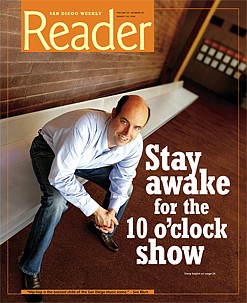
Meet Christopher Ashley, artistic director of the La Jolla Playhouse.
Stay awake for the ten o'clock show
“Theater matters because it’s the only place where one can find hope. Films are manufactured for us, but in the theater, the actors and the audience are getting together to manufacture a narrative, and to me, that’s where hope resides.”
— Moises Kaufman, playwright, 33 Variations, The Laramie Project, etc.
Kaufman’s friend Christopher Ashley, currently in the midst of his first season as artistic director of the La Jolla Playhouse, concurs. For both men, the folks in the seats are not merely a crowd of spectators; they’re participants. “For me,” says Ashley, “there is nothing like being in a live audience, with an actual person on stage, experiencing emotions in front of you. There’s a sort of tightrope thing that happens — everything is being made up in the moment, and anything could happen. There’s a communal experience that’s part church, part circus, and part book club.”
When 9/11 hit, Ashley was running a revival of The Rocky Horror Show on Broadway. “It’s totally ridiculous — a story about how transsexual aliens take over the world. As unpertinent to 9/11 as it’s possible to be.” Pertinent or not, it shut down just like the rest of New York City theater in the attack’s immediate aftermath. “But when we started up performances again a week later, the audience watched it with this electric, jubilant presence: ‘I’m out of the house, and no one has tried to attack me, and I’m together with people, and I’m celebrating being part of a community.’ Going to the theater that night was necessary and important, whether it was light entertainment or serious drama. People needed to be part of a community, together in a theater. When people watch a movie, they’re mostly in their own heads, immersed in the movie. I think people watch a play together…. You’re aware of yourself enjoying the show with other people.”
Of course, that’s coming from a self-diagnosed sufferer of “what Jean Cocteau called ‘the red and gold disease.’ ” By which Ashley means a theater addiction: a love for the red velvet curtain with gold braid. “I suffered from a very early age,” attests Ashley. “Acting as one of the workhouse boys in a production of Oliver! at the Cortland Repertory Theater in upstate New York, it seemed impossibly glamorous at age eight. The sense of community in an acting company was addictive, and staying up four hours past my regular bedtime seemed incredibly bohemian.”
Cortland gave way to Ann Arbor, and Ann Arbor led to Yale, and Yale led to Broadway, and Broadway, after 20-odd years, led to La Jolla. Ashley had wanted to come here ever since the mid-’90s, when artistic director Des McAnuff, the man who had revived the Playhouse in 1983, took what ended up being a five-year break from the position. Ashley applied (unsuccessfully) for the job; he was 30.
Even back then, he recalls, the Playhouse “had a reputation for an adventurous spirit.” He keeps a poster advertising the 1986 season on his office wall; among other shows, the season included a new translation of Sophocles’ Ajax, directed by Peter Sellars. The setting for the play was shifted to the present-day United States, and the final line about the inscrutability of the future was changed to a warning about the future’s ability to “wipe us out” if we aren’t careful. (And of course, in a nuclear era, there are no more godlike warriors, only diabolical weapons.) Also produced: the West Coast premiere of William Hauptman’s Gillette. Hauptman had won a Tony in 1985 after writing the book for Big River. In 2002, Bruce Weber panned a revival of the play in the New York Times:
“I wish I had seen it [in 1986]; perhaps I would now have a clue what Mr. Hauptman had in mind. But as it is, the script is so riddled with juvenilia, borrowed character types and misguided flights of poetic fancy that it feels like the work of a teenager who has seen too many B movies. Either that or Mr. Hauptman was intent on writing a straight play with the cartoon heart of a musical.”
Gillette may not have been entirely successful — or perhaps it merely failed to age well — but Weber’s last sentence does sound like evidence for that “adventurous spirit” Ashley admired. “Those playwrights and directors were such an exciting crowd to bring here. I use the poster to remember what’s become a kind of rule for myself: bring in the most exciting artists you can find, and make sure they can do their best work.”
Moises Kaufman was one of those artists. When Ashley learned in April of 2007 that his second attempt at landing the artistic directorship had proven successful, he was already committed to three directing jobs, including the Broadway musical version of Xanadu (a roller-disco story that had flopped at the box office in 1980, only to be reborn years later on stage in all its glittery glory). “I arrived in La Jolla, and I had about two months to program our first season. The first thing I did was sit down with the staff, and we wrote down on three-by-five cards every project we could think of that would be fun to do. We filled a wall. Then the question was, ‘How do we trim that to six subscription shows, two Edge shows, and a couple of Page-to-Stages?’ ”
Kaufman was an easy choice for Ashley. “Part of my application process was that the board wanted to know what artists I was interested in bringing in. That’s one of the great things about being a producer; I get to support other artists in a way I never could as a freelance director. I developed a list of about 150 writers, directors, designers, and actors, and Moises was right at the top. I’ve known him for 15 years; he’s one of the people I would invite in to dress rehearsals when I was directing to give me supportive feedback. I love his eye, and he’s kind and critical in a really good mix.”
And in 33 Variations, Kaufman had a play in development. That meant it had already debuted at Arena Stage in Washington, D.C., but might still need, as Ashley put it, “another stage to explore itself before it ended up in New York. I saw it in Washington and almost made a call at intermission to offer for him to come here. I was that excited.”
The play tells the story of Katherine Brandt, an ailing musicologist who becomes obsessed with Beethoven’s obsession with a “secondhand waltz” written by music publisher Anton Diabelli. Diabelli invites 50 composers to write a single variation on his waltz; Beethoven winds up writing the titular 33. The play skips back and forth in time, from Katherine to Beethoven and back again, allowing for the occasional chronological mash-up. As she struggles against time to unravel the mystery of Beethoven’s obsession, Katherine must also confront her disappointment with her own “secondhand waltz” — a daughter who is loving but worryingly unfocused, seemingly content to spend herself little by little on this thing and that.
Kaufman was happy to accept Ashley’s invitation. “There was a lot he wanted to work on,” recalls Ashley. “He’s a perfectionist; I think he’s had plays that have been four years in workshops. Here, he kept working right through the previews.”
“I wanted to increase the character of Beethoven,” says Kaufman. “And I wanted to deepen the relationship between the mother and the daughter.”
Ashley elucidates: “In Washington, Beethoven was a much more rudimentary character. He had a lot of stage time but almost no development. The present was where all the complete thinking had happened, and the past was kind of sketched in. Moises wanted to explore the questions of ‘Who is Beethoven? What’s he going through? How is his journey paralleling Katherine’s? How are the two story lines working toward colliding at the end?’ And he fleshed out the way the daughter was debilitated by her mother’s disapproval and how their relationship developed through time. This draft is very different than what he had in Washington.”
There are a number of reasons for that difference. Kaufman’s own questions came first, but those of others followed. “He’s very collaborative,” says Ashley. “Every single night, questions would come up in rehearsals, and he would go home and redraft and rethink.”
Says Kaufman, “I work very much on my feet, with the actors on their feet, improvising, making changes. I do listen to the actors. It was funny — I was directing a couple of episodes of The L Word for television, and I would go on-set and ask an actor, ‘What do you think your character wants at this moment? Why is she behaving this way?’ The actor’s eyes would open up — she was so grateful, really. ‘You really want me to tell you what I think?’ Most of the time, the director just says, ‘Stand over there and say your line,and then come over here and say this other line.’ In theater, you’re in the same room for many hours a day. Remember the scene in 33 Variations where Katherine comes over and sits down at the table and leans her head on Beethoven’s back? That scene doesn’t have a line of text — it was arrived at entirely through improvisation.” Kaufman is quick to acknowledge that there are some film directors who are interested in actors’ opinions, but still, the story plays to his notion of theater as the more communal milieu.
In this case, the communion was between playwright, director, and actor — and artistic director. “What shocked me about Ashley,” says Kaufman, “is that for someone who’s been at his job for so little time, he does it so well. He knows intuitively what the process needs: you want somebody supportive, but you don’t want someone in your rehearsal room every day, and you don’t want someone who gives you what you need and then doesn’t come around again until opening night. Chris would leave us alone for weeks at a time, but he always kept in touch with me. And after the first previews, he gave me some fantastic notes. There were moments in the beginning where I was letting the actors take some time, and he said, ‘You don’t need that. Your play resides in the next two scenes, not in those moments.’ And he was absolutely right. I think the job is a really good fit for him.”
Other changes, says Kaufman, got made because “I am interested in playwriting that uses every single element of the stage. I call it ‘writing performance’ instead of ‘writing text.’ You saw it in 33 Variations — the sets were used, the projections, the live pianist; everything was used to create a narrative.”
That’s true. I saw the play in the Playhouse’s 492-seat Mandell Weiss Theatre — a standard proscenium with a stage down front. (The facility’s other major space, the Mandell Weiss Forum, is designed as a thrust — one portion of the stage jutting out well in front of the rest.) Any number of moments from the La Jolla Playhouse production of 33 Variations might serve to illustrate Kaufman’s notion of creating narrative, but I’ll choose just one: Beethoven alone at center stage, staring wildly at nothing save perhaps the music in his head, gesturing with swoops and jerks of his hands and arms and fingers as he describes the motion of the music he is wringing out of the “secondhand waltz,” the same music that’s ringing out from the piano stage left, while behind him on the wall, the notes appear like black spatters of paint on a projected staff. (I’m a child of my age; I would call the effect frankly cinematic. I suspect Kaufman would prefer “theatrical.”)
After the play, as my wife and I wandered out through the lobby toward the evening dark, a woman draped in swaths of black fabric called out, “There will be a postshow outside in five minutes!” About six people gathered to see what was what. When the woman — La Jolla Playhouse teaching artist Sherri Allen — emerged to join us, she began running down a list of questions and making notes of our answers. An example:
“What did you think the play was about?”
Person A: “Finding the transcendent virtue in everyday things — Beethoven in the beer-hall waltz, and the mother and her daughter, who is content to be ordinary.”
Allen ran down the list, her pen twitching away over the clipboard. “Were there any particular scenes that will stay with you? Were there any points that weren’t clear? What did you think of the nudity? What was done particularly well?” Then she asked for general feedback.
Person B: “I thought the first act was very slow — it didn’t go from emotional beat to emotional beat. Instead, it went from intellectual point to intellectual point.”
And so on. Toward the end, Allen pulled back the curtain a bit: “The play, from the playwright’s point of view, is about obsession. Beethoven’s obsession with the waltz, and Katherine’s obsession with finding out why he was obsessed with it — it’s her life’s work. The daughter is the metaphor for the secondhand waltz. Katherine’s daughter does not meet her expectations because Katherine knows what she wants and is very driven. She’s devoted her whole life to one thing, and her daughter wants to try out different things.”
Person B: “But the mother is not obsessed with the daughter.”
Allen: “No, she’s obsessed with her own life’s work — she neglects her daughter.”
Person B: “How does one illuminate the other if she’s not obsessed with her daughter?”
Woman: “The daughter craves the mother’s approval. She feels she’s never met her mother’s expectations.”
Person A: “Beethoven is obsessed with the minor work. But Mom is not obsessed with the parallel minor work, which is the daughter. That’s why Person B is saying that the one doesn’t illuminate the other, because Beethoven is obsessed with the waltz, but Mom is obsessed with Beethoven.”
Person B: “If Mom was obsessed with making the daughter into what she wanted the daughter to be, maybe we would be able to make that emotional connection between the two more easily.”
Woman: “That’s interesting. No one I know of has made that observation. I’m sure that will be very fascinating to the dramaturge and to the playwright himself.”
“The audience feedback always got back to me,” says Kaufman. “Those were my questions. I put it all in my head. When you begin to hear over and over that something is fantastic, you know that that part is working really well. When you hear over and over that there is confusion around a character, you had better look at that character. It’s not that specific comments made a difference, but I read and studied everything. The whole ending of the play changed between the second and third preview in La Jolla. That was based on feedback from both the audience and the collaborators.” The audience joins in the creation of narrative; the art becomes the starting point for a kind of conversation.
That fits nicely with Ashley’s vision for his role at the Playhouse, and the Playhouse’s role in the community. “When you do freelance shows, you start over every six weeks — new actors, new audience. I was ready to stop dating and have a relationship with a theater, put down some roots with the audience. I wanted to talk with them, not just for two hours, but across the seasons. For an individual show that we do, we have about half single tickets and half subscription tickets. What’s great about a subscription audience is that they’re loyal to you, and you get to have a conversation with them over time.”
Subscribers bring stability, and stability brings with it a certain luxury of time and range. You don’t have to make every show a blockbuster; in fact, it’s probably better if you don’t. Getting back to that wall of index cards and how Ashley went about paring it down: “I try to make sure that no play is like the others in the season; along every axis you can think of, you make sure the plays oppose each other — that there’s small and large, funny and upsetting, musical and spoken, spectacle and just a person sitting in a room under a beam of light. There’s room for political plays that look outward and for plays that look inward and ask what it’s like being alive in a specific moment. We’re committed to being a safe harbor for unsafe work, and by that I mean that we’re always restlessly struggling for what’s new, either in form or content — taking the audience someplace unknown. Hopefully, that’s going to mean a big range as far as the kinds of experiences you have when you walk in the door.”
The season opened with 33 Variations — a small-scale, spoken-word drama. Then came the single-person show, Charlayne Woodard’s Night Watcher, which told the story of a woman and the 30 children living under her care. “Charlayne has had a long history with the Playhouse,” says Ashley. “This is her third show here.”
The Night Watcher served as this year’s Page-to-Stage performance. According to the Playhouse’s website, the program allows audiences to “experience the ‘birth’ of a play. Throughout the rehearsal and run of the show, the playwright and director make constant changes in response to audience reactions and feedback.” That’s the model for making the audience a member of the creative community, says Ashley. “I want to be doing more and more preshow discussions, along with the postshow. I don’t want audiences to just come and see what we’re doing; I want to talk to them about it. I want to invite the audience into the early stages of the play, to see the first reading, see the workshop of the third draft. That way, they get to see that a play is not just a final draft; it actually goes through this whole journey of self-discovery. Hopefully, the audience gets out of the ‘liked it/didn’t like it’ idea and starts saying, ‘Oh, wow, so that’s how those ideas developed over time. How that character pays off at the end is not a random choice; that’s a choice the artists have discovered and developed through the drafts.’ ”
Along the way, the theater gets to take the audience’s temperature. “One of the things that’s dangerous about being really heavily subscribed” — which, Ashley notes, the Playhouse isn’t — “is that you can start programming to keep your subscribers. The more adventurous a show gets, the more some people will like it and the more some people won’t.” The Playhouse has found a solution in the Edge Series — one play a year supported not by subscribers but by a grant from the James Irvine Foundation. “It’s not necessarily a play that we expect all of our subscribers to come to, but we think that for several thousand people, it will be their favorite thing all year. We’ll pick each show because it’s close to some edge, whether in form or content.” Last season’s inaugural production for the series was Most Wanted, a musical based on Andrew Cunanan, the San Diego native who killed five people, including designer Gianni Versace, in 1997. Says Ashley, “I think the audience was tender enough, scared enough about how we were going to present San Diego — it was fictionalized but clearly drawn from fact — that they were really glad for the chance to process it afterwards, to talk about their feelings.”
(Ashley is quick to point out that the existence of the Edge as a distinct series ought not to reflect badly on the Playhouse’s subscribers. “Did you see The Seven last season?” he asks. “It’s a hip-hop Greek tragedy — a thousand words a minute, with a really dense hipster vocabulary. And you had all these 60-year-old white audience members totally grooving along. They knew very little about that world before they walked in the door, but they approached it with such a generous spirit; I was really impressed.”)
Just now, the dial is turned to the musical-spectacle setting: Memphis, a musical about the roots of rock ’n’ roll directed by Ashley himself and with music composed by David Bryan, the keyboard player for Bon Jovi. In November, Xanadu will take up the musical mantle, only without the gravitas. But before that will come the upsetting revival: Erskine Caldwell’s Tobacco Road. “To me, it’s a 75-year-old play that feels supremely modern,” says Ashley. “It’s about need. You have these characters during the Depression on this farmed-out bit of land, and they can’t feed themselves. It’s such a time of need in this country — and worldwide — and as a friend of mine said, the play is perfect for right now. And it’s one of those things I love — a play that is both really dark and really funny.” And before that will come The Third Story, an original (and rather less naturalistic) work from Charles Busch that was commissioned by the Playhouse before Ashley arrived. “One of my goals for the Playhouse is to make it more actively a home for new work, and one of the ways to do that is to commission artists you’re excited about to create a play.”
Here, “home” means where the new work lives — where it’s born, grows up, and runs its course. And thanks to a recent multimillion-dollar expansion project, Ashley can put roofs over a lot of heads. “It was a real gift to have all the work of getting these buildings built before I got here. Now I get to play in them. We’ve gone from being a summer theater to producing 11 months of the year. One of my jobs here is to create events that use what this facility offers. The first one will probably be two years from now — a festival of new work that occurs simultaneously in all of the eight spaces and even connects over into the UCSD spaces. If you had eight shows going on here simultaneously, it would be one of the most exciting places in the country for theater.”
“Before the expansion,” he says, “there was only the Weiss Theatre and the Weiss Forum. We could produce only in these very inflexible, fixed-seat houses, which meant that we had to do plays that would appeal to a large audience.” (Apparently, there would be little aesthetic or social pleasure to be had in sitting with a scattered few fellow travelers in the grand emptiness of a major space — another way that attending a play differs from going to the movies.) “The amazing thing about the Sheila and Hughes Potiker Theater is that it can be anything you imagine.”
The Potiker is a big black box — pure potency. “We’re talking about a show for the ’09–’10 season where the audience walks through this maze of different walls.” But if you have something more conventional in mind, the Potiker can be that, too. “We did a show called Adding Machine here last season — it was in the round. We did The Seven here, and we bumped up one section into a sort of raised stage. All the seats can disappear, so you can do a show for 50 people or a show for 400. The whole space is trapped — there’s a parallel space below, so you can go down anywhere you want. And right behind the scrim is a big loading door; we’ve talked about opening it up for A Midsummer Night’s Dream.”
The Rao and Padma Makineni Play Development Center offers boxes as well, complete with lighting and sound system, if not seats and stages. “You can tape out the shape of any sort of stage you like and rehearse. It’s fantastic. We also do workshoppy productions here. Every year, we commission a show for grade-schoolers that goes out and tours area schools, and then it comes here for a week.” Other, smaller spaces feature windows looking out onto the sidewalk around the theater complex. “The architecture is striving to be as transparent as possible — open to the environment, a people’s theater. The rehearsals are all open, in general. When you come to see a show, you’ll hopefully be able to see everything that’s happening in all the other spaces, so that it feels like a great community of arts happenings.”
“If you’re going to be a major theater, you need a place to rehearse your shows,” concludes Ashley — and now he’s got that. But that’s not all you need. “Right now,” he explains, “a lot of the readings and workshops that we do for new plays, we do in New York. It’s amazing. It’s a third as expensive to rehearse and do a reading in New York as it is to do it here. You have to bring in a playwright and a director and actors and put them up. It’s part of the plan to actually own our own housing, so that we can have artists in residence. I definitely want to make that part of our conversation with the audience” — few of whom are likely to jaunt off to New York for a workshop.
Of course, another way to have artists in residence is to have artists who are residents, who come to San Diego because there’s enough going on that they can hope to make a living. “There’s a lot of theater energy in San Diego right now. Did you follow Seattle in the ’80s? It was a real hotbed of theater — a lot of shows started there and went on to make a big impact nationally. Actors started to move there, because it was an exciting place to be. I think San Diego is on the edge of having the critical mass to be a major, major arts community.”
The timing, he suspects, is ideal. “There are times when theater rides on its master storytellers, and there are times when there’s room for exciting new people. Sometimes TV and film raid theater, and certainly, AIDS decimated a whole generation of writers. But now there are new people. I was just at the Theater Communications Group conference, and there are a lot of new, young theaters with tiny budgets — places being run on a couple of people’s passion to put on a play. The work they’re doing tends to be based on new writers from within their own community, and as far as I could tell, the work is tending to be very adventurous. That’s a really good sign for the next ten years” — for theater in general, and for San Diego and the Playhouse in particular. Because along with the Weiss Theatre and the Forum, along with the Potiker and rehearsal spaces, grand and intimate, there is the Mandell Weiss Studio Theater: a 100-seat black box that will play host to Ashley’s final piece in the community puzzle: local theater companies.
“Part of the mandate for myself was that I wanted to have a local theater company in residence. We’re going to have a new company every year. We were looking for a company without a permanent home, one that was doing really interesting work and was ready for taking the next step vis-à-vis what we could give them” — a well-equipped home with a prestige address for two shows and exposure to a curious, adventurous audience.
“The day I got here, I started looking through the papers and the publicity to see what I should be seeing. I went from downtown San Diego to La Jolla, from basements to churches, seeing every company I could find. I was trying to jam as many people’s work into my memory as I could. That way, when we were looking at applications, I would have a framework: ‘Oh, I’ve seen them.’ ”
One of those companies was Mo’olelo, founded by Seema Sueko; Ashley attended the opening night of Cowboy versus Samurai, an Asian-American retelling of Cyrano de Bergerac. Explains Sueko, “Underneath the issue of the nose, it’s transferred to race, and some other issues come out around how the characters limit themselves based on identity. The main character, who is Korean, chooses to write letters for his friend, who is Caucasian, because he thinks this Korean-American woman likes only white guys.”
The treatment of identity made the play of a piece with the rest of Mo’olelo’s productions, works like remains, which explores the Israeli-Palestinian conflict; A Piece of My Heart, which focuses on women who served in Vietnam; and Since Africa, which tells the story of a Lost Boy of Sudan and his efforts at resettlement in America. “There are two volunteers helping him, a Caucasian Chicago socialite and the deacon at a black Catholic church. They live in different Americas — which one does he get settled into, and how does his identity factor into that?”
Sueko first heard about Ashley’s resident-company plan through press interviews. She heard about it again at the reception given Ashley at the W Hotel when he arrived in town. When the program was officially announced in January, she was ready, and Ashley was impressed. “I think we had ten theaters apply for the first year, and they were really strong applications. All ten basically made the case for why they were ready for attention and how they would use our resources to create exciting theater. Mo’olelo made a great case, but honestly, if no new companies applied, I could do the next eight years with what I’ve already got.”
Like Kaufman, the choice of Mo’olelo seems an easy one, especially in light of Ashley’s vision of involving the community — it’s integral to every show Mo’olelo puts on. Consider Night Sky, the first show they’ll be putting on at the Playhouse. Says Sueko, “Kristen Brandt, the former artistic director at the Sledgehammer Theatre, mailed me the script in November of 2006.” (In this and other respects, the production fairly drips with locality — starting with the idea of doing it in the first place.) “She said, ‘This looks like something that might fit for Mo’olelo.’ It focuses on aphasia, a type of brain injury. It’s about an astronomy professor who is rendered aphasic after suffering a concussion. A big part of what we do is community outreach in conjunction with each play, and she was saying, ‘Maybe there is outreach work you can do at stroke centers and things like that.’ ”
Then, in February of ’07, “One of our audience members came up after a performance and said, ‘Have you ever considered a play that deals with brain injury? I used to be the executive director of the Brain Injury Foundation here in San Diego — there’s a large community. The stories around brain injury are heroic and epic and funny — really great stories.’ ” (Another local impetus.) Sueko gave him the script; he shared it with the Foundation. “They liked it; they thought it really captured what aphasia was about.” (Local involvement at the level of content.)
Finally, in May of ’07, the Mo’olelo board met to discuss its 2008 projects. From the company’s blog: “In a unique moment of art imitating life, or rather life guiding art, Joe Hiel, husband of board member Elaine Hiel, who had been patiently reading the paper…perked up. He pulled out the San Diego Union-Tribune, which featured a front-page article about soldiers returning from Iraq with brain injury. Joe, whose stroke in 1981 rendered him aphasic, pointed to the news article, referenced the play, and said, ‘This is me.’ The decision was made.”
Since then, says Sueko, “We’ve been reaching out to the brain-injured community. It isn’t just ‘Hey, buy a ticket to see a show about people like you!’ It’s to encourage the community to be a partner, to take ownership of the project. And it’s because we need the community to even do it. I’m going to play the character with aphasia, but I knew nothing about it, so I needed dramaturgical support from the brain-injured community.” Sueko attended speech-therapy classes for the aphasic — her character’s inability to express herself is a key theme. She spent time with the aphasic and those who care for the aphasic, learning about their troubles and how they deal with them, getting a sense for them as people. From the Mo’olelo blog: “Don Strom survived a brain aneurysm in 1992 that rendered him aphasic.” He and his wife Jane “navigated through the journey of brain injury recovery and aphasia…a journey which changed them both but which they did together. They are a model for how a couple can face a crisis and not only survive but grow…Thanks to Jane and Don, I’m starting to crystallize some ideas about Anna,” the play’s protagonist. (Local involvement in the play’s artistic development.)
(Clearly, it isn’t just “Hey, buy a ticket,” but Sueko is happy to grant that community outreach is a crucial part of her marketing plan. “We spend a majority of our time fundraising and writing donation letters; our ticket revenues cover only about 30 percent of the cost of each show, and we offer free tickets to community groups based on need. But we can go out into the community and establish relationships with key people who can help spread the word. When we did Since Africa, we sold out before it even opened, and one of the reasons was community outreach. We had the Sudanese Refugee Network, the International Rescue Committee, the National Conflict Resolution Center. And our leading actor was a Lost Boy of Sudan and had written a book. Whenever he went to a speaking engagement, he would mention the show.”)
Sueko is unabashed about Mo’olelo’s social-issue overtones. “With the returning Iraq War vets who have suffered traumatic brain injuries, I think it’s crucial for the San Diego community to become more aware about these things — how do we support brain-injury survivors of all kinds? I don’t see theater as being this exclusive thing that lives out on the side of things. I think theater is most effective when it is central to the civic dialogue. I spent a lot of time in the Middle East, and I was speaking with an Israeli playwright there — this was during my formative years in college. He said that theater should be the temples, the mosques, the synagogues, the churches of our lifetime, where people can really grapple with issues. Theater should be a place where people come and have dialogue and leave having heard something — a perspective that maybe they have not heard before. But they should also leave feeling reflected on stage. The hallmark of Mo’olelo is specifically that: making a show that has multiple perspectives and using it to create community dialogue. Bringing in communities who would not typically sit in the same room together, fostering bridges. There can be work done beyond the show.”
Night Sky, to some extent, seems to be about giving voice to those who might be literally voiceless. Past Mo’olelo shows, however, give a clearer picture of the kind of dialogue Sueko mentioned — dialogue between groups “who would not typically sit in the same room.” “We cannot live in a world which sees people as just labels,” says Sueko. “Well, we can, but it’s ultimately dangerous and unproductive. When I was writing remains, I workshopped it with both the local Jewish community and the local Palestinians, and I talked with some Christian Arab communities. When we did A Piece of My Heart, we partnered with the Veterans’ Museum and used their venue for the play. After doing remains, our database was all social activists. We wanted to have a dialogue about Vietnam and about the current conflict. After the play, we had conversations that really broke down bridges. We had social activists talking with the daughter of a Vietnam veteran. They didn’t see each other as opposites but as humans. They might seem like small things, but for the individuals, they are huge.”
That kind of social commitment helps explain why Mo’olelo performed just one show a year until 2007, when it scaled up to two. Sueko came to San Diego in 2003 as an Equity actor, only to find that few directors in San Diego would hire her unless she gave up her Equity card. “If you give it up, you’re cheaper, and you don’t get health insurance and that sort of thing. I talked with other Equity actors who were experiencing the same thing, and I thought, ‘I can sit around and bitch and moan about it, or I can create a small theater company that says: we will pay union wages to local actors. It’s a line item on the budget, a big one, but one we’ll never cut.’ ” And that kind of commitment helps make San Diego a more attractive destination for would-be actors — bringing Ashley’s vision of San Diego as a major theater city one step closer to fruition.
In Sueko’s eyes, it’s practically synergy. “The Playhouse is demonstrating that you can be a major, national force on the theater scene, a theater that artists from all over the world are dying to work at, and at the same time, you can nourish the community in which you live. I think the theater residency demonstrates that.” And she agrees with Ashley that the artistic spirit is fomenting in town. “In the past five, six, seven years, there have been a number of small companies like Mo’olelo that have been able to launch and survive. That speaks volumes.”
The pieces are in place; now it’s just a matter of making it all happen and keeping things exciting and varied. “It’s an ongoing task for every theater in America,” says Ashley. “How do you keep on broadening?” One way is to engage the community — or communities: playwrights, audiences, actors, other companies. Another way is to expand the notion of what theater is. The Playhouse expansion included a restaurant, and Ashley is happy that it will offer space for a cabaret. “It’s going to be exciting, programming the cabaret, having music as part of the experience. The real question I have is this: people keep telling me that everyone in San Diego goes home by ten. That late-night San Diego is not so much a thing. Are we going to be able to keep an audience awake for a ten o’clock show? That will be interesting.”
Here's something you might be interested in.
Meet Christopher Ashley, artistic director of the La Jolla Playhouse.
Stay awake for the ten o'clock show

Meet Christopher Ashley, artistic director of the La Jolla Playhouse.
Stay awake for the ten o'clock show
“Theater matters because it’s the only place where one can find hope. Films are manufactured for us, but in the theater, the actors and the audience are getting together to manufacture a narrative, and to me, that’s where hope resides.”
— Moises Kaufman, playwright, 33 Variations, The Laramie Project, etc.
Kaufman’s friend Christopher Ashley, currently in the midst of his first season as artistic director of the La Jolla Playhouse, concurs. For both men, the folks in the seats are not merely a crowd of spectators; they’re participants. “For me,” says Ashley, “there is nothing like being in a live audience, with an actual person on stage, experiencing emotions in front of you. There’s a sort of tightrope thing that happens — everything is being made up in the moment, and anything could happen. There’s a communal experience that’s part church, part circus, and part book club.”
When 9/11 hit, Ashley was running a revival of The Rocky Horror Show on Broadway. “It’s totally ridiculous — a story about how transsexual aliens take over the world. As unpertinent to 9/11 as it’s possible to be.” Pertinent or not, it shut down just like the rest of New York City theater in the attack’s immediate aftermath. “But when we started up performances again a week later, the audience watched it with this electric, jubilant presence: ‘I’m out of the house, and no one has tried to attack me, and I’m together with people, and I’m celebrating being part of a community.’ Going to the theater that night was necessary and important, whether it was light entertainment or serious drama. People needed to be part of a community, together in a theater. When people watch a movie, they’re mostly in their own heads, immersed in the movie. I think people watch a play together…. You’re aware of yourself enjoying the show with other people.”
Of course, that’s coming from a self-diagnosed sufferer of “what Jean Cocteau called ‘the red and gold disease.’ ” By which Ashley means a theater addiction: a love for the red velvet curtain with gold braid. “I suffered from a very early age,” attests Ashley. “Acting as one of the workhouse boys in a production of Oliver! at the Cortland Repertory Theater in upstate New York, it seemed impossibly glamorous at age eight. The sense of community in an acting company was addictive, and staying up four hours past my regular bedtime seemed incredibly bohemian.”
Cortland gave way to Ann Arbor, and Ann Arbor led to Yale, and Yale led to Broadway, and Broadway, after 20-odd years, led to La Jolla. Ashley had wanted to come here ever since the mid-’90s, when artistic director Des McAnuff, the man who had revived the Playhouse in 1983, took what ended up being a five-year break from the position. Ashley applied (unsuccessfully) for the job; he was 30.
Even back then, he recalls, the Playhouse “had a reputation for an adventurous spirit.” He keeps a poster advertising the 1986 season on his office wall; among other shows, the season included a new translation of Sophocles’ Ajax, directed by Peter Sellars. The setting for the play was shifted to the present-day United States, and the final line about the inscrutability of the future was changed to a warning about the future’s ability to “wipe us out” if we aren’t careful. (And of course, in a nuclear era, there are no more godlike warriors, only diabolical weapons.) Also produced: the West Coast premiere of William Hauptman’s Gillette. Hauptman had won a Tony in 1985 after writing the book for Big River. In 2002, Bruce Weber panned a revival of the play in the New York Times:
“I wish I had seen it [in 1986]; perhaps I would now have a clue what Mr. Hauptman had in mind. But as it is, the script is so riddled with juvenilia, borrowed character types and misguided flights of poetic fancy that it feels like the work of a teenager who has seen too many B movies. Either that or Mr. Hauptman was intent on writing a straight play with the cartoon heart of a musical.”
Gillette may not have been entirely successful — or perhaps it merely failed to age well — but Weber’s last sentence does sound like evidence for that “adventurous spirit” Ashley admired. “Those playwrights and directors were such an exciting crowd to bring here. I use the poster to remember what’s become a kind of rule for myself: bring in the most exciting artists you can find, and make sure they can do their best work.”
Moises Kaufman was one of those artists. When Ashley learned in April of 2007 that his second attempt at landing the artistic directorship had proven successful, he was already committed to three directing jobs, including the Broadway musical version of Xanadu (a roller-disco story that had flopped at the box office in 1980, only to be reborn years later on stage in all its glittery glory). “I arrived in La Jolla, and I had about two months to program our first season. The first thing I did was sit down with the staff, and we wrote down on three-by-five cards every project we could think of that would be fun to do. We filled a wall. Then the question was, ‘How do we trim that to six subscription shows, two Edge shows, and a couple of Page-to-Stages?’ ”
Kaufman was an easy choice for Ashley. “Part of my application process was that the board wanted to know what artists I was interested in bringing in. That’s one of the great things about being a producer; I get to support other artists in a way I never could as a freelance director. I developed a list of about 150 writers, directors, designers, and actors, and Moises was right at the top. I’ve known him for 15 years; he’s one of the people I would invite in to dress rehearsals when I was directing to give me supportive feedback. I love his eye, and he’s kind and critical in a really good mix.”
And in 33 Variations, Kaufman had a play in development. That meant it had already debuted at Arena Stage in Washington, D.C., but might still need, as Ashley put it, “another stage to explore itself before it ended up in New York. I saw it in Washington and almost made a call at intermission to offer for him to come here. I was that excited.”
The play tells the story of Katherine Brandt, an ailing musicologist who becomes obsessed with Beethoven’s obsession with a “secondhand waltz” written by music publisher Anton Diabelli. Diabelli invites 50 composers to write a single variation on his waltz; Beethoven winds up writing the titular 33. The play skips back and forth in time, from Katherine to Beethoven and back again, allowing for the occasional chronological mash-up. As she struggles against time to unravel the mystery of Beethoven’s obsession, Katherine must also confront her disappointment with her own “secondhand waltz” — a daughter who is loving but worryingly unfocused, seemingly content to spend herself little by little on this thing and that.
Kaufman was happy to accept Ashley’s invitation. “There was a lot he wanted to work on,” recalls Ashley. “He’s a perfectionist; I think he’s had plays that have been four years in workshops. Here, he kept working right through the previews.”
“I wanted to increase the character of Beethoven,” says Kaufman. “And I wanted to deepen the relationship between the mother and the daughter.”
Ashley elucidates: “In Washington, Beethoven was a much more rudimentary character. He had a lot of stage time but almost no development. The present was where all the complete thinking had happened, and the past was kind of sketched in. Moises wanted to explore the questions of ‘Who is Beethoven? What’s he going through? How is his journey paralleling Katherine’s? How are the two story lines working toward colliding at the end?’ And he fleshed out the way the daughter was debilitated by her mother’s disapproval and how their relationship developed through time. This draft is very different than what he had in Washington.”
There are a number of reasons for that difference. Kaufman’s own questions came first, but those of others followed. “He’s very collaborative,” says Ashley. “Every single night, questions would come up in rehearsals, and he would go home and redraft and rethink.”
Says Kaufman, “I work very much on my feet, with the actors on their feet, improvising, making changes. I do listen to the actors. It was funny — I was directing a couple of episodes of The L Word for television, and I would go on-set and ask an actor, ‘What do you think your character wants at this moment? Why is she behaving this way?’ The actor’s eyes would open up — she was so grateful, really. ‘You really want me to tell you what I think?’ Most of the time, the director just says, ‘Stand over there and say your line,and then come over here and say this other line.’ In theater, you’re in the same room for many hours a day. Remember the scene in 33 Variations where Katherine comes over and sits down at the table and leans her head on Beethoven’s back? That scene doesn’t have a line of text — it was arrived at entirely through improvisation.” Kaufman is quick to acknowledge that there are some film directors who are interested in actors’ opinions, but still, the story plays to his notion of theater as the more communal milieu.
In this case, the communion was between playwright, director, and actor — and artistic director. “What shocked me about Ashley,” says Kaufman, “is that for someone who’s been at his job for so little time, he does it so well. He knows intuitively what the process needs: you want somebody supportive, but you don’t want someone in your rehearsal room every day, and you don’t want someone who gives you what you need and then doesn’t come around again until opening night. Chris would leave us alone for weeks at a time, but he always kept in touch with me. And after the first previews, he gave me some fantastic notes. There were moments in the beginning where I was letting the actors take some time, and he said, ‘You don’t need that. Your play resides in the next two scenes, not in those moments.’ And he was absolutely right. I think the job is a really good fit for him.”
Other changes, says Kaufman, got made because “I am interested in playwriting that uses every single element of the stage. I call it ‘writing performance’ instead of ‘writing text.’ You saw it in 33 Variations — the sets were used, the projections, the live pianist; everything was used to create a narrative.”
That’s true. I saw the play in the Playhouse’s 492-seat Mandell Weiss Theatre — a standard proscenium with a stage down front. (The facility’s other major space, the Mandell Weiss Forum, is designed as a thrust — one portion of the stage jutting out well in front of the rest.) Any number of moments from the La Jolla Playhouse production of 33 Variations might serve to illustrate Kaufman’s notion of creating narrative, but I’ll choose just one: Beethoven alone at center stage, staring wildly at nothing save perhaps the music in his head, gesturing with swoops and jerks of his hands and arms and fingers as he describes the motion of the music he is wringing out of the “secondhand waltz,” the same music that’s ringing out from the piano stage left, while behind him on the wall, the notes appear like black spatters of paint on a projected staff. (I’m a child of my age; I would call the effect frankly cinematic. I suspect Kaufman would prefer “theatrical.”)
After the play, as my wife and I wandered out through the lobby toward the evening dark, a woman draped in swaths of black fabric called out, “There will be a postshow outside in five minutes!” About six people gathered to see what was what. When the woman — La Jolla Playhouse teaching artist Sherri Allen — emerged to join us, she began running down a list of questions and making notes of our answers. An example:
“What did you think the play was about?”
Person A: “Finding the transcendent virtue in everyday things — Beethoven in the beer-hall waltz, and the mother and her daughter, who is content to be ordinary.”
Allen ran down the list, her pen twitching away over the clipboard. “Were there any particular scenes that will stay with you? Were there any points that weren’t clear? What did you think of the nudity? What was done particularly well?” Then she asked for general feedback.
Person B: “I thought the first act was very slow — it didn’t go from emotional beat to emotional beat. Instead, it went from intellectual point to intellectual point.”
And so on. Toward the end, Allen pulled back the curtain a bit: “The play, from the playwright’s point of view, is about obsession. Beethoven’s obsession with the waltz, and Katherine’s obsession with finding out why he was obsessed with it — it’s her life’s work. The daughter is the metaphor for the secondhand waltz. Katherine’s daughter does not meet her expectations because Katherine knows what she wants and is very driven. She’s devoted her whole life to one thing, and her daughter wants to try out different things.”
Person B: “But the mother is not obsessed with the daughter.”
Allen: “No, she’s obsessed with her own life’s work — she neglects her daughter.”
Person B: “How does one illuminate the other if she’s not obsessed with her daughter?”
Woman: “The daughter craves the mother’s approval. She feels she’s never met her mother’s expectations.”
Person A: “Beethoven is obsessed with the minor work. But Mom is not obsessed with the parallel minor work, which is the daughter. That’s why Person B is saying that the one doesn’t illuminate the other, because Beethoven is obsessed with the waltz, but Mom is obsessed with Beethoven.”
Person B: “If Mom was obsessed with making the daughter into what she wanted the daughter to be, maybe we would be able to make that emotional connection between the two more easily.”
Woman: “That’s interesting. No one I know of has made that observation. I’m sure that will be very fascinating to the dramaturge and to the playwright himself.”
“The audience feedback always got back to me,” says Kaufman. “Those were my questions. I put it all in my head. When you begin to hear over and over that something is fantastic, you know that that part is working really well. When you hear over and over that there is confusion around a character, you had better look at that character. It’s not that specific comments made a difference, but I read and studied everything. The whole ending of the play changed between the second and third preview in La Jolla. That was based on feedback from both the audience and the collaborators.” The audience joins in the creation of narrative; the art becomes the starting point for a kind of conversation.
That fits nicely with Ashley’s vision for his role at the Playhouse, and the Playhouse’s role in the community. “When you do freelance shows, you start over every six weeks — new actors, new audience. I was ready to stop dating and have a relationship with a theater, put down some roots with the audience. I wanted to talk with them, not just for two hours, but across the seasons. For an individual show that we do, we have about half single tickets and half subscription tickets. What’s great about a subscription audience is that they’re loyal to you, and you get to have a conversation with them over time.”
Subscribers bring stability, and stability brings with it a certain luxury of time and range. You don’t have to make every show a blockbuster; in fact, it’s probably better if you don’t. Getting back to that wall of index cards and how Ashley went about paring it down: “I try to make sure that no play is like the others in the season; along every axis you can think of, you make sure the plays oppose each other — that there’s small and large, funny and upsetting, musical and spoken, spectacle and just a person sitting in a room under a beam of light. There’s room for political plays that look outward and for plays that look inward and ask what it’s like being alive in a specific moment. We’re committed to being a safe harbor for unsafe work, and by that I mean that we’re always restlessly struggling for what’s new, either in form or content — taking the audience someplace unknown. Hopefully, that’s going to mean a big range as far as the kinds of experiences you have when you walk in the door.”
The season opened with 33 Variations — a small-scale, spoken-word drama. Then came the single-person show, Charlayne Woodard’s Night Watcher, which told the story of a woman and the 30 children living under her care. “Charlayne has had a long history with the Playhouse,” says Ashley. “This is her third show here.”
The Night Watcher served as this year’s Page-to-Stage performance. According to the Playhouse’s website, the program allows audiences to “experience the ‘birth’ of a play. Throughout the rehearsal and run of the show, the playwright and director make constant changes in response to audience reactions and feedback.” That’s the model for making the audience a member of the creative community, says Ashley. “I want to be doing more and more preshow discussions, along with the postshow. I don’t want audiences to just come and see what we’re doing; I want to talk to them about it. I want to invite the audience into the early stages of the play, to see the first reading, see the workshop of the third draft. That way, they get to see that a play is not just a final draft; it actually goes through this whole journey of self-discovery. Hopefully, the audience gets out of the ‘liked it/didn’t like it’ idea and starts saying, ‘Oh, wow, so that’s how those ideas developed over time. How that character pays off at the end is not a random choice; that’s a choice the artists have discovered and developed through the drafts.’ ”
Along the way, the theater gets to take the audience’s temperature. “One of the things that’s dangerous about being really heavily subscribed” — which, Ashley notes, the Playhouse isn’t — “is that you can start programming to keep your subscribers. The more adventurous a show gets, the more some people will like it and the more some people won’t.” The Playhouse has found a solution in the Edge Series — one play a year supported not by subscribers but by a grant from the James Irvine Foundation. “It’s not necessarily a play that we expect all of our subscribers to come to, but we think that for several thousand people, it will be their favorite thing all year. We’ll pick each show because it’s close to some edge, whether in form or content.” Last season’s inaugural production for the series was Most Wanted, a musical based on Andrew Cunanan, the San Diego native who killed five people, including designer Gianni Versace, in 1997. Says Ashley, “I think the audience was tender enough, scared enough about how we were going to present San Diego — it was fictionalized but clearly drawn from fact — that they were really glad for the chance to process it afterwards, to talk about their feelings.”
(Ashley is quick to point out that the existence of the Edge as a distinct series ought not to reflect badly on the Playhouse’s subscribers. “Did you see The Seven last season?” he asks. “It’s a hip-hop Greek tragedy — a thousand words a minute, with a really dense hipster vocabulary. And you had all these 60-year-old white audience members totally grooving along. They knew very little about that world before they walked in the door, but they approached it with such a generous spirit; I was really impressed.”)
Just now, the dial is turned to the musical-spectacle setting: Memphis, a musical about the roots of rock ’n’ roll directed by Ashley himself and with music composed by David Bryan, the keyboard player for Bon Jovi. In November, Xanadu will take up the musical mantle, only without the gravitas. But before that will come the upsetting revival: Erskine Caldwell’s Tobacco Road. “To me, it’s a 75-year-old play that feels supremely modern,” says Ashley. “It’s about need. You have these characters during the Depression on this farmed-out bit of land, and they can’t feed themselves. It’s such a time of need in this country — and worldwide — and as a friend of mine said, the play is perfect for right now. And it’s one of those things I love — a play that is both really dark and really funny.” And before that will come The Third Story, an original (and rather less naturalistic) work from Charles Busch that was commissioned by the Playhouse before Ashley arrived. “One of my goals for the Playhouse is to make it more actively a home for new work, and one of the ways to do that is to commission artists you’re excited about to create a play.”
Here, “home” means where the new work lives — where it’s born, grows up, and runs its course. And thanks to a recent multimillion-dollar expansion project, Ashley can put roofs over a lot of heads. “It was a real gift to have all the work of getting these buildings built before I got here. Now I get to play in them. We’ve gone from being a summer theater to producing 11 months of the year. One of my jobs here is to create events that use what this facility offers. The first one will probably be two years from now — a festival of new work that occurs simultaneously in all of the eight spaces and even connects over into the UCSD spaces. If you had eight shows going on here simultaneously, it would be one of the most exciting places in the country for theater.”
“Before the expansion,” he says, “there was only the Weiss Theatre and the Weiss Forum. We could produce only in these very inflexible, fixed-seat houses, which meant that we had to do plays that would appeal to a large audience.” (Apparently, there would be little aesthetic or social pleasure to be had in sitting with a scattered few fellow travelers in the grand emptiness of a major space — another way that attending a play differs from going to the movies.) “The amazing thing about the Sheila and Hughes Potiker Theater is that it can be anything you imagine.”
The Potiker is a big black box — pure potency. “We’re talking about a show for the ’09–’10 season where the audience walks through this maze of different walls.” But if you have something more conventional in mind, the Potiker can be that, too. “We did a show called Adding Machine here last season — it was in the round. We did The Seven here, and we bumped up one section into a sort of raised stage. All the seats can disappear, so you can do a show for 50 people or a show for 400. The whole space is trapped — there’s a parallel space below, so you can go down anywhere you want. And right behind the scrim is a big loading door; we’ve talked about opening it up for A Midsummer Night’s Dream.”
The Rao and Padma Makineni Play Development Center offers boxes as well, complete with lighting and sound system, if not seats and stages. “You can tape out the shape of any sort of stage you like and rehearse. It’s fantastic. We also do workshoppy productions here. Every year, we commission a show for grade-schoolers that goes out and tours area schools, and then it comes here for a week.” Other, smaller spaces feature windows looking out onto the sidewalk around the theater complex. “The architecture is striving to be as transparent as possible — open to the environment, a people’s theater. The rehearsals are all open, in general. When you come to see a show, you’ll hopefully be able to see everything that’s happening in all the other spaces, so that it feels like a great community of arts happenings.”
“If you’re going to be a major theater, you need a place to rehearse your shows,” concludes Ashley — and now he’s got that. But that’s not all you need. “Right now,” he explains, “a lot of the readings and workshops that we do for new plays, we do in New York. It’s amazing. It’s a third as expensive to rehearse and do a reading in New York as it is to do it here. You have to bring in a playwright and a director and actors and put them up. It’s part of the plan to actually own our own housing, so that we can have artists in residence. I definitely want to make that part of our conversation with the audience” — few of whom are likely to jaunt off to New York for a workshop.
Of course, another way to have artists in residence is to have artists who are residents, who come to San Diego because there’s enough going on that they can hope to make a living. “There’s a lot of theater energy in San Diego right now. Did you follow Seattle in the ’80s? It was a real hotbed of theater — a lot of shows started there and went on to make a big impact nationally. Actors started to move there, because it was an exciting place to be. I think San Diego is on the edge of having the critical mass to be a major, major arts community.”
The timing, he suspects, is ideal. “There are times when theater rides on its master storytellers, and there are times when there’s room for exciting new people. Sometimes TV and film raid theater, and certainly, AIDS decimated a whole generation of writers. But now there are new people. I was just at the Theater Communications Group conference, and there are a lot of new, young theaters with tiny budgets — places being run on a couple of people’s passion to put on a play. The work they’re doing tends to be based on new writers from within their own community, and as far as I could tell, the work is tending to be very adventurous. That’s a really good sign for the next ten years” — for theater in general, and for San Diego and the Playhouse in particular. Because along with the Weiss Theatre and the Forum, along with the Potiker and rehearsal spaces, grand and intimate, there is the Mandell Weiss Studio Theater: a 100-seat black box that will play host to Ashley’s final piece in the community puzzle: local theater companies.
“Part of the mandate for myself was that I wanted to have a local theater company in residence. We’re going to have a new company every year. We were looking for a company without a permanent home, one that was doing really interesting work and was ready for taking the next step vis-à-vis what we could give them” — a well-equipped home with a prestige address for two shows and exposure to a curious, adventurous audience.
“The day I got here, I started looking through the papers and the publicity to see what I should be seeing. I went from downtown San Diego to La Jolla, from basements to churches, seeing every company I could find. I was trying to jam as many people’s work into my memory as I could. That way, when we were looking at applications, I would have a framework: ‘Oh, I’ve seen them.’ ”
One of those companies was Mo’olelo, founded by Seema Sueko; Ashley attended the opening night of Cowboy versus Samurai, an Asian-American retelling of Cyrano de Bergerac. Explains Sueko, “Underneath the issue of the nose, it’s transferred to race, and some other issues come out around how the characters limit themselves based on identity. The main character, who is Korean, chooses to write letters for his friend, who is Caucasian, because he thinks this Korean-American woman likes only white guys.”
The treatment of identity made the play of a piece with the rest of Mo’olelo’s productions, works like remains, which explores the Israeli-Palestinian conflict; A Piece of My Heart, which focuses on women who served in Vietnam; and Since Africa, which tells the story of a Lost Boy of Sudan and his efforts at resettlement in America. “There are two volunteers helping him, a Caucasian Chicago socialite and the deacon at a black Catholic church. They live in different Americas — which one does he get settled into, and how does his identity factor into that?”
Sueko first heard about Ashley’s resident-company plan through press interviews. She heard about it again at the reception given Ashley at the W Hotel when he arrived in town. When the program was officially announced in January, she was ready, and Ashley was impressed. “I think we had ten theaters apply for the first year, and they were really strong applications. All ten basically made the case for why they were ready for attention and how they would use our resources to create exciting theater. Mo’olelo made a great case, but honestly, if no new companies applied, I could do the next eight years with what I’ve already got.”
Like Kaufman, the choice of Mo’olelo seems an easy one, especially in light of Ashley’s vision of involving the community — it’s integral to every show Mo’olelo puts on. Consider Night Sky, the first show they’ll be putting on at the Playhouse. Says Sueko, “Kristen Brandt, the former artistic director at the Sledgehammer Theatre, mailed me the script in November of 2006.” (In this and other respects, the production fairly drips with locality — starting with the idea of doing it in the first place.) “She said, ‘This looks like something that might fit for Mo’olelo.’ It focuses on aphasia, a type of brain injury. It’s about an astronomy professor who is rendered aphasic after suffering a concussion. A big part of what we do is community outreach in conjunction with each play, and she was saying, ‘Maybe there is outreach work you can do at stroke centers and things like that.’ ”
Then, in February of ’07, “One of our audience members came up after a performance and said, ‘Have you ever considered a play that deals with brain injury? I used to be the executive director of the Brain Injury Foundation here in San Diego — there’s a large community. The stories around brain injury are heroic and epic and funny — really great stories.’ ” (Another local impetus.) Sueko gave him the script; he shared it with the Foundation. “They liked it; they thought it really captured what aphasia was about.” (Local involvement at the level of content.)
Finally, in May of ’07, the Mo’olelo board met to discuss its 2008 projects. From the company’s blog: “In a unique moment of art imitating life, or rather life guiding art, Joe Hiel, husband of board member Elaine Hiel, who had been patiently reading the paper…perked up. He pulled out the San Diego Union-Tribune, which featured a front-page article about soldiers returning from Iraq with brain injury. Joe, whose stroke in 1981 rendered him aphasic, pointed to the news article, referenced the play, and said, ‘This is me.’ The decision was made.”
Since then, says Sueko, “We’ve been reaching out to the brain-injured community. It isn’t just ‘Hey, buy a ticket to see a show about people like you!’ It’s to encourage the community to be a partner, to take ownership of the project. And it’s because we need the community to even do it. I’m going to play the character with aphasia, but I knew nothing about it, so I needed dramaturgical support from the brain-injured community.” Sueko attended speech-therapy classes for the aphasic — her character’s inability to express herself is a key theme. She spent time with the aphasic and those who care for the aphasic, learning about their troubles and how they deal with them, getting a sense for them as people. From the Mo’olelo blog: “Don Strom survived a brain aneurysm in 1992 that rendered him aphasic.” He and his wife Jane “navigated through the journey of brain injury recovery and aphasia…a journey which changed them both but which they did together. They are a model for how a couple can face a crisis and not only survive but grow…Thanks to Jane and Don, I’m starting to crystallize some ideas about Anna,” the play’s protagonist. (Local involvement in the play’s artistic development.)
(Clearly, it isn’t just “Hey, buy a ticket,” but Sueko is happy to grant that community outreach is a crucial part of her marketing plan. “We spend a majority of our time fundraising and writing donation letters; our ticket revenues cover only about 30 percent of the cost of each show, and we offer free tickets to community groups based on need. But we can go out into the community and establish relationships with key people who can help spread the word. When we did Since Africa, we sold out before it even opened, and one of the reasons was community outreach. We had the Sudanese Refugee Network, the International Rescue Committee, the National Conflict Resolution Center. And our leading actor was a Lost Boy of Sudan and had written a book. Whenever he went to a speaking engagement, he would mention the show.”)
Sueko is unabashed about Mo’olelo’s social-issue overtones. “With the returning Iraq War vets who have suffered traumatic brain injuries, I think it’s crucial for the San Diego community to become more aware about these things — how do we support brain-injury survivors of all kinds? I don’t see theater as being this exclusive thing that lives out on the side of things. I think theater is most effective when it is central to the civic dialogue. I spent a lot of time in the Middle East, and I was speaking with an Israeli playwright there — this was during my formative years in college. He said that theater should be the temples, the mosques, the synagogues, the churches of our lifetime, where people can really grapple with issues. Theater should be a place where people come and have dialogue and leave having heard something — a perspective that maybe they have not heard before. But they should also leave feeling reflected on stage. The hallmark of Mo’olelo is specifically that: making a show that has multiple perspectives and using it to create community dialogue. Bringing in communities who would not typically sit in the same room together, fostering bridges. There can be work done beyond the show.”
Night Sky, to some extent, seems to be about giving voice to those who might be literally voiceless. Past Mo’olelo shows, however, give a clearer picture of the kind of dialogue Sueko mentioned — dialogue between groups “who would not typically sit in the same room.” “We cannot live in a world which sees people as just labels,” says Sueko. “Well, we can, but it’s ultimately dangerous and unproductive. When I was writing remains, I workshopped it with both the local Jewish community and the local Palestinians, and I talked with some Christian Arab communities. When we did A Piece of My Heart, we partnered with the Veterans’ Museum and used their venue for the play. After doing remains, our database was all social activists. We wanted to have a dialogue about Vietnam and about the current conflict. After the play, we had conversations that really broke down bridges. We had social activists talking with the daughter of a Vietnam veteran. They didn’t see each other as opposites but as humans. They might seem like small things, but for the individuals, they are huge.”
That kind of social commitment helps explain why Mo’olelo performed just one show a year until 2007, when it scaled up to two. Sueko came to San Diego in 2003 as an Equity actor, only to find that few directors in San Diego would hire her unless she gave up her Equity card. “If you give it up, you’re cheaper, and you don’t get health insurance and that sort of thing. I talked with other Equity actors who were experiencing the same thing, and I thought, ‘I can sit around and bitch and moan about it, or I can create a small theater company that says: we will pay union wages to local actors. It’s a line item on the budget, a big one, but one we’ll never cut.’ ” And that kind of commitment helps make San Diego a more attractive destination for would-be actors — bringing Ashley’s vision of San Diego as a major theater city one step closer to fruition.
In Sueko’s eyes, it’s practically synergy. “The Playhouse is demonstrating that you can be a major, national force on the theater scene, a theater that artists from all over the world are dying to work at, and at the same time, you can nourish the community in which you live. I think the theater residency demonstrates that.” And she agrees with Ashley that the artistic spirit is fomenting in town. “In the past five, six, seven years, there have been a number of small companies like Mo’olelo that have been able to launch and survive. That speaks volumes.”
The pieces are in place; now it’s just a matter of making it all happen and keeping things exciting and varied. “It’s an ongoing task for every theater in America,” says Ashley. “How do you keep on broadening?” One way is to engage the community — or communities: playwrights, audiences, actors, other companies. Another way is to expand the notion of what theater is. The Playhouse expansion included a restaurant, and Ashley is happy that it will offer space for a cabaret. “It’s going to be exciting, programming the cabaret, having music as part of the experience. The real question I have is this: people keep telling me that everyone in San Diego goes home by ten. That late-night San Diego is not so much a thing. Are we going to be able to keep an audience awake for a ten o’clock show? That will be interesting.”
Comments