

Here's something you might be interested in.
Ask a Hipster — Advice you didn't know you needed
Big Screen — Movie commentary
Blurt — Music's inside track
Booze News — San Diego spirits
Classical Music — Immortal beauty
Classifieds — Free and easy
Cover Stories — Front-page features
Drinks All Around — Bartenders' drink recipes
Excerpts — Literary and spiritual excerpts
Feast! — Food & drink reviews
Feature Stories — Local news & stories
Fishing Report — What’s getting hooked from ship and shore
From the Archives — Spotlight on the past
Golden Dreams — Talk of the town
The Gonzo Report — Making the musical scene, or at least reporting from it
Letters — Our inbox
Movies@Home — Local movie buffs share favorites
Movie Reviews — Our critics' picks and pans
Musician Interviews — Up close with local artists
Neighborhood News from Stringers — Hyperlocal news
News Ticker — News & politics
Obermeyer — San Diego politics illustrated
Outdoors — Weekly changes in flora and fauna
Overheard in San Diego — Eavesdropping illustrated
Poetry — The old and the new
Reader Travel — Travel section built by travelers
Reading — The hunt for intellectuals
Roam-O-Rama — SoCal's best hiking/biking trails
San Diego Beer — Inside San Diego suds
SD on the QT — Almost factual news
Sheep and Goats — Places of worship
Special Issues — The best of
Street Style — San Diego streets have style
Surf Diego — Real stories from those braving the waves
Theater — On stage in San Diego this week
Tin Fork — Silver spoon alternative
Under the Radar — Matt Potter's undercover work
Unforgettable — Long-ago San Diego
Unreal Estate — San Diego's priciest pads
Your Week — Daily event picks
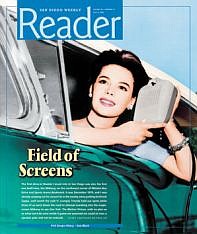
Field of Screens: Drive-in theaters in San Diego
Field of screens
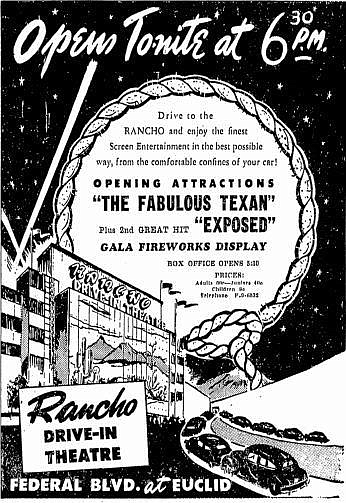
San Diego's third outdoor theater, at the corner of Euclid and Federal, opened Wednesday, January 28, 1948, with a double feature of The Fabulous Texan and Exposed (photo courtesy Teri Oldknow/DeAnza)
Traffic-Trol featured spring-loaded spikes that retracted when driven over by exiting cars but shredded the tires of lgate-crashers attempting to enter the lot via the exit gates.
The first drive-in theater I snuck into in San Diego was also the first one built here, the Midway, on the northwest corner of Mission Bay Drive and Sports Arena Boulevard. It was December 1979, and I was already camping out for concert tix in the nearby arena parking lot (Frank Zappa, well worth the cold 'n' cramps). Friends held our spots while three of us went down the road to attempt sneaking into the single-screen Midway to see Star Trek: The Motion Picture, with no plan as to what we'd do once inside (I guess we assumed we could sit near a speaker pole and not be noticed).
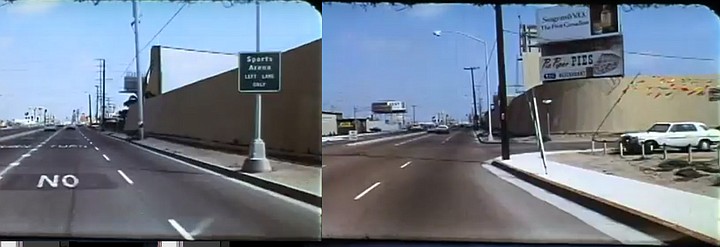
Midway circa 1973
Dusty-yellow with occasional trees around the perimeter to help block light pollution, the Midway's sloping hollow wall proved easy enough to scale, but it made the damnedest noise as we slid down the other side, and it was obvious that half the lot was staring at us. As soon as our feet hit the pavement, some guys rolled up in a beach-buggy-style cart and hauled us off the premises to the sound of paying patrons laughing as we were wheeled past their comfy, warm cars and dropped outside the exit gate. I vowed to return as soon as I owned a car, and before long I did have a vehicle (of sorts, an old Rambler) and I was frequenting every outdoor movie screen I could find within safe driving distance of downtown (about 45 miles, given my dicey wheels). I had become a so-called "ozoner."
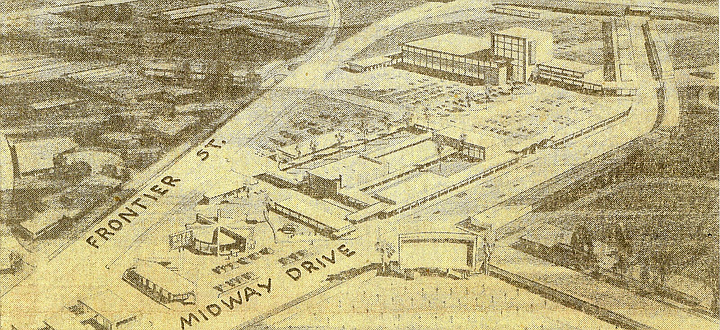
The Midway Drive-In was constructed in late 1947 at the intersection of Midway Drive and Sports Arena Boulevard, back when the Boulevard was still Frontier Street and Navy barracks stood on acreage later occupied by a FedMart. The Midway Drive-In Theatre Corporation was incorporated July 31, 1946, with Floyd Bernard Jr. listed as company president. Soon, Joseph Shure and his Shure Theatres Inc. bought into the drive-in, eventually owning a majority share.
Originally designed for 400 cars, the screen tower was anchored by large poles sunk into what had once been swamp grounds. It was an enclosed structure that included storage rooms and a small efficiency apartment briefly occupied by various theater employees.
The first screen was a canvas-style flat that rolled open over a scaffolding tower, and there were no individual car speakers, only bullhorn-style broadcast speakers designed by RCA Victor, a system called "Directional Sound," where three loudspeakers were mounted near the screen.
Built by Floyd Bernard, Jr., the Midway screened its first film – Body and Soul starring James Garfield -- in February 1947. Tickets were 75 cents, and Bernard was later quoted saying “We made $6,300 the very first week…that was a lot of money in those days.”
By late 1948, individual car speakers on poles protruded from cement islands sprinkling the lot. The original snack bar was a makeshift Quonset hut in front of the screen, though this was later replaced with a standard concession building, sitting in the middle of the lot, a few feet below the rest of the graded property. From that point onward, the projection booth was located on top of the concession stand. There were also bleacher-style benches for up to 200 walk-ins.
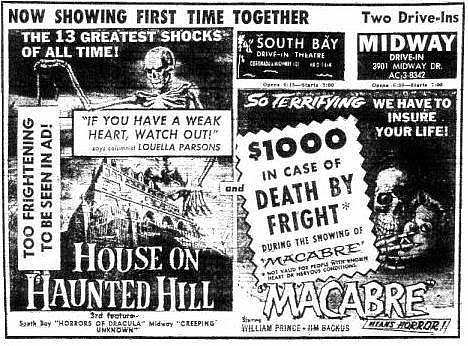
Courtesy San Diego Cinerama
Early gimmicks used to get patrons parking included free baby bottle warmers, a real-cloth diaper service, in-car heaters, a free car wash from nearby screen-ad sponsor Genie ("with the magic towel!"), whose sign was lined up alongside the Midway marquee. Later, "by-the-carload" pricing was instituted, as the Midway and several other local ozones competed to top each other's all-fer-one ticketing. The Screen tower would double as an advertising billboard for the nearby Pie Piper restaurant and a Heavenly Donuts that outlived the Drive-In itself.
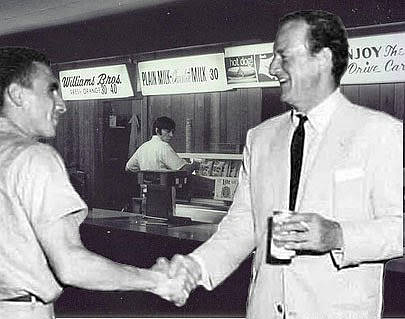
John Wayne unexpectedly showed up at the Midway in either 1951 or 1952. “We were showing Hondo,” Floyd Bernard’s son Dusty told one San Diego paper (9-8-80), “and he walked right into the snack bar and started shaking hands with everybody. He was really nice to all of us.”
In 1953, theater operators Sero Amusements Company purchased 30,000 of the 110,000 outstanding shares of common stock in the Midway Drive-In Theatre Corporation.
In the mid-fifties, the entire lot was paved over, in a modernization project spearheaded by Dusty Bernard, along with assistant manager Bob Belchez. “When we finished,” he says, “we each took a car to all the speaker locations, to make sure that the view of the screen was perfect from everywhere in the lot.”
At that time, it was one of around 60 Midway Drive-Ins operating in the U.S. Theater co-owner Dusty Bernard was living in the apartment built into the screen tower itself, along with his mother and sister.
Though the Bernards still owned the Midway, Sero took over management and expanded the lot to fit around 700 cars. The company would later run the nearby Frontier Drive-In (which morphed into the Frontier Twin), the Rancho Drive-In (at Federal and Euclid), Chula Vista's Big Sky Drive-In, and other local ozones. In 1958, with Midway's stock averaging $2.82 per share, Sero had a falling out with partners at Shure and purchased their stake in the theater as well.
This eventually led to a dispute regarding dividends paid and whether they were applicable to a franchise tax assessment of $2,652.19 for the income year ending June 30, 1960. The matter was settled in May 1968 when the State Board of Equalization agreed to modify the franchise tax amount due by $1,249.
In the early '60s, the Midway enlarged its screen to 75 feet by 120 feet to better display widescreen Cinema-Scope features. Around the same time, the projection booth was outfitted for 70-millimeter film presentation (5-perforation wide gauge, with an aspect ratio of 2.20).
The first 70mm screening was King of Kings, starring Jeffrey Hunter as Jesus, beginning April 11, 1962, and shown in "Super Technirama 70." A 70mm reissue of Oklahoma! ran at the Midway beginning April 25 and attracted big crowds but, by the time Spartacus debuted in 70mm at the Midway on May 23, the city's third drive-in theater, the Rancho (opened January 1948), was also equipped for 70mm and was showing the same feature.
When MASH was screened in late June 1970, management apparently attempted a political statement by having the projectionist briefly turn off the film and instead run the audio from Lyndon Johnson's speech of March 3, 1968, in which he stated that "I shall not seek, and I will not accept, the nomination of my party for another term as your President." Customers leaning on their car horns may have been honking either in approval or complaint.
The paved lot began seeing daytime use when Monte Kobey brought his San Diego Swap Meet to the locale in 1976. The graduate of Arizona State University (with degrees in advertising and marketing) had spent nine years working for radio and television stations before being named general manager of his father-in-law's Phoenix company, Park & Swap. Reportedly, a mere 13 sellers and around 200 buyers showed up for Kobey's inaugural swap meet on the Midway lot, though it eventually grew to be the third-largest outdoor market on the West Coast, attracting around 1000 sellers and over 30,000 shoppers each week. In 1979, Kobey's Swap Meet moved to the Sports Arena parking lot, and for a time a farmer's market was run in its stead at the drive-in.
By the late '70s, the hollow walls surrounding the lot were infested with feral cats, who thrived on an even larger colony of rats, who did battle with employees over edible, drinkable, and sometimes smokable leftovers dropped all over the lot by customers.
The Midway showed its last film - That's Entertainment Part 1 - on Saturday night, September 6, 1980. Before the final screening, co-owners Dusty and Lynn Bernard held a private party on the lot, for around 400 friends and associates. A loud rock band named Metro played, while snack bar pizzas, hot dogs, burgers, and popcorn buckets were served, along with beer and wine.
Ozone operators provided cans of black spray paint for anyone who wanted to scrawl farewell messages on the wooden green walls - the Union-Tribune (9-8-80) quoted one as reading "One of my fantasies was fulfilled here 20 years ago."
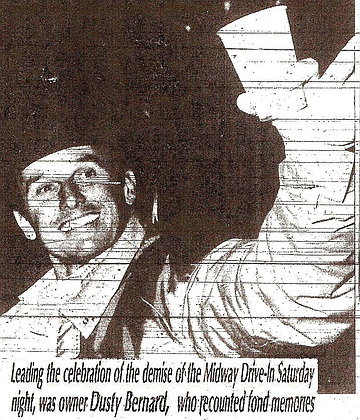
Courtesy Gabriel Neeb
"We never had time to watch the movies," according to 50 year-old projectionist Bob Belchez, who'd worked at the Midway from 1965 to 1977. "We always had speakers to repair or equipment to keep up."
Dusty Bernard told reporters the Midway had just experienced its best summer season in years. “But I felt that the up-and-coming trend in drive-ins is the multi-screened theaters. At this point, we don’t have enough room to do that. I was afraid we’d become outdated, or that we’d lose our hold on the market.”
His father Floyd said “To stay competitive, you have to bid with the other theaters for films. Some of the studios today want 90 percent of the gross and a six-week guarantee minimum.”
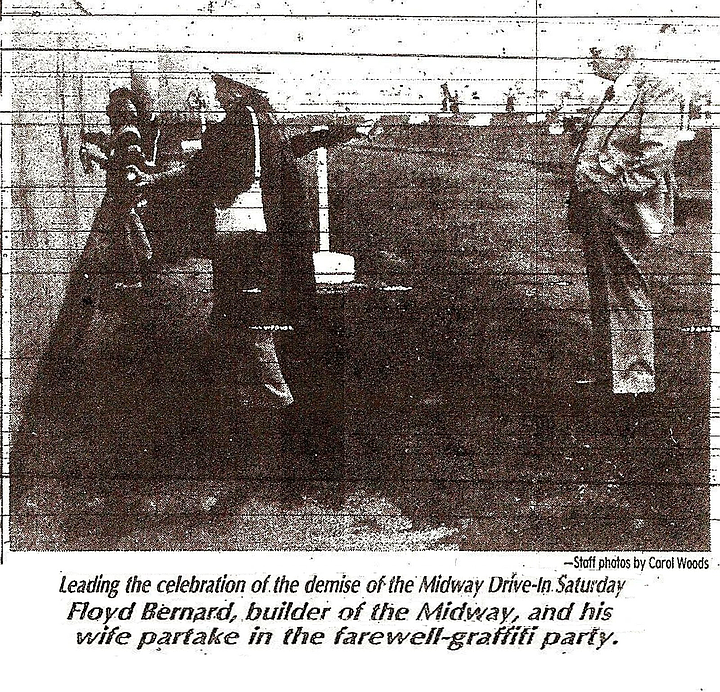
Courtesy Gabriel Neeb
The Midway Drive-In Corporation was officially dissolved in February 1987. After being torn down, the site became home to a shopping center with a Longs Drugs, a Ralphs, and a Denny's. The area behind where the screen once stood housed a drive-through Heavenly Donuts for a while and later a Salazar's Mexican restaurant.
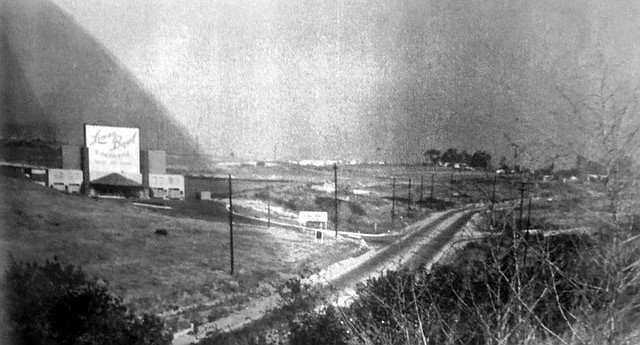
Courtesy Lemon Grove Historical Society
The Lemon Bowl Cinema Dine opened at the beginning of 1948, San Diego's second drive-in theater. The opening night feature Go For Broke honored the Japanese-American heroes of the 442nd Regiment.
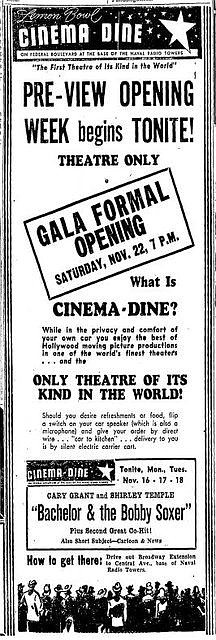
Located on Federal Boulevard in Lemon Grove, the 1948-49 Theatre Catalog lists its original owners as C.E. Norcross, Suburban Theatres Inc. of Loma Linda, California. Ira Durham and Oliver McNeel operated the theater through 1953.
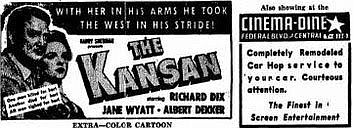
The lot included a restaurant, where everything from grilled-cheese sandwiches to seafood dinners was served, as well as pre-warmed bottles of baby formula. When patrons entered, their 25 to 50 cents got them two speakers: one to hear the movie and the other to order food, delivered for a time on electric carts that could only navigate horizontally along the lot’s flat surface aisles.
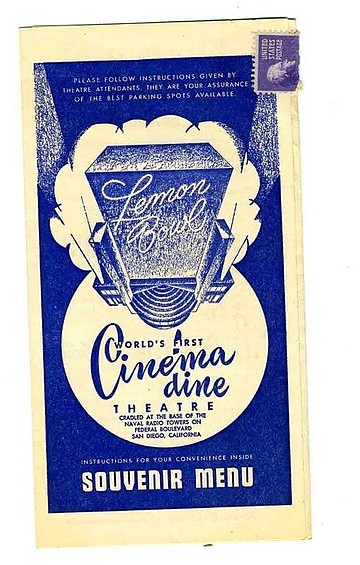
The Cinema Dine's art deco-style speakers frequently disappeared, either stolen or torn from poles by accidental drive-offs, and now trade for $50 and up on eBay and elsewhere.
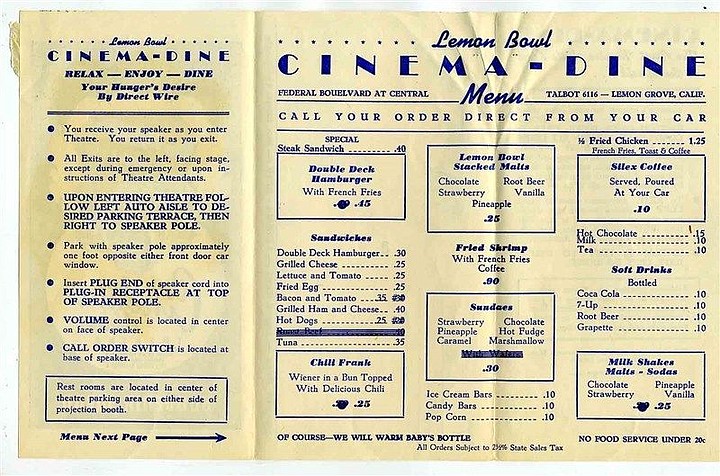
The Cinema Dine was apparently one of the first area drive-ins to experiment with broadcasting film sound through AM radios in 1972, and an on-site miniature golf course was briefly advertised.
This ozone was torn down even before the nationwide atrophy of drive-ins began, to make room for access to the 94 freeway, with a portion of the property eventually housing a Toyota dealership.
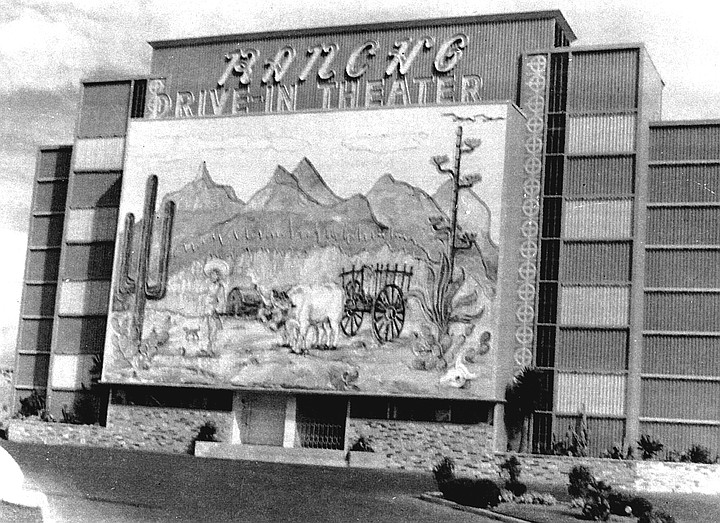
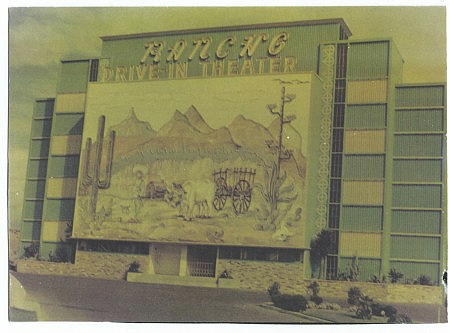
Rancho Drive-In, at the corner of Euclid and Federal, featured a mural on the back of the Rancho's green screen tower which depicted a Mexican village, cacti, and a campesino with his ox cart. The ox's head moved up and down.
San Diego's third outdoor theater, the Rancho Drive-In, at the corner of Euclid and Federal, opened Wednesday, January 28, 1948, with a double feature of The Fabulous Texan and Exposed. Touted in ads as "America's Most Beautiful Drive-In Theatre," it accommodated 600 cars on 13 acres, with bench seats for around 300 walk-ins.
Its 60- x 50-foot screen was at the time one of the largest in the country, requiring 30 cubic yards of concrete to support. Over 1000 tons of rock were used to grade the property, and it took nearly seven miles of cables to furnish sound to the speakers. The lower level of the screen building housed offices and storage rooms.
The mural on the back of the Rancho's green screen tower depicted a Mexican village, cacti, and a campesino with his ox cart. Animated at night by neon, the ox's head moved up and down as the cart's wheel turned, drawing motorists like moths toward the lights.
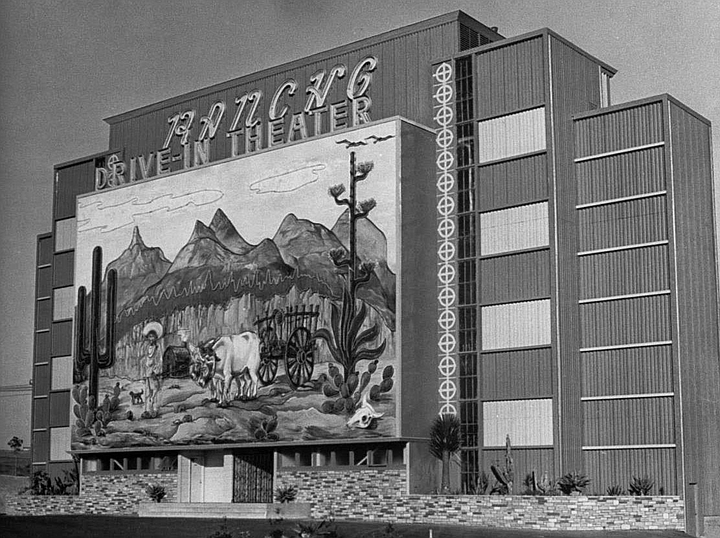
Courtesy DeAnza
The neon portion of the mural remained in service until being condemned as a fire hazard by the city in June 1976 (due to the hot neon being too close to aging wooden signage).
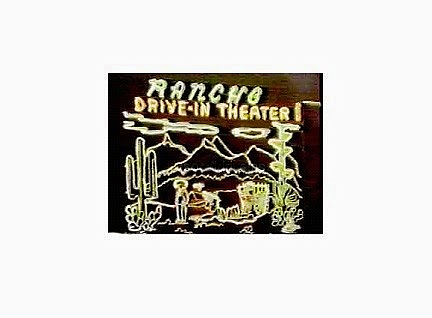
Like most drive-ins of that era, the Rancho had a playground on the property, in this case right in front of the screen tower itself. This sort of setup became more rare, as society became more litigious-minded, until eventually few ozone operators could afford the liability insurance required to run a playground.
In 1955, there were seven Rancho Drive-Ins in the U.S. San Diego's Rancho was operated by the Oldknow family, whose history in film exhibition dates back to 1909. It was, in fact, the first business venture of William Oldknow, who went on to run theaters across the country (his family still runs the South Bay Drive-In, Atlanta's Starlight Drive-In, and others).
William Oldknow's grandfather had opened the third-ever U.S. movie theater. William began as an usher at L.A.'s Beverly Theatre, later becoming a doorman at the nearby Westlake before changing courses to attend Harvard Military Academy and do a tour of duty as a Navy ensign.
"When I got out of the Navy in 1946, I got into the business, too," he told the San Diego Union in October 1978. "Euclid and Federal at that time was in county territory, and one of the reasons I built there was because the city had an amusement tax on theater tickets of, I think, five percent. We didn't want to charge that. Later, the tax was repealed, so we petitioned for annexation to the city in order to get city water. Our water came from a well, and it tasted awful."
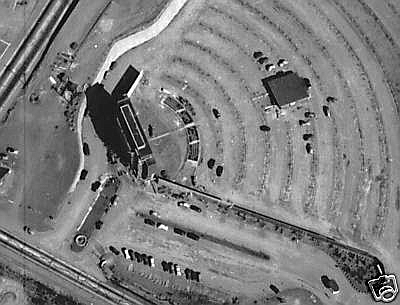
After building the Rancho, Oldknow partnered with Sero Amusements, which owned the land the Frontier Drive-In would be built on. Before long, Sero hired Oldknow as company president. "As Sero went through some restructuring, and as various partners were bought out in the '50s, he came to own the company," says William's daughter Teri Oldknow, operations manager for De Anza Land & Leisure Corporation (as Sero came to be known after 1968).
From the late '50s onward, Oldknow oversaw other local Sero properties, like the Frontier and Midway, the South Bay, the Del Mar, and Big Sky. Sero also held leases on area outdoor screens like the Aero Drive-In in El Cajon, plus Oldknow was running ozones in Pomona, Riverside, Ontario, L.A., Beaumont, Salt Lake City, and Tucson.
“In 1953 I watched my first 3D movie there,” San Diego Reader reader John66Vette emails. “It was Fort Ti with George Montgomery. We had to wear the cardboard & plastic colored lenses to be able to see the spears the Indians threw coming right at you. I really ducked.”
In 1957, the Rancho was the first local ozone to enlarge its original screen to 70´ x 130´, in order to show Cinema-Scope and other wide-screen films (the Midway Drive-In near Sports Arena soon followed). It was also the first area drive-in to display a 70mm film, with Madame debuting March 6, 1962 (Midway didn't show its first 70mm until April 11). On May 23, it "competed" with the Midway for Spartacus viewers interested in 70mm, though in reality both theaters were overseen by Oldknow and Sero.
"Cinema-Scope was really a creation of 20th Century Fox," says Teri Oldknow, "and my father's uncle-in-law was Spyros Skouras, the president of Fox, so I'm sure he talked my father into enlarging that screen and the Midway's. It was his job to convince us that Cinema-Scope and 70mm would be the next big thing." This would not prove to be the case.
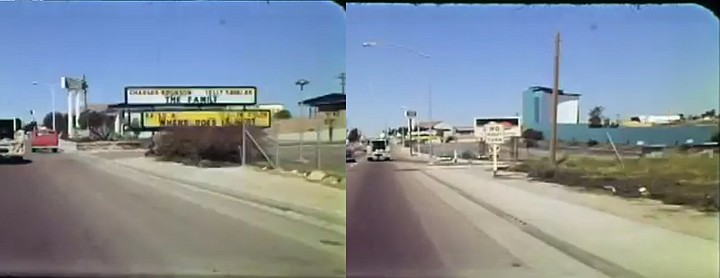
Rancho circa 1973
In 1978, Oldknow sold the Rancho Drive-In for just over $1 million to a La Mesa company, Alessio Leasing Inc., which had been renting part of the property for a used truck lot (Standard Oil leased another triangular corner of the lot for a filling station that partially obscured the neon screen mural).
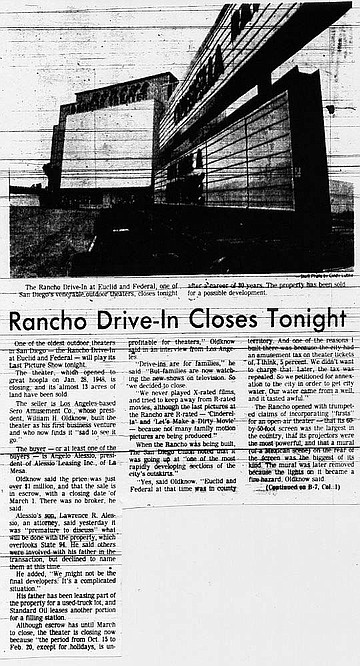
"That really breaks my heart," his daughter Teri says. "The Rancho was the first in a whole circuit of drive-ins we ran in California, Utah, Nevada, Arizona, and Atlanta, Georgia. I understand that, from a land-value aspect, the property was worth more to developers, but it still makes me sad."
She lays blame for the closure on several factors. "Gas prices went up in 1973, cars were getting smaller, and you had the decline of the urban single-screen theaters in favor of multiplex multiscreen theaters in the suburbs, in malls. Meanwhile, drive-ins built as cheaply as possible, 20 to 30 years ago, they're getting more and more run down. Even the elaborate old screen murals and neon, these things weren't built to last long."
William Oldknow is still alive and in the drive-in business. "Families are now watching the new shows on television," he said back in 1978, just before the Rancho was shut down. "So we decided to close. We never played X-rated films and tried to keep away from R-rated movies, although the last pictures at the Rancho are R-rated -- Cinderella and Let's Make a Dirty Movie -- because not many family motion pictures are being produced."
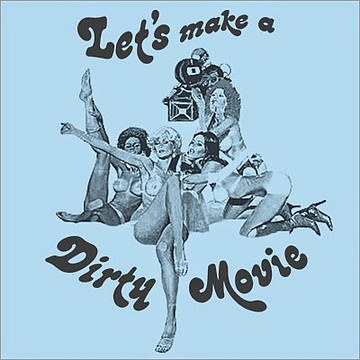
Cinderella was a Charles Band musical sex comedy with drive-in queen Cheryl "Rainbeaux" Smith and her "snapping pussy," while Let's Make a Dirty Movie was exactly what the title promised
The Rancho Drive-In's screen last flickered October 17, 1978. The property was later occupied by a Chevron station, a McDonald's, and a Cox Communications building.
Courtesy sandiegohistory.org
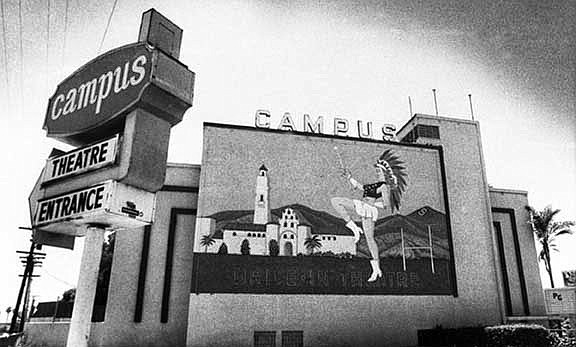
The Campus Drive-In at the corner of El Cajon Boulevard and College Avenue, and stretching to 61st Street, was a single-screen ozone originally built for 700 cars and 200 walk-ins (the seats were later removed, making room for up to 900 cars).
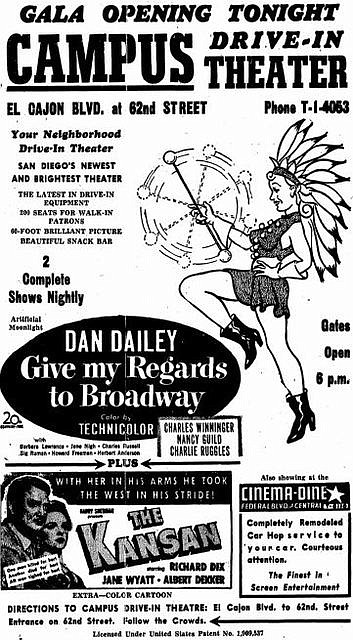
The Campus Drive-In Corporation was formed August 7, 1947, and the theater itself opened in August the following year, with a double feature headlined by Give My Regards to Broadway and opened by The Kansan, charging 50 cents admission and giving out free popcorn during opening week.
Sam J. Russo and Co-Op Theatres Inc. were listed as chief operators. The Russo family ran several local movie houses, including the nearby College theater (sold in the early '70s), as well as owning minority stakes in theaters operated by others, such as the Tu-Vu Drive-in.
"The Russo's company in later days was called Eldorado Enterprises," says Dan Whitehead, a longtime local projectionist since the '70s (he's worked for Walnut Properties, Edwards Cinemas, and many others).
"They were a very famous name in the San Diego movie theatre circles. They also owned the Aztec, Balboa and Casino theatres downtown. They eventually sold the Aztec to Mr. Wesley Andrews. Walnut Properties bought the Casino and purchased a lease on the Balboa. Their sister, a Mrs. Weatherby, owned the Tower theatre on West Broadway (now long gone). They also owned the Tower Bowling Alley (also on West Broadway and also long gone) which had a little tiny theatre that used a rear screen projection system."
Eldorado/Russo also opened the Ace Drive-In in Lemon Grove during the late '60s (don't worry, we'll get to that one.....).
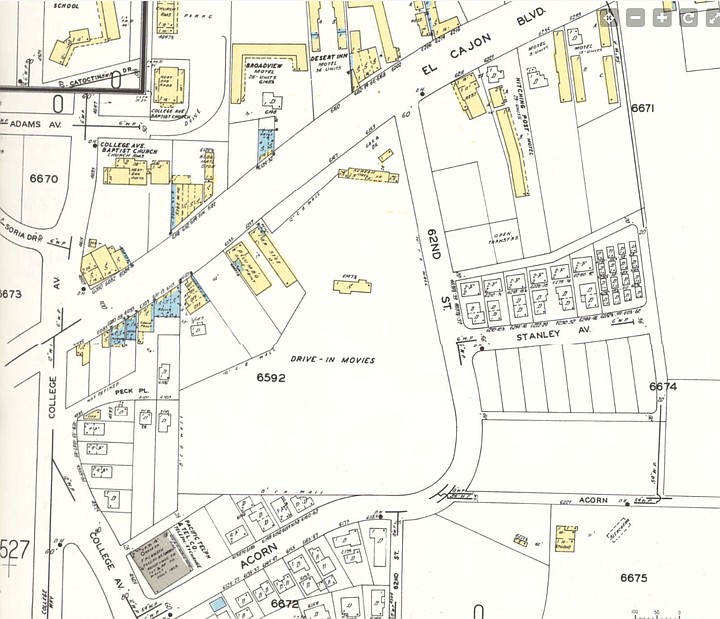
1956 map
At the time, the Campus was one of the largest drive-in theaters on the West Coast. Signage on the back of the screen featured a 50- x 80-foot mural. Lit up at night by 1900 feet of piping installed by California Neon, it depicted a 46-foot-tall marching majorette, wearing an Indian headdress and spinning a baton that appeared to twirl as she strutted in front of a depiction of SDSU's old main building and bell-tower quadrangle, football goalposts, and mountains (one with a white S on it).
The majorette was designed by Austin Linn Gray and Joe Schmidt, two San Diegans said to have based her on a photograph of Marion Caster Heatherly Baker, head drum majorette at San Diego High School in 1943 and later a majorette for the Los Angeles Rams.
In 1956, the Campus was charging $1.00 per adult admission, 65 cents for “juniors,” and children were 35 cents.
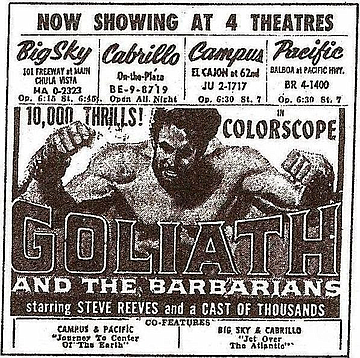
Courtesy San Diego Cinerama
A killing took place at the Campus on December 2, 1961. Snack-bar employee Tom O'Leary got into an argument with patron Dennis O'Conner. Things got increasingly heated, and O'Leary ended up pulling a knife on the patron and stabbing him to death. O'Leary was charged with unlawful killing and was found guilty of involuntary manslaughter.
This didn't satisfy O'Conner's family, who filed a lawsuit against the Campus Drive-In Corporation, seeking damages for corporate negligence by maintaining that O'Leary committed the assault while acting in the course of his employment. The court eventually ruled that the Campus wasn't a party to the manslaughter and thus shouldn't be held liable, though appeals and motions regarding the judgment continued through 1967.
O'Connor's father Jerome O'Connor spent so much time in courtrooms that he eventually became president of the San Diego Court Watchers Association.
In 1971, the murdered man's sister, Maureen O'Connor, became the youngest person ever to be elected to the San Diego City Council. She was elected Mayor of San Diego in 1986.
The original Campus Drive-In Corporation dissolved July 8, 1975, and soon the locale was being run by Eldorado Theatres, the same corporation that had opened the Ace Drive-In in Lemon Grove during the late '60s. From the '70s onward, screenings opened with a short film that featured a rippling American flag set to "The Star-Spangled Banner." During intermissions, "Speedometer Bingo" numbers were announced over the speakers, with patrons winning snack-bar prizes when the last three digits on their speedometer matched the numbers called.
I first went to the Campus on Christmas Eve, 1979, to see Steve Martin in The Jerk, though I was still carless (and essentially homeless) at the time. I recall it as a fairly easy drive-in to sneak into, and I managed to go unmolested for about a third of the film before a theater employee noticed me sitting and shivering up against a pole in a corner of the lot.
I was making myself a peanut butter and jelly sandwich from supplies carried in a paper bag when the kid stepped up to me and started to ask me to leave. I must have looked particularly pitiful; no place to go and no family to be with on Christmas Eve, just me and my PB&J on a cold cement lot.
He shook his head like a guy who'd just seen the ghosts of his own potential Christmases past, present, and future and decided not to kick me out.
"Never mind, Merry Christmas," he said and walked away, leaving me to enjoy the rest of The Jerk (which I did enjoy -- this is a more fond than maudlin memory for me, such is my passion for ozones).
The Campus Drive-In closed in February 1983; the final two features were The Dark Crystal and a retread print (a second- or third-run film) of Dragonslayer. The theater's equipment was sold to Walnut Properties, who at the time ran downtown theaters like the Aztec, Casino, Plaza, Cabrillo, Bijou, and others. The Campus projectors and sound heads wound up in the Roxy Theater in Goleta. The lamphouses and rectifiers went to the Balboa Theater downtown and, when that house closed, they ended up in Oceanside's Star Theater.
Before the drive-in's demolition, the majorette portion of the screen mural was donated to the Save Our Neon Organization, which packed the sign in crates to store in a downtown warehouse.
In 1985, the majorette was purchased for $4000 by William J. Stone and Associates, operators of Marketplace at the Grove, off Highway 94. The neon was restored at a cost of around $200,000 by El Cajon-based Integrated Sign Associates, and the majorette was reinstalled at the Marketplace, near the Mann Theatre. After the shopping center was renovated as College Grove Center, a relighting ceremony was held March 10, 2000, reportedly attended by over 8000 people and covered by several local TV news crews.
On July 2, 2001, the operators of College Grove Center, Vestar Development Company, donated the neon landmark to a company called SOHO (Save Our Heritage Organisation). Vestar has agreed to remain responsible for financial and physical maintenance of the sign and for keeping it lit at night in the shopping center. SOHO has an easement for access and the right to remove the majorette, although there are no plans to abandon the Center. The Campus majorette has been featured in photo spreads in Time and Life, as well as in numerous books and calendars. The shopping center that replaced the drive-in uses small reproductions of the majorette in building signage.
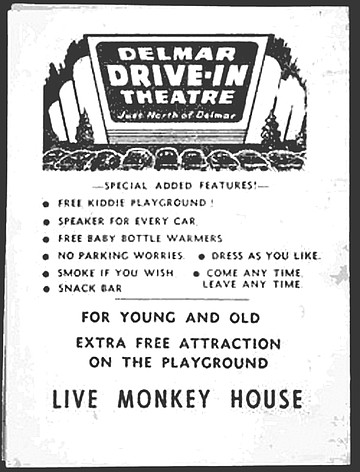
"The Del Mar had a giant tiki sign on the entranceway that went right across the driveway."
The Del Mar Drive-In on Via de la Valle, across the street from the Del Mar Fairgrounds, opened in 1953 with space for 700 cars. Operated independently for its first two years, it was eventually run by William Oldknow and Sero Amusements, a company that hired him as president but which he'd come to own. "The Del Mar had a giant tiki sign on the entranceway that went right across the driveway," recalls Teri Oldknow, "with a giant catamaran painted with sort of tiki hatching. It was really cool."
From the start, the Del Mar decided to remain open seven nights a week, since many film studios at the time refused to provide new first-run films to theaters open weekends only. During most of the '50s, admission was $1 per carload on weekdays and 50 cents per person on weekends (children were free) -- the real profits, as at most ozones, were in the concession stand. As patron perks, they offered free baby-bottle warmers, and for a time, a "live monkey house" was advertised as being on the playground.
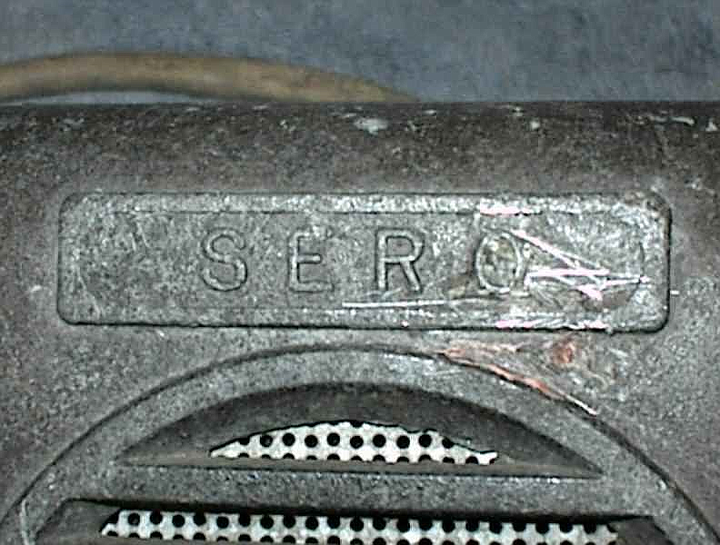
Sero was operating so many drive-ins that the speakers at the Del Mar and elsewhere were actually manufactured specifically for Sero and carried the company's imprint on the front of their metal casings. "We made them in Pomona with a company called Bevelite from the mid-'50s through about the late '60s," recalls Teri Oldknow. "They made the speakers for the Pacific Theatres, too."
She says few of those audio relics remain in the company's possession, though they frequently turn up on eBay and elsewhere (fetching anywhere from $10 to $100 and up for wired kits, including stand-alone poles). "You'd think, of all companies, we would have realized how just plain cool the speakers were and would have kept them, but I guess nobody ever thought something like that would end up rare and valuable."
In the early ‘70s, the Del Mar was managed by Dixie Burton, who’d moved to San Diego in 1967 to live on lot at the Midway Drive-in, which was being run by her then-husband. Burton earned national headlines in 1974, when she successfully campaigned to get her 12-year-old daughter Robyn on the Solana Beach Little League team, an almost unheard-of achievement for a girl at the time. She later became prominent in local theater by heading up San Diego Playgoers (beginning in 1978), and also helping to spearhead the campaign to save downtown’s historic Balboa Theater.
A Reader reader named MoHansen emailed to say “Dixie Burton was the mother of my friends, Laurie, Barbara, Brent and Robyn, and she used to let me in to practice driving at the drive-in on the weekend days when no one was around. The inclines were great for practicing how to go up a hill from a stop in a car with a clutch.”
After being closed for awhile, the Del Mar underwent remodeling in early 1979, reopening on Memorial Day weekend with a free open house featuring High Ballin’ and Stingray. However, despite spending over $15,000 on improvements, business failed to pick up.
In late 1979, the Oldknows announced they were selling the Del Mar Drive-In lot for commercial use. "Developers came in and built a huge sea of condominiums... it was too much money to turn down at the time," says Teri Oldknow.
In August 1984, McKellar Development of La Jolla (ranked that year at number 25 among the nation's largest developers by Building Design & Construction Magazine) began building condos on the old drive-in site.
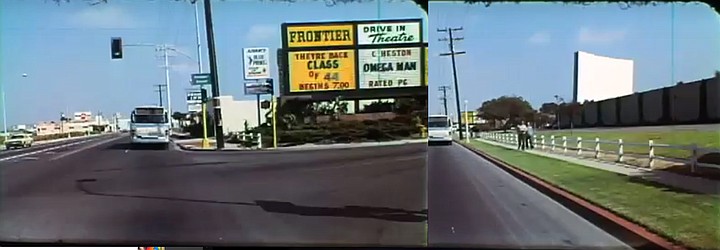
Frontier Drive-in circa 1973
The Frontier Drive-In at 3601 Midway Drive, on the southwest corner of Midway and Kemper Street (between Rosecrans and West Point Loma Boulevard), was named for nearby Frontier Street (later Sports Arena Boulevard). Though opened in 1957, owner Sero Amusements actually bought the Frontier's land in 1941, intending to build the city's first ozone. An architect was commissioned, plans drawn, supplies purchased, and in early 1942 a building-permit application was in the works.
Then the city, facing an acute housing shortage, condemned the land in order to put up the Frontier Housing Project, subsidized in part by the U.S. government. "Sero Amusement Company expected the land to be returned immediately after the war in 1946 and started drafting new plans," William Oldknow said in an opening-day article about the Frontier in the Sentinel, a newspaper-style promo given out to opening-night attendees. "The government, however, did not release the property until May 1956."
Construction finally began that summer on a lot intended to hold up to 1600 cars, but work couldn't be completed until after August -- a local Little League team was using a school fence still remaining on the property as a batting cage backdrop. After 16 years of waiting to use his land, Sero owner William Oldknow knew better than to engender bad local PR and agreed to delay building until baseball season was over.
Meanwhile, construction superintendent Bill Post had to figure out a way to tear out the huge cement slabs that had been the housing project's floors, as well as how to dismantle the more problematic cement-encased fuel tanks. There was also an overpopulation of gophers tearing up the land, resulting in Post jokingly offering company gardener Nito Chavez a 25-cent-per-gopher bounty. Chavez came up with around 100 critter corpses, and Post had to pay $25 out of pocket for the unbudgeted expense.
Local firm Haydock Construction, with offices on Meade Avenue, graded the land to gradually rise 16 feet in elevation from the front to the rear of the theater. Capital Electric Company installed the 20 miles of underground wiring needed to power small electric lights and speakers placed on each of the 750 posts scattered over the lot, requiring over 10,000 splices and connections. An underground transformer vault in the middle channeled 12,000 volts of electric power supplied by SDG&E. The all-metal screen structure was 75 feet high, with the screen itself measuring 121 feet wide and 52 feet high, painted with a polyvinyl plastic-based paint specially designed for ultra-white ozone screens (the job required around 100 gallons, over four coats).
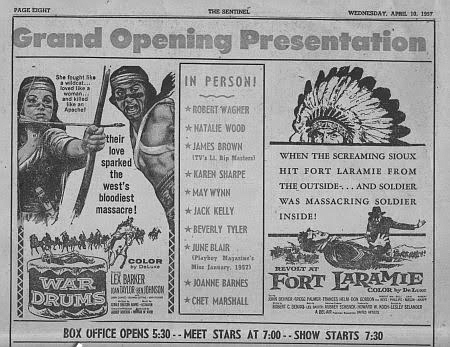
With two box-office entrances ("No lines!"), the Frontier Drive-In opened Wednesday, April 10, 1957, with a first-run double feature: War Drums ("Their love sparked the west's bloodiest massacre!") and Revolt at Fort Laramie ("Screaming Sioux outside...soldier killing soldier inside!"). Opening-night admission was 90 cents for adults, 50 cents for juniors (12-15), and kids under 12 were admitted free.
Movie stars Robert Wagner and Natalie Wood made opening-night appearances on a makeshift stage in front of the snack bar, alongside actor/singer James Brown (not the Godfather of Soul, but rather Lt. Rip Masters on the kids' TV show Rin Tin Tin), and Playboy's Miss January 1957, June Blair (a former Miss Huntington Beach). Second-tier stars also on-site included Karen Sharpe, May Wynn, Jack Kelly, Beverly Tyler, Joanne Barnes, and Chet Marshall.
Sero records show the celebs were flown in to Lindbergh Field, arriving at 4:30 p.m.; they later attended a post-appearance dinner party at the Mission Valley Inn. Robert Wagner, who'd made fewer than a dozen films and was working under a seven-year contract with 20th Century Fox, was presumably invited because he starred in The True Story of Jesse James, due to play the Frontier a week later, on April 17 (along with Alan Ladd's Big Land).
At the time of its launch, there were around a half-dozen Frontier Drive-Ins in the U.S. This one was planned as direct competition for the nearby Midway Drive-In, though Sero eventually bought into that theater as well. Ads touted the Frontier's Cinema-Scope screen ("Giant!") and excellent sound ("Adjust volume yourself!"), and patron perks included a bottle-warming service, free windshield towels, and a "mechanic on duty." The Half Way House Restaurant, directly across the street, often shared advertising space with the theater.
Initially, the snack bar (built by Mission Valley's R.E. Hazard Contracting and featuring 60 feet of Formica counter space) had an exclusive cola arrangement with Coke. Early ads promised quality ice cream and candy, pizza, XLNT brand tamales, chili dishes and toppings, and hot dogs that, as per Sero's chainwide policy, were always "broiled, to give them that extra special flavor." One offbeat item was described in ads as "new to San Diego...Tater Dogs, they are called, wieners wrapped in mashed potatoes and French fried. Delicious!"
A large kiddie playground with swings and slides was erected in front of the original screen, though the playsets were later taken down and replaced with hand-spun merry-go-rounds, which seemed to fall quickly into disrepair. "I think they had one of those mini-trains that kids could ride around in," recalls Teri Oldknow.
Several twilight talent shows were held on the property in the mid-'60s, including one contest advertised as "The Search for Miss Loma Portal," with a promised prize of "music lessons and gifts valued at over $100."
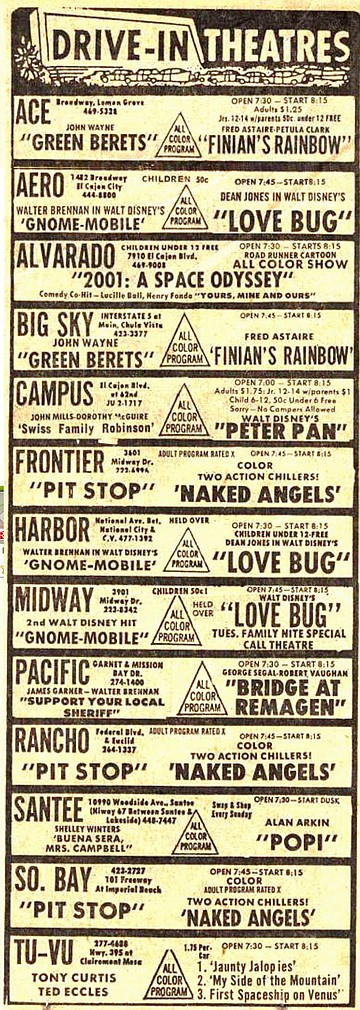
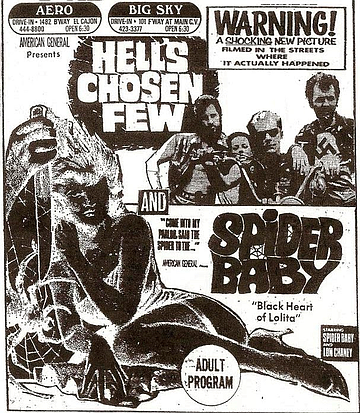
However, summer 1969 saw the Frontier (and the Rancho and the South Bay) experimenting with “X-rated” features, which were really fairly soft sexploitation films, as seen in below 7-24-69 ad with all three venues screening Pit Stop and Naked Angels, billed for adults only (belying William Oldknow's claim that the Rancho never showed X-rated fare).
By 1978, Sero had added a second screen and renamed it "the Frontier Twin Drive-In," cutting capacity to around 750 cars per side. This second screen was often visible to moviegoers parked up the street at the Midway. "The Twin was really successful, so not too long after that they added a third and a fourth screen, both at the same time," says Teri Oldknow. " 'Plexing to quads was really common then; it helped keep drive-ins competitive with the new multiplex mall theaters." Double and triple features were (and remain) another lure usually offered only at ozones.
Around this period, multi-feature theme shows often ran from dusk till dawn, such as all-night Planet of the Apes marathons and back-to-back horror movies. Cult movies attracted cult crowds. I recall a late-'79 showing of Roller Boogie with countless patrons attempting to navigate the lot on roller skates, finding the graded hills fairly deadly to the knees and shins, much to the hysteria of my companions and me (disco-haters one and all, we were there to see Linda Blair's skimpy outfits).
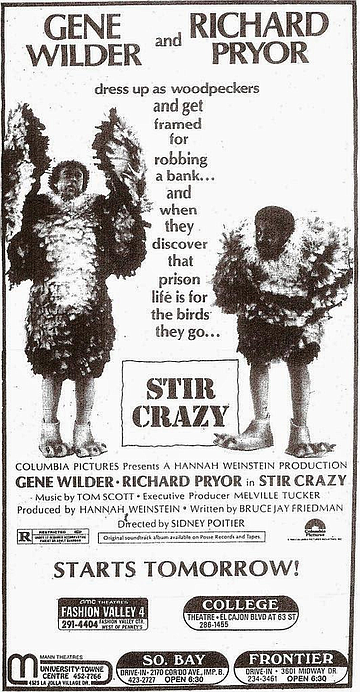
12-10-80 ad courtesy San Diego Cinerama
In the theater's final years, a deal was made with a nearby apartment building wherein a special room would be built behind the apartments with a wall-sized window facing one of the drive-in screens. Movie sound was to be piped in for a few dozen viewers seated in theater-style chairs. The apartment complex was to pay the theater $500 a month for this privilege, but it's unclear if construction on the movie room was ever completed before the Frontier shut down in September 1985.
"That sounds like something De Anza would do," laughs Teri Oldknow, "and, really, all they had to do was point the FM sound at the apartment building. There were always little side deals being made to squeeze a few extra dollars somehow."
Frontier owner De Anza tried to convince the city not to zone the property out of the drive-in biz with the "special use permit" being bandied about in the City Planning Department. "In July, we almost had the deal," De Anza chairman and drive-in pioneer William Oldknow said at the time, "but the city planning department threw the overalls in the chowder."
"The Frontier is still doing great business," manager Herbert Burton told the San Diego Union-Tribune of the 1,209-car theater. "I hate to see it close, and so do our customers." Burton said the Frontier would probably be torn down and replaced with a shopping mall by Santa Anna developer Paul Quon. The 12 acre lot sold to Quon for $9.4 million, in a deal connected to a land transfer with a property in Pasadena that was arranged by the Bank of America.
William Oldknow said "The theater makes a good return on a $3 million investment, but Quon is offering $9.4 million, through a bank in Texas. And the drive-in business is tied to an invention by Mr. Edison that's a century old, and is being superseded by other inventions." He said the South Bay Drive-in was probably still safe from closure. "We have a profitable swap meet there, and if we also work out a parking lot arrangement, the South Bay should be around for a long time."
The Frontier's final screenings took place October 17, 1985. Ironically, the final film feature on one of the Frontier's screens was Back to the Future.
A December 3, 1985, city council meeting presided over by Mayor Roger Hedgecock detailed the rezoning of what was then referred to as "Midway Mall," covering 15 acres of the Frontier Drive-In's former property. The lot was eventually occupied by a shopping center.
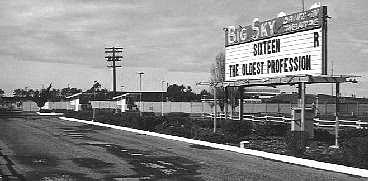
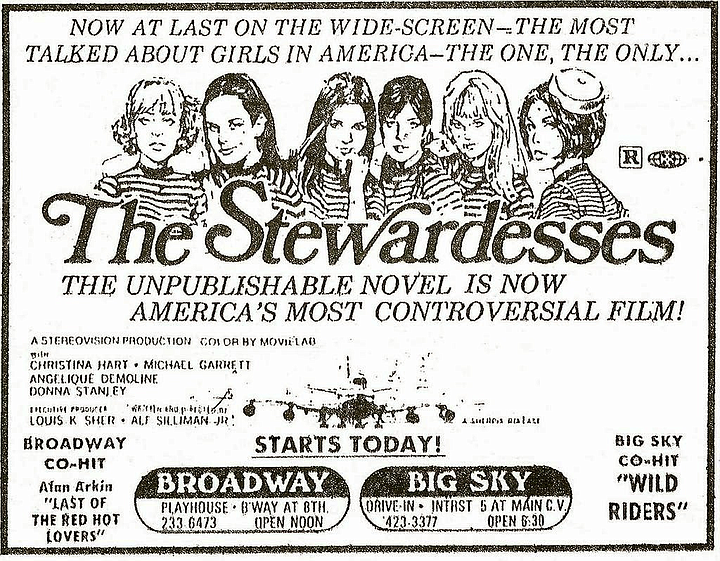
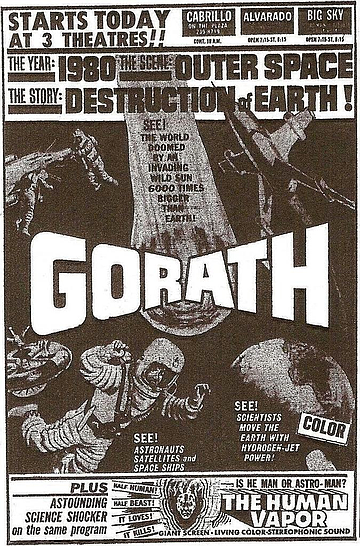
When the Big Sky Drive-In opened in 1955 at 2245 Main Street in Chula Vista, its car capacity of 2000 made it one of the four largest ozones in the U.S. (Los Aitos in Long Beach held 2100 while the 41 Twin in Franklin, Wisconsin, and the Twin Open Air in Oak Lawn, Illinois, were the same size as the Big Sky.)
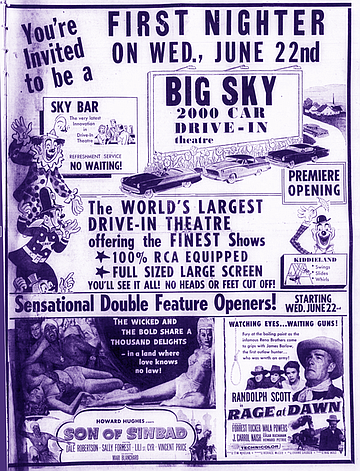
The full-color opening night features were Howard Hughes' Son of Sinbad, along with the Randolph Scott western Rage At Dawn. The stainless steel-filled snack bar was dubbed The Sky Bar, and for years the Big Sky advertised "Always two cartoons!" A "Kiddieland" playground on the property included swings, slides, and whirls.
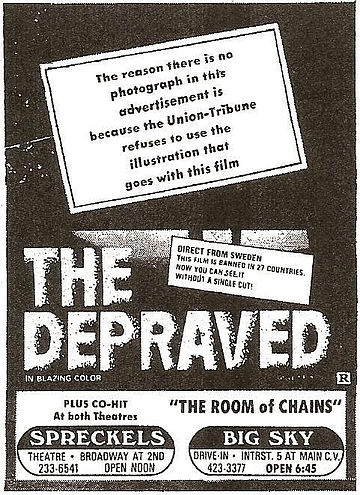
Courtesy San Diego Cinerama
One 1967 showing at this Sero Amusements property of The Undertaker and His Pals (motorcyclists who club women on the head to drum up business for their funeral home and diner) was advertised as having "a professional nurse on duty at all times, in case our movie gives you a heart attack."
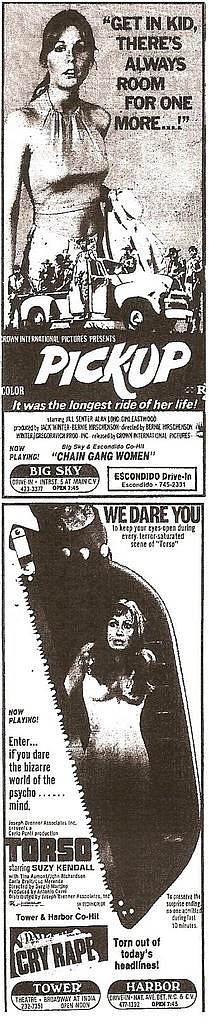
Courtesy San Diego Cinerama
Both of the Big Sky's exit paths were booby-trapped with a device called "Traffic-Trol." This featured spring-loaded spikes that retracted when driven over by exiting cars but shredded the tires of larcenous gate-crashers attempting to enter the lot via the exit gates. These indiscriminate car-killers became staples at most area ozones, though more than one enterprising miscreant figured out that short plywood ramps placed over the spikes enabled a careful driver to cross over them.
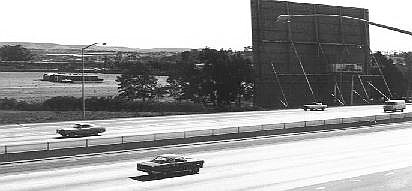
Backside of the Big Sky
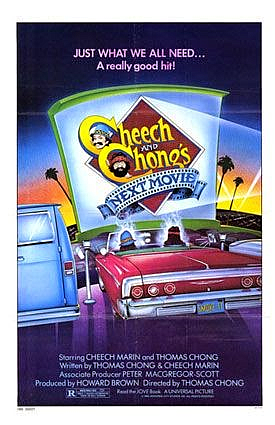
This drive-in went dark in July 1980 with two ultracool final features: The Blues Brothers and Cheech and Chong's Next Movie. The poster for that movie features the duo at a drive-in.
After closing, the abandoned snack bar became notorious as a homeless hangout, where at least one violent sexual assault occurred. An industrial park was eventually built on the property.
Courtesy San Diego Cinerama
Courtesy San Diego Cinerama
The Alvarado Drive-In at 7910 El Cajon Boulevard in La Mesa was located near Interstate 8, west of Baltimore Drive, with its entrance on the Boulevard. It's difficult to determine its opening date, as advertising for this ozone is scarce and details are hard to confirm.
A Reader reader named Leonard Pellman wrote to say "The Alvarado Drive-In was built in the early to mid 1950s. I lived at the Miles Motel, 7930 El Cajon Boulevard, from 1953 to 1957. The theatre entrance was on El Cajon Boulevard and they had to get an easement from the motel owners. In exchange for that easement, the Alvarado allowed the motel to construct a private viewing booth at the property line with two speakers in it. I clearly remember watching movies from that booth for the last couple years we lived at the motel, so it must have been built by 1955 or 1956 at the latest."
Its first appearance in the annual Theatre Guide books is 1961, listed as being operated by "Lanford & Long," with a car capacity of 900. Early on, members and supporters of the Motion Picture Projectionist Local 297 picketed the Alvarado lot because non-union help was said to be running the booth equipment. Owners eventually agreed to switch to union projectionists.
In 1968, the theater began admitting kids under 12 free, boosting attendance. By July 1969, operators had formed Alvarado Drive-In Theatre Inc. The business was purchased in January 1972 by Syufy Century Theatres Inc. of San Francisco, which ran several other indoor and outdoor California screens.
Within a few years, the Mann Theatres chain came to run this drive-in. This was a huge boon in 1973, when this ozone hosted the local debut of Disney’s re-release of Snow White and the Seven Dwarves.
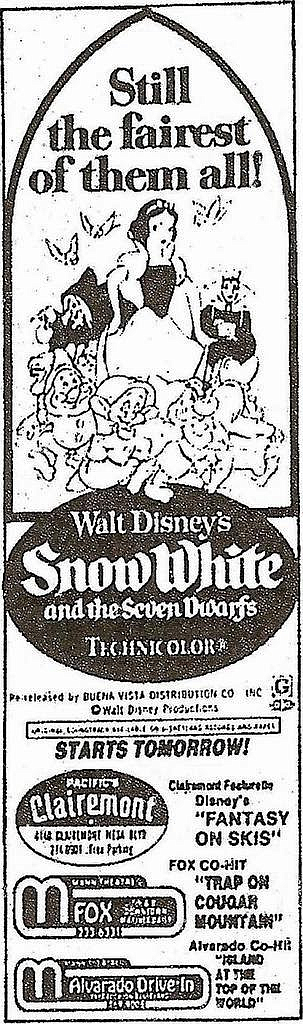
Courtesy San Diego Cinerama
The Mann connection proved even more valuable in 1975, when the Alvarado was one of the few local theaters to debut the film Jaws during its opening weeks, along with Mann’s Fashion Valley 4 cinemas. In those days, it was very rare for drive-ins to screen prints of newly-released blockbusters, a lament that many ozone owners say contributed to the decline of outdoor theaters.
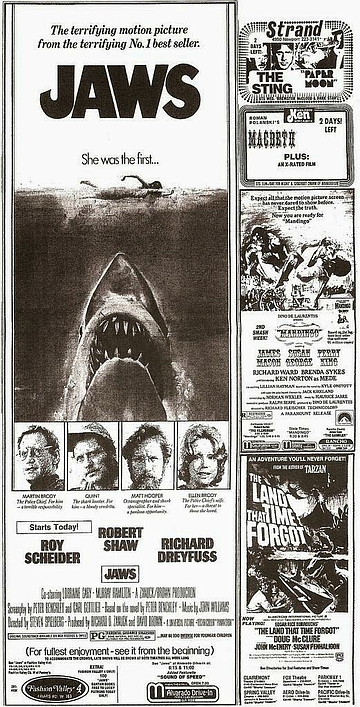
Courtesy San Diego Cinerama
In the late '70s, daytime Sunday church services were being held on the lot. The Alvarado appears to have closed around 1980, to be replaced by a Best market, a Godfather's Pizza, an El Torito, and other strip-mall shops.
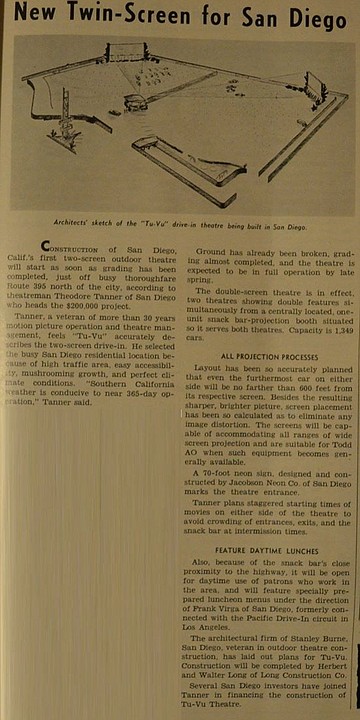
Courtesy Bill Sheet @ the Speaker Post
The Tu-Vu Drive-In at 5535 Kearny Villa Road, as its name implies, featured two screens and a total car capacity of 650. When the Tu-Vu opened in 1958, the snack bar had 80 feet of counter space, and two large picture windows on either side allowed patrons to keep an eye on both screens while lining up for snacks and drinks.
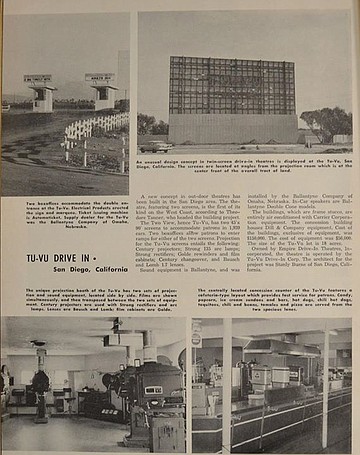
The lot was originally run by Empire Drive-In Theatres, who leased the property and purchased the equipment. On September 30, 1958, all the drive-in's assets were transferred to the Tu-Vu Drive-In Corporation (incorporated September 22, 1958), owned by William D. Russo (listed as company president), along with a woman named Della M. Ashkins and a third party. Tu-Vu agreed to assume and pay the rental prescribed by the master lease; to assume and pay the equipment sales contract obligation, which amounted to $58,652.10; to pay into escrow the sum of $23,840, which was to be used to pay Empire's creditors in full; and to pay $6160 toward additional construction work.
Courtesy San Diego Cinerama
Tu-Vu took possession of the theater, operated it and paid the prescribed rental (amounting to approximately $32,000; it paid between $30,000 and $35,000 on the conditional sales contract), and deposited about $30,000 into escrow.
By 1961, the Tu-Vu was packing the lot with $1 adult admission, juniors for 50 cents, and kids admitted free.
However, the Tu-Vu's partnership dissolved into several lawsuits. At the time of Tu-Vu Drive-In Corp. v. Ashkins (61 C2d 283), plaintiff Russo owned 54 percent of the Tu-Vu Drive-In Corporation stock, defendant Ashkins owned 39 percent, and a third party owned 7 percent. The corporation, by the written consent of Russo as majority stockholder, had adopted a bylaw in 1960 stipulating that Tu-Vu shares could only be transferred to an outsider if the owner of those shares first offered them to the other shareholders, at the same price and under the same terms.
On December 7, 1960, Russo obtained an option to purchase Ashkins' stock. Russo relinquished the option on January 7, 1961. Tu-Vu issued new stock certificates containing the new bylaw restriction, placing the certificates in escrow on January 31 with the commissioner of corporations. Apparently, neither Russo nor the corporation ever gave Ashkins actual notice of the new bylaw. Ashkins then went out shopping for an outside buyer for her shares, apparently unaware of the new requirement to first offer the stock to Russo and their other partner.
On May 1, 1961, Ashkins granted an option to purchase her Tu-Vu stock to Sero Amusements, a competitor running several local drive-ins. Russo was upset and initiated a lawsuit against Ashkins July 20, 1961, seeking a declaratory judgment sustaining the validity of the bylaw that regulated the transfer of Tu-Vu shares. The trial court entered a judgment that Ashkins possessed a vested right to retain her shares free of restrictions upon alienation, i.e., she could sell her stock to whomever she wanted, whether or not she first offered it to fellow shareholders.
Unfortunately for Ashkins, the sale to Sero never did go through, as Sero chose not to exercise its purchase option and it expired April 30, 1963. The judgment in Ashkins' favor was later reversed, and the trial court was directed to enter judgment declaring that the bylaw in question was valid and enforceable against defendant Ashkins.
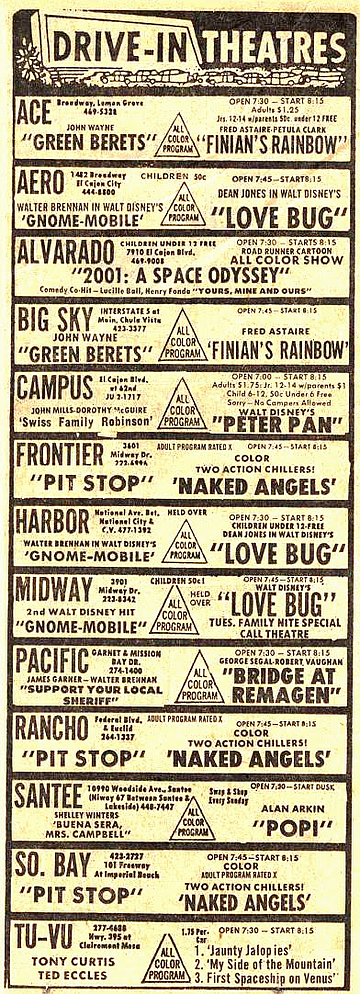
In the late ‘60s, the Tu-Vu followed the lead of other area ozones and began offering a per-car admission fee of $3.00. This was lowered further to $1.75 in summer 1969 (see below ad), $2.00 in 1972, then $2.50 in 1975, to better compete with other area drive-ins.
During its final few years, the Tu-Vu held a flea market on its grounds during daylight hours before closing for good around 1978. The Tu-Vu Drive-In Corporation was officially dissolved November 25, 1981. A Denny's and an industrial park later took up the drive-in's former acreage.
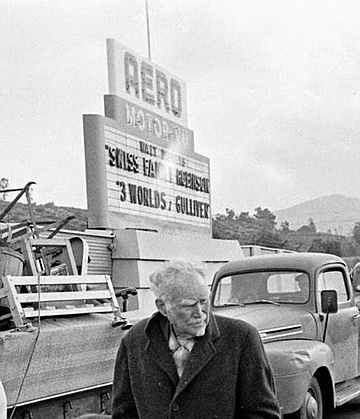
Aero Motor Vu marquee 1961
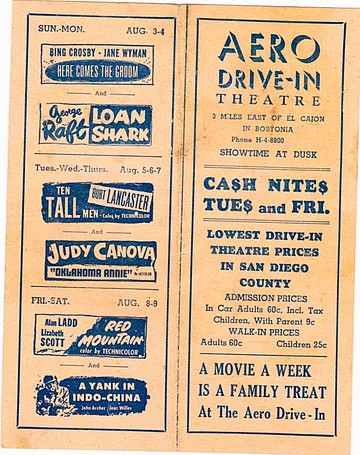
The Aero Motor Vu Drive-In at 1470 E. Broadway in El Cajon opened in 1954, independently owned by Donald Johnson. The equipment was leased from Sero Amusements and William Oldknow, who operated the drive-in for a time. Designed to fit just under 500 cars, the projection booth was built onto the snack bar and was located fairly close to the single screen, providing one of the brighter outdoor pictures in the area.
In early 1956, the Aero became perhaps the first San Diego drive-in to hold church services on the property on Sunday mornings. A "Swap Fair" began operating on the property during weekend days, starting around 1960.
For years, the Aero gave out raffle tickets with admission, distributing prizes (usually food) during intermissions, and it was among the first area ozones outfitted for AM radio sound in early 1973. Usually open only in the summer, a swap meet was run year-round on the premises beginning in 1975. This eventually caused problems with neighbors, upset over early-bird patrons who camped in their cars on the street.
Courtesy San Diego Cinerama
In 1988, screen visibility at the Aero was substantially affected by $750,000 worth of renovations done on the outdoor ball field at nearby Greenfield Junior High School. The substantial new lighting arrays allowed for nighttime Little League use of the field, but the Aero found many movies were washing out onscreen even worse than before. The theater was already having trouble getting a hold of increasingly scarce “drive-in prints” of movies, few of which were being struck any more (DI prints had a thinner emulsion, allowing them to compete with the moon and city lights).
The Navy made an offer to buy the 10-acre parcel beneath the Aero in April 1989, hoping to develop affordable apartments for 100 to 150 military families. "I, for one, welcome you to the city of El Cajon," Mayor John Reber said.
However, the land owner, Voltaire Company Limited of Del Mar, soured the Navy deal. "Our real-estate department had made contact with [the owner] a couple of times," the Navy's housing acquisition planner Mary Jane Bailey told the Union-Tribune (August 25, 1989). "For whatever reason, he decided he did not want to sell…It's dead in the water."
In 1990, the lease on the property beneath the Aero ran out, and operators were talking about closing up shop. This is when Regan Myles and his Regan Group Inc. began running the Aero, though it didn't take long for trouble to find them. The Vista-based company (which also operated the Harbor Drive-In in National City) was sued by the Union-Tribune over unpaid advertising, losing a judgment of $8645 in August 1992. The Aero lost another civil judgment in March 1993 over an unpaid loan and was required to pay $2264 to the San Diego Wholesale Credit Association.
Around the same time, Aero owner Don Johnson met with city officials to discuss the ever-growing backlog of complaints from neighbors about the weekend Swap Meet operation. Johnson hired security guards to patrol neighborhood streets and deter illegal parking, while Police accelerated enforcement of traffic regulations before and during Meets, especially along hard-hit Luke Lane. Johnson also began letting sellers into the lot at 6 a.m., an hour earlier than buyers, which alleviated some of the weekend traffic congestion at Broadway and Third Street attributed to the Meet.
City planning director James Griffin wrote in a 1993 report to City Manager Bob Acker that Johnson was "making a concerted effort to be a good neighbor…The swap meet operators routinely collect trash from around the site, they have security personnel who patrol inside and outside, and they have cooperated with the Police Department."
City support for the Aero was a major factor on August 2, 1994, when the City Council voted 4-1 AGAINST a developer’s plan to build a shopping center on the 9 acre site. Over 200 Aero neighbors had signed a petition favoring the development; one of them, John Kremensky, told the council he’d been living in the shadow of the drive-in for 30 years.
"If you don't approve this plan, that drive-in will still be standing when we're all in the ground," he told the Council.
Would-be developer Bob Cahan was unhappy to see his shopping center shot down. "He [owner Don Johnson] has a money-making operation there, and he owes nothing on the property," he told the Union-Tribune (8-4-94). "I don't see any reason for him to walk away from that."
Except the Aero wasn’t really much of a “money-making operation.” With admission set at around $5 adults, $3 kids, and $10 per carload, the theater incurred a loss of around $45,000 in summer 1997, causing the owner to announce it’d be closing, at least temporarily, in mid-September of that year. Several staffers were laid off.
In early 1999, after the owner passed away, new owners decided the damaged screen (hit hard by the previous winter's storms) wasn't worth replacing. The theater did reopen, but only briefly. On its final night, advertised in the local Union-Tribune and the Reader, the Aero offered free admission, free popcorn, and free soda to all attendees.
Only four cars showed up.
By June 1999, a crane had completed dismantling the screen, though the lot was still used for swap meets. In 2003, around 90 condo-style homes were built on the property.
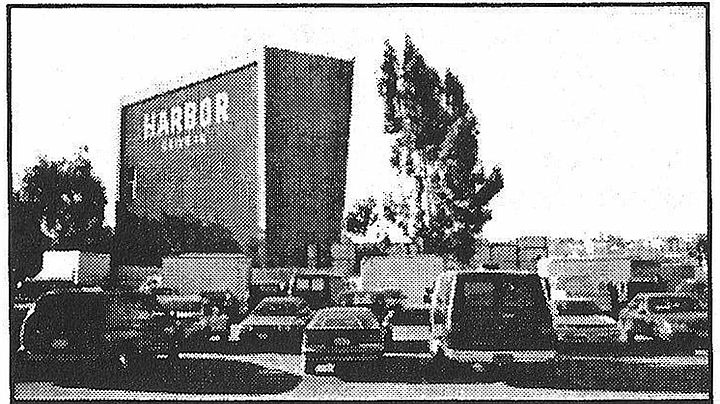
Drive-In Theatre Fan Club 1999 Yearbook
The Harbor Drive-In at 3150 National Avenue (i.e., National City Avenue, near Highway 54) opened in 1949 with a single screen and built to hold 500 cars. It was operated independently for years by T.P. Huntington, whose firm Harbor Drive-In Theatres Inc. was launched January 15, 1948. The lot at 32nd and D Avenue was open through all seasons, and raffles were a popular theater tradition beginning in the late '70s.
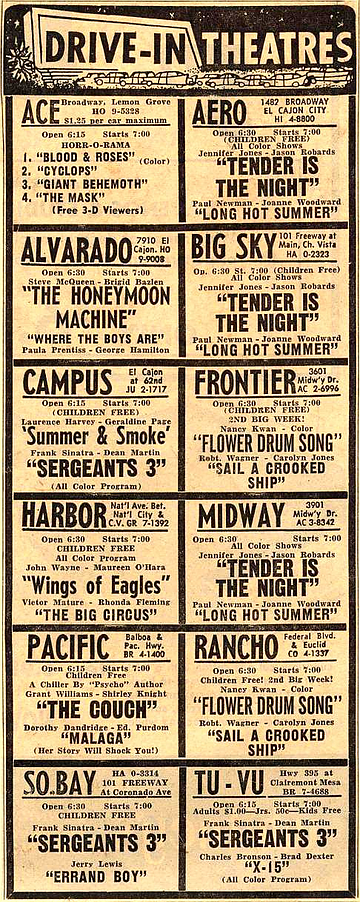
3-15-62
Beginning in November 1974, the Chula Vista Community Church rented the Harbor lot for Sunday church services, which were advertised on the theater screen on Saturday nights with a short promotional film. The preacher's pulpit was a flatbed truck parked beneath the screen tower, with a large cross propped up behind him and potted flowers all around him. The sermon piped into cars via the pole speakers, as were devotional songs performed by a church organist, who was usually also set up on the flatbed, and a church choir seated on a set of portable folding bleachers.
Ushers carried collection plates from car to car. When it rained, parish members lined up their cars to drive slowly past the ticket booth and get their communion sacrament through a drive-up window. "It's all God's world," church elder Cora Perry told the San Diego Union-Tribune in December '86. "We just have a sky for a cathedral."
The Harbor eventually broadcast with FM sound, and the speakers were removed, causing a steady stream of complaints from neighborhood drivers claiming that movie soundtracks hijacked their car speakers while passing nearby (not to mention complaints from patrons with no FM sound in their cars, forcing them to rent a radio from the snack bar).
By the '90s, attendance at area ozones was rapidly declining, and the Harbor was hit particularly hard. In 1993, it was assessed a state tax lien of $1272, and its parent firm in Vista was still paying off thousands of dollars in outstanding advertising bills due to the San Diego Union-Tribune, which was refusing to take new advertising for the Harbor or its sister drive-in the Aero in El Cajon.
Luckily, the Harbor's owners had purchased property surrounding the drive-in lot, and this gave them space to operate a flea market that quickly grew to fill the available acreage. Theater owners used income from this endeavor to subsidize drive-in screenings long after the movies stopped generating profits.
John Marin began managing the Harbor in 1992. "I think we can stay in business forever," he told the Union-Tribune five years later (10-26-97). Marin (who also managed the Aero Drive-in, as well as owning a rotisserie chicken franchise and working as a tax consultant) tried several promotions to increase attendance at the Harbor; Giving away soda to early arrivals, holding raffles for free tickets, discounting popcorn to $4 (with free refills!), and offering a $7 per carload special on Tuesdays.
However, little or nothing was put into upkeep in and around the theater lot, however, as it had become what outdoor screen operators refer to as a "land bank," i.e., a way of keeping a piece of property extant, with minimal expenditure and for as long as possible, for the sole purpose of maximum sales value. The land itself eventually out-values any business the owners care or can afford to launch. By 2000, the Harbor had become one of the shabbier California ozones among an often-motley cadre of scarred survivors.
"The Harbor had a giant paved lot dotted with chuckholes that could swallow a Yugo," wrote Stu Megaw in the 1999 Yearbook issue of The Drive-In Theatre Fan Club magazine. "The green painted screen tower looked to be in good shape. Remnants of a playground harkened back to a simpler time before personal injury lawsuits replaced baseball as the national pasttime. Clearly someone had lived in the screen tower at one time or another. Speakers were long gone, and local graffiti artists had been at work on some of the surrounding structures, but the lot still had its charms."
In 2001, the Harbor refurbished much of the property, including a newly remodeled snack bar. A new marquee was planned to replace the increasingly tattered and whitewashed original. Tuesday nights usually boomed, thanks to the per-carload price STILL being $7, as spelled out in Christmas lights strung from the concession bar to the fence and visible from the freeway.
“The Harbor mostly showed kids' movies toward the end,” one drive-in fan emailed me. “They always gave a voucher for a free small orange soda and bag of popcorn when you paid; my son was always excited about that. The first time we went there in '98, I saw the swingset in front of the screen and walked my son over there, thinking I could push him. I freaked out, because it had junk all around it; old hanging plant holders were on it!”
“The funniest thing of all was that this banner sign used to say ‘No dogs or cats allowed,’ but - because the lot was crawling with begging cats - the word ‘cats’ was painted over! When they first did it, we laughed so hard, 'cause the cats were one of the highlights of the Harbor, if you're a cat lover, anyway!”
“Even though the place was pretty comical and most of it run-down, I had a soft spot in my heart for it. After everyone had left, I used to let my son sit on my lap and ‘drive’ us to the exit. He got a big thrill out of that. I worked the pedals and was ready to steer, but he did a pretty good job. That was our little tradition, from when he was 4 or 5 until he got too big. Actually, this is bringing tears to my eyes as I write it…”
Another big problem at the Harbor was picture quality. Clear screen projection was increasingly hampered by nearby Highway 54 and its ever-growing array of freeway lights. In addition, city officials cracked down on the swap meet operation, forcing it to close up shop in 1999.
The Harbor eventually lost a long-running battle against the nearby South Bay Drive-In and went dark around 2003, with its final feature being Spy Kids 3D. A flea market now runs on the property, for which the old drive-in space is used as a parking lot.
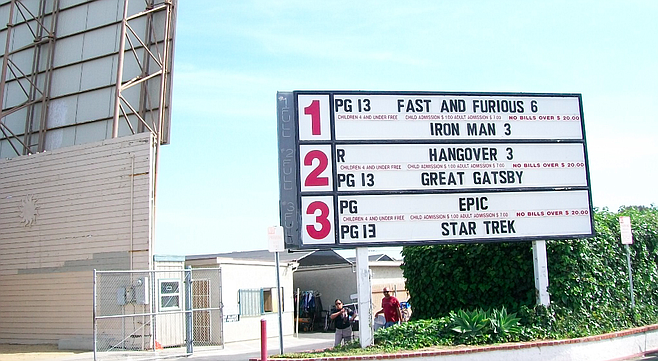
The South Bay Drive-In, open since 1958 at 2170 Coronado Avenue, is one of only two San Diego drive-ins remaining in operation today. One mile north of the border and with space for up to 1500 cars, it was built on a triangular 13.2-acre site bordered on the north and east by Interstate 5.
The former farmland was another William Oldknow/Sero Amusements venture (still run today by Oldknow's company, now called De Anza Land & Leisure Corporation). Originally called the Bayview and sporting a single screen, in 1961 the theater installed a “real midget auto ride” in its playground.
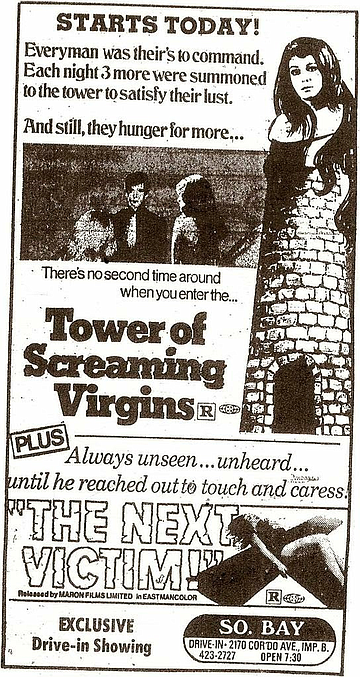
Courtesy San Diego Cinerama
In the mid-'70s, the South Bay added two more screens, both a bit smaller than the original but well landscaped into the background hills. The main screen had a black border painted around it, about three feet on all sides, so its actual picture size was about the same as the two newer screens. The entrance was restructured to include three individual ticket booths, separated on each side by paved lanes so that a total of five lanes led into the various screen lots.
Most of the speaker poles were phased out for AM sound in 1972, and then FM beginning in the early '80s (movies are currently broadcast in stereo, via FM only). The snack bar has been renovated a few times, most recently sporting a nautical theme, with the entire concession building painted blue and white and designed to resemble a ship, portholes and all. A mast rises from the center of the building.
Local legend has it that actor Matthew Modine used to work at the South Bay. "Actually, that was his father, Mark Modine, who worked for us," laughs De Anza operations manager Teri Oldknow. "That was in the '70s, and they had, like, eight kids who all grew up at the drive-in. His sister still works there to this day."
The lot was operated at the time by George Zishank and his wife Helen, who were also (with fair success, given the time period) running the Frontier Drive-In for much of the 1970s.
When I mention to Oldknow my recollection of how run-down this drive-in got in the early '80s -- with frequent gang activity, drug trade, and other scary goings-on -- she says, "I know it was bad. There were plans to sell around that time. I wasn't with the company then, but the attitude was kind of like 'We'll just let it go long enough to get a good offer and then sell it.' I started here in 1996, and that was one of my big pushes, to revive places like that and make them better than ever. If you manage a drive-in properly, you keep it fun, keep it clean, keep it safe, there'll be so much business you'll have to turn customers away
San Diego Reader reader Tony D. Metal emailed me to say “The South Bay Drive-In was always a trip. The back rows were reserved for the lowriders. Somewhat intimidating, they did draw attention. However, everyone got along. The whites and Hispanics showed mutual respect, and we were on their turf, but the drive-in was for all to enjoy. No racial barriers. We all got along very well.”
The company also runs the six-screen Redwood in Salt Lake City, the four-screen Mission in Pomona, the four-screen De Anza in Tucson, and the three-screen Van Buren and three-screen Rubidoux in Riverside, California.
The De Anza company really goes all out for the Starlight Drive-In near Atlanta. This well-advertised ozone regularly hosts pop-culture conventions and car shows on its lot during the day, and frequent "Drive-In Madness" theme-athons (often with live band performances) run all night long. "We had [exploitation filmmaker] Dave Friedman there last year for Blood Feast," Oldknow says. "His offices used to be across the street from ours in L.A., and we'd share the same screening room. We can get away with that at the Starlight because it's an industrial area with no neighbors but a cemetery and a landfill. We can't do adventurous stuff like that at the South Bay because we're surrounded by residential properties. Neighborhood people are going to complain no matter what you do, so we're reluctant to have that kind of programming there. I'd like to, though, maybe timed around the Comic-Con."
The South Bay has done events such as all-night Monsteramas, "Bloodsucker Film Festivals" with back-to-back vampire films, an "All-Beatles" program, and even occasional daytime concerts, though this sort of cult-inclined programming faded out by the late '70s.
A swap meet has run on the lot since April 1977, operated by the drive-in's owners rather than being leased out as at other area ozones. It appears to have been the area's third drive-in swap meet (Midway began leasing to Monte Kobey's swap meet the previous summer, and the Valley Drive-In held an Oceanside flea market as far back as 1971). "That's why the South Bay survived," says Oldknow. "There was that early recognition of how to turn daytime use into profits on the property. There's no overhead for a swap meet, whereas we're paying 50 percent of our box office take to the studio for movies. Swap meets were the only thing enabling most drive-ins to survive the '80s. We're charging money for parking spaces and keeping all the proceeds...this was so profitable that it would be difficult for other businesses to compete for the property."
In 1986, the Swap Meet on the South Bay lot was the only area Meet to operate on Wednesdays. This created a big problem with the ozone's neighbors, who said the parking shortage resulted in vehicles overrunning the entire area, often blocking driveways or even parking on people's lawns. Swap Meet attendance was said to be from 3,500 to 5,800 patrons every Wednesday.
By mid-January 1987, things hadn’t improved. The City Planning Commission actually voted to suspend the Wednesday meets, but the City Council overturned the decision and offered De Anza one more chance. "If you don't clean up your act in three months, you're not going to get your permit," Mayor O'Connor quoted saying in the January 14 Union-Tribune.
Police Commander Jim Sing noted that ticketing on Wednesdays was three times higher than other days, and that some customers spent Tuesday night sleeping in their vehicles on the neighborhood streets. "I think they'll never be able to fix some of the problems," said Sing. “They [patrons] don't pay any attention to the traffic laws.”
Angry ozone neighbor Sue Martin dramatically told the City Council "I pray every Wednesday night and thank the Lord that I still have my child alive."
"We've taken a lot of steps to improve this," Stephen L. Pentoney, secretary-treasurer for De Anza Land and Leisure Corporation told the Union-Tribune. De Anza began offering lower admission prices to patrons who parked in the theater lot instead of outside on city streets. They also built a wall to keep patrons out of the Meet until 7 a.m., allowing the parking lot to open 45 minutes earlier and thus cutting down on parked cars backing up outside the facility at sunrise. Barricades were also erected, to detour traffic away from neighborhood streets, with six hired security guards to redirect traffic.
De Anza also got Swap Meet exhibitors and patrons to mount a write-in campaign to Save the Swap Meet. In addition, they distributed pamphlets called "It's Your Last Chance to Save the Swap Meet," with a list of "dos and don'ts" about parking and driving on neighborhood streets. These efforts resulted in De Anza's "conditional use permit" being extended to cover the Wednesday events.
By 1999, the South Bay’s swap meet had become a local institution, praised by all but a few occasionally unhappy neighbors. Oldknow estimates that the meet brought in around $1 million dollars annually, while the land beneath the theater lot was worth around $8 million.
The main screen number one at the South Bay blew down during the early 2003 winter storms and had to be replaced that spring, at a cost of around $60,000. In summer 2005, a new Technalight installation was done on the projectors for all three South Bay screens. "That increased the picture brightness from five to nine times brighter," says Oldknow, "so it's as bright as any indoor screen now." Open seven nights a week, 52 weeks a year (admission $6 per person, children nine and under free), it may be the only drive-in in the U.S. to serve menudo.
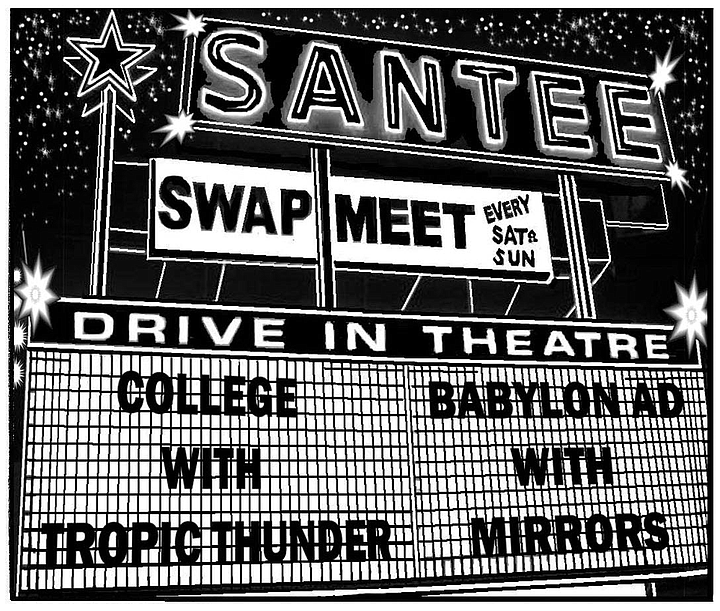
The Santee Drive-In at 10990 North Woodside Avenue remains open today, still operated by the same family that built it in 1958, James and Patti Henry, along with sometime partner Joe Crowder (who has also owned drive-ins in Escondido and Oceanside).
In 1961, the Santee was only charging $1.50 per carload, boosting attendance through 1963. A playground with a merry-go-round, swingsets, and monkey bars used to sit in the grass area beneath the screen, until rising insurance rates forced owners to remove all the equipment. Lawnchairs lined up in front of the screen were also removed, possibly to discourage pedestrian gate crashers, but also eliminating the need to landscape that part of the lot quite so meticulously.
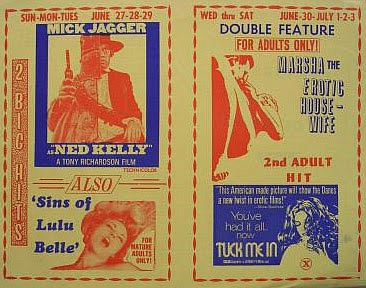
By 1973, fortunes had downturned and the theater was screening X-rated triple features. That year, a second screen was added; for a time, features like Last House on the Left and Ned Kelly would show on one screen, while porn unspooled on the other. For a short time, there was even a drive-in church service on the lot every Sunday, while sex flicks screened at night, making for quite the eye-catching marquee.
A daytime swap meet has run on the lot since July 1982 (at the time, the Henrys formed a separate corporation to run this endeavor, but it's now owned by a separate unconnected party). The swap meet's current operators feature monthly shows themed for ham-radio enthusiasts and sports-equipment traders.
In 1986, four large banks of high-intensity floodlights were installed at nearby Santana High School’s football stadium, to illuminate the playing field at night. This affected the clarity of movies projected on both Santee screens, resulting in the drive-in filing a $10,000 claim against the Grossmont Union High School District in early 1991. The field is around three-quarters of a mile from the drive-in, whose screens are visible from the stadium bleachers.
“The frequency of [outdoor field] use has increased dramatically in the last year,” said Santee lawyer James Sternberg. “At first, they used it just for football. Now, they're using it for all kinds of things.”
With two 1.85:1-ratio screens facing each other and room for 700 cars, it's open seven nights a week and at this writing charges $6 per person. The last time I attended, there were still two rows of speakers on poles, and films were also broadcast in FM sound, though I understand the speakers have now been removed. The orange-painted bathrooms can be a little dicey, but their snack-bar food is surprisingly edible and affordable.
Santee employees say they still have to be vigilant about gate-crashers. "When we see them going over a fence, we wait until they get to a car and kick them all out," says assistant manager Matt Jarbo. "Nobody comes in the trunk anymore. From the ticket booth, I call in the license numbers of any cars with a single driver. We'll have a security guard walk past, see if the driver's the only one in there. If not, we walk up and talk to them. Sometimes they'll say, 'I lost my receipt, we came together' and get all belligerent. We just step away and say, 'You're trespassing, we can call the sheriff,' and they usually just leave."
Santee co-owner Mike Long said "There's a big dent in the fence from somebody we kicked out. They came around the corner and just rammed the fence and left. They even tried to run me and Little Jeff over. We jumped up on the curb as they zoomed on past. I think they did more damage to their car than the fence."
I recall arriving early at the Santee on April 20, 1999, I think for a showing of Jawbreaker. The staff was used to seeing me stake out a speaker pole near the front rows, where I'd sit with the convertible top down and usually work on whatever drawing or writing project had been due the previous weekend.
On this visit, it was still daylight, and the speakers near the screen and alongside the snack bar broadcast a local oldies station. Several other early arrivals were playing the music along in their cars, so the whole lot echoed and reverberated to the same sounds, coming from all directions at once, a multisourced auditory experience only attainable on certain drive-in lots, right about at twilight.
Suddenly, the music was interrupted by an all-too-detailed breaking news report on the Columbine school shootings.
I remember looking around and seeing everyone on their own individual little auto islands, everybody pale and still, nobody speaking or moving for what seemed like several moments. Then children started crying, a slowly rising cacophony as the stillness was broken and parents tried various ways to comfort their increasingly upset charges. I just happened to catch the eye of a guy in the car two spaces down from me, also attending alone; even as I saw his face was glistening with tears, I realized he was staring at my own wet face.
It was an extraordinary shared moment, just before crisis-management kicked in and everyone tried to pull themselves together a bit. That twilight, I overheard hushed bits of many sobering conversations, especially coming from cars containing young kids. Several vehicles just up and left after the news report.
A more upbeat group experience occurred when Herbie: Fully Loaded was released in 2005. Bug owners swarmed the Santee lot in droves, beginning midafternoons and eventually covering nearly every square inch of drive-in pavement for two consecutive sold-out weekends. Transformed into a convention-hub for area Volkswagen fans of all ages, the Santee also brought in a replica Herbie car, which was popular for family photo ops (an enterprising photog was usually onsite with a Polaroid, charging $2 per pic).
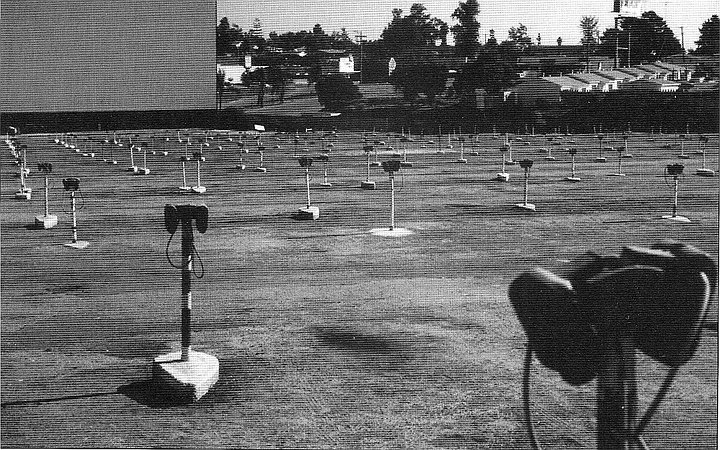
Ace circa 1983, courtesy Lemon Grove Historical Society
The Ace Drive-In on 8015 Imperial Avenue in Lemon Grove appears to have been one of the latter ozones constructed in San Diego, not turning up in The International Motion Picture Almanac until the 1969 edition. Owned by Eldorado Theatres, the Ace had a vehicle capacity of 900, with its entrance on Broadway. For a short while, a rolling concession cart delivered snacks and drinks to vehicle owners not inclined to make the trip to the snack bar.
In the early ‘60s, the Ace became known as one of the main local hangouts for teenagers, particular those often branded by the press as “juvenile delinquents.” In 1961, an all night show featuring a half dozen teen films – including Jailhouse Rock and Teen-O-Rama - was literally raided by police, who reportedly confiscated liquor, weapons, and “suspected marijuana reefers” from patrons.
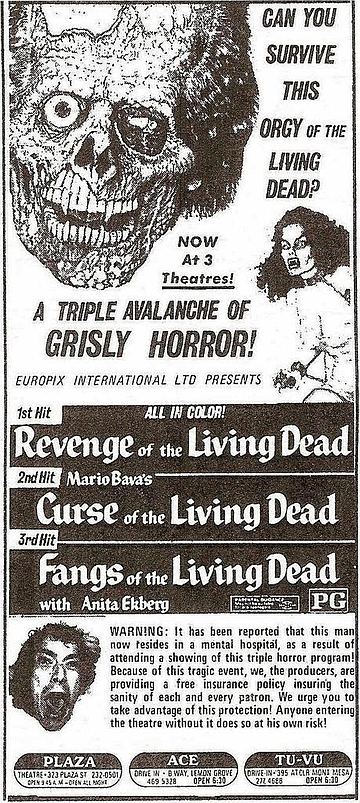
Below ad from early 3-15-62 touts a “horr-o-rama” bill featuring a four-pack with Blood & Roses, Cyclops, Giant Behemoth, and The Mask (“free 3D viewers”), all for $1.25 per carload.
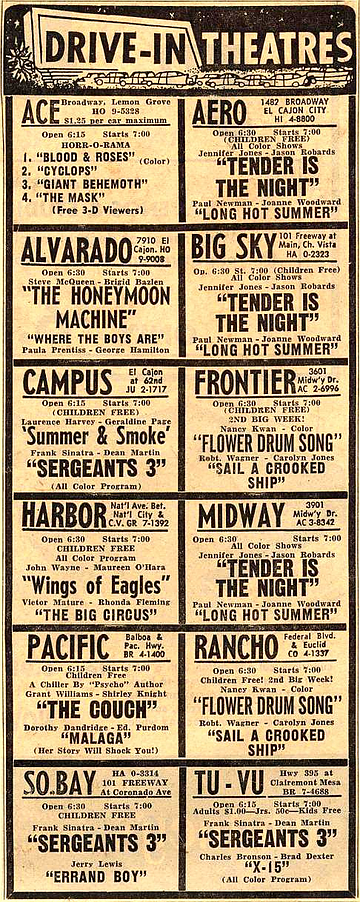
In 1963, an admission special of $1.25 per carload was implemented – the Campus Drive-in countered with a $1.24 special, including giving free admittance to kids under 12.
In 1969, admission at the Ace was $3.00 per carload, solidifying its niche as the premier area spot for teen gatherings, and the price was lowered further in 1973 to $2.00 per car (it rose again in 1975, to $2.50 per). By that time, the theater was known for endless kung fu triple features and "head" flicks like The Nine Lives of Fritz the Cat, The Groove Tube, Zardoz, and The Kentucky Fried Movie.
It was also known for employees willing to turn a blind eye to cars arriving filled with liquor-laden teenagers and stoners reeking like Tommy Chong's beard. Locals had a saying at the time: "The Ace is the place to space." By 1979, the admission price had gone up to $3.00 per carload.
In 1986, the land beneath the Ace was owned by Oral Carpenter, while the theater itself was owned by Bill Russo, who leased the property for 30 years. "Drive-ins are like dinosaurs," Russo told the Union-Tribune. "I've already gotten out of eight others in the county." Shortly thereafter, the land was sold to Jack Guttman, of Guttman Construction.
The last movies screened in November 1986 were King Kong Lives and The Wraith. The 7.6-acre parcel of land at the northeast corner of Broadway and Grove Street later became home to the Village Grove apartment complex, built by Guttman at a cost of around $8 million dollars and featuring 161 rental apartments.
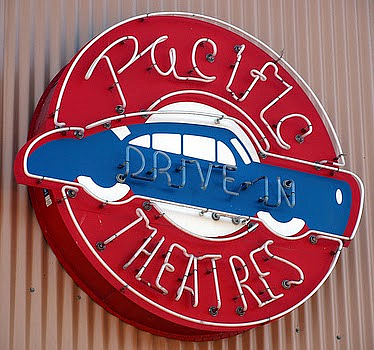
The Pacific Drive-In, located on Mission Bay Drive, north of Bluffside Avenue, shouldn't be confused with San Clemente's drive-in of the same name. Though the corporation listed as owning this ozone was based in National City, it was actually operated by Pacific Theatres, founded by William Foreman, who got his start in Seattle operating several walk-in theaters before moving to L.A. in 1937 to open California's first drive-in, the Pico (at the time, the fourth drive-in in the nation). Pacific eventually ended up running around a hundred ozones.
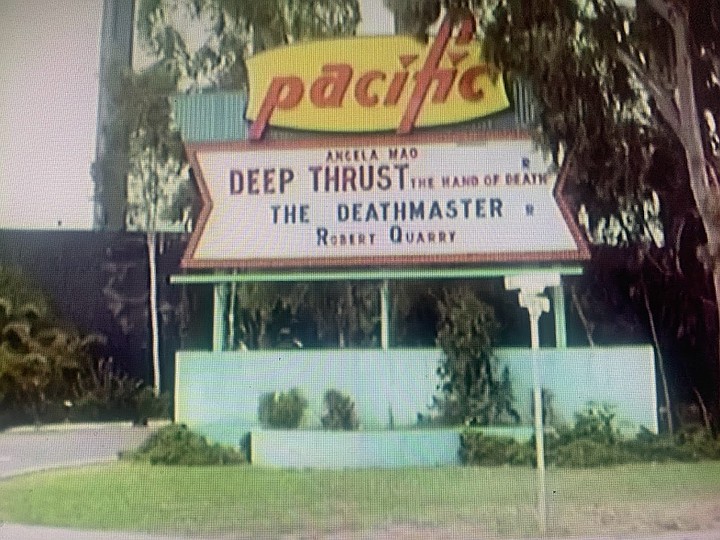
In 1969, "There were three main families running most of the outdoor screens," says Teri Oldknow at De Anza. "There was us [as Sero], the Edwards family, and then there were the Foremans [Pacific]. The three basically controlled the exhibition business and the way things went, right down to whether or not theaters would go along with the studio on things like widescreen and 70 millimeter."
In 1973, The Poseidon Adventure played for 21 weeks at the Pacific. In 1976, the Pacific was one of only three local ozones equipped for showing 70mm films (they screened Logan's Run in 70mm beginning June 23, though the print had a mono soundtrack).
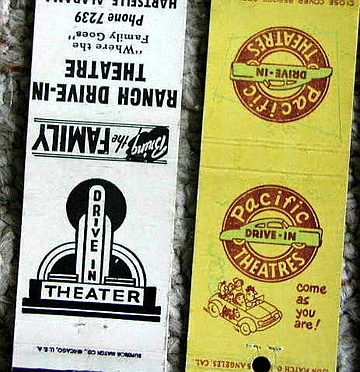
The Pacific's snack bar sold a unique concoction still fondly remembered by locals -- an entire pizza (one dollar) with mozzarella, cheddar cheese, and jalapeño toppings.
The drive-in was torn down in 1980. In 1985, Jack Guttman and his Guttman Construction Inc. built the $10 million Bella Pacific project on the former ozone lot, featuring 120 “condominium-grade” apartments.
Guttman also built the $8 million Village Grove project on the old Ace Drive-in lot, featuring 161 rental apartments, earning him an ominous nickname on several cinema aficionado websites: “The Ozone Killer.”
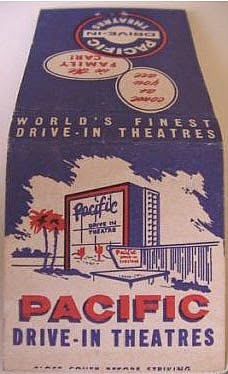
"I think we may have tried a flea market on the [Pacific Drive-In] site," says Jay Swerdlow, executive vice president of Pacific Theatres, "but chances are we just got a purchase offer that was too good to resist and we unloaded it. Some properties pay off as land investments ten times more than they could ever pay off as an operating business. At that time, nothing we could have done on that piece of real estate could have equaled the value of selling."
In 1997, Pacific built a 14-screen multiplex in Claremont (the Town Square 14), and the 15-screen Gaslamp Theaters. Pacific today operates about 400 hardtop screens, including theaters in La Mesa (Grossmont Center's Stadium 10 and Trolley 8), and elsewhere in San Diego. The company has all but given up on the drive-in business.
The Escondido Drive-In opened July 6, 1950 on the southwest corner of Escondido Boulevard, at 427 Grant (later 755 West Mission), screening The Boy From Indiana for 50 cents per patron.
The lot only fit 325 cars, miniscule by ozone standards. The family of owner and operator Dan Johnston had been running theaters in the area since before World War II - when this ozone opened, they also ran Escondido’s Pala and Ritz theaters, which were only a block apart on Grand.
Future Escondido mayor Wil Mason was one of the drive-in's original employees. "My main job was to check the trunks of cars for kids sneaking in," he told the Union-Tribune (1-25-04).
During its debut 1950 season, the Escondido Drive-in hosted political stumper Richard Nixon, whose California campaign included stops at several other ozones, but no others in San Diego. Since there was no footer "stage" constructed in front of the screen, Drive-in Dick stood up on a car to address the rally.
“That [drive-in] was there up through the mid-'60s,” recalls longtime Valley Center resident Jim Quisquis. “I believe that the property was owned by Einer. Einer Brothers Construction was on the northwest corner. And it was a fort-like structure. It had telephone poles and fence all the way around it, so it looked just like a fort.”
In 1962, pastor Richard Huls began holding Sunday church services on the theater lot. Two years later, he installed drive-in style speakers in the back parking lot at nearby Community Reformed Church on Felicita Avenue, where he continued the drive-up church services all the way into the next millennium. Owner Dan Johnson’s son Jeff began working the concession stand in 1964, at the age of 16.
This theater moved to 755 West Grant in 1966, losing 25 car spaces in the process. The old locale was eventually occupied by a DMV office.
The Escondido Drive-In at 755 West Grant (later 635 West Mission Avenue) opened in the 1966 with a single 8,400 square foot screen and room this time for around 500 cars. Through the 1970s, this ozone offered better-than-average outdoor food fare, courtesy of Dan Johnson’s custom-created chicken and shrimp dinner plates. Selling upwards of 1,500 tickets wasn’t uncommon.
Eventual operator Joe Colin Crowder hung a "Closed for the Winter" sign in 1982, after a screening of Blow Out. When summer 1983 rolled around, the theater did not reopen. "Most drive-ins closed because of home video," says Crowder, "but our problem was getting a good picture. There was a lot of what you'd call 'light pollution' from nearby businesses, and then theater projection technology was basically ignoring [drive-ins] and equipment wasn't being made anymore that allowed for a nice, bright picture on outdoor screens."
The screen stayed up, however, along with around 60 speaker posts, and a successful swap meet was launched on the site in 1986. Crowder also ran swap meets at Oceanside’s Valley Drive-in and the Santee Drive-in.
He says the swap-meet business has proved too lucrative for him to give up the property. "They call us Little Tijuana. The old drive-in lot is pretty much the main gathering place for Hispanics on the weekends up here." In 1998, the swap meet went to five days a week and remained open until 11 p.m. on Fridays. A stage was built for live performances, which the City Planning department gave permission to operate until 10 p.m. in the summer and 9:30 the rest of the year.
At that time, non-reserved spots at the swap meet cost sellers $8 to $18, and reserved fees were $10 to $23, ‘pending the day of the week. Vendors could rent small, lockable storage spaces for $160 to $400 – it’s easy to see how the second-hand biz so thoroughly trumped movie exhibition.
Beginning in late 2004, the locale underwent around $10 million worth of improvements, including a large children's playground and picnic areas near the "food court," which consists of around 15 vendors on any given weekend afternoon. The swap meet (incorporated October 1999) has been periodically raided by immigration officials rounding up suspected undocumented workers, but otherwise managed to avoid the kind of civic embattlement that swap meets at the Harbor and Valley drive-ins faced.
Other than from residents of the Village Grove Apartments, across the street from the theater, who filed numerous complaints with the city. “We like where we live” apartment manager Carol Spaziano told the Union-Tribune (7-16-99), “but my tenants don't feel safe because of the people coming out of the swap meet on weekends.”
On April 15, 2009, the Escondido Drive-In screen was torn down by AMG Demolition, after swap meet operators decided it was too expensive to repair and city officials declined to designate it "historic" enough to merit saving. "Fifty years is our rule of thumb on historical significance," the city's planning chief Jon Brindle told the North County Times (4-15-09). "It was also not a particularly unique kind of movie screen."
"It's a neat piece of the town, but it's nothing incredibly special," said Bob McQuead of Escondido's Historic Preservation Commission. "There might be something someday I will fight to preserve, but not this."
In April 2011, the Escondido City Council approved a general plan amendment to change the land-use designation of the Swap Meet property and the Reidy Creek flood-control channel, in order to (some time in the future) establish a commercial area for development.
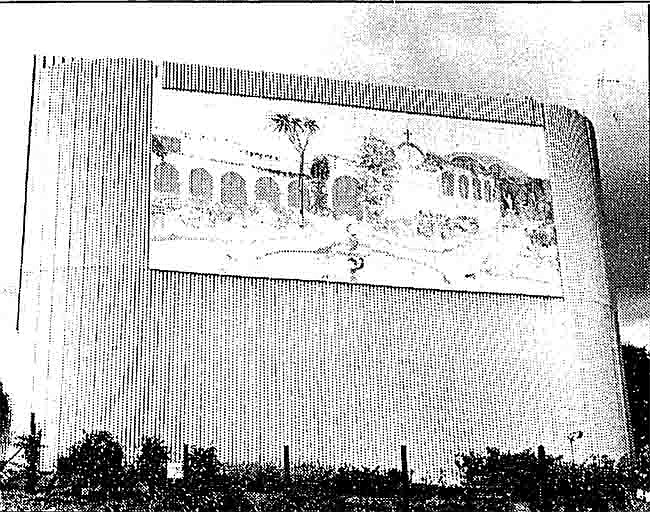
Mission Drive-in courtesy San Juan Capistrano Historical Society
The Mission Drive-In at 30002 Del Obispo Street in San Juan Capistrano was owned by William Foreman's Pacific Theatres and featured a mural of Mission San Juan Capistrano on the back of its screen, visible from the highway. Operated by Carolyn and Robert Patrick, it opened in November, 1966, with Elvis Presley in Paradise Hawaiian Style and Clint Walker in Night of the Grizzly. Admission was $1.25 for adults, $1.00 for students, and children were admitted free.
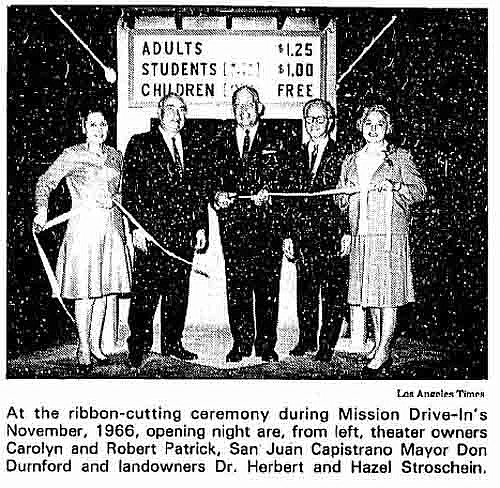
By the mid-'80s, admission was $3.75 for adults, and kids got in free. The lot was ringed by eucalyptus trees, and the speaker poles never did get replaced by radio sound, unlike at most southern California ozones.
Preacher Robert A. Schuller tried to talk the city into letting him hold church services on the Mission Drive-in lot, as his father Rev. Robert Harold Schuller had famously done in 1955 on the roof of the Orange Drive-in snack bar. However, the San Juan Capistrano City Council ruled that worship services at a drive-in constituted "inappropriate use" of the property.
“I was out in the cold with no place to go,” Robert A. Schuller recalled in his book The Power to Grow Beyond Yourself, “not even a drive-in.”
Eventually, Herbert and Hazel Stroschein - the family who owned the 7-acre property - decided to sell. The last screening took place September 8, 1985, with the featured film Return of the Living Dead. "It's going to be sad, but I'm going to help tear it down after Sunday," the Mission's assistant manager, Kim Weaver (24) told the Los Angeles Times.
Theater manager David McIntosh said "It's just a little Podunk theater," mentioning his impending transfer to another Pacific theater closer to his home in La Habra. "It's not really deserving of all the attention it's getting -- on some nights last winter, there were only 10 or 15 cars out there. You can't sustain a business like that."
Pacific Vice President Robert Selig, who opened the Mission with Mr. and Mrs. Patrick of San Juan Capistrano as partners, said the drive-in was grossing about $6,000 a week and employing 15 people on a busy night.
The lot was later occupied by a Marshalls Department Store and a Wherehouse record store.
The Vista Drive-In on Thunder Drive at Highway 78 in Vista, operated by Western Amusement Company, originally had buttons on the speakers that summoned a carhop so you could order food to be served at your car. With a vehicle capacity of only 500 (tiny, for an ozone), it appears to have opened in the early '60s. One of the theater’s most notable features was its "Moonlight Terrace," set up on an upper level and overlooking the lot and screen.
In 1972, the year Deep Throat was released, the Vista began showing adult movies, at first non-explicit R-rated fare but then actual, factual hardcore. Vista City Council member Gloria McClellan actively campaigned to get the Vista to either switch back to family movies or be shut down entirely.
"This is the first time in my life that I saw a 50-foot nudie on the screen," she told the LA Times. "It was right next to the hospital. The women's clubs, the churches, the doctors, I'm the first one they called. They saw these 50-foot nudies and said we can't have this."
In 1975 McClellan convinced a local sheriff's deputy to attempt driving onto the lot one night with his underage teen daughter in a car, along with some of her (also underage) friends. When the deputy later told the City Council about being sold tickets and admitted with no questions asked, Vista Drive-in operators quickly caved and went back to all-age screenings.
It didn't help. The Vista Drive-in closed around 1978. The site was later occupied by buildings in the Tri-City Medical Center.
The Midway Drive-In at 1831 Mission Avenue in Oceanside was not connected with the Midway near the Sports Arena, nor should it be confused with the Oceanside Drive-In or that town's other ozone, the Valley Drive-In. The Midway was operated by Robert Siegel (who with his brother owned many area movie houses, including the Siegel Brothers Theatre in Oceanside). Patrons frequent grabbed their dinner on the way in, from nearby Daisy’s (late Ranchman’s Family Restaurant) and Sambo’s (which became a Chinese buffet).
Oceanside’s Midway was apparently closed in the '60s and was demolished. A strip of stores, including a Big Bear market, was built on the location, which later became the site of the MiraCosta College Community Learning Center.
The Oceanside Drive-In on Fallbrook Road was listed in the 1948-49 Theatre Catalog as being operated by Joseph Shure and his Shure Theatres Corporation. A conflicting source indicates it was only open from 1950 through the mid-'60s.
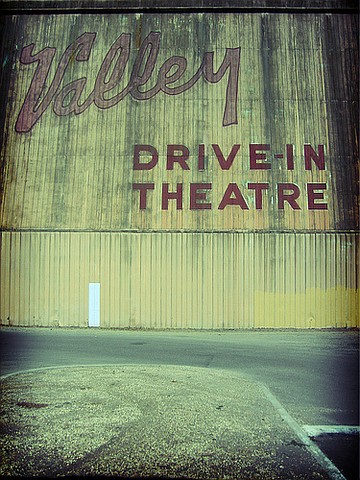
Courtesy the Speaker Post
The Valley Drive-In at 3480 West Mission Avenue in Oceanside (two miles east of Interstate 5) was among the last drive-ins to launch in Southern California. When it opened on August 24, 1966, it was called the Mission Drive-In, though the name was changed to the Mission San Luis Rey Drive-In and then the Valley Drive-in, presumably to avoid confusion with the Mission DI in San Juan Capistrano.
The opening night feature was Assault on a Queen with Frank Sinatra, backed with Marty Allen's The Last of the Secret Agents - below ad comes courtesy http://valleydrive-in.blogspot.com/ (where you can also find video clips of this ozone from 1989 and 1994):
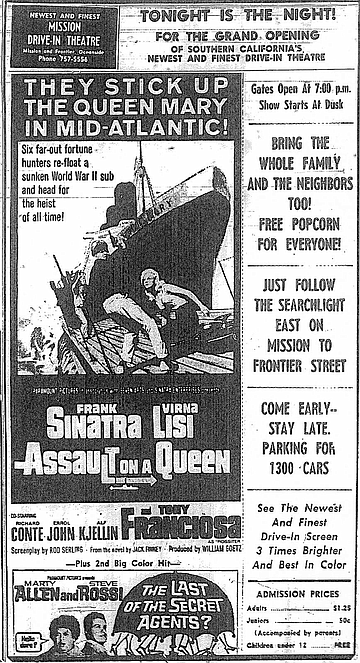
Courtesy valleydrive-in.blogspot.com/
Originally a single-screen built for 1250 to 1,300 cars, by 1968 the Valley had added a second screen, and a third and fourth were built in 1977/1978, for a total vehicle capacity of 1600. From the start, it remained open year-round. Several of the union projectionists who worked there also worked at various "hardtop" theaters around Oceanside, including the Crest, the Palomar, the Star, and the Towne.
Samuel Ramirez, with his family, has been a caretaker on the property from opening night through the current day. Ramirez recalls "We used to be cleaning up the lot until five, six in the morning. We'd find all kinds of crazy things, and then there would be homeless people jumping over the fence too."
Regarding owners John and Robert Siegel, whose family has operated theaters in Oceanside since 1934, he says "At one time, they had a theater in Coronado and they owned almost every theater in Oceanside and Escondido. The Crest, the Paramount, the Cinema Plaza; they ran any place that showed movies."
The Siegels fought many battles with Oceanside over their theater properties, all of which the city coveted. In August 1986, Valley Drive-in manager Jerry R. Beauchamp went so far as to file for a seat on the Oceanside City Council. He withdrew from the race a few weeks later, choosing to instead support candidate Paul Wick, a 50-year-old businessman who had been living in Oceanside for 25 years
By the late ‘80s, this ozone was operating with four screens and 1,600-spaces. An 8-24-87 L.A. Times article headlined “Oceanside Drive-In is Thriving While Others Fail” noted that the $4-a-car nights (Wednesday and Thursday nights) were attracting between 800 and 1,200 cars. Both evenings required a staff of around 18, including ticket sellers, popcorn poppers, register clerks, a projectionist, and several roving security guards.
“We pull in people for miles around,” manager Jerry Beauchamp was quoted saying. “You can bring a whole family in here, and it don't matter if you talk, and a carload of folks can pile in for $4…In my book, that's some kind of entertainment bonanza.”
Employee Jan Warner, who’d been minding the ticket booth since July, 1967, mentioned several ex-ozone employees going on to great things; One was a Fire Department captain, another was an Air Force officer, and one famous former usher had become "one of the country's top pilots."
Speaking of pilots, in October, 1982, a single-engine Bonanza plane taking off from the Oceanside Municipal Airport crashed northeast of the runway, close to the drive-in lot, killing the four people aboard. The proximity of the airport to the drive-in would become a prominent local issue, even/especially long after the property was screening movies.
A successful swap meet has been held on the site since 1971, eventually growing to over 1000 vendors. Junior Seau was a frequently seen fixture. Originally unlicensed (as the city didn’t require one), the swap meet became a "non-conforming use" on the commercial-zoned property under code changes enacted in 1988, bringing it in line with city requirements.
However, beginning around 1990, property owners John and Robert Siegel and swap-meet operator Joe Colin Crowder (who also ran a meet at the closed Escondido Drive-in) found their 3-day-weekly Swap Meet becoming increasingly unpopular, with both neighboring residents and city officials.
“It's really turned into a circus out there,” Planning Commissioner Bob Wilson told the Union-Tribune (June 1, 1990). "The success of this thing has become a detriment to the city and to the neighborhoods over there…It's creating a tremendous traffic problem.”
Another problem: Migrant workers were known to form impromptu brothels in the bushes and fields near the drive-in, wherein prostitutes would come in, a few mattresses were laid on the ground, and men lined up for their turns with the working women. Police raids occasionally resulted in a burst of men and women, in various stages of dress, leaping over and through the drive-in fence to run through the lot, seeking escape from whichever authorities were pursuing them.
Commissioner Wilson tied the bush shenanigans to the drive-in itself. "It's a shopping center for the riverbed [inhabitants] is what it is…This thing started out where everybody cleaned out their garages and went out there. It's just out of control up there…It's gone too far." In late 1991, two murders and two shootings were reported in the thickets behind the ozone screen buttressing the end of North Foussat Road.
In November 1991, responding to complaints of around 45 "love shacks" operating in the bushes and littered with countless used condoms and 6 foot-high heaps of beer cans, city workers spent a week using bulldozers, tractors, and chain saws to clear the land near the drive-in. This sent the estimated 300 or so weekend bush dwellers packing.
Valley manager Dan Wooten talked about the city's plan to raze the ozone for a 115 acre retail complex in 1993. "The owners recently approved certain screen and equipment repairs," he told the Union-Tribune. "We'll be here one more season if we're lucky, maybe two or three. Who knows? This is the quietest summer I've had, in the five years I've been here."
Things weren’t so quiet in the brush around this ozone, though. Despite repeated sweeps to clear out transients, residents complained that little had changed. In late summer 1994, while searching for a missing 44 year-old woman named Rebecca Ann Jensen who’d last been seen at the drive-in, police found a dead male and then, almost three weeks later, Jensen’s body was found, both of them just a few dozen feet from the theater lot. Even after several transients were charged with murder, Valley neighbors fretted that the daytime Swap Meet attracted unsavory elements into their back yards.
The Valley was becoming increasingly run-down. Especially scary was the men's room, with its sickly green walls and one long urinal trough of indeterminate color (shudder). The lot was ringed by gray and rusty sheets of corrugated metal, which were often covered with graffiti that would be covered up with messy, ugly blotches of mismatched paint. Whereas the four screens had once included 1,800 speakers, the count was down to only around 1,400, and many of those barely operated.
Road construction along Route 76 forced the owners to move the entrance on Foussat Road, which was right about where 76 ended at the time. The new entrance was a half-mile away, on the west side of the property, near Oceanside Municipal Airport. This caused countless would-be patrons to drive away after seeing the old gates boarded up, assuming the theater had closed. The Valley hadn’t enjoyed a sellout crowd in at least three years, according co-manager and resident projectionist Jud Burks, Sr.
Burks came out to North County from rural Alabama in 1956. He’d been a projectionist since screening his first movie in 1948, Abbott and Costello in The Noose Hangs High. "We used to pack 'em in here like flies," he told the Union-Tribune (5-5-96). "We didn't count the money, we just weighed it and bailed it."
The 65 year-old Burks retired in May 1996, after the drive-in cut back to screening only three nights a week. He’d managed the Valley from 1975 to 1980 and from 1989 to ‘96. His son who’d also worked at the Valley, 45 year-old Jud Burks Jr., continued to work as a projectionist at the Mann Theater 8, and at various Oceanside theaters run by the Siegal brothers, for whom the elder Burks had been working since 1956.
The Valley stopped screening movies altogether after the 1999 season, with the last admission price $4.50 per person. All four screens were left standing, and the snack bar remains today, with the original popcorn and ice machines still intact. "We used to have the posters, the ones we didn't have to send back to Hollywood," says Ramirez, "but somebody broke in and stole them all."
For awhile, owners the Siegel Brothers, were working with a developer to turn the parcel into a $150 million shopping center. However, the project never passed muster at City Hall, mostly because City planners were focused on redeveloping the downtown area.
The Valley lot and surrounding property owned by the Siegels totaled 145 acres. Around summer 2004, the City of Oceanside apparently decided the drive-in property was indeed desirable. City agencies were accused by the swap-meet company of applying pressure to break their lease and abandon the property.
Oceanside fire marshal Rob Dunham required swap-meet owners to repaint and enforce fire lanes, and to impose new restrictions on vendors. Sellers were required to use fire retardant canopies and to refrain from parking vehicles in the sales area unless their gas tanks had less than five gallons of gas and their batteries were disconnected. Even the IRS got in on the action, levying a $72,062 tax lien on Oceanside Drive-In Swap Meet operators.
In December 2004, the Oceanside City Council reported that the Siegels had agreed to sell the city a five-acre parcel of the Valley property for $3.3 million, to put up a fire station and drill wells. This small land plot was isolated from the larger theater lot by construction of the state Route 76 expressway. In January 2005, the Siegels reportedly sold the remaining Valley property for commercial development.
The Valley’s drive-in equipment was all purchased in 2007 by Seth Sonstein and Nicola Spechko of Portland Oregon, where the duo operates the Clinton Street Theater. They hope to use their Oceanside acquisitions open a new drive-in in that area.
Oceanside is building a shopping center called the Pavilion on the site at Mission Avenue and Foussat Street, in the San Luis Rey Valley. The center will reportedly contain more than 800,000 square feet of commercial space, including a 136-room hotel a health club, supermarkets, restaurants, and a multi-screen movie theater.
In late January 2009, a Cessna 172 registered to California Flight Academy in El Cajon crashed a half-mile east of Oceanside Municipal Airport, though both pilot and passenger escaped serious injury. Landing on the north side of Mission Avenue at Frontier, about 50 feet from Route 76 and the Valley Drive-in site, the plane's descent and destruction did not interrupt swap meet shopping.
By summer 2009, talks were in progress to build a new Chargers stadium on and around the old drive-in property. Thomas Enterprises, owner the 92-acre site, sent their west coast Vice President Mel Kuhnel to meet with Chargers President Dean Spanos.
However, at this writing, concerns over the proximity of the nearby airport (half a mile away) have kept the matter in civic contention.
Here's something you might be interested in.
Field of Screens: Drive-in theaters in San Diego
Field of screens

Field of Screens: Drive-in theaters in San Diego
Field of screens
San Diego's third outdoor theater, at the corner of Euclid and Federal, opened Wednesday, January 28, 1948, with a double feature of The Fabulous Texan and Exposed (photo courtesy Teri Oldknow/DeAnza)
Traffic-Trol featured spring-loaded spikes that retracted when driven over by exiting cars but shredded the tires of lgate-crashers attempting to enter the lot via the exit gates.
The first drive-in theater I snuck into in San Diego was also the first one built here, the Midway, on the northwest corner of Mission Bay Drive and Sports Arena Boulevard. It was December 1979, and I was already camping out for concert tix in the nearby arena parking lot (Frank Zappa, well worth the cold 'n' cramps). Friends held our spots while three of us went down the road to attempt sneaking into the single-screen Midway to see Star Trek: The Motion Picture, with no plan as to what we'd do once inside (I guess we assumed we could sit near a speaker pole and not be noticed).
Midway circa 1973
Dusty-yellow with occasional trees around the perimeter to help block light pollution, the Midway's sloping hollow wall proved easy enough to scale, but it made the damnedest noise as we slid down the other side, and it was obvious that half the lot was staring at us. As soon as our feet hit the pavement, some guys rolled up in a beach-buggy-style cart and hauled us off the premises to the sound of paying patrons laughing as we were wheeled past their comfy, warm cars and dropped outside the exit gate. I vowed to return as soon as I owned a car, and before long I did have a vehicle (of sorts, an old Rambler) and I was frequenting every outdoor movie screen I could find within safe driving distance of downtown (about 45 miles, given my dicey wheels). I had become a so-called "ozoner."
The Midway Drive-In was constructed in late 1947 at the intersection of Midway Drive and Sports Arena Boulevard, back when the Boulevard was still Frontier Street and Navy barracks stood on acreage later occupied by a FedMart. The Midway Drive-In Theatre Corporation was incorporated July 31, 1946, with Floyd Bernard Jr. listed as company president. Soon, Joseph Shure and his Shure Theatres Inc. bought into the drive-in, eventually owning a majority share.
Originally designed for 400 cars, the screen tower was anchored by large poles sunk into what had once been swamp grounds. It was an enclosed structure that included storage rooms and a small efficiency apartment briefly occupied by various theater employees.
The first screen was a canvas-style flat that rolled open over a scaffolding tower, and there were no individual car speakers, only bullhorn-style broadcast speakers designed by RCA Victor, a system called "Directional Sound," where three loudspeakers were mounted near the screen.
Built by Floyd Bernard, Jr., the Midway screened its first film – Body and Soul starring James Garfield -- in February 1947. Tickets were 75 cents, and Bernard was later quoted saying “We made $6,300 the very first week…that was a lot of money in those days.”
By late 1948, individual car speakers on poles protruded from cement islands sprinkling the lot. The original snack bar was a makeshift Quonset hut in front of the screen, though this was later replaced with a standard concession building, sitting in the middle of the lot, a few feet below the rest of the graded property. From that point onward, the projection booth was located on top of the concession stand. There were also bleacher-style benches for up to 200 walk-ins.
Courtesy San Diego Cinerama
Early gimmicks used to get patrons parking included free baby bottle warmers, a real-cloth diaper service, in-car heaters, a free car wash from nearby screen-ad sponsor Genie ("with the magic towel!"), whose sign was lined up alongside the Midway marquee. Later, "by-the-carload" pricing was instituted, as the Midway and several other local ozones competed to top each other's all-fer-one ticketing. The Screen tower would double as an advertising billboard for the nearby Pie Piper restaurant and a Heavenly Donuts that outlived the Drive-In itself.
John Wayne unexpectedly showed up at the Midway in either 1951 or 1952. “We were showing Hondo,” Floyd Bernard’s son Dusty told one San Diego paper (9-8-80), “and he walked right into the snack bar and started shaking hands with everybody. He was really nice to all of us.”
In 1953, theater operators Sero Amusements Company purchased 30,000 of the 110,000 outstanding shares of common stock in the Midway Drive-In Theatre Corporation.
In the mid-fifties, the entire lot was paved over, in a modernization project spearheaded by Dusty Bernard, along with assistant manager Bob Belchez. “When we finished,” he says, “we each took a car to all the speaker locations, to make sure that the view of the screen was perfect from everywhere in the lot.”
At that time, it was one of around 60 Midway Drive-Ins operating in the U.S. Theater co-owner Dusty Bernard was living in the apartment built into the screen tower itself, along with his mother and sister.
Though the Bernards still owned the Midway, Sero took over management and expanded the lot to fit around 700 cars. The company would later run the nearby Frontier Drive-In (which morphed into the Frontier Twin), the Rancho Drive-In (at Federal and Euclid), Chula Vista's Big Sky Drive-In, and other local ozones. In 1958, with Midway's stock averaging $2.82 per share, Sero had a falling out with partners at Shure and purchased their stake in the theater as well.
This eventually led to a dispute regarding dividends paid and whether they were applicable to a franchise tax assessment of $2,652.19 for the income year ending June 30, 1960. The matter was settled in May 1968 when the State Board of Equalization agreed to modify the franchise tax amount due by $1,249.
In the early '60s, the Midway enlarged its screen to 75 feet by 120 feet to better display widescreen Cinema-Scope features. Around the same time, the projection booth was outfitted for 70-millimeter film presentation (5-perforation wide gauge, with an aspect ratio of 2.20).
The first 70mm screening was King of Kings, starring Jeffrey Hunter as Jesus, beginning April 11, 1962, and shown in "Super Technirama 70." A 70mm reissue of Oklahoma! ran at the Midway beginning April 25 and attracted big crowds but, by the time Spartacus debuted in 70mm at the Midway on May 23, the city's third drive-in theater, the Rancho (opened January 1948), was also equipped for 70mm and was showing the same feature.
When MASH was screened in late June 1970, management apparently attempted a political statement by having the projectionist briefly turn off the film and instead run the audio from Lyndon Johnson's speech of March 3, 1968, in which he stated that "I shall not seek, and I will not accept, the nomination of my party for another term as your President." Customers leaning on their car horns may have been honking either in approval or complaint.
The paved lot began seeing daytime use when Monte Kobey brought his San Diego Swap Meet to the locale in 1976. The graduate of Arizona State University (with degrees in advertising and marketing) had spent nine years working for radio and television stations before being named general manager of his father-in-law's Phoenix company, Park & Swap. Reportedly, a mere 13 sellers and around 200 buyers showed up for Kobey's inaugural swap meet on the Midway lot, though it eventually grew to be the third-largest outdoor market on the West Coast, attracting around 1000 sellers and over 30,000 shoppers each week. In 1979, Kobey's Swap Meet moved to the Sports Arena parking lot, and for a time a farmer's market was run in its stead at the drive-in.
By the late '70s, the hollow walls surrounding the lot were infested with feral cats, who thrived on an even larger colony of rats, who did battle with employees over edible, drinkable, and sometimes smokable leftovers dropped all over the lot by customers.
The Midway showed its last film - That's Entertainment Part 1 - on Saturday night, September 6, 1980. Before the final screening, co-owners Dusty and Lynn Bernard held a private party on the lot, for around 400 friends and associates. A loud rock band named Metro played, while snack bar pizzas, hot dogs, burgers, and popcorn buckets were served, along with beer and wine.
Ozone operators provided cans of black spray paint for anyone who wanted to scrawl farewell messages on the wooden green walls - the Union-Tribune (9-8-80) quoted one as reading "One of my fantasies was fulfilled here 20 years ago."
Courtesy Gabriel Neeb
"We never had time to watch the movies," according to 50 year-old projectionist Bob Belchez, who'd worked at the Midway from 1965 to 1977. "We always had speakers to repair or equipment to keep up."
Dusty Bernard told reporters the Midway had just experienced its best summer season in years. “But I felt that the up-and-coming trend in drive-ins is the multi-screened theaters. At this point, we don’t have enough room to do that. I was afraid we’d become outdated, or that we’d lose our hold on the market.”
His father Floyd said “To stay competitive, you have to bid with the other theaters for films. Some of the studios today want 90 percent of the gross and a six-week guarantee minimum.”
Courtesy Gabriel Neeb
The Midway Drive-In Corporation was officially dissolved in February 1987. After being torn down, the site became home to a shopping center with a Longs Drugs, a Ralphs, and a Denny's. The area behind where the screen once stood housed a drive-through Heavenly Donuts for a while and later a Salazar's Mexican restaurant.
Courtesy Lemon Grove Historical Society
The Lemon Bowl Cinema Dine opened at the beginning of 1948, San Diego's second drive-in theater. The opening night feature Go For Broke honored the Japanese-American heroes of the 442nd Regiment.
Located on Federal Boulevard in Lemon Grove, the 1948-49 Theatre Catalog lists its original owners as C.E. Norcross, Suburban Theatres Inc. of Loma Linda, California. Ira Durham and Oliver McNeel operated the theater through 1953.
The lot included a restaurant, where everything from grilled-cheese sandwiches to seafood dinners was served, as well as pre-warmed bottles of baby formula. When patrons entered, their 25 to 50 cents got them two speakers: one to hear the movie and the other to order food, delivered for a time on electric carts that could only navigate horizontally along the lot’s flat surface aisles.
The Cinema Dine's art deco-style speakers frequently disappeared, either stolen or torn from poles by accidental drive-offs, and now trade for $50 and up on eBay and elsewhere.
The Cinema Dine was apparently one of the first area drive-ins to experiment with broadcasting film sound through AM radios in 1972, and an on-site miniature golf course was briefly advertised.
This ozone was torn down even before the nationwide atrophy of drive-ins began, to make room for access to the 94 freeway, with a portion of the property eventually housing a Toyota dealership.
Rancho Drive-In, at the corner of Euclid and Federal, featured a mural on the back of the Rancho's green screen tower which depicted a Mexican village, cacti, and a campesino with his ox cart. The ox's head moved up and down.
San Diego's third outdoor theater, the Rancho Drive-In, at the corner of Euclid and Federal, opened Wednesday, January 28, 1948, with a double feature of The Fabulous Texan and Exposed. Touted in ads as "America's Most Beautiful Drive-In Theatre," it accommodated 600 cars on 13 acres, with bench seats for around 300 walk-ins.
Its 60- x 50-foot screen was at the time one of the largest in the country, requiring 30 cubic yards of concrete to support. Over 1000 tons of rock were used to grade the property, and it took nearly seven miles of cables to furnish sound to the speakers. The lower level of the screen building housed offices and storage rooms.
The mural on the back of the Rancho's green screen tower depicted a Mexican village, cacti, and a campesino with his ox cart. Animated at night by neon, the ox's head moved up and down as the cart's wheel turned, drawing motorists like moths toward the lights.
Courtesy DeAnza
The neon portion of the mural remained in service until being condemned as a fire hazard by the city in June 1976 (due to the hot neon being too close to aging wooden signage).
Like most drive-ins of that era, the Rancho had a playground on the property, in this case right in front of the screen tower itself. This sort of setup became more rare, as society became more litigious-minded, until eventually few ozone operators could afford the liability insurance required to run a playground.
In 1955, there were seven Rancho Drive-Ins in the U.S. San Diego's Rancho was operated by the Oldknow family, whose history in film exhibition dates back to 1909. It was, in fact, the first business venture of William Oldknow, who went on to run theaters across the country (his family still runs the South Bay Drive-In, Atlanta's Starlight Drive-In, and others).
William Oldknow's grandfather had opened the third-ever U.S. movie theater. William began as an usher at L.A.'s Beverly Theatre, later becoming a doorman at the nearby Westlake before changing courses to attend Harvard Military Academy and do a tour of duty as a Navy ensign.
"When I got out of the Navy in 1946, I got into the business, too," he told the San Diego Union in October 1978. "Euclid and Federal at that time was in county territory, and one of the reasons I built there was because the city had an amusement tax on theater tickets of, I think, five percent. We didn't want to charge that. Later, the tax was repealed, so we petitioned for annexation to the city in order to get city water. Our water came from a well, and it tasted awful."
After building the Rancho, Oldknow partnered with Sero Amusements, which owned the land the Frontier Drive-In would be built on. Before long, Sero hired Oldknow as company president. "As Sero went through some restructuring, and as various partners were bought out in the '50s, he came to own the company," says William's daughter Teri Oldknow, operations manager for De Anza Land & Leisure Corporation (as Sero came to be known after 1968).
From the late '50s onward, Oldknow oversaw other local Sero properties, like the Frontier and Midway, the South Bay, the Del Mar, and Big Sky. Sero also held leases on area outdoor screens like the Aero Drive-In in El Cajon, plus Oldknow was running ozones in Pomona, Riverside, Ontario, L.A., Beaumont, Salt Lake City, and Tucson.
“In 1953 I watched my first 3D movie there,” San Diego Reader reader John66Vette emails. “It was Fort Ti with George Montgomery. We had to wear the cardboard & plastic colored lenses to be able to see the spears the Indians threw coming right at you. I really ducked.”
In 1957, the Rancho was the first local ozone to enlarge its original screen to 70´ x 130´, in order to show Cinema-Scope and other wide-screen films (the Midway Drive-In near Sports Arena soon followed). It was also the first area drive-in to display a 70mm film, with Madame debuting March 6, 1962 (Midway didn't show its first 70mm until April 11). On May 23, it "competed" with the Midway for Spartacus viewers interested in 70mm, though in reality both theaters were overseen by Oldknow and Sero.
"Cinema-Scope was really a creation of 20th Century Fox," says Teri Oldknow, "and my father's uncle-in-law was Spyros Skouras, the president of Fox, so I'm sure he talked my father into enlarging that screen and the Midway's. It was his job to convince us that Cinema-Scope and 70mm would be the next big thing." This would not prove to be the case.
Rancho circa 1973
In 1978, Oldknow sold the Rancho Drive-In for just over $1 million to a La Mesa company, Alessio Leasing Inc., which had been renting part of the property for a used truck lot (Standard Oil leased another triangular corner of the lot for a filling station that partially obscured the neon screen mural).
"That really breaks my heart," his daughter Teri says. "The Rancho was the first in a whole circuit of drive-ins we ran in California, Utah, Nevada, Arizona, and Atlanta, Georgia. I understand that, from a land-value aspect, the property was worth more to developers, but it still makes me sad."
She lays blame for the closure on several factors. "Gas prices went up in 1973, cars were getting smaller, and you had the decline of the urban single-screen theaters in favor of multiplex multiscreen theaters in the suburbs, in malls. Meanwhile, drive-ins built as cheaply as possible, 20 to 30 years ago, they're getting more and more run down. Even the elaborate old screen murals and neon, these things weren't built to last long."
William Oldknow is still alive and in the drive-in business. "Families are now watching the new shows on television," he said back in 1978, just before the Rancho was shut down. "So we decided to close. We never played X-rated films and tried to keep away from R-rated movies, although the last pictures at the Rancho are R-rated -- Cinderella and Let's Make a Dirty Movie -- because not many family motion pictures are being produced."
Cinderella was a Charles Band musical sex comedy with drive-in queen Cheryl "Rainbeaux" Smith and her "snapping pussy," while Let's Make a Dirty Movie was exactly what the title promised
The Rancho Drive-In's screen last flickered October 17, 1978. The property was later occupied by a Chevron station, a McDonald's, and a Cox Communications building.
Courtesy sandiegohistory.org
The Campus Drive-In at the corner of El Cajon Boulevard and College Avenue, and stretching to 61st Street, was a single-screen ozone originally built for 700 cars and 200 walk-ins (the seats were later removed, making room for up to 900 cars).
The Campus Drive-In Corporation was formed August 7, 1947, and the theater itself opened in August the following year, with a double feature headlined by Give My Regards to Broadway and opened by The Kansan, charging 50 cents admission and giving out free popcorn during opening week.
Sam J. Russo and Co-Op Theatres Inc. were listed as chief operators. The Russo family ran several local movie houses, including the nearby College theater (sold in the early '70s), as well as owning minority stakes in theaters operated by others, such as the Tu-Vu Drive-in.
"The Russo's company in later days was called Eldorado Enterprises," says Dan Whitehead, a longtime local projectionist since the '70s (he's worked for Walnut Properties, Edwards Cinemas, and many others).
"They were a very famous name in the San Diego movie theatre circles. They also owned the Aztec, Balboa and Casino theatres downtown. They eventually sold the Aztec to Mr. Wesley Andrews. Walnut Properties bought the Casino and purchased a lease on the Balboa. Their sister, a Mrs. Weatherby, owned the Tower theatre on West Broadway (now long gone). They also owned the Tower Bowling Alley (also on West Broadway and also long gone) which had a little tiny theatre that used a rear screen projection system."
Eldorado/Russo also opened the Ace Drive-In in Lemon Grove during the late '60s (don't worry, we'll get to that one.....).
1956 map
At the time, the Campus was one of the largest drive-in theaters on the West Coast. Signage on the back of the screen featured a 50- x 80-foot mural. Lit up at night by 1900 feet of piping installed by California Neon, it depicted a 46-foot-tall marching majorette, wearing an Indian headdress and spinning a baton that appeared to twirl as she strutted in front of a depiction of SDSU's old main building and bell-tower quadrangle, football goalposts, and mountains (one with a white S on it).
The majorette was designed by Austin Linn Gray and Joe Schmidt, two San Diegans said to have based her on a photograph of Marion Caster Heatherly Baker, head drum majorette at San Diego High School in 1943 and later a majorette for the Los Angeles Rams.
In 1956, the Campus was charging $1.00 per adult admission, 65 cents for “juniors,” and children were 35 cents.
Courtesy San Diego Cinerama
A killing took place at the Campus on December 2, 1961. Snack-bar employee Tom O'Leary got into an argument with patron Dennis O'Conner. Things got increasingly heated, and O'Leary ended up pulling a knife on the patron and stabbing him to death. O'Leary was charged with unlawful killing and was found guilty of involuntary manslaughter.
This didn't satisfy O'Conner's family, who filed a lawsuit against the Campus Drive-In Corporation, seeking damages for corporate negligence by maintaining that O'Leary committed the assault while acting in the course of his employment. The court eventually ruled that the Campus wasn't a party to the manslaughter and thus shouldn't be held liable, though appeals and motions regarding the judgment continued through 1967.
O'Connor's father Jerome O'Connor spent so much time in courtrooms that he eventually became president of the San Diego Court Watchers Association.
In 1971, the murdered man's sister, Maureen O'Connor, became the youngest person ever to be elected to the San Diego City Council. She was elected Mayor of San Diego in 1986.
The original Campus Drive-In Corporation dissolved July 8, 1975, and soon the locale was being run by Eldorado Theatres, the same corporation that had opened the Ace Drive-In in Lemon Grove during the late '60s. From the '70s onward, screenings opened with a short film that featured a rippling American flag set to "The Star-Spangled Banner." During intermissions, "Speedometer Bingo" numbers were announced over the speakers, with patrons winning snack-bar prizes when the last three digits on their speedometer matched the numbers called.
I first went to the Campus on Christmas Eve, 1979, to see Steve Martin in The Jerk, though I was still carless (and essentially homeless) at the time. I recall it as a fairly easy drive-in to sneak into, and I managed to go unmolested for about a third of the film before a theater employee noticed me sitting and shivering up against a pole in a corner of the lot.
I was making myself a peanut butter and jelly sandwich from supplies carried in a paper bag when the kid stepped up to me and started to ask me to leave. I must have looked particularly pitiful; no place to go and no family to be with on Christmas Eve, just me and my PB&J on a cold cement lot.
He shook his head like a guy who'd just seen the ghosts of his own potential Christmases past, present, and future and decided not to kick me out.
"Never mind, Merry Christmas," he said and walked away, leaving me to enjoy the rest of The Jerk (which I did enjoy -- this is a more fond than maudlin memory for me, such is my passion for ozones).
The Campus Drive-In closed in February 1983; the final two features were The Dark Crystal and a retread print (a second- or third-run film) of Dragonslayer. The theater's equipment was sold to Walnut Properties, who at the time ran downtown theaters like the Aztec, Casino, Plaza, Cabrillo, Bijou, and others. The Campus projectors and sound heads wound up in the Roxy Theater in Goleta. The lamphouses and rectifiers went to the Balboa Theater downtown and, when that house closed, they ended up in Oceanside's Star Theater.
Before the drive-in's demolition, the majorette portion of the screen mural was donated to the Save Our Neon Organization, which packed the sign in crates to store in a downtown warehouse.
In 1985, the majorette was purchased for $4000 by William J. Stone and Associates, operators of Marketplace at the Grove, off Highway 94. The neon was restored at a cost of around $200,000 by El Cajon-based Integrated Sign Associates, and the majorette was reinstalled at the Marketplace, near the Mann Theatre. After the shopping center was renovated as College Grove Center, a relighting ceremony was held March 10, 2000, reportedly attended by over 8000 people and covered by several local TV news crews.
On July 2, 2001, the operators of College Grove Center, Vestar Development Company, donated the neon landmark to a company called SOHO (Save Our Heritage Organisation). Vestar has agreed to remain responsible for financial and physical maintenance of the sign and for keeping it lit at night in the shopping center. SOHO has an easement for access and the right to remove the majorette, although there are no plans to abandon the Center. The Campus majorette has been featured in photo spreads in Time and Life, as well as in numerous books and calendars. The shopping center that replaced the drive-in uses small reproductions of the majorette in building signage.
"The Del Mar had a giant tiki sign on the entranceway that went right across the driveway."
The Del Mar Drive-In on Via de la Valle, across the street from the Del Mar Fairgrounds, opened in 1953 with space for 700 cars. Operated independently for its first two years, it was eventually run by William Oldknow and Sero Amusements, a company that hired him as president but which he'd come to own. "The Del Mar had a giant tiki sign on the entranceway that went right across the driveway," recalls Teri Oldknow, "with a giant catamaran painted with sort of tiki hatching. It was really cool."
From the start, the Del Mar decided to remain open seven nights a week, since many film studios at the time refused to provide new first-run films to theaters open weekends only. During most of the '50s, admission was $1 per carload on weekdays and 50 cents per person on weekends (children were free) -- the real profits, as at most ozones, were in the concession stand. As patron perks, they offered free baby-bottle warmers, and for a time, a "live monkey house" was advertised as being on the playground.
Sero was operating so many drive-ins that the speakers at the Del Mar and elsewhere were actually manufactured specifically for Sero and carried the company's imprint on the front of their metal casings. "We made them in Pomona with a company called Bevelite from the mid-'50s through about the late '60s," recalls Teri Oldknow. "They made the speakers for the Pacific Theatres, too."
She says few of those audio relics remain in the company's possession, though they frequently turn up on eBay and elsewhere (fetching anywhere from $10 to $100 and up for wired kits, including stand-alone poles). "You'd think, of all companies, we would have realized how just plain cool the speakers were and would have kept them, but I guess nobody ever thought something like that would end up rare and valuable."
In the early ‘70s, the Del Mar was managed by Dixie Burton, who’d moved to San Diego in 1967 to live on lot at the Midway Drive-in, which was being run by her then-husband. Burton earned national headlines in 1974, when she successfully campaigned to get her 12-year-old daughter Robyn on the Solana Beach Little League team, an almost unheard-of achievement for a girl at the time. She later became prominent in local theater by heading up San Diego Playgoers (beginning in 1978), and also helping to spearhead the campaign to save downtown’s historic Balboa Theater.
A Reader reader named MoHansen emailed to say “Dixie Burton was the mother of my friends, Laurie, Barbara, Brent and Robyn, and she used to let me in to practice driving at the drive-in on the weekend days when no one was around. The inclines were great for practicing how to go up a hill from a stop in a car with a clutch.”
After being closed for awhile, the Del Mar underwent remodeling in early 1979, reopening on Memorial Day weekend with a free open house featuring High Ballin’ and Stingray. However, despite spending over $15,000 on improvements, business failed to pick up.
In late 1979, the Oldknows announced they were selling the Del Mar Drive-In lot for commercial use. "Developers came in and built a huge sea of condominiums... it was too much money to turn down at the time," says Teri Oldknow.
In August 1984, McKellar Development of La Jolla (ranked that year at number 25 among the nation's largest developers by Building Design & Construction Magazine) began building condos on the old drive-in site.
Frontier Drive-in circa 1973
The Frontier Drive-In at 3601 Midway Drive, on the southwest corner of Midway and Kemper Street (between Rosecrans and West Point Loma Boulevard), was named for nearby Frontier Street (later Sports Arena Boulevard). Though opened in 1957, owner Sero Amusements actually bought the Frontier's land in 1941, intending to build the city's first ozone. An architect was commissioned, plans drawn, supplies purchased, and in early 1942 a building-permit application was in the works.
Then the city, facing an acute housing shortage, condemned the land in order to put up the Frontier Housing Project, subsidized in part by the U.S. government. "Sero Amusement Company expected the land to be returned immediately after the war in 1946 and started drafting new plans," William Oldknow said in an opening-day article about the Frontier in the Sentinel, a newspaper-style promo given out to opening-night attendees. "The government, however, did not release the property until May 1956."
Construction finally began that summer on a lot intended to hold up to 1600 cars, but work couldn't be completed until after August -- a local Little League team was using a school fence still remaining on the property as a batting cage backdrop. After 16 years of waiting to use his land, Sero owner William Oldknow knew better than to engender bad local PR and agreed to delay building until baseball season was over.
Meanwhile, construction superintendent Bill Post had to figure out a way to tear out the huge cement slabs that had been the housing project's floors, as well as how to dismantle the more problematic cement-encased fuel tanks. There was also an overpopulation of gophers tearing up the land, resulting in Post jokingly offering company gardener Nito Chavez a 25-cent-per-gopher bounty. Chavez came up with around 100 critter corpses, and Post had to pay $25 out of pocket for the unbudgeted expense.
Local firm Haydock Construction, with offices on Meade Avenue, graded the land to gradually rise 16 feet in elevation from the front to the rear of the theater. Capital Electric Company installed the 20 miles of underground wiring needed to power small electric lights and speakers placed on each of the 750 posts scattered over the lot, requiring over 10,000 splices and connections. An underground transformer vault in the middle channeled 12,000 volts of electric power supplied by SDG&E. The all-metal screen structure was 75 feet high, with the screen itself measuring 121 feet wide and 52 feet high, painted with a polyvinyl plastic-based paint specially designed for ultra-white ozone screens (the job required around 100 gallons, over four coats).
With two box-office entrances ("No lines!"), the Frontier Drive-In opened Wednesday, April 10, 1957, with a first-run double feature: War Drums ("Their love sparked the west's bloodiest massacre!") and Revolt at Fort Laramie ("Screaming Sioux outside...soldier killing soldier inside!"). Opening-night admission was 90 cents for adults, 50 cents for juniors (12-15), and kids under 12 were admitted free.
Movie stars Robert Wagner and Natalie Wood made opening-night appearances on a makeshift stage in front of the snack bar, alongside actor/singer James Brown (not the Godfather of Soul, but rather Lt. Rip Masters on the kids' TV show Rin Tin Tin), and Playboy's Miss January 1957, June Blair (a former Miss Huntington Beach). Second-tier stars also on-site included Karen Sharpe, May Wynn, Jack Kelly, Beverly Tyler, Joanne Barnes, and Chet Marshall.
Sero records show the celebs were flown in to Lindbergh Field, arriving at 4:30 p.m.; they later attended a post-appearance dinner party at the Mission Valley Inn. Robert Wagner, who'd made fewer than a dozen films and was working under a seven-year contract with 20th Century Fox, was presumably invited because he starred in The True Story of Jesse James, due to play the Frontier a week later, on April 17 (along with Alan Ladd's Big Land).
At the time of its launch, there were around a half-dozen Frontier Drive-Ins in the U.S. This one was planned as direct competition for the nearby Midway Drive-In, though Sero eventually bought into that theater as well. Ads touted the Frontier's Cinema-Scope screen ("Giant!") and excellent sound ("Adjust volume yourself!"), and patron perks included a bottle-warming service, free windshield towels, and a "mechanic on duty." The Half Way House Restaurant, directly across the street, often shared advertising space with the theater.
Initially, the snack bar (built by Mission Valley's R.E. Hazard Contracting and featuring 60 feet of Formica counter space) had an exclusive cola arrangement with Coke. Early ads promised quality ice cream and candy, pizza, XLNT brand tamales, chili dishes and toppings, and hot dogs that, as per Sero's chainwide policy, were always "broiled, to give them that extra special flavor." One offbeat item was described in ads as "new to San Diego...Tater Dogs, they are called, wieners wrapped in mashed potatoes and French fried. Delicious!"
A large kiddie playground with swings and slides was erected in front of the original screen, though the playsets were later taken down and replaced with hand-spun merry-go-rounds, which seemed to fall quickly into disrepair. "I think they had one of those mini-trains that kids could ride around in," recalls Teri Oldknow.
Several twilight talent shows were held on the property in the mid-'60s, including one contest advertised as "The Search for Miss Loma Portal," with a promised prize of "music lessons and gifts valued at over $100."
However, summer 1969 saw the Frontier (and the Rancho and the South Bay) experimenting with “X-rated” features, which were really fairly soft sexploitation films, as seen in below 7-24-69 ad with all three venues screening Pit Stop and Naked Angels, billed for adults only (belying William Oldknow's claim that the Rancho never showed X-rated fare).
By 1978, Sero had added a second screen and renamed it "the Frontier Twin Drive-In," cutting capacity to around 750 cars per side. This second screen was often visible to moviegoers parked up the street at the Midway. "The Twin was really successful, so not too long after that they added a third and a fourth screen, both at the same time," says Teri Oldknow. " 'Plexing to quads was really common then; it helped keep drive-ins competitive with the new multiplex mall theaters." Double and triple features were (and remain) another lure usually offered only at ozones.
Around this period, multi-feature theme shows often ran from dusk till dawn, such as all-night Planet of the Apes marathons and back-to-back horror movies. Cult movies attracted cult crowds. I recall a late-'79 showing of Roller Boogie with countless patrons attempting to navigate the lot on roller skates, finding the graded hills fairly deadly to the knees and shins, much to the hysteria of my companions and me (disco-haters one and all, we were there to see Linda Blair's skimpy outfits).
12-10-80 ad courtesy San Diego Cinerama
In the theater's final years, a deal was made with a nearby apartment building wherein a special room would be built behind the apartments with a wall-sized window facing one of the drive-in screens. Movie sound was to be piped in for a few dozen viewers seated in theater-style chairs. The apartment complex was to pay the theater $500 a month for this privilege, but it's unclear if construction on the movie room was ever completed before the Frontier shut down in September 1985.
"That sounds like something De Anza would do," laughs Teri Oldknow, "and, really, all they had to do was point the FM sound at the apartment building. There were always little side deals being made to squeeze a few extra dollars somehow."
Frontier owner De Anza tried to convince the city not to zone the property out of the drive-in biz with the "special use permit" being bandied about in the City Planning Department. "In July, we almost had the deal," De Anza chairman and drive-in pioneer William Oldknow said at the time, "but the city planning department threw the overalls in the chowder."
"The Frontier is still doing great business," manager Herbert Burton told the San Diego Union-Tribune of the 1,209-car theater. "I hate to see it close, and so do our customers." Burton said the Frontier would probably be torn down and replaced with a shopping mall by Santa Anna developer Paul Quon. The 12 acre lot sold to Quon for $9.4 million, in a deal connected to a land transfer with a property in Pasadena that was arranged by the Bank of America.
William Oldknow said "The theater makes a good return on a $3 million investment, but Quon is offering $9.4 million, through a bank in Texas. And the drive-in business is tied to an invention by Mr. Edison that's a century old, and is being superseded by other inventions." He said the South Bay Drive-in was probably still safe from closure. "We have a profitable swap meet there, and if we also work out a parking lot arrangement, the South Bay should be around for a long time."
The Frontier's final screenings took place October 17, 1985. Ironically, the final film feature on one of the Frontier's screens was Back to the Future.
A December 3, 1985, city council meeting presided over by Mayor Roger Hedgecock detailed the rezoning of what was then referred to as "Midway Mall," covering 15 acres of the Frontier Drive-In's former property. The lot was eventually occupied by a shopping center.
When the Big Sky Drive-In opened in 1955 at 2245 Main Street in Chula Vista, its car capacity of 2000 made it one of the four largest ozones in the U.S. (Los Aitos in Long Beach held 2100 while the 41 Twin in Franklin, Wisconsin, and the Twin Open Air in Oak Lawn, Illinois, were the same size as the Big Sky.)
The full-color opening night features were Howard Hughes' Son of Sinbad, along with the Randolph Scott western Rage At Dawn. The stainless steel-filled snack bar was dubbed The Sky Bar, and for years the Big Sky advertised "Always two cartoons!" A "Kiddieland" playground on the property included swings, slides, and whirls.
Courtesy San Diego Cinerama
One 1967 showing at this Sero Amusements property of The Undertaker and His Pals (motorcyclists who club women on the head to drum up business for their funeral home and diner) was advertised as having "a professional nurse on duty at all times, in case our movie gives you a heart attack."
Courtesy San Diego Cinerama
Both of the Big Sky's exit paths were booby-trapped with a device called "Traffic-Trol." This featured spring-loaded spikes that retracted when driven over by exiting cars but shredded the tires of larcenous gate-crashers attempting to enter the lot via the exit gates. These indiscriminate car-killers became staples at most area ozones, though more than one enterprising miscreant figured out that short plywood ramps placed over the spikes enabled a careful driver to cross over them.
Backside of the Big Sky
This drive-in went dark in July 1980 with two ultracool final features: The Blues Brothers and Cheech and Chong's Next Movie. The poster for that movie features the duo at a drive-in.
After closing, the abandoned snack bar became notorious as a homeless hangout, where at least one violent sexual assault occurred. An industrial park was eventually built on the property.
Courtesy San Diego Cinerama
Courtesy San Diego Cinerama
The Alvarado Drive-In at 7910 El Cajon Boulevard in La Mesa was located near Interstate 8, west of Baltimore Drive, with its entrance on the Boulevard. It's difficult to determine its opening date, as advertising for this ozone is scarce and details are hard to confirm.
A Reader reader named Leonard Pellman wrote to say "The Alvarado Drive-In was built in the early to mid 1950s. I lived at the Miles Motel, 7930 El Cajon Boulevard, from 1953 to 1957. The theatre entrance was on El Cajon Boulevard and they had to get an easement from the motel owners. In exchange for that easement, the Alvarado allowed the motel to construct a private viewing booth at the property line with two speakers in it. I clearly remember watching movies from that booth for the last couple years we lived at the motel, so it must have been built by 1955 or 1956 at the latest."
Its first appearance in the annual Theatre Guide books is 1961, listed as being operated by "Lanford & Long," with a car capacity of 900. Early on, members and supporters of the Motion Picture Projectionist Local 297 picketed the Alvarado lot because non-union help was said to be running the booth equipment. Owners eventually agreed to switch to union projectionists.
In 1968, the theater began admitting kids under 12 free, boosting attendance. By July 1969, operators had formed Alvarado Drive-In Theatre Inc. The business was purchased in January 1972 by Syufy Century Theatres Inc. of San Francisco, which ran several other indoor and outdoor California screens.
Within a few years, the Mann Theatres chain came to run this drive-in. This was a huge boon in 1973, when this ozone hosted the local debut of Disney’s re-release of Snow White and the Seven Dwarves.
Courtesy San Diego Cinerama
The Mann connection proved even more valuable in 1975, when the Alvarado was one of the few local theaters to debut the film Jaws during its opening weeks, along with Mann’s Fashion Valley 4 cinemas. In those days, it was very rare for drive-ins to screen prints of newly-released blockbusters, a lament that many ozone owners say contributed to the decline of outdoor theaters.
Courtesy San Diego Cinerama
In the late '70s, daytime Sunday church services were being held on the lot. The Alvarado appears to have closed around 1980, to be replaced by a Best market, a Godfather's Pizza, an El Torito, and other strip-mall shops.
Courtesy Bill Sheet @ the Speaker Post
The Tu-Vu Drive-In at 5535 Kearny Villa Road, as its name implies, featured two screens and a total car capacity of 650. When the Tu-Vu opened in 1958, the snack bar had 80 feet of counter space, and two large picture windows on either side allowed patrons to keep an eye on both screens while lining up for snacks and drinks.
The lot was originally run by Empire Drive-In Theatres, who leased the property and purchased the equipment. On September 30, 1958, all the drive-in's assets were transferred to the Tu-Vu Drive-In Corporation (incorporated September 22, 1958), owned by William D. Russo (listed as company president), along with a woman named Della M. Ashkins and a third party. Tu-Vu agreed to assume and pay the rental prescribed by the master lease; to assume and pay the equipment sales contract obligation, which amounted to $58,652.10; to pay into escrow the sum of $23,840, which was to be used to pay Empire's creditors in full; and to pay $6160 toward additional construction work.
Courtesy San Diego Cinerama
Tu-Vu took possession of the theater, operated it and paid the prescribed rental (amounting to approximately $32,000; it paid between $30,000 and $35,000 on the conditional sales contract), and deposited about $30,000 into escrow.
By 1961, the Tu-Vu was packing the lot with $1 adult admission, juniors for 50 cents, and kids admitted free.
However, the Tu-Vu's partnership dissolved into several lawsuits. At the time of Tu-Vu Drive-In Corp. v. Ashkins (61 C2d 283), plaintiff Russo owned 54 percent of the Tu-Vu Drive-In Corporation stock, defendant Ashkins owned 39 percent, and a third party owned 7 percent. The corporation, by the written consent of Russo as majority stockholder, had adopted a bylaw in 1960 stipulating that Tu-Vu shares could only be transferred to an outsider if the owner of those shares first offered them to the other shareholders, at the same price and under the same terms.
On December 7, 1960, Russo obtained an option to purchase Ashkins' stock. Russo relinquished the option on January 7, 1961. Tu-Vu issued new stock certificates containing the new bylaw restriction, placing the certificates in escrow on January 31 with the commissioner of corporations. Apparently, neither Russo nor the corporation ever gave Ashkins actual notice of the new bylaw. Ashkins then went out shopping for an outside buyer for her shares, apparently unaware of the new requirement to first offer the stock to Russo and their other partner.
On May 1, 1961, Ashkins granted an option to purchase her Tu-Vu stock to Sero Amusements, a competitor running several local drive-ins. Russo was upset and initiated a lawsuit against Ashkins July 20, 1961, seeking a declaratory judgment sustaining the validity of the bylaw that regulated the transfer of Tu-Vu shares. The trial court entered a judgment that Ashkins possessed a vested right to retain her shares free of restrictions upon alienation, i.e., she could sell her stock to whomever she wanted, whether or not she first offered it to fellow shareholders.
Unfortunately for Ashkins, the sale to Sero never did go through, as Sero chose not to exercise its purchase option and it expired April 30, 1963. The judgment in Ashkins' favor was later reversed, and the trial court was directed to enter judgment declaring that the bylaw in question was valid and enforceable against defendant Ashkins.
In the late ‘60s, the Tu-Vu followed the lead of other area ozones and began offering a per-car admission fee of $3.00. This was lowered further to $1.75 in summer 1969 (see below ad), $2.00 in 1972, then $2.50 in 1975, to better compete with other area drive-ins.
During its final few years, the Tu-Vu held a flea market on its grounds during daylight hours before closing for good around 1978. The Tu-Vu Drive-In Corporation was officially dissolved November 25, 1981. A Denny's and an industrial park later took up the drive-in's former acreage.
Aero Motor Vu marquee 1961
The Aero Motor Vu Drive-In at 1470 E. Broadway in El Cajon opened in 1954, independently owned by Donald Johnson. The equipment was leased from Sero Amusements and William Oldknow, who operated the drive-in for a time. Designed to fit just under 500 cars, the projection booth was built onto the snack bar and was located fairly close to the single screen, providing one of the brighter outdoor pictures in the area.
In early 1956, the Aero became perhaps the first San Diego drive-in to hold church services on the property on Sunday mornings. A "Swap Fair" began operating on the property during weekend days, starting around 1960.
For years, the Aero gave out raffle tickets with admission, distributing prizes (usually food) during intermissions, and it was among the first area ozones outfitted for AM radio sound in early 1973. Usually open only in the summer, a swap meet was run year-round on the premises beginning in 1975. This eventually caused problems with neighbors, upset over early-bird patrons who camped in their cars on the street.
Courtesy San Diego Cinerama
In 1988, screen visibility at the Aero was substantially affected by $750,000 worth of renovations done on the outdoor ball field at nearby Greenfield Junior High School. The substantial new lighting arrays allowed for nighttime Little League use of the field, but the Aero found many movies were washing out onscreen even worse than before. The theater was already having trouble getting a hold of increasingly scarce “drive-in prints” of movies, few of which were being struck any more (DI prints had a thinner emulsion, allowing them to compete with the moon and city lights).
The Navy made an offer to buy the 10-acre parcel beneath the Aero in April 1989, hoping to develop affordable apartments for 100 to 150 military families. "I, for one, welcome you to the city of El Cajon," Mayor John Reber said.
However, the land owner, Voltaire Company Limited of Del Mar, soured the Navy deal. "Our real-estate department had made contact with [the owner] a couple of times," the Navy's housing acquisition planner Mary Jane Bailey told the Union-Tribune (August 25, 1989). "For whatever reason, he decided he did not want to sell…It's dead in the water."
In 1990, the lease on the property beneath the Aero ran out, and operators were talking about closing up shop. This is when Regan Myles and his Regan Group Inc. began running the Aero, though it didn't take long for trouble to find them. The Vista-based company (which also operated the Harbor Drive-In in National City) was sued by the Union-Tribune over unpaid advertising, losing a judgment of $8645 in August 1992. The Aero lost another civil judgment in March 1993 over an unpaid loan and was required to pay $2264 to the San Diego Wholesale Credit Association.
Around the same time, Aero owner Don Johnson met with city officials to discuss the ever-growing backlog of complaints from neighbors about the weekend Swap Meet operation. Johnson hired security guards to patrol neighborhood streets and deter illegal parking, while Police accelerated enforcement of traffic regulations before and during Meets, especially along hard-hit Luke Lane. Johnson also began letting sellers into the lot at 6 a.m., an hour earlier than buyers, which alleviated some of the weekend traffic congestion at Broadway and Third Street attributed to the Meet.
City planning director James Griffin wrote in a 1993 report to City Manager Bob Acker that Johnson was "making a concerted effort to be a good neighbor…The swap meet operators routinely collect trash from around the site, they have security personnel who patrol inside and outside, and they have cooperated with the Police Department."
City support for the Aero was a major factor on August 2, 1994, when the City Council voted 4-1 AGAINST a developer’s plan to build a shopping center on the 9 acre site. Over 200 Aero neighbors had signed a petition favoring the development; one of them, John Kremensky, told the council he’d been living in the shadow of the drive-in for 30 years.
"If you don't approve this plan, that drive-in will still be standing when we're all in the ground," he told the Council.
Would-be developer Bob Cahan was unhappy to see his shopping center shot down. "He [owner Don Johnson] has a money-making operation there, and he owes nothing on the property," he told the Union-Tribune (8-4-94). "I don't see any reason for him to walk away from that."
Except the Aero wasn’t really much of a “money-making operation.” With admission set at around $5 adults, $3 kids, and $10 per carload, the theater incurred a loss of around $45,000 in summer 1997, causing the owner to announce it’d be closing, at least temporarily, in mid-September of that year. Several staffers were laid off.
In early 1999, after the owner passed away, new owners decided the damaged screen (hit hard by the previous winter's storms) wasn't worth replacing. The theater did reopen, but only briefly. On its final night, advertised in the local Union-Tribune and the Reader, the Aero offered free admission, free popcorn, and free soda to all attendees.
Only four cars showed up.
By June 1999, a crane had completed dismantling the screen, though the lot was still used for swap meets. In 2003, around 90 condo-style homes were built on the property.
Drive-In Theatre Fan Club 1999 Yearbook
The Harbor Drive-In at 3150 National Avenue (i.e., National City Avenue, near Highway 54) opened in 1949 with a single screen and built to hold 500 cars. It was operated independently for years by T.P. Huntington, whose firm Harbor Drive-In Theatres Inc. was launched January 15, 1948. The lot at 32nd and D Avenue was open through all seasons, and raffles were a popular theater tradition beginning in the late '70s.
3-15-62
Beginning in November 1974, the Chula Vista Community Church rented the Harbor lot for Sunday church services, which were advertised on the theater screen on Saturday nights with a short promotional film. The preacher's pulpit was a flatbed truck parked beneath the screen tower, with a large cross propped up behind him and potted flowers all around him. The sermon piped into cars via the pole speakers, as were devotional songs performed by a church organist, who was usually also set up on the flatbed, and a church choir seated on a set of portable folding bleachers.
Ushers carried collection plates from car to car. When it rained, parish members lined up their cars to drive slowly past the ticket booth and get their communion sacrament through a drive-up window. "It's all God's world," church elder Cora Perry told the San Diego Union-Tribune in December '86. "We just have a sky for a cathedral."
The Harbor eventually broadcast with FM sound, and the speakers were removed, causing a steady stream of complaints from neighborhood drivers claiming that movie soundtracks hijacked their car speakers while passing nearby (not to mention complaints from patrons with no FM sound in their cars, forcing them to rent a radio from the snack bar).
By the '90s, attendance at area ozones was rapidly declining, and the Harbor was hit particularly hard. In 1993, it was assessed a state tax lien of $1272, and its parent firm in Vista was still paying off thousands of dollars in outstanding advertising bills due to the San Diego Union-Tribune, which was refusing to take new advertising for the Harbor or its sister drive-in the Aero in El Cajon.
Luckily, the Harbor's owners had purchased property surrounding the drive-in lot, and this gave them space to operate a flea market that quickly grew to fill the available acreage. Theater owners used income from this endeavor to subsidize drive-in screenings long after the movies stopped generating profits.
John Marin began managing the Harbor in 1992. "I think we can stay in business forever," he told the Union-Tribune five years later (10-26-97). Marin (who also managed the Aero Drive-in, as well as owning a rotisserie chicken franchise and working as a tax consultant) tried several promotions to increase attendance at the Harbor; Giving away soda to early arrivals, holding raffles for free tickets, discounting popcorn to $4 (with free refills!), and offering a $7 per carload special on Tuesdays.
However, little or nothing was put into upkeep in and around the theater lot, however, as it had become what outdoor screen operators refer to as a "land bank," i.e., a way of keeping a piece of property extant, with minimal expenditure and for as long as possible, for the sole purpose of maximum sales value. The land itself eventually out-values any business the owners care or can afford to launch. By 2000, the Harbor had become one of the shabbier California ozones among an often-motley cadre of scarred survivors.
"The Harbor had a giant paved lot dotted with chuckholes that could swallow a Yugo," wrote Stu Megaw in the 1999 Yearbook issue of The Drive-In Theatre Fan Club magazine. "The green painted screen tower looked to be in good shape. Remnants of a playground harkened back to a simpler time before personal injury lawsuits replaced baseball as the national pasttime. Clearly someone had lived in the screen tower at one time or another. Speakers were long gone, and local graffiti artists had been at work on some of the surrounding structures, but the lot still had its charms."
In 2001, the Harbor refurbished much of the property, including a newly remodeled snack bar. A new marquee was planned to replace the increasingly tattered and whitewashed original. Tuesday nights usually boomed, thanks to the per-carload price STILL being $7, as spelled out in Christmas lights strung from the concession bar to the fence and visible from the freeway.
“The Harbor mostly showed kids' movies toward the end,” one drive-in fan emailed me. “They always gave a voucher for a free small orange soda and bag of popcorn when you paid; my son was always excited about that. The first time we went there in '98, I saw the swingset in front of the screen and walked my son over there, thinking I could push him. I freaked out, because it had junk all around it; old hanging plant holders were on it!”
“The funniest thing of all was that this banner sign used to say ‘No dogs or cats allowed,’ but - because the lot was crawling with begging cats - the word ‘cats’ was painted over! When they first did it, we laughed so hard, 'cause the cats were one of the highlights of the Harbor, if you're a cat lover, anyway!”
“Even though the place was pretty comical and most of it run-down, I had a soft spot in my heart for it. After everyone had left, I used to let my son sit on my lap and ‘drive’ us to the exit. He got a big thrill out of that. I worked the pedals and was ready to steer, but he did a pretty good job. That was our little tradition, from when he was 4 or 5 until he got too big. Actually, this is bringing tears to my eyes as I write it…”
Another big problem at the Harbor was picture quality. Clear screen projection was increasingly hampered by nearby Highway 54 and its ever-growing array of freeway lights. In addition, city officials cracked down on the swap meet operation, forcing it to close up shop in 1999.
The Harbor eventually lost a long-running battle against the nearby South Bay Drive-In and went dark around 2003, with its final feature being Spy Kids 3D. A flea market now runs on the property, for which the old drive-in space is used as a parking lot.
The South Bay Drive-In, open since 1958 at 2170 Coronado Avenue, is one of only two San Diego drive-ins remaining in operation today. One mile north of the border and with space for up to 1500 cars, it was built on a triangular 13.2-acre site bordered on the north and east by Interstate 5.
The former farmland was another William Oldknow/Sero Amusements venture (still run today by Oldknow's company, now called De Anza Land & Leisure Corporation). Originally called the Bayview and sporting a single screen, in 1961 the theater installed a “real midget auto ride” in its playground.
Courtesy San Diego Cinerama
In the mid-'70s, the South Bay added two more screens, both a bit smaller than the original but well landscaped into the background hills. The main screen had a black border painted around it, about three feet on all sides, so its actual picture size was about the same as the two newer screens. The entrance was restructured to include three individual ticket booths, separated on each side by paved lanes so that a total of five lanes led into the various screen lots.
Most of the speaker poles were phased out for AM sound in 1972, and then FM beginning in the early '80s (movies are currently broadcast in stereo, via FM only). The snack bar has been renovated a few times, most recently sporting a nautical theme, with the entire concession building painted blue and white and designed to resemble a ship, portholes and all. A mast rises from the center of the building.
Local legend has it that actor Matthew Modine used to work at the South Bay. "Actually, that was his father, Mark Modine, who worked for us," laughs De Anza operations manager Teri Oldknow. "That was in the '70s, and they had, like, eight kids who all grew up at the drive-in. His sister still works there to this day."
The lot was operated at the time by George Zishank and his wife Helen, who were also (with fair success, given the time period) running the Frontier Drive-In for much of the 1970s.
When I mention to Oldknow my recollection of how run-down this drive-in got in the early '80s -- with frequent gang activity, drug trade, and other scary goings-on -- she says, "I know it was bad. There were plans to sell around that time. I wasn't with the company then, but the attitude was kind of like 'We'll just let it go long enough to get a good offer and then sell it.' I started here in 1996, and that was one of my big pushes, to revive places like that and make them better than ever. If you manage a drive-in properly, you keep it fun, keep it clean, keep it safe, there'll be so much business you'll have to turn customers away
San Diego Reader reader Tony D. Metal emailed me to say “The South Bay Drive-In was always a trip. The back rows were reserved for the lowriders. Somewhat intimidating, they did draw attention. However, everyone got along. The whites and Hispanics showed mutual respect, and we were on their turf, but the drive-in was for all to enjoy. No racial barriers. We all got along very well.”
The company also runs the six-screen Redwood in Salt Lake City, the four-screen Mission in Pomona, the four-screen De Anza in Tucson, and the three-screen Van Buren and three-screen Rubidoux in Riverside, California.
The De Anza company really goes all out for the Starlight Drive-In near Atlanta. This well-advertised ozone regularly hosts pop-culture conventions and car shows on its lot during the day, and frequent "Drive-In Madness" theme-athons (often with live band performances) run all night long. "We had [exploitation filmmaker] Dave Friedman there last year for Blood Feast," Oldknow says. "His offices used to be across the street from ours in L.A., and we'd share the same screening room. We can get away with that at the Starlight because it's an industrial area with no neighbors but a cemetery and a landfill. We can't do adventurous stuff like that at the South Bay because we're surrounded by residential properties. Neighborhood people are going to complain no matter what you do, so we're reluctant to have that kind of programming there. I'd like to, though, maybe timed around the Comic-Con."
The South Bay has done events such as all-night Monsteramas, "Bloodsucker Film Festivals" with back-to-back vampire films, an "All-Beatles" program, and even occasional daytime concerts, though this sort of cult-inclined programming faded out by the late '70s.
A swap meet has run on the lot since April 1977, operated by the drive-in's owners rather than being leased out as at other area ozones. It appears to have been the area's third drive-in swap meet (Midway began leasing to Monte Kobey's swap meet the previous summer, and the Valley Drive-In held an Oceanside flea market as far back as 1971). "That's why the South Bay survived," says Oldknow. "There was that early recognition of how to turn daytime use into profits on the property. There's no overhead for a swap meet, whereas we're paying 50 percent of our box office take to the studio for movies. Swap meets were the only thing enabling most drive-ins to survive the '80s. We're charging money for parking spaces and keeping all the proceeds...this was so profitable that it would be difficult for other businesses to compete for the property."
In 1986, the Swap Meet on the South Bay lot was the only area Meet to operate on Wednesdays. This created a big problem with the ozone's neighbors, who said the parking shortage resulted in vehicles overrunning the entire area, often blocking driveways or even parking on people's lawns. Swap Meet attendance was said to be from 3,500 to 5,800 patrons every Wednesday.
By mid-January 1987, things hadn’t improved. The City Planning Commission actually voted to suspend the Wednesday meets, but the City Council overturned the decision and offered De Anza one more chance. "If you don't clean up your act in three months, you're not going to get your permit," Mayor O'Connor quoted saying in the January 14 Union-Tribune.
Police Commander Jim Sing noted that ticketing on Wednesdays was three times higher than other days, and that some customers spent Tuesday night sleeping in their vehicles on the neighborhood streets. "I think they'll never be able to fix some of the problems," said Sing. “They [patrons] don't pay any attention to the traffic laws.”
Angry ozone neighbor Sue Martin dramatically told the City Council "I pray every Wednesday night and thank the Lord that I still have my child alive."
"We've taken a lot of steps to improve this," Stephen L. Pentoney, secretary-treasurer for De Anza Land and Leisure Corporation told the Union-Tribune. De Anza began offering lower admission prices to patrons who parked in the theater lot instead of outside on city streets. They also built a wall to keep patrons out of the Meet until 7 a.m., allowing the parking lot to open 45 minutes earlier and thus cutting down on parked cars backing up outside the facility at sunrise. Barricades were also erected, to detour traffic away from neighborhood streets, with six hired security guards to redirect traffic.
De Anza also got Swap Meet exhibitors and patrons to mount a write-in campaign to Save the Swap Meet. In addition, they distributed pamphlets called "It's Your Last Chance to Save the Swap Meet," with a list of "dos and don'ts" about parking and driving on neighborhood streets. These efforts resulted in De Anza's "conditional use permit" being extended to cover the Wednesday events.
By 1999, the South Bay’s swap meet had become a local institution, praised by all but a few occasionally unhappy neighbors. Oldknow estimates that the meet brought in around $1 million dollars annually, while the land beneath the theater lot was worth around $8 million.
The main screen number one at the South Bay blew down during the early 2003 winter storms and had to be replaced that spring, at a cost of around $60,000. In summer 2005, a new Technalight installation was done on the projectors for all three South Bay screens. "That increased the picture brightness from five to nine times brighter," says Oldknow, "so it's as bright as any indoor screen now." Open seven nights a week, 52 weeks a year (admission $6 per person, children nine and under free), it may be the only drive-in in the U.S. to serve menudo.
The Santee Drive-In at 10990 North Woodside Avenue remains open today, still operated by the same family that built it in 1958, James and Patti Henry, along with sometime partner Joe Crowder (who has also owned drive-ins in Escondido and Oceanside).
In 1961, the Santee was only charging $1.50 per carload, boosting attendance through 1963. A playground with a merry-go-round, swingsets, and monkey bars used to sit in the grass area beneath the screen, until rising insurance rates forced owners to remove all the equipment. Lawnchairs lined up in front of the screen were also removed, possibly to discourage pedestrian gate crashers, but also eliminating the need to landscape that part of the lot quite so meticulously.
By 1973, fortunes had downturned and the theater was screening X-rated triple features. That year, a second screen was added; for a time, features like Last House on the Left and Ned Kelly would show on one screen, while porn unspooled on the other. For a short time, there was even a drive-in church service on the lot every Sunday, while sex flicks screened at night, making for quite the eye-catching marquee.
A daytime swap meet has run on the lot since July 1982 (at the time, the Henrys formed a separate corporation to run this endeavor, but it's now owned by a separate unconnected party). The swap meet's current operators feature monthly shows themed for ham-radio enthusiasts and sports-equipment traders.
In 1986, four large banks of high-intensity floodlights were installed at nearby Santana High School’s football stadium, to illuminate the playing field at night. This affected the clarity of movies projected on both Santee screens, resulting in the drive-in filing a $10,000 claim against the Grossmont Union High School District in early 1991. The field is around three-quarters of a mile from the drive-in, whose screens are visible from the stadium bleachers.
“The frequency of [outdoor field] use has increased dramatically in the last year,” said Santee lawyer James Sternberg. “At first, they used it just for football. Now, they're using it for all kinds of things.”
With two 1.85:1-ratio screens facing each other and room for 700 cars, it's open seven nights a week and at this writing charges $6 per person. The last time I attended, there were still two rows of speakers on poles, and films were also broadcast in FM sound, though I understand the speakers have now been removed. The orange-painted bathrooms can be a little dicey, but their snack-bar food is surprisingly edible and affordable.
Santee employees say they still have to be vigilant about gate-crashers. "When we see them going over a fence, we wait until they get to a car and kick them all out," says assistant manager Matt Jarbo. "Nobody comes in the trunk anymore. From the ticket booth, I call in the license numbers of any cars with a single driver. We'll have a security guard walk past, see if the driver's the only one in there. If not, we walk up and talk to them. Sometimes they'll say, 'I lost my receipt, we came together' and get all belligerent. We just step away and say, 'You're trespassing, we can call the sheriff,' and they usually just leave."
Santee co-owner Mike Long said "There's a big dent in the fence from somebody we kicked out. They came around the corner and just rammed the fence and left. They even tried to run me and Little Jeff over. We jumped up on the curb as they zoomed on past. I think they did more damage to their car than the fence."
I recall arriving early at the Santee on April 20, 1999, I think for a showing of Jawbreaker. The staff was used to seeing me stake out a speaker pole near the front rows, where I'd sit with the convertible top down and usually work on whatever drawing or writing project had been due the previous weekend.
On this visit, it was still daylight, and the speakers near the screen and alongside the snack bar broadcast a local oldies station. Several other early arrivals were playing the music along in their cars, so the whole lot echoed and reverberated to the same sounds, coming from all directions at once, a multisourced auditory experience only attainable on certain drive-in lots, right about at twilight.
Suddenly, the music was interrupted by an all-too-detailed breaking news report on the Columbine school shootings.
I remember looking around and seeing everyone on their own individual little auto islands, everybody pale and still, nobody speaking or moving for what seemed like several moments. Then children started crying, a slowly rising cacophony as the stillness was broken and parents tried various ways to comfort their increasingly upset charges. I just happened to catch the eye of a guy in the car two spaces down from me, also attending alone; even as I saw his face was glistening with tears, I realized he was staring at my own wet face.
It was an extraordinary shared moment, just before crisis-management kicked in and everyone tried to pull themselves together a bit. That twilight, I overheard hushed bits of many sobering conversations, especially coming from cars containing young kids. Several vehicles just up and left after the news report.
A more upbeat group experience occurred when Herbie: Fully Loaded was released in 2005. Bug owners swarmed the Santee lot in droves, beginning midafternoons and eventually covering nearly every square inch of drive-in pavement for two consecutive sold-out weekends. Transformed into a convention-hub for area Volkswagen fans of all ages, the Santee also brought in a replica Herbie car, which was popular for family photo ops (an enterprising photog was usually onsite with a Polaroid, charging $2 per pic).
Ace circa 1983, courtesy Lemon Grove Historical Society
The Ace Drive-In on 8015 Imperial Avenue in Lemon Grove appears to have been one of the latter ozones constructed in San Diego, not turning up in The International Motion Picture Almanac until the 1969 edition. Owned by Eldorado Theatres, the Ace had a vehicle capacity of 900, with its entrance on Broadway. For a short while, a rolling concession cart delivered snacks and drinks to vehicle owners not inclined to make the trip to the snack bar.
In the early ‘60s, the Ace became known as one of the main local hangouts for teenagers, particular those often branded by the press as “juvenile delinquents.” In 1961, an all night show featuring a half dozen teen films – including Jailhouse Rock and Teen-O-Rama - was literally raided by police, who reportedly confiscated liquor, weapons, and “suspected marijuana reefers” from patrons.
Below ad from early 3-15-62 touts a “horr-o-rama” bill featuring a four-pack with Blood & Roses, Cyclops, Giant Behemoth, and The Mask (“free 3D viewers”), all for $1.25 per carload.
In 1963, an admission special of $1.25 per carload was implemented – the Campus Drive-in countered with a $1.24 special, including giving free admittance to kids under 12.
In 1969, admission at the Ace was $3.00 per carload, solidifying its niche as the premier area spot for teen gatherings, and the price was lowered further in 1973 to $2.00 per car (it rose again in 1975, to $2.50 per). By that time, the theater was known for endless kung fu triple features and "head" flicks like The Nine Lives of Fritz the Cat, The Groove Tube, Zardoz, and The Kentucky Fried Movie.
It was also known for employees willing to turn a blind eye to cars arriving filled with liquor-laden teenagers and stoners reeking like Tommy Chong's beard. Locals had a saying at the time: "The Ace is the place to space." By 1979, the admission price had gone up to $3.00 per carload.
In 1986, the land beneath the Ace was owned by Oral Carpenter, while the theater itself was owned by Bill Russo, who leased the property for 30 years. "Drive-ins are like dinosaurs," Russo told the Union-Tribune. "I've already gotten out of eight others in the county." Shortly thereafter, the land was sold to Jack Guttman, of Guttman Construction.
The last movies screened in November 1986 were King Kong Lives and The Wraith. The 7.6-acre parcel of land at the northeast corner of Broadway and Grove Street later became home to the Village Grove apartment complex, built by Guttman at a cost of around $8 million dollars and featuring 161 rental apartments.
The Pacific Drive-In, located on Mission Bay Drive, north of Bluffside Avenue, shouldn't be confused with San Clemente's drive-in of the same name. Though the corporation listed as owning this ozone was based in National City, it was actually operated by Pacific Theatres, founded by William Foreman, who got his start in Seattle operating several walk-in theaters before moving to L.A. in 1937 to open California's first drive-in, the Pico (at the time, the fourth drive-in in the nation). Pacific eventually ended up running around a hundred ozones.
In 1969, "There were three main families running most of the outdoor screens," says Teri Oldknow at De Anza. "There was us [as Sero], the Edwards family, and then there were the Foremans [Pacific]. The three basically controlled the exhibition business and the way things went, right down to whether or not theaters would go along with the studio on things like widescreen and 70 millimeter."
In 1973, The Poseidon Adventure played for 21 weeks at the Pacific. In 1976, the Pacific was one of only three local ozones equipped for showing 70mm films (they screened Logan's Run in 70mm beginning June 23, though the print had a mono soundtrack).
The Pacific's snack bar sold a unique concoction still fondly remembered by locals -- an entire pizza (one dollar) with mozzarella, cheddar cheese, and jalapeño toppings.
The drive-in was torn down in 1980. In 1985, Jack Guttman and his Guttman Construction Inc. built the $10 million Bella Pacific project on the former ozone lot, featuring 120 “condominium-grade” apartments.
Guttman also built the $8 million Village Grove project on the old Ace Drive-in lot, featuring 161 rental apartments, earning him an ominous nickname on several cinema aficionado websites: “The Ozone Killer.”
"I think we may have tried a flea market on the [Pacific Drive-In] site," says Jay Swerdlow, executive vice president of Pacific Theatres, "but chances are we just got a purchase offer that was too good to resist and we unloaded it. Some properties pay off as land investments ten times more than they could ever pay off as an operating business. At that time, nothing we could have done on that piece of real estate could have equaled the value of selling."
In 1997, Pacific built a 14-screen multiplex in Claremont (the Town Square 14), and the 15-screen Gaslamp Theaters. Pacific today operates about 400 hardtop screens, including theaters in La Mesa (Grossmont Center's Stadium 10 and Trolley 8), and elsewhere in San Diego. The company has all but given up on the drive-in business.
The Escondido Drive-In opened July 6, 1950 on the southwest corner of Escondido Boulevard, at 427 Grant (later 755 West Mission), screening The Boy From Indiana for 50 cents per patron.
The lot only fit 325 cars, miniscule by ozone standards. The family of owner and operator Dan Johnston had been running theaters in the area since before World War II - when this ozone opened, they also ran Escondido’s Pala and Ritz theaters, which were only a block apart on Grand.
Future Escondido mayor Wil Mason was one of the drive-in's original employees. "My main job was to check the trunks of cars for kids sneaking in," he told the Union-Tribune (1-25-04).
During its debut 1950 season, the Escondido Drive-in hosted political stumper Richard Nixon, whose California campaign included stops at several other ozones, but no others in San Diego. Since there was no footer "stage" constructed in front of the screen, Drive-in Dick stood up on a car to address the rally.
“That [drive-in] was there up through the mid-'60s,” recalls longtime Valley Center resident Jim Quisquis. “I believe that the property was owned by Einer. Einer Brothers Construction was on the northwest corner. And it was a fort-like structure. It had telephone poles and fence all the way around it, so it looked just like a fort.”
In 1962, pastor Richard Huls began holding Sunday church services on the theater lot. Two years later, he installed drive-in style speakers in the back parking lot at nearby Community Reformed Church on Felicita Avenue, where he continued the drive-up church services all the way into the next millennium. Owner Dan Johnson’s son Jeff began working the concession stand in 1964, at the age of 16.
This theater moved to 755 West Grant in 1966, losing 25 car spaces in the process. The old locale was eventually occupied by a DMV office.
The Escondido Drive-In at 755 West Grant (later 635 West Mission Avenue) opened in the 1966 with a single 8,400 square foot screen and room this time for around 500 cars. Through the 1970s, this ozone offered better-than-average outdoor food fare, courtesy of Dan Johnson’s custom-created chicken and shrimp dinner plates. Selling upwards of 1,500 tickets wasn’t uncommon.
Eventual operator Joe Colin Crowder hung a "Closed for the Winter" sign in 1982, after a screening of Blow Out. When summer 1983 rolled around, the theater did not reopen. "Most drive-ins closed because of home video," says Crowder, "but our problem was getting a good picture. There was a lot of what you'd call 'light pollution' from nearby businesses, and then theater projection technology was basically ignoring [drive-ins] and equipment wasn't being made anymore that allowed for a nice, bright picture on outdoor screens."
The screen stayed up, however, along with around 60 speaker posts, and a successful swap meet was launched on the site in 1986. Crowder also ran swap meets at Oceanside’s Valley Drive-in and the Santee Drive-in.
He says the swap-meet business has proved too lucrative for him to give up the property. "They call us Little Tijuana. The old drive-in lot is pretty much the main gathering place for Hispanics on the weekends up here." In 1998, the swap meet went to five days a week and remained open until 11 p.m. on Fridays. A stage was built for live performances, which the City Planning department gave permission to operate until 10 p.m. in the summer and 9:30 the rest of the year.
At that time, non-reserved spots at the swap meet cost sellers $8 to $18, and reserved fees were $10 to $23, ‘pending the day of the week. Vendors could rent small, lockable storage spaces for $160 to $400 – it’s easy to see how the second-hand biz so thoroughly trumped movie exhibition.
Beginning in late 2004, the locale underwent around $10 million worth of improvements, including a large children's playground and picnic areas near the "food court," which consists of around 15 vendors on any given weekend afternoon. The swap meet (incorporated October 1999) has been periodically raided by immigration officials rounding up suspected undocumented workers, but otherwise managed to avoid the kind of civic embattlement that swap meets at the Harbor and Valley drive-ins faced.
Other than from residents of the Village Grove Apartments, across the street from the theater, who filed numerous complaints with the city. “We like where we live” apartment manager Carol Spaziano told the Union-Tribune (7-16-99), “but my tenants don't feel safe because of the people coming out of the swap meet on weekends.”
On April 15, 2009, the Escondido Drive-In screen was torn down by AMG Demolition, after swap meet operators decided it was too expensive to repair and city officials declined to designate it "historic" enough to merit saving. "Fifty years is our rule of thumb on historical significance," the city's planning chief Jon Brindle told the North County Times (4-15-09). "It was also not a particularly unique kind of movie screen."
"It's a neat piece of the town, but it's nothing incredibly special," said Bob McQuead of Escondido's Historic Preservation Commission. "There might be something someday I will fight to preserve, but not this."
In April 2011, the Escondido City Council approved a general plan amendment to change the land-use designation of the Swap Meet property and the Reidy Creek flood-control channel, in order to (some time in the future) establish a commercial area for development.
Mission Drive-in courtesy San Juan Capistrano Historical Society
The Mission Drive-In at 30002 Del Obispo Street in San Juan Capistrano was owned by William Foreman's Pacific Theatres and featured a mural of Mission San Juan Capistrano on the back of its screen, visible from the highway. Operated by Carolyn and Robert Patrick, it opened in November, 1966, with Elvis Presley in Paradise Hawaiian Style and Clint Walker in Night of the Grizzly. Admission was $1.25 for adults, $1.00 for students, and children were admitted free.
By the mid-'80s, admission was $3.75 for adults, and kids got in free. The lot was ringed by eucalyptus trees, and the speaker poles never did get replaced by radio sound, unlike at most southern California ozones.
Preacher Robert A. Schuller tried to talk the city into letting him hold church services on the Mission Drive-in lot, as his father Rev. Robert Harold Schuller had famously done in 1955 on the roof of the Orange Drive-in snack bar. However, the San Juan Capistrano City Council ruled that worship services at a drive-in constituted "inappropriate use" of the property.
“I was out in the cold with no place to go,” Robert A. Schuller recalled in his book The Power to Grow Beyond Yourself, “not even a drive-in.”
Eventually, Herbert and Hazel Stroschein - the family who owned the 7-acre property - decided to sell. The last screening took place September 8, 1985, with the featured film Return of the Living Dead. "It's going to be sad, but I'm going to help tear it down after Sunday," the Mission's assistant manager, Kim Weaver (24) told the Los Angeles Times.
Theater manager David McIntosh said "It's just a little Podunk theater," mentioning his impending transfer to another Pacific theater closer to his home in La Habra. "It's not really deserving of all the attention it's getting -- on some nights last winter, there were only 10 or 15 cars out there. You can't sustain a business like that."
Pacific Vice President Robert Selig, who opened the Mission with Mr. and Mrs. Patrick of San Juan Capistrano as partners, said the drive-in was grossing about $6,000 a week and employing 15 people on a busy night.
The lot was later occupied by a Marshalls Department Store and a Wherehouse record store.
The Vista Drive-In on Thunder Drive at Highway 78 in Vista, operated by Western Amusement Company, originally had buttons on the speakers that summoned a carhop so you could order food to be served at your car. With a vehicle capacity of only 500 (tiny, for an ozone), it appears to have opened in the early '60s. One of the theater’s most notable features was its "Moonlight Terrace," set up on an upper level and overlooking the lot and screen.
In 1972, the year Deep Throat was released, the Vista began showing adult movies, at first non-explicit R-rated fare but then actual, factual hardcore. Vista City Council member Gloria McClellan actively campaigned to get the Vista to either switch back to family movies or be shut down entirely.
"This is the first time in my life that I saw a 50-foot nudie on the screen," she told the LA Times. "It was right next to the hospital. The women's clubs, the churches, the doctors, I'm the first one they called. They saw these 50-foot nudies and said we can't have this."
In 1975 McClellan convinced a local sheriff's deputy to attempt driving onto the lot one night with his underage teen daughter in a car, along with some of her (also underage) friends. When the deputy later told the City Council about being sold tickets and admitted with no questions asked, Vista Drive-in operators quickly caved and went back to all-age screenings.
It didn't help. The Vista Drive-in closed around 1978. The site was later occupied by buildings in the Tri-City Medical Center.
The Midway Drive-In at 1831 Mission Avenue in Oceanside was not connected with the Midway near the Sports Arena, nor should it be confused with the Oceanside Drive-In or that town's other ozone, the Valley Drive-In. The Midway was operated by Robert Siegel (who with his brother owned many area movie houses, including the Siegel Brothers Theatre in Oceanside). Patrons frequent grabbed their dinner on the way in, from nearby Daisy’s (late Ranchman’s Family Restaurant) and Sambo’s (which became a Chinese buffet).
Oceanside’s Midway was apparently closed in the '60s and was demolished. A strip of stores, including a Big Bear market, was built on the location, which later became the site of the MiraCosta College Community Learning Center.
The Oceanside Drive-In on Fallbrook Road was listed in the 1948-49 Theatre Catalog as being operated by Joseph Shure and his Shure Theatres Corporation. A conflicting source indicates it was only open from 1950 through the mid-'60s.
Courtesy the Speaker Post
The Valley Drive-In at 3480 West Mission Avenue in Oceanside (two miles east of Interstate 5) was among the last drive-ins to launch in Southern California. When it opened on August 24, 1966, it was called the Mission Drive-In, though the name was changed to the Mission San Luis Rey Drive-In and then the Valley Drive-in, presumably to avoid confusion with the Mission DI in San Juan Capistrano.
The opening night feature was Assault on a Queen with Frank Sinatra, backed with Marty Allen's The Last of the Secret Agents - below ad comes courtesy http://valleydrive-in.blogspot.com/ (where you can also find video clips of this ozone from 1989 and 1994):
Courtesy valleydrive-in.blogspot.com/
Originally a single-screen built for 1250 to 1,300 cars, by 1968 the Valley had added a second screen, and a third and fourth were built in 1977/1978, for a total vehicle capacity of 1600. From the start, it remained open year-round. Several of the union projectionists who worked there also worked at various "hardtop" theaters around Oceanside, including the Crest, the Palomar, the Star, and the Towne.
Samuel Ramirez, with his family, has been a caretaker on the property from opening night through the current day. Ramirez recalls "We used to be cleaning up the lot until five, six in the morning. We'd find all kinds of crazy things, and then there would be homeless people jumping over the fence too."
Regarding owners John and Robert Siegel, whose family has operated theaters in Oceanside since 1934, he says "At one time, they had a theater in Coronado and they owned almost every theater in Oceanside and Escondido. The Crest, the Paramount, the Cinema Plaza; they ran any place that showed movies."
The Siegels fought many battles with Oceanside over their theater properties, all of which the city coveted. In August 1986, Valley Drive-in manager Jerry R. Beauchamp went so far as to file for a seat on the Oceanside City Council. He withdrew from the race a few weeks later, choosing to instead support candidate Paul Wick, a 50-year-old businessman who had been living in Oceanside for 25 years
By the late ‘80s, this ozone was operating with four screens and 1,600-spaces. An 8-24-87 L.A. Times article headlined “Oceanside Drive-In is Thriving While Others Fail” noted that the $4-a-car nights (Wednesday and Thursday nights) were attracting between 800 and 1,200 cars. Both evenings required a staff of around 18, including ticket sellers, popcorn poppers, register clerks, a projectionist, and several roving security guards.
“We pull in people for miles around,” manager Jerry Beauchamp was quoted saying. “You can bring a whole family in here, and it don't matter if you talk, and a carload of folks can pile in for $4…In my book, that's some kind of entertainment bonanza.”
Employee Jan Warner, who’d been minding the ticket booth since July, 1967, mentioned several ex-ozone employees going on to great things; One was a Fire Department captain, another was an Air Force officer, and one famous former usher had become "one of the country's top pilots."
Speaking of pilots, in October, 1982, a single-engine Bonanza plane taking off from the Oceanside Municipal Airport crashed northeast of the runway, close to the drive-in lot, killing the four people aboard. The proximity of the airport to the drive-in would become a prominent local issue, even/especially long after the property was screening movies.
A successful swap meet has been held on the site since 1971, eventually growing to over 1000 vendors. Junior Seau was a frequently seen fixture. Originally unlicensed (as the city didn’t require one), the swap meet became a "non-conforming use" on the commercial-zoned property under code changes enacted in 1988, bringing it in line with city requirements.
However, beginning around 1990, property owners John and Robert Siegel and swap-meet operator Joe Colin Crowder (who also ran a meet at the closed Escondido Drive-in) found their 3-day-weekly Swap Meet becoming increasingly unpopular, with both neighboring residents and city officials.
“It's really turned into a circus out there,” Planning Commissioner Bob Wilson told the Union-Tribune (June 1, 1990). "The success of this thing has become a detriment to the city and to the neighborhoods over there…It's creating a tremendous traffic problem.”
Another problem: Migrant workers were known to form impromptu brothels in the bushes and fields near the drive-in, wherein prostitutes would come in, a few mattresses were laid on the ground, and men lined up for their turns with the working women. Police raids occasionally resulted in a burst of men and women, in various stages of dress, leaping over and through the drive-in fence to run through the lot, seeking escape from whichever authorities were pursuing them.
Commissioner Wilson tied the bush shenanigans to the drive-in itself. "It's a shopping center for the riverbed [inhabitants] is what it is…This thing started out where everybody cleaned out their garages and went out there. It's just out of control up there…It's gone too far." In late 1991, two murders and two shootings were reported in the thickets behind the ozone screen buttressing the end of North Foussat Road.
In November 1991, responding to complaints of around 45 "love shacks" operating in the bushes and littered with countless used condoms and 6 foot-high heaps of beer cans, city workers spent a week using bulldozers, tractors, and chain saws to clear the land near the drive-in. This sent the estimated 300 or so weekend bush dwellers packing.
Valley manager Dan Wooten talked about the city's plan to raze the ozone for a 115 acre retail complex in 1993. "The owners recently approved certain screen and equipment repairs," he told the Union-Tribune. "We'll be here one more season if we're lucky, maybe two or three. Who knows? This is the quietest summer I've had, in the five years I've been here."
Things weren’t so quiet in the brush around this ozone, though. Despite repeated sweeps to clear out transients, residents complained that little had changed. In late summer 1994, while searching for a missing 44 year-old woman named Rebecca Ann Jensen who’d last been seen at the drive-in, police found a dead male and then, almost three weeks later, Jensen’s body was found, both of them just a few dozen feet from the theater lot. Even after several transients were charged with murder, Valley neighbors fretted that the daytime Swap Meet attracted unsavory elements into their back yards.
The Valley was becoming increasingly run-down. Especially scary was the men's room, with its sickly green walls and one long urinal trough of indeterminate color (shudder). The lot was ringed by gray and rusty sheets of corrugated metal, which were often covered with graffiti that would be covered up with messy, ugly blotches of mismatched paint. Whereas the four screens had once included 1,800 speakers, the count was down to only around 1,400, and many of those barely operated.
Road construction along Route 76 forced the owners to move the entrance on Foussat Road, which was right about where 76 ended at the time. The new entrance was a half-mile away, on the west side of the property, near Oceanside Municipal Airport. This caused countless would-be patrons to drive away after seeing the old gates boarded up, assuming the theater had closed. The Valley hadn’t enjoyed a sellout crowd in at least three years, according co-manager and resident projectionist Jud Burks, Sr.
Burks came out to North County from rural Alabama in 1956. He’d been a projectionist since screening his first movie in 1948, Abbott and Costello in The Noose Hangs High. "We used to pack 'em in here like flies," he told the Union-Tribune (5-5-96). "We didn't count the money, we just weighed it and bailed it."
The 65 year-old Burks retired in May 1996, after the drive-in cut back to screening only three nights a week. He’d managed the Valley from 1975 to 1980 and from 1989 to ‘96. His son who’d also worked at the Valley, 45 year-old Jud Burks Jr., continued to work as a projectionist at the Mann Theater 8, and at various Oceanside theaters run by the Siegal brothers, for whom the elder Burks had been working since 1956.
The Valley stopped screening movies altogether after the 1999 season, with the last admission price $4.50 per person. All four screens were left standing, and the snack bar remains today, with the original popcorn and ice machines still intact. "We used to have the posters, the ones we didn't have to send back to Hollywood," says Ramirez, "but somebody broke in and stole them all."
For awhile, owners the Siegel Brothers, were working with a developer to turn the parcel into a $150 million shopping center. However, the project never passed muster at City Hall, mostly because City planners were focused on redeveloping the downtown area.
The Valley lot and surrounding property owned by the Siegels totaled 145 acres. Around summer 2004, the City of Oceanside apparently decided the drive-in property was indeed desirable. City agencies were accused by the swap-meet company of applying pressure to break their lease and abandon the property.
Oceanside fire marshal Rob Dunham required swap-meet owners to repaint and enforce fire lanes, and to impose new restrictions on vendors. Sellers were required to use fire retardant canopies and to refrain from parking vehicles in the sales area unless their gas tanks had less than five gallons of gas and their batteries were disconnected. Even the IRS got in on the action, levying a $72,062 tax lien on Oceanside Drive-In Swap Meet operators.
In December 2004, the Oceanside City Council reported that the Siegels had agreed to sell the city a five-acre parcel of the Valley property for $3.3 million, to put up a fire station and drill wells. This small land plot was isolated from the larger theater lot by construction of the state Route 76 expressway. In January 2005, the Siegels reportedly sold the remaining Valley property for commercial development.
The Valley’s drive-in equipment was all purchased in 2007 by Seth Sonstein and Nicola Spechko of Portland Oregon, where the duo operates the Clinton Street Theater. They hope to use their Oceanside acquisitions open a new drive-in in that area.
Oceanside is building a shopping center called the Pavilion on the site at Mission Avenue and Foussat Street, in the San Luis Rey Valley. The center will reportedly contain more than 800,000 square feet of commercial space, including a 136-room hotel a health club, supermarkets, restaurants, and a multi-screen movie theater.
In late January 2009, a Cessna 172 registered to California Flight Academy in El Cajon crashed a half-mile east of Oceanside Municipal Airport, though both pilot and passenger escaped serious injury. Landing on the north side of Mission Avenue at Frontier, about 50 feet from Route 76 and the Valley Drive-in site, the plane's descent and destruction did not interrupt swap meet shopping.
By summer 2009, talks were in progress to build a new Chargers stadium on and around the old drive-in property. Thomas Enterprises, owner the 92-acre site, sent their west coast Vice President Mel Kuhnel to meet with Chargers President Dean Spanos.
However, at this writing, concerns over the proximity of the nearby airport (half a mile away) have kept the matter in civic contention.
Comments