Stories
Soundtrack
By Barbarella , Various Authors, Jennifer Ball, Dodie Bellamy, Geoff Bouvier, William Crain, Patrick Daugherty, W.S. Di Piero, Dave Good, Drew Goodmanson, Ernie Grimm, Mary Grimm, Mark Halperin, Bill Hayes, Rosa Jurjevics, Rachel Kempster, Thomas Larson, Deirdre Lickona, Matthew Lickona, Laura McNeal, Mary Montgomery, Jangchup Phelgyal | Published Thursday, Aug. 11, 2005
The Woes Of A Woman In Love
My hand paused before the mascara reached my lashes and I inhaled deeply -- it was almost time. The mounting passion in her voice, off-key yet somehow harmonizing with the piano's crescendo, jerked me to my feet. With my arms spread wide and my eyes shut tight, I belted along, "That's how much I luhuhuove you, I...would go anywhere, anywhere you go, dun dun dun DUN, if you just say you wanted me too. What moooorrroooorrre can I say?!?" "Emotionally spent, I nodded with satisfaction and sat back down. I applied the mascara and wondered if I had disturbed any of my neighbors as they went about their morning routines. As I was coloring my lips with the latest rock-star endorsed shade from Mac, Nina Simone crooned to me about the woes of a woman in love with a married man. When she reached the line, "the other woman finds time to manicure her nails," I instinctively examined my own -- they had been free of that tacky acrylic coating for almost a year. I systematically pressed the tip of each fingernail, from pinky to thumb.
The phone rang, shaking me from my inspection. I was reluctant to answer; Nina was only halfway into telling me how wild the wind was. My cheap stereo was just out of arm's reach, so I used the remote to momentarily hush the music (if I'd gotten up, I would have disturbed the makeup fortress I had built around me on the couch). I carefully reached outside the circle of shadows, brushes, and liners, each a stain waiting to happen, and managed to grab the cordless from my cluttered coffee table without incident.
"Yeah?" I said, checking my watch as I waited to find out who had interrupted my morning meditation with my makeup and Nina.
"Alright, so get this. Last night, after you left, I went with that guy Jay -- "
"Who's Jay?" I interrupted. I could have kicked myself for cutting her off because I didn't really care who Jay was or what my friend had done with him -- asking was a force of habit.
"Remember? The one who bought me a drink? Not the first guy on the rooftop, but the second one, downstairs."
"Right. That guy. So? What happened?" I didn't know that that was his name, but I knew exactly who she was talking about. The drink she'd earned for being cute was the reason I'd left the club.
It's not that I wasn't used to being passed over for one of my better-looking girlfriends -- it was the way he had dismissed me with such indifference, the same way one might shoo away a mangy dog on the street. And as I had made my way to the door, I couldn't help but notice the rows of plastic girls who averted their eyes and pretended to talk about the likelihood of rain in the next few days. In L.A., fat chicks are regarded with a pungent mixture of pity and disgust, and the sting of it had somehow broken through my armor.
As I half-listened to her explain how Jay wooed her back to his house in the hills, I sang the words to the next song in my head: This is the end of the line, how can I ever be fine, how helpless I've become, I feel like some discarded Valentine.
"Can you believe that? Isn't it crazy? He wants to take me! What am I gonna wear?" I suddenly realized she'd reached the end of her story and that I'd clearly missed the climax. Rather than ask her to repeat it, I jumped back in, picking up pieces on the way.
"Well, anything goes. Something with a splash of color," I suggested. Listen to me, I thought, offering help to the same person who has inadvertently assisted just about every guy who has crushed my hopes and my heart in this town. It wasn't her fault, though. She couldn't help it if men were drawn to her with the same magnitude of force that repelled them from me.
"You know what, babe, I'm gonna be late for work. Can we pick this up later? Maybe hang out tomorrow night or something?"
"Oh. Sure, no problem. But don't forget, because I really want to get your opinion on my ensemble." She said this last word with an exaggerated French accent -- on-som-bluh.
I hung up the phone and glanced at the green leafy branches through the windows. A droplet of rain fell against the glass, quickly followed by many more.
"Driving to work will be a bitch," I said out loud.
We've reached the end of the line. I hope your dreams turn out fine. I'm awfully tired and so, I guess I'll go, although it's only nine, I finished in my head. With my phone already in hand, I called work and told them I wouldn't be making it in -- food poisoning, the easiest excuse in the book.
I carefully placed each piece of makeup back into the case, and said, "Alright, Nina. It's just you, me, and the rain. You tell me all about the color of your true love's hair, and I'll make us a cup of cocoa."
-- Barbarella
Notes Give Pathos to Clouds
Artur Schnabel Plays Beethoven, Volume 1
Sonata no. 19 in G Minor, op. 49, no. 1
My father bought my first piano from the Briscoes in Sumter, South Carolina. We knew the Briscoes from church and because Brother Briscoe, as we called him, was in the Air Force like my father. They were poor, like all large Mormon families I knew. Sister Briscoe was thin and tall, with dry white skin and straight black hair that I would ponder during the long hours in church because it had been combed but not washed. It was impossible for me to imagine sacrificing so much of yourself that you gave up washing your own hair. Sister Briscoe had five children and she stayed home with them, as the Prophet urged. When we went to buy the piano, their house was small and dark, decorated with knick-knacks from military duty in Okinawa, Japan.
I was 11 and I had been pleading for a piano for a long time. My parents weren't musical, and I didn't know anyone who played, so I imagine my yearning for it had something to do with the contrast between religion, which was full of mystery and beauty, and our lives, which lacked both. We spent three hours each Sunday in church, and we believed in the Holy Spirit, resurrection, redemption, and the King James Bible. I sat on the pew and pretended to play, moving my fingers over imaginary keys. To play classical piano, I believed, would lift me like the words Thee and Thou to a state where the air trembled with revelation.
So my parents, who had two children and two incomes, bought Sister Briscoe's piano. If she missed it, I never knew, never even wondered. I began to take lessons from a small-boned neighbor whose hands flaked and reddened with eczema. I rode my bicycle to her house once a week and sat before her plain beige upright piano, the only furniture in a bare carpeted room beyond which we could hear the thumping sounds of her children, forbidden to interrupt the ticking metronome, the playing of scales, the graceless attempts to speak a language that had no words. The double flats and double sharps, the trills, and Italian notations, directing me to play "dolcissimo" or "agitato" made me feel as I had felt when, for a brief period, my parents had hired a French tutor, and I sat in the kitchen of Madame Gregoire, repeating "Comment vous appelez-vous?" True revelation came in a foreign tongue, half understood, still mysterious, not quite translatable.
I won a small piano competition in seventh grade, the first and last of such prizes, and the next year we moved away from the south. A moving truck delivered the piano to a plain wooden house on the edge of the Great Salt Lake, a farm town where irrigation water flowed through ditches and Mormons were everywhere. A woman at church said her sister Beth Ann taught piano in a town 30 miles away at the base of Mount Olympus, and we began commuting there once a week by back roads, crisscrossing the farmland that was slowly disappearing under subdivisions.
The mountain peaks were always white above Beth Ann's house. Like my first piano teacher, she had an ordinary woman's life, one that musical talent had not visibly transformed. Married, devout, and efficient, she had twin boys, one of whom had been deformed in the womb, and a daughter who aspired to be a country-western singer. In her basement she corrected my fingering of Beethoven, Debussy, and Chopin, penciling marks on the chords I'd mangled, the notes I'd missed. The metronome ticked, and her children's footsteps hammered overhead.
Still, I believed that playing the piano would transform my life. I practiced after dinner every night. I played Beethoven's sonatas until the spine of the book broke and the pages were soft at the edges. To make those sounds with my hands would change everything, I thought -- did change everything, when I played well enough. The notes gave pathos to the clouds moving over the Wasatch Mountains, the flat green farmland that I longed to leave, the darkening living room, the women making dinner in every house along my street, the long straight roads, the plain ugly houses and the silvery shimmer of the lake I could see when I stood on our driveway. In the first line of Opus 49, "Sonata Facile," in the falling down trill of those plaintive notes, lay both solace and escape, revelations too mysterious for words.
-- Laura McNeal
Trouble Man
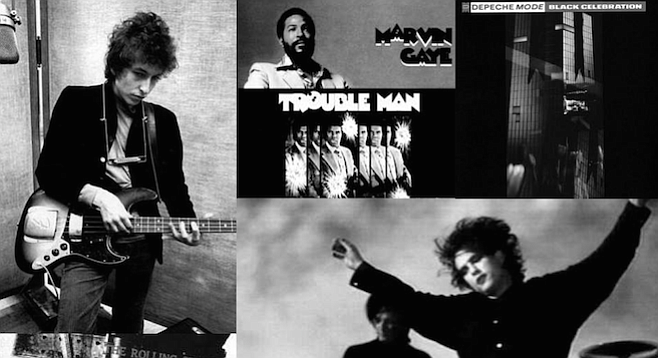
I'm a lousy housekeeper, and by the end of the week dishes are stacked on every available surface of my kitchen. The thought of cleaning them is overwhelming. So I've developed this ritual. I slip my feet into thick, cushy Dansko clogs, tie on an apron my grandmother sewed when I was a girl, put the green plastic tub in the sink, fill it with warm water and biodegradable dish soap, and carefully lower in as many crusty bowls and plates as possible. Then I turn on Marvin Gaye's Trouble Man. It begins with a two-beat wail -- whaa-whaa, ohh-whaa -- whatever instrument it is, it sounds like a voice, like it's singing, whaa-whaa, ooh-whaa, like a creature from another world who's made contact with us earthlings. And then the horns echo it, as if we earthlings have caught on and we're signaling that we come in peace.
The music turns lively, upbeat. It's perfect music to listen to standing up. I dance around the kitchen as I carry dishes to the sink, carry dishes from the drainer to the hutch my boom box sits on top of. I break out a bottle of organic brown rice sake I bought at the same place as the biodegradable dish soap. Trouble Man is the soundtrack to a 1972 blaxploitation film that's no longer in print. It's a soundtrack that has outlived its movie. So now the movie is me washing the dishes, and I'm feeling pretty good. The kitchen table is half cleared, the dish soap smells like oranges, and the sake is kicking in.
When I found a washed out video of Trouble Man on eBay, I snapped it up. It's an action flick where actors jump backwards before fists hit their jaws, so their backward plummets look more like spasms of some neurological condition than any effect of a fight. Mr. T., the hero played by the impenetrable Robert Hooks, is a debonair private eye, with more of a sense of politics and community than James Bond. The film opens with a long tracking shot of Mr. T in a luxury sedan on the Los Angeles freeways. The title song blares through the speakers of his car radio. We don't know where he's going, he's just moving, and the camera follows him with the unnerving distance with which it later followed O.J. Simpson's flight into Brentwood. Throughout the film Mr. T doesn't say much, but he seems never to stop thinking. He's always one step ahead of the game. The scarcity of words on the soundtrack is emblematic. When Gaye's voice breaks through it's usually as a moan or a sigh. Trouble Man, the soundtrack, is not about action or representation, but about a state of being, and the film only slightly more so. In Trouble Man's dystopic mindscapes, community is everything, but nothing helps the angst, the existential pain of being alone; thus the retreat to the nonverbal.
In my kitchen the music switches gears. It gets sadder and sweeter as dissonant elements intrude. Now it reminds me of the chiming of a clock, its urgent forward momentum warning me that time is running out. And then the music opens to a lagoon of stillness. Track 10 is called "Life Is A Gamble." Its rhythms stop and start, weird synthesized twangs intrude -- the alien creatures are upping the ante. Water's running, dishes clank, the sake's tasting better with each sip, I'm swaying at the sink, my mind wandering, and then track 10 comes on and pulls me back in. I stop everything -- the coffee mug in my hand frozen midair -- and listen. The simple melody of ooh hoohs is plaintive, beautiful. Without words, Gaye's voice is a body crying out, loving and losing, with nowhere to hide. I say to my husband, "If I die I want this played at my memorial service."
I've been to few conventional funerals over the 27 years I've lived in San Francisco, but I've attended many AIDS memorials. There's never a body, just photos and favorite music. The dead person has usually chosen the music ahead of time, like a DJ from beyond the grave. Common selections are Patti Smith and Joni Mitchell. The music makes people laugh. The music makes people cry. "When you hear 'Horses,' remember me." "Life Is a Gamble" is what I'd like to be remembered by, melody so beautiful you could die to it.
-- Dodie Bellamy
The Hiss Was Bylsma Himself
Before puberty, before a scalding flood of hormones seared my synapses and boiled my cerebellum, I was a smart kid. My parents blame the eventual change on a month spent in the mountains of Wyoming with ex-hippie instructors and the children of the wealthy, learning about low-impact camping and the necessity of chilling out and kicking back. But I blame the hormones.
Back then, I was smart enough for my smartness to be a liability, smart enough to receive insults from my fellow third-graders along the lines of, "I bet you read the dictionary and listen to classical music." The horror -- what kind of freak would ever do such things of his own free will?
My accuser was mistaken, however. I didn't read the dictionary, and I didn't listen to classical music -- or not much, anyway. The one exception was Virgil Fox's collection of Bach's greatest organ works, which I fell asleep to for at least a couple of years. (It was, to my unending shame, replaced by Lionel Richie's Can't Slow Down. I was young.) And my parents played Pachelbel's Canon. Other than that, my musical diet consisted of their Broadway musical soundtracks, their Ann Murray, Barbra Streisand, and Trini Lopez. Some time after that, I heard Billy Joel's Glass Houses at a friend's, and by sixth grade, I was arguing that Joel was better than the Beatles (hello again, unending shame).
When CDs came out, I bought my brother a copy of Sgt. Pepper's -- I was over my devotion to Joel. And I bought myself a copy of the Bach organ works. But it was Bach's cello suites that got me listening. I first heard them during my sophomore year at college, oozing through the stud-and-paneling walls of my dorm. My next-door neighbor was a gaunt, mysterious freshman with a long ponytail, a Mephistophelean goatee, and little round Lenin glasses. The only decoration in his half of his room was a print of Hieronymus Bosch's The Garden of Earthly Delights. He was gracious enough when I asked what he was listening to -- the cello suites, recorded by Pierre Fournier.
It was the first classical music that had ever gone to my gut. It was complicated and elegant, but also brooding and wild -- notes on top of notes, sometimes so many that you wondered if the cellist was still in control of his bow. But then the music would resolve, and Fournier would caress a single note so that it had a discernible beginning, middle, and end -- the gentle attack, the swelling middle (I imagined the cellist leaning into his stroke ever so slightly), then the feather-light release. It was the first time I had ever thought music sensuous.
I told people about my wondrous discovery. A college tutor remarked that he owned the finest recording ever made of the cello suites, made by one Anner Bylsma. It was not available for sale in the United States. I was miffed at his untouchable superiority, but also curious. When a Bylsma recording showed up at Cymbeline on a later visit, I jumped at it.
The playing was incredible; I had to admit I preferred it to my Fournier. But the disc was flawed; every 15 seconds or so, I heard a distracting hiss. Maddening, like a skip on an LP. I put on the second disc -- the same thing. I resolved to ignore it. I failed. Finally, as I suffered, it dawned on me -- the hiss was Bylsma himself, taking in huge snootfuls of air as he tore through the music. I tried to accept it as a quirk of his brilliance. I failed again. I returned the record. I tried Rostropovich -- expressive, but too imprecise for my taste. Yo-Yo Ma -- too precise, and too thin of tone to boot. Pablo Casals, who brought the suites out of obscurity, just didn't move me the way Fournier did. But the listening tour bore this fruit -- I got my first concrete lesson in the way a performer interprets a composition and makes it his (or her) own.
My third-grade accuser is still more wrong than right. I still don't read the dictionary, and I listen to more pop and rock than classical. The horror-below-the-surface, surreal goofiness of They Might Be Giants' Lincoln has probably wormed further into my soul than Bach's cello suites ever will. Mine is not a classical sensibility. But if I had to go to that desert island with just one recording, I would want the Fournier, if only for the range and complexity of impressions it yields. A deeper vein to mine while I await my rescuers.
-- Matthew Lickona
My Junior High High
James Taylor was the soundtrack for my adolescence. I would sit in the living room and play his records over and over on our big console while I tried to imagine what anyone would ever see in me. There was no other music player in the house. We all shared the stereo. We all had to listen to the same music. My children are unable to comprehend this. "What about a Walkman?" they ask.
Before Ben Hashimoto introduced me to "Mudslide Slim" and "Sweet Baby James" and "Steam Roller" ("a churning urn of burning funk"), I knew only musicals and Frank Sinatra. I was the oldest kid in my family, and I had no close, older cousins to introduce me to the latest hits. In sixth grade, when I heard "Raindrops Keep Falling On My Head" on the bus, I thought that was rock and roll. The Monkees and the Irish Rovers were the only other bands that I knew of (and I liked the Rovers mostly because of their accents). My second cousin saw Help four times, which my mother thought ridiculous, and so I was never allowed to know much about the Beatles until I learned about them myself later in high school.
But James Taylor was my junior high high; the closest I could get to an altered state. I would sit and write and cry and listen for hours. I had such a crush on Ben in seventh grade that it lasted until eighth grade. I was 12 in 1970, and the country was at war then too. I used to listen to "Fire and Rain" and despair that Ben would never fall for me. And he didn't. He dated my two best girlfriends, both blondes. I, a brunette, felt so alone. But alone isn't so bad with James Taylor. (Although when James Taylor and Carly Simon divorced two years later, I thought, "What hope is there for romance?")
I even got James Taylor sheet music for the piano and whenever I felt sad, I used to play "Blossom" or "Carolina In My Mind." ("Hey, babe, the sky's on fire, I'm dying, ain't I? I'm gone to Carolina in my mind." I think of one James Taylor lyric and the whole song comes flooding back to me -- why do we equate memory retrieval with natural disasters?)
I put a book cover on my James Taylor book to protect it, and I loaned the book to Ben because I loved him and longed for any connection between us. He was rougher with my book than I would have expected. When I got it back, the book cover was a bit tattered, and the bottom corner of the book cover was ripped off so that you could see the book underneath. My mother took one look at it and said, "That's a breast."
"What are you talking about?" I asked.
She pointed to the exposed bottom right corner. It did look kind of like a breast. I took the cover off and realized that it was James Taylor's elbow.
She said, "They do that. They put stuff like that on covers to sell records; it's disgusting." She was disparaging of James Taylor after that. She also implied that Ben was in on this ruse and had purposely ripped the cover to highlight the indignity.
I went into the bathroom and took a good look at the cover picture. Then I looked at my own bent elbow in the mirror, cupping my other hand around the point of my elbow to see what it looked like. And it looked like a breast. I wasn't sure, but I didn't think it was James Taylor or Ben who was responsible here. Perhaps evolution made the body more sexual than we know. And it took my mother to see it.
-- Jennifer Ball
An Album with a Singer
What one album would I take with me to a desert island?
Immediately, it occurs to me that perhaps I shouldn't take any music with me at all. I'd have my untainted memory of other people's music, and I'd have my own ability to make some. I could fashion rudimentary instruments out of fallen palm fronds, sand, and coconut husks.
No. I'd take an album. I'd have to. But could I cheat and burn a mixed disc? How else might I have musical accompaniment for all my desert island moods? (The savage beast does need periodic new soothing.) Actually, that might be my final answer. To put together my favorite 80 minutes of assorted music and listen to that on a CD player that offers "shuffle."
Or what if I could take along a box set? Unquestionably, I would bring the life's music of the artist whose work I admire most, the inimitable John Coltrane. (Although Johann Sebastian Bach...) Anyway, I own 29 discs by Coltrane. But not one of them alone, not even Crescent, nor My Favorite Things, nor A Love Supreme, could tide me on my island.
To pick one album above all the others... Perhaps the best choice would be the finest single work by the preeminent rock band of all time. Unquestionably, in my opinion, the Beatles are that band. And my favorite album by the Beatles, although it's a difficult choice, is Abbey Road.
Or perhaps I should carry an album that reminds me of something positive and wonderful, some music that is a part of the deep fiber of who I am, and that can strike a chord of finer times when I wasn't hot, shriveling under sunshine, eating my single desert island meal (pasta) morning, noon, and night. When I was a child, my mother used to sing Kingston Trio songs around the house. "Seasons in the Sun," "500 Miles," and especially "The First Time (Ever I Saw Your Face)" all choke me up when I sing along with them today.
No. It must be an album containing solely music. Not a single word on it. Because when it comes to words and music, those chanting medieval monks took things about as far as they should have gone: the human voice sounding tunefully but alone, without some instrumental composition "helping" the words along.
Although it does occur to me, as I consider this assignment literally ("What album would you take to a desert island?"), that I ought to waive my feelings regarding music with words: my desert island will also be a deserted island, presumably, and unless I bring an album with a singer on it, then I'll have no recourse to any human voice except my own.
But one album for the rest of my life in a hot place? It would have to be something somber yet hopeful. It would have to be something that I don't know too well, and that I could never know too well. I can already "sing" along with many of the saxophone solos on Coltrane's records. And I would hate to bring along some delicate music that I love tenderly now, because I know that it would try me over time. You know, the old familiarity/contempt predicament. This is about commitment, and I would need a music so dense and complicated that I could perhaps grow to love it over time, and yet I'd hope to never know the soul of it completely, even as I memorized its notes. A music so full of feeling and musical complexity that it could continually sustain me.
I would choose a piece of music that at least begins to meet the majority of my requirements: my dad used to listen to it often when I was a kid; the human voice is present, both male and female, but it's in German, so it doesn't sound like mere meaningful words to me; it is a music of incredible hopefulness, but also realistic humanity; it is inexhaustibly complex and incomparably beautiful.
I choose Ludwig von Beethoven's Ninth Symphony, under Leonard Bernstein's pleasing conductorship, with its "Ode to Joy," sweeping emotional statements, and varied energies and passages. Spiritual and earthy, formally strict yet working its way free: Beethoven's Ninth Symphony.
-- Geoff Bouvier
We Carried Each Other
In 1991, God seized my attention. So did Homer, Plato, Aristotle, and U2. I was 20, a freshman in college, raised Catholic but without much understanding or interest in practicing my faith. I had plenty of opinions about life, but little in the way of reasoned thought. That changed when I started reading the Great Books in a Catholic atmosphere.
U2 was a little like my Catholicism -- I had grown up with the band; it had been part of the atmosphere during my '80s adolescence, hanging in the air the way the Beatles and Led Zeppelin had hung about the '60s and '70s. But Achtung Baby was different. It came in through my ears and kept reverberating. It was for me one of those complete albums, the kind you always listen to all the way through instead of just picking a song or two.
Freshman year of college, I found love -- love of the intellectual life, love of my fellow man, love of Jesus Christ. I swam in love. I struggled to understand and follow the philosophers -- the lovers of wisdom. I wrestled with their questions about the world and the forces that shaped it. I came to share, in some measure, their desire for truth, however arduous the hunt.
I met my best friend, Kathy. We had the same sense of humor, we shared the same faith and the same tastes. In "One," Bono sang, "We get to carry each other, carry each other..." We carried each other. We nursed each other's broken hearts. We screamed along with "Who's Gonna Ride Your Wild Horses" and "So Cruel." Women never forget heartbreaks, and after a time, they may even remember them with a kind of fondness. We put those memories behind the lyrics.
I came to know Christ as an intimate lover. I went to Mass and received Him in the Eucharist. In prayer, I opened my heart to him. He understood all. I felt I had left behind the wasteland of the world and entered the Promised Land. I felt loved.
Achtung Baby meshed with that experience. It gave a sense that something was terribly wrong -- "It's not secret that the stars are falling from the sky/the universe exploding 'cosa one man's lie" -- but still teased love out of every song and situation. The love songs, which so often seemed to concern the love between a man and a woman, yielded easily to a more layered interpretation. That love was a surface layer; underneath, there was the struggle (and the love) between creature and Creator. In the final chorus of "Mysterious Ways," the line "She moves in mysterious ways" shifted to "Spirit moves in mysterious ways." Christ was strewn throughout, sometimes subtly, sometimes less so. In "Until the End of the World," Bono played Judas, betraying Christ in the garden, but the final verse left the door open for mercy: "In waves of regret, waves of joy/I reached out for the one I tried to destroy/You, you said you'd wait/until the end of the world." And there was this from "One":
Have you come here for forgiveness?
Have you come to raise the dead?
Have you come here to play Jesus
To the lepers in your head?
Jesus haunted U2. I'd just found Him, and I relished their references. Achtung Baby penetrated my heart.
All these encounters with love left me a more lovable person. I was like the seed, its outer shell softened by moisture, cracking and giving way to something new. But the cracking wasn't gentle; I had to suffer to grow. Something had to break, something had to die. Achtung Baby got that. It showed the wasteland, and it showed the way out: love.
-- Deirdre Lickona
The Psychedelic Furs' Talk Talk Talk
"If you like Hendrix, you'll like this," my guitar teacher said, handing me a cassette of the Psychedelic Furs' second album, Talk Talk Talk.
More than 20 years later, I have no idea what he meant by that. Talk Talk Talk doesn't sound anything like Hendrix. I imagine that my teacher was just taking pity on the nerdy 15-year-old in front of him, trying to trick me into listening to something other than classic rock and heavy metal.
I was skeptical. I held the cassette case by its edges and saw a typical new wave album cover: a black-and-white picture of the band overlapped with geometric shapes in bright colors. But I liked my guitar teacher and I really didn't have anything better to do, so I decided to give it a shot.
As I remember it, I first listened to the album in the car. My family was driving to Monterey for the weekend and I reached up from the back seat and popped the tape in the cassette deck. My father grimaced. "Is this tape warped?" he asked.
The guitars were overdubbed so many times and each track was so saturated with electronic effects that the instruments seemed to be fighting with each other to get out. There were horns and keyboards squealing and squawking here and there, and everywhere there were pounding drums. And of course, there was singer Richard Butler, sounding like Johnny Rotten playing the part of Casanova. I was amazed.
A couple of years later, Talk Talk Talk would become famous as the album that contained "Pretty in Pink," a song Molly Ringwald liked so much that she convinced John Hughes to borrow its title for his next movie.
But as we drove to Monterey that weekend, all that was a couple of years away. When I listened to the cassette, "Pretty in Pink" wasn't yet a teen anthem. It was, I thought, a very adult-sounding song on a very adult-sounding album.
"Pretty in Pink" tells the story of a woman named Caroline and her despicable ex-lovers. In his croaking voice and thick cockney accent, Butler tells us that Caroline "says I love you, and too much." It's not clear if that means she says "I love you too much" or that she says "I love you" too often. The men, on the other hand, are easy to read: "The one who insists he was first in the line is the last to remember her name."
Sitting in the back seat of my parents' car, I felt older and cooler just for hearing this album. As Butler sang "They're making up things that we've all heard before, like romance and engage and divorce," I held an imaginary cigarette and stared out the window with what I thought was a suitably world-weary expression on my 15-year-old face. "Yeah," I thought, "We've all heard those before."
Today, the Psychedelic Furs are a fixture of the nostalgia tour circuit. They cashed out their credibility a long time ago. When I listen to Talk Talk Talk, I find some of the songs aren't as strong as I thought they were. The saxophone, I now realize, is often out of tune. I now recognize that the densely layered production, which once struck me as wholly original, owes a heavy debt to Brian Eno. And, most importantly, I'm also no longer convinced that Butler's jaded-romantic pose is a good way to live one's life.
But if my guitar teacher hadn't lent me that cassette, I don't know if I would have later got into My Bloody Valentine or the Flaming Lips or a lot of the bands that would become my favorites. And I don't know that I would be the same person I am today.
Maybe the pretentious 15-year-olds of 2005 are having similar experiences when they download one song at a time and listen to them on their iPods. Maybe they don't need albums to let music change their lives. But I don't know. When I first listened to Talk Talk Talk, sides one and two, I entered a new world. I don't think I ever really left it.
-- William Crain
Whoooooooo
Though I had anticipated its arrival, I dreaded this day. The exact hour when the desire to experience something thrilling had effervesced within me for so long, it expired. Cognitive reservoirs of gumption, drive, purposefulness were stagnant. I surrendered to apathy.
Thankfully the pain wasn't too bad. I was scarred by listlessness more than anything else, a suffering that was only inhibited momentarily by the aural cure that I found in Roger Daltrey's voice, a voice whose blustery inflections alluded to my search for escape, identity, and impunity.
The Who's 1971 album, Who's Next, became the soundtrack for days when I felt as though I could disappear into that bright white fuzzy space that snaps me into wakefulness each morning, the ambient noise in Pete Townshend's extended pieces resonating with the same timbre of the stifled inner scream piercing my consciousness. I've always seen "Baba O' Riley" as the anthem of 20-somethings everywhere who find themselves suspended in limbo; too young to be taken seriously, and too old to not know any better, approaching adulthood with trepidation, the onset of the now-what-the-hell-am-I-going-to-do-with-my-life syndrome having befallen them.
A glimpse at the album's song titles, "Who Are You?" "I Don't Even Know Myself," and "Too Much of Anything," seem to respond to my dilemma, though there is none so striking as "Baba O'Riley." Daltrey's gruff inflections open the song with the lines "Out here in the fields/I fight for my meals/I get my back into my living/I don't need to fight/ to prove I'm right/I don't need to be forgiven." For me, he is speaking to a legion of young people too exhausted from spending 40+ hours a week dedicated to selling, stocking, cleaning, cooking, or serving to verbalize these thoughts. The beauty of this song is the fluidity of its lyricism. In ten years, these same words will probably speak to me in a very different way. I'll let you know, but presently, when Daltrey sings, "The exodus is here/the happy ones are near/let's get together/before we get much older," it's as if to say that it's not too late to opt out of the next four decades of servitude to the 40-hour workweek for the ephemeral retraction into the teenage wasteland that you secretly long for.
Fear of living a purposeless existence is not something that easily fades at any age, but what to do? Maybe claw my way to the top in a professional career and encounter the same individuals on my way down some years later. Or take the road less traveled and dedicate my life to some charitable cause or needy individual. Perhaps resign from society entirely and begin a hermetic contemplation of these very conundrums. Needless to say, it is doubtful that I could make a decision like this today. Daltrey and Townshend were able to channel the unspoken but understood torrent of emotion that rages beneath the surface of human insecurity, and they did it with tact and grace, nothing like the bellicose wailing of the Scorpions or the unmistakable twang of defiance in Mick Jagger's songs. Granted, each of these is appealing in its own right, but the Who managed to weave riotous apprehension into a cohesive whole. Maybe it was the turbulent era from which it came, or the fact that it was probably ingrained in the collective musical knowledge I gained at an early age. I mostly attribute it to artistic daring, when rock songs defied brevity's sake, negating the constraints of a three-minute power ballad, and addressing some higher purpose.
As in life, one's perceptions are as reliant upon the ambient noise in the background as are Townshend's power chords. A baritone yeeeeaaaahhhhh! pierces through the trippy ethereal synergy, and the volatility in Daltrey's vocals strike a chord as he sings "I'd gladly lose me to find you," saying so much in so little. Similarly, I find myself intending so much, but doing so little in terms of following through with my grandiose schemes to take on the world, my resignation eclipsed by preventative indecision. I'm sure I'll feel up to it tomorrow.
-- Mary Montgomery
Stranded
RE: the rock and roll album and unfurnished island situation.
I'm going to have a problem packing my rucksack. The fact is, I don't have a relationship with music, although at one time in my life I've owned a box seat at the San Francisco Symphony, I've played a musical instrument in a professional band, and I've spent enough time at the San Diego Opera to be able to walk through a side door, go backstage, and get a wave from the crew.
Still, I can take music or leave it alone. I rarely have music playing in my home. The presets on my truck radio tune to NPR or sports stations. I don't go to rock and roll concerts now or ever, don't go to bars and listen to bands now or ever. I don't dance. I don't have a glimmer about how music is put together, the technical foundation of it, much less a sense of music's history, how it's developed over time. Come to think of it, I don't know the history of rock and roll.
I was born with a voice that cannot carry a tune; indeed, it cannot lift a tune. Now, add the wild, rhythmic syncopation of a rotting tomato. I've known these unfortunate personal truths since my first conscious thought, but, and this is horribly unfair, that self-knowledge did not arm me against the disappointment I endured as a consequence of my first run-in with a musical instrument.
Sixth grade. My parents moved to Burbank, SoCal. It was my first day at William McKinley Elementary School. Third period. Music class. This was well into the school year and the roomful of whizgigging little toadies had been practicing "Pomp and Circumstance" for weeks. The peculiar, tippy-tippy-toe male music teacher directed me to a seat in the first row and handed me a triangle. I was to be the new trianglist!
Now we're cooking. I received instruction from the peculiar male music teacher, to wit; at a predetermined point during the orchestral performance, he would thrust his right hand directly at my nose. That's the instant I am to take my tiny stainless steel triangle striker, which I hold in my right hand, and strike the bottom of the triangle, which I hold in my left hand, with authority.
Well now. I was pumped. First day in class and already a soloist. The peculiar male music teacher taps his conductor's baton and the William McKinley Elementary School sixth grade orchestra came together, much like an out-of-tune lump of compost. The peculiar male music teacher glides his charges through the haunting introduction of "Pomp and Circumstance," the melody builds, builds, builds, hearts swelling, music billowing, up, up, up, and now, yes, now, finally, finally...every instrument in the room falls silent, just for a moment, just for that one beat, the beat that was to belong to me, and now the maestro's right hand moves away from the swarm of greedy children, and points to my nose, only to my nose, or, to put it another way, to the nose of the one and only trianglist. I understand now, by the terrible light of all-seeing adult clarity, that the responsibility for this morning's performance rests upon my shoulders. I grip my tiny, stainless steel striker and with a manly cock of my wrist, launch it toward the triangle and...miss. I MISSED!
I missed the bottom of the triangle! Missed both sides! Missed. Missed. Missed! The music room heaves and rolls with yahoo har-de-har. I am mocked.
Twenty years later my professional musical career is in full swing. We called ourselves the Sidewinders. Our old-time band was made up of two fiddles, banjo, mandolin, rhythm guitar, kazoo, tambourine, three female backup singers, and, ahem, myself. I play washtub bass. This was Alaska, summertime. We toured roadhouses, small towns, fairgrounds, and passed the hat. Constant carnival, rolling jamboree, once-in-a-lifetime fun. I lived one summer far above my game. Credit belongs to the powerful combination of youth, drugs, booze, sex, and travel.
But that summer didn't bring me closer to music. I don't know why. I've cruised El Cajon Boulevard with my tape deck cranked to obnoxious, blasting a Lynyrd Skynyrd tune, one hundred times. I've had my heart broken to the sound of "Girl from the North Country," enjoyed raunchy, foulmouthed sex while listening to "Sympathy for the Devil." I've known my share of heartthrob songs that spoke, privately, urgently, to what was in my heart. Nothing else cut so deeply as that song. For that particular season.
But...seasons pass. To be dropped onto a desert island with only one tune or album would inevitably mean my musical selection would quickly transmute into audio torture, or, perhaps, considering our national circumstances, one should say, audio abuse. Still, if you're going to be packed off to a deserted island one is not in the position to say no to any offer of entertainment.
Therefore, the envelope please. Ta-da. My desert island musical companion shall be... Eternal Chant (An Anthology of Classic Gregorian Chants). Atlantic Records. Catalog #82703. Three discs, 70 tracks.
-- Patrick Daugherty
Black Celebration by Depeche Mode
My life changed forever when I was 13 years old. Up until this time, my thoughts were filled with jumping my BMX bike off curbs and lighting things on fire in my back yard. This day didn't seem all that different from any other day, but it became the day that divided my life into two. It was on this day I lost my pop-culture virginity to Depeche Mode.
I can always remember important days because the oddest details stick in my mind. I remember sitting cross-legged on the floor in Justin Holcher's room. The thick carpet cluttered with Dungeons & Dragons pieces, magazines, and a new red skateboard his mom bought him. More important than these details is that Justin put a tape into the boom box and pressed play. A slow, dark, synthesized sound began to build through the speakers. Then a quickened beat pulsed and my heart began to beat faster. "Let's have a black celebration. Black celebration. Tonight," began the full voice of David Gahan, lead singer of Depeche Mode. I was mesmerized. At this moment, all the details in the world became muted except for the song. I stared at the little black box waiting for every word, listening like I had to capture each new idea birthed from the speakers.
The education from Black Celebration continued with "Fly on the Windscreen," which cut my illusion of childhood immortality like a Ginsu knife. "Death is everywhere. There are flies on the windscreen for a start reminding us we could be torn apart tonight." As a teenager, the thought of death never crossed my mind. Yet, in some sort of nihilistic disregard for mortality, Gahan used death as a pick-up line, "death is everywhere, the more I look, the more I see, the more I feel a sense of urgency tonight. Come here, touch me, kiss me, touch me now." This song was only foreplay for the blatant sexuality to come.
Black Celebration introduced me into the warm, tingly thoughts of sex like a kid who stumbled into his dad's hidden stash of Playboys. I have to confess, at 13, I was a late bloomer, having missed the big E on the eye chart when it came to Sex Ed. I didn't know this because the norm for me was my father whose first kiss was my mom in college. Yet, the next several songs pushed deeper into a dark place of sensuality. Their songs dealt with teen sex in "A Question of Time," the casual sex and the loss of virginity in "World Full of Nothing," to the nakedness of "Stripped." Depeche Mode wasn't afraid to portray a colder reality of sex in "It Doesn't Matter," as Martin Gore writes, "Though it feels good now I know it's only for now." It was with this album I entered through a pop-culture rite of passage.
Depeche Mode pulled back the curtain and exposed a new reality for me. Through their lyrics I began to transition from the safety of childhood into something that felt dangerous and exciting. I felt like I had a new decoder ring to unravel secret messages that my parents and teachers would never dare to speak about. I'll always remember Black Celebration nostalgically as my first. It has been a while since I've returned to Depeche Mode because my tastes have changed over the years, but my education continues to this day. It continues each time I turn on the radio, watch a movie or flip through a magazine. Pop-culture has become a pimp in my life that influences my speech, the clothes I wear, and the decisions I make whether I like it or not. What started with an innocent encounter years ago has led me to be a man slut to pop-culture.
-- Drew Goodmanson
A Rage Against Monotony
I was grounded, which was a worse proposition than it sounded in my house. I was 14. It was 1965. My father's decree, he knew not to what he was consigning me. A summer in the countryside of Illinois; idyllic and humid, far more mosquitoes here than in Chicago where we had been living a month ago. No air conditioning, a few fans -- all in my mother's room. No color television, of course (we were rarely allowed to watch the black and white Zenith). It mostly depended on my mother and which stage of her (legally prescribed) Dexedrine and or Nembutal high she was engaged in at the moment. Most things in the household depended on this.
My crime was arriving home at 4 a.m. after seeing Albert King and The Paul Butterfield Blues Band at the Aragon Ballroom in the city. My father had been waiting for me in the darkened living room. The only light was the glowing ember in the bowl of the pipe clenched between his teeth.
I was sentenced to six weeks of confinement from mid-July to the end of August. During that time I read The Catcher in the Rye at least twice, I think more. I forget the brand name of the portable turntable I had, but I was allowed to listen to what records I had and the ones that would be smuggled to me by my friend and neighbor, Rick. During those six weeks I listened to the Temptations and Supremes, the Animals, the Kinks, the Beatles and Paul Butterfield. (Was the first Butterfield album out then? In my mind it was.) I also had the McCoys and the Troggs (I was 14) and Bob Dylan's Highway 61 Revisited. The Beatles albums were Beatles '65 and Rubber Soul. (Was Rubber Soul out in the summer or winter? In my soul it doesn't matter.)
I reach back to that time because of loneliness and I figure a desert island would be lonely. To be isolated on one with a single album and theoretically something to play it on would be a formula for madness soon enough and pretty much any CD or album would get smashed to bits in a rage against monotony. But there was music for me that summer that helped me get through that isolation. Of course I had more than one album and several 45s. These recordings were the soundtrack to my loneliness, resentment, alienation, resignation, and, I should not forget, puberty.
As unlikely as it is that I will ever again be anywhere near a desert island, I will entertain the idea that I am the lone survivor of a shipwreck in which I manage to salvage a CD player and CD.
Harkening back to that summer, possibly I can isolate a single album that was most useful in preserving some semblance of sanity.
I keep thinking back to the Animals albums, Animal Tracks and Animalization. There was something so tough in Eric Burdon's voice that those studio performances helped me get through much. His voice seemed to say, "Do your worst, world. Fuck you, I'm still standing." Like a punch-drunk prizefighter, Burdon seemed (and actually still does) to be indestructible. Songs like "Inside Lookin' Out," "Don't Let Me Be Misunderstood" (the way he did it, not Nina Simone), "I'm Mad," That's Another Side of this Life," (produced by Frank Zappa), and "All Night Long" (those are not on any single album, alas) helped ameliorate feelings of abandonment, condemnation, hopelessness. If it's not against the rules, I would burn my own CD of this single artist, maybe two CDs, because I know many contributors to this piece are going to go for Blonde on Blonde or The White Album, both two-record sets.
The End of the Innocence by Don Henley helped get me through a bad time at the end of a soured love affair. But as much affection as I had for that record at the time, on a desert isle, with that alone, I would turn into Mojo Nixon in a week, screaming, "Don Henley must die!"
December 11, 2003, Rolling Stone put out an issue of "500 Greatest Albums of All Time." The list begins with Sgt. Pepper's Lonely Heart's Club Band, unsurprisingly. They called it, "...the most important rock and roll album ever made." They went on to place Elvis Presley's The Sun Sessions at number 11. The first would never have existed without the 11th. Other strokes of wrong-headedness on this list has Band on the Run at 418, which is okay, but ahead of 443, Sam Cooke Live at the Harlem Square...?!?!?
And so I ignore the list, the issue, though my heart hovers at RS's number five, Rubber Soul. If I can't have my own burned, double CD of The Animals and Eric Burdon: A Brizzolara Compilation, then give me Rubber Soul. I might survive on the magic and beauty in those grooves.
-- John Brizzolara
Alto Workouts
It was the stuff we did in high school band class that eventually told how my life would play out. It's hard to imagine any public school music class as being influential, but this was no ordinary band class. Divide it into two halves: the good half and the bad half. The bad half was the mandatory concert band and parade unit. A Calvinist approach to music education if ever there was one, the concert band was a reason to drink. It was designed to punish the PTA moms and dads who were foolish enough to buy us music instruments in the first place -- forced, as they were, to sit through our horrific presentations.
As for marching band, there is nothing worse than wearing seedy pajama-weight uniforms as if hired to guard British Royalty on a winter's night at the local football game. This, so you can hump out onto the field at halftime -- in formation -- and bomb the stands with a bad medley of Stevie Wonder's hit songs.
But it was Crawford's jazz ensemble that was the good half of that equation. I lucked out, arriving for tenth grade with a busload of gifted musicians from points south and east on the district's map. I believe they called us a magnet school. They didn't call it bussing, like they did in other parts of the country. Those were fast and exotic times for a sheltered kid from the 'burbs like me, and band class was the equalizer. I got to play music with kids from the hood that took it to the next level. Among them were Nathan East -- he eventually went on to join Eric Clapton's band -- and Carl Evans, the piano mastermind behind Fattburger.
At the vortex of all this raw talent was a kid named Hollis Gentry. He played saxophone. So did I, but I played nothing like Hollis. Even then, Hollis was already a proficient jazz musician, a child prodigy skilled in the art. I grew up in Lawrence Welk culture, and that's how I sounded when I played. I hardly knew from jazz. I came from La Mesa. Our streets were white and Protestant-safe. Jazz music was not part of our blue-collar Republican lives. And my grandfather's sweet tooth for Delta blues was only a temporary respite from his hard-core bigotry. "There's good n*****s," my grandmother explained, "and there's bad n*****s." And I think she actually believed that.
But the changing racial fabric in my classrooms required quick adjustments on my part. And I've certainly never told anyone, but that was a coming-of-age time for me. Slippery footing it was, learning that the truths held by my family were utterly cheap and wrong. It would have been easier to come full circle and live the redneck life. Had it not been for Crawford's jazz ensemble, I might well have. Racism, when deeply ingrained from childhood, can be heavy gravity.
Hollis doesn't know this either, but his alto workouts got me through the long days of high school. He blew with candor and an elegiac suffering that was simply not developed in most teenage boys. The raw emotions that boiled out of that horn invited me to confront my own mental stuff; at 15, one didn't do that. In our jock culture, making vulnerable music that did not come loud and hard from a guitar amp was like being stripped naked in public. It was not always a safe place in the emotional pecking order of high school boys. Now I know that Hollis Gentry's music was about possibilities. I didn't then. And the experience enlarged my own head-heart connection, even though I would not come to capitalize on that for years to come. And all that time, I thought I was only learning to play jazz.
-- Dave Good
In Love with Two Daughters
I've been sleeping on a lumpy sofa for several days, and my back is on fire.
The sofa isn't in my own house, a take-no-prisoners zone I return to only to collect fresh clothes, but in the house of elderly friends kind enough to shelter me. It's 1967, I'm 22, I've lived in Philadelphia all my days and graduated from a local college where I lost a year because of a rheumatic illness that put me in the hospital for months, left me slow and gimpy, and made my lower back a kiln that fires up when I sleep on that sofa.
For months, life's details, every one, have felt intractable or inscrutable. To get by, I work a series of classy jobs: insurance company file clerk; mail sorter at Oscar Meyer Weiner, Inc.; bookstore cashier. My safe house is here, in my friends' high-ceilinged, airy rooms scented with bayberry candles and fresh-cut lilacs in a hamlet outside town with the winning Welsh name of Gwynnyd Valley. But then, I'm also in love, more or less, with the two daughters of the house, and they with me. Somehow we manage assignations at different times, sometimes on the same day, with no one any the wiser, we think.
One kind of mental breakdown is caused by the impacting of the minutest details of everyday life into, it seems, each separate instant. It's not overload, exactly, so much as a feeling that the body, already too head-heavy, is filling with concrete that while it begins to set also begins to crack from amassed internal pressure. The heaviest concentration and most groaning crack is the lower lumbar pain that keeps me awake most nights on the sofa, across from which is a window that lets in silky evening breezes and, on an oak table before the window, a hi-fi set. One night, I play a record I've just acquired and have, as they say, a moment.
* * *
It's now 2005, and the vinyl beauty I spun that night, along with all my other sides, got sold off several months later with practically everything else I owned -- clothes, books, turntable, speakers, and a beloved Webcor reel-to-reel tape deck -- so that I could launch myself from Philadelphia to land's end in San Francisco. I now own the CD version of that album and listen to it every so often, not to remind myself of that other time of my life (though of course it does that), but to set free a mysterious force that cuts right through me with a pleasure threaded with vague menace.
The opening bars of Sketches of Spain, one of the three albums Gil Evans arranged for Miles Davis backed by a large ensemble, punch me into a peculiarly heightened wakefulness. (The track is a reworking of Joaquin Rodrigo's composition for guitar and orchestra, Concierto de Aranjuez.) Nothing on the other two Evans-Davis collaborations have quite this effect, not the lush grievousness of Porgy and Bess or the sky-clearing arousals of Miles Ahead, my personal favorite. The Evans-Davis Concierto begins with faint castanet cricketing. Then the silence softly cracks open with a whistle of flute and brass brilliantined with wariness, a slightly dissonant reedy reveille of consciousness, a call. It's bold, but it trembles. It has a Romantic rawness; its ringing tones are the bayberry, the lumpiness, and the sisters' very different fragrances; it also carries a piercing sensation of life's beautiful unforgiving totality. Other choice passages throughout the recording have the same effect. They bite into my bones a bereaved cry. But what, exactly, has been lost?
-- W.S. DiPiero
Joni's Hejira
Stranded on a desert island, I'd find relief from the blazing sun in the wintry imagery of Joni Mitchell's album Hejira. Just gazing at the black-and-white album cover would start cooling me down: Joni in a fur coat and beret, the Goddess of Wanderlust, floating above an iced-over lake skirted by snow-dusted trees. Hejira would also bring to mind the dead of winter because that's the time of year I first listened to it, on a snowy day in 1976, soon after the album was released. I was 15 and had gotten it as a Christmas present. With four older sisters who adored Joni Mitchell, I'd heard all of her previous eight albums endlessly, and I loved them. But those were records of the past, Joni's hippie-chick past, and, physically, the LPs betrayed their age in pops and scratches and skips. With Hejira, however, I met Joni in present tense. The vinyl was pristine. And when I put needle to record, she didn't even sing at first. Instead, she spoke the opening line of the first song: "No regrets," Joni said.
She sounded unlike anyone I'd heard before. For myself, raised in a strict Catholic household where the six Hayes children were constantly saying, "I'm sorry, I'm sorry," asking forgiveness at every minor slip, it was radical to hear Joni Mitchell, someone I worshipped, be so unapologetic. It was a shocking statement made more so by the insouciant way she said it, as if she'd just ambled up to the mike and announced: "OK, folks, things are going to be different from now on." She wasn't blue anymore. She wasn't writing conventional folk, pop, or rock songs. She could no longer hit the high notes (no doubt due to the "smokes" she sings about), and she didn't give a shit. It was the attitude of a bohemian romantic, someone who'd been places and done things I could only imagine. I wanted to lead a life just like hers.
I loved everything about this album, and I still do -- not only the evocative cover and Joni's smoky vocals but also its sophisticated literary quality. Hejira, named after an obscure word meaning "a journey undertaken to seek refuge," documents a solo cross-country road trip as she leaves behind a failed relationship and, along the way, does the kind of soul-searching that only comes from time spent alone. In her lyrics, at once confessional and unsentimental, Joni addresses mistakes and choices she's made and considers what the future may hold. Listening to the album, you can actually trace her journey, both deeply personal and geographic, as one hypnotic song flows into the next. Throughout the music is driven by a propulsive bass that constantly pushes the narrative -- and her travels -- forward.
Holed up in my bedroom at age 15, I would daydream of joining Joni's hejira, like the subject of the fourth song, "A Strange Boy." The only boy in my family, living in the small town of Spokane, and, as I was coming to realize, gay (though I'd never spoken of this to anyone), I was already stranded on my own personal island. But Hejira represented to me the possibility of triumphant escape. As witnessed in the album cover photo -- in which Joni's coat opens to reveal a two-lane highway -- the way out lies inside of you.
This then is the final reason I would choose Joni Mitchell's masterpiece as my "stranded" album. Just as Hejira helped me bide my time in a place where I felt stuck, it would be my soundtrack as I try to figure out some way off this damn desert island.
-- Bill Hayes
Love-Drunk Kid
When I was 12, most of my time was spent (a) being mad at absolutely everybody and everything, (b) writing furiously, or (c) being mad at absolutely everybody and everything and writing furiously at the same time. Most 12-year-olds are angry bastards. If they're not, they're either the products of perfect parents (unlikely) or hiding their rage extremely well (probably). And if it's anything that will swallow the pure, hotheaded seething of a preteen -- or a preteen with a sizeable chip on her shoulder as I was -- it is music, in some form or another. And, while my contemporaries were getting their ya-yas out to pop-punk power trio Green Day, I was drowning my sorrows in white typing paper and Magical Mystery Tour.
It was the beginning of seventh grade and my life sucked. I say this as I would have said it then, as I sometimes find myself saying now: "My life sucked." The most generic and vague yet sentimentally perfect statement. That was the end-all, be-all.
The cards seemed stacked against me that year, as my father was on the cusp of remarriage, my school couldn't stand me, and I was just beginning to discover that I could not possibly, in any way, shape, or form, turn out to be a normal human being. I had gone from nauseatingly cute child to awkward and funny-looking adolescent, and, I thought, everybody knew it. I was nursing a two-year crush on a manipulative and slightly clueless teacher; the kids in my class, by and large, thought I was nuts and I was desperately lonely. My heart unabashedly on my sleeve for all the world to see, I was doomed. Consumed with fear, dread, self-loathing, I turned to the only people I could: John, George, Paul, and Ringo.
I don't know how they came to me, my four mop-topped, junior high angels. I remember, at some yard sale or other, my eyes wandering over a pile of mysterious new things called compact discs with a youngster's eye for the new and exciting. For novelty's sake alone, I purchased Beatles Sampler, a mix tape of sorts put out by Rhino Records containing a series of unreleased and/or poorly recorded tracks. This, however, was merely an awakening, as I didn't listen to that CD until months, if not years, later, after I weaned myself off cassette tapes in the interest of technological integration. It was, however, the first CD I ever bought -- something important in and of itself -- and I can still recall it now, blue with wallet-sized headshots of each Beatle adorning the front in a line. But.
My introduction to rock music had come the year before this, during which I had learned all the words to, ironically, "Mrs. Robinson." My parents had a healthy collection of LPs, all of which were readily at my disposal, including an original print of the Stones' Sticky Fingers, complete with a scandalous, fully unzipping zipper down the front of Keith's jeans.
As a youngster, exposed to Scott Joplin and Ry Cooder, among others, I'd become intimately familiar with the phonograph, learning at an early age how to reset and drop the needle with an expert's grace. It was a ritual that I loved; the feeling of the velvety record cleaner in my hand, the way it smelled lightly of plastic and chemicals, how it slid slowly back into its case; the little crack and pop just before the song started; the way the edge of the record spun on the lip of the turntable.
In a matter of months, I'd gone through a few decades' worth of music. I started with Beatles for Sale, moving from that to Revolver, from Revolver to Rubber Soul. When no one was home, I belted out "No Reply" as the cats skulked by the dining table, having learned to be unperturbed by the noise. I loved the lost, lofty sentiments of "I'm a Loser," which is what I was. "Got to Get You Into My Life," with its explosion of horns, got me on my toes and dancing. This was my rock and roll odyssey.
But my favorite favorite: "Strawberry Fields" entered my life via the complicated and horrendously long Beatles Anthology, which was released my seventh-grade year. An overambitious, love-drunk kid, I wrote an entire novel listening to that song, the slow melancholy of it taking me away. There were three versions on that 2-tape set -- Anthology 2 I think it was -- and I loved each one of them, rewinding and rewinding and rewinding just to hear them all again. It was this song, in every one of its recordings, that said it all to me, in strange, cryptic language, in a way I didn't quite understand. It was this song that pulled from me what I had deep inside -- the misery, the hurt, the hope, even -- and helped me pour it onto the page, put my real realities and imagined realities up there together. It is for this that I am eternally thankful to those four lads from Liverpool, bright boys who grew to be jaded men, the surviving members growing to be old, bright, nostalgic, and eccentric gents.
So those of you who know 12-year-olds, or any lusty, angry, or hell, even ambivalent preteen, save them from the destruction of modern pop music: go out and buy them Hard Days Night, just to get them started. They'll learn to love it; if not, there's no hope for 'em. And when they hand you the 50 pages of manuscript, the hand-drawn comic book, the five-painting series, you'll know. You'll know.
-- Rosa Colwin Jurjevics
A Summer on Desolation Row
"Like a Rolling Stone," the most famous song on Bob Dylan's Highway 61 Revisited, portrays somebody who thought she was on top contending with her fall to the bottom. It's a fun song but not a great one.
Highway 61 isn't a perfect album. "Tombstone Blues" I skip on account of the drummer's insistence on slamming the cymbal with every backbeat.
"Ballad of a Thin Man" doesn't wear well, with its arrogant lyrics that claim old guys don't know where it's at but young ones do, which I hope makes Bob Dylan cover his ears now that history has proved his generation was also clueless.
And "Queen Jane Approximately" sounds like filler. But with CDs allowing us to skip around, weak tracks don't matter as long as the album has great ones.
"It Takes a Lot to Laugh and a Train to Cry" isn't great, but I used to sing it when I played in a band, and it has a lilting melody that lifts my spirits. "From a Buick Six" is driven by a pounding beat that let us play the instrumental breaks for 20 minutes and still keep people dancing.
"Highway 61 Revisited" is a great one, a trip through millennia that begins "God said to Abraham give me a son. Abe said, man, you must be putting me on. God said no, Abe said What? God said you can do what you want Abe but the next time you see me coming you'd better run..." and ends with an apocalyptic vision of the next world war.
"Just Like Tom Thumb's Blues" takes me to Juarez, Mexico. Having spent my share of nights in border towns, I get transported by the song's mood of abject confusion and insecurity to times my consciousness had lost.
But the masterpiece is "Desolation Row." After the nifty Mike Bloomfield guitar intro and a procession of chilling images comes: "At midnight all the agents and the super human crew come out and round up everyone that knows more than they do, and they bring them to the factory where the heart attack machine is strapped across their shoulders, and then the kerosene is brought down from the castle by insurance men who go check to see that no one is escaping to Desolation Row."
At a writers' conference last month, I tried to convince a gang of nonfiction writers that we can sometimes fabricate a scene or character that becomes truer than fact. I could've cited "Desolation Row" and argued that the picture it paints of life in the 20th Century is as powerfully rendered a glimpse of reality as any I've seen.
The album came out when I was in college. One summer I attended Universidad de Las Americas in Mexico City. Before I left San Diego to drive there, since I was recovering from a painful injury, my mother gave me a bottle of codeine she'd been prescribed but hadn't taken. On the road, I came to enjoy codeine.
My lodging in Mexico City was a room in an apartment near Sanborn's Farmacia. In those days, prescriptions were optional, and the visions codeine gave me, most of them like cartoons from the dark side, didn't allow much sleep. I began to appreciate a couple amphetamine capsules each morning. With their help, I could stay awake through my classes.
Life got ever more intense. Every day the mean red-haired landlady screamed at her son and cussed prices and thieves and lowbrows and bragged about her rich and cultured friends.
I got a letter from my girlfriend back in San Diego. Whatever it was she wrote all sounded trivial in my condition. So I wrote back only a few words of my own, along with a quote from "Desolation Row."
"I received your letter yesterday, about the time the doorknob broke. When you asked me how I was doing, was that some kind of joke? Right now, I can't read so good, don't send me no more letters, no. Not unless you mail them from Desolation Row."
If I were condemned for life to a desert island, I would take Highway 61 Revisited. I would sometimes wish I had brought Bringing It All Back Home instead, as the Bloomfield guitar riffs on "Mr. Tambourine Man" are even more enchanting than those on "Desolation Row."
But I would remind myself that "Mr. Tambourine Man" makes me yearn for freedom. "Desolation Row" helps me accept being condemned.
-- Ken Kuhlken
Could I Start Over?
These days when you can download all sorts of music into an iPod and burn your own CDs, it's odd to think of taking one prerecorded CD to a desert island. But the spirit of the question is one of restricting choices, maybe deciding between music you listen to frequently and the music that you need. On a car trip, when I'm loading five CDs into the player, Monk often shows up and Boccherini. The trouble is, I don't have one favorite, I have lots. I want to hear Big Bill Broonzy, and I want to hear Joshua Bell. I'm not an opera fan, and I don't get excited about rock, but I perk up when Alison Krauss is on the radio as often as I do when it's Yo-Yo Ma.
When I was in graduate school, Bob Z., who I'd known since high school, always answered "Who's your favorite composer?" with this: "When I'm listening to Bach, Bach is my favorite composer, and when I'm listening to Mozart, Mozart is my favorite composer, and when I'm listening to Beethoven, Beethoven is my favorite composer. And when I'm not listening to anyone, Beethoven is my favorite composer." I understand that, though I'd be tempted to put in Bach.
When I first heard Glen Gould play the Goldberg Variations I was in college. The harpsichord was coming back. Though I'd begun to like baroque music, keyboard works just seemed to me "up-and-down" streams of notes, and when on the harpsichord, clattering, jangling strings. And then I heard Gould's recordings. No harpsichord, but more important: melodies, lines of music, several at the same time that I could hear, phrases with breaths that separated them. Listening to Gould play Bach was going to places, not countries, but places all the same, that were, if you applied yourself, intelligible and coherent. Listening made me tired, but it was possible to get to these places and keep in them as long as the music played and I attended to it.
It seems to me now learning that was a defining experience. I can relive it by listening to those recordings. At the same time, I am reminded how I have changed, how I was changed by returning to those spaces that Bach, through Gould, constructs and dismantles.
This is the place to stop. But I can't. There are too many recordings I want to take -- they're all magic in being able to conjure up the past or, rather, my youth. I remember, in that youth, talking with a woman 20 years older than I was who said, "Tell me your favorite jazz musician and I'll tell you how old you are." Those were days people like us had favorite jazz musicians, in New York City, anyway. She thought you chose some musician who was playing when you were in your early 20s, because that's when you went to hear them, and you stopped going out, stopped keeping up later. It was how your taste got fixed, how you got stuck in your rut. The world after that was filled with people you'd never heard of, and they all sounded "derivative." If you loved Coleman Hawkins, you were in your 20s in the '30s; if Lester Young was your man, it was the '40s, and Sonny Rollins fans were younger still.
She needed to correct her theory to include all the music first heard in your 20s -- not just jazz, not just live. When I was in college, after my girlfriend visited I would play one of the five records I had over and over again; thus Faure's Requiem is a reminder of lost love for me. And I recall the Five-Spot in NY where I hung out to hear Monk play as well as the apartment of friends where I first heard Flatt and Scruggs. A little later, when I was a continent away in rural Washington State and my mid-20s -- I had a protracted youth -- I found records of Wade Ward and Tampa Red.
No matter what I listen to now, part of it is hooks into my youth. I got to know more Mozart, more Brahms, Charlie Patton and Django Reinhart and Dmitri Shostakovich -- some of that in my 30s, some later still. Moving from my 20s into middle age has gotten confused for me. Times become more and more "the past" -- remote, faded, and soft-edged.
Fortunately, there's no sense that I'd be abandoning, dooming any music I left behind -- saving one child, while rejecting others. All the music would remain safe. It's only I who would be at risk. Which might be just the reason to go off to the desert island. One of my recurrent fantasies is of starting over. In the new place no one knows who you are, has any expectations concerning a you that can't be reversed; you can become someone with no history. It's never true. I always revert more to character than I intend. But when I traveled last and lived abroad for several months, for the first time I took no music. I had a radio, but never found a station that appealed to me. I did go to concerts of jazz and classical and regional music that looked interesting, though I could only pick from what was offered, and was restricted by times and prices. I went frequently.
If the desert island had no concert hall, no radio, I would not want to do without music. I'd have to bring something. As I write, I'm inclined to avoid something from my past. Perhaps I'd take the music of the area or, failing that, some music I'd never heard. It might prove wonderful, and it might prove disappointing. The chance of "irrecoverable error" doesn't make you listen better, only harder.
-- Mark Halperin
Family Music
It's not that I listen to it very often -- I don't think I've listened to it once in the past 15 years. Even if I owned a copy I wouldn't be able to play it. I don't own a turntable, and it's never been digitized. Still, it's the album I would take with me to a deserted island, because it's the album my family choir made.
The Grimm Family Choir record was made in 1972 but it had its beginnings in the late 1960s, when my oldest sister Marya was studying literature at the University of Southern California. The hippie movement was in full swing, and the sexual libertinism, drug use, and acid-rock music revolted my sister. Classes were no refuge either. One professor turned a lecture on Shakespeare's Macbeth into a rant against the Vietnam War. Disgusted, Marya decided she'd launch a movement to preserve Western Culture from this onslaught. Luckily, she had an ever-growing throng of younger siblings with which to populate the early stages of her new society. Jess, Marya's lone older sibling, who wasn't so sure the hippie movement -- particularly its music -- was all bad, lampooned Marya's society as the Guardians of Edifying and Enlightening Culture, or GEEC (pronounced with a hard C) for short.
The GEEC membership rules were simple: first, obey the Ten Commandments, all of which were under assault in the counterculture; and, second, acknowledge rock music as an instrument of evil then totally reject it. Marya reasoned that it wasn't just the subversive lyrics of the rock music that made it attractive to acid-droppers, weed-smokers, and fornicators. There must be, she thought, something in the very nature of rock music (The electrification? The syncopation? The three-chord repetition?) that, if it didn't exactly cause people to turn from good and embrace evil, at least it helped them along that path.
Since obeying the Ten Commandments isn't exactly a group activity, GEEC focused on the second rule. What better way, Marya opined, to reject rock and roll than to make better music. The problem was there was only one trained musician in the family, my brother Stephen who was a contest-winning pianist. But we Grimms have always had good singing voices, good pitch, and a quick ear for memorizing tunes. So Marya decided to mold the membership of GEEC into an a cappella singing group. For material, she dug into the back shelves of her college library and pulled out sheet music for Renaissance and Medieval madrigals such as "My Heart is Offered Still to You" by Orlando di Lasso, "Never Has My Heart Been Merry" by Pierre Certon, and "Blow Shepherds Blow" by Thomas Morley. Marya learned the four and sometimes five parts of these pieces and taught them to her sisters Paula, Patricia, Anita, and Michelle, and to her brothers Stephen and Danny.
The counterculture, in those days, was not only infiltrating Shakespeare classes, it was invading the Catholic Church. The now-familiar guitars and tambourines were starting to show up at Mass. To fight it, Marya taught the group sacred church pieces from the 13th through 17th centuries, such as the motets "O Jesu Christe" by Jacquet de Mantua, "Alma Redemptoris Mater" by Giovanni Pierluigi Palestrina, and the "Missa Secunda" by Hans Leo Hassler. My parents, avowed enemies of the counterculture themselves, were tickled pink. At first, the seven sang at family parties in front of admiring aunts and uncles as well as snickering longhaired cousins wearing bellbottoms and "Fuck the Draft" T-shirts. Later, they started singing small concerts, the girls all in matching dresses they had sewn themselves. A friend of my sister's who had contacts at a recording studio convinced her to produce an album. In 1972, the group gathered in the cold, dark chapel at Thomas Aquinas College (to which Marya had transferred) and sang the six pieces mentioned above plus 13 more.
The album did not go gold. It sold a few hundred copies, mostly to family, friends, and friends of friends. But the Grimm Family Choir lives on. As each of my parents' 17 children came of age, he or she joined the choir. I joined when I was a teenager and still sing with the group when we're all together for a wedding or a big party. Now my nephews and nieces are singing with the choir, and when we're all together the choir, which once numbered seven, now has more than 40 voices. Marya's movement is growing.
-- Ernie Grimm
Forth From My Pioneer Speakers
The summer of 1976, PBS broadcast The Unanswered Question: Six Talks at Harvard by Leonard Bernstein. Each week Bernstein explained the structure and the meaning of music as well as the crisis of harmony composers faced in the 20th Century. I was in my 20s, a folk-blues-ragtime-jazz guitar player, a composer of songs and instrumental pieces that fit that wide vein. But I was also bored with the smallness and the lack of abstraction of these musical forms. My musical-analytic interests were spiraling outward like a nautilus. But whither? In lecture five, Bernstein played Charles Ives's "The Unanswered Question," a mystical work for strings, woodwinds, and trumpet. Here's a sketch: the strings drone a pulseless diatonic chord; a trumpet plays a melodic fragment, sounding like a question; the strings drone on; the winds answer the question in harmony; the trumpet again poses the question while the strings drone on; the winds respond as a group but with individual lines; trumpet questions; strings drone; winds, losing cohesion, play chaotic, ambiguous lines; trumpet questions but it goes unanswered while the strings drone on. This piece, Bernstein said, embodied the increasing confusion and violence of 20th-century music as well as of the 20th Century itself. That music could pose ideas -- become a field of inquiry, which I'd associated only with literature, philosophy, and criticism -- was enthralling. I headed to the library.
I began with Bernstein recordings. He had, alongside musicals like West Side Story, composed three symphonies. His first was the Jeremiah Symphony, issued on Columbia ML 5703 (recorded in 1960, released in 1962). A marvelous piece, while on the flip side was the Third Symphony (In One Movement) by the American Roy Harris. Harris, once a farmer, was a largely self-taught composer, born in Oklahoma, raised in California, who'd been on the vanguard of a new sensibility in American classical music. Conductor Serge Koussevitzky premiered Harris's Third with the Boston Symphony Orchestra in 1939, calling it "the first great symphony by an American composer." Critic Edward Downes noted how Harris's Third revealed the "brooding prairie night" of Western Kansas. Its slowly unfolding initial section gave off "stronger and more fundamental emotions than are associated with the entertainments of American jazz."
I loved jazz and all things musically American. But Harris's 17-minute symphony, as it swept forth from my Pioneer speakers, was unlike anything I'd ever heard. There was nothing "entertaining" about it. It was emotionally dark, its sound, recognizably, achingly nationalistic. It also seemed that to identify the feelings it raised in words lessened it somehow, robbed it of its soul. Stirred by Bernstein's analysis of Ives -- "Why," he asked, "do so many of us try to explain the beauty of music, thus depriving it of its mystery?" -- I hoped to discover what it was about this piece that beckoned and resisted my own explanation.
Harris labeled the Third's five sections: tragic, lyric, pastoral, fugue-dramatic, and dramatic-tragic. The sections can be heard as such but, overriding all, is a developing, eerie instability. The music lopes, dances, marches, rushes ahead in boyish exuberance. The last two sections grow, as Harris wrote, from "savage bright to savage dark." The harmonies and the melodies clash in several church modes; the phrasing is asymmetrical; the rhythm and the meter are irregular and syncopated.
But what was the Americanness it projected? We hear the Germanic in any Beethoven symphony as the composer repeats and extends short musical figures with his characteristic expeditionary and uncompromising ego. Harris develops his melodic ideas with immediate variation; he eschews repetition, paradoxically letting phrases wander but without losing their momentum. The music seems lost while it's getting somewhere. It struck me that Harris was illustrating my own indecision.
In 1976, I had decided to return to college to study composition. This was part of a pattern: either fate or my insecurity over which expressive language -- music or writing -- was mine, had bounced me from one to the other since I was young. As a child I sang in choirs and played several instruments. By high school, I had left music for the rapture of Victorian novels and dreams of writing. After two years of studying literature in college, I quit: a romance gone bad was the reason. I went back to playing and composing. The unanswerable questions snapped at my heels: Should I write? Should I compose? Which art could satisfy my longing that one art transcend the other?
For me, Harris's syncopated trumpets bursting over trudging chords, his finger-pointing crescendo that ends naggingly on g-minor say this: our lives open and close on tragedy while in the long in-between where the inevitable is disguised and waylaid things are sunny and serene. His symphony captures the fatalism of American life, optimistic and aggrieved, what the Kansas sky is brooding upon. It also speaks to my fate, saying this: Let the tension between music and words be. I need not choose, I need not think the beauty of music has lessened because of my attempts to explain it in words. Every time I hear Harris's Third I hear the mystery that couples song and explanation; I also hear my desire to hold fast to that mystery as it escapes me at every moment.
-- Thomas Larson
Leontyne and Me
I met Joseph when I was 25 and he was 52, eight years younger than I am now. I shared my one-bedroom apartment on the Lower East Side in New York City with night-crawling cockroaches while Joseph, a successful writer, lived some blocks away in urban grandeur, including security gates that crisscrossed his windows. I said it was like living in a prison, and not for me.
Then came my first burglary.
"Immediately replace everything stolen," he advised. "Or everyday you'll feel like you've been robbed again."
In the years before I moved and got my own security gates, I lost bikes, television sets, my college ring, and several stereo systems. Amid the ongoing pillage, my record albums (with little value on the street or to pawnbrokers) remained untouched. After the second raid, Joseph handed me the RCA recording of Samuel Barber's Knoxville Summer: 1915.
"This is for you," he said.
Out of its jacket and removed from the white paper sleeve, the long-playing disc was the size of a dinner plate. It smelled of solvent; its face of perfect grooves gleamed. I fit the record on my new turntable. The needle dropped onto the record's edge and slid inward. Static, a brief interlude of woodwinds, then the lush soprano of Leontyne Price.
It has become that time of evening
when people sit on their porches, rocking gently, and talking gently...
People go by; things go by.
I grew up deep in the middle of the American Century in San Diego with its gold skies and endless summers, but James Agee's words sent me south to one summer night in 1915.
On the rough wet grass of the back yard
my father and mother have spread quilts.
We all lie there,
my mother, my father, my uncle, my aunt,
and I too am lying there...
I threw a surprise birthday party for Joseph. With just two chairs and no table, his friends stood while others ate on my bed with plates on their laps. The electricity went off and I lit candles for light. There was no heat so I poured extra cayenne in the chili, thinking to solve the problem.
They are not talking much, and the talk is quiet,
of nothing in particular,
of nothing at all in particular,
of nothing at all.
I was a small-town kid -- dumb, even innocent. But to fully take in the music, an experience of artistry and intention that was studied and complex, was to transform the listener. Who knows where change may lead?
All my people are larger bodies than mine,
quiet, with voices gentle and meaningless
like the voices of sleeping birds.
1979. It is ten years later and I am at graduation ceremonies at Yale. Leontyne Price sits on the dais, 20 feet straight ahead. She awaits her honorary doctorate in music. I am here to collect my third graduate degree, now own a condominium, and have won a postdoctoral year at Oxford -- all this while holding down a full-time tenured post. But there is a cost. I am so wrecked on drugs this afternoon that I am a human yo-yo, up and down. The diva notices and shoots me the same look my mother used to nail me with. Instantly I remain put.
I'm sure my record album is around someplace. Joseph, long ago, went missing.
One is an artist, he is living at home.
One is a musician, she is living at home.
One is my mother who is good to me.
One is my father who is good to me.
My father has turned 90. My mother suffers from Alzheimer's disease. They reside in San Diego. I live not far away. I neither drink nor do drugs. I live alone with a small dog and no security gates. One year ago, I wrote Joseph. He did not write back.
After a little I am taken in and put to bed.
Sleep, softly smiling, draws me unto her;
and those receive me, who quietly treat me
as one familiar and well-beloved in that home:
but will not, oh will not
not now, not ever,
but will never tell me who I am.
The RCA recording Knoxville Summer: 1915 with Leontyne Price is out of print. But recently a snatch of melody heard drifting off the radio and I am walking Manhattan's streets, warmed under San Diego skies, and 90 years before, am again beloved one summer evening.
-- Jangchup Phelgyal
From "American Tourist" to "Loser"
"Dancing in September" wept from the doorway of a music shop. I pulled my scarf and jacket collar open, exposing my neck and ear.
I stayed on that street for the day. I wanted to hear more music and the passing people seemed to be generous. I looked from face to face, interpreting nuances. If someone spotted me then looked away and down abruptly I knew I couldn't ask them. Not too many people gave when I did ask. Mostly, kind strangers would walk over to me and drop Koruns into my gloved hand without me asking. "D_kuji vám," I'd say, thank you, in Czech.
That night, in front of a four-story club of lights and tinted glass, a rich Euro-trash man in a white turtleneck, blue ski jacket, and tight jeans grabbed an American girl's ass. The girl spun around and yelled, "Asshole!" in his face. The jerk's friends grabbed his shoulders and leaned against him, laughing.
The front door of the whorehouse discotheque opened and a measure from "Dancing in September" spilled out while a group of revelers was admitted entrance. The song was clipped when the door swung shut again. The girl stormed over to the curb and waved her arm for a cab.
The group of young Euro hipsters followed her. She ignored their come-ons and pushed them back when they grabbed her again. They surrounded her like a pack of wolves and were just as intent, blocking everything else out except their prey.
The tall blond who had goosed her earlier looked to be the Alpha of the group. My left hand found the collar of his bulky jacket and jerked it backwards. He spun to his left on the way down and landed on his hip and elbow. I still had hold of him and gave him two right-hand shots to the jaw. Wap. Wap. His friends jumped and gibbered. I grabbed one, but he broke free. They pulled their dropped buddy by his collar until he was standing and then marched down the sidewalk shouting in the staccato "SH"s, "T"s, and "N"s that string together to form curse words in German.
I hadn't seen myself in a couple days, and my appearance must have slipped from "American Tourist" to "Loser" because the girl thanked me at arm's length with an overturned fist of bills. It must've been everything she was carrying on her: I noticed the white lining of her inside-out jeans pocket. "Thanks," I said, ashamed to need a handout, but grateful for the money. Last year she was my peer, just another American. This year she was my benefactor. If we'd been in San Diego I would have asked for her number. But with bleary eyes and a dope-sick face, I just turned and walked away.
I walked the long hill from downtown, past Winston Churchill Square, to the Clown and Bard Hostel on Borivojova Street. The junky receptionist with blond dreadlocks and sharp elbows handed me a key attached to a six-inch block of wood. It felt good to be indoors again. I lugged my pack up three flights of stairs and unlocked a metal fire door. I chained my backpack to a bunk bed with the bike lock I'd brought with me from America, even though the 18 other bunks in the room were vacant. I couldn't risk losing the only things I had.
The shower and shave revealed how gray and drawn my skin had become in the past three weeks, since I'd lost my way. What was 240 pounds of muscle, sinew, and joints had become soiled sheets on a rickety wooden frame. I was surprised I'd fared so well against the wolves.
Sitting on my bunk in long underwear and a sweater I rummaged through my clothes and separated them for washing. When I pulled the wad of cash from my pants pocket something else fell out and tick-ticked against the checkered tile floor. I followed the sound back toward the light spilling in from the bathroom. There, in the cold glow, sat a pale pink pill with small flecks of orange in it.
Where the hell had that come from? I knew every stitch and bob of fuzz in my empty pockets intimately; this couldn't have been in there for long. When the American girl on the street had emptied her gratitude onto me it must've come out with the wad of money. Now here it was. I cupped it in my hand and washed it down my throat under the tap, slurping at the icy stream.
Soon my hands were clapping and wringing at each other. The bright lights of the city danced against the panorama window and brightened the room. Why shouldn't I have some fun tonight? I thought, I did my good deed for the day. I've still got a little coin left. I deserve a little music and beer. I dashed to my bunk and pulled my jeans on, grabbing the money and the big blocky key ring. The yellow light of the stairwell got more intense as I descended until it revealed the blinding pale bulb outside of the cellar bar.
Inside the bar I ordered a glass of Amber Czech pilsner and scanned the room for potential. Groups of backpackers gathered at tables beneath the orange pendulum lights and their brown shadows waved along the walls while they laughed and drank. One girl in a red fleece and matching headband climbed her chair and sang along with the blaring music, "Ahh, ahh, say do you remember," she shouted, "Ahh, ahh, dancing in September."
-- Ollie
The Ultimate Love Song
In the age of the iPod, I can't imagine not bringing a music mix with me to the proverbial desert island. In fact, it goes further back than the iPod. I grew up in the golden age of the mix tape. Mixes, not albums, have always meant the most to me. And a mix tape from a boy was a little bit of heaven. But the desert island mix I've chosen does not involve a boy. It involves the absence of boys. Boyfriendless until college, boyfriendless in those formative high school years, I started to keep a list of songs for my future boyfriend. Strange as it might seem, this mix captures everything I thought I wanted at the innocent idealistic age of 15. Just the thing to while away the long desert island days.
So here I present my desert island soundtrack: Songs For My Future Boyfriend. A little desperate, a little tragic, and very much riddled with danceable hope and joy.
"Just Like Heaven", The Cure (1987)
Robert Smith and his band touch me (and on many listless nights I wished he would, literally). I started listening to them to impress a boy -- Jeff -- who consequently turned out to be gay. It took three or four listens of Disintegration to get me going, but once I started I couldn't stop. A rabid Cure fan, I started reading Other Voices, a '90s zine that encouraged pen pals. Through Other Voices I met my future prom date (who turned out to be latent -- sense a theme?).
"Just Like Heaven" from the Kiss Me, Kiss Me, Kiss Me album ranks as my favorite Cure song of all. I will admit that when I finally did land a boyfriend (in college, long after I'd lost touch with prom date and his boyfriends) and fell in love, I decreed this to be the first dance at our future wedding.
That never happened, but there's no taint to the song. More than anything I hope that I never forget how "Just Like Heaven" made me feel when I first heard it -- alive and free and full of boundless hope and energy. If one day I do marry (after a much-heralded rescue from the desert island), I must dance to this.
"Love Shack", B-52s (1989)
A song that bubbles with joy. I danced to this, danced hard, at every school dance, wedding, and Sweet 16 I've ever attended. I can't imagine never hearing it again, never screaming out, "Tin Roof! Rusted," never hopping up and down, never screaming along, never hearing Fred Schneider tell me that "love rules at the Love Shack." To me, this was a potential make-out song. A song that would make a boy reach for my hand and pull me onto the dance floor. We'd stop, sweaty, red-faced, and out of breath. And then...who knows?
"Eternal Flame," the Bangles (1997)
I'm embarrassed that this song means something to me. It's a light song, a twinkly song, a song lacking in substance and real feeling. Still, I must have cried myself to sleep 1,000 times at the age of 15 listening to it. And it's kind of catchy and sing-a-long-able.
"Pictures of You," The Cure (1989)
Yes, there has to be another Cure song. And yes, it has to be Disintegration's depressing anthem to broken hearts, lost love, and memory. Ouch. It hurts just thinking about it.
"Please, Please, Please Let Me Get What I Want," The Smiths (1986 via the Pretty in Pink soundtrack)
The ultimate longing song. I've cried to this more times than I can count. When Morrissey -- in all his snarky, Oscar Wildean glory -- sang, "For once in my life, let me get what I want, Lord knows it would be the first time," I believed, in the way that only an egocentric 16-year-old can, that he was speaking to me. This song made my longing for a boyfriend, my longing to be thin and cute, my longing to not be sad seem justified. Now I look back and I want to slap myself for being so dramatic. But still I love the song for its sad simplicity.
"Never Tear Us Apart," INXS (1987)
Such a hot and sexy song! It hit me right in my underused teenage loins. This is what sexy meant -- a steady, hard bassline and a long-haired man in tight pants telling me, forcefully, that no one would tear us apart. Yummy.
"(I've Had) The Time of My Life," Bill Medley (1987)
"Nobody puts Baby in a corner." God how I wanted someone to say that to my Dad. This soul-lifting anthem from Dirty Dancing made me long for Patrick Swayze. It also made me long to be small enough for a boy to lift me over his head and throw me around in front of a crowd. This was also another wedding song candidate. Sad but true -- I was hoping my husband-to-be would make me do the lift.
Let me add a note, and another justification for adding this song to the mix. The first concert I ever attended was Dirty Dancing Live at Radio City Music Hall. Another well-worn memory ripe for desert island dreaming.
"On My Own", Les Misérables soundtrack (1985)
During community-theater years when I played a variety of bit parts in middle-school productions of Bye Bye Birdie and Guys and Dolls, I went through a Broadway phase. This song I taped from the radio, and I wore it out from overlistening. This was the ultimate expression of my boyfriendless angst: "So now I'm all alone again, no where to run, no where to turn to." Yeah. While the other girls had real boyfriends -- shaggy-haired, alternative-music listening, baggy-jean-wearing boys -- I was languishing at home. Or maybe working drive-thru at my part-time McDonald's job. All I thought about were boys, all I wanted was one of my own.
But all I had were these songs, and the smallest ray of hope that everything would turn out in the end.
And so my mix comes to a close. The Beatles, Bob Dylan, Johnny Cash, Sarah Vaughn -- brilliant in every way. But I never made out with my pillow while listening to "Like a Rolling Stone."
-- Rachel Kempster
Loud, Shrill, Piercing, and Unpleasant
This is a weighty matter, or would be if there was the slightest possibility that it might actually happen. In my case it's complicated by the fact that I'm older than dirt, and have more than 50 years of music to choose from.
In 1950, as a geeky 13-year-old in a crew cut and a plaid bowtie, I would repair with my buddies to the hotdog and orange juice stand next to the Criterion Theater on Main Street in Oklahoma City on Friday nights, prior to viewing filmed violence. The jukebox was packed with R&B hits, and it was there I first heard "One Mint Julep" by the Clovers, and realized that there was enough good stuff in life to make it worth the trouble.
Musically, 1955 was the biggest year of my life. Louis Armstrong played at my high school graduation dance. Let me explain how this remarkable thing happened. Armstrong had played a gig in Tulsa the night before, and had one in Ft. Worth a night later. Rather than spend the evening sitting around in a hotel, smoking those funny cigarettes, they decided to play for us for half-price, which was $2000.
Then, in November, as a college freshman, I saw Elvis Presley in concert at the Oklahoma City Civic Center. He was ninth on a bill headlined by Hank Snow. But the word was out; it was Elvis we came to see.
There was no rock 'n' roll at that time. It was invented by Sam Phillips of Sun Records, right then, by the simple expedient of finding white boys who could play and sing Black music.
Elvis was the greatest sellout of my generation, and Col. Tom Parker was the Devil. Everything Elvis recorded for Sam Phillips was great; everything after that sucked. It was as though when Satan led Jesus to the top of the mountain and offered him the world if he would fall down and worship evil, Jesus replied, "Sure, cool."
Jerry Lee Lewis, on the other hand, was a terrible person, but he stayed true to the music. Contrary to his own expectations, I think he will go to heaven for that alone.
From the time Elvis left Sun until the acid rock of the '60s, rock 'n' roll had lyrics that were monuments to insipidity. That all changed while I was in Vietnam. When I left the music was pathetic. When I came back there was Dylan, the Stones, the Beatles, Lou Reed, the Moody Blues, the Steve Miller Band, Led Zeppelin, the Grateful Dead... The list is practically endless and my God, it was wonderful!
This was not the result of genius, but of LSD.
That era phased out less than a decade later, and there was nothing much worth hearing from 1975 to the present day. At least that's what I thought. Recently I met a young man named Justin Chancellor, who is bass player for a loud but musically and lyrically tight band called Tool.
I asked Justin to turn me on to some decent tunes, and he did: the Black Keys, Jeff Buckley, Queens of the Stone Age, and, of course, Tool. There is music out there, just not on the radio.
So, out of all this, what one recording would I take to a desert island? I'm cheating a bit, 'cause it's a double CD, but I would take Bob Dylan's 30th Anniversary Concert Collection. Twenty-nine songs by the greatest songwriter of...well, ever. As Jerry Garcia said, "You can sing his lyrics without embarrassment."
As with all Dylan albums, there are performances I can do without. When whichever of the Clancy Brothers says, "Bet you never thought you'd hear Dylan with an Irish accent!" I mutter, "You right, Bubba," and hit the skip button. I can do without the preachy songs too. "The Times They Are A-Changing" and "Masters of War" are sociologically interesting, but don't move me anymore. On the other hand Lou Reed's performance of "Foot of Pride" is the best thing he's ever done. Willie Nelson's version of "What Was It You Wanted?" is the nastiest, meanest, funniest tune I've ever heard.
My favorite cut is Johnny Winter's version of "Highway 61 Revisited." Let me be clear. I do not like Johnny Winter's music. It is loud, shrill, piercing, and unpleasant, but he outdoes himself, and everybody else here. Sometimes I put the first CD in this set on my player and just play this one tune over and over. That mood has hit me periodically for over a decade now.
There are standout performances by John Mellencamp, Tom Petty, Johnny Cash, Roseanne Cash, the Band, Chrissie Hynde, George Harrison, Neil Young, Roger McGuinn, Dylan himself, and many others.
Good-bye! I must play it now.
-- Jim Morris
I Grew Weary of Three-Chord Rock
My first favorite album was the original cast recording of Oklahoma. Mom says when I was a baby, she'd put on the record as she lay me down to sleep and by the second line of the title song I would be fast asleep. I hate that song now; it's my least favorite show tune. By the time I reached grammar school, Anne Murray was the thing. "Spread your tiny wings and fly away/ And take the snow back with you where it came from on that day..." my sisters and I would sing as we danced around the living room, strumming our imaginary guitars. In middle school, I was into rock 'n' roll, but not the rock 'n' roll of my era. Sneaking downstairs, I'd press play on my older brother's boom box, and listen to the Beach Boys' "Surfin' USA." The volume never passed two; I was terrified of discovery by my mother who had a strict house ban on rock music. Somehow big brother got away with it, but I was soon found ear to stereo. Mom grilled big brother on the music and he rose to my defense. "The music is really harmless." Mom believed him.
Junior and senior year of high school I was sent off to boarding school in Massachusetts. To cheer me up the first homesick weekend I spent there, my roommate put on Howard Jones and Cat Stevens. It worked. For the next two years, I was a devout listener to them, as well as to The Cars and The Outfield. Occasionally, one roommate's love for dance tunes would intrude on my sappy '80s rock. I remember Dead or Alive singing "You spin me right round baby right round/like a record baby right round, round, round," and my wild roommate Juliet performing her smoothest dance moves for us sheltered Catholic girls. I was never sold on the dance tunes. When Juliet was out, Howard Jones went back in the CD player.
Then came college. A grueling four years of a great books program left me little time to enjoy music. I never was one for studying while music with lyrics played in the background. Eight years of piano study had made me a keen listener to the musicality of a piece, and I couldn't detach from the song and focus on my book. So I'd put on classical music. I didn't particularly love it at first; it was just pleasant background noise. But soon it was love. For the college Halloween party, my roommate and I dressed all in black and went as parallel lines -- we were studying the geometer Euclid -- and danced in alignment to the deep cello strains of the second movement of Beethoven's Seventh symphony. The music haunted me.
I discovered jazz in college -- Frank Sinatra, Louis Armstrong, Ella Fitzgerald, Chet Baker -- and I still listened to rock music at times, adding solo guitarist Joe Satriani, and the nouveau funk band Brand New Heavies to my cheesy diet of soft hits. The rock and jazz were nice for racing down the highway to the beach or dancing at one of the school's formal balls. But I found that they didn't feed the soul. And it seemed incongruous for me to be reading the great authors of Western Civilization part of the time and listening to three-chord rock the rest. Bach, Mozart, and Beethoven, on the other hand, seemed fitting companions for Aristotle, St. Augustine, and Jane Austen. Classical increased. Rock and jazz decreased.
It was also in college that I began to sing ancient church music -- four- or five-part Latin pieces which we sung a cappella during Mass. The harmony of the voices was addictive, especially when my own voice was an integral part in producing the sound. With the rest of the choir I sang Palestrina's "Sicut Cervus," William Byrd's "Ave Verum," and Allegre's "Miserere" and found joy in music that I'd never experienced before.
Now, 11 years out of college, I still listen to a lot of the same music. But I see my own kids experimenting with variety in music. My sons love a CD of traditional music of the Andes, which my husband bought from a couple of Peruvians performing on the boardwalk in Seaport Village. My daughter loves an album of songs from The King and I and The Sound of Music.
My favorite CD, the one I would take to a desert island is The Hilliard Ensemble singing William Byrd's Masses for 3, 4, and 5 voices and "Ave Verum." Every Sunday morning I put it on. The music lifts and at the same time settles my soul. A calm comes over the whole house while the five-voice Agnus Dei floats out of the Bose stereo. William Byrd feeds my soul while I feed my kids pancakes.
-- Mary Grimm
- More Barbarella
- More Various Authors
- More Jennifer Ball
- More Dodie Bellamy
- More Geoff Bouvier
- More William Crain
- More Patrick Daugherty
- More W.S. Di Piero
- More Dave Good
- More Drew Goodmanson
- More Ernie Grimm
- More Mary Grimm
- More Mark Halperin
- More Bill Hayes
- More Rosa Jurjevics
- More Rachel Kempster
- More Thomas Larson
- More Deirdre Lickona
- More Matthew Lickona
- More Laura McNeal
- More Mary Montgomery
- More Jangchup Phelgyal
- More Cover Story
- Send Letter to the Editor
- Send to a Friend
- Printer Friendly