

Here's something you might be interested in.
Ask a Hipster — Advice you didn't know you needed
Big Screen — Movie commentary
Blurt — Music's inside track
Booze News — San Diego spirits
Classical Music — Immortal beauty
Classifieds — Free and easy
Close to Home — What it’s like on the street where you live
Cover Stories — Front-page features
Drinks All Around — Bartenders' drink recipes
Excerpts — Literary and spiritual excerpts
Feast! — Food & drink reviews
Feature Stories — Local news & stories
Fishing Report — What’s getting hooked from ship and shore
From the Archives — Spotlight on the past
Golden Dreams — Talk of the town
The Gonzo Report — Making the musical scene, or at least reporting from it
Letters — Our inbox
Movies@Home — Local movie buffs share favorites
Movie Reviews — Our critics' picks and pans
Musician Interviews — Up close with local artists
Neighborhood News from Stringers — Hyperlocal news
News Ticker — News & politics
Obermeyer — San Diego politics illustrated
Outdoors — Weekly changes in flora and fauna
Overheard in San Diego — Eavesdropping illustrated
Poetry — The old and the new
Reader Travel — Travel section built by travelers
Reading — The hunt for intellectuals
Roam-O-Rama — SoCal's best hiking/biking trails
San Diego Beer — Inside San Diego suds
SD on the QT — Almost factual news
Sheep and Goats — Places of worship
Special Issues — The best of
Street Style — San Diego streets have style
Surf Diego — Real stories from those braving the waves
Theater — On stage in San Diego this week
Tin Fork — Silver spoon alternative
Under the Radar — Matt Potter's undercover work
Unforgettable — Long-ago San Diego
Unreal Estate — San Diego's priciest pads
Your Week — Daily event picks
Dinesh D’Souza speaks from home in Fairbanks Ranch
His father "didn't know what the heck I was talking about"
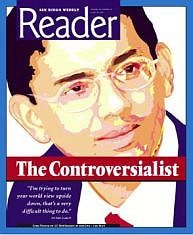
Not long ago, Dinesh D'Souza, who is an Indian immigrant from Bombay, one of America's prominent conservative authors, and, like William F. Buckley Jr., an enthusiastic and skilled debater, was discussing things political and personal with a group of Indian-American students. One young man tentatively asked, "How will I know when I've become an American?" A quipper in the tradition of his hero Ronald Reagan, the quintessential political quipster, D'Souza replied, "One way you'll know is by voting Republican." What he meant by that, he tells me at his home in Fairbanks Ranch, where he, his wife Dixie, and their ten-year-old daughter live in a very big house, "is that the Republican Party is the party of the insiders, the guys who feel at home. So when the immigrant feels he can vote Republican, he's saying, 'I'm on the inside of the system. I'm not throwing stones from the outside. It benefits me to be on the inside. I believe in the team.' " Given a question about self-discovery, D'Souza opts for a partisan answer. It's the kind of response he's good at -- glib, provocative, tendentious.
D'Souza came to America as a high school student in 1978, attended Dartmouth, worked in the Reagan White House, became a citizen in 1991, and has made millions writing and speaking about conservative causes: obviously, there's nothing mainstream about his story. Rarely does an immigrant make it as D'Souza has. Though many immigrants are socially conservative, few identify with the principles of the Republican Party. The Democrat's principle of inclusion for minority and immigrant groups offers a path for the unstable communities who are struggling to belong. In America, however, immigrants often have neither the time nor the self-assurance to align themselves with any political party. At 44, D'Souza is the exception: he has rolled several generations of the assimilating immigrant into one bona fide conservative, individuating at warp speed. In so doing, he may be entirely self-made, more authentically American than any of us, foreign-born or native.
D'Souza is unique because it is highly unusual for Indian or Asian immigrants to join any political movement, let alone the conservative rank and file. In a country with 13 million Asian-Americans (almost 5 percent of the population) -- nearly 2 million of them Indian-Americans -- are there any other Asian-American conservatives than D'Souza? A Google search of "Asian-American conservatives" brings up 15 webpage citations; one online club lists three members. From Hawaii, Japan, Vietnam, China, the Philippines, India, who has a speaking part in the Republican drama?
D'Souza is short, perpetually keyed-up; one eye is half shut, the other wide open. He's a brown-skinned man, who by his admission is "neither white nor black. Typical African-Americans are no different in skin color from me; light-skinned people who are called black, from Whitney Houston to Jesse Jackson, have white ancestry." And though a Hindi accent may trickle in when he's morally animated, he says, "No one can tell on the phone where I'm from," and "My wife tells me, 'I never think of you as an Indian.' " This is his enigma. While his assimilation into our society is almost complete, his immigrant perspective remains primary to how others see him. D'Souza is often praised, unknowingly, for embodying this enigma. Recently, a native-born American who married a Brazilian woman and hears regularly from her about the blessings of liberty wrote him to say, "It takes the eyes of someone from another country to make us see the truth about America."
In 20 years, D'Souza has written hundreds of polemical pieces as well as six books. (In 1984, fresh out of college, he wrote a "reporting book" about Jerry Falwell, published by "a very small press, like one out of your basement, only 3000 copies. Some of the book is about whether evangelicals should get involved in politics. It's frozen in time.") Not until after a stint (1987-1988) in the Reagan White House as a domestic policy analyst was D'Souza hired by the American Enterprise Institute, a conservative think tank, to write books. His first was Illiberal Education: The Politics of Race and Sex on Campus (1991), which made political correctness an everyday term and excoriated affirmative action at American universities. Throughout the 1990s, D'Souza debated Stanley Fish, Walter Mondale, Cornel West, and dozens of others, typically before raucous college crowds who seldom sided with D'Souza. (He's been "seasoned by rhetorical warfare.") Next came The End of Racism: Principles for a Multiracial Society (1995), a book reviled on the Left and sporadically lauded on the Right. In the introduction, D'Souza contends that the book "refutes the widely shared belief that racism is the primary explanation for black failure in the United States today." Low-income blacks suffer neither from racism nor from genetic inferiority (as the authors of The Bell Curve had argued) but from the "pathologies" of their own culture that purportedly places little value on intact families or academic success. Needless to say, a book criticizing "black culture," written by a nonwhite conservative immigrant, created a swarm of protest that has not entirely subsided.
In 1997, D'Souza about-faced his assault on left-wing positions and began celebrating men and ideas within the conservative cause. He wrote Ronald Reagan: How an Ordinary Man Became an Extraordinary Leader, in which he debunked the idea of Reagan as a confused patriarch, sapped of influence by Iran-Contra ne'er-do-wells. Oh, no, D'Souza argued, Reagan was one of our greatest presidents: his defense buildup bankrupted the Soviet Union and ended the Cold War. The book was criticized by Joan Didion, who said that D'Souza had "superimposed" "the 'leadership' narrative" onto Reagan ex post facto: since the Soviet Union had dissolved, Reagan had intended it all along. In contrast, the book persuaded Douglas Brinkley; it was a "major accomplishment," the author of John Kerry's biography, Tour of Duty, says by phone. Though Brinkley disagrees politically with D'Souza, he says that D'Souza proved "we are living in the shadow of Reagan's presidency in the same way that from 1932 to 1976 we lived in the shadow of FDR." Today, D'Souza is the Rishwain Fellow at the Hoover Institution, another conservative think tank. With Hoover underwriting his work since 2000, D'Souza has turned out more morning-in-America testaments: The Virtue of Prosperity (2000), Letters to a Young Conservative (2002), and What's So Great About America (2002). While the latter book echoes the neoconservative response to Islamic fundamentalism and the war on terror, more intriguingly it muses on D'Souza's immigrant status and on becoming an American. Perhaps the Southern California sun has softened some of his political bluster.
What the writer discloses, the person often keeps close to the vest. During the hours I spent with him, at his home in that gated and guarded warren of mansions called Fairbanks Ranch and on the road in Texas, I was interested less in his bluster and more in his avoidance of autobiography. D'Souza is rarely asked about himself: usually, he's asked about his views on, say, the Reagan revolution or the conservative's place on campus. D'Souza is more comfortable steering queries about his life into explicating his convictions. A request to characterize yourself seems a bit taxing. "Perhaps, you could say," and he repeats "you could say" as though its pungency, like wine, needs to swish around in his mouth first, "you could say I am provocative as a writer, but I am certainly not confrontational in person when I'm debating." This admission is one of the few times I will hear him say "I am." As opposed to "I believe." And yet the statement characterizes him because his writing and speaking voices both define him in terms of what he does, not who he is. Who he is surfaces in his writing when, on rare occasion, he departs from the catechism of conservative values and tells us why he left India.
"If I had remained in India," he writes in What's So Great About America, "I would probably have lived my entire existence within a one-mile radius of where I was born. I would undoubtedly have married a woman of my identical religious, socioeconomic, and cultural background. I would almost certainly have become a medical doctor, an engineer, or a software programmer. I would have socialized within my ethnic community and had cordial relations, but few friends, outside that group. I would have a whole set of opinions that could be predicted in advance; indeed, they would not be very different from what my father believed, or his father before him. In sum, my destiny would to a large degree have been given to me."
"In America, by contrast, you get to write the script of your own life.... What to be, where to live, whom to love, whom to marry, what to believe, what religion to practice -- these are all decisions that Americans make for themselves."
Inside of three decades, D'Souza has made good on the immigrant promise, becoming, in his phrase, "the architect of his own destiny." For years he was incurious as to why he was able to make something of himself so readily here when others have not or, more commonly, have been reluctant to. Today, he's pondering it. "One immigrant said to me, 'I'm envious of you, because you really seem at home in America. I'm not at home here, but you are.' I'm sometimes hard-pressed to account for that."
OUT OF INDIA
D'Souza's family is from Goa, a port city in southern India, whose Hindu people were colonized by the Portuguese and converted to Catholicism. His father, who eventually worked for Johnson & Johnson, moved the family to Bombay, where Dinesh was born in 1961. Bicultural from birth, the D'Souza name is Portuguese, while Dinesh means "God of the sun." His schooling was Jesuit, he says. "The best schools in India are run by the Catholic Church. It's true of many of the old English colonies." While the Jesuit curriculum featured humanities and science, it was "memory-driven, very competitive" with national exams, "nothing classically liberal about it." As a child he heard about America only through his grandfather, who, with Dinesh on his knee, would recount the fights of Muhammad Ali. D'Souza recalls the provinciality of his Indian youth with fondness. Extended family was nearby; no one traveled or had aspirations beyond Bombay. "It gave me a sturdy, happy, healthy upbringing," if a sheltered one. "I hadn't thought about my place in the universe. I'd also never thought about socialism or capitalism, or whether the Soviet Union was any good." D'Souza's family showed little interest in politics: they were "loving people," "educated but essentially technically oriented."
In 1978, an exchange program, run by Rotary International, brought him to America and the outpost of Patagonia, Arizona. There, during a year with four families, he finished high school, though academically his senior year was "supereasy," equivalent to his eighth grade in India. In math, he says, "I was at the level of the teacher." A counselor, seeing D'Souza's potential, helped him apply to Dartmouth College. Was he already thinking about a career? Yes, according to the dictates of Indian culture: college men would go into the sciences or commerce, while women would choose the arts. Though D'Souza had an analytical bent toward writing, he still felt it would be his hobby, not his profession. He saw himself majoring in business or math, then, one day, going to graduate school at Oxford, and then returning to India to work at a middle-class job.
But Dartmouth changed everything, in part, because D'Souza was amazed by what he saw his first semester. He recalls that not only was the campus "pristine and luxurious," but it was also a place of "unbelievable tolerance, affluence, and opportunity," where the ideas of foreign students, like himself, "could be circulated. People would listen to what you had to say." But he was shocked at the condemnatory opinions other foreign students at Dartmouth displayed toward this country. His fellow foreigners groused that America was riddled with homophobia, racism, and sexism. " 'America is so bad,' they would complain. 'Americans are so ignorant.' " D'Souza says he was "unprepared for" just how strongly allied the white left-wing students and the foreign students were. And yet, as a newbie, he was still "too polite and nonjudgmental" to attack anyone and too naïve to grasp the political stratification on campus.
Suddenly, his calling to write was engaged: there was an opening on the campus newspaper, the Daily D. D'Souza volunteered, covering sports, speeches, parking, whatever. Meanwhile, and largely unknown to D'Souza, a political struggle for control of the paper's editorial slant had begun. When the forces of an "overwhelmingly liberal faculty and administration" won out, a few conservative mutineers started their own paper, the Dartmouth Review, in 1980. Its editor, Gregory Fossedal, began to write editorials promoting Ronald Reagan, who was at the time campaigning in the New Hampshire primary. Fossedal recruited D'Souza. But, D'Souza says, he was still politically naïve. He just wanted to keep writing. He lovingly recalls the "inky fingers" of production, the door-to-door deliveries the entire staff had to make.
Then D'Souza started "eavesdropping" on the conversations of Fossedal and others. "I was intrigued by their intellectual daring, their passion for ideas. They would say things that at first seemed almost outrageous, and then they'd defend them tenaciously." D'Souza's flair for analysis took wing. Like Fossedal, he "got excited by defending my positions, backing them up with learning and wit. My natural interest in ideas was kindled." D'Souza was fascinated that ideas had practical applications. "You could have a discussion about Hamlet in English class, but at the end of the day, so what? These guys were debating tax rates and the Soviet Union, and it was all connected, in some ways, to Reagan. I shared the view of Reagan as being a somewhat likable but ridiculous guy." He liked Reagan's iconoclastic view. "He was the first to say, 'Government isn't the solution, it's the problem.' That was appealing, even though it never occurred to me that government should be smaller or larger." Though "a spectator and an outsider" (his wallet contained his student visa and $500 to fall back on), he admits to "being drawn into the conservative fray."
The Dartmouth Review featured conservative opinion and bathroom humor, geared to lampoon liberal orthodoxies. In Letters to a Young Conservative, D'Souza writes that to attack the liberal bias in society or on campus, "The conservative must stop being conservative. More precisely, he must be philosophically conservative but temperamentally radical." At the Review, radicals they were. The paper quickly became known for its outrageous claims: one, written by Keeney Jones in response to Dartmouth's having gone coed in 1972, is notorious: "The question is not whether women should be educated at Dartmouth. The question is whether women should be educated at all." Today, D'Souza justifies these and other pranks as a "necessary strategy to break the liberal intellectual monopoly of the campus. Which is exactly the way rebels of the '60s and '70s saw their antics -- a way of breaking the conservative monopoly."
Initially, the paper's brashness was "discomforting" to D'Souza; he shied away from confrontation. But by his senior year, D'Souza was the editor. Alongside 40 others, he was, he says, an ardent "rebel conservative." So arch, in fact, that his opponents nicknamed him "Distort D'Newsa." How did it happen that he became an ardent rebel? A series of jolts connected his wiring. The anti-American international students stirred his ire, and the militancy of the paper's advocates fired up his thinking. He began to realize that his family and his culture in India had embedded in him a set of conservative values he seemed unaware of. "As a product of my upbringing -- and I'm not unusual at all -- I reflected the social conservatism of Asian-American cultures. This is an issue on which the whole swath of civilization that would begin in the Middle East and go all the way to China agrees on. In behavior, the Asian-American group is the most socially conservative group in America, to the right of evangelical Christians." D'Souza cites the rates of Asian-American illegitimacy and divorce as much lower than those of evangelicals. During his time at Dartmouth, he also discovered how unfazed he was by certain American cultural taboos. He recalls that when he spoke against what gays, women, or minorities believed in, his comments made "everyone quiver. To me, it meant nothing. Someone would say to me, 'You're being insensitive.' In India, there's no moral outrage attached" to violating another's sensitivity. D'Souza did not cower before liberal assumptions, the "sacred cows" of the Left -- white racism causes black underperformance, for example.
What really got D'Souza's goat was that many at Dartmouth believed the school was "a very racist place." D'Souza remembers hammering back at such opinions. "What are you talking about? The admissions policy benefits Hispanics and African-Americans and Native Americans. There's a full scholarship program for any Native American Indian who wants to come here. There's a large Native American studies program; there's all kinds of stuff Dartmouth does with local tribes. So if anything, it looks like the native Indians are getting a lot of benefits and attention, while the real Indians" -- a self-referential jest -- "are on the sidelines. In what way is this a form of oppression?"
By the end of college, D'Souza's values were set -- by Indian nature and Dartmouth nurture. Were these two things ever at odds? Not at first, he says; not in the heyday of college, when he was exercising his advocate's voice. (D'Souza's first job was to edit an anthology called the Catholic Classics.) For him, the freedom of thought and the exercise of free speech in the American university engendered confidence in his own opinions. He would align himself politically as he saw fit: his choice would come down against the prevailing liberal notions of college students in the 1970s.
CONSERVATIVE AND PARTISAN
Since Dartmouth, the conservative fray has been quite remunerative for D'Souza. Six years ago, he and his wife bought their home in Fairbanks Ranch. The nearly 8000-square-foot house has six bedrooms, seven and a half baths, and a four-car garage, where they keep their maroon 1992 Jaguar XJS. A circular drive fronts the French country stone house. The cathedral-like front room, with its full-length mirrors and tapestries, has an 18th-century French decor of (veneered) golden maple burl furniture. The slick floors echo like a museum as one walks through. In his office, there's wall-to-wall leopard-print carpet; floor-to-ceiling bookcases are stocked with titles in history, politics, and philosophy. The view out back features a bright blue pool and the arboretum-like landscape.
Today, at his desk, D'Souza is comfortably dressed in preppy garb. Plain shirt (with the polo player insignia), plain pants, tasseled loafers. At one point, his wife Dixie breezes in. She is blonde, petite, California-tanned, and effervescent about her husband. She's wearing a stylish pink plastic-leather rain jacket. We exchange pleasantries, and she's gone before I can respond to her evident delight in marriage. The D'Souzas met in 1988 at the Reagan White House, where he was a policy advisor and Dixie was an intern. She had read his articles and heard that he, too, worked there, so, D'Souza recalls, "She decided I would be a good contact. She figured I was some 60-year-old guy. She came into my office -- I was on the phone -- and she thought I was the intern. She thought, 'Who is this arrogant intern with his feet up on the desk in his boss's office?' " A mutual love of things conservative ensued; a long courtship resulted in a wedding in 1992. Dixie went to work for Texaco, writing summaries of government hearings. She quit after their daughter was born, though now, with more time, she researches news stories, usually on popular culture, for her husband. D'Souza says that moving to San Diego from Washington in 1999 fulfilled their mutual desire to get out of the capital. "In Washington, you are what you do. It's good if you're single, but it's not kind to family life."
Around the time D'Souza and Dixie were married, D'Souza began his career as a debater, arguing against proponents of affirmative action. Thirteen years later, he still goes to colleges to debate that and other issues. Now, as then, he's often harassed, forced to account for his views given his dark skin. He rankles multicultural audiences who turn out in hopes of seeing him trounced by left-wingers, race scholars, even Libertarians. He's never trounced. In debates, D'Souza speaks off the cuff and, as he gets excited, with a kind of locomotive hurrying. He can be prickly and piercing, at times menacingly logical, at times sophomorically cute. To those who boo him, he may say, "Hey, I remember my first beer"; to heckling socialists, he may reply, "I know you guys have been in an irritable mood ever since the Berlin Wall fell." He can also be brilliant: "What we should judge individuals by in this society is merit. Nobody argues that the NBA should be more open to more guys like me. We're not outraged that there's too few Asian-Americans in basketball. The best players play because of their merit. What's the most troubling aspect of affirmative action is the perversion of the rule of merit -- not that blacks haven't suffered racism." There is a sway in him, an outrage, that is electric and undismissible.
In a debate on affirmative action at Brown University, D'Souza was pitted against Howard University Law School professor Frank Wu, who supports affirmative action. D'Souza spoke first (he quipped a few lines), then Wu responded: "I'm not as funny as Dinesh D'Souza, but I'm also not as inflammatory." (Big applause.) Wu charged that D'Souza was trying to fool people by equating affirmative action with racial discrimination. In addition, because D'Souza favored admissions based on income level, he was a hypocrite: he approves of economic-based preferences but doesn't like those based on race. In his rebuttal, D'Souza responded, "I counted three errors of fact and several errors of logic; for 15 minutes, that's accomplishing quite a lot." He paused and said, "I feel a little bit like the mosquito at a nudist colony. I don't know where to begin." During the next 45 minutes, it wasn't surprising that Frank Wu won over the liberal crowd. (By D'Souza's estimate, most campus audiences are 10 percent conservative students, 50 percent middle-of-the-road liberals, and 40 percent left-wingers.) What was surprising was how effective he was at deflecting or explaining away or counterarguing his opponent and those students who, politely or not, went after him. His purpose is calculated: "to introduce seeds of doubt and persuade the middle-of-the-road students," as well as "to flummox and bewilder the radical students. I mean, I know I can't persuade them. Part of my measurement for success is, have I effectively and amusingly and persuasively repelled the javelins that are being hurled at me?"
"You're very good at it," I say. "Not so much that you win. But that you hang in there."
"I have to confess, it's fun," he says, laughing rascally. "It's quite challenging. You don't know what the other guy is going to say. You have to think on your feet."
In seeking the limelight, D'Souza throws against the Left topics that most Americans have trouble discussing dispassionately: race and race-based preferences in hiring and college admission; political correctness; social engineering of the diversity agenda; the educational relevance of self-esteem (he calls it the "self-esteem hoax"). He knows the risks any political debater knows of being loved or hated personally as the messenger of unpopular ideas. Once, in 1998, while a mob of Leftists at Columbia University shouted him down -- "their goal was to keep 'racists' off campus," he says, and he repeats Herbert Marcuse's 1960s tenet, "Tolerance, yes, but no tolerance for intolerant people" -- D'Souza cried out, "Mine are legitimate arguments. Are you saying they shouldn't be discussed at all?" Yes, that's exactly what they were saying, and they chanted so loud that he had to quit. Though mad at being censored, he's also bemused. He says that it's difficult for liberals to call him a racist "because of this strange belief on the Left that if you are a person of color you can't be a racist."
Besides speaking on campuses, D'Souza lectures at dozens of business conferences every year; he has debated on PBS's News Hour; and he's been a paid analyst on CNN (the week in June 2004 that TV mourned Reagan's passing featured D'Souza's frequent tributes). I'm curious whether D'Souza feels he's helping to divide the country with his arguments. He agrees that our society has become politically polarized, but he thinks that our divisions "have come about because of a lack of debate, not an excess of it. You've seen the emergence of a rebel conservative media: talk radio, Fox News, Rush Limbaugh. That would never have happened if mainstream conservative views had been represented in the mainstream media. For example, the New York Times has had a policy for 25 years of having a dozen columnists and one token conservative. Initially, the New York Times hired Bill Safire when Richard Nixon was reelected. 'We have to have one,' they said. Half the time Safire would attack Nixon. Not that Safire wasn't right. But the point is, conservatives of the Bill Buckley stripe have felt that our point of view is not represented in the New York Times at all. This was true of the three networks, PBS, and CNN when it first started."
Nowadays, the pendulum of political chat has swung right. "There are conservatives," D'Souza notes, "who are being heard but act as if they're still being persecuted." Though he makes his living largely via personal appearances, self-promotion is not D'Souza's bailiwick. He is not one of the right- or left-wing media darlings, nor does he want to be. For such "pundit provocateurs" as Ann Coulter on TV or Limbaugh on radio, they draw attention to their cloying personalities and not to the intelligence of their positions. D'Souza says he's "not a partisan. I voted for Bush, not because I agree with everything he says. But on balance, given the choice, I'm for Bush. I see myself as an intellectual, politically conservative, and not as a Republican Party hack. An independent conservative." That independence has also helped him bridge conservative and liberal. Unlike the reproachful Leftist, D'Souza says, the liberal "is analytical, sedate, and open-minded. In other words, he has intellectual tolerance, and that's a marker of liberalism. I'm very liberal in temperament, and I see that as a virtue."
And yet, there's always the chance that what you say, especially on TV, may not be what others want to hear. On September 20, 2001, Bill Maher, for the first post-9/11 broadcast of his ABC show Politically Incorrect, invited D'Souza and Arianna Huffington, both regular guests, to join him. One chair was left open for Barbara Olson, another regular, who had died when American Flight 77 crashed into the Pentagon. As D'Souza recalls, the conversation began with Maher asserting that political correctness was dead: since the terrorists looked exactly the way we thought terrorists should look, all this talk about racial profiling is meaningless. From today forward, we'll suspect every Arab. D'Souza paraphrases now what his response was then. "A number of things being said about 9/11 seem to me not right. You're saying political correctness is dead, but we're saying all these things about 9/11, like 'Islam isn't behind this, Islam is a religion of peace, the terrorists are cowardly guys who are betraying the true faith.' I'm not sure any of this" -- referring, he says, to how Bush had been analyzing the plot and demonizing its participants as cowards all week -- "is true. I wouldn't call people who pilot and crash airliners into skyscrapers 'cowards.' " Arianna Huffington, he says now, "agreed with me, but nobody paid her much attention." Then Maher, every bit as seasoned a quipper as D'Souza or Reagan, launched his famous retort. Referring to the U.S. bombing of al-Qaeda sites in Afghanistan prior to 9/11, Maher said, "We have been cowards, lobbing cruise missiles from 2000 miles away. That's cowardly."
D'Souza thought little of Maher's comment: "He was doing what he always does," cynically reacting to politically correct thought. The following day, Maher was denounced as a traitor by talk show hosts and veterans groups; his sponsors pulled the plug, and when no new ones ponied up, ABC canned him. White House press secretary Ari Fleischer uttered, arguably, the worst line about Maher's statement: "The reminder is to all Americans that they need to watch what they say, watch what they do, and that this is not a time for remarks like that." Because the exchange from Maher's show was "widely aired," D'Souza got dozens of e-mails blasting him for disagreeing with Bush's labeling of the hijackers. "As Maher got into more and more hot water, he tried to shift the blame onto me. He was on The View with Barbara Walters, and he said, 'I don't know why everyone's getting mad at me; the conservative thinker Dinesh D'Souza said...' " Two weeks later, D'Souza defended Maher in a PBS show about free speech in a time of national crisis. But D'Souza acknowledges that he escaped the bullet Maher took.
The power of live debate and speaking out can wear on D'Souza, returning him to the quietude and rigor of writing. And yet, when he spends too much time on a book or article, the work often ends up lacking the liveliness of debate and speech-making. In writing he can often sound less strung. Some passages in his recent books read like college term papers; not just the scholarly work but the predictable point-counterpoint, which, when overused, can stifle thought. On occasion, D'Souza will, to awaken the style of his live voice, infuse his writing with some wild rhetoric, as he did at the Dartmouth Review. In 2002, he wrote a piece for the National Review that took aim at the Democrats after their losses during the midterm elections. In it, D'Souza urges Democrats to "improve their political fortunes by unequivocally embracing the three central principles of the political Left: anti-Americanism, economic piracy, and moral degeneracy." Because Democrats support "freedom of choice" as a guiding value, they may as well -- to win next time -- "become advocates for divorce, illegitimacy, adultery, homosexuality, bestiality, and pornography."
As lively as this characterization is, D'Souza abandons the rigor of conservative thought to the licentiousness of party-time rhetoric. Where's the intelligence bar if "freedom of choice" is equated with choosing adultery? Does a political party "choose" adultery? The moral discussion is lost in a media-blown punditocracy that raises partisanship over philosophy, mouth over message.
"HE HAD NO IDEA WHO I WAS"
Following graduation from Dartmouth in 1983, D'Souza, a Phi Beta Kappa, was accepted to the Wharton School of Finance (Donald Trump's alma mater). The dean, however, thought D'Souza should get away from academia before enrolling, "immerse myself in the culture," and work. D'Souza was thankful to have the dean's authoritative opinion to pass on to his parents, who were still expecting him home. Yes, he reminded them, he was planning on a business degree and, as far as he knew, returning to India. However, he says now, his parents must have begun to realize that the longer he stayed in America, the more likely he might court a non-Indian, resulting in "the horror of marrying outside the tribe. If they felt they were losing me, they never let on. But it was inevitable that they knew."
His first job was as the editor of Prospect magazine, at Princeton. Itching to be a part of Washington's conservative milieu during Reagan's presidency, he became a managing editor at Policy Review, a quarterly "owned by but independent of the Heritage Foundation." Since that job was not strenuous, D'Souza's freelance writing began in earnest. "I was prolific. There was a 30 percent chance you could open any major magazine or newspaper and see me in it": New York Times op-ed pieces, Wall Street Journal articles, the Washington Post's Sunday section.
It was a golden age for the redcoat with the conservative musket. A "fast writer," D'Souza calls his style "opinion-oriented, with a point of view and with a lot of analysis." One of his pieces, which coupled a "Dartmouth Review tinge with a tingling quality that people liked," was "The Bishops as Pawns." At the time, Catholic bishops were writing "pastoral letters as to why nuclear weapons were dangerous. I got my Dartmouth mind working -- wouldn't it be funny to call up these guys, 30 of them, and ask them some rather elementary questions?" He called them directly, quoting from one letter: " 'You write that the cost to make an MX missile is a waste of money. How much do you think it costs?' 'You say the MX missile takes the arms race to a new level. How many warheads are on an MX missile?' I got the most outrageous, wacky, uninformed answers. Obviously what was going on -- the bishops had nothing to do with this. They had a left-wing staff, at the U.S. Catholic Conference in D.C., writing all this stuff. Those guys were well-informed. But the bishops didn't have a clue."
Adam Meyerson, the editor of Policy Review from 1983 to 1998, recalls with affection hiring D'Souza. Meyerson noted that D'Souza's letters of recommendation all said, "He is one of the best students I've ever had." Meyerson knew of what he calls D'Souza's "collegiate high jinks, though they weren't sufficient to dissuade me. One of the most influential conservative intellectuals of the day -- I won't say his name -- said, 'Don't hire him.' He was upset with me when I did. But eventually he came around and said I'd made the right decision." Meyerson particularly liked D'Souza's avidity for tackling a new topic. "He was unself-conscious about showing his early drafts to me and others as a way to clarify his own thought. Whatever the Indian word is for 'chutzpah,' D'Souza had it."
By 1987, D'Souza's name had been in print so often that, he says, people in Washington were asking, "Who is this guy with the weird name?" When the White House called him to interview for a job as policy advisor, he leapt at the opportunity. D'Souza was thrilled to get hired, even though he realized at once that it was "an inopportune time" -- in the midst of Iran-Contra. (That spring Reagan's job rating had plunged overnight from 70 to 35 percent.) With the scandal spreading, "Any new conservative initiative was drowned out." D'Souza began second-guessing his decision: "I had given up a very public and prominent public status as a writer. Once I joined, I couldn't write a word. I disappeared into the administration."
D'Souza worked in the East Wing, the policy-development side of the White House. There, he was drawn into the daily grind of "the White House culture: memos and meetings. Write a memo; if it goes anywhere, it'll go to a meeting." At Policy Review, he enjoyed going "where the idea takes you" as well as being recognized as "a public intellectual in a company town like Washington." In the Reagan administration, the job was "tedious -- task force on this, working group on that. I understood the need for it. That's how policy develops, goes through layers, has to be vetted by lawyers." On the other hand, he loved briefing visitors, Afghan refugees, Fulbright scholars. He would speak for ten minutes and take questions, "essentially defending the administration." He would also brief the White House staff on judicial nominations. Most satisfying was the "incredible cachet of the place." D'Souza had a huge office (where Dixie found him one day), a staff, a car. "My call to the prime minister of India would result in the prime minister taking the call. You have incredible reach." Noncitizen D'Souza, easily the highest-ranking Indian in the U.S. government, would get requests from fellow countrymen: help, my visa's expired. "In India, that's what you go into government to do -- sell favors. In the White House, I couldn't. By and large in America, you have to make money before you go into government." D'Souza concedes that the revolving door between politics and lobbying exists, and he quotes the old Washington saw, "So-and-So came to government to do good and stayed to do well."
When D'Souza began, Reagan was "limping." When D'Souza left in 1989, Reagan was "strutting," after the late 1987 surprise in which Gorbachev accepted Reagan's terms to eliminate a whole class of nuclear missiles. Did D'Souza meet Reagan? Only once, for a photo. "He had no idea who I was. He was personally remote as a man. He was very genial. He didn't take an interest in you. I was on the back burner, but those who worked in his office every day felt that too." In keeping with his own low profile, D'Souza was far less interested in "Reagan the man" than in his ideas.
D'Souza points to this as one of the paradoxes of leadership. Reagan, who never served in war, "inspires this tremendous conviction on the part of the military," while Bob Dole, who did serve, "is much less effective as a leader." This played out in the 2004 race between Kerry and Bush: the dramatis personae were Kerry, the Vietnam and anti-Vietnam warrior; Bush, perhaps a shirker of military service; and Vice President Cheney, who famously declared that he had "other priorities" than fighting in Vietnam. "If I was in a foxhole," D'Souza says, "I'd take Kerry. But we're not electing the president to jump in your foxhole. Who's the better man is not always the best way to go." Bob Dole used that campaign slogan against Clinton: "People said, 'Yeah, Dole, you're the better man.' But he lost on that. People said, 'No, we think Clinton is the better leader.' And that's what turned on Kerry."
After Reagan, D'Souza faced two prospects. First he was invited by President-elect George H.W. Bush's chief of staff John Sununu to interview for a position in the West Wing. That "job would have given me enormous influence: every time the president goes to the bathroom, he goes by your desk." D'Souza was also asked by the head of the American Enterprise Institute, Christopher DeMuth, to take a position he was offering. " 'Come to AEI,' " D'Souza remembers DeMuth telling him, " 'write a couple of books, put your name on the map. I've seen these guys who've served in government. What are they experts in? Writing memos. What do they do all day? Go to meetings. What skill do they have coming out of government? None. You see why they want to become lobbyists. They can't do anything else.' "
D'Souza concluded that DeMuth was right: "I took a big pay cut and went to AEI."
A REAL WORLD EDUCATION
In 1990, D'Souza got the idea for Illiberal Education from a colleague at the American Enterprise Institute, Morton Kondracke. Kondracke listened while D'Souza recounted what he had witnessed at Dartmouth: the censorship of conservatives; the nascent multicultural, or diversity, movement; and the drive to teach non-Western culture on a par with Western culture. D'Souza recalls Kondracke saying, " 'Dinesh, there's your book idea. Get out there and give us a scouting report from the front. Tell us what's going on on campus.' " During the next year, D'Souza's brown skin and cherubic face (for his 1991 book-jacket photo, he looks like a brainy adolescent) helped him, as he says, "masquerade as a student of color" and eavesdrop on the cultural stew of six elite colleges.
What he found made him famous. It was, as he catalogued in Illiberal Education, "the idea of political correctness -- which I didn't invent, but which I helped promulgate. This phenomenon is not just censorship in the pure sense -- you're not allowed to say this or that -- but the idea that politics and etiquette conspire to narrow the permissible range of debate. This idea the book helped to consolidate in the public mind." D'Souza found that a "liberal education," which he favors, was "being undermined in three ways. Universities talk about equal rights and equal opportunity while they practice race-based and gender-based preferences. They talk about free speech, free discussion, intellectual debate, but they practice, legally and socially, restrictive ways to stop the discussion of taboo issues. In the curriculum, they talk about teaching the best that has been thought and said, but in reality professors have a very narrow-minded approach to other cultures and the West. This was the book's theme. What was interesting about it was it split the liberals from the Left. On the conservative side, I got universal acclaim. The reason why the Left attacked me so hard was because some mainstream liberals agreed with me. One of the leading figures in scholarship about slavery or civil rights was C. Vann Woodward, who wrote The Strange Career of Jim Crow and a gigantic piece in the New York Review of Books praising my book. Then Eugene Genovese [a Marxist scholar on slavery] wrote the cover review in the New Republic, extravagantly praising the book. So the Left became very nervous that the liberals were embracing my book; they were worried about mainstream liberalism turning against the diversity movement."
Woodward's essay-review begins warmly: "For a subject so heatedly debated...the investigation seems reasonably thorough, the rhetoric comparatively temperate, and the documentation fairly detailed, if sometimes very selective." He calls Illiberal Education "the most extensive critical study yet" about political correctness, deserving "serious attention." Woodward sides with D'Souza: there's a new McCarthyism on campus that attacks freedom of speech on behalf of minority rights. Such censorship is bad because it "imposed conformity or silent submission on the campus." For those wronged during American history, justice cannot be administered by diversifying the campus, for it will only resegregate the student body along racial lines. Worst of all, the "essential freedoms" that underlie controversy at a university, Woodward says, are imperiled: "the ancient right of disputation has already yielded to the practice of indoctrination."
By contrast, the New Yorker's Louis Menand wrote in a balanced critique that "D'Souza makes no mention of his own contributions to the campus tensions he now writes about with such concern." This "lack of personal candor tarnishes his book." What Menand is referring to is how D'Souza, under the guise of researching Illiberal Education, kept "turning the tables" or arguing with those he interviewed and then highlighting the nonsensical responses that would fit his polemic. Menand also wrote a line, which D'Souza remembers word for word: "It is not pleasant to see a man who did so much to poison the wells now turning up dressed as the water commissioner." Menand does agree with the book's claim that "the present threat to the new academic culture comes...from the academic Left." He believes D'Souza has made the case that "the American university has embarrassed itself" with its emphasis on "a person's race and sex." "Black, white, male, female, homosexual, heterosexual" were once "the least important things" about people but, in the academy, have become "the only important things." "Literature, in particular," Menand writes, "is being taught as though it were only political medicine or political poison -- a view that is not only illiberal but illiterate."
D'Souza characterizes Menand's and others' criticisms as "an incredible howl of anguish from the Left. You had a whole host of college presidents, leading intellectuals, people in the media -- a firestorm of controversy about it. MacNeil-Lehrer did a whole week on the book. I was accused of throwing oil on the fire." Surprised by the "magnitude" but not the emotional friction of its publication, he says it sold a lot of copies. "It put me on the map. I got 300 speaking invitations."
But why the negativity?
"Because," he tells me, his eyes momentarily glaring, "when I wrote Illiberal Education, nobody even knew there was a problem. So the book had to outline a rather stinging critique. People were conscious of it on campus, but there was not much consciousness of it on the national level. No public debate. I put it in front of the intelligent general audience and said, 'Here's what these guys are doing, and here's why it's a problem.' "
D'Souza is proud of the book's amendatory success. In the immediate aftermath of its publication, "Speech codes on most campuses were suspended. I pretty much won the speech-code debate. Eventually, the book vindicated its main arguments. A much harder target is the political correctness that is built into the etiquette of campus life. In that sense, the problem of political correctness has gotten worse. But even there, it's fair to say, the public critique of political correctness did a lot to raise the curtain on previously forbidden issues. Even today, you can discuss things on campus that you couldn't discuss then. For example, the question, 'Should only black people be allowed to teach other blacks?' is a topic that was beyond the pale. Today, no. People might disagree with you, but the topics are definitely discussable."
ON NOT CONSERVING LIBERALISM
D'Souza has, perhaps more so than anyone in the past 15 years, legitimized the conservative perspective at colleges; often, conservative students seek his example as the means to confront the authoritarianism of campus liberalism. To witness this exchange, I accompany him in February to Austin, Texas, where he speaks to the University of Texas Law School and to the 25th-anniversary conference of the Young Conservatives of Texas. Though D'Souza's lecture, "American Empire and International Law," focuses on the Iraq War, many want him to help them with the alienation they feel on a predominantly liberal campus. A pair of right-wing "bomb throwers," as D'Souza calls them, from Austin are making a documentary, Storming the Ivory Tower, about conservative students. They ask D'Souza why conservatives are not part of the university debate, why they're always on the defensive.
"There's something in the liberal temperament," D'Souza tells them, the video rolling, "that attracts liberals to academia. Intelligent conservatives do other things. If they go to academia at all, they go to economics or the hard sciences; they don't go into education, sociology, literature. Not through conspiracy, but through affinity, the universities tend to be liberal, which means liberalism is also self-perpetuating. Liberalism identifies itself with progress, with the future. People say [of a new idea], 'How can you believe that? This is 2005.' The assumption is things are always getting better. So the conservative is seen not as someone who reasonably disagrees with you about the economy or foreign policy; the conservative is seen as a retrograde, who's trying to oppose, in a mindless way, the good things. That's why all the attacks on conservatives are on motive. 'You're a warmonger; you're greedy; you're a racist.' The assumption is you're not wrong, you're immoral. This is why conservatives get so irritated; they feel like they're excommunicated from the debate."
Outside the law school auditorium, J.P. Lund, now a law student and vice president of the school's Federalist Society, tells me that in the 1990s he was an undergraduate at the University of California, Berkeley. "I was totally a fish out of water. I took a class in so-called American Cultures, which means tearing America down, mouthing the platitudes of your liberal professor. I wrote an essay about" -- Lund clears his throat; his black suit, shaved head, and cavernous eyes remind me of an Addams Family member -- "I confess. I wrote an essay about all the bad things in America so I could get an A in the class. I realized that to get the grade I needed in that class I'd have to write an essay of lies."
Laurel Boatright agrees. The peppy young woman, second year in law, says that there's hostility toward conservative students who don't tout the leftist line. One reason is, she says, "The vast majority of all professors at UT Law are way left. Like anything, those things about which you feel passionate, you'll do a fair job of representing both sides of an argument, and you'll do an excellent job representing the side you genuinely believe." During the question period after D'Souza's talk, Boatright asks him to help her make arguments for the war in Iraq that she has trouble making -- because she thinks Bush is unable to articulate any moral reasoning. Moral pro-war arguments "have not been modeled for me." D'Souza concurs. "Whenever it comes to war, conservatives and liberals have a gross inability to explain themselves." One argument D'Souza says Bush should have used in moving more swiftly to an invasion of Iraq is this: Though the United Nations typically tries to steer America away from military intervention, its dictates need not be followed by us or anyone. The U.N.'s "credibility as a promoter of democracy," he says, "is compromised by its own heavily undemocratic membership."
The next morning, the Young Conservatives of Texas convene at the Methodist Family Life Center. In a high-windowed room, 150 young and old whites and one black woman sit at circular tables. One couple has brought their baby, whose T-shirt shows two recognizable political heads perched on a toilet seat with the lines, "We Flushed the Johns. No More Crap From Kerry and Edwards." By no means, however, is this a monolithic group. During lunch, they listen to Ron Paul, a maverick Libertarian congressional representative from south Texas, who says there are two things we need to do in America: one, "Get out of the United Nations!" (the assembled jump to their feet in raucous applause) and two, "Get out of Iraq!" (the assembled sit motionless, a few tidying their lips with linen napkins). Trinity University alumnus David Guenthner tells me that at Trinity "the campus Right was on a much shorter leash than the campus Left. We had a conservative paper, but we couldn't distribute the paper on campus. We had to register a table in the commons building and hand it out only to people who said they wanted one." Guenthner, the Lone Star flag on his red tie, says that they also faced discrimination when the group registered for an Earth Day celebration and handed out "literature on free-market solutions that dealt with pollution, essentially debunking the Left's myths about the greenhouse effect and global warming. We brought plastic cups to go with our free lemonade." An Earth Day no-no. The following year their application was denied.
Introduced by a 20-year-old as "the wicked and the awesome," D'Souza mixes vehemence and tenderness as he outlines why so many hate and love America. During question time, one Young Conservative of Texas sponsor asks for his opinion of a game, "Capture the Illegal Immigrant," her group recently played at the University of North Texas. A few group members wore bright orange T-shirts with "Illegal Immigrant" on the front and "Catch Me If U Can" on the back. At the end of a press conference, they were chased around campus until caught: the prize to the apprehender, 100 candy bars. The stunt got national press.
D'Souza responds that a conservative who works at a large university cannot "conserve the environment in which he works because then he'll just be conserving liberalism." He must be creative, daring: he gives an example from his Dartmouth days. To protest the school's funding of an organization based on sexual orientation, a group of students proposed a Dartmouth Bestiality Society, with "a president, a vice president, a treasurer, and a zookeeper. We went to the deans, with a straight face, and said, 'We demand recognition and funding.' I remember one of the deans who said, 'Well, I'm not sure there's a great interest in bestiality here at Dartmouth.' And we said, 'That may seem to be so, but it's only because of centuries of discrimination and prejudice.' "
The previous day, law student Lund put his finger on why anyone with an unpopular idea should be allowed to speak: "If you don't like the person's opinions, let them demonstrate it."
BLAMING THE MESSENGER
In 1995, D'Souza demonstrated his opinion about the state of black America, especially the black underclass, in his most contentious book, The End of Racism. Not only did critics attack his conclusion -- that African-Americans are responsible for their own condition -- they attacked, even more strenuously, the narrator for reaching such a conclusion with, what they called, so little sensitivity. D'Souza has said that while his Indian-ness coated him with a racial Teflon, he has, at some personal cost, spent much time dealing with the insensitivity charge. His tack can be summed up in what he said to me about his work: "All criticism should bother you in the sense that it makes you ask whether you are mistaken or misunderstood, and if so, why."
The book's idea came to him while writing Illiberal Education: were blacks right to say that since they still suffered racism in America, affirmative action was necessary? D'Souza looked at the history of racism but, more deeply, at what he called contemporary "black culture" to find out whether blacks were holding themselves back economically. What he found he portrayed as black life in the 1990s: a high illegitimacy rate, a lack of two-parent families, a dependency on welfare, a neglect of entrepreneurship, a hostility toward schoolwork, a view of literacy that said educated blacks were "acting white," and a valorized "gangsta" culture. Where did this culture come from, he argued, but that blacks had created it themselves: they were accountable for their condition, and, even though racism existed, it was not the cause of today's underclass. D'Souza says he felt he had to be "somewhat clinical and, in a blunt way, make these points, take the reader by the lapels, because our society has an almost willful evasion" of looking at race-based inequities.
He knew the book, which came in at 724 pages and 2000 footnotes, would be enraging. His rationale for writing it emphatically is this: "Let's say you believe in 90 percent of what I believe but I want to persuade you that the other 10 percent of what you believe is wrong. I can do that relatively easily because I can show you that the 10 percent that I want you to believe is consistent with the other 90 percent you already believe. On the other hand, if I say to you that 90 percent of what you believe is wrong and I'm going to persuade you that" -- and here he shifts to the book's subject -- "racism didn't originate in the way you think, and slavery wasn't exactly what you think, and that slavery was abolished for reasons other than what you think, and that the debate over the civil rights movement is different from what you've been led to believe -- in other words, I'm trying to turn your worldview upside down, then that's a very difficult thing to do." Furthermore, D'Souza was saying to African-Americans, a people who had experienced multigenerational racism, the existence of which he does not deny, that what their families had lived with and known and taught to one another over the ages was wrong.
The most sustained attack came from Glenn Loury, a black economist and a member of the board of advisers at the American Enterprise Institute, from which D'Souza had received funding during the 1990s to write the book. According to D'Souza, Loury wrote about ten reviews of The End of Racism, checking and commenting on the book's sources. One of D'Souza's points was that segregation began "in part as a way to protect blacks," while historians, by contrast, have argued that segregation arose only to oppress blacks. "Loury was disbelieving and indignant about this claim. He checked all my quotations, revisited the scholarship; he came up to me at a forum and said, 'You're right on this. When I read it, I couldn't believe it.' "
D'Souza describes Loury as a "brilliant economist. He started out as a liberal and moved into the conservative camp; he was someone who was a mentor. My book came along about a year later after The Bell Curve, by Charles Murray and Richard Herrnstein." Murray, who came to the American Enterprise Institute following The Bell Curve's publication, claimed that black underperformance was, D'Souza says, "due to intellectual inferiority, while my book claims that it's due to cultural inferiority. Of course, the predominant word is 'inferiority.' Glenn reacted strongly and bitterly." D'Souza says Loury called another advisory board member, Robert Woodson, a conservative black community activist, and convinced him that they should both resign. D'Souza says Loury tried to enlist other black conservatives, such as Thomas Sowell, to protest D'Souza's book, but "it didn't work." After resigning, Woodson called D'Souza "the Mark Fuhrman of public policy."
D'Souza says he never responded to Loury or Woodson in kind: "I always treated them graciously. Glenn's goal was to excommunicate me from the Right. I maintained my cool, and a year later I realized I had done him no harm." Much of Loury's critique was answered by D'Souza in the preface to the paperback edition of The End of Racism. In it, D'Souza restates statistical gaps that persist between white and black in terms of out-of-wedlock births, crime, and academic achievement. Before citing rapper Ice-T's "embrace of some of my positions," D'Souza calls on African-Americans not to "postpone a serious project in cultural rehabilitation."
Loury's story is nearly the opposite. On Booknotes (C-SPAN's nonfiction-author interview show), he said the book's language and its "characterization of African-American community life" was "contemptuous. It had an air of a smart-alecky sneer about it." "The substantive quality of its argument [was]...full of historical inaccuracy [and] exaggeration." In one review, Loury cites his "central point," namely, that the book's analysis "is below professional standards." "D'Souza has analyzed no survey evidence of black opinion; he undertook no extensive interviews with a broad sample of blacks." Loury writes that D'Souza's evidence is anecdotal, and he presents data contrary to D'Souza's: that whites cut class in high school as much as blacks do, that black parents participate in their kids' education as much as white parents do, that blacks do not drop out any more than white kids do. In Loury's opinion, D'Souza used evidence that would back up his claims about "cultural inferiority" and left it at that. The worst effect was that D'Souza fanned "the flames of racial antagonism."
In an e-mail, Loury disputed what D'Souza had told me. Though he and D'Souza were "friendly, our relationship did not approach that of mentor/protégé -- not close." Concerning D'Souza's story in which Loury told D'Souza he was right about segregation -- "that is a complete fiction. I never did any such thing, nor did I ever say anything of the sort to him. I find the entire argument that D'Souza makes in regard to the purportedly benign motives of the segregationist to be historically dubious and morally offensive." Loury also states that he barely knew Thomas Sowell and denies trying to rally black conservatives against D'Souza. Loury doubts that "Dinesh was hurt at all by our resignations (which was never my intent, by the way). And, he may even have helped [himself] with many conservatives (who think that if a guy is being attacked by angry blacks, then he must be doing something right)." Loury writes that by leaving the American Enterprise Institute "I was set free from an alliance with a bunch of social conservatives who did not and do not have the best interests of my people (fellow black Americans) at heart."
D'Souza contends that to suggest his book has set back race relations is "blaming the messenger." He acknowledges that the debate about his book was "quite bitter, and since that's not my temperament, I enjoyed the book less than Illiberal Education. I argued my points, I did a lot of debates, but it was less fun for me because I could see that some of the opponents of the book were pained by it." Using the phrase "black culture," D'Souza says, was a mistake. "Some took that to mean that there's something about being black that gives you a certain kind of culture. I was using 'black' for African-American ethnicity, not race. I wasn't arguing that pigment leads to behavior. That misunderstanding I could have avoided. Other phrases I think are accurate but inflammatory. At one point in the book I say that 'the slave in America was treated like property, which is to say, rather well.' And what I meant to say is that the slaves of the 19th Century were expensive: they cost between $900 and $1500, a lot of money in those days. As a result, the slave was an asset. You didn't want your slave to get sick and die. I was making a point, but it hurt people's feelings."
FROM ROUSSEAU TO REAGAN
The immigrant D'Souza has made the most of his opportunities. One estimate, reported by James Warren in the Washington Monthly, says D'Souza garnered $1.5 million over ten years from the American Enterprise Institute; another estimate has him receiving $173,000 from the Intercollegiate Studies Institute to help underwrite Illiberal Education; on hundreds of campuses, he's received, as he told Booknotes, "a few thousand dollars to give the same speech, with minor variations, again and again and again"; and his books remain in print and sell healthily. D'Souza acknowledges that he has banked the benefits of being a conservative person of color in a cause that is often desperate to add hues to its public face.
I wonder how personally responsible he feels for his financial success. A friend recently reminded him that had he gone to the Wharton School of Business he could have made millions in the high-tech boom. "But I rolled the dice and went to Washington in the '80s. I never thought I was going into a field [writing] that would pay well. It's been very gratifying -- having set aside a potentially lucrative business career -- to become a journalist, a policy guy, a think-tank guy, and make a good living. While I would say, 'Sure, to some degree I did it,' I have to remember that if I'm a smart guy, I didn't give myself brains. And if I worked hard, my work ethic comes out of a socialization process that I deserve no credit for. Even if it's true that it's hard work and brains that put me here, those are things we derive from the outside. I also feel there's lots of smart guys out there, lots of guys who work really hard. And I've also learned over the years that being a decent guy is just as important as being a smart guy."
Revelations such as this are rare in D'Souza's writing, although he has begun offering more details about his personal life. In Letters to a Young Conservative, there is some memoir. But it's mostly chatty nostalgia for his Dartmouth days, which alternates with a sort of freshman comp list of right-wing planks such as "More Guns, Less Crime." Letters lacks the nuanced critical prose he is capable of. But in What's So Great About America, which may be his best book, D'Souza is neither gamily superficial nor rigidly partisan. In the America book, as he calls it, D'Souza's self has real weight. It's a judicious, softened polemic in which, in addition to chapters on "The Reparations Fallacy" and "Two Cheers for Colonialism," D'Souza tells personal tales to illustrate several of the controversies he brings up. If I want to finally understand him, I need to engage why he feels it's so great to be an American.
D'Souza, ever the controversialist, cannot just talk about himself. Rather, he must create an argumentative context in which he can oppose -- so as to debate -- the ideas of self and society. It's a debate he knows well, for it's at the heart of conservative thinking. It's a debate between the freedom of the individual and the authority of the society.
In the America book, D'Souza centers this debate around human nature and society's regulation of individual freedom. He builds one chapter around Jean-Jacques Rousseau, who believed individuals were "born free" but are "everywhere in chains." Each person's "inner freedom" is inviolable. When we trust our hearts and obey our feelings, we are the closest to our nature as human beings. Societies only corrupt the individual.
As appealing (and liberal) as this view of the individual is, D'Souza cannot accept it. The individual that D'Souza believes in is Immanuel Kant's "crooked timber of human nature. I believe human nature is defective, it's warped, and we need institutions and ideas to constantly shape it and rein it in and check our wayward impulses. The liberal impulse" -- which he identifies with Rousseau, who regarded human beings as good -- "is a utopian impulse. It tends to locate defects not in us but in society. Mine is a belief in freedom, in personal responsibility, in moral decency. The liberal impulse," also a code word for the 1960s, has misled an entire generation, he says, creating government dependency and a self-gratifying culture. What kind of society can we have when everyone is bent on "finding themselves"?
What is the alternative to such an indulgent culture? D'Souza says it's an authoritarian one, which he believes can also be corrupted. When he observes the Bill Bennetts and Robert Borks of the moralizing Right who favor laws based on Christian morality, he draws the line. He says these theological commanders of the Right "are missing something vitally important about America."
That vital thing, D'Souza contends, is authenticity. "The ethic of authenticity -- of being true to yourself." In America when we say someone is authentic we mean he is original, real, genuine. It's hard for a person to remain true to himself in a society whose conformity and rules stifle and censor his individuality. Moreover, this Rousseauean notion of being true to oneself is what the Founding Fathers, D'Souza writes in the America book, had in mind when shaping America's Constitution. "America is a new kind of society that produces a new kind of human being. That human being -- confident, self-reliant, tolerant, generous, future-oriented -- is a vast improvement over the wretched, servile, fatalistic and intolerant human being that traditional societies have always produced."
One can hear D'Souza ping-ponging between an enthusiasm for and a wariness of Rousseau. On one hand, he can't dismiss this principle of individual freedom because it is the very thing that kept him in America. On the other hand, he feels that it leads to excesses. Conservatives oppose liberals not on the virtue of individual freedom but on the excess of unchecked freedom. Such a fight between freedom and authority leads to ambivalence: how much freedom, how much authority is right? While D'Souza acknowledges this ambivalence, he says it does not bother him. "I have a pretty secure sense of myself. But it's a sense I am reexamining because I'm well aware of my identity having emerged out of the flux of two cultures."
D'Souza illustrates the flux in the America book. He tells a story about the authority of his father and of his expectations for his son. One day, several years after he had graduated and was working in Washington, D'Souza was convinced that he wanted to stay in America but, more important, he wanted to become a writer. He asked his father "to support my decision" to write. His father felt writing was only a hobby, not a profession. His father advised him to drop the idea and pursue an MBA: that lucrative business career. But, D'Souza told him, he felt called to write. "I wanted a life that made me feel true to myself." His father then began to chide him. "There is a little being that lives inside of you. Let's call him Little Dinesh. Little Dinesh apparently has the wisdom and authority to run your life. And apparently you communicate and converse with Little Dinesh. You worry that you have lost touch with him, and you are eager to renew contact." Their exchange went nowhere. D'Souza concluded that in terms of his being true to himself, his father "didn't know what the heck I was talking about."
"That instinctual voice," I suggest, "is Rousseau. It's telling you what's authentic in you, your calling. It's the voice individual liberty insists we listen to."
D'Souza agrees that the voice is speaking to us all the time; he concedes, too, that "the idea of authenticity has validity, moral worth." But, he says, this Rousseauean value is "not an unqualified good. I would give two cheers rather than three for authenticity. Authenticity without some independent grounding runs the risk of drift or nihilism. As John Stuart Mill says, through open-mindedness you debate, you reason, you examine, in order to find out what's true. If you're dogmatically committed to an open-mindedness that never allows you to say, 'This is true,' then the means subverts the end. You're open-minded, but there's never anything in there. So authenticity is a valuable thing as a way of searching for that integrated whole experience of life that is going to make one feel satisfied at its end. It seems to me we're all searching for that sense of wholeness. Authenticity is the means to achieve that; it's not the end."
I agree: authenticity should be grounded. No one wants a society based on self-interest. But let's consider the self-interest of his hero, Ronald Reagan. D'Souza regards the man with fanatical reverence; his 1997 Ronald Reagan carries the subtitle, "how an ordinary man became an extraordinary leader." After reading this biography, I see D'Souza's main point: Reagan's accomplishments were based far more on his "firm moral conviction" than his adherence to any political agenda or party line. In fact, he became extraordinary by being true to himself. Child of an alcoholic, middling movie star, strong union-supporting Democrat and head of the Screen Actors Guild, self-made millionaire who pushed products for General Electric, one day in the mid-1950s Reagan realized that the leaders of the Democratic Party were not anti-Communist enough for him. He was in no time a committed Republican, then governor of California, eventually U.S. president. Reagan's life (an act and a reality, as Edmund Morris demonstrates in Dutch) was continually reborn from the ashes of family, movie career, political defeat. But in each of his rebirths, Reagan listened primarily to himself to determine his principles.
"Reagan achieved what he achieved," I say, "by following what his inner voice was telling him."
"I agree, but wouldn't you say that Reagan not only believed that his ideas were true for him, but they were true in an absolute or objective sense that went beyond his own conception of them?"
"Such an absolute may be true," I counter, "but, as you argue in your book, no one but Reagan, who believed as strongly as he did, could have made the Soviets change."
Our exchange continues, but, after a while, it feels like a draw. Today, it's still not clear to me how Reagan's moral conviction fits into D'Souza's belief that with a defective and warped human nature it is possible for one faded movie star to be an exception. Nor is it clear that conservative anti-Communist principles are what propelled Reagan to greatness or that Reagan embodied those principles and his sticking to them brought about his success. There may be, however, something that unifies Rousseau, Reagan, and D'Souza. And that's a balance between societal opportunity and opportunistic individuals. In America you can change your loyalties and remain true to yourself. In America you can value those groups whose principles will benefit you individually. (Part of D'Souza's reason for telling the Indian immigrant to vote Republican is that "it benefits me to be on the inside.") Forget what F. Scott Fitzgerald said: "There are no second acts in American lives." The authentic American regularly brings about a second, a third, a fourth act. However many he needs. The stage on which these acts take place is opportunity, a stage the reborn native and the reborn immigrant share. The moment he got off the plane, the young D'Souza may have known that this drama suited him perfectly.
Here's something you might be interested in.
Dinesh D’Souza speaks from home in Fairbanks Ranch
His father "didn't know what the heck I was talking about"

Dinesh D’Souza speaks from home in Fairbanks Ranch
His father "didn't know what the heck I was talking about"
Not long ago, Dinesh D'Souza, who is an Indian immigrant from Bombay, one of America's prominent conservative authors, and, like William F. Buckley Jr., an enthusiastic and skilled debater, was discussing things political and personal with a group of Indian-American students. One young man tentatively asked, "How will I know when I've become an American?" A quipper in the tradition of his hero Ronald Reagan, the quintessential political quipster, D'Souza replied, "One way you'll know is by voting Republican." What he meant by that, he tells me at his home in Fairbanks Ranch, where he, his wife Dixie, and their ten-year-old daughter live in a very big house, "is that the Republican Party is the party of the insiders, the guys who feel at home. So when the immigrant feels he can vote Republican, he's saying, 'I'm on the inside of the system. I'm not throwing stones from the outside. It benefits me to be on the inside. I believe in the team.' " Given a question about self-discovery, D'Souza opts for a partisan answer. It's the kind of response he's good at -- glib, provocative, tendentious.
D'Souza came to America as a high school student in 1978, attended Dartmouth, worked in the Reagan White House, became a citizen in 1991, and has made millions writing and speaking about conservative causes: obviously, there's nothing mainstream about his story. Rarely does an immigrant make it as D'Souza has. Though many immigrants are socially conservative, few identify with the principles of the Republican Party. The Democrat's principle of inclusion for minority and immigrant groups offers a path for the unstable communities who are struggling to belong. In America, however, immigrants often have neither the time nor the self-assurance to align themselves with any political party. At 44, D'Souza is the exception: he has rolled several generations of the assimilating immigrant into one bona fide conservative, individuating at warp speed. In so doing, he may be entirely self-made, more authentically American than any of us, foreign-born or native.
D'Souza is unique because it is highly unusual for Indian or Asian immigrants to join any political movement, let alone the conservative rank and file. In a country with 13 million Asian-Americans (almost 5 percent of the population) -- nearly 2 million of them Indian-Americans -- are there any other Asian-American conservatives than D'Souza? A Google search of "Asian-American conservatives" brings up 15 webpage citations; one online club lists three members. From Hawaii, Japan, Vietnam, China, the Philippines, India, who has a speaking part in the Republican drama?
D'Souza is short, perpetually keyed-up; one eye is half shut, the other wide open. He's a brown-skinned man, who by his admission is "neither white nor black. Typical African-Americans are no different in skin color from me; light-skinned people who are called black, from Whitney Houston to Jesse Jackson, have white ancestry." And though a Hindi accent may trickle in when he's morally animated, he says, "No one can tell on the phone where I'm from," and "My wife tells me, 'I never think of you as an Indian.' " This is his enigma. While his assimilation into our society is almost complete, his immigrant perspective remains primary to how others see him. D'Souza is often praised, unknowingly, for embodying this enigma. Recently, a native-born American who married a Brazilian woman and hears regularly from her about the blessings of liberty wrote him to say, "It takes the eyes of someone from another country to make us see the truth about America."
In 20 years, D'Souza has written hundreds of polemical pieces as well as six books. (In 1984, fresh out of college, he wrote a "reporting book" about Jerry Falwell, published by "a very small press, like one out of your basement, only 3000 copies. Some of the book is about whether evangelicals should get involved in politics. It's frozen in time.") Not until after a stint (1987-1988) in the Reagan White House as a domestic policy analyst was D'Souza hired by the American Enterprise Institute, a conservative think tank, to write books. His first was Illiberal Education: The Politics of Race and Sex on Campus (1991), which made political correctness an everyday term and excoriated affirmative action at American universities. Throughout the 1990s, D'Souza debated Stanley Fish, Walter Mondale, Cornel West, and dozens of others, typically before raucous college crowds who seldom sided with D'Souza. (He's been "seasoned by rhetorical warfare.") Next came The End of Racism: Principles for a Multiracial Society (1995), a book reviled on the Left and sporadically lauded on the Right. In the introduction, D'Souza contends that the book "refutes the widely shared belief that racism is the primary explanation for black failure in the United States today." Low-income blacks suffer neither from racism nor from genetic inferiority (as the authors of The Bell Curve had argued) but from the "pathologies" of their own culture that purportedly places little value on intact families or academic success. Needless to say, a book criticizing "black culture," written by a nonwhite conservative immigrant, created a swarm of protest that has not entirely subsided.
In 1997, D'Souza about-faced his assault on left-wing positions and began celebrating men and ideas within the conservative cause. He wrote Ronald Reagan: How an Ordinary Man Became an Extraordinary Leader, in which he debunked the idea of Reagan as a confused patriarch, sapped of influence by Iran-Contra ne'er-do-wells. Oh, no, D'Souza argued, Reagan was one of our greatest presidents: his defense buildup bankrupted the Soviet Union and ended the Cold War. The book was criticized by Joan Didion, who said that D'Souza had "superimposed" "the 'leadership' narrative" onto Reagan ex post facto: since the Soviet Union had dissolved, Reagan had intended it all along. In contrast, the book persuaded Douglas Brinkley; it was a "major accomplishment," the author of John Kerry's biography, Tour of Duty, says by phone. Though Brinkley disagrees politically with D'Souza, he says that D'Souza proved "we are living in the shadow of Reagan's presidency in the same way that from 1932 to 1976 we lived in the shadow of FDR." Today, D'Souza is the Rishwain Fellow at the Hoover Institution, another conservative think tank. With Hoover underwriting his work since 2000, D'Souza has turned out more morning-in-America testaments: The Virtue of Prosperity (2000), Letters to a Young Conservative (2002), and What's So Great About America (2002). While the latter book echoes the neoconservative response to Islamic fundamentalism and the war on terror, more intriguingly it muses on D'Souza's immigrant status and on becoming an American. Perhaps the Southern California sun has softened some of his political bluster.
What the writer discloses, the person often keeps close to the vest. During the hours I spent with him, at his home in that gated and guarded warren of mansions called Fairbanks Ranch and on the road in Texas, I was interested less in his bluster and more in his avoidance of autobiography. D'Souza is rarely asked about himself: usually, he's asked about his views on, say, the Reagan revolution or the conservative's place on campus. D'Souza is more comfortable steering queries about his life into explicating his convictions. A request to characterize yourself seems a bit taxing. "Perhaps, you could say," and he repeats "you could say" as though its pungency, like wine, needs to swish around in his mouth first, "you could say I am provocative as a writer, but I am certainly not confrontational in person when I'm debating." This admission is one of the few times I will hear him say "I am." As opposed to "I believe." And yet the statement characterizes him because his writing and speaking voices both define him in terms of what he does, not who he is. Who he is surfaces in his writing when, on rare occasion, he departs from the catechism of conservative values and tells us why he left India.
"If I had remained in India," he writes in What's So Great About America, "I would probably have lived my entire existence within a one-mile radius of where I was born. I would undoubtedly have married a woman of my identical religious, socioeconomic, and cultural background. I would almost certainly have become a medical doctor, an engineer, or a software programmer. I would have socialized within my ethnic community and had cordial relations, but few friends, outside that group. I would have a whole set of opinions that could be predicted in advance; indeed, they would not be very different from what my father believed, or his father before him. In sum, my destiny would to a large degree have been given to me."
"In America, by contrast, you get to write the script of your own life.... What to be, where to live, whom to love, whom to marry, what to believe, what religion to practice -- these are all decisions that Americans make for themselves."
Inside of three decades, D'Souza has made good on the immigrant promise, becoming, in his phrase, "the architect of his own destiny." For years he was incurious as to why he was able to make something of himself so readily here when others have not or, more commonly, have been reluctant to. Today, he's pondering it. "One immigrant said to me, 'I'm envious of you, because you really seem at home in America. I'm not at home here, but you are.' I'm sometimes hard-pressed to account for that."
OUT OF INDIA
D'Souza's family is from Goa, a port city in southern India, whose Hindu people were colonized by the Portuguese and converted to Catholicism. His father, who eventually worked for Johnson & Johnson, moved the family to Bombay, where Dinesh was born in 1961. Bicultural from birth, the D'Souza name is Portuguese, while Dinesh means "God of the sun." His schooling was Jesuit, he says. "The best schools in India are run by the Catholic Church. It's true of many of the old English colonies." While the Jesuit curriculum featured humanities and science, it was "memory-driven, very competitive" with national exams, "nothing classically liberal about it." As a child he heard about America only through his grandfather, who, with Dinesh on his knee, would recount the fights of Muhammad Ali. D'Souza recalls the provinciality of his Indian youth with fondness. Extended family was nearby; no one traveled or had aspirations beyond Bombay. "It gave me a sturdy, happy, healthy upbringing," if a sheltered one. "I hadn't thought about my place in the universe. I'd also never thought about socialism or capitalism, or whether the Soviet Union was any good." D'Souza's family showed little interest in politics: they were "loving people," "educated but essentially technically oriented."
In 1978, an exchange program, run by Rotary International, brought him to America and the outpost of Patagonia, Arizona. There, during a year with four families, he finished high school, though academically his senior year was "supereasy," equivalent to his eighth grade in India. In math, he says, "I was at the level of the teacher." A counselor, seeing D'Souza's potential, helped him apply to Dartmouth College. Was he already thinking about a career? Yes, according to the dictates of Indian culture: college men would go into the sciences or commerce, while women would choose the arts. Though D'Souza had an analytical bent toward writing, he still felt it would be his hobby, not his profession. He saw himself majoring in business or math, then, one day, going to graduate school at Oxford, and then returning to India to work at a middle-class job.
But Dartmouth changed everything, in part, because D'Souza was amazed by what he saw his first semester. He recalls that not only was the campus "pristine and luxurious," but it was also a place of "unbelievable tolerance, affluence, and opportunity," where the ideas of foreign students, like himself, "could be circulated. People would listen to what you had to say." But he was shocked at the condemnatory opinions other foreign students at Dartmouth displayed toward this country. His fellow foreigners groused that America was riddled with homophobia, racism, and sexism. " 'America is so bad,' they would complain. 'Americans are so ignorant.' " D'Souza says he was "unprepared for" just how strongly allied the white left-wing students and the foreign students were. And yet, as a newbie, he was still "too polite and nonjudgmental" to attack anyone and too naïve to grasp the political stratification on campus.
Suddenly, his calling to write was engaged: there was an opening on the campus newspaper, the Daily D. D'Souza volunteered, covering sports, speeches, parking, whatever. Meanwhile, and largely unknown to D'Souza, a political struggle for control of the paper's editorial slant had begun. When the forces of an "overwhelmingly liberal faculty and administration" won out, a few conservative mutineers started their own paper, the Dartmouth Review, in 1980. Its editor, Gregory Fossedal, began to write editorials promoting Ronald Reagan, who was at the time campaigning in the New Hampshire primary. Fossedal recruited D'Souza. But, D'Souza says, he was still politically naïve. He just wanted to keep writing. He lovingly recalls the "inky fingers" of production, the door-to-door deliveries the entire staff had to make.
Then D'Souza started "eavesdropping" on the conversations of Fossedal and others. "I was intrigued by their intellectual daring, their passion for ideas. They would say things that at first seemed almost outrageous, and then they'd defend them tenaciously." D'Souza's flair for analysis took wing. Like Fossedal, he "got excited by defending my positions, backing them up with learning and wit. My natural interest in ideas was kindled." D'Souza was fascinated that ideas had practical applications. "You could have a discussion about Hamlet in English class, but at the end of the day, so what? These guys were debating tax rates and the Soviet Union, and it was all connected, in some ways, to Reagan. I shared the view of Reagan as being a somewhat likable but ridiculous guy." He liked Reagan's iconoclastic view. "He was the first to say, 'Government isn't the solution, it's the problem.' That was appealing, even though it never occurred to me that government should be smaller or larger." Though "a spectator and an outsider" (his wallet contained his student visa and $500 to fall back on), he admits to "being drawn into the conservative fray."
The Dartmouth Review featured conservative opinion and bathroom humor, geared to lampoon liberal orthodoxies. In Letters to a Young Conservative, D'Souza writes that to attack the liberal bias in society or on campus, "The conservative must stop being conservative. More precisely, he must be philosophically conservative but temperamentally radical." At the Review, radicals they were. The paper quickly became known for its outrageous claims: one, written by Keeney Jones in response to Dartmouth's having gone coed in 1972, is notorious: "The question is not whether women should be educated at Dartmouth. The question is whether women should be educated at all." Today, D'Souza justifies these and other pranks as a "necessary strategy to break the liberal intellectual monopoly of the campus. Which is exactly the way rebels of the '60s and '70s saw their antics -- a way of breaking the conservative monopoly."
Initially, the paper's brashness was "discomforting" to D'Souza; he shied away from confrontation. But by his senior year, D'Souza was the editor. Alongside 40 others, he was, he says, an ardent "rebel conservative." So arch, in fact, that his opponents nicknamed him "Distort D'Newsa." How did it happen that he became an ardent rebel? A series of jolts connected his wiring. The anti-American international students stirred his ire, and the militancy of the paper's advocates fired up his thinking. He began to realize that his family and his culture in India had embedded in him a set of conservative values he seemed unaware of. "As a product of my upbringing -- and I'm not unusual at all -- I reflected the social conservatism of Asian-American cultures. This is an issue on which the whole swath of civilization that would begin in the Middle East and go all the way to China agrees on. In behavior, the Asian-American group is the most socially conservative group in America, to the right of evangelical Christians." D'Souza cites the rates of Asian-American illegitimacy and divorce as much lower than those of evangelicals. During his time at Dartmouth, he also discovered how unfazed he was by certain American cultural taboos. He recalls that when he spoke against what gays, women, or minorities believed in, his comments made "everyone quiver. To me, it meant nothing. Someone would say to me, 'You're being insensitive.' In India, there's no moral outrage attached" to violating another's sensitivity. D'Souza did not cower before liberal assumptions, the "sacred cows" of the Left -- white racism causes black underperformance, for example.
What really got D'Souza's goat was that many at Dartmouth believed the school was "a very racist place." D'Souza remembers hammering back at such opinions. "What are you talking about? The admissions policy benefits Hispanics and African-Americans and Native Americans. There's a full scholarship program for any Native American Indian who wants to come here. There's a large Native American studies program; there's all kinds of stuff Dartmouth does with local tribes. So if anything, it looks like the native Indians are getting a lot of benefits and attention, while the real Indians" -- a self-referential jest -- "are on the sidelines. In what way is this a form of oppression?"
By the end of college, D'Souza's values were set -- by Indian nature and Dartmouth nurture. Were these two things ever at odds? Not at first, he says; not in the heyday of college, when he was exercising his advocate's voice. (D'Souza's first job was to edit an anthology called the Catholic Classics.) For him, the freedom of thought and the exercise of free speech in the American university engendered confidence in his own opinions. He would align himself politically as he saw fit: his choice would come down against the prevailing liberal notions of college students in the 1970s.
CONSERVATIVE AND PARTISAN
Since Dartmouth, the conservative fray has been quite remunerative for D'Souza. Six years ago, he and his wife bought their home in Fairbanks Ranch. The nearly 8000-square-foot house has six bedrooms, seven and a half baths, and a four-car garage, where they keep their maroon 1992 Jaguar XJS. A circular drive fronts the French country stone house. The cathedral-like front room, with its full-length mirrors and tapestries, has an 18th-century French decor of (veneered) golden maple burl furniture. The slick floors echo like a museum as one walks through. In his office, there's wall-to-wall leopard-print carpet; floor-to-ceiling bookcases are stocked with titles in history, politics, and philosophy. The view out back features a bright blue pool and the arboretum-like landscape.
Today, at his desk, D'Souza is comfortably dressed in preppy garb. Plain shirt (with the polo player insignia), plain pants, tasseled loafers. At one point, his wife Dixie breezes in. She is blonde, petite, California-tanned, and effervescent about her husband. She's wearing a stylish pink plastic-leather rain jacket. We exchange pleasantries, and she's gone before I can respond to her evident delight in marriage. The D'Souzas met in 1988 at the Reagan White House, where he was a policy advisor and Dixie was an intern. She had read his articles and heard that he, too, worked there, so, D'Souza recalls, "She decided I would be a good contact. She figured I was some 60-year-old guy. She came into my office -- I was on the phone -- and she thought I was the intern. She thought, 'Who is this arrogant intern with his feet up on the desk in his boss's office?' " A mutual love of things conservative ensued; a long courtship resulted in a wedding in 1992. Dixie went to work for Texaco, writing summaries of government hearings. She quit after their daughter was born, though now, with more time, she researches news stories, usually on popular culture, for her husband. D'Souza says that moving to San Diego from Washington in 1999 fulfilled their mutual desire to get out of the capital. "In Washington, you are what you do. It's good if you're single, but it's not kind to family life."
Around the time D'Souza and Dixie were married, D'Souza began his career as a debater, arguing against proponents of affirmative action. Thirteen years later, he still goes to colleges to debate that and other issues. Now, as then, he's often harassed, forced to account for his views given his dark skin. He rankles multicultural audiences who turn out in hopes of seeing him trounced by left-wingers, race scholars, even Libertarians. He's never trounced. In debates, D'Souza speaks off the cuff and, as he gets excited, with a kind of locomotive hurrying. He can be prickly and piercing, at times menacingly logical, at times sophomorically cute. To those who boo him, he may say, "Hey, I remember my first beer"; to heckling socialists, he may reply, "I know you guys have been in an irritable mood ever since the Berlin Wall fell." He can also be brilliant: "What we should judge individuals by in this society is merit. Nobody argues that the NBA should be more open to more guys like me. We're not outraged that there's too few Asian-Americans in basketball. The best players play because of their merit. What's the most troubling aspect of affirmative action is the perversion of the rule of merit -- not that blacks haven't suffered racism." There is a sway in him, an outrage, that is electric and undismissible.
In a debate on affirmative action at Brown University, D'Souza was pitted against Howard University Law School professor Frank Wu, who supports affirmative action. D'Souza spoke first (he quipped a few lines), then Wu responded: "I'm not as funny as Dinesh D'Souza, but I'm also not as inflammatory." (Big applause.) Wu charged that D'Souza was trying to fool people by equating affirmative action with racial discrimination. In addition, because D'Souza favored admissions based on income level, he was a hypocrite: he approves of economic-based preferences but doesn't like those based on race. In his rebuttal, D'Souza responded, "I counted three errors of fact and several errors of logic; for 15 minutes, that's accomplishing quite a lot." He paused and said, "I feel a little bit like the mosquito at a nudist colony. I don't know where to begin." During the next 45 minutes, it wasn't surprising that Frank Wu won over the liberal crowd. (By D'Souza's estimate, most campus audiences are 10 percent conservative students, 50 percent middle-of-the-road liberals, and 40 percent left-wingers.) What was surprising was how effective he was at deflecting or explaining away or counterarguing his opponent and those students who, politely or not, went after him. His purpose is calculated: "to introduce seeds of doubt and persuade the middle-of-the-road students," as well as "to flummox and bewilder the radical students. I mean, I know I can't persuade them. Part of my measurement for success is, have I effectively and amusingly and persuasively repelled the javelins that are being hurled at me?"
"You're very good at it," I say. "Not so much that you win. But that you hang in there."
"I have to confess, it's fun," he says, laughing rascally. "It's quite challenging. You don't know what the other guy is going to say. You have to think on your feet."
In seeking the limelight, D'Souza throws against the Left topics that most Americans have trouble discussing dispassionately: race and race-based preferences in hiring and college admission; political correctness; social engineering of the diversity agenda; the educational relevance of self-esteem (he calls it the "self-esteem hoax"). He knows the risks any political debater knows of being loved or hated personally as the messenger of unpopular ideas. Once, in 1998, while a mob of Leftists at Columbia University shouted him down -- "their goal was to keep 'racists' off campus," he says, and he repeats Herbert Marcuse's 1960s tenet, "Tolerance, yes, but no tolerance for intolerant people" -- D'Souza cried out, "Mine are legitimate arguments. Are you saying they shouldn't be discussed at all?" Yes, that's exactly what they were saying, and they chanted so loud that he had to quit. Though mad at being censored, he's also bemused. He says that it's difficult for liberals to call him a racist "because of this strange belief on the Left that if you are a person of color you can't be a racist."
Besides speaking on campuses, D'Souza lectures at dozens of business conferences every year; he has debated on PBS's News Hour; and he's been a paid analyst on CNN (the week in June 2004 that TV mourned Reagan's passing featured D'Souza's frequent tributes). I'm curious whether D'Souza feels he's helping to divide the country with his arguments. He agrees that our society has become politically polarized, but he thinks that our divisions "have come about because of a lack of debate, not an excess of it. You've seen the emergence of a rebel conservative media: talk radio, Fox News, Rush Limbaugh. That would never have happened if mainstream conservative views had been represented in the mainstream media. For example, the New York Times has had a policy for 25 years of having a dozen columnists and one token conservative. Initially, the New York Times hired Bill Safire when Richard Nixon was reelected. 'We have to have one,' they said. Half the time Safire would attack Nixon. Not that Safire wasn't right. But the point is, conservatives of the Bill Buckley stripe have felt that our point of view is not represented in the New York Times at all. This was true of the three networks, PBS, and CNN when it first started."
Nowadays, the pendulum of political chat has swung right. "There are conservatives," D'Souza notes, "who are being heard but act as if they're still being persecuted." Though he makes his living largely via personal appearances, self-promotion is not D'Souza's bailiwick. He is not one of the right- or left-wing media darlings, nor does he want to be. For such "pundit provocateurs" as Ann Coulter on TV or Limbaugh on radio, they draw attention to their cloying personalities and not to the intelligence of their positions. D'Souza says he's "not a partisan. I voted for Bush, not because I agree with everything he says. But on balance, given the choice, I'm for Bush. I see myself as an intellectual, politically conservative, and not as a Republican Party hack. An independent conservative." That independence has also helped him bridge conservative and liberal. Unlike the reproachful Leftist, D'Souza says, the liberal "is analytical, sedate, and open-minded. In other words, he has intellectual tolerance, and that's a marker of liberalism. I'm very liberal in temperament, and I see that as a virtue."
And yet, there's always the chance that what you say, especially on TV, may not be what others want to hear. On September 20, 2001, Bill Maher, for the first post-9/11 broadcast of his ABC show Politically Incorrect, invited D'Souza and Arianna Huffington, both regular guests, to join him. One chair was left open for Barbara Olson, another regular, who had died when American Flight 77 crashed into the Pentagon. As D'Souza recalls, the conversation began with Maher asserting that political correctness was dead: since the terrorists looked exactly the way we thought terrorists should look, all this talk about racial profiling is meaningless. From today forward, we'll suspect every Arab. D'Souza paraphrases now what his response was then. "A number of things being said about 9/11 seem to me not right. You're saying political correctness is dead, but we're saying all these things about 9/11, like 'Islam isn't behind this, Islam is a religion of peace, the terrorists are cowardly guys who are betraying the true faith.' I'm not sure any of this" -- referring, he says, to how Bush had been analyzing the plot and demonizing its participants as cowards all week -- "is true. I wouldn't call people who pilot and crash airliners into skyscrapers 'cowards.' " Arianna Huffington, he says now, "agreed with me, but nobody paid her much attention." Then Maher, every bit as seasoned a quipper as D'Souza or Reagan, launched his famous retort. Referring to the U.S. bombing of al-Qaeda sites in Afghanistan prior to 9/11, Maher said, "We have been cowards, lobbing cruise missiles from 2000 miles away. That's cowardly."
D'Souza thought little of Maher's comment: "He was doing what he always does," cynically reacting to politically correct thought. The following day, Maher was denounced as a traitor by talk show hosts and veterans groups; his sponsors pulled the plug, and when no new ones ponied up, ABC canned him. White House press secretary Ari Fleischer uttered, arguably, the worst line about Maher's statement: "The reminder is to all Americans that they need to watch what they say, watch what they do, and that this is not a time for remarks like that." Because the exchange from Maher's show was "widely aired," D'Souza got dozens of e-mails blasting him for disagreeing with Bush's labeling of the hijackers. "As Maher got into more and more hot water, he tried to shift the blame onto me. He was on The View with Barbara Walters, and he said, 'I don't know why everyone's getting mad at me; the conservative thinker Dinesh D'Souza said...' " Two weeks later, D'Souza defended Maher in a PBS show about free speech in a time of national crisis. But D'Souza acknowledges that he escaped the bullet Maher took.
The power of live debate and speaking out can wear on D'Souza, returning him to the quietude and rigor of writing. And yet, when he spends too much time on a book or article, the work often ends up lacking the liveliness of debate and speech-making. In writing he can often sound less strung. Some passages in his recent books read like college term papers; not just the scholarly work but the predictable point-counterpoint, which, when overused, can stifle thought. On occasion, D'Souza will, to awaken the style of his live voice, infuse his writing with some wild rhetoric, as he did at the Dartmouth Review. In 2002, he wrote a piece for the National Review that took aim at the Democrats after their losses during the midterm elections. In it, D'Souza urges Democrats to "improve their political fortunes by unequivocally embracing the three central principles of the political Left: anti-Americanism, economic piracy, and moral degeneracy." Because Democrats support "freedom of choice" as a guiding value, they may as well -- to win next time -- "become advocates for divorce, illegitimacy, adultery, homosexuality, bestiality, and pornography."
As lively as this characterization is, D'Souza abandons the rigor of conservative thought to the licentiousness of party-time rhetoric. Where's the intelligence bar if "freedom of choice" is equated with choosing adultery? Does a political party "choose" adultery? The moral discussion is lost in a media-blown punditocracy that raises partisanship over philosophy, mouth over message.
"HE HAD NO IDEA WHO I WAS"
Following graduation from Dartmouth in 1983, D'Souza, a Phi Beta Kappa, was accepted to the Wharton School of Finance (Donald Trump's alma mater). The dean, however, thought D'Souza should get away from academia before enrolling, "immerse myself in the culture," and work. D'Souza was thankful to have the dean's authoritative opinion to pass on to his parents, who were still expecting him home. Yes, he reminded them, he was planning on a business degree and, as far as he knew, returning to India. However, he says now, his parents must have begun to realize that the longer he stayed in America, the more likely he might court a non-Indian, resulting in "the horror of marrying outside the tribe. If they felt they were losing me, they never let on. But it was inevitable that they knew."
His first job was as the editor of Prospect magazine, at Princeton. Itching to be a part of Washington's conservative milieu during Reagan's presidency, he became a managing editor at Policy Review, a quarterly "owned by but independent of the Heritage Foundation." Since that job was not strenuous, D'Souza's freelance writing began in earnest. "I was prolific. There was a 30 percent chance you could open any major magazine or newspaper and see me in it": New York Times op-ed pieces, Wall Street Journal articles, the Washington Post's Sunday section.
It was a golden age for the redcoat with the conservative musket. A "fast writer," D'Souza calls his style "opinion-oriented, with a point of view and with a lot of analysis." One of his pieces, which coupled a "Dartmouth Review tinge with a tingling quality that people liked," was "The Bishops as Pawns." At the time, Catholic bishops were writing "pastoral letters as to why nuclear weapons were dangerous. I got my Dartmouth mind working -- wouldn't it be funny to call up these guys, 30 of them, and ask them some rather elementary questions?" He called them directly, quoting from one letter: " 'You write that the cost to make an MX missile is a waste of money. How much do you think it costs?' 'You say the MX missile takes the arms race to a new level. How many warheads are on an MX missile?' I got the most outrageous, wacky, uninformed answers. Obviously what was going on -- the bishops had nothing to do with this. They had a left-wing staff, at the U.S. Catholic Conference in D.C., writing all this stuff. Those guys were well-informed. But the bishops didn't have a clue."
Adam Meyerson, the editor of Policy Review from 1983 to 1998, recalls with affection hiring D'Souza. Meyerson noted that D'Souza's letters of recommendation all said, "He is one of the best students I've ever had." Meyerson knew of what he calls D'Souza's "collegiate high jinks, though they weren't sufficient to dissuade me. One of the most influential conservative intellectuals of the day -- I won't say his name -- said, 'Don't hire him.' He was upset with me when I did. But eventually he came around and said I'd made the right decision." Meyerson particularly liked D'Souza's avidity for tackling a new topic. "He was unself-conscious about showing his early drafts to me and others as a way to clarify his own thought. Whatever the Indian word is for 'chutzpah,' D'Souza had it."
By 1987, D'Souza's name had been in print so often that, he says, people in Washington were asking, "Who is this guy with the weird name?" When the White House called him to interview for a job as policy advisor, he leapt at the opportunity. D'Souza was thrilled to get hired, even though he realized at once that it was "an inopportune time" -- in the midst of Iran-Contra. (That spring Reagan's job rating had plunged overnight from 70 to 35 percent.) With the scandal spreading, "Any new conservative initiative was drowned out." D'Souza began second-guessing his decision: "I had given up a very public and prominent public status as a writer. Once I joined, I couldn't write a word. I disappeared into the administration."
D'Souza worked in the East Wing, the policy-development side of the White House. There, he was drawn into the daily grind of "the White House culture: memos and meetings. Write a memo; if it goes anywhere, it'll go to a meeting." At Policy Review, he enjoyed going "where the idea takes you" as well as being recognized as "a public intellectual in a company town like Washington." In the Reagan administration, the job was "tedious -- task force on this, working group on that. I understood the need for it. That's how policy develops, goes through layers, has to be vetted by lawyers." On the other hand, he loved briefing visitors, Afghan refugees, Fulbright scholars. He would speak for ten minutes and take questions, "essentially defending the administration." He would also brief the White House staff on judicial nominations. Most satisfying was the "incredible cachet of the place." D'Souza had a huge office (where Dixie found him one day), a staff, a car. "My call to the prime minister of India would result in the prime minister taking the call. You have incredible reach." Noncitizen D'Souza, easily the highest-ranking Indian in the U.S. government, would get requests from fellow countrymen: help, my visa's expired. "In India, that's what you go into government to do -- sell favors. In the White House, I couldn't. By and large in America, you have to make money before you go into government." D'Souza concedes that the revolving door between politics and lobbying exists, and he quotes the old Washington saw, "So-and-So came to government to do good and stayed to do well."
When D'Souza began, Reagan was "limping." When D'Souza left in 1989, Reagan was "strutting," after the late 1987 surprise in which Gorbachev accepted Reagan's terms to eliminate a whole class of nuclear missiles. Did D'Souza meet Reagan? Only once, for a photo. "He had no idea who I was. He was personally remote as a man. He was very genial. He didn't take an interest in you. I was on the back burner, but those who worked in his office every day felt that too." In keeping with his own low profile, D'Souza was far less interested in "Reagan the man" than in his ideas.
D'Souza points to this as one of the paradoxes of leadership. Reagan, who never served in war, "inspires this tremendous conviction on the part of the military," while Bob Dole, who did serve, "is much less effective as a leader." This played out in the 2004 race between Kerry and Bush: the dramatis personae were Kerry, the Vietnam and anti-Vietnam warrior; Bush, perhaps a shirker of military service; and Vice President Cheney, who famously declared that he had "other priorities" than fighting in Vietnam. "If I was in a foxhole," D'Souza says, "I'd take Kerry. But we're not electing the president to jump in your foxhole. Who's the better man is not always the best way to go." Bob Dole used that campaign slogan against Clinton: "People said, 'Yeah, Dole, you're the better man.' But he lost on that. People said, 'No, we think Clinton is the better leader.' And that's what turned on Kerry."
After Reagan, D'Souza faced two prospects. First he was invited by President-elect George H.W. Bush's chief of staff John Sununu to interview for a position in the West Wing. That "job would have given me enormous influence: every time the president goes to the bathroom, he goes by your desk." D'Souza was also asked by the head of the American Enterprise Institute, Christopher DeMuth, to take a position he was offering. " 'Come to AEI,' " D'Souza remembers DeMuth telling him, " 'write a couple of books, put your name on the map. I've seen these guys who've served in government. What are they experts in? Writing memos. What do they do all day? Go to meetings. What skill do they have coming out of government? None. You see why they want to become lobbyists. They can't do anything else.' "
D'Souza concluded that DeMuth was right: "I took a big pay cut and went to AEI."
A REAL WORLD EDUCATION
In 1990, D'Souza got the idea for Illiberal Education from a colleague at the American Enterprise Institute, Morton Kondracke. Kondracke listened while D'Souza recounted what he had witnessed at Dartmouth: the censorship of conservatives; the nascent multicultural, or diversity, movement; and the drive to teach non-Western culture on a par with Western culture. D'Souza recalls Kondracke saying, " 'Dinesh, there's your book idea. Get out there and give us a scouting report from the front. Tell us what's going on on campus.' " During the next year, D'Souza's brown skin and cherubic face (for his 1991 book-jacket photo, he looks like a brainy adolescent) helped him, as he says, "masquerade as a student of color" and eavesdrop on the cultural stew of six elite colleges.
What he found made him famous. It was, as he catalogued in Illiberal Education, "the idea of political correctness -- which I didn't invent, but which I helped promulgate. This phenomenon is not just censorship in the pure sense -- you're not allowed to say this or that -- but the idea that politics and etiquette conspire to narrow the permissible range of debate. This idea the book helped to consolidate in the public mind." D'Souza found that a "liberal education," which he favors, was "being undermined in three ways. Universities talk about equal rights and equal opportunity while they practice race-based and gender-based preferences. They talk about free speech, free discussion, intellectual debate, but they practice, legally and socially, restrictive ways to stop the discussion of taboo issues. In the curriculum, they talk about teaching the best that has been thought and said, but in reality professors have a very narrow-minded approach to other cultures and the West. This was the book's theme. What was interesting about it was it split the liberals from the Left. On the conservative side, I got universal acclaim. The reason why the Left attacked me so hard was because some mainstream liberals agreed with me. One of the leading figures in scholarship about slavery or civil rights was C. Vann Woodward, who wrote The Strange Career of Jim Crow and a gigantic piece in the New York Review of Books praising my book. Then Eugene Genovese [a Marxist scholar on slavery] wrote the cover review in the New Republic, extravagantly praising the book. So the Left became very nervous that the liberals were embracing my book; they were worried about mainstream liberalism turning against the diversity movement."
Woodward's essay-review begins warmly: "For a subject so heatedly debated...the investigation seems reasonably thorough, the rhetoric comparatively temperate, and the documentation fairly detailed, if sometimes very selective." He calls Illiberal Education "the most extensive critical study yet" about political correctness, deserving "serious attention." Woodward sides with D'Souza: there's a new McCarthyism on campus that attacks freedom of speech on behalf of minority rights. Such censorship is bad because it "imposed conformity or silent submission on the campus." For those wronged during American history, justice cannot be administered by diversifying the campus, for it will only resegregate the student body along racial lines. Worst of all, the "essential freedoms" that underlie controversy at a university, Woodward says, are imperiled: "the ancient right of disputation has already yielded to the practice of indoctrination."
By contrast, the New Yorker's Louis Menand wrote in a balanced critique that "D'Souza makes no mention of his own contributions to the campus tensions he now writes about with such concern." This "lack of personal candor tarnishes his book." What Menand is referring to is how D'Souza, under the guise of researching Illiberal Education, kept "turning the tables" or arguing with those he interviewed and then highlighting the nonsensical responses that would fit his polemic. Menand also wrote a line, which D'Souza remembers word for word: "It is not pleasant to see a man who did so much to poison the wells now turning up dressed as the water commissioner." Menand does agree with the book's claim that "the present threat to the new academic culture comes...from the academic Left." He believes D'Souza has made the case that "the American university has embarrassed itself" with its emphasis on "a person's race and sex." "Black, white, male, female, homosexual, heterosexual" were once "the least important things" about people but, in the academy, have become "the only important things." "Literature, in particular," Menand writes, "is being taught as though it were only political medicine or political poison -- a view that is not only illiberal but illiterate."
D'Souza characterizes Menand's and others' criticisms as "an incredible howl of anguish from the Left. You had a whole host of college presidents, leading intellectuals, people in the media -- a firestorm of controversy about it. MacNeil-Lehrer did a whole week on the book. I was accused of throwing oil on the fire." Surprised by the "magnitude" but not the emotional friction of its publication, he says it sold a lot of copies. "It put me on the map. I got 300 speaking invitations."
But why the negativity?
"Because," he tells me, his eyes momentarily glaring, "when I wrote Illiberal Education, nobody even knew there was a problem. So the book had to outline a rather stinging critique. People were conscious of it on campus, but there was not much consciousness of it on the national level. No public debate. I put it in front of the intelligent general audience and said, 'Here's what these guys are doing, and here's why it's a problem.' "
D'Souza is proud of the book's amendatory success. In the immediate aftermath of its publication, "Speech codes on most campuses were suspended. I pretty much won the speech-code debate. Eventually, the book vindicated its main arguments. A much harder target is the political correctness that is built into the etiquette of campus life. In that sense, the problem of political correctness has gotten worse. But even there, it's fair to say, the public critique of political correctness did a lot to raise the curtain on previously forbidden issues. Even today, you can discuss things on campus that you couldn't discuss then. For example, the question, 'Should only black people be allowed to teach other blacks?' is a topic that was beyond the pale. Today, no. People might disagree with you, but the topics are definitely discussable."
ON NOT CONSERVING LIBERALISM
D'Souza has, perhaps more so than anyone in the past 15 years, legitimized the conservative perspective at colleges; often, conservative students seek his example as the means to confront the authoritarianism of campus liberalism. To witness this exchange, I accompany him in February to Austin, Texas, where he speaks to the University of Texas Law School and to the 25th-anniversary conference of the Young Conservatives of Texas. Though D'Souza's lecture, "American Empire and International Law," focuses on the Iraq War, many want him to help them with the alienation they feel on a predominantly liberal campus. A pair of right-wing "bomb throwers," as D'Souza calls them, from Austin are making a documentary, Storming the Ivory Tower, about conservative students. They ask D'Souza why conservatives are not part of the university debate, why they're always on the defensive.
"There's something in the liberal temperament," D'Souza tells them, the video rolling, "that attracts liberals to academia. Intelligent conservatives do other things. If they go to academia at all, they go to economics or the hard sciences; they don't go into education, sociology, literature. Not through conspiracy, but through affinity, the universities tend to be liberal, which means liberalism is also self-perpetuating. Liberalism identifies itself with progress, with the future. People say [of a new idea], 'How can you believe that? This is 2005.' The assumption is things are always getting better. So the conservative is seen not as someone who reasonably disagrees with you about the economy or foreign policy; the conservative is seen as a retrograde, who's trying to oppose, in a mindless way, the good things. That's why all the attacks on conservatives are on motive. 'You're a warmonger; you're greedy; you're a racist.' The assumption is you're not wrong, you're immoral. This is why conservatives get so irritated; they feel like they're excommunicated from the debate."
Outside the law school auditorium, J.P. Lund, now a law student and vice president of the school's Federalist Society, tells me that in the 1990s he was an undergraduate at the University of California, Berkeley. "I was totally a fish out of water. I took a class in so-called American Cultures, which means tearing America down, mouthing the platitudes of your liberal professor. I wrote an essay about" -- Lund clears his throat; his black suit, shaved head, and cavernous eyes remind me of an Addams Family member -- "I confess. I wrote an essay about all the bad things in America so I could get an A in the class. I realized that to get the grade I needed in that class I'd have to write an essay of lies."
Laurel Boatright agrees. The peppy young woman, second year in law, says that there's hostility toward conservative students who don't tout the leftist line. One reason is, she says, "The vast majority of all professors at UT Law are way left. Like anything, those things about which you feel passionate, you'll do a fair job of representing both sides of an argument, and you'll do an excellent job representing the side you genuinely believe." During the question period after D'Souza's talk, Boatright asks him to help her make arguments for the war in Iraq that she has trouble making -- because she thinks Bush is unable to articulate any moral reasoning. Moral pro-war arguments "have not been modeled for me." D'Souza concurs. "Whenever it comes to war, conservatives and liberals have a gross inability to explain themselves." One argument D'Souza says Bush should have used in moving more swiftly to an invasion of Iraq is this: Though the United Nations typically tries to steer America away from military intervention, its dictates need not be followed by us or anyone. The U.N.'s "credibility as a promoter of democracy," he says, "is compromised by its own heavily undemocratic membership."
The next morning, the Young Conservatives of Texas convene at the Methodist Family Life Center. In a high-windowed room, 150 young and old whites and one black woman sit at circular tables. One couple has brought their baby, whose T-shirt shows two recognizable political heads perched on a toilet seat with the lines, "We Flushed the Johns. No More Crap From Kerry and Edwards." By no means, however, is this a monolithic group. During lunch, they listen to Ron Paul, a maverick Libertarian congressional representative from south Texas, who says there are two things we need to do in America: one, "Get out of the United Nations!" (the assembled jump to their feet in raucous applause) and two, "Get out of Iraq!" (the assembled sit motionless, a few tidying their lips with linen napkins). Trinity University alumnus David Guenthner tells me that at Trinity "the campus Right was on a much shorter leash than the campus Left. We had a conservative paper, but we couldn't distribute the paper on campus. We had to register a table in the commons building and hand it out only to people who said they wanted one." Guenthner, the Lone Star flag on his red tie, says that they also faced discrimination when the group registered for an Earth Day celebration and handed out "literature on free-market solutions that dealt with pollution, essentially debunking the Left's myths about the greenhouse effect and global warming. We brought plastic cups to go with our free lemonade." An Earth Day no-no. The following year their application was denied.
Introduced by a 20-year-old as "the wicked and the awesome," D'Souza mixes vehemence and tenderness as he outlines why so many hate and love America. During question time, one Young Conservative of Texas sponsor asks for his opinion of a game, "Capture the Illegal Immigrant," her group recently played at the University of North Texas. A few group members wore bright orange T-shirts with "Illegal Immigrant" on the front and "Catch Me If U Can" on the back. At the end of a press conference, they were chased around campus until caught: the prize to the apprehender, 100 candy bars. The stunt got national press.
D'Souza responds that a conservative who works at a large university cannot "conserve the environment in which he works because then he'll just be conserving liberalism." He must be creative, daring: he gives an example from his Dartmouth days. To protest the school's funding of an organization based on sexual orientation, a group of students proposed a Dartmouth Bestiality Society, with "a president, a vice president, a treasurer, and a zookeeper. We went to the deans, with a straight face, and said, 'We demand recognition and funding.' I remember one of the deans who said, 'Well, I'm not sure there's a great interest in bestiality here at Dartmouth.' And we said, 'That may seem to be so, but it's only because of centuries of discrimination and prejudice.' "
The previous day, law student Lund put his finger on why anyone with an unpopular idea should be allowed to speak: "If you don't like the person's opinions, let them demonstrate it."
BLAMING THE MESSENGER
In 1995, D'Souza demonstrated his opinion about the state of black America, especially the black underclass, in his most contentious book, The End of Racism. Not only did critics attack his conclusion -- that African-Americans are responsible for their own condition -- they attacked, even more strenuously, the narrator for reaching such a conclusion with, what they called, so little sensitivity. D'Souza has said that while his Indian-ness coated him with a racial Teflon, he has, at some personal cost, spent much time dealing with the insensitivity charge. His tack can be summed up in what he said to me about his work: "All criticism should bother you in the sense that it makes you ask whether you are mistaken or misunderstood, and if so, why."
The book's idea came to him while writing Illiberal Education: were blacks right to say that since they still suffered racism in America, affirmative action was necessary? D'Souza looked at the history of racism but, more deeply, at what he called contemporary "black culture" to find out whether blacks were holding themselves back economically. What he found he portrayed as black life in the 1990s: a high illegitimacy rate, a lack of two-parent families, a dependency on welfare, a neglect of entrepreneurship, a hostility toward schoolwork, a view of literacy that said educated blacks were "acting white," and a valorized "gangsta" culture. Where did this culture come from, he argued, but that blacks had created it themselves: they were accountable for their condition, and, even though racism existed, it was not the cause of today's underclass. D'Souza says he felt he had to be "somewhat clinical and, in a blunt way, make these points, take the reader by the lapels, because our society has an almost willful evasion" of looking at race-based inequities.
He knew the book, which came in at 724 pages and 2000 footnotes, would be enraging. His rationale for writing it emphatically is this: "Let's say you believe in 90 percent of what I believe but I want to persuade you that the other 10 percent of what you believe is wrong. I can do that relatively easily because I can show you that the 10 percent that I want you to believe is consistent with the other 90 percent you already believe. On the other hand, if I say to you that 90 percent of what you believe is wrong and I'm going to persuade you that" -- and here he shifts to the book's subject -- "racism didn't originate in the way you think, and slavery wasn't exactly what you think, and that slavery was abolished for reasons other than what you think, and that the debate over the civil rights movement is different from what you've been led to believe -- in other words, I'm trying to turn your worldview upside down, then that's a very difficult thing to do." Furthermore, D'Souza was saying to African-Americans, a people who had experienced multigenerational racism, the existence of which he does not deny, that what their families had lived with and known and taught to one another over the ages was wrong.
The most sustained attack came from Glenn Loury, a black economist and a member of the board of advisers at the American Enterprise Institute, from which D'Souza had received funding during the 1990s to write the book. According to D'Souza, Loury wrote about ten reviews of The End of Racism, checking and commenting on the book's sources. One of D'Souza's points was that segregation began "in part as a way to protect blacks," while historians, by contrast, have argued that segregation arose only to oppress blacks. "Loury was disbelieving and indignant about this claim. He checked all my quotations, revisited the scholarship; he came up to me at a forum and said, 'You're right on this. When I read it, I couldn't believe it.' "
D'Souza describes Loury as a "brilliant economist. He started out as a liberal and moved into the conservative camp; he was someone who was a mentor. My book came along about a year later after The Bell Curve, by Charles Murray and Richard Herrnstein." Murray, who came to the American Enterprise Institute following The Bell Curve's publication, claimed that black underperformance was, D'Souza says, "due to intellectual inferiority, while my book claims that it's due to cultural inferiority. Of course, the predominant word is 'inferiority.' Glenn reacted strongly and bitterly." D'Souza says Loury called another advisory board member, Robert Woodson, a conservative black community activist, and convinced him that they should both resign. D'Souza says Loury tried to enlist other black conservatives, such as Thomas Sowell, to protest D'Souza's book, but "it didn't work." After resigning, Woodson called D'Souza "the Mark Fuhrman of public policy."
D'Souza says he never responded to Loury or Woodson in kind: "I always treated them graciously. Glenn's goal was to excommunicate me from the Right. I maintained my cool, and a year later I realized I had done him no harm." Much of Loury's critique was answered by D'Souza in the preface to the paperback edition of The End of Racism. In it, D'Souza restates statistical gaps that persist between white and black in terms of out-of-wedlock births, crime, and academic achievement. Before citing rapper Ice-T's "embrace of some of my positions," D'Souza calls on African-Americans not to "postpone a serious project in cultural rehabilitation."
Loury's story is nearly the opposite. On Booknotes (C-SPAN's nonfiction-author interview show), he said the book's language and its "characterization of African-American community life" was "contemptuous. It had an air of a smart-alecky sneer about it." "The substantive quality of its argument [was]...full of historical inaccuracy [and] exaggeration." In one review, Loury cites his "central point," namely, that the book's analysis "is below professional standards." "D'Souza has analyzed no survey evidence of black opinion; he undertook no extensive interviews with a broad sample of blacks." Loury writes that D'Souza's evidence is anecdotal, and he presents data contrary to D'Souza's: that whites cut class in high school as much as blacks do, that black parents participate in their kids' education as much as white parents do, that blacks do not drop out any more than white kids do. In Loury's opinion, D'Souza used evidence that would back up his claims about "cultural inferiority" and left it at that. The worst effect was that D'Souza fanned "the flames of racial antagonism."
In an e-mail, Loury disputed what D'Souza had told me. Though he and D'Souza were "friendly, our relationship did not approach that of mentor/protégé -- not close." Concerning D'Souza's story in which Loury told D'Souza he was right about segregation -- "that is a complete fiction. I never did any such thing, nor did I ever say anything of the sort to him. I find the entire argument that D'Souza makes in regard to the purportedly benign motives of the segregationist to be historically dubious and morally offensive." Loury also states that he barely knew Thomas Sowell and denies trying to rally black conservatives against D'Souza. Loury doubts that "Dinesh was hurt at all by our resignations (which was never my intent, by the way). And, he may even have helped [himself] with many conservatives (who think that if a guy is being attacked by angry blacks, then he must be doing something right)." Loury writes that by leaving the American Enterprise Institute "I was set free from an alliance with a bunch of social conservatives who did not and do not have the best interests of my people (fellow black Americans) at heart."
D'Souza contends that to suggest his book has set back race relations is "blaming the messenger." He acknowledges that the debate about his book was "quite bitter, and since that's not my temperament, I enjoyed the book less than Illiberal Education. I argued my points, I did a lot of debates, but it was less fun for me because I could see that some of the opponents of the book were pained by it." Using the phrase "black culture," D'Souza says, was a mistake. "Some took that to mean that there's something about being black that gives you a certain kind of culture. I was using 'black' for African-American ethnicity, not race. I wasn't arguing that pigment leads to behavior. That misunderstanding I could have avoided. Other phrases I think are accurate but inflammatory. At one point in the book I say that 'the slave in America was treated like property, which is to say, rather well.' And what I meant to say is that the slaves of the 19th Century were expensive: they cost between $900 and $1500, a lot of money in those days. As a result, the slave was an asset. You didn't want your slave to get sick and die. I was making a point, but it hurt people's feelings."
FROM ROUSSEAU TO REAGAN
The immigrant D'Souza has made the most of his opportunities. One estimate, reported by James Warren in the Washington Monthly, says D'Souza garnered $1.5 million over ten years from the American Enterprise Institute; another estimate has him receiving $173,000 from the Intercollegiate Studies Institute to help underwrite Illiberal Education; on hundreds of campuses, he's received, as he told Booknotes, "a few thousand dollars to give the same speech, with minor variations, again and again and again"; and his books remain in print and sell healthily. D'Souza acknowledges that he has banked the benefits of being a conservative person of color in a cause that is often desperate to add hues to its public face.
I wonder how personally responsible he feels for his financial success. A friend recently reminded him that had he gone to the Wharton School of Business he could have made millions in the high-tech boom. "But I rolled the dice and went to Washington in the '80s. I never thought I was going into a field [writing] that would pay well. It's been very gratifying -- having set aside a potentially lucrative business career -- to become a journalist, a policy guy, a think-tank guy, and make a good living. While I would say, 'Sure, to some degree I did it,' I have to remember that if I'm a smart guy, I didn't give myself brains. And if I worked hard, my work ethic comes out of a socialization process that I deserve no credit for. Even if it's true that it's hard work and brains that put me here, those are things we derive from the outside. I also feel there's lots of smart guys out there, lots of guys who work really hard. And I've also learned over the years that being a decent guy is just as important as being a smart guy."
Revelations such as this are rare in D'Souza's writing, although he has begun offering more details about his personal life. In Letters to a Young Conservative, there is some memoir. But it's mostly chatty nostalgia for his Dartmouth days, which alternates with a sort of freshman comp list of right-wing planks such as "More Guns, Less Crime." Letters lacks the nuanced critical prose he is capable of. But in What's So Great About America, which may be his best book, D'Souza is neither gamily superficial nor rigidly partisan. In the America book, as he calls it, D'Souza's self has real weight. It's a judicious, softened polemic in which, in addition to chapters on "The Reparations Fallacy" and "Two Cheers for Colonialism," D'Souza tells personal tales to illustrate several of the controversies he brings up. If I want to finally understand him, I need to engage why he feels it's so great to be an American.
D'Souza, ever the controversialist, cannot just talk about himself. Rather, he must create an argumentative context in which he can oppose -- so as to debate -- the ideas of self and society. It's a debate he knows well, for it's at the heart of conservative thinking. It's a debate between the freedom of the individual and the authority of the society.
In the America book, D'Souza centers this debate around human nature and society's regulation of individual freedom. He builds one chapter around Jean-Jacques Rousseau, who believed individuals were "born free" but are "everywhere in chains." Each person's "inner freedom" is inviolable. When we trust our hearts and obey our feelings, we are the closest to our nature as human beings. Societies only corrupt the individual.
As appealing (and liberal) as this view of the individual is, D'Souza cannot accept it. The individual that D'Souza believes in is Immanuel Kant's "crooked timber of human nature. I believe human nature is defective, it's warped, and we need institutions and ideas to constantly shape it and rein it in and check our wayward impulses. The liberal impulse" -- which he identifies with Rousseau, who regarded human beings as good -- "is a utopian impulse. It tends to locate defects not in us but in society. Mine is a belief in freedom, in personal responsibility, in moral decency. The liberal impulse," also a code word for the 1960s, has misled an entire generation, he says, creating government dependency and a self-gratifying culture. What kind of society can we have when everyone is bent on "finding themselves"?
What is the alternative to such an indulgent culture? D'Souza says it's an authoritarian one, which he believes can also be corrupted. When he observes the Bill Bennetts and Robert Borks of the moralizing Right who favor laws based on Christian morality, he draws the line. He says these theological commanders of the Right "are missing something vitally important about America."
That vital thing, D'Souza contends, is authenticity. "The ethic of authenticity -- of being true to yourself." In America when we say someone is authentic we mean he is original, real, genuine. It's hard for a person to remain true to himself in a society whose conformity and rules stifle and censor his individuality. Moreover, this Rousseauean notion of being true to oneself is what the Founding Fathers, D'Souza writes in the America book, had in mind when shaping America's Constitution. "America is a new kind of society that produces a new kind of human being. That human being -- confident, self-reliant, tolerant, generous, future-oriented -- is a vast improvement over the wretched, servile, fatalistic and intolerant human being that traditional societies have always produced."
One can hear D'Souza ping-ponging between an enthusiasm for and a wariness of Rousseau. On one hand, he can't dismiss this principle of individual freedom because it is the very thing that kept him in America. On the other hand, he feels that it leads to excesses. Conservatives oppose liberals not on the virtue of individual freedom but on the excess of unchecked freedom. Such a fight between freedom and authority leads to ambivalence: how much freedom, how much authority is right? While D'Souza acknowledges this ambivalence, he says it does not bother him. "I have a pretty secure sense of myself. But it's a sense I am reexamining because I'm well aware of my identity having emerged out of the flux of two cultures."
D'Souza illustrates the flux in the America book. He tells a story about the authority of his father and of his expectations for his son. One day, several years after he had graduated and was working in Washington, D'Souza was convinced that he wanted to stay in America but, more important, he wanted to become a writer. He asked his father "to support my decision" to write. His father felt writing was only a hobby, not a profession. His father advised him to drop the idea and pursue an MBA: that lucrative business career. But, D'Souza told him, he felt called to write. "I wanted a life that made me feel true to myself." His father then began to chide him. "There is a little being that lives inside of you. Let's call him Little Dinesh. Little Dinesh apparently has the wisdom and authority to run your life. And apparently you communicate and converse with Little Dinesh. You worry that you have lost touch with him, and you are eager to renew contact." Their exchange went nowhere. D'Souza concluded that in terms of his being true to himself, his father "didn't know what the heck I was talking about."
"That instinctual voice," I suggest, "is Rousseau. It's telling you what's authentic in you, your calling. It's the voice individual liberty insists we listen to."
D'Souza agrees that the voice is speaking to us all the time; he concedes, too, that "the idea of authenticity has validity, moral worth." But, he says, this Rousseauean value is "not an unqualified good. I would give two cheers rather than three for authenticity. Authenticity without some independent grounding runs the risk of drift or nihilism. As John Stuart Mill says, through open-mindedness you debate, you reason, you examine, in order to find out what's true. If you're dogmatically committed to an open-mindedness that never allows you to say, 'This is true,' then the means subverts the end. You're open-minded, but there's never anything in there. So authenticity is a valuable thing as a way of searching for that integrated whole experience of life that is going to make one feel satisfied at its end. It seems to me we're all searching for that sense of wholeness. Authenticity is the means to achieve that; it's not the end."
I agree: authenticity should be grounded. No one wants a society based on self-interest. But let's consider the self-interest of his hero, Ronald Reagan. D'Souza regards the man with fanatical reverence; his 1997 Ronald Reagan carries the subtitle, "how an ordinary man became an extraordinary leader." After reading this biography, I see D'Souza's main point: Reagan's accomplishments were based far more on his "firm moral conviction" than his adherence to any political agenda or party line. In fact, he became extraordinary by being true to himself. Child of an alcoholic, middling movie star, strong union-supporting Democrat and head of the Screen Actors Guild, self-made millionaire who pushed products for General Electric, one day in the mid-1950s Reagan realized that the leaders of the Democratic Party were not anti-Communist enough for him. He was in no time a committed Republican, then governor of California, eventually U.S. president. Reagan's life (an act and a reality, as Edmund Morris demonstrates in Dutch) was continually reborn from the ashes of family, movie career, political defeat. But in each of his rebirths, Reagan listened primarily to himself to determine his principles.
"Reagan achieved what he achieved," I say, "by following what his inner voice was telling him."
"I agree, but wouldn't you say that Reagan not only believed that his ideas were true for him, but they were true in an absolute or objective sense that went beyond his own conception of them?"
"Such an absolute may be true," I counter, "but, as you argue in your book, no one but Reagan, who believed as strongly as he did, could have made the Soviets change."
Our exchange continues, but, after a while, it feels like a draw. Today, it's still not clear to me how Reagan's moral conviction fits into D'Souza's belief that with a defective and warped human nature it is possible for one faded movie star to be an exception. Nor is it clear that conservative anti-Communist principles are what propelled Reagan to greatness or that Reagan embodied those principles and his sticking to them brought about his success. There may be, however, something that unifies Rousseau, Reagan, and D'Souza. And that's a balance between societal opportunity and opportunistic individuals. In America you can change your loyalties and remain true to yourself. In America you can value those groups whose principles will benefit you individually. (Part of D'Souza's reason for telling the Indian immigrant to vote Republican is that "it benefits me to be on the inside.") Forget what F. Scott Fitzgerald said: "There are no second acts in American lives." The authentic American regularly brings about a second, a third, a fourth act. However many he needs. The stage on which these acts take place is opportunity, a stage the reborn native and the reborn immigrant share. The moment he got off the plane, the young D'Souza may have known that this drama suited him perfectly.
Comments