
Here's something you might be interested in.
Ask a Hipster — Advice you didn't know you needed
Big Screen — Movie commentary
Blurt — Music's inside track
Booze News — San Diego spirits
Classical Music — Immortal beauty
Classifieds — Free and easy
Cover Stories — Front-page features
Drinks All Around — Bartenders' drink recipes
Excerpts — Literary and spiritual excerpts
Feast! — Food & drink reviews
Feature Stories — Local news & stories
Fishing Report — What’s getting hooked from ship and shore
From the Archives — Spotlight on the past
Golden Dreams — Talk of the town
The Gonzo Report — Making the musical scene, or at least reporting from it
Letters — Our inbox
Movies@Home — Local movie buffs share favorites
Movie Reviews — Our critics' picks and pans
Musician Interviews — Up close with local artists
Neighborhood News from Stringers — Hyperlocal news
News Ticker — News & politics
Obermeyer — San Diego politics illustrated
Outdoors — Weekly changes in flora and fauna
Overheard in San Diego — Eavesdropping illustrated
Poetry — The old and the new
Reader Travel — Travel section built by travelers
Reading — The hunt for intellectuals
Roam-O-Rama — SoCal's best hiking/biking trails
San Diego Beer — Inside San Diego suds
SD on the QT — Almost factual news
Sheep and Goats — Places of worship
Special Issues — The best of
Street Style — San Diego streets have style
Surf Diego — Real stories from those braving the waves
Theater — On stage in San Diego this week
Tin Fork — Silver spoon alternative
Under the Radar — Matt Potter's undercover work
Unforgettable — Long-ago San Diego
Unreal Estate — San Diego's priciest pads
Your Week — Daily event picks
50 Greatest Concerts in San Diego History 1917 - 2005
Revised 10-9: Historic local shows
1 - Fifty Historic Local Concerts: 1917 thru 2005 (revised/updated 10-9-08)
2 - The Day Nirvana Played Off the Record (10-24-91): The Inside Story, from interviews with OTR staff
3 - The Day Jimi Hendrix Came to Town (5-24-69): The Inside Story, from interviews with Hendrix bassist Noel Redding
4 - The Day Brian Wilson Got Busted in Balboa Park as a Vagrant (June 1978)
5 - Why Mexicans Hated Elvis
FIFTY HISTORIC SAN DIEGO CONCERTS: 1917 thru 2005

 2-28-17 – Blues legend Jelly Roll Morton played a San Diego gig on this date, according to Morton biographers and Sandiegoconcertarchive.com. Several historians speculate that this concert, at an unnamed local venue, led to an offer of steady gigs in L.A., prompting Morton to relocate to the west coast in summer 1917.
In 1921, Morton was performing regularly at the Kansas City Bar in Tijuana. Two of his most revered songs were written there: “The Pearls” and "Kansas City Stomp," named after the bar. According to Dead Man Blues author Phil Pastras, “His trips to San Diego and south of the border had something to do with the Hollywood crowd as well, especially after prohibition set in. That is where the crowd would go to drink and party. They had a race track, and gambling and booze was legal, so that is where the crowd went.” San Diego had outlawed cabaret dancing in 1917 and the U.S. ban on alcoholic drinks was launched in 1920.
In 1921, Morton and a small orchestra were scheduled to perform at the U.S. Grant Hotel. Band member Dink Johnson later claimed the band was fired by the hotel management, because Morton sat at the piano and played with his legs crossed, ostensibly offending white patrons. Morton, however, later told an interviewer that he cancelled the gig himself, after finding out an all-white band playing at the Hotel was being paid twice the fee his band had been offered.
 (Morton’s Mexican visa, courtesy Henry Villalapando Ford collection)
 4-4-56 and 4-5-56 – Elvis Presley: "This is the first time that the Hancock is going to rock and roll, while still in anchor!" The titular host of NBC's Milton Berle Show [aka Texaco Star Theater] introduced Elvis Presley to a live audience on the deck of the aircraft carrier USS Hancock, docked at the Naval Station in San Diego bay. Presley's first-ever California performance included "Heartbreak Hotel" (on its way to becoming his first #1 hit) and a few others. The singer gamely acknowledged the raging controversy about his "shocking" onstage pelvic gyrations by taking part in a comedy sketch. Presley introduced Berle, dressed as Elvis (world's first Elvis impersonator?), saying "Mah twin brother, Melvin Presley." Berle/Melvin then takes credit for all the hip-wiggling, saying "I gave him his singing style - I used to drop grasshoppers down his pants."
Elvis' sexually-charged "singing style" was no joke to San Diego police, however. The next two nights, both of Presley's concerts at the San Diego Arena on 8th and Harbor Drive (aka Glacier Garden ) were sold out and police presence was heavy. Over both evenings, several young women were removed from the Arena, reportedly for "hysterical and lewd behavior." The Shore Patrol had to set up a floating blockade behind the venue, after two teen girls in their underwear and carrying soaked dresses emerged from the water to make a run for Presley's dressing room (they were caught by police and released, presumably after their garments dried). Three people were arrested.
"Some girls broke into the bathroom of Elvis's dressing room and stole the toilet seat," recalled KCBQ disc jockey Don Howard in a 1979 interview with localKicks Magazine. "His Cadillac was covered with obscene messages, and two sailors were arrested for masturbating during the show from watching the antics.... After the concert, the police arrested 12 girls running nude through the halls of the El Cortez Hotel, looking for Elvis.”
“I introduced him [to the stage],” says longtime local DJ Happy Hare Martin, “and he rushed out and sang the first chorus of Hound Dog, which I could not hear above their primal screams. Then…he began wiggling and rotating his pelvis. This is when half the girls lost control of their bladders.”
Martin had been with Elvis backstage in the hours leading up to the show. “Elvis was a blonde,” he says. “I kept his secret for many years, until I learned that he had been outed…When I entered the dressing room, I was flustered to see that the King had no clothes. He was pacing buck naked in the dressing room…Seeing me, he grabbed his gold Lamé suit and covered himself. Too late. I had caught him.”
“In contrast to his black head of hair was a golden wheat-colored tuft [down below]. Yep, he was a natural blonde, alright. ‘You ain’t gonna tell nobody, are ya?’ he asked, almost pleading. I nodded a firm no, and that was that. I later learned that Tony Curtis was his idol. He regarded Tony as the ultimate babe magnet, so he dyed his hair raven black, just like Tony's…the kid obviously did not realize that his hair could have been [turd brown], and it would not have mattered.”
Ticket sales for the two 1956 concerts (with his new backing band the Jordanaires) reportedly totaled $17,250, with 11,250 fans attending. The day after the second San Diego date -- April 6 -- Presley signed a seven-year movie deal with Paramount. Three weeks later, "Heartbreak Hotel" hit number one.
When Presley was scheduled to return to the Arena June 6, Police Chief Adam Elmer Jansen (the city's longest-serving Chief, at 14 years) had had enough. "If he puts on the same kind of show that he did last April, I'll arrest him for disorderly conduct," he was quoted saying in the Union (repeated nationwide after newswires picked up the story). "I've had enough complaints from parents to assure me that twerp is not doing the kids any good." Late in the year, the city Social Services Department held a series of hearings, to discuss whether Presley should be banned from playing in San Diego .
Presley escaped town without being arrested or banned and in fact returned years later to pack them in for three more sold-out performances, after Police Chief Jansen retired - November 15, 1970 (ticket sales 14,659), April 26, 1973 (15,050 attendees) and April 24, 1976 (17,500 attendees).
 9-58: Ritchie Valens had two hits on the charts -- "La Bamba" and "Donna" -- when longtime local DJ Harry "Happy Hare" Martin persuaded him to perform at the 1958 opening of Clairemont High School.
“The Principal called and asked me to do something for the new kids,” Martin told me in March 2008. “I was full of myself in those days. I said ‘Sure’ and got on the phone…I took it for granted that he [Valens] knew me, and I asked him about coming down to San Diego to sing for the new school. No mention of money. He immediately said yes, no doubt thinking that anyone this audacious must be important.”
“There was no opposition from the school, all were thrilled that I could get someone with two or three songs on the Hit Parade.” When Hare picked up Valens at the airport, the rising rock star emerged from the plane with his guitar slung around his neck and carrying a small amp. “At the school, all of the students were in the yard, because they were still painting the new auditorium. Ritchie didn’t seem to mind. He sang two songs that I recall, ‘Donna’ and ‘La Bamba,’ and some other newer songs, all on the red clay, in the broiling sun, for the better part of an hour.”
“Many kids broke into impromptu dancing and that egged Ritchie on. Him playing, and them dancing and celebrating, [it was] a musical fiesta. A South L.A. Latino kid, connecting with 2,000 young Anglos…it was historic. No autographs or pictures…things were more structured in those days.”
Valens was literally on the brink of superstardom as he flew back to L.A. that evening. “If it had been a couple of months later,” says Hare, “I would have had to put him up in an expensive hotel and paid him a lot of bucks. But, that day, he was just a simple kid wanting to help.” Valens perished in the same February 1959 plane crash that also killed Buddy Holly and the Big Bopper.
 1961: Johnny Cash at Bostonia Ballroom, El Cajon - The story of Johnny Cash walking into a local club in 1961 to play a surprise set with a group of local pickup players has been hotly disputed. It supposedly happened at El Cajon's Bostonia Ballroom (aka Red Mill, El Amigo, Club 911, Marco Polo, and most recently known as the troubled Royal Palace). El Cajon's mayor Mark Lewis has been quoted saying Cash did the unannounced show there, among other locals making claiming this happened.
However, according to Eldonna Lay, author of an El Cajon book of history and curator of the Knox House Museum, it never occurred. Now it turns out that Iron Butterfly co-founder Danny Weis (one of the guys who quit the band before their first album came out) has photos of his father's band backing up Cash at the Bostonia, to back up his story of how it came to happen. Some of the pics include the Bostonia's owner at the time, Smokey Rogers, which seems a fair indication that they were indeed taken at the place and date Weis provided.
Still unconfirmed is the rumored (and far less likely) Elvis appearance at the Bostonia, in the audience rather than onstage, cited repeatedly by Mayor Lewis but also debunked Eldonna Lay (this time I suspect correctly).
 6-30-65: Jerry Lee Lewis played downtown's Convention Hall, earning himself a "stern warning" from a "top local cop" because he allegedly violated city municipal code 33.1593: "It is unlawful for any musician or entertainer performing at a teenage dance to mingle with or physically contact the patrons." Lewis later told Goldmine magazine, "A couple of ladies, I don't know who they were or how old they were, they came up onstage and danced with me...when I came offstage, all of a sudden I was scared they'd run me out of town. This guy, he might've been the chief, he told me I could have been arrested."
 7-21-65 – Sonny and Cher: When the duo performed the first of two nights at El Cajon's Power House (1550 North Magnolia Avenue), local radio was just beginning to play their single "I Got You, Babe," and they'd just made their first TV appearance on June 12 on American Bandstand. In a venue seating no more than 500 people, they performed the song, as well as several others from their upcoming debut album Look at Us (to be released that August). The majority of the set was made up of cover songs like "You've Really Got a Hold on Me" (the Miracles), "Then He Kissed Me" (written by Phil Spector for the Crystals), and "Unchained Melody" (by North and Zaret, most famously recorded by the Righteous Brothers).
The Power House date may have been their first performance of the Dylan song "All I Really Want to Do," which they'd just seen the Byrds perform in L.A. the previous week. Even though they knew the Byrds wanted to record it, Sonny -- who'd noted the Byrds' success redoing Dylan tunes -- convinced Cher to record the song for a solo release, and this version would hit stores first.
A week after the San Diego concerts, they were on TV again in the half-hour musical-variety show Where the Action Is, just as "I Got You Babe" closed in on Billboard's number-one chart spot, where it remained for three consecutive weeks. After an appearance on The Ed Sullivan Show later in the year, they were done with small venues. Their 1-21-66 appearance at San Diego's Convention Hall (202 C Street, downtown) reportedly sold out the same midsize room the Rolling Stones had barely filled the previous month (12-5-65, though that was an afternoon show).
 8-28-65 – the Beatles: For the Beatles' one and only local appearance, at Balboa Stadium, radio station KCBQ declared that Saturday "Beatle Day" and gave out pins saying so to attendees. Four local teenagers won a contest to present ceremonial keys to the city to the band at an afternoon press conference.
 (The Beatles being awarded the key to San Diego - hey, wake up, George!)
Area DJ "Happy Hare" (aka Harry Martin) recalled for Kicks Magazine that "Joan Baez was going to visit John Lennon [backstage], and she was caught up in the human riptide, because she was on the outside of the fence with all the kids. I literally lifted her up and pushed her over the fence. She eventually got backstage, but she came close to being crushed to death."

Local headlines the next day read "Beatles Quip at a Fast Clip" and "Ecstasy and Emotion: Beatles and Beatlemania Erupt." The band played around 40 minutes, with some of the show surreptitiously recorded by KGTV chief photographer Lee Louis, who smuggled in a 16mm film camera (a portion of his footage is posted on YouTube). Around 28,000 tickets were printed, priced at $3.50 and $5.50, though only about 18,000 were sold. The Beatles were reportedly paid $50,000, while promoters said their cut was around $6000.
The night before the San Diego gig, August 27th, the Beatles met Elvis Presley for the first time, spending around an hour in his Bel Air mansion. According to Disc Weekly at the time (9-4-65), Elvis jammed with the Beatles to a tune played on his jukebox. A member of Elvis' Memphic Mafia talked the Beatles into signing a piece of Elvis stationary, which is due to be auctioned with an opening bid of $50,000.

Helen Halmay interviewed the Beatles before their only San Diego concert. Halmay, who was 20 at the time, says she has a few regrets.
"Nobody who interviewed them asked for their autograph.... I had never been to a press conference before. I didn't know I didn't need tickets since I was with the press. After the press conference, we went out and went in through the gates. I thought, 'By God, if I bought tickets, I'm going to use them.' Do you know how much those tickets would be worth if I had saved them?"
What questions did reporters ask the Beatles? "People tended to ask them what they thought of San Diego. That was really dumb. They had never been here before, and they had just gotten off the bus. My one question was 'What's your favorite American TV show?' I think they said The Man from U.N.C.L.E."
Halmay, who was the society editor for the weekly La Mesa Scout, says she "asked my owner/editor/publisher if I could cover it. He said, 'None of our readers are interested in the Beatles.' " Halmay got permission to go (off the job) and bought her own film to take pictures.
"They are not very exciting. It just shows them sitting in a row at a table." She says all four were heavy smokers. "I guess I've forgotten how much people used to smoke in those days."
As it was with Balboa Stadium, Halmay says the La Mesa Scout "...never made it out of the '70s." (Some material for this capsule written by Ken Leighton)
 (Beatles at San Diego press conference)

(The Rolling Stones in San Diego, with Misfits, etc. - photo from Kicks Magazine, 1979)
11-1-64: the Rolling Stones played an evening show at Balboa Park Bowl, after appearing that afternoon at Long Beach’s Civic Auditorium. Tickets cost $3.50, with the show starting at 5:00 p.m. Various acts opened, including local garage band the Misfits, featuring future Moby Grape singer/bassist Bob Mosley. “We played a lot of places around town,” he recalled in a 2005 interview, “but [the Stones show] was the biggest thing we’d done.”
At the time, the Misfits were signed to Imperial Records, whose roster included Ricky Nelson and Fats Domino. Their single “This Little Piggy,” released just before the Stones show, was appearing in Top 30 surveys for radio station KDEO - which hosted the Stones concert - as well as at KCBQ and KGB.
A backstage photo of the Stones mingling with various locals is reproduced here, featuring (top row from left) Ron Armstrong, Bill Wyman, Keith Richards, Earl Steely, Mick Jagger, Joey Page, Charlie Watts and Bob Mosley; (bottom row from left) Joel Scott Hill, an unidentified photographer, Harold Kirby and Eddy Dunn. Misfits members depicted are drummer Armstrong, rhythm guitarist Steely, bassist Mosley, and lead guitarist Dunn. Hill and Kirby were with the local Joel Scott Band. Page was an area singer, and the photo (published in Kicks Magazine in 1979) was taken by Misfits manager (and swimming pool salesman) Bob Herrington.
The Misfits split in 1965, after guitarist Earl Steely married and refused to tour. Bob Mosley joined Moby Grape, but hit on hard times after that band dissolved amidst years of lawsuits. “I was living in the bushes alongside a San Diego freeway in 1996,” he recalled in 2005, “when a friend picked me up and told me Judge Garcia in San Francisco had agreed to give the Moby Grape name back to the band, instead of the corporate suits.” The partially reformed Grape occasionally performs and records today.
The day after the San Diego show, the Rolling Stones recorded at RCA Studios in Hollywood for the first time. They taped the songs Pain in My Heart, Everybody Needs Somebody to Love, Hitch Hike, Heart of Stone, and Down Home Girl.
 7-8-67: The Doors' debut album was still new when former Clairemont Longfellow Elementary School student Jim Morrison appeared with the band in his former hometown for the first time. His parents lived in Coronado, his father having just risen to the rank of rear admiral.
"North County band the Lyrics, Marsha and the Esquires, and two other bands started promptly at 8:30 p.m., for over 4000 fans," reports "Crasher" columnist Josh Board. "Unfortunately, with only one album out, it was a short set, with only a handful of songs."
Board points to Greg Shaw's book The Doors on the Road, which states, "...during 'Light My Fire,' two women leaped over the railing...and raced to the stage, briefly clutching Morrison's feet before being briskly escorted off by the police."
The Doors played three other San Diego concerts with Morrison; 11-4-67 and 6-29-68 at the Community Concourse and 8-22-70 at the Sports Arena (captured on the bootleg vinyl album Celebration). A 10-26-69 date at Balboa Stadium was canceled after Morrison was accused of exposing himself onstage in Miami.
After Morrison died, the Doors returned to Balboa Stadium -- 8-13-72 -- for a taped performance widely circulated among Doors concert collectors under titles like Turn Me On Dead Man and Breakin' through Balboa.
 Jim Morrison backstage in San Diego
 1-13-68 - The Turtles, the Byrds, Buffalo Springfield, the Stone Poneys, San Diego Sports Arena: "Although I loved the hits of the Turtles, I took umbrage at them getting top billing over the Byrds," remembers AcousticMusicSanDiego operator Carey Driscoll of this ten-band event. Buffalo Springfield refused to leave the stage after their two allotted songs, instead playing a full 30 minutes (irking organizers).
The Stone Poneys with Linda Ronstadt had Mike Nesmith's "Different Drum" on the charts and were about to put out their third album, though they would split up within two weeks of the San Diego show (one of their final concerts). The Byrds had released The Notorious Byrd Brothers just ten days before and were in the midst of lineup changes; though they'd lost David Crosby, the San Diego date was one of their first with eventual cult icon Gram Parsons.
The Turtles, touring behind their Golden Hits album, were at the peak of their powers and popularity. "One of the best sets I've seen to this day," recalls Driscoll. "Mark Volman and Howard Kaylan were energetic and entertaining.... Volman's antics included throwing his tambourine straight up into the rafters of the arena, doing spins and splits while it was up there, kicking it off the heel of his foot when it came down, grabbing it out of the air and hitting it, on the beat, in perfect timing with the next verse."
 9-28-68: Big Brother and the Holding Company were scheduled to play a sold-out show at downtown's Community Concourse. The afternoon before the show, Janis Joplin announced to the press her intention to quit the band.
"I told you, you remember, that I was going to do a thing of my own," she wrote in a letter to her family dated the same day (and published by her sister in the book Love, Janis). "There'll be a whole lot of pressure because of the 'vibes' created by my leaving Big Brother and also how big I am now." (The band's album, Cheap Thrills, was number one on the Billboard charts, where it remained for eight weeks.)
Joplin explained in the letter that "It's to be set up [so] I'm a corporation called Fantality, which will hire all the musicians and pay all the bills. Much more responsibility, but also much more chance of making money for me as my price goes up.... Albert [Grossman, manager] told me -- are you ready? -- that I should make a half million next year, counting record royalties." Her final gig with Big Brother took place in San Francisco two months later.
 3-29-69: Janis Joplin appeared at the Sports Arena for one of the first West Coast concerts with her new group, the Kozmic Blues Band. "Janis was flirting with a lethal combination of drugs, alcohol, and heroin," wrote Joplin's sister Laura of that period in her Love, Janis book.
"Linda Gravenites found Janis purple on the floor one day in March. At least she knew how to revive Janis from a heroin overdose.... The media pressure might have been one reason she gave herself for increasing her use of heroin."
Also in March '69, the New York Times magazine ran an article quoting Joplin: "Yeah, I know I might be going too fast. That's what a doctor said.... I don't go back to him anymore. Man, I'd rather have ten years of superhypermost [sic] than live to be seventy by sitting in some [expletive] chair watching TV."
Joplin and the Kozmic Blues Band appeared in San Diego one other time (October 4, '69), exactly one year before her death.
 5-11-69: The Grateful Dead headlined SDSU's Spring Fling concert at the Aztec Bowl. Held on Mother's Day, the show included Canned Heat, Quicksilver Messenger Service, Lee Michaels, Tarantula, and Tijuana-bred Carlos Santana. Jerry Garcia performed "Morning Dew," and Ron "Pigpen" McKernan (four years before he died) sang lead on a 20-minute version of "Hard to Handle." Pigpen also fronted the band for "Good Lovin'," "Good Morning Little Schoolgirl," and "Turn on Your Love Light," the last highlighted by a jam with Santana's percussionists and singer.
One of Spring Fling's promoters was future mayor Roger Hedgecock, who at the time aspired to create a local concert scene similar to San Francisco's. "There was a lot of opposition from the city," he recalled in a 1980 interview with Kicks Magazine. "But all the predictions of total chaos and calamity did not come true." Hedgecock recruited the local chapter of the Hell's Angels to provide security, sealing the deal with a complimentary case of Jack Daniel's. "I got a note back from them thanking me for the case," according to Hedgecock. "They drank it all at one party."
Space was provided for arts-and-crafts exhibits, as well as a booth for the city's brand-new free clinic. "Even the Black Panthers had a booth," said Hedgecock. Much of the show was aired live on KPRI-FM, and tapes of the broadcast still circulate among tie-dyed and squinty-eyed collectors.
 5-24-69 - The Jimi Hendrix Experience played one of its final gigs at the Sports Arena. Ticketless fans rushed the doors en masse, resulting in local headlines the next day reading "Police Arrest Gate Crashers" and " 'Music Lovers' Mar Hendrix Concert." Attendee J. Stuart recalled for the Reader website “What did happen as we were leaving was we encountered a very large group of riot squad sprinting towards us. One man fell down and I witnessed three riot police clubbing him with long riot sticks. I told the girl I was with to run for the car, and I escaped by climbing on the hood of a car and sprinting over many car hoods. It was a total downer after such a great concert.”
Backstage, Hendrix was interviewed by San Diego Free Press writer Jim Brodey. "At one point," according to Brodey, "the interview was interrupted by promoters and someone with a 'love medallion.' Top 40 radio station KCBQ had sponsored a contest in which entrants who had made the 'grooviest love medallion' would win a free ticket to the concert and present their love beads to Hendrix in person. Jimi, who knew nothing of the contest, refused to save face for the bumbling KCBQ and wouldn't see the winners."
When the Experience hit the stage just before 10 p.m., a professional crew recorded the entire concert. Hendrix told the audience, "You people down here are witnessing some really beautiful times. Like, groovy times you'll be telling your children and their children's children about, man. This is, like, the epicenter of where it's happening, right here in California. I just wanted you to know that, even though I think you know it already. Does it ever rain here? Would you care if it did? I didn't think so."
The 12-minute Arena version of "Red House" turns up on Hendrix in the West (Polydor/WB Reprise, 1972). A 1982 LP, Concerts, uses snippets of Hendrix's stage chatter spliced between live takes from other performances. The four-CD set Stages (Polydor/WB Reprise, 1991) has nearly the whole show, except for "Foxy Lady" (the feedback-heavy intro caused too much buzz on the master tape). A box set collection, The Jimi Hendrix Experience (Universal/MCA, 2000), features the San Diego version of "Red House," along with "Purple Haze" from the same show.
Just over a month after playing San Diego, the Experience played its last concert at the Denver Pop Festival.
 7-11-70 – Janis Joplin made her final San Diego appearance at the Sports Arena on this night, backed by her new group the Full Tilt Boogie Band. Ticket prices were $3.75 to $5.50.
Also on the bill were her old band, Big Brother and the Holding Company, whose guitarist Sam Andrew, had quit Big Brother for awhile to join Janis’s shortlived Kozmic Blues Band
“Sam said the drinking was beginning to show in Janis’s body and she was gaining weight again,” according to Joplin’s sister Laura, in her book Love, Janis. “Sam also recalled the puffy red skin that she had, a clear sign of excessive alcohol consumption. The emotional roller coaster was still going fast for Janis. High and then low, she struggled to maintain an equilibrium.”
Joining Joplin at the Sports Arena was longtime Doors producer Paul Rothchild, who was being considered to work on her next album. “In San Diego,” says Laura, “Janis gave him a stopwatch, saying ‘Look, I’ve got thirty-five good minutes in me. You stand behind the amps and I’ll look you over, you flash me how much time I have left.’ Paul thought it was a good sign that she was pacing herself like a runner.”
Rothchild later said of watching Joplin in San Diego, “She was singing and I was enraptured, because I was listening to one of the most brilliant vocalists I ever heard, in classical, pop, or jazz music. What a voice…all of the woman was revealed. The vessel of Janis vanished. For somebody like me, who was always talking about the inner beauty and all that stuff, it got me big. So I was totally hooked from that moment on, on every single possible level.” Rothchild would work on Joplin’s final album Pearl, including her only number one single, “Me and Bobby McGee.”
“The presence of old friends in San Diego had energized her for the airplane journey back to San Francisco,” according to Laura Joplin. “She bought drinks for everyone. [Big Brother guitarist] James Gurley found her too exuberant, as though desperately trying to be the life of the party.”
One month later, on August 12, the Full Tilt Boogie Band’s equipment was stolen in Boston, and the group performed at Harvard Stadium with borrowed gear. It was Joplin’s last public appearance with the group; she died of a drug overdose in Los Angeles October 4.

 10-18-70: Pink Floyd performed in San Diego for the first time at the Intercollegiate Baseball Facility (a.k.a. the Polo Field) at UCSD. Touring behind their Atom Heart Mother album, they had played the previous month for their largest audience ever -- over 500,000 people -- in Paris. Despite their popularity in Europe, Floyd was third on the San Diego bill, behind Hot Tuna and Leon Russell.
Tickets cost $3.50 for the general-admission show, which started at noon. "There was a big marijuana protest on the grounds at the same time," recalls one-time concert promoter Dan Tee, a member of UCSD's Student Body Council at the time and one of the people behind the show. "About a hundred people were carrying signs and chanting 'legalize it, legalize it,' and it seemed like there were at least that many cops around too. "[The protestors] weren't too organized, though. Before long, most of them were going into the concert instead of protesting.... We used a bunch of their [abandoned] sign poles to prop up a temporary fence that gate-crashers tore down to get into the concert."
The San Diego date was one of the few where the experimental song "Alan's Psychedelic Breakfast" was performed by the band. It lasted around 20 minutes. "They actually sat at a little folding table and ate for part of the song," says Tee, "with tapes of voices and sound effects playing in the background."
The band returned to San Diego one year later -- 10/17/71 -- to play a show at Golden Hall that became widely bootlegged.
 10-17-71 – Pink Floyd at Golden Hall: One of the most widely bootlegged concerts of the vinyl era, collectors of ROIOs (recordings of illegitimate origin) at www.pf-roio say of this concert:
"This is post-Syd pre-Dark Side Floyd at the height of their jamming power...Each instrument is clear and, for a change, Rick [Wright]'s organ is played up in the mix."
"Possibly the best currently available show from the fall 1971 shows...'Fat Old Sun' is the extended version, with an extra verse sung before the jam." "PF shows off their quad sound effects. The music fades out and somebody enters through a door, walks around in the room opening doors with different sounds behind them. After a while, 'Cymbaline' fades in again." Among the many bootlegs available of this performance, From Oblivion appears to have the closest to a complete setlist, now available on CD and frequently auctioned through eBay.
 6-13-72 - Rolling Stones: Only recently have viewing-copies of Robert Frank's long-suppressed documentary "[Expletive]sucker Blues" surfaced. The movie famously chronicles the Stones' infamous 1972 tour, timed to promote "Exile On Main Street" [released April 12] and the group's first time playing North America since the deadly 1969 Altamont concert. In the film, one scene takes place at the San Diego International Sports Arena date
Backstage, Mick Jagger can be seen deciding what to wear over his purple jumpsuit - a silver lame' jacket, black leather coat or raspberry polka dot shirt, his three main sartorial accessories for the tour. He ends up shrugging his shoulders to don a plain denim jacket that looks small even on his thin frame, muttering "I don't care, it's only San Diego ." The set was reportedly fair - it's one of the few occasions they've performed "Honky Tonk Woman" live. The real show was happening outside, in the Arena parking lot.
The Bill Graham-produced event had, like the Stones themselves, sold out. Unreserved seating cost $6.50, among the year's highest ticket prices (even aside from the free parking) in an era when Pink Floyd, Traffic and Chicago tickets cost local patrons $4 - $5.
Around three hundred apparently ticketless youths milled around the Arena parking lot as someone, perhaps several someones, worked their way through the crowd, selling dozens of counterfeit tickets for anywhere from $10 to $20 each. The actual tickets had been imprinted on a beige fiber cardstock with slightly raised ink - the counterfeits were offset printed with thick raised ink, fairly convincing except printed on a yellow-orange cardstock. Had the color been closer to the genuine tickets, most of the counterfeits might have gone unnoticed.
Hapless scam victims were refused admission and soon the crowd of angry, ripped off Stones fans and rowdy ticketless bystanders were moving threateningly en masse for the row of entrances. Guards (one of whom later characterized the scene as "a riot") were overwhelmed, dozens of people stormed the gates and ran into the hall and police were helpless do anything other than summon medical aid for a handful of mildly injured gatekeepers.
When it was reported that most rioters appeared underage, a Juvenile Delinquency and Crime Commission was set up to investigate whether local rock concerts in general and Stones concerts in particular should be restricted to only adult patrons (no city measure ever materialized). The scene was eerily repeated in July at a Montreal Stones show, where 3,000 victims of ticket forgers rioted in the streets. At the same concert, one of the band's equipment trucks was dynamited by French separatists, making the San Diego date seem more rowdy than riotous by comparison.
Surviving counterfeit tickets from the Sports Arena show are highly prized collector's items, sold and traded with certificates of authenticity signed by purported experts in rock and roll memorabilia. One eBay auction in late 2003 for an untorn San Diego 6-13-72 bootleg ticket, "certified authentic" (an authentic counterfeit?), attracted over 3,800 hits, drawing 65 bids and closing at $251.00, plus $7.50 insured shipping.

9-7-72 – Jefferson Airplane at the San Diego Sports Arena: This was one of the Airplane's final concerts with their "classic" lineup, which split up two weeks later following a San Francisco date. Onstage at the Sports Arena were Paul Kantner, Jack Casady, Jorma Kaukonen, and Grace Slick. Singer Marty Balin had left the band, and drummer Joey Covington had quit in April, to be replaced by John Barbata from the Turtles. Future Jefferson Starship members David Freiberg and Papa John Creach were also on board for this show, recorded for the original Airplane's final album, Long John Silver. Poco opened, playing a short set that included "Consequently So Long," with Jorma Kaukonen guesting on the latter.
Just two weeks earlier, the band had threatened to cancel the remainder of the tour, after Slick was maced by police and Kantner slightly injured in a fight during an Akron, Ohio, concert. Someone in the band's crew allegedly called the police "pigs" from the stage, sparking the melee: the crewmember -- Jack Casady's brother Chick -- was dragged off the stage and arrested.
 10-27-72 – Elton John at San Diego Sports Arena: there was some doubt whether Elton John would make his scheduled appearance at the Sports Arena. His new single “Crocodile Rock” b/w “Elderberry Wine” was due to hit stores that very day, but the future Sir Elton had been summoned by the Queen of England for a royal command performance at London’s Palladium, alongside Liberace, and was thinking of canceling. With the San Diego show sold out, while an October 30 concert in Phoenix still showed empty seats, John decided to blow off Phoenix for his date with the Queen.
His Sports Arena set featured nineteen songs, including “Tiny Dancer,” “Levon,” and “Honky Cat,” with guest Larry “Legs” Smith tap dancing during “I Think I'm Gonna Kill Myself.”
After the concert, Elton was spotted at a local bar known as Jerry’s Hole, on San Diego Avenue and California, where Paul Lynde would also show up from time to time. Jerry's Hole was then already known around town as an early so-called “gay bar,” located in the center of a V–shaped intersection.
Dan Whitehead, who spent two decades as a local theater projectionist, recalls “There was an outdoor section where there was a fire ring. When my friends and I came in that night there was a guy setting at the fire and I told Trish and Duffy ‘I think that's Elton John.’ They mocked me at first until it was discovered that it was indeed him. It was during a time when he was thinking of buying a home in San Diego. I never spoke with him and I don't know why he didn't buy a place in San Diego. I wish I'd gone over to talk to him. I felt intimidated and just didn't do it. For that matter, I don't think any of my friends went over and spoke to him either. I wonder if he thought we were all cold fish?”
While in the U.K. to perform for the Queen (not Bernie Taupin, but the Queen of England), John duped new keyboard tracks over a filmed promo for T Rex’s “Bang A Gong (Get It On),” directed by pal Ringo Starr. 
 4-26-73: Elvis Presley appeared at the San Diego Sports Arena. He came to perform in San Diego five times (six, if you count his 4/3/56 set on the aircraft carrier USS Hancock, docked at the 28th street Naval Station). After the Navy show, he appeared for two consecutive nights at the San Diego Arena on Eighth and Harbor Drive (a.k.a. Glacier Garden). He returned to the Arena for a sold-out show in June 1956 but didn't perform again in San Diego until November 15, 1970.
It was at the 1970 show where, according to ipayonecenter.com, "[Elvis] met a security guard working backstage who, as it turns out, hailed from Elvis's hometown. They shared a few laughs and Elvis went to perform to a full house and leave town. The next day, much to the amazement of the security guard and the entire Arena staff, a brand-new Cadillac was delivered to the security guard."
Elvis's final local appearance was at the Sports Arena on April 24, 1976.

 (Tom Waits high school yearbook photo)
11-17-73: Tom Waits played at Folk Arts Rare Records, then located in Hillcrest at 3743 Fifth Avenue. "He did our open-mike nights back when he was still at Hilltop High," says Folk Arts owner Lou Curtiss. "In '73, he was a doorman at the Heritage but, when they closed, I started doing concerts at the store, and I asked him to do one of the first ones. We didn't have much space, so we were crammed to the rooftops; he was just starting to get real well known.... Bob Webb, who owned the Heritage, played guitar, and Tom played guitar and piano."
Waits, who had one album under his belt, performed songs from his upcoming LP The Heart of Saturday Night, including "Shiver Me Timbers" and "San Diego Serenade."
"I still have a tape of the show," says Curtiss. Admission was "no more than $4" and Waits was paid from proceeds of around 150 ticket sales. "He got most of the money," says Curtiss, "we weren't getting rich off these things."
Curtiss owns over 4000 reels of concert tapes, the majority recorded by himself. Having recently received $35,000 from the Grammy Foundation Grant Program to preserve some of his collection, this concert is in consideration for the planned digital archive, which will be available to researchers and interested public.
 8-11-74: Frank Zappa brought his Mothers of Invention to Golden Hall for a show immortalized on the bootleg LP Golden Debris. The audience was admitted while the band performed a sound check, apparently with faulty equipment. Zappa apologized for the poor sound during "Uncle Meat," "Pygmy Twylyte," "Cosmik Debris," and "Help, I'm a Rock" before concluding, "That seems to be as good as it gets."
Opening act Tom Waits then took the stage with his piano. Waits performed "San Diego Serenade," along with a few other songs and an extended monologue -- boos were heard, and one audience member yelled, "Somebody shoot that [expletive]." Waits showed up onstage again during Zappa's set, telling his "12-inch man" joke while the Mothers played "Ol' 55."
The Mothers that night included drummer Chester Thompson, who'd later play with Genesis. Three of the songs performed were unreleased at the time: "Inca Roads," "T'Mershi Duween," and "Dupree's Paradise." After the show -- captured on the bootleg LP Golden Debris -- the duo visited Waits's old job site, Napoleone's Pizza in National City, where Zappa was so impressed by the jukebox selection that he mentioned it glowingly in a subsequent interview. He told Zappa fanzine City of Tiny Lights (published out of North County), "It's a good thing I didn't know about that pizza, or that jukebox, or I might have never left San Diego."
 10-13-74: T Rex and Blue Oyster Cult were scheduled to play Golden Hall. T Rex had just undergone personnel changes and singer Marc Bolan was in the midst of splitting with his wife and living in L.A. to avoid British taxes. T Rex's new album, Teenage Dream, hadn't done well in the U.S., and Bolan was struggling with health problems. (His weight gain caused tabloids to dub him England's Porky Pixie.)
After an October 2 show in New Jersey, Bolan (reportedly drinking heavily and using cocaine) became ill and the next few tour dates were cancelled, including San Diego. With Blue Oyster Cult still willing to play, Little Feat were added to the bill and the concert went on.
 (Led Zep's San Diego bootleg)
3-10-75 – Led Zeppelin at San Diego Sports Arena: On tour behind their Physical Graffiti album, the mighty Zep played a 14-song set at the Sports Arena, with no opening band. Doors for the sold-out concert opened at 3:00 p.m., and seating was unreserved, with no chairs on the floor. A ten-foot balloon imprinted with "1975 World Tour" was bounced around the audience, until the band finally took the stage at 9:00 p.m., an hour later than scheduled.
As captured on the bootleg album Symphony in a Thousand Parts, after the opening medley of "Rock and Roll" and "Sick Again," Robert Plant implored the unruly crowd to "shut right up" and "step back," as patrons pressed toward the stage. The drum solo in "Moby Dick" ran just under a half hour in length, and female attendees reportedly showered the stage with underwear during the opening strains of "Stairway to Heaven." The bootleg album does not include the final encore, "Heartbreaker." Two weeks after this show, Zeppelin became the first band in history with six albums on the charts simultaneously.

 6-16-76 – Paul McCartney and Wings at San Diego Sports Arena: McCartney brought his Wings Over America tour to the Sports Arena just as Wings at the Speed of Sound was topping the U.S. charts. "They flew in on a private jet, [and] people literally wept when McCartney hit the stage," recalls local music historian and Shambles front man Bart Mendoza. "He played a hit-filled show, lasting just over two hours, and included a few Beatles tunes -- 'I've Just Seen a Face,' 'Lady Madonna,' etc. -- but stuck heavily to his solo tunes." Mendoza says that a high point came with "a pyrotechnic-laden 'Live and Let Die.' But the defining moment was likely those first two seconds as the crowd realized that, yes, he was about to play 'Yesterday.' It was pandemonium."
Several songs from this show appear on the bootleg album Oriental Nightfish, produced in 1977 by Reading Railroad Records (aka Hoffman Avenue Industries, Inc.). A double LP on colored vinyl, San Diego cuts include "Jet," "Magneto and Titanium Man," "My Love," "Soily," and "Beware My Love." 
 10-7-76 – the Who at San Diego Sports Arena: Beneath Keith Moon's drum kit that evening was a Persian rug that the day before had graced a reception area near his room in a Phoenix hotel. According to the biographical DVD The Most Dangerous Man Alive, Moon was "accused by another hotel guest of urinating on the expensive carpet...easily seen by anyone walking past the room." Moon told hotel management that the wet spot had been caused by a spilled drink. "When told the band would be billed for the full value [of the rug], Moon moved some furniture off the carpet, rolled it up, slung it over his shoulder, and took it immediately to the band's tour bus, using it that night and over the next few dates [including San Diego] to anchor his notoriously unstable drum kit."
The 21-song set included cuts from their newest album, The Who by Numbers, including "Squeeze Box" and "Dreaming from the Waist," as well as an eight-song medley from Tommy (the movie version having debuted the previous year). No local news reports surfaced of damage to the Westgate Hotel, where the band stayed that night before driving to Oakland. The Who only played San Diego one other time with Moon before the drummer died in September 1978.
 9-2-77: On this date, local concertgoers could choose from Mahogany Rush at the Civic Theater, Leon Russell at SDSU's Open Air Amphitheatre, and Bob Marley at the Civic Theatre. The Marley show (and the rest of his tour) was canceled because a cancerous growth had been found on one of Marley's toes. The press was told he'd injured his foot while playing soccer. When a toe had to be amputated, Marley refused, saying it was against his Rastafarian beliefs. He died of cancer three and a half years later.
 12-15-78: I saw the Ramones play this Montezuma Hall show. The band was still breaking in "Marky," fresh from Richard Hell and the Voidoids. That night, they played "Rockaway Beach," "Sheena Is a Punk Rocker," and "Now I Wanna Sniff Some Glue," which Joey introduced as "the one that got us banned in Sweden" (true).
My friend Joe and I were collecting autographs after the show when a guy I later deduced to be Ed Stasium (producer and sometime band guitarist) came up and announced the band's van wouldn't start and the equipment trucks had already left for L.A. Joe piped in that he had a pickup truck, and, the next thing we knew, we were driving north with four Ramones and manager Danny Fields in the truck bed.
The band was due to shoot scenes the next day for Rock 'n' Roll High School at the abandoned Mount Carmel High in Watts. Unbeknownst to us, the guys had some blue Magic Markers, and they spent the trip doing shaky drawings on a grey tarp that Joe had in the truck bed.
After we dropped the band at a roadside motel near Watts, Joe was angry to see the marked-up tarp, but I offered to buy him a new one if he let me keep it. I still have it...don't bother making offers.
When the Ramones returned to town to play Montezuma Hall 10-31-79, they squeezed in a visit to the zoo, where they posed for a photo spread that ran a few weeks later in the short-lived local music magazine Kicks.

 12-28-78 - The Grateful Dead at Golden Hall: This second of two nights at downtown’s Golden Hall was one of the Dead’s last performances with soon-to-be-fired keyboardist Keith Godchaux. An audience-recorded tape of the show has long circulated – with an much-cursed break during “Eyes Of The World” - but now a soundboard recording of all twenty-one (or so) songs, provided by Dead guitarist Bob Weir, is available to fans online.
Some review excerpts from the trading website Deadbase:
“The Tennessee Jed solo has always fascinated me and this one is in my top twenty percent...[Bob] Weir of course screws up the lyrics to Truckin’…5:01 into Wharf Rat, Jerry yells ‘Quiet!’ I think he was directing it to Keith.” “Nice Sugaree opener, although in the middle, Donna [Godchaux] gets a little too wobble waily [sp].”
“The Shakedown [Street] is tight and super-funky. Bob's rhythmic fills are just fantastic…Check out the transition between Truckin’ and Wharf Rat. Picture perfect.”
“The Estimated Prophet lead, it's a friggin' anthem. One can imagine ancient Irish warriors racing into battle with the bagpipes playing this tune.”
“The Eyes of the World is quick-paced but clean. In the jam coming out of it, there's a short section where Phil [Lesh] and Keith are definitely playing Turn On Your Lovelight, sans Pigpen, alas.”
"Eyes is glorious in its noodley [sp] splendor. What are those, 1/164th notes?” 
5-16-79: The Police played the long-gone Roxy club on this night, on Cass Street in Pacific Beach. Broadcast live on KGB-FM, the performance was widely bootlegged, the most common version being "San Diego d'Amour."
Several websites offer the entire bootleg, including dimeadozen.org, jimihendrixforever.blogspot.com, and rapidshare.com. One site, fisica.unlp.edu, claims to have the first-generation radio station reels. “This is from station tapes, logo on them and all, given to me by a station employee in 1998 [and] taken directly from their reel to reel.”
The site claims its recording is “a slight upgrade to the well-circulated [bootleg]…The key differences: The speed of the recording in the present transfer is a little slower, and in my opinion closer to pitch correct than ‘San Diego d'Amour.’ There is greater dynamic range…the present transfer has a tape flip during the jam in 'Roxanne.' I have taken the liberty of patching this up using the missing bars from ‘San Diego d'Amour.’”
Listening to the download, two songs into a thirteen-song set, just before “So Lonely,” Sting tells the crowd “Nice to be in San Diego. I thought it would be warm. It's too cold for us.” Near the end of the night, during “Roxanne,” he announces “You know we are live on the radio on KGB-FM 101.5, which makes it even more important that you sing and show all the folks out there what they miss.” The ensuing cheers peg the volume meters into distortion.
After the approximately one-hour set, Roxy operators were reportedly dismayed to find graffiti on the theater’s wall murals featuring movie stars like Marilyn Monroe and W.C. Fields. A brief article in the San Diego Union didn’t specify the nature of the messages, other than to say they were “amorous.” A theater worker was quoted saying “We cleaned a lot of lipstick off Marilyn.”

5-22-79 – the New Barbarians at San Diego Sports Arena: This was the final U.S. (and second-to-final ever) public concert by Keith Richards's short-lived "community service" band, formed to work off a drug bust. The stellar lineup included Richards, Ron Wood, jazz bassist Stanley Clarke, and Faces keyboardist Ian McLagan. Three weeks earlier, Richards had skipped out on a Milwaukee show, causing patrons to stage a riot, but all were present and accounted for at the Sports Arena.
The high-ticket garage band slammed through Wood solo songs, as well as tunes by Dylan, Chuck Berry, Johnny Paycheck, and of course several Stones standards (though "Honky Tonk Woman" went MIA, despite being played on most of the other 19 Barbarian dates). Wood sang lead for Robert Johnson's "Love in Vain," evoking his old Faces version of the tune (the Stones also covered it), while Richards tickled the ivories for Tammy Wynette's "Apartment Number 9" (?!).
Famed album photographer Henry Diltz (Morrison Hotel, etc.) shot pictures in San Diego, and the band taped the gig (as did at least two bootleggers), but the New Barbarians didn't appear on official record until last year, when Wood released a double CD archiving a 1979 Maryland show.
10-10-79 - The Clash at Golden Hall: The Clash headlined this bill at downtown’s Golden Hall that included local band the Standbys. For this date on the "Clash Take the Fifth" tour, a few weeks before the release of London Calling, the Hall was only about half full. A series of troublesome punk shows downtown caused the fire marshal to insist on the house lights remaining at full intensity during the entire event.
The Clash played their set so fast and furious, with virtually no break between songs, that local newspaper reporters had difficulty discerning which number was being performed when the audience overran their seats and tried to climb onstage en masse, only to be fought off by security, police, and the band itself.
“They swarmed the stage in a fervid display of violent solidarity for the disillusioned from all walks of life,” wrote concert reviewer Clyde Hadlock in Kicks Magazine (November 1979). As recounted in the book A Riot of Our Own by Johnny Green, the band stopped mid-song at least twice before the full-on audience assault, to complain about patrons trying to get onstage and spitting at the band. According to Joe Strummer, “When they all came at us at once, I kicked one punter right in his face.”
Gary Heffern of the vintage local band the Penetrators says "The night before the Clash played that show with the standbys, they came to an after-prom show that we played with the Paladins at - I'm thinking La Jolla (?) - I remember I had a broken foot (my main toe-bone came up through the top of my foot, during an on-stage flip in Arizona. Had to spend 5 days in the hospital on that one, and wait for swelling to go down, so they could re-break and re-set it. Anyways, I remember doing the show in pajamas and a cane, which Strummer and company kept stealing during our show. Man, I loved the Clash...Ah, San Diego I still love and hate you from the bottom of my little punk rock heart."
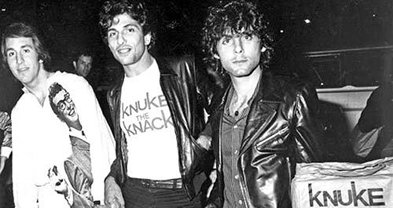 11-4-79 - the Knack: Tickets for this show at downtown’s Fox Theatre sold out in just a few hours. The band opened with the first three songs from their newly released album Get the Knack, which many critics compared favorably to the Beatles.
During the concert, detractors in the audience unfurled a large banner reading “Knuke the Knack” and “Get off your ego trip, the Knack suck.” The show continued and the banner eventually vanished; both the San Diego Union and Kicks magazine mentioned it in their respective reviews.
Few Knack biographies note that the band debuted Get the Knack at a San Diego venue. In February 1979, two months before its release, the Knack played the entire album for a Capitol Records showcase at the Catamaran near Mission Beach. Based on advance buzz, the Catamaran sold out, prompting the venue to host other prerelease live-album performances by then-unknowns such as the Motels and the Pop.
By November 1979, the Catamaran was presenting themed concert events such as a “San Diego New Wave Showcase” (which included locals the Penetrators and the Crawdaddys) and “L.A.’s Best Rock Night,” which featured both X and the Go-Go’s in their pre-album days.
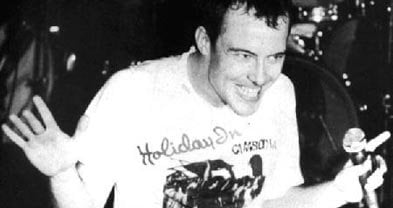 11-10-79 - the Dead Kennedys: On this night, the Dead Kennedys played the final concert ever staged at the city’s first punk venue, downtown’s original Skeleton Club on Fourth Avenue, across from Horton Plaza. Owner Laura Fraser was forced to close the basement level club due to problems with the hundred year-old building meeting fire codes. In addition, plainclothes police frequently ticketed patrons for everything from public drunkenness and drug possession to weapons violations, lewd behavior, and even for spitting on the sidewalk outside the club, prompting Fraser to allege municipal harassment.
When the Dead Kennedys hit the Club’s four-inch-high stage, lead singer Jello Biafra had just recently run for Mayor of San Francisco, coming in at fourth place. Around 300 patrons paid $3.50 to see the band speed through a topical set that included the anti- totalitarianism anthem “Holiday in Cambodia,” “Kill the Poor” (concerning urban neutron bombs), and “California Über Alles,” about a world where political punching bag Jerry Brown is President. One local paper called the mosh pit “a battleground that formed in front of, and at times on, the stage.”
The Skeleton Club reopened on December 7, 1979, at 202 West Market Street, in a locale abandoned by the previous – and ultimately doomed – tenant; Climax Limited Disco World.

2-1-80 – Gary Wilson: On this date, eccentric punk pioneer Gary Wilson played downtown's Skeleton Club along with locals Four Eyes.
"Gary Wilson had tape and stuff wrapped around him and there's flour being thrown all over during his performances," recalls Mark DeCerbo of Four Eyes. "I'm sure the crowd there that night had never seen anything like it in their lives.... Gary would run through the crowd like a maniac and out of the club and disappear. We would see him back at the house after the gig, and he'd be sitting there in the dark."
Wilson had recently arrived in San Diego and formed a group he called the Blind Dates (whose members would also play with Four Eyes).
"Our equipment was broken down and ragged and literally held together by duct tape," recalls Wilson today. "Something caught on fire onstage; I think it was caused by a power cord from one of our amps. After our performance, there was a tremendous amount of flour all over the stage and the club's equipment. It looked like a snowstorm hit the place.... I can't remember being paid for the gig. The owner probably got mad at us and docked us our pay."
Gary Wilson's career was recently jumpstarted after he was found working at a local porn store by private detectives; they were employed by a record label that wanted to reissue Wilson's music.
 7-1-80: Grateful Dead fans, however believable their addled faculties may be, usually cite the band's 1980 album "Go To Heaven" as the nadir of their recording career, though "Alabama Getaway" and "Don't Ease Me In" became later concert staples. That year's tour still managed to bring out the tie-dyed and squinty-eyed in big numbers for an appearance at the Sports Arena. Advance press reports made it clear that local police were "on guard" for the expected influx of illicit drugs and illegal activity in the parking lot and audience seats.
Even before the show started, several people were arrested for smoking pot. One bust was witnessed from alongside the stage by Dead members Bob Weir, Mickey Hart and band manager Danny Rifkin.
The trio tried to intervene, cajoling onlookers to join them in separating the young potsmoker from police offers trying to effect the arrest. Cops pulled out additional handcuffs and arrested Weir, Hart and Rifkin for "suspicion of inciting a riot."
The three defendants had to return to San Diego several weeks later to face charges. Their offense was reduced to a low grade misdemeanor, fines were paid and everyone walked out of the courtroom with a grudge against the SDPD that lingers to this day. "We couldn't believe what fascists they are down there," Weir told Golden Scarab, a Dead fanzine, in 1999. "We almost never went further south than Irvine after that. We didn't wanna set the kids up to be busted by a bunch of gorillas with no education, who hate rock and roll music."
 11-3-80: The Police, XTC and Oingo Boingo at the Civic Theater: Opening act XTC was riding on the popularity of their Black Sea album. Two years later, they'd play only one date of an American tour, in San Diego, before canceling the rest of the tour due to Andy Partridge's stage fright, essentially retiring from concert appearances forever. Oingo Boingo (with Danny Elfman) had only recently altered format, from a theatrical troupe called the Mystic Nights of the Oingo Boingo to a rock combo; they'd only released one self-titled EP under the shortened name at the time.
The Police's Zenyatta Mondatta (and its first single "Don't Stand So Close to Me") was in the U.S. top ten. The concert was sold out, with ticket sales reported at 14,585. I had a second-row seat, and the statute of limitations now allows me to admit that I broke that seat while dancing on it to "Walking on the Moon." The Police were reportedly so exhausted by this show that they canceled their next gig in Las Vegas to recuperate.
After the concert, gate-crashers were found to have gained entry via an ingenious route. On the roof of the theater, a vent duct had been disassembled, and an unknown number of ticketless patrons apparently climbed into the hole to enter an elevator shaft, open a trap door, and drop in. The elevator faced an administrative area leading directly to the concert hall itself. The breach was discovered later, as the gate-crashers neglected to reclose the elevator ceiling's trap door or return to the roof to reattach the vent grate. The illicit access was soon curtailed by pouring cement over the roof's vent bolts.

9-15-83: Elvis Costello and the Attractions played an experimental "amphitheater seating" show at the Sports Arena with two thirds of the venue blocked off. The bands (Aztec Camera opened) were set up in the rear of the venue and played to what would normally be the worst seats in the house. About a third of the 3500 seats were filled, despite the success of Costello's most commercial effort up to that time (Punch the Clock).
Security guards let in people without tickets, but the exodus of patrons outnumbered those coming in, and the Attractions finished their (mostly inaudible) set for fewer than a thousand fans. "Amphitheater seating" at the Sports Arena died soon after.

8-6-84 – Spirit at the Rodeo: The reunion of Spirit's classic lineup should have finally earned them the fame and acclaim they'd long deserved. Guitarist Randy California and drummer Ed Cassidy had been calling their band Spirit, but this date at La Jolla's defunct Rodeo was the group's first performance in nine years to also include original members Jay Ferguson and Mark Andes (who were having hits as Jo Jo Gunne) and John Locke. It was the opening date of their first tour together in 14 years.
Cassidy was 61 years old, Ferguson and Andes had tasted considerable post-Spirit success (Andes had also played with Firefall and was still with Heart), and California had clearly taken his version of Spirit in a more hippie-jam direction since the original lineup fractured.
My balcony seat afforded me a great view of both the band on fire and a wildly enthusiastic audience stoking the flames. Even if it weren't a historic occasion for Spirit (in my opinion the best and most underrated band ever to emerge from L.A.), I'd still rank it among the top fives shows I've seen. However, despite the five-album deal they'd just signed with Mercury Records, and regardless of the demonstrative sellout crowd in San Diego, the reunited Spirit only played a handful of subsequent gigs.
Members soon went their separate ways -- again -- leaving only core members Ed Cassidy and Randy California to carry on the name. For a while. California drowned in 1997, while saving his son from an ocean riptide in Hawaii (his son survived). Locke died in 2006 from complications due to lymphoma.
 9-1-85: Black Flag, the Minutemen, and SWA played Palisade Gardens Roller Rink on University near 30th. Police stopped the show four times due to noise complaints. Nearby businesses frequently petitioned owner Johnnie Wright to shut down Palisade's concerts. The shows stopped soon after this one, but what a helluva show it was…….

12-14-85: The Dead Kennedys played one of their final shows with original singer Jello Biafra, at downtown’s California Theater. As the set wrapped up, raucous fans tore up the seats and pulled curtains down from walls, causing police to call out a riot squad, though officers stayed outside the building until the crowd dispersed on its own. The fifteen song set included tunes off their newest album Frankenchrist, as well as “Triumph of the Swill,” “Police Truck,” and the encore “Holiday in Cambodia.”
The show's promoter - future Casbah owner Tim Mays - recalls "The police were called in by the fire marshalls - who were freaking out about fans not staying in their seats and clogging the aisles. Some seats got destroyed...At one point I went outside to get some air, and there were police on all four corners surrounding the block the theatre was on. They weren't going to let me go back inside. Finally, one of my production managers convinced a female cop he happened to know that I was indeed the promoter and not just some random fan who had wandered outside."
The next night, the DKs performed at Tijuana’s Teatro Casa de la Cultura, in a show also promoted by Mays (tickets: $5). Outside the venue, Mexican police arrested several San Diegans “for no apparent reason,” according to newspaper columnist George Varga. After the DKs, the California Theater only hosted a handful of punk shows for the remainder of its existence as a concert hall. After TJ, the band with Biafra only played three more concerts before calling quitting the concert trail a few weeks later.
 (Wild Man Fischer at Comic-Con, with Carnal Comics artist Holly GoLightly, aka Fauve)
8-5-88 – Wild Man Fischer at the San Diego Comic-Con: Moving around between low-budget downtown hotels in the mid-'80s, Frank Zappa's one-time protégé Larry "Wild Man" Fischer quietly became a San Diego street fixture. In 1988, his friend Bill (Lost in Space) Mumy came to town for the San Diego Comic Convention, along with a few comic-creator musicians who'd formed a band called Seduction of the Innocent.
Fischer told the Reader: "Billy said, 'Why don't you sing with us? You'll have a good time!' It'd been a long time since I'd played live." Was he nervous about the prospect? "I'm always nervous," he says.
Fischer was coerced onstage long enough for an incandescent set that included his doo-wop ditty "The Taster" and an a cappella rendering of "Merry Go Round." ("I'm getting a little sick of that song," he says now about his best-known tune.) The crowd was rowdy and responsive, even those unfamiliar with Fischer. His ever-increasing volume, enthusiasm, and spasmodic onstage body language proved infectious, and the audience handed "Wild Man" the most sustained applause of the evening. I was lucky enough to catch this rare show, one of only two dozen or so gigs Fischer can recall performing (struggling with schizophrenia, he'd backed out of many performances). Video clips from this performance appear in a new documentary film about Fischer, DeRailroaded.
 8-19-90: Nirvana played the year-old Casbah. This gig (a year before the release of Nevermind) has appeared on two bootlegs. The first to surface featured only 46 minutes of the band's 17-song set and is missing the last 5 songs ("Stain," "Negative Creep," "Blew," a bluesy jam, and "Verse Chorus Verse"). In March 2003, a more complete and better-recorded version surfaced; it's 62 minutes long, but with almost a minute of "Dive" missing (complete on the older, poorer-sounding version). Dave Grohl was not yet with the band (he joined in September of '90); drummer Dale Crover played San Diego and a few other West Coast dates.
 10-24-91 – Nirvana at Off The Record: Thanks to the Hillcrest record store's relationship with Geffen Records, OTR hosted Nirvana for an in-store appearance near the start of their first national headline tour. "Right when we found out [Nirvana] was definitely coming, Nevermind jumped from number 20 to number 7 on the Billboard charts," recalls store manager Phil Galloway. "Part of the deal was that we had to provide the equipment, a 12-string guitar, a PA...the plan was for them to do an all-acoustic set. Geffen [Records], or some radio network, was also going to record it. Things on our side fell through because we had all right-handed instruments, and so Curt went ahead and played electric guitar. They ended up doing a whole 40-minute hard-rock set."
"After the set, they hung out and signed autographs and posters for people. You could tell Curt [Cobain] wasn't into that part at all, though. He wasn't in the mood to pose for pictures and, well, let's just say he was definitely feeling down. Not at all like he was during the set...A lot of us talked about that later, how he seemed to be having a great time, and all of a sudden he looked so miserable and depressed. The guys in the band went out to dinner with a bunch of the employees, some record-company people, and even a few customers got invited along, but that definitely wasn't something [Cobain] was into." A video of this performance has been uploaded to YouTube.
 9-19-93 – Jethro Tull at SDSU Outdoor Amphitheatre: The band had canceled an earlier local show due to singer Ian Anderson's throat problems. This concert (the final date of a U.S. tour) got off to a rough start, with Anderson verbally berating an audience member near the front for smoking a joint. He later gave a short speech about how the stage pulls smoke past him and how this affects his singing. "He mentioned he had been taking amoxicillin and joked he was receiving it anally," according to Reader reviewer Allan Peterson.
The upside to the vocal problems was that they played unusual instrumental versions of songs normally sung ("The Whistler," "Sossity, You're a Woman"), as well as added numbers rarely performed live, like Andy Giddings's "Parrott" and a lengthy flute solo that included bits of "In the Grip of Stronger Stuff" (unreleased until two years later). Peterson describes the latter as "an untitled jazzlike instrumental that seemed free of any historical expectation and actually flew on its own."
Opening band Procol Harum pranked the headliners by showing up onstage while Tull played -- for the only time that tour -- in drag!
 12-29-93: Nirvana played the Sports Arena. The band's 24-song set was the source of two widely circulated bootleg albums: Smells Like TJ captures all 100 minutes onto a Hi8 master, while Pizzongs is missing most of the unidentified mystery finale.
After the third song, "Breed," bassist Krist Novoselic told the crowd, "Nice to be playing San Diego, hometown of Eddie Vedder." After covering Bowie's "Man Who Sold the World," Novoselic asked, "Who here is from San Ysidro?" Two songs later, he continued, "We used to play here in San Diego, we used to play, like, the Casbah and Iguanas, where you have to wait at the McDonald's in San Ysidro because the federales were on the payroll to let you cross the province."
 (Me backstage for Pink Floyd at Jack Murphy Stadium - mock if you must my fanny pack, stone-washed jean jacket, jogging pants, and mullet, but they had a killer catering tent and I was having the time of my life!)
4-14-94 – Pink Floyd at Jack Murphy Stadium: "I could easily smell the burning stench of our failed drug laws," wrote Reader columnist Allan Peterson about Pink Floyd's first San Diego concert in 19 years. The immense scope of the elaborate show, with all its effects, movie screens, inflatable animals, and (excellent) quad sound, is not what ranks this show (sans the "real" Pink, Roger Waters) among great and historic local events.
Rather, it was the stirring performance of "The Great Gig in the Sky." Peterson says, "Singer Durga McBroom's take on that classic piece was seamlessly compelling and contained all that one could hope for -- longing, sadness, acceptance, raw beauty...the terrifying immediacy of mortality, the telling reality of loss." I felt the same chill down my spine during the rendition, and over a decade later, that's "the moment" everyone I know who was there still raves about.
Bootleg aficionados apparently agree, usually ranking this date -- and that performance of "Great Gig" -- among the best of the entire U.S. tour.

11-6-95 and 11-7-95 – Pearl Jam at San Diego Sports Arena: The Ramones opened for these two sold-out general-admission shows. On opening night, "They did an awesome version of 'Deep' with some cool-sounding slide sounds," recalls an attendee on the band's Fanview webpage. "They performed a short screamer of a song. Later we would find this to be 'Lukin,' but it wouldn't be released until No Code came out in August of '96...they did a sweet version of 'Black,' with lighters raised all around and the crowd chanting to the doo doo doo."
"At the conclusion of 'Blood,' Eddie slammed his microphone stand into the ground and threw it into the crowd. The band left the stage and the noise level was incredible, trying to get the band back out for an encore." Also on the setlist was another unreleased No Code number, "Habit," and a cover of the Byrds' "So You Want to Be a Rock and Roll Star."
Of the second night, Tom S. at Fanview says, "At the end [of "I Got [expletive]"], Eddie was having a problem with his guitar, it didn't want to stay in tune. He leaned into the mike and said, 'Watch this,' whereupon he took his axe off and grabbed it by the neck, spun around, and launched the [expletive] over Jack's head, clearing it by maybe a foot, and said, 'New guitar please; after all, I am a rock star.' "
Introducing "Leaving Here," Vedder told the crowd, "We tried to play this song last night, and we [expletive] it up really badly, so we'd like to try it again." Says Tom S.: "It was funny because they false-started it three times before they got it going. But, when they did, it sounded great."

 8-29-2000 – Stevie Nicks at the Marriott Hotel: The Fleetwood Mac songstress brought her full wardrobe and dual video screens for this private corporate gig in a dinner club setting at the Marriott Hotel, for the National Association of Chain Drug Stores Convention (no cocaine jokes, please…).
"She started the show with 'Enchanted,' and the entire band sounded very technical and like a studio recording," recalls Jim T at Nicksfix.com. "Her appearance reminded me of the FM days in the late '70s that I grew up listening to. She was charismatic and looked young again... people stood and started dancing in their dresses and suits."
Erin at Nicksfix -- only 14 at the time -- says, "Everyone was screaming and clapping for her...She was wearing the same dress she wore on VH1's Storytellers, and I also noticed that she traded her usual platform boots for black platforms where the whole sole touched the ground with rhinestones on the front...Stevie dedicated 'Landslide' to all of us, and while she was singing, I just wanted to cry."
 6-16-01: Snoop Dogg's "Puff, Puff, Pass" tour began in San Diego on this night. The show ended early, as the rapper left the Coors Amphitheatre stage after only 45 minutes. When he pulled the plug, Dogg had already been hit in the chest with a thrown red visor and members of his entourage standing onstage were being pelted with bottles and other debris.
Someone from the audience tried to climb onstage and alleged gangmembers were pulling speakers from the stage and trashing them. According to witnesses, it had nothing to do with the music - the people onstage were wearing blue colors. Offending/offended audience members were wearing red.
Suddenly, it was a a scene from Dr. Suess, only with with tattoos, as starbellied sneeches and barebellied sneeches threatened to go head to head in a violent confrontation. According to the Union-Tribune, a security guard suffered a minor injury after being struck by an unidentified object during the "disturbance" but no arrests were made other than a woman under the influence of drugs or alcohol.
As Dogg left the stage and house lights came up, the sound of microphones being slammed to the ground while still amplified was mistaken by some to be gunshots and a minor panic ensued.
Chula Vista Police took the stage in what police Lt. Dan Linney called a "skirmish line," as a show of force, but audience members quickly regained their calm and left the venue compound peaceably.
After the concert, Snoop's tour bus was pulled over in Temecula. The police smelled marijuana smoke, searched the bus and found 300 grams of pot. A member of Snoop's entourage claimed possession of the herb, was cited for misdemeanor possession and released. On October 19, two of the rapper's tour busses were pulled over again, this time in Cleveland , for speeding, and six more bags of weed weighing 200 grams were found. Snoop and two fellow passengers were arrested for misdemeanor possession, making the "Puff, Puff, Pass" tour one of the most aptly named in recent memory.
 10-18-02: Nelly had nothing to do with the fatal stabbing that took place after his performance, in a VIP parking lot at the Coors Amphitheatre stop of his Nellyville tour. However the incident further tarnished hip-hop's reputation among local promoters and venue owners and raised public concern about concert safety, with area hip-hop bookings becoming fairly scarce over the ensuing year.
Police said officers directing traffic after the Nelly concert were flagged down by people in two cars near the venue. Each car contained a stabbing victim and a third car was pointed out containing parties said to be involved in the stabbing. Concertgoer Faitamai Tauanuu, a 30-year old Samoan man, died from his injuries and Sean Bowers, 27, was stabbed in the shoulder and under the armpit and hospitalized in serious condition.
Police arrested Steven Tesam, 42, and Hank Banegas, 26, holding them for murder and attempted murder, and Tesam's 16-year-old son was taken to a juvenile facility, under suspicion of conspiracy. Tesam was the chairman of the Viejas band of the Kumeyaay Indians, who operate the Viejas Casino. Banegas is his nephew.
Witnesses said Tauanuu was stabbed in the heart during an alcohol-fueled fight, the combatants shouting obscenities. At a preliminary hearing in January 2003, Fili Usini testified that the victim was killed while trying to break up a scuffle between TeSam and Bowers. Deputy District Attorney Jeff Dusek told the court that charges would not be brought against Tesam because of insufficient evidence and the tribal chairman was released. The 16-year old was also released but Tesam's nephew Banegas was charged with the murder and faced 26 years to life for the stabbing.
On August 13 2003, Banegas circumvented his upcoming trial by pleading guilty to voluntary manslaughter and assault charges. At the October 8 sentencing, Defense attorney Tom Warwick tried to characterize the victim Tauanuu as belonging to a Samoan "Blood" gang, but prosecutor Dusek said the 30-year-old Paradise Hills man was just trying to break up a fight Tesam started with Tauanuu's friends. "He was trying to solve the situation that night and he ended up dead," Dusek told the judge. Banegas was sentenced to ten years in prison.
The mayor of Chula Vista , Shirley Horton, pointed out that the Nelly incident was the first major violent incident at the Amphitheatre after more than 50 events, adding "We will certainly evaluate the situation."
 (Beatle at birthday bash)
2-22-03 – Paul McCartney plays a private party in Rancho Santa Fe: When Ralph Whitworth threw his wife a 50th birthday party at Delicias restaurant, he forked out a million bucks (for charity) to have McCartney perform for the crowd of around 150. Macca and band (including guitarist Rusty Anderson) did 19 songs, as well as the Beatles' rarely performed "Birthday" (which was later added to the tour's setlist).
In a press release, McCartney said, "Normally I don't do this sort of gig, but I was chuffed to do it because it was a 'win-win' show. Ralph gets to be the great husband for organizing the surprise, his wife gets a rocking party, I get to rehearse the band for the tour, and most important, Adopt-A-Minefield gets one million dollars."
"Crasher" columnist Josh Board knows Rusty Anderson's sister, who lives in San Diego. "The day after the Rancho Santa Fe concert, I called to ask if she was there. She said, 'No, I didn't make it. Rusty left a few messages on my machine, but I got them too late. I can't believe it. For them to be so close like that. And I went all the way to Russia to see them.'"
Less than a year later, the Whitworths filed for divorce.
 3-28-05 and 3-30-05 – U2 at San Diego Sports Arena: The opening dates of U2's Vertigo Tour came just two weeks after their induction into the Rock and Roll Hall of Fame. Ticket prices ran $49.50 to $165, though area resale agencies like Advancetickets.com were charging $1190 for fifth-row seats.
"The band sounded amazing from start to finish," says Interference.com contributing editor Devlin Smith of the opening date. "Even though Bono said at the end of the main set, 'You can screw up a little, we're amongst friends, right?' I couldn't name a single blunder."
"Bono said during 'One,' 'Did You come here to play, Jesus, because I did,' and introduced himself to the audience during the night's closer, '40,' as Little Lord Jesus," says Smith. "Edge was confident and comfortable, taking much of the spotlight for himself as he shared vocal duties on 'Miracle Drug,' sang 'La, la, la, la, de, day' on 'Running to Stand Still,' and sported a Madonna-style head mike to provide backing vocals on 'Zoo Station.'"
Smith says drummer Larry Mullen was "broadening his stage persona, supplying backing vocals for 'Love and Peace or Else' and 'Elevation,' and picking out notes on a synthesizer for 'Yahweh.' " As for bassist Adam Clayton, "He and Edge did mix it up, readopting an early-'80s tradition of swapping instruments for 40."
According to Pollstar magazine, the March 30 show grossed $2.9 million, making it the only 2005 San Diego show among that year's top 100 moneymaking concerts.
THE DAY NIRVANA PLAYED OFF THE RECORD: 10-24-91
 Ticket and photos of Nirvana at OTR 10-24-91
Who doesn't miss the staple-infested LP bins of Off The Record's late lamented Hillcrest locale? Those beat up bins survived hundreds of live concerts, with both bins and shows dating back to the store's original College Grove location.
Phil Galloway was a fixture at OTR nearly as long as the bins, booking many of those performances and witnessing nearly all of them.
"It's a pain in the -ss to do an in-store [concert]. We have to rearrange the racks, run ads, sometimes we hire security, and then we're losing $300.00 to $400.00 in sales while the band's playing. Even though it's a huge hassle, in-stores promote the business, they create goodwill with our customers and, really, all of us at the shop love putting our heads together and saying 'Let's put on a show!'"
"About half the time, we approached the band directly or through their agents, and the rest of the time it's a vendor, their record company or someone like that who gets ahold of us to say [the band is] available. The El Cajon Boulevard store was a lot smaller but we managed to pull off in-stores with Slayer, Husker Du [and] a lot of punk groups."
Long lines and packed aisles were common when bands played OTR, with the largest turnouts greeting the Posies (1991), Mudhoney (1994), the Misfits (1996), Drive Like Jehu (1997) and Rocket From the Crypt (1998). An April 2001 set by the Locust drew, in Galloway 's estimate, over two hundred patrons.
"I've only ever been starstuck twice in my life. Once was when I had the chance to hang out with Elvis Costello, [because] I'm a huge fan. The other was when I was thirteen years old and I met Charles Schulz at the Comic-Con[vention]."
 Cartoonist Schulz
Just mentioning the comic strip artist who created Snoopy and Charlie Brown causes Galloway to slip into a reverent, almost worshipful tone.
"I had a collection of 'Peanuts' comics that I saved in binders and he signed those, and then he actually drew Linus for me," he sighs, enjoying a fond recollection directed more inward than toward the tape recorder.

The record store's "close relationship" with Geffen Records, coupled with the success of a recent in-store with The Posies which had been broadcast for television, earned OTR an offer to host Nirvana for a performance to be staged near the start of their first national headline tour.
"Right when we found out [Nirvana] was definitely coming, 'Nevermind' jumped from number twenty to number seven on the Billboard charts. At that point, they decided there'd only be three in-stores for the whole tour - Seattle , San Diego and New York . For the one in Seattle , they purposely leaked out the wrong date and location, so the actual gig could stay a secret until the last possible minute."
"Down here, we prepared by creating limited edition tickets; purple, with a watermark. Each one [was] individually signed and numbered and recorded, not only to control the number of people in the store but to prevent counterfeiting. I heard right away about the Seattle gig. The kids who got in went nuts and were bin-diving. Actually climbing on the record bins and diving off, falling all over the band! That made us a little nervous, for sure. I'm sure, to our insurance company, just saying 'Please, no stagediving off the record bins' isn't going to cover the injuries and damage!"

"I was in the store at 5:30 AM, taping baby dolls and fishhooks everywhere, like on the [Nevermind ablbum] cover. The record bins had to be moved and those weigh three or four hundred pounds each. Oh, and part of the deal was that we had to provide the equipment, a twelve string guitar, a PA.the plan was for them to do an all-acoustic set. Geffen [Records] or some radio network was also going to record it. Things on our side fell through because we had all right handed instruments and so Kurt went ahead and played electric guitar. They ended up doing a whole forty minute hard rock set."
 Nirvana at OTR
"After the set, they hung out and signed autographs and posters for people. You could tell Kurt [Cobain] wasn't into that part at all though. He wasn't in the mood to pose for pictures and, well, let's just say he was definitely feeling down. Not at all like he was during the set. I'm sure that he was used to being able to wind down and go to sleep after a show so this must have been a drain, having all this activity going on around him for so long after playing so great [and] putting out all that energy."
"A lot of us talked about that later, how he seemed to be having a great time and all of a sudden he looked so miserable and depressed."

Cobain agreed to pose with his bandmates for a group snapshot with the OTR staff, and the resulting photo, capturing him making a face somewhere between a grimace and a nyahh-nyaahhh taunt, seems to show him already disgusted with rock star posing and commercial ass-kissing.
"The guys in the band went out to dinner with a bunch of the employees, some record company people and even a few customers got invited along, but that definitely wasn't something [Cobain] was into. But, hey, they played an awesome set."
Galloway phrases this with a finality that seems to discourage more discussion about the singer's off-stage attitude.
Further inquiry results in a long sigh and then a longer silence. "The other two [bandmembers] had just gotten over being sick so, I don't know, maybe he was coming down with something?"
Nirvana at Off The Record on 10-24-91 can be viewed on YouTube:
Nirvana at OTR part 1
Part 2
Part 3


THE DAY JIMI HENDRIX CAME TO TOWN: 5-24-69

May 1969: Two hundred years after Father Junípero Serra founded the first California mission on Presidio Hill, San Diego celebrated its bicentennial. The Ferry still shuttled passengers and cargo across the harbor, as it had for over eighty years, but the Coronado Bay Bridge was in the final phase of construction before its scheduled August 3rd opening.
Also nearing completion was the Fashion Valley Mall, a fifty million dollar shopping center covering seventy-eight acres of land that had previously been home to The Padres' Westgate Park . Students at San Diego State University responded to headlines about the war in Vietnam by making headlines of their own with campus anti-war rallies, while academic strikes were held in symbolic protest of U.S. bombing raids.
The sounds of the sixties were blowin' in what little wind there was in San Diego .
The Flying Burrito Brothers played two nights, May 9th and 10th, at the newly opened United Fruit club at 4009 Central Avenue in North Park, while SDSU's Aztec Bowl (now the site of Cox Arena) hosted the Grateful Dead on May 11th, along with Tijuana native son Carlos Santana, blues belters Canned Heat and forgotten pop wizard Lee Michaels.
On Saturday the 24th, Bob Dylan turned 28 years old. The Beatles' "Get Back" hit #1 on Billboard Magazine's list of top selling singles, knocking "Aquarius/Let The Sunshine In" by the Fifth Dimension from the top slot. Local radio stations were spinning platters by Blood, Sweat And Tears ("You've Made Me So Very Happy"), the Zombies ("Time Of The Season") and the Doors ("Touch Me").
Guitarist Jimi Hendrix, who, with his band the Experience - bassist Noel Redding and drummer Mitch Mitchell - had just played a hometown gig the previous day at the Seattle Center Coliseum, checked into his "deluxe" two-room suite at the Hilton Inn.
Hendrix and his band were nearing the end of a two month long concert tour and were due to play San Diego's International Sports Arena that evening. The Experience's spring tour of America had begun in Raleigh , North Carolina , during April 1969, sweeping through Philadelphia , Memphis , Houston , Dallas , Los Angeles , Oakland , Detroit and Toronto Canada .

Scheduled to open the San Diego show at 8:30 pm was Fat Mattress, a group Noel Redding had formed - ostensibly as a "side project" but really, he'd later admit, created as a way to hedge his bets in case rumors about Hendrix's plan to disband the Experience proved to be true (the rumors were correct).
"Fat Mattress was me getting back to me roots," Redding told me during an interview he did for Rock 'N' Roll Comics, before he died in 2003. "I never played bass before I auditioned [for The Experience], and I missed playing guitar and singing. Fat Mattress was done with two members from an old band I'd been in called the Loving Kind. We put together the new group to open for Experience shows, sure, but also to record and tour on our own.this was my outlet for songwriting, and Jimi seemed to think the idea was great. We all planned on having our separate side projects, to keep everybody happy, but to keep the Experience going as well."
Redding says part of the motivation behind forming Fat Mattress was statements Hendrix had given in press interviews about "taking a year off," as well as behind-the-scenes vibes he'd picked up from the mercurial guitarist. "Around the time we went down to San Diego .there was talk of the group being 'expanded.' I hadn't been asked about it. At that point, I was asking a lot of questions about the finances, about where all the money was. I think they brought in Billy Cox [who replaced Redding in the Experience several months after the San Diego concert] 'cause I was asking so many questions."
Redding recalls an argument with the Experience's road manager when the group arrived in San Diego . "I think that was the first time Mitch [Mitchell, Experience drummer] and I were put on a 'daily dole' - an allowance, I guess you'd call it, that we had to use to pay for anything besides the hotel and room service. Everything used to be taken care of and paid for, but all of a sudden it was up to me to buy me own guitar strings if I needed another set! He [the Experience road manager] fobbed off paying the bill for [Fat Mattress] too...I believe they had to stay in a different hotel from the rest of us, and a none too nice one at that."
Tickets for the Sports Arena show cost patrons from $2.75 to $5.50. The concert was sold out, and a few hundred fans were milling about in the Arena parking lot as Fat Mattress hit the stage, just before 9 o'clock. Several people had been caught trying to gain entrance with counterfeit tickets, apparently purchased from a parking lot scalper. The bogus tickets were confiscated and those bearing them weren't arrested but weren't granted admittance either.
Some of these agitated individuals loitered near the entrances well into the concert, alongside other ticketless youths determined to get an earful of the music being played on the other side of the Arena's glass doors. At one point, a few dozen of them decided to join forces and rush the gate by surging en mass past security guards. A scuffle and several short chases ensued and most of the gate crashers were turned away or arrested, prompting local headlines the next day to read "Police Arrest Gate Crashers At Arena Show" and "'Music Lovers' Mar Hendrix Concert in Arena."

After Fat Mattress' set, Hendrix sat in a small backstage dressing room, strumming an unplugged electric guitar while several others milled about. Present were his bandmates Redding and Mitchell, as well as an out-of-place looking man wearing a suit (possibly working for the promoter or a local radio station) who was roundly ignored as he tried to talk Hendrix into taping a radio interview with a DJ waiting outside the room.
In the arena, technical engineers were setting up a stereo tape deck intended to record the concert direct from the soundboard mix. The man in charge of recording the show was Wally Heider, owner of a Northern California recording facility frequented by the Jefferson Airplane and many others (Heider would also serve as sound engineer on the recording "Hendrix Live At Fillmore East").
Running the mix from the soundboard was Abe Jacob. Jacob had started as a sound engineer in San Francisco , mixing for The Mamas and the Papas and Peter Paul and Mary, as well as designing the sound system for the Monterey Pop Festival, where the Jimi Hendrix Experience first wowed America in 1967. Until Jacob gave the go-ahead that the equipment was primed and ready, Hendrix would remain in the dressing room, as it was important to the guitarist that this date be perfectly preserved on tape, both for his own personal archives and for a possible live album.

Backstage, Hendrix agreed to be interviewed by Jim Brodey, a writer for the San Diego Free Press. First, though, he instructed a roadie to clear the room of everyone but himself and Brodey, whom he gave permission to tape the interview. Even so, people kept walking in and out of the room during the chat, apparently causing Hendrix some distress.
As published in San Diego Free Press' June 13 1969 edition, Hendrix discussed his May 3rd arrest (for "illegal possession of narcotics") at the Toronto International Airport . Royal Canadian Mounted police had searched his luggage, claiming to find several ounces of heroin wrapped in small packages and tucked into a bottle, discovered in one of his travel bags.
"I can't tell you too much about that because my lawyer told me not to," the guitarist told Brodey. "Anyway, I'm innocent, completely innocent." Asked if he thought the bust was "a frame," Hendrix replied, somewhat incoherently, "It must have been or either it was just a very bad scene, because it ain't anything it was. But, anyway, I can't talk too much about it now."
Asked about the rumors of his upcoming year long "retirement," or whether he was looking to form a new band, Hendrix rambled without committing, possibly because he hadn't made up his mind up yet regarding his increasingly estranged bass player, Noel Redding. "Oh well, see this is what the negative folks are trying to tell you. That's what the establishment is telling you. They're trying to blow us all up and give us awards and all that so that they can just dust us away, but we're not here to collect awards, you know, we're here to turn people on to the right way because there is some really strange scenes coming up though..."

At that point, the constant flow of bodies going in and out of the small room distracted him and he told Brodey "Hey, I can't do this with other people in the room."
This wasn't the only break in the proceedings, according to Brodey. "At one point," he says, "the interview was interrupted by promoters and someone with a 'love' medallion. Top forty radio station KCBQ had sponsored a contest in which entrants who had made the 'grooviest love' medallion would win a free ticket to the concert and present their love beads to Hendrix in person. Jimi, who knew nothing of the contest, refused to save face for the bumbling KCBQ and wouldn't see the winners."

A few minutes before 10:00pm, the Jimi Hendrix Experience hit the stage. The 5/24/69 tapes would become the source of one of the most widely "bootlegged" recordings of all time. It's unclear how Jacob's master reels landed in the hands of pirates, but within weeks of the show, vinyl albums were circulating featuring performance excerpts or even the entire concert, marketed with titles like "Hendrix Burns," "Jimi West Coast Jam," "Sunshine Jam" and "Jimi's Red House."
As immortalized on those tapes, the Experience set list that night was comprised of "Fire," "Hey Joe," "Spanish Castle Magic" (with an interlude featuring jams to the tune of Cream's "Sunshine Of Your Love" aka "Sunshine Jam," stretching the song out to nearly eleven minutes), "Red House," "I Don't Live Today," "Foxy Lady," "Purple Haze" and a ten minute-plus version of "Voodoo Chile (Slight Return)."
Jimi talked quite a bit to the audience between songs, including one extended rap where he told them "You people down here are witnessing some really beautiful times. Like, groovy times you'll be telling your children and their children's children about, man. This is, like, the epicenter of where it's happening, right here in California . I just wanted you to know that, even though I think you know it already. Does it ever rain here? Would you care if it did? I didn't think so."

The entire set lasted just over an hour, for which the band was reportedly paid $55,000.00. A few minutes after 11pm, the Jimi Hendrix Experience left the stage and all three bandmembers walked off in different directions, not saying a word to each other until it was time for an equipment check before loading up their instruments into a rented U-haul truck and leaving town the following morning.
Hendrix went back to the Hilton Inn and met up with Brodey again in the hotel cocktail lounge, where the guitarist "further discussed his philosophies of life," Brodey says, without the pressure of a running tape recorder present. The newspaper reporter got the impression that "The possibility of personnel changes isn't unlikely," which wasn't exactly news to Noel Redding, who tried unsuccessfully to find Hendrix at the Hilton Inn.
"I'd go down to [Hendrix's] hotel room," Redding says, "and he wouldn't be in there. There would be all these sorts of people getting room service and smoking all these reefers, etcetera, etcetera, and I could tell he was getting, you know, a bit bad. But what could I say?"
Just over a month after playing San Diego , on June 29 1969, at the Denver Pop Festival in Mile High Stadium, the Jimi Hendrix Experience featuring Mitch Mitchell and Noel Redding played their last concert together.
"In 1970, we were going to get back together.for this major tour," Redding told me. "But by then I'd become, I don't know, too much trouble. They didn't want to deal with me any more than I wanted to deal with them.when we came back from the rehearsals, I heard through somebody else that they'd gotten [Billy] Cox in rehearsing. I was really upset because Hendrix didn't have the neck to tell me face-to-face."
Prior to San Diego, the band's April 26th set at the Forum in Los Angeles had been professionally recorded for the proposed live album (also by Abe Jacob, for Wally Heider Recording), as had some other dates on the tour. After the Sports Arena set, Hendix joined forces with engineer Eddie Kramer and began to mix the concert tapes at a studio in L.A. For reasons never stated officially, the live album project was abandoned and the recordings were stored in the Warner Bros. tape library.

The twelve minute long version of "Red House" performed in San Diego on May 24th later turned up on the official release "Hendrix In the West" (Polydor/WB Reprise, released January 1972) and it's considered the guitarist's best rendition of the song. Hendrix's solo runs nearly five minutes until Mitchell and Redding go back to work and pick up the tempo behind him - even then, Hendrix seems reluctant to stop riffing and sing the next refrain.

Other official and semi-official releases offer songs from the San Diego date, including the 1982 LP "Concerts" (which uses chopped up snippets of Hendrix's stage chatter in San Diego, spliced between live takes from several different concert performances) and the four CD set "Stages" (Polydor/WB Reprise 1991), which has nearly the whole 5/24/69 show, except "Foxy Lady," on disc three (the feedback heavy intro to "Foxy Lady" caused an uncomfortably fuzzy buzz on the unedited master tape reel).
In addition, a recent box set collection "The Jimi Hendrix Experience" (2000, Universal/MCA) features the San Diego version of " Red House ," along with " Purple Haze " from the same show.
As recently as summer 2008, the SD version of "Purple Haze" became part of the Guitar Hero games, further qualifying the night Jimi Hendrix came to town as the stuff of rock and roll legend.
Jimi Hendrix died in London, at the age of 27, on September 18, 1970, "When he died," Redding quietly said during one reflective moment, "I'd seen him a couple of weeks before he passed away. It was grand, we got on quite well. I'd like to think that things were on the up and up, that nothing was left unsettled and unresolved. That's what I'd like to think."

Comments
Well, as if you need proof that jimi lives... i was born about 3 years after his passing. my parents absolutely didn't listen ro rock. or roll. get picture?
Yet none the less, over 35 years after his passing, i decided to come to my cpu, put on some tunes, and check my em. i put on electric ladyland - i was wanting to hear it from still raining, still dreaming, - then i randomly went to sdreader.com (not sure why i didn't just go right to gmail) and started looked for something to read. i guess my point, obvious to most i suppose, is that so many years later, his influence, his instinctive random genius, the love that is expressed through the art in his music, the sudden truth of emotional fires bursting, it's influenced so heavily, so deeply, it is a spirit we all hope we are striving for.
By sdblogger 6:25 p.m.
THE DAY BRIAN WILSON GOT BUSTED AS A VAGRANT IN BALBOA PARK

SUMMER 1978: BRIAN WILSON was picked up by cops as a vagrant in Balboa Park...
 In late 1976, mercurial Beach Boy Brian Wilson was complaining about round-the-clock “treatment” administered by Beverly Hills shrink Dr. Eugene E. Landy, a controversial mental health guru who, with his staff, essentially dictated and controlled his subject’s every move. Landy was later fired by band management, after it was discovered the doctor’s $90 hourly/$10,000 monthly salary had doubled.
However, Wilson's new therapist Steve Schwartz was soon killed in a rock-climbing accident and before long the songwriter’s delicate mental and emotional equilibrium was, as Landy might say, “disharmonious.”
In June 1978, Wilson - without telling his wife or fellow bandmembers - decided (inexplicably) to escape his life entirely and hitchhike to Mexico. He wound up in San Diego a few days later, according to Steven Gaines’ biography “Heroes And Villains,” which describes a mentally fogged pop star millionaire wandering around the city for days, “barefoot and unwashed.”
“He was on a binge," according to Stephen Love, brother of Beach Boy Mike Love and sometime-band manager (he kept getting fired and rehired). Wilson’s wife since 1965, Marilyn Rovell, referred to the incident in later divorce papers as the beginning of their marriage dissolution, saying “He told me he wanted to know what it feels like to be a bum…[he was] playing for drinks in San Diego bars.”
Someone from a local recording studio recognized Wilson and attempted to get him to record a track, apparently unaware that Wilson was at the time basically living under a tree near the entrance of the Laurel Street Bridge in Balboa Park. That’s where he was discovered one afternoon, passed out and nearly comatose.
"The cops found him in Balboa Park under a tree with no shoes on, his white pants filthy, obviously a vagrant, with no wallet, no money," according to another Love brother, Stanley. Wilson was taken by ambulance to nearby Alvarado Hospital and a doctor called Mrs. Wilson to inform that her husband was being treated for alcohol poisoning.
Wilson's wife had already approved sending a private detective to San Diego to search for her missing husband. She'd done so after a phone call from someone at the local recording studio who called CBS, the Beach Boys’ one-time label, with news of Wilson’s vagrancy.
Marilyn, with Stephen and Stanley Love, came to San Diego to take Wilson home but decided to leave him at the hospital a few extra days for treatment. Wilson’s mental and physical health was precarious and the Beach Boys were scheduled to begin sessions for a new album in Florida soon.
Wilson flew to meet rest of the band straight from treatment, to record the group’s debut for Caribou Records at Florida's Criteria Studios. He was quickly supplanted as producer by Bruce Johnston when it became evident that Wilson was incapable – or unwilling – to do the job.
Brian Wilson and his wife filed for legal separation in LA Superior Court July 15. Alvarado Hospital is also where, in August 1999, Brian’s daughter Carnie Wilson underwent her highly publicized laparoscopic gastric bypass (weight reduction) surgery, performed live on TV and the internet.
(Thanx to Bart Mendoza for the tip and info that led to researching and writing above)


WHY MEXICANS HATED ELVIS!
 May 1959: While Elvis Presley’s popularity in the U.S. was arguably at its all-time peak, Mexico was in the midst of a huge anti-Elvis backlash.
Tijuana tabloids called him a racist and homosexual, after the singer reportedly told gossip columnist Federico de León "I'd rather kiss three black girls than a Mexican." A Mexican woman in the same column was quoted saying "I'd rather kiss three dogs than one Elvis Presley.”
 Mexican Radio Exitos read de León's column over the air and spearheaded a boycott of the "insolent artist," while the powerful student group Federación Estudiantil Universitaria (FEU) held public record burnings.
 When Elvis’ movie King Creole screened in May 1959 at the Américas Cinema in Mexico City, newspapers who’d advertised the film under the title Melodía Siniestra (Sinister Melody) reported a “riot” occurring.
Mexican counterculture novelist Parménides García Saldaña wrote a short story, "El rey criollo," about the screening where several hundred gatecrashers reportedly shredded the seats and threw lit papers onto patrons from the balcony.
“Before the film began,” wrote Saldaña, “it was pure chaos, a f-ing riot as they say more vulgarly. The different gangs shouted ‘Here the Guerrero [neighborhood],’ ‘Here the Roma’ ...And then some chicks come in with leather jackets with swastikas painted on them, pony tails and bobby socks, real rock and roller like…a group of guys gang up around them [and shout] “‘Dance!’”

 Mexican reporters suggested Elvis’ hip-wiggling and mannerisms proved he was either maricón (homosexual) or actually a woman in reverse-drag.

The movie Los chiflados del rock'n roll, a musical spoof, was promoted with posters showing Elvis in drag, being shot by rifle-toting men in sombreros, under a banner reading “Die Elvis Presley!”
The book "Refried Elvis: The Rise of the Mexican Counterculture" (Berkeley: University of California Press, c1999) claims the original Elvis quote was fabricated. According to author Eric Zolov, “Herbe Pompeyo of Polygram Records in Mexico City claims that a high-up Mexican political figure wanted to contract Presley for a private party, for which he sent the performer a blank check to fill in as he wished. Presley, according to the story, returned the blank check, so the politico, extremely offended, invented the storyline about Elvis not liking Mexican women.”


Who could have imagined that, four decades later, Mexico would be producing more Elvis velvet paintings than any other region in the world…
 …not to mention giving us “El Vez, the Mexican Elvis….”

Like this blog? Here are some related links:
OVERHEARD IN SAN DIEGO - Several years' worth of this comic strip, which debuted in the Reader in 1996: http://www.sandiegoreader.com/photos/galleries/overheard-san-diego/
FAMOUS FORMER NEIGHBORS - Over 100 comic strips online, with mini-bios of famous San Diegans: http://www.sandiegoreader.com/photos/galleries/famous-former-neighbors/
SAN DIEGO READER MUSIC MySpace page: http://www.myspace.com/sandiegoreadermusic
JAY ALLEN SANFORD MySpace page: http://www.myspace.com/jayallensanford
Here's something you might be interested in.
Previous article
Sessions marijuana lounge looks to fall opening in National City
How will they police this area?
50 Greatest Concerts in San Diego History 1917 - 2005
Revised 10-9: Historic local shows
1 - Fifty Historic Local Concerts: 1917 thru 2005 (revised/updated 10-9-08)
2 - The Day Nirvana Played Off the Record (10-24-91): The Inside Story, from interviews with OTR staff
3 - The Day Jimi Hendrix Came to Town (5-24-69): The Inside Story, from interviews with Hendrix bassist Noel Redding
4 - The Day Brian Wilson Got Busted in Balboa Park as a Vagrant (June 1978)
5 - Why Mexicans Hated Elvis
FIFTY HISTORIC SAN DIEGO CONCERTS: 1917 thru 2005
2-28-17 – Blues legend Jelly Roll Morton played a San Diego gig on this date, according to Morton biographers and Sandiegoconcertarchive.com. Several historians speculate that this concert, at an unnamed local venue, led to an offer of steady gigs in L.A., prompting Morton to relocate to the west coast in summer 1917.
In 1921, Morton was performing regularly at the Kansas City Bar in Tijuana. Two of his most revered songs were written there: “The Pearls” and "Kansas City Stomp," named after the bar. According to Dead Man Blues author Phil Pastras, “His trips to San Diego and south of the border had something to do with the Hollywood crowd as well, especially after prohibition set in. That is where the crowd would go to drink and party. They had a race track, and gambling and booze was legal, so that is where the crowd went.” San Diego had outlawed cabaret dancing in 1917 and the U.S. ban on alcoholic drinks was launched in 1920.
In 1921, Morton and a small orchestra were scheduled to perform at the U.S. Grant Hotel. Band member Dink Johnson later claimed the band was fired by the hotel management, because Morton sat at the piano and played with his legs crossed, ostensibly offending white patrons. Morton, however, later told an interviewer that he cancelled the gig himself, after finding out an all-white band playing at the Hotel was being paid twice the fee his band had been offered.
(Morton’s Mexican visa, courtesy Henry Villalapando Ford collection)
4-4-56 and 4-5-56 – Elvis Presley: "This is the first time that the Hancock is going to rock and roll, while still in anchor!" The titular host of NBC's Milton Berle Show [aka Texaco Star Theater] introduced Elvis Presley to a live audience on the deck of the aircraft carrier USS Hancock, docked at the Naval Station in San Diego bay. Presley's first-ever California performance included "Heartbreak Hotel" (on its way to becoming his first #1 hit) and a few others. The singer gamely acknowledged the raging controversy about his "shocking" onstage pelvic gyrations by taking part in a comedy sketch. Presley introduced Berle, dressed as Elvis (world's first Elvis impersonator?), saying "Mah twin brother, Melvin Presley." Berle/Melvin then takes credit for all the hip-wiggling, saying "I gave him his singing style - I used to drop grasshoppers down his pants."
Elvis' sexually-charged "singing style" was no joke to San Diego police, however. The next two nights, both of Presley's concerts at the San Diego Arena on 8th and Harbor Drive (aka Glacier Garden ) were sold out and police presence was heavy. Over both evenings, several young women were removed from the Arena, reportedly for "hysterical and lewd behavior." The Shore Patrol had to set up a floating blockade behind the venue, after two teen girls in their underwear and carrying soaked dresses emerged from the water to make a run for Presley's dressing room (they were caught by police and released, presumably after their garments dried). Three people were arrested.
"Some girls broke into the bathroom of Elvis's dressing room and stole the toilet seat," recalled KCBQ disc jockey Don Howard in a 1979 interview with localKicks Magazine. "His Cadillac was covered with obscene messages, and two sailors were arrested for masturbating during the show from watching the antics.... After the concert, the police arrested 12 girls running nude through the halls of the El Cortez Hotel, looking for Elvis.”
“I introduced him [to the stage],” says longtime local DJ Happy Hare Martin, “and he rushed out and sang the first chorus of Hound Dog, which I could not hear above their primal screams. Then…he began wiggling and rotating his pelvis. This is when half the girls lost control of their bladders.”
Martin had been with Elvis backstage in the hours leading up to the show. “Elvis was a blonde,” he says. “I kept his secret for many years, until I learned that he had been outed…When I entered the dressing room, I was flustered to see that the King had no clothes. He was pacing buck naked in the dressing room…Seeing me, he grabbed his gold Lamé suit and covered himself. Too late. I had caught him.”
“In contrast to his black head of hair was a golden wheat-colored tuft [down below]. Yep, he was a natural blonde, alright. ‘You ain’t gonna tell nobody, are ya?’ he asked, almost pleading. I nodded a firm no, and that was that. I later learned that Tony Curtis was his idol. He regarded Tony as the ultimate babe magnet, so he dyed his hair raven black, just like Tony's…the kid obviously did not realize that his hair could have been [turd brown], and it would not have mattered.”
Ticket sales for the two 1956 concerts (with his new backing band the Jordanaires) reportedly totaled $17,250, with 11,250 fans attending. The day after the second San Diego date -- April 6 -- Presley signed a seven-year movie deal with Paramount. Three weeks later, "Heartbreak Hotel" hit number one.
When Presley was scheduled to return to the Arena June 6, Police Chief Adam Elmer Jansen (the city's longest-serving Chief, at 14 years) had had enough. "If he puts on the same kind of show that he did last April, I'll arrest him for disorderly conduct," he was quoted saying in the Union (repeated nationwide after newswires picked up the story). "I've had enough complaints from parents to assure me that twerp is not doing the kids any good." Late in the year, the city Social Services Department held a series of hearings, to discuss whether Presley should be banned from playing in San Diego .
Presley escaped town without being arrested or banned and in fact returned years later to pack them in for three more sold-out performances, after Police Chief Jansen retired - November 15, 1970 (ticket sales 14,659), April 26, 1973 (15,050 attendees) and April 24, 1976 (17,500 attendees).
9-58: Ritchie Valens had two hits on the charts -- "La Bamba" and "Donna" -- when longtime local DJ Harry "Happy Hare" Martin persuaded him to perform at the 1958 opening of Clairemont High School.
“The Principal called and asked me to do something for the new kids,” Martin told me in March 2008. “I was full of myself in those days. I said ‘Sure’ and got on the phone…I took it for granted that he [Valens] knew me, and I asked him about coming down to San Diego to sing for the new school. No mention of money. He immediately said yes, no doubt thinking that anyone this audacious must be important.”
“There was no opposition from the school, all were thrilled that I could get someone with two or three songs on the Hit Parade.” When Hare picked up Valens at the airport, the rising rock star emerged from the plane with his guitar slung around his neck and carrying a small amp. “At the school, all of the students were in the yard, because they were still painting the new auditorium. Ritchie didn’t seem to mind. He sang two songs that I recall, ‘Donna’ and ‘La Bamba,’ and some other newer songs, all on the red clay, in the broiling sun, for the better part of an hour.”
“Many kids broke into impromptu dancing and that egged Ritchie on. Him playing, and them dancing and celebrating, [it was] a musical fiesta. A South L.A. Latino kid, connecting with 2,000 young Anglos…it was historic. No autographs or pictures…things were more structured in those days.”
Valens was literally on the brink of superstardom as he flew back to L.A. that evening. “If it had been a couple of months later,” says Hare, “I would have had to put him up in an expensive hotel and paid him a lot of bucks. But, that day, he was just a simple kid wanting to help.” Valens perished in the same February 1959 plane crash that also killed Buddy Holly and the Big Bopper.
1961: Johnny Cash at Bostonia Ballroom, El Cajon - The story of Johnny Cash walking into a local club in 1961 to play a surprise set with a group of local pickup players has been hotly disputed. It supposedly happened at El Cajon's Bostonia Ballroom (aka Red Mill, El Amigo, Club 911, Marco Polo, and most recently known as the troubled Royal Palace). El Cajon's mayor Mark Lewis has been quoted saying Cash did the unannounced show there, among other locals making claiming this happened.
However, according to Eldonna Lay, author of an El Cajon book of history and curator of the Knox House Museum, it never occurred. Now it turns out that Iron Butterfly co-founder Danny Weis (one of the guys who quit the band before their first album came out) has photos of his father's band backing up Cash at the Bostonia, to back up his story of how it came to happen. Some of the pics include the Bostonia's owner at the time, Smokey Rogers, which seems a fair indication that they were indeed taken at the place and date Weis provided.
Still unconfirmed is the rumored (and far less likely) Elvis appearance at the Bostonia, in the audience rather than onstage, cited repeatedly by Mayor Lewis but also debunked Eldonna Lay (this time I suspect correctly).
6-30-65: Jerry Lee Lewis played downtown's Convention Hall, earning himself a "stern warning" from a "top local cop" because he allegedly violated city municipal code 33.1593: "It is unlawful for any musician or entertainer performing at a teenage dance to mingle with or physically contact the patrons." Lewis later told Goldmine magazine, "A couple of ladies, I don't know who they were or how old they were, they came up onstage and danced with me...when I came offstage, all of a sudden I was scared they'd run me out of town. This guy, he might've been the chief, he told me I could have been arrested."
7-21-65 – Sonny and Cher: When the duo performed the first of two nights at El Cajon's Power House (1550 North Magnolia Avenue), local radio was just beginning to play their single "I Got You, Babe," and they'd just made their first TV appearance on June 12 on American Bandstand. In a venue seating no more than 500 people, they performed the song, as well as several others from their upcoming debut album Look at Us (to be released that August). The majority of the set was made up of cover songs like "You've Really Got a Hold on Me" (the Miracles), "Then He Kissed Me" (written by Phil Spector for the Crystals), and "Unchained Melody" (by North and Zaret, most famously recorded by the Righteous Brothers).
The Power House date may have been their first performance of the Dylan song "All I Really Want to Do," which they'd just seen the Byrds perform in L.A. the previous week. Even though they knew the Byrds wanted to record it, Sonny -- who'd noted the Byrds' success redoing Dylan tunes -- convinced Cher to record the song for a solo release, and this version would hit stores first.
A week after the San Diego concerts, they were on TV again in the half-hour musical-variety show Where the Action Is, just as "I Got You Babe" closed in on Billboard's number-one chart spot, where it remained for three consecutive weeks. After an appearance on The Ed Sullivan Show later in the year, they were done with small venues. Their 1-21-66 appearance at San Diego's Convention Hall (202 C Street, downtown) reportedly sold out the same midsize room the Rolling Stones had barely filled the previous month (12-5-65, though that was an afternoon show).
8-28-65 – the Beatles: For the Beatles' one and only local appearance, at Balboa Stadium, radio station KCBQ declared that Saturday "Beatle Day" and gave out pins saying so to attendees. Four local teenagers won a contest to present ceremonial keys to the city to the band at an afternoon press conference.
(The Beatles being awarded the key to San Diego - hey, wake up, George!)
Area DJ "Happy Hare" (aka Harry Martin) recalled for Kicks Magazine that "Joan Baez was going to visit John Lennon [backstage], and she was caught up in the human riptide, because she was on the outside of the fence with all the kids. I literally lifted her up and pushed her over the fence. She eventually got backstage, but she came close to being crushed to death."
Local headlines the next day read "Beatles Quip at a Fast Clip" and "Ecstasy and Emotion: Beatles and Beatlemania Erupt." The band played around 40 minutes, with some of the show surreptitiously recorded by KGTV chief photographer Lee Louis, who smuggled in a 16mm film camera (a portion of his footage is posted on YouTube). Around 28,000 tickets were printed, priced at $3.50 and $5.50, though only about 18,000 were sold. The Beatles were reportedly paid $50,000, while promoters said their cut was around $6000.
The night before the San Diego gig, August 27th, the Beatles met Elvis Presley for the first time, spending around an hour in his Bel Air mansion. According to Disc Weekly at the time (9-4-65), Elvis jammed with the Beatles to a tune played on his jukebox. A member of Elvis' Memphic Mafia talked the Beatles into signing a piece of Elvis stationary, which is due to be auctioned with an opening bid of $50,000.
Helen Halmay interviewed the Beatles before their only San Diego concert. Halmay, who was 20 at the time, says she has a few regrets.
"Nobody who interviewed them asked for their autograph.... I had never been to a press conference before. I didn't know I didn't need tickets since I was with the press. After the press conference, we went out and went in through the gates. I thought, 'By God, if I bought tickets, I'm going to use them.' Do you know how much those tickets would be worth if I had saved them?"
What questions did reporters ask the Beatles? "People tended to ask them what they thought of San Diego. That was really dumb. They had never been here before, and they had just gotten off the bus. My one question was 'What's your favorite American TV show?' I think they said The Man from U.N.C.L.E."
Halmay, who was the society editor for the weekly La Mesa Scout, says she "asked my owner/editor/publisher if I could cover it. He said, 'None of our readers are interested in the Beatles.' " Halmay got permission to go (off the job) and bought her own film to take pictures.
"They are not very exciting. It just shows them sitting in a row at a table." She says all four were heavy smokers. "I guess I've forgotten how much people used to smoke in those days."
As it was with Balboa Stadium, Halmay says the La Mesa Scout "...never made it out of the '70s." (Some material for this capsule written by Ken Leighton)
(Beatles at San Diego press conference)
(The Rolling Stones in San Diego, with Misfits, etc. - photo from Kicks Magazine, 1979)
11-1-64: the Rolling Stones played an evening show at Balboa Park Bowl, after appearing that afternoon at Long Beach’s Civic Auditorium. Tickets cost $3.50, with the show starting at 5:00 p.m. Various acts opened, including local garage band the Misfits, featuring future Moby Grape singer/bassist Bob Mosley. “We played a lot of places around town,” he recalled in a 2005 interview, “but [the Stones show] was the biggest thing we’d done.”
At the time, the Misfits were signed to Imperial Records, whose roster included Ricky Nelson and Fats Domino. Their single “This Little Piggy,” released just before the Stones show, was appearing in Top 30 surveys for radio station KDEO - which hosted the Stones concert - as well as at KCBQ and KGB.
A backstage photo of the Stones mingling with various locals is reproduced here, featuring (top row from left) Ron Armstrong, Bill Wyman, Keith Richards, Earl Steely, Mick Jagger, Joey Page, Charlie Watts and Bob Mosley; (bottom row from left) Joel Scott Hill, an unidentified photographer, Harold Kirby and Eddy Dunn. Misfits members depicted are drummer Armstrong, rhythm guitarist Steely, bassist Mosley, and lead guitarist Dunn. Hill and Kirby were with the local Joel Scott Band. Page was an area singer, and the photo (published in Kicks Magazine in 1979) was taken by Misfits manager (and swimming pool salesman) Bob Herrington.
The Misfits split in 1965, after guitarist Earl Steely married and refused to tour. Bob Mosley joined Moby Grape, but hit on hard times after that band dissolved amidst years of lawsuits. “I was living in the bushes alongside a San Diego freeway in 1996,” he recalled in 2005, “when a friend picked me up and told me Judge Garcia in San Francisco had agreed to give the Moby Grape name back to the band, instead of the corporate suits.” The partially reformed Grape occasionally performs and records today.
The day after the San Diego show, the Rolling Stones recorded at RCA Studios in Hollywood for the first time. They taped the songs Pain in My Heart, Everybody Needs Somebody to Love, Hitch Hike, Heart of Stone, and Down Home Girl.
7-8-67: The Doors' debut album was still new when former Clairemont Longfellow Elementary School student Jim Morrison appeared with the band in his former hometown for the first time. His parents lived in Coronado, his father having just risen to the rank of rear admiral.
"North County band the Lyrics, Marsha and the Esquires, and two other bands started promptly at 8:30 p.m., for over 4000 fans," reports "Crasher" columnist Josh Board. "Unfortunately, with only one album out, it was a short set, with only a handful of songs."
Board points to Greg Shaw's book The Doors on the Road, which states, "...during 'Light My Fire,' two women leaped over the railing...and raced to the stage, briefly clutching Morrison's feet before being briskly escorted off by the police."
The Doors played three other San Diego concerts with Morrison; 11-4-67 and 6-29-68 at the Community Concourse and 8-22-70 at the Sports Arena (captured on the bootleg vinyl album Celebration). A 10-26-69 date at Balboa Stadium was canceled after Morrison was accused of exposing himself onstage in Miami.
After Morrison died, the Doors returned to Balboa Stadium -- 8-13-72 -- for a taped performance widely circulated among Doors concert collectors under titles like Turn Me On Dead Man and Breakin' through Balboa.
Jim Morrison backstage in San Diego
1-13-68 - The Turtles, the Byrds, Buffalo Springfield, the Stone Poneys, San Diego Sports Arena: "Although I loved the hits of the Turtles, I took umbrage at them getting top billing over the Byrds," remembers AcousticMusicSanDiego operator Carey Driscoll of this ten-band event. Buffalo Springfield refused to leave the stage after their two allotted songs, instead playing a full 30 minutes (irking organizers).
The Stone Poneys with Linda Ronstadt had Mike Nesmith's "Different Drum" on the charts and were about to put out their third album, though they would split up within two weeks of the San Diego show (one of their final concerts). The Byrds had released The Notorious Byrd Brothers just ten days before and were in the midst of lineup changes; though they'd lost David Crosby, the San Diego date was one of their first with eventual cult icon Gram Parsons.
The Turtles, touring behind their Golden Hits album, were at the peak of their powers and popularity. "One of the best sets I've seen to this day," recalls Driscoll. "Mark Volman and Howard Kaylan were energetic and entertaining.... Volman's antics included throwing his tambourine straight up into the rafters of the arena, doing spins and splits while it was up there, kicking it off the heel of his foot when it came down, grabbing it out of the air and hitting it, on the beat, in perfect timing with the next verse."
9-28-68: Big Brother and the Holding Company were scheduled to play a sold-out show at downtown's Community Concourse. The afternoon before the show, Janis Joplin announced to the press her intention to quit the band.
"I told you, you remember, that I was going to do a thing of my own," she wrote in a letter to her family dated the same day (and published by her sister in the book Love, Janis). "There'll be a whole lot of pressure because of the 'vibes' created by my leaving Big Brother and also how big I am now." (The band's album, Cheap Thrills, was number one on the Billboard charts, where it remained for eight weeks.)
Joplin explained in the letter that "It's to be set up [so] I'm a corporation called Fantality, which will hire all the musicians and pay all the bills. Much more responsibility, but also much more chance of making money for me as my price goes up.... Albert [Grossman, manager] told me -- are you ready? -- that I should make a half million next year, counting record royalties." Her final gig with Big Brother took place in San Francisco two months later.
3-29-69: Janis Joplin appeared at the Sports Arena for one of the first West Coast concerts with her new group, the Kozmic Blues Band. "Janis was flirting with a lethal combination of drugs, alcohol, and heroin," wrote Joplin's sister Laura of that period in her Love, Janis book.
"Linda Gravenites found Janis purple on the floor one day in March. At least she knew how to revive Janis from a heroin overdose.... The media pressure might have been one reason she gave herself for increasing her use of heroin."
Also in March '69, the New York Times magazine ran an article quoting Joplin: "Yeah, I know I might be going too fast. That's what a doctor said.... I don't go back to him anymore. Man, I'd rather have ten years of superhypermost [sic] than live to be seventy by sitting in some [expletive] chair watching TV."
Joplin and the Kozmic Blues Band appeared in San Diego one other time (October 4, '69), exactly one year before her death.
5-11-69: The Grateful Dead headlined SDSU's Spring Fling concert at the Aztec Bowl. Held on Mother's Day, the show included Canned Heat, Quicksilver Messenger Service, Lee Michaels, Tarantula, and Tijuana-bred Carlos Santana. Jerry Garcia performed "Morning Dew," and Ron "Pigpen" McKernan (four years before he died) sang lead on a 20-minute version of "Hard to Handle." Pigpen also fronted the band for "Good Lovin'," "Good Morning Little Schoolgirl," and "Turn on Your Love Light," the last highlighted by a jam with Santana's percussionists and singer.
One of Spring Fling's promoters was future mayor Roger Hedgecock, who at the time aspired to create a local concert scene similar to San Francisco's. "There was a lot of opposition from the city," he recalled in a 1980 interview with Kicks Magazine. "But all the predictions of total chaos and calamity did not come true." Hedgecock recruited the local chapter of the Hell's Angels to provide security, sealing the deal with a complimentary case of Jack Daniel's. "I got a note back from them thanking me for the case," according to Hedgecock. "They drank it all at one party."
Space was provided for arts-and-crafts exhibits, as well as a booth for the city's brand-new free clinic. "Even the Black Panthers had a booth," said Hedgecock. Much of the show was aired live on KPRI-FM, and tapes of the broadcast still circulate among tie-dyed and squinty-eyed collectors.
5-24-69 - The Jimi Hendrix Experience played one of its final gigs at the Sports Arena. Ticketless fans rushed the doors en masse, resulting in local headlines the next day reading "Police Arrest Gate Crashers" and " 'Music Lovers' Mar Hendrix Concert." Attendee J. Stuart recalled for the Reader website “What did happen as we were leaving was we encountered a very large group of riot squad sprinting towards us. One man fell down and I witnessed three riot police clubbing him with long riot sticks. I told the girl I was with to run for the car, and I escaped by climbing on the hood of a car and sprinting over many car hoods. It was a total downer after such a great concert.”
Backstage, Hendrix was interviewed by San Diego Free Press writer Jim Brodey. "At one point," according to Brodey, "the interview was interrupted by promoters and someone with a 'love medallion.' Top 40 radio station KCBQ had sponsored a contest in which entrants who had made the 'grooviest love medallion' would win a free ticket to the concert and present their love beads to Hendrix in person. Jimi, who knew nothing of the contest, refused to save face for the bumbling KCBQ and wouldn't see the winners."
When the Experience hit the stage just before 10 p.m., a professional crew recorded the entire concert. Hendrix told the audience, "You people down here are witnessing some really beautiful times. Like, groovy times you'll be telling your children and their children's children about, man. This is, like, the epicenter of where it's happening, right here in California. I just wanted you to know that, even though I think you know it already. Does it ever rain here? Would you care if it did? I didn't think so."
The 12-minute Arena version of "Red House" turns up on Hendrix in the West (Polydor/WB Reprise, 1972). A 1982 LP, Concerts, uses snippets of Hendrix's stage chatter spliced between live takes from other performances. The four-CD set Stages (Polydor/WB Reprise, 1991) has nearly the whole show, except for "Foxy Lady" (the feedback-heavy intro caused too much buzz on the master tape). A box set collection, The Jimi Hendrix Experience (Universal/MCA, 2000), features the San Diego version of "Red House," along with "Purple Haze" from the same show.
Just over a month after playing San Diego, the Experience played its last concert at the Denver Pop Festival.
7-11-70 – Janis Joplin made her final San Diego appearance at the Sports Arena on this night, backed by her new group the Full Tilt Boogie Band. Ticket prices were $3.75 to $5.50.
Also on the bill were her old band, Big Brother and the Holding Company, whose guitarist Sam Andrew, had quit Big Brother for awhile to join Janis’s shortlived Kozmic Blues Band
“Sam said the drinking was beginning to show in Janis’s body and she was gaining weight again,” according to Joplin’s sister Laura, in her book Love, Janis. “Sam also recalled the puffy red skin that she had, a clear sign of excessive alcohol consumption. The emotional roller coaster was still going fast for Janis. High and then low, she struggled to maintain an equilibrium.”
Joining Joplin at the Sports Arena was longtime Doors producer Paul Rothchild, who was being considered to work on her next album. “In San Diego,” says Laura, “Janis gave him a stopwatch, saying ‘Look, I’ve got thirty-five good minutes in me. You stand behind the amps and I’ll look you over, you flash me how much time I have left.’ Paul thought it was a good sign that she was pacing herself like a runner.”
Rothchild later said of watching Joplin in San Diego, “She was singing and I was enraptured, because I was listening to one of the most brilliant vocalists I ever heard, in classical, pop, or jazz music. What a voice…all of the woman was revealed. The vessel of Janis vanished. For somebody like me, who was always talking about the inner beauty and all that stuff, it got me big. So I was totally hooked from that moment on, on every single possible level.” Rothchild would work on Joplin’s final album Pearl, including her only number one single, “Me and Bobby McGee.”
“The presence of old friends in San Diego had energized her for the airplane journey back to San Francisco,” according to Laura Joplin. “She bought drinks for everyone. [Big Brother guitarist] James Gurley found her too exuberant, as though desperately trying to be the life of the party.”
One month later, on August 12, the Full Tilt Boogie Band’s equipment was stolen in Boston, and the group performed at Harvard Stadium with borrowed gear. It was Joplin’s last public appearance with the group; she died of a drug overdose in Los Angeles October 4.
10-18-70: Pink Floyd performed in San Diego for the first time at the Intercollegiate Baseball Facility (a.k.a. the Polo Field) at UCSD. Touring behind their Atom Heart Mother album, they had played the previous month for their largest audience ever -- over 500,000 people -- in Paris. Despite their popularity in Europe, Floyd was third on the San Diego bill, behind Hot Tuna and Leon Russell.
Tickets cost $3.50 for the general-admission show, which started at noon. "There was a big marijuana protest on the grounds at the same time," recalls one-time concert promoter Dan Tee, a member of UCSD's Student Body Council at the time and one of the people behind the show. "About a hundred people were carrying signs and chanting 'legalize it, legalize it,' and it seemed like there were at least that many cops around too. "[The protestors] weren't too organized, though. Before long, most of them were going into the concert instead of protesting.... We used a bunch of their [abandoned] sign poles to prop up a temporary fence that gate-crashers tore down to get into the concert."
The San Diego date was one of the few where the experimental song "Alan's Psychedelic Breakfast" was performed by the band. It lasted around 20 minutes. "They actually sat at a little folding table and ate for part of the song," says Tee, "with tapes of voices and sound effects playing in the background."
The band returned to San Diego one year later -- 10/17/71 -- to play a show at Golden Hall that became widely bootlegged.
10-17-71 – Pink Floyd at Golden Hall: One of the most widely bootlegged concerts of the vinyl era, collectors of ROIOs (recordings of illegitimate origin) at www.pf-roio say of this concert:
"This is post-Syd pre-Dark Side Floyd at the height of their jamming power...Each instrument is clear and, for a change, Rick [Wright]'s organ is played up in the mix."
"Possibly the best currently available show from the fall 1971 shows...'Fat Old Sun' is the extended version, with an extra verse sung before the jam." "PF shows off their quad sound effects. The music fades out and somebody enters through a door, walks around in the room opening doors with different sounds behind them. After a while, 'Cymbaline' fades in again." Among the many bootlegs available of this performance, From Oblivion appears to have the closest to a complete setlist, now available on CD and frequently auctioned through eBay.
6-13-72 - Rolling Stones: Only recently have viewing-copies of Robert Frank's long-suppressed documentary "[Expletive]sucker Blues" surfaced. The movie famously chronicles the Stones' infamous 1972 tour, timed to promote "Exile On Main Street" [released April 12] and the group's first time playing North America since the deadly 1969 Altamont concert. In the film, one scene takes place at the San Diego International Sports Arena date
Backstage, Mick Jagger can be seen deciding what to wear over his purple jumpsuit - a silver lame' jacket, black leather coat or raspberry polka dot shirt, his three main sartorial accessories for the tour. He ends up shrugging his shoulders to don a plain denim jacket that looks small even on his thin frame, muttering "I don't care, it's only San Diego ." The set was reportedly fair - it's one of the few occasions they've performed "Honky Tonk Woman" live. The real show was happening outside, in the Arena parking lot.
The Bill Graham-produced event had, like the Stones themselves, sold out. Unreserved seating cost $6.50, among the year's highest ticket prices (even aside from the free parking) in an era when Pink Floyd, Traffic and Chicago tickets cost local patrons $4 - $5.
Around three hundred apparently ticketless youths milled around the Arena parking lot as someone, perhaps several someones, worked their way through the crowd, selling dozens of counterfeit tickets for anywhere from $10 to $20 each. The actual tickets had been imprinted on a beige fiber cardstock with slightly raised ink - the counterfeits were offset printed with thick raised ink, fairly convincing except printed on a yellow-orange cardstock. Had the color been closer to the genuine tickets, most of the counterfeits might have gone unnoticed.
Hapless scam victims were refused admission and soon the crowd of angry, ripped off Stones fans and rowdy ticketless bystanders were moving threateningly en masse for the row of entrances. Guards (one of whom later characterized the scene as "a riot") were overwhelmed, dozens of people stormed the gates and ran into the hall and police were helpless do anything other than summon medical aid for a handful of mildly injured gatekeepers.
When it was reported that most rioters appeared underage, a Juvenile Delinquency and Crime Commission was set up to investigate whether local rock concerts in general and Stones concerts in particular should be restricted to only adult patrons (no city measure ever materialized). The scene was eerily repeated in July at a Montreal Stones show, where 3,000 victims of ticket forgers rioted in the streets. At the same concert, one of the band's equipment trucks was dynamited by French separatists, making the San Diego date seem more rowdy than riotous by comparison.
Surviving counterfeit tickets from the Sports Arena show are highly prized collector's items, sold and traded with certificates of authenticity signed by purported experts in rock and roll memorabilia. One eBay auction in late 2003 for an untorn San Diego 6-13-72 bootleg ticket, "certified authentic" (an authentic counterfeit?), attracted over 3,800 hits, drawing 65 bids and closing at $251.00, plus $7.50 insured shipping.
9-7-72 – Jefferson Airplane at the San Diego Sports Arena: This was one of the Airplane's final concerts with their "classic" lineup, which split up two weeks later following a San Francisco date. Onstage at the Sports Arena were Paul Kantner, Jack Casady, Jorma Kaukonen, and Grace Slick. Singer Marty Balin had left the band, and drummer Joey Covington had quit in April, to be replaced by John Barbata from the Turtles. Future Jefferson Starship members David Freiberg and Papa John Creach were also on board for this show, recorded for the original Airplane's final album, Long John Silver. Poco opened, playing a short set that included "Consequently So Long," with Jorma Kaukonen guesting on the latter.
Just two weeks earlier, the band had threatened to cancel the remainder of the tour, after Slick was maced by police and Kantner slightly injured in a fight during an Akron, Ohio, concert. Someone in the band's crew allegedly called the police "pigs" from the stage, sparking the melee: the crewmember -- Jack Casady's brother Chick -- was dragged off the stage and arrested.
10-27-72 – Elton John at San Diego Sports Arena: there was some doubt whether Elton John would make his scheduled appearance at the Sports Arena. His new single “Crocodile Rock” b/w “Elderberry Wine” was due to hit stores that very day, but the future Sir Elton had been summoned by the Queen of England for a royal command performance at London’s Palladium, alongside Liberace, and was thinking of canceling. With the San Diego show sold out, while an October 30 concert in Phoenix still showed empty seats, John decided to blow off Phoenix for his date with the Queen.
His Sports Arena set featured nineteen songs, including “Tiny Dancer,” “Levon,” and “Honky Cat,” with guest Larry “Legs” Smith tap dancing during “I Think I'm Gonna Kill Myself.”
After the concert, Elton was spotted at a local bar known as Jerry’s Hole, on San Diego Avenue and California, where Paul Lynde would also show up from time to time. Jerry's Hole was then already known around town as an early so-called “gay bar,” located in the center of a V–shaped intersection.
Dan Whitehead, who spent two decades as a local theater projectionist, recalls “There was an outdoor section where there was a fire ring. When my friends and I came in that night there was a guy setting at the fire and I told Trish and Duffy ‘I think that's Elton John.’ They mocked me at first until it was discovered that it was indeed him. It was during a time when he was thinking of buying a home in San Diego. I never spoke with him and I don't know why he didn't buy a place in San Diego. I wish I'd gone over to talk to him. I felt intimidated and just didn't do it. For that matter, I don't think any of my friends went over and spoke to him either. I wonder if he thought we were all cold fish?”
While in the U.K. to perform for the Queen (not Bernie Taupin, but the Queen of England), John duped new keyboard tracks over a filmed promo for T Rex’s “Bang A Gong (Get It On),” directed by pal Ringo Starr.
4-26-73: Elvis Presley appeared at the San Diego Sports Arena. He came to perform in San Diego five times (six, if you count his 4/3/56 set on the aircraft carrier USS Hancock, docked at the 28th street Naval Station). After the Navy show, he appeared for two consecutive nights at the San Diego Arena on Eighth and Harbor Drive (a.k.a. Glacier Garden). He returned to the Arena for a sold-out show in June 1956 but didn't perform again in San Diego until November 15, 1970.
It was at the 1970 show where, according to ipayonecenter.com, "[Elvis] met a security guard working backstage who, as it turns out, hailed from Elvis's hometown. They shared a few laughs and Elvis went to perform to a full house and leave town. The next day, much to the amazement of the security guard and the entire Arena staff, a brand-new Cadillac was delivered to the security guard."
Elvis's final local appearance was at the Sports Arena on April 24, 1976.
(Tom Waits high school yearbook photo)
11-17-73: Tom Waits played at Folk Arts Rare Records, then located in Hillcrest at 3743 Fifth Avenue. "He did our open-mike nights back when he was still at Hilltop High," says Folk Arts owner Lou Curtiss. "In '73, he was a doorman at the Heritage but, when they closed, I started doing concerts at the store, and I asked him to do one of the first ones. We didn't have much space, so we were crammed to the rooftops; he was just starting to get real well known.... Bob Webb, who owned the Heritage, played guitar, and Tom played guitar and piano."
Waits, who had one album under his belt, performed songs from his upcoming LP The Heart of Saturday Night, including "Shiver Me Timbers" and "San Diego Serenade."
"I still have a tape of the show," says Curtiss. Admission was "no more than $4" and Waits was paid from proceeds of around 150 ticket sales. "He got most of the money," says Curtiss, "we weren't getting rich off these things."
Curtiss owns over 4000 reels of concert tapes, the majority recorded by himself. Having recently received $35,000 from the Grammy Foundation Grant Program to preserve some of his collection, this concert is in consideration for the planned digital archive, which will be available to researchers and interested public.
8-11-74: Frank Zappa brought his Mothers of Invention to Golden Hall for a show immortalized on the bootleg LP Golden Debris. The audience was admitted while the band performed a sound check, apparently with faulty equipment. Zappa apologized for the poor sound during "Uncle Meat," "Pygmy Twylyte," "Cosmik Debris," and "Help, I'm a Rock" before concluding, "That seems to be as good as it gets."
Opening act Tom Waits then took the stage with his piano. Waits performed "San Diego Serenade," along with a few other songs and an extended monologue -- boos were heard, and one audience member yelled, "Somebody shoot that [expletive]." Waits showed up onstage again during Zappa's set, telling his "12-inch man" joke while the Mothers played "Ol' 55."
The Mothers that night included drummer Chester Thompson, who'd later play with Genesis. Three of the songs performed were unreleased at the time: "Inca Roads," "T'Mershi Duween," and "Dupree's Paradise." After the show -- captured on the bootleg LP Golden Debris -- the duo visited Waits's old job site, Napoleone's Pizza in National City, where Zappa was so impressed by the jukebox selection that he mentioned it glowingly in a subsequent interview. He told Zappa fanzine City of Tiny Lights (published out of North County), "It's a good thing I didn't know about that pizza, or that jukebox, or I might have never left San Diego."
10-13-74: T Rex and Blue Oyster Cult were scheduled to play Golden Hall. T Rex had just undergone personnel changes and singer Marc Bolan was in the midst of splitting with his wife and living in L.A. to avoid British taxes. T Rex's new album, Teenage Dream, hadn't done well in the U.S., and Bolan was struggling with health problems. (His weight gain caused tabloids to dub him England's Porky Pixie.)
After an October 2 show in New Jersey, Bolan (reportedly drinking heavily and using cocaine) became ill and the next few tour dates were cancelled, including San Diego. With Blue Oyster Cult still willing to play, Little Feat were added to the bill and the concert went on.
(Led Zep's San Diego bootleg)
3-10-75 – Led Zeppelin at San Diego Sports Arena: On tour behind their Physical Graffiti album, the mighty Zep played a 14-song set at the Sports Arena, with no opening band. Doors for the sold-out concert opened at 3:00 p.m., and seating was unreserved, with no chairs on the floor. A ten-foot balloon imprinted with "1975 World Tour" was bounced around the audience, until the band finally took the stage at 9:00 p.m., an hour later than scheduled.
As captured on the bootleg album Symphony in a Thousand Parts, after the opening medley of "Rock and Roll" and "Sick Again," Robert Plant implored the unruly crowd to "shut right up" and "step back," as patrons pressed toward the stage. The drum solo in "Moby Dick" ran just under a half hour in length, and female attendees reportedly showered the stage with underwear during the opening strains of "Stairway to Heaven." The bootleg album does not include the final encore, "Heartbreaker." Two weeks after this show, Zeppelin became the first band in history with six albums on the charts simultaneously.
6-16-76 – Paul McCartney and Wings at San Diego Sports Arena: McCartney brought his Wings Over America tour to the Sports Arena just as Wings at the Speed of Sound was topping the U.S. charts. "They flew in on a private jet, [and] people literally wept when McCartney hit the stage," recalls local music historian and Shambles front man Bart Mendoza. "He played a hit-filled show, lasting just over two hours, and included a few Beatles tunes -- 'I've Just Seen a Face,' 'Lady Madonna,' etc. -- but stuck heavily to his solo tunes." Mendoza says that a high point came with "a pyrotechnic-laden 'Live and Let Die.' But the defining moment was likely those first two seconds as the crowd realized that, yes, he was about to play 'Yesterday.' It was pandemonium."
Several songs from this show appear on the bootleg album Oriental Nightfish, produced in 1977 by Reading Railroad Records (aka Hoffman Avenue Industries, Inc.). A double LP on colored vinyl, San Diego cuts include "Jet," "Magneto and Titanium Man," "My Love," "Soily," and "Beware My Love."
10-7-76 – the Who at San Diego Sports Arena: Beneath Keith Moon's drum kit that evening was a Persian rug that the day before had graced a reception area near his room in a Phoenix hotel. According to the biographical DVD The Most Dangerous Man Alive, Moon was "accused by another hotel guest of urinating on the expensive carpet...easily seen by anyone walking past the room." Moon told hotel management that the wet spot had been caused by a spilled drink. "When told the band would be billed for the full value [of the rug], Moon moved some furniture off the carpet, rolled it up, slung it over his shoulder, and took it immediately to the band's tour bus, using it that night and over the next few dates [including San Diego] to anchor his notoriously unstable drum kit."
The 21-song set included cuts from their newest album, The Who by Numbers, including "Squeeze Box" and "Dreaming from the Waist," as well as an eight-song medley from Tommy (the movie version having debuted the previous year). No local news reports surfaced of damage to the Westgate Hotel, where the band stayed that night before driving to Oakland. The Who only played San Diego one other time with Moon before the drummer died in September 1978.
9-2-77: On this date, local concertgoers could choose from Mahogany Rush at the Civic Theater, Leon Russell at SDSU's Open Air Amphitheatre, and Bob Marley at the Civic Theatre. The Marley show (and the rest of his tour) was canceled because a cancerous growth had been found on one of Marley's toes. The press was told he'd injured his foot while playing soccer. When a toe had to be amputated, Marley refused, saying it was against his Rastafarian beliefs. He died of cancer three and a half years later.
12-15-78: I saw the Ramones play this Montezuma Hall show. The band was still breaking in "Marky," fresh from Richard Hell and the Voidoids. That night, they played "Rockaway Beach," "Sheena Is a Punk Rocker," and "Now I Wanna Sniff Some Glue," which Joey introduced as "the one that got us banned in Sweden" (true).
My friend Joe and I were collecting autographs after the show when a guy I later deduced to be Ed Stasium (producer and sometime band guitarist) came up and announced the band's van wouldn't start and the equipment trucks had already left for L.A. Joe piped in that he had a pickup truck, and, the next thing we knew, we were driving north with four Ramones and manager Danny Fields in the truck bed.
The band was due to shoot scenes the next day for Rock 'n' Roll High School at the abandoned Mount Carmel High in Watts. Unbeknownst to us, the guys had some blue Magic Markers, and they spent the trip doing shaky drawings on a grey tarp that Joe had in the truck bed.
After we dropped the band at a roadside motel near Watts, Joe was angry to see the marked-up tarp, but I offered to buy him a new one if he let me keep it. I still have it...don't bother making offers.
When the Ramones returned to town to play Montezuma Hall 10-31-79, they squeezed in a visit to the zoo, where they posed for a photo spread that ran a few weeks later in the short-lived local music magazine Kicks.
12-28-78 - The Grateful Dead at Golden Hall: This second of two nights at downtown’s Golden Hall was one of the Dead’s last performances with soon-to-be-fired keyboardist Keith Godchaux. An audience-recorded tape of the show has long circulated – with an much-cursed break during “Eyes Of The World” - but now a soundboard recording of all twenty-one (or so) songs, provided by Dead guitarist Bob Weir, is available to fans online.
Some review excerpts from the trading website Deadbase:
“The Tennessee Jed solo has always fascinated me and this one is in my top twenty percent...[Bob] Weir of course screws up the lyrics to Truckin’…5:01 into Wharf Rat, Jerry yells ‘Quiet!’ I think he was directing it to Keith.” “Nice Sugaree opener, although in the middle, Donna [Godchaux] gets a little too wobble waily [sp].”
“The Shakedown [Street] is tight and super-funky. Bob's rhythmic fills are just fantastic…Check out the transition between Truckin’ and Wharf Rat. Picture perfect.”
“The Estimated Prophet lead, it's a friggin' anthem. One can imagine ancient Irish warriors racing into battle with the bagpipes playing this tune.”
“The Eyes of the World is quick-paced but clean. In the jam coming out of it, there's a short section where Phil [Lesh] and Keith are definitely playing Turn On Your Lovelight, sans Pigpen, alas.”
"Eyes is glorious in its noodley [sp] splendor. What are those, 1/164th notes?”
5-16-79: The Police played the long-gone Roxy club on this night, on Cass Street in Pacific Beach. Broadcast live on KGB-FM, the performance was widely bootlegged, the most common version being "San Diego d'Amour."
Several websites offer the entire bootleg, including dimeadozen.org, jimihendrixforever.blogspot.com, and rapidshare.com. One site, fisica.unlp.edu, claims to have the first-generation radio station reels. “This is from station tapes, logo on them and all, given to me by a station employee in 1998 [and] taken directly from their reel to reel.”
The site claims its recording is “a slight upgrade to the well-circulated [bootleg]…The key differences: The speed of the recording in the present transfer is a little slower, and in my opinion closer to pitch correct than ‘San Diego d'Amour.’ There is greater dynamic range…the present transfer has a tape flip during the jam in 'Roxanne.' I have taken the liberty of patching this up using the missing bars from ‘San Diego d'Amour.’”
Listening to the download, two songs into a thirteen-song set, just before “So Lonely,” Sting tells the crowd “Nice to be in San Diego. I thought it would be warm. It's too cold for us.” Near the end of the night, during “Roxanne,” he announces “You know we are live on the radio on KGB-FM 101.5, which makes it even more important that you sing and show all the folks out there what they miss.” The ensuing cheers peg the volume meters into distortion.
After the approximately one-hour set, Roxy operators were reportedly dismayed to find graffiti on the theater’s wall murals featuring movie stars like Marilyn Monroe and W.C. Fields. A brief article in the San Diego Union didn’t specify the nature of the messages, other than to say they were “amorous.” A theater worker was quoted saying “We cleaned a lot of lipstick off Marilyn.”
5-22-79 – the New Barbarians at San Diego Sports Arena: This was the final U.S. (and second-to-final ever) public concert by Keith Richards's short-lived "community service" band, formed to work off a drug bust. The stellar lineup included Richards, Ron Wood, jazz bassist Stanley Clarke, and Faces keyboardist Ian McLagan. Three weeks earlier, Richards had skipped out on a Milwaukee show, causing patrons to stage a riot, but all were present and accounted for at the Sports Arena.
The high-ticket garage band slammed through Wood solo songs, as well as tunes by Dylan, Chuck Berry, Johnny Paycheck, and of course several Stones standards (though "Honky Tonk Woman" went MIA, despite being played on most of the other 19 Barbarian dates). Wood sang lead for Robert Johnson's "Love in Vain," evoking his old Faces version of the tune (the Stones also covered it), while Richards tickled the ivories for Tammy Wynette's "Apartment Number 9" (?!).
Famed album photographer Henry Diltz (Morrison Hotel, etc.) shot pictures in San Diego, and the band taped the gig (as did at least two bootleggers), but the New Barbarians didn't appear on official record until last year, when Wood released a double CD archiving a 1979 Maryland show.
10-10-79 - The Clash at Golden Hall: The Clash headlined this bill at downtown’s Golden Hall that included local band the Standbys. For this date on the "Clash Take the Fifth" tour, a few weeks before the release of London Calling, the Hall was only about half full. A series of troublesome punk shows downtown caused the fire marshal to insist on the house lights remaining at full intensity during the entire event.
The Clash played their set so fast and furious, with virtually no break between songs, that local newspaper reporters had difficulty discerning which number was being performed when the audience overran their seats and tried to climb onstage en masse, only to be fought off by security, police, and the band itself.
“They swarmed the stage in a fervid display of violent solidarity for the disillusioned from all walks of life,” wrote concert reviewer Clyde Hadlock in Kicks Magazine (November 1979). As recounted in the book A Riot of Our Own by Johnny Green, the band stopped mid-song at least twice before the full-on audience assault, to complain about patrons trying to get onstage and spitting at the band. According to Joe Strummer, “When they all came at us at once, I kicked one punter right in his face.”
Gary Heffern of the vintage local band the Penetrators says "The night before the Clash played that show with the standbys, they came to an after-prom show that we played with the Paladins at - I'm thinking La Jolla (?) - I remember I had a broken foot (my main toe-bone came up through the top of my foot, during an on-stage flip in Arizona. Had to spend 5 days in the hospital on that one, and wait for swelling to go down, so they could re-break and re-set it. Anyways, I remember doing the show in pajamas and a cane, which Strummer and company kept stealing during our show. Man, I loved the Clash...Ah, San Diego I still love and hate you from the bottom of my little punk rock heart."
11-4-79 - the Knack: Tickets for this show at downtown’s Fox Theatre sold out in just a few hours. The band opened with the first three songs from their newly released album Get the Knack, which many critics compared favorably to the Beatles.
During the concert, detractors in the audience unfurled a large banner reading “Knuke the Knack” and “Get off your ego trip, the Knack suck.” The show continued and the banner eventually vanished; both the San Diego Union and Kicks magazine mentioned it in their respective reviews.
Few Knack biographies note that the band debuted Get the Knack at a San Diego venue. In February 1979, two months before its release, the Knack played the entire album for a Capitol Records showcase at the Catamaran near Mission Beach. Based on advance buzz, the Catamaran sold out, prompting the venue to host other prerelease live-album performances by then-unknowns such as the Motels and the Pop.
By November 1979, the Catamaran was presenting themed concert events such as a “San Diego New Wave Showcase” (which included locals the Penetrators and the Crawdaddys) and “L.A.’s Best Rock Night,” which featured both X and the Go-Go’s in their pre-album days.
11-10-79 - the Dead Kennedys: On this night, the Dead Kennedys played the final concert ever staged at the city’s first punk venue, downtown’s original Skeleton Club on Fourth Avenue, across from Horton Plaza. Owner Laura Fraser was forced to close the basement level club due to problems with the hundred year-old building meeting fire codes. In addition, plainclothes police frequently ticketed patrons for everything from public drunkenness and drug possession to weapons violations, lewd behavior, and even for spitting on the sidewalk outside the club, prompting Fraser to allege municipal harassment.
When the Dead Kennedys hit the Club’s four-inch-high stage, lead singer Jello Biafra had just recently run for Mayor of San Francisco, coming in at fourth place. Around 300 patrons paid $3.50 to see the band speed through a topical set that included the anti- totalitarianism anthem “Holiday in Cambodia,” “Kill the Poor” (concerning urban neutron bombs), and “California Über Alles,” about a world where political punching bag Jerry Brown is President. One local paper called the mosh pit “a battleground that formed in front of, and at times on, the stage.”
The Skeleton Club reopened on December 7, 1979, at 202 West Market Street, in a locale abandoned by the previous – and ultimately doomed – tenant; Climax Limited Disco World.
2-1-80 – Gary Wilson: On this date, eccentric punk pioneer Gary Wilson played downtown's Skeleton Club along with locals Four Eyes.
"Gary Wilson had tape and stuff wrapped around him and there's flour being thrown all over during his performances," recalls Mark DeCerbo of Four Eyes. "I'm sure the crowd there that night had never seen anything like it in their lives.... Gary would run through the crowd like a maniac and out of the club and disappear. We would see him back at the house after the gig, and he'd be sitting there in the dark."
Wilson had recently arrived in San Diego and formed a group he called the Blind Dates (whose members would also play with Four Eyes).
"Our equipment was broken down and ragged and literally held together by duct tape," recalls Wilson today. "Something caught on fire onstage; I think it was caused by a power cord from one of our amps. After our performance, there was a tremendous amount of flour all over the stage and the club's equipment. It looked like a snowstorm hit the place.... I can't remember being paid for the gig. The owner probably got mad at us and docked us our pay."
Gary Wilson's career was recently jumpstarted after he was found working at a local porn store by private detectives; they were employed by a record label that wanted to reissue Wilson's music.
7-1-80: Grateful Dead fans, however believable their addled faculties may be, usually cite the band's 1980 album "Go To Heaven" as the nadir of their recording career, though "Alabama Getaway" and "Don't Ease Me In" became later concert staples. That year's tour still managed to bring out the tie-dyed and squinty-eyed in big numbers for an appearance at the Sports Arena. Advance press reports made it clear that local police were "on guard" for the expected influx of illicit drugs and illegal activity in the parking lot and audience seats.
Even before the show started, several people were arrested for smoking pot. One bust was witnessed from alongside the stage by Dead members Bob Weir, Mickey Hart and band manager Danny Rifkin.
The trio tried to intervene, cajoling onlookers to join them in separating the young potsmoker from police offers trying to effect the arrest. Cops pulled out additional handcuffs and arrested Weir, Hart and Rifkin for "suspicion of inciting a riot."
The three defendants had to return to San Diego several weeks later to face charges. Their offense was reduced to a low grade misdemeanor, fines were paid and everyone walked out of the courtroom with a grudge against the SDPD that lingers to this day. "We couldn't believe what fascists they are down there," Weir told Golden Scarab, a Dead fanzine, in 1999. "We almost never went further south than Irvine after that. We didn't wanna set the kids up to be busted by a bunch of gorillas with no education, who hate rock and roll music."
11-3-80: The Police, XTC and Oingo Boingo at the Civic Theater: Opening act XTC was riding on the popularity of their Black Sea album. Two years later, they'd play only one date of an American tour, in San Diego, before canceling the rest of the tour due to Andy Partridge's stage fright, essentially retiring from concert appearances forever. Oingo Boingo (with Danny Elfman) had only recently altered format, from a theatrical troupe called the Mystic Nights of the Oingo Boingo to a rock combo; they'd only released one self-titled EP under the shortened name at the time.
The Police's Zenyatta Mondatta (and its first single "Don't Stand So Close to Me") was in the U.S. top ten. The concert was sold out, with ticket sales reported at 14,585. I had a second-row seat, and the statute of limitations now allows me to admit that I broke that seat while dancing on it to "Walking on the Moon." The Police were reportedly so exhausted by this show that they canceled their next gig in Las Vegas to recuperate.
After the concert, gate-crashers were found to have gained entry via an ingenious route. On the roof of the theater, a vent duct had been disassembled, and an unknown number of ticketless patrons apparently climbed into the hole to enter an elevator shaft, open a trap door, and drop in. The elevator faced an administrative area leading directly to the concert hall itself. The breach was discovered later, as the gate-crashers neglected to reclose the elevator ceiling's trap door or return to the roof to reattach the vent grate. The illicit access was soon curtailed by pouring cement over the roof's vent bolts.
9-15-83: Elvis Costello and the Attractions played an experimental "amphitheater seating" show at the Sports Arena with two thirds of the venue blocked off. The bands (Aztec Camera opened) were set up in the rear of the venue and played to what would normally be the worst seats in the house. About a third of the 3500 seats were filled, despite the success of Costello's most commercial effort up to that time (Punch the Clock).
Security guards let in people without tickets, but the exodus of patrons outnumbered those coming in, and the Attractions finished their (mostly inaudible) set for fewer than a thousand fans. "Amphitheater seating" at the Sports Arena died soon after.
8-6-84 – Spirit at the Rodeo: The reunion of Spirit's classic lineup should have finally earned them the fame and acclaim they'd long deserved. Guitarist Randy California and drummer Ed Cassidy had been calling their band Spirit, but this date at La Jolla's defunct Rodeo was the group's first performance in nine years to also include original members Jay Ferguson and Mark Andes (who were having hits as Jo Jo Gunne) and John Locke. It was the opening date of their first tour together in 14 years.
Cassidy was 61 years old, Ferguson and Andes had tasted considerable post-Spirit success (Andes had also played with Firefall and was still with Heart), and California had clearly taken his version of Spirit in a more hippie-jam direction since the original lineup fractured.
My balcony seat afforded me a great view of both the band on fire and a wildly enthusiastic audience stoking the flames. Even if it weren't a historic occasion for Spirit (in my opinion the best and most underrated band ever to emerge from L.A.), I'd still rank it among the top fives shows I've seen. However, despite the five-album deal they'd just signed with Mercury Records, and regardless of the demonstrative sellout crowd in San Diego, the reunited Spirit only played a handful of subsequent gigs.
Members soon went their separate ways -- again -- leaving only core members Ed Cassidy and Randy California to carry on the name. For a while. California drowned in 1997, while saving his son from an ocean riptide in Hawaii (his son survived). Locke died in 2006 from complications due to lymphoma.
9-1-85: Black Flag, the Minutemen, and SWA played Palisade Gardens Roller Rink on University near 30th. Police stopped the show four times due to noise complaints. Nearby businesses frequently petitioned owner Johnnie Wright to shut down Palisade's concerts. The shows stopped soon after this one, but what a helluva show it was…….
12-14-85: The Dead Kennedys played one of their final shows with original singer Jello Biafra, at downtown’s California Theater. As the set wrapped up, raucous fans tore up the seats and pulled curtains down from walls, causing police to call out a riot squad, though officers stayed outside the building until the crowd dispersed on its own. The fifteen song set included tunes off their newest album Frankenchrist, as well as “Triumph of the Swill,” “Police Truck,” and the encore “Holiday in Cambodia.”
The show's promoter - future Casbah owner Tim Mays - recalls "The police were called in by the fire marshalls - who were freaking out about fans not staying in their seats and clogging the aisles. Some seats got destroyed...At one point I went outside to get some air, and there were police on all four corners surrounding the block the theatre was on. They weren't going to let me go back inside. Finally, one of my production managers convinced a female cop he happened to know that I was indeed the promoter and not just some random fan who had wandered outside."
The next night, the DKs performed at Tijuana’s Teatro Casa de la Cultura, in a show also promoted by Mays (tickets: $5). Outside the venue, Mexican police arrested several San Diegans “for no apparent reason,” according to newspaper columnist George Varga. After the DKs, the California Theater only hosted a handful of punk shows for the remainder of its existence as a concert hall. After TJ, the band with Biafra only played three more concerts before calling quitting the concert trail a few weeks later.
(Wild Man Fischer at Comic-Con, with Carnal Comics artist Holly GoLightly, aka Fauve)
8-5-88 – Wild Man Fischer at the San Diego Comic-Con: Moving around between low-budget downtown hotels in the mid-'80s, Frank Zappa's one-time protégé Larry "Wild Man" Fischer quietly became a San Diego street fixture. In 1988, his friend Bill (Lost in Space) Mumy came to town for the San Diego Comic Convention, along with a few comic-creator musicians who'd formed a band called Seduction of the Innocent.
Fischer told the Reader: "Billy said, 'Why don't you sing with us? You'll have a good time!' It'd been a long time since I'd played live." Was he nervous about the prospect? "I'm always nervous," he says.
Fischer was coerced onstage long enough for an incandescent set that included his doo-wop ditty "The Taster" and an a cappella rendering of "Merry Go Round." ("I'm getting a little sick of that song," he says now about his best-known tune.) The crowd was rowdy and responsive, even those unfamiliar with Fischer. His ever-increasing volume, enthusiasm, and spasmodic onstage body language proved infectious, and the audience handed "Wild Man" the most sustained applause of the evening. I was lucky enough to catch this rare show, one of only two dozen or so gigs Fischer can recall performing (struggling with schizophrenia, he'd backed out of many performances). Video clips from this performance appear in a new documentary film about Fischer, DeRailroaded.
8-19-90: Nirvana played the year-old Casbah. This gig (a year before the release of Nevermind) has appeared on two bootlegs. The first to surface featured only 46 minutes of the band's 17-song set and is missing the last 5 songs ("Stain," "Negative Creep," "Blew," a bluesy jam, and "Verse Chorus Verse"). In March 2003, a more complete and better-recorded version surfaced; it's 62 minutes long, but with almost a minute of "Dive" missing (complete on the older, poorer-sounding version). Dave Grohl was not yet with the band (he joined in September of '90); drummer Dale Crover played San Diego and a few other West Coast dates.
10-24-91 – Nirvana at Off The Record: Thanks to the Hillcrest record store's relationship with Geffen Records, OTR hosted Nirvana for an in-store appearance near the start of their first national headline tour. "Right when we found out [Nirvana] was definitely coming, Nevermind jumped from number 20 to number 7 on the Billboard charts," recalls store manager Phil Galloway. "Part of the deal was that we had to provide the equipment, a 12-string guitar, a PA...the plan was for them to do an all-acoustic set. Geffen [Records], or some radio network, was also going to record it. Things on our side fell through because we had all right-handed instruments, and so Curt went ahead and played electric guitar. They ended up doing a whole 40-minute hard-rock set."
"After the set, they hung out and signed autographs and posters for people. You could tell Curt [Cobain] wasn't into that part at all, though. He wasn't in the mood to pose for pictures and, well, let's just say he was definitely feeling down. Not at all like he was during the set...A lot of us talked about that later, how he seemed to be having a great time, and all of a sudden he looked so miserable and depressed. The guys in the band went out to dinner with a bunch of the employees, some record-company people, and even a few customers got invited along, but that definitely wasn't something [Cobain] was into." A video of this performance has been uploaded to YouTube.
9-19-93 – Jethro Tull at SDSU Outdoor Amphitheatre: The band had canceled an earlier local show due to singer Ian Anderson's throat problems. This concert (the final date of a U.S. tour) got off to a rough start, with Anderson verbally berating an audience member near the front for smoking a joint. He later gave a short speech about how the stage pulls smoke past him and how this affects his singing. "He mentioned he had been taking amoxicillin and joked he was receiving it anally," according to Reader reviewer Allan Peterson.
The upside to the vocal problems was that they played unusual instrumental versions of songs normally sung ("The Whistler," "Sossity, You're a Woman"), as well as added numbers rarely performed live, like Andy Giddings's "Parrott" and a lengthy flute solo that included bits of "In the Grip of Stronger Stuff" (unreleased until two years later). Peterson describes the latter as "an untitled jazzlike instrumental that seemed free of any historical expectation and actually flew on its own."
Opening band Procol Harum pranked the headliners by showing up onstage while Tull played -- for the only time that tour -- in drag!
12-29-93: Nirvana played the Sports Arena. The band's 24-song set was the source of two widely circulated bootleg albums: Smells Like TJ captures all 100 minutes onto a Hi8 master, while Pizzongs is missing most of the unidentified mystery finale.
After the third song, "Breed," bassist Krist Novoselic told the crowd, "Nice to be playing San Diego, hometown of Eddie Vedder." After covering Bowie's "Man Who Sold the World," Novoselic asked, "Who here is from San Ysidro?" Two songs later, he continued, "We used to play here in San Diego, we used to play, like, the Casbah and Iguanas, where you have to wait at the McDonald's in San Ysidro because the federales were on the payroll to let you cross the province."
(Me backstage for Pink Floyd at Jack Murphy Stadium - mock if you must my fanny pack, stone-washed jean jacket, jogging pants, and mullet, but they had a killer catering tent and I was having the time of my life!)
4-14-94 – Pink Floyd at Jack Murphy Stadium: "I could easily smell the burning stench of our failed drug laws," wrote Reader columnist Allan Peterson about Pink Floyd's first San Diego concert in 19 years. The immense scope of the elaborate show, with all its effects, movie screens, inflatable animals, and (excellent) quad sound, is not what ranks this show (sans the "real" Pink, Roger Waters) among great and historic local events.
Rather, it was the stirring performance of "The Great Gig in the Sky." Peterson says, "Singer Durga McBroom's take on that classic piece was seamlessly compelling and contained all that one could hope for -- longing, sadness, acceptance, raw beauty...the terrifying immediacy of mortality, the telling reality of loss." I felt the same chill down my spine during the rendition, and over a decade later, that's "the moment" everyone I know who was there still raves about.
Bootleg aficionados apparently agree, usually ranking this date -- and that performance of "Great Gig" -- among the best of the entire U.S. tour.
11-6-95 and 11-7-95 – Pearl Jam at San Diego Sports Arena: The Ramones opened for these two sold-out general-admission shows. On opening night, "They did an awesome version of 'Deep' with some cool-sounding slide sounds," recalls an attendee on the band's Fanview webpage. "They performed a short screamer of a song. Later we would find this to be 'Lukin,' but it wouldn't be released until No Code came out in August of '96...they did a sweet version of 'Black,' with lighters raised all around and the crowd chanting to the doo doo doo."
"At the conclusion of 'Blood,' Eddie slammed his microphone stand into the ground and threw it into the crowd. The band left the stage and the noise level was incredible, trying to get the band back out for an encore." Also on the setlist was another unreleased No Code number, "Habit," and a cover of the Byrds' "So You Want to Be a Rock and Roll Star."
Of the second night, Tom S. at Fanview says, "At the end [of "I Got [expletive]"], Eddie was having a problem with his guitar, it didn't want to stay in tune. He leaned into the mike and said, 'Watch this,' whereupon he took his axe off and grabbed it by the neck, spun around, and launched the [expletive] over Jack's head, clearing it by maybe a foot, and said, 'New guitar please; after all, I am a rock star.' "
Introducing "Leaving Here," Vedder told the crowd, "We tried to play this song last night, and we [expletive] it up really badly, so we'd like to try it again." Says Tom S.: "It was funny because they false-started it three times before they got it going. But, when they did, it sounded great."
8-29-2000 – Stevie Nicks at the Marriott Hotel: The Fleetwood Mac songstress brought her full wardrobe and dual video screens for this private corporate gig in a dinner club setting at the Marriott Hotel, for the National Association of Chain Drug Stores Convention (no cocaine jokes, please…).
"She started the show with 'Enchanted,' and the entire band sounded very technical and like a studio recording," recalls Jim T at Nicksfix.com. "Her appearance reminded me of the FM days in the late '70s that I grew up listening to. She was charismatic and looked young again... people stood and started dancing in their dresses and suits."
Erin at Nicksfix -- only 14 at the time -- says, "Everyone was screaming and clapping for her...She was wearing the same dress she wore on VH1's Storytellers, and I also noticed that she traded her usual platform boots for black platforms where the whole sole touched the ground with rhinestones on the front...Stevie dedicated 'Landslide' to all of us, and while she was singing, I just wanted to cry."
6-16-01: Snoop Dogg's "Puff, Puff, Pass" tour began in San Diego on this night. The show ended early, as the rapper left the Coors Amphitheatre stage after only 45 minutes. When he pulled the plug, Dogg had already been hit in the chest with a thrown red visor and members of his entourage standing onstage were being pelted with bottles and other debris.
Someone from the audience tried to climb onstage and alleged gangmembers were pulling speakers from the stage and trashing them. According to witnesses, it had nothing to do with the music - the people onstage were wearing blue colors. Offending/offended audience members were wearing red.
Suddenly, it was a a scene from Dr. Suess, only with with tattoos, as starbellied sneeches and barebellied sneeches threatened to go head to head in a violent confrontation. According to the Union-Tribune, a security guard suffered a minor injury after being struck by an unidentified object during the "disturbance" but no arrests were made other than a woman under the influence of drugs or alcohol.
As Dogg left the stage and house lights came up, the sound of microphones being slammed to the ground while still amplified was mistaken by some to be gunshots and a minor panic ensued.
Chula Vista Police took the stage in what police Lt. Dan Linney called a "skirmish line," as a show of force, but audience members quickly regained their calm and left the venue compound peaceably.
After the concert, Snoop's tour bus was pulled over in Temecula. The police smelled marijuana smoke, searched the bus and found 300 grams of pot. A member of Snoop's entourage claimed possession of the herb, was cited for misdemeanor possession and released. On October 19, two of the rapper's tour busses were pulled over again, this time in Cleveland , for speeding, and six more bags of weed weighing 200 grams were found. Snoop and two fellow passengers were arrested for misdemeanor possession, making the "Puff, Puff, Pass" tour one of the most aptly named in recent memory.
10-18-02: Nelly had nothing to do with the fatal stabbing that took place after his performance, in a VIP parking lot at the Coors Amphitheatre stop of his Nellyville tour. However the incident further tarnished hip-hop's reputation among local promoters and venue owners and raised public concern about concert safety, with area hip-hop bookings becoming fairly scarce over the ensuing year.
Police said officers directing traffic after the Nelly concert were flagged down by people in two cars near the venue. Each car contained a stabbing victim and a third car was pointed out containing parties said to be involved in the stabbing. Concertgoer Faitamai Tauanuu, a 30-year old Samoan man, died from his injuries and Sean Bowers, 27, was stabbed in the shoulder and under the armpit and hospitalized in serious condition.
Police arrested Steven Tesam, 42, and Hank Banegas, 26, holding them for murder and attempted murder, and Tesam's 16-year-old son was taken to a juvenile facility, under suspicion of conspiracy. Tesam was the chairman of the Viejas band of the Kumeyaay Indians, who operate the Viejas Casino. Banegas is his nephew.
Witnesses said Tauanuu was stabbed in the heart during an alcohol-fueled fight, the combatants shouting obscenities. At a preliminary hearing in January 2003, Fili Usini testified that the victim was killed while trying to break up a scuffle between TeSam and Bowers. Deputy District Attorney Jeff Dusek told the court that charges would not be brought against Tesam because of insufficient evidence and the tribal chairman was released. The 16-year old was also released but Tesam's nephew Banegas was charged with the murder and faced 26 years to life for the stabbing.
On August 13 2003, Banegas circumvented his upcoming trial by pleading guilty to voluntary manslaughter and assault charges. At the October 8 sentencing, Defense attorney Tom Warwick tried to characterize the victim Tauanuu as belonging to a Samoan "Blood" gang, but prosecutor Dusek said the 30-year-old Paradise Hills man was just trying to break up a fight Tesam started with Tauanuu's friends. "He was trying to solve the situation that night and he ended up dead," Dusek told the judge. Banegas was sentenced to ten years in prison.
The mayor of Chula Vista , Shirley Horton, pointed out that the Nelly incident was the first major violent incident at the Amphitheatre after more than 50 events, adding "We will certainly evaluate the situation."
(Beatle at birthday bash)
2-22-03 – Paul McCartney plays a private party in Rancho Santa Fe: When Ralph Whitworth threw his wife a 50th birthday party at Delicias restaurant, he forked out a million bucks (for charity) to have McCartney perform for the crowd of around 150. Macca and band (including guitarist Rusty Anderson) did 19 songs, as well as the Beatles' rarely performed "Birthday" (which was later added to the tour's setlist).
In a press release, McCartney said, "Normally I don't do this sort of gig, but I was chuffed to do it because it was a 'win-win' show. Ralph gets to be the great husband for organizing the surprise, his wife gets a rocking party, I get to rehearse the band for the tour, and most important, Adopt-A-Minefield gets one million dollars."
"Crasher" columnist Josh Board knows Rusty Anderson's sister, who lives in San Diego. "The day after the Rancho Santa Fe concert, I called to ask if she was there. She said, 'No, I didn't make it. Rusty left a few messages on my machine, but I got them too late. I can't believe it. For them to be so close like that. And I went all the way to Russia to see them.'"
Less than a year later, the Whitworths filed for divorce.
3-28-05 and 3-30-05 – U2 at San Diego Sports Arena: The opening dates of U2's Vertigo Tour came just two weeks after their induction into the Rock and Roll Hall of Fame. Ticket prices ran $49.50 to $165, though area resale agencies like Advancetickets.com were charging $1190 for fifth-row seats.
"The band sounded amazing from start to finish," says Interference.com contributing editor Devlin Smith of the opening date. "Even though Bono said at the end of the main set, 'You can screw up a little, we're amongst friends, right?' I couldn't name a single blunder."
"Bono said during 'One,' 'Did You come here to play, Jesus, because I did,' and introduced himself to the audience during the night's closer, '40,' as Little Lord Jesus," says Smith. "Edge was confident and comfortable, taking much of the spotlight for himself as he shared vocal duties on 'Miracle Drug,' sang 'La, la, la, la, de, day' on 'Running to Stand Still,' and sported a Madonna-style head mike to provide backing vocals on 'Zoo Station.'"
Smith says drummer Larry Mullen was "broadening his stage persona, supplying backing vocals for 'Love and Peace or Else' and 'Elevation,' and picking out notes on a synthesizer for 'Yahweh.' " As for bassist Adam Clayton, "He and Edge did mix it up, readopting an early-'80s tradition of swapping instruments for 40."
According to Pollstar magazine, the March 30 show grossed $2.9 million, making it the only 2005 San Diego show among that year's top 100 moneymaking concerts.
THE DAY NIRVANA PLAYED OFF THE RECORD: 10-24-91
Ticket and photos of Nirvana at OTR 10-24-91
Who doesn't miss the staple-infested LP bins of Off The Record's late lamented Hillcrest locale? Those beat up bins survived hundreds of live concerts, with both bins and shows dating back to the store's original College Grove location.
Phil Galloway was a fixture at OTR nearly as long as the bins, booking many of those performances and witnessing nearly all of them.
"It's a pain in the -ss to do an in-store [concert]. We have to rearrange the racks, run ads, sometimes we hire security, and then we're losing $300.00 to $400.00 in sales while the band's playing. Even though it's a huge hassle, in-stores promote the business, they create goodwill with our customers and, really, all of us at the shop love putting our heads together and saying 'Let's put on a show!'"
"About half the time, we approached the band directly or through their agents, and the rest of the time it's a vendor, their record company or someone like that who gets ahold of us to say [the band is] available. The El Cajon Boulevard store was a lot smaller but we managed to pull off in-stores with Slayer, Husker Du [and] a lot of punk groups."
Long lines and packed aisles were common when bands played OTR, with the largest turnouts greeting the Posies (1991), Mudhoney (1994), the Misfits (1996), Drive Like Jehu (1997) and Rocket From the Crypt (1998). An April 2001 set by the Locust drew, in Galloway 's estimate, over two hundred patrons.
"I've only ever been starstuck twice in my life. Once was when I had the chance to hang out with Elvis Costello, [because] I'm a huge fan. The other was when I was thirteen years old and I met Charles Schulz at the Comic-Con[vention]."
Cartoonist Schulz
Just mentioning the comic strip artist who created Snoopy and Charlie Brown causes Galloway to slip into a reverent, almost worshipful tone.
"I had a collection of 'Peanuts' comics that I saved in binders and he signed those, and then he actually drew Linus for me," he sighs, enjoying a fond recollection directed more inward than toward the tape recorder.
The record store's "close relationship" with Geffen Records, coupled with the success of a recent in-store with The Posies which had been broadcast for television, earned OTR an offer to host Nirvana for a performance to be staged near the start of their first national headline tour.
"Right when we found out [Nirvana] was definitely coming, 'Nevermind' jumped from number twenty to number seven on the Billboard charts. At that point, they decided there'd only be three in-stores for the whole tour - Seattle , San Diego and New York . For the one in Seattle , they purposely leaked out the wrong date and location, so the actual gig could stay a secret until the last possible minute."
"Down here, we prepared by creating limited edition tickets; purple, with a watermark. Each one [was] individually signed and numbered and recorded, not only to control the number of people in the store but to prevent counterfeiting. I heard right away about the Seattle gig. The kids who got in went nuts and were bin-diving. Actually climbing on the record bins and diving off, falling all over the band! That made us a little nervous, for sure. I'm sure, to our insurance company, just saying 'Please, no stagediving off the record bins' isn't going to cover the injuries and damage!"
"I was in the store at 5:30 AM, taping baby dolls and fishhooks everywhere, like on the [Nevermind ablbum] cover. The record bins had to be moved and those weigh three or four hundred pounds each. Oh, and part of the deal was that we had to provide the equipment, a twelve string guitar, a PA.the plan was for them to do an all-acoustic set. Geffen [Records] or some radio network was also going to record it. Things on our side fell through because we had all right handed instruments and so Kurt went ahead and played electric guitar. They ended up doing a whole forty minute hard rock set."
Nirvana at OTR
"After the set, they hung out and signed autographs and posters for people. You could tell Kurt [Cobain] wasn't into that part at all though. He wasn't in the mood to pose for pictures and, well, let's just say he was definitely feeling down. Not at all like he was during the set. I'm sure that he was used to being able to wind down and go to sleep after a show so this must have been a drain, having all this activity going on around him for so long after playing so great [and] putting out all that energy."
"A lot of us talked about that later, how he seemed to be having a great time and all of a sudden he looked so miserable and depressed."
Cobain agreed to pose with his bandmates for a group snapshot with the OTR staff, and the resulting photo, capturing him making a face somewhere between a grimace and a nyahh-nyaahhh taunt, seems to show him already disgusted with rock star posing and commercial ass-kissing.
"The guys in the band went out to dinner with a bunch of the employees, some record company people and even a few customers got invited along, but that definitely wasn't something [Cobain] was into. But, hey, they played an awesome set."
Galloway phrases this with a finality that seems to discourage more discussion about the singer's off-stage attitude.
Further inquiry results in a long sigh and then a longer silence. "The other two [bandmembers] had just gotten over being sick so, I don't know, maybe he was coming down with something?"
Nirvana at Off The Record on 10-24-91 can be viewed on YouTube:
Nirvana at OTR part 1
Part 2
Part 3
THE DAY JIMI HENDRIX CAME TO TOWN: 5-24-69
May 1969: Two hundred years after Father Junípero Serra founded the first California mission on Presidio Hill, San Diego celebrated its bicentennial. The Ferry still shuttled passengers and cargo across the harbor, as it had for over eighty years, but the Coronado Bay Bridge was in the final phase of construction before its scheduled August 3rd opening.
Also nearing completion was the Fashion Valley Mall, a fifty million dollar shopping center covering seventy-eight acres of land that had previously been home to The Padres' Westgate Park . Students at San Diego State University responded to headlines about the war in Vietnam by making headlines of their own with campus anti-war rallies, while academic strikes were held in symbolic protest of U.S. bombing raids.
The sounds of the sixties were blowin' in what little wind there was in San Diego .
The Flying Burrito Brothers played two nights, May 9th and 10th, at the newly opened United Fruit club at 4009 Central Avenue in North Park, while SDSU's Aztec Bowl (now the site of Cox Arena) hosted the Grateful Dead on May 11th, along with Tijuana native son Carlos Santana, blues belters Canned Heat and forgotten pop wizard Lee Michaels.
On Saturday the 24th, Bob Dylan turned 28 years old. The Beatles' "Get Back" hit #1 on Billboard Magazine's list of top selling singles, knocking "Aquarius/Let The Sunshine In" by the Fifth Dimension from the top slot. Local radio stations were spinning platters by Blood, Sweat And Tears ("You've Made Me So Very Happy"), the Zombies ("Time Of The Season") and the Doors ("Touch Me").
Guitarist Jimi Hendrix, who, with his band the Experience - bassist Noel Redding and drummer Mitch Mitchell - had just played a hometown gig the previous day at the Seattle Center Coliseum, checked into his "deluxe" two-room suite at the Hilton Inn.
Hendrix and his band were nearing the end of a two month long concert tour and were due to play San Diego's International Sports Arena that evening. The Experience's spring tour of America had begun in Raleigh , North Carolina , during April 1969, sweeping through Philadelphia , Memphis , Houston , Dallas , Los Angeles , Oakland , Detroit and Toronto Canada .
Scheduled to open the San Diego show at 8:30 pm was Fat Mattress, a group Noel Redding had formed - ostensibly as a "side project" but really, he'd later admit, created as a way to hedge his bets in case rumors about Hendrix's plan to disband the Experience proved to be true (the rumors were correct).
"Fat Mattress was me getting back to me roots," Redding told me during an interview he did for Rock 'N' Roll Comics, before he died in 2003. "I never played bass before I auditioned [for The Experience], and I missed playing guitar and singing. Fat Mattress was done with two members from an old band I'd been in called the Loving Kind. We put together the new group to open for Experience shows, sure, but also to record and tour on our own.this was my outlet for songwriting, and Jimi seemed to think the idea was great. We all planned on having our separate side projects, to keep everybody happy, but to keep the Experience going as well."
Redding says part of the motivation behind forming Fat Mattress was statements Hendrix had given in press interviews about "taking a year off," as well as behind-the-scenes vibes he'd picked up from the mercurial guitarist. "Around the time we went down to San Diego .there was talk of the group being 'expanded.' I hadn't been asked about it. At that point, I was asking a lot of questions about the finances, about where all the money was. I think they brought in Billy Cox [who replaced Redding in the Experience several months after the San Diego concert] 'cause I was asking so many questions."
Redding recalls an argument with the Experience's road manager when the group arrived in San Diego . "I think that was the first time Mitch [Mitchell, Experience drummer] and I were put on a 'daily dole' - an allowance, I guess you'd call it, that we had to use to pay for anything besides the hotel and room service. Everything used to be taken care of and paid for, but all of a sudden it was up to me to buy me own guitar strings if I needed another set! He [the Experience road manager] fobbed off paying the bill for [Fat Mattress] too...I believe they had to stay in a different hotel from the rest of us, and a none too nice one at that."
Tickets for the Sports Arena show cost patrons from $2.75 to $5.50. The concert was sold out, and a few hundred fans were milling about in the Arena parking lot as Fat Mattress hit the stage, just before 9 o'clock. Several people had been caught trying to gain entrance with counterfeit tickets, apparently purchased from a parking lot scalper. The bogus tickets were confiscated and those bearing them weren't arrested but weren't granted admittance either.
Some of these agitated individuals loitered near the entrances well into the concert, alongside other ticketless youths determined to get an earful of the music being played on the other side of the Arena's glass doors. At one point, a few dozen of them decided to join forces and rush the gate by surging en mass past security guards. A scuffle and several short chases ensued and most of the gate crashers were turned away or arrested, prompting local headlines the next day to read "Police Arrest Gate Crashers At Arena Show" and "'Music Lovers' Mar Hendrix Concert in Arena."
After Fat Mattress' set, Hendrix sat in a small backstage dressing room, strumming an unplugged electric guitar while several others milled about. Present were his bandmates Redding and Mitchell, as well as an out-of-place looking man wearing a suit (possibly working for the promoter or a local radio station) who was roundly ignored as he tried to talk Hendrix into taping a radio interview with a DJ waiting outside the room.
In the arena, technical engineers were setting up a stereo tape deck intended to record the concert direct from the soundboard mix. The man in charge of recording the show was Wally Heider, owner of a Northern California recording facility frequented by the Jefferson Airplane and many others (Heider would also serve as sound engineer on the recording "Hendrix Live At Fillmore East").
Running the mix from the soundboard was Abe Jacob. Jacob had started as a sound engineer in San Francisco , mixing for The Mamas and the Papas and Peter Paul and Mary, as well as designing the sound system for the Monterey Pop Festival, where the Jimi Hendrix Experience first wowed America in 1967. Until Jacob gave the go-ahead that the equipment was primed and ready, Hendrix would remain in the dressing room, as it was important to the guitarist that this date be perfectly preserved on tape, both for his own personal archives and for a possible live album.
Backstage, Hendrix agreed to be interviewed by Jim Brodey, a writer for the San Diego Free Press. First, though, he instructed a roadie to clear the room of everyone but himself and Brodey, whom he gave permission to tape the interview. Even so, people kept walking in and out of the room during the chat, apparently causing Hendrix some distress.
As published in San Diego Free Press' June 13 1969 edition, Hendrix discussed his May 3rd arrest (for "illegal possession of narcotics") at the Toronto International Airport . Royal Canadian Mounted police had searched his luggage, claiming to find several ounces of heroin wrapped in small packages and tucked into a bottle, discovered in one of his travel bags.
"I can't tell you too much about that because my lawyer told me not to," the guitarist told Brodey. "Anyway, I'm innocent, completely innocent." Asked if he thought the bust was "a frame," Hendrix replied, somewhat incoherently, "It must have been or either it was just a very bad scene, because it ain't anything it was. But, anyway, I can't talk too much about it now."
Asked about the rumors of his upcoming year long "retirement," or whether he was looking to form a new band, Hendrix rambled without committing, possibly because he hadn't made up his mind up yet regarding his increasingly estranged bass player, Noel Redding. "Oh well, see this is what the negative folks are trying to tell you. That's what the establishment is telling you. They're trying to blow us all up and give us awards and all that so that they can just dust us away, but we're not here to collect awards, you know, we're here to turn people on to the right way because there is some really strange scenes coming up though..."
At that point, the constant flow of bodies going in and out of the small room distracted him and he told Brodey "Hey, I can't do this with other people in the room."
This wasn't the only break in the proceedings, according to Brodey. "At one point," he says, "the interview was interrupted by promoters and someone with a 'love' medallion. Top forty radio station KCBQ had sponsored a contest in which entrants who had made the 'grooviest love' medallion would win a free ticket to the concert and present their love beads to Hendrix in person. Jimi, who knew nothing of the contest, refused to save face for the bumbling KCBQ and wouldn't see the winners."
A few minutes before 10:00pm, the Jimi Hendrix Experience hit the stage. The 5/24/69 tapes would become the source of one of the most widely "bootlegged" recordings of all time. It's unclear how Jacob's master reels landed in the hands of pirates, but within weeks of the show, vinyl albums were circulating featuring performance excerpts or even the entire concert, marketed with titles like "Hendrix Burns," "Jimi West Coast Jam," "Sunshine Jam" and "Jimi's Red House."
As immortalized on those tapes, the Experience set list that night was comprised of "Fire," "Hey Joe," "Spanish Castle Magic" (with an interlude featuring jams to the tune of Cream's "Sunshine Of Your Love" aka "Sunshine Jam," stretching the song out to nearly eleven minutes), "Red House," "I Don't Live Today," "Foxy Lady," "Purple Haze" and a ten minute-plus version of "Voodoo Chile (Slight Return)."
Jimi talked quite a bit to the audience between songs, including one extended rap where he told them "You people down here are witnessing some really beautiful times. Like, groovy times you'll be telling your children and their children's children about, man. This is, like, the epicenter of where it's happening, right here in California . I just wanted you to know that, even though I think you know it already. Does it ever rain here? Would you care if it did? I didn't think so."
The entire set lasted just over an hour, for which the band was reportedly paid $55,000.00. A few minutes after 11pm, the Jimi Hendrix Experience left the stage and all three bandmembers walked off in different directions, not saying a word to each other until it was time for an equipment check before loading up their instruments into a rented U-haul truck and leaving town the following morning.
Hendrix went back to the Hilton Inn and met up with Brodey again in the hotel cocktail lounge, where the guitarist "further discussed his philosophies of life," Brodey says, without the pressure of a running tape recorder present. The newspaper reporter got the impression that "The possibility of personnel changes isn't unlikely," which wasn't exactly news to Noel Redding, who tried unsuccessfully to find Hendrix at the Hilton Inn.
"I'd go down to [Hendrix's] hotel room," Redding says, "and he wouldn't be in there. There would be all these sorts of people getting room service and smoking all these reefers, etcetera, etcetera, and I could tell he was getting, you know, a bit bad. But what could I say?"
Just over a month after playing San Diego , on June 29 1969, at the Denver Pop Festival in Mile High Stadium, the Jimi Hendrix Experience featuring Mitch Mitchell and Noel Redding played their last concert together.
"In 1970, we were going to get back together.for this major tour," Redding told me. "But by then I'd become, I don't know, too much trouble. They didn't want to deal with me any more than I wanted to deal with them.when we came back from the rehearsals, I heard through somebody else that they'd gotten [Billy] Cox in rehearsing. I was really upset because Hendrix didn't have the neck to tell me face-to-face."
Prior to San Diego, the band's April 26th set at the Forum in Los Angeles had been professionally recorded for the proposed live album (also by Abe Jacob, for Wally Heider Recording), as had some other dates on the tour. After the Sports Arena set, Hendix joined forces with engineer Eddie Kramer and began to mix the concert tapes at a studio in L.A. For reasons never stated officially, the live album project was abandoned and the recordings were stored in the Warner Bros. tape library.
The twelve minute long version of "Red House" performed in San Diego on May 24th later turned up on the official release "Hendrix In the West" (Polydor/WB Reprise, released January 1972) and it's considered the guitarist's best rendition of the song. Hendrix's solo runs nearly five minutes until Mitchell and Redding go back to work and pick up the tempo behind him - even then, Hendrix seems reluctant to stop riffing and sing the next refrain.
Other official and semi-official releases offer songs from the San Diego date, including the 1982 LP "Concerts" (which uses chopped up snippets of Hendrix's stage chatter in San Diego, spliced between live takes from several different concert performances) and the four CD set "Stages" (Polydor/WB Reprise 1991), which has nearly the whole 5/24/69 show, except "Foxy Lady," on disc three (the feedback heavy intro to "Foxy Lady" caused an uncomfortably fuzzy buzz on the unedited master tape reel).
In addition, a recent box set collection "The Jimi Hendrix Experience" (2000, Universal/MCA) features the San Diego version of " Red House ," along with " Purple Haze " from the same show.
As recently as summer 2008, the SD version of "Purple Haze" became part of the Guitar Hero games, further qualifying the night Jimi Hendrix came to town as the stuff of rock and roll legend.
Jimi Hendrix died in London, at the age of 27, on September 18, 1970, "When he died," Redding quietly said during one reflective moment, "I'd seen him a couple of weeks before he passed away. It was grand, we got on quite well. I'd like to think that things were on the up and up, that nothing was left unsettled and unresolved. That's what I'd like to think."
Comments
Well, as if you need proof that jimi lives... i was born about 3 years after his passing. my parents absolutely didn't listen ro rock. or roll. get picture?
Yet none the less, over 35 years after his passing, i decided to come to my cpu, put on some tunes, and check my em. i put on electric ladyland - i was wanting to hear it from still raining, still dreaming, - then i randomly went to sdreader.com (not sure why i didn't just go right to gmail) and started looked for something to read. i guess my point, obvious to most i suppose, is that so many years later, his influence, his instinctive random genius, the love that is expressed through the art in his music, the sudden truth of emotional fires bursting, it's influenced so heavily, so deeply, it is a spirit we all hope we are striving for.
By sdblogger 6:25 p.m.
THE DAY BRIAN WILSON GOT BUSTED AS A VAGRANT IN BALBOA PARK
SUMMER 1978: BRIAN WILSON was picked up by cops as a vagrant in Balboa Park...
In late 1976, mercurial Beach Boy Brian Wilson was complaining about round-the-clock “treatment” administered by Beverly Hills shrink Dr. Eugene E. Landy, a controversial mental health guru who, with his staff, essentially dictated and controlled his subject’s every move. Landy was later fired by band management, after it was discovered the doctor’s $90 hourly/$10,000 monthly salary had doubled.
However, Wilson's new therapist Steve Schwartz was soon killed in a rock-climbing accident and before long the songwriter’s delicate mental and emotional equilibrium was, as Landy might say, “disharmonious.”
In June 1978, Wilson - without telling his wife or fellow bandmembers - decided (inexplicably) to escape his life entirely and hitchhike to Mexico. He wound up in San Diego a few days later, according to Steven Gaines’ biography “Heroes And Villains,” which describes a mentally fogged pop star millionaire wandering around the city for days, “barefoot and unwashed.”
“He was on a binge," according to Stephen Love, brother of Beach Boy Mike Love and sometime-band manager (he kept getting fired and rehired). Wilson’s wife since 1965, Marilyn Rovell, referred to the incident in later divorce papers as the beginning of their marriage dissolution, saying “He told me he wanted to know what it feels like to be a bum…[he was] playing for drinks in San Diego bars.”
Someone from a local recording studio recognized Wilson and attempted to get him to record a track, apparently unaware that Wilson was at the time basically living under a tree near the entrance of the Laurel Street Bridge in Balboa Park. That’s where he was discovered one afternoon, passed out and nearly comatose.
"The cops found him in Balboa Park under a tree with no shoes on, his white pants filthy, obviously a vagrant, with no wallet, no money," according to another Love brother, Stanley. Wilson was taken by ambulance to nearby Alvarado Hospital and a doctor called Mrs. Wilson to inform that her husband was being treated for alcohol poisoning.
Wilson's wife had already approved sending a private detective to San Diego to search for her missing husband. She'd done so after a phone call from someone at the local recording studio who called CBS, the Beach Boys’ one-time label, with news of Wilson’s vagrancy.
Marilyn, with Stephen and Stanley Love, came to San Diego to take Wilson home but decided to leave him at the hospital a few extra days for treatment. Wilson’s mental and physical health was precarious and the Beach Boys were scheduled to begin sessions for a new album in Florida soon.
Wilson flew to meet rest of the band straight from treatment, to record the group’s debut for Caribou Records at Florida's Criteria Studios. He was quickly supplanted as producer by Bruce Johnston when it became evident that Wilson was incapable – or unwilling – to do the job.
Brian Wilson and his wife filed for legal separation in LA Superior Court July 15. Alvarado Hospital is also where, in August 1999, Brian’s daughter Carnie Wilson underwent her highly publicized laparoscopic gastric bypass (weight reduction) surgery, performed live on TV and the internet.
(Thanx to Bart Mendoza for the tip and info that led to researching and writing above)
WHY MEXICANS HATED ELVIS!
May 1959: While Elvis Presley’s popularity in the U.S. was arguably at its all-time peak, Mexico was in the midst of a huge anti-Elvis backlash.
Tijuana tabloids called him a racist and homosexual, after the singer reportedly told gossip columnist Federico de León "I'd rather kiss three black girls than a Mexican." A Mexican woman in the same column was quoted saying "I'd rather kiss three dogs than one Elvis Presley.”
Mexican Radio Exitos read de León's column over the air and spearheaded a boycott of the "insolent artist," while the powerful student group Federación Estudiantil Universitaria (FEU) held public record burnings.
When Elvis’ movie King Creole screened in May 1959 at the Américas Cinema in Mexico City, newspapers who’d advertised the film under the title Melodía Siniestra (Sinister Melody) reported a “riot” occurring.
Mexican counterculture novelist Parménides García Saldaña wrote a short story, "El rey criollo," about the screening where several hundred gatecrashers reportedly shredded the seats and threw lit papers onto patrons from the balcony.
“Before the film began,” wrote Saldaña, “it was pure chaos, a f-ing riot as they say more vulgarly. The different gangs shouted ‘Here the Guerrero [neighborhood],’ ‘Here the Roma’ ...And then some chicks come in with leather jackets with swastikas painted on them, pony tails and bobby socks, real rock and roller like…a group of guys gang up around them [and shout] “‘Dance!’”
Mexican reporters suggested Elvis’ hip-wiggling and mannerisms proved he was either maricón (homosexual) or actually a woman in reverse-drag.
The movie Los chiflados del rock'n roll, a musical spoof, was promoted with posters showing Elvis in drag, being shot by rifle-toting men in sombreros, under a banner reading “Die Elvis Presley!”
The book "Refried Elvis: The Rise of the Mexican Counterculture" (Berkeley: University of California Press, c1999) claims the original Elvis quote was fabricated. According to author Eric Zolov, “Herbe Pompeyo of Polygram Records in Mexico City claims that a high-up Mexican political figure wanted to contract Presley for a private party, for which he sent the performer a blank check to fill in as he wished. Presley, according to the story, returned the blank check, so the politico, extremely offended, invented the storyline about Elvis not liking Mexican women.”
Who could have imagined that, four decades later, Mexico would be producing more Elvis velvet paintings than any other region in the world…
…not to mention giving us “El Vez, the Mexican Elvis….”
Like this blog? Here are some related links:
OVERHEARD IN SAN DIEGO - Several years' worth of this comic strip, which debuted in the Reader in 1996: http://www.sandiegoreader.com/photos/galleries/overheard-san-diego/
FAMOUS FORMER NEIGHBORS - Over 100 comic strips online, with mini-bios of famous San Diegans: http://www.sandiegoreader.com/photos/galleries/famous-former-neighbors/
SAN DIEGO READER MUSIC MySpace page: http://www.myspace.com/sandiegoreadermusic
JAY ALLEN SANFORD MySpace page: http://www.myspace.com/jayallensanford
Sponsored
BharathKumar
This comment was removed by the site staff for violation of the usage agreement.
May 23, 2020