

Here's something you might be interested in.
Ask a Hipster — Advice you didn't know you needed
Big Screen — Movie commentary
Blurt — Music's inside track
Booze News — San Diego spirits
Classical Music — Immortal beauty
Classifieds — Free and easy
Close to Home — What it’s like on the street where you live
Cover Stories — Front-page features
Drinks All Around — Bartenders' drink recipes
Excerpts — Literary and spiritual excerpts
Feast! — Food & drink reviews
Feature Stories — Local news & stories
Fishing Report — What’s getting hooked from ship and shore
From the Archives — Spotlight on the past
Golden Dreams — Talk of the town
The Gonzo Report — Making the musical scene, or at least reporting from it
Letters — Our inbox
Movies@Home — Local movie buffs share favorites
Movie Reviews — Our critics' picks and pans
Musician Interviews — Up close with local artists
Neighborhood News from Stringers — Hyperlocal news
News Ticker — News & politics
Obermeyer — San Diego politics illustrated
Outdoors — Weekly changes in flora and fauna
Overheard in San Diego — Eavesdropping illustrated
Poetry — The old and the new
Reader Travel — Travel section built by travelers
Reading — The hunt for intellectuals
Roam-O-Rama — SoCal's best hiking/biking trails
San Diego Beer — Inside San Diego suds
SD on the QT — Almost factual news
Sheep and Goats — Places of worship
Special Issues — The best of
Street Style — San Diego streets have style
Surf Diego — Real stories from those braving the waves
Theater — On stage in San Diego this week
Tin Fork — Silver spoon alternative
Under the Radar — Matt Potter's undercover work
Unforgettable — Long-ago San Diego
Unreal Estate — San Diego's priciest pads
Your Week — Daily event picks
Dontaye brought his wild man act to San Diego
“The reason why Dontaye has not cut his hair is because he is trying to portray a persona of a wild man to the guys in jail.”
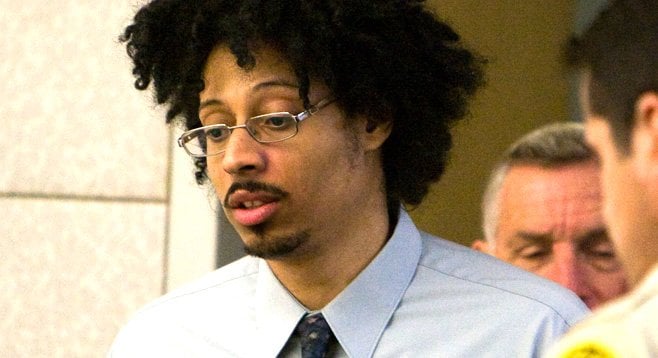
In January 2012, prospective jurors got a good look at Henderson’s “wild man” hair.
“The reason why Dontaye has not cut his hair is because he is trying to portray a persona of a wild man to the guys in jail.”
Dontaye Henderson’s mother wrote these words in 2003, while her son was in a San Diego jail waiting to be sentenced for rape.
Henderson had been born in Tuskegee, Alabama, 21 years earlier. Sometime in 2003, he followed his first wife from their home in Georgia to California — the desperate woman was trying to escape him. She hid at her sister’s place in Oceanside. But Henderson tricked his young bride into coming to a hotel where he was waiting. He raped her at knifepoint.
Henderson was arrested and charged with spousal rape and eventually pleaded guilty to that charge. But his public defender might have been considering an insanity plea, because he arranged for Henderson to meet with a clinical psychologist.
Dr. Gregg A. Michel sent a report of the meeting to Henderson’s attorney on June 27, 2003. A copy of the report is in court files.
Dr. Michel wrote: “During the first 10 minutes of the interview he was mute, placed his face near a wall and merely stared straight ahead. He then began pacing-like behavior in the small confines of the interview room.…He then rocked back and forth. When he finally began to speak, he claimed he did not know his age and stated he was actually a woman with a different name. He exhibited quite extreme and blatant attempts at malingering…”
Mental health professionals use the word “malingering” when they mean “faking crazy.” Although Henderson went on to describe “glowing spirits” and other creatures in the room, Dr. Michel never accepted these as actual symptoms.
Henderson told the psychologist that when he was 16 years old and living with his mother in Kentucky, he’d been placed in an “adolescent facility.” He said it was because he’d threatened to kill himself.
Henderson whined that he had been moved out of the psych ward in San Diego’s downtown jail — the Psychiatric Security Units — and was no longer receiving the drugs he preferred.
After meeting with Henderson, Dr. Michel concluded: “He would not be an appropriate candidate for treatment in the community…but [instead] has exhibited a pattern of escalating domestic violence, including having a weapon in his possession that indicates he would be a threat or danger if free in the community.”
Henderson pled guilty to raping his first wife, although he claimed he’d been holding the knife to his own throat and threatening suicide when he made his sexual demands.
Henderson’s mother hoped to influence the sentencing judge with her letter. She may have been told about Dr. Michel’s findings, writing: “Another point is that if Dontaye did not do well on his evaluations with the Psychiatrist, it is because he is probably trying to come across as crazy so that the Judge will not sentence him to prison, but instead sentence him to a mental institution.” Perhaps she hoped her son would be sentenced to community service. “Dontaye is so afraid of going to a prison he might fake being a mental case, when the fact of the matter is that he is very sane and more than capable of functioning normally in society.”
Henderson and his defense attorney tried one more time with a different psychologist. Another psych evaluation was arranged. In August of 2003, psychologist Dr. Lynette Rivers sent in a report in which she found that “Mr. Henderson has dependent, obsessive-compulsive, depressive, and narcissistic personality features.” There was more good news. “According to two risk assessment instruments, Mr. Henderson is at low risk of future violence towards others.”
Nonetheless, Dr. Rivers stated: “It is imperative that Mr. Henderson remain in treatment with a psychiatrist…”
The Problem with Predicting Violence
Less than eight years later, Henderson was arrested for killing his second wife.
For the 2003 attack on his first wife, the judge sent Henderson to a California prison for three years. He then served additional prison time for various parole violations. Henderson was out on parole again in 2008, when he met tall, slender Tamara. He was 26; she was 23 years old.
A parole officer met with Tamara to make sure she was aware of certain things about Henderson. He was a registered sex offender. As a condition of his parole, he wore a GPS monitoring bracelet on his left ankle at all times.
Henderson and Tamara had a whirlwind romance. They dated for four months, then married in January 2009. They rented an apartment in Oceanside.
In the wedding portrait, they make a handsome couple. Henderson is genteel and thoughtful as he extends a hand to a little flower girl — Tamara’s four-year-old daughter from a previous relationship — helping her to hold up a bouquet of roses.
Nine months later, Tamara gave her husband a son.
The hospital picture shows a happy Tamara, her newborn baby held in her arms. Father Dontaye is at her side, smiling down on his son. That was in September 2009.
First Homicide of the Year
On January 1, 2011, the first homicide of the year occurred in San Diego County. Henderson dialed 911 that morning. His first words to the emergency dispatcher were: “My wife is getting hurt.” He said, “She got hurt, um, she hurt herself,” and “She just, uh, hurt herself real bad.” Henderson claimed his wife had asthma. “She can’t breathe too good.” He said, “She hit her head and she fell.”
Henderson requested an ambulance for his dying wife. He failed to mention the gunshot wound to her chest.
Henderson left the apartment before paramedics arrived. He walked to a nearby hotel, cut the GPS monitoring bracelet off his leg, and hid it in a trash can. Then he phoned his parole officer. He said he was holed up in the hotel with a gun and suggested that he was suicidal. This delayed law enforcement for some time, while they surrounded the hotel and evacuated the guests.
Meanwhile, Henderson had phoned a female acquaintance and tricked her into giving him a ride. The 24-year-old woman showed up in her 1997 Toyota Corolla, her two-year-old son strapped into the child seat behind her. After a while, police retrieved the cell phone number of the duped driver. She and Henderson were traveling east, headed out of San Diego County. At some point after this, Henderson took the cell phones apart.
The next morning, Henderson let his frightened friend drive away. Police were able to obtain information from her that allowed them to trace his escape path along Highway 8 and out into the desert. They learned that Henderson had bought a bus ticket in El Centro. It appeared that he was bound for Lexington, Kentucky, where a former girlfriend lived.
The Greyhound bus had a scheduled layover in St. Louis, so Oceanside police contacted Missouri lawmen. St. Louis Metro Police agreed to arrest the fugitive. They wore plainclothes and stood around the bus station as if they were passengers. When the policemen saw Henderson walking toward his bus, they came up from behind him and pinned his arms.
Henderson was arrested in St. Louis on January 4, three days after his wife had been found dead. Police took a loaded .40 caliber handgun from the camera bag that Henderson carried. The gun’s safety was off, and the hammer was pulled back, and there was one round in the chamber.
Detective David Rudolph made an accounting of the ammunition: the magazine clip for the Taurus semi-automatic could hold ten rounds; there was one round in the chamber, seven more stacked in the clip. One unexpended .40 caliber round had been found on the bedroom floor near where Tamara lay on her bed. The last bullet was found in Tamara’s spine.
Detective Rudolph said they found another clip of ammunition for the same handgun, plus additional, boxed ammunition.
San Diego law enforcement requested that St. Louis police not question the fugitive; Oceanside detectives should do it. But Henderson wanted to talk right away. It seemed he wanted to explain things, and he made spontaneous comments. Detective Rudolph took notes.
Henderson told the Missouri lawmen that he knew he was being arrested for shooting his wife in California. He described a heated argument with Tamara and said he’d pointed a gun at her. He claimed he pulled the trigger once and heard a “click.” Then he told her, “Bitch, if that had went bang, you wouldn’t be talking all that shit.” Then he racked the gun and pointed it at her again and shot her.
Henderson was sorry he’d shot his wife. He said he spoke to her as she lay there wounded and that she seemed strong. He said he’d expected more blood. He said he’d phoned for help and claimed that he met paramedics outside the apartment — a claim emergency responders refuted.
Henderson blabbed that he planned to travel around the United States, to visit some of the six children he had fathered, spread across four states, before fleeing to Honduras. He expected to live in Central America on cash for a while. Eventually, he planned to return to the United States with a “clean passport.”
Henderson had loaded up on cash before he left San Diego County. When his deceived driver picked him up, Henderson directed her to take him to various ATM machines, where he used Tamara’s credit cards to extract as much cash as possible.
Twenty-five-year-old Tamara Henderson was found lying on her back on her bed with a gunshot entry wound in her chest. The expended casing for the fatal shot was never recovered. Henderson later admitted he’d picked up that casing and put it in his pocket. He said it must have fallen out somewhere along his escape route.
Henderson was held in lieu of $10 million bail.
The Crazy Plea
Henderson made a startling change of appearance when he appeared in court for a hearing in August 2011. His hair had grown long, there were fresh scratch marks around his neck, and a bandage placed on his forehead.
Prosecutor Keith Watanabe said the defendant had made “superficial” wounds on himself in an attempt to delay criminal proceedings. But Superior court judge K. Michael Kirkman heard evidence that day anyway. The judge ordered Henderson to face trial on first-degree murder charges.
Two months later, Henderson entered a plea of not guilty by reason of insanity. That was on October 18. But a week later, his public defender withdrew the insanity plea, and they reverted to a not-guilty plea.
Jury selection began in January 2012. One year had passed since Tamara’s death. Henderson assisted in choosing his own jury. Prospective jurors got a good look at Henderson’s “wild man” hair, which was longer than ever. He sat at the defense table and whispered to his attorney while jurors were questioned and accepted or dismissed. Henderson had added wire-rimmed glasses and a dress shirt and tie to his look.
The prosecutor told the jury that Henderson had nude photos from a former girlfriend texted to his cell phone on December 28, 2010, just four days before the shooting. Less than four hours after the shooting, Henderson texted to this same woman: “I left my wife for good.” This woman was a former girlfriend who lived in Alabama.
Prosecutor Watanabe also suggested that Henderson may have been trying to stage a suicide scene around his dying wife: Henderson had posed his wife on the bed and put a framed photo of the couple into her hands.
Plans went awry when Henderson could not find the keys to his car. The apartment was in such a shambles when emergency personnel got there, police later asked Henderson why his apartment looked as if it had been ransacked. He told them he’d thrown around the couch cushions and upset the furniture and everything else while searching for his car keys. He claimed that he’d initially planned to drive his wife to the hospital himself. But he never did find the keys.
The first witness called was Henderson’s first wife. The tiny woman described their short marriage as filled with physical and verbal abuse. When her husband left an obvious mark on her — for instance, a busted lip — he would tell people, “Omigosh, she’s crazy, she just hits herself!”
Tamara’s daughter came in to testify. The skinny seven-year-old girl clutched a teddy bear in the witness box. She told the jury that she’d heard her parents fighting that morning. “I saw them arguing about, that he has another, that he cheated on her.”
“And then what happened?” asked prosecutor Watanabe.
“He shot her,” said the serious little girl, holding tight her bear.
The second day of the trial, the defendant showed up with a new look: Henderson had shaved his head. Maybe he was preparing for his turn in the witness box. He kept the wire-rimmed glasses and wore a crisp white dress shirt.
Public defender Jack Campbell introduced his client by telling the jury: “He is the one witness who actually saw what happened.”
Henderson Tells the Jury
Henderson spoke of his first wife: “We didn’t have a perfect marriage.” He said she was a woman who would “overexaggerate.”
Henderson admitted that he’d gotten the murder weapon maybe two months before the shooting. He declined to say from whom he got it: “I’m not at liberty to say.” The handgun was reported stolen in San Diego County.
Henderson said, “We was expected to be at New Hope at 11 o’clock.” They were getting ready to go to church when the argument began. Henderson said that his wife had called him “slick” and accused him of trying to get away with things with other women. The argument escalated. Henderson threatened suicide. It was his wife, he said, who went and got the handgun. She threw it onto the bed and dared him to do it.
Henderson told the jury, “She didn’t believe me, that I would actually do it.”
He picked up the gun. “I was trying to intimidate her, to get her attention, by threatening suicide.” He said his wife put her hand on his forearm. “She was trying to get possession of the gun at that time.
“The shooting was an accident,” he said. “When she pulled my hand, it went off.”
According to medical testimony, a bullet passed through Tamara’s lung and heart and liver and spleen and lodged in her spine.
Henderson said, “I told her it wasn’t meant for that to happen.”
A doctor testified that the bullet in Tamara’s spine would have immediately paralyzed her lower body and prevented her from walking. Henderson claimed his wife took a couple steps toward him after she was shot, then fell into his arms. He said he laid her on the floor; later, he moved her onto the bed.
Henderson was asked why he didn’t mention the gunshot wound when he phoned 911.
“I didn’t want an overreaction to happen,” he explained.
Tamara died of internal bleeding. The prosecutor suggested that Tamara slowly bled to death between the first 911 call at 10:13 — which was a hang-up — and the second, which didn’t take place until 11:04. During the second 911 call, Henderson described his wife as having hurt herself. Between calls, he was searching for his car keys and staging the death scene and arranging his getaway.
Henderson denied that he’d tried to stage a suicide scene. He said he’d hoped his wife would explain that it was an accident because “I was trying to avoid the police.” He did admit that he’d fled. “Yes, I eluded the police.”
The prosecutor asked Henderson why he didn’t tell police in St. Louis that the shooting was an accident.
“Not when you first get arrested, it doesn’t make sense,” Henderson said.
Public defender Campbell told the jury: “He did not intend to murder his wife. It was an accidental homicide.” Campbell pointed out that prosecution’s evidence was circumstantial, but that Henderson’s eyewitness testimony was direct evidence. Henderson was not guilty of first-degree murder; the jury should instead find that it was involuntary manslaughter.
The jury deliberated a day before declaring Henderson, now 29, guilty of first-degree murder.
“I’m thankful that the jury didn’t buy into his lies,” said prosecutor Keith Watanabe.
Henderson was sentenced to 75 years to life, plus five years for the previous strike. ■
Here's something you might be interested in.
Dontaye brought his wild man act to San Diego
“The reason why Dontaye has not cut his hair is because he is trying to portray a persona of a wild man to the guys in jail.”

Dontaye brought his wild man act to San Diego
“The reason why Dontaye has not cut his hair is because he is trying to portray a persona of a wild man to the guys in jail.”
In January 2012, prospective jurors got a good look at Henderson’s “wild man” hair.
“The reason why Dontaye has not cut his hair is because he is trying to portray a persona of a wild man to the guys in jail.”
Dontaye Henderson’s mother wrote these words in 2003, while her son was in a San Diego jail waiting to be sentenced for rape.
Henderson had been born in Tuskegee, Alabama, 21 years earlier. Sometime in 2003, he followed his first wife from their home in Georgia to California — the desperate woman was trying to escape him. She hid at her sister’s place in Oceanside. But Henderson tricked his young bride into coming to a hotel where he was waiting. He raped her at knifepoint.
Henderson was arrested and charged with spousal rape and eventually pleaded guilty to that charge. But his public defender might have been considering an insanity plea, because he arranged for Henderson to meet with a clinical psychologist.
Dr. Gregg A. Michel sent a report of the meeting to Henderson’s attorney on June 27, 2003. A copy of the report is in court files.
Dr. Michel wrote: “During the first 10 minutes of the interview he was mute, placed his face near a wall and merely stared straight ahead. He then began pacing-like behavior in the small confines of the interview room.…He then rocked back and forth. When he finally began to speak, he claimed he did not know his age and stated he was actually a woman with a different name. He exhibited quite extreme and blatant attempts at malingering…”
Mental health professionals use the word “malingering” when they mean “faking crazy.” Although Henderson went on to describe “glowing spirits” and other creatures in the room, Dr. Michel never accepted these as actual symptoms.
Henderson told the psychologist that when he was 16 years old and living with his mother in Kentucky, he’d been placed in an “adolescent facility.” He said it was because he’d threatened to kill himself.
Henderson whined that he had been moved out of the psych ward in San Diego’s downtown jail — the Psychiatric Security Units — and was no longer receiving the drugs he preferred.
After meeting with Henderson, Dr. Michel concluded: “He would not be an appropriate candidate for treatment in the community…but [instead] has exhibited a pattern of escalating domestic violence, including having a weapon in his possession that indicates he would be a threat or danger if free in the community.”
Henderson pled guilty to raping his first wife, although he claimed he’d been holding the knife to his own throat and threatening suicide when he made his sexual demands.
Henderson’s mother hoped to influence the sentencing judge with her letter. She may have been told about Dr. Michel’s findings, writing: “Another point is that if Dontaye did not do well on his evaluations with the Psychiatrist, it is because he is probably trying to come across as crazy so that the Judge will not sentence him to prison, but instead sentence him to a mental institution.” Perhaps she hoped her son would be sentenced to community service. “Dontaye is so afraid of going to a prison he might fake being a mental case, when the fact of the matter is that he is very sane and more than capable of functioning normally in society.”
Henderson and his defense attorney tried one more time with a different psychologist. Another psych evaluation was arranged. In August of 2003, psychologist Dr. Lynette Rivers sent in a report in which she found that “Mr. Henderson has dependent, obsessive-compulsive, depressive, and narcissistic personality features.” There was more good news. “According to two risk assessment instruments, Mr. Henderson is at low risk of future violence towards others.”
Nonetheless, Dr. Rivers stated: “It is imperative that Mr. Henderson remain in treatment with a psychiatrist…”
The Problem with Predicting Violence
Less than eight years later, Henderson was arrested for killing his second wife.
For the 2003 attack on his first wife, the judge sent Henderson to a California prison for three years. He then served additional prison time for various parole violations. Henderson was out on parole again in 2008, when he met tall, slender Tamara. He was 26; she was 23 years old.
A parole officer met with Tamara to make sure she was aware of certain things about Henderson. He was a registered sex offender. As a condition of his parole, he wore a GPS monitoring bracelet on his left ankle at all times.
Henderson and Tamara had a whirlwind romance. They dated for four months, then married in January 2009. They rented an apartment in Oceanside.
In the wedding portrait, they make a handsome couple. Henderson is genteel and thoughtful as he extends a hand to a little flower girl — Tamara’s four-year-old daughter from a previous relationship — helping her to hold up a bouquet of roses.
Nine months later, Tamara gave her husband a son.
The hospital picture shows a happy Tamara, her newborn baby held in her arms. Father Dontaye is at her side, smiling down on his son. That was in September 2009.
First Homicide of the Year
On January 1, 2011, the first homicide of the year occurred in San Diego County. Henderson dialed 911 that morning. His first words to the emergency dispatcher were: “My wife is getting hurt.” He said, “She got hurt, um, she hurt herself,” and “She just, uh, hurt herself real bad.” Henderson claimed his wife had asthma. “She can’t breathe too good.” He said, “She hit her head and she fell.”
Henderson requested an ambulance for his dying wife. He failed to mention the gunshot wound to her chest.
Henderson left the apartment before paramedics arrived. He walked to a nearby hotel, cut the GPS monitoring bracelet off his leg, and hid it in a trash can. Then he phoned his parole officer. He said he was holed up in the hotel with a gun and suggested that he was suicidal. This delayed law enforcement for some time, while they surrounded the hotel and evacuated the guests.
Meanwhile, Henderson had phoned a female acquaintance and tricked her into giving him a ride. The 24-year-old woman showed up in her 1997 Toyota Corolla, her two-year-old son strapped into the child seat behind her. After a while, police retrieved the cell phone number of the duped driver. She and Henderson were traveling east, headed out of San Diego County. At some point after this, Henderson took the cell phones apart.
The next morning, Henderson let his frightened friend drive away. Police were able to obtain information from her that allowed them to trace his escape path along Highway 8 and out into the desert. They learned that Henderson had bought a bus ticket in El Centro. It appeared that he was bound for Lexington, Kentucky, where a former girlfriend lived.
The Greyhound bus had a scheduled layover in St. Louis, so Oceanside police contacted Missouri lawmen. St. Louis Metro Police agreed to arrest the fugitive. They wore plainclothes and stood around the bus station as if they were passengers. When the policemen saw Henderson walking toward his bus, they came up from behind him and pinned his arms.
Henderson was arrested in St. Louis on January 4, three days after his wife had been found dead. Police took a loaded .40 caliber handgun from the camera bag that Henderson carried. The gun’s safety was off, and the hammer was pulled back, and there was one round in the chamber.
Detective David Rudolph made an accounting of the ammunition: the magazine clip for the Taurus semi-automatic could hold ten rounds; there was one round in the chamber, seven more stacked in the clip. One unexpended .40 caliber round had been found on the bedroom floor near where Tamara lay on her bed. The last bullet was found in Tamara’s spine.
Detective Rudolph said they found another clip of ammunition for the same handgun, plus additional, boxed ammunition.
San Diego law enforcement requested that St. Louis police not question the fugitive; Oceanside detectives should do it. But Henderson wanted to talk right away. It seemed he wanted to explain things, and he made spontaneous comments. Detective Rudolph took notes.
Henderson told the Missouri lawmen that he knew he was being arrested for shooting his wife in California. He described a heated argument with Tamara and said he’d pointed a gun at her. He claimed he pulled the trigger once and heard a “click.” Then he told her, “Bitch, if that had went bang, you wouldn’t be talking all that shit.” Then he racked the gun and pointed it at her again and shot her.
Henderson was sorry he’d shot his wife. He said he spoke to her as she lay there wounded and that she seemed strong. He said he’d expected more blood. He said he’d phoned for help and claimed that he met paramedics outside the apartment — a claim emergency responders refuted.
Henderson blabbed that he planned to travel around the United States, to visit some of the six children he had fathered, spread across four states, before fleeing to Honduras. He expected to live in Central America on cash for a while. Eventually, he planned to return to the United States with a “clean passport.”
Henderson had loaded up on cash before he left San Diego County. When his deceived driver picked him up, Henderson directed her to take him to various ATM machines, where he used Tamara’s credit cards to extract as much cash as possible.
Twenty-five-year-old Tamara Henderson was found lying on her back on her bed with a gunshot entry wound in her chest. The expended casing for the fatal shot was never recovered. Henderson later admitted he’d picked up that casing and put it in his pocket. He said it must have fallen out somewhere along his escape route.
Henderson was held in lieu of $10 million bail.
The Crazy Plea
Henderson made a startling change of appearance when he appeared in court for a hearing in August 2011. His hair had grown long, there were fresh scratch marks around his neck, and a bandage placed on his forehead.
Prosecutor Keith Watanabe said the defendant had made “superficial” wounds on himself in an attempt to delay criminal proceedings. But Superior court judge K. Michael Kirkman heard evidence that day anyway. The judge ordered Henderson to face trial on first-degree murder charges.
Two months later, Henderson entered a plea of not guilty by reason of insanity. That was on October 18. But a week later, his public defender withdrew the insanity plea, and they reverted to a not-guilty plea.
Jury selection began in January 2012. One year had passed since Tamara’s death. Henderson assisted in choosing his own jury. Prospective jurors got a good look at Henderson’s “wild man” hair, which was longer than ever. He sat at the defense table and whispered to his attorney while jurors were questioned and accepted or dismissed. Henderson had added wire-rimmed glasses and a dress shirt and tie to his look.
The prosecutor told the jury that Henderson had nude photos from a former girlfriend texted to his cell phone on December 28, 2010, just four days before the shooting. Less than four hours after the shooting, Henderson texted to this same woman: “I left my wife for good.” This woman was a former girlfriend who lived in Alabama.
Prosecutor Watanabe also suggested that Henderson may have been trying to stage a suicide scene around his dying wife: Henderson had posed his wife on the bed and put a framed photo of the couple into her hands.
Plans went awry when Henderson could not find the keys to his car. The apartment was in such a shambles when emergency personnel got there, police later asked Henderson why his apartment looked as if it had been ransacked. He told them he’d thrown around the couch cushions and upset the furniture and everything else while searching for his car keys. He claimed that he’d initially planned to drive his wife to the hospital himself. But he never did find the keys.
The first witness called was Henderson’s first wife. The tiny woman described their short marriage as filled with physical and verbal abuse. When her husband left an obvious mark on her — for instance, a busted lip — he would tell people, “Omigosh, she’s crazy, she just hits herself!”
Tamara’s daughter came in to testify. The skinny seven-year-old girl clutched a teddy bear in the witness box. She told the jury that she’d heard her parents fighting that morning. “I saw them arguing about, that he has another, that he cheated on her.”
“And then what happened?” asked prosecutor Watanabe.
“He shot her,” said the serious little girl, holding tight her bear.
The second day of the trial, the defendant showed up with a new look: Henderson had shaved his head. Maybe he was preparing for his turn in the witness box. He kept the wire-rimmed glasses and wore a crisp white dress shirt.
Public defender Jack Campbell introduced his client by telling the jury: “He is the one witness who actually saw what happened.”
Henderson Tells the Jury
Henderson spoke of his first wife: “We didn’t have a perfect marriage.” He said she was a woman who would “overexaggerate.”
Henderson admitted that he’d gotten the murder weapon maybe two months before the shooting. He declined to say from whom he got it: “I’m not at liberty to say.” The handgun was reported stolen in San Diego County.
Henderson said, “We was expected to be at New Hope at 11 o’clock.” They were getting ready to go to church when the argument began. Henderson said that his wife had called him “slick” and accused him of trying to get away with things with other women. The argument escalated. Henderson threatened suicide. It was his wife, he said, who went and got the handgun. She threw it onto the bed and dared him to do it.
Henderson told the jury, “She didn’t believe me, that I would actually do it.”
He picked up the gun. “I was trying to intimidate her, to get her attention, by threatening suicide.” He said his wife put her hand on his forearm. “She was trying to get possession of the gun at that time.
“The shooting was an accident,” he said. “When she pulled my hand, it went off.”
According to medical testimony, a bullet passed through Tamara’s lung and heart and liver and spleen and lodged in her spine.
Henderson said, “I told her it wasn’t meant for that to happen.”
A doctor testified that the bullet in Tamara’s spine would have immediately paralyzed her lower body and prevented her from walking. Henderson claimed his wife took a couple steps toward him after she was shot, then fell into his arms. He said he laid her on the floor; later, he moved her onto the bed.
Henderson was asked why he didn’t mention the gunshot wound when he phoned 911.
“I didn’t want an overreaction to happen,” he explained.
Tamara died of internal bleeding. The prosecutor suggested that Tamara slowly bled to death between the first 911 call at 10:13 — which was a hang-up — and the second, which didn’t take place until 11:04. During the second 911 call, Henderson described his wife as having hurt herself. Between calls, he was searching for his car keys and staging the death scene and arranging his getaway.
Henderson denied that he’d tried to stage a suicide scene. He said he’d hoped his wife would explain that it was an accident because “I was trying to avoid the police.” He did admit that he’d fled. “Yes, I eluded the police.”
The prosecutor asked Henderson why he didn’t tell police in St. Louis that the shooting was an accident.
“Not when you first get arrested, it doesn’t make sense,” Henderson said.
Public defender Campbell told the jury: “He did not intend to murder his wife. It was an accidental homicide.” Campbell pointed out that prosecution’s evidence was circumstantial, but that Henderson’s eyewitness testimony was direct evidence. Henderson was not guilty of first-degree murder; the jury should instead find that it was involuntary manslaughter.
The jury deliberated a day before declaring Henderson, now 29, guilty of first-degree murder.
“I’m thankful that the jury didn’t buy into his lies,” said prosecutor Keith Watanabe.
Henderson was sentenced to 75 years to life, plus five years for the previous strike. ■
Comments