

Here's something you might be interested in.
Ask a Hipster — Advice you didn't know you needed
Big Screen — Movie commentary
Blurt — Music's inside track
Booze News — San Diego spirits
Classical Music — Immortal beauty
Classifieds — Free and easy
Close to Home — What it’s like on the street where you live
Cover Stories — Front-page features
Drinks All Around — Bartenders' drink recipes
Excerpts — Literary and spiritual excerpts
Feast! — Food & drink reviews
Feature Stories — Local news & stories
Fishing Report — What’s getting hooked from ship and shore
From the Archives — Spotlight on the past
Golden Dreams — Talk of the town
The Gonzo Report — Making the musical scene, or at least reporting from it
Letters — Our inbox
Movies@Home — Local movie buffs share favorites
Movie Reviews — Our critics' picks and pans
Musician Interviews — Up close with local artists
Neighborhood News from Stringers — Hyperlocal news
News Ticker — News & politics
Obermeyer — San Diego politics illustrated
Outdoors — Weekly changes in flora and fauna
Overheard in San Diego — Eavesdropping illustrated
Poetry — The old and the new
Reader Travel — Travel section built by travelers
Reading — The hunt for intellectuals
Roam-O-Rama — SoCal's best hiking/biking trails
San Diego Beer — Inside San Diego suds
SD on the QT — Almost factual news
Sheep and Goats — Places of worship
Special Issues — The best of
Street Style — San Diego streets have style
Surf Diego — Real stories from those braving the waves
Theater — On stage in San Diego this week
Tin Fork — Silver spoon alternative
Under the Radar — Matt Potter's undercover work
Unforgettable — Long-ago San Diego
Unreal Estate — San Diego's priciest pads
Your Week — Daily event picks
San Diego artists try all kinds of things
A.B. Grizzwald, Helen Chang, Tom Plonka, LaRon Lindsay, Abigail Lyn
The Good Son: A.B. Grizzwald sits on a stool in his friend’s Golden Hill garage studio. Though he claims this is where he paints occasionally, everything in the studio — paint, canvases, radio, couch, rug, and paint-splotched rags — belongs to the friend, a beefy, tattooed guy named Neko. Grizzwald sips from a paper cup of coffee while Neko paints in the background. The scent of Nag Champa incense wafts through the room. We’re discussing Grizzwald’s work in the art show at Bedouin Vintage Collective and Art Gallery in North Park two days ago. Though the curator said all five artists represented “the grimier side of painting,” and one visitor called it “lowbrow art,” Grizzwald refuses to label his work.
“I guess whatever people want to call it works for me,” he says.
He’s also reluctant to describe his work.
“It feels really corny trying to describe [my] painting. It sounds like I’m taking myself too seriously.”
The name A.B. Grizzwald is one he came up with on his own, two weeks before the group art show, and now he calls it “stupid.” Nonetheless, he’s sticking with it. The 26-year-old’s giant dark-rimmed eyeglasses, black skinny jeans, and sparse moustache make for a complete surface package. If I saw him working the cash register in his green Whole Foods apron, I’d probably guess he’s an artist. But he won’t call himself one.
“I don’t like calling myself an artist because it seems like an injustice to people I know [whose] art is their life. It’s everything they do.”
We both eye Neko on the other side of the room, who stands back from a large painting laid across a tabletop. Neko squints, steps forward again, and dips his brush in the can of white paint held in his left hand. He stoops over and resumes painting in short strokes.
Grizzwald turns back to me. He admits that although there is a part of him that “always feels the need to be creating,” he rarely paints unless he has a deadline looming. Last week, he painted the four pieces for the Bedouin Vintage show in two days. He finished at 4:00 a.m. the day of the show. But then last night, as most nights, he watched television instead of painting before he went to sleep. He calls himself “lazy” and says he spreads himself too thin, what with school full time (at City College, for psychology and sociology) and full-time work as a Whole Foods cashier (for $13-something an hour).
“I thought about going to art school, but the art world seems kind of really bourgeoisie, a disgusting business-related place.”
What about Neko, I ask. Isn’t Neko the art world?
“Yeah, Neko’s the art world,” Grizzwald says with a sheepish, I’m-full-of-hot-air tone to his voice.
Neko, still stooped over the painting, laughs.
“But we’re different people,” Grizzwald says. “I don’t know if I’m tough enough to deal with that kind of atmosphere, the business-related side, rubbing elbows and stuff. There are so many awesome people that sometimes I just feel like giving up.”
Although he says it sounds “corny,” he admits that his fear was once instigated while watching the audition episodes of American Idol. “Watching these people that were terrible and had no idea that they were terrible, I thought, ‘What if I’m one of those people and I have no idea?’”
I ask Neko what he thinks. He stands up straight and says, “I think [Grizzwald] talks himself down. He’s a lot bigger than he thinks he is.”
Bigger, how?
“People appreciate his work,” Neko says. “He’s extremely modest.”
It turns out that Grizzwald’s negative self-talk is a little more than modesty. Years ago, he started out as a graffiti artist. In 2004, he was arrested; a week or so later, the police raided his house.
“They blocked off our street and had my mom and aunt at gunpoint. There weren’t any drugs in the house. They might have found a butter knife,” he says bitterly. “They treat graffiti like it’s a violent crime and me as if I was dangerous. I weigh, like, 145 pounds.”
He holds his cup close to his chest with both hands. His lanky body curves inward, as if to absorb the warmth of the coffee. He follows with his eyes as Neko carries the painting outside. A moment later, we hear the sound of Neko shaking a can of spray paint. Then the whishy sound of the spray.
Soon after the raid, Grizzwald quit doing graffiti (“I just didn’t mentally have what it took anymore”) and took up painting.
“It’s about taking pride in something I’ve created with my hands. It’s a little hard finding things you can take pride in. I mean, I don’t take pride in my cashiering skills at an organic grocery store.”
He doesn’t have the option to choose art as a lifestyle.
“There’s a lot of risks involved in [living the life of an artist]. It’s not the safest bet. I have a mom who’s financially dependent on me, and my brother. Not that money is everything, but if I had to choose following a dream or making sure that my mom has food and shelter, I’m going to choose food and shelter.”
When I ask about his choice to study social work over art, he gives a long list of reasons, including a love for social work and a group of artist friends who didn’t need art school. But when I ask if he’d have made a different choice if it weren’t for his financial responsibilities, he says, “I totally would have. If I didn’t have any responsibility to anybody else, I totally would’ve done it.”
Grizzwald watches as Neko returns with the painting, sets it on the table, and stands back from it once again. Neko walks a few steps to the right, yanks at the rag that dangles from his back pocket, and dabs at the painting. Then he walks a few more steps to the right and does it again.
“He does this all day every day,” Grizzwald says.
I ask if he envies Neko.
“For doing what he wants to do? Yeah. I guess it’s a risk I’m too scared to take, and he’s just going for it.”
The Ghostwriter
Midafternoon on a Wednesday in early January, Helen Chang calls me and says, “Are we still on for 4:00 today? I have a 4:30 phone call, so hopefully a half-hour is enough time to get what you need.”
I’m not surprised. By now, we’ve spoken twice on the phone and exchanged several emails. I’ve browsed her two websites, perused some of the books she’s ghostwritten, and read a handful of articles and blog posts. She’s a busy woman, professional and efficient, not big on chit-chat or other time-wasters. And, yet, when she answers the door to her two-bedroom Mission Gorge apartment, Helen Chang is wearing not a power suit but sweatpants.
Even in sweatpants, she’s intense. After requesting that I remove my shoes, she leads me through her bare-bones living room to the master-bedroom-turned-office, where a “visionboard” and “mind maps” cover the walls.
“That visionboard was created two years ago.” She points to a collage hanging behind the desk, a picture of a woman in a straw hat lounging near a body of water and writing on a laptop. Above her head is a pretend check written out to Helen Chang for “$10,000+ per month.”
“I’ve fulfilled that one already,” she says. “It’s there just because I don’t have a new one to replace it. I do have more visions,” she assures me. “They’re in the mind maps.”
She opens a notebook. On the cover, “2011” is written in marker. She flips quickly through pages of mind maps she created for her financial, spiritual, personal, and business goals. She won’t let me look closely because some of the information, she says, is personal and confidential. But she does point me toward a white board on the wall full of the same circles, lines, and words I’d glimpsed in the notebook.
“These are all my clients and the projects we’ve got going on,” she says.
There are names written inside the circles, and words like “edit workbook” and “rewrite chapter four” are written on lines jutting out from the circles. There must be 10 or 15 of them. Down at the bottom, in the right hand corner, a little circle reads “Helen.” The single line protruding from it says “take classes.”
“That’s me,” she says. “My personal dream right now is to write my own book. Nonfiction. I’m actually kind of working on, if you can even call it that, a memoir.”
“Why the air quotes around ‘working on?’” I ask.
She leads me back to the living room before she answers. Aside from a picture of dewy orange flowers hung behind us, and a couple of leis strung here and there (Chang is from Hawaii), the walls are bare and the room void of color. Her laptop sits open on the coffee table in front of a comfy white couch, where we sit. Between us is a collapsed stack of books and workbooks Helen’s edited or ghostwritten.
“My goal last year was to write the first draft of the memoir, but I didn’t do that,” she confesses. “So I set a new goal this year to write a first draft. By the end of the year. [I used] air quotes because there’s a part of me that’s not confident I’ll get it done. But creatively, that’s what I want to do.”
Chang is not one to boo-hoo about failures or mistakes. She has several big ones in her past. In the 1990s, after making a name for herself as a business journalist in Singapore (writing for Time, Business Week, and other publications), she was “sick of doing business stories” and decided to start a holistic lifestyle magazine. She took on the role of “publisher, the face of it, investor relations,” and hired someone else to do the editing.
Although she did learn a lot about business, the only writing she did was the monthly publisher’s column.
“I really missed the writing,” she says. “I didn’t enjoy being an entrepreneur.”
In the end, after the dotcom bust, the magazine went bankrupt, and Chang went back to freelance writing. In 2003, she met a real-estate investor who hired her to ghostwrite manuals for courses he taught. This was the beginning of her ghostwriting career, though she did continue to work as a freelance journalist.
Chang made what she calls another “big mistake” in 2008 while ghostwriting a real-estate book.
“I didn’t want to be an entrepreneur. I only wanted to write,” she tells me. “I deliberately didn’t want to deal with the business side of it because I was tired of business. And then the real-estate crash happened. My business dried up. You always hear that: never depend on just a few clients for your business. But my journalism gigs dried up, too.”
Though she appears relaxed and comfortable with her legs folded up beneath her, Chang speaks with a loud voice and dramatic gesticulations that confirm her natural intensity.
Today, she lives and works with a balance of business and writing that satisfies her for the most part. Her list of ghostwriting and editing clients includes well-known financial self-help gurus and celebrity hosts from HGTV. Chang’s ghostwriting success has lead her to use the services of 6–12 transcribers, editors, writers, and a personal assistant.
Does it create more work?
“Yes,” she says. “But I’m able to get more work done through them than I am by myself.”
Chang started writing at five, when she created a booklet called “Five Myths and a Poem.” She laughs dismissively when she tells me this, as if the silly projects of a five-year-old have nothing to do with the woman she is today. But as she continues talking about her childhood relationship with stories, her demeanor shifts from one of serious intensity to a more playful animation.
“My mom used to read to me Aesop’s Fables. So, those were the first things I remember reading, and I loved them. And they had the My Little Golden Books with the little golden tab on the side. I used to love those.”
Her voice rises when she says the word “love.”
During the early years, Chang’s dream was “to be Beverly Cleary. The dream of writing books has been in me since childhood. So when I read Beverly Cleary, I was, like, ‘Oh, God, I wish I could write like that.’ And when I read Pippi Longstocking, I was, like, ‘Oh, God, who could create a character like that?’”
She’s sitting on the edge of the couch now, feet on the floor. Her face is bright with the memory of childhood dreams, and the volume and drama in her voice escalate. Soon, she’s all but screaming, as though she were a teeny-bopper and these writers the pop stars she idolizes.
“Later on, when I grew up, it was, ‘If only I could write like Amy Tan!’ And then Kahlil Gibran, oh, my God! Or Elizabeth Gilbert! Oh, my God, if only I could write that way and eat pasta in Italy!”
She laughs at herself and calms a bit. “My whole life has been like that.”
When I mention that most of these literary heroes write fiction and ask if the genre is still an aspiration for her, she says, “To me, fiction is kind of the master art of writing. I’m not at that level. I may never be in this lifetime. On the other hand, Laura Ingalls Wilder [published her first book] at 65.”
Besides, she adds, “If I can do this memoir, I’m incorporating a lot of elements of fiction. You still have to know plot, character, scene, description, and that kind of stuff.”
Chang estimates that in 2010, she spent 90 percent of her time on ghostwriting, five percent on journalism and blogging, and the final five percent on the memoir. But she refuses to bemoan her current situation.
“Ghostwriting is like a bridge between journalism and writing my own books. I’m writing books for people and getting paid for it. It’s awesome. I love it.”
Chang admits that it’s nice seeing her name in print, but she’s not tormented by the fact that her name’s missing from the books she writes. “My byline’s all over the place. I have hundreds of articles in national and international publications.”
She’s more interested in “the challenge of a storyteller to take a message, or a wisdom, and translate it into a story. Of course, I do want to tell my story, and when I do, the byline will be there. But in that case, it won’t be about the byline. It’ll be about the story I want to tell.”
The phone rings. It’s a client for whom she’s writing a book on financial success. Chang apologizes but says she has to take it.”
The Tradesman
At 51, Tom Plonka isn’t old, but he does have the ruddy and weathered look you’d expect from a guy who spends as much time as he can on the 22-foot fishing boat parked in his driveway. The blue-and-yellow Hawaiian print shirt he wears adds to the effect. Plonka is a water guy. Except for the five-foot-square, earth-tone painting of a mother and daughter that hangs over his living room couch, the rest of the walls in his Linda Vista home feature paintings with a whole lot of blue. Ultramarine and Prussian blues, with some Thalo green thrown in the mix. And dolphins. Plonka is crazy about dolphins.
“[Art] was my main thing, although I was also very interested in marine biology,” Plonka says from the rickety desk chair where he’s perched with his arms folded.
We’re in his studio, a narrow room built off the back of his 900-square-foot house. It’s the one cold, gray January day in a week of hot ones. A door at one end of the studio opens to a narrow side-yard, which I imagine would be nice on a warmer day. Two long tables run the length of the room, so that the space left over feels like a hallway. The gray-blue carpet is industrial and dusty. I’m seated on a kind of low deck chair with weatherproof cushions. A shelf to my left is stacked with blank Blick canvases wrapped in plastic. These walls, too, are covered with paintings of dolphins and the occasional angelfish.
Plonka claims he “was always fiddling with” art, painting murals on friends’ walls in high school and on canvases every now and again, but he was still torn when it came time to choose a major in college.
He reclines and crosses an ankle over a knee.
“I probably should have pursued [marine biology] heavier, so I’d have both. I thought that art was going to be able to carry me. Now I don’t look at it that way.”
Shortly after his 1986 graduation from the University of California at San Diego (with a Bachelor in Fine Arts) Plonka met a muralist/sign painter who taught him about hand-painted lettering.
“Back then, there weren’t computers. There were no vinyl letters or anything like that. It was all hand painted, and that’s basically how I made a career out of it.”
Plonka’s father taught graphic arts at a high school and ran his own print shop, so Plonka junior has always seen his artistry as a marketable skill. That accounts, perhaps, for the old-school vibe he gives off, and for the way he presents his work less as an extension of his creative soul and more as a trade.
“I’m trying to make a living, just like anybody else. Just like a doctor, a nurse, a teacher, whatever. I’m out to make a buck.”
In 2000, approximately 20 percent of Plonka’s income came from doing large murals and oil paintings, and 80 percent came from sign work. In 2010, those numbers were reversed.
“I’ve [gotten] a lot more big money with murals than signs. Way more big money. Because I’m really good at it, and I don’t have as much competition with the murals. Signage is a different story. Everybody does it.”
Luckily, this week has yielded a few painting jobs. Next week, he might have to take a drywalling job with his roommate.
“Let’s see, I’m doing lettering on somebody’s truck. I’m doing logo work and lettering for the Mission restaurants downtown and in North Park. They’re all sign jobs.”
Plonka’s arms are still folded over his chest. He shrugs often as he speaks, as if he’s resigned himself to the hustle. Often, he tells me, the work is secured by his “broker,” whom he’d rather not name. This unnamed broker gets as much as a 50 percent commission on the work Plonka does. Plonka admits that he ends up giving away a lot of money with this arrangement, but he says, “marketing is my main obstacle.”
“He gets me a lot of work,” Plonka says of the broker. “This guy is one of the best salesmen I know.”
The way it works is that the broker will bid on a job, then he’ll ask Plonka to bid on the work through him. Plonka gives his number without knowing how much the broker has already accepted for the job. When Plonka does find out the total amount, the client is being charged, it sometimes comes as a shock.
“The problem is I have to almost do the job with a fine tooth comb and a one-hair brush, just to make sure it’s perfect, because [the client] is paying so much. It’s gotta be tight, which is a pain because I’m not getting paid for that. They’re paying more for the job than they should. That’s my opinion. Maybe I just feel guilty about charging somebody that much.”
He bursts out laughing, a loud and surprisingly mirthless sound. His jaw hardly opens, and the smile that accompanies it is slight.
About four or five years ago, Plonka was making “$50,000–60,000 a year. I was working with new clients all the time and making real good money.”
One of his sources of income back then was for a series of nail salons across the country. The owners paid him to paint murals of dolphins on their walls. “I was going all over the country, New Jersey, Pennsylvania, and I went to Phoenix numerous times.”
He stands and grabs a photo album from a table covered with electrical cords, matted prints of his work wrapped in plastic, and a half-finished seascape painting on an easel.
“That’s one of them right there.” He flips to a photograph that shows an underwater scene, complete with dolphins and angelfish, spread across the wall of a nail salon. He turns the page and shows me another. An ocean scene. Dolphins.
“This is right at Kit Carson [elementary school]. I was doing really good. This guy was getting me a lot of mural work and other things too on the side. Besides Fenway Park, we had the whole Macayo’s restaurant chain in Phoenix. God, I could go on and on. We did so much stuff.”
Besides the drywall job he might do with his roommate next week, Plonka tells me he’s looking to supplement his current $20,000–$25,000 annual income, perhaps by obtaining a captain’s license and a certificate as a scuba instructor to work in Catalina. Or maybe by running a shore boat. There’s also a possible teaching gig in Catalina. But these are things that take time and money to get started.
The mood in the studio sours.
The phone rings. He answers, listens, holds his hand over the mouthpiece and asks how much longer we’re going to be. Then he hangs up, first telling the caller he just needs another five minutes.
He begins speaking before I’ve finished asking what his dream life might be. “Traveling around the world to different oceans,” he says. Days spent exploring and nights spent painting.
“I love what I do. When I’m busy I love it,” he says. “What I don’t like is hauling stuff around, cleaning up and everything. I’ve always dreamed I’d have somebody to do that for me.” Again he bursts out laughing. It’s a hard, ironic laugh that stops as quickly as it starts.
“Yeah, right,” he adds. “That’ll never happen.”
The Batman of Photography
LaRon Lindsay isn’t into the whole starving artist thing. And he doesn’t believe his new “government job” will be the death of his art. Instead, he sees it as the security that’s allowing him to run his photography business “without worrying at all. I can pay all the bills. Everything will be taken care of, and then I can make extra money and have all the fun.”
Today, Lindsay wears low-slung skinny jeans, a black T-shirt bearing silk-screened images of what look to be implements of torture. A big, red, square-faced watch adorns his wrist. The day we met, months earlier, he wore a suit, tie, and shiny shoes.
We’re in a den in the four-bedroom Chula Vista house he shares with his girlfriend and three other friends. The house once belonged to the girlfriend’s parents; they’re still present in certain details, such as the dramatic crystal chandelier in the entryway. But the art has a louder and much younger voice. Right inside the front door, a four-foot painting greets visitors with a big black middle finger. The coffee table sports a Styrofoam and plaster sculpture of a Chuck Taylor All-Star. The paintings on the walls are vibrant and youthful, in stark contrast to this earth-and-clay-hued neighborhood. The art is the work of Lindsay’s girl, the same one who gave him the kick in the pants that got his photography business started.
He tells the story with dramatic facial expressions and voice impressions. “I have this ideas book where I write all these ideas down. It’s a ton of different ideas, and I’m drawing these things and they’re silly-looking, but I’m thinking that she can use it.” He points upstairs where his girlfriend is puttering around. “I’d say, ‘What about this idea?’ and she was like, ‘I don’t want to do that. I’m doing what I’m doing.’ So I said, you know what, I’m gonna do it myself.”
For as long as he can remember, Lindsay has been carrying around disposable cameras, taking pictures and “freezing time.” Until his girl challenged him to do something with his ideas, he never considered photography a potential moneymaker or a platform for his creative expression; all he knew was that he loved taking pictures.
“The reason why I decided to go official was because, forever, I always wanted to do what my brother did,” he says.
He holds out his left arm and shows me a tattoo of his older brother Lamar, who lives in Los Angeles and designs and manufactures his own clothing line. On the other wrist, Lindsay wears a rubber bracelet designed by his brother. It reads: “The only thing in the way is me. I am the only thing in my way.”
“Photography was the first thing that was different than what he does all the time,” he says. “So it was my first chance to branch off.”
At Lindsay’s feet sits a black case that resembles the kind you’d see full of money in a heist movie. He opens it to show me the equipment he uses.
“I don’t like to carry all my stuff in a Canon photo bag. I don’t like to look like a photographer before I get to the photo shoot. I’d rather blend in and watch people and how they act before I get into it.”
He pulls out lenses wrapped in protective padding and shows me his “camera housing.” He also drags over a four- or five-foot-long nylon bag and rifles through it. It holds his lighting and generators. His backdrop, he says, is in another small bag around here somewhere.
From a nearby closet, he pulls out three framed photos, 20 by 30 inches each. One is a fashion shot he submitted to a contest by H&M, for which he landed in the top 20 (out of 5000). The other two are close-up portraits of costumed participants (one devil, one creepy clown) from a Halloween Party at the Hard Rock Cafe last October. A company called 3D Entertainment hired him to shoot the event. After he completed his $100 hour, he took a few shots of his own. When I ask why these pictures are hidden away in a closet, he mumbles something about a clean-up to make way for Christmas decor.
“I never took any classes,” he says, when we return to the couch. “I thought I should actually try and learn how to take these photos. So I started going to Borders and reading books on photography. I don’t like to read books, so photography is the first thing that got me to read books.”
The books were mostly how-to books.
“I like instructions. I like to make stuff and build stuff. And the instructions would say something about an ‘aperture’. So, then I’d go look it up — what aperture is. Then I’d see ‘f/stop’. And I’d have to go look up f/stop.”
Two years ago, while working sales at 24-Hour Fitness, he started RedHawk Photography. It was slow going because his commission-only job required so much time and energy.
“Either you’re here or you’re here,” he says, placing one hand in the air at eye level, the other down near his chest. “And if you’re here,” he wiggles the lower hand, “you’ll get eaten up by the sharks up here.”
In order to be one of the sharks that made the sales and got the commissions, he had to work long hours, including Saturdays and Sundays. And he had to have “major mouthpiece” everyday. In other words, he had to be “on” all the time.
“I didn’t have time [for anything else]. I was stressed out.”
Granted, he did make good money. Better than he’s making now in his new job (about which he is allowed to tell me nothing) as a civilian Department of Defense employee at the North Island Naval Base in Coronado. But in his last full year of work at 24-Hour Fitness, he estimates that he was only able to spend about ten percent of his time working on photography.
“I didn’t feel like it was going anywhere. Even my brother was, like, ‘Okay, you’re talented, and I see you want to do it, but are you gonna do it? Probably not because you’re not really taking the time to do it.’ And now? With my government job? Shoot, it’s about 40 percent.”
The new job has clear, identifiable start and stop times. Monday through Friday, he goes to the gym from 4:30 to 5:30 and starts work at 6:00. He finishes work at 3:00 p.m. Most evenings, he and his girlfriend take their laptops to a coffee shop (lately, Claire de Lune or Filter, both in North Park), where they work until 9:00 or 9:30. He edits photos, checks the traffic on his website, and does whatever needs to be done. Weekends are reserved for shoots.
Lindsay says he’s happy with the balance. But he also indirectly admits to some insecurity, both financial and otherwise.
“There are so many people out there who think that anyone can take a picture, myself included. And even though I know I’ll always have customers, there’s always that open door where somebody can say, ‘Hey, the iPhone 19 is out and they have a Canon application on there. We can take our own pictures.’ And then where am I?”
Lindsay’s goals for the coming year are to have two photography jobs every weekend, to revamp his website, and to take the level of his record-keeping from “ghetto fab” (everything written on pieces of paper here and there) to neat and tidy columns in a notebook. He shows me the notebook he has started to this end. It is, indeed, neat and tidy.
And if, say, someone from a magazine calls and wants him to work?
“I’ll be like, ‘Great. Let’s do it. Saturday and Sunday.’ After work, too, but definitely not instead of my job. I got my Thrift Savings Plan set up. I’m saving my money for retirement. All that stuff. I got everything set up the right way.”
And then he adds, “I’m the Batman of photography. I’ve got a day job, I look the way I look, and everybody’s, like, ‘Oh, he’s a government worker.’ Then I put on my cape, pull out my camera, and I make it happen. People don’t know what’s coming.”
The Good Wife
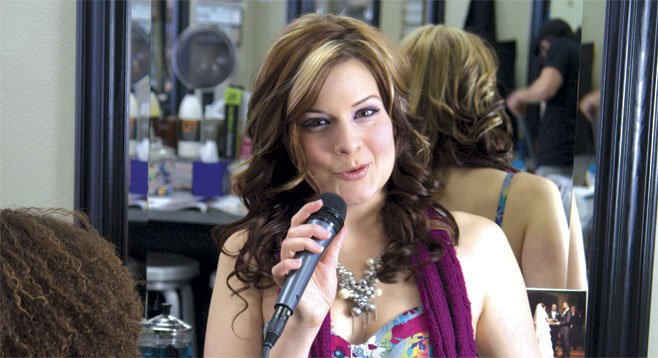
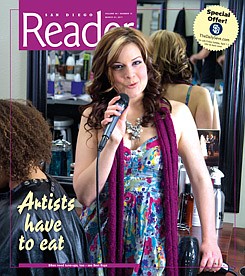
“I would die to be one of the singing voices on a Disney film!” Abigail Lyn squeals over the sound of the hair dryer.
I’m in her chair at a trendy downtown salon. It’s a bright, warm Saturday morning in January, and dance-y music thumps through the speakers overhead. I watch Lyn work in the mirror. She waves the blow dryer as she speaks.
“I started singing in church when I was four. When I was probably six or seven, I remember playing in the back yard with my imaginary friends. I gave them all twigs and stones and things as their tickets, and I seated them to my concert on this embankment. I’d seat everybody, and then I’d belt out this great concert.”
At first glance, Lyn’s two-toned hair (dark brown and bright blonde) gives her an edge, but that edge softens at the sound of her speaking voice. She is bubbly, and her smile and sweetish voice would make it easy to mistake her for 21, instead of 27. Though we’ve known each other for under an hour, I can already visualize her in front of a castle, wearing a pointy princess hat, spinning in circles with her arms outstretched and her head thrown back, singing about how happy she is to be married to the man of her dreams.
“I started voice lessons when I was 11,” she says, swinging the dryer’s long cord around the chair so she can reach the left side of my head. “I put all my identity in my music. As a teenager, I thought, ‘People are going to like me when they hear me sing.’ One girl even told me, ‘I only like you when you sing.’”
Throughout her school years, she performed both solo and in groups. But during her junior year in high school, she began to experience severe hoarseness and was diagnosed with vocal nodules, “calluses on your vocal cords.” When speech therapy and voice rehabilitation didn’t fix the problem, she had the nodules surgically removed.
“So that put me out of commission for a couple years,” she says. It also put her through a bit of an identity crisis. “I thought, ‘Why are people going to like me?’ I also thought ‘I’m not good at anything else. What am I going to do?’ And around that time, I learned that I was good with hair.”
In college, Lyn studied with “a hardcore opera teacher who got me healthy again.” And she spent the next years singing with various bands, including one that took her all the way to France to play at a jazz festival two years in a row. That particular band, she says, “gave me a taste of playing in really small venues and singing consistently for ten people who aren’t really listening.”
Though a native San Diegan, from age ten Lyn was raised in North Carolina. In 2007, after breaking up with the bass player of the jazz band, she returned to San Diego to attend beauty school and “get back to doing the solo thing.” In three years she lived in ten different places, including months at a time on couches, and an eight-month stint sharing a double bed with her younger sister.
She turns off the blow dryer, plugs in her flat iron, and clips my hair up in four sections. Though she no longer has to shout over the dryer, the dance music and other stylist-client conversations require her to raise her voice.
Lynn found her current producer on Google in 2009. They recorded a single in the spring, then he invited her to participate in a charity CD called Song for Food, for which she also wrote a song performed by another artist. In July, she found her job at this salon and another at a sandwich shop. Eventually, she also found a room for rent. Although she continued to sing in church and play Lestat’s open mic whenever she could, music ceased to be her main priority.
“All this unemployment stuff, trying to find work, was really distracting from being able to do music.” She pulls a thin section of my hair through the flat iron. “I had to focus on surviving.”
In January 2010, Lyn found a full-time job doing phone sales. She quit the sandwich-shop job but kept some hours at the salon. Though her new schedule gave her some financial stability, it took her away from music for almost a year.
“I had to quit for a while. I had no voice. I could hardly speak. Last year, I wasn’t able to do anything, and that’s devastating. I was working from 7:00 a.m. to 9:00 at night, so physically, I couldn’t go out and play. I was exhausted.”
Then in July, Justin, her boyfriend of two years proposed. And as soon as he did, she quit her phone-sales job. But because they wanted to wait to move in together until they were married, she found herself couch-surfing again. The couple got married in November, and today they live in his downtown condominium.
Now that she’s “married and stable,” Lyn says, “the necessities are taken care of, so I have no excuse.”
The plan is to learn to play the guitar, get to know other open mics around San Diego, start a band, and put out an EP. Her schedule at the salon gives her mornings free.
“I’ve typically written out of an experience and just let it flow, so I really want to get myself into songwriting exercises and write a song a week. Ideally, my morning’s going to start with some sort of music something.”
So far, three weeks into the new year, she admits it’s not quite panning out that way. Instead of spending her mornings on music, she’s been spending them “trying to learn how to menu plan,” she says. “My husband wouldn’t care if we had tomato soup and grilled cheese. I’m the one who wants to try to be Martha Stewart.”
She pulls another section of my hair through the flat iron and gives me an embarrassed smile.
Two days later, she’s smiling big and with not a hint of nerves or embarrassment. “I’m Abigail Lyn, and this is Tim on guitar,” she says to the jeans-and-flip-flop-clad audience at Lestat’s open mic in Normal Heights. “Give it up for Tim! He’s, like, amazing.” The audience complies with sleepy applause. But they perk up when Lyn begins to sing.
The first song is peppy and fun. The second is a slower one about how happy she is to be married to the man she loves.
Here's something you might be interested in.
San Diego artists try all kinds of things
A.B. Grizzwald, Helen Chang, Tom Plonka, LaRon Lindsay, Abigail Lyn

San Diego artists try all kinds of things
A.B. Grizzwald, Helen Chang, Tom Plonka, LaRon Lindsay, Abigail Lyn
The Good Son: A.B. Grizzwald sits on a stool in his friend’s Golden Hill garage studio. Though he claims this is where he paints occasionally, everything in the studio — paint, canvases, radio, couch, rug, and paint-splotched rags — belongs to the friend, a beefy, tattooed guy named Neko. Grizzwald sips from a paper cup of coffee while Neko paints in the background. The scent of Nag Champa incense wafts through the room. We’re discussing Grizzwald’s work in the art show at Bedouin Vintage Collective and Art Gallery in North Park two days ago. Though the curator said all five artists represented “the grimier side of painting,” and one visitor called it “lowbrow art,” Grizzwald refuses to label his work.
“I guess whatever people want to call it works for me,” he says.
He’s also reluctant to describe his work.
“It feels really corny trying to describe [my] painting. It sounds like I’m taking myself too seriously.”
The name A.B. Grizzwald is one he came up with on his own, two weeks before the group art show, and now he calls it “stupid.” Nonetheless, he’s sticking with it. The 26-year-old’s giant dark-rimmed eyeglasses, black skinny jeans, and sparse moustache make for a complete surface package. If I saw him working the cash register in his green Whole Foods apron, I’d probably guess he’s an artist. But he won’t call himself one.
“I don’t like calling myself an artist because it seems like an injustice to people I know [whose] art is their life. It’s everything they do.”
We both eye Neko on the other side of the room, who stands back from a large painting laid across a tabletop. Neko squints, steps forward again, and dips his brush in the can of white paint held in his left hand. He stoops over and resumes painting in short strokes.
Grizzwald turns back to me. He admits that although there is a part of him that “always feels the need to be creating,” he rarely paints unless he has a deadline looming. Last week, he painted the four pieces for the Bedouin Vintage show in two days. He finished at 4:00 a.m. the day of the show. But then last night, as most nights, he watched television instead of painting before he went to sleep. He calls himself “lazy” and says he spreads himself too thin, what with school full time (at City College, for psychology and sociology) and full-time work as a Whole Foods cashier (for $13-something an hour).
“I thought about going to art school, but the art world seems kind of really bourgeoisie, a disgusting business-related place.”
What about Neko, I ask. Isn’t Neko the art world?
“Yeah, Neko’s the art world,” Grizzwald says with a sheepish, I’m-full-of-hot-air tone to his voice.
Neko, still stooped over the painting, laughs.
“But we’re different people,” Grizzwald says. “I don’t know if I’m tough enough to deal with that kind of atmosphere, the business-related side, rubbing elbows and stuff. There are so many awesome people that sometimes I just feel like giving up.”
Although he says it sounds “corny,” he admits that his fear was once instigated while watching the audition episodes of American Idol. “Watching these people that were terrible and had no idea that they were terrible, I thought, ‘What if I’m one of those people and I have no idea?’”
I ask Neko what he thinks. He stands up straight and says, “I think [Grizzwald] talks himself down. He’s a lot bigger than he thinks he is.”
Bigger, how?
“People appreciate his work,” Neko says. “He’s extremely modest.”
It turns out that Grizzwald’s negative self-talk is a little more than modesty. Years ago, he started out as a graffiti artist. In 2004, he was arrested; a week or so later, the police raided his house.
“They blocked off our street and had my mom and aunt at gunpoint. There weren’t any drugs in the house. They might have found a butter knife,” he says bitterly. “They treat graffiti like it’s a violent crime and me as if I was dangerous. I weigh, like, 145 pounds.”
He holds his cup close to his chest with both hands. His lanky body curves inward, as if to absorb the warmth of the coffee. He follows with his eyes as Neko carries the painting outside. A moment later, we hear the sound of Neko shaking a can of spray paint. Then the whishy sound of the spray.
Soon after the raid, Grizzwald quit doing graffiti (“I just didn’t mentally have what it took anymore”) and took up painting.
“It’s about taking pride in something I’ve created with my hands. It’s a little hard finding things you can take pride in. I mean, I don’t take pride in my cashiering skills at an organic grocery store.”
He doesn’t have the option to choose art as a lifestyle.
“There’s a lot of risks involved in [living the life of an artist]. It’s not the safest bet. I have a mom who’s financially dependent on me, and my brother. Not that money is everything, but if I had to choose following a dream or making sure that my mom has food and shelter, I’m going to choose food and shelter.”
When I ask about his choice to study social work over art, he gives a long list of reasons, including a love for social work and a group of artist friends who didn’t need art school. But when I ask if he’d have made a different choice if it weren’t for his financial responsibilities, he says, “I totally would have. If I didn’t have any responsibility to anybody else, I totally would’ve done it.”
Grizzwald watches as Neko returns with the painting, sets it on the table, and stands back from it once again. Neko walks a few steps to the right, yanks at the rag that dangles from his back pocket, and dabs at the painting. Then he walks a few more steps to the right and does it again.
“He does this all day every day,” Grizzwald says.
I ask if he envies Neko.
“For doing what he wants to do? Yeah. I guess it’s a risk I’m too scared to take, and he’s just going for it.”
The Ghostwriter
Midafternoon on a Wednesday in early January, Helen Chang calls me and says, “Are we still on for 4:00 today? I have a 4:30 phone call, so hopefully a half-hour is enough time to get what you need.”
I’m not surprised. By now, we’ve spoken twice on the phone and exchanged several emails. I’ve browsed her two websites, perused some of the books she’s ghostwritten, and read a handful of articles and blog posts. She’s a busy woman, professional and efficient, not big on chit-chat or other time-wasters. And, yet, when she answers the door to her two-bedroom Mission Gorge apartment, Helen Chang is wearing not a power suit but sweatpants.
Even in sweatpants, she’s intense. After requesting that I remove my shoes, she leads me through her bare-bones living room to the master-bedroom-turned-office, where a “visionboard” and “mind maps” cover the walls.
“That visionboard was created two years ago.” She points to a collage hanging behind the desk, a picture of a woman in a straw hat lounging near a body of water and writing on a laptop. Above her head is a pretend check written out to Helen Chang for “$10,000+ per month.”
“I’ve fulfilled that one already,” she says. “It’s there just because I don’t have a new one to replace it. I do have more visions,” she assures me. “They’re in the mind maps.”
She opens a notebook. On the cover, “2011” is written in marker. She flips quickly through pages of mind maps she created for her financial, spiritual, personal, and business goals. She won’t let me look closely because some of the information, she says, is personal and confidential. But she does point me toward a white board on the wall full of the same circles, lines, and words I’d glimpsed in the notebook.
“These are all my clients and the projects we’ve got going on,” she says.
There are names written inside the circles, and words like “edit workbook” and “rewrite chapter four” are written on lines jutting out from the circles. There must be 10 or 15 of them. Down at the bottom, in the right hand corner, a little circle reads “Helen.” The single line protruding from it says “take classes.”
“That’s me,” she says. “My personal dream right now is to write my own book. Nonfiction. I’m actually kind of working on, if you can even call it that, a memoir.”
“Why the air quotes around ‘working on?’” I ask.
She leads me back to the living room before she answers. Aside from a picture of dewy orange flowers hung behind us, and a couple of leis strung here and there (Chang is from Hawaii), the walls are bare and the room void of color. Her laptop sits open on the coffee table in front of a comfy white couch, where we sit. Between us is a collapsed stack of books and workbooks Helen’s edited or ghostwritten.
“My goal last year was to write the first draft of the memoir, but I didn’t do that,” she confesses. “So I set a new goal this year to write a first draft. By the end of the year. [I used] air quotes because there’s a part of me that’s not confident I’ll get it done. But creatively, that’s what I want to do.”
Chang is not one to boo-hoo about failures or mistakes. She has several big ones in her past. In the 1990s, after making a name for herself as a business journalist in Singapore (writing for Time, Business Week, and other publications), she was “sick of doing business stories” and decided to start a holistic lifestyle magazine. She took on the role of “publisher, the face of it, investor relations,” and hired someone else to do the editing.
Although she did learn a lot about business, the only writing she did was the monthly publisher’s column.
“I really missed the writing,” she says. “I didn’t enjoy being an entrepreneur.”
In the end, after the dotcom bust, the magazine went bankrupt, and Chang went back to freelance writing. In 2003, she met a real-estate investor who hired her to ghostwrite manuals for courses he taught. This was the beginning of her ghostwriting career, though she did continue to work as a freelance journalist.
Chang made what she calls another “big mistake” in 2008 while ghostwriting a real-estate book.
“I didn’t want to be an entrepreneur. I only wanted to write,” she tells me. “I deliberately didn’t want to deal with the business side of it because I was tired of business. And then the real-estate crash happened. My business dried up. You always hear that: never depend on just a few clients for your business. But my journalism gigs dried up, too.”
Though she appears relaxed and comfortable with her legs folded up beneath her, Chang speaks with a loud voice and dramatic gesticulations that confirm her natural intensity.
Today, she lives and works with a balance of business and writing that satisfies her for the most part. Her list of ghostwriting and editing clients includes well-known financial self-help gurus and celebrity hosts from HGTV. Chang’s ghostwriting success has lead her to use the services of 6–12 transcribers, editors, writers, and a personal assistant.
Does it create more work?
“Yes,” she says. “But I’m able to get more work done through them than I am by myself.”
Chang started writing at five, when she created a booklet called “Five Myths and a Poem.” She laughs dismissively when she tells me this, as if the silly projects of a five-year-old have nothing to do with the woman she is today. But as she continues talking about her childhood relationship with stories, her demeanor shifts from one of serious intensity to a more playful animation.
“My mom used to read to me Aesop’s Fables. So, those were the first things I remember reading, and I loved them. And they had the My Little Golden Books with the little golden tab on the side. I used to love those.”
Her voice rises when she says the word “love.”
During the early years, Chang’s dream was “to be Beverly Cleary. The dream of writing books has been in me since childhood. So when I read Beverly Cleary, I was, like, ‘Oh, God, I wish I could write like that.’ And when I read Pippi Longstocking, I was, like, ‘Oh, God, who could create a character like that?’”
She’s sitting on the edge of the couch now, feet on the floor. Her face is bright with the memory of childhood dreams, and the volume and drama in her voice escalate. Soon, she’s all but screaming, as though she were a teeny-bopper and these writers the pop stars she idolizes.
“Later on, when I grew up, it was, ‘If only I could write like Amy Tan!’ And then Kahlil Gibran, oh, my God! Or Elizabeth Gilbert! Oh, my God, if only I could write that way and eat pasta in Italy!”
She laughs at herself and calms a bit. “My whole life has been like that.”
When I mention that most of these literary heroes write fiction and ask if the genre is still an aspiration for her, she says, “To me, fiction is kind of the master art of writing. I’m not at that level. I may never be in this lifetime. On the other hand, Laura Ingalls Wilder [published her first book] at 65.”
Besides, she adds, “If I can do this memoir, I’m incorporating a lot of elements of fiction. You still have to know plot, character, scene, description, and that kind of stuff.”
Chang estimates that in 2010, she spent 90 percent of her time on ghostwriting, five percent on journalism and blogging, and the final five percent on the memoir. But she refuses to bemoan her current situation.
“Ghostwriting is like a bridge between journalism and writing my own books. I’m writing books for people and getting paid for it. It’s awesome. I love it.”
Chang admits that it’s nice seeing her name in print, but she’s not tormented by the fact that her name’s missing from the books she writes. “My byline’s all over the place. I have hundreds of articles in national and international publications.”
She’s more interested in “the challenge of a storyteller to take a message, or a wisdom, and translate it into a story. Of course, I do want to tell my story, and when I do, the byline will be there. But in that case, it won’t be about the byline. It’ll be about the story I want to tell.”
The phone rings. It’s a client for whom she’s writing a book on financial success. Chang apologizes but says she has to take it.”
The Tradesman
At 51, Tom Plonka isn’t old, but he does have the ruddy and weathered look you’d expect from a guy who spends as much time as he can on the 22-foot fishing boat parked in his driveway. The blue-and-yellow Hawaiian print shirt he wears adds to the effect. Plonka is a water guy. Except for the five-foot-square, earth-tone painting of a mother and daughter that hangs over his living room couch, the rest of the walls in his Linda Vista home feature paintings with a whole lot of blue. Ultramarine and Prussian blues, with some Thalo green thrown in the mix. And dolphins. Plonka is crazy about dolphins.
“[Art] was my main thing, although I was also very interested in marine biology,” Plonka says from the rickety desk chair where he’s perched with his arms folded.
We’re in his studio, a narrow room built off the back of his 900-square-foot house. It’s the one cold, gray January day in a week of hot ones. A door at one end of the studio opens to a narrow side-yard, which I imagine would be nice on a warmer day. Two long tables run the length of the room, so that the space left over feels like a hallway. The gray-blue carpet is industrial and dusty. I’m seated on a kind of low deck chair with weatherproof cushions. A shelf to my left is stacked with blank Blick canvases wrapped in plastic. These walls, too, are covered with paintings of dolphins and the occasional angelfish.
Plonka claims he “was always fiddling with” art, painting murals on friends’ walls in high school and on canvases every now and again, but he was still torn when it came time to choose a major in college.
He reclines and crosses an ankle over a knee.
“I probably should have pursued [marine biology] heavier, so I’d have both. I thought that art was going to be able to carry me. Now I don’t look at it that way.”
Shortly after his 1986 graduation from the University of California at San Diego (with a Bachelor in Fine Arts) Plonka met a muralist/sign painter who taught him about hand-painted lettering.
“Back then, there weren’t computers. There were no vinyl letters or anything like that. It was all hand painted, and that’s basically how I made a career out of it.”
Plonka’s father taught graphic arts at a high school and ran his own print shop, so Plonka junior has always seen his artistry as a marketable skill. That accounts, perhaps, for the old-school vibe he gives off, and for the way he presents his work less as an extension of his creative soul and more as a trade.
“I’m trying to make a living, just like anybody else. Just like a doctor, a nurse, a teacher, whatever. I’m out to make a buck.”
In 2000, approximately 20 percent of Plonka’s income came from doing large murals and oil paintings, and 80 percent came from sign work. In 2010, those numbers were reversed.
“I’ve [gotten] a lot more big money with murals than signs. Way more big money. Because I’m really good at it, and I don’t have as much competition with the murals. Signage is a different story. Everybody does it.”
Luckily, this week has yielded a few painting jobs. Next week, he might have to take a drywalling job with his roommate.
“Let’s see, I’m doing lettering on somebody’s truck. I’m doing logo work and lettering for the Mission restaurants downtown and in North Park. They’re all sign jobs.”
Plonka’s arms are still folded over his chest. He shrugs often as he speaks, as if he’s resigned himself to the hustle. Often, he tells me, the work is secured by his “broker,” whom he’d rather not name. This unnamed broker gets as much as a 50 percent commission on the work Plonka does. Plonka admits that he ends up giving away a lot of money with this arrangement, but he says, “marketing is my main obstacle.”
“He gets me a lot of work,” Plonka says of the broker. “This guy is one of the best salesmen I know.”
The way it works is that the broker will bid on a job, then he’ll ask Plonka to bid on the work through him. Plonka gives his number without knowing how much the broker has already accepted for the job. When Plonka does find out the total amount, the client is being charged, it sometimes comes as a shock.
“The problem is I have to almost do the job with a fine tooth comb and a one-hair brush, just to make sure it’s perfect, because [the client] is paying so much. It’s gotta be tight, which is a pain because I’m not getting paid for that. They’re paying more for the job than they should. That’s my opinion. Maybe I just feel guilty about charging somebody that much.”
He bursts out laughing, a loud and surprisingly mirthless sound. His jaw hardly opens, and the smile that accompanies it is slight.
About four or five years ago, Plonka was making “$50,000–60,000 a year. I was working with new clients all the time and making real good money.”
One of his sources of income back then was for a series of nail salons across the country. The owners paid him to paint murals of dolphins on their walls. “I was going all over the country, New Jersey, Pennsylvania, and I went to Phoenix numerous times.”
He stands and grabs a photo album from a table covered with electrical cords, matted prints of his work wrapped in plastic, and a half-finished seascape painting on an easel.
“That’s one of them right there.” He flips to a photograph that shows an underwater scene, complete with dolphins and angelfish, spread across the wall of a nail salon. He turns the page and shows me another. An ocean scene. Dolphins.
“This is right at Kit Carson [elementary school]. I was doing really good. This guy was getting me a lot of mural work and other things too on the side. Besides Fenway Park, we had the whole Macayo’s restaurant chain in Phoenix. God, I could go on and on. We did so much stuff.”
Besides the drywall job he might do with his roommate next week, Plonka tells me he’s looking to supplement his current $20,000–$25,000 annual income, perhaps by obtaining a captain’s license and a certificate as a scuba instructor to work in Catalina. Or maybe by running a shore boat. There’s also a possible teaching gig in Catalina. But these are things that take time and money to get started.
The mood in the studio sours.
The phone rings. He answers, listens, holds his hand over the mouthpiece and asks how much longer we’re going to be. Then he hangs up, first telling the caller he just needs another five minutes.
He begins speaking before I’ve finished asking what his dream life might be. “Traveling around the world to different oceans,” he says. Days spent exploring and nights spent painting.
“I love what I do. When I’m busy I love it,” he says. “What I don’t like is hauling stuff around, cleaning up and everything. I’ve always dreamed I’d have somebody to do that for me.” Again he bursts out laughing. It’s a hard, ironic laugh that stops as quickly as it starts.
“Yeah, right,” he adds. “That’ll never happen.”
The Batman of Photography
LaRon Lindsay isn’t into the whole starving artist thing. And he doesn’t believe his new “government job” will be the death of his art. Instead, he sees it as the security that’s allowing him to run his photography business “without worrying at all. I can pay all the bills. Everything will be taken care of, and then I can make extra money and have all the fun.”
Today, Lindsay wears low-slung skinny jeans, a black T-shirt bearing silk-screened images of what look to be implements of torture. A big, red, square-faced watch adorns his wrist. The day we met, months earlier, he wore a suit, tie, and shiny shoes.
We’re in a den in the four-bedroom Chula Vista house he shares with his girlfriend and three other friends. The house once belonged to the girlfriend’s parents; they’re still present in certain details, such as the dramatic crystal chandelier in the entryway. But the art has a louder and much younger voice. Right inside the front door, a four-foot painting greets visitors with a big black middle finger. The coffee table sports a Styrofoam and plaster sculpture of a Chuck Taylor All-Star. The paintings on the walls are vibrant and youthful, in stark contrast to this earth-and-clay-hued neighborhood. The art is the work of Lindsay’s girl, the same one who gave him the kick in the pants that got his photography business started.
He tells the story with dramatic facial expressions and voice impressions. “I have this ideas book where I write all these ideas down. It’s a ton of different ideas, and I’m drawing these things and they’re silly-looking, but I’m thinking that she can use it.” He points upstairs where his girlfriend is puttering around. “I’d say, ‘What about this idea?’ and she was like, ‘I don’t want to do that. I’m doing what I’m doing.’ So I said, you know what, I’m gonna do it myself.”
For as long as he can remember, Lindsay has been carrying around disposable cameras, taking pictures and “freezing time.” Until his girl challenged him to do something with his ideas, he never considered photography a potential moneymaker or a platform for his creative expression; all he knew was that he loved taking pictures.
“The reason why I decided to go official was because, forever, I always wanted to do what my brother did,” he says.
He holds out his left arm and shows me a tattoo of his older brother Lamar, who lives in Los Angeles and designs and manufactures his own clothing line. On the other wrist, Lindsay wears a rubber bracelet designed by his brother. It reads: “The only thing in the way is me. I am the only thing in my way.”
“Photography was the first thing that was different than what he does all the time,” he says. “So it was my first chance to branch off.”
At Lindsay’s feet sits a black case that resembles the kind you’d see full of money in a heist movie. He opens it to show me the equipment he uses.
“I don’t like to carry all my stuff in a Canon photo bag. I don’t like to look like a photographer before I get to the photo shoot. I’d rather blend in and watch people and how they act before I get into it.”
He pulls out lenses wrapped in protective padding and shows me his “camera housing.” He also drags over a four- or five-foot-long nylon bag and rifles through it. It holds his lighting and generators. His backdrop, he says, is in another small bag around here somewhere.
From a nearby closet, he pulls out three framed photos, 20 by 30 inches each. One is a fashion shot he submitted to a contest by H&M, for which he landed in the top 20 (out of 5000). The other two are close-up portraits of costumed participants (one devil, one creepy clown) from a Halloween Party at the Hard Rock Cafe last October. A company called 3D Entertainment hired him to shoot the event. After he completed his $100 hour, he took a few shots of his own. When I ask why these pictures are hidden away in a closet, he mumbles something about a clean-up to make way for Christmas decor.
“I never took any classes,” he says, when we return to the couch. “I thought I should actually try and learn how to take these photos. So I started going to Borders and reading books on photography. I don’t like to read books, so photography is the first thing that got me to read books.”
The books were mostly how-to books.
“I like instructions. I like to make stuff and build stuff. And the instructions would say something about an ‘aperture’. So, then I’d go look it up — what aperture is. Then I’d see ‘f/stop’. And I’d have to go look up f/stop.”
Two years ago, while working sales at 24-Hour Fitness, he started RedHawk Photography. It was slow going because his commission-only job required so much time and energy.
“Either you’re here or you’re here,” he says, placing one hand in the air at eye level, the other down near his chest. “And if you’re here,” he wiggles the lower hand, “you’ll get eaten up by the sharks up here.”
In order to be one of the sharks that made the sales and got the commissions, he had to work long hours, including Saturdays and Sundays. And he had to have “major mouthpiece” everyday. In other words, he had to be “on” all the time.
“I didn’t have time [for anything else]. I was stressed out.”
Granted, he did make good money. Better than he’s making now in his new job (about which he is allowed to tell me nothing) as a civilian Department of Defense employee at the North Island Naval Base in Coronado. But in his last full year of work at 24-Hour Fitness, he estimates that he was only able to spend about ten percent of his time working on photography.
“I didn’t feel like it was going anywhere. Even my brother was, like, ‘Okay, you’re talented, and I see you want to do it, but are you gonna do it? Probably not because you’re not really taking the time to do it.’ And now? With my government job? Shoot, it’s about 40 percent.”
The new job has clear, identifiable start and stop times. Monday through Friday, he goes to the gym from 4:30 to 5:30 and starts work at 6:00. He finishes work at 3:00 p.m. Most evenings, he and his girlfriend take their laptops to a coffee shop (lately, Claire de Lune or Filter, both in North Park), where they work until 9:00 or 9:30. He edits photos, checks the traffic on his website, and does whatever needs to be done. Weekends are reserved for shoots.
Lindsay says he’s happy with the balance. But he also indirectly admits to some insecurity, both financial and otherwise.
“There are so many people out there who think that anyone can take a picture, myself included. And even though I know I’ll always have customers, there’s always that open door where somebody can say, ‘Hey, the iPhone 19 is out and they have a Canon application on there. We can take our own pictures.’ And then where am I?”
Lindsay’s goals for the coming year are to have two photography jobs every weekend, to revamp his website, and to take the level of his record-keeping from “ghetto fab” (everything written on pieces of paper here and there) to neat and tidy columns in a notebook. He shows me the notebook he has started to this end. It is, indeed, neat and tidy.
And if, say, someone from a magazine calls and wants him to work?
“I’ll be like, ‘Great. Let’s do it. Saturday and Sunday.’ After work, too, but definitely not instead of my job. I got my Thrift Savings Plan set up. I’m saving my money for retirement. All that stuff. I got everything set up the right way.”
And then he adds, “I’m the Batman of photography. I’ve got a day job, I look the way I look, and everybody’s, like, ‘Oh, he’s a government worker.’ Then I put on my cape, pull out my camera, and I make it happen. People don’t know what’s coming.”
The Good Wife
“I would die to be one of the singing voices on a Disney film!” Abigail Lyn squeals over the sound of the hair dryer.
I’m in her chair at a trendy downtown salon. It’s a bright, warm Saturday morning in January, and dance-y music thumps through the speakers overhead. I watch Lyn work in the mirror. She waves the blow dryer as she speaks.
“I started singing in church when I was four. When I was probably six or seven, I remember playing in the back yard with my imaginary friends. I gave them all twigs and stones and things as their tickets, and I seated them to my concert on this embankment. I’d seat everybody, and then I’d belt out this great concert.”
At first glance, Lyn’s two-toned hair (dark brown and bright blonde) gives her an edge, but that edge softens at the sound of her speaking voice. She is bubbly, and her smile and sweetish voice would make it easy to mistake her for 21, instead of 27. Though we’ve known each other for under an hour, I can already visualize her in front of a castle, wearing a pointy princess hat, spinning in circles with her arms outstretched and her head thrown back, singing about how happy she is to be married to the man of her dreams.
“I started voice lessons when I was 11,” she says, swinging the dryer’s long cord around the chair so she can reach the left side of my head. “I put all my identity in my music. As a teenager, I thought, ‘People are going to like me when they hear me sing.’ One girl even told me, ‘I only like you when you sing.’”
Throughout her school years, she performed both solo and in groups. But during her junior year in high school, she began to experience severe hoarseness and was diagnosed with vocal nodules, “calluses on your vocal cords.” When speech therapy and voice rehabilitation didn’t fix the problem, she had the nodules surgically removed.
“So that put me out of commission for a couple years,” she says. It also put her through a bit of an identity crisis. “I thought, ‘Why are people going to like me?’ I also thought ‘I’m not good at anything else. What am I going to do?’ And around that time, I learned that I was good with hair.”
In college, Lyn studied with “a hardcore opera teacher who got me healthy again.” And she spent the next years singing with various bands, including one that took her all the way to France to play at a jazz festival two years in a row. That particular band, she says, “gave me a taste of playing in really small venues and singing consistently for ten people who aren’t really listening.”
Though a native San Diegan, from age ten Lyn was raised in North Carolina. In 2007, after breaking up with the bass player of the jazz band, she returned to San Diego to attend beauty school and “get back to doing the solo thing.” In three years she lived in ten different places, including months at a time on couches, and an eight-month stint sharing a double bed with her younger sister.
She turns off the blow dryer, plugs in her flat iron, and clips my hair up in four sections. Though she no longer has to shout over the dryer, the dance music and other stylist-client conversations require her to raise her voice.
Lynn found her current producer on Google in 2009. They recorded a single in the spring, then he invited her to participate in a charity CD called Song for Food, for which she also wrote a song performed by another artist. In July, she found her job at this salon and another at a sandwich shop. Eventually, she also found a room for rent. Although she continued to sing in church and play Lestat’s open mic whenever she could, music ceased to be her main priority.
“All this unemployment stuff, trying to find work, was really distracting from being able to do music.” She pulls a thin section of my hair through the flat iron. “I had to focus on surviving.”
In January 2010, Lyn found a full-time job doing phone sales. She quit the sandwich-shop job but kept some hours at the salon. Though her new schedule gave her some financial stability, it took her away from music for almost a year.
“I had to quit for a while. I had no voice. I could hardly speak. Last year, I wasn’t able to do anything, and that’s devastating. I was working from 7:00 a.m. to 9:00 at night, so physically, I couldn’t go out and play. I was exhausted.”
Then in July, Justin, her boyfriend of two years proposed. And as soon as he did, she quit her phone-sales job. But because they wanted to wait to move in together until they were married, she found herself couch-surfing again. The couple got married in November, and today they live in his downtown condominium.
Now that she’s “married and stable,” Lyn says, “the necessities are taken care of, so I have no excuse.”
The plan is to learn to play the guitar, get to know other open mics around San Diego, start a band, and put out an EP. Her schedule at the salon gives her mornings free.
“I’ve typically written out of an experience and just let it flow, so I really want to get myself into songwriting exercises and write a song a week. Ideally, my morning’s going to start with some sort of music something.”
So far, three weeks into the new year, she admits it’s not quite panning out that way. Instead of spending her mornings on music, she’s been spending them “trying to learn how to menu plan,” she says. “My husband wouldn’t care if we had tomato soup and grilled cheese. I’m the one who wants to try to be Martha Stewart.”
She pulls another section of my hair through the flat iron and gives me an embarrassed smile.
Two days later, she’s smiling big and with not a hint of nerves or embarrassment. “I’m Abigail Lyn, and this is Tim on guitar,” she says to the jeans-and-flip-flop-clad audience at Lestat’s open mic in Normal Heights. “Give it up for Tim! He’s, like, amazing.” The audience complies with sleepy applause. But they perk up when Lyn begins to sing.
The first song is peppy and fun. The second is a slower one about how happy she is to be married to the man she loves.
Comments