

Here's something you might be interested in.
Ask a Hipster — Advice you didn't know you needed
Big Screen — Movie commentary
Blurt — Music's inside track
Booze News — San Diego spirits
Classical Music — Immortal beauty
Classifieds — Free and easy
Close to Home — What it’s like on the street where you live
Cover Stories — Front-page features
Drinks All Around — Bartenders' drink recipes
Excerpts — Literary and spiritual excerpts
Feast! — Food & drink reviews
Feature Stories — Local news & stories
Fishing Report — What’s getting hooked from ship and shore
From the Archives — Spotlight on the past
Golden Dreams — Talk of the town
The Gonzo Report — Making the musical scene, or at least reporting from it
Letters — Our inbox
Movies@Home — Local movie buffs share favorites
Movie Reviews — Our critics' picks and pans
Musician Interviews — Up close with local artists
Neighborhood News from Stringers — Hyperlocal news
News Ticker — News & politics
Obermeyer — San Diego politics illustrated
Outdoors — Weekly changes in flora and fauna
Overheard in San Diego — Eavesdropping illustrated
Poetry — The old and the new
Reader Travel — Travel section built by travelers
Reading — The hunt for intellectuals
Roam-O-Rama — SoCal's best hiking/biking trails
San Diego Beer — Inside San Diego suds
SD on the QT — Almost factual news
Sheep and Goats — Places of worship
Special Issues — The best of
Street Style — San Diego streets have style
Surf Diego — Real stories from those braving the waves
Theater — On stage in San Diego this week
Tin Fork — Silver spoon alternative
Under the Radar — Matt Potter's undercover work
Unforgettable — Long-ago San Diego
Unreal Estate — San Diego's priciest pads
Your Week — Daily event picks
There Is No Black San Diego
"Black people got issues, girl."
Evelyn Irving-Jackson’s olive-green Hummer takes up two of the four pint-sized parking spaces in front of the 1100-square-foot Trinity House thrift shop. The ostentatious gas guzzler seems incongruous, not only with the size of the lot and the run-down environment of the National City neighborhood but also with the purpose of the thrift shop itself: to benefit the nonprofit organization of the same name, which provides transitional housing to “underserved individuals and families in need.” But an afternoon spent with the Trinity House founder makes it clear that she doesn’t give two hoots about congruity.
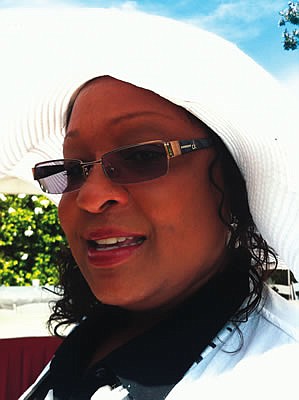
Miss Eveyln
“I’m definitely an anomaly,” she’ll tell me before the day is over. “I’m not the norm.”
True. Not everyone can boast bachelor’s and master’s degrees in computer-software engineering, ten years of dedication toward a doctorate in information technology (“all but the dissertation”), and a history of overdoses, prostitution, jail time, and homelessness, all in the name of drug addiction.
Even her jeans and faded blue T-shirt are out of harmony with the ornate fingernails and toenails done up in gold and swirls.
At the moment, Miss Evelyn (“that’s what the girls call me”) sits upright in a rolling chair in the shop’s back office, telling me that, the way she sees it, “there is no black San Diego.”
Such a statement would not be unusual if preceded by, say, a glance at a tourist brochure for America’s Finest City. But coming from Miss Evelyn, it’s…odd. Black herself, the 49-year-old was raised in Skyline East, surrounded by a good part of San Diego’s six-percent-black population. Her friends growing up were black, and today, as she runs down a mental list of current friends, she says, “Vanessa, black. Julia, black. Susan, white, but she has a mixed daughter. She’s got a little jungle fever.”
And yet Miss Evelyn has considered moving her family someplace where the black community is more “cohesive.” Atlanta, maybe. Or somewhere in Alabama.
Recently, she and a new acquaintance (also black) who runs a nonprofit organization that was in need of a board member, decided to join each other’s boards, but it didn’t work out the way that she’d hoped.
“I was going to their meetings, but they never came to mine. It’s that type of thing.” This is what she means when she speaks of the lack of cohesion in San Diego’s black community. “I think, culturally, we just don’t work together the way some cultures do. When I look at other demographics, like Hispanics, they seem to live in the same house and work together. And even if they don’t go to college, they own the business that you’re [patronizing]. That’s a lot of power.”
Miles Davis’s “’Round Midnight” drifts through the shop from a boombox on a shelf in the office. The music’s moodiness doesn’t quite fit with the musty printed dresses and cluttered thrift-store atmosphere. (“We keep it on Smooth Jazz [KIFM/98.1] because they’re our media sponsor,” she says.)
Miss Evelyn takes a deep breath, exhales, and then launches into a brief monologue about the goodness of God, how she relies on Him to take care of her needs, and the miracles He performs every day.
“God has been faithful,” she concludes. “I know that this is His deal, it’s not my deal. I just show up and participate and make myself available.”
The “this” of which she speaks is Trinity House, begun by Miss Evelyn and her husband Glen six years ago. In addition to providing housing to homeless families, the organization also helps residents develop goals, budgets, and daily task lists as part of their transition back into independent living.
“It’s a challenge being the founder, executive director, case manager, accounts payable, accounts receivable, human resources, grant writer, you know — everything, and trying to have a family. We have four homes that we operate for the homeless, so we’re talking anywhere from 30 to 40 people who have issues. And their issues have issues.”
Because Evelyn and Glen believe in the importance of reciprocity, Trinity House residents have to “give back” ten hours a month, at least two of which must be spent working at the thrift shop. The other eight can include babysitting for another resident while she goes to a doctor’s appointment or soliciting donations over the phone. Other house rules include remaining clean and sober at all times and attending at least two self-help groups, anything from parenting classes or Bible Study to Alcoholics Anonymous meetings. As simple as the Trinity House rules sound, not every resident complies.
“The people that we deal with are so raw and so unappreciative sometimes, and so harsh,” she says.
An older, light-skinned man in a white T-shirt and jeans comes through the shop and pokes his head into the office. His name is Edmond, and aside from Evelyn and Glen, he’s the sole employee of Trinity House. His hours are paid for by a Community Options program, which employs seniors and hires them out to government agencies and nonprofit organizations. Edmond asks what Miss Evelyn wants him to bring in from her car.
“There’s a bag on my front seat, and then you’ll see a chair,” she says. “Anything that’s not Mary Kay.”
As she flaps her hand in the direction of the Hummer to indicate where Edmond will find the donations, a giant pink gemstone on her right ring finger catches the light. She’ll later tell me it was a prize for recruiting 14 new Mary Kay beauty consultants in one month. Half of those 14 are Trinity House residents.
When Edmond leaves, we continue our conversation about the Trinity House residents.
“A lot of them call me Mom,” she says, “and sometimes I am Mom: ‘How come there’s dishes in the sink? How come this? And how come that?’ Some of them can run you down and make every issue they have your issue. I’ve really learned how to set boundaries.”
Until this moment, her round face and frameless glasses have given me a serious, motherly vibe, but now, as she discusses her residents, the formality of her posture collapses and gives way to a demeanor that’s less church, more street.
“We’ve had to evict people that we’ve helped, and we’ve had women want to fight me, women calling me out by name.” She raises an eyebrow. “There have been times when, before I knew it, I was taking my earrings off and kicking my shoes off. I’ve had to learn to temper my spirit and to not let anybody rile me.”
And, no, they’re not all black. In fact, there are times when she’d like to emphasize that point.
“When we have events and stuff — we’ve had a lot of television coverage — I don’t want to always be up there with a black girl [when drawing attention to the issue of homelessness]. You’d be quite surprised. Right now, we have three white girls, two Hispanics, and two black residents at Trinity House. It’s such a melting pot.”
Not too long ago, one of the “white girls,” whom she calls “a cutter,” tried to commit suicide and had to be taken to the emergency psychiatric ward.
“When those situations happen, we refer them to a crisis house or another organization that can deal with their immediate psychiatric needs. I have to constantly assess our risks and exposure and do what’s best for the house as a whole.”
Miss Evelyn’s education in handling the tough cases came from her relationship with her own mother, a teacher who taught at Freese Elementary School in Skyline East for 36 years.
“I grew up in Skyline. I grew up in the ’hood, but because my parents were both educators, I had more of an upper-middle-class upbringing. I had all the things a lot of people didn’t have.”
Despite the material security, she started smoking marijuana at age 12. From there, her drug use progressed to cocaine and then crack.
“I found myself from the age of about 25, 26, up until I was about 31, walking up and down the streets, prostituting, doing whatever I could do to get drugs. I had heard of Skid Row, but one day I looked up, and I was on Skid Row. I was in downtown Los Angeles by myself. I was gone. Out of it.”
After failing to “rescue” Evelyn a few times, her mother started going to Nar-Anon meetings (“for those affected by someone else’s addiction,” the Nar-Anon Family Groups website reads).
“Before that, I would steal from her, manipulate, steal things out of her house, whatever I could do, She wouldn’t let me live with her, but she’d pay for me to have a place. She’d say, ‘You can’t live with me, but I don’t want to see you on the streets.’ When she finally learned tough love, it saved my life. That meant no more money. Don’t come knocking on my door. I don’t want to talk to you. I don’t want to hear from you. I’d get arrested, I’d be in jail, she wouldn’t accept my calls.”
The deal was, Evelyn could have her mother back if she went to rehab. And in 1992, after extradition from Los Angeles to San Diego, where she served 60 days for writing $6000 worth of bad checks, she finally acquiesced and went to a rehab house called Kiva — for seven months. She has been clean since.
Miss Evelyn looks at me straight on, without blinking, and repeats, “That tough love saved my life.”
To emphasize the point further, she tells me about her mother’s best friend, who had a son Evelyn’s age. He also became heavily involved with drugs, and unlike Mrs. Irving, his mother did not set boundaries.
“That mother could never say no to her son. She would get up at three o’clock in the morning, go find him, give him money all the time. I don’t care how many times he stole from her or what he did to manipulate. When I was in rehab, he was murdered. His throat was cut. When I look back on that, I know my mom saved my life.”
Miss Evelyn stands up from her chair and reaches toward the wall behind me. She removes a thumbtack from a collage of magazine words and pictures pasted to a piece of cardboard.
“Let me show you this. It’s something I made when I was in rehab.” She flips the collage over to reveal her name handwritten above a number. “That was my number: 1411.”
At a quick glance, it would be easy to mistake the collage for a visual affirmation. The words “achievement” and “expectation” stand out, as do pictures of black men, women, and children. But on closer examination, I see the words, “agony” and “shorter life” as well. The assignment, she tells me, was to reflect on her life and what she was feeling and then to make a collage.
“I was projecting all the different things from my past and my future, and what’s so weird about it is that everything came true.”
She directs my attention toward several pictures: a row of old, clunky computers; a black father-daughter couple sitting at a table; a heavily made-up woman standing in front of a serious-looking man; the word “abortion” spray-painted on a wall.
“Look,” she explains, pointing to each in turn, “I ended up getting my degree in computers. I’ve got my husband and one daughter. This was me when I was prostituting. I’ve had abortions.”
When I ask why she keeps it hung on the wall, she says, “It’s just so special to me. I was on drugs in L.A. I woke up in the hospital eight times in one year and didn’t have a clue as to how I’d gotten there. I would wake up and be strapped in, IVs in my neck and in my feet. So this is a reminder. It humbles me that God would even see me worthy to do this work.”
A long, lanky-limbed man with light eyes and dark shiny skin excuses himself and slips between us to grab a folder from one of the desks. Miss Evelyn introduces him as her husband Glen whom she met at Kiva. In 1994, they married, and the next year, she gave birth to her daughter Kiva.
In 1997, Miss Evelyn graduated from National University with a bachelor’s in computer-software engineering, and in 1999, she received her master’s degree. After years of working for $85,000–$90,000 “at the height of the tech boom” (at Cox, SAIC, Alaris) and accumulating property, cars, and all manner of material goods, she and Glen decided that they “wanted to help some homeless women and children that were in the situation we were in. So we gave notice to the tenants at one of our rental properties, and we just did it.”
But it hasn’t been easy. Last month, the receipts from the thrift shop added up to $800. The rent is $1500.
“It may look like we have a lot going on and we have a lifestyle because we drive nice cars and everything, but we’re struggling like a lot of people in this economy. But all our needs are always met. God has been really good to us.”
Still, she and Glen know they can’t rely on God without putting some good old-fashioned common sense to work.
“We haven’t been open enough,” Miss Evelyn says of the thrift shop. “We’re not open Saturdays. We’re open during business hours, and that’s not going to cut it. Kmart’s not open 9:00 to 5:00. We need to make some adjustments.”
Miss Evelyn leans back in her chair and tells me she considers herself “blessed,” but she believes the black community in general is “still suffering from the repercussions of slavery and the mentality that we were subjected to, which was divide and conquer.”
This brings us back to the lack of cohesion in San Diego’s black community, but she’s not sure she’d go so far as to say it’s the biggest issue. She calls out to Glen, who has returned to the front of the store. When he steps out from behind a rack of men’s wear, she asks him what he thinks are the biggest issues in the black community.
“Drugs and gang violence,” Glen says, as if the answer should be obvious to everybody. Then he turns around and heads back through the racks of jackets and shirts.
Miss Evelyn nods. “Yeah, he’s probably right.”
More smooth jazz plays overhead. Edmond and Glen chat at the front of the store.
“Although it may sound crazy,” she says, “I honestly think that the powers that be — whoever...the government, CIA — really flooded the black community with drugs. When crack hit the scene, it was crazy. I think it was used as a tool to wreak havoc in the ghetto.”
Then she sighs. “Yeah, black people got issues, girl.”
So, has she ever wished she was white?
“Only to have white-people hair,” she says, laughing and grabbing a handful of her shoulder-length weave. “But I can buy that now.” ■
Here's something you might be interested in.
There Is No Black San Diego
"Black people got issues, girl."

There Is No Black San Diego
"Black people got issues, girl."
Evelyn Irving-Jackson’s olive-green Hummer takes up two of the four pint-sized parking spaces in front of the 1100-square-foot Trinity House thrift shop. The ostentatious gas guzzler seems incongruous, not only with the size of the lot and the run-down environment of the National City neighborhood but also with the purpose of the thrift shop itself: to benefit the nonprofit organization of the same name, which provides transitional housing to “underserved individuals and families in need.” But an afternoon spent with the Trinity House founder makes it clear that she doesn’t give two hoots about congruity.
Miss Eveyln
“I’m definitely an anomaly,” she’ll tell me before the day is over. “I’m not the norm.”
True. Not everyone can boast bachelor’s and master’s degrees in computer-software engineering, ten years of dedication toward a doctorate in information technology (“all but the dissertation”), and a history of overdoses, prostitution, jail time, and homelessness, all in the name of drug addiction.
Even her jeans and faded blue T-shirt are out of harmony with the ornate fingernails and toenails done up in gold and swirls.
At the moment, Miss Evelyn (“that’s what the girls call me”) sits upright in a rolling chair in the shop’s back office, telling me that, the way she sees it, “there is no black San Diego.”
Such a statement would not be unusual if preceded by, say, a glance at a tourist brochure for America’s Finest City. But coming from Miss Evelyn, it’s…odd. Black herself, the 49-year-old was raised in Skyline East, surrounded by a good part of San Diego’s six-percent-black population. Her friends growing up were black, and today, as she runs down a mental list of current friends, she says, “Vanessa, black. Julia, black. Susan, white, but she has a mixed daughter. She’s got a little jungle fever.”
And yet Miss Evelyn has considered moving her family someplace where the black community is more “cohesive.” Atlanta, maybe. Or somewhere in Alabama.
Recently, she and a new acquaintance (also black) who runs a nonprofit organization that was in need of a board member, decided to join each other’s boards, but it didn’t work out the way that she’d hoped.
“I was going to their meetings, but they never came to mine. It’s that type of thing.” This is what she means when she speaks of the lack of cohesion in San Diego’s black community. “I think, culturally, we just don’t work together the way some cultures do. When I look at other demographics, like Hispanics, they seem to live in the same house and work together. And even if they don’t go to college, they own the business that you’re [patronizing]. That’s a lot of power.”
Miles Davis’s “’Round Midnight” drifts through the shop from a boombox on a shelf in the office. The music’s moodiness doesn’t quite fit with the musty printed dresses and cluttered thrift-store atmosphere. (“We keep it on Smooth Jazz [KIFM/98.1] because they’re our media sponsor,” she says.)
Miss Evelyn takes a deep breath, exhales, and then launches into a brief monologue about the goodness of God, how she relies on Him to take care of her needs, and the miracles He performs every day.
“God has been faithful,” she concludes. “I know that this is His deal, it’s not my deal. I just show up and participate and make myself available.”
The “this” of which she speaks is Trinity House, begun by Miss Evelyn and her husband Glen six years ago. In addition to providing housing to homeless families, the organization also helps residents develop goals, budgets, and daily task lists as part of their transition back into independent living.
“It’s a challenge being the founder, executive director, case manager, accounts payable, accounts receivable, human resources, grant writer, you know — everything, and trying to have a family. We have four homes that we operate for the homeless, so we’re talking anywhere from 30 to 40 people who have issues. And their issues have issues.”
Because Evelyn and Glen believe in the importance of reciprocity, Trinity House residents have to “give back” ten hours a month, at least two of which must be spent working at the thrift shop. The other eight can include babysitting for another resident while she goes to a doctor’s appointment or soliciting donations over the phone. Other house rules include remaining clean and sober at all times and attending at least two self-help groups, anything from parenting classes or Bible Study to Alcoholics Anonymous meetings. As simple as the Trinity House rules sound, not every resident complies.
“The people that we deal with are so raw and so unappreciative sometimes, and so harsh,” she says.
An older, light-skinned man in a white T-shirt and jeans comes through the shop and pokes his head into the office. His name is Edmond, and aside from Evelyn and Glen, he’s the sole employee of Trinity House. His hours are paid for by a Community Options program, which employs seniors and hires them out to government agencies and nonprofit organizations. Edmond asks what Miss Evelyn wants him to bring in from her car.
“There’s a bag on my front seat, and then you’ll see a chair,” she says. “Anything that’s not Mary Kay.”
As she flaps her hand in the direction of the Hummer to indicate where Edmond will find the donations, a giant pink gemstone on her right ring finger catches the light. She’ll later tell me it was a prize for recruiting 14 new Mary Kay beauty consultants in one month. Half of those 14 are Trinity House residents.
When Edmond leaves, we continue our conversation about the Trinity House residents.
“A lot of them call me Mom,” she says, “and sometimes I am Mom: ‘How come there’s dishes in the sink? How come this? And how come that?’ Some of them can run you down and make every issue they have your issue. I’ve really learned how to set boundaries.”
Until this moment, her round face and frameless glasses have given me a serious, motherly vibe, but now, as she discusses her residents, the formality of her posture collapses and gives way to a demeanor that’s less church, more street.
“We’ve had to evict people that we’ve helped, and we’ve had women want to fight me, women calling me out by name.” She raises an eyebrow. “There have been times when, before I knew it, I was taking my earrings off and kicking my shoes off. I’ve had to learn to temper my spirit and to not let anybody rile me.”
And, no, they’re not all black. In fact, there are times when she’d like to emphasize that point.
“When we have events and stuff — we’ve had a lot of television coverage — I don’t want to always be up there with a black girl [when drawing attention to the issue of homelessness]. You’d be quite surprised. Right now, we have three white girls, two Hispanics, and two black residents at Trinity House. It’s such a melting pot.”
Not too long ago, one of the “white girls,” whom she calls “a cutter,” tried to commit suicide and had to be taken to the emergency psychiatric ward.
“When those situations happen, we refer them to a crisis house or another organization that can deal with their immediate psychiatric needs. I have to constantly assess our risks and exposure and do what’s best for the house as a whole.”
Miss Evelyn’s education in handling the tough cases came from her relationship with her own mother, a teacher who taught at Freese Elementary School in Skyline East for 36 years.
“I grew up in Skyline. I grew up in the ’hood, but because my parents were both educators, I had more of an upper-middle-class upbringing. I had all the things a lot of people didn’t have.”
Despite the material security, she started smoking marijuana at age 12. From there, her drug use progressed to cocaine and then crack.
“I found myself from the age of about 25, 26, up until I was about 31, walking up and down the streets, prostituting, doing whatever I could do to get drugs. I had heard of Skid Row, but one day I looked up, and I was on Skid Row. I was in downtown Los Angeles by myself. I was gone. Out of it.”
After failing to “rescue” Evelyn a few times, her mother started going to Nar-Anon meetings (“for those affected by someone else’s addiction,” the Nar-Anon Family Groups website reads).
“Before that, I would steal from her, manipulate, steal things out of her house, whatever I could do, She wouldn’t let me live with her, but she’d pay for me to have a place. She’d say, ‘You can’t live with me, but I don’t want to see you on the streets.’ When she finally learned tough love, it saved my life. That meant no more money. Don’t come knocking on my door. I don’t want to talk to you. I don’t want to hear from you. I’d get arrested, I’d be in jail, she wouldn’t accept my calls.”
The deal was, Evelyn could have her mother back if she went to rehab. And in 1992, after extradition from Los Angeles to San Diego, where she served 60 days for writing $6000 worth of bad checks, she finally acquiesced and went to a rehab house called Kiva — for seven months. She has been clean since.
Miss Evelyn looks at me straight on, without blinking, and repeats, “That tough love saved my life.”
To emphasize the point further, she tells me about her mother’s best friend, who had a son Evelyn’s age. He also became heavily involved with drugs, and unlike Mrs. Irving, his mother did not set boundaries.
“That mother could never say no to her son. She would get up at three o’clock in the morning, go find him, give him money all the time. I don’t care how many times he stole from her or what he did to manipulate. When I was in rehab, he was murdered. His throat was cut. When I look back on that, I know my mom saved my life.”
Miss Evelyn stands up from her chair and reaches toward the wall behind me. She removes a thumbtack from a collage of magazine words and pictures pasted to a piece of cardboard.
“Let me show you this. It’s something I made when I was in rehab.” She flips the collage over to reveal her name handwritten above a number. “That was my number: 1411.”
At a quick glance, it would be easy to mistake the collage for a visual affirmation. The words “achievement” and “expectation” stand out, as do pictures of black men, women, and children. But on closer examination, I see the words, “agony” and “shorter life” as well. The assignment, she tells me, was to reflect on her life and what she was feeling and then to make a collage.
“I was projecting all the different things from my past and my future, and what’s so weird about it is that everything came true.”
She directs my attention toward several pictures: a row of old, clunky computers; a black father-daughter couple sitting at a table; a heavily made-up woman standing in front of a serious-looking man; the word “abortion” spray-painted on a wall.
“Look,” she explains, pointing to each in turn, “I ended up getting my degree in computers. I’ve got my husband and one daughter. This was me when I was prostituting. I’ve had abortions.”
When I ask why she keeps it hung on the wall, she says, “It’s just so special to me. I was on drugs in L.A. I woke up in the hospital eight times in one year and didn’t have a clue as to how I’d gotten there. I would wake up and be strapped in, IVs in my neck and in my feet. So this is a reminder. It humbles me that God would even see me worthy to do this work.”
A long, lanky-limbed man with light eyes and dark shiny skin excuses himself and slips between us to grab a folder from one of the desks. Miss Evelyn introduces him as her husband Glen whom she met at Kiva. In 1994, they married, and the next year, she gave birth to her daughter Kiva.
In 1997, Miss Evelyn graduated from National University with a bachelor’s in computer-software engineering, and in 1999, she received her master’s degree. After years of working for $85,000–$90,000 “at the height of the tech boom” (at Cox, SAIC, Alaris) and accumulating property, cars, and all manner of material goods, she and Glen decided that they “wanted to help some homeless women and children that were in the situation we were in. So we gave notice to the tenants at one of our rental properties, and we just did it.”
But it hasn’t been easy. Last month, the receipts from the thrift shop added up to $800. The rent is $1500.
“It may look like we have a lot going on and we have a lifestyle because we drive nice cars and everything, but we’re struggling like a lot of people in this economy. But all our needs are always met. God has been really good to us.”
Still, she and Glen know they can’t rely on God without putting some good old-fashioned common sense to work.
“We haven’t been open enough,” Miss Evelyn says of the thrift shop. “We’re not open Saturdays. We’re open during business hours, and that’s not going to cut it. Kmart’s not open 9:00 to 5:00. We need to make some adjustments.”
Miss Evelyn leans back in her chair and tells me she considers herself “blessed,” but she believes the black community in general is “still suffering from the repercussions of slavery and the mentality that we were subjected to, which was divide and conquer.”
This brings us back to the lack of cohesion in San Diego’s black community, but she’s not sure she’d go so far as to say it’s the biggest issue. She calls out to Glen, who has returned to the front of the store. When he steps out from behind a rack of men’s wear, she asks him what he thinks are the biggest issues in the black community.
“Drugs and gang violence,” Glen says, as if the answer should be obvious to everybody. Then he turns around and heads back through the racks of jackets and shirts.
Miss Evelyn nods. “Yeah, he’s probably right.”
More smooth jazz plays overhead. Edmond and Glen chat at the front of the store.
“Although it may sound crazy,” she says, “I honestly think that the powers that be — whoever...the government, CIA — really flooded the black community with drugs. When crack hit the scene, it was crazy. I think it was used as a tool to wreak havoc in the ghetto.”
Then she sighs. “Yeah, black people got issues, girl.”
So, has she ever wished she was white?
“Only to have white-people hair,” she says, laughing and grabbing a handful of her shoulder-length weave. “But I can buy that now.” ■
Comments