

Here's something you might be interested in.
Ask a Hipster — Advice you didn't know you needed
Big Screen — Movie commentary
Blurt — Music's inside track
Booze News — San Diego spirits
Classical Music — Immortal beauty
Classifieds — Free and easy
Cover Stories — Front-page features
Drinks All Around — Bartenders' drink recipes
Excerpts — Literary and spiritual excerpts
Feast! — Food & drink reviews
Feature Stories — Local news & stories
Fishing Report — What’s getting hooked from ship and shore
From the Archives — Spotlight on the past
Golden Dreams — Talk of the town
The Gonzo Report — Making the musical scene, or at least reporting from it
Letters — Our inbox
Movies@Home — Local movie buffs share favorites
Movie Reviews — Our critics' picks and pans
Musician Interviews — Up close with local artists
Neighborhood News from Stringers — Hyperlocal news
News Ticker — News & politics
Obermeyer — San Diego politics illustrated
Outdoors — Weekly changes in flora and fauna
Overheard in San Diego — Eavesdropping illustrated
Poetry — The old and the new
Reader Travel — Travel section built by travelers
Reading — The hunt for intellectuals
Roam-O-Rama — SoCal's best hiking/biking trails
San Diego Beer — Inside San Diego suds
SD on the QT — Almost factual news
Sheep and Goats — Places of worship
Special Issues — The best of
Street Style — San Diego streets have style
Surf Diego — Real stories from those braving the waves
Theater — On stage in San Diego this week
Tin Fork — Silver spoon alternative
Under the Radar — Matt Potter's undercover work
Unforgettable — Long-ago San Diego
Unreal Estate — San Diego's priciest pads
Your Week — Daily event picks
Mountain lions, badgers, crows, falcons nibbling around the edges of San Diego
Sometimes wildlife comes to you
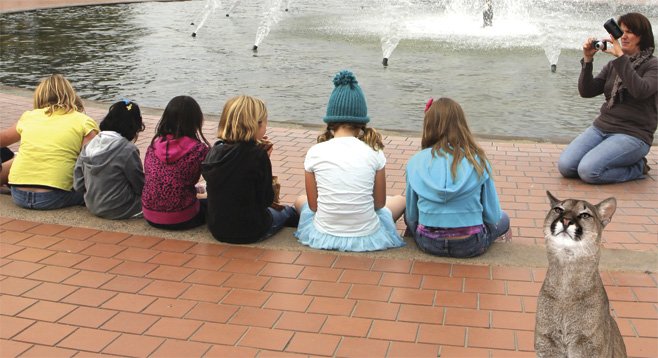
Midsummer. Japatul Valley, south of Alpine.
Too hot to sleep indoors.
Warren Storm-thunder snoozes in his hammock. He has slung it under trees down by a creek bottom near his isolated valley home.
Then, around midnight, sounds.
Crunch. Crunch. Crunch. Crunch.
It’s the press of heavy paws on leaves and twigs, right beside the creek bed, heading downstream. The creature passes under him. Stormthunder doesn’t move. He knows what it is: a mountain lion.
He falls back to sleep.
Four hours later, as night gives way to daylight, he hears the same crunch, crunch, coming back upstream. He lies still. Once again, the crunching passes beneath his hammock, then fades.
“It was our resident mountain lioness,” he says. “I pretty much knew she was going down to Loveland Reservoir to hunt deer. Then she’d come back up about dawn. It was like a daily commute.”
Stormthunder says he has also seen a jaguarundi — a smaller, black, jaguar-related big-cat species about three feet long, with a tail about as long. “He had the characteristic raked stance, longer back legs, shorter front legs. He was 25 feet away, in the tall grass of the meadow.”
Come on, black jaguars, even small ones, in San Diego County?
Stormthunder has no doubt. He says this exotic maybe could have wandered west from Texas or Arizona, which are their extreme northern habitats, or escaped from captivity. “There’s nothing else that size that’s black and with that rake.”
Also in Storm-thunder’s world: bobcats. “Lots around here. I’m constantly hearing them coughing up fur balls.”
That’s not all. San Diego is being repopulated by crows, feral pigs, exotic plants, golden beetles, parrots, seals, sea lions, coyotes, jack rabbits, llamas, foxes, bats, tarantulas, pythons, guinea pigs…even mammoths are turning up, though these are very long dead.
What’s happening? Is Mother Nature nibbling around the edges of San Diego, waiting to take her back? San Diego, the next Palenque, the Mayan city that the jungle claimed back, a thousand years ago?
If this sounds a tad hysterical, my awakening to the issue had a pretty hysterical beginning.
∗ ∗ ∗
Crash-thump!
Late on day, I’m lying in bed, sweating from the flu. Second-floor apartment, Coronado. Outside, the canopy of a ficus tree shelters the roof of the neighbors’ outside patio. Something must have fallen from the sky. Now I think I hear scratching, muted mewling, squeaks. Something in extremis.
I sit up, stumble to the half-open window, look out.
Oh, wow.
There, below me, with hooked beak hauling out the guts of a stunned pigeon, talons levered against the pigeon’s neck and tail, a peregrine falcon crouches and pecks, wings spread to cover its prey.
Death in the afternoon! I stand fascinated as the falcon works, flicking through the feathers, pulling out all the best bits. I’ve heard falcons can dive-attack at over 200 miles per hour. This pigeon never stood a chance.
It’s about 20 minutes before the falcon scuffs his beak against the bark and lifts on out of there, leaving a surprisingly small pile of feathers and blood.
Man! I’d wondered why the pigeon population in town seemed to be diminishing. There was a time when you couldn’t sit outside at the bakery without food-fighting pigeons landing on your morning muffin, picking it apart with their beaks, and strutting all over your plate. It was pretty disgusting.
But then, mysteriously, their numbers began to drop, and I kind of forgot they were even a problem. Soon there weren’t enough pigeons to weigh down the power lines near Orange Avenue. Those direction-finder flights the whole flock would take? Didn’t seem to happen much anymore. The birds that remained appeared more skittish. It was as if some Lone Ranger Bird Man had ridden in to clean up this town.
Could this wild creature from the desert be it?
Well, not so much bird-man as lady-bird. I soon found out from an exotic-bird vet that my hunter was a huntress. A mother falcon who had hatchlings to feed in her nest somewhere in the steelwork of the Coronado bridge.
Once you start looking, you can’t help becoming aware of the wildlife in San Diego. Jackrabbits at sunset on the beach, the wings of a falcon or golden eagles overhead, the ringed red snake — a California Mountain King snake? — I spotted once, warming itself in the morning sun in upper Mission Valley.
My friend Jason saw a tarantula being dragged away by a tarantula hawk — a two-inch black wasp with orange wings — to her wasps’ nest. She had paralyzed the tarantula so she could lay her eggs inside it. Her little wasps would feed on the giant spider and eat it alive, from the inside out. Nice.
Sometimes, the wildlife comes to you. My wife Lita and I were about to do some late-night laundry when I heard chirrup-grunts, like a cat might make. The ghostly, toothy, button-eyed face of a possum looked up at us. It sat resolutely outside the open laundry-room door, spitting out these little calls. Finally, from inside the laundry room, a tiny mouse — no, wait, a baby possum! — came squeaking out, jumped on the mother’s back, and hung on for dear life. This had to be the Mrs. Possum we were sure had been living under the house in front of us. She kept grunting, and a second baby came out and hoisted itself aboard. Then a third, and a fourth. The mom kept calling until seven baby possums sat in a row on her back. She then turned and waddled off into the bushes, as her offspring swung back and forth like a loose mohawk hairdo. It was like she was introducing the family to us, one by one. We were enchanted.
It turns out the city looks favorably on these invaders because, for one, they eat snails and baby rats and garbage — a free cleanup brigade. Of course, they also clean up any cat food you may leave outside.
But it gets you thinking. Is Mother Nature really returning to town? How much wildlife is there around us?
Quite a bit, from what I’ve learned.
∗ ∗ ∗
Splat. Something wet hits my head. Standing under the Norfolk pines outside Coronado’s public library, I look up just in time to see another yellow-white bomb dropping from the sky. Maybe 60 feet above me, two huge birds are fighting for space in a maybe five-foot-wide nest of sticks. I’m guessing they’re chicks who’ve outgrown the living quarters. But even from way down here on the ground, you can see how big they are. You can hear their raucous squawks. It looks like Jurassic Park has moved in up there.
On the one hand, I’m annoyed as hell at the poop in my hair. On the other, what a wondrous thing it is, to have wild giant birds — blue herons, the librarians tell me — moving back to be among us. It turns out there are at least 300 nesting pairs in San Diego County, maybe 40 or more on Coronado.
Steve Wampler’s the environmentalist I talked to for last year’s story on global warming. He thinks global warming is “crap,” but he still does his part to bring nature back to town. Here, in his home’s backyard, he has waterfalls, ponds, fish, and frogs. Above all, he’s planted milkweed — a toxic weed — to attract Monarch butterflies, because milkweed is pretty much all they feed on. He did it to provide the butterflies with a nutritious break and a little R&R on their migration down to Mexico.
“Now,” he says, “see the caterpillars on the milkweed? Their parents landed here to winter over. Five years ago, there were no Monarchs that I knew of in Coronado, and now some of these guys live here all the time. They’re forgetting the migration, because, just like the rest of us, hey, who can resist San Diego? The caterpillars go through about ten molting stages, and they increase in size 1000 times in two weeks. In five years I went from zero butterflies to probably a couple of hundred. And next year, probably 1000.”
“So, they’re moving in, just like the blue herons at the library,” I say. “There are dozens of big nests in the Norfolk pines there. It’s cool.”
“I hate the blue herons,” Wampler says. “They’re big, cruel birds. They steal my fish and my frogs. I’ve had to put nets up to stop them from diving in.”
∗ ∗ ∗
Other raucous birds lead me to Dr. Jeffrey Jenkins.
Back in my own garden, our cat Nicco looks up at the sky, loudly meowing. From above comes a cackle of laughter, and then, as if especially for Nicco, a mocking yowl.
I look up. Three green parrots with vivid red flashes on their foreheads are sitting in a neighbor’s tree, squawking. It sounds like they’re laughing at Nicco, even imitating her.
Parrots are one of the amazing stories of resettlement by wild creatures in this county, and maybe the most obvious of the wildlife resettlers.
“They’re my wards,” says Jenkins, a vet who may be the county’s most recognized expert in caring for exotic pets. “Mexican parrots are my godchildren. One of the neat things about San Diego is that there has been this flock of wild parrots here for a long time. Most are Mexican redheads [aka Amazons, from their Latin name Amazona viridigenalis, or red-crowned parrots]. It wouldn’t be uncommon in Coronado for you to see a band of 15, all yelling at your cat. They’re completely wild.”
Where do they come from?
Jenkins says they might have escaped from an Ocean Beach bird collector known as the Parrot Woman, when her house burned down in the early 1960s.
It turns out he’s about to release an Amazon of his own, a Mexican redhead he has in his care.
“We call him ‘Argh!’ — from the sound he makes,” Jenkins says. “He has a hole in his head. We think he’s a very lucky survivor from a hawk attack. Hopefully, he’s ready to go back and join the wild flock that lives here. But the majority of domesticated parrots would never be able to survive out there. Like, if your pet got loose, he’s probably going to be hawk food within a week. Because [pet parrots] are very picky about what they eat. They don’t recognize wild sources of food, they’re not acclimated to the outside temperature…”
But he believes that Argh! is ready to become wild again.
“[Argh!] has improved so much, we’ve been retraining him to fly in our clinic’s passageway. We’re going to take a chance and release him tomorrow morning.”
This I’ve got to see.
∗ ∗ ∗
The next morning, around 7:30, I’m in Ocean Beach, looking for the park where Jenkins is going to release Argh!
I should have gotten more precise instructions, because time is ticking toward 8:00 and I’m lost in curvy, tree-shaded lanes, and lanes off lanes. No sign of a park. I’m thinking of giving up, when I hear this noise: excited birds seem to be sounding an alarm. A neighborhood dog starts barking. Suddenly, the birds are overhead, a flock diving, rolling, tumbling, all the while making this raucous chorus of yelps. From down here, they look black-bodied, silhouetted against the rising sun as they convolute overhead. But I can tell they’re the same Mexican redheads that buzzed Nicco, the tribe Argh! belongs to. I wonder if it’s a “Welcome back!” chorus, if Argh! is up there with them already, celebrating his return to freedom.
Later, at his surgery clinic in Mission Valley, Dr. Jenkins tells me, “We came and set him in his cage down on the picnic table there, at Ocean Beach Community Park. We let him sit long enough that he could hear the [other Mexican redheads], and start squawking back a bit.
“A couple of the wild parrots flew down and sat in the tree above us. They squawked and walked back and forth and gave us the eye, and did all those parrot things. Then we opened Argh!’s cage door.
“For a while, he didn’t want to get out. He was going, ‘What’s up?’ Then he popped out and flew into the tree. In a moment, he was lost to us. We just hope he can keep up with them, remember his old skills.”
It turns out that Dr. Jenkins also knows my falcon, the one who dive-bombed the pigeon next to my bedroom.
“That falcon died right here. She was one of the ones that were released by the Peregrine Fund. Falcons were just about gone, finished. They were down to very few. Then in the mid-’70s, falconers all over the United States got together. They contributed their birds to form this Peregrine Fund to breed falcons and release them back into the wild. They really brought them out of extinction. Now they’re off the endangered-species list. Your bird was bred in Santa Barbara, she was released down here in Southern California someplace, and she nested [under] the Coronado Bay Bridge for years — with a number of different males, by the way. She chose the nesting spot.”
He says the process of painting the bridge used to stop for her.
“In years past, you would see the whole bridge had been painted, but one section would still be old paint. That’s because she was nesting. They’d skip that part, so they wouldn’t disturb her.”
Surprisingly, perhaps, the mama falcon never was given a name.
Finally, she was fished out of the harbor, exhausted, old, ill.
“This was five, six years ago. Somebody who lives on the harbor saw her hit the water. They went out, scooped her up, and called animal control. Animal control rushed her in here, but we couldn’t keep her alive. She’d lost a lot of weight. We did a postmortem on her, and she had some pneumonia, which was probably because she was debilitated. Out laying eggs and raising babies is very hard on those guys, and it probably took more than she had left in her. Falcons can live well into their 30s. My suspicion is she was released in the late-’70s, early-’80s. And she lived into the mid-2000s. So she probably made it to around 30 years old.”
What would she have been hunting over the harbor?
“Mostly pigeons. Rock doves. All our street pigeons come from racing pigeons. They’re not native to here. Falcons are natives. Back in the day, they would have eaten mourning doves, or other birds.”
He says some of her babies survived.
“I’m sure they’re still here. I was downtown, waiting for my daughter. She’s a little ballerina, and she was performing in The Nutcracker last year at the Civic Theatre. I was waiting for her to get out after the performance. Just before the sun went down, there was a pair of falcons chasing pigeons between the buildings. Your lady’s kids, for sure. How cool is that?”
∗ ∗ ∗
“We see coyotes, on and off,” says Leigha Robertson, who lives in Olivenhain and has lost four cats to, she suspects, coyotes. “In the summertime, ’specially, we really, really fear them. Driving home around dusk, you hear them: a yip-yelpy bark. ‘Ow ow ow ow ow!’ A lot of people around here don’t even keep cats anymore. So, instead, the coyotes are going for their small dogs.
“And rabbits. We had, like, 12 rabbits used to live out here. This year, we have maybe one or two. We think the coyotes came in and cleaned them out. The worst thing I ever heard was when one got a bunny. Bunnies cry really loud.”
∗ ∗ ∗
The badger that Scott Tremor hands me is as stiff as a board.
“How rare are these?” I ask.
“How rare? If I heard there was one found out there, anywhere, I’d drop this interview and be gone. Bye-bye! They’re that important. I prepared this one [for preservation] in 1994. It came from the Warner Springs area. Santa Ysabel. Road kill. These are very, very rare. This is the effect of roads, and urbanization. Dogs harass them, but road kill is most common. Because badgers have no fear of anything. They’ll stand in front of a tractor and challenge it.”
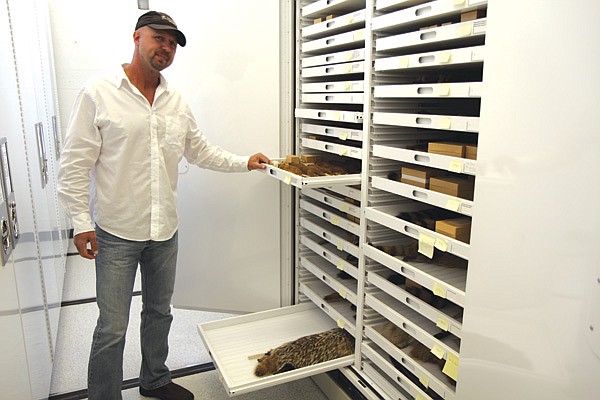
These massive cabinets contain the mammal and
bird collection of the San Diego Natural History Museum
Tremor is in charge of mammals at the San Diego Natural History Museum. The museum oversees — and adds to — a collection of 23,000 mammals and 54,000 birds, all dead, disemboweled, dried specimens collected since the 1870s.
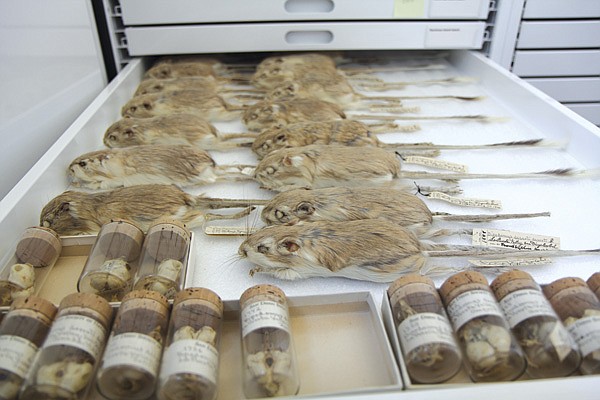
Tremor pulls out a drawerful of what look like Cuban cigars, or elongated corn dogs.
They’re long-tailed weasels. “See the tag? This one was collected by Frank Stevens in 1896. These are native to this area. Recently, the population has exploded. It could be because of the rains. The vegetation comes back, and so do California ground squirrels and pocket gophers. That’s the weasels’ prey diet.”
Who knew? And who cares? This fauna morgue has been locked up for generations in a building known more as a backdrop for balloon-twisting clowns, sax-players, and soothsayers on the Prado. What’s the point of painstakingly collecting scrappy little animals most of us will never see in a San Diego lifetime?
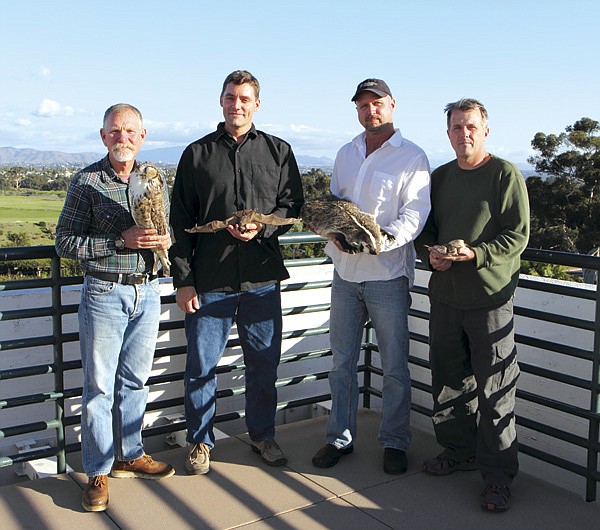
Phil Unitt, John Rebman, Scott Tremor, and Brad Hollingsworth: The four amigos, a new generation of pro-active scientists
But maybe these guys who tag the county’s natural past are best positioned to predict its future. Because Tremor and his colleagues Phil Unitt (curator of the museum’s department of birds and mammals), Jon Rebman (the plant guy), and Brad Hollingsworth (lizards and snakes) are often the first to see problems coming down nature’s turnpike.
They’re also — believe it or not — eco-revolutionaries. The four amigos, a new generation of proactive scientists at the museum. Together, they’ve revived the lost art of collecting mammals, plants, snakes, other reptiles, and birds after a 60-year gap when nobody did nothin’. They also publish atlases of San Diego County for plants, mammals, snakes, and lizards. And, boy, have they put life back into this venerable institution.
Result? They keep discovering things. Plants and creatures — like, unnamed San Diego life-forms, or unnoticed relatives to known ones, all totally new to science — on an almost daily basis.
“Let’s see if I can find the right drawer,” Tremor says. “Ah…round-tailed ground squirrels. This one is from Bard, California. These were all listed as the same species, but then I said, ‘This color is a lot different than that color. Orange-tans, compared to the much darker pelt.’ Now we’re able to measure the skulls, take measurements of the color of the pelts through the colorimeter — exactly what they use in paint stores — and [create] a three-dimensional plot, to statistically determine that this is a new subspecies, a new animal for San Diego County.”
∗ ∗ ∗
I ask Tremor how San Diego is doing today, wildlife-wise, compared with, say, a hundred years ago.
“If you look at the last 30 years, 40 years, urbanization has increased dramatically,” he says. “San Diego County is extremely biodiverse. We live among up to 80 species of mammals that occurred or are occurring here. We also have many that are extinct. For example, we had pronghorn [antelope] that Cabrillo’s naturalists had noted on Kearny Mesa [in 1542] when they came off the ship. But [the pronghorn] are long gone, long extirpated. Kumeyaay, Spanish settlers, we Americans — all of us are to blame.”
Tremor says that mid-level predators like coyote and fox are doing fine. But what of our top predators?
“We had the southern grizzly bear, which is extinct. We assume that the early settlers killed off many of those. The last one taken was shot in 1908, in Trabuco Canyon on the Orange County/San Diego County border. [More may have persisted, undiscovered.] The mountain lion are still very common. They follow the cycles of their main prey, which is deer, and deer often follow the rainfall cycles, because of the vegetation they consume. So the mountain lion population is healthy.
“Roughly 15 years ago, we passed Proposition 117, which helps protect mountain lions. It’s no longer a gamed species. Previously, in California you could hunt it. They mainly live out in East County, in non-urban areas. It’s very rare where they come in, into the canyons. A few periodically come across Interstate 15, or near Miramar. The MSCP [Multiple Species Conservation Program] has helped in many ways. Not only in protecting these animals, but [in providing corridors]. The more open space we have that’s connected, the better.”
But these are dangerous animals. What’s the value in having them around, especially as we build out beyond the edges of town?
“There was a great experiment done on the Kaibab plateau [in Northern Arizona]. I think it was [Teddy] Roosevelt’s era. He was a big hunter, and he said, ‘Let’s go in and remove the lions, the top predators.’ So what happened was [after the top predators were wiped out], all the deer and the elk proliferated and ate the living crap out of everything. It just denuded the environment. It became a moonscape. Then the elk started dying out, so the experiment failed. I think a lot of wildlife managers learned from that simple experiment that you can’t eliminate those top predators from the system.
“Here, in San Diego County, the mountain lion keeps the deer population in check, also coyote, fox, skunks, even vole.”
What is the biggest threat to wildlife in San Diego, apart from humans?
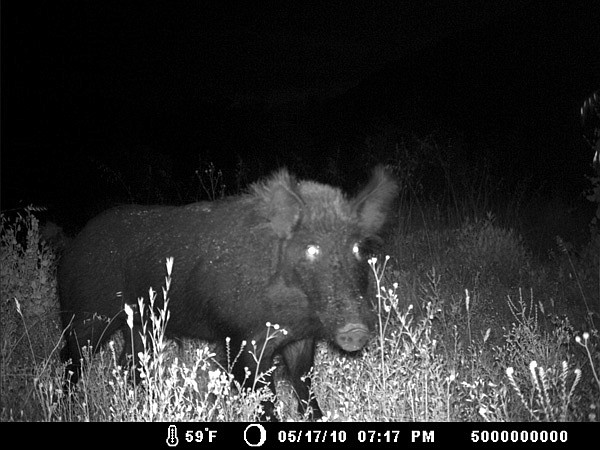
Motion-sensing camera captured this feral pig near
El Capitan Reservoir. “Pigs are a huge, huge threat...
a potential environmental catastrophe.”
Tremor’s face darkens. “It’s a three-letter word,” he says. “P-i-g. Pigs are a huge, huge threat. They’ll come into these [wild] lands that we’ve been conserving and consume everything and anything, including small vertebrates, vegetation, destroying grassland through rooting…it’s horrible. It’s a potential environmental catastrophe, if they’re allowed to persist.”
How did they get here?
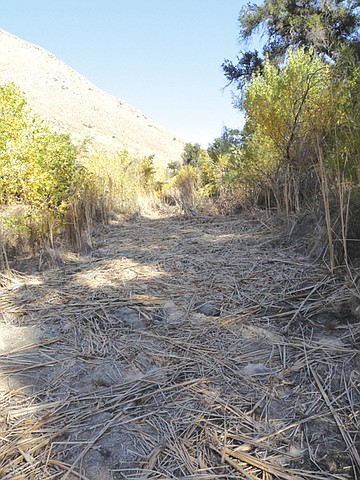
Feral pigs consume everything and
anything, including these cattails
“We believe that, in 2006, there was an introduction into the San Diego River watershed, north of El Capitan. [Sources say that after breeding the pigs in a pen, a member of the Capitan Grande Indian Reservation released the initial herd behind El Capitan Reservoir, to start a hunting program.] And, boy, they’ve done well.
“They are old-world-introduced feral pigs. They’re bad. And they’ve spread. Now they’re as far north and west as Fallbrook, up to Lake Henshaw, south to the Hauser Wilderness Area [east of El Cajon], the Campo area. Yeah, they’re moving.
“They’ll eat acorns, and that’s a huge issue. So not only is the oak facing attack by the goldspotted oak borer, it now has the pigs, which are uprooting from underneath, disturbing the soils, and also consuming all the acorns, thus limiting the chances of regeneration. They’re also eating vertebrates, defecating in our water system, our drinking water. This is probably our most important environmental concern right now.”
But, he says, the possum are a problem as well, nowhere nearly as benign as I thought. They’re another species introduced to the West Coast after stowing away on ships that came from the East Coast, through the Panama Canal.
“Any introduced species is not okay, because they’re taking away a niche from a native species, like raccoons, coyotes, foxes, which do a lot of scavenging. Possums climb trees and eat native fruits, taking anything and everything away from [our native] rodents and birds. And now they’re everywhere. But they’re nowhere near the same threat as the pig. The pig is very bad.”
∗ ∗ ∗
We’re also being invaded from the air.
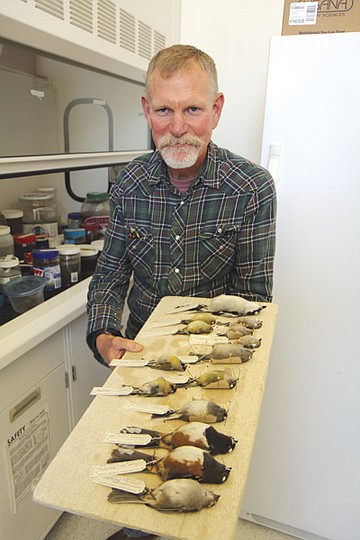
The San Diego Natural History Museum oversees — and adds to — a collection of 23,000 mammals and 54,000 birds, collected since the 1870s
Phil Unitt, the Natural History Museum’s curator of birds, says that, in our lifetime, San Diego has witnessed a Hitchcockian change in the behavior of crows. They’re here in town big-time, struttin’ their thing. And it’s not just San Diego.
“Even [as recently as] 35 years ago, we never saw crows until you got to the east end of El Cajon.”
What happened?
“I’d call it turning the corner of evolution,” Unitt says. “Forty years ago, in our Christmas bird-count for San Diego, it was very rare that we would get a crow. Now, it’s, like, the second most abundant species.”
Did the crows just come in because they suddenly realized they could?
“Why has the adaptation of the crow [to urban San Diego] happened at this particular moment in history? I don’t have an answer. But in Boise, Idaho — Idaho is in the center of the crow’s range — they didn’t used to live in the city, either. Then, around 1985, they moved into Boise. And…”
He gives me a funny look, like this is the weirdest part.
“…and 1985 happened to be about the same time that crows moved in to our city. San Diego. Is it a learned behavior? Back in the good old farming days, it was every boy’s sacred duty to shoot crows [because they ate crops]. Did the crows learn that ‘Oh! People aren’t shooting us anymore, [so] we can exploit this habitat’? Is that a learned behavior? Did it spread, like a fad? The word was out, so to speak. The crow roosts in big flocks. It has been proposed that these communal roosts serve as actual information centers.”
∗ ∗ ∗
Two years ago, when they were building the Jefferson Law School beside the new library site downtown, in East Village, they discovered a southern woolly mammoth at Tenth and Island. That was 500,000 years ago. Ten feet below him, and 100,000 years even farther back in time, they found a California gray whale, and nearby, at the same level, parts of a giant ground sloth.
“That find of the mammoth was tremendously exciting,” says Tom Demere, the museum’s paleontology curator. Pat [Sena, fellow paleontologist] called in to tell us, ‘I just discovered a mammoth tusk! Downtown! And a skull with it!’
“When something like that happens, you drop everything. It’s like a fire drill. We raced down to rescue as much as we could while we could. Now we have most of it here.”
Demere says they have a pretty good picture of the fellow San Diegans you might have run across while strolling Broadway, back in the day of our mammoth. “You’d meet large camels, mammoths, horses, zebras, llamas, giant ground sloths, coyotes, mountain lions. There would have been sycamore trees — and conifer forest, not jungle — because there wasn’t enough rain, but plenty of trees near the river. Yes, Broadway was once tropical rainforest, but that was way older, 45 million years back. Globally, that’s when the climatic deterioration started that we’re living the results of now.”
∗ ∗ ∗
“I used to see deer every day, and we’d see the lions within 200–300 feet of the house,” says Warren Stormthunder, the Japatul Valley resident. “They [were tracking deer], so we wouldn’t worry too much.”
Stormthunder is an arborist, a tree doctor. He lives a kind of wild life. “I’ve been here some 35 years, and we don’t have electricity. I don’t miss it that much. We’ve got flashlights, like the headlamps rock climbers use. Otherwise, we use candles. The edge of the valley is Forest Service land. We’re kind of surrounded by forest here.”
Mountain lions have always been a part of the scenery.
“We have one resident lion. My neighbor sees the lion’s tracks all the time. He has the next 40-acre parcel over and lives nearer to where the deer used to congregate [until the Sunrise Powerlink bulldozers arrived]. But he keeps track of our resident. He does carry a gun when he’s out hiking in the evening.
“Seeing lions isn’t that big a deal. Once one was in the meadow across the creek from us. It’s a little tree meadow. It was in daytime. Our dog alerted on him. Because it was August [the mountain lion] blended in with the weeds, the grasses, the foxtails. He was just sitting there. The dog alerted, and then we saw him, and [the lion] just stood up and stretched and walked away. He was 150–200 feet away. There’s a small creek between us and the meadow. He was probably relaxing, or maybe waiting for some animal to come by.
“Another time, when the original female mountain lion was around, there were neighbors at the other end of the valley, and they had kids who would [walk] home from school, and they’d see her. And she didn’t bother the little kids.”
Does he hear the mountain lions roar, or grunt?
“No. Not really. Just bobcats hacking up hairballs. It sounds pretty gross. Bobcats seem to be doing okay, at this moment. They have a small range. But the mountain lions have about a 100-mile range, and they take about a month to rotate through it.”
∗ ∗ ∗
So should San Diego worry that these wild animals are going to become so used to us they’ll be coming right into town and threatening the citizens, like moose in Anchorage, Alaska, or bears in Yosemite?
“I’ll never say it’s not possible,” says Scott Tremor, the mammalogist, “but it’s not likely. Look, we also get black bear in the county, but only sometimes, and usually they’re vagrants from the north. They head for places like Palomar Mountain. And, yes, lions venture to the urban edges. That’s to be expected, with the way the wildlife corridors lead into the canyons that slice through this city. But lions are easily spooked by people. They don’t want to be around us.”
He says factors like global warming can expand tropical animals’ range. Sounder wildlife policies in Mexico can lead to increased populations of lion and jaguar requiring new territory, which could push more of the great predators north toward us.
“Sightings happen every day,” Tremor says. “A jaguar was actually shot and killed in Arizona recently. A hundred years ago, they claimed to have spotted a jaguar in San Ysidro. It’s possible. We had sea otters sighted off San Diego this month. But much of that is because we’re all more conscious, we get out more, and we have the internet. We report everything so much quicker and to a way-wider audience. It just seems like there’s more life out there.
One thing’s clear: the crows are way ahead. They’ve broken through the barrier of fear. They know we’re rich pickins: there is such a thing as a free lunch, when you hang around humans.
As for the rest of our wild neighbors? Maybe there’s still time to work out a deal.
Here's something you might be interested in.
Mountain lions, badgers, crows, falcons nibbling around the edges of San Diego
Sometimes wildlife comes to you

Mountain lions, badgers, crows, falcons nibbling around the edges of San Diego
Sometimes wildlife comes to you
Midsummer. Japatul Valley, south of Alpine.
Too hot to sleep indoors.
Warren Storm-thunder snoozes in his hammock. He has slung it under trees down by a creek bottom near his isolated valley home.
Then, around midnight, sounds.
Crunch. Crunch. Crunch. Crunch.
It’s the press of heavy paws on leaves and twigs, right beside the creek bed, heading downstream. The creature passes under him. Stormthunder doesn’t move. He knows what it is: a mountain lion.
He falls back to sleep.
Four hours later, as night gives way to daylight, he hears the same crunch, crunch, coming back upstream. He lies still. Once again, the crunching passes beneath his hammock, then fades.
“It was our resident mountain lioness,” he says. “I pretty much knew she was going down to Loveland Reservoir to hunt deer. Then she’d come back up about dawn. It was like a daily commute.”
Stormthunder says he has also seen a jaguarundi — a smaller, black, jaguar-related big-cat species about three feet long, with a tail about as long. “He had the characteristic raked stance, longer back legs, shorter front legs. He was 25 feet away, in the tall grass of the meadow.”
Come on, black jaguars, even small ones, in San Diego County?
Stormthunder has no doubt. He says this exotic maybe could have wandered west from Texas or Arizona, which are their extreme northern habitats, or escaped from captivity. “There’s nothing else that size that’s black and with that rake.”
Also in Storm-thunder’s world: bobcats. “Lots around here. I’m constantly hearing them coughing up fur balls.”
That’s not all. San Diego is being repopulated by crows, feral pigs, exotic plants, golden beetles, parrots, seals, sea lions, coyotes, jack rabbits, llamas, foxes, bats, tarantulas, pythons, guinea pigs…even mammoths are turning up, though these are very long dead.
What’s happening? Is Mother Nature nibbling around the edges of San Diego, waiting to take her back? San Diego, the next Palenque, the Mayan city that the jungle claimed back, a thousand years ago?
If this sounds a tad hysterical, my awakening to the issue had a pretty hysterical beginning.
∗ ∗ ∗
Crash-thump!
Late on day, I’m lying in bed, sweating from the flu. Second-floor apartment, Coronado. Outside, the canopy of a ficus tree shelters the roof of the neighbors’ outside patio. Something must have fallen from the sky. Now I think I hear scratching, muted mewling, squeaks. Something in extremis.
I sit up, stumble to the half-open window, look out.
Oh, wow.
There, below me, with hooked beak hauling out the guts of a stunned pigeon, talons levered against the pigeon’s neck and tail, a peregrine falcon crouches and pecks, wings spread to cover its prey.
Death in the afternoon! I stand fascinated as the falcon works, flicking through the feathers, pulling out all the best bits. I’ve heard falcons can dive-attack at over 200 miles per hour. This pigeon never stood a chance.
It’s about 20 minutes before the falcon scuffs his beak against the bark and lifts on out of there, leaving a surprisingly small pile of feathers and blood.
Man! I’d wondered why the pigeon population in town seemed to be diminishing. There was a time when you couldn’t sit outside at the bakery without food-fighting pigeons landing on your morning muffin, picking it apart with their beaks, and strutting all over your plate. It was pretty disgusting.
But then, mysteriously, their numbers began to drop, and I kind of forgot they were even a problem. Soon there weren’t enough pigeons to weigh down the power lines near Orange Avenue. Those direction-finder flights the whole flock would take? Didn’t seem to happen much anymore. The birds that remained appeared more skittish. It was as if some Lone Ranger Bird Man had ridden in to clean up this town.
Could this wild creature from the desert be it?
Well, not so much bird-man as lady-bird. I soon found out from an exotic-bird vet that my hunter was a huntress. A mother falcon who had hatchlings to feed in her nest somewhere in the steelwork of the Coronado bridge.
Once you start looking, you can’t help becoming aware of the wildlife in San Diego. Jackrabbits at sunset on the beach, the wings of a falcon or golden eagles overhead, the ringed red snake — a California Mountain King snake? — I spotted once, warming itself in the morning sun in upper Mission Valley.
My friend Jason saw a tarantula being dragged away by a tarantula hawk — a two-inch black wasp with orange wings — to her wasps’ nest. She had paralyzed the tarantula so she could lay her eggs inside it. Her little wasps would feed on the giant spider and eat it alive, from the inside out. Nice.
Sometimes, the wildlife comes to you. My wife Lita and I were about to do some late-night laundry when I heard chirrup-grunts, like a cat might make. The ghostly, toothy, button-eyed face of a possum looked up at us. It sat resolutely outside the open laundry-room door, spitting out these little calls. Finally, from inside the laundry room, a tiny mouse — no, wait, a baby possum! — came squeaking out, jumped on the mother’s back, and hung on for dear life. This had to be the Mrs. Possum we were sure had been living under the house in front of us. She kept grunting, and a second baby came out and hoisted itself aboard. Then a third, and a fourth. The mom kept calling until seven baby possums sat in a row on her back. She then turned and waddled off into the bushes, as her offspring swung back and forth like a loose mohawk hairdo. It was like she was introducing the family to us, one by one. We were enchanted.
It turns out the city looks favorably on these invaders because, for one, they eat snails and baby rats and garbage — a free cleanup brigade. Of course, they also clean up any cat food you may leave outside.
But it gets you thinking. Is Mother Nature really returning to town? How much wildlife is there around us?
Quite a bit, from what I’ve learned.
∗ ∗ ∗
Splat. Something wet hits my head. Standing under the Norfolk pines outside Coronado’s public library, I look up just in time to see another yellow-white bomb dropping from the sky. Maybe 60 feet above me, two huge birds are fighting for space in a maybe five-foot-wide nest of sticks. I’m guessing they’re chicks who’ve outgrown the living quarters. But even from way down here on the ground, you can see how big they are. You can hear their raucous squawks. It looks like Jurassic Park has moved in up there.
On the one hand, I’m annoyed as hell at the poop in my hair. On the other, what a wondrous thing it is, to have wild giant birds — blue herons, the librarians tell me — moving back to be among us. It turns out there are at least 300 nesting pairs in San Diego County, maybe 40 or more on Coronado.
Steve Wampler’s the environmentalist I talked to for last year’s story on global warming. He thinks global warming is “crap,” but he still does his part to bring nature back to town. Here, in his home’s backyard, he has waterfalls, ponds, fish, and frogs. Above all, he’s planted milkweed — a toxic weed — to attract Monarch butterflies, because milkweed is pretty much all they feed on. He did it to provide the butterflies with a nutritious break and a little R&R on their migration down to Mexico.
“Now,” he says, “see the caterpillars on the milkweed? Their parents landed here to winter over. Five years ago, there were no Monarchs that I knew of in Coronado, and now some of these guys live here all the time. They’re forgetting the migration, because, just like the rest of us, hey, who can resist San Diego? The caterpillars go through about ten molting stages, and they increase in size 1000 times in two weeks. In five years I went from zero butterflies to probably a couple of hundred. And next year, probably 1000.”
“So, they’re moving in, just like the blue herons at the library,” I say. “There are dozens of big nests in the Norfolk pines there. It’s cool.”
“I hate the blue herons,” Wampler says. “They’re big, cruel birds. They steal my fish and my frogs. I’ve had to put nets up to stop them from diving in.”
∗ ∗ ∗
Other raucous birds lead me to Dr. Jeffrey Jenkins.
Back in my own garden, our cat Nicco looks up at the sky, loudly meowing. From above comes a cackle of laughter, and then, as if especially for Nicco, a mocking yowl.
I look up. Three green parrots with vivid red flashes on their foreheads are sitting in a neighbor’s tree, squawking. It sounds like they’re laughing at Nicco, even imitating her.
Parrots are one of the amazing stories of resettlement by wild creatures in this county, and maybe the most obvious of the wildlife resettlers.
“They’re my wards,” says Jenkins, a vet who may be the county’s most recognized expert in caring for exotic pets. “Mexican parrots are my godchildren. One of the neat things about San Diego is that there has been this flock of wild parrots here for a long time. Most are Mexican redheads [aka Amazons, from their Latin name Amazona viridigenalis, or red-crowned parrots]. It wouldn’t be uncommon in Coronado for you to see a band of 15, all yelling at your cat. They’re completely wild.”
Where do they come from?
Jenkins says they might have escaped from an Ocean Beach bird collector known as the Parrot Woman, when her house burned down in the early 1960s.
It turns out he’s about to release an Amazon of his own, a Mexican redhead he has in his care.
“We call him ‘Argh!’ — from the sound he makes,” Jenkins says. “He has a hole in his head. We think he’s a very lucky survivor from a hawk attack. Hopefully, he’s ready to go back and join the wild flock that lives here. But the majority of domesticated parrots would never be able to survive out there. Like, if your pet got loose, he’s probably going to be hawk food within a week. Because [pet parrots] are very picky about what they eat. They don’t recognize wild sources of food, they’re not acclimated to the outside temperature…”
But he believes that Argh! is ready to become wild again.
“[Argh!] has improved so much, we’ve been retraining him to fly in our clinic’s passageway. We’re going to take a chance and release him tomorrow morning.”
This I’ve got to see.
∗ ∗ ∗
The next morning, around 7:30, I’m in Ocean Beach, looking for the park where Jenkins is going to release Argh!
I should have gotten more precise instructions, because time is ticking toward 8:00 and I’m lost in curvy, tree-shaded lanes, and lanes off lanes. No sign of a park. I’m thinking of giving up, when I hear this noise: excited birds seem to be sounding an alarm. A neighborhood dog starts barking. Suddenly, the birds are overhead, a flock diving, rolling, tumbling, all the while making this raucous chorus of yelps. From down here, they look black-bodied, silhouetted against the rising sun as they convolute overhead. But I can tell they’re the same Mexican redheads that buzzed Nicco, the tribe Argh! belongs to. I wonder if it’s a “Welcome back!” chorus, if Argh! is up there with them already, celebrating his return to freedom.
Later, at his surgery clinic in Mission Valley, Dr. Jenkins tells me, “We came and set him in his cage down on the picnic table there, at Ocean Beach Community Park. We let him sit long enough that he could hear the [other Mexican redheads], and start squawking back a bit.
“A couple of the wild parrots flew down and sat in the tree above us. They squawked and walked back and forth and gave us the eye, and did all those parrot things. Then we opened Argh!’s cage door.
“For a while, he didn’t want to get out. He was going, ‘What’s up?’ Then he popped out and flew into the tree. In a moment, he was lost to us. We just hope he can keep up with them, remember his old skills.”
It turns out that Dr. Jenkins also knows my falcon, the one who dive-bombed the pigeon next to my bedroom.
“That falcon died right here. She was one of the ones that were released by the Peregrine Fund. Falcons were just about gone, finished. They were down to very few. Then in the mid-’70s, falconers all over the United States got together. They contributed their birds to form this Peregrine Fund to breed falcons and release them back into the wild. They really brought them out of extinction. Now they’re off the endangered-species list. Your bird was bred in Santa Barbara, she was released down here in Southern California someplace, and she nested [under] the Coronado Bay Bridge for years — with a number of different males, by the way. She chose the nesting spot.”
He says the process of painting the bridge used to stop for her.
“In years past, you would see the whole bridge had been painted, but one section would still be old paint. That’s because she was nesting. They’d skip that part, so they wouldn’t disturb her.”
Surprisingly, perhaps, the mama falcon never was given a name.
Finally, she was fished out of the harbor, exhausted, old, ill.
“This was five, six years ago. Somebody who lives on the harbor saw her hit the water. They went out, scooped her up, and called animal control. Animal control rushed her in here, but we couldn’t keep her alive. She’d lost a lot of weight. We did a postmortem on her, and she had some pneumonia, which was probably because she was debilitated. Out laying eggs and raising babies is very hard on those guys, and it probably took more than she had left in her. Falcons can live well into their 30s. My suspicion is she was released in the late-’70s, early-’80s. And she lived into the mid-2000s. So she probably made it to around 30 years old.”
What would she have been hunting over the harbor?
“Mostly pigeons. Rock doves. All our street pigeons come from racing pigeons. They’re not native to here. Falcons are natives. Back in the day, they would have eaten mourning doves, or other birds.”
He says some of her babies survived.
“I’m sure they’re still here. I was downtown, waiting for my daughter. She’s a little ballerina, and she was performing in The Nutcracker last year at the Civic Theatre. I was waiting for her to get out after the performance. Just before the sun went down, there was a pair of falcons chasing pigeons between the buildings. Your lady’s kids, for sure. How cool is that?”
∗ ∗ ∗
“We see coyotes, on and off,” says Leigha Robertson, who lives in Olivenhain and has lost four cats to, she suspects, coyotes. “In the summertime, ’specially, we really, really fear them. Driving home around dusk, you hear them: a yip-yelpy bark. ‘Ow ow ow ow ow!’ A lot of people around here don’t even keep cats anymore. So, instead, the coyotes are going for their small dogs.
“And rabbits. We had, like, 12 rabbits used to live out here. This year, we have maybe one or two. We think the coyotes came in and cleaned them out. The worst thing I ever heard was when one got a bunny. Bunnies cry really loud.”
∗ ∗ ∗
The badger that Scott Tremor hands me is as stiff as a board.
“How rare are these?” I ask.
“How rare? If I heard there was one found out there, anywhere, I’d drop this interview and be gone. Bye-bye! They’re that important. I prepared this one [for preservation] in 1994. It came from the Warner Springs area. Santa Ysabel. Road kill. These are very, very rare. This is the effect of roads, and urbanization. Dogs harass them, but road kill is most common. Because badgers have no fear of anything. They’ll stand in front of a tractor and challenge it.”
These massive cabinets contain the mammal and
bird collection of the San Diego Natural History Museum
Tremor is in charge of mammals at the San Diego Natural History Museum. The museum oversees — and adds to — a collection of 23,000 mammals and 54,000 birds, all dead, disemboweled, dried specimens collected since the 1870s.
Tremor pulls out a drawerful of what look like Cuban cigars, or elongated corn dogs.
They’re long-tailed weasels. “See the tag? This one was collected by Frank Stevens in 1896. These are native to this area. Recently, the population has exploded. It could be because of the rains. The vegetation comes back, and so do California ground squirrels and pocket gophers. That’s the weasels’ prey diet.”
Who knew? And who cares? This fauna morgue has been locked up for generations in a building known more as a backdrop for balloon-twisting clowns, sax-players, and soothsayers on the Prado. What’s the point of painstakingly collecting scrappy little animals most of us will never see in a San Diego lifetime?
Phil Unitt, John Rebman, Scott Tremor, and Brad Hollingsworth: The four amigos, a new generation of pro-active scientists
But maybe these guys who tag the county’s natural past are best positioned to predict its future. Because Tremor and his colleagues Phil Unitt (curator of the museum’s department of birds and mammals), Jon Rebman (the plant guy), and Brad Hollingsworth (lizards and snakes) are often the first to see problems coming down nature’s turnpike.
They’re also — believe it or not — eco-revolutionaries. The four amigos, a new generation of proactive scientists at the museum. Together, they’ve revived the lost art of collecting mammals, plants, snakes, other reptiles, and birds after a 60-year gap when nobody did nothin’. They also publish atlases of San Diego County for plants, mammals, snakes, and lizards. And, boy, have they put life back into this venerable institution.
Result? They keep discovering things. Plants and creatures — like, unnamed San Diego life-forms, or unnoticed relatives to known ones, all totally new to science — on an almost daily basis.
“Let’s see if I can find the right drawer,” Tremor says. “Ah…round-tailed ground squirrels. This one is from Bard, California. These were all listed as the same species, but then I said, ‘This color is a lot different than that color. Orange-tans, compared to the much darker pelt.’ Now we’re able to measure the skulls, take measurements of the color of the pelts through the colorimeter — exactly what they use in paint stores — and [create] a three-dimensional plot, to statistically determine that this is a new subspecies, a new animal for San Diego County.”
∗ ∗ ∗
I ask Tremor how San Diego is doing today, wildlife-wise, compared with, say, a hundred years ago.
“If you look at the last 30 years, 40 years, urbanization has increased dramatically,” he says. “San Diego County is extremely biodiverse. We live among up to 80 species of mammals that occurred or are occurring here. We also have many that are extinct. For example, we had pronghorn [antelope] that Cabrillo’s naturalists had noted on Kearny Mesa [in 1542] when they came off the ship. But [the pronghorn] are long gone, long extirpated. Kumeyaay, Spanish settlers, we Americans — all of us are to blame.”
Tremor says that mid-level predators like coyote and fox are doing fine. But what of our top predators?
“We had the southern grizzly bear, which is extinct. We assume that the early settlers killed off many of those. The last one taken was shot in 1908, in Trabuco Canyon on the Orange County/San Diego County border. [More may have persisted, undiscovered.] The mountain lion are still very common. They follow the cycles of their main prey, which is deer, and deer often follow the rainfall cycles, because of the vegetation they consume. So the mountain lion population is healthy.
“Roughly 15 years ago, we passed Proposition 117, which helps protect mountain lions. It’s no longer a gamed species. Previously, in California you could hunt it. They mainly live out in East County, in non-urban areas. It’s very rare where they come in, into the canyons. A few periodically come across Interstate 15, or near Miramar. The MSCP [Multiple Species Conservation Program] has helped in many ways. Not only in protecting these animals, but [in providing corridors]. The more open space we have that’s connected, the better.”
But these are dangerous animals. What’s the value in having them around, especially as we build out beyond the edges of town?
“There was a great experiment done on the Kaibab plateau [in Northern Arizona]. I think it was [Teddy] Roosevelt’s era. He was a big hunter, and he said, ‘Let’s go in and remove the lions, the top predators.’ So what happened was [after the top predators were wiped out], all the deer and the elk proliferated and ate the living crap out of everything. It just denuded the environment. It became a moonscape. Then the elk started dying out, so the experiment failed. I think a lot of wildlife managers learned from that simple experiment that you can’t eliminate those top predators from the system.
“Here, in San Diego County, the mountain lion keeps the deer population in check, also coyote, fox, skunks, even vole.”
What is the biggest threat to wildlife in San Diego, apart from humans?
Motion-sensing camera captured this feral pig near
El Capitan Reservoir. “Pigs are a huge, huge threat...
a potential environmental catastrophe.”
Tremor’s face darkens. “It’s a three-letter word,” he says. “P-i-g. Pigs are a huge, huge threat. They’ll come into these [wild] lands that we’ve been conserving and consume everything and anything, including small vertebrates, vegetation, destroying grassland through rooting…it’s horrible. It’s a potential environmental catastrophe, if they’re allowed to persist.”
How did they get here?
Feral pigs consume everything and
anything, including these cattails
“We believe that, in 2006, there was an introduction into the San Diego River watershed, north of El Capitan. [Sources say that after breeding the pigs in a pen, a member of the Capitan Grande Indian Reservation released the initial herd behind El Capitan Reservoir, to start a hunting program.] And, boy, they’ve done well.
“They are old-world-introduced feral pigs. They’re bad. And they’ve spread. Now they’re as far north and west as Fallbrook, up to Lake Henshaw, south to the Hauser Wilderness Area [east of El Cajon], the Campo area. Yeah, they’re moving.
“They’ll eat acorns, and that’s a huge issue. So not only is the oak facing attack by the goldspotted oak borer, it now has the pigs, which are uprooting from underneath, disturbing the soils, and also consuming all the acorns, thus limiting the chances of regeneration. They’re also eating vertebrates, defecating in our water system, our drinking water. This is probably our most important environmental concern right now.”
But, he says, the possum are a problem as well, nowhere nearly as benign as I thought. They’re another species introduced to the West Coast after stowing away on ships that came from the East Coast, through the Panama Canal.
“Any introduced species is not okay, because they’re taking away a niche from a native species, like raccoons, coyotes, foxes, which do a lot of scavenging. Possums climb trees and eat native fruits, taking anything and everything away from [our native] rodents and birds. And now they’re everywhere. But they’re nowhere near the same threat as the pig. The pig is very bad.”
∗ ∗ ∗
We’re also being invaded from the air.
The San Diego Natural History Museum oversees — and adds to — a collection of 23,000 mammals and 54,000 birds, collected since the 1870s
Phil Unitt, the Natural History Museum’s curator of birds, says that, in our lifetime, San Diego has witnessed a Hitchcockian change in the behavior of crows. They’re here in town big-time, struttin’ their thing. And it’s not just San Diego.
“Even [as recently as] 35 years ago, we never saw crows until you got to the east end of El Cajon.”
What happened?
“I’d call it turning the corner of evolution,” Unitt says. “Forty years ago, in our Christmas bird-count for San Diego, it was very rare that we would get a crow. Now, it’s, like, the second most abundant species.”
Did the crows just come in because they suddenly realized they could?
“Why has the adaptation of the crow [to urban San Diego] happened at this particular moment in history? I don’t have an answer. But in Boise, Idaho — Idaho is in the center of the crow’s range — they didn’t used to live in the city, either. Then, around 1985, they moved into Boise. And…”
He gives me a funny look, like this is the weirdest part.
“…and 1985 happened to be about the same time that crows moved in to our city. San Diego. Is it a learned behavior? Back in the good old farming days, it was every boy’s sacred duty to shoot crows [because they ate crops]. Did the crows learn that ‘Oh! People aren’t shooting us anymore, [so] we can exploit this habitat’? Is that a learned behavior? Did it spread, like a fad? The word was out, so to speak. The crow roosts in big flocks. It has been proposed that these communal roosts serve as actual information centers.”
∗ ∗ ∗
Two years ago, when they were building the Jefferson Law School beside the new library site downtown, in East Village, they discovered a southern woolly mammoth at Tenth and Island. That was 500,000 years ago. Ten feet below him, and 100,000 years even farther back in time, they found a California gray whale, and nearby, at the same level, parts of a giant ground sloth.
“That find of the mammoth was tremendously exciting,” says Tom Demere, the museum’s paleontology curator. Pat [Sena, fellow paleontologist] called in to tell us, ‘I just discovered a mammoth tusk! Downtown! And a skull with it!’
“When something like that happens, you drop everything. It’s like a fire drill. We raced down to rescue as much as we could while we could. Now we have most of it here.”
Demere says they have a pretty good picture of the fellow San Diegans you might have run across while strolling Broadway, back in the day of our mammoth. “You’d meet large camels, mammoths, horses, zebras, llamas, giant ground sloths, coyotes, mountain lions. There would have been sycamore trees — and conifer forest, not jungle — because there wasn’t enough rain, but plenty of trees near the river. Yes, Broadway was once tropical rainforest, but that was way older, 45 million years back. Globally, that’s when the climatic deterioration started that we’re living the results of now.”
∗ ∗ ∗
“I used to see deer every day, and we’d see the lions within 200–300 feet of the house,” says Warren Stormthunder, the Japatul Valley resident. “They [were tracking deer], so we wouldn’t worry too much.”
Stormthunder is an arborist, a tree doctor. He lives a kind of wild life. “I’ve been here some 35 years, and we don’t have electricity. I don’t miss it that much. We’ve got flashlights, like the headlamps rock climbers use. Otherwise, we use candles. The edge of the valley is Forest Service land. We’re kind of surrounded by forest here.”
Mountain lions have always been a part of the scenery.
“We have one resident lion. My neighbor sees the lion’s tracks all the time. He has the next 40-acre parcel over and lives nearer to where the deer used to congregate [until the Sunrise Powerlink bulldozers arrived]. But he keeps track of our resident. He does carry a gun when he’s out hiking in the evening.
“Seeing lions isn’t that big a deal. Once one was in the meadow across the creek from us. It’s a little tree meadow. It was in daytime. Our dog alerted on him. Because it was August [the mountain lion] blended in with the weeds, the grasses, the foxtails. He was just sitting there. The dog alerted, and then we saw him, and [the lion] just stood up and stretched and walked away. He was 150–200 feet away. There’s a small creek between us and the meadow. He was probably relaxing, or maybe waiting for some animal to come by.
“Another time, when the original female mountain lion was around, there were neighbors at the other end of the valley, and they had kids who would [walk] home from school, and they’d see her. And she didn’t bother the little kids.”
Does he hear the mountain lions roar, or grunt?
“No. Not really. Just bobcats hacking up hairballs. It sounds pretty gross. Bobcats seem to be doing okay, at this moment. They have a small range. But the mountain lions have about a 100-mile range, and they take about a month to rotate through it.”
∗ ∗ ∗
So should San Diego worry that these wild animals are going to become so used to us they’ll be coming right into town and threatening the citizens, like moose in Anchorage, Alaska, or bears in Yosemite?
“I’ll never say it’s not possible,” says Scott Tremor, the mammalogist, “but it’s not likely. Look, we also get black bear in the county, but only sometimes, and usually they’re vagrants from the north. They head for places like Palomar Mountain. And, yes, lions venture to the urban edges. That’s to be expected, with the way the wildlife corridors lead into the canyons that slice through this city. But lions are easily spooked by people. They don’t want to be around us.”
He says factors like global warming can expand tropical animals’ range. Sounder wildlife policies in Mexico can lead to increased populations of lion and jaguar requiring new territory, which could push more of the great predators north toward us.
“Sightings happen every day,” Tremor says. “A jaguar was actually shot and killed in Arizona recently. A hundred years ago, they claimed to have spotted a jaguar in San Ysidro. It’s possible. We had sea otters sighted off San Diego this month. But much of that is because we’re all more conscious, we get out more, and we have the internet. We report everything so much quicker and to a way-wider audience. It just seems like there’s more life out there.
One thing’s clear: the crows are way ahead. They’ve broken through the barrier of fear. They know we’re rich pickins: there is such a thing as a free lunch, when you hang around humans.
As for the rest of our wild neighbors? Maybe there’s still time to work out a deal.
Comments