

Here's something you might be interested in.
Ask a Hipster — Advice you didn't know you needed
Big Screen — Movie commentary
Blurt — Music's inside track
Booze News — San Diego spirits
Classical Music — Immortal beauty
Classifieds — Free and easy
Close to Home — What it’s like on the street where you live
Cover Stories — Front-page features
Drinks All Around — Bartenders' drink recipes
Excerpts — Literary and spiritual excerpts
Feast! — Food & drink reviews
Feature Stories — Local news & stories
Fishing Report — What’s getting hooked from ship and shore
From the Archives — Spotlight on the past
Golden Dreams — Talk of the town
The Gonzo Report — Making the musical scene, or at least reporting from it
Letters — Our inbox
Movies@Home — Local movie buffs share favorites
Movie Reviews — Our critics' picks and pans
Musician Interviews — Up close with local artists
Neighborhood News from Stringers — Hyperlocal news
News Ticker — News & politics
Obermeyer — San Diego politics illustrated
Outdoors — Weekly changes in flora and fauna
Overheard in San Diego — Eavesdropping illustrated
Poetry — The old and the new
Reader Travel — Travel section built by travelers
Reading — The hunt for intellectuals
Roam-O-Rama — SoCal's best hiking/biking trails
San Diego Beer — Inside San Diego suds
SD on the QT — Almost factual news
Sheep and Goats — Places of worship
Special Issues — The best of
Street Style — San Diego streets have style
Surf Diego — Real stories from those braving the waves
Theater — On stage in San Diego this week
Tin Fork — Silver spoon alternative
Under the Radar — Matt Potter's undercover work
Unforgettable — Long-ago San Diego
Unreal Estate — San Diego's priciest pads
Your Week — Daily event picks
Local Jungians try sandplay therapy
"We want to be happy"
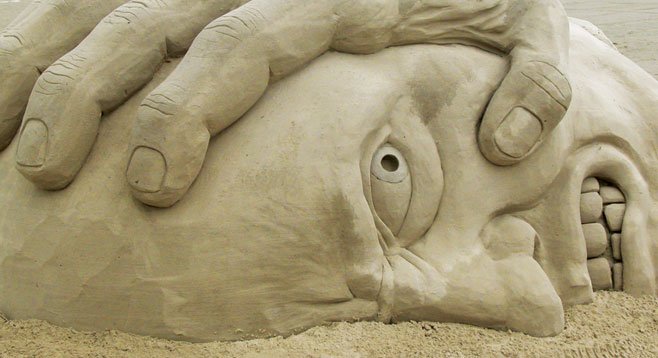
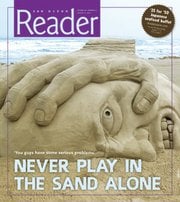
- “In the hands of a properly prepared therapist, sandplay is a powerful, invaluable modality. The operative word is ‘powerful.’ To the extent that any method can heal, so can it do harm.”
- — Dora M. Kalff
To my friends John and Sara, it looked like an ordinary tray filled with sand. On the shelves of a bookcase beside the small table supporting the sandbox were hundreds of small figures, or, as John referred to them, toys. The home office belonged to John’s cousin, Laura. “Go ahead,” Laura said to them, gesturing at both the tray of sand and the bookcase lined with figures. “Pick a few items and put them in there. Have fun with it.”
“Why did she have a sandbox?” I asked. “Does she have kids or something?”
“No, she’s a therapist,” John explained. He sat in my living room, sipping a cup of espresso and relaying tales from a week spent out of town. “She specializes in a certain kind of therapy called sandplay.”
I’d never heard of such a thing. With an inquisitive raise of my brows, I gestured for John to continue.
The mood in the room that night had been casual, he said: there’d been a married couple; John and Sara, who were visiting family; Laura, the cousin who was a psychologist; a bottle of wine; and a room filled with eye-catching objects.
John dresses fashionably in torn jeans and has a collection of unique eyeglasses. He rearranges his furniture frequently and redesigns his facial hair as often as it allows.
On a shelf he’d spotted a statuette of the Little Prince — his favorite childhood storybook character. In Saint-Exupéry’s story, the Little Prince is the master of his own planet. John laughed as he told me how he relates to this character — how he loves nothing more than to be the center of attention, with spontaneity and chaos swirling around him. When he and Sara are out together, John’s charisma glows bright, and the gravitational pull of his personality can clearly be felt. In such situations, Sara seems content to engage in bits of small talk along the periphery.
John plucked the figurine off the shelf and placed it on the sand at the center of the tray.
In contrast to John, Sara’s world is one of order, schedules, and control. She dresses in elegant, minimalist black pantsuits and has worked tirelessly to win promotions at her company, where she is a middle-management training executive. There was a time when John had been the breadwinner, but it is now Sara who brings home the dough.
While Sara contemplated her choices, John used his finger to draw a circle in the sand around his prince. By the time Sara had chosen three items — a plastic Cinderella, a miniature oven, and a paper sheet of play money — John had added two rings around the first.
As the three adults chatted casually about dinner plans, Sara set the Cinderella and stove on the sand near an edge of the tray, then, using the dollar bill, she began to smooth the surface, starting near her objects and moving slowly toward the center of the box, exerting order over the randomness of the sand, until she had leveled half of John’s rings.
“That’s when she said it,” John told me. I leaned forward. “Laura looked at what Sara and I had done in the sand and said, ‘You guys have some serious problems.’” John let out a long breath, sat back in his chair, and rubbed his chin.
He explained that although he and Sara had been growing farther apart in recent years, before their encounter with the sand, they had not yet acknowledged the problem, let alone addressed it. As a result of what had transpired in that room, John announced, he and Sara were now considering a trial separation.
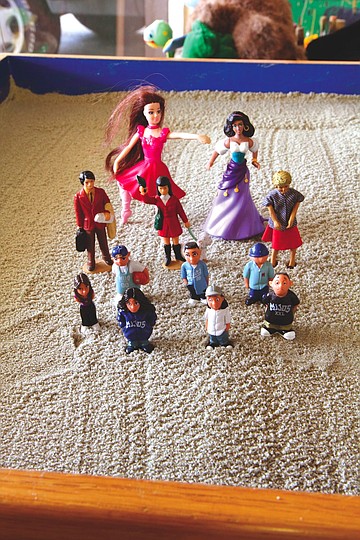
I couldn’t get my head around the idea that toys in sand might have a tangible impact on real life. I’ve dabbled with therapy — a psychologist here, a pill dispenser there — but never have I come into contact with anything like what John described. I like toys; sand, not so much. Still, my curiosity was piqued.
Through online research I found that sandplay therapy was developed in Switzerland, in the 1950s, by Jungian therapist Dora Kalff. At the time, Carl Jung’s “analytical psychology” (analysis of both the unconscious and conscious mind) was the hot new method for helping emotionally ill people achieve a sense of well-being.
Beyond that, the words on the screen were a labyrinth of indecipherable psychobabble. I required a translator. I found one in Encinitas — Peggy McCarthy, PhD, and licensed psychologist. On her professional profile, she listed sandplay as one of her specialties, the other being dream therapy, yet another branch of Jungian psychology.
I visited McCarthy at her office one sunny afternoon. She was dressed business casual, in pants and a loose-fitting shirt, and wore her shoulder-length flaxen hair down. Her smile was relaxed and natural.
“Jung and his ideas sort of fell out of favor when the whole behavioral [therapy] thing came along,” she said. “But there’s still a small core of us [Jungians]. What happens in psychology throughout history is that we go from ‘We have a soul’ to ‘We don’t have a soul.’ The zeitgeist swings. ‘We have a soul’ is Freud, Jung, that deep, dark psyche. ‘We don’t have a soul’ is behavioral: we react to things that happen in our world. It would not surprise me in the least if we swung back again.”
Against one wall of her office several bookshelves were populated with figurines. McCarthy pulled a tray out from a white cabinet. The tray itself was a rectangle, about two feet by one foot, and three inches deep. The interior was painted blue, and there was much more sand than I expected. McCarthy explained that the blue was meant to look like water, so that people could move the sand around, creating the shape of an island, or shoreline.
“Go ahead, feel it,” she urged. “If you want, just play with it for a while. This is not a session, I’m not going to analyze you. Just play with it.”
I pushed the sand around the tray, gradually packing it into the shape of a giant peanut set lengthwise. It was a sturdy mound, and the more solid it became, the more I enjoyed the sensation of patting it.
Brushing residual dust from my hands, I turned toward the bookcase and scanned the miniature trees, animals, and human figures. “How did you amass all this?” I asked.
“Many of these were in a collection I purchased,” McCarthy said. The sand tray, including the sand, had also come from the woman who sold her collection to McCarthy. Some pieces McCarthy had accumulated on her own. “You can go to garage sales. McDonald’s toys are cool, because you’ve got lots of different girls you can use. In the original collection, it was hard to get ethnic dolls. I had to color a few in, but you can see they’re just white features, colored in dark.”
Now that I’d been introduced to the components of sandplay therapy, I wanted to see them in action. Regardless of what people told me, or what I’d read, I had yet to see how this stuff worked. It was easy to imagine the method being utilized to coax abused children to communicate the wordless atrocities they’d suffered. But that was literal, akin to holding up a doll and asking a child to point to where it hurts, not the fathomless allegory that had snuck up from the sand and slapped my friends John and Sara in the face.
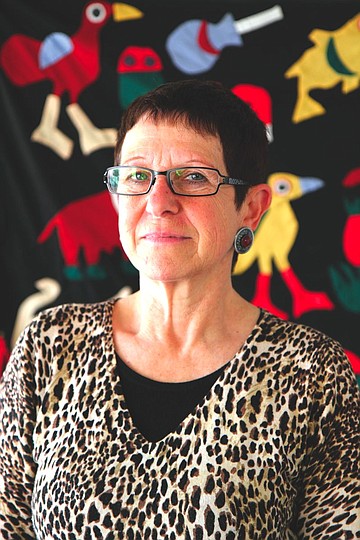
Leslie Fadem: “The sand becomes a vehicle or a way…of expressing needs.”
A Facebook friend (the only contact I could find who’d heard of sandplay) referred me to Leslie Fadem, a marriage and family therapist based in La Mesa. “Born and hatched” in New York City, Fadem began adulthood as an elementary school teacher. She moved to Michigan for graduate work in psychology, eventually obtaining Pupil Personnel Services (PPS) credentials and returning to the school system as a counselor. For the past 20 years or so, she’s been in San Diego, working with schools, community organizations, and running her own private practice.
Fadem’s extensive experience with children is evident in her voice. She enunciates carefully, presenting each word as a gift wrapped in a smile. Her petite frame and close-cropped pixie hair give her an elfin appearance.
Whereas McCarthy has a bookcase against one wall, Fadem has dedicated an entire room to sandplay, with countless items that she began collecting in 1991. She has not one, but two trays, one for wet sand, one for dry. Bookshelves line the walls, upon which figurines are organized according to their classifications: animals, religious symbols, baskets of assorted monsters, reptiles, insects; one shelf is populated solely by buildings — ceramic, wooden, and plastic homes, lighthouses, even a log cabin.
It looks like a children’s playroom, but Fadem says it’s anything but. Though she does plenty of work with children, she also uses the room with adolescents and adults.
“Let’s say a couple has boundary issues, or lots of conflict,” she says. “The sand becomes a vehicle, a way to acknowledge that, to express needs that aren’t initially apparent, or not within the individual’s awareness or vocabulary, to say to a partner, ‘I need more this or that.’ The use of symbols in the sand allows that process to take place and become visible.” This made me think of my friend, who’d smoothed the sand as if to make order out of her partner’s chaos.
Fadem also conducts group-therapy sessions. One Monday evening, with the permission of each participant — a doctor, a “retired mom,” and a marketing manager — she invited me to sit in on her Women’s Self-Esteem group.
Fadem set out coffee and tea in her main office, which contains a sofa, chairs, her desk, and a bookshelf. After ten minutes of allowing everyone to get acquainted (this was for my benefit; the others were obviously long-time friends), Fadem invited us into the next room in a very therapist way, pointedly adding, “Only if you feel comfortable and ready.”
I was invited to take part. The five of us milled about the room, searching the shelves and considering the items. The retired mom asked Fadem for direction, a specific theme, some way to narrow the focus. I found myself wanting this as well. Where to begin? What to choose? Something that represents what I want to share with these people? If I chose something happy, would I be bragging? Or would that mean I’m overcompensating? My head began to hurt.
Fadem declined to manage the process, then politely hushed the other two women, who had been chatting as they perused the shelves. Apparently, silent contemplation is part of the selection process. Regarding our request for direction, Fadem said, in a pleasant, quiet tone through her perpetual smile, “I hear the possibility of some performance anxiety. That speaks to control issues.”
She had me there.
I brought my handful of trinkets to the sand, and, seeing that Fadem had set hers up in one corner, and another woman had begun organizing her things in another corner, I did the math — five women, four corners — and placed the items I’d selected in the center of the tray. Regarding the group, Fadem later told me, “I have gotten to know these women over time. There is already an established sense of safety and trust.” She insists it is only because of that unique situation that she takes part in the session. “Certainly, when I’m working with couples in the sand, I wouldn’t [involve myself].”
I arranged my four items: a red-and-black lacquered Japanese girl, a squirrel, a wedding cake, and an elephant adorned with blue thread and gold sequins. All the creatures faced each other, forming a circle.
“Now look,” Fadem said, her voice barely above a whisper. “Notice what you placed in the sand, what other people placed in the sand — there’s no right, there’s no wrong. This is what we call a safe, protected space. We use this as a repository for whatever is inside of us.”
I let my eyes drift around the tray and take in the artifacts the others had chosen: a sand dollar, a parrot, shiny stones…two of the women had selected magnifying glasses, and the same two had also each chosen smiling ceramic suns.
“So, is there anyone who would be willing to go first, to share a little bit about some of the objects you picked?” Fadem studied our faces. “Anything that attracted you to it, what meaning it might have for you, and it doesn’t have to be…it can be whatever.”
“I’ll go,” said the doctor. She gestured at a small mask that she’d pushed half an inch into the sand. “Well, I feel almost like the opposite of those previous [sandplay sessions], where I had a lot of those little monsters and angry guys. So, I’ve limited myself to the one little angry monster…” When the rest of the women offered a knowing laugh, the doctor smiled and continued, “…to be the sole source of the angst and unhappiness.” This met with murmurs of understanding. “But, then, I actually found that one last” — she indicated the parrot — “[and] I found myself much more drawn to it. I liked the open wings, sort of like not flying yet but about to. And I found the tree not yet blooming but about to, sort of the pre-spring, and I just felt the warmth of new beginning here. And when I saw this one” — she pointed to the sand dollar — “I loved that it was broken and still beautiful.” She paused before addressing the magnifying glass: “This [represents] a way of being able to focus on [the good] part, as opposed to all the other little monsters that were once covering my sandplay.”
After a stretch of silence, the retired mom said, “When I saw the bird and knew it was yours, it made me really happy that you would think that of yourself.”
Because she had spoken up, it seemed natural for the retired mom to go next.
“Well, I planned,” she said. “Instead of finding things that I just noticed, or that spoke to me, I went looking for specific things. So these are all the things that are making me sad right now.” Of the miniature baby doll, she said, “So, my babies are gone.” Of a tiny dollar bill: “And my husband’s very worried about money, even though there’s nothing to worry about, and it’s just driving me crazy.” She pointed to a picnic basket containing wine and bread. “This is supposed to represent Italy. I was looking for the Leaning Tower of Pisa, but didn’t see one. My husband’s Italian, and I’ve been meaning to learn to speak Italian. I feel really discouraged, I feel like after 12 years I should be able to — ”
Everyone, including me, gasped.
“I know,” said the retired mom. “I said should. But that’s how I feel.”
“Don’t should all over yourself,” I said.
The retired mom nodded. She’d fashioned a cross out of red pipe cleaners and had placed it upright in the sand. “This is a red cross,” she said. “I don’t feel well right now. I’m discouraged about everything.”
When she was done, I expected the others to jump in with reassurance, but the room went quiet for nearly a minute.
It was marketing manager who broke the silence. She opened her mouth to speak, but choked on the first word. She wiped tears from her eyes. Of her selections she said, “This is a bed, because I’m tired, really, really tired.” She sniffled, then straightened her back and took a deep breath. As she let it out, her composure returned. “And this is a Botswana agate. It’s beautiful, and it’s from Botswana, which is an interesting, fascinating country, which has a lot of human-rights issues, but it’s a beautiful agate.”
Someone asked if she’d been there. “No, but I know the stones.” She’d placed the stone on the bed, atop the plastic pillow.
“This is obviously a compass,” she said, “because I really need some direction.” This prompted laughter. “And this is a magnifying glass. I picked it because it has this superty-duperty extra-helper part, so you can really examine, because I think I need to be really careful and make good choices and examine my path well and evaluate it, so I wanted the extra help. The sun is a symbol that I’ve used for myself for a long, long time, and it’s basically spirit, God, nature, what have you, and it sort of watches over everything and is involved with everything.”
When she finished speaking, everyone looked to me.
“Well, okay,” I said. “I took the nondirection to heart, and I didn’t think about what any of these represented. I liked the elephant because it’s all dressed up, meticulously adorned. I love red and black, and there’s a lot of Asian stuff in our home, so I thought this girl was cute and shiny, and I liked the smooth texture. The squirrel here…I have a thing with squirrels — I was attacked by a squirrel once — ” There were guffaws all around. “But I love them, and I’m doing morning walks every day, and there are squirrels there, so they’re present in my mind. And this cake looked tasty. I thought, ‘You know, I’m having sweet cravings.’” I grew thoughtful. “It looks like a wedding cake. I didn’t have a wedding cake, but it, you know, just looks sweet.”
“It called your name,” offered the doctor.
“That’s true, it did, and I heard it, too, but that’s for another session,” I joked.
Fadem had selected shiny rocks and other natural items. She limited her participation, keeping her focus on the rest of the sand tray. By joining us, even in a limited capacity, she became part of the group. I found her involvement reassuring. When I spoke, it felt more like I was sharing with friends than reporting symptoms.
When all of the objects in the tray had been identified and explained, Fadem sat back and took a deep breath. “So, I see a couple of different themes,” she said, addressing all of the items in the tray. “Some of the things you selected have important symbolism.” She unfurled her fingers over the center of the tray. “We have ancient culture here. Ancient past and wisdom coming through you. Elephants are very, very intelligent animals, very strong, and they symbolize a moving forward; they’re hard workers. Curiously,” she continued, “you’re in the center area, and that often happens after people have done a lot of work — at least individually. Eventually, we develop some kind of scene in the center, which signifies the strong development of self, of ego. You’re there.”
“I didn’t want my things to be in the way of anyone else’s,” I said, though I sat a little straighter in my chair.
“I made a point of making my own room, which is unusual to me,” said the marketing manager. “I didn’t want to be on the same track as everyone else.” It was only then that I noticed the deep lines she’d drawn in the sand, cordoning off her corner.
“So what does that say about you?” Fadem asked.
“Leave me alone,” said the marketing manager, in what seemed an accidentally forceful tone. When she spoke again, her voice softened. “Well, there’s a leave-me-alone aspect to it, but also an ‘I’m kind of busy right now, and I need to get serious, so I’ll be back later.’”
Each of the women came up with a name for her area and suggested an overall theme for the tray. When we’d finished, Fadem asked our permission to photograph the tray. She does this for every sandplay session. Patients leave the room with the security of a tray intact. It is only after they’ve left that Fadem puts each figure back in its place on the shelf and smoothes over the sand.
Private practices like McCarthy’s and Fadem’s are not the only settings in which one might come across sandplay. It’s also a common tool for therapists working at San Diego Hospice. “We call it sand tray,” says licensed marriage and family therapist Liane Fry. “A straightforward way [to use the method] might be to do a memorialization tray, a directive intervention where they might say, ‘Go to the shelf, trust your hands as you think about the deceased, pull whatever attracts you, place it in the tray, process, and talk about it.’”
The soon-to-be or recently bereaved are susceptible to an existential crisis. “In terms of beliefs, how the world works, it can be ‘Who am I now that I’m not a parent or a spouse?’ — depending on who has died. There’s a feeling of not being anchored. Oftentimes, our work with the bereaved is not only about processing their loss but also about how they are going to adapt to living without the deceased. When things are not very clear on a narrative level, we can give it some sort of form, grab a metaphorical feeling for it, and that’s a starting point.”
Sometimes, the grieving experience becomes a catalyst for significant changes in a survivor’s life.
Fry shares an example of one woman whose mother passed away. “This woman was creating a tray that was more future oriented. She created a pathway in the tray, and she described it in that way. She had an end point, a place she wanted to get up to on the hill, representative of spiritual integrity and self-actualization. But in the tray there was a barrier, a figure that she clearly couldn’t get past.”
Upon initial assessment, the woman had described the obstacle as anger. After looking at the tray for a while, she decided that the three-inch figure “wasn’t quite right.” She removed it and returned with another. “She pulled a very large, two-headed monster figurine about six inches long and put that in and said, ‘It’s fear, that’s what’s there.’ Before that moment, she really didn’t realize the impact of her fear, because it was always covered up by her anger. Only in the tray was she really able to see underneath that anger to the huge lurking fear that was impeding her process.”
Fry describes the work of another woman, whose spouse had died. “She had originally chosen a figure for herself that was quite small relative to the other figures in the tray.” Upon noticing the difference, Fry says, “she realized how much she had squished herself down, made herself smaller than she really was. Only after that was she able to start coming into her own and blossoming to become who she was.”
San Diego Hospice provides its services, including the first three sessions of sand-tray therapy, for free, though the breakthroughs described in each of Fry’s examples had occurred in the first session. After that, sessions are priced according to a sliding scale of hardship. “We never close our doors to anybody,” says Fry. “We’re very lucky that we’ve been supported by our community.”
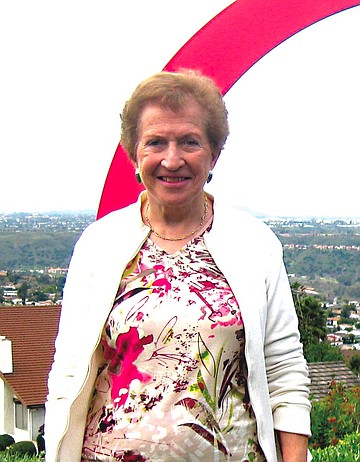
Lee Ben-Yehuda has specialized in sandplay therapy since 1985.
The most impressive collection of sandplay paraphernalia in San Diego has got to be the one that belongs to Lee Ben-Yehuda, who has specialized in sandplay therapy since 1985. Ben-Yehuda cofounded the San Diego Sandplay Association. The white shelves lining the walls of her sandplay sanctuary are floor to ceiling and six figures deep: Superman, Skeletor, E.T., Dorothy, Uncle Sam. If a character has ever been made in miniature, you are likely to find it at Ben-Yehuda’s.
As with the Ouija board, sandplay, says Ben-Yehuda, should never be carried out alone. “The therapist holds the space,” she explains. “I create a presence and a safety for the person. If somebody’s been abused and they start dealing in the sand and up comes the memory of this abuse…there’s somebody there to really be present. A lot of what we do is witness. We watch.”
“But how does that help?” I ask.
“Because you’re not alone,” Ben-Yehuda quietly responds. “And often abuse is in secret, and it’s never told, regardless of what kind of abuse it is. Here is somebody who’s witnessing the truth and able to hold your hand, sometimes literally.”
Like Fadem, Ben-Yehuda is a petite woman with a permanent smile. It was Fadem who referred me to Ben-Yehuda, whom she considers a mentor. Also similar to Fadem, Ben-Yehuda was an elementary school teacher (kindergarten, to be precise) before she became a therapist. I sought Ben-Yehuda’s counsel because I had a basic question that no one on my journey thus far had been able to explain in a way I could understand: What does it mean to “work through” something?
Ben-Yehuda’s response was succinct: when someone is stuck, they work on getting unstuck until their “stuckness” is relieved. “Sometimes not even so much consciously,” Ben-Yehuda says. “Sometimes, people have to work a long time. It’s not an overnight process. But miracles — breakthroughs — do happen.”
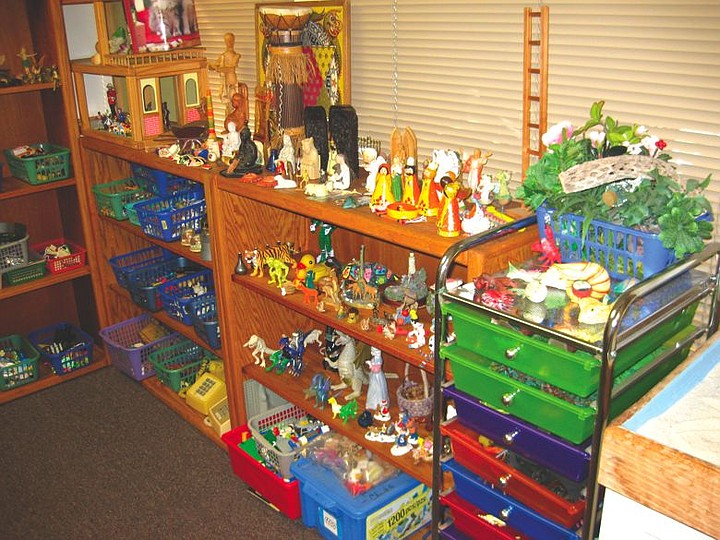
Leslie Fadem has dedicated an entire room to sandplay, with countless items that she began collecting in 1991.
Though toys in sand may seem silly to some, as they originally did to my friends John and Sara, the technique has managed to break through the shell of even hardened soldiers. Alabama-based therapist Poppy Moon wrote a paper about her work with soldiers returning from Iraq. In this paper, she quotes a study from the New England Journal of Medicine that concluded (in 2004) that up to 17 percent of returning veterans suffer from post-traumatic stress disorder. Moon writes: “This means that literally thousands of American soldiers are returning to the United States with a serious mental disorder that not only affects the soldier, but his or her family system as well.”
She describes a case study involving a soldier whose fiancé had urged him to seek treatment “because he no longer could express affection or emotion.” After a few unsuccessful sessions during which “Paul” would only discuss trivialities, Moon took out the sand tray. She details what happened next: “He immediately began to touch the sand, feeling the texture and weight as it slipped through his fingers. Then he collected all my military figures and started to create several busy scenes.”
Moon asked Paul if he’d like to share anything about the tray. “He pointed to a section where five children lay facedown in the sand, dead, unmoving under several army trucks. He said that these tiny bodies had been plowed over by American army supply trucks on a mission in Iraq. The children had been part of a human barrier preventing supplies from reaching our troops. Despite the fact that they were children, the orders were clear: deliver the goods at all costs.” The tray elicited emotion from Paul, who wiped a tear from his eye. Moon concludes, “Through the sand tray, he was able to describe to me the horrors of war that he had previously [been] unable to share with me verbally.”
McCarthy, the first sandplay therapist I met, summed it up best: “I believe — and many, many people believe — that the unconscious wants to be better. We want to be happy, we want to heal, the organism wants to heal. With therapy, with the sand tray, it’s the unconscious’s chance to get this stuff out.” ■
Here's something you might be interested in.
Local Jungians try sandplay therapy
"We want to be happy"

Local Jungians try sandplay therapy
"We want to be happy"
- “In the hands of a properly prepared therapist, sandplay is a powerful, invaluable modality. The operative word is ‘powerful.’ To the extent that any method can heal, so can it do harm.”
- — Dora M. Kalff
To my friends John and Sara, it looked like an ordinary tray filled with sand. On the shelves of a bookcase beside the small table supporting the sandbox were hundreds of small figures, or, as John referred to them, toys. The home office belonged to John’s cousin, Laura. “Go ahead,” Laura said to them, gesturing at both the tray of sand and the bookcase lined with figures. “Pick a few items and put them in there. Have fun with it.”
“Why did she have a sandbox?” I asked. “Does she have kids or something?”
“No, she’s a therapist,” John explained. He sat in my living room, sipping a cup of espresso and relaying tales from a week spent out of town. “She specializes in a certain kind of therapy called sandplay.”
I’d never heard of such a thing. With an inquisitive raise of my brows, I gestured for John to continue.
The mood in the room that night had been casual, he said: there’d been a married couple; John and Sara, who were visiting family; Laura, the cousin who was a psychologist; a bottle of wine; and a room filled with eye-catching objects.
John dresses fashionably in torn jeans and has a collection of unique eyeglasses. He rearranges his furniture frequently and redesigns his facial hair as often as it allows.
On a shelf he’d spotted a statuette of the Little Prince — his favorite childhood storybook character. In Saint-Exupéry’s story, the Little Prince is the master of his own planet. John laughed as he told me how he relates to this character — how he loves nothing more than to be the center of attention, with spontaneity and chaos swirling around him. When he and Sara are out together, John’s charisma glows bright, and the gravitational pull of his personality can clearly be felt. In such situations, Sara seems content to engage in bits of small talk along the periphery.
John plucked the figurine off the shelf and placed it on the sand at the center of the tray.
In contrast to John, Sara’s world is one of order, schedules, and control. She dresses in elegant, minimalist black pantsuits and has worked tirelessly to win promotions at her company, where she is a middle-management training executive. There was a time when John had been the breadwinner, but it is now Sara who brings home the dough.
While Sara contemplated her choices, John used his finger to draw a circle in the sand around his prince. By the time Sara had chosen three items — a plastic Cinderella, a miniature oven, and a paper sheet of play money — John had added two rings around the first.
As the three adults chatted casually about dinner plans, Sara set the Cinderella and stove on the sand near an edge of the tray, then, using the dollar bill, she began to smooth the surface, starting near her objects and moving slowly toward the center of the box, exerting order over the randomness of the sand, until she had leveled half of John’s rings.
“That’s when she said it,” John told me. I leaned forward. “Laura looked at what Sara and I had done in the sand and said, ‘You guys have some serious problems.’” John let out a long breath, sat back in his chair, and rubbed his chin.
He explained that although he and Sara had been growing farther apart in recent years, before their encounter with the sand, they had not yet acknowledged the problem, let alone addressed it. As a result of what had transpired in that room, John announced, he and Sara were now considering a trial separation.
I couldn’t get my head around the idea that toys in sand might have a tangible impact on real life. I’ve dabbled with therapy — a psychologist here, a pill dispenser there — but never have I come into contact with anything like what John described. I like toys; sand, not so much. Still, my curiosity was piqued.
Through online research I found that sandplay therapy was developed in Switzerland, in the 1950s, by Jungian therapist Dora Kalff. At the time, Carl Jung’s “analytical psychology” (analysis of both the unconscious and conscious mind) was the hot new method for helping emotionally ill people achieve a sense of well-being.
Beyond that, the words on the screen were a labyrinth of indecipherable psychobabble. I required a translator. I found one in Encinitas — Peggy McCarthy, PhD, and licensed psychologist. On her professional profile, she listed sandplay as one of her specialties, the other being dream therapy, yet another branch of Jungian psychology.
I visited McCarthy at her office one sunny afternoon. She was dressed business casual, in pants and a loose-fitting shirt, and wore her shoulder-length flaxen hair down. Her smile was relaxed and natural.
“Jung and his ideas sort of fell out of favor when the whole behavioral [therapy] thing came along,” she said. “But there’s still a small core of us [Jungians]. What happens in psychology throughout history is that we go from ‘We have a soul’ to ‘We don’t have a soul.’ The zeitgeist swings. ‘We have a soul’ is Freud, Jung, that deep, dark psyche. ‘We don’t have a soul’ is behavioral: we react to things that happen in our world. It would not surprise me in the least if we swung back again.”
Against one wall of her office several bookshelves were populated with figurines. McCarthy pulled a tray out from a white cabinet. The tray itself was a rectangle, about two feet by one foot, and three inches deep. The interior was painted blue, and there was much more sand than I expected. McCarthy explained that the blue was meant to look like water, so that people could move the sand around, creating the shape of an island, or shoreline.
“Go ahead, feel it,” she urged. “If you want, just play with it for a while. This is not a session, I’m not going to analyze you. Just play with it.”
I pushed the sand around the tray, gradually packing it into the shape of a giant peanut set lengthwise. It was a sturdy mound, and the more solid it became, the more I enjoyed the sensation of patting it.
Brushing residual dust from my hands, I turned toward the bookcase and scanned the miniature trees, animals, and human figures. “How did you amass all this?” I asked.
“Many of these were in a collection I purchased,” McCarthy said. The sand tray, including the sand, had also come from the woman who sold her collection to McCarthy. Some pieces McCarthy had accumulated on her own. “You can go to garage sales. McDonald’s toys are cool, because you’ve got lots of different girls you can use. In the original collection, it was hard to get ethnic dolls. I had to color a few in, but you can see they’re just white features, colored in dark.”
Now that I’d been introduced to the components of sandplay therapy, I wanted to see them in action. Regardless of what people told me, or what I’d read, I had yet to see how this stuff worked. It was easy to imagine the method being utilized to coax abused children to communicate the wordless atrocities they’d suffered. But that was literal, akin to holding up a doll and asking a child to point to where it hurts, not the fathomless allegory that had snuck up from the sand and slapped my friends John and Sara in the face.
Leslie Fadem: “The sand becomes a vehicle or a way…of expressing needs.”
A Facebook friend (the only contact I could find who’d heard of sandplay) referred me to Leslie Fadem, a marriage and family therapist based in La Mesa. “Born and hatched” in New York City, Fadem began adulthood as an elementary school teacher. She moved to Michigan for graduate work in psychology, eventually obtaining Pupil Personnel Services (PPS) credentials and returning to the school system as a counselor. For the past 20 years or so, she’s been in San Diego, working with schools, community organizations, and running her own private practice.
Fadem’s extensive experience with children is evident in her voice. She enunciates carefully, presenting each word as a gift wrapped in a smile. Her petite frame and close-cropped pixie hair give her an elfin appearance.
Whereas McCarthy has a bookcase against one wall, Fadem has dedicated an entire room to sandplay, with countless items that she began collecting in 1991. She has not one, but two trays, one for wet sand, one for dry. Bookshelves line the walls, upon which figurines are organized according to their classifications: animals, religious symbols, baskets of assorted monsters, reptiles, insects; one shelf is populated solely by buildings — ceramic, wooden, and plastic homes, lighthouses, even a log cabin.
It looks like a children’s playroom, but Fadem says it’s anything but. Though she does plenty of work with children, she also uses the room with adolescents and adults.
“Let’s say a couple has boundary issues, or lots of conflict,” she says. “The sand becomes a vehicle, a way to acknowledge that, to express needs that aren’t initially apparent, or not within the individual’s awareness or vocabulary, to say to a partner, ‘I need more this or that.’ The use of symbols in the sand allows that process to take place and become visible.” This made me think of my friend, who’d smoothed the sand as if to make order out of her partner’s chaos.
Fadem also conducts group-therapy sessions. One Monday evening, with the permission of each participant — a doctor, a “retired mom,” and a marketing manager — she invited me to sit in on her Women’s Self-Esteem group.
Fadem set out coffee and tea in her main office, which contains a sofa, chairs, her desk, and a bookshelf. After ten minutes of allowing everyone to get acquainted (this was for my benefit; the others were obviously long-time friends), Fadem invited us into the next room in a very therapist way, pointedly adding, “Only if you feel comfortable and ready.”
I was invited to take part. The five of us milled about the room, searching the shelves and considering the items. The retired mom asked Fadem for direction, a specific theme, some way to narrow the focus. I found myself wanting this as well. Where to begin? What to choose? Something that represents what I want to share with these people? If I chose something happy, would I be bragging? Or would that mean I’m overcompensating? My head began to hurt.
Fadem declined to manage the process, then politely hushed the other two women, who had been chatting as they perused the shelves. Apparently, silent contemplation is part of the selection process. Regarding our request for direction, Fadem said, in a pleasant, quiet tone through her perpetual smile, “I hear the possibility of some performance anxiety. That speaks to control issues.”
She had me there.
I brought my handful of trinkets to the sand, and, seeing that Fadem had set hers up in one corner, and another woman had begun organizing her things in another corner, I did the math — five women, four corners — and placed the items I’d selected in the center of the tray. Regarding the group, Fadem later told me, “I have gotten to know these women over time. There is already an established sense of safety and trust.” She insists it is only because of that unique situation that she takes part in the session. “Certainly, when I’m working with couples in the sand, I wouldn’t [involve myself].”
I arranged my four items: a red-and-black lacquered Japanese girl, a squirrel, a wedding cake, and an elephant adorned with blue thread and gold sequins. All the creatures faced each other, forming a circle.
“Now look,” Fadem said, her voice barely above a whisper. “Notice what you placed in the sand, what other people placed in the sand — there’s no right, there’s no wrong. This is what we call a safe, protected space. We use this as a repository for whatever is inside of us.”
I let my eyes drift around the tray and take in the artifacts the others had chosen: a sand dollar, a parrot, shiny stones…two of the women had selected magnifying glasses, and the same two had also each chosen smiling ceramic suns.
“So, is there anyone who would be willing to go first, to share a little bit about some of the objects you picked?” Fadem studied our faces. “Anything that attracted you to it, what meaning it might have for you, and it doesn’t have to be…it can be whatever.”
“I’ll go,” said the doctor. She gestured at a small mask that she’d pushed half an inch into the sand. “Well, I feel almost like the opposite of those previous [sandplay sessions], where I had a lot of those little monsters and angry guys. So, I’ve limited myself to the one little angry monster…” When the rest of the women offered a knowing laugh, the doctor smiled and continued, “…to be the sole source of the angst and unhappiness.” This met with murmurs of understanding. “But, then, I actually found that one last” — she indicated the parrot — “[and] I found myself much more drawn to it. I liked the open wings, sort of like not flying yet but about to. And I found the tree not yet blooming but about to, sort of the pre-spring, and I just felt the warmth of new beginning here. And when I saw this one” — she pointed to the sand dollar — “I loved that it was broken and still beautiful.” She paused before addressing the magnifying glass: “This [represents] a way of being able to focus on [the good] part, as opposed to all the other little monsters that were once covering my sandplay.”
After a stretch of silence, the retired mom said, “When I saw the bird and knew it was yours, it made me really happy that you would think that of yourself.”
Because she had spoken up, it seemed natural for the retired mom to go next.
“Well, I planned,” she said. “Instead of finding things that I just noticed, or that spoke to me, I went looking for specific things. So these are all the things that are making me sad right now.” Of the miniature baby doll, she said, “So, my babies are gone.” Of a tiny dollar bill: “And my husband’s very worried about money, even though there’s nothing to worry about, and it’s just driving me crazy.” She pointed to a picnic basket containing wine and bread. “This is supposed to represent Italy. I was looking for the Leaning Tower of Pisa, but didn’t see one. My husband’s Italian, and I’ve been meaning to learn to speak Italian. I feel really discouraged, I feel like after 12 years I should be able to — ”
Everyone, including me, gasped.
“I know,” said the retired mom. “I said should. But that’s how I feel.”
“Don’t should all over yourself,” I said.
The retired mom nodded. She’d fashioned a cross out of red pipe cleaners and had placed it upright in the sand. “This is a red cross,” she said. “I don’t feel well right now. I’m discouraged about everything.”
When she was done, I expected the others to jump in with reassurance, but the room went quiet for nearly a minute.
It was marketing manager who broke the silence. She opened her mouth to speak, but choked on the first word. She wiped tears from her eyes. Of her selections she said, “This is a bed, because I’m tired, really, really tired.” She sniffled, then straightened her back and took a deep breath. As she let it out, her composure returned. “And this is a Botswana agate. It’s beautiful, and it’s from Botswana, which is an interesting, fascinating country, which has a lot of human-rights issues, but it’s a beautiful agate.”
Someone asked if she’d been there. “No, but I know the stones.” She’d placed the stone on the bed, atop the plastic pillow.
“This is obviously a compass,” she said, “because I really need some direction.” This prompted laughter. “And this is a magnifying glass. I picked it because it has this superty-duperty extra-helper part, so you can really examine, because I think I need to be really careful and make good choices and examine my path well and evaluate it, so I wanted the extra help. The sun is a symbol that I’ve used for myself for a long, long time, and it’s basically spirit, God, nature, what have you, and it sort of watches over everything and is involved with everything.”
When she finished speaking, everyone looked to me.
“Well, okay,” I said. “I took the nondirection to heart, and I didn’t think about what any of these represented. I liked the elephant because it’s all dressed up, meticulously adorned. I love red and black, and there’s a lot of Asian stuff in our home, so I thought this girl was cute and shiny, and I liked the smooth texture. The squirrel here…I have a thing with squirrels — I was attacked by a squirrel once — ” There were guffaws all around. “But I love them, and I’m doing morning walks every day, and there are squirrels there, so they’re present in my mind. And this cake looked tasty. I thought, ‘You know, I’m having sweet cravings.’” I grew thoughtful. “It looks like a wedding cake. I didn’t have a wedding cake, but it, you know, just looks sweet.”
“It called your name,” offered the doctor.
“That’s true, it did, and I heard it, too, but that’s for another session,” I joked.
Fadem had selected shiny rocks and other natural items. She limited her participation, keeping her focus on the rest of the sand tray. By joining us, even in a limited capacity, she became part of the group. I found her involvement reassuring. When I spoke, it felt more like I was sharing with friends than reporting symptoms.
When all of the objects in the tray had been identified and explained, Fadem sat back and took a deep breath. “So, I see a couple of different themes,” she said, addressing all of the items in the tray. “Some of the things you selected have important symbolism.” She unfurled her fingers over the center of the tray. “We have ancient culture here. Ancient past and wisdom coming through you. Elephants are very, very intelligent animals, very strong, and they symbolize a moving forward; they’re hard workers. Curiously,” she continued, “you’re in the center area, and that often happens after people have done a lot of work — at least individually. Eventually, we develop some kind of scene in the center, which signifies the strong development of self, of ego. You’re there.”
“I didn’t want my things to be in the way of anyone else’s,” I said, though I sat a little straighter in my chair.
“I made a point of making my own room, which is unusual to me,” said the marketing manager. “I didn’t want to be on the same track as everyone else.” It was only then that I noticed the deep lines she’d drawn in the sand, cordoning off her corner.
“So what does that say about you?” Fadem asked.
“Leave me alone,” said the marketing manager, in what seemed an accidentally forceful tone. When she spoke again, her voice softened. “Well, there’s a leave-me-alone aspect to it, but also an ‘I’m kind of busy right now, and I need to get serious, so I’ll be back later.’”
Each of the women came up with a name for her area and suggested an overall theme for the tray. When we’d finished, Fadem asked our permission to photograph the tray. She does this for every sandplay session. Patients leave the room with the security of a tray intact. It is only after they’ve left that Fadem puts each figure back in its place on the shelf and smoothes over the sand.
Private practices like McCarthy’s and Fadem’s are not the only settings in which one might come across sandplay. It’s also a common tool for therapists working at San Diego Hospice. “We call it sand tray,” says licensed marriage and family therapist Liane Fry. “A straightforward way [to use the method] might be to do a memorialization tray, a directive intervention where they might say, ‘Go to the shelf, trust your hands as you think about the deceased, pull whatever attracts you, place it in the tray, process, and talk about it.’”
The soon-to-be or recently bereaved are susceptible to an existential crisis. “In terms of beliefs, how the world works, it can be ‘Who am I now that I’m not a parent or a spouse?’ — depending on who has died. There’s a feeling of not being anchored. Oftentimes, our work with the bereaved is not only about processing their loss but also about how they are going to adapt to living without the deceased. When things are not very clear on a narrative level, we can give it some sort of form, grab a metaphorical feeling for it, and that’s a starting point.”
Sometimes, the grieving experience becomes a catalyst for significant changes in a survivor’s life.
Fry shares an example of one woman whose mother passed away. “This woman was creating a tray that was more future oriented. She created a pathway in the tray, and she described it in that way. She had an end point, a place she wanted to get up to on the hill, representative of spiritual integrity and self-actualization. But in the tray there was a barrier, a figure that she clearly couldn’t get past.”
Upon initial assessment, the woman had described the obstacle as anger. After looking at the tray for a while, she decided that the three-inch figure “wasn’t quite right.” She removed it and returned with another. “She pulled a very large, two-headed monster figurine about six inches long and put that in and said, ‘It’s fear, that’s what’s there.’ Before that moment, she really didn’t realize the impact of her fear, because it was always covered up by her anger. Only in the tray was she really able to see underneath that anger to the huge lurking fear that was impeding her process.”
Fry describes the work of another woman, whose spouse had died. “She had originally chosen a figure for herself that was quite small relative to the other figures in the tray.” Upon noticing the difference, Fry says, “she realized how much she had squished herself down, made herself smaller than she really was. Only after that was she able to start coming into her own and blossoming to become who she was.”
San Diego Hospice provides its services, including the first three sessions of sand-tray therapy, for free, though the breakthroughs described in each of Fry’s examples had occurred in the first session. After that, sessions are priced according to a sliding scale of hardship. “We never close our doors to anybody,” says Fry. “We’re very lucky that we’ve been supported by our community.”
Lee Ben-Yehuda has specialized in sandplay therapy since 1985.
The most impressive collection of sandplay paraphernalia in San Diego has got to be the one that belongs to Lee Ben-Yehuda, who has specialized in sandplay therapy since 1985. Ben-Yehuda cofounded the San Diego Sandplay Association. The white shelves lining the walls of her sandplay sanctuary are floor to ceiling and six figures deep: Superman, Skeletor, E.T., Dorothy, Uncle Sam. If a character has ever been made in miniature, you are likely to find it at Ben-Yehuda’s.
As with the Ouija board, sandplay, says Ben-Yehuda, should never be carried out alone. “The therapist holds the space,” she explains. “I create a presence and a safety for the person. If somebody’s been abused and they start dealing in the sand and up comes the memory of this abuse…there’s somebody there to really be present. A lot of what we do is witness. We watch.”
“But how does that help?” I ask.
“Because you’re not alone,” Ben-Yehuda quietly responds. “And often abuse is in secret, and it’s never told, regardless of what kind of abuse it is. Here is somebody who’s witnessing the truth and able to hold your hand, sometimes literally.”
Like Fadem, Ben-Yehuda is a petite woman with a permanent smile. It was Fadem who referred me to Ben-Yehuda, whom she considers a mentor. Also similar to Fadem, Ben-Yehuda was an elementary school teacher (kindergarten, to be precise) before she became a therapist. I sought Ben-Yehuda’s counsel because I had a basic question that no one on my journey thus far had been able to explain in a way I could understand: What does it mean to “work through” something?
Ben-Yehuda’s response was succinct: when someone is stuck, they work on getting unstuck until their “stuckness” is relieved. “Sometimes not even so much consciously,” Ben-Yehuda says. “Sometimes, people have to work a long time. It’s not an overnight process. But miracles — breakthroughs — do happen.”
Leslie Fadem has dedicated an entire room to sandplay, with countless items that she began collecting in 1991.
Though toys in sand may seem silly to some, as they originally did to my friends John and Sara, the technique has managed to break through the shell of even hardened soldiers. Alabama-based therapist Poppy Moon wrote a paper about her work with soldiers returning from Iraq. In this paper, she quotes a study from the New England Journal of Medicine that concluded (in 2004) that up to 17 percent of returning veterans suffer from post-traumatic stress disorder. Moon writes: “This means that literally thousands of American soldiers are returning to the United States with a serious mental disorder that not only affects the soldier, but his or her family system as well.”
She describes a case study involving a soldier whose fiancé had urged him to seek treatment “because he no longer could express affection or emotion.” After a few unsuccessful sessions during which “Paul” would only discuss trivialities, Moon took out the sand tray. She details what happened next: “He immediately began to touch the sand, feeling the texture and weight as it slipped through his fingers. Then he collected all my military figures and started to create several busy scenes.”
Moon asked Paul if he’d like to share anything about the tray. “He pointed to a section where five children lay facedown in the sand, dead, unmoving under several army trucks. He said that these tiny bodies had been plowed over by American army supply trucks on a mission in Iraq. The children had been part of a human barrier preventing supplies from reaching our troops. Despite the fact that they were children, the orders were clear: deliver the goods at all costs.” The tray elicited emotion from Paul, who wiped a tear from his eye. Moon concludes, “Through the sand tray, he was able to describe to me the horrors of war that he had previously [been] unable to share with me verbally.”
McCarthy, the first sandplay therapist I met, summed it up best: “I believe — and many, many people believe — that the unconscious wants to be better. We want to be happy, we want to heal, the organism wants to heal. With therapy, with the sand tray, it’s the unconscious’s chance to get this stuff out.” ■
Comments