

Here's something you might be interested in.
Ask a Hipster — Advice you didn't know you needed
Big Screen — Movie commentary
Blurt — Music's inside track
Booze News — San Diego spirits
Classical Music — Immortal beauty
Classifieds — Free and easy
Cover Stories — Front-page features
Drinks All Around — Bartenders' drink recipes
Excerpts — Literary and spiritual excerpts
Feast! — Food & drink reviews
Feature Stories — Local news & stories
Fishing Report — What’s getting hooked from ship and shore
From the Archives — Spotlight on the past
Golden Dreams — Talk of the town
The Gonzo Report — Making the musical scene, or at least reporting from it
Letters — Our inbox
Movies@Home — Local movie buffs share favorites
Movie Reviews — Our critics' picks and pans
Musician Interviews — Up close with local artists
Neighborhood News from Stringers — Hyperlocal news
News Ticker — News & politics
Obermeyer — San Diego politics illustrated
Outdoors — Weekly changes in flora and fauna
Overheard in San Diego — Eavesdropping illustrated
Poetry — The old and the new
Reader Travel — Travel section built by travelers
Reading — The hunt for intellectuals
Roam-O-Rama — SoCal's best hiking/biking trails
San Diego Beer — Inside San Diego suds
SD on the QT — Almost factual news
Sheep and Goats — Places of worship
Special Issues — The best of
Street Style — San Diego streets have style
Surf Diego — Real stories from those braving the waves
Theater — On stage in San Diego this week
Tin Fork — Silver spoon alternative
Under the Radar — Matt Potter's undercover work
Unforgettable — Long-ago San Diego
Unreal Estate — San Diego's priciest pads
Your Week — Daily event picks
San Diego women who have converted to Islam
They should not display their beauty
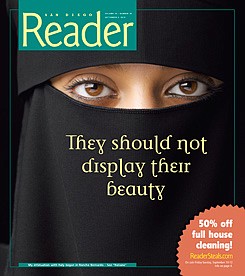
Over the phone, Maureen Slater sounds like a soccer mom. She uses words like “jammies” instead of pajamas and laughs at her own jokes (“I’m smarter than my husband, ha-ha-ha”), some of which aren’t really jokes (“but seriously, he’d tell you the same thing”). She lifts weights two or three times per week on a home gym set up on the patio of her Paradise Hills home. Her hands are large and strong-looking, the nails cut to the quick, and she wears one thin band of diamonds at the first knuckle of her index finger. But few people will ever see her hands.
The most the general public will see of Maureen is the amber brown of her eyes and the smudge of liner she wears beneath her lower lashes. The rest remains covered — hands, feet, face, hair, all of her — when she shops for groceries, picks up her children from school, travels to and from work, or during any of her other daily activities outside the home.
Typically, Maureen wears a black, ankle-length, robelike covering called an abaya (in conversation, she refers to it as a “coat”), a black hijab (which covers her head and hair, her shoulders, and everything else down to her knees), and a niqab (a veil) over her face, leaving only a slit for her eyes. On her hands, she wears black gloves, and on her feet, a pair of cowboy boots or Doc Martens.
At our first meeting, however, Maureen is between hospice patients, and so she’s “dressed down” in a white knee-length tunic and matching pants, a bright-green scarf covering her head and hair, and a black veil covering her face. Her hands are bare, exposing the ring, the short nails, and her white skin. She leans forward, into my personal space, firmly grasps my hand in hers, and shakes.
Hidden though she is in what she calls her “private little room,” Maureen is candid and outspoken, the antithesis of what many assume of Muslim women, whether they choose to wear a face veil or not.
The 46-year-old mother of five converted to Islam from Catholicism 27 years ago — under her own conditions. “I was still going to wear makeup and wear bikinis and go to the beach and have a beer occasionally,” she says.
By the time she converted, she’d been married to her Egyptian Muslim husband for six months. He agreed to her conditions, saying that once she took the Shahada (the oath declaring belief in the oneness of Allah and the acceptance of Muhammad as God’s prophet), he trusted God to guide her if it was His will that she conduct herself differently.
Every step she’s since taken, graduating over the years from the masar (which covers the hair but leaves the neck exposed) to the hijab, and, finally, to the niqab (each step covering more of herself in public), has been her own choice. Although she’d once sworn she would “never, ever” wear the niqab, Maureen says the first time she wore one out in public “was like being on the computer and doing some work at home while you’re in your jammies.”
∗ ∗ ∗
“Say to the believing women that they should lower their gaze and guard their modesty; that they should not display their beauty and ornaments except what must ordinarily appear thereof.” (Qur’an 24.31)
Some Islamic scholars teach that the face veil is mandatory, while others believe that a woman covering even her hair is a personal choice, but all agree that modesty is an important part of the Islamic faith.
On the website IslamForToday.com, Syed Rahman published an article titled “Seven Conditions for Women’s Dress in Islam.” Women’s clothing, he writes, must cover everything but the hands and the face; the material must not be transparent; it must hang loose to hide the shape of the wearer; the design must not resemble men’s clothing or that of nonbelieving women; it must not consist of bold designs; and it should not be worn for the sole purpose of increasing one’s status or reputation.
My friend Ifrah explains Rahman’s “Seven Conditions” in her own words.
“You should wear something that’s not form-fitting and something that covers you up, so that when somebody looks at you, they can’t talk about your body shape or your beauty or what you lack or don’t lack.” The purpose, she says, “is for a woman to be judged on her abilities, her knowledge, her education, and her mind, not for how sexy she looks.”
To dress as such is to observe hijab. Not every Muslim woman interprets this modesty in the same way. In City Heights (home to many Muslims), some women wear black, brown, or dark-green solids, their long, shapeless head-to-toe coverings reminiscent of a nun’s habit. Others wear bright colors and patterns, kitten heels visible beneath their long skirts, topped off with gauzy scarves and giant, trendy sunglasses, all of it giving them a look somewhere between Erykah Badu and Audrey Hepburn.
For those born into Islam, most begin with a small, child-sized hijab between the ages of five and nine.
Dumb Questions, Mean Friends, and Transformers
A Tuesday morning in June, less than a week left to go in the school year. A fourth-grade classroom at Oak Park Elementary buzzes with a restlessness not typical of independent reading time. Whispers rise to a hum, and the teacher calls out from the back of the classroom, “I like the way Amal is reading quietly.”
Amal, a creamy brown-skinned girl in a black-and-gray hijab set with silver sequins, smiles behind her book. The rest of the class quiets down. When the teacher turns her attention to the reading group she is facilitating at the back of the class, Amal and the girl whose desk faces hers begin to kick each other under the table and giggle quietly behind the books still propped up in front of them.
Ten minutes later, the children line up for recess. Outside, some run to jump rope or to join four-square games already in progress. Amal and several other girls crowd around the backpacks, where one classmate is passing out Flamin’ Hot Cheetos.
A handful of other girls in hijab and jeans or hijab and long skirts dot the playground, some laughing out loud, some whispering quietly among friends. They are free. It’s recess time.
∗ ∗ ∗
The five teenage girls gathered around the oval table in a conference room at Hoover High represent a range of Muslimah (female Muslim) styles. Habiba (the only one of the five who chooses not to reveal her real name) wears a lavender masar, a black long-sleeved shirt, and a full lavender skirt. She says there’s no real reason her scarf isn’t tucked under her chin like Safiya’s across the table, except that, without a pin to hold in place, it’s annoying to keep tucking and retucking it all day long.
The sleeves of Safiyah’s brown (and slightly snug) button-up top reach only to her elbows. By most standards, she’s covered and clearly modest, but when I ask if her bare forearms are considered risqué, she grins with embarrassment and pulls at the sleeves, as if to will them longer. Only Hanifo, the quiet freshman in the dusky-blue waist-length hijab and the pale-blue skirt, would likely meet with the full approval of her mother.
“We have to cover our neck, our arms, everything from head to toe,” says Amina. “No skin.”
Amina is the one girl in the room whose head is not covered. She’s the dramatic type, dominating most of the conversation with stories about her sisters and various cousins and occasional attempts to one-up Safiya’s clear intellectualism with confusing explanations of the hows and whys of Islam for girls. Though she claims to love answering the questions of strangers about why Muslim women wear hijab, she struggles with that answer here and now.
“I don’t know how to explain it,” she says after a fumbled attempt at clarity. “It’s because of my religion.” This confusion might explain why so much of what she says she’s “supposed” to do is exactly the opposite of what she’s doing now.
“I’m not supposed to dress like this,” she says, indicating the plaid shirt with the top button secured just above her cleavage and the almost form-fitting, long, satiny skirt. “I’m supposed to wear clothes that don’t show my body shape. Because of the guys. So I don’t get the guys’ attention. That’s what we believe.”
Later, she remembers a play she saw at San Diego State University where a woman made the point that covering one’s head is not mandatory for Muslim women.
“She said it’s a choice,” Amina says incredulously. “But I believe it’s a ‘have-to’ even though I’m not wearing it.”
Safiya agrees. “It is a ‘have-to.’”
“Yeah,” says Habiba at the same time that Fadumo says, “It is.”
Although these girls believe that covering their hair is mandatory, each of the five remembers making the decision to wear the hijab on their own. Habiba wanted to wear one because her friends at Birney Elementary did. Fadumo said she was envious that her big sister wore one, so she asked her mother to buy her one too.
Safiya says she was proud to wear hers “because it’s part of who I am.” The only problem she had with other children at school was once when two girls ganged up on her, and one told the other to pull off Safiyah’s hijab. Neither girl dared to.
Amina pipes in, “When I was seven years old, people used to say, ‘Why do you have that?’ They used to question me. They’d say, ‘Take that towel off your head’ and stuff like that.”
The girls agree that despite a minor incident or insult here and there, kids in elementary school were mostly curious. In middle school, however, they became cruel.
“Middle-schoolers are the worst,” says Safiya.
“Ignorant,” says Habiba.
“Middle school was definitely the hardest,” confirms Fadumo.
The worst of it, they say, was the daily questions they had to answer, such as “Do you wear that in the shower?” and “Is that a tablecloth on your head?” Insults disguised as ignorance.
And then there was “Aren’t you hot?” mocks Safiya.
Every one of them groans. Two roll their eyes.
“It’s super thin,” says Habiba, clearly over the whole thing. Duh.
I don’t tell them that nearly every non-Muslim I’ve spoken to about hijab has wondered the same thing.
High-schoolers “don’t ask dumb questions,” says Amina. “They’re way more mature.”
Not always, though. During freshman year, a friend pulled off Fadumo’s hijab in the middle of class, in front of a bunch of boys.
“They were, like, ‘Can I see your hair?’ and I was, like, ‘No, you can’t see it. It’s against my religion to show you my hair.’ And there were a lot of guys in the class,” Fadumo says. “I was, like, ‘I can’t show you my hair,’ so she came behind my back and she pulled [my hijab] off.”
The rest of the girls give their full attention to this story, and when Fadumo stops there, Amina asks, “What did you do?”
“I didn’t do nothing because she was my friend.”
The teacher called Fadumo out of the class and said she could have the girl suspended. Fadumo said not to worry about it and accepted an apology from the friend instead.
Somewhere in the middle of our discussion, Fadumo and Habiba begin a side conversation about celebrities who are rumored to have converted to Islam. Chris Tucker’s name comes up. Former bad-boy rapper Loon is mentioned as well.
And this takes us off into a new direction. From this point on, they don’t care so much for my questions about hijab. There are more pressing matters at hand, such as why it’s supposed to be a sin to talk or text with a member of the opposite sex. None of these girls like the idea of arranged marriage, and they can’t comprehend how they’re supposed to fall in love when they can’t even get to know someone first.
They break down some of the rules they’re supposed to follow: no sex before marriage and no alcohol; no nail polish unless you have your period because you can’t pray then anyway; no perfume, at least not so much that boys will be attracted to you; no holding a grudge for more than three days.
And then there’s the issue of music. A big one, they all agree. They’re not supposed to listen to it. But they do, and it’s a major point of contention between most teenagers and their parents. Fadumo’s mother puts a guilt trip on Fadumo, asking why she doesn’t use her brainpower to memorize the Qur’an rather than to memorize the lyrics to that darn music.
“Our generation,” says Amina, “nowadays…like…our age group…people that I know and stuff, they play with the religion.”
Some girls, she says, post pictures of themselves on the internet fully covered one day, and the next day, they’re wearing “booty shorts to parties.” Other girls leave their houses fully covered and then change into, say, pants in the bathroom at school.
“I think they’re just trying to fit in,” Safiya says.
“We call them ‘undercovers’ or ‘transformers,’” says Amina.
The girls shake their heads at the thought of such antics. Amina in particular scoffs at the idea that she’d ever be a “transformer.” Her parents know she’s wearing her hair out today. It’s a special occasion, she says, and she’s going out to eat with her sisters after school. Otherwise, she’d be covered, just like every other day. Last year, she wore her hair out almost every day. This year, she’s working on “being a better Muslim.”
Special occasion or no, Amina says she believes that she’s sinning by not covering her hair. So why not cover it today?
“I don’t know,” she says, appearing to contemplate the question seriously. “I don’t know.”
A few minutes later, she admits that while she knows observing hijab is supposed to protect women from the eyes of men, it doesn’t always do the trick. “Everywhere you go, guys are still going to pay attention,” she says.
They’re teenage girls. Isn’t there some part of them that wants to be noticed?
“No.” Habiba sneers, as if the question itself is appalling.
Safiya’s face tells a similar story.
“But if it happens, that’s what’s up,” Amina says with a laugh. The others laugh too.
“We actually do [want to be noticed],” admits Fadumo. “But we can’t date.”
Eventually, Safiya brings it all back home to the reasons why they abstain from so many things. “God is very giving,” she says. “And if you do everything God tells you to do right now, you’re gonna go to Heaven. And in Heaven, you get to listen to music if you want to. You get to taste the best beer and alcohol. You know? If you follow Him, He’ll reward you with more things and better things. That’s why we have to try our best to be a better Muslim.”
I’d Like to Believe They’re Staring at My Car
According to Maureen, who has three daughters of her own, Amina’s to-hijab-or-not-to-hijab struggle is no different than that of a Catholic teenager who doesn’t want to go to church anymore. She shares this with Ifrah and me over coffee at Cutters Point, a coffeehouse near the corner of College and El Cajon Boulevard.
“Even though we raise our children Muslim, they go through a type of conversion themselves. I think everyone goes through a period where they decide how religious they’re going to be.”
Maureen recently came to this understanding when her 21-year-old daughter decided to stop wearing the hijab. The most devastating part of the experience, Maureen says, are the judgments made by the other Muslims.
“I may just have to let her live like everyone else. There may be this sense of deprivation or something she feels deprived of, and I’m hoping she’s going to find out it’s really not what this is about.”
Ifrah says one of her sisters went through a similar experience.
“The hijab she wore just kept getting shorter and shorter and smaller and smaller until she didn’t want it anymore. She bought the tightest clothing, and it was just peer pressure.”
Today, Ifrah’s sister observes hijab once again.
“I think I did a pretty good job raising my kids,” says Maureen. “I never wanted to raise them with ‘Here’s a list of things to do and don’t do.’ Some people say ‘halal, haram, halal, haram,’ which means ‘lawful, prohibited, lawful, prohibited.’ [But] there’s so much gray.”
In contrast to Maureen’s oldest daughter, her 17-year-old feels empowered in her hijab and isn’t afraid of anything. On the other hand, her 12-year-old, the youngest, has started to become annoyed with people staring at her family.
“I drive a 1971 Volkswagen Beetle, a really cute bug,” says Maureen, “so when we’re driving and people stare, I always tell my kids they’re staring at my car. My kids say, ‘Mom, they’re staring at you,’ And I say, ‘I’d like to believe they’re staring at my car.’”
A positive attitude, she says, projects confidence and keeps hostility at bay. To assist others in that positivity, she introduces herself everywhere she goes. Indeed, when I went up to the counter at Cutters Point, the barista asked me, “How do you know Maureen?”
“I never, ever get harassed,” Maureen says.
Oh, yeah, except for that one time a guy tried to run her off the road. Even then, it took her a few minutes to realize what was happening.
“Even as he was inching me off the road, I thought, ‘Oh my God, that guy is on the phone or he’s distracted.’ Then, as I moved over one lane to let him go, he turned around and flipped me off. And I was, like, ‘Oh, he was being mean.’”
Although Maureen removes her face veil at work, she does it because her hospice patients are dying and she doesn’t want to come off like “the grim reaper” in their last days — not because her employer insists. Every now and again, when a family member calls to complain about the nurse with the head scarf, her case manager at Avalon Hospice tells them Maureen is the best of the best. If they come right out and say that it’s the head scarf that makes them uncomfortable, the case manager will arrange for another nurse. This is a decision Maureen supports.
“It wouldn’t make sense to send a black CNA to a Ku Klux Klan family, would it?”
Though Ifrah doesn’t wear the niqab, eight or nine years ago she transitioned from wearing what she calls “a rainbow of hijab colors” to all-black. She, too, says she lives a life free from harassment and insults and that there’s no place in San Diego she won’t go.
I believe it when Ifrah tells me she feels comfortable wherever she goes, but I also question whether she is a reliable witness, especially after she tells me a story about driving around with a friend who kept pointing out that people were staring or shooting hostile glances their way. Ifrah says she didn’t notice anyone staring that day, or any other day, for that matter. It never occurs to her that people would stare because she’s been in San Diego, hijab and all, for 18 years, and she says, “I feel like I belong here.”
This is the first of two reasons I decide to spend a day in hijab. I’ll have to see for myself.
The second reason I want to wear hijab is that, one day, over coffee and bagels at Nate’s on Euclid Avenue, Ifrah lifted the hem of her black abaya, showing me that beneath it she wore a pair of purple pants. She also told me she shops at Victoria’s Secret and that, beneath her black, nunlike garments, she wears matching bra and panty sets.
In this case, Victoria really does have a secret. And I want one, too.
Victoria Has a Muffin Top
The experience is neither as traumatic nor as fun as I’d imagined. Instead, it turns out to be nothing more than a regular day peppered with tiny revelations and minor irritations.
On the Thursday Ifrah and I have chosen for this adventure, I wear a neither too-tight nor low-cut tank top and a lightweight, long-sleeved cardigan (in case my forearms show) and a pair of jeans rolled halfway up my calves. (A happy medium between the shorts I fear might be offensive to the shop owners who will provide my hijab and the long pants that would roast me on this 85-degree day; I own no floor-length skirts or dresses.) For fun and a bit of sass, I go with my zebra-print, peep-toe flats.
Ifrah meets me at the northeast corner of University and Winona. She guides me across the street, east a half block, and into a store called Home and Fashion for Less. My plan is to get in and out. All I need is a plain black abaya and hijab, something to cover my clothes and get on with the day. But when I see the racks of leopard-print and floral skirts, and the array of colored and printed dirac hanging along the wall, my desire to be cute overrides the simplicity of the task at hand. Ifrah encourages me to try on several items until I find something I’m comfortable with. I dig the Erykah-meets-Audrey look, but that’s the kind of thing you have to get just right. I don’t want Ifrah to sense the depth of my vanity, so I settle for an ultra-lightweight burgundy-colored bati covered in a pale-gold print. The white hijab I choose is set with small silver sequins and a copper design that resembles abstract dragonflies.
The shopkeeper hands me a mirror, and I’m baffled by the sight of my face poking out of the hijab. It looks as if it belongs to someone else. Is it really only familiar when framed by hair and a collarbone? To be all face is disconcerting. When we step outside, I’m self-conscious. But not about my body. In fact, I realize right away I can stop holding in my stomach. Aha! Victoria’s first secret: she has a muffin top.
Our plan is to run errands. I need a potty-training book for my daughter, and Ifrah is open to anything, so we head first for Borders in Mission Valley. In the car along the way, we become so involved in our mother-chat (about, yes, potty training) that I forget to look for snarky types in the cars alongside us. All I can say is that no one tries to run us off the road — that much I notice.
At the bookstore, nothing of note happens. Unless you count the woman who took time away from reading with her young daughter to help me find the potty-training shelf in the children’s section. Or the little girl who stares and stares and stares while we wait in line to make our purchases.
Actually, the not staring is more noteworthy. Every time I happen to catch someone’s eye, they quickly look away. It’s the I’m-not-staring-at-you game, and I only recognize it because, when I’m not the one wearing hijab, I do the same thing.
Minor irritations one, two, and three: the hijab’s seams meet just under my chin, and it itches like hell; the bati is too long and threatens to trip me with every step I take; and although I can feel my clothes blowing lightly, I can’t feel the breeze that moves them.
(No, I’m not hot. But this phantom breeze makes me phantom hot.)
Tiny revelation: strangely enough, I feel invisible.
Each time we get in and out of the car, I become aware of a fleeting hope that someone will catch a glimpse of my rolled-up jeans and experience a flicker of curiosity about who I am underneath all this cloth. At DSW Shoe Warehouse I try on sexy, expensive shoes and steal glances at other shoppers, wondering if any of their dinner-table conversations tonight will begin with “Honey, I saw a Muslim woman trying on a pair of stilettos today. Are they allowed to wear those?”
Another tiny revelation: I’m attached to the presentation of my corporal body.
Granted, I’m not the spring chicken I once was, but I am fighting her disappearance to the death; that I still have a waist and some perk to my behind means more to me than I might have known without this little experiment. I don’t want to keep my still-decent curves to myself, and if I weren’t sure it would look ridiculous, I’d belt this bati.
We eat lunch in La Mesa. As Ifrah entertains me with tales of her travels to Kuwait and Dubai, the waiter seats a table of four women across from us. They are all white, older, maybe in their 50s, and one of them keeps staring. I pretend not to notice, but every time I glance in her direction, she’s looking. Although she doesn’t appear hostile, I think, Ah-ha! La Mesa is enemy territory.
Turns out, Ifrah is staring back (albeit less conspicuously), trying to figure out why the woman’s face is so familiar to her. Later she’ll remember that the woman is the receptionist at Ifrah’s gynecologist’s office.
Back in Little Mogadishu, at the halal market where we stop for goat meat and the other ingredients I’ll need to make a Somali recipe Ifrah has given me, we stand in line behind a woman who makes me wish I were wearing a more fashionable hijab. Something cuter. I don’t know what it is about her that raises my competitive female hackles, but it occurs to me that Ifrah, in all black, her face free of makeup save a hint of eyeliner, has done more than just hide the shape of her body. She’s also removed herself from the female-vs.-female size-up game that most of us don’t know, or won’t admit, we’re playing.
(Later, she’ll tell me that she’s not entirely removed from the game. Among the devout, it’s a competition of who is the most intellectual, most knowledgeable. And of women who wear the niqab, Ifrah states, “They’re much better than me.”)
Our uneventful day of errands completed, Ifrah invites me into her home — a small, tidy apartment on Winona Avenue. Once inside, she takes off her hijab and heats a pot of tea. As she microwaves a plate of sambusas (meat-filled pastries) and sets out a tiered tray of sweets, I try not to stare, but I’m amazed by how different she looks.
Her bare neck makes her face look so round and young. She wears a hot-pink-and-black plaid vest over a long-sleeved black shirt, and suddenly, her body has a shape. (Maureen will later tell me that I should not reveal anything specific about Ifrah’s shape or the length of her hair, and truthfully, the specifics seem less important than that she looks suddenly so bare, though still fully dressed.) When we first met, I found Ifrah intimidating and almost unapproachable, but now, sitting with me across a plateful of Somali sweets, she is all vulnerability and softness. It’s slightly terrifying to witness this transformation.
But I keep my cool.
I indulge in the goodies she has provided and pester her for another recipe so I can make these savory sambusas at home. After a while, she glances at the clock, and I realize I’ve nearly overstayed my welcome. I thank her for everything and drive home in my hijab.
On the way, I pass my stepson and his friend playing in a neighbor’s driveway. I honk and wave hello. They don’t recognize me. At home, when I walk in the door, my husband says, “Hubba hubba!”
The goat meat turns out all right.
Here's something you might be interested in.
San Diego women who have converted to Islam
They should not display their beauty

San Diego women who have converted to Islam
They should not display their beauty
Over the phone, Maureen Slater sounds like a soccer mom. She uses words like “jammies” instead of pajamas and laughs at her own jokes (“I’m smarter than my husband, ha-ha-ha”), some of which aren’t really jokes (“but seriously, he’d tell you the same thing”). She lifts weights two or three times per week on a home gym set up on the patio of her Paradise Hills home. Her hands are large and strong-looking, the nails cut to the quick, and she wears one thin band of diamonds at the first knuckle of her index finger. But few people will ever see her hands.
The most the general public will see of Maureen is the amber brown of her eyes and the smudge of liner she wears beneath her lower lashes. The rest remains covered — hands, feet, face, hair, all of her — when she shops for groceries, picks up her children from school, travels to and from work, or during any of her other daily activities outside the home.
Typically, Maureen wears a black, ankle-length, robelike covering called an abaya (in conversation, she refers to it as a “coat”), a black hijab (which covers her head and hair, her shoulders, and everything else down to her knees), and a niqab (a veil) over her face, leaving only a slit for her eyes. On her hands, she wears black gloves, and on her feet, a pair of cowboy boots or Doc Martens.
At our first meeting, however, Maureen is between hospice patients, and so she’s “dressed down” in a white knee-length tunic and matching pants, a bright-green scarf covering her head and hair, and a black veil covering her face. Her hands are bare, exposing the ring, the short nails, and her white skin. She leans forward, into my personal space, firmly grasps my hand in hers, and shakes.
Hidden though she is in what she calls her “private little room,” Maureen is candid and outspoken, the antithesis of what many assume of Muslim women, whether they choose to wear a face veil or not.
The 46-year-old mother of five converted to Islam from Catholicism 27 years ago — under her own conditions. “I was still going to wear makeup and wear bikinis and go to the beach and have a beer occasionally,” she says.
By the time she converted, she’d been married to her Egyptian Muslim husband for six months. He agreed to her conditions, saying that once she took the Shahada (the oath declaring belief in the oneness of Allah and the acceptance of Muhammad as God’s prophet), he trusted God to guide her if it was His will that she conduct herself differently.
Every step she’s since taken, graduating over the years from the masar (which covers the hair but leaves the neck exposed) to the hijab, and, finally, to the niqab (each step covering more of herself in public), has been her own choice. Although she’d once sworn she would “never, ever” wear the niqab, Maureen says the first time she wore one out in public “was like being on the computer and doing some work at home while you’re in your jammies.”
∗ ∗ ∗
“Say to the believing women that they should lower their gaze and guard their modesty; that they should not display their beauty and ornaments except what must ordinarily appear thereof.” (Qur’an 24.31)
Some Islamic scholars teach that the face veil is mandatory, while others believe that a woman covering even her hair is a personal choice, but all agree that modesty is an important part of the Islamic faith.
On the website IslamForToday.com, Syed Rahman published an article titled “Seven Conditions for Women’s Dress in Islam.” Women’s clothing, he writes, must cover everything but the hands and the face; the material must not be transparent; it must hang loose to hide the shape of the wearer; the design must not resemble men’s clothing or that of nonbelieving women; it must not consist of bold designs; and it should not be worn for the sole purpose of increasing one’s status or reputation.
My friend Ifrah explains Rahman’s “Seven Conditions” in her own words.
“You should wear something that’s not form-fitting and something that covers you up, so that when somebody looks at you, they can’t talk about your body shape or your beauty or what you lack or don’t lack.” The purpose, she says, “is for a woman to be judged on her abilities, her knowledge, her education, and her mind, not for how sexy she looks.”
To dress as such is to observe hijab. Not every Muslim woman interprets this modesty in the same way. In City Heights (home to many Muslims), some women wear black, brown, or dark-green solids, their long, shapeless head-to-toe coverings reminiscent of a nun’s habit. Others wear bright colors and patterns, kitten heels visible beneath their long skirts, topped off with gauzy scarves and giant, trendy sunglasses, all of it giving them a look somewhere between Erykah Badu and Audrey Hepburn.
For those born into Islam, most begin with a small, child-sized hijab between the ages of five and nine.
Dumb Questions, Mean Friends, and Transformers
A Tuesday morning in June, less than a week left to go in the school year. A fourth-grade classroom at Oak Park Elementary buzzes with a restlessness not typical of independent reading time. Whispers rise to a hum, and the teacher calls out from the back of the classroom, “I like the way Amal is reading quietly.”
Amal, a creamy brown-skinned girl in a black-and-gray hijab set with silver sequins, smiles behind her book. The rest of the class quiets down. When the teacher turns her attention to the reading group she is facilitating at the back of the class, Amal and the girl whose desk faces hers begin to kick each other under the table and giggle quietly behind the books still propped up in front of them.
Ten minutes later, the children line up for recess. Outside, some run to jump rope or to join four-square games already in progress. Amal and several other girls crowd around the backpacks, where one classmate is passing out Flamin’ Hot Cheetos.
A handful of other girls in hijab and jeans or hijab and long skirts dot the playground, some laughing out loud, some whispering quietly among friends. They are free. It’s recess time.
∗ ∗ ∗
The five teenage girls gathered around the oval table in a conference room at Hoover High represent a range of Muslimah (female Muslim) styles. Habiba (the only one of the five who chooses not to reveal her real name) wears a lavender masar, a black long-sleeved shirt, and a full lavender skirt. She says there’s no real reason her scarf isn’t tucked under her chin like Safiya’s across the table, except that, without a pin to hold in place, it’s annoying to keep tucking and retucking it all day long.
The sleeves of Safiyah’s brown (and slightly snug) button-up top reach only to her elbows. By most standards, she’s covered and clearly modest, but when I ask if her bare forearms are considered risqué, she grins with embarrassment and pulls at the sleeves, as if to will them longer. Only Hanifo, the quiet freshman in the dusky-blue waist-length hijab and the pale-blue skirt, would likely meet with the full approval of her mother.
“We have to cover our neck, our arms, everything from head to toe,” says Amina. “No skin.”
Amina is the one girl in the room whose head is not covered. She’s the dramatic type, dominating most of the conversation with stories about her sisters and various cousins and occasional attempts to one-up Safiya’s clear intellectualism with confusing explanations of the hows and whys of Islam for girls. Though she claims to love answering the questions of strangers about why Muslim women wear hijab, she struggles with that answer here and now.
“I don’t know how to explain it,” she says after a fumbled attempt at clarity. “It’s because of my religion.” This confusion might explain why so much of what she says she’s “supposed” to do is exactly the opposite of what she’s doing now.
“I’m not supposed to dress like this,” she says, indicating the plaid shirt with the top button secured just above her cleavage and the almost form-fitting, long, satiny skirt. “I’m supposed to wear clothes that don’t show my body shape. Because of the guys. So I don’t get the guys’ attention. That’s what we believe.”
Later, she remembers a play she saw at San Diego State University where a woman made the point that covering one’s head is not mandatory for Muslim women.
“She said it’s a choice,” Amina says incredulously. “But I believe it’s a ‘have-to’ even though I’m not wearing it.”
Safiya agrees. “It is a ‘have-to.’”
“Yeah,” says Habiba at the same time that Fadumo says, “It is.”
Although these girls believe that covering their hair is mandatory, each of the five remembers making the decision to wear the hijab on their own. Habiba wanted to wear one because her friends at Birney Elementary did. Fadumo said she was envious that her big sister wore one, so she asked her mother to buy her one too.
Safiya says she was proud to wear hers “because it’s part of who I am.” The only problem she had with other children at school was once when two girls ganged up on her, and one told the other to pull off Safiyah’s hijab. Neither girl dared to.
Amina pipes in, “When I was seven years old, people used to say, ‘Why do you have that?’ They used to question me. They’d say, ‘Take that towel off your head’ and stuff like that.”
The girls agree that despite a minor incident or insult here and there, kids in elementary school were mostly curious. In middle school, however, they became cruel.
“Middle-schoolers are the worst,” says Safiya.
“Ignorant,” says Habiba.
“Middle school was definitely the hardest,” confirms Fadumo.
The worst of it, they say, was the daily questions they had to answer, such as “Do you wear that in the shower?” and “Is that a tablecloth on your head?” Insults disguised as ignorance.
And then there was “Aren’t you hot?” mocks Safiya.
Every one of them groans. Two roll their eyes.
“It’s super thin,” says Habiba, clearly over the whole thing. Duh.
I don’t tell them that nearly every non-Muslim I’ve spoken to about hijab has wondered the same thing.
High-schoolers “don’t ask dumb questions,” says Amina. “They’re way more mature.”
Not always, though. During freshman year, a friend pulled off Fadumo’s hijab in the middle of class, in front of a bunch of boys.
“They were, like, ‘Can I see your hair?’ and I was, like, ‘No, you can’t see it. It’s against my religion to show you my hair.’ And there were a lot of guys in the class,” Fadumo says. “I was, like, ‘I can’t show you my hair,’ so she came behind my back and she pulled [my hijab] off.”
The rest of the girls give their full attention to this story, and when Fadumo stops there, Amina asks, “What did you do?”
“I didn’t do nothing because she was my friend.”
The teacher called Fadumo out of the class and said she could have the girl suspended. Fadumo said not to worry about it and accepted an apology from the friend instead.
Somewhere in the middle of our discussion, Fadumo and Habiba begin a side conversation about celebrities who are rumored to have converted to Islam. Chris Tucker’s name comes up. Former bad-boy rapper Loon is mentioned as well.
And this takes us off into a new direction. From this point on, they don’t care so much for my questions about hijab. There are more pressing matters at hand, such as why it’s supposed to be a sin to talk or text with a member of the opposite sex. None of these girls like the idea of arranged marriage, and they can’t comprehend how they’re supposed to fall in love when they can’t even get to know someone first.
They break down some of the rules they’re supposed to follow: no sex before marriage and no alcohol; no nail polish unless you have your period because you can’t pray then anyway; no perfume, at least not so much that boys will be attracted to you; no holding a grudge for more than three days.
And then there’s the issue of music. A big one, they all agree. They’re not supposed to listen to it. But they do, and it’s a major point of contention between most teenagers and their parents. Fadumo’s mother puts a guilt trip on Fadumo, asking why she doesn’t use her brainpower to memorize the Qur’an rather than to memorize the lyrics to that darn music.
“Our generation,” says Amina, “nowadays…like…our age group…people that I know and stuff, they play with the religion.”
Some girls, she says, post pictures of themselves on the internet fully covered one day, and the next day, they’re wearing “booty shorts to parties.” Other girls leave their houses fully covered and then change into, say, pants in the bathroom at school.
“I think they’re just trying to fit in,” Safiya says.
“We call them ‘undercovers’ or ‘transformers,’” says Amina.
The girls shake their heads at the thought of such antics. Amina in particular scoffs at the idea that she’d ever be a “transformer.” Her parents know she’s wearing her hair out today. It’s a special occasion, she says, and she’s going out to eat with her sisters after school. Otherwise, she’d be covered, just like every other day. Last year, she wore her hair out almost every day. This year, she’s working on “being a better Muslim.”
Special occasion or no, Amina says she believes that she’s sinning by not covering her hair. So why not cover it today?
“I don’t know,” she says, appearing to contemplate the question seriously. “I don’t know.”
A few minutes later, she admits that while she knows observing hijab is supposed to protect women from the eyes of men, it doesn’t always do the trick. “Everywhere you go, guys are still going to pay attention,” she says.
They’re teenage girls. Isn’t there some part of them that wants to be noticed?
“No.” Habiba sneers, as if the question itself is appalling.
Safiya’s face tells a similar story.
“But if it happens, that’s what’s up,” Amina says with a laugh. The others laugh too.
“We actually do [want to be noticed],” admits Fadumo. “But we can’t date.”
Eventually, Safiya brings it all back home to the reasons why they abstain from so many things. “God is very giving,” she says. “And if you do everything God tells you to do right now, you’re gonna go to Heaven. And in Heaven, you get to listen to music if you want to. You get to taste the best beer and alcohol. You know? If you follow Him, He’ll reward you with more things and better things. That’s why we have to try our best to be a better Muslim.”
I’d Like to Believe They’re Staring at My Car
According to Maureen, who has three daughters of her own, Amina’s to-hijab-or-not-to-hijab struggle is no different than that of a Catholic teenager who doesn’t want to go to church anymore. She shares this with Ifrah and me over coffee at Cutters Point, a coffeehouse near the corner of College and El Cajon Boulevard.
“Even though we raise our children Muslim, they go through a type of conversion themselves. I think everyone goes through a period where they decide how religious they’re going to be.”
Maureen recently came to this understanding when her 21-year-old daughter decided to stop wearing the hijab. The most devastating part of the experience, Maureen says, are the judgments made by the other Muslims.
“I may just have to let her live like everyone else. There may be this sense of deprivation or something she feels deprived of, and I’m hoping she’s going to find out it’s really not what this is about.”
Ifrah says one of her sisters went through a similar experience.
“The hijab she wore just kept getting shorter and shorter and smaller and smaller until she didn’t want it anymore. She bought the tightest clothing, and it was just peer pressure.”
Today, Ifrah’s sister observes hijab once again.
“I think I did a pretty good job raising my kids,” says Maureen. “I never wanted to raise them with ‘Here’s a list of things to do and don’t do.’ Some people say ‘halal, haram, halal, haram,’ which means ‘lawful, prohibited, lawful, prohibited.’ [But] there’s so much gray.”
In contrast to Maureen’s oldest daughter, her 17-year-old feels empowered in her hijab and isn’t afraid of anything. On the other hand, her 12-year-old, the youngest, has started to become annoyed with people staring at her family.
“I drive a 1971 Volkswagen Beetle, a really cute bug,” says Maureen, “so when we’re driving and people stare, I always tell my kids they’re staring at my car. My kids say, ‘Mom, they’re staring at you,’ And I say, ‘I’d like to believe they’re staring at my car.’”
A positive attitude, she says, projects confidence and keeps hostility at bay. To assist others in that positivity, she introduces herself everywhere she goes. Indeed, when I went up to the counter at Cutters Point, the barista asked me, “How do you know Maureen?”
“I never, ever get harassed,” Maureen says.
Oh, yeah, except for that one time a guy tried to run her off the road. Even then, it took her a few minutes to realize what was happening.
“Even as he was inching me off the road, I thought, ‘Oh my God, that guy is on the phone or he’s distracted.’ Then, as I moved over one lane to let him go, he turned around and flipped me off. And I was, like, ‘Oh, he was being mean.’”
Although Maureen removes her face veil at work, she does it because her hospice patients are dying and she doesn’t want to come off like “the grim reaper” in their last days — not because her employer insists. Every now and again, when a family member calls to complain about the nurse with the head scarf, her case manager at Avalon Hospice tells them Maureen is the best of the best. If they come right out and say that it’s the head scarf that makes them uncomfortable, the case manager will arrange for another nurse. This is a decision Maureen supports.
“It wouldn’t make sense to send a black CNA to a Ku Klux Klan family, would it?”
Though Ifrah doesn’t wear the niqab, eight or nine years ago she transitioned from wearing what she calls “a rainbow of hijab colors” to all-black. She, too, says she lives a life free from harassment and insults and that there’s no place in San Diego she won’t go.
I believe it when Ifrah tells me she feels comfortable wherever she goes, but I also question whether she is a reliable witness, especially after she tells me a story about driving around with a friend who kept pointing out that people were staring or shooting hostile glances their way. Ifrah says she didn’t notice anyone staring that day, or any other day, for that matter. It never occurs to her that people would stare because she’s been in San Diego, hijab and all, for 18 years, and she says, “I feel like I belong here.”
This is the first of two reasons I decide to spend a day in hijab. I’ll have to see for myself.
The second reason I want to wear hijab is that, one day, over coffee and bagels at Nate’s on Euclid Avenue, Ifrah lifted the hem of her black abaya, showing me that beneath it she wore a pair of purple pants. She also told me she shops at Victoria’s Secret and that, beneath her black, nunlike garments, she wears matching bra and panty sets.
In this case, Victoria really does have a secret. And I want one, too.
Victoria Has a Muffin Top
The experience is neither as traumatic nor as fun as I’d imagined. Instead, it turns out to be nothing more than a regular day peppered with tiny revelations and minor irritations.
On the Thursday Ifrah and I have chosen for this adventure, I wear a neither too-tight nor low-cut tank top and a lightweight, long-sleeved cardigan (in case my forearms show) and a pair of jeans rolled halfway up my calves. (A happy medium between the shorts I fear might be offensive to the shop owners who will provide my hijab and the long pants that would roast me on this 85-degree day; I own no floor-length skirts or dresses.) For fun and a bit of sass, I go with my zebra-print, peep-toe flats.
Ifrah meets me at the northeast corner of University and Winona. She guides me across the street, east a half block, and into a store called Home and Fashion for Less. My plan is to get in and out. All I need is a plain black abaya and hijab, something to cover my clothes and get on with the day. But when I see the racks of leopard-print and floral skirts, and the array of colored and printed dirac hanging along the wall, my desire to be cute overrides the simplicity of the task at hand. Ifrah encourages me to try on several items until I find something I’m comfortable with. I dig the Erykah-meets-Audrey look, but that’s the kind of thing you have to get just right. I don’t want Ifrah to sense the depth of my vanity, so I settle for an ultra-lightweight burgundy-colored bati covered in a pale-gold print. The white hijab I choose is set with small silver sequins and a copper design that resembles abstract dragonflies.
The shopkeeper hands me a mirror, and I’m baffled by the sight of my face poking out of the hijab. It looks as if it belongs to someone else. Is it really only familiar when framed by hair and a collarbone? To be all face is disconcerting. When we step outside, I’m self-conscious. But not about my body. In fact, I realize right away I can stop holding in my stomach. Aha! Victoria’s first secret: she has a muffin top.
Our plan is to run errands. I need a potty-training book for my daughter, and Ifrah is open to anything, so we head first for Borders in Mission Valley. In the car along the way, we become so involved in our mother-chat (about, yes, potty training) that I forget to look for snarky types in the cars alongside us. All I can say is that no one tries to run us off the road — that much I notice.
At the bookstore, nothing of note happens. Unless you count the woman who took time away from reading with her young daughter to help me find the potty-training shelf in the children’s section. Or the little girl who stares and stares and stares while we wait in line to make our purchases.
Actually, the not staring is more noteworthy. Every time I happen to catch someone’s eye, they quickly look away. It’s the I’m-not-staring-at-you game, and I only recognize it because, when I’m not the one wearing hijab, I do the same thing.
Minor irritations one, two, and three: the hijab’s seams meet just under my chin, and it itches like hell; the bati is too long and threatens to trip me with every step I take; and although I can feel my clothes blowing lightly, I can’t feel the breeze that moves them.
(No, I’m not hot. But this phantom breeze makes me phantom hot.)
Tiny revelation: strangely enough, I feel invisible.
Each time we get in and out of the car, I become aware of a fleeting hope that someone will catch a glimpse of my rolled-up jeans and experience a flicker of curiosity about who I am underneath all this cloth. At DSW Shoe Warehouse I try on sexy, expensive shoes and steal glances at other shoppers, wondering if any of their dinner-table conversations tonight will begin with “Honey, I saw a Muslim woman trying on a pair of stilettos today. Are they allowed to wear those?”
Another tiny revelation: I’m attached to the presentation of my corporal body.
Granted, I’m not the spring chicken I once was, but I am fighting her disappearance to the death; that I still have a waist and some perk to my behind means more to me than I might have known without this little experiment. I don’t want to keep my still-decent curves to myself, and if I weren’t sure it would look ridiculous, I’d belt this bati.
We eat lunch in La Mesa. As Ifrah entertains me with tales of her travels to Kuwait and Dubai, the waiter seats a table of four women across from us. They are all white, older, maybe in their 50s, and one of them keeps staring. I pretend not to notice, but every time I glance in her direction, she’s looking. Although she doesn’t appear hostile, I think, Ah-ha! La Mesa is enemy territory.
Turns out, Ifrah is staring back (albeit less conspicuously), trying to figure out why the woman’s face is so familiar to her. Later she’ll remember that the woman is the receptionist at Ifrah’s gynecologist’s office.
Back in Little Mogadishu, at the halal market where we stop for goat meat and the other ingredients I’ll need to make a Somali recipe Ifrah has given me, we stand in line behind a woman who makes me wish I were wearing a more fashionable hijab. Something cuter. I don’t know what it is about her that raises my competitive female hackles, but it occurs to me that Ifrah, in all black, her face free of makeup save a hint of eyeliner, has done more than just hide the shape of her body. She’s also removed herself from the female-vs.-female size-up game that most of us don’t know, or won’t admit, we’re playing.
(Later, she’ll tell me that she’s not entirely removed from the game. Among the devout, it’s a competition of who is the most intellectual, most knowledgeable. And of women who wear the niqab, Ifrah states, “They’re much better than me.”)
Our uneventful day of errands completed, Ifrah invites me into her home — a small, tidy apartment on Winona Avenue. Once inside, she takes off her hijab and heats a pot of tea. As she microwaves a plate of sambusas (meat-filled pastries) and sets out a tiered tray of sweets, I try not to stare, but I’m amazed by how different she looks.
Her bare neck makes her face look so round and young. She wears a hot-pink-and-black plaid vest over a long-sleeved black shirt, and suddenly, her body has a shape. (Maureen will later tell me that I should not reveal anything specific about Ifrah’s shape or the length of her hair, and truthfully, the specifics seem less important than that she looks suddenly so bare, though still fully dressed.) When we first met, I found Ifrah intimidating and almost unapproachable, but now, sitting with me across a plateful of Somali sweets, she is all vulnerability and softness. It’s slightly terrifying to witness this transformation.
But I keep my cool.
I indulge in the goodies she has provided and pester her for another recipe so I can make these savory sambusas at home. After a while, she glances at the clock, and I realize I’ve nearly overstayed my welcome. I thank her for everything and drive home in my hijab.
On the way, I pass my stepson and his friend playing in a neighbor’s driveway. I honk and wave hello. They don’t recognize me. At home, when I walk in the door, my husband says, “Hubba hubba!”
The goat meat turns out all right.
CommentsGoldElements
This comment was removed by the site staff for violation of the usage agreement.
Oct. 1, 2018
abcassignmenthelp
This comment was removed by the site staff for violation of the usage agreement.
Oct. 2, 2018