

Here's something you might be interested in.
Ask a Hipster — Advice you didn't know you needed
Big Screen — Movie commentary
Blurt — Music's inside track
Booze News — San Diego spirits
Classical Music — Immortal beauty
Classifieds — Free and easy
Cover Stories — Front-page features
Drinks All Around — Bartenders' drink recipes
Excerpts — Literary and spiritual excerpts
Feast! — Food & drink reviews
Feature Stories — Local news & stories
Fishing Report — What’s getting hooked from ship and shore
From the Archives — Spotlight on the past
Golden Dreams — Talk of the town
The Gonzo Report — Making the musical scene, or at least reporting from it
Letters — Our inbox
Movies@Home — Local movie buffs share favorites
Movie Reviews — Our critics' picks and pans
Musician Interviews — Up close with local artists
Neighborhood News from Stringers — Hyperlocal news
News Ticker — News & politics
Obermeyer — San Diego politics illustrated
Outdoors — Weekly changes in flora and fauna
Overheard in San Diego — Eavesdropping illustrated
Poetry — The old and the new
Reader Travel — Travel section built by travelers
Reading — The hunt for intellectuals
Roam-O-Rama — SoCal's best hiking/biking trails
San Diego Beer — Inside San Diego suds
SD on the QT — Almost factual news
Sheep and Goats — Places of worship
Special Issues — The best of
Street Style — San Diego streets have style
Surf Diego — Real stories from those braving the waves
Theater — On stage in San Diego this week
Tin Fork — Silver spoon alternative
Under the Radar — Matt Potter's undercover work
Unforgettable — Long-ago San Diego
Unreal Estate — San Diego's priciest pads
Your Week — Daily event picks
San Diego's harpists and those who help them
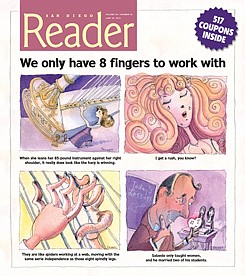
We only have eight fingers to work with
81 pounds of wood and steel
Valentine’s Day, 2010: Strolling through the outer edges of downtown before heading home for the evening. Passing Salvatore’s Cucina Italiana at the corner of Front and G and glancing through the plate-glass walls at the couples dotting the creamy-dreamy interior and paying homage to romance through fine dining. And just inside the door — of course: a harp, grand and gilt, plucked and strummed by a smiling woman as she sets the mood. Just part of what’s included with your $65 or $95 prix fixe. As Julie Ann Smith, principal harpist for the San Diego Symphony, puts it, “When people hear the harp, they’re, like, ‘Ahhh — the harp.’ It just relaxes people.”
Or, to cite a slightly more ancient source (the Book of Samuel in the Old Testament): “And it came to pass, when the evil spirit from God was upon Saul, that David took the harp and played with his hand; and Saul was refreshed and was well, and the evil spirit departed from him.”
February 27, 2010: A wood-paneled acoustic shield juts out from above the stage at Copley Symphony Hall, the better to carry sound into the grand and filigreed theater beyond. The visual effect of the smooth, undulating planes against all that frillery is striking (a person might even be tempted to use “jarring,” except, well, carrying sound is the point of things in here, and “striking” strives to make a virtue of the necessity).
More striking still is that the same contrast can be seen in the two harps that occupy the stage. Both are from the Chicago-based harp maker Lyon & Healy, and neither is gilt, but wow, are they different. The harp in back, where harps usually stand, is the Style 23 Concert Grand: 75 inches high, nearly 40 inches wide, 81 pounds of wood and steel mechanics built to manage 47 strings of gut, nylon, and wound steel and silk. The Style 23 dates back to 1890, and it looks it: floral carving graces the harp’s crown, column, base, and feet. The look is classic, expected. This is a harp.
Pedal to the medal
But the harp up front, sitting alone on a platform beside the conductor’s podium, the one bathed in the soloist’s spotlight — that harp is a Salzedo, named for the 20th-Century peformer-composer-teacher who helped with its design. (More on him later, promise.) It’s heavier and a touch wider than the Style 23, but the main thing about it is that, besides the swooping arm across the top, there’s hardly a curved line on the thing. It’s all Art Deco angles and layers: a bold and severe Harp for the Modern Age, which is maybe not a thing you ever supposed might exist.
Here’s the funny part: this modern version might actually be more up front about what the harp is: a complicated machine for making music. Seven metal pedals sprout from the instrument’s base. Each pedal may be set to one of three positions, sort of like the shift on a car with automatic transmission. The pedals move rods that run up through the column; the rods move linked metal plates that run through the arm; the plates move one of two double-pronged disks that surround the harp’s strings. When the pedal is in the top position, neither disk touches the string — that’s a flat. Move the pedal to the middle, and the upper disk presses its prongs against the string, shortening the length that will vibrate when plucked and so raising the tone — that’s a natural. Move the pedal to the bottom, and the lower disk comes into play, shortening the string still further — that’s a sharp.
Here’s Julie Ann Smith discussing the preparation of a specific piece — say, the Mozart Concerto for Harp and Flute in C Major, which she will be performing this evening. “I have to sit and study the music and the pedals while I’m away from the instrument, so that I don’t have to rely on muscle memory. In a modern piece, you better have every single pedal change memorized backwards and forwards — otherwise, it could be an interesting night. I think, with harp, that we have to do a lot more homework. You have to have a spatial awareness of the instrument before you can play it. With piano, you see the notes, and you press the notes. With the harp, it’s different. You have to see the music in your head, be thinking of where you are in the piece, what pedal comes next — ‘I have an F sharp, but then I need a G sharp there, and then I’m going to have an A sharp with a B flat.’ When you’re playing a solo, you’re supposed to be playing in the moment, but then you have to be thinking ahead as well.” In short, before your fingers even touch the strings, you have to ready the machine to yield the sound you need. “You have to create that pitch, and so you have to get your whole body in sync with your mind — it goes so fast.”
Smith knows from piano — she played both instruments clear through high school, one of those students who practices four hours a day and spends every Saturday driving to and from lessons in a city two and a half hours away, because that’s where the best teacher lives. Asked what she loved better about the harp, she replies, “It’s the fascination with how the instrument works, the mechanisms that go into it. When I physically play it, I get a rush, you know? The touch of the strings, the way I use my whole body to make it work.” A machine for making music, and she gets to become part of it.
That’s only a mild exaggeration. Smith is small; seeing her in street clothes, you might even think she was slight. It’s only when she strides out onstage in her sleeveless blue-and-purple dress, when you can see the definition and tone in her pale shoulders and arms, that “slight” ceases to fit. Still, when she sits down and opens her knees and leans her 85-pound instrument back against her right shoulder and sets the tips of her high-heeled shoes atop the pedals, it really does look as if the harp is winning. Then she plays.
Elbows up
Smith is a Salzedo harpist. This has no essential connection to the fact that she is playing a Salzedo harp — that she likes for its sonic richness, useful for a soloist looking to cut through a symphony’s hum. Rather, it means that she is a student of the Salzedo school, with a pedigree that traces right back to the man himself. She found her second teacher, Patrice Lockhart, when she attended a master class in Omaha given by Alice Chalifoux, principal harpist with the Cleveland Orchestra for over 40 years and student of Carlos Salzedo. (Chalifoux must have been something of a favorite. Smith notes that Salzedo “only taught women, and he married two of his students.” But he left management of the Salzedo Summer Harp Colony in Camden, Maine, to Chalifoux.) Chalifoux — old, cranky, terrifying — “tore me to pieces,” recalls Smith. But Lockhart was in the audience and saw something worth teaching in the tiny 12-year-old. “That summer, Patrice took me to Maine” — to Chalifoux’s Camden Colony. “I was really frustrated with the harp at that point, but she retrained my hands. I learned a new technique — the way my hands were shaped, the strength in my fingers, the way I could get a good tone out of the instrument.” Later, she attended the Cleveland Institute of Music so that she could study with Yolanda Kondonassis, another Salzedo student and Chalifoux’s successor at the Institute. “It just felt very connected,” says Smith.
And why should you care about Carlos Salzedo? Let’s hear from Kimberly Houser, harpist in residence at Louisiana State University, who wrote her doctoral dissertation on “Five Virtuoso Harpists as Composers: Contributions to the Technique and Literature of the Harp.” Says Houser, “I would say that 95 percent of harpists alive today can trace themselves back to a teacher in Paris named Alphonse Hasselmans. It was one of those moments where instrument and player came together. In the earlier part of the Romantic period, the double-action harp had been developed, but it was Hasselmans who adopted it as the instrument of choice for classical music. After that, the harp was finally taken seriously.”
After that, you could get a piece like Debussy’s La Mer (which, as it happens, is also on the program tonight). “He taught the next great generation. The list reads as icons: Lily Laskine, Marcel Tournier, Henriette Renié, Pierre Jamet, Marcel Grandjany, Carlos Salzedo…As performers, teachers, and composers, they created a world for this instrument, one that wouldn’t exist without them.” The harp, an instrument supposedly ancient enough to predate history, only made it into the classical club a couple of centuries ago, and someone like Smith is only four generations removed from the blessed event.
Houser herself studied with one teacher who had studied under Jamet and another who had studied under Renié. That puts her outside the two principal American camps: Salzedo, and the more characteristically French method espoused by Marcel Grandjany at Juilliard. “I looked at both sides as objectively as I could,” says Houser, who is quick to emphasize that they share “the same basic concepts” and are “not that different — it just depends on the player.”
She stresses the similarity because it’s the differences — put crudely, French warmth vs. Salzedan precision — that are famous and, until recently, hotly contested. (The years since the masters’ deaths have served to temper their disciples somewhat.) There is also the obvious difference in how things look. “The French school tends to be more contained, emphasizing minimal movement for maximum effect. The right arm is allowed to rest on the soundboard. But Salzedo developed a problem with his right hand, and detaching his hand from the soundboard was his way of dealing with the pain.” He taught his students to imitate him as a preventative measure. “He said, ‘I’m going to teach them not to have pain.’”
Enter unintended consequences. “Salzedo worked in a trio, and one day, he changed the position of the harp onstage. The audience got upset, because they had been buying tickets in order to see his hands.” Salzedo the performer had a revelation: a new way to highlight the harp’s visual appeal. He began working with a choreographer. “The system tends to focus on the theatrics of the gesture,” says Houser.
(Smith agrees. “Typically,” she explains, “you can recognize a Salzedo player because the elbows are up, the wrists are in, and the fingers are curved and really strong. When you have a curved finger, you have control over each part of it. You can control the sound of the string; you can play stronger. I just feel it’s more convincing playing.” More dramatic, too. “There is a lot of raising up of the hands away from the strings, creating visual matches for the sounds you hear. A lot of it has to do with relaxation, but it’s also to make the music visually appealing.”)
Along the way, his students transformed into disciples. “I’ve got to give it to him as an educator,” says Houser. “To incite the devotion he did was amazing. There was this worshipful approach, almost a religious belief in maintaining the tradition he set forth. And he was a very critical person, very critical of his students. So his students have gone out and been critical. There are great players on both sides,” she insists, but for a number of years, they weren’t on speaking terms.
“I’ve heard of relationships being cut off,” grants Smith. “You’re bonded with your teacher, and you kind of follow in the footsteps. Fortunately, over time, there has been more understanding. I feel like Yolanda, my teacher, has really been an advocate of opening the doors and trying to make it a good place for everybody. You find a technique that works for you.” And for Smith, Salzedo is that technique. Let’s make our way back to Copley Symphony Hall and see what that looks like.
A bird diving for prey
Demarre McGill, the flautist for the Mozart piece, joins Smith at the front of the stage. He is young and handsome and full of presence; the light clings to the velvet texture of his jacket. When he plays, he dips and swoons, as if the flute were brought to animated life by the thrill of music, with him merely following its happy gambols. (It’s a delight both to see and to hear; after the piece, the woman next to me says twice, “I’d come to see him again.”) Often, during his interplay with the harp, he leans in toward it, eyes peering through the strings at Smith while she plays.
Smith does not return his look. It wouldn’t be fair to say that she ignores him — their musical parts are too closely intertwined for that. But her focus is absolutely on the harp — less a tool than her first partner in this music-making effort. Her expression — concentration almost to the point of frowning — does not change; her head moves only to bob from side to side in rhythm with her fingers as they speed their way along the strings.
Those fingers, it turns out, will do all the expressing here. Sometimes, they are like spiders working at a web, moving with the same eerie independence as those eight spindly legs. Sometimes, they tumble down the strings, wrists turning her hands thumb-over-pinky. Sometimes, they are all thumbs, or rather, nothing but thumbs, two blunt digits battering the strings with alternating hammer-blows of percussive force. Again and again, her fingers pluck at and then float away from the strings with deceiving lightness, only to descend again and rest flat-palmed, stopping the sound short. The control and sweep brings to mind a bird diving for prey. And Smith is right: it all happens so fast.
Below, the brass pedals flash in the spotlight as she works them up and down. The pedals prepare the instrument’s pitch. Everything else is in the hands — volume, tone, length, shape. The symphony swells its harmonies and countermelodies, but all the while, the harp is busy making its own, descending into the realm of tonal color when the lower register is overcome by violins. Smith’s elbow is held straight out; the twitching muscles in her forearm cast trembling shadows under the spotlight. When she rests, her hand drops to her thigh, where her fingers drum and rub and gently clench.
The performance is a success. The audience stands to applaud, bouquets find their way into the soloists’ arms before they depart the stage, and the Salzedo harp is moved back to its usual place alongside the Style 23 in preparation for La Mer. But first, an intermission — time enough for the second harpist, Elena Mashkovtseva, to come out and give her instrument a final tuning.
My husband says I can’t fix things
“You always have to tune a harp,” observes JoAnn Dickinson Ford as we listen to Mashkovtseva test the sound of her strings against her tuner. Ford is in the audience tonight, but she played with the symphony from 1960 to 1972, back when they rehearsed nights and weekends and you could hold down a day job somewhere else. (She also served as president of the American Harp Society from 2004–2006.) “Orchestra conductors were always saying that if you tune an hour before a concert, by the time it’s time to play, you’re out of tune — because of all the people coming into the room. It can go out so easily.”
It’s just one of the many ways a harp can turn on you. Soundboards can warp from the 2000 pounds of pressure exerted by the 47 tightened strings. Even if the boards don’t crack, the shift will change the way the strings touch the disks, making tuning more difficult. And a string can break, of course, necessitating a trip into the guts of the soundboard to attach a new one. Sometimes, even the metal rods that run up the column can break, and when they do, things get complicated. “There are 2000 parts to a harp, and a lot of them moving,” says Ford. “I had a pedal rod break two days before a major recital. I could have used my teacher’s harp, but you get so used to your own. I had to drive up to Los Angeles to get [a replacement] rod. Then I had to take the harp apart, pull out the base, take the [pedal] springs off, put in the new rod, and put it all back together. And you still don’t know if it’s right until you’re doing those turns of the screw at the top. I was lucky — it was right. My husband teases me, saying that I can’t fix things, but I can fix my harp.”
So much potential for heartbreak, and for an instrument that gets few chances to shine in an ensemble — is it worth it? “You have to be dedicated to your instrument,” says Ford. The drive comes from within, often right from the get-go. “Most of the time, I think it’s kids, asking their parents to play.” Julie Ann Smith, for example, saw a guest harpist perform in the community orchestra of Hastings, Nebraska, where she lived. Once was enough; she fell in love. She was 9, with six years of piano already behind her, and she spent two years convincing her parents she was serious. “My uncle owns a riverboat on the Missouri River; he gives old-fashioned cruises. I would sit on the dock and play old-fashioned songs on a calliope to help bring people in, and I drew a picture of a harp on a gold tin can and set it down in front. That was pretty convincing for my parents. When I was 11, that same uncle found a harp listed in the Omaha World-Herald.”
A local story
Ford’s own story is more local; to hear it, I visit her in her Point Loma home, which is one of the places where she gives lessons. We sit together on the living-room couch, looking out on Ford’s two Lyon & Healy Style 23 concert grands. “My dad wanted me to play violin, but I didn’t like it. One day I was at Thearles, which was this big music store downtown, on the corner of Seventh and Broadway. Lots of people took lessons there” — Ford took piano — “and they had all kinds of instruments. Up on their balcony, they had a harp display, and I kept begging my mom” for lessons. “Later, I learned it was not a playable harp but only a kind of model.” (No matter — the glorious look of the thing was enough.)
Happily, Ford’s mother, Louise Dickinson, later met Mrs. Blanche Campbell, who lived four blocks away from their Point Loma home and happened to own a pedal harp. “You could count the harpists in San Diego on two hands,” marvels Ford, “and Mrs. Campbell said, ‘Your daughter can come over and play if she wants to.’ She was very generous. For two years, starting when I was ten, I stopped at her house every day on the way home from Loma Portal Elementary School and practiced for two hours.”
She attended Pomona College in 1952 and met her future husband in the orchestra during her freshman year. “It was his mistake, asking out the harpist. For three and a half years, he carried my harp up and down a spiral staircase for rehearsals.” (Her father, who perhaps had less choice in the matter, needed a wooden case and a special trailer to drive the harp from here to there. The advent of the SUV has made things easier on the harpist of today.)
At Pomona, Ford studied under Dorothy Remsen, harpist for the Los Angeles Philharmonic. (Ford also taught herself string bass so she would have something to do in the school’s beginning orchestra.) Remsen was a student of Grandjany, and so Ford studied in that style until she returned to San Diego. There, she came under the tutelage of San Diego Symphony harpist Gertrude Peterson Hustana. The Symphony “needed a second harpist,” recalls Ford, “and she was getting me ready for that.” Hustana had been a student of Salzedo’s, so it’s not surprising to hear that “she was strictly Salzedo — you didn’t vary from it at all.” Today, Ford herself teaches mainly the Salzedo method, especially when it comes to his music. “I say, ‘You have to play it this way exactly, because you’re passing it on.’ And if you don’t pass it on correctly, it won’t sound the way he wanted it to sound. If he’s written a glissando that starts on A and ends on A, you had better start on A and end on A. Your elbows are supposed to be really high, and his finger action gives you a nice, rich tone.” Devotion, precision, showmanship.
One reason harpists love Salzedo is that Salzedo loved the harp — he wanted to make it a star. “Salzedo said, ‘The harp can do much more than play glissandos’ — a lot of early harp music was just arpeggios and glissandos. It’s very pretty, but it gets tiring, so he developed a lot of special effects.” Ford opens Yolanda Kondonassis’s On Playing the Harp and demonstrates a number of those effects as I read them out: “For a guitar effect, play very close to the soundboard.” (This cuts down on the echo surrounding each note.) “For xylophonic, muffle the soundboard with the fingers of the left hand. Washboard — muffle a block of strings and play a short, forceful glissando.” And on it goes.
If you don’t like the sound, don’t buy it
The vertical blinds in Ford’s living room are drawn; thin washes of sideways light slip in, but no beam falls directly on the two harps that dominate the space under the cove ceiling. (There are plenty of other harps in here as well — in the framed Egyptian papyrus on the wall, in the hands of a porcelain angel on the coffee table, in a glass wall display for miniatures, topping Ford’s Teacher of the Year award from the San Diego Youth Symphony…) Nineteen-year-old Amaris Alvarez sits at the older instrument, plucking out a slow, sweet, wandering melody. She wears jeans and a black T-shirt — a funny contrast to the flowery gilt of the harp leaning against her shoulder. But her shoes are correct — black ballet slippers, narrow enough to allow precise pedal work. (Alvarez, an advanced student, has been taking lessons since she was 12 and says she loves the harp for its sound. “A violin is all squeaky, and the piano, which is what I started on, is all clanky. The harp just has a pretty tone.”)
Ford stops her, asks her to play just the pedal part of the piece. “You want to have the pedals down pat,” she explains. “Feet are the worst things” for harpists to train, says Ford. “They’re the furthest from the brain.” Slight twangs sound as the strings are tightened and relaxed. “D flat, A natural, D natural, A flat, A natural…and then you take a breath, right? Somewhere in the piece, I wrote a nice big ‘Breathe!’”
“You tend to hold your breath as you play,” Ford says to me. “I remember Yolanda once did a master class with a Bach piece from the Sonatas and Partitas. It goes on and on and never stops. She said, ‘You’ve got to catch your breath, otherwise you’re never going to make it.’ Bach is very difficult on the harp — he had ten fingers to work with, but we have only eight. You don’t get to use your pinky, because it doesn’t reach out as far as your ring finger when you place your hands on the strings.”
The exercise completed, Alvarez gets to play something more familiar — a tango by Salzedo, followed by a minuet and a polka. Seven years in, she is gaining some mastery of the master’s effects — the guitarish line down low in the tango, the tinkling high notes in the polka, the controlled chords throughout. Then she plays an Andante section from a Bach sonata. Ford stops her when a particularly grand chord comes up a hair short. “We want everybody to [imagine] that you sound like an organ,” she says. “Bring the chord forward much more. A violin can hold everything out, but we have a plucked instrument, so we have to do things to make it smooth.” (Later, she praises Alvarez’s adjustment: “She moved her hands down just a tad on the strings to improve the clarity at low volume. She didn’t even know she was doing it.”)
As Alvarez leaves, Ford encourages her to up her daily practice time from 60 to 70 minutes. “Two hours a day is unusual nowadays,” she says to me. “Students can’t do that anymore; they have too much homework. For beginners, I ask for half an hour, broken up into ten-minute segments — your fingers get sore, and your back gets tired. But Amaris is homeschooled, and so she has more time,” she says, obviously pleased.
Ford began teaching when she returned from college, and never stopped. “I’ll teach until I can’t teach anymore,” she says. “I love teaching — seeing kids start on ‘Twinkle, Twinkle, Little Star’ and progressing on to the things I play. I’m demanding, but I’ve never had anybody quit on me because of it. They’ve quit because they’ve quit the harp. But most of my students have gone on through high school.” And some have gone on to professional careers. Former student Karen Rokos is now the principal harpist with the Halifax Symphony Orchestra. Rokos is also owner of the store the Harp Connection in Salem, Massachusetts, which is where, five years ago, Ford bought the second of her Style 23s. It is the first new harp she has ever owned.
Ford bought her first concert grand in 1960 for $2500; it was over 30 years old at the time. As the years went by, she replaced both the neck and the soundboard — an expensive proposition, but nothing compared to a new instrument. These days, the Style 23 runs around $30,000. “It took me a long time to get up the courage” to purchase a new harp, she says. A student’s wedding near Chicago gave her an opportunity to visit the Lyon & Healy factory, but when she did, she found she didn’t like any of the harps on the factory floor. “I always tell people, ‘Don’t let anybody tell you that this one or that one is the best. If you don’t like the sound, don’t buy it.’ So I called Karen. She had studied with me for so long that she knew just what I liked, and she said, ‘I have a perfect harp for you.’ It was a split-second decision. I said, ‘Okay, ship it out.’” It hasn’t been moved since. “It’s nice having two harps when you’re teaching,” she says, but it’s hard not to suspect that her chief pleasure is just the joy of the thing itself — a pristine machine as well engineered and lovely as any sports car.
Gigi plays
“One nice thing about playing the harp is, it sounds pretty from the first day,” says Ford.
Now we are standing in Harp Haven, the harp store in Old Town owned by Ford’s student Ramona Unwin and her husband Randal. We are preparing to hear “Halloween,” an original composition by Gigi, aged seven and one of Unwin’s students. As she prepares to take her place behind the Lyon & Healy Troubadour — a midsized lever harp — Gigi carefully raises several of the levers at the tops of the strings. The levers, she explains, tighten the strings and make the notes sharp.
Gigi has been playing for a little over a year. “She wanted to start when she was three,” explains her mother, “but I ‘looked it up,’ and it was the rule that you had to learn the piano first.” (At this, Ford smiles in agreement.) Gigi sits on a raised mechanical bench with a platform under her feet, a combination that provides stability and allows her to reach the center of the strings without straining.
Unwin is Ford’s heir apparent, so it’s no surprise when Unwin’s student Gigi assumes a proper Salzedo posture — elbows out, fingers curled. She walks up five notes with her right hand (the tightened strings lending the spooky, minor-key feel she’s after) and then walks back down before knocking on the soundboard with her left — a bump in the night. Repeat, repeat, then a rest followed by two knocks that serve as a bridge. For her finish, she plays a glissando that picks up speed as it descends, then plucks a chord for the “big, flashy ending” Unwin admires.
Ford is impressed with Gigi’s technique — the way she pulls her fingers in toward her palm as she plucks the strings. “It gives you this warm, rich sound,” she says. “Her tone quality was like that of a ten-year-old.” Unwin, who teaches Gigi, is pleased to hear her own teacher’s praise.
Unwin’s own interest in plucked strings came early as well, but like Gigi, she took a detour into the world of piano. “My parents bought me a grand piano, and I used to lift the lid and pluck the strings. I was told that I shouldn’t do that, so that was the end of my harping career for a while.” She stuck to banging on keys — both piano and organ — and strumming the more conventional strings of the guitar until about 20 years ago, when she heard a harpist play at her church. Unwin was intrigued and approached the harpist for lessons. After only three months of renting, she was enchanted enough to buy an instrument of her own. Three years after that, she began playing in small venues and taking on students.
Unwin’s first instructor taught her technique. Her second taught her “how to perform, how to make a song come alive — to sing with the strings. Her favorite phrase was ‘Make it yummy, like melted chocolate.’ Making phrases smooth and beautiful. I know I’m playing well when I can make a big, burly man cry.” And Ford, her third, has taught her how to study a piece — how to change fingerings to improve the flow, how to get inside the music. “That in turn helps me to teach.”
It’s a good thing she’s a good teacher — the lessons (and the rentals) are what keep Harp Haven going. “I’ve sold three harps in a day and then not sold any for nine months,” says Unwin. “But I really wanted to have a store for just harps, to provide a service for all the harpists in San Diego.” (She estimates that there are about 200 in the immediate area.) “I had been teaching at another music store, and they had a couple of harps, but there was no place to just walk in and look through an inventory. There would be two or three harp CDs, some beginning music, and one or two pieces of Irish harp music. I started 11 years ago with just a catalog and a cell phone. We rented a facility in Mission Valley for eight and a half years and then bought this place a little over 3 years ago. It was just a run-down little cottage.” She contacted Marrokal, a local design and remodeling company, and set to work. “We took it down to the studs, jacked it up, and poured a foundation…”
Today, the place is appropriately adorable, landscaped to the hilt, complete with a harp-shaped weathervane atop the turret-style entryway. Harps of all sizes fill what were once the living and dining rooms; the bedrooms now serve as teaching and practice spaces and recording studios. “We have concerts here and events. I’m hoping to start an open-mike night. We’ll clear the harps away and set up a couple up front by the window. Set up little tables, get the local coffee shop to serve coffee and desserts. Any harpist could come in and play for 15 minutes in an emotionally safe area. It would help them get used to performing in front of people.”
“Emotionally safe” is a good description for Harp Haven. The low ceilings, lavender and cream walls, the warm lighting on the warm wood of the harps…not to mention the soothing sound from the instrument itself. “Some of my students come in for lessons almost as if they were coming in for therapy,” says Unwin. “They have high-stress jobs, and it’s a time they can set aside to come in and do something that is de-stressing. Sometimes moms with really small children come in — it’s their time to get away and have something for themselves. Sometimes, when I’m having a lesson with JoAnn and I’m very stressed — even in tears — we’ll just keep plodding along, and by the time we’re three-quarters of the way in, I’m relaxed. I think it takes so much concentration that you just forget about the stress.”
We live in a vibrational world
Sometimes, there is no “almost” about the relation between the harp and therapy. Unwin sells a range of small, lightweight harps that are used “in hospice settings or rest homes. People play for the patients or let the patients strum it.” One of those people is Christina Tourin, founder and director of the International Harp Therapy Program. The program has practitioners and educators worldwide, but it’s based in Mount Laguna (on the eastern edge of the Cleveland National Forest) and affiliated with San Diego Hospice, which first invited Tourin to town back in 1997.
Tourin landed in Mount Laguna because it was home to Robbie Robinson, who went to Paraguay in the 1960s, heard the Paraguayan harp, came home, and started the Folk Harp Society, which later became the International Society of Folk Harpers and Craftsmen, Robinson’s Harp Shop, and the Folk Harp Journal. (It’s still home to the shop and to Robinson’s wife Phyllis; Robbie died in a 1993 traffic accident.)
Tourin, who trained as a classical harpist, had a similar folk-harp epiphany during a late-’60s move to Scotland. “I saw the small harps there, and I got the big idea that I’d be able to use them to teach children to play. When I was in Salzburg” — Tourin studied at the Mozarteum — “we’d have two measures a day, and we’d be in our own cubbyholes practicing for eight hours on those two measures. We’d learn technique, how to bring the most out of those two measures. It was so secluded. But the small harp was very social. I came back, and that’s how I met my husband, who was an instrument builder.” (The two have since divorced.) “We built harps, and I started teaching.”
Not that she gave up the big harp altogether — for 17 years, Tourin made a living playing with the Vermont Symphony and at the Trapp Family Lodge in Stowe. Eventually, she became the East Coast director for Robinson’s Folk Harp Society, and in 1982, she started up the Scottish Harp Society of America. By 1989, there were 8000 interested souls.
And then, in 1990, her father had a heart attack. “He had triple-bypass surgery, and he was in a coma. I had my harp there in the hospital — a small harp — and I started playing for him.” And then for other patients as well. “The doctors were starting to see how the patients’ blood pressure would decrease when I played and how oxygenation would increase. After two weeks, my father came out of the coma” — to the music, says Tourin. “I realized that what I was doing was very powerful. The doctors were impressed with what they saw. So I started researching music-therapy schools.” But she had small children to care for and didn’t see a way to go off and attend a traditional music-therapy school.
In spite of that hurdle, she says, “I got this vision about starting a harp-therapy program.” So she enrolled in a counseling and psychology program at the University of Vermont. And then a two-year program in resonant kinesiology — “understanding how sound vibrations affect the body. We live in, for want of a better word, a vibrational world. Science books from seventh grade introduce all sorts of vibrational energies — from matter to gamma rays. Then I put the two vocations together with music” to create a program that would train not music therapists but therapeutic musicians.
Music therapy tends to be very goal-oriented, explains Tourin. “You go in and assess somebody’s behavior and then try to implement change. I’m also a music therapist now, and my training from Arizona State was very much involved in saying, ‘Okay, I have a child with emotional disturbances, and I’m going to give this one prompt to this child 15 times.’ You note whether they respond to the prompt, check it off, and do statistics. You use the statistics to document the effectiveness of your treatment.”
She’s not slagging on music therapy — she is quick to note that she still lectures at numerous music-therapy schools — and she happily grants considerable overlap between the two disciplines. But, she says, “Therapeutic musicians are using the music itself — the intrinsic healing power of music — for the healing component. We work with vibrational energies, helping to relax people and increase their oxygenation. They breathe easier, and the pain is less, and when the pain is less, the healing goes faster. We’re providing peace.”
In 1994, she placed an ad for her program in the Harp Journal. “Within a month, I had 15 students. By 1996, we had moved to Shands Hospital in Gainesville, Florida. The CEO there said that doctors and nurses can do everything to put a body back together, but unless a person wants to heal, it’s not going to happen.” And that’s where the music (together with other forms of therapy) comes in.
Tourin and I are sitting out in front of a strip-mall Starbucks as she relates all this, and she reaches down, unzips a soft-sided case, and pulls out a lightweight therapeutic harp. “You can hold it over a patient for them to play. And there’s a strap, so you can walk around a room and get out of the way of the doctor or nurse.” You can also play it while sitting outside a Starbucks.
“Within each key, there are seven different modes,” she begins. Depending on what mode she chooses, Tourin can produce “seven different feelings” — outreaching, grounding, reflective, dreamy, spacey, etc. The spacey one, called the Locrian mode, “is often used when people are taking their last breath. You’re not holding them back; you’re just creating a cradle of sound for them to be able to rest upon and float.” (Providing peace is not always about getting better.) Using the levers on the harp, she can create eight different keys, for a total of 56 possibilities. Which key to use? “I’m listening to your voice,” she says, “and there’s a frequency in your voice. Right now, I’ve got this G resonance coming to me. We have many ways of identifying what a person’s resonant tone is.”
Now it’s time to consider my mood, which will help determine the appropriate interval to emphasize in her playing. “Let’s say you’re outreaching. Here you are in G. I would use what’s called the sixth interval, which is based on the Fibonacci series — it’s the ratio of the nautilus shell and of sunflowers, everything reaching outwards.” And with that, she plays a song custom-made for a G-resonant reporter trying to get a handle on harp therapy.
“We do a lot of assessment,” concludes Tourin. “We’ve been in operating rooms, playing classical to country-western music on the harp. A lot of times, musicians will go into old folks’ homes and they’ll play only common songs, when some people have listened to classical music and opera all their lives. I think it would be pretty hard to be 90 years old, having done that, and then listening to someone give you ‘The Old Grey Mare.’”
Other times, a simple ditty is just the ticket. “There was one man who had a brain tumor, and he was very, very angry. He wouldn’t let anybody in the room; he screamed at the doctors and nurses. He had no family. I was asked to go in. If you go in and say, ‘Would you like music?’ and they say no, you’re out. But I showed him my harp and said, ‘Have you ever seen one of these?’ ‘Yes.’ ‘What kind of wood do you think it’s made of?’ ‘Cherry.’ I said, ‘You’re right. I play music, and I’d love to play you just one song.’”
The man relented. “So I’m sitting there, and in a situation like this, we actually say, ‘Something come to me, so I can play for this person. What does this person need?’ I’m sitting there, and nothing’s coming. Then my hands start playing ‘The Whiffenpoof Song,’ and I’m thinking, ‘Where is this coming from?’ Toward the end of the song, he starts crying and singing along. At the end, he says, ‘When I was nine years old, I sang with the CBS Television Studios up in L.A., in the boys’ choir. That was the theme song for the Here Comes Danny show. I asked, ‘What else did you sing?’ And he sang and he sang for three days before he passed away.”
“And it came to pass, when the evil spirit from God was upon Saul, that David took the harp and played with his hand; and Saul was refreshed and was well, and the evil spirit departed from him.”
Here's something you might be interested in.
San Diego's harpists and those who help them
We only have eight fingers to work with

San Diego's harpists and those who help them
We only have eight fingers to work with
81 pounds of wood and steel
Valentine’s Day, 2010: Strolling through the outer edges of downtown before heading home for the evening. Passing Salvatore’s Cucina Italiana at the corner of Front and G and glancing through the plate-glass walls at the couples dotting the creamy-dreamy interior and paying homage to romance through fine dining. And just inside the door — of course: a harp, grand and gilt, plucked and strummed by a smiling woman as she sets the mood. Just part of what’s included with your $65 or $95 prix fixe. As Julie Ann Smith, principal harpist for the San Diego Symphony, puts it, “When people hear the harp, they’re, like, ‘Ahhh — the harp.’ It just relaxes people.”
Or, to cite a slightly more ancient source (the Book of Samuel in the Old Testament): “And it came to pass, when the evil spirit from God was upon Saul, that David took the harp and played with his hand; and Saul was refreshed and was well, and the evil spirit departed from him.”
February 27, 2010: A wood-paneled acoustic shield juts out from above the stage at Copley Symphony Hall, the better to carry sound into the grand and filigreed theater beyond. The visual effect of the smooth, undulating planes against all that frillery is striking (a person might even be tempted to use “jarring,” except, well, carrying sound is the point of things in here, and “striking” strives to make a virtue of the necessity).
More striking still is that the same contrast can be seen in the two harps that occupy the stage. Both are from the Chicago-based harp maker Lyon & Healy, and neither is gilt, but wow, are they different. The harp in back, where harps usually stand, is the Style 23 Concert Grand: 75 inches high, nearly 40 inches wide, 81 pounds of wood and steel mechanics built to manage 47 strings of gut, nylon, and wound steel and silk. The Style 23 dates back to 1890, and it looks it: floral carving graces the harp’s crown, column, base, and feet. The look is classic, expected. This is a harp.
Pedal to the medal
But the harp up front, sitting alone on a platform beside the conductor’s podium, the one bathed in the soloist’s spotlight — that harp is a Salzedo, named for the 20th-Century peformer-composer-teacher who helped with its design. (More on him later, promise.) It’s heavier and a touch wider than the Style 23, but the main thing about it is that, besides the swooping arm across the top, there’s hardly a curved line on the thing. It’s all Art Deco angles and layers: a bold and severe Harp for the Modern Age, which is maybe not a thing you ever supposed might exist.
Here’s the funny part: this modern version might actually be more up front about what the harp is: a complicated machine for making music. Seven metal pedals sprout from the instrument’s base. Each pedal may be set to one of three positions, sort of like the shift on a car with automatic transmission. The pedals move rods that run up through the column; the rods move linked metal plates that run through the arm; the plates move one of two double-pronged disks that surround the harp’s strings. When the pedal is in the top position, neither disk touches the string — that’s a flat. Move the pedal to the middle, and the upper disk presses its prongs against the string, shortening the length that will vibrate when plucked and so raising the tone — that’s a natural. Move the pedal to the bottom, and the lower disk comes into play, shortening the string still further — that’s a sharp.
Here’s Julie Ann Smith discussing the preparation of a specific piece — say, the Mozart Concerto for Harp and Flute in C Major, which she will be performing this evening. “I have to sit and study the music and the pedals while I’m away from the instrument, so that I don’t have to rely on muscle memory. In a modern piece, you better have every single pedal change memorized backwards and forwards — otherwise, it could be an interesting night. I think, with harp, that we have to do a lot more homework. You have to have a spatial awareness of the instrument before you can play it. With piano, you see the notes, and you press the notes. With the harp, it’s different. You have to see the music in your head, be thinking of where you are in the piece, what pedal comes next — ‘I have an F sharp, but then I need a G sharp there, and then I’m going to have an A sharp with a B flat.’ When you’re playing a solo, you’re supposed to be playing in the moment, but then you have to be thinking ahead as well.” In short, before your fingers even touch the strings, you have to ready the machine to yield the sound you need. “You have to create that pitch, and so you have to get your whole body in sync with your mind — it goes so fast.”
Smith knows from piano — she played both instruments clear through high school, one of those students who practices four hours a day and spends every Saturday driving to and from lessons in a city two and a half hours away, because that’s where the best teacher lives. Asked what she loved better about the harp, she replies, “It’s the fascination with how the instrument works, the mechanisms that go into it. When I physically play it, I get a rush, you know? The touch of the strings, the way I use my whole body to make it work.” A machine for making music, and she gets to become part of it.
That’s only a mild exaggeration. Smith is small; seeing her in street clothes, you might even think she was slight. It’s only when she strides out onstage in her sleeveless blue-and-purple dress, when you can see the definition and tone in her pale shoulders and arms, that “slight” ceases to fit. Still, when she sits down and opens her knees and leans her 85-pound instrument back against her right shoulder and sets the tips of her high-heeled shoes atop the pedals, it really does look as if the harp is winning. Then she plays.
Elbows up
Smith is a Salzedo harpist. This has no essential connection to the fact that she is playing a Salzedo harp — that she likes for its sonic richness, useful for a soloist looking to cut through a symphony’s hum. Rather, it means that she is a student of the Salzedo school, with a pedigree that traces right back to the man himself. She found her second teacher, Patrice Lockhart, when she attended a master class in Omaha given by Alice Chalifoux, principal harpist with the Cleveland Orchestra for over 40 years and student of Carlos Salzedo. (Chalifoux must have been something of a favorite. Smith notes that Salzedo “only taught women, and he married two of his students.” But he left management of the Salzedo Summer Harp Colony in Camden, Maine, to Chalifoux.) Chalifoux — old, cranky, terrifying — “tore me to pieces,” recalls Smith. But Lockhart was in the audience and saw something worth teaching in the tiny 12-year-old. “That summer, Patrice took me to Maine” — to Chalifoux’s Camden Colony. “I was really frustrated with the harp at that point, but she retrained my hands. I learned a new technique — the way my hands were shaped, the strength in my fingers, the way I could get a good tone out of the instrument.” Later, she attended the Cleveland Institute of Music so that she could study with Yolanda Kondonassis, another Salzedo student and Chalifoux’s successor at the Institute. “It just felt very connected,” says Smith.
And why should you care about Carlos Salzedo? Let’s hear from Kimberly Houser, harpist in residence at Louisiana State University, who wrote her doctoral dissertation on “Five Virtuoso Harpists as Composers: Contributions to the Technique and Literature of the Harp.” Says Houser, “I would say that 95 percent of harpists alive today can trace themselves back to a teacher in Paris named Alphonse Hasselmans. It was one of those moments where instrument and player came together. In the earlier part of the Romantic period, the double-action harp had been developed, but it was Hasselmans who adopted it as the instrument of choice for classical music. After that, the harp was finally taken seriously.”
After that, you could get a piece like Debussy’s La Mer (which, as it happens, is also on the program tonight). “He taught the next great generation. The list reads as icons: Lily Laskine, Marcel Tournier, Henriette Renié, Pierre Jamet, Marcel Grandjany, Carlos Salzedo…As performers, teachers, and composers, they created a world for this instrument, one that wouldn’t exist without them.” The harp, an instrument supposedly ancient enough to predate history, only made it into the classical club a couple of centuries ago, and someone like Smith is only four generations removed from the blessed event.
Houser herself studied with one teacher who had studied under Jamet and another who had studied under Renié. That puts her outside the two principal American camps: Salzedo, and the more characteristically French method espoused by Marcel Grandjany at Juilliard. “I looked at both sides as objectively as I could,” says Houser, who is quick to emphasize that they share “the same basic concepts” and are “not that different — it just depends on the player.”
She stresses the similarity because it’s the differences — put crudely, French warmth vs. Salzedan precision — that are famous and, until recently, hotly contested. (The years since the masters’ deaths have served to temper their disciples somewhat.) There is also the obvious difference in how things look. “The French school tends to be more contained, emphasizing minimal movement for maximum effect. The right arm is allowed to rest on the soundboard. But Salzedo developed a problem with his right hand, and detaching his hand from the soundboard was his way of dealing with the pain.” He taught his students to imitate him as a preventative measure. “He said, ‘I’m going to teach them not to have pain.’”
Enter unintended consequences. “Salzedo worked in a trio, and one day, he changed the position of the harp onstage. The audience got upset, because they had been buying tickets in order to see his hands.” Salzedo the performer had a revelation: a new way to highlight the harp’s visual appeal. He began working with a choreographer. “The system tends to focus on the theatrics of the gesture,” says Houser.
(Smith agrees. “Typically,” she explains, “you can recognize a Salzedo player because the elbows are up, the wrists are in, and the fingers are curved and really strong. When you have a curved finger, you have control over each part of it. You can control the sound of the string; you can play stronger. I just feel it’s more convincing playing.” More dramatic, too. “There is a lot of raising up of the hands away from the strings, creating visual matches for the sounds you hear. A lot of it has to do with relaxation, but it’s also to make the music visually appealing.”)
Along the way, his students transformed into disciples. “I’ve got to give it to him as an educator,” says Houser. “To incite the devotion he did was amazing. There was this worshipful approach, almost a religious belief in maintaining the tradition he set forth. And he was a very critical person, very critical of his students. So his students have gone out and been critical. There are great players on both sides,” she insists, but for a number of years, they weren’t on speaking terms.
“I’ve heard of relationships being cut off,” grants Smith. “You’re bonded with your teacher, and you kind of follow in the footsteps. Fortunately, over time, there has been more understanding. I feel like Yolanda, my teacher, has really been an advocate of opening the doors and trying to make it a good place for everybody. You find a technique that works for you.” And for Smith, Salzedo is that technique. Let’s make our way back to Copley Symphony Hall and see what that looks like.
A bird diving for prey
Demarre McGill, the flautist for the Mozart piece, joins Smith at the front of the stage. He is young and handsome and full of presence; the light clings to the velvet texture of his jacket. When he plays, he dips and swoons, as if the flute were brought to animated life by the thrill of music, with him merely following its happy gambols. (It’s a delight both to see and to hear; after the piece, the woman next to me says twice, “I’d come to see him again.”) Often, during his interplay with the harp, he leans in toward it, eyes peering through the strings at Smith while she plays.
Smith does not return his look. It wouldn’t be fair to say that she ignores him — their musical parts are too closely intertwined for that. But her focus is absolutely on the harp — less a tool than her first partner in this music-making effort. Her expression — concentration almost to the point of frowning — does not change; her head moves only to bob from side to side in rhythm with her fingers as they speed their way along the strings.
Those fingers, it turns out, will do all the expressing here. Sometimes, they are like spiders working at a web, moving with the same eerie independence as those eight spindly legs. Sometimes, they tumble down the strings, wrists turning her hands thumb-over-pinky. Sometimes, they are all thumbs, or rather, nothing but thumbs, two blunt digits battering the strings with alternating hammer-blows of percussive force. Again and again, her fingers pluck at and then float away from the strings with deceiving lightness, only to descend again and rest flat-palmed, stopping the sound short. The control and sweep brings to mind a bird diving for prey. And Smith is right: it all happens so fast.
Below, the brass pedals flash in the spotlight as she works them up and down. The pedals prepare the instrument’s pitch. Everything else is in the hands — volume, tone, length, shape. The symphony swells its harmonies and countermelodies, but all the while, the harp is busy making its own, descending into the realm of tonal color when the lower register is overcome by violins. Smith’s elbow is held straight out; the twitching muscles in her forearm cast trembling shadows under the spotlight. When she rests, her hand drops to her thigh, where her fingers drum and rub and gently clench.
The performance is a success. The audience stands to applaud, bouquets find their way into the soloists’ arms before they depart the stage, and the Salzedo harp is moved back to its usual place alongside the Style 23 in preparation for La Mer. But first, an intermission — time enough for the second harpist, Elena Mashkovtseva, to come out and give her instrument a final tuning.
My husband says I can’t fix things
“You always have to tune a harp,” observes JoAnn Dickinson Ford as we listen to Mashkovtseva test the sound of her strings against her tuner. Ford is in the audience tonight, but she played with the symphony from 1960 to 1972, back when they rehearsed nights and weekends and you could hold down a day job somewhere else. (She also served as president of the American Harp Society from 2004–2006.) “Orchestra conductors were always saying that if you tune an hour before a concert, by the time it’s time to play, you’re out of tune — because of all the people coming into the room. It can go out so easily.”
It’s just one of the many ways a harp can turn on you. Soundboards can warp from the 2000 pounds of pressure exerted by the 47 tightened strings. Even if the boards don’t crack, the shift will change the way the strings touch the disks, making tuning more difficult. And a string can break, of course, necessitating a trip into the guts of the soundboard to attach a new one. Sometimes, even the metal rods that run up the column can break, and when they do, things get complicated. “There are 2000 parts to a harp, and a lot of them moving,” says Ford. “I had a pedal rod break two days before a major recital. I could have used my teacher’s harp, but you get so used to your own. I had to drive up to Los Angeles to get [a replacement] rod. Then I had to take the harp apart, pull out the base, take the [pedal] springs off, put in the new rod, and put it all back together. And you still don’t know if it’s right until you’re doing those turns of the screw at the top. I was lucky — it was right. My husband teases me, saying that I can’t fix things, but I can fix my harp.”
So much potential for heartbreak, and for an instrument that gets few chances to shine in an ensemble — is it worth it? “You have to be dedicated to your instrument,” says Ford. The drive comes from within, often right from the get-go. “Most of the time, I think it’s kids, asking their parents to play.” Julie Ann Smith, for example, saw a guest harpist perform in the community orchestra of Hastings, Nebraska, where she lived. Once was enough; she fell in love. She was 9, with six years of piano already behind her, and she spent two years convincing her parents she was serious. “My uncle owns a riverboat on the Missouri River; he gives old-fashioned cruises. I would sit on the dock and play old-fashioned songs on a calliope to help bring people in, and I drew a picture of a harp on a gold tin can and set it down in front. That was pretty convincing for my parents. When I was 11, that same uncle found a harp listed in the Omaha World-Herald.”
A local story
Ford’s own story is more local; to hear it, I visit her in her Point Loma home, which is one of the places where she gives lessons. We sit together on the living-room couch, looking out on Ford’s two Lyon & Healy Style 23 concert grands. “My dad wanted me to play violin, but I didn’t like it. One day I was at Thearles, which was this big music store downtown, on the corner of Seventh and Broadway. Lots of people took lessons there” — Ford took piano — “and they had all kinds of instruments. Up on their balcony, they had a harp display, and I kept begging my mom” for lessons. “Later, I learned it was not a playable harp but only a kind of model.” (No matter — the glorious look of the thing was enough.)
Happily, Ford’s mother, Louise Dickinson, later met Mrs. Blanche Campbell, who lived four blocks away from their Point Loma home and happened to own a pedal harp. “You could count the harpists in San Diego on two hands,” marvels Ford, “and Mrs. Campbell said, ‘Your daughter can come over and play if she wants to.’ She was very generous. For two years, starting when I was ten, I stopped at her house every day on the way home from Loma Portal Elementary School and practiced for two hours.”
She attended Pomona College in 1952 and met her future husband in the orchestra during her freshman year. “It was his mistake, asking out the harpist. For three and a half years, he carried my harp up and down a spiral staircase for rehearsals.” (Her father, who perhaps had less choice in the matter, needed a wooden case and a special trailer to drive the harp from here to there. The advent of the SUV has made things easier on the harpist of today.)
At Pomona, Ford studied under Dorothy Remsen, harpist for the Los Angeles Philharmonic. (Ford also taught herself string bass so she would have something to do in the school’s beginning orchestra.) Remsen was a student of Grandjany, and so Ford studied in that style until she returned to San Diego. There, she came under the tutelage of San Diego Symphony harpist Gertrude Peterson Hustana. The Symphony “needed a second harpist,” recalls Ford, “and she was getting me ready for that.” Hustana had been a student of Salzedo’s, so it’s not surprising to hear that “she was strictly Salzedo — you didn’t vary from it at all.” Today, Ford herself teaches mainly the Salzedo method, especially when it comes to his music. “I say, ‘You have to play it this way exactly, because you’re passing it on.’ And if you don’t pass it on correctly, it won’t sound the way he wanted it to sound. If he’s written a glissando that starts on A and ends on A, you had better start on A and end on A. Your elbows are supposed to be really high, and his finger action gives you a nice, rich tone.” Devotion, precision, showmanship.
One reason harpists love Salzedo is that Salzedo loved the harp — he wanted to make it a star. “Salzedo said, ‘The harp can do much more than play glissandos’ — a lot of early harp music was just arpeggios and glissandos. It’s very pretty, but it gets tiring, so he developed a lot of special effects.” Ford opens Yolanda Kondonassis’s On Playing the Harp and demonstrates a number of those effects as I read them out: “For a guitar effect, play very close to the soundboard.” (This cuts down on the echo surrounding each note.) “For xylophonic, muffle the soundboard with the fingers of the left hand. Washboard — muffle a block of strings and play a short, forceful glissando.” And on it goes.
If you don’t like the sound, don’t buy it
The vertical blinds in Ford’s living room are drawn; thin washes of sideways light slip in, but no beam falls directly on the two harps that dominate the space under the cove ceiling. (There are plenty of other harps in here as well — in the framed Egyptian papyrus on the wall, in the hands of a porcelain angel on the coffee table, in a glass wall display for miniatures, topping Ford’s Teacher of the Year award from the San Diego Youth Symphony…) Nineteen-year-old Amaris Alvarez sits at the older instrument, plucking out a slow, sweet, wandering melody. She wears jeans and a black T-shirt — a funny contrast to the flowery gilt of the harp leaning against her shoulder. But her shoes are correct — black ballet slippers, narrow enough to allow precise pedal work. (Alvarez, an advanced student, has been taking lessons since she was 12 and says she loves the harp for its sound. “A violin is all squeaky, and the piano, which is what I started on, is all clanky. The harp just has a pretty tone.”)
Ford stops her, asks her to play just the pedal part of the piece. “You want to have the pedals down pat,” she explains. “Feet are the worst things” for harpists to train, says Ford. “They’re the furthest from the brain.” Slight twangs sound as the strings are tightened and relaxed. “D flat, A natural, D natural, A flat, A natural…and then you take a breath, right? Somewhere in the piece, I wrote a nice big ‘Breathe!’”
“You tend to hold your breath as you play,” Ford says to me. “I remember Yolanda once did a master class with a Bach piece from the Sonatas and Partitas. It goes on and on and never stops. She said, ‘You’ve got to catch your breath, otherwise you’re never going to make it.’ Bach is very difficult on the harp — he had ten fingers to work with, but we have only eight. You don’t get to use your pinky, because it doesn’t reach out as far as your ring finger when you place your hands on the strings.”
The exercise completed, Alvarez gets to play something more familiar — a tango by Salzedo, followed by a minuet and a polka. Seven years in, she is gaining some mastery of the master’s effects — the guitarish line down low in the tango, the tinkling high notes in the polka, the controlled chords throughout. Then she plays an Andante section from a Bach sonata. Ford stops her when a particularly grand chord comes up a hair short. “We want everybody to [imagine] that you sound like an organ,” she says. “Bring the chord forward much more. A violin can hold everything out, but we have a plucked instrument, so we have to do things to make it smooth.” (Later, she praises Alvarez’s adjustment: “She moved her hands down just a tad on the strings to improve the clarity at low volume. She didn’t even know she was doing it.”)
As Alvarez leaves, Ford encourages her to up her daily practice time from 60 to 70 minutes. “Two hours a day is unusual nowadays,” she says to me. “Students can’t do that anymore; they have too much homework. For beginners, I ask for half an hour, broken up into ten-minute segments — your fingers get sore, and your back gets tired. But Amaris is homeschooled, and so she has more time,” she says, obviously pleased.
Ford began teaching when she returned from college, and never stopped. “I’ll teach until I can’t teach anymore,” she says. “I love teaching — seeing kids start on ‘Twinkle, Twinkle, Little Star’ and progressing on to the things I play. I’m demanding, but I’ve never had anybody quit on me because of it. They’ve quit because they’ve quit the harp. But most of my students have gone on through high school.” And some have gone on to professional careers. Former student Karen Rokos is now the principal harpist with the Halifax Symphony Orchestra. Rokos is also owner of the store the Harp Connection in Salem, Massachusetts, which is where, five years ago, Ford bought the second of her Style 23s. It is the first new harp she has ever owned.
Ford bought her first concert grand in 1960 for $2500; it was over 30 years old at the time. As the years went by, she replaced both the neck and the soundboard — an expensive proposition, but nothing compared to a new instrument. These days, the Style 23 runs around $30,000. “It took me a long time to get up the courage” to purchase a new harp, she says. A student’s wedding near Chicago gave her an opportunity to visit the Lyon & Healy factory, but when she did, she found she didn’t like any of the harps on the factory floor. “I always tell people, ‘Don’t let anybody tell you that this one or that one is the best. If you don’t like the sound, don’t buy it.’ So I called Karen. She had studied with me for so long that she knew just what I liked, and she said, ‘I have a perfect harp for you.’ It was a split-second decision. I said, ‘Okay, ship it out.’” It hasn’t been moved since. “It’s nice having two harps when you’re teaching,” she says, but it’s hard not to suspect that her chief pleasure is just the joy of the thing itself — a pristine machine as well engineered and lovely as any sports car.
Gigi plays
“One nice thing about playing the harp is, it sounds pretty from the first day,” says Ford.
Now we are standing in Harp Haven, the harp store in Old Town owned by Ford’s student Ramona Unwin and her husband Randal. We are preparing to hear “Halloween,” an original composition by Gigi, aged seven and one of Unwin’s students. As she prepares to take her place behind the Lyon & Healy Troubadour — a midsized lever harp — Gigi carefully raises several of the levers at the tops of the strings. The levers, she explains, tighten the strings and make the notes sharp.
Gigi has been playing for a little over a year. “She wanted to start when she was three,” explains her mother, “but I ‘looked it up,’ and it was the rule that you had to learn the piano first.” (At this, Ford smiles in agreement.) Gigi sits on a raised mechanical bench with a platform under her feet, a combination that provides stability and allows her to reach the center of the strings without straining.
Unwin is Ford’s heir apparent, so it’s no surprise when Unwin’s student Gigi assumes a proper Salzedo posture — elbows out, fingers curled. She walks up five notes with her right hand (the tightened strings lending the spooky, minor-key feel she’s after) and then walks back down before knocking on the soundboard with her left — a bump in the night. Repeat, repeat, then a rest followed by two knocks that serve as a bridge. For her finish, she plays a glissando that picks up speed as it descends, then plucks a chord for the “big, flashy ending” Unwin admires.
Ford is impressed with Gigi’s technique — the way she pulls her fingers in toward her palm as she plucks the strings. “It gives you this warm, rich sound,” she says. “Her tone quality was like that of a ten-year-old.” Unwin, who teaches Gigi, is pleased to hear her own teacher’s praise.
Unwin’s own interest in plucked strings came early as well, but like Gigi, she took a detour into the world of piano. “My parents bought me a grand piano, and I used to lift the lid and pluck the strings. I was told that I shouldn’t do that, so that was the end of my harping career for a while.” She stuck to banging on keys — both piano and organ — and strumming the more conventional strings of the guitar until about 20 years ago, when she heard a harpist play at her church. Unwin was intrigued and approached the harpist for lessons. After only three months of renting, she was enchanted enough to buy an instrument of her own. Three years after that, she began playing in small venues and taking on students.
Unwin’s first instructor taught her technique. Her second taught her “how to perform, how to make a song come alive — to sing with the strings. Her favorite phrase was ‘Make it yummy, like melted chocolate.’ Making phrases smooth and beautiful. I know I’m playing well when I can make a big, burly man cry.” And Ford, her third, has taught her how to study a piece — how to change fingerings to improve the flow, how to get inside the music. “That in turn helps me to teach.”
It’s a good thing she’s a good teacher — the lessons (and the rentals) are what keep Harp Haven going. “I’ve sold three harps in a day and then not sold any for nine months,” says Unwin. “But I really wanted to have a store for just harps, to provide a service for all the harpists in San Diego.” (She estimates that there are about 200 in the immediate area.) “I had been teaching at another music store, and they had a couple of harps, but there was no place to just walk in and look through an inventory. There would be two or three harp CDs, some beginning music, and one or two pieces of Irish harp music. I started 11 years ago with just a catalog and a cell phone. We rented a facility in Mission Valley for eight and a half years and then bought this place a little over 3 years ago. It was just a run-down little cottage.” She contacted Marrokal, a local design and remodeling company, and set to work. “We took it down to the studs, jacked it up, and poured a foundation…”
Today, the place is appropriately adorable, landscaped to the hilt, complete with a harp-shaped weathervane atop the turret-style entryway. Harps of all sizes fill what were once the living and dining rooms; the bedrooms now serve as teaching and practice spaces and recording studios. “We have concerts here and events. I’m hoping to start an open-mike night. We’ll clear the harps away and set up a couple up front by the window. Set up little tables, get the local coffee shop to serve coffee and desserts. Any harpist could come in and play for 15 minutes in an emotionally safe area. It would help them get used to performing in front of people.”
“Emotionally safe” is a good description for Harp Haven. The low ceilings, lavender and cream walls, the warm lighting on the warm wood of the harps…not to mention the soothing sound from the instrument itself. “Some of my students come in for lessons almost as if they were coming in for therapy,” says Unwin. “They have high-stress jobs, and it’s a time they can set aside to come in and do something that is de-stressing. Sometimes moms with really small children come in — it’s their time to get away and have something for themselves. Sometimes, when I’m having a lesson with JoAnn and I’m very stressed — even in tears — we’ll just keep plodding along, and by the time we’re three-quarters of the way in, I’m relaxed. I think it takes so much concentration that you just forget about the stress.”
We live in a vibrational world
Sometimes, there is no “almost” about the relation between the harp and therapy. Unwin sells a range of small, lightweight harps that are used “in hospice settings or rest homes. People play for the patients or let the patients strum it.” One of those people is Christina Tourin, founder and director of the International Harp Therapy Program. The program has practitioners and educators worldwide, but it’s based in Mount Laguna (on the eastern edge of the Cleveland National Forest) and affiliated with San Diego Hospice, which first invited Tourin to town back in 1997.
Tourin landed in Mount Laguna because it was home to Robbie Robinson, who went to Paraguay in the 1960s, heard the Paraguayan harp, came home, and started the Folk Harp Society, which later became the International Society of Folk Harpers and Craftsmen, Robinson’s Harp Shop, and the Folk Harp Journal. (It’s still home to the shop and to Robinson’s wife Phyllis; Robbie died in a 1993 traffic accident.)
Tourin, who trained as a classical harpist, had a similar folk-harp epiphany during a late-’60s move to Scotland. “I saw the small harps there, and I got the big idea that I’d be able to use them to teach children to play. When I was in Salzburg” — Tourin studied at the Mozarteum — “we’d have two measures a day, and we’d be in our own cubbyholes practicing for eight hours on those two measures. We’d learn technique, how to bring the most out of those two measures. It was so secluded. But the small harp was very social. I came back, and that’s how I met my husband, who was an instrument builder.” (The two have since divorced.) “We built harps, and I started teaching.”
Not that she gave up the big harp altogether — for 17 years, Tourin made a living playing with the Vermont Symphony and at the Trapp Family Lodge in Stowe. Eventually, she became the East Coast director for Robinson’s Folk Harp Society, and in 1982, she started up the Scottish Harp Society of America. By 1989, there were 8000 interested souls.
And then, in 1990, her father had a heart attack. “He had triple-bypass surgery, and he was in a coma. I had my harp there in the hospital — a small harp — and I started playing for him.” And then for other patients as well. “The doctors were starting to see how the patients’ blood pressure would decrease when I played and how oxygenation would increase. After two weeks, my father came out of the coma” — to the music, says Tourin. “I realized that what I was doing was very powerful. The doctors were impressed with what they saw. So I started researching music-therapy schools.” But she had small children to care for and didn’t see a way to go off and attend a traditional music-therapy school.
In spite of that hurdle, she says, “I got this vision about starting a harp-therapy program.” So she enrolled in a counseling and psychology program at the University of Vermont. And then a two-year program in resonant kinesiology — “understanding how sound vibrations affect the body. We live in, for want of a better word, a vibrational world. Science books from seventh grade introduce all sorts of vibrational energies — from matter to gamma rays. Then I put the two vocations together with music” to create a program that would train not music therapists but therapeutic musicians.
Music therapy tends to be very goal-oriented, explains Tourin. “You go in and assess somebody’s behavior and then try to implement change. I’m also a music therapist now, and my training from Arizona State was very much involved in saying, ‘Okay, I have a child with emotional disturbances, and I’m going to give this one prompt to this child 15 times.’ You note whether they respond to the prompt, check it off, and do statistics. You use the statistics to document the effectiveness of your treatment.”
She’s not slagging on music therapy — she is quick to note that she still lectures at numerous music-therapy schools — and she happily grants considerable overlap between the two disciplines. But, she says, “Therapeutic musicians are using the music itself — the intrinsic healing power of music — for the healing component. We work with vibrational energies, helping to relax people and increase their oxygenation. They breathe easier, and the pain is less, and when the pain is less, the healing goes faster. We’re providing peace.”
In 1994, she placed an ad for her program in the Harp Journal. “Within a month, I had 15 students. By 1996, we had moved to Shands Hospital in Gainesville, Florida. The CEO there said that doctors and nurses can do everything to put a body back together, but unless a person wants to heal, it’s not going to happen.” And that’s where the music (together with other forms of therapy) comes in.
Tourin and I are sitting out in front of a strip-mall Starbucks as she relates all this, and she reaches down, unzips a soft-sided case, and pulls out a lightweight therapeutic harp. “You can hold it over a patient for them to play. And there’s a strap, so you can walk around a room and get out of the way of the doctor or nurse.” You can also play it while sitting outside a Starbucks.
“Within each key, there are seven different modes,” she begins. Depending on what mode she chooses, Tourin can produce “seven different feelings” — outreaching, grounding, reflective, dreamy, spacey, etc. The spacey one, called the Locrian mode, “is often used when people are taking their last breath. You’re not holding them back; you’re just creating a cradle of sound for them to be able to rest upon and float.” (Providing peace is not always about getting better.) Using the levers on the harp, she can create eight different keys, for a total of 56 possibilities. Which key to use? “I’m listening to your voice,” she says, “and there’s a frequency in your voice. Right now, I’ve got this G resonance coming to me. We have many ways of identifying what a person’s resonant tone is.”
Now it’s time to consider my mood, which will help determine the appropriate interval to emphasize in her playing. “Let’s say you’re outreaching. Here you are in G. I would use what’s called the sixth interval, which is based on the Fibonacci series — it’s the ratio of the nautilus shell and of sunflowers, everything reaching outwards.” And with that, she plays a song custom-made for a G-resonant reporter trying to get a handle on harp therapy.
“We do a lot of assessment,” concludes Tourin. “We’ve been in operating rooms, playing classical to country-western music on the harp. A lot of times, musicians will go into old folks’ homes and they’ll play only common songs, when some people have listened to classical music and opera all their lives. I think it would be pretty hard to be 90 years old, having done that, and then listening to someone give you ‘The Old Grey Mare.’”
Other times, a simple ditty is just the ticket. “There was one man who had a brain tumor, and he was very, very angry. He wouldn’t let anybody in the room; he screamed at the doctors and nurses. He had no family. I was asked to go in. If you go in and say, ‘Would you like music?’ and they say no, you’re out. But I showed him my harp and said, ‘Have you ever seen one of these?’ ‘Yes.’ ‘What kind of wood do you think it’s made of?’ ‘Cherry.’ I said, ‘You’re right. I play music, and I’d love to play you just one song.’”
The man relented. “So I’m sitting there, and in a situation like this, we actually say, ‘Something come to me, so I can play for this person. What does this person need?’ I’m sitting there, and nothing’s coming. Then my hands start playing ‘The Whiffenpoof Song,’ and I’m thinking, ‘Where is this coming from?’ Toward the end of the song, he starts crying and singing along. At the end, he says, ‘When I was nine years old, I sang with the CBS Television Studios up in L.A., in the boys’ choir. That was the theme song for the Here Comes Danny show. I asked, ‘What else did you sing?’ And he sang and he sang for three days before he passed away.”
“And it came to pass, when the evil spirit from God was upon Saul, that David took the harp and played with his hand; and Saul was refreshed and was well, and the evil spirit departed from him.”
Comments