

Here's something you might be interested in.
Ask a Hipster — Advice you didn't know you needed
Big Screen — Movie commentary
Blurt — Music's inside track
Booze News — San Diego spirits
Classical Music — Immortal beauty
Classifieds — Free and easy
Cover Stories — Front-page features
Drinks All Around — Bartenders' drink recipes
Excerpts — Literary and spiritual excerpts
Feast! — Food & drink reviews
Feature Stories — Local news & stories
Fishing Report — What’s getting hooked from ship and shore
From the Archives — Spotlight on the past
Golden Dreams — Talk of the town
The Gonzo Report — Making the musical scene, or at least reporting from it
Letters — Our inbox
Movies@Home — Local movie buffs share favorites
Movie Reviews — Our critics' picks and pans
Musician Interviews — Up close with local artists
Neighborhood News from Stringers — Hyperlocal news
News Ticker — News & politics
Obermeyer — San Diego politics illustrated
Outdoors — Weekly changes in flora and fauna
Overheard in San Diego — Eavesdropping illustrated
Poetry — The old and the new
Reader Travel — Travel section built by travelers
Reading — The hunt for intellectuals
Roam-O-Rama — SoCal's best hiking/biking trails
San Diego Beer — Inside San Diego suds
SD on the QT — Almost factual news
Sheep and Goats — Places of worship
Special Issues — The best of
Street Style — San Diego streets have style
Surf Diego — Real stories from those braving the waves
Theater — On stage in San Diego this week
Tin Fork — Silver spoon alternative
Under the Radar — Matt Potter's undercover work
Unforgettable — Long-ago San Diego
Unreal Estate — San Diego's priciest pads
Your Week — Daily event picks
Russian boars let loose on Capitan Grande Indian Reservation
Four years later, hunters pursue them south of Julian
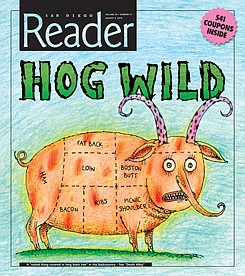
The only sign of life in Julian at 5:00 a.m. this April morning are men in white paper toques rolling out pie dough at the bright-lighted Julian Bakery. It’s a deep black morning when I meet Marc, a hunter who’s agreed to lead me by starlight to a semisecret spot, down several ravines in the Cleveland National Forest. There we’ll track and surprise and he’ll shoot, if he’s lucky, San Diego’s newest and most elusive game animal, the Russian boar.
Five miles southwest of town, driving into the headlighted darkness, we stop at an access point, a chain barring our entrance. Marc leaves his Dodge Durango running, and we talk in the red glow of his taillights. Of the few admonitions he offers up — the 40-year-old French-Canadian and 9-year Julian resident prefers I not use his last name — is this: “If you don’t mind, don’t say where we are. If we get a pig today, tomorrow there’ll be 50 people from PETA and 200 hunters converging on this spot.” Though I can’t see the playful tease in his eyes, I get the seriousness in his voice — some things are worth keeping secret. Especially to hard-core hunters.
Out of my view, Marc puts on his hunter’s clothing, head-to-toe camouflage — boots, pants, and shirt, and “nothing on underneath,” he says. He bundles his unruly, wiry long hair under a face mask and ball cap. It’s a striking look — a sort of woodsy terrorist. He notes that the face mask, as well as the entire outfit, suppresses human body odor, which pigs, whose eyesight is lousy but whose nose is first-rate, can detect hundreds of yards away. They will smell us — that is, me — before they see us.
Before we step over the chain, Marc unlocks from its fiberglass case a Smith & Wesson i-Bolt .30-06 hunting rifle with scope and shoulder strap. He says he can hit a game animal 500 yards away — “precisely.” (Later, he loads the magazine with three copper bullets.) The last piece of gear he totes is a small folding seat, with a carrier slot underneath for a self-filtering water bottle that he fills from the creek. “I drink of streams,” he says proudly.
A few days back, Marc phoned the California Department of Fish and Game and requested a good spot on public land where we might encounter pig. He was told that groups of 20 to 30 feral pigs had been spotted in the backcountry of the Cleveland National Forest, south of Julian and east of Ramona, in the backcountry canyons of the San Diego River.
Since when have wild boars been in San Diego County?
In 2006, a tribal person (most everyone I spoke with for this story knew the person’s name but wouldn’t repeat it) let loose a small herd of Russian boars on the Capitan Grande Indian Reservation. The plan (a generous descriptor) was to start a pig-hunting program on Indian land. For many reasons, the release was not authorized by Fish and Game officials.
First, the state lacks jurisdiction over tribes. Second, hogs reproduce rapidly once they find a habitat that suits them. This is a problem because the animals don’t observe borders between public and tribal areas, which in the county’s backcountry are vast and complicated. A map of the area shows all sorts of zigzagging boundaries between Indian, private, and public land. Pigs rarely stay in one place, wandering and rooting where they please — most often in protected or less-populated areas, a long, safe distance from hunters.
In four years, that herd, estimated at 20 to 30, has grown to between 200 and 400 today. Do the math: four doublings in four years. The pigs have been spotted throughout the backcountry: in Alpine, Cuyamaca, Ramona, east of Poway, and near the headwaters of the San Luis Rey River in the western foothills of Palomar Mountain. Recently, boars have been seen crossing the road near Dudley’s Bakery in Santa Ysabel and along the Sunrise Highway in the Laguna Mountains. The pigs’ range extends more than 30 miles from their release point on the north side of El Capitan Reservoir all the way to Pala Indian Reservation.
Feral hogs are destructive to ranchland and native plants, they compete for resources with deer and other game, and as noted, they proliferate like rabbits. Their unchecked propagation has stirred the U.S. Forest Service and California Fish and Game to direct hunters to access points where pigs can be “harvested” (the kindly term) on public land. Our miserly rainfall will do some of the weeding. But pigs are supremely adaptive. What’s more, they are “naturally reclusive,” says Marc. Pigs in the right habitat can grow to the tens of thousands: during the 1990s, more than 30,000 pigs were shot in California alone. Accurate state and national estimates are hard to come by. Some boar watchers say there are three million pigs in Texas and one million in Florida. Others put the U.S. total between two and six million.
Marc has hunted pigs at Fort Hunter Liggett Army base, near King City, in southern Monterey County. In two years, he’s hunted at Liggett some 20 times and had a chance at a pig only once. “I had five seconds,” he recalls as we cross a field and head toward a ravine. The pig came out of and ran back into the brush. Marc shot and missed. People who object to hunts think that the animals are flushed out toward certain deaths. On the contrary, Marc says. His lone chance is proof of how hard it is to bag a pig.
Pigs Are Extremely Intelligent, Far More Than We Imagine
Such odds make our seeing, let alone shooting, a pig highly improbable. Pigs, Marc says, are “100 percent nocturnal.” That’s why we’re here in the dark. As we approach, they are bedding down in the thickest thickets they can find, typically near a stream. The best we can hope for is to catch a sow and her young emerging for a predawn drink in the creek or a solitary boar, sleepless and on the roam.
Like most hunters in San Diego, Marc has not yet seen a feral pig in the county. He’s seen pictures of them and read the chatter on internet forums, where hunters talk with one another while revealing no precise location of pig sightings. “What they know about game, they learned in the field, so they guard it jealously,” he says. Descanso hunter John Ogle bagged a 241-pound wild pig last October east of Ramona near the San Diego River. He told the Union-Tribune, “I’ve hunted San Diego County for 38 years and I’ve never seen a wild pig here before.” After butchering, Ogle had the oinker’s head stuffed and mounted. When I contacted him about my tagging along on a hunt, he curtly replied, no thanks. I took it to mean that lugging a reporter (decidedly, a nonhunter) into the field would identify tactics and spots Ogle has earned through long, hard slogs — and for what, tipping his hand to some writer?
A purple haze bands the eastern sky. We’re a good mile into a steep ravine, trying not to crash through the brush. Marc slows and says softly that “a pig is more intelligent than a dog. If we startle one, he’s going to go for the guy with no gun” — his glance at me is merciless — “so stay behind.” If there’s a choice of hogs, Marc continues, he’ll try to bring down a hundred-pounder. It would be onerous to drag a 300-pound boar, despite its being field dressed and boned, out of this gulch.
Soon we find rutted ground, telltale pig presence. The churning is spread under a grove of coast live oaks, their trunks scorched from the 2003 Cedar Fire but their crowns grown back. Full-grown pigs use their upper and lower canines like a garden tiller to unearth buried acorns and plant roots. Maybe a week ago, they came through, Marc estimates. “They bedded here, stayed a couple of days, and moved on.”
Wandering a bit drunkenly downhill, slipping on rocks that look firmly in place but suddenly tip up, dodging dry swirls of cow dung, putting my arms up and creeping through poison oak brambles, I feel my wilderness schooling in the Boy Scouts settle me down. Step softly like the moccasin-footed Indian. Keep your voice at a whisper. Anything worth saying can wait. Linger, scan for movement. There, what’s that? Is that a boar or a boar-shaped rock?
For the next three hours, morning comes on, quiet and tranquil. Marc and I find overlooks above creek washes, and there we sit. We don’t talk. We watch with and without binoculars. We take in the terrain. Far off, the delicate lavender of Ceanothus sprigs. Close by, the ritual upper-body bobbing of a male lizard courting Ms. Right on a sun-dappled rock. During a one-hour bivouac, Marc, hands tucked under his armpits, gun across his lap, dozes. Only the rustle of the creek and the infrequent squawk of a Steller’s jay break the silence. We wait for the pigs to come into view. I learn that hunting is waiting, requiring more patience than fishing, where, reeling in and casting out, you have, at least, some dialogue with the fish, imagined or not.
Waiting, we seem to melt into the landscape, inconspicuous. Hunting is about noticing everything else while you wait.
Later, over lunch, Marc tells me about himself. A solitary hunter, he learned to hunt with rifle and bow just recently, following a self-defense class. That class was brought on by the bruising year of 2003, when he lost his home in Harrison Park. Harrison Park, he maintains, was “sacrificed” to save Julian during the Cedar Fire. He’s still dry-mouth bitter about the fire’s and the government’s unfairness, during and after the siege. A computer programmer who is rebuilding his home with solar panels on the roof, Marc is “hooked on hunting.” Out in the grand quietude of the Cleveland National Forest, waiting for boars, he likes to contemplate his fate.
Moreover, Marc has been driven to hunt as a move toward self-sufficiency. For one, he says, “Human psychology has a hunter-gatherer streak”; for another, he believes we must face an impending loss of resources, especially electricity, and scale back our communities to the basics, living as our ancestors did in the 19th Century. He’s not a survivalist, he says, though he will survive. He’s not political. He’s pragmatic. Learn to garden, hunt, use less. Only a hunter, he says, knows where game animals are in the Cleveland National Forest: incredibly, animals worth shooting for food occupy, he notes, about 1 percent of the forest’s 460,000 acres. The thing he’s learned is that animals “are extremely intelligent, far more than we can imagine.” They don’t just give in and wait to be shot.
Such is our lot: eight hours spent in the placidity of perfect pig habitat yields no pigs. They’ve been and gone, at least, in the ravine we’d been told they were. Or perhaps they were asleep in a thicket, dreaming of cattails, unstirred by our morning arrival.
They Use Their Tusks to Scar and Bleed
A rainy evening last December, Susan Wells heard a commotion outside her home, coming from her corral. She owns Morning Star Ranch, “Where,” as her website says, “horses are boarded with T.L.C.” The horses were spooked by something. Wells’s ranch is in Poway, near the top of the Sycamore Canyon Preserve and numerous riding trails. Running outside, she discovered a boar and a sow, about a year old, rooting in the corrals for food. They had squirmed in under the fences to where horse feed and droppings lay. She tells me that “an older horse got scared, slipped, and fell down. He couldn’t get back up.” The pigs were not attacking the horses, but their presence was “traumatizing” them nonetheless.
Wells says she espied the culprits right off; they had stumbled onto a bounty of eats: fallen fruit, leaves, hay, grain, horse manure. “They thought they’d found the best place on Earth here,” she recalls. Wells phoned “a million different people.” She contacted neighbors to see if they had lost a pair of pigs. Then she called the Humane Society, Animal Control, Project Wildlife, Fish and Game. None of those agencies returned her call that evening. “The only people to respond were the Emergency Animal Rescue,” a volunteer group. “They came out and helped me catch them.” It wasn’t hard, either. They laid down a trail of cookies, a line of tasty deception the pigs fell for. Wells and Animal Rescue guided the pair into a pen.
During the ordeal, she wasn’t sure that these were wild pigs because she’d never heard of any in San Diego. Wells says she got a good look at their distinctiveness: pointy face, root-worthy snout, erect ears, long legs, hairy hide, razor-backed body, russet color, and sinewy tail. The pigs were wary of her and quick to bolt. “They were fast,” she says, and would snort and fake a charge if she got too close.
The next morning two officials, one from the Humane Society and one from Fish and Game, came to her ranch. The two conferred. If the pigs were domestic, the Humane Society would take them away. But since these were wild and a nuisance, the game warden shot them, at close range, in the pen. The “very knowledgeable” warden told her, Wells says, that since the pigs were a male and female, weighing about 125 pounds, his main reason for killing them was to halt their reproduction — more wild pigs would cause even more havoc.
Why did the hogs have to die? I asked Kyle Orr, a spokesperson for Fish and Game. He says that his office issues a depredation (defined: “an attack involving plunder and pillage”) permit, which allows “immediate take” of pigs when they are “damaging or destroying land or property. Relocating them,” Orr says, “only moves the problem somewhere else.” Wild animals, as everyone knows, cannot be domesticated.
Wells’s story is one of several told by backcountry residents who’ve encountered feral hogs during the past year. Jamie Leclair, a Ramona accountant, hit a pair of pigs on Poway Road near the junction with State Route 67. She told the Union-Tribune they were “running together, nose to butt, and the first one went under the truck when I hit it. When I hit the second one, the truck went up on two wheels for a few seconds.” In addition to blood and hair on her tires, her truck needed an alignment.
In Ramona’s feed store, Kahoots, I meet a woman whose father calls me later to say that he’s been watching the Discovery Channel and its show Pig Bomb. One segment, called “Hogzilla,” depicts — in you-are-there re-creation — the stalking and killing of an 800-pounder, Hogzilla he was named, in rural Georgia. Hogzilla would soon be topped by Pigzilla, or “Monster Pig,” which weighed 1051 pounds and was shot by an 11-year-old boy in Alabama. (According to the Berryman Institute’s report “Managing Wild Pigs,” the dirty secret is that such mammoth porkers are raised by pig ranchers, who fatten them in pens and then release the boars for hunters.) “Man, that show just blew me away,” the man says, breathlessly. “How fast and big these pigs are going to get. It’s scary.”
A butcher in Ramona who prefers anonymity tells me that he’s made sausage out of all sorts of animals (but only when he sees a tag that proves it was legally killed). He insists that there have been feral pigs in the San Diego backcountry for years, long before any Russian boars were released on Indian land.
The Department of Fish and Game notes in its “Guide to Hunting Wild Pigs in California” that West Coast wild pigs are a “wild boar/feral domestic pig hybrid.” Since the 1920s, escaped domestic pigs have mated with the European or Russian wild boar. Today, wild pigs, which are not native to North America, exist in 56 of the state’s 58 counties. California is split about 50-50 between private and public land. Pigs that are hunted on public land take refuge in private areas. Hunters, who must buy a pig tag and report a kill, harvest them with rifle, pistol, bow, crossbow, shotgun, and muzzle-loading, or front-loading, gun. During the July to June 2008–2009 count, some 51,625 pig tags were sold and 3838 reports of harvest filed. (About a third of the pigs were shot in Monterey and Kern counties.) In that year, two pigs were shot in San Diego County.
According to several websites run by pig scholars and trackers, Hernando de Sota brought the first pigs to Florida in 1539. Since then, feral hogs have ranged freely throughout the Southeast, having grown excessively in size and number. The U.S. Department of Agriculture notes that European wild boars were released in North Carolina in 1912 and then in California in 1925.
Captive pigs are bred for their meat. Penned, they grow to two feet tall and weigh between 90 and 260 pounds. Their feral cousins grow to be three feet tall and weigh in between 250 and 500 pounds. The wild boar has a flatter skull and longer legs than its domestic cousin. The upper and lower canines of the male sharpen each other during chewing; they can grow to four inches or more. When males fight over a sow, they use these tusks to scar and bleed their opponent. This is one method by which hogs give themselves away — boars jousting to claim a sow, and the sow’s horror-movie cry to protect her piglets.
I Wouldn’t Be Surprised If They Eat Toads
Undaunted, I’m on a second pig hunt, this time with field biologists Megan Jennings of the Descano Ranger District and Jeff Wells (no relation to Susan Wells) of the Palomar district. It’s a bright morning, and we’re moving single file along a slope toward a crystal-clear cow pond, deep in the Cleveland National Forest. In their piney green slacks and jackets, minus the broad-brimmed hats, Jennings and Wells, both unarmed, are stepping in streams and dodging cow patties in what they call a natural pig habitat: a grassland bowl around a pond with plenty of oaks positioned postcard perfect on the slopes. Leaving the Palomar Ranger District office in Ramona, we bumped down Eagle Peak Road just below the Pine Hills enclave south of Julian. The pigs, so they’ve heard, have made their way up the San Diego River; they’re ranging into this bouldery, hilly terrain, once the Rutherford Ranch, stopping to root in its pristine valleys. We’re looking for signs: hoofprints, wallows (mud holes pigs lie in) and mud rubs on trees, uprooted cattails, and scat.
During the long truck ride, I was schooled by Jennings, a ponytailed blond ecology grad student at San Diego State, about the pigs’ diet: grasses, the blanket of acorn mast, forbs, roots and tubers, the eggs of ground-nesting birds, small animals, and newborn fawn. “Pigs,” she’s read, “are attracted to afterbirth.” They’ll even eat their dead, she notes. They’re relentless scavengers, a species of disciplined omnivory: “Whatever they root up, there’s a chance they’ll eat it.” In doing so, they compete with deer and other mammals: those who have been in the backcountry a long time are certainly at risk with a new glutton in the mix. Pigs are such, well, pigs about eating that their gray, sticky scat most resembles that of another equally aggressive and eats-anything species: us.
As we watch the trail, we look for hoofprints, which are deerlike but broader, more oval. Boars also have dewclaws, which make two button-size marks just behind the hoofprints. Jennings shows me the four indentations of the pig print in her tracker’s manual.
In terms of range, the three of us are just the opposite of the pigs. We dally. We partake of resplendent moments, temperature a golden 62 degrees, to chat. Jeff, who majored in Russian studies at San Diego State and wears a knockoff of Oakley’s M Frame sunglasses, tells me that as a boy he hunted in Northern California, where the pigs have been present for decades, grown as big as house trailers for game-worthy ends. Pigs, he says, are “incredibly smart.” Pressured, they travel in packs called “sounders,” with several females and many juveniles, to secure areas as far from our smell as possible — until hunger overtakes them and they cross highways in search of grub. Still, Wells notes, they’re never an easy catch. The other sign of their intelligence, he says, is “They already have a fear of humans.”
Suddenly, Jennings gives us a call. “Over here.”
“You got pig?” Wells shouts.
Sure enough, she’s found a patch of ground whose bareness, she says, “isn’t explained by anything else” but pig rooting. Here, under a coast live oak, they stopped to dig big-time. The pigs have torn up the native grass and gorged on acorns and other mast. Then, with a superkeen olfactory sense, they smell out tubers and bulbs and go hog wild upturning the soil at the slightest nose twitch. Jennings says one big problem occurs when, in the wake of damage, nonnative plants and grasses take root in the native plants’ stead. The boars are also a tree pest. They barrel through thickets of young coast live oak, canyon live oak, and black oak, sleep on or stomp the saplings, which, Jennings says, “can be a big hit to our oak population.” Large feral pig families can impact oak regeneration for years to come. Other animals eat the mast, but “pigs,” she says, “may be taking more than their share.”
Boars also threaten native animals such as the arroyo toad, which is on the endangered species list. “I wouldn’t be surprised if they eat toads,” Jennings says. Pigs disturb the sensitive pond shore, where rutting for dead fish they step on toads.
The three of us spend hours hiking, knocking along in the Forest Service truck, looking at photos of animal tracks and pig scat and maps of huntable terrain. Twice, we stop and stand beside the truck and wonder where the pigs are. Such a nice, cool day, why aren’t they relishing the fine weather as we are? That’s because, I later realize, the pigs have been and gone, which is the story of this story.
Do You Wait and See or Try to Manage the Pig Problem Now?
On the phone, Georgia Martin, manager of the Lake Cuyamaca Recreation and Park District, tells me that she’s seen pigs around her lakeside home. She bristles, “What are they going to do about these pigs?” Martin knows what she’ll do if a boar starts tearing up her campground: “He’s dead meat.” As their numbers proliferate, everyone is wondering how big a problem these animals will be.
I think the question is not “What are they going to do?” but rather, “Who’s going to do what?” As anyone who’s ever ended the day eating hot apple pie in Julian after a hike in the woods knows, San Diego’s backcountry is governed, if that’s the right word, by a patchwork of landowners and land managers, officials and bureaucrats, tribal leaders and a few politicians. It’s a checkerboard of responsibilities: the Forest Service manages the habitat; the Department of Fish and Game manages the animals; the U.S. Border Patrol manages migrant laborers, who are known to move through the same environs that the pigs do; and Indians have sovereignty over their land. The harshest terrain in San Diego County is national forest land. Early ranchers and settlers took the best, most accessible, most farmable land; ownership of the ravines and mountain slopes has devolved to the state and federal governments. Habitat-seeking pigs cross all jurisdictions: Forest Service, Indian reservation, private ranches and farmland, subdivisions, fire roads, and the Helix Water District.
If the pigs’ ability to thrive in all these habitats is an indication, the wild boars of San Diego County will have “a significant impact on this environment,” biologist Wells says. The question is, “Do we wait and see, or do we try and manage it ahead of time?” The answer, he notes, is clearly the latter.
Jennings and Wells have started their own management by making a map of likely spots the pigs will go — grasslands, stream and pond, oak habitat. They want hunters to know where to get pigs since they can be hunted, with a proper tag, anytime of the year. The map indicates access roads through public land and delineates boundaries with private and tribal land. (Experts and hunters I talked with agreed that a huntable mass of feral pigs is a year away, when both reporter and rifleman will likely see or bag a boar.) Driving through the backcountry, Jennings and Wells show me numerous access roads adjacent to private land, where a hunted pig can squeal his way to safety under a barbed-wire fence.
The “Judas Pig” Method
I asked Marc just before we parted where I might spot a wild pig. He said to drive out Eagle Peak Road at dusk. “Animals aren’t bothered by cars or headlights. You might get lucky.”
On a Sunday evening around seven, I’m driving the eight-mile downgrade of Eagle Peak, which is paved for two miles, then turns to dirt. Pass Deadman Flat. Pass Kessler Flat. In the distance, the hills darken to silhouettes, gray snake backs against vanishing sunlight. The farther I go, the narrower the road — if I stay on this rutted dirt road, I’ll end up at a place called Saddleback, a stopping point for the hike down to Cedar Creek Falls.
Tooling along at 15 miles per hour, I’m thinking about a novel way of catching a boar, the Judas pig method. Management officials capture a pig, usually an adult female, tag her with an electronic device that emits a radio signal, mark her with a streak of Day-Glo paint, and release her. When the hog returns to its sounder, it becomes, as one study calls it, “the betraying individual.” Judas. San Diego County is not using the Judas pig as yet, though in other locales, notably Australia, the technology has proved one surefire way to manage an oversized population — the radio signal allows hunting by helicopter, the paint mark an indication of whom not to shoot.
Long about now, I could use a Judas pig. It seems the only way to find a pig. On my third trip to the backcountry, I feel as though I’m striking out again.
And then, lost in thought, there, about 100 yards to my left, on a grassy flat, studded with oak, I see something.
It’s a large, dark brown mass, and it’s moving. No, romping. Not running away, but what seems like a playful, devil-may-care romp, a very big animal leaping about.
What? A happy, ecstatic pig?
Yes, body large and dark brown. Decidedly not a cow, which is too ungainly. Or a deer, too thin. Or a young bison, too hairy. It’s a very big boar, a solitary male, partying on his own.
How much do I want this to be true? How much of it is?
At once I stop the car and rush over to where I can view the spot. Of course, the animal is gone. He’s romped away. He toyed with me, and that’s that. But I did see it.
What’s fashioning itself in my mind is this. As I drive Highway 79 in the starlit darkness, looping around Lake Cuyamaca, and almost take down a doe standing in the road, I realize I’m the Judas reporter. I’ve been sent out, my assignment a tracking device around my neck, to bring home the bacon.
Here's something you might be interested in.
Russian boars let loose on Capitan Grande Indian Reservation
Four years later, hunters pursue them south of Julian

Russian boars let loose on Capitan Grande Indian Reservation
Four years later, hunters pursue them south of Julian
The only sign of life in Julian at 5:00 a.m. this April morning are men in white paper toques rolling out pie dough at the bright-lighted Julian Bakery. It’s a deep black morning when I meet Marc, a hunter who’s agreed to lead me by starlight to a semisecret spot, down several ravines in the Cleveland National Forest. There we’ll track and surprise and he’ll shoot, if he’s lucky, San Diego’s newest and most elusive game animal, the Russian boar.
Five miles southwest of town, driving into the headlighted darkness, we stop at an access point, a chain barring our entrance. Marc leaves his Dodge Durango running, and we talk in the red glow of his taillights. Of the few admonitions he offers up — the 40-year-old French-Canadian and 9-year Julian resident prefers I not use his last name — is this: “If you don’t mind, don’t say where we are. If we get a pig today, tomorrow there’ll be 50 people from PETA and 200 hunters converging on this spot.” Though I can’t see the playful tease in his eyes, I get the seriousness in his voice — some things are worth keeping secret. Especially to hard-core hunters.
Out of my view, Marc puts on his hunter’s clothing, head-to-toe camouflage — boots, pants, and shirt, and “nothing on underneath,” he says. He bundles his unruly, wiry long hair under a face mask and ball cap. It’s a striking look — a sort of woodsy terrorist. He notes that the face mask, as well as the entire outfit, suppresses human body odor, which pigs, whose eyesight is lousy but whose nose is first-rate, can detect hundreds of yards away. They will smell us — that is, me — before they see us.
Before we step over the chain, Marc unlocks from its fiberglass case a Smith & Wesson i-Bolt .30-06 hunting rifle with scope and shoulder strap. He says he can hit a game animal 500 yards away — “precisely.” (Later, he loads the magazine with three copper bullets.) The last piece of gear he totes is a small folding seat, with a carrier slot underneath for a self-filtering water bottle that he fills from the creek. “I drink of streams,” he says proudly.
A few days back, Marc phoned the California Department of Fish and Game and requested a good spot on public land where we might encounter pig. He was told that groups of 20 to 30 feral pigs had been spotted in the backcountry of the Cleveland National Forest, south of Julian and east of Ramona, in the backcountry canyons of the San Diego River.
Since when have wild boars been in San Diego County?
In 2006, a tribal person (most everyone I spoke with for this story knew the person’s name but wouldn’t repeat it) let loose a small herd of Russian boars on the Capitan Grande Indian Reservation. The plan (a generous descriptor) was to start a pig-hunting program on Indian land. For many reasons, the release was not authorized by Fish and Game officials.
First, the state lacks jurisdiction over tribes. Second, hogs reproduce rapidly once they find a habitat that suits them. This is a problem because the animals don’t observe borders between public and tribal areas, which in the county’s backcountry are vast and complicated. A map of the area shows all sorts of zigzagging boundaries between Indian, private, and public land. Pigs rarely stay in one place, wandering and rooting where they please — most often in protected or less-populated areas, a long, safe distance from hunters.
In four years, that herd, estimated at 20 to 30, has grown to between 200 and 400 today. Do the math: four doublings in four years. The pigs have been spotted throughout the backcountry: in Alpine, Cuyamaca, Ramona, east of Poway, and near the headwaters of the San Luis Rey River in the western foothills of Palomar Mountain. Recently, boars have been seen crossing the road near Dudley’s Bakery in Santa Ysabel and along the Sunrise Highway in the Laguna Mountains. The pigs’ range extends more than 30 miles from their release point on the north side of El Capitan Reservoir all the way to Pala Indian Reservation.
Feral hogs are destructive to ranchland and native plants, they compete for resources with deer and other game, and as noted, they proliferate like rabbits. Their unchecked propagation has stirred the U.S. Forest Service and California Fish and Game to direct hunters to access points where pigs can be “harvested” (the kindly term) on public land. Our miserly rainfall will do some of the weeding. But pigs are supremely adaptive. What’s more, they are “naturally reclusive,” says Marc. Pigs in the right habitat can grow to the tens of thousands: during the 1990s, more than 30,000 pigs were shot in California alone. Accurate state and national estimates are hard to come by. Some boar watchers say there are three million pigs in Texas and one million in Florida. Others put the U.S. total between two and six million.
Marc has hunted pigs at Fort Hunter Liggett Army base, near King City, in southern Monterey County. In two years, he’s hunted at Liggett some 20 times and had a chance at a pig only once. “I had five seconds,” he recalls as we cross a field and head toward a ravine. The pig came out of and ran back into the brush. Marc shot and missed. People who object to hunts think that the animals are flushed out toward certain deaths. On the contrary, Marc says. His lone chance is proof of how hard it is to bag a pig.
Pigs Are Extremely Intelligent, Far More Than We Imagine
Such odds make our seeing, let alone shooting, a pig highly improbable. Pigs, Marc says, are “100 percent nocturnal.” That’s why we’re here in the dark. As we approach, they are bedding down in the thickest thickets they can find, typically near a stream. The best we can hope for is to catch a sow and her young emerging for a predawn drink in the creek or a solitary boar, sleepless and on the roam.
Like most hunters in San Diego, Marc has not yet seen a feral pig in the county. He’s seen pictures of them and read the chatter on internet forums, where hunters talk with one another while revealing no precise location of pig sightings. “What they know about game, they learned in the field, so they guard it jealously,” he says. Descanso hunter John Ogle bagged a 241-pound wild pig last October east of Ramona near the San Diego River. He told the Union-Tribune, “I’ve hunted San Diego County for 38 years and I’ve never seen a wild pig here before.” After butchering, Ogle had the oinker’s head stuffed and mounted. When I contacted him about my tagging along on a hunt, he curtly replied, no thanks. I took it to mean that lugging a reporter (decidedly, a nonhunter) into the field would identify tactics and spots Ogle has earned through long, hard slogs — and for what, tipping his hand to some writer?
A purple haze bands the eastern sky. We’re a good mile into a steep ravine, trying not to crash through the brush. Marc slows and says softly that “a pig is more intelligent than a dog. If we startle one, he’s going to go for the guy with no gun” — his glance at me is merciless — “so stay behind.” If there’s a choice of hogs, Marc continues, he’ll try to bring down a hundred-pounder. It would be onerous to drag a 300-pound boar, despite its being field dressed and boned, out of this gulch.
Soon we find rutted ground, telltale pig presence. The churning is spread under a grove of coast live oaks, their trunks scorched from the 2003 Cedar Fire but their crowns grown back. Full-grown pigs use their upper and lower canines like a garden tiller to unearth buried acorns and plant roots. Maybe a week ago, they came through, Marc estimates. “They bedded here, stayed a couple of days, and moved on.”
Wandering a bit drunkenly downhill, slipping on rocks that look firmly in place but suddenly tip up, dodging dry swirls of cow dung, putting my arms up and creeping through poison oak brambles, I feel my wilderness schooling in the Boy Scouts settle me down. Step softly like the moccasin-footed Indian. Keep your voice at a whisper. Anything worth saying can wait. Linger, scan for movement. There, what’s that? Is that a boar or a boar-shaped rock?
For the next three hours, morning comes on, quiet and tranquil. Marc and I find overlooks above creek washes, and there we sit. We don’t talk. We watch with and without binoculars. We take in the terrain. Far off, the delicate lavender of Ceanothus sprigs. Close by, the ritual upper-body bobbing of a male lizard courting Ms. Right on a sun-dappled rock. During a one-hour bivouac, Marc, hands tucked under his armpits, gun across his lap, dozes. Only the rustle of the creek and the infrequent squawk of a Steller’s jay break the silence. We wait for the pigs to come into view. I learn that hunting is waiting, requiring more patience than fishing, where, reeling in and casting out, you have, at least, some dialogue with the fish, imagined or not.
Waiting, we seem to melt into the landscape, inconspicuous. Hunting is about noticing everything else while you wait.
Later, over lunch, Marc tells me about himself. A solitary hunter, he learned to hunt with rifle and bow just recently, following a self-defense class. That class was brought on by the bruising year of 2003, when he lost his home in Harrison Park. Harrison Park, he maintains, was “sacrificed” to save Julian during the Cedar Fire. He’s still dry-mouth bitter about the fire’s and the government’s unfairness, during and after the siege. A computer programmer who is rebuilding his home with solar panels on the roof, Marc is “hooked on hunting.” Out in the grand quietude of the Cleveland National Forest, waiting for boars, he likes to contemplate his fate.
Moreover, Marc has been driven to hunt as a move toward self-sufficiency. For one, he says, “Human psychology has a hunter-gatherer streak”; for another, he believes we must face an impending loss of resources, especially electricity, and scale back our communities to the basics, living as our ancestors did in the 19th Century. He’s not a survivalist, he says, though he will survive. He’s not political. He’s pragmatic. Learn to garden, hunt, use less. Only a hunter, he says, knows where game animals are in the Cleveland National Forest: incredibly, animals worth shooting for food occupy, he notes, about 1 percent of the forest’s 460,000 acres. The thing he’s learned is that animals “are extremely intelligent, far more than we can imagine.” They don’t just give in and wait to be shot.
Such is our lot: eight hours spent in the placidity of perfect pig habitat yields no pigs. They’ve been and gone, at least, in the ravine we’d been told they were. Or perhaps they were asleep in a thicket, dreaming of cattails, unstirred by our morning arrival.
They Use Their Tusks to Scar and Bleed
A rainy evening last December, Susan Wells heard a commotion outside her home, coming from her corral. She owns Morning Star Ranch, “Where,” as her website says, “horses are boarded with T.L.C.” The horses were spooked by something. Wells’s ranch is in Poway, near the top of the Sycamore Canyon Preserve and numerous riding trails. Running outside, she discovered a boar and a sow, about a year old, rooting in the corrals for food. They had squirmed in under the fences to where horse feed and droppings lay. She tells me that “an older horse got scared, slipped, and fell down. He couldn’t get back up.” The pigs were not attacking the horses, but their presence was “traumatizing” them nonetheless.
Wells says she espied the culprits right off; they had stumbled onto a bounty of eats: fallen fruit, leaves, hay, grain, horse manure. “They thought they’d found the best place on Earth here,” she recalls. Wells phoned “a million different people.” She contacted neighbors to see if they had lost a pair of pigs. Then she called the Humane Society, Animal Control, Project Wildlife, Fish and Game. None of those agencies returned her call that evening. “The only people to respond were the Emergency Animal Rescue,” a volunteer group. “They came out and helped me catch them.” It wasn’t hard, either. They laid down a trail of cookies, a line of tasty deception the pigs fell for. Wells and Animal Rescue guided the pair into a pen.
During the ordeal, she wasn’t sure that these were wild pigs because she’d never heard of any in San Diego. Wells says she got a good look at their distinctiveness: pointy face, root-worthy snout, erect ears, long legs, hairy hide, razor-backed body, russet color, and sinewy tail. The pigs were wary of her and quick to bolt. “They were fast,” she says, and would snort and fake a charge if she got too close.
The next morning two officials, one from the Humane Society and one from Fish and Game, came to her ranch. The two conferred. If the pigs were domestic, the Humane Society would take them away. But since these were wild and a nuisance, the game warden shot them, at close range, in the pen. The “very knowledgeable” warden told her, Wells says, that since the pigs were a male and female, weighing about 125 pounds, his main reason for killing them was to halt their reproduction — more wild pigs would cause even more havoc.
Why did the hogs have to die? I asked Kyle Orr, a spokesperson for Fish and Game. He says that his office issues a depredation (defined: “an attack involving plunder and pillage”) permit, which allows “immediate take” of pigs when they are “damaging or destroying land or property. Relocating them,” Orr says, “only moves the problem somewhere else.” Wild animals, as everyone knows, cannot be domesticated.
Wells’s story is one of several told by backcountry residents who’ve encountered feral hogs during the past year. Jamie Leclair, a Ramona accountant, hit a pair of pigs on Poway Road near the junction with State Route 67. She told the Union-Tribune they were “running together, nose to butt, and the first one went under the truck when I hit it. When I hit the second one, the truck went up on two wheels for a few seconds.” In addition to blood and hair on her tires, her truck needed an alignment.
In Ramona’s feed store, Kahoots, I meet a woman whose father calls me later to say that he’s been watching the Discovery Channel and its show Pig Bomb. One segment, called “Hogzilla,” depicts — in you-are-there re-creation — the stalking and killing of an 800-pounder, Hogzilla he was named, in rural Georgia. Hogzilla would soon be topped by Pigzilla, or “Monster Pig,” which weighed 1051 pounds and was shot by an 11-year-old boy in Alabama. (According to the Berryman Institute’s report “Managing Wild Pigs,” the dirty secret is that such mammoth porkers are raised by pig ranchers, who fatten them in pens and then release the boars for hunters.) “Man, that show just blew me away,” the man says, breathlessly. “How fast and big these pigs are going to get. It’s scary.”
A butcher in Ramona who prefers anonymity tells me that he’s made sausage out of all sorts of animals (but only when he sees a tag that proves it was legally killed). He insists that there have been feral pigs in the San Diego backcountry for years, long before any Russian boars were released on Indian land.
The Department of Fish and Game notes in its “Guide to Hunting Wild Pigs in California” that West Coast wild pigs are a “wild boar/feral domestic pig hybrid.” Since the 1920s, escaped domestic pigs have mated with the European or Russian wild boar. Today, wild pigs, which are not native to North America, exist in 56 of the state’s 58 counties. California is split about 50-50 between private and public land. Pigs that are hunted on public land take refuge in private areas. Hunters, who must buy a pig tag and report a kill, harvest them with rifle, pistol, bow, crossbow, shotgun, and muzzle-loading, or front-loading, gun. During the July to June 2008–2009 count, some 51,625 pig tags were sold and 3838 reports of harvest filed. (About a third of the pigs were shot in Monterey and Kern counties.) In that year, two pigs were shot in San Diego County.
According to several websites run by pig scholars and trackers, Hernando de Sota brought the first pigs to Florida in 1539. Since then, feral hogs have ranged freely throughout the Southeast, having grown excessively in size and number. The U.S. Department of Agriculture notes that European wild boars were released in North Carolina in 1912 and then in California in 1925.
Captive pigs are bred for their meat. Penned, they grow to two feet tall and weigh between 90 and 260 pounds. Their feral cousins grow to be three feet tall and weigh in between 250 and 500 pounds. The wild boar has a flatter skull and longer legs than its domestic cousin. The upper and lower canines of the male sharpen each other during chewing; they can grow to four inches or more. When males fight over a sow, they use these tusks to scar and bleed their opponent. This is one method by which hogs give themselves away — boars jousting to claim a sow, and the sow’s horror-movie cry to protect her piglets.
I Wouldn’t Be Surprised If They Eat Toads
Undaunted, I’m on a second pig hunt, this time with field biologists Megan Jennings of the Descano Ranger District and Jeff Wells (no relation to Susan Wells) of the Palomar district. It’s a bright morning, and we’re moving single file along a slope toward a crystal-clear cow pond, deep in the Cleveland National Forest. In their piney green slacks and jackets, minus the broad-brimmed hats, Jennings and Wells, both unarmed, are stepping in streams and dodging cow patties in what they call a natural pig habitat: a grassland bowl around a pond with plenty of oaks positioned postcard perfect on the slopes. Leaving the Palomar Ranger District office in Ramona, we bumped down Eagle Peak Road just below the Pine Hills enclave south of Julian. The pigs, so they’ve heard, have made their way up the San Diego River; they’re ranging into this bouldery, hilly terrain, once the Rutherford Ranch, stopping to root in its pristine valleys. We’re looking for signs: hoofprints, wallows (mud holes pigs lie in) and mud rubs on trees, uprooted cattails, and scat.
During the long truck ride, I was schooled by Jennings, a ponytailed blond ecology grad student at San Diego State, about the pigs’ diet: grasses, the blanket of acorn mast, forbs, roots and tubers, the eggs of ground-nesting birds, small animals, and newborn fawn. “Pigs,” she’s read, “are attracted to afterbirth.” They’ll even eat their dead, she notes. They’re relentless scavengers, a species of disciplined omnivory: “Whatever they root up, there’s a chance they’ll eat it.” In doing so, they compete with deer and other mammals: those who have been in the backcountry a long time are certainly at risk with a new glutton in the mix. Pigs are such, well, pigs about eating that their gray, sticky scat most resembles that of another equally aggressive and eats-anything species: us.
As we watch the trail, we look for hoofprints, which are deerlike but broader, more oval. Boars also have dewclaws, which make two button-size marks just behind the hoofprints. Jennings shows me the four indentations of the pig print in her tracker’s manual.
In terms of range, the three of us are just the opposite of the pigs. We dally. We partake of resplendent moments, temperature a golden 62 degrees, to chat. Jeff, who majored in Russian studies at San Diego State and wears a knockoff of Oakley’s M Frame sunglasses, tells me that as a boy he hunted in Northern California, where the pigs have been present for decades, grown as big as house trailers for game-worthy ends. Pigs, he says, are “incredibly smart.” Pressured, they travel in packs called “sounders,” with several females and many juveniles, to secure areas as far from our smell as possible — until hunger overtakes them and they cross highways in search of grub. Still, Wells notes, they’re never an easy catch. The other sign of their intelligence, he says, is “They already have a fear of humans.”
Suddenly, Jennings gives us a call. “Over here.”
“You got pig?” Wells shouts.
Sure enough, she’s found a patch of ground whose bareness, she says, “isn’t explained by anything else” but pig rooting. Here, under a coast live oak, they stopped to dig big-time. The pigs have torn up the native grass and gorged on acorns and other mast. Then, with a superkeen olfactory sense, they smell out tubers and bulbs and go hog wild upturning the soil at the slightest nose twitch. Jennings says one big problem occurs when, in the wake of damage, nonnative plants and grasses take root in the native plants’ stead. The boars are also a tree pest. They barrel through thickets of young coast live oak, canyon live oak, and black oak, sleep on or stomp the saplings, which, Jennings says, “can be a big hit to our oak population.” Large feral pig families can impact oak regeneration for years to come. Other animals eat the mast, but “pigs,” she says, “may be taking more than their share.”
Boars also threaten native animals such as the arroyo toad, which is on the endangered species list. “I wouldn’t be surprised if they eat toads,” Jennings says. Pigs disturb the sensitive pond shore, where rutting for dead fish they step on toads.
The three of us spend hours hiking, knocking along in the Forest Service truck, looking at photos of animal tracks and pig scat and maps of huntable terrain. Twice, we stop and stand beside the truck and wonder where the pigs are. Such a nice, cool day, why aren’t they relishing the fine weather as we are? That’s because, I later realize, the pigs have been and gone, which is the story of this story.
Do You Wait and See or Try to Manage the Pig Problem Now?
On the phone, Georgia Martin, manager of the Lake Cuyamaca Recreation and Park District, tells me that she’s seen pigs around her lakeside home. She bristles, “What are they going to do about these pigs?” Martin knows what she’ll do if a boar starts tearing up her campground: “He’s dead meat.” As their numbers proliferate, everyone is wondering how big a problem these animals will be.
I think the question is not “What are they going to do?” but rather, “Who’s going to do what?” As anyone who’s ever ended the day eating hot apple pie in Julian after a hike in the woods knows, San Diego’s backcountry is governed, if that’s the right word, by a patchwork of landowners and land managers, officials and bureaucrats, tribal leaders and a few politicians. It’s a checkerboard of responsibilities: the Forest Service manages the habitat; the Department of Fish and Game manages the animals; the U.S. Border Patrol manages migrant laborers, who are known to move through the same environs that the pigs do; and Indians have sovereignty over their land. The harshest terrain in San Diego County is national forest land. Early ranchers and settlers took the best, most accessible, most farmable land; ownership of the ravines and mountain slopes has devolved to the state and federal governments. Habitat-seeking pigs cross all jurisdictions: Forest Service, Indian reservation, private ranches and farmland, subdivisions, fire roads, and the Helix Water District.
If the pigs’ ability to thrive in all these habitats is an indication, the wild boars of San Diego County will have “a significant impact on this environment,” biologist Wells says. The question is, “Do we wait and see, or do we try and manage it ahead of time?” The answer, he notes, is clearly the latter.
Jennings and Wells have started their own management by making a map of likely spots the pigs will go — grasslands, stream and pond, oak habitat. They want hunters to know where to get pigs since they can be hunted, with a proper tag, anytime of the year. The map indicates access roads through public land and delineates boundaries with private and tribal land. (Experts and hunters I talked with agreed that a huntable mass of feral pigs is a year away, when both reporter and rifleman will likely see or bag a boar.) Driving through the backcountry, Jennings and Wells show me numerous access roads adjacent to private land, where a hunted pig can squeal his way to safety under a barbed-wire fence.
The “Judas Pig” Method
I asked Marc just before we parted where I might spot a wild pig. He said to drive out Eagle Peak Road at dusk. “Animals aren’t bothered by cars or headlights. You might get lucky.”
On a Sunday evening around seven, I’m driving the eight-mile downgrade of Eagle Peak, which is paved for two miles, then turns to dirt. Pass Deadman Flat. Pass Kessler Flat. In the distance, the hills darken to silhouettes, gray snake backs against vanishing sunlight. The farther I go, the narrower the road — if I stay on this rutted dirt road, I’ll end up at a place called Saddleback, a stopping point for the hike down to Cedar Creek Falls.
Tooling along at 15 miles per hour, I’m thinking about a novel way of catching a boar, the Judas pig method. Management officials capture a pig, usually an adult female, tag her with an electronic device that emits a radio signal, mark her with a streak of Day-Glo paint, and release her. When the hog returns to its sounder, it becomes, as one study calls it, “the betraying individual.” Judas. San Diego County is not using the Judas pig as yet, though in other locales, notably Australia, the technology has proved one surefire way to manage an oversized population — the radio signal allows hunting by helicopter, the paint mark an indication of whom not to shoot.
Long about now, I could use a Judas pig. It seems the only way to find a pig. On my third trip to the backcountry, I feel as though I’m striking out again.
And then, lost in thought, there, about 100 yards to my left, on a grassy flat, studded with oak, I see something.
It’s a large, dark brown mass, and it’s moving. No, romping. Not running away, but what seems like a playful, devil-may-care romp, a very big animal leaping about.
What? A happy, ecstatic pig?
Yes, body large and dark brown. Decidedly not a cow, which is too ungainly. Or a deer, too thin. Or a young bison, too hairy. It’s a very big boar, a solitary male, partying on his own.
How much do I want this to be true? How much of it is?
At once I stop the car and rush over to where I can view the spot. Of course, the animal is gone. He’s romped away. He toyed with me, and that’s that. But I did see it.
What’s fashioning itself in my mind is this. As I drive Highway 79 in the starlit darkness, looping around Lake Cuyamaca, and almost take down a doe standing in the road, I realize I’m the Judas reporter. I’ve been sent out, my assignment a tracking device around my neck, to bring home the bacon.
Comments