

Here's something you might be interested in.
Ask a Hipster — Advice you didn't know you needed
Big Screen — Movie commentary
Blurt — Music's inside track
Booze News — San Diego spirits
Classical Music — Immortal beauty
Classifieds — Free and easy
Cover Stories — Front-page features
Drinks All Around — Bartenders' drink recipes
Excerpts — Literary and spiritual excerpts
Feast! — Food & drink reviews
Feature Stories — Local news & stories
Fishing Report — What’s getting hooked from ship and shore
From the Archives — Spotlight on the past
Golden Dreams — Talk of the town
The Gonzo Report — Making the musical scene, or at least reporting from it
Letters — Our inbox
Movies@Home — Local movie buffs share favorites
Movie Reviews — Our critics' picks and pans
Musician Interviews — Up close with local artists
Neighborhood News from Stringers — Hyperlocal news
News Ticker — News & politics
Obermeyer — San Diego politics illustrated
Outdoors — Weekly changes in flora and fauna
Overheard in San Diego — Eavesdropping illustrated
Poetry — The old and the new
Reader Travel — Travel section built by travelers
Reading — The hunt for intellectuals
Roam-O-Rama — SoCal's best hiking/biking trails
San Diego Beer — Inside San Diego suds
SD on the QT — Almost factual news
Sheep and Goats — Places of worship
Special Issues — The best of
Street Style — San Diego streets have style
Surf Diego — Real stories from those braving the waves
Theater — On stage in San Diego this week
Tin Fork — Silver spoon alternative
Under the Radar — Matt Potter's undercover work
Unforgettable — Long-ago San Diego
Unreal Estate — San Diego's priciest pads
Your Week — Daily event picks
Ninth annual Cajon Classic Cruise – who are these people?
Give me good old American metal
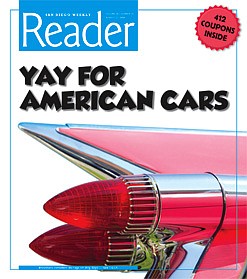
As I write this, Transformers 2 has just finished taking in over $200 million in five days. One of the main characters in that film is a robot who disguises himself as a 2009 Chevy Camaro — a car designed to rouse fond memories of the Muscle Car era, when Detroit was the automotive world’s equivalent of ancient Rome. Another robot goes about as a Corvette concept car. Yay for American cars!
As I write this, Chrysler — makers of the throwback-style Dodge Magnum, Dodge Charger, Dodge Challenger, and Chrysler 300 (along with the less recent PT Cruiser) — is settling into its new status as a property of Fiat. General Motors is lurching through bankruptcy. And Ford is inexplicably tinkering with the front and rear ends of its own entry into the Remember When Muscle Car Dreamscape: the briefly awesome new Mustang. Boo for American cars!
And yet…and yet. On May 13, 2009, the city of El Cajon closed a fair chunk of Main Street to traffic, so as to better celebrate the beginning of the ninth annual Cajon Classic Cruise — a Wednesday-night car show running from 5:00–8:00 p.m. through the end of September. And according to the Cruise’s website, the event drew its “biggest crowd ever — over 10,000 attendees!” Ten thousand people, gathered to amble the sidewalks of downtown El Cajon, gawking at, talking about, and forming an ad hoc community around cars, almost exclusively of the American variety. (Though a brand-new Dodge Challenger, cheekily parked right alongside its ’70s forbear, does raise the question of whether Dodge is still an American car.) Yes, most of them are over 30 years old, but this is Southern California, an automotive paradise where moths and rust may not enter in. It’s almost enough to make a body quote Faulkner: “The past isn’t dead — it isn’t even past.”
Around 7:30 p.m., as the summer light begins to fade, people begin to gather at the back of the Prescott Promenade. They are here to see Charger Steve and the Cajon Cruise girls present this week’s gold-cup trophies to the beautiful machines selected as winners under this week’s theme of “Too Cool.” (Other weeks’ themes include “NASCAR Up Close,” “Cajon Speed Week,” and “Hall of Flames.”) “It’s purely what we like, the People’s Choice awards,” explains one judge. There are no hard and fast criteria, “though Steve will tell us certain sorts of cars to go and find.” Tonight, for example, “We were told to find something classic and unmodified for one of our winners. And we were told to find a motorcycle.”
The winners, notified by a placard placed on the windshields or handlebars during the show, line up their cars in the alley that passes in front of the modest stage — risers leading up to a black curtain surrounded by speakers. Two gentlemen in black suits and fedoras warm up the audience by performing “Soul Man” as rendered by the Blues Brothers. The Cajon Cruise girls — white sashes draped over their black tops, high-heeled black boots rising up over their denim-clad calves — gather to one side; they will present the trophies and pose alongside the lucky cars (and their owners) for photos that will run in an upcoming issue of the East County Californian. Charger Steve bursts from between the curtains, accompanied by a blare of rock ’n’ roll. White skulls cover his button-down shirt, matching the white of his cowboy hat. He hollers to the crowd, loping across the staging area, boostering for all he’s worth. There is music (Steve Miller Band) and a raffle (SeaWorld tickets), and then Charger Steve begins to summon the winners, one by one, for their moments of glory before the people gathered ’round, when all the time and effort and expense are made worthwhile.
Well, not really. The applause and the trophy and the photo op are more of a tip of the cap — “It’s nice to be noticed.” It’s not the reason why these people do what they do. It couldn’t be — what they do is way too much for that. What is the reason? Read on.
Mark Salter, 56
’51 Chevy Deluxe
Mark Salter found his car on eBay. “Some guy in Shelby, North Carolina, had taken it as collateral from some guy that owed him money and was trying to get rid of it. I called him, found out what was going on with it, and bought it. I loved the lines — the flats, the curves. I love the fat-fender cars. From ’49 to ’51 was a transition period, where they were still using some of those fat fenders.”
When Salter got it, the Chevy hadn’t run in 18 months. “It had some drive-train issues. Over the course of the last four years, I’ve done body work, suspension work…this year was motor work and a little bit on the interior.” It’s not so much restoration as tinkering and tweaking — Salter is a hot-rodder, not a purist. “All my drag-racing influences are under the hood. I like a car to look one way but sound another. Most ’50s cars wouldn’t have side exhaust, which is why I painted it black. It’s there, but it doesn’t draw your eye.”
He’s not nearly finished working on it — but then, he’s not in any hurry. “Most guys who are true hot-rodders, their cars are never done. A friend of mine saw the car and said, ‘Give me a call when you’re finished.’ I just laughed and said, ‘It’s never finished.’ You’re always changing something. If you think it’s finished, you sell it, buy something else, and start the whole thing over again.”
Dan Sutton, 30
1937 R35 BMW motorcycle
“I’m not actually what you might call a connoisseur of cars,” explains Sutton. Rather, “I teach sophomore world history at West Hills High School in Santee. I’m the weird teacher who comes dressed in vintage suits with wide ties, or in uniform. I do really hands-on, interactive kinds of history things. I’ve got one room in my house that looks like a quartermaster’s — more World War II memorabilia than I can shake a fist at. I’ve got another room that’s set up so that it looks like it’s from 1935. Even the light switch is pushbutton instead of toggle. My wife is into vintage clothes as well, so it’s a shared addiction. That helps.”
The addiction shows in Sutton’s ability to accessorize his ride. Everything strapped onto the back of the bike is “original German Army, the common gear that an average infantryman would have had: ammo canister, gas-mask canister, knapsack…in World War II, if you had a vehicle, you lived out of it.” The leather saddlebags, he grants, are Polish reproductions (less expensive), and his heavy leather gloves were worn by British dispatch riders during WWII, not Germans — but at least they fit with the purpose of the single-cylinder R35.
His unmodified motorcycle — just what Charger Steve ordered! — is one more part of his collection, more an artifact you can ride than anything else. “I really enjoy talking about it, giving people the history. I mean, it went through the Second World War; it still had the original German nomenclature plate on the front fender. It gives me a chance to enlighten people. The first thing they do is say, ‘Whoa! Is that a Nazi motorcycle?’ They always get the notion that if you were a German soldier, you had to be a Nazi. Something like three percent of the German population were card-carrying members of the Nazi Party. I have fun educating them — it’s the teacher in me.”
Mind you, it’s not that Sutton wouldn’t love to own a car from the ’30s or ’40s. It’s that he just bought a house. The motorcycle, brought over from Lithuania to Oregon and auctioned off to Sutton on eBay, cost him a reasonably sane $3200. Five years later, it’s just about road-ready, “though I’m still working the kinks out. I’m still working on getting the third and fourth gear to go in because there’s one bolt on the shifting tower that controls that, and the threads are just worn. Because it’s a single cylinder, it vibrates to hell, and screws are coming out.”
Getting the thing from a barn in Oregon to Main Street in El Cajon was something of a history lesson in itself, starting with the paint. “When I got it, it was painted black. Somebody had literally applied it with a brush. Typical Eastern European, Soviet Bloc — ‘We don’t have anything, so use bubble gum and make it run.’ I started sanding it down, and below the black paint was Russian Army pea-green. The Russians were notorious for reusing captured German vehicles. Below that was German Army Panzer gray. They used it from the beginning of the war until about 1943, when they realized it didn’t really blend in well with Russia and North Africa and switched to Ordinance Tan. And below that was the factory-applied BMW black paint. Originally, there was a white pinstripe all around the frame and fender — very Art Deco. And half the bike was chrome. But for the army, you want everything painted as flat as possible, so that you don’t glimmer in the sun and draw attention to yourself.”
Sutton eventually found a Chula Vista auto-paint shop that could match the color on his old Mauser cleaning kit. He borrowed a compressor and laid on a new coat of Panzer gray but not before he made a few more discoveries. “It was a rusted-up pile of crap when I got it, and when I sat down with it, I realized it was a classic Eastern European chop-job: a mixture of pre- and postwar BMW parts and a Zündapp rear drive and rear wheel. Joe Schmoe Soviet-guy had literally bent the frame out, cut extra holes, and taken a hacksaw to it to make sure he could fit in a rear drive from this other German motorcycle company. BMW stopped making this model in 1940; they made only about 15,000. The postwar parts were there because at the end of World War II, the Soviets captured one of the BMW factories that made the R35, and they started manufacturing the motorcycle under the BMW name. West Germany ended up suing the Soviet government to make them stop, so the Soviets renamed it the EMW factory and made minor modifications to the parts.” Not that Sutton is complaining — by continuing the model, the Soviets helped ensure that today, eBay Germany would have plenty of what he needed to fulfill the historian’s dream of making history come alive. Or at least getting it up to 45 mph.
Ray Dowd, 66
’40 Ford convertible (among others)
“Ray’s Wherehouse” reads the sign on the steel-sided building with the dilapidated jalopy lolling in the rock lawn out front. Inside, however, nothing is dilapidated. Inside, everything is clean and in fine condition, from the high stacks of model cars still in their boxes to the pool table to the golf cart to the desk to the four cars that take up about half the floor space. “That’s a ’34 Chevy,” says Dowd, settling in behind his desk and pointing to the car nearest me. “I bought it from the DEA — long story, I won’t bore you with it. In the corner is a ’32 Ford. Next to it is a ’40 Ford” — the Viper-blue convertible he brought to the Cruise. “And next to that is a Corvette that I bought new [in 1997].”
The four cars amount to less than half his collection; the rest resides in an identical building behind this one. “I’ve always had an interest in cars,” he says. “As a youngster, myself and a friend would sneak out of church to go lift the hoods on the cars in the lot and try to identify the parts. I enjoy working on them. I enjoy looking at them. To me, some of them are art — form follows function.” He gestures toward the model cars. “I enjoy reflecting on the styles as they evolved over the years; it’s a kind of little mental exercise. And I enjoy the camaraderie of like-minded people.”
The “like-minded” part is key because at the end of the day, this is a hobby, and there’s only so far the gawkers can see into the hobbyist’s world. “The evening you were in El Cajon,” Dowd says, “my neighbor was there. He brought his ’37 Cord — just beautiful. Fresh from a two-and-a-half-year restoration. No one paid much attention to it. They didn’t know what it was, thought it was a foreign car. But if he was in the presence of other, similar people, they would appreciate it. They would be all over the car. So again, it depends on who, when, where, what.”
What it isn’t is a business. Dowd takes me on a tour of the workshop that houses his other cars; outside, it looks just like the showroom building, but inside, there’s a hydraulic lift and all the rest of it. Up on the lift is a ’27 Model T; next to it is a ’56 Pontiac Safari wagon. He gives the wagon a pat. “It’s entertainment for me. When you see a car for sale and it says, X amount invested…
invested? You spent it. To date on this car, I have receipts for about $65,000, plus endless hours of work from me and endless more hours from others. I still have roughly $15,000 to spend — wheels, tires, interior, and detail work. The way I’ve modified it, I would be very lucky to get $40,000 for it. So I would take a big hit if I sold this junk, but again, what’s a dead dog worth? Nothing but memories. The people that spend all the money on dog shows — when the dog dies, it’s all over. A hobby’s a hobby. Never made a dime on a car in my life, and I’ve had quite a few.”
The business part comes earlier, when the hobbyist’s own desire starts in bleeding money in pursuit of a dream. “Some would say a hot-rodder’s goal was to have a ’40 Ford and a ’32 Ford,” says Dowd, who owns both. “The ’32 was the first production car after the Model A, and in ’33, Ford changed some things around. The ’32 has always been popular for a number of things, racing being one of them — drag-racing and salt-racing. Also, more or less, the ’40” — understandably. Among the winners at the Cruise, the ’40, with its gorgeous curves and bulges, drew more oohs and aahs than anything, except maybe Dana Hinkle’s Plymouth
DeSoto Firesweep (see below). “The goal way back then was to have a Ford vehicle with a Chevy motor in it. The Chevy engines, relatively speaking, were inexpensive and very reliable. That was basically the standard for hot rods — lightweight, inexpensive, designed to go fast on a budget.” But now, all that has changed. “There’s no budget any longer in this stuff. It’s multiple billions of dollars in annual business.”
Dana Hinkle, 53
’58 Plymouth DeSoto Firesweep (among others)
“My dad always worked on cars,” recalls Hinkle as we survey his gleaming garage and even more gleaming car collection. “Something happens when you’re young, and you get influenced. I got it bad. Some guys have one or two cars. But if I can afford it, I’ll just keep building them, and I don’t really want to sell. I can fit six in here, and I’ve got an older shed that we’re going to turn into another garage for three more cars. I’m not going to have any more than that. I’m not.” The assurance seems aimed as much at himself as at me.
While Dad worked on cars, young Dana built models from Ed Roth’s Rat Fink collection — “these crazy-looking hot rods and monster models. I’ve got a collection in the game room that’s pretty wild — I love Rat Fink.” The Fink himself — bloodshot ratty eyes bulging, tongue flapping in the breeze from between his fangs — appears everywhere: on posters, on creepers, even rendered in crystal and standing on the rear dash of Hinkle’s DeSoto Firesweep.
Let’s concentrate on that Firesweep, shall we? The other cars offer a parade of wonders — from the solid Zebrano hardwood bed he’s having installed in his ’32 Ford truck, to the 15 hides it took to lovingly wrap the interior (including the roll bar) of his ’56 Pro Street Chevy in buttery leather — but the long, lilac Firesweep is what he brought to the Cruise.
Through the internet, Hinkle knows a DeSoto expert who “thinks there are probably 200 of these left in the world, and probably 50 really nice ones. You can’t buy parts for this car. They don’t want to make parts for a car when you might sell two a year. Luckily, this car came with everything on it. Originally, I had gone up to Escondido to look at a guy’s ’70 Challenger, and he had this up in his driveway. I had never seen one before, and I just fell in love and bought it. I drove it home the next day and disassembled the entire car.” The engine was rebuilt and the guts were in good shape, but otherwise, it was time to start over.
“Sometimes, you can buy a car that somebody’s put $100,000 into for around $30,000. But normally, I can’t buy a car that’s finished; I’d have to tear it apart and do what I want to do with it.” (In fact, the Firesweep didn’t come in for a whole lot of modifying, not when you consider the custom chrome radiator in the Chevy, or its rear frame, narrowed to allow for the fat rear tires. On the Chevy, “It’s all custom.”) The Firesweep was red; it took book after book of paint samples, and no small amount of discussion with his wife (who prefers horses to cars), to settle on lilac mist and pearl white. “And I didn’t like the stock interior, but I didn’t want to do it in leather — this is tuck-and-roll vinyl, like you would have had in the ’60s. Also, there’s a guy in Poway who restores steering wheels. He made me a new one” — a two-toned hula hoop girded with chrome — “and it made the car.”
“I can be really anal when I’m building this stuff,” admits Hinkle. “I’ll take an extra year. All the bolts on this door interior are chrome. I’ll get a list of bolts, measure them, and have them fabricated by a company that makes chrome bolts. There’s this guy in Australia who is the only person in the world who makes taillights for all these weird cars. He pours them. They would have been impossible to find, and the old ones are all cracked and dark red. It would have looked terrible, especially the way they’re stacked against the chrome. I was so thankful to get it from this guy. It took him five months…” Looking at those three red tumblers rising up in a line from the chrome exhaust port at the bottom of the tailfin, it’s easy to agree: “…but it was worth it.”
“I am so scared about this car now,” he sighs. “If it gets hit…you can’t buy trim. You’d have to spend months finding parts,” even with the internet on your side. “You’d probably buy a whole other car if you could find it,” just to have a backup fender or suchlike. “But I still take it out and drive it. It’s too much fun to keep in the garage. This is a 4000-pound car, no seat belts, and it just floats. I say it’s like driving a sofa. I’ll take a Sunday drive, put on my old hat, roll down the windows, and listen to the oldies.”
It sounds like a perfect recipe for nostalgia, but it’s not all about recapturing the past. “I’m trying to influence my son. He’s going to like cars. Here comes my mechanic right now,” he says, noticing the 11-year-old towhead heading up the driveway with the day’s mail. “He’s my helper. He does a lot of wrenching; he’s got good dexterity with the ratchets and screwdrivers. He’s good at taking things apart; he loves it. You know, it’s like any kid — ‘Come on, let’s work on the cars.’ ‘I don’t want to.’ But then when he gets out here, it’s ‘Dylan, can we take a break?’ ”
Tim Hawkins, 51
1965 Ford Mustang
“Anybody can do this,” says Hawkins. “It’s just money and time.”
Money: “What I should have put on the license plates is ‘Second Mortgage.’ I will never get the house paid off, but I’ve got a nice car to play with. I got to the point in my life where my wife was making decent money — both people have to work full time now if you’ve got a family and want to have any kind of decent living at all. If it wasn’t for her having a good job and making decent money, I probably wouldn’t be able to do this.”
Time: The June 10 Cajon Cruise “was my first outing with the car,” says Hawkins. “Just a couple of days before, I had done the last step, which was getting the front end aligned. Before that, it took about six months of working 2 hours in the afternoons after work and probably 12 hours on the weekends.” And before that, “I had it in a shop here in El Cajon for about a year and a half. The guy stripped everything down to bare metal — top, bottom, inside and out — and did all the repairs that were needed, any rust spots or spots that needed filling. Then he painted it.”
“This would be called a restomod,” says Hawkins of his classic Mustang. Except it’s not quite totally classic, which is why it’s called a restomod. “It’s been restored, but modified, so that it’s non-stock. You can build these cars any way you want to. You can put in air-conditioning and power everything, make it just like a Cadillac — they’ll make kits to do anything you want. The only thing that I don’t really like is modifying the body, putting on these flared-out kits so that you can’t really tell what kind of car it is. But then again, that’s the nature of it — to each his own.”
Hawkins hasn’t gone too far in the realm of modification, but there are hints of it, starting with the bumped-up hood scoop and its four air-intake grills. “That’s to direct colder air into the intake of the engine. Supposedly, it gives it a little bit more power. But also, the engine I have in there now rises above where the stock hood would close. Originally, this came with a 289 V8 engine. What I have in here now is actually a Ford 351 stroked to 427 cubic inches, so it’s got about 550 horsepower.”
Not that you would… “That’s way overkill for what I’ll ever need; I just wanted something that would sound rumpety. I’m not going to be racing or screaming around the streets. The fastest I’ve gotten this thing up to was about 65 while going home on the freeway. I’m not a speed freak, and I’m almost 52. I’m getting to the point where I don’t want to crank this thing up to 160 and have a tire go out. It might be fun, but is it worth dying for? I don’t think so.” A beefier engine meant that he needed a beefier transmission and a beefier rear axle. And while “the original little steel wheels would have worked fine, they would have looked kind of funky with a big old hot-rod motor.” So he got beefier wheels.
Why this car? “My parents had Fords,” Hawkins says. “My first car was a Ford, a ’67 Ford Galaxie. I got it for $250, and it got me where I needed to go. And I’ve always liked the Mustang, since I was a kid, seeing them drive around the streets in the ’60s. I got to the point in my life where I was able to build myself a nice car, and I just went ahead and did it. I didn’t want to wait until I was retired and end up out here with a walker and a cane trying to put something together.”
John Mayhew, 35
’70 Dodge Charger R/T
“Guys will come by at the shows,” says Mayhew, “and I’ll be sitting in my chair next to the car. They’ll look around, and they’ll look at the car, and after about five minutes, they’ll ask, ‘Is this your car?’ ”
It’s a fair question, seeing as how the Charger is older than he is. More importantly, seeing how a man born in 1973 came of age in the ’80s, an era that spawned, among other horrors, the Dodge Aries K. The nostalgia factor gets complicated: How does a man born in that unhappy time ever learn to love American cars? “I like that old school,” explains Mayhew. “My wife says I should have been born in the ’60s, because I like all that kind of stuff. And I’ve always liked the Charger; I think it was from watching Dukes of Hazzard. By the time I was 25 and found this one, I had just gotten married. But my wife had been helping me look for years, and when she saw the deal this one was, she let me buy it.” “This one” was factory Plum Crazy purple, with a white vinyl top and one less year on it than the General Lee.
And here’s where the nostalgia factor gets not only complicated but intensified: Mayhew turns out to be a fairly strict originalist. “A friend of a friend told my brother about a guy who was retiring in Arizona and was selling his Charger. I called him up and told him I was looking for something original and unmolested. He had it in a barn. There were some cracks in the vinyl on the top, and the white on the interior is not really white anymore, but for the period it came from, it was in really good shape. He had already committed to another guy, but that guy showed up and said that he was going to pull the 440 engine out and put in a hemi. The owner liked the fact that I wanted the car in its original state, so he sold it to me.”
Once in possession of his dream, Mayhew promptly got his Dukes on. “Some kids in a Honda were messing around near me. At first, I thought, ‘Let ’em mess around,’ but then they got a little too close to the car. So I hopped on the 8, and when I looked down, we were doing 125. I didn’t even realize — the car is so big and heavy and smooth that when you’re doing 90, it feels like 50. But that was an accident.” Still, it inspired him to put on new bushings, nice modern ones made from polyurethane. “I didn’t want to be doing 100 mph and lose a tire or something.” He saw his way clear to putting on a three-inch exhaust “to give it a little throat,” and after much agonizing, he put on some wider rims. “On the big car, the original six-inch rims looked like little cookie cutters, and it didn’t handle that well. You can spin out when you take off or slide when you go around a corner.” But even there, he can claim nostalgia: “I think that the Dukes’ car had the American Racing rims even back then.”
Otherwise, it’s all original, all the time. “Whenever I have to replace a part, I try to find an original, hunting junkyards and stuff like that. I’m actually looking for a used windshield-washer bottle right now. A brand-new bottle would stick out like a sore thumb.” And when you’re sold on preserving instead of replacing/restoring, you get into a whole other realm of caretaking. “Before I had my son, I’d get home at six, eat dinner, and be out in the garage until 10:00. I remember going underneath the ashtrays to detail the car. I rolled under and painted the undercarriage. Someone had painted the gas tank black, and it looked kind of cruddy. So I sanded and repainted and painted the tank straps purple just to kind of set them off a little bit. Because the rear of these cars picks up a little bit, you can see all of that, so I dressed it up.”
And once she’s dressed up, where does she go? “In the car-show season, I drive it a couple of times a week — El Cajon and La Mesa. I’ll go up to Escondido every once in a while. In the wintertime, if I do drive it, I’ll just take it up the freeway a little bit and come back, just to keep the juices flowing. I don’t drive it anywhere other than to shows. Otherwise, it’s hidden in the garage. In ten years, I’ve probably put 5000 miles on it.”
Richard Como, 72
’29 Ford
Well, not exactly. More like a homemade version of a ’29 Ford rat rod. Explains Como, “I had built a ’54 Chevy pickup and gotten it to where it was pretty finished. It was painted and polished and shiny, and you had to watch where you parked it and everything. I kept looking at these little rat rods buzzing around, and I thought, ‘Man, I need something I can just get in and enjoy.’ And I wanted to build one from scratch.”
A rat rod is basically a cobbled-together hot rod. “The rat rods kind of evolved out of what they called the Track T — people would take the old T Models, put a streamlined front end on them, and race them.” The rat-rodders glommed on to the notion of composite race cars but didn’t limit themselves to any particular model. “They’d get the engine out of one old car and the frame out of another. Sometimes, they’d stick on a pickup cab for a body. They didn’t have any money; they just had a little talent for building.”
Como decided to emulate the rat-rodders, except most rat-rodders don’t build their own frames or bend their own bodies. Says Como, “You can’t build the rims and the engine and the transmission, stuff like that. But the brackets, the frame, the sheet metal, the dash, the hinges — all that, I built myself. I used to do a little mechanical drawing — my background is in carpentry. I sat down in the evenings and drew out what I wanted the car to look like. Then I started putting sizes to things, shapes and lengths. Designing it was a head-scratcher. I have a lot of respect for people who design things.” After that, he descended to his 14x30 garage and built himself a wooden mock-up.
“One of the biggest challenges,” he recalls, “was coming up with a way to keep it completely symmetrical. It took a lot of bracing and a lot of measuring. I had it set up on the concrete floor with a straight popline down the middle. After that, I built it as an assembly, starting with the firewall. I had built a few boats, so I built it under those premises — water line, station line, etc. The sheet metal was the other big challenge, all those compound bends. You take a good, sturdy bench and a beanbag filled with either sand or little steel pellets. Then you get the right body hammer and start beating on a piece of sheet metal, stretching and bending.”
As for the parts he couldn’t build: “I got the rear end out of an old wrecked Camaro. I took the taillights off a trailer and put LED inserts into them. I salvaged the steering column out of an old forklift. And I traded some tools for the transmission and the Chevy engine. I knew the guy who built the engine — Smiling Ed Hail. He used to race at El Cajon Speedway, has an engine shop on Wintergardens Boulevard. The shop’s still there, but he passed away about two years ago.” The whole restoration took Como about six months and $4000.
The result is a lot of fun. “There’s no power steering,” but because it’s so light, that’s not much of a problem. “And it’s very quick from the stop sign, because there are only about five pounds of car weight per horsepower. For comparison, a Corvette has about ten pounds per horsepower. I once had it close to 100 mph — but it was in a controlled area. Mostly, I go and see friends, take it to shows. The first Saturday of every month, there are five or six car clubs that meet for breakfast at Hometown Buffet in El Cajon. I’ve been in mine, the Road Ramblers, since I was 19; the club’s been around since ’37. A lot of the guys will bring their cars, and a lot of the guys I’ve known since high school.”
One of those guys owns Mark Motors Ford in El Cajon. “He’s interested in old cars; being a Ford dealer, he’s seen the gamut” — and the older stuff is what holds the owner’s interest. Como’s, too. “I can remember when I was a kid — even when I was a young man — we would get excited about the new models hitting the showroom floors. Because they were different. You’d go down to Mark Motors Ford, and they’d have a date in September or October when the new models were coming out, and there would be a crowd. That’s gone. I can look at a ’32, a ’33, or a ’34 and tell you exactly what year it is, by the hood, by the whole shape of it. I can’t do that anymore. I look at a new Ford or Chevy truck, I can’t tell what year it is. They’ve all been designed and built in a wind tunnel. I think General Motors, to use one example, got to the point where they were out of touch, and they weren’t building what the people wanted.”
Como’s everyday drive is a black ’02 PT Cruiser, a retro-style car that he thinks “damn near hit the mark. They made a retro look — running boards, fenders — and they made it affordable. The Chevy HHR was retro, but it was something like $42,000. It was a two-seater — a second car, not a car you buy with a family. I’d like to have had one, but I’m not going to spend $42,000 for a car that sits in the garage.”
Pat Donohue, 46
’69 Chevy Camaro Z-28
In 1969, race-car driver Mark Donohue drove a Roger Penske–owned Camaro to victory in the Trans-American Road Racing Championship. “My father actually met Mark Donohue and became friends with him,” recalls Pat Donohue (no relation). “At one point, my dad started doing body and paint work on Roger Penske’s Trans-Am Javelin.”
Years later, Pat and his brothers John and Michael decided to pay a little homage. “The ’69 Camaro was basically our favorite car, and with our last name being Donohue and our dad knowing Donohue, we decided to build one. We started going down to Coronado, where the original Penske Camaro races once a year. We went down four years straight, taking pictures and movies, and then we replicated as best we could.”
They found their ’69 in a friend’s backyard; the man traded it for a paint job on his truck. (Pat is co-owner of Rodon Automotive Inc. in El Cajon; the shop specializes in custom bodywork.) “Over a four- or five-year period, we didn’t do anything but collect the parts — swap meet here, eBay there. Then, in 2005, we got into it hot and heavy. It took us about a year and a half to finish.”
Verisimilitude acc-ounted for at least one chunk of that time. “The car had really good quarter panels on it, which is rare for a ’69 Camaro. Usually, they’re rotted out. But we wanted to flare them out over the wheels, just like on the real race car. It took me a good half hour of standing next to the car to get the nerve to cut perfectly good quarter panels off of a ’69 Camaro. But I did it. We moved the wheel well out to where we wanted it, and then we put the quarter back on. And then, to make it fit, we had to cut it and trim it and weld it — heat it and move it and let it cool. There’s probably 90–100 hours of work just in those quarter panels.”
The brothers were out to build a race car, not a street car, so they didn’t have to worry too much about things like carpets and headliners. Instead, they concentrated on getting a roll cage installed, putting in a Jericho transmission that would let them shift without a clutch, and building an engine. “Out of the car, it’s a 302. In the car, it’s putting out about 420 horsepower. There’s more compression and more heat than in a street engine, so you have to have a more extensive cooling system.”
Once you have your race car, of course, it’s time to…show it? “We took it to Coronado a couple of times, and it was fun to hear every-body’s stories, but we wanted to race it. When we were down there, the Mustang Shelby Cobra club approached us and basically insisted that we join their club. We go up to Willow Springs twice a year and run it on a two-and-a-half-mile road course. The course is made on the side of a mountain. You know when you see a car commercial on TV where the driver is sliding around those huge turns, and they say it’s a closed course? Nine times out of ten, that’s Willow Springs.” It’s a good fit. “My brothers and I ran out at El Cajon Speedway — my first race was in ’86, and my last was around 2002. I’m just basically tired of rule books. So we go out there and just play — take the family and go have a ball.”
At least, until something breaks. “We work the bugs out on the racetrack. We’ve had oil leaks, oil-pressure problems, fuel problems…We finally got all the bugs out last time. We probably put 70 laps on the car, and it’s still running. So I’m happy with that.” And every now and then, he’ll bring it down to the Cajon Cruise, just to let folks marvel at those flared quarter panels, swelling out along the car’s backside, “Sunoco Camaro” emblazoned in sunflower yellow across the bright blue bulge.
Blast from the Past in Chula Vista
“Look at this guy,” said one middle-aged white man to another, throwing a sidelong glance at the jacked-up Lincoln Town Car, sparkling in pinstriped purple glory as it rolled through El Cajon, high above its tiny wheels. “There’s nobody down here like him.” This was not a compliment, but the hostility was directed less against the driver’s race than against his sense of What May Be Done to a Car. Sure, you saw your curiosities in El Cajon — a Porsche with a Corvette engine, a ’69 Camaro V8 Coupe “recreated” into a Z-28 R/S that is “possibly more fun to drive than the original” — but mostly, the cars displayed a basic fidelity to the maker’s intentions. Not everyone was a strict originalist, but very few people seemed out to have their way with history.
I saw that Lincoln again a week later at the Blast from the Past Car Show, held Tuesday nights from 5:00…8:00 p.m. on Third Avenue in downtown Chula Vista. This time, there were plenty of people down there “like him.” I beheld pickups lowered almost to the street, their beds cluttered with the hydraulics required to start them bouncing on their way, a brand-new Chrysler 300 outfitted with front doors that swiveled forward and up instead of opening out. More flames, more primer, more ratty interiors (the ride’s the thing), and definitely more cars from the ’80s to go along with the generally younger crowd. An ’80s car may not be a thing worth restoring to its original glory, but restoring was not always the name of the game here. There were plenty of Restored Glories, including some Pontiacs and Lincolns unlike anything I saw in El Cajon. But there was also a sense of experiment, of appreciation unmoored by tradition — perhaps not unlike that felt by the first tinkerer who thought to put a Chevy engine in a Ford car. A sense of things being rethunk — why shouldn’t an SUV’s cargo space be given over to a sound system? Why shouldn’t my Impala ride with its nose way up in the air? Also: way more old VWs, including a charmingly mottled bug with “California Special” emblazoned on its sloping hood.
Cruising Grand in Escondido
El Cajon may boast the largest car show in Southern California, but my bet is on Escondido’s Cruising Grand for most moneyed. I’m thinking July 19 was Pantera night, judging by the 30 or so I saw lining one side street, casually jockeying for attention even as they were collectively eclipsed by a single orange Ford GT (you can’t see the stars when the sun is shining). Oh, and the other side of the street was lined with Shelby Cobras. The whole thing came off as an embarrassment of riches. Long lineups of classic Camaros and Mustangs, one after the other, so that their beauty became almost commonplace. A special exhibit of mini-cars, including a 1946 midget racer built by San Diego’s own Solar Aircraft Company. A restored Highway Patrol car, complete with Tommy Gun in the front seat. The restaurants hummed with activity, the band played excellent oldies covers, and there were free sno-cones.
So opulent was the display that it almost came as no surprise to find a dented and dingy ’51 Ford panel truck — with ten used motors in its past and a million miles to its credit — set up as a kind of protest against autophilic excess. Laminated sheets of paper taped to the body told the truck’s history and served notice: “Understanding the difference between this truck and all of the other vehicles here today — this truck has been, and is, my main transportation from 1960 until now…All of the cars here today have a history!! Unfortunately, it has been lost in the shuffle of being bought and sold again and again. Ask anyone here today, and all they can tell you is what they paid for their vehicle. The real value has been lost!!!…All of the ‘trailer queens’ started out with the premise of ‘I would really like to fix up an old car and drive it and have fun with it!!’ However, as time and car shows and cruise nights go on, something gets lost along the way…Now your ‘creation’ sits in an air-conditioned garage and is transported from here to there on an enclosed trailer…”
Back to the ’50s in La Mesa
Yes, I’m biased: I can walk to La Mesa’s Back to the ’50s show on any given Thursday night in summer and listen to the guy who put an electric motor in his Rolls-Royce hunting wagon tell his story. It is not the largest show in the county, nor the flashiest. (If anything, it’s the coziest — something about the way the cars tuck in diagonally between the trees planted just off the curb.) But it’s my show, full of automotive wonder and variety and summoning the denizens of my community to come out and browse and chat and maybe get a margarita at Por Favor. Which is pretty much the point.
Here's something you might be interested in.
Ninth annual Cajon Classic Cruise – who are these people?
Give me good old American metal

Ninth annual Cajon Classic Cruise – who are these people?
Give me good old American metal
As I write this, Transformers 2 has just finished taking in over $200 million in five days. One of the main characters in that film is a robot who disguises himself as a 2009 Chevy Camaro — a car designed to rouse fond memories of the Muscle Car era, when Detroit was the automotive world’s equivalent of ancient Rome. Another robot goes about as a Corvette concept car. Yay for American cars!
As I write this, Chrysler — makers of the throwback-style Dodge Magnum, Dodge Charger, Dodge Challenger, and Chrysler 300 (along with the less recent PT Cruiser) — is settling into its new status as a property of Fiat. General Motors is lurching through bankruptcy. And Ford is inexplicably tinkering with the front and rear ends of its own entry into the Remember When Muscle Car Dreamscape: the briefly awesome new Mustang. Boo for American cars!
And yet…and yet. On May 13, 2009, the city of El Cajon closed a fair chunk of Main Street to traffic, so as to better celebrate the beginning of the ninth annual Cajon Classic Cruise — a Wednesday-night car show running from 5:00–8:00 p.m. through the end of September. And according to the Cruise’s website, the event drew its “biggest crowd ever — over 10,000 attendees!” Ten thousand people, gathered to amble the sidewalks of downtown El Cajon, gawking at, talking about, and forming an ad hoc community around cars, almost exclusively of the American variety. (Though a brand-new Dodge Challenger, cheekily parked right alongside its ’70s forbear, does raise the question of whether Dodge is still an American car.) Yes, most of them are over 30 years old, but this is Southern California, an automotive paradise where moths and rust may not enter in. It’s almost enough to make a body quote Faulkner: “The past isn’t dead — it isn’t even past.”
Around 7:30 p.m., as the summer light begins to fade, people begin to gather at the back of the Prescott Promenade. They are here to see Charger Steve and the Cajon Cruise girls present this week’s gold-cup trophies to the beautiful machines selected as winners under this week’s theme of “Too Cool.” (Other weeks’ themes include “NASCAR Up Close,” “Cajon Speed Week,” and “Hall of Flames.”) “It’s purely what we like, the People’s Choice awards,” explains one judge. There are no hard and fast criteria, “though Steve will tell us certain sorts of cars to go and find.” Tonight, for example, “We were told to find something classic and unmodified for one of our winners. And we were told to find a motorcycle.”
The winners, notified by a placard placed on the windshields or handlebars during the show, line up their cars in the alley that passes in front of the modest stage — risers leading up to a black curtain surrounded by speakers. Two gentlemen in black suits and fedoras warm up the audience by performing “Soul Man” as rendered by the Blues Brothers. The Cajon Cruise girls — white sashes draped over their black tops, high-heeled black boots rising up over their denim-clad calves — gather to one side; they will present the trophies and pose alongside the lucky cars (and their owners) for photos that will run in an upcoming issue of the East County Californian. Charger Steve bursts from between the curtains, accompanied by a blare of rock ’n’ roll. White skulls cover his button-down shirt, matching the white of his cowboy hat. He hollers to the crowd, loping across the staging area, boostering for all he’s worth. There is music (Steve Miller Band) and a raffle (SeaWorld tickets), and then Charger Steve begins to summon the winners, one by one, for their moments of glory before the people gathered ’round, when all the time and effort and expense are made worthwhile.
Well, not really. The applause and the trophy and the photo op are more of a tip of the cap — “It’s nice to be noticed.” It’s not the reason why these people do what they do. It couldn’t be — what they do is way too much for that. What is the reason? Read on.
Mark Salter, 56
’51 Chevy Deluxe
Mark Salter found his car on eBay. “Some guy in Shelby, North Carolina, had taken it as collateral from some guy that owed him money and was trying to get rid of it. I called him, found out what was going on with it, and bought it. I loved the lines — the flats, the curves. I love the fat-fender cars. From ’49 to ’51 was a transition period, where they were still using some of those fat fenders.”
When Salter got it, the Chevy hadn’t run in 18 months. “It had some drive-train issues. Over the course of the last four years, I’ve done body work, suspension work…this year was motor work and a little bit on the interior.” It’s not so much restoration as tinkering and tweaking — Salter is a hot-rodder, not a purist. “All my drag-racing influences are under the hood. I like a car to look one way but sound another. Most ’50s cars wouldn’t have side exhaust, which is why I painted it black. It’s there, but it doesn’t draw your eye.”
He’s not nearly finished working on it — but then, he’s not in any hurry. “Most guys who are true hot-rodders, their cars are never done. A friend of mine saw the car and said, ‘Give me a call when you’re finished.’ I just laughed and said, ‘It’s never finished.’ You’re always changing something. If you think it’s finished, you sell it, buy something else, and start the whole thing over again.”
Dan Sutton, 30
1937 R35 BMW motorcycle
“I’m not actually what you might call a connoisseur of cars,” explains Sutton. Rather, “I teach sophomore world history at West Hills High School in Santee. I’m the weird teacher who comes dressed in vintage suits with wide ties, or in uniform. I do really hands-on, interactive kinds of history things. I’ve got one room in my house that looks like a quartermaster’s — more World War II memorabilia than I can shake a fist at. I’ve got another room that’s set up so that it looks like it’s from 1935. Even the light switch is pushbutton instead of toggle. My wife is into vintage clothes as well, so it’s a shared addiction. That helps.”
The addiction shows in Sutton’s ability to accessorize his ride. Everything strapped onto the back of the bike is “original German Army, the common gear that an average infantryman would have had: ammo canister, gas-mask canister, knapsack…in World War II, if you had a vehicle, you lived out of it.” The leather saddlebags, he grants, are Polish reproductions (less expensive), and his heavy leather gloves were worn by British dispatch riders during WWII, not Germans — but at least they fit with the purpose of the single-cylinder R35.
His unmodified motorcycle — just what Charger Steve ordered! — is one more part of his collection, more an artifact you can ride than anything else. “I really enjoy talking about it, giving people the history. I mean, it went through the Second World War; it still had the original German nomenclature plate on the front fender. It gives me a chance to enlighten people. The first thing they do is say, ‘Whoa! Is that a Nazi motorcycle?’ They always get the notion that if you were a German soldier, you had to be a Nazi. Something like three percent of the German population were card-carrying members of the Nazi Party. I have fun educating them — it’s the teacher in me.”
Mind you, it’s not that Sutton wouldn’t love to own a car from the ’30s or ’40s. It’s that he just bought a house. The motorcycle, brought over from Lithuania to Oregon and auctioned off to Sutton on eBay, cost him a reasonably sane $3200. Five years later, it’s just about road-ready, “though I’m still working the kinks out. I’m still working on getting the third and fourth gear to go in because there’s one bolt on the shifting tower that controls that, and the threads are just worn. Because it’s a single cylinder, it vibrates to hell, and screws are coming out.”
Getting the thing from a barn in Oregon to Main Street in El Cajon was something of a history lesson in itself, starting with the paint. “When I got it, it was painted black. Somebody had literally applied it with a brush. Typical Eastern European, Soviet Bloc — ‘We don’t have anything, so use bubble gum and make it run.’ I started sanding it down, and below the black paint was Russian Army pea-green. The Russians were notorious for reusing captured German vehicles. Below that was German Army Panzer gray. They used it from the beginning of the war until about 1943, when they realized it didn’t really blend in well with Russia and North Africa and switched to Ordinance Tan. And below that was the factory-applied BMW black paint. Originally, there was a white pinstripe all around the frame and fender — very Art Deco. And half the bike was chrome. But for the army, you want everything painted as flat as possible, so that you don’t glimmer in the sun and draw attention to yourself.”
Sutton eventually found a Chula Vista auto-paint shop that could match the color on his old Mauser cleaning kit. He borrowed a compressor and laid on a new coat of Panzer gray but not before he made a few more discoveries. “It was a rusted-up pile of crap when I got it, and when I sat down with it, I realized it was a classic Eastern European chop-job: a mixture of pre- and postwar BMW parts and a Zündapp rear drive and rear wheel. Joe Schmoe Soviet-guy had literally bent the frame out, cut extra holes, and taken a hacksaw to it to make sure he could fit in a rear drive from this other German motorcycle company. BMW stopped making this model in 1940; they made only about 15,000. The postwar parts were there because at the end of World War II, the Soviets captured one of the BMW factories that made the R35, and they started manufacturing the motorcycle under the BMW name. West Germany ended up suing the Soviet government to make them stop, so the Soviets renamed it the EMW factory and made minor modifications to the parts.” Not that Sutton is complaining — by continuing the model, the Soviets helped ensure that today, eBay Germany would have plenty of what he needed to fulfill the historian’s dream of making history come alive. Or at least getting it up to 45 mph.
Ray Dowd, 66
’40 Ford convertible (among others)
“Ray’s Wherehouse” reads the sign on the steel-sided building with the dilapidated jalopy lolling in the rock lawn out front. Inside, however, nothing is dilapidated. Inside, everything is clean and in fine condition, from the high stacks of model cars still in their boxes to the pool table to the golf cart to the desk to the four cars that take up about half the floor space. “That’s a ’34 Chevy,” says Dowd, settling in behind his desk and pointing to the car nearest me. “I bought it from the DEA — long story, I won’t bore you with it. In the corner is a ’32 Ford. Next to it is a ’40 Ford” — the Viper-blue convertible he brought to the Cruise. “And next to that is a Corvette that I bought new [in 1997].”
The four cars amount to less than half his collection; the rest resides in an identical building behind this one. “I’ve always had an interest in cars,” he says. “As a youngster, myself and a friend would sneak out of church to go lift the hoods on the cars in the lot and try to identify the parts. I enjoy working on them. I enjoy looking at them. To me, some of them are art — form follows function.” He gestures toward the model cars. “I enjoy reflecting on the styles as they evolved over the years; it’s a kind of little mental exercise. And I enjoy the camaraderie of like-minded people.”
The “like-minded” part is key because at the end of the day, this is a hobby, and there’s only so far the gawkers can see into the hobbyist’s world. “The evening you were in El Cajon,” Dowd says, “my neighbor was there. He brought his ’37 Cord — just beautiful. Fresh from a two-and-a-half-year restoration. No one paid much attention to it. They didn’t know what it was, thought it was a foreign car. But if he was in the presence of other, similar people, they would appreciate it. They would be all over the car. So again, it depends on who, when, where, what.”
What it isn’t is a business. Dowd takes me on a tour of the workshop that houses his other cars; outside, it looks just like the showroom building, but inside, there’s a hydraulic lift and all the rest of it. Up on the lift is a ’27 Model T; next to it is a ’56 Pontiac Safari wagon. He gives the wagon a pat. “It’s entertainment for me. When you see a car for sale and it says, X amount invested…
invested? You spent it. To date on this car, I have receipts for about $65,000, plus endless hours of work from me and endless more hours from others. I still have roughly $15,000 to spend — wheels, tires, interior, and detail work. The way I’ve modified it, I would be very lucky to get $40,000 for it. So I would take a big hit if I sold this junk, but again, what’s a dead dog worth? Nothing but memories. The people that spend all the money on dog shows — when the dog dies, it’s all over. A hobby’s a hobby. Never made a dime on a car in my life, and I’ve had quite a few.”
The business part comes earlier, when the hobbyist’s own desire starts in bleeding money in pursuit of a dream. “Some would say a hot-rodder’s goal was to have a ’40 Ford and a ’32 Ford,” says Dowd, who owns both. “The ’32 was the first production car after the Model A, and in ’33, Ford changed some things around. The ’32 has always been popular for a number of things, racing being one of them — drag-racing and salt-racing. Also, more or less, the ’40” — understandably. Among the winners at the Cruise, the ’40, with its gorgeous curves and bulges, drew more oohs and aahs than anything, except maybe Dana Hinkle’s Plymouth
DeSoto Firesweep (see below). “The goal way back then was to have a Ford vehicle with a Chevy motor in it. The Chevy engines, relatively speaking, were inexpensive and very reliable. That was basically the standard for hot rods — lightweight, inexpensive, designed to go fast on a budget.” But now, all that has changed. “There’s no budget any longer in this stuff. It’s multiple billions of dollars in annual business.”
Dana Hinkle, 53
’58 Plymouth DeSoto Firesweep (among others)
“My dad always worked on cars,” recalls Hinkle as we survey his gleaming garage and even more gleaming car collection. “Something happens when you’re young, and you get influenced. I got it bad. Some guys have one or two cars. But if I can afford it, I’ll just keep building them, and I don’t really want to sell. I can fit six in here, and I’ve got an older shed that we’re going to turn into another garage for three more cars. I’m not going to have any more than that. I’m not.” The assurance seems aimed as much at himself as at me.
While Dad worked on cars, young Dana built models from Ed Roth’s Rat Fink collection — “these crazy-looking hot rods and monster models. I’ve got a collection in the game room that’s pretty wild — I love Rat Fink.” The Fink himself — bloodshot ratty eyes bulging, tongue flapping in the breeze from between his fangs — appears everywhere: on posters, on creepers, even rendered in crystal and standing on the rear dash of Hinkle’s DeSoto Firesweep.
Let’s concentrate on that Firesweep, shall we? The other cars offer a parade of wonders — from the solid Zebrano hardwood bed he’s having installed in his ’32 Ford truck, to the 15 hides it took to lovingly wrap the interior (including the roll bar) of his ’56 Pro Street Chevy in buttery leather — but the long, lilac Firesweep is what he brought to the Cruise.
Through the internet, Hinkle knows a DeSoto expert who “thinks there are probably 200 of these left in the world, and probably 50 really nice ones. You can’t buy parts for this car. They don’t want to make parts for a car when you might sell two a year. Luckily, this car came with everything on it. Originally, I had gone up to Escondido to look at a guy’s ’70 Challenger, and he had this up in his driveway. I had never seen one before, and I just fell in love and bought it. I drove it home the next day and disassembled the entire car.” The engine was rebuilt and the guts were in good shape, but otherwise, it was time to start over.
“Sometimes, you can buy a car that somebody’s put $100,000 into for around $30,000. But normally, I can’t buy a car that’s finished; I’d have to tear it apart and do what I want to do with it.” (In fact, the Firesweep didn’t come in for a whole lot of modifying, not when you consider the custom chrome radiator in the Chevy, or its rear frame, narrowed to allow for the fat rear tires. On the Chevy, “It’s all custom.”) The Firesweep was red; it took book after book of paint samples, and no small amount of discussion with his wife (who prefers horses to cars), to settle on lilac mist and pearl white. “And I didn’t like the stock interior, but I didn’t want to do it in leather — this is tuck-and-roll vinyl, like you would have had in the ’60s. Also, there’s a guy in Poway who restores steering wheels. He made me a new one” — a two-toned hula hoop girded with chrome — “and it made the car.”
“I can be really anal when I’m building this stuff,” admits Hinkle. “I’ll take an extra year. All the bolts on this door interior are chrome. I’ll get a list of bolts, measure them, and have them fabricated by a company that makes chrome bolts. There’s this guy in Australia who is the only person in the world who makes taillights for all these weird cars. He pours them. They would have been impossible to find, and the old ones are all cracked and dark red. It would have looked terrible, especially the way they’re stacked against the chrome. I was so thankful to get it from this guy. It took him five months…” Looking at those three red tumblers rising up in a line from the chrome exhaust port at the bottom of the tailfin, it’s easy to agree: “…but it was worth it.”
“I am so scared about this car now,” he sighs. “If it gets hit…you can’t buy trim. You’d have to spend months finding parts,” even with the internet on your side. “You’d probably buy a whole other car if you could find it,” just to have a backup fender or suchlike. “But I still take it out and drive it. It’s too much fun to keep in the garage. This is a 4000-pound car, no seat belts, and it just floats. I say it’s like driving a sofa. I’ll take a Sunday drive, put on my old hat, roll down the windows, and listen to the oldies.”
It sounds like a perfect recipe for nostalgia, but it’s not all about recapturing the past. “I’m trying to influence my son. He’s going to like cars. Here comes my mechanic right now,” he says, noticing the 11-year-old towhead heading up the driveway with the day’s mail. “He’s my helper. He does a lot of wrenching; he’s got good dexterity with the ratchets and screwdrivers. He’s good at taking things apart; he loves it. You know, it’s like any kid — ‘Come on, let’s work on the cars.’ ‘I don’t want to.’ But then when he gets out here, it’s ‘Dylan, can we take a break?’ ”
Tim Hawkins, 51
1965 Ford Mustang
“Anybody can do this,” says Hawkins. “It’s just money and time.”
Money: “What I should have put on the license plates is ‘Second Mortgage.’ I will never get the house paid off, but I’ve got a nice car to play with. I got to the point in my life where my wife was making decent money — both people have to work full time now if you’ve got a family and want to have any kind of decent living at all. If it wasn’t for her having a good job and making decent money, I probably wouldn’t be able to do this.”
Time: The June 10 Cajon Cruise “was my first outing with the car,” says Hawkins. “Just a couple of days before, I had done the last step, which was getting the front end aligned. Before that, it took about six months of working 2 hours in the afternoons after work and probably 12 hours on the weekends.” And before that, “I had it in a shop here in El Cajon for about a year and a half. The guy stripped everything down to bare metal — top, bottom, inside and out — and did all the repairs that were needed, any rust spots or spots that needed filling. Then he painted it.”
“This would be called a restomod,” says Hawkins of his classic Mustang. Except it’s not quite totally classic, which is why it’s called a restomod. “It’s been restored, but modified, so that it’s non-stock. You can build these cars any way you want to. You can put in air-conditioning and power everything, make it just like a Cadillac — they’ll make kits to do anything you want. The only thing that I don’t really like is modifying the body, putting on these flared-out kits so that you can’t really tell what kind of car it is. But then again, that’s the nature of it — to each his own.”
Hawkins hasn’t gone too far in the realm of modification, but there are hints of it, starting with the bumped-up hood scoop and its four air-intake grills. “That’s to direct colder air into the intake of the engine. Supposedly, it gives it a little bit more power. But also, the engine I have in there now rises above where the stock hood would close. Originally, this came with a 289 V8 engine. What I have in here now is actually a Ford 351 stroked to 427 cubic inches, so it’s got about 550 horsepower.”
Not that you would… “That’s way overkill for what I’ll ever need; I just wanted something that would sound rumpety. I’m not going to be racing or screaming around the streets. The fastest I’ve gotten this thing up to was about 65 while going home on the freeway. I’m not a speed freak, and I’m almost 52. I’m getting to the point where I don’t want to crank this thing up to 160 and have a tire go out. It might be fun, but is it worth dying for? I don’t think so.” A beefier engine meant that he needed a beefier transmission and a beefier rear axle. And while “the original little steel wheels would have worked fine, they would have looked kind of funky with a big old hot-rod motor.” So he got beefier wheels.
Why this car? “My parents had Fords,” Hawkins says. “My first car was a Ford, a ’67 Ford Galaxie. I got it for $250, and it got me where I needed to go. And I’ve always liked the Mustang, since I was a kid, seeing them drive around the streets in the ’60s. I got to the point in my life where I was able to build myself a nice car, and I just went ahead and did it. I didn’t want to wait until I was retired and end up out here with a walker and a cane trying to put something together.”
John Mayhew, 35
’70 Dodge Charger R/T
“Guys will come by at the shows,” says Mayhew, “and I’ll be sitting in my chair next to the car. They’ll look around, and they’ll look at the car, and after about five minutes, they’ll ask, ‘Is this your car?’ ”
It’s a fair question, seeing as how the Charger is older than he is. More importantly, seeing how a man born in 1973 came of age in the ’80s, an era that spawned, among other horrors, the Dodge Aries K. The nostalgia factor gets complicated: How does a man born in that unhappy time ever learn to love American cars? “I like that old school,” explains Mayhew. “My wife says I should have been born in the ’60s, because I like all that kind of stuff. And I’ve always liked the Charger; I think it was from watching Dukes of Hazzard. By the time I was 25 and found this one, I had just gotten married. But my wife had been helping me look for years, and when she saw the deal this one was, she let me buy it.” “This one” was factory Plum Crazy purple, with a white vinyl top and one less year on it than the General Lee.
And here’s where the nostalgia factor gets not only complicated but intensified: Mayhew turns out to be a fairly strict originalist. “A friend of a friend told my brother about a guy who was retiring in Arizona and was selling his Charger. I called him up and told him I was looking for something original and unmolested. He had it in a barn. There were some cracks in the vinyl on the top, and the white on the interior is not really white anymore, but for the period it came from, it was in really good shape. He had already committed to another guy, but that guy showed up and said that he was going to pull the 440 engine out and put in a hemi. The owner liked the fact that I wanted the car in its original state, so he sold it to me.”
Once in possession of his dream, Mayhew promptly got his Dukes on. “Some kids in a Honda were messing around near me. At first, I thought, ‘Let ’em mess around,’ but then they got a little too close to the car. So I hopped on the 8, and when I looked down, we were doing 125. I didn’t even realize — the car is so big and heavy and smooth that when you’re doing 90, it feels like 50. But that was an accident.” Still, it inspired him to put on new bushings, nice modern ones made from polyurethane. “I didn’t want to be doing 100 mph and lose a tire or something.” He saw his way clear to putting on a three-inch exhaust “to give it a little throat,” and after much agonizing, he put on some wider rims. “On the big car, the original six-inch rims looked like little cookie cutters, and it didn’t handle that well. You can spin out when you take off or slide when you go around a corner.” But even there, he can claim nostalgia: “I think that the Dukes’ car had the American Racing rims even back then.”
Otherwise, it’s all original, all the time. “Whenever I have to replace a part, I try to find an original, hunting junkyards and stuff like that. I’m actually looking for a used windshield-washer bottle right now. A brand-new bottle would stick out like a sore thumb.” And when you’re sold on preserving instead of replacing/restoring, you get into a whole other realm of caretaking. “Before I had my son, I’d get home at six, eat dinner, and be out in the garage until 10:00. I remember going underneath the ashtrays to detail the car. I rolled under and painted the undercarriage. Someone had painted the gas tank black, and it looked kind of cruddy. So I sanded and repainted and painted the tank straps purple just to kind of set them off a little bit. Because the rear of these cars picks up a little bit, you can see all of that, so I dressed it up.”
And once she’s dressed up, where does she go? “In the car-show season, I drive it a couple of times a week — El Cajon and La Mesa. I’ll go up to Escondido every once in a while. In the wintertime, if I do drive it, I’ll just take it up the freeway a little bit and come back, just to keep the juices flowing. I don’t drive it anywhere other than to shows. Otherwise, it’s hidden in the garage. In ten years, I’ve probably put 5000 miles on it.”
Richard Como, 72
’29 Ford
Well, not exactly. More like a homemade version of a ’29 Ford rat rod. Explains Como, “I had built a ’54 Chevy pickup and gotten it to where it was pretty finished. It was painted and polished and shiny, and you had to watch where you parked it and everything. I kept looking at these little rat rods buzzing around, and I thought, ‘Man, I need something I can just get in and enjoy.’ And I wanted to build one from scratch.”
A rat rod is basically a cobbled-together hot rod. “The rat rods kind of evolved out of what they called the Track T — people would take the old T Models, put a streamlined front end on them, and race them.” The rat-rodders glommed on to the notion of composite race cars but didn’t limit themselves to any particular model. “They’d get the engine out of one old car and the frame out of another. Sometimes, they’d stick on a pickup cab for a body. They didn’t have any money; they just had a little talent for building.”
Como decided to emulate the rat-rodders, except most rat-rodders don’t build their own frames or bend their own bodies. Says Como, “You can’t build the rims and the engine and the transmission, stuff like that. But the brackets, the frame, the sheet metal, the dash, the hinges — all that, I built myself. I used to do a little mechanical drawing — my background is in carpentry. I sat down in the evenings and drew out what I wanted the car to look like. Then I started putting sizes to things, shapes and lengths. Designing it was a head-scratcher. I have a lot of respect for people who design things.” After that, he descended to his 14x30 garage and built himself a wooden mock-up.
“One of the biggest challenges,” he recalls, “was coming up with a way to keep it completely symmetrical. It took a lot of bracing and a lot of measuring. I had it set up on the concrete floor with a straight popline down the middle. After that, I built it as an assembly, starting with the firewall. I had built a few boats, so I built it under those premises — water line, station line, etc. The sheet metal was the other big challenge, all those compound bends. You take a good, sturdy bench and a beanbag filled with either sand or little steel pellets. Then you get the right body hammer and start beating on a piece of sheet metal, stretching and bending.”
As for the parts he couldn’t build: “I got the rear end out of an old wrecked Camaro. I took the taillights off a trailer and put LED inserts into them. I salvaged the steering column out of an old forklift. And I traded some tools for the transmission and the Chevy engine. I knew the guy who built the engine — Smiling Ed Hail. He used to race at El Cajon Speedway, has an engine shop on Wintergardens Boulevard. The shop’s still there, but he passed away about two years ago.” The whole restoration took Como about six months and $4000.
The result is a lot of fun. “There’s no power steering,” but because it’s so light, that’s not much of a problem. “And it’s very quick from the stop sign, because there are only about five pounds of car weight per horsepower. For comparison, a Corvette has about ten pounds per horsepower. I once had it close to 100 mph — but it was in a controlled area. Mostly, I go and see friends, take it to shows. The first Saturday of every month, there are five or six car clubs that meet for breakfast at Hometown Buffet in El Cajon. I’ve been in mine, the Road Ramblers, since I was 19; the club’s been around since ’37. A lot of the guys will bring their cars, and a lot of the guys I’ve known since high school.”
One of those guys owns Mark Motors Ford in El Cajon. “He’s interested in old cars; being a Ford dealer, he’s seen the gamut” — and the older stuff is what holds the owner’s interest. Como’s, too. “I can remember when I was a kid — even when I was a young man — we would get excited about the new models hitting the showroom floors. Because they were different. You’d go down to Mark Motors Ford, and they’d have a date in September or October when the new models were coming out, and there would be a crowd. That’s gone. I can look at a ’32, a ’33, or a ’34 and tell you exactly what year it is, by the hood, by the whole shape of it. I can’t do that anymore. I look at a new Ford or Chevy truck, I can’t tell what year it is. They’ve all been designed and built in a wind tunnel. I think General Motors, to use one example, got to the point where they were out of touch, and they weren’t building what the people wanted.”
Como’s everyday drive is a black ’02 PT Cruiser, a retro-style car that he thinks “damn near hit the mark. They made a retro look — running boards, fenders — and they made it affordable. The Chevy HHR was retro, but it was something like $42,000. It was a two-seater — a second car, not a car you buy with a family. I’d like to have had one, but I’m not going to spend $42,000 for a car that sits in the garage.”
Pat Donohue, 46
’69 Chevy Camaro Z-28
In 1969, race-car driver Mark Donohue drove a Roger Penske–owned Camaro to victory in the Trans-American Road Racing Championship. “My father actually met Mark Donohue and became friends with him,” recalls Pat Donohue (no relation). “At one point, my dad started doing body and paint work on Roger Penske’s Trans-Am Javelin.”
Years later, Pat and his brothers John and Michael decided to pay a little homage. “The ’69 Camaro was basically our favorite car, and with our last name being Donohue and our dad knowing Donohue, we decided to build one. We started going down to Coronado, where the original Penske Camaro races once a year. We went down four years straight, taking pictures and movies, and then we replicated as best we could.”
They found their ’69 in a friend’s backyard; the man traded it for a paint job on his truck. (Pat is co-owner of Rodon Automotive Inc. in El Cajon; the shop specializes in custom bodywork.) “Over a four- or five-year period, we didn’t do anything but collect the parts — swap meet here, eBay there. Then, in 2005, we got into it hot and heavy. It took us about a year and a half to finish.”
Verisimilitude acc-ounted for at least one chunk of that time. “The car had really good quarter panels on it, which is rare for a ’69 Camaro. Usually, they’re rotted out. But we wanted to flare them out over the wheels, just like on the real race car. It took me a good half hour of standing next to the car to get the nerve to cut perfectly good quarter panels off of a ’69 Camaro. But I did it. We moved the wheel well out to where we wanted it, and then we put the quarter back on. And then, to make it fit, we had to cut it and trim it and weld it — heat it and move it and let it cool. There’s probably 90–100 hours of work just in those quarter panels.”
The brothers were out to build a race car, not a street car, so they didn’t have to worry too much about things like carpets and headliners. Instead, they concentrated on getting a roll cage installed, putting in a Jericho transmission that would let them shift without a clutch, and building an engine. “Out of the car, it’s a 302. In the car, it’s putting out about 420 horsepower. There’s more compression and more heat than in a street engine, so you have to have a more extensive cooling system.”
Once you have your race car, of course, it’s time to…show it? “We took it to Coronado a couple of times, and it was fun to hear every-body’s stories, but we wanted to race it. When we were down there, the Mustang Shelby Cobra club approached us and basically insisted that we join their club. We go up to Willow Springs twice a year and run it on a two-and-a-half-mile road course. The course is made on the side of a mountain. You know when you see a car commercial on TV where the driver is sliding around those huge turns, and they say it’s a closed course? Nine times out of ten, that’s Willow Springs.” It’s a good fit. “My brothers and I ran out at El Cajon Speedway — my first race was in ’86, and my last was around 2002. I’m just basically tired of rule books. So we go out there and just play — take the family and go have a ball.”
At least, until something breaks. “We work the bugs out on the racetrack. We’ve had oil leaks, oil-pressure problems, fuel problems…We finally got all the bugs out last time. We probably put 70 laps on the car, and it’s still running. So I’m happy with that.” And every now and then, he’ll bring it down to the Cajon Cruise, just to let folks marvel at those flared quarter panels, swelling out along the car’s backside, “Sunoco Camaro” emblazoned in sunflower yellow across the bright blue bulge.
Blast from the Past in Chula Vista
“Look at this guy,” said one middle-aged white man to another, throwing a sidelong glance at the jacked-up Lincoln Town Car, sparkling in pinstriped purple glory as it rolled through El Cajon, high above its tiny wheels. “There’s nobody down here like him.” This was not a compliment, but the hostility was directed less against the driver’s race than against his sense of What May Be Done to a Car. Sure, you saw your curiosities in El Cajon — a Porsche with a Corvette engine, a ’69 Camaro V8 Coupe “recreated” into a Z-28 R/S that is “possibly more fun to drive than the original” — but mostly, the cars displayed a basic fidelity to the maker’s intentions. Not everyone was a strict originalist, but very few people seemed out to have their way with history.
I saw that Lincoln again a week later at the Blast from the Past Car Show, held Tuesday nights from 5:00…8:00 p.m. on Third Avenue in downtown Chula Vista. This time, there were plenty of people down there “like him.” I beheld pickups lowered almost to the street, their beds cluttered with the hydraulics required to start them bouncing on their way, a brand-new Chrysler 300 outfitted with front doors that swiveled forward and up instead of opening out. More flames, more primer, more ratty interiors (the ride’s the thing), and definitely more cars from the ’80s to go along with the generally younger crowd. An ’80s car may not be a thing worth restoring to its original glory, but restoring was not always the name of the game here. There were plenty of Restored Glories, including some Pontiacs and Lincolns unlike anything I saw in El Cajon. But there was also a sense of experiment, of appreciation unmoored by tradition — perhaps not unlike that felt by the first tinkerer who thought to put a Chevy engine in a Ford car. A sense of things being rethunk — why shouldn’t an SUV’s cargo space be given over to a sound system? Why shouldn’t my Impala ride with its nose way up in the air? Also: way more old VWs, including a charmingly mottled bug with “California Special” emblazoned on its sloping hood.
Cruising Grand in Escondido
El Cajon may boast the largest car show in Southern California, but my bet is on Escondido’s Cruising Grand for most moneyed. I’m thinking July 19 was Pantera night, judging by the 30 or so I saw lining one side street, casually jockeying for attention even as they were collectively eclipsed by a single orange Ford GT (you can’t see the stars when the sun is shining). Oh, and the other side of the street was lined with Shelby Cobras. The whole thing came off as an embarrassment of riches. Long lineups of classic Camaros and Mustangs, one after the other, so that their beauty became almost commonplace. A special exhibit of mini-cars, including a 1946 midget racer built by San Diego’s own Solar Aircraft Company. A restored Highway Patrol car, complete with Tommy Gun in the front seat. The restaurants hummed with activity, the band played excellent oldies covers, and there were free sno-cones.
So opulent was the display that it almost came as no surprise to find a dented and dingy ’51 Ford panel truck — with ten used motors in its past and a million miles to its credit — set up as a kind of protest against autophilic excess. Laminated sheets of paper taped to the body told the truck’s history and served notice: “Understanding the difference between this truck and all of the other vehicles here today — this truck has been, and is, my main transportation from 1960 until now…All of the cars here today have a history!! Unfortunately, it has been lost in the shuffle of being bought and sold again and again. Ask anyone here today, and all they can tell you is what they paid for their vehicle. The real value has been lost!!!…All of the ‘trailer queens’ started out with the premise of ‘I would really like to fix up an old car and drive it and have fun with it!!’ However, as time and car shows and cruise nights go on, something gets lost along the way…Now your ‘creation’ sits in an air-conditioned garage and is transported from here to there on an enclosed trailer…”
Back to the ’50s in La Mesa
Yes, I’m biased: I can walk to La Mesa’s Back to the ’50s show on any given Thursday night in summer and listen to the guy who put an electric motor in his Rolls-Royce hunting wagon tell his story. It is not the largest show in the county, nor the flashiest. (If anything, it’s the coziest — something about the way the cars tuck in diagonally between the trees planted just off the curb.) But it’s my show, full of automotive wonder and variety and summoning the denizens of my community to come out and browse and chat and maybe get a margarita at Por Favor. Which is pretty much the point.
Comments