

Here's something you might be interested in.
Ask a Hipster — Advice you didn't know you needed
Big Screen — Movie commentary
Blurt — Music's inside track
Booze News — San Diego spirits
Classical Music — Immortal beauty
Classifieds — Free and easy
Close to Home — What it’s like on the street where you live
Cover Stories — Front-page features
Drinks All Around — Bartenders' drink recipes
Excerpts — Literary and spiritual excerpts
Feast! — Food & drink reviews
Feature Stories — Local news & stories
Fishing Report — What’s getting hooked from ship and shore
From the Archives — Spotlight on the past
Golden Dreams — Talk of the town
The Gonzo Report — Making the musical scene, or at least reporting from it
Letters — Our inbox
Movies@Home — Local movie buffs share favorites
Movie Reviews — Our critics' picks and pans
Musician Interviews — Up close with local artists
Neighborhood News from Stringers — Hyperlocal news
News Ticker — News & politics
Obermeyer — San Diego politics illustrated
Outdoors — Weekly changes in flora and fauna
Overheard in San Diego — Eavesdropping illustrated
Poetry — The old and the new
Reader Travel — Travel section built by travelers
Reading — The hunt for intellectuals
Roam-O-Rama — SoCal's best hiking/biking trails
San Diego Beer — Inside San Diego suds
SD on the QT — Almost factual news
Sheep and Goats — Places of worship
Special Issues — The best of
Street Style — San Diego streets have style
Surf Diego — Real stories from those braving the waves
Theater — On stage in San Diego this week
Tin Fork — Silver spoon alternative
Under the Radar — Matt Potter's undercover work
Unforgettable — Long-ago San Diego
Unreal Estate — San Diego's priciest pads
Your Week — Daily event picks
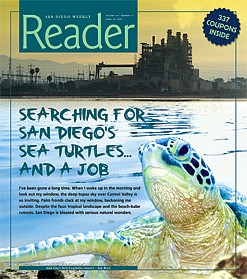
Searching for San Diego's Sea Turtles and a Job
Why are they here? Why are we?
I’ve been gone a long time. When I wake up in the morning and look out my window, the deep topaz sky over Carmel Valley is so inviting. Palm fronds clack at my window, beckoning me outside. Despite the faux tropical landscape and the beach-babe cutouts, San Diego is bloated with serious natural wonders.
One sunny day I make plans to go snorkeling with my sister and her kids at the Cove. It is noon, the seagulls yelp, the kelp glows amber. Despite the fact that it is a Monday, it’s crowded and I can’t find a spot on the beach. Squished between cliff walls and surrounded by five different towels, each its own fiefdom, I manage to situate myself semi-comfortably in my area for a while, watching an ambiguously European family spray some aerosol substance all over each other. The youngest son seems more interested in the BBQ-flavor Pringles than the scenery.
I waddle into the sparkling ocean waters and maneuver my way through fins and swim trunks. Suddenly one guy turns toward me and gurgles through his snorkel-face, “There’s a sea turtle!” There it is, fins flapping away, slowly disappearing into the watery blue shadows, elusive yet adorable. It wouldn’t have been more magical if we had just seen a unicorn. Even though I was born and raised in San Diego, I had never seen or heard of sea turtles here.
And so my summer ended in San Diego. I had no job and was completely broke. It was only two weeks since I had moved back into my parents’ house after living in San Francisco.
I have a lot of pressure to realize the American dream. My father is Syrian, my mother is American. Ever since I was a kid I have been told how great it is to be an Atassi. I’m told that being an Atassi in Syria is something akin to being a Kennedy in America. Sure, we’ve had our share of Syrian presidents in the past, but these days Atassis are getting ridiculously educated abroad. We have even published books about our great legacy. In fact, someone has put them in the University of Michigan Dearborn Library.
Being an Atassi heiress is something I might mention casually to boyfriends to mix things up. It’s a convenient parlor trick. I even got complimentary baklava once.
It’s difficult to explain my obscure interests and myriad hobbies, such as solving the turtle mystery, to my family. I do some research and find that it is actually an Eastern Pacific green turtle with a distribution typically between 30 degrees north and 30 degrees south. San Diego is right outside this range. Was that turtle I saw smuggled home over the Mexican border in a suitcase packed with novelty-size sombrero hats and artisan ceramics? All it would take is one accidental spill down the storm drain for a clutch of eggs to spawn an exotic species.
San Diego is home to a thriving and established colony of approximately 60 turtles. There are several stories explaining their origins.
One story describes the sea turtles as renegades busted free from turtle-meat farms where they awaited slaughter during the earlier half of the 20th Century. Another eerily posits the turtles being attracted to the warm-water canals of the power plant in south San Diego Bay.
Sandwiched between Interstate 5 and the South Bay, the electric power plant sits on the edge of the Sweetwater Marsh National Wildlife Refuge. This complicates things because it seems these endangered sea turtles are protected in an area where they exist artificially. To a species swimming around, foraging for eel grass and generally being turtles, it makes no difference.
I call ecologist Jeff Seminoff at the Marine Turtle Research Program for the Southwest Fisheries Science Center. According to his findings, the turtles are in the bay for the bounty of eel grass. That thing about tropical power-plant waters is a rumor, he says. He goes on to explain that sea turtles travel thousands of miles foraging for food. The Navy plants eel grass out in the Bay.
“Imagine you are a sea turtle,” he says. “Wouldn’t you stay here, too?”
He seems rushed, and we don’t get to talk much before the phone conversation ends. His obvious explanation doesn’t explain why there are so many stories about the turtles.
One day, back in San Francisco, I was having a chat with my fun-loving boss, Mustafa. He owned Cafe du Soleil, where I worked as a barista. Mustafa held a wad of receipts in one hand and used the other to pour beer from the tap. The foam spilled onto the bills, when he said to me, “You’re young, you don’t need to be so serious. Just go have fun, get yourself a boyfriend or two, get yourself a girlfriend — I’m not the kind to judge — enjoy yourself. I’m stuck here, I gotta go down to city hall, I gotta get some papers signed, the kids are driving me nuts, the customers…”
I sold everything I owned and flew to South America.
My parents reminded me I was running out of money, but I explained that the exchange rate would actually make me better off. All I needed was my backpack.
When I came home, my dad took me to Syria. It was a bummer. The idea of getting married was brought up by relatives between suggestions about grad school. Why wasn’t I pursuing a profession or an engagement, the family asked. There was a cousin in Ukraine asking about me, and another man in Alberta, they said with optimism.
This was nothing new. While I was away in San Francisco, I would call home when I desperately needed cash. If I needed to see the dentist, my dad would suggest I marry one. There was a husband for whatever professional service was needed.
“There is a man in San Francisco asking about you,” he would say. “He just bought a Lexus, new!”
According to my dad, marriage would solve any of the self-inflicted headaches I was experiencing. Turning down marriage was as ludicrous as turning down free health insurance, which I still don’t have, free or otherwise.
I am living at home with my parents. Since I’m not about to move to a commune, I need to figure out how to get some cash without turning into a complete square who hates her job.
I spend days driving around looking for work, thinking about all the evil gas I am guzzling and how San Francisco is far superior in that regard. But I am in suburbia now, a tedious place to walk. Freeways, roads, neighborhood associations, these are the things responsible for my new habit of driving anywhere and everywhere. I’ve put on a couple of pounds, too, since lately I’ve been so well fed. Another reason to hate paradise.
“San Diego has high rates of car theft because there are too many roads,” I might hypothesize. “If you want to fight crime, plant trees. Turn highways into blooming oxen trails. Down with cars, down with crime, down with loneliness!”
One hot afternoon, while no one is home, I let myself weep during a particularly moving segment of a NOVA television special. There is a shot of the Earth from the perspective of the moon. A scientist says he hasn’t stopped thinking about the human genome for the past five years. It is followed by a clip of him saying, “After that photo was taken of our delicate little planet sailing through the universe, humanity began to see itself differently.” The scientist used succinct terms like “recombination” and “linkage.”
One of the special things about sea turtles in San Diego is that they are residents, not wanderers. I visit Victoria Touchstone, conservation planner for the San Diego National Wildlife Complex. The complex is a series of nature refuges scattered between Orange County and Tijuana. Their offices are in Carlsbad.
Despite being located in a sleek business park, the interior of administrative headquarters gives the feel of a park ranger station, from the decor in shades of brown down to the government-rationed bulletin board. Victoria greets me wearing full ranger garb. She is also wearing gold earrings depicting marshland birds. Under her arm is the refuge plan, a thick binder with a small section about the resident sea turtles.
“The issue you have is that you save these small pockets of habitat that are as natural as you can get them,” she says while flipping through the binder. “All the species are competing against...amongst themselves to try to survive.”
That sounds like my job search. Victoria is aware of the different stories explaining about the sea turtles living in San Diego Bay.
“I like to think — but I am a big turtle fan anyway — that even if the power plant goes away, the turtles are gonna stick around.”
Victoria is not a biologist. She is a writer. She knows all the tiny details about the conservation plan, from the sea turtles to the nesting habits of the California least terns. What is the point of habitat conservation? Why does she care about the green sea turtles or the California least tern? She pauses for a minute.
“You tug on this piece of the web and it all moves, so you have to look at that too. I don’t know if the California least tern has some effect on us all, but I think it does.”
Later that week, things improve when I am hired at a breezy café situated along Highway 101. The inside is decorated with surfboards, giant pink conch shells, and palm fronds to accent the happily tanned employees. I might as well do San Diego all the way, I think, and put on some corduroy shorts.
On my first day, I notice the manager’s habit of saying “No worries.” I wonder about the sorts of worries I could be having while spreading peanut butter on bagels and fastening plastic monkeys onto smoothie straws. After receiving winks from old surfer dudes, I make a brash decision.
I quit that first day, with hopes of finding something better. Emboldened by my quitter’s high, I come home with the ambition to make a statement. I am sick of being a customer-service whore. I am going to shave my head.
I call my younger sister Nedda, who lives in San Francisco. I tell her I am bald.
She scoffs through the phone, “So, you’re one of those feminists?”
This is not the reaction I want. I tell her I am not actually bald.
“What do you mean you aren’t bald? Why did you tell me you’re bald?”
“I’ve just been thinking about it,” I say, fishing for some sort of encouragement. “I’m not bald yet.”
“Well, good, because you already dress pretty ugly. People will think you’re a dyke.”
“But I want people to think I’m a dyke, if that is the only way to be taken seriously. I’m thinking forward.”
“What?”
My sister’s doubts are annoying, but I don’t want to shave my head anyway. I hang up and go online to look for a job.
I am contacted on Facebook by the prospective groom in Alberta. He would like to chat. My aunt has already told me everything I need to know, namely his family legacy and that he is studying to get his Ph.D. By my family’s standards, he is a real catch. She also informs me that he is looking for someone who is Westernized.
I block him from my profile and continue scouring the web for office jobs on craigslist.
Hundreds of ads solicit self-motivated data clerks and undervalued team players. Since I’m neither, I conclude that I am not ready to wear business drab yet. I continue scrounging around at the bottom of the service industry, not quite sure where I fit. I take a break and dream of turtles.
They once were so abundant in the Pacific that flotillas of migrating turtles in Baja waters would slow navigators. Surrounded by the swarms, it wouldn’t have required more than an afterthought for 17th- and 18th-century pirates and explorers to eat this unassuming prey. By 1920, up to 1000 sea turtles were being shipped to San Diego restaurants on a weekly basis.
I find a job at a sushi restaurant minutes away from my house. It’s in the Del Mar Highlands Town Center, the fancifully named strip mall. My official title is server, and I have to share 40 percent of my tips with the master sushi chef, but at least this job is within walking distance. There is another server in the same situation as I, a college graduate with a degree in anthropology.
Much of my job entails dumping plates of uneaten sushi into a large plastic tub. It is spotted with rainbow flecks of sea life. I ask myself how many fish have ended up here, eons of evolution halted by nibbling trophy wives. Getting in my car after my closing shift one night, I lick something sticky off my knuckles and find it to be eel sauce splatters. I am vegetarian.
So I quit my job and think about marriage. At this point in time, my goal is to acquire money. I would never be a prostitute, but it is the same as working at a job I can’t stand. America suggests that I take the highest-paying job, despite how lame it is. At least with marriage, I could throw in some home decorating and get elaborate with the baking, which would make it fun.
Driving to my sister’s apartment in Imperial Beach, my mom and I chat about finding work. She is supportive of me but thinks I should get some sort of temp position. Maybe at the real-estate company where she used to work. It is a long drive. Then, tucked between Interstate 5 and the South Bay waters, I see the power plant rising up out of the marsh with electrical lines draped over the marsh.
I know a job is never permanent, but how many people start working as a temp and end up getting sucked into spending the rest of their lives dreaming about the weekend? Exactly.
I decide to be more direct in my job search and head to a neighborhood I like. I spend half a day pounding the pavement on University Avenue. I have one résumé left when I spot something promising.
I see a busy café with yoga types stretching and hipsters leaning on things outside. Vanilla and hot sweetness greet my tired nose. Cinnamon rolls sit on the front counter. One is missing from the pan. Already, I can see myself flinging open the curtains with the rise of the sun and pouring second helpings of coffee into cold, empty mugs.
A large man, the manager, smiles and walks toward me. The last job I enjoyed was at a place just like this, crowded and warm. We talk about the fresh homemade bread. He needs a barista. I can pour hearts and fern leaves into latte foam.
The manager herds me through the maze of packed tables and darting elbows over to the bar to fill out an application, my lucky break! A girl with pink hair sitting at the next stool over wishes me luck through a syrupy mouthful of pancakes. I thank her and think, You’re a sign!
He comes back and I hand over my application, with bubbly dots over each i.
He thanks me and says he needs to fax my app over to corporate. He says human resources will call me back to schedule an interview.
Wasn’t this the interview? I write him off as one more plebe following another management script. I am more than a résumé. I don’t get the job.
The weather is freakishly nice, so I take a walk through the pristine desolation of my neighborhood. Houses look the same, row after row, punctuated by a crystal studded license plate frame on an Escalade that reads “Spoiled Rotten.” Joggers wear technologically advanced shorts sporting labels such as Clima Cool. A woman with a securely fastened ponytail pushing an all-terrain stroller jogs by, her small child sipping from a bubbly green bottle of Perrier. This is the dream and I don’t get it.
The next morning I drive down to Sweetwater Marsh, the refuge closest to the power plant where the turtles were first spotted.
I navigate streams of rush-hour traffic winding down from North County to Chula Vista. When I approach the entrance gate, I slow my car to 5 mph. A light-footed clapper rail darts across the road. Looking closely, I see these birds are everywhere, their long necks barely stretching above the thicket. A man dressed in taupe crawls quietly through the terrain. After parking, I walk lightly so as not to disturb.
I am greeted by the sandy-haired refuge manager, Don Brubaker, who informs me that the biologist I was scheduled to meet has broken out with a rash and couldn’t make it this morning. We step up to the management trailers to survey the misty expanse. He tells me that things have changed a lot since the Kumeyaay Indians first used this site. Brubaker pauses to mention the most important feature. “As you can see, this site has a nice view of the bay.”
Brubaker tells me that the particular area we are looking at is named Gunpowder Point, where kelp was once harvested and processed to make gunpowder during World War I.
Today you can see the boxed buildings lining the Silver Strand. Brubaker looks out across the water and tells me that at one point you could have sailed a boat straight out to the ocean. To our left is the power plant, and to our right is a shipping dock.
There are trails meandering through the shrubs of the marshland. I can hear tiny bird tweets coming from the bushes around us over the din of the distant freeway.
“All this development,” he points to the sidewalks, “is for people to come out and see history, to hear a Caspian bird call. Do you hear that? Those are juveniles.”
Hearing a bird call is a lot like experiencing history. It puts things into perspective. The bay has changed, and so have the wildlife populations. I ask him about the green sea turtles living in the refuge.
He tells me that they are attracted to the warm water around the power plant.
This takes me back to the beginning. It is hard to know why the turtles are here. They just are.
Here's something you might be interested in.
Searching for San Diego's Sea Turtles and a Job
Why are they here? Why are we?

Searching for San Diego's Sea Turtles and a Job
Why are they here? Why are we?
I’ve been gone a long time. When I wake up in the morning and look out my window, the deep topaz sky over Carmel Valley is so inviting. Palm fronds clack at my window, beckoning me outside. Despite the faux tropical landscape and the beach-babe cutouts, San Diego is bloated with serious natural wonders.
One sunny day I make plans to go snorkeling with my sister and her kids at the Cove. It is noon, the seagulls yelp, the kelp glows amber. Despite the fact that it is a Monday, it’s crowded and I can’t find a spot on the beach. Squished between cliff walls and surrounded by five different towels, each its own fiefdom, I manage to situate myself semi-comfortably in my area for a while, watching an ambiguously European family spray some aerosol substance all over each other. The youngest son seems more interested in the BBQ-flavor Pringles than the scenery.
I waddle into the sparkling ocean waters and maneuver my way through fins and swim trunks. Suddenly one guy turns toward me and gurgles through his snorkel-face, “There’s a sea turtle!” There it is, fins flapping away, slowly disappearing into the watery blue shadows, elusive yet adorable. It wouldn’t have been more magical if we had just seen a unicorn. Even though I was born and raised in San Diego, I had never seen or heard of sea turtles here.
And so my summer ended in San Diego. I had no job and was completely broke. It was only two weeks since I had moved back into my parents’ house after living in San Francisco.
I have a lot of pressure to realize the American dream. My father is Syrian, my mother is American. Ever since I was a kid I have been told how great it is to be an Atassi. I’m told that being an Atassi in Syria is something akin to being a Kennedy in America. Sure, we’ve had our share of Syrian presidents in the past, but these days Atassis are getting ridiculously educated abroad. We have even published books about our great legacy. In fact, someone has put them in the University of Michigan Dearborn Library.
Being an Atassi heiress is something I might mention casually to boyfriends to mix things up. It’s a convenient parlor trick. I even got complimentary baklava once.
It’s difficult to explain my obscure interests and myriad hobbies, such as solving the turtle mystery, to my family. I do some research and find that it is actually an Eastern Pacific green turtle with a distribution typically between 30 degrees north and 30 degrees south. San Diego is right outside this range. Was that turtle I saw smuggled home over the Mexican border in a suitcase packed with novelty-size sombrero hats and artisan ceramics? All it would take is one accidental spill down the storm drain for a clutch of eggs to spawn an exotic species.
San Diego is home to a thriving and established colony of approximately 60 turtles. There are several stories explaining their origins.
One story describes the sea turtles as renegades busted free from turtle-meat farms where they awaited slaughter during the earlier half of the 20th Century. Another eerily posits the turtles being attracted to the warm-water canals of the power plant in south San Diego Bay.
Sandwiched between Interstate 5 and the South Bay, the electric power plant sits on the edge of the Sweetwater Marsh National Wildlife Refuge. This complicates things because it seems these endangered sea turtles are protected in an area where they exist artificially. To a species swimming around, foraging for eel grass and generally being turtles, it makes no difference.
I call ecologist Jeff Seminoff at the Marine Turtle Research Program for the Southwest Fisheries Science Center. According to his findings, the turtles are in the bay for the bounty of eel grass. That thing about tropical power-plant waters is a rumor, he says. He goes on to explain that sea turtles travel thousands of miles foraging for food. The Navy plants eel grass out in the Bay.
“Imagine you are a sea turtle,” he says. “Wouldn’t you stay here, too?”
He seems rushed, and we don’t get to talk much before the phone conversation ends. His obvious explanation doesn’t explain why there are so many stories about the turtles.
One day, back in San Francisco, I was having a chat with my fun-loving boss, Mustafa. He owned Cafe du Soleil, where I worked as a barista. Mustafa held a wad of receipts in one hand and used the other to pour beer from the tap. The foam spilled onto the bills, when he said to me, “You’re young, you don’t need to be so serious. Just go have fun, get yourself a boyfriend or two, get yourself a girlfriend — I’m not the kind to judge — enjoy yourself. I’m stuck here, I gotta go down to city hall, I gotta get some papers signed, the kids are driving me nuts, the customers…”
I sold everything I owned and flew to South America.
My parents reminded me I was running out of money, but I explained that the exchange rate would actually make me better off. All I needed was my backpack.
When I came home, my dad took me to Syria. It was a bummer. The idea of getting married was brought up by relatives between suggestions about grad school. Why wasn’t I pursuing a profession or an engagement, the family asked. There was a cousin in Ukraine asking about me, and another man in Alberta, they said with optimism.
This was nothing new. While I was away in San Francisco, I would call home when I desperately needed cash. If I needed to see the dentist, my dad would suggest I marry one. There was a husband for whatever professional service was needed.
“There is a man in San Francisco asking about you,” he would say. “He just bought a Lexus, new!”
According to my dad, marriage would solve any of the self-inflicted headaches I was experiencing. Turning down marriage was as ludicrous as turning down free health insurance, which I still don’t have, free or otherwise.
I am living at home with my parents. Since I’m not about to move to a commune, I need to figure out how to get some cash without turning into a complete square who hates her job.
I spend days driving around looking for work, thinking about all the evil gas I am guzzling and how San Francisco is far superior in that regard. But I am in suburbia now, a tedious place to walk. Freeways, roads, neighborhood associations, these are the things responsible for my new habit of driving anywhere and everywhere. I’ve put on a couple of pounds, too, since lately I’ve been so well fed. Another reason to hate paradise.
“San Diego has high rates of car theft because there are too many roads,” I might hypothesize. “If you want to fight crime, plant trees. Turn highways into blooming oxen trails. Down with cars, down with crime, down with loneliness!”
One hot afternoon, while no one is home, I let myself weep during a particularly moving segment of a NOVA television special. There is a shot of the Earth from the perspective of the moon. A scientist says he hasn’t stopped thinking about the human genome for the past five years. It is followed by a clip of him saying, “After that photo was taken of our delicate little planet sailing through the universe, humanity began to see itself differently.” The scientist used succinct terms like “recombination” and “linkage.”
One of the special things about sea turtles in San Diego is that they are residents, not wanderers. I visit Victoria Touchstone, conservation planner for the San Diego National Wildlife Complex. The complex is a series of nature refuges scattered between Orange County and Tijuana. Their offices are in Carlsbad.
Despite being located in a sleek business park, the interior of administrative headquarters gives the feel of a park ranger station, from the decor in shades of brown down to the government-rationed bulletin board. Victoria greets me wearing full ranger garb. She is also wearing gold earrings depicting marshland birds. Under her arm is the refuge plan, a thick binder with a small section about the resident sea turtles.
“The issue you have is that you save these small pockets of habitat that are as natural as you can get them,” she says while flipping through the binder. “All the species are competing against...amongst themselves to try to survive.”
That sounds like my job search. Victoria is aware of the different stories explaining about the sea turtles living in San Diego Bay.
“I like to think — but I am a big turtle fan anyway — that even if the power plant goes away, the turtles are gonna stick around.”
Victoria is not a biologist. She is a writer. She knows all the tiny details about the conservation plan, from the sea turtles to the nesting habits of the California least terns. What is the point of habitat conservation? Why does she care about the green sea turtles or the California least tern? She pauses for a minute.
“You tug on this piece of the web and it all moves, so you have to look at that too. I don’t know if the California least tern has some effect on us all, but I think it does.”
Later that week, things improve when I am hired at a breezy café situated along Highway 101. The inside is decorated with surfboards, giant pink conch shells, and palm fronds to accent the happily tanned employees. I might as well do San Diego all the way, I think, and put on some corduroy shorts.
On my first day, I notice the manager’s habit of saying “No worries.” I wonder about the sorts of worries I could be having while spreading peanut butter on bagels and fastening plastic monkeys onto smoothie straws. After receiving winks from old surfer dudes, I make a brash decision.
I quit that first day, with hopes of finding something better. Emboldened by my quitter’s high, I come home with the ambition to make a statement. I am sick of being a customer-service whore. I am going to shave my head.
I call my younger sister Nedda, who lives in San Francisco. I tell her I am bald.
She scoffs through the phone, “So, you’re one of those feminists?”
This is not the reaction I want. I tell her I am not actually bald.
“What do you mean you aren’t bald? Why did you tell me you’re bald?”
“I’ve just been thinking about it,” I say, fishing for some sort of encouragement. “I’m not bald yet.”
“Well, good, because you already dress pretty ugly. People will think you’re a dyke.”
“But I want people to think I’m a dyke, if that is the only way to be taken seriously. I’m thinking forward.”
“What?”
My sister’s doubts are annoying, but I don’t want to shave my head anyway. I hang up and go online to look for a job.
I am contacted on Facebook by the prospective groom in Alberta. He would like to chat. My aunt has already told me everything I need to know, namely his family legacy and that he is studying to get his Ph.D. By my family’s standards, he is a real catch. She also informs me that he is looking for someone who is Westernized.
I block him from my profile and continue scouring the web for office jobs on craigslist.
Hundreds of ads solicit self-motivated data clerks and undervalued team players. Since I’m neither, I conclude that I am not ready to wear business drab yet. I continue scrounging around at the bottom of the service industry, not quite sure where I fit. I take a break and dream of turtles.
They once were so abundant in the Pacific that flotillas of migrating turtles in Baja waters would slow navigators. Surrounded by the swarms, it wouldn’t have required more than an afterthought for 17th- and 18th-century pirates and explorers to eat this unassuming prey. By 1920, up to 1000 sea turtles were being shipped to San Diego restaurants on a weekly basis.
I find a job at a sushi restaurant minutes away from my house. It’s in the Del Mar Highlands Town Center, the fancifully named strip mall. My official title is server, and I have to share 40 percent of my tips with the master sushi chef, but at least this job is within walking distance. There is another server in the same situation as I, a college graduate with a degree in anthropology.
Much of my job entails dumping plates of uneaten sushi into a large plastic tub. It is spotted with rainbow flecks of sea life. I ask myself how many fish have ended up here, eons of evolution halted by nibbling trophy wives. Getting in my car after my closing shift one night, I lick something sticky off my knuckles and find it to be eel sauce splatters. I am vegetarian.
So I quit my job and think about marriage. At this point in time, my goal is to acquire money. I would never be a prostitute, but it is the same as working at a job I can’t stand. America suggests that I take the highest-paying job, despite how lame it is. At least with marriage, I could throw in some home decorating and get elaborate with the baking, which would make it fun.
Driving to my sister’s apartment in Imperial Beach, my mom and I chat about finding work. She is supportive of me but thinks I should get some sort of temp position. Maybe at the real-estate company where she used to work. It is a long drive. Then, tucked between Interstate 5 and the South Bay waters, I see the power plant rising up out of the marsh with electrical lines draped over the marsh.
I know a job is never permanent, but how many people start working as a temp and end up getting sucked into spending the rest of their lives dreaming about the weekend? Exactly.
I decide to be more direct in my job search and head to a neighborhood I like. I spend half a day pounding the pavement on University Avenue. I have one résumé left when I spot something promising.
I see a busy café with yoga types stretching and hipsters leaning on things outside. Vanilla and hot sweetness greet my tired nose. Cinnamon rolls sit on the front counter. One is missing from the pan. Already, I can see myself flinging open the curtains with the rise of the sun and pouring second helpings of coffee into cold, empty mugs.
A large man, the manager, smiles and walks toward me. The last job I enjoyed was at a place just like this, crowded and warm. We talk about the fresh homemade bread. He needs a barista. I can pour hearts and fern leaves into latte foam.
The manager herds me through the maze of packed tables and darting elbows over to the bar to fill out an application, my lucky break! A girl with pink hair sitting at the next stool over wishes me luck through a syrupy mouthful of pancakes. I thank her and think, You’re a sign!
He comes back and I hand over my application, with bubbly dots over each i.
He thanks me and says he needs to fax my app over to corporate. He says human resources will call me back to schedule an interview.
Wasn’t this the interview? I write him off as one more plebe following another management script. I am more than a résumé. I don’t get the job.
The weather is freakishly nice, so I take a walk through the pristine desolation of my neighborhood. Houses look the same, row after row, punctuated by a crystal studded license plate frame on an Escalade that reads “Spoiled Rotten.” Joggers wear technologically advanced shorts sporting labels such as Clima Cool. A woman with a securely fastened ponytail pushing an all-terrain stroller jogs by, her small child sipping from a bubbly green bottle of Perrier. This is the dream and I don’t get it.
The next morning I drive down to Sweetwater Marsh, the refuge closest to the power plant where the turtles were first spotted.
I navigate streams of rush-hour traffic winding down from North County to Chula Vista. When I approach the entrance gate, I slow my car to 5 mph. A light-footed clapper rail darts across the road. Looking closely, I see these birds are everywhere, their long necks barely stretching above the thicket. A man dressed in taupe crawls quietly through the terrain. After parking, I walk lightly so as not to disturb.
I am greeted by the sandy-haired refuge manager, Don Brubaker, who informs me that the biologist I was scheduled to meet has broken out with a rash and couldn’t make it this morning. We step up to the management trailers to survey the misty expanse. He tells me that things have changed a lot since the Kumeyaay Indians first used this site. Brubaker pauses to mention the most important feature. “As you can see, this site has a nice view of the bay.”
Brubaker tells me that the particular area we are looking at is named Gunpowder Point, where kelp was once harvested and processed to make gunpowder during World War I.
Today you can see the boxed buildings lining the Silver Strand. Brubaker looks out across the water and tells me that at one point you could have sailed a boat straight out to the ocean. To our left is the power plant, and to our right is a shipping dock.
There are trails meandering through the shrubs of the marshland. I can hear tiny bird tweets coming from the bushes around us over the din of the distant freeway.
“All this development,” he points to the sidewalks, “is for people to come out and see history, to hear a Caspian bird call. Do you hear that? Those are juveniles.”
Hearing a bird call is a lot like experiencing history. It puts things into perspective. The bay has changed, and so have the wildlife populations. I ask him about the green sea turtles living in the refuge.
He tells me that they are attracted to the warm water around the power plant.
This takes me back to the beginning. It is hard to know why the turtles are here. They just are.
Comments