

Here's something you might be interested in.
Ask a Hipster — Advice you didn't know you needed
Big Screen — Movie commentary
Blurt — Music's inside track
Booze News — San Diego spirits
Classical Music — Immortal beauty
Classifieds — Free and easy
Close to Home — What it’s like on the street where you live
Cover Stories — Front-page features
Drinks All Around — Bartenders' drink recipes
Excerpts — Literary and spiritual excerpts
Feast! — Food & drink reviews
Feature Stories — Local news & stories
Fishing Report — What’s getting hooked from ship and shore
From the Archives — Spotlight on the past
Golden Dreams — Talk of the town
The Gonzo Report — Making the musical scene, or at least reporting from it
Letters — Our inbox
Movies@Home — Local movie buffs share favorites
Movie Reviews — Our critics' picks and pans
Musician Interviews — Up close with local artists
Neighborhood News from Stringers — Hyperlocal news
News Ticker — News & politics
Obermeyer — San Diego politics illustrated
Outdoors — Weekly changes in flora and fauna
Overheard in San Diego — Eavesdropping illustrated
Poetry — The old and the new
Reader Travel — Travel section built by travelers
Reading — The hunt for intellectuals
Roam-O-Rama — SoCal's best hiking/biking trails
San Diego Beer — Inside San Diego suds
SD on the QT — Almost factual news
Sheep and Goats — Places of worship
Special Issues — The best of
Street Style — San Diego streets have style
Surf Diego — Real stories from those braving the waves
Theater — On stage in San Diego this week
Tin Fork — Silver spoon alternative
Under the Radar — Matt Potter's undercover work
Unforgettable — Long-ago San Diego
Unreal Estate — San Diego's priciest pads
Your Week — Daily event picks
San Diego's Superhero is sick of the crime
The making of Xtreme Man, our protector
A baby wails its first song in an unexceptional San Diego hospital. Doctors notice nothing special or unusual about the child. No clerics have wandered to greet him; no comets or meteor showers threaten Earth’s atmosphere or orbit; there are no earthquakes. No great genetic mutations have been recorded, nor have there been recent leaps in weaponry or nuclear technology. It is hardly a superhero’s arrival. Scientific advancements of the time include commercially available computers, which are apartment-sized. NASA engineers are nearing completion of the prototype space shuttle Enterprise. Paleontologists pick over the bones of “Lucy,” a skeletal specimen of an extinct hominid classified as Australopithecus afarensis. Political lines and powers are as stable as political lines and powers can be. That night, California Governor Jerry Brown and San Diego Mayor Pete Wilson each presumably sleep with no notice of the newborn baby boy.
Pass ten years.
The boy’s father treats him harshly, as some fathers do, whether to denigrate or inspire the child, only the father knows. “Use your head,” the father pleads, exasperated. “Don’t you have any common sense?” When the boy stands up for another round of dinner, his father casts a judgmental eye. “Maybe that’s why you look the way you do.”
Through their working-class neighborhood, the boy walks to and from school. He earns no better than average grades. Socially, he’s alone. Onlookers define him by his weight, the only characteristic about him that exceeds. He dresses similarly to his peers, but there the comparison ends. He ostracizes himself in deed and demeanor. Entering adolescence, he lags a shade behind. To encounters he brings awkwardness; internally, he struggles with the pain of interaction. Uninterested in athletics, he develops no sports skills and therefore can claim neither victories nor defeats nor the accomplishment of confidence. The lessons elude him.
As others grow taller and stronger, he grows apart, eating alone, walking alone; in a classroom filled with others, still he’s cleaved of them. After the final bell rings, he lopes toward his family home. Along the way he is bullied. Two young men mock and insult him. They knock his tin Muppets lunchbox from his hand. They punch him. He’s unharmed, though, and finally the older boys let him go, realizing he threatens no one, especially them. The child retreats further within.
Meanwhile, the population of San Diego breaks the one million mark. Crime increases. Instances of larceny and property theft jump by thousands. By 1986, street gangs have learned the lucrative process of converting cocaine into crack. California and the Federal government have yet to ban assault weapons. Drive-by shootings proliferate.
Age the boy forward two years. 1988. Not quite teenaged, he’s retreated further from the world outside his windows. Anything but reality. Action movies and comic books soothe his angst. Is it any wonder? In fantasy, the underdog comes from behind; the normal are transformed into extraordinary; revenge is sought and extracted from persecutors of the innocent and unassuming. One of his favorite films is They Still Call Me Bruce, a karate farce flick ladled with puns and stereotypes, featuring an affable, bumbling lead. The Teenage Mutant Ninja Turtles cartoon series tethers him to the television.
His one connection to the city around him comes from the newspaper. He clips articles of crime and punishment and collects them. Soon his collection more than doubles. He no longer saves the articles, he only reads them now, internalizes them.
Crime is reality. South of the outcast child’s neighborhood 300 citizens protest the wave of violence by taking to Market Street and marching; some carry cardboard coffins as symbols of the killings. After the march, assailants in a passing automobile shoot a man in the leg. At a National Conference on Crime, San Diego Mayor Maureen O’Connor admits, “We are losing ground in the war against drugs.”
Six months thence, in the summer of 1989, the end of the decade of decadence draws nigh. Mayor O’Connor asks Governor George Deukmejian to declare a state of emergency in San Diego and to commit $34 million in state funds to combating drug deals and shootings in her city. Governor Deukmejian declines the request. San Diego swirls in a whirlpool tide of crime.
See the boy in high school, a teenager now. Accustomed to eating alone, on a lawn, on a curb, a park bench. Accustomed to walking alone. He orbits popular teenage culture as the Earth does the sun; gravity holds him to it, light from it reaches him, he understands but can never touch it. His presence affects it very little.
On his way home from school again. Two older boys again. Different boys this time, but still taller than he. Again. This time, they’re dressed in the matching red shirts that denote the Bloods street gang. The boys mock him. Punch him, just like before. One has a knife, but it only flashes in the sunlight, never jumps from the waistband where it lives. They order him to take off his shirt, bare his globular flesh to the light of day, bare his shame. The misfit teenager remains unharmed; the older boys let him pass. The pariah teen seeks solace in fantasy justice, more movies and comics, as an answer to his welling distaste for street crime.
By 1993, every community in San Diego lives with the fear of crime, some streets and districts more than others. City Heights’ violent crime rate surpasses the citywide rate by more than double: there are 29 violent crimes for every 1000 City Heights residents, 13 violent crimes for every 1000 San Diegans of other neighborhoods. The citywide crime index, which includes all crime, violent or not, levels out at 72.75 incidents per 1000 people. Mayor Susan Golding endorses a plan for brighter white streetlights downtown and temporary expansion of city police walking patrols.
Graduation for the loner. A maintenance job for the boy who is becoming a man. His father eases his harsh treatment of the young man; he is no longer just a doughy child in the eyes of his dad. At night, he studies plumbing and electrical at a junior college. He studies security. He tests to obtain a license in security and passes; California awards him a guard card. He enjoys the Mighty Morphin’ Power Rangers. He still follows crime news.
In 2002, San Diego crime rates drop to half of what they were a decade before.
In this year, on the first Friday in February, a man, Damon van Dam, tucks his daughter Danielle into bed. Danielle wears tiny Mickey Mouse earrings. The father never again sees his daughter alive. The following Monday, David Westerfield returns home. He lives in the same neighborhood as the van Dams, and his RV gleams, freshly washed after desert camping. Monday, a jacket is discovered at the dry cleaners. Some of Danielle’s blood now resides outside her seven-year-old body; some of it clings to the jacket, some to the RV.
Weeks later, search volunteers discover Danielle’s partially charred body, everything except a foot.
What follows is a trial like a volcano. Many things erupt from it: media attention, child pornography, an angry son, divested parents, sexual partners, alarms, shouts, tears…viscera. Entomologists testify about the maggots found in Danielle’s head. David Westerfield’s niece testifies that when she was a child, she awoke one night to find him with his finger rubbing her teeth. The ugliest of man’s abject compulsions burst outward. Streams of it run in the city streets, and the details are relayed across the country in news reports. The event sickens and saddens many, our socially inept security guard included.
March 1, 2002, Lincoln Park, a gun battle erupts along Logan Avenue. José Misael Alegria-Uribe and Larson Tufi, teenaged boys, lose their lives that day. Wounded and running, José collapses and dies near the doorway of Dr. J’s liquor store.
January 1, 2003, Lincoln Park, a crowd of New Year’s revelers mills about. A car stops, young men armed with guns disembark the vehicle and open fire, injuring four people and killing two women, Carol Waites and Sharen Burton, in the parking lot of Dr. J’s liquor store.
May 1, 2003, Lincoln Park, schoolchildren find a body in a pool of blood in the back room of Dr. J’s liquor store. The body is that of Eddie Meram, owner of Dr. J’s liquor store.
Our man follows the news as closely as ever. He reads of the innocent dead that lie stricken, shot in the head, chest, and legs. Bullets bite and tear flesh like an inimical creature commanded by wicked boys. Our man reads on. He leaves his maintenance job for full-time security work.
Advance three years. Three years of reading the news, watching action movies, and daydreaming of comic-book heroes. Twice he leaves his father’s house, and twice he returns, swatted back by an unforgiving city. He’s now approaching his 30th year under the same stars that never afforded him superiority or alien abilities. Neither science nor providence has supplied to him magical or technological bracelets, lassos, capes, belts, glasses, superlative strength, or heightened senses. He would be painfully normal if he weren’t so cast down. Still, in spite of his awkwardness, he wonders if he can’t insert himself into the fabric, the porous boundary, between the innocent and the criminal. It’s 2006 now, and already so much time has marched on without him. He wonders if he can change the course of wrongdoing.
Wait, though.
To understand our man, we have to understand his influences. Now he searches for an out-of-print comic, The Human Fly. Marvel comics printed 19 issues of The Human Fly from 1977 to 1979. It details the fantastic exploits of a stuntman, and its pages feature photographs of a real, live stuntman in the superhero’s crimson costume. The stuntman of the book is Rick Rojatt. He captured America’s attention and inspired the creation of the eponymous comic-book line, by wing-walking on a DC8 over the Mojave Desert. In real life, he jumps buses on a rocket motorcycle; in the comic, his illustrated avatar battles a campy arch-criminal named Copperhead. The book’s tagline reads: “The Wildest Super-Hero Ever — Because He’s Real!”
This fate swarms our man, our awkward guard. This fate: real-life superhero.
Through his family’s computer he finds a network of others like our guard: the World Superhero Registry at worldsuperheroregistry.com.
He creates a persona known as “the Nag.”
Mr. Xtreme
I meet the guard, the hero of this story, at a coffee shop to talk to him.
“Why ‘the Nag’?”
“Because I nagged the criminals, I nagged the cops to do something; I was a thorn in everyone’s side,” he tells me.
“Did you ever patrol as the Nag? Were you ever in any scuffles?”
“No, I just made a MySpace page. Oh, also I called myself the Nag because of the group known as the NAGs in the movie They Still Call Me Bruce. The name was inspired by them.”
Those NAGs were a band of citizen enforcers, modeled after the Guardian Angels, famous from 1980s New York.
The Guardian Angels
In 1979, a McDonald’s night manager formed a group known as the “Magnificent 13” and began patrols of New York City subways. The original group of 13 grew to 48 as newspaper reports rolled out about the group’s protectionism — 48 young men and women in red berets. They stomp the vomit of night trains with heavy combat boots. Time magazine publishes an affectionate and outlandish article detailing an incident in which members of the Magnificent 13 stopped six men from raping a woman, noting that the leader of the Magnificent 13 patrol disabled the shotgun-bearing attacker with a “kung fu kick to the head.”
Numbers of the Magnificent 13 swell beyond the 48, and the group changes its name to the “Guardian Angels.” Now they patrol in waves. Now they openly and brazenly fight fist-to-tooth, knuckle and blood, with criminals and police. Now the McDonald’s night manager, the originating member, receives a beating at the end of a police baton, and the police dump him in a river. Now a Newark City police officer shoots one of the Guardian Angels. Apartment doors, known to hide crack dens, splinter open with a kick from heavy combat boots, and the Guardian Angels beat and menace the drug dealers and junkies inside. Their chemicals are flushed, their pipes smashed and ground under black heels.
Heroes, the Guardian Angels are called. Vigilantes, they’re called.
Magnify the details, though. The night manager faked his own kidnapping, beating, and dumping into a river. It never happened; it was pure fantasy. Stories of wandering gang members raping, pissing, swindling, robbing, and shooting — all deterred by Guardian Angels — flow from Guardian Angels’ mouths; but in fact these stories are small lies, exaggerations, or wholesale fabrications from the Angels’ members. Some of those crack dens with splintered doors, it turns out, were normal apartments, the inhabitants working-poor citizens, lawful people, abused, and now so fearful of authority as to never seek redress of their civil rights. Some of the “known dealers” were nothing more than bystanders, pulled and pushed, hassled, their pockets surrendered, and the contents strewn over concrete in search of evidence that never existed.
The Guardian Angels and professional wrestling link together. The Big Bossman, a wrestler, becomes, for the World Championship Wrestling league, “The Guardian Angel,” and wears the signature red beret. A wrestler named Vampiro heads the Mexico City chapter of the Guardian Angels.
To the Guardian Angels, lawfulness exists as a definite line, much like those drawn on the subway maps or streets, bounded under their protective patrols. The line delineates right and wrong, legality and illegality, whether those offenses they fight are real or imagined, whether actual or fictional, as in pro wrestling, often faked; stories born of fantasy.
This is what vigilantes and superheroes are in the sunshine of day: imagination become flesh.
The Nag only ever existed online as a MySpace page. His nagging of cops and criminals occurred only in his own mind. But just as the Magnificent 13 outgrew their combat boots and became the Guardian Angels, our lowly security guard, the Nag, eventually outgrows his online persona. He buys superhero masks and becomes Mr. Xtreme, his first superhero persona who operates out in the world. He walks among us still.
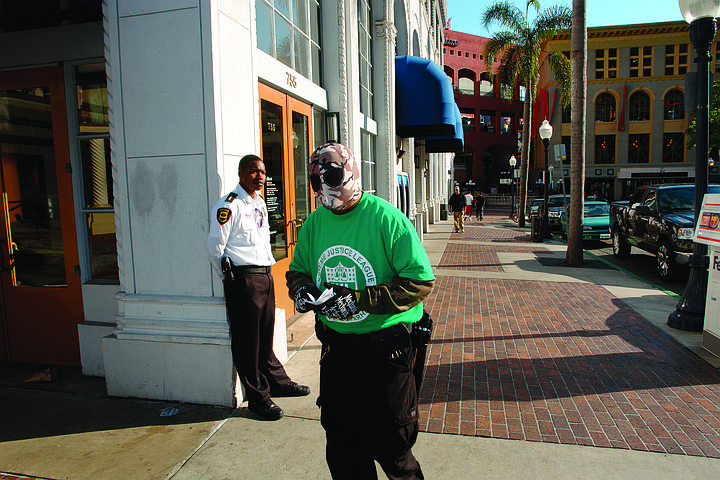
His reception is typical of his previous existence, marked by both polite and impolite refusal of his presence. Mr. Xtreme dons a mask emblazoned with a skull. He drives the hot blacktop — past flowered offramps and beige weedy hills — from a small house in East San Diego, the Xtreme Cave, to the twists of concrete curbs and painted metal signs of the city center and the maze of streets called Hillcrest. He walks in the hot bright sunlight, exposed on the white sidewalks; he’s in his death’s head mask and genial Hillcrest denizens, tugging on leashed dogs, jogging in flimsy shirts, and concluding meetings over lunch tables, take a moment as he passes. Of course, people stare, as they stared at him in elementary school, as they stared at him in high school. He encourages that. He seeks attention that might discomfit others because it is a part of him.
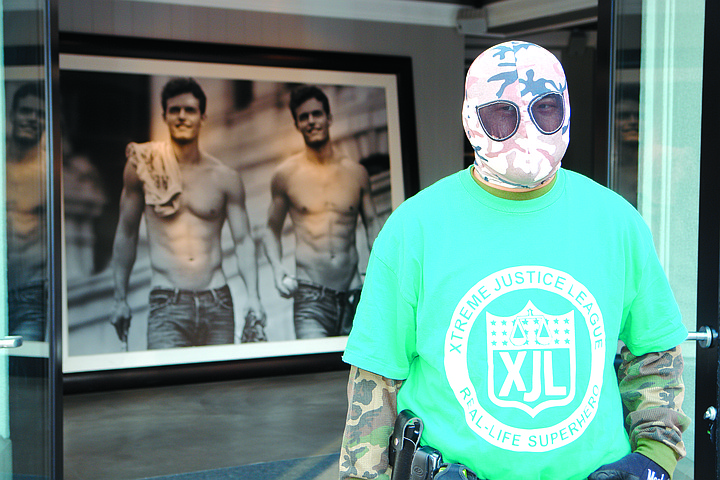
Mr. Extreme outside Abercrombie
He attends a Hillcrest community meeting and is asked to leave. The meeting organizer tells him that the skull mask disturbs the meeting and frightens people. Our man, however, persists. He wants to inform the police of the real-life superhero network, the World Superhero Registry, and how they’re here to help. He wants to interact with law enforcement, get information from them as to where he might be needed and how he can serve. Again, he is asked to leave.
He buys a new mask, a camouflage one with large mesh eyes, similar to Mexican wrestlers’ Luchadores masks.
Over the next year, he attends other community meetings. The meetings are arranged for citizens to speak to councilmembers and police about crime and blight in their areas. Mr. Xtreme attends to do the same, and over and over again he’s politely asked to leave.
Enter 2009. On January 10, the second Saturday of the year, the sun postpones its rise until 6:52 a.m. standard time, the latest hour it will rise this year. It reaches full height at midday, but the air is still crisp. San Diegans blow steam into cupped palms. Tides recede to their lowest point; people follow the waves out to inspect flora and fauna usually submerged. The sun sets at 5:01 p.m. Appearing now, the “cold moon,” January’s full moon, the brightest and largest of full moons for all of 2009, as the oblong dance between it and Earth reaches its perigee. A peculiar night with frigid and cranky air.
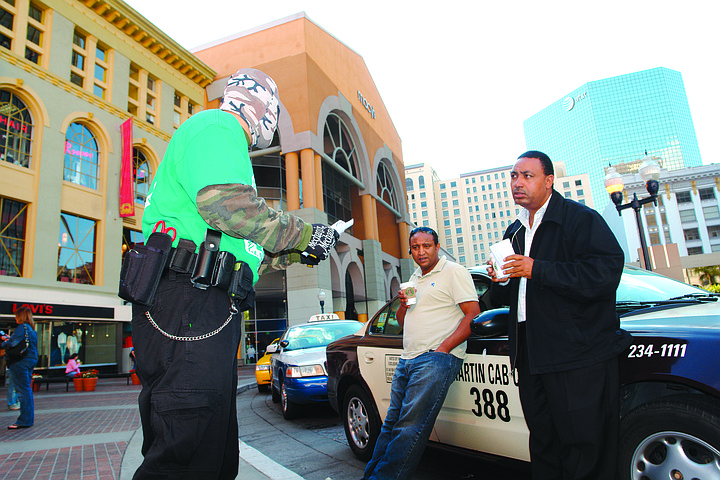
Mr. Xtreme patrols downtown.
If everything and everybody were equal, a bland gray socialist utopia where nothing is emphasized or shiny and nothing is particularly dull, downtown today would be a different place. But the Gaslamp is our bright center. Glass and steel towers gleam in hot light, upwardly salient. The inhabitants glow in their shiny clothes. Below lurks a surrounding ring of sludge and slime, the tent cities and chemical communities of vagabonds and junkies.
Down 16th Street we follow a skateboarder. He enjoys an extended adolescence, because from the looks of his graying, shaggy beard he’s seen 30 or more winters, but from the tiny wooden toy beneath his feet and the backward hat resting on his shaggy head, he looks to be pretending he’s 17. Past Market Street, he slaloms his board along the yellow line, down the center of the street. He passes a church adorned with a blocky asymmetrical cross made from a string of Christmas lights tacked to its front wall. The vagrants depend on darkness, away from the lighted cross. One darts into the bushes, a lighter flickers. An ozone smell of burning drugs billows, and then a small pennant of white smoke rises. Around the bright cross sits no one; the addicts skirt its luminous range. Farther down 16th Street now, the skateboarder passes J Street, and in the abandoned forecourt of a former auto garage scurry more fiends and outcasts, dipping into their tents to retrieve God knows what. The windows of the former garage have been relieved of their glass, and it’s been sprinkled about in semicircles on the forecourt, and the chips of it twinkle on sidewalks and pavement, under the beaten tennis shoes of the vagrants and on the cement floors of the tarpaulin shelters. The skateboarder rides into the cold dark, heading toward K Street. The full moon backlights dense clouds. Teenage girls hide their beers as the skater approaches. At K and 16th, the skater passes the intersection without noticing that on the corner, standing in a pool of yellow sodium light, is a man in a bright green shirt, a bulky black security guard belt, and a camouflage mask: Mr. Xtreme. He’s on patrol in this, the ugliest of neighborhoods.
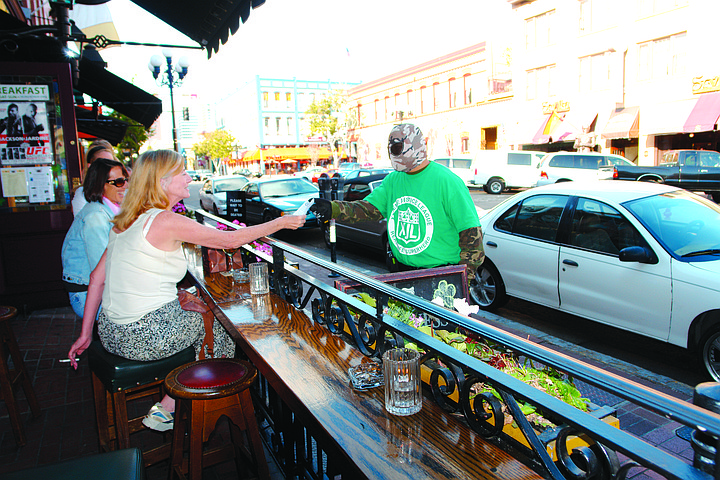
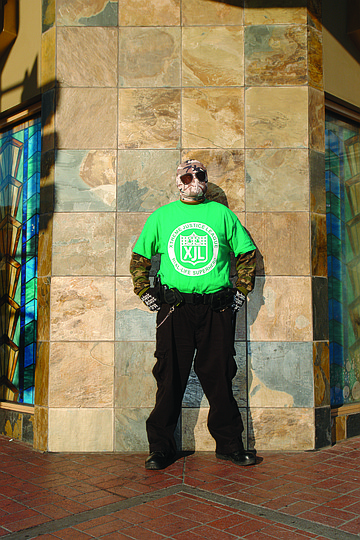
Mr. Xtreme no longer carries a waistcoat of flab as he did as a teenager, but neither does he possess the blocky, muscular build nor slender waist of the comic-book heroes he idolizes. He’s just shy of six feet tall. His shoulders slump a little, and his masked head angles slightly down. His arms curve like parentheses around the thick belt. Clinging to the belt are holsters and pockets filled with a first-aid kit, a long, black, baton-like flashlight, and a stun gun. He removes the stun gun. It fits in the fist, a short plastic horseshoe with double metal electrodes at each end. When Mr. Xtreme activates it, blue lightning arcs around the metal prongs. The sound cracks and chatters, formidable and alarming. He has no pistol; for himself, he doesn’t believe in them. Which is the superhero standard.
What Is a superhero?
Following a line back there are antiheroes of late: Spawn and Wolverine. Before them were giant beasts like the Thing and the Incredible Hulk, mutated by mysterious scientific rays. There was Hawkman and the Flash in the 1940s and 1950s. Batman as well. Preceding them was Superman.
Superman is the line of demarcation. Superior abilities or powers had never been coupled with skin-tight, colorful clothing and a recognizable logo. Jerry Seigal and Joe Shuster created Superman in the early 1930s and sold the story and iconic image to DC Comics in 1938. They were the first to use the prefix “super” to describe the actions and powers of a person involved in protecting others from harm.
Before Superman, there was a radio serial and newspaper comic strip of a costumed detective known as the Phantom. The Phantom had no superhuman abilities. Athletic and smart, he devoted himself to fighting crime but was not an alien as Superman is and was not imbued with strength from strange rays as were the Thing or the Hulk. He was not a mutant like the
X-Men. The Phantom was a detective, the first crime-fighter to wear colorful tights and a mask in which no pupils are visible — which later became a comic-book standard.
Before the Phantom, heroes were either normal men, usually without a mask, who addressed social injustices, men such as Robin Hood and the Scarlet Pimpernel, or they were gods and demigods, such as Hercules, Thor, and Gilgamesh. There have been archetypes of human morality, bravery, or godlike powers since recorded history, and audiences devour the stories. Why? Because we identify with both heroes and victims. Heroes offer an archetypal behavior we can strive for and a chance at rescue when we’re in peril. Bullied by muggers, a victim wishes for intervention. We hope that somewhere, hidden in the crowd, or maybe on a parapet above, our defender awaits to deliver us. It could be anyone, anyone with the courage to interfere. That’s what superheroes are: hope embodied.
Some possess powers bestowed by heaven or magic. Some, like Batman, have no special powers at all. Some, like Spawn, don’t much care for humanity. Some are wealthy, some poor. Some are populists, some pariahs. Some only want revenge. Super-abilities aren’t required. Batman has none. The Punisher has none. The one common trait is that superheroes, perhaps sometimes reluctantly, help mankind, and give hope.
So, our man, Mr. Xtreme, can lay claim to the mantle “Superhero” — if he helps society. He believes he does.
“Just being out here helps,” he says. “If bad guys see us, they might think twice about dealing drugs, they might think twice about raping a young woman, they might think twice about mugging an innocent victim.”
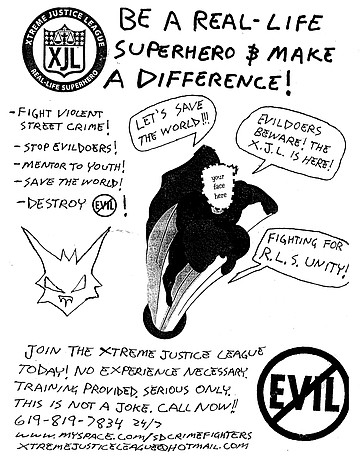
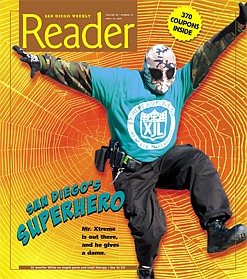
You cannot see his pupils through his mask. He wears a bright green shirt bearing the XJL, Xtreme Justice League, logo — his costume. On patrols, he’ll often hand out granola bars and orange juice to the homeless. He tries to help, to offer hope.
Patrolling, we walk the blocks of downtrodden human existence in east downtown. A scruffy man sits on the frigid concrete; his head wobbles on its peg, and his eyes wander around their sockets. Upon seeing the camouflage mask he shouts, “Hey, I was in ’Nam! Sixty-eight to ’71, man!”
“Thank you for your service,” Mr. Xtreme responds in a practiced Boy Scout voice. He does not add “kind citizen,” but it wouldn’t be out of place.
“Hey, who are you?” asks a woman too young and frail to live outdoors in winter.
“I’m Mr. Xtreme, ma’am.”
His boots tread through a rivulet of piss on the sidewalk. He strides confidently along darkened streets lined with weedy fields and tattered chain-link fences. Drug smoke and shouts ribbon the air.
“Are you a vigilante?” I ask.
“No. Vigilantes act as judge, jury, executioner — I’m not that. I’m here as a preventative measure. I’m out here to let everyone know, hey, somebody’s here who gives a damn.”
San Diego crime rates are down for the third straight year. Mayor Jerry Sanders touts the numbers as “encouraging.” At a press conference on November 17, 2008, he states: “Crime [overall] is at the lowest it’s been in more than 40 years, with fewer than 35 crimes per 1000 residents. This is the first time since 1966 that we’ve dipped below that 35 crime mark on the crime index.”
If crime is down, perhaps we don’t need Mr. Xtreme; or perhaps we do. Overall crime is down, but homicides are up 10 percent. Rapes are up 34 percent. Gang-related crimes — vandalism, drugs, theft — are up 8 percent.
We round 17th and K streets. I can see 16th Street, where there are four police cars and two uniformed officers talking with a woman. She stands outside her tent and points to something in the distant night. The police write on pads and touch the radio microphones strapped to their shoulders. The cones of light from the cruisers undulate and carom across the graffitied brick walls of the former garage. The woman seems hysterical. I can hear her yelling and weeping from a block away. Another cop car arrives. For all our conflicted feelings about the police, we can say this: they are a force, a computer-connected team of able people determined to affect crime. I look to Mr. Xtreme in his security belt and camouflage mask. He is not a force but one man in a costume.
“Do you think you help out here?” I ask.
“Of course.”
“Have you ever broken the law?”
“Yes.”
“By accident or intentionally?”
“Intentionally,” he says, and touches his chin to think. “Let’s see. I’ve jaywalked, jaywalked quite a bit, actually. I’ve littered; I used to smoke and throw the butts on the ground, but I don’t anymore. I’d say it’s been a long time since I broke a law.”
“Have you ever hurt anyone or violated anyone’s rights by attempting to stop a crime, like the Guardian Angels were accused of?”
“No. As a security guard, I’ve been trained to escalate force until no threat remains. But I’ve never hurt anyone, never used my stun gun as Mr. Xtreme. I don’t violate anyone’s rights. We all have the power of citizen’s arrest. I wouldn’t use it unless it was absolutely necessary, a clear situation that called for it. But I don’t think I’d arrest anyone, even if they were dealing drugs or something. I might get close to them and watch and let them know I’m here, but I wouldn’t want to take on the responsibility of arrest. I see myself as a preventative measure. Most likely, I’ll end up stopping fights, or maybe an assault.”
“Have you ever stopped a crime?”
“I’ve stopped a case of road rage — you know, prevented a fight.” In this case, Mr. Xtreme had traveled to Chula Vista to search for a sexual assault suspect. “Around 3rd Avenue, in an intersection, two guys got out of their cars, you know, ready to fight.” Mr. Xtreme got between the two men. He held his hands out to block their eye contact with each other, and he told the men, “It’s not worth it. It’s not worth getting hurt or hurting someone, and it’s not worth going to jail.” The men got back in their cars and left.
“You were in Chula Vista as a volunteer to catch this guy, this molester. Will you show up for any volunteer situation, any search?”
“No,” Mr. Xtreme says. “But for anything violent, for maybe sexual assault or kidnapping, murder, or rape — anything violent, I want to help out.”
“Like Danielle van Dam? Volunteers found her body.”
“Yes, like Danielle. Anything like that and I’ll be there.”
“What are you going to do in the future? What is Mr. Xtreme becoming?”
“I’m taking correspondence courses in private investigation.”
“Like a detective?”
“Yes.”
“Are you going to be a PI?”
“Probably not. I’m taking them so I can help out more. So I can do more for the community.”
There it is. He might be a bumbler, awkward and ill at ease — more They Still Call Me Bruce than Captain America. His résumé of crime fighting is still thin. But he’s out there, and he gives a damn.
Here's something you might be interested in.
San Diego's Superhero is sick of the crime
The making of Xtreme Man, our protector

San Diego's Superhero is sick of the crime
The making of Xtreme Man, our protector
A baby wails its first song in an unexceptional San Diego hospital. Doctors notice nothing special or unusual about the child. No clerics have wandered to greet him; no comets or meteor showers threaten Earth’s atmosphere or orbit; there are no earthquakes. No great genetic mutations have been recorded, nor have there been recent leaps in weaponry or nuclear technology. It is hardly a superhero’s arrival. Scientific advancements of the time include commercially available computers, which are apartment-sized. NASA engineers are nearing completion of the prototype space shuttle Enterprise. Paleontologists pick over the bones of “Lucy,” a skeletal specimen of an extinct hominid classified as Australopithecus afarensis. Political lines and powers are as stable as political lines and powers can be. That night, California Governor Jerry Brown and San Diego Mayor Pete Wilson each presumably sleep with no notice of the newborn baby boy.
Pass ten years.
The boy’s father treats him harshly, as some fathers do, whether to denigrate or inspire the child, only the father knows. “Use your head,” the father pleads, exasperated. “Don’t you have any common sense?” When the boy stands up for another round of dinner, his father casts a judgmental eye. “Maybe that’s why you look the way you do.”
Through their working-class neighborhood, the boy walks to and from school. He earns no better than average grades. Socially, he’s alone. Onlookers define him by his weight, the only characteristic about him that exceeds. He dresses similarly to his peers, but there the comparison ends. He ostracizes himself in deed and demeanor. Entering adolescence, he lags a shade behind. To encounters he brings awkwardness; internally, he struggles with the pain of interaction. Uninterested in athletics, he develops no sports skills and therefore can claim neither victories nor defeats nor the accomplishment of confidence. The lessons elude him.
As others grow taller and stronger, he grows apart, eating alone, walking alone; in a classroom filled with others, still he’s cleaved of them. After the final bell rings, he lopes toward his family home. Along the way he is bullied. Two young men mock and insult him. They knock his tin Muppets lunchbox from his hand. They punch him. He’s unharmed, though, and finally the older boys let him go, realizing he threatens no one, especially them. The child retreats further within.
Meanwhile, the population of San Diego breaks the one million mark. Crime increases. Instances of larceny and property theft jump by thousands. By 1986, street gangs have learned the lucrative process of converting cocaine into crack. California and the Federal government have yet to ban assault weapons. Drive-by shootings proliferate.
Age the boy forward two years. 1988. Not quite teenaged, he’s retreated further from the world outside his windows. Anything but reality. Action movies and comic books soothe his angst. Is it any wonder? In fantasy, the underdog comes from behind; the normal are transformed into extraordinary; revenge is sought and extracted from persecutors of the innocent and unassuming. One of his favorite films is They Still Call Me Bruce, a karate farce flick ladled with puns and stereotypes, featuring an affable, bumbling lead. The Teenage Mutant Ninja Turtles cartoon series tethers him to the television.
His one connection to the city around him comes from the newspaper. He clips articles of crime and punishment and collects them. Soon his collection more than doubles. He no longer saves the articles, he only reads them now, internalizes them.
Crime is reality. South of the outcast child’s neighborhood 300 citizens protest the wave of violence by taking to Market Street and marching; some carry cardboard coffins as symbols of the killings. After the march, assailants in a passing automobile shoot a man in the leg. At a National Conference on Crime, San Diego Mayor Maureen O’Connor admits, “We are losing ground in the war against drugs.”
Six months thence, in the summer of 1989, the end of the decade of decadence draws nigh. Mayor O’Connor asks Governor George Deukmejian to declare a state of emergency in San Diego and to commit $34 million in state funds to combating drug deals and shootings in her city. Governor Deukmejian declines the request. San Diego swirls in a whirlpool tide of crime.
See the boy in high school, a teenager now. Accustomed to eating alone, on a lawn, on a curb, a park bench. Accustomed to walking alone. He orbits popular teenage culture as the Earth does the sun; gravity holds him to it, light from it reaches him, he understands but can never touch it. His presence affects it very little.
On his way home from school again. Two older boys again. Different boys this time, but still taller than he. Again. This time, they’re dressed in the matching red shirts that denote the Bloods street gang. The boys mock him. Punch him, just like before. One has a knife, but it only flashes in the sunlight, never jumps from the waistband where it lives. They order him to take off his shirt, bare his globular flesh to the light of day, bare his shame. The misfit teenager remains unharmed; the older boys let him pass. The pariah teen seeks solace in fantasy justice, more movies and comics, as an answer to his welling distaste for street crime.
By 1993, every community in San Diego lives with the fear of crime, some streets and districts more than others. City Heights’ violent crime rate surpasses the citywide rate by more than double: there are 29 violent crimes for every 1000 City Heights residents, 13 violent crimes for every 1000 San Diegans of other neighborhoods. The citywide crime index, which includes all crime, violent or not, levels out at 72.75 incidents per 1000 people. Mayor Susan Golding endorses a plan for brighter white streetlights downtown and temporary expansion of city police walking patrols.
Graduation for the loner. A maintenance job for the boy who is becoming a man. His father eases his harsh treatment of the young man; he is no longer just a doughy child in the eyes of his dad. At night, he studies plumbing and electrical at a junior college. He studies security. He tests to obtain a license in security and passes; California awards him a guard card. He enjoys the Mighty Morphin’ Power Rangers. He still follows crime news.
In 2002, San Diego crime rates drop to half of what they were a decade before.
In this year, on the first Friday in February, a man, Damon van Dam, tucks his daughter Danielle into bed. Danielle wears tiny Mickey Mouse earrings. The father never again sees his daughter alive. The following Monday, David Westerfield returns home. He lives in the same neighborhood as the van Dams, and his RV gleams, freshly washed after desert camping. Monday, a jacket is discovered at the dry cleaners. Some of Danielle’s blood now resides outside her seven-year-old body; some of it clings to the jacket, some to the RV.
Weeks later, search volunteers discover Danielle’s partially charred body, everything except a foot.
What follows is a trial like a volcano. Many things erupt from it: media attention, child pornography, an angry son, divested parents, sexual partners, alarms, shouts, tears…viscera. Entomologists testify about the maggots found in Danielle’s head. David Westerfield’s niece testifies that when she was a child, she awoke one night to find him with his finger rubbing her teeth. The ugliest of man’s abject compulsions burst outward. Streams of it run in the city streets, and the details are relayed across the country in news reports. The event sickens and saddens many, our socially inept security guard included.
March 1, 2002, Lincoln Park, a gun battle erupts along Logan Avenue. José Misael Alegria-Uribe and Larson Tufi, teenaged boys, lose their lives that day. Wounded and running, José collapses and dies near the doorway of Dr. J’s liquor store.
January 1, 2003, Lincoln Park, a crowd of New Year’s revelers mills about. A car stops, young men armed with guns disembark the vehicle and open fire, injuring four people and killing two women, Carol Waites and Sharen Burton, in the parking lot of Dr. J’s liquor store.
May 1, 2003, Lincoln Park, schoolchildren find a body in a pool of blood in the back room of Dr. J’s liquor store. The body is that of Eddie Meram, owner of Dr. J’s liquor store.
Our man follows the news as closely as ever. He reads of the innocent dead that lie stricken, shot in the head, chest, and legs. Bullets bite and tear flesh like an inimical creature commanded by wicked boys. Our man reads on. He leaves his maintenance job for full-time security work.
Advance three years. Three years of reading the news, watching action movies, and daydreaming of comic-book heroes. Twice he leaves his father’s house, and twice he returns, swatted back by an unforgiving city. He’s now approaching his 30th year under the same stars that never afforded him superiority or alien abilities. Neither science nor providence has supplied to him magical or technological bracelets, lassos, capes, belts, glasses, superlative strength, or heightened senses. He would be painfully normal if he weren’t so cast down. Still, in spite of his awkwardness, he wonders if he can’t insert himself into the fabric, the porous boundary, between the innocent and the criminal. It’s 2006 now, and already so much time has marched on without him. He wonders if he can change the course of wrongdoing.
Wait, though.
To understand our man, we have to understand his influences. Now he searches for an out-of-print comic, The Human Fly. Marvel comics printed 19 issues of The Human Fly from 1977 to 1979. It details the fantastic exploits of a stuntman, and its pages feature photographs of a real, live stuntman in the superhero’s crimson costume. The stuntman of the book is Rick Rojatt. He captured America’s attention and inspired the creation of the eponymous comic-book line, by wing-walking on a DC8 over the Mojave Desert. In real life, he jumps buses on a rocket motorcycle; in the comic, his illustrated avatar battles a campy arch-criminal named Copperhead. The book’s tagline reads: “The Wildest Super-Hero Ever — Because He’s Real!”
This fate swarms our man, our awkward guard. This fate: real-life superhero.
Through his family’s computer he finds a network of others like our guard: the World Superhero Registry at worldsuperheroregistry.com.
He creates a persona known as “the Nag.”
Mr. Xtreme
I meet the guard, the hero of this story, at a coffee shop to talk to him.
“Why ‘the Nag’?”
“Because I nagged the criminals, I nagged the cops to do something; I was a thorn in everyone’s side,” he tells me.
“Did you ever patrol as the Nag? Were you ever in any scuffles?”
“No, I just made a MySpace page. Oh, also I called myself the Nag because of the group known as the NAGs in the movie They Still Call Me Bruce. The name was inspired by them.”
Those NAGs were a band of citizen enforcers, modeled after the Guardian Angels, famous from 1980s New York.
The Guardian Angels
In 1979, a McDonald’s night manager formed a group known as the “Magnificent 13” and began patrols of New York City subways. The original group of 13 grew to 48 as newspaper reports rolled out about the group’s protectionism — 48 young men and women in red berets. They stomp the vomit of night trains with heavy combat boots. Time magazine publishes an affectionate and outlandish article detailing an incident in which members of the Magnificent 13 stopped six men from raping a woman, noting that the leader of the Magnificent 13 patrol disabled the shotgun-bearing attacker with a “kung fu kick to the head.”
Numbers of the Magnificent 13 swell beyond the 48, and the group changes its name to the “Guardian Angels.” Now they patrol in waves. Now they openly and brazenly fight fist-to-tooth, knuckle and blood, with criminals and police. Now the McDonald’s night manager, the originating member, receives a beating at the end of a police baton, and the police dump him in a river. Now a Newark City police officer shoots one of the Guardian Angels. Apartment doors, known to hide crack dens, splinter open with a kick from heavy combat boots, and the Guardian Angels beat and menace the drug dealers and junkies inside. Their chemicals are flushed, their pipes smashed and ground under black heels.
Heroes, the Guardian Angels are called. Vigilantes, they’re called.
Magnify the details, though. The night manager faked his own kidnapping, beating, and dumping into a river. It never happened; it was pure fantasy. Stories of wandering gang members raping, pissing, swindling, robbing, and shooting — all deterred by Guardian Angels — flow from Guardian Angels’ mouths; but in fact these stories are small lies, exaggerations, or wholesale fabrications from the Angels’ members. Some of those crack dens with splintered doors, it turns out, were normal apartments, the inhabitants working-poor citizens, lawful people, abused, and now so fearful of authority as to never seek redress of their civil rights. Some of the “known dealers” were nothing more than bystanders, pulled and pushed, hassled, their pockets surrendered, and the contents strewn over concrete in search of evidence that never existed.
The Guardian Angels and professional wrestling link together. The Big Bossman, a wrestler, becomes, for the World Championship Wrestling league, “The Guardian Angel,” and wears the signature red beret. A wrestler named Vampiro heads the Mexico City chapter of the Guardian Angels.
To the Guardian Angels, lawfulness exists as a definite line, much like those drawn on the subway maps or streets, bounded under their protective patrols. The line delineates right and wrong, legality and illegality, whether those offenses they fight are real or imagined, whether actual or fictional, as in pro wrestling, often faked; stories born of fantasy.
This is what vigilantes and superheroes are in the sunshine of day: imagination become flesh.
The Nag only ever existed online as a MySpace page. His nagging of cops and criminals occurred only in his own mind. But just as the Magnificent 13 outgrew their combat boots and became the Guardian Angels, our lowly security guard, the Nag, eventually outgrows his online persona. He buys superhero masks and becomes Mr. Xtreme, his first superhero persona who operates out in the world. He walks among us still.
His reception is typical of his previous existence, marked by both polite and impolite refusal of his presence. Mr. Xtreme dons a mask emblazoned with a skull. He drives the hot blacktop — past flowered offramps and beige weedy hills — from a small house in East San Diego, the Xtreme Cave, to the twists of concrete curbs and painted metal signs of the city center and the maze of streets called Hillcrest. He walks in the hot bright sunlight, exposed on the white sidewalks; he’s in his death’s head mask and genial Hillcrest denizens, tugging on leashed dogs, jogging in flimsy shirts, and concluding meetings over lunch tables, take a moment as he passes. Of course, people stare, as they stared at him in elementary school, as they stared at him in high school. He encourages that. He seeks attention that might discomfit others because it is a part of him.
Mr. Extreme outside Abercrombie
He attends a Hillcrest community meeting and is asked to leave. The meeting organizer tells him that the skull mask disturbs the meeting and frightens people. Our man, however, persists. He wants to inform the police of the real-life superhero network, the World Superhero Registry, and how they’re here to help. He wants to interact with law enforcement, get information from them as to where he might be needed and how he can serve. Again, he is asked to leave.
He buys a new mask, a camouflage one with large mesh eyes, similar to Mexican wrestlers’ Luchadores masks.
Over the next year, he attends other community meetings. The meetings are arranged for citizens to speak to councilmembers and police about crime and blight in their areas. Mr. Xtreme attends to do the same, and over and over again he’s politely asked to leave.
Enter 2009. On January 10, the second Saturday of the year, the sun postpones its rise until 6:52 a.m. standard time, the latest hour it will rise this year. It reaches full height at midday, but the air is still crisp. San Diegans blow steam into cupped palms. Tides recede to their lowest point; people follow the waves out to inspect flora and fauna usually submerged. The sun sets at 5:01 p.m. Appearing now, the “cold moon,” January’s full moon, the brightest and largest of full moons for all of 2009, as the oblong dance between it and Earth reaches its perigee. A peculiar night with frigid and cranky air.
Mr. Xtreme patrols downtown.
If everything and everybody were equal, a bland gray socialist utopia where nothing is emphasized or shiny and nothing is particularly dull, downtown today would be a different place. But the Gaslamp is our bright center. Glass and steel towers gleam in hot light, upwardly salient. The inhabitants glow in their shiny clothes. Below lurks a surrounding ring of sludge and slime, the tent cities and chemical communities of vagabonds and junkies.
Down 16th Street we follow a skateboarder. He enjoys an extended adolescence, because from the looks of his graying, shaggy beard he’s seen 30 or more winters, but from the tiny wooden toy beneath his feet and the backward hat resting on his shaggy head, he looks to be pretending he’s 17. Past Market Street, he slaloms his board along the yellow line, down the center of the street. He passes a church adorned with a blocky asymmetrical cross made from a string of Christmas lights tacked to its front wall. The vagrants depend on darkness, away from the lighted cross. One darts into the bushes, a lighter flickers. An ozone smell of burning drugs billows, and then a small pennant of white smoke rises. Around the bright cross sits no one; the addicts skirt its luminous range. Farther down 16th Street now, the skateboarder passes J Street, and in the abandoned forecourt of a former auto garage scurry more fiends and outcasts, dipping into their tents to retrieve God knows what. The windows of the former garage have been relieved of their glass, and it’s been sprinkled about in semicircles on the forecourt, and the chips of it twinkle on sidewalks and pavement, under the beaten tennis shoes of the vagrants and on the cement floors of the tarpaulin shelters. The skateboarder rides into the cold dark, heading toward K Street. The full moon backlights dense clouds. Teenage girls hide their beers as the skater approaches. At K and 16th, the skater passes the intersection without noticing that on the corner, standing in a pool of yellow sodium light, is a man in a bright green shirt, a bulky black security guard belt, and a camouflage mask: Mr. Xtreme. He’s on patrol in this, the ugliest of neighborhoods.
Mr. Xtreme no longer carries a waistcoat of flab as he did as a teenager, but neither does he possess the blocky, muscular build nor slender waist of the comic-book heroes he idolizes. He’s just shy of six feet tall. His shoulders slump a little, and his masked head angles slightly down. His arms curve like parentheses around the thick belt. Clinging to the belt are holsters and pockets filled with a first-aid kit, a long, black, baton-like flashlight, and a stun gun. He removes the stun gun. It fits in the fist, a short plastic horseshoe with double metal electrodes at each end. When Mr. Xtreme activates it, blue lightning arcs around the metal prongs. The sound cracks and chatters, formidable and alarming. He has no pistol; for himself, he doesn’t believe in them. Which is the superhero standard.
What Is a superhero?
Following a line back there are antiheroes of late: Spawn and Wolverine. Before them were giant beasts like the Thing and the Incredible Hulk, mutated by mysterious scientific rays. There was Hawkman and the Flash in the 1940s and 1950s. Batman as well. Preceding them was Superman.
Superman is the line of demarcation. Superior abilities or powers had never been coupled with skin-tight, colorful clothing and a recognizable logo. Jerry Seigal and Joe Shuster created Superman in the early 1930s and sold the story and iconic image to DC Comics in 1938. They were the first to use the prefix “super” to describe the actions and powers of a person involved in protecting others from harm.
Before Superman, there was a radio serial and newspaper comic strip of a costumed detective known as the Phantom. The Phantom had no superhuman abilities. Athletic and smart, he devoted himself to fighting crime but was not an alien as Superman is and was not imbued with strength from strange rays as were the Thing or the Hulk. He was not a mutant like the
X-Men. The Phantom was a detective, the first crime-fighter to wear colorful tights and a mask in which no pupils are visible — which later became a comic-book standard.
Before the Phantom, heroes were either normal men, usually without a mask, who addressed social injustices, men such as Robin Hood and the Scarlet Pimpernel, or they were gods and demigods, such as Hercules, Thor, and Gilgamesh. There have been archetypes of human morality, bravery, or godlike powers since recorded history, and audiences devour the stories. Why? Because we identify with both heroes and victims. Heroes offer an archetypal behavior we can strive for and a chance at rescue when we’re in peril. Bullied by muggers, a victim wishes for intervention. We hope that somewhere, hidden in the crowd, or maybe on a parapet above, our defender awaits to deliver us. It could be anyone, anyone with the courage to interfere. That’s what superheroes are: hope embodied.
Some possess powers bestowed by heaven or magic. Some, like Batman, have no special powers at all. Some, like Spawn, don’t much care for humanity. Some are wealthy, some poor. Some are populists, some pariahs. Some only want revenge. Super-abilities aren’t required. Batman has none. The Punisher has none. The one common trait is that superheroes, perhaps sometimes reluctantly, help mankind, and give hope.
So, our man, Mr. Xtreme, can lay claim to the mantle “Superhero” — if he helps society. He believes he does.
“Just being out here helps,” he says. “If bad guys see us, they might think twice about dealing drugs, they might think twice about raping a young woman, they might think twice about mugging an innocent victim.”
You cannot see his pupils through his mask. He wears a bright green shirt bearing the XJL, Xtreme Justice League, logo — his costume. On patrols, he’ll often hand out granola bars and orange juice to the homeless. He tries to help, to offer hope.
Patrolling, we walk the blocks of downtrodden human existence in east downtown. A scruffy man sits on the frigid concrete; his head wobbles on its peg, and his eyes wander around their sockets. Upon seeing the camouflage mask he shouts, “Hey, I was in ’Nam! Sixty-eight to ’71, man!”
“Thank you for your service,” Mr. Xtreme responds in a practiced Boy Scout voice. He does not add “kind citizen,” but it wouldn’t be out of place.
“Hey, who are you?” asks a woman too young and frail to live outdoors in winter.
“I’m Mr. Xtreme, ma’am.”
His boots tread through a rivulet of piss on the sidewalk. He strides confidently along darkened streets lined with weedy fields and tattered chain-link fences. Drug smoke and shouts ribbon the air.
“Are you a vigilante?” I ask.
“No. Vigilantes act as judge, jury, executioner — I’m not that. I’m here as a preventative measure. I’m out here to let everyone know, hey, somebody’s here who gives a damn.”
San Diego crime rates are down for the third straight year. Mayor Jerry Sanders touts the numbers as “encouraging.” At a press conference on November 17, 2008, he states: “Crime [overall] is at the lowest it’s been in more than 40 years, with fewer than 35 crimes per 1000 residents. This is the first time since 1966 that we’ve dipped below that 35 crime mark on the crime index.”
If crime is down, perhaps we don’t need Mr. Xtreme; or perhaps we do. Overall crime is down, but homicides are up 10 percent. Rapes are up 34 percent. Gang-related crimes — vandalism, drugs, theft — are up 8 percent.
We round 17th and K streets. I can see 16th Street, where there are four police cars and two uniformed officers talking with a woman. She stands outside her tent and points to something in the distant night. The police write on pads and touch the radio microphones strapped to their shoulders. The cones of light from the cruisers undulate and carom across the graffitied brick walls of the former garage. The woman seems hysterical. I can hear her yelling and weeping from a block away. Another cop car arrives. For all our conflicted feelings about the police, we can say this: they are a force, a computer-connected team of able people determined to affect crime. I look to Mr. Xtreme in his security belt and camouflage mask. He is not a force but one man in a costume.
“Do you think you help out here?” I ask.
“Of course.”
“Have you ever broken the law?”
“Yes.”
“By accident or intentionally?”
“Intentionally,” he says, and touches his chin to think. “Let’s see. I’ve jaywalked, jaywalked quite a bit, actually. I’ve littered; I used to smoke and throw the butts on the ground, but I don’t anymore. I’d say it’s been a long time since I broke a law.”
“Have you ever hurt anyone or violated anyone’s rights by attempting to stop a crime, like the Guardian Angels were accused of?”
“No. As a security guard, I’ve been trained to escalate force until no threat remains. But I’ve never hurt anyone, never used my stun gun as Mr. Xtreme. I don’t violate anyone’s rights. We all have the power of citizen’s arrest. I wouldn’t use it unless it was absolutely necessary, a clear situation that called for it. But I don’t think I’d arrest anyone, even if they were dealing drugs or something. I might get close to them and watch and let them know I’m here, but I wouldn’t want to take on the responsibility of arrest. I see myself as a preventative measure. Most likely, I’ll end up stopping fights, or maybe an assault.”
“Have you ever stopped a crime?”
“I’ve stopped a case of road rage — you know, prevented a fight.” In this case, Mr. Xtreme had traveled to Chula Vista to search for a sexual assault suspect. “Around 3rd Avenue, in an intersection, two guys got out of their cars, you know, ready to fight.” Mr. Xtreme got between the two men. He held his hands out to block their eye contact with each other, and he told the men, “It’s not worth it. It’s not worth getting hurt or hurting someone, and it’s not worth going to jail.” The men got back in their cars and left.
“You were in Chula Vista as a volunteer to catch this guy, this molester. Will you show up for any volunteer situation, any search?”
“No,” Mr. Xtreme says. “But for anything violent, for maybe sexual assault or kidnapping, murder, or rape — anything violent, I want to help out.”
“Like Danielle van Dam? Volunteers found her body.”
“Yes, like Danielle. Anything like that and I’ll be there.”
“What are you going to do in the future? What is Mr. Xtreme becoming?”
“I’m taking correspondence courses in private investigation.”
“Like a detective?”
“Yes.”
“Are you going to be a PI?”
“Probably not. I’m taking them so I can help out more. So I can do more for the community.”
There it is. He might be a bumbler, awkward and ill at ease — more They Still Call Me Bruce than Captain America. His résumé of crime fighting is still thin. But he’s out there, and he gives a damn.
Comments