

Here's something you might be interested in.
Ask a Hipster — Advice you didn't know you needed
Big Screen — Movie commentary
Blurt — Music's inside track
Booze News — San Diego spirits
Classical Music — Immortal beauty
Classifieds — Free and easy
Close to Home — What it’s like on the street where you live
Cover Stories — Front-page features
Drinks All Around — Bartenders' drink recipes
Excerpts — Literary and spiritual excerpts
Feast! — Food & drink reviews
Feature Stories — Local news & stories
Fishing Report — What’s getting hooked from ship and shore
From the Archives — Spotlight on the past
Golden Dreams — Talk of the town
The Gonzo Report — Making the musical scene, or at least reporting from it
Letters — Our inbox
Movies@Home — Local movie buffs share favorites
Movie Reviews — Our critics' picks and pans
Musician Interviews — Up close with local artists
Neighborhood News from Stringers — Hyperlocal news
News Ticker — News & politics
Obermeyer — San Diego politics illustrated
Outdoors — Weekly changes in flora and fauna
Overheard in San Diego — Eavesdropping illustrated
Poetry — The old and the new
Reader Travel — Travel section built by travelers
Reading — The hunt for intellectuals
Roam-O-Rama — SoCal's best hiking/biking trails
San Diego Beer — Inside San Diego suds
SD on the QT — Almost factual news
Sheep and Goats — Places of worship
Special Issues — The best of
Street Style — San Diego streets have style
Surf Diego — Real stories from those braving the waves
Theater — On stage in San Diego this week
Tin Fork — Silver spoon alternative
Under the Radar — Matt Potter's undercover work
Unforgettable — Long-ago San Diego
Unreal Estate — San Diego's priciest pads
Your Week — Daily event picks
Plastic bags block La Jolla kelp beds
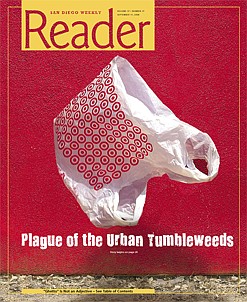
Plague of the urban tumbleweeds
• Captain Charles Moore, UCSD alum, steps overboard. He disappears into the inky Pacific. It’s 2007, nighttime, 500 miles west of San Diego. He swims, about three, four feet beneath the surface, through the spooky blue. A large jellyfish swipes him in the face.
Except it isn’t a jellyfish. It’s a plastic shopping bag.
“It could have come from San Diego, it could have come from Tokyo,” says Moore. “They’re both on the edge of the North Pacific Gyre.” The Gyre? A slow-swirling oceanic system that has amassed a huge floating plastic garbage patch, twice the size of North America.
• In the kelp beds off La Jolla, a spore drops away from its giant mother plant toward the bottom, destined to grow into a male kelp gametophyte whose sperm will wiggle-swim toward a female kelp egg. But the resulting baby plant needs a rock to anchor on and start growing. Problem? Plastic grocery bags cover the stones. It tries to grip. Slips. Tries again. Slips. Tries one last time before the currents carry it off.
• An outboard-powered fishing day boat heads homeward through big surf toward the calm waters of Mission Bay. It must make it through the narrow entrance of the Mission Bay Channel. Suddenly, a heat alarm sounds. Something is blocking the water intake. The engine cuts. The boat drifts helplessly onto the rocks.
Score another for the iniquitous, ubiquitous plastic bag.
Plastic bags. Why can’t we eliminate these polluting, addicting, consumer-age indulgences from our lives? Probably because they’re so damned practical, so accommodating. What better overnight-clothes stuffer? Beach towel carrier? Garbage pail liner? Pooper-scooper bag? Californians Against Waste estimate that we use 19 billion plastic grocery bags each year in the state. That’s about 500 each, almost 2 a day. But we recycle only 1 to 4 percent properly, which means 18-plus billion end up in landfills like Miramar — or blow out to sea.
Put it this way: the average plastic bag has an estimated life of from 20 to 1000 years, depending on the bag and whom you talk to. So if William the Conqueror had buried his dog’s doodoo in a plastic bag after the Battle of Hastings in 1066, the bag’d be wasting away just about now. We don’t need to be creating history like that.
A plastic bag’s useful lifespan is, what, 20 or 30 minutes? However long it takes to get from the supermarket to home. Thereafter, it launches into a second career filling our landfills and clogging our streams, storm drains, oceans, fishes’ bellies. And from there, perhaps, to our bellies. How bad is the problem? Green think tanks have had a field day conjuring up original ways to express the horror.
By weight, Californians alone, you read, throw away 294,000,000 pounds of plastic bags every year, or 147,000 tons.
By volume? End to end, enough to circle the planet over 250 times.
By time? Six hundred plastic bags jettisoned every second. Worldwide, around 17,000 per second, a million a minute, more than half a trillion plastic bags per year.
You can take them back to the supermarket, but don’t try putting them out in your recycling bin. Edco or Allied will reject them or send them to the landfill because (a) they’re the lowest-grade plastic and hard to sell at a profit, (b) they gum up the sorting machinery at the recycle centers, and (c) they’re too much trouble. Just leaving a shopping receipt inside one can cause sorting problems, plus it takes huge numbers to make up a nice, heavy, sellable bundle.
“Plastic bags are not a waste issue,” says Yvette Snyder of Edco. “They’re a stormwater issue. Those bags are like little parachutes. They fly around, and being a coastal community, our biggest concern is that they can get into the ocean.”
The “Bagfish” Invasion
Rod Messinger, a 15-year veteran of the City’s Lifeguard Service, has learned to hate what he calls “bagfish.”
“They’re the curse of outboard engines,” he says, “because if you run over one, it’ll wrap itself around the cooling intake on the outboard engine and the engine will overheat. Most modern outboards have a little alarm that’ll go off, called the ‘hot horn.’ There are some times when you’ll be doing a rescue, and you hit a bagfish and you don’t know it because you can’t really tell. You have to stop what you’re doing and back down on the engine, so the pump reverses and blows the bag off. It’s a guaranteed stop for at least a couple of minutes while the engine gets squared away, which counts when you’re trying to reach someone in trouble. It can affect any precarious situation.”
Messinger says the bagfish invasion has gotten worse. “Way worse. The Port has a full-time trash boat on the bay, every day, does nothing but pick up trash from the water, and a helluva lot of it is plastic bags. It happens to me every time I paddle out. I end up taking around ten items out of the water, and three of them will always be bagfish.”
Even when people dispose of bags properly, they can end up in the ocean. “You should come down to Mission Beach after a holiday,” says Messinger. “It’s plastic-bag mayhem! It’s not careless people. Most of them have done the right thing. They’ve stuffed their leftovers into a plastic bag and tried to squeeze it into one of the trash bins. Of course, there are never enough. And no sooner have the folks taken off than the seagulls fly in. They haul those bags out and peck them to bits to get at the food. Then the bags get light and fly off in the evening breeze. You remember the plastic-bag scene in American Beauty? So beautiful. But that’s what happens above every downtown. Those high-rises create heat chimneys. Half the time you can’t tell if they’re bags or birds. I saw one today. Thought it was a bird. It was flying over the Coronado Bridge. Plastic bag. And you should see the Center Beach and Silver Strand. Bags galore.”
Next evening I’m down on Coronado’s Center Beach, walking the mile to Naval Air Station North Island, where the fence struts out into the water. I’m looking for plastic bags in the sand, among the seaweed, in the water, aloft on the breeze. Not a thing. In the whole two-mile walk, I find one plastic cup and an orange and yellow Sour Patch candy wrapper.
“What’s the story?” I ask Messinger when I call him back that night.
“Ah,” he says. “Center Beach. That’s a special case. Have you ever heard of FODs? That means foreign object debris or foreign object damage. Or foreign object disposal. It’s a continual worry for fliers. Things getting sucked into their jet intakes or props. Anything from seagulls to plastic bags. At North Island they take a lot of trouble to track them down and keep the base clear of them. Why don’t you go down to the slough at IB or across the border? Trust me. You’ll see plenty of bagfish there.”
I do. There are. Hiding in pockets in the slough, wrapped around Otay River bridge legs, caught on seagull claws as the birds fly high to free themselves, swirling in dust devils under I-5 off-ramps, pinioned to cactus prickles down at Popotla in Baja. Once you start looking, you see them everywhere.
Harbor Garbage Patrol
One morning I wander out to the G Street Mole, just past the American Tunaboat Association building, where a few old guys mend nets stretched from jetty railings. Three men in jeans and caps hover around a workaday catamaran you wouldn’t normally notice among the hotshot blue-water fishing vessels with names like Charlotte V., Nancy, and Victoria City. The craft has a black outboard attached and two massive logs slung alongside, floating in the water. A big box with built-up sides is sunk into the deck area, just ahead of the steering console.
The box is packed with flotsam, jetsam, driftwood, picture frames, plastic buckets, water cooler bottles, shoes, Clorox bottles, and plastic bags, lots of bags, like interstitial tissue among the other debris. The two logs alongside are collapsed pier legs they’re disposing of. The crew, Julio Bello, Jose Robles, and Antonio Sandoval, spend their days putt-putting from one end of the bay to the other (it takes a couple of hours to get down to Chula Vista). They do nothing but pick up debris. They call the boat Alligator because it’s supposed to snap up floating garbage. “Plastic bags? A lot,” says Robles. “Drifting across the water or alongside the riprap off Seaport Village. By the outfalls especially.”
“We get to pick up dead animals, syringes, plastic bags,” says Bello. “You name it, it’s coming down the storm drains.”
It’s a countywide problem, they say. Outfalls can debouch plastic bags that have traveled from as far inland as the Cuyamacas.
“If only they’d come up with heavy-duty biodegradable plastic,” says Bello, “it’d make our job easier. Especially at places like Seaport Village, where tourists let bags fly, and National City. I’d say we pick up 30 to 50 a day.”
What’s Being Done About the Plastic Plague?
So what are we, San Diegans, doing about this? In the City of San Diego, it’s hard to know. If you can believe this, Mayor Jerry Sanders has decreed that none of his employees shall speak to or cooperate with, and definitely not have lunch with, the Reader. I was not even allowed to go to the City’s landfill at Miramar to inspect the situation with the City’s landfill king, Stephen Grealy, who sounded slightly embarrassed in relaying the bad news. So let me get this right: the mayor, a paid servant of the People, tells the People of San Diego whom it should get its news through? Echoes of Putin-style “managing the news”?
Donna Frye, chair of the city council’s Natural Resources and Culture Committee, is the other most likely elected city official to take an interest in the issue. In July, members of San Diego Coastkeeper presented arguments for banning the bag to the committee. Frye said she needed to hear from the other side, in a meeting scheduled for today, September 10. But it doesn’t look as if the City is giving the bag ban the fast-track treatment.
The County hasn’t moved any faster. “I like the idea of ‘pay as you throw,’ ” says Wayne Williams, program coordinator for recycling with the County’s Department of Public Works. “Charge a dollar a bag. Why not? That would control the use. But a ban? You need a plan for a ban.”
The County has supported only the voluntary approach to recycling plastic bags. “We were very happy when the State passed AB-2449, the legislation requiring retail stores of a certain square footage to set up recycling facilities in each store,” he says, “because we thought that that was a very good way to control this problem we have with plastic bags. At this time, neither the County nor the City has ordinances aimed specifically at recycling plastic bags. However, we do have anti-litter ordinances, which are enforced.”
Personally, Williams doesn’t think the plastic-bag problem is that bad. “I’ve worked in 23 different countries, most of them in the third world. And comparatively speaking, the litter problem [here] isn’t anywhere near what it is in many of them,” he says. The County, he says, is concerned, but bags are a lower priority than, say, recycling food waste and construction and demolition materials. “Our way is through educational programs,” he says. “We’re spending $175,000 — 12 percent of the recycling budget — in education programs, including 60 presentations to schools, and billboards.”
And yet, Williams says, he recognizes that “100 percent” of plastic bags eventually make it to the ocean and that that can be a dangerous thing. “If a plastic bag takes 500 years to go from the Sycamore Landfill to the ocean, molecules intact, in many cases, the plasticizers are still residual in the final product. And when those plasticizers are released, if they’re taken into cells, then it could create problems, because we know that those are problematic.”
And the effect on us?
Moore tries to demonstrate the enormity of the problem and the health risks that plastics in the ocean pose for us humans. “The American people weigh approximately 50 billion pounds,” he writes on his website, “but 100 billion pounds of plastic resin pellets (the raw materials for consumer plastics) are produced in the U.S. annually.…
“Plastic materials accumulate and concentrate organic chemicals and environmental pollutants up to one million times their concentration in the surrounding sea water. Many of these chemicals are called ‘endocrine disruptors’ and can be released when the plastics are ingested. The endocrine system produces hormones in humans and animals. Hormones are amazingly potent.… Effects of hormone disruption on humans run the gamut from enlarged prostates and cancer to early puberty in young girls, even mental retardation and propensity to violence.”
Why, then, not just ban plastic bags? “If citizens want to ban them,” says Williams, “they should make their voices heard. Petition! Use democracy! I work for elected officials. Give them information. These actions need strong grass roots.”
Ban the Bag
Revolution wasn’t needed in San Francisco. San Francisco has simply banned plastic bags in its supermarkets and chain pharmacies. “Did San Francisco’s city government act as a result of popular pressure?” I ask Mark Westlund, spokesman for that city’s Department of the Environment.
“No, not at all,” Westlund says. “It was driven from the top, and that’s what you call political leadership.”
San Francisco’s elders, under Mayor Gavin Newsom, wanted to get rid of plastic-bag blight, perhaps inspired by Ireland’s decision to tax plastic grocery bags, which resulted in a stunning 94 percent reduction in the use of plastic bags at supermarkets. At first Newsom played nice. “We initially did a voluntary agreement with the grocery stores,” Westlund says. “We said, ‘Can we reduce your bags by ten million over the course of a year?’ And we signed agreements at a whole big press show with the mayor and the supervisors and the grocery store representatives. A year goes by, and we’d actually given the grocery stores the format that we needed to have the data in, so that we could verify that it was accurate. And the year comes by, and we get no data. And we give them two extensions and we get no data. And finally the third time we give them an extension, a couple of stores turn some [data] in. But only one used the proper forms, and we couldn’t verify any of the stuff that came in. So I can’t call that a success at all.”
The grocery chains could see the writing on the wall and started lobbying Sacramento through the California Grocers Association to amend a state bill-in-the-making (AB-2449) intended to curb plastic-bag use. The supermarkets and the plastic-bag makers “succeeded in amending that bill so no city could charge a fee on bags and no city could ask the stores how many plastic bags they use,” says Westlund. “That shot directly at the deal we’d made with them. So we couldn’t really extend our deal, and no other city could do anything like it. I think it was that fact alone that created the political will amongst our city fathers to push through this ban on plastic grocery bags. It was ‘We can’t do voluntary agreements, and we can’t charge a fee. I guess we’re going to have to ban them.’
“So we gave them six months before the ban took effect for the markets, and within that six months, the stores started finding alternative supplies, and most stores were compliant before the ban even took effect. They had paper and cornstarch plastic [compostable] bags and, of course, reusable bags for sale.”
Other cities tried to follow San Francisco’s lead. But they had not only the California Grocers Association but also the American Chemistry Council, a trade association, to contend with. Oakland’s attempt foundered on these groups’ insistence that the environmental impact of using paper bags be studied before a plastic-bag ban be allowed to proceed. Meanwhile, other West Coast cities, including Seattle, Malibu, and Manhattan Beach, have decided to ban or charge — in Seattle’s case — for plastic bags. L.A. plans to too. Chula Vista’s Steve Castañeda has been urging his four fellow councilmembers to take action.
It may seem like just another greens–versus–corporate America tussle, but many see this as a bellwether fight for a paradigm shift in America: whether America “gets it,” that a profligate energy-consuming lifestyle can’t continue. And it comes down to a simple but perhaps life-changing act: choosing between using plastic bags at the supermarket and taking your own cloth bags.
Dave Heylen, spokesperson for the California Grocers Association, says it should be voluntary. No government mandates. “Actually, the way the City of San Francisco did it was it wasn’t an outright ban on plastic bags,” he says. “It was called a ‘compostable bag mandate,’ which meant that grocers had the option of either using a compostable plastic bag, which could go into the city’s compost program, or use a paper bag, or provide reusable bags for sale to consumers.”
Of course, Heylen’s members had no desire to pay maybe five cents for a compostable plastic bag or paper bag instead of one cent for a standard plastic bag. And the plastics manufacturers had no desire to lose sales of their plastic bags. But under San Francisco’s virtually lawsuit-proof formula, they had to bite the bullet. It wouldn’t have been possible in San Diego because San Francisco has a curbside compost program that picks up organic waste, from flowers to food scraps and, potentially, compostable plastic bags, and hauls it off to the municipal compost heap. (In fact, the grocers never took to the compostable plastic bags. Both sides disliked them. They weren’t strong enough for the grocers, and composters complained that the bags took three times as long to break down as the compost scraps. The beach crowd complained that the corn-oil plastic bags decomposed only in compost-style 115-degree heat; in the cool ocean, they were as long lasting as ordinary plastic.)
But for the rest of the state, “voluntary” remains the key word for grocers. “We support AB-2449 — to reduce the amount of waste in the waste stream through either recycling or not using any bags but using your own reusable bag,” says the Grocers Association’s Heylen. “Our motto is ‘reduce, reuse, and recycle.’ Let the retailer be responsible for recycling the plastic bags.”
History of the Plastic Bag
(…and it’s surprisingly brief).
From the Society of the Plastics Industry:
• 1957 The first Baggies and sandwich bags on a roll are introduced.
• 1958 Poly dry-cleaning bags compete with traditional brown paper.
• 1966 Plastic bag use in bread packaging takes over 25 to 30 percent of the market.
• 1966 Plastic produce bags on a roll are introduced in grocery stores.
• 1969 The New York City Sanitation Department’s “New York City Experiment” demonstrates that plastic refuse bag curbside pickup is cleaner, safer, and quieter than metal trash can pickup, beginning a shift to plastic can liners among consumers.
• 1973 The first commercial system for manufacturing plastic grocery bags becomes operational.
• 1974/75 Retailing giants such as Sears, JCPenney, Montgomery Ward, Jordan Marsh, Allied, Federated, and Hills make the switch to plastic merchandise bags.
• 1977 The plastic grocery bag is introduced to the supermarket industry as an alternative to paper sacks.
• 1982 Kroger and Safeway start to replace traditional [bags] with polyethylene “T-shirt” bags.
• 1990 Consumer plastic bag recycling begins through a supermarket collection-site network.
• 1992 Nearly half of U.S. supermarkets have recycling available for plastic bags.
• 1996 Four of five grocery bags used are plastic.
“We call them urban tumbleweeds,”
…says Elizabeth Willes. “But they’re lethal tumbleweeds.” Willes is the driving force behind the Surfrider Foundation’s push to get Encinitas to become the first city in San Diego County to ban plastic bags. “A Surfrider chapter recently found a baleen whale that had starved to death because once they get plastic in their system it doesn’t pass. And it had six square meters of plastic bags in its stomach. They look a lot like jellyfish, suspended in the water, so anything like whales or sea turtles that eat those jellyfish are dying from ingesting the bags.
“I walk my dogs in Encinitas, and you’d be surprised at the amount of trash that ends up on the street. Bags are easily picked up by the wind. Two of the reasons we are targeting plastic bags are, one, they’re hard to recycle because they’re the lowest-grade plastic, and, two, most people just use them once and toss them. It’s not only a waste of oil, but they never go away!”
Willes is a real estate lawyer by day. “But I’m also a surfer and environmentalist. I got involved with Surfrider. My main goal is outreach, to alert and energize people. We’re going to try to encourage Encinitas to be at the forefront on this issue because, one, they were last on the smoking ban, and, two, I think it’s a wave coming. Plastic bags are going down!”
During the spring she was instrumental in gathering signatures for a plastic-bag petition. “It’s a very simple petition showing that citizens of Encinitas support trying to reduce the amount of plastic bags that are used, whether that’s in an outright ban or some kind of voluntary reduction.” She managed only around half of her goal of 3000 signatures by the time Encinitas Environment Day (June 8) was over but still got a sympathetic hearing from city councilmembers Maggie Houlihan and Teresa Barth. On June 11, Surfrider presented the petition to the council, which sent it to the Encinitas Environmental Committee to give it a 90-day review. “We talk about a needless blight on the landscape that could [disappear],” says Willes, “if people just used the little effort of using a reusable bag. And you [could save on] a lot of costs to the city, such as cleaning up storm drains clogged by plastic bags.”
She realizes that it sounds very Encinitas. And that a ban sounds like one more government imposition on citizens, but she has hope for another way. “Currently there is a state law in California [AB-2449] that says cities cannot impose a tax on plastic bags. But now there’s a bill going through the assembly and expected to go to the senate shortly, and that’s AB-2058. It would repeal that ban, and cities could start charging taxes [on plastic bags], and we’re really hoping that this one will go through.”
Under AB-2058, retailers would be required to demonstrate 70 percent diversion by July 2011. If the goal is not met, retailers would have to charge a 25-cent-per-bag fee, the proceeds of which would be used for plastic-bag cleanup efforts, recycling, and waste reduction.
(The City of San Francisco and the County of Los Angeles support the bill. San Diego is noticeable by its absence.)
But doesn’t this smell of middle-class antismoking campaigns that resulted in ever-higher taxes on cigarettes, which mainly affected the poor? “No way,” says Willes. “When Heal the Bay [foundation] went into low-income communities, looking for support for a plastic-bag ban in Santa Monica, what they found was that it’s kind of a social justice issue. The amount of trash that is found in low-income communities versus the more affluent is just out of sight. And plastic bags are a huge part of that blight. And so they found there was a lot of support for reducing the use of plastic. So Surfrider has bought several thousand reusable bags that we [are] planning to distribute in low-income communities in San Diego [over] the summer, in order to encourage people there to not use plastic bags anymore.”
She says response to the petition to ban plastic bags in Encinitas was guarded among the business community but “very, very positive” among its coastal dwellers. Of course, these are people who use the ocean and see firsthand how it has become plastic bags’ ultimate destination.
Bill Hickman, chapter coordinator of San Diego Surfrider, says his group has collected 1000 plastic bags this year in seven beach cleanups, including beaches in Encinitas, La Jolla, Carlsbad, Oceanside, Coronado, and Point Loma. Coronado, it turns out, delivered the highest number with 245 bags.
“We hope people will go back to a simpler way of life with less of a plastic footprint, less of a carbon footprint, that’s more sustainable,” says Willes. “Because the amount of petroleum that we use for our lives right now is not sustainable. With the price of gas, I hope people will realize the connection.”
The Watery Grave of Plastic Bags
Out in the great North Pacific Gyre, where all good plastic bags go, Captain Charles Moore, the night swimmer, has seen the full horror of our plastic explosion and where it ends up to do maybe its most damage.
Moore is an unlikely character. He grew up in Long Beach, graduated from UCSD, where he majored in chemistry and Spanish, then went on to run a woodworking and finishing business for 25 years. He founded Algalita (“little kelp”) Marine Research Foundation in 1994 and in 1995 launched his aluminum-hulled research vessel, Alguita, in Hobart, Tasmania. His idea was to look at man’s effects on ocean and shoreline ecology. But it was while returning from a 1997 yacht race to Hawaii that he sailed into the giant plastic garbage patch in the northeastern Pacific.
Over these past ten years, he has returned many times to check on the effects of the plastic-garbage epidemic on the fish out there. The 2007 incident wasn’t the worst. In 2000, “When I dove into the water, I swam right into a ten-mile stretch of shopping bags. They had spilled off a ship.”
He had been looking for fish, especially the lantern fish. “What you see is these tiny little creatures frantically night feeding on plankton. The dawn is their enemy. They become visible. They’re food for predators if they hang around. They’ve got to have an internal clock that lets them know, just before dawn, to swim down so deep that no light can penetrate. These fish, if you look at them, have huge eyes. At night you see them, as big as your middle finger, darting everywhere. They’re engaged in a frantic effort to put on fat. Especially, we found that males and females in a reproductive phase are eating not just plankton but the little white balls, remains of plastic bags, which they mistake for plankton. The female is creating eggs and the male is creating sperm, so the demands for nutrients are increased. So they become less selective. When you see this desperate feeding going on, I just had a gut feeling — before I actually got back to the lab and our ichthyologist opened them up — that we were going to find plastic in them. But I had no idea we’d find such a high percentage of each species impacted and with so many pieces of plastic.”
Earlier this year, he and his team collected and brought back over 500 fish. “The most common are lantern fish — myctophids. Over 50 percent had plastic in their stomach, and one tiny fish [two and a half inches long] had 84 pieces of plastic inside him.”
The garbage, he says, gradually spins in from the coasts of Asia and North America. “These subtropical gyres — called gentle maelstroms, that sweep the coasts and bring the trash out into the center — cover 40 percent of the world’s oceans.”
So what is this “garbage patch” like? Could it coalesce into an island? “What we found on our latest trip was this so-called garbage patch is like the cemetery where the stuff goes to die, but the line of hearses waiting to get into the cemetery is longer and has more caskets than the cemetery itself. We found more pollution on the way to that [spot] near the international dateline than within the actual garbage patch. We’re adding it at such a rate that it’s not simply a garbage patch anymore.”
Not that you’d notice it from the air: this plastic mainly floats like a soup of tiny particles, in a deep vertical layer below the surface, but not below the levels where plankton floats to catch the sunlight and its predators come to feed.
He concedes that people sometimes overestimate the damage caused by man. “But in the case of plastic, we may be underestimating it. That’s the worry. The future is pretty bad. I’m looking at some figures: In 1999, at station number six, we rolled up 1210 particles out on the ocean. In 2008, that same exact transect, we went to the exact same coordinates and patrolled it again. And the [plastic particle count] went from 1210 to 4588. And that makes sense to me. Because in 1988, [colleague] Dr. Robert H. Day went out, and the worst he could find was one-third of the amount we found. And since then, it has multiplied four times.”
The effect, he says, reaches far beyond plastic in fishes’ stomachs. “It’s becoming increasingly like shade cloth. As we’re adding more plastic to the ocean, it’s shading the ocean below it more, creating more and more shade. Which is interrupting the sequestration of carbon dioxide from the atmosphere, which occurs more in the ocean than anywhere else because the plant life in the ocean is the largest sink for carbon dioxide. We’re inevitably going to interrupt the natural cycle.”
Broken-down pieces of plastic bags are sponges for DDT, PCBs, and other oily pollutants. “They can absorb up to a million times the level in the ambient seawater. When we surveyed the ocean with our nets and trawled and collected samples, we were finding that the [plastic ingestion] by these fishes was much worse than we expected. It’s pretty clear now where it’s going, which is the fishes, the main food leading up to the fish that we eat. You’ve got these poison pills with all these pollutants absorbed into them now making the link to the basic food for the predatory fish, which are our favorites: mahimahi — the dolphin fish — and the tuna. They’re eating tons of these myctophids — lantern fish — and the myctophids are eating tons of plastic.”
So does that mean that, in effect, we’re eating our own plastic bags? “These fish are a vector for our own industrial pollutants. Anyone who has their own body analyzed will find that they have a body burden of industrial chemicals unknown before the 1950s, numbering in the hundreds. Thin plastics make up a significant percentage of all the debris that’s out there. The bags occupy a disproportionately large part of the pollution. I think it’s because they are so easily carried by the wind.”
A study Moore did in 1999, published in the Marine Pollution Bulletin in 2001, found six times more plastic fragments by weight in the central Pacific than zooplankton. A second paper he published found that even in the surface waters off Southern California plastic outweighs plankton by a factor of 2.5. Next year he’ll conduct a tenth-anniversary study of his original test areas at the heart of the gyre. After a decade of carrying out ocean and coastal sampling for plastic fragments in over 20,000 miles of the north Pacific Ocean, he suspects this study will sharply delineate increases in the presence of those bags we hold as such icons of our lifestyle.
It was while he was at Puente Hills Landfill, shooting a documentary with National Geographic, that Moore got a dramatic view of one source of much of that gyre’s plastic bags. “We were working on Strange Days on Planet Earth when I looked up in the sky and I saw birds, maybe 300 or 400 meters up, so they just looked like dots in the sky,” he says. “Then I put my binoculars on them, and I realized not only were there birds flying up there, there were plastic bags flying up there too. This was part of L.A.’s largest landfill. These things were escaping, even from a well-managed place like [Puente Hills]. It’s really not possible to contain them. They’re always going to be such volatile components of our waste, they need to be made out of something that won’t last forever. Because the material that they’re made of now, polyethylene, is not biodegradable. So if you’ve got to use a thin plastic bag, select one that is going to biodegrade. If you don’t, it’s going to become a permanent part of the ecosystem.”
But even biodegradable plastic bags, he says, are not the answer. “If we continue to make it a policy that single-use throw-away containers are to be preferred, then biodegradables will end up on the street and in the gutters. And as they slowly degrade, they will clog up our trap stations that control litter.”
Has the world sat up and paid attention to this? “Al Gore has made headlines helping us understand the threat to our own survival from the atmosphere. But an ecological crash on an oceanic scale similar to what we’re facing in the atmosphere? I don’t think the government is ready or has the energy to tackle the global threat to the oceans. But it is indeed global. At least half of the oceans have become a plastic soup.”
What we have to realize, Moore says, is that we have entered the age of plastic. “We did it in 1979, when the tonnage of plastic outstripped the tonnage of steel.”
What’s beyond plastic? “We don’t know what the next phase is. All we know is we’re now becoming aware that we need the next phase. We need a new approach to our use of materials that doesn’t threaten our survival. This present way does.”
Others go further. Curtis Ebbesmeyer, a world expert on flotsam and a colleague of Moore’s, told the Seattle Times’ Pacific Northwest magazine that plastic could spell the end of man. “If you could fast-forward 10,000 years and do an archeological dig, a core sample down through the beach, you’d find a little line of plastic,” he says. “What happened to those people? Well, they ate their own plastic and disrupted their genetic structure and weren’t able to reproduce. They didn’t last very long because they killed themselves.… Mother Nature is writing to us…and if we don’t listen, it’s very easy for her to get rid of us.”
“I think zero waste is the new peace movement,”
…says Richard Anthony, an internationally known zero-waste advocate and member of a group called Campaign Against the Plastic Plague. The longtime San Diegan says the plastic-bag plague is being — at last — successfully attacked by using the same weapon that floored the Ku Klux Klan: going for the bank-account jugular.
“It’s happening all over the world,” Anthony says. “The Chinese have banned giveaway plastic bags. Apparently they get in the gutters and clog up the sewage. The cost of cleanup was somewhere around 25 cents a bag. And they say the move will save China millions of barrels of oil each year.”
Anthony reckons if Ireland and China can banish plastic-bag giveaways, that’s the least San Diego should do. “People say bans don’t work,” says Moore. “But look at smoking. It’s cut down secondhand cancers tremendously. It’s a very good thing to do, to ban harmful practices. People just don’t get the harm of these bags like I do. But they’re not out on the ocean all the time.”
The future’s already here in Hillcrest. Even if cities don’t get their acts together, individual stores can. On Earth Day (April 22) this year, the Whole Foods store, along with its 269 fellow stores across the U.S. and Canada, opened up as maybe San Diego’s first plastic-bag–free zone. Their unilateral action has sent a ripple through the more conventional supermarkets. “Yes, we’re ordering about 30 percent more paper bags every day,” says Mike Gaby, who’s listed as the Hillcrest store’s “front-end team leader,” “but we’re getting near to 50 percent of customers bringing their own bags. Just since Earth Day. It’s incredible. They’ve really got the spirit. So that somewhat offsets the extra costs, even though we give back a nickel to each customer who brings their own bag. And,” he says with eyes shining, “from Earth Day through the end of the year, we estimate that we’re going to be taking a million plastic bags out of the environment, in two-thirds of a year.”
Of course, Whole Foods customers tend to be prosperous and eco-minded. They’re used to loading their take-out salads into a pannier made of, uh, bulrushes and being handed biodegradable spoons and forks made out of potatoes (guaranteed to biodegrade in 90 days). The store boasts pretty much zero waste going to the landfill, and the checkout clerks seemed to like the extra space on the checkout counter (no more plastic bags floating around all over the place) and prefer the “stand-up” qualities of the paper and cloth bags. Question is, how well would the economics work in a Ralphs or Vons, where the profit margins are probably much tighter?
And for everybody who assumes plastic’s been around forever, this little revolution is happening a mere 31 years after the plastic shopping bag was first introduced to supermarkets — in 1977 — as the bag that would save a million trees.
Now all you and I have to do is to change one teeny-weeny habit: to remember to take our own cloth bags to the supermarket.
Sign of the times? In the checkout lines at Albertsons, you hear the guy ahead of you with a loaded cart muttering, “Dammit!”
You know what’s happened. He’s left the cloth bags in the car.
Rome wasn’t bagged in a day.
* * *
Reader poll
Do you most often use paper, plastic, or canvas bags?
- Paper bags
- Brand-new plastic bags
- Used plastic bags
- Canvas bags
157 total votes.
Here's something you might be interested in.
Plastic bags block La Jolla kelp beds
Plague of the urban tumbleweeds

Plastic bags block La Jolla kelp beds
Plague of the urban tumbleweeds
• Captain Charles Moore, UCSD alum, steps overboard. He disappears into the inky Pacific. It’s 2007, nighttime, 500 miles west of San Diego. He swims, about three, four feet beneath the surface, through the spooky blue. A large jellyfish swipes him in the face.
Except it isn’t a jellyfish. It’s a plastic shopping bag.
“It could have come from San Diego, it could have come from Tokyo,” says Moore. “They’re both on the edge of the North Pacific Gyre.” The Gyre? A slow-swirling oceanic system that has amassed a huge floating plastic garbage patch, twice the size of North America.
• In the kelp beds off La Jolla, a spore drops away from its giant mother plant toward the bottom, destined to grow into a male kelp gametophyte whose sperm will wiggle-swim toward a female kelp egg. But the resulting baby plant needs a rock to anchor on and start growing. Problem? Plastic grocery bags cover the stones. It tries to grip. Slips. Tries again. Slips. Tries one last time before the currents carry it off.
• An outboard-powered fishing day boat heads homeward through big surf toward the calm waters of Mission Bay. It must make it through the narrow entrance of the Mission Bay Channel. Suddenly, a heat alarm sounds. Something is blocking the water intake. The engine cuts. The boat drifts helplessly onto the rocks.
Score another for the iniquitous, ubiquitous plastic bag.
Plastic bags. Why can’t we eliminate these polluting, addicting, consumer-age indulgences from our lives? Probably because they’re so damned practical, so accommodating. What better overnight-clothes stuffer? Beach towel carrier? Garbage pail liner? Pooper-scooper bag? Californians Against Waste estimate that we use 19 billion plastic grocery bags each year in the state. That’s about 500 each, almost 2 a day. But we recycle only 1 to 4 percent properly, which means 18-plus billion end up in landfills like Miramar — or blow out to sea.
Put it this way: the average plastic bag has an estimated life of from 20 to 1000 years, depending on the bag and whom you talk to. So if William the Conqueror had buried his dog’s doodoo in a plastic bag after the Battle of Hastings in 1066, the bag’d be wasting away just about now. We don’t need to be creating history like that.
A plastic bag’s useful lifespan is, what, 20 or 30 minutes? However long it takes to get from the supermarket to home. Thereafter, it launches into a second career filling our landfills and clogging our streams, storm drains, oceans, fishes’ bellies. And from there, perhaps, to our bellies. How bad is the problem? Green think tanks have had a field day conjuring up original ways to express the horror.
By weight, Californians alone, you read, throw away 294,000,000 pounds of plastic bags every year, or 147,000 tons.
By volume? End to end, enough to circle the planet over 250 times.
By time? Six hundred plastic bags jettisoned every second. Worldwide, around 17,000 per second, a million a minute, more than half a trillion plastic bags per year.
You can take them back to the supermarket, but don’t try putting them out in your recycling bin. Edco or Allied will reject them or send them to the landfill because (a) they’re the lowest-grade plastic and hard to sell at a profit, (b) they gum up the sorting machinery at the recycle centers, and (c) they’re too much trouble. Just leaving a shopping receipt inside one can cause sorting problems, plus it takes huge numbers to make up a nice, heavy, sellable bundle.
“Plastic bags are not a waste issue,” says Yvette Snyder of Edco. “They’re a stormwater issue. Those bags are like little parachutes. They fly around, and being a coastal community, our biggest concern is that they can get into the ocean.”
The “Bagfish” Invasion
Rod Messinger, a 15-year veteran of the City’s Lifeguard Service, has learned to hate what he calls “bagfish.”
“They’re the curse of outboard engines,” he says, “because if you run over one, it’ll wrap itself around the cooling intake on the outboard engine and the engine will overheat. Most modern outboards have a little alarm that’ll go off, called the ‘hot horn.’ There are some times when you’ll be doing a rescue, and you hit a bagfish and you don’t know it because you can’t really tell. You have to stop what you’re doing and back down on the engine, so the pump reverses and blows the bag off. It’s a guaranteed stop for at least a couple of minutes while the engine gets squared away, which counts when you’re trying to reach someone in trouble. It can affect any precarious situation.”
Messinger says the bagfish invasion has gotten worse. “Way worse. The Port has a full-time trash boat on the bay, every day, does nothing but pick up trash from the water, and a helluva lot of it is plastic bags. It happens to me every time I paddle out. I end up taking around ten items out of the water, and three of them will always be bagfish.”
Even when people dispose of bags properly, they can end up in the ocean. “You should come down to Mission Beach after a holiday,” says Messinger. “It’s plastic-bag mayhem! It’s not careless people. Most of them have done the right thing. They’ve stuffed their leftovers into a plastic bag and tried to squeeze it into one of the trash bins. Of course, there are never enough. And no sooner have the folks taken off than the seagulls fly in. They haul those bags out and peck them to bits to get at the food. Then the bags get light and fly off in the evening breeze. You remember the plastic-bag scene in American Beauty? So beautiful. But that’s what happens above every downtown. Those high-rises create heat chimneys. Half the time you can’t tell if they’re bags or birds. I saw one today. Thought it was a bird. It was flying over the Coronado Bridge. Plastic bag. And you should see the Center Beach and Silver Strand. Bags galore.”
Next evening I’m down on Coronado’s Center Beach, walking the mile to Naval Air Station North Island, where the fence struts out into the water. I’m looking for plastic bags in the sand, among the seaweed, in the water, aloft on the breeze. Not a thing. In the whole two-mile walk, I find one plastic cup and an orange and yellow Sour Patch candy wrapper.
“What’s the story?” I ask Messinger when I call him back that night.
“Ah,” he says. “Center Beach. That’s a special case. Have you ever heard of FODs? That means foreign object debris or foreign object damage. Or foreign object disposal. It’s a continual worry for fliers. Things getting sucked into their jet intakes or props. Anything from seagulls to plastic bags. At North Island they take a lot of trouble to track them down and keep the base clear of them. Why don’t you go down to the slough at IB or across the border? Trust me. You’ll see plenty of bagfish there.”
I do. There are. Hiding in pockets in the slough, wrapped around Otay River bridge legs, caught on seagull claws as the birds fly high to free themselves, swirling in dust devils under I-5 off-ramps, pinioned to cactus prickles down at Popotla in Baja. Once you start looking, you see them everywhere.
Harbor Garbage Patrol
One morning I wander out to the G Street Mole, just past the American Tunaboat Association building, where a few old guys mend nets stretched from jetty railings. Three men in jeans and caps hover around a workaday catamaran you wouldn’t normally notice among the hotshot blue-water fishing vessels with names like Charlotte V., Nancy, and Victoria City. The craft has a black outboard attached and two massive logs slung alongside, floating in the water. A big box with built-up sides is sunk into the deck area, just ahead of the steering console.
The box is packed with flotsam, jetsam, driftwood, picture frames, plastic buckets, water cooler bottles, shoes, Clorox bottles, and plastic bags, lots of bags, like interstitial tissue among the other debris. The two logs alongside are collapsed pier legs they’re disposing of. The crew, Julio Bello, Jose Robles, and Antonio Sandoval, spend their days putt-putting from one end of the bay to the other (it takes a couple of hours to get down to Chula Vista). They do nothing but pick up debris. They call the boat Alligator because it’s supposed to snap up floating garbage. “Plastic bags? A lot,” says Robles. “Drifting across the water or alongside the riprap off Seaport Village. By the outfalls especially.”
“We get to pick up dead animals, syringes, plastic bags,” says Bello. “You name it, it’s coming down the storm drains.”
It’s a countywide problem, they say. Outfalls can debouch plastic bags that have traveled from as far inland as the Cuyamacas.
“If only they’d come up with heavy-duty biodegradable plastic,” says Bello, “it’d make our job easier. Especially at places like Seaport Village, where tourists let bags fly, and National City. I’d say we pick up 30 to 50 a day.”
What’s Being Done About the Plastic Plague?
So what are we, San Diegans, doing about this? In the City of San Diego, it’s hard to know. If you can believe this, Mayor Jerry Sanders has decreed that none of his employees shall speak to or cooperate with, and definitely not have lunch with, the Reader. I was not even allowed to go to the City’s landfill at Miramar to inspect the situation with the City’s landfill king, Stephen Grealy, who sounded slightly embarrassed in relaying the bad news. So let me get this right: the mayor, a paid servant of the People, tells the People of San Diego whom it should get its news through? Echoes of Putin-style “managing the news”?
Donna Frye, chair of the city council’s Natural Resources and Culture Committee, is the other most likely elected city official to take an interest in the issue. In July, members of San Diego Coastkeeper presented arguments for banning the bag to the committee. Frye said she needed to hear from the other side, in a meeting scheduled for today, September 10. But it doesn’t look as if the City is giving the bag ban the fast-track treatment.
The County hasn’t moved any faster. “I like the idea of ‘pay as you throw,’ ” says Wayne Williams, program coordinator for recycling with the County’s Department of Public Works. “Charge a dollar a bag. Why not? That would control the use. But a ban? You need a plan for a ban.”
The County has supported only the voluntary approach to recycling plastic bags. “We were very happy when the State passed AB-2449, the legislation requiring retail stores of a certain square footage to set up recycling facilities in each store,” he says, “because we thought that that was a very good way to control this problem we have with plastic bags. At this time, neither the County nor the City has ordinances aimed specifically at recycling plastic bags. However, we do have anti-litter ordinances, which are enforced.”
Personally, Williams doesn’t think the plastic-bag problem is that bad. “I’ve worked in 23 different countries, most of them in the third world. And comparatively speaking, the litter problem [here] isn’t anywhere near what it is in many of them,” he says. The County, he says, is concerned, but bags are a lower priority than, say, recycling food waste and construction and demolition materials. “Our way is through educational programs,” he says. “We’re spending $175,000 — 12 percent of the recycling budget — in education programs, including 60 presentations to schools, and billboards.”
And yet, Williams says, he recognizes that “100 percent” of plastic bags eventually make it to the ocean and that that can be a dangerous thing. “If a plastic bag takes 500 years to go from the Sycamore Landfill to the ocean, molecules intact, in many cases, the plasticizers are still residual in the final product. And when those plasticizers are released, if they’re taken into cells, then it could create problems, because we know that those are problematic.”
And the effect on us?
Moore tries to demonstrate the enormity of the problem and the health risks that plastics in the ocean pose for us humans. “The American people weigh approximately 50 billion pounds,” he writes on his website, “but 100 billion pounds of plastic resin pellets (the raw materials for consumer plastics) are produced in the U.S. annually.…
“Plastic materials accumulate and concentrate organic chemicals and environmental pollutants up to one million times their concentration in the surrounding sea water. Many of these chemicals are called ‘endocrine disruptors’ and can be released when the plastics are ingested. The endocrine system produces hormones in humans and animals. Hormones are amazingly potent.… Effects of hormone disruption on humans run the gamut from enlarged prostates and cancer to early puberty in young girls, even mental retardation and propensity to violence.”
Why, then, not just ban plastic bags? “If citizens want to ban them,” says Williams, “they should make their voices heard. Petition! Use democracy! I work for elected officials. Give them information. These actions need strong grass roots.”
Ban the Bag
Revolution wasn’t needed in San Francisco. San Francisco has simply banned plastic bags in its supermarkets and chain pharmacies. “Did San Francisco’s city government act as a result of popular pressure?” I ask Mark Westlund, spokesman for that city’s Department of the Environment.
“No, not at all,” Westlund says. “It was driven from the top, and that’s what you call political leadership.”
San Francisco’s elders, under Mayor Gavin Newsom, wanted to get rid of plastic-bag blight, perhaps inspired by Ireland’s decision to tax plastic grocery bags, which resulted in a stunning 94 percent reduction in the use of plastic bags at supermarkets. At first Newsom played nice. “We initially did a voluntary agreement with the grocery stores,” Westlund says. “We said, ‘Can we reduce your bags by ten million over the course of a year?’ And we signed agreements at a whole big press show with the mayor and the supervisors and the grocery store representatives. A year goes by, and we’d actually given the grocery stores the format that we needed to have the data in, so that we could verify that it was accurate. And the year comes by, and we get no data. And we give them two extensions and we get no data. And finally the third time we give them an extension, a couple of stores turn some [data] in. But only one used the proper forms, and we couldn’t verify any of the stuff that came in. So I can’t call that a success at all.”
The grocery chains could see the writing on the wall and started lobbying Sacramento through the California Grocers Association to amend a state bill-in-the-making (AB-2449) intended to curb plastic-bag use. The supermarkets and the plastic-bag makers “succeeded in amending that bill so no city could charge a fee on bags and no city could ask the stores how many plastic bags they use,” says Westlund. “That shot directly at the deal we’d made with them. So we couldn’t really extend our deal, and no other city could do anything like it. I think it was that fact alone that created the political will amongst our city fathers to push through this ban on plastic grocery bags. It was ‘We can’t do voluntary agreements, and we can’t charge a fee. I guess we’re going to have to ban them.’
“So we gave them six months before the ban took effect for the markets, and within that six months, the stores started finding alternative supplies, and most stores were compliant before the ban even took effect. They had paper and cornstarch plastic [compostable] bags and, of course, reusable bags for sale.”
Other cities tried to follow San Francisco’s lead. But they had not only the California Grocers Association but also the American Chemistry Council, a trade association, to contend with. Oakland’s attempt foundered on these groups’ insistence that the environmental impact of using paper bags be studied before a plastic-bag ban be allowed to proceed. Meanwhile, other West Coast cities, including Seattle, Malibu, and Manhattan Beach, have decided to ban or charge — in Seattle’s case — for plastic bags. L.A. plans to too. Chula Vista’s Steve Castañeda has been urging his four fellow councilmembers to take action.
It may seem like just another greens–versus–corporate America tussle, but many see this as a bellwether fight for a paradigm shift in America: whether America “gets it,” that a profligate energy-consuming lifestyle can’t continue. And it comes down to a simple but perhaps life-changing act: choosing between using plastic bags at the supermarket and taking your own cloth bags.
Dave Heylen, spokesperson for the California Grocers Association, says it should be voluntary. No government mandates. “Actually, the way the City of San Francisco did it was it wasn’t an outright ban on plastic bags,” he says. “It was called a ‘compostable bag mandate,’ which meant that grocers had the option of either using a compostable plastic bag, which could go into the city’s compost program, or use a paper bag, or provide reusable bags for sale to consumers.”
Of course, Heylen’s members had no desire to pay maybe five cents for a compostable plastic bag or paper bag instead of one cent for a standard plastic bag. And the plastics manufacturers had no desire to lose sales of their plastic bags. But under San Francisco’s virtually lawsuit-proof formula, they had to bite the bullet. It wouldn’t have been possible in San Diego because San Francisco has a curbside compost program that picks up organic waste, from flowers to food scraps and, potentially, compostable plastic bags, and hauls it off to the municipal compost heap. (In fact, the grocers never took to the compostable plastic bags. Both sides disliked them. They weren’t strong enough for the grocers, and composters complained that the bags took three times as long to break down as the compost scraps. The beach crowd complained that the corn-oil plastic bags decomposed only in compost-style 115-degree heat; in the cool ocean, they were as long lasting as ordinary plastic.)
But for the rest of the state, “voluntary” remains the key word for grocers. “We support AB-2449 — to reduce the amount of waste in the waste stream through either recycling or not using any bags but using your own reusable bag,” says the Grocers Association’s Heylen. “Our motto is ‘reduce, reuse, and recycle.’ Let the retailer be responsible for recycling the plastic bags.”
History of the Plastic Bag
(…and it’s surprisingly brief).
From the Society of the Plastics Industry:
• 1957 The first Baggies and sandwich bags on a roll are introduced.
• 1958 Poly dry-cleaning bags compete with traditional brown paper.
• 1966 Plastic bag use in bread packaging takes over 25 to 30 percent of the market.
• 1966 Plastic produce bags on a roll are introduced in grocery stores.
• 1969 The New York City Sanitation Department’s “New York City Experiment” demonstrates that plastic refuse bag curbside pickup is cleaner, safer, and quieter than metal trash can pickup, beginning a shift to plastic can liners among consumers.
• 1973 The first commercial system for manufacturing plastic grocery bags becomes operational.
• 1974/75 Retailing giants such as Sears, JCPenney, Montgomery Ward, Jordan Marsh, Allied, Federated, and Hills make the switch to plastic merchandise bags.
• 1977 The plastic grocery bag is introduced to the supermarket industry as an alternative to paper sacks.
• 1982 Kroger and Safeway start to replace traditional [bags] with polyethylene “T-shirt” bags.
• 1990 Consumer plastic bag recycling begins through a supermarket collection-site network.
• 1992 Nearly half of U.S. supermarkets have recycling available for plastic bags.
• 1996 Four of five grocery bags used are plastic.
“We call them urban tumbleweeds,”
…says Elizabeth Willes. “But they’re lethal tumbleweeds.” Willes is the driving force behind the Surfrider Foundation’s push to get Encinitas to become the first city in San Diego County to ban plastic bags. “A Surfrider chapter recently found a baleen whale that had starved to death because once they get plastic in their system it doesn’t pass. And it had six square meters of plastic bags in its stomach. They look a lot like jellyfish, suspended in the water, so anything like whales or sea turtles that eat those jellyfish are dying from ingesting the bags.
“I walk my dogs in Encinitas, and you’d be surprised at the amount of trash that ends up on the street. Bags are easily picked up by the wind. Two of the reasons we are targeting plastic bags are, one, they’re hard to recycle because they’re the lowest-grade plastic, and, two, most people just use them once and toss them. It’s not only a waste of oil, but they never go away!”
Willes is a real estate lawyer by day. “But I’m also a surfer and environmentalist. I got involved with Surfrider. My main goal is outreach, to alert and energize people. We’re going to try to encourage Encinitas to be at the forefront on this issue because, one, they were last on the smoking ban, and, two, I think it’s a wave coming. Plastic bags are going down!”
During the spring she was instrumental in gathering signatures for a plastic-bag petition. “It’s a very simple petition showing that citizens of Encinitas support trying to reduce the amount of plastic bags that are used, whether that’s in an outright ban or some kind of voluntary reduction.” She managed only around half of her goal of 3000 signatures by the time Encinitas Environment Day (June 8) was over but still got a sympathetic hearing from city councilmembers Maggie Houlihan and Teresa Barth. On June 11, Surfrider presented the petition to the council, which sent it to the Encinitas Environmental Committee to give it a 90-day review. “We talk about a needless blight on the landscape that could [disappear],” says Willes, “if people just used the little effort of using a reusable bag. And you [could save on] a lot of costs to the city, such as cleaning up storm drains clogged by plastic bags.”
She realizes that it sounds very Encinitas. And that a ban sounds like one more government imposition on citizens, but she has hope for another way. “Currently there is a state law in California [AB-2449] that says cities cannot impose a tax on plastic bags. But now there’s a bill going through the assembly and expected to go to the senate shortly, and that’s AB-2058. It would repeal that ban, and cities could start charging taxes [on plastic bags], and we’re really hoping that this one will go through.”
Under AB-2058, retailers would be required to demonstrate 70 percent diversion by July 2011. If the goal is not met, retailers would have to charge a 25-cent-per-bag fee, the proceeds of which would be used for plastic-bag cleanup efforts, recycling, and waste reduction.
(The City of San Francisco and the County of Los Angeles support the bill. San Diego is noticeable by its absence.)
But doesn’t this smell of middle-class antismoking campaigns that resulted in ever-higher taxes on cigarettes, which mainly affected the poor? “No way,” says Willes. “When Heal the Bay [foundation] went into low-income communities, looking for support for a plastic-bag ban in Santa Monica, what they found was that it’s kind of a social justice issue. The amount of trash that is found in low-income communities versus the more affluent is just out of sight. And plastic bags are a huge part of that blight. And so they found there was a lot of support for reducing the use of plastic. So Surfrider has bought several thousand reusable bags that we [are] planning to distribute in low-income communities in San Diego [over] the summer, in order to encourage people there to not use plastic bags anymore.”
She says response to the petition to ban plastic bags in Encinitas was guarded among the business community but “very, very positive” among its coastal dwellers. Of course, these are people who use the ocean and see firsthand how it has become plastic bags’ ultimate destination.
Bill Hickman, chapter coordinator of San Diego Surfrider, says his group has collected 1000 plastic bags this year in seven beach cleanups, including beaches in Encinitas, La Jolla, Carlsbad, Oceanside, Coronado, and Point Loma. Coronado, it turns out, delivered the highest number with 245 bags.
“We hope people will go back to a simpler way of life with less of a plastic footprint, less of a carbon footprint, that’s more sustainable,” says Willes. “Because the amount of petroleum that we use for our lives right now is not sustainable. With the price of gas, I hope people will realize the connection.”
The Watery Grave of Plastic Bags
Out in the great North Pacific Gyre, where all good plastic bags go, Captain Charles Moore, the night swimmer, has seen the full horror of our plastic explosion and where it ends up to do maybe its most damage.
Moore is an unlikely character. He grew up in Long Beach, graduated from UCSD, where he majored in chemistry and Spanish, then went on to run a woodworking and finishing business for 25 years. He founded Algalita (“little kelp”) Marine Research Foundation in 1994 and in 1995 launched his aluminum-hulled research vessel, Alguita, in Hobart, Tasmania. His idea was to look at man’s effects on ocean and shoreline ecology. But it was while returning from a 1997 yacht race to Hawaii that he sailed into the giant plastic garbage patch in the northeastern Pacific.
Over these past ten years, he has returned many times to check on the effects of the plastic-garbage epidemic on the fish out there. The 2007 incident wasn’t the worst. In 2000, “When I dove into the water, I swam right into a ten-mile stretch of shopping bags. They had spilled off a ship.”
He had been looking for fish, especially the lantern fish. “What you see is these tiny little creatures frantically night feeding on plankton. The dawn is their enemy. They become visible. They’re food for predators if they hang around. They’ve got to have an internal clock that lets them know, just before dawn, to swim down so deep that no light can penetrate. These fish, if you look at them, have huge eyes. At night you see them, as big as your middle finger, darting everywhere. They’re engaged in a frantic effort to put on fat. Especially, we found that males and females in a reproductive phase are eating not just plankton but the little white balls, remains of plastic bags, which they mistake for plankton. The female is creating eggs and the male is creating sperm, so the demands for nutrients are increased. So they become less selective. When you see this desperate feeding going on, I just had a gut feeling — before I actually got back to the lab and our ichthyologist opened them up — that we were going to find plastic in them. But I had no idea we’d find such a high percentage of each species impacted and with so many pieces of plastic.”
Earlier this year, he and his team collected and brought back over 500 fish. “The most common are lantern fish — myctophids. Over 50 percent had plastic in their stomach, and one tiny fish [two and a half inches long] had 84 pieces of plastic inside him.”
The garbage, he says, gradually spins in from the coasts of Asia and North America. “These subtropical gyres — called gentle maelstroms, that sweep the coasts and bring the trash out into the center — cover 40 percent of the world’s oceans.”
So what is this “garbage patch” like? Could it coalesce into an island? “What we found on our latest trip was this so-called garbage patch is like the cemetery where the stuff goes to die, but the line of hearses waiting to get into the cemetery is longer and has more caskets than the cemetery itself. We found more pollution on the way to that [spot] near the international dateline than within the actual garbage patch. We’re adding it at such a rate that it’s not simply a garbage patch anymore.”
Not that you’d notice it from the air: this plastic mainly floats like a soup of tiny particles, in a deep vertical layer below the surface, but not below the levels where plankton floats to catch the sunlight and its predators come to feed.
He concedes that people sometimes overestimate the damage caused by man. “But in the case of plastic, we may be underestimating it. That’s the worry. The future is pretty bad. I’m looking at some figures: In 1999, at station number six, we rolled up 1210 particles out on the ocean. In 2008, that same exact transect, we went to the exact same coordinates and patrolled it again. And the [plastic particle count] went from 1210 to 4588. And that makes sense to me. Because in 1988, [colleague] Dr. Robert H. Day went out, and the worst he could find was one-third of the amount we found. And since then, it has multiplied four times.”
The effect, he says, reaches far beyond plastic in fishes’ stomachs. “It’s becoming increasingly like shade cloth. As we’re adding more plastic to the ocean, it’s shading the ocean below it more, creating more and more shade. Which is interrupting the sequestration of carbon dioxide from the atmosphere, which occurs more in the ocean than anywhere else because the plant life in the ocean is the largest sink for carbon dioxide. We’re inevitably going to interrupt the natural cycle.”
Broken-down pieces of plastic bags are sponges for DDT, PCBs, and other oily pollutants. “They can absorb up to a million times the level in the ambient seawater. When we surveyed the ocean with our nets and trawled and collected samples, we were finding that the [plastic ingestion] by these fishes was much worse than we expected. It’s pretty clear now where it’s going, which is the fishes, the main food leading up to the fish that we eat. You’ve got these poison pills with all these pollutants absorbed into them now making the link to the basic food for the predatory fish, which are our favorites: mahimahi — the dolphin fish — and the tuna. They’re eating tons of these myctophids — lantern fish — and the myctophids are eating tons of plastic.”
So does that mean that, in effect, we’re eating our own plastic bags? “These fish are a vector for our own industrial pollutants. Anyone who has their own body analyzed will find that they have a body burden of industrial chemicals unknown before the 1950s, numbering in the hundreds. Thin plastics make up a significant percentage of all the debris that’s out there. The bags occupy a disproportionately large part of the pollution. I think it’s because they are so easily carried by the wind.”
A study Moore did in 1999, published in the Marine Pollution Bulletin in 2001, found six times more plastic fragments by weight in the central Pacific than zooplankton. A second paper he published found that even in the surface waters off Southern California plastic outweighs plankton by a factor of 2.5. Next year he’ll conduct a tenth-anniversary study of his original test areas at the heart of the gyre. After a decade of carrying out ocean and coastal sampling for plastic fragments in over 20,000 miles of the north Pacific Ocean, he suspects this study will sharply delineate increases in the presence of those bags we hold as such icons of our lifestyle.
It was while he was at Puente Hills Landfill, shooting a documentary with National Geographic, that Moore got a dramatic view of one source of much of that gyre’s plastic bags. “We were working on Strange Days on Planet Earth when I looked up in the sky and I saw birds, maybe 300 or 400 meters up, so they just looked like dots in the sky,” he says. “Then I put my binoculars on them, and I realized not only were there birds flying up there, there were plastic bags flying up there too. This was part of L.A.’s largest landfill. These things were escaping, even from a well-managed place like [Puente Hills]. It’s really not possible to contain them. They’re always going to be such volatile components of our waste, they need to be made out of something that won’t last forever. Because the material that they’re made of now, polyethylene, is not biodegradable. So if you’ve got to use a thin plastic bag, select one that is going to biodegrade. If you don’t, it’s going to become a permanent part of the ecosystem.”
But even biodegradable plastic bags, he says, are not the answer. “If we continue to make it a policy that single-use throw-away containers are to be preferred, then biodegradables will end up on the street and in the gutters. And as they slowly degrade, they will clog up our trap stations that control litter.”
Has the world sat up and paid attention to this? “Al Gore has made headlines helping us understand the threat to our own survival from the atmosphere. But an ecological crash on an oceanic scale similar to what we’re facing in the atmosphere? I don’t think the government is ready or has the energy to tackle the global threat to the oceans. But it is indeed global. At least half of the oceans have become a plastic soup.”
What we have to realize, Moore says, is that we have entered the age of plastic. “We did it in 1979, when the tonnage of plastic outstripped the tonnage of steel.”
What’s beyond plastic? “We don’t know what the next phase is. All we know is we’re now becoming aware that we need the next phase. We need a new approach to our use of materials that doesn’t threaten our survival. This present way does.”
Others go further. Curtis Ebbesmeyer, a world expert on flotsam and a colleague of Moore’s, told the Seattle Times’ Pacific Northwest magazine that plastic could spell the end of man. “If you could fast-forward 10,000 years and do an archeological dig, a core sample down through the beach, you’d find a little line of plastic,” he says. “What happened to those people? Well, they ate their own plastic and disrupted their genetic structure and weren’t able to reproduce. They didn’t last very long because they killed themselves.… Mother Nature is writing to us…and if we don’t listen, it’s very easy for her to get rid of us.”
“I think zero waste is the new peace movement,”
…says Richard Anthony, an internationally known zero-waste advocate and member of a group called Campaign Against the Plastic Plague. The longtime San Diegan says the plastic-bag plague is being — at last — successfully attacked by using the same weapon that floored the Ku Klux Klan: going for the bank-account jugular.
“It’s happening all over the world,” Anthony says. “The Chinese have banned giveaway plastic bags. Apparently they get in the gutters and clog up the sewage. The cost of cleanup was somewhere around 25 cents a bag. And they say the move will save China millions of barrels of oil each year.”
Anthony reckons if Ireland and China can banish plastic-bag giveaways, that’s the least San Diego should do. “People say bans don’t work,” says Moore. “But look at smoking. It’s cut down secondhand cancers tremendously. It’s a very good thing to do, to ban harmful practices. People just don’t get the harm of these bags like I do. But they’re not out on the ocean all the time.”
The future’s already here in Hillcrest. Even if cities don’t get their acts together, individual stores can. On Earth Day (April 22) this year, the Whole Foods store, along with its 269 fellow stores across the U.S. and Canada, opened up as maybe San Diego’s first plastic-bag–free zone. Their unilateral action has sent a ripple through the more conventional supermarkets. “Yes, we’re ordering about 30 percent more paper bags every day,” says Mike Gaby, who’s listed as the Hillcrest store’s “front-end team leader,” “but we’re getting near to 50 percent of customers bringing their own bags. Just since Earth Day. It’s incredible. They’ve really got the spirit. So that somewhat offsets the extra costs, even though we give back a nickel to each customer who brings their own bag. And,” he says with eyes shining, “from Earth Day through the end of the year, we estimate that we’re going to be taking a million plastic bags out of the environment, in two-thirds of a year.”
Of course, Whole Foods customers tend to be prosperous and eco-minded. They’re used to loading their take-out salads into a pannier made of, uh, bulrushes and being handed biodegradable spoons and forks made out of potatoes (guaranteed to biodegrade in 90 days). The store boasts pretty much zero waste going to the landfill, and the checkout clerks seemed to like the extra space on the checkout counter (no more plastic bags floating around all over the place) and prefer the “stand-up” qualities of the paper and cloth bags. Question is, how well would the economics work in a Ralphs or Vons, where the profit margins are probably much tighter?
And for everybody who assumes plastic’s been around forever, this little revolution is happening a mere 31 years after the plastic shopping bag was first introduced to supermarkets — in 1977 — as the bag that would save a million trees.
Now all you and I have to do is to change one teeny-weeny habit: to remember to take our own cloth bags to the supermarket.
Sign of the times? In the checkout lines at Albertsons, you hear the guy ahead of you with a loaded cart muttering, “Dammit!”
You know what’s happened. He’s left the cloth bags in the car.
Rome wasn’t bagged in a day.
* * *
Reader poll
Do you most often use paper, plastic, or canvas bags?
- Paper bags
- Brand-new plastic bags
- Used plastic bags
- Canvas bags
157 total votes.