

Here's something you might be interested in.
Ask a Hipster — Advice you didn't know you needed
Big Screen — Movie commentary
Blurt — Music's inside track
Booze News — San Diego spirits
Classical Music — Immortal beauty
Classifieds — Free and easy
Cover Stories — Front-page features
Drinks All Around — Bartenders' drink recipes
Excerpts — Literary and spiritual excerpts
Feast! — Food & drink reviews
Feature Stories — Local news & stories
Fishing Report — What’s getting hooked from ship and shore
From the Archives — Spotlight on the past
Golden Dreams — Talk of the town
The Gonzo Report — Making the musical scene, or at least reporting from it
Letters — Our inbox
Movies@Home — Local movie buffs share favorites
Movie Reviews — Our critics' picks and pans
Musician Interviews — Up close with local artists
Neighborhood News from Stringers — Hyperlocal news
News Ticker — News & politics
Obermeyer — San Diego politics illustrated
Outdoors — Weekly changes in flora and fauna
Overheard in San Diego — Eavesdropping illustrated
Poetry — The old and the new
Reader Travel — Travel section built by travelers
Reading — The hunt for intellectuals
Roam-O-Rama — SoCal's best hiking/biking trails
San Diego Beer — Inside San Diego suds
SD on the QT — Almost factual news
Sheep and Goats — Places of worship
Special Issues — The best of
Street Style — San Diego streets have style
Surf Diego — Real stories from those braving the waves
Theater — On stage in San Diego this week
Tin Fork — Silver spoon alternative
Under the Radar — Matt Potter's undercover work
Unforgettable — Long-ago San Diego
Unreal Estate — San Diego's priciest pads
Your Week — Daily event picks
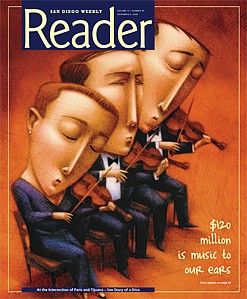
The San Diego Symphony rebounds and swings.
$120 is music to our ears
It’s Friday morning, and a woman in casual clothes, with a viola case on her back, bicycles down Harbor Drive. She’s headed toward Embarcadero Park, behind the Convention Center, for a summer pops rehearsal of the San Diego Symphony Orchestra.
The Coronado Bridge and downtown loom large, and the green lawn and blue waters of the bay complete a scenic color palette.
Approaching the stage from the parking area, dozens of people — older, distinguished-looking fellows with mustaches and smoking jackets, alongside young Asian women in shorts and T-shirts — stride along with instruments slung like guns.
Closer to the stage, across the field of chairs in rows, strains of classical tunes spring up and die away among the scales and finger exercises and quiet conversations.
An ominous trombone. A curious bassoon. Swooning strings. Dapper clarinets, and the tinkling flutter of a flute.
The orchestra is warming up.
Tonight, the men will wear tails and white bow ties and cummerbunds, and the women will be in black formal wear, with sleeves past their elbows and skirts past their knees; but right now, there are visors and straw hats, reading glasses and Ray-Bans, dress socks and sandals.
The rehearsal begins with some announcements. Monica Mancini, the guest artist for tonight’s summer pops show, is introduced. The orchestra members clap. Many of them — instruments in hand — “clap” by tapping their feet.
Mancini waves and smiles to the symphony members and says nothing. Her performance with the summer pops this evening will celebrate the music of her father, Academy Award-winning composer Henry Mancini. As for Monica, she’s been nominated for multiple Grammys and sung with everyone from Stevie Wonder to Michael Jackson to major symphony orchestras.
Matthew Garbutt, summer pops conductor for the symphony, says good morning. And then, “Let’s begin.”
Garbutt is wearing high-top white sneakers, khaki shorts, and a red, short-sleeved, collared golf shirt. His outfit provides counterpoint to the conductor’s baton in his right hand.
The baton — like a judge’s gavel or a hypnotist’s watch — is the mark of a specialist among specialists. Leonard Bernstein referred to the conductor’s baton as an “instrument of meaning.”
“First up, we’ll do ‘Pink Panther,’ ” Garbutt says, referring to one of the elder Mancini’s most famous tunes.
For much of the three-minute instrumental, Garbutt taps his right foot, his hands behind his back, his head bobbing in tacit enjoyment. Every half-minute or so, he turns the page of the score on the stand in front of him.
Slinking along the notes, the orchestra sounds flawless. That is, until something almost imperceptible occurs, and they all stop playing at once.
The strings are confused about a transition. “Bar 105,” a voice says. And then the same voice asks a question. Garbutt leans forward, addressing the question.
Then Garbutt speaks up and says, “Everyone! Let’s take it from 105.” And “Pink Panther” plays on to the end.
Mancini steps up to the microphone. She’s thin and attractive, with long arms and legs. Wearing sunglasses, she faces the empty seats on the lawn of the Embarcadero and sings “It Had Better Be Tonight” with the orchestra sounding spicy behind her.
After the tune, the harpist applies hand lotion.
Then “Moment to Moment” comes on, seething and slow, but stops after a few sultry measures. The woodwinds have a question about tempo. Garbutt responds, “It’s two-four in the alto part,” the rest of his answer mostly swallowed by an airplane flying over.
The orchestra starts again.
They seem like a race car in the slow lane or a hurricane-capable wind lifting a few leaves, half-hiding their potential.
This is the orchestra’s second time rehearsing the Henry Mancini material and its first time rehearsing with Monica Mancini. Tonight will be the show.
After an hour, it’s time for a break. The musicians tend to their instruments first — wiping down strings, protecting reeds — before they tend to their own needs. They have a snack in a tent behind the stage and then shuffle back up to their places.
During the first piece after the break, Garbutt interrupts. “We need the brass a little more raunchy,” he says, “a little dirtier, a little more hot.” The tune they’re playing is, after all, called “Le Jazz Hot.”
“Should we stand up to play it?” asks one trombonist.
Everyone laughs.
“Do whatever blows your skirt up,” calls out Mancini.
But Garbutt says no, no need to stand.
Garbutt, 57, has been with the symphony since 1977.
“Being the pops conductor, I have instantly a little more connection with the audience, because we’re playing popular stuff that they know,” Garbutt says.
In addition to Garbutt, the symphony employs three conductors: Jahja Ling, the music director; Marvin Hamlisch (of A Chorus Line fame), who is the principal pops conductor and leads the winter pops; and Philip Mann, the fellowship conductor.
Garbutt is also the principal tuba player for the symphony, when he’s not waving his baton.
“For the summer pops, we played along with a Pink Floyd cover band this year,” Garbutt says. “And we did the music of Billy Joel.”
Back from the Ashes
Ward Gill leans earnestly across a small round table in the corner of his office. Gill has served as the symphony’s executive director for the past five years. His office in the Symphony Towers building on Seventh and B breathes with an air of elegance, right down to the rich wood desk, lush fabric on the chairs, and abstract paintings on the walls.
“I’ll speak from a business perspective,” Gill says, folding his hands. “If you want to be a business player — and there are new concert halls going in right now in Beijing, Shanghai, in Malaysia and India — you need to have a symphony. You judge a city by its institutions: its hospitals, its universities, its museums, its theater community, and certainly its symphony. That’s how you create great cities.”
Says Gill, “Six years ago, we were a tier-two orchestra, or a regional orchestra. We had a budget of a little over $8 million. Since then we’ve more than doubled that, to over $17 million.”
But before this recent boom, the symphony went through years of financial hardship.
“Back in 1996, the symphony didn’t have any money left to pay people,” says Gill. “There was no money left at all, and we basically closed up shop.”
While struggling through the 1996 season, the symphony made increasingly impassioned requests to local banks and the citizens of San Diego.
Symphony violinist John Stubbs remembers guest conductor Murray Sidlin all but begging the audience after one of the last concerts in 1996. “He gave the most heartfelt speech,” Stubbs remembers, “about what a treasure this was. And how it was hard to imagine a civilized city like San Diego allowing this treasure to slip from its fingers.”
To no avail.
After the final scheduled show in 1996, almost everyone on the payroll — including all of the musicians and the conductors — was laid off. Only a skeleton administrative crew remained, trying to seek the funds necessary to restart the symphony.
At the time, the Union-Tribune reported that a 600-page Chapter 7 liquidation bankruptcy filing by the symphony listed assets of about $6.5 million, liabilities of $5.2 million, and no money in the bank for operating and payroll expenses.
The musicians were left to seek out solo gigs and extra students, and to make ends meet, many of them were able to find jobs playing in the symphonies for the San Diego Opera and the California Ballet.
Stubbs remembers the dark season well. “It seemed like such an embarrassment,” he says. “It was just unbelievable that the city would allow that to happen. But I remember thinking that with a city of this size, the symphony would inevitably have to come back at some point.”
San Diego’s mayor in 1997, Susan Golding, was influential in getting the orchestra restarted, even assembling a save-the-symphony task force, according to Gill.
“We didn’t actually go through and officially file for Chapter 11 bankruptcy,” Gill says. “We just went dark, if you will, instead of going through all the legal proceedings. And in order for Symphony Hall not to be liquidated, a gentleman by the name of Larry Robinson came up with the necessary funding to take control of the hall. At the same time, he made a gift back to the symphony, stating that the hall officially will become the property of the symphony again in 2014.”
Robinson’s gift of $2 million and pro bono efforts by local bankruptcy attorneys Ted Graham and Jeff Garfinkle were instrumental in the symphony’s resurrection.
After going dark for one season, the symphony resumed concerts on July 23, 1998, with a limited summer season of ten weeks. “Most all of the musicians came back,” Gill says, “but we could only pay them on a per-concert basis.”
For the shortened, 26-week season in 1998, stand musicians received roughly $25,000 apiece. A restructured labor agreement raised their salaries to the $40,000 range in 2001 for a 41-week season. In 2006, their salaries were raised again, to a minimum of $46,412, and under the current labor agreement, the salaries will continue to go up every year, to a minimum of $55,776 in 2011, according to Gill. Since 2006, the symphony has played full seasons of 42 weeks.
The 2008 San Diego Symphony employs 80 musicians and 40 administrative staff year-round. According to reports from the symphony’s Form 990, both Gill and principal conductor Jahja Ling earn in the neighborhood of $250,000 each. Principal players within the orchestra will make in the range of $75,000 to $125,000.
These positions are supplemented by 100 or so ushers and part-time workers, many of whom volunteer, and about 20 additional musicians who will augment the orchestra throughout the year — Monica Mancini, for instance — sometimes to the tune of as much as $200,000 for a single concert appearance.
The symphony’s budget has recovered gradually since the Chapter 7 filing, escalating at a rate of at least $1 million almost every year, from $6.9 million in 1998 to a current figure of about $17 million. Roughly one-third of the orchestra’s revenues come from ticket sales, and the rest is due to endowments and fundraising.
The major turnaround for the symphony occurred in 2002, when the largest individual orchestra endowment in history — $100 million from the founder and chief executive of Qualcomm, Irwin Jacobs, and his wife Joan — all but ended the financial woes. According to reports in the Union-Tribune, this historic donation is to be doled out to the symphony at the rate of $5 million per year for ten years, with the remainder to be left to the orchestra as a bequest.
In 2004, when Gill was hired, expensive and historically significant instruments were purchased for some of the musicians, and Maestro Ling came onboard as well.
Today, the San Diego Symphony is one of the 20 largest symphonies in the United States.
The current $17 million annual budget covers musicians’ salaries ($9.5 million), administrative salaries ($3.3 million), and production costs ($1.6 million for lighting, repairs, and maintenance); the remaining $2.6 million goes for advertising and non-staff-related expenses such as office supplies.
“We’ve always been undercapitalized,” says Gill. “We’re undercapitalized even now. But thanks to the largesse of the Jacobses and other benefactors within the community, our worst times appear to be behind us.”
A $2.5 Million Violin
Soon after Jeff Thayer was hired to be the San Diego Symphony’s concertmaster in 2004, he was told that Irwin and Joan Jacobs — the symphony’s major benefactors — wanted San Diego’s orchestra to have an instrument with few peers in the music world.
They’d arranged for a dealer to collect a handful of Stradivarius and Guarneri violins, and they wanted Thayer to try each one out and decide which one they should buy for him to play.
Most experts agree that the apex of violin making was reached in the late 17th and early 18th Centuries in the workshops of Antonio Stradivari and Giuseppe Guarneri, who were both from Cremona, Italy. Today, only about 1000 or so of these prized instruments still exist. And because a violin, well cared for, actually improves over time, today’s “Strads” and Guarneris are worth millions of dollars apiece.
The instrument Thayer selected was a Stradivarius from 1706 called the “Sir Bagshawe.”
“Sir Bagshawe was an Englishman, and this violin was in his family for about a hundred years,” Thayer relates.
The Sir Bagshawe Stradivarius cost the Jacobses $2.5 million.
Thayer is a redhead, or, as he insists, a “strawberry blond.” As such, he’d be relatively easy to pick out among his colleagues, even if he wasn’t the one who led the tuning of the orchestra before concerts, and even if he didn’t sit right in front of the conductor, in the concertmaster’s chair.
Is the Strad really that different from other good violins?
“Maybe nonmusicians wouldn’t be able to tell the difference,” Thayer says, “but most musicians that have trained ears would be able to discern the difference. The best way I could describe it is, if you have a Fiat, and then you have a Lamborghini, and you drive both of those cars, then you would certainly know the superior car. Now, the trick about it is, those cars don’t drive themselves. So you need to have someone who can get the most out of the potential of the car to make it worthwhile. That’s the thing about having a Strad. Everyone thinks that if you have a Strad, you’re supposed to sound like a million bucks. But there’s a famous story about a famous violinist, Yasha Heifetz. After one of his concerts, an adoring fan came backstage and said, ‘Oh, Mr. Heifetz, your violin sounds so wonderful.’ And Mr. Heifetz picked up his violin and put his ear to it, and he responded, ‘I don’t hear anything.’ ”
Maestro!
Jahja Ling, 56, the San Diego Symphony’s music director and principal conductor, is the kind of local celebrity who inspires admiring autograph-seekers.
Ling relates a story about driving in Cleveland — where he was a conductor for over 20 years — and being pulled over for speeding. “The officer said to me, ‘You’re Jahja Ling, the conductor, right?’ And I said, ‘Yes.’ And he said, ‘This time, I’ll let you go. But my wife is a fan of yours. So before you go, could you sign an autograph for her?’ ”
Ling, an American citizen of Chinese descent, grew up in Jakarta, on the island of Java, in Indonesia. After high school, he won a piano competition and received a scholarship to attend Julliard School of Music in New York City as a concert piano major. It was his first time out of Indonesia.
After graduating from Julliard with a piano major, Ling decided to pursue a doctorate in conducting. He was the lone student accepted into the doctorate conducting program at Yale, under Otto-Werner Mueller. Ling was 24.
From there, he went to the Massachusetts summer proving ground for all the great classical conductors — Tanglewood — and performed so well that Leonard Bernstein came up to Ling and told him that he would one day be a great conductor.
Soon thereafter, Ling landed his first job, in San Francisco. He then spent 14 years as director of the Florida Orchestra, 20 years with the Cleveland, and now for the past 4 years he’s been at the head of the San Diego Symphony.
How does Ling classify his own conducting technique?
He comes, he says, from the German tradition, thanks to Mueller, his teacher at Yale. And German and Austrian roots — Bach, Beethoven, Mozart, etc. — are the core of classical music. “I got all of the most strict, deep, analytical musical tradition,” says Ling. “But then I met Leonard Bernstein, and I got the American side. I learned to feel the composer, instead of just intellectually trying to understand the music.”
A Day in the Life of a Tutti Violinist
John Stubbs practices the violin nearly every day. “I at least try to do a half hour of maintenance,” he says. “You know, scales, arpeggios.”
This week, Stubbs is practicing excerpts for violin auditions, since two openings in the violin section will be coming up soon. He’ll be on the audition committee, and he wants to be intimate with the material.
“One of the things that I really enjoy doing is coaching people when they’re going to be taking auditions,” Stubbs says.
Stubbs wears round, thin glasses over his blue-gray eyes. His hair is kept short, and his body is thin and wiry.
The modest South Park house Stubbs shares with his wife Denise, a semiretired prima ballerina, is full of books and modern art.
The whole time that Stubbs talks, the whirr of his wife on a treadmill hums faintly from another room.
“A violin not only sounds beautiful, but it also has a beautiful shape,” says Stubbs.
Stubbs plays an August Hermann model that was made in Berlin in 1907. He bought it when he finished graduate school in 1977 for about $4000. “It’s appreciated since then,” he says, then adds, “but it’s a German instrument. It’s not really worth all that much, relatively speaking. But I love this instrument. It’s a joy to play. It has enough sound, and it blends in beautifully. It’s my tool in the orchestra.”
Stubbs goes from sitting cross-legged in an armchair to sitting cross-footed in a high swiveling office chair. He takes up his bow and places his August Hermann to his throat.
He begins to play, sawing the horsehair of the bow back and forth over the strings, slightly tight-lipped as he stares at his finger work.
He’s playing an excerpt from Schumann’s Scherzo. His violin moans and cries, filling the house with feeling.
At 20–30 seats, there are more violins than any other instrument in the orchestra. Within the violin section, there’s the first principal violinist — who’s also called the concertmaster — and the second and third principal violinists, and then there’s the assistant first, second, and third violins. The rest of the players are called “tutti,” Italian for “all,” which usually refers to an ensemble. Stubbs plays tutti.
When he finishes playing the Schumann, Stubbs places his violin and bow down on the glass coffee table in front of him. He’s dashed off a rendition of one of the more difficult technical pieces in the classical repertory but has a look on his face that seems to say, “Well, so that’s what I do.”
Stubbs is right-handed, and the left side of his throat bears the telltale mark of a violinist: a hickey. “You’d think we were all attacked by the same weird vampire,” Stubbs laughs. “You can pad the violin all you want, but it doesn’t change the fact that you’ve got this thing there, and you’re pinching down. Also, you can’t have too much padding, or you wouldn’t have control of the instrument.”
Stubbs has played the violin since he was eight years old, and he’s been in the San Diego Symphony for more than 30 years. He also conducts.
“In December,” Stubbs says, “the symphony splits the orchestra, and half does winter pops, and the other half comes down to the Civic Theatre with me, and I conduct for the California Ballet.”
But Stubbs wants to make it clear that he’s not just a “wimpy” musician. He’s proud to mention that he has a “baby” in the garage.
“It’s a 1946 Willys, and I’ve been working on it for a while now,” Stubbs says, smiling widely. “It’s the first civilian jeep model after World War I.”
Besides making music on the stage and in his garage, Stubbs also rides his electric bike just about every day.
Are most classical musicians athletic?
“Well, the orchestra’s young,” Stubbs says. He sits in calm silence for three or four seconds, thinking of an answer to the question. “Everything we do is actually pretty physically demanding,” he says, finally. “We’re prone to injuries. You can get tennis elbow from playing the violin. I’ve had cortisone shots in my shoulders. So we have to sort of keep in shape. If you want to sustain your career, you have to do something. I’ve started doing Pilates now.”
Without the Union, Musicians Would Be in a Bad Way
Ward Gill, the symphony’s executive director, paints an equivocal picture of the American Federation of Musicians (AF of M), the national musicians’ union. “Because of the union, musicians make a pretty good wage, and their salaries are guaranteed, but those salaries also don’t go up very much,” says Gill.
“The union is one of those things that has helped musicians, but at the same time, it has hindered them. Because of the position of the national union, there is very little new recording being done. Almost none.”
The San Diego Symphony releases two limited-run editions of recordings made from live concerts every year, but they aren’t pure recordings done in a recording studio. “They don’t do that anymore,” says Gill. “It’s impossible to afford to do that under the phonograph record contract of the AF of M. It would cost us $200,000 to make an official CD today. Instead, we do these limited pressings. If you sell under a thousand discs, and you have complete rights to it, and you do not distribute through a commercial channel, then it’s okay. It ends up costing us about $20,000.”
“The biggest thing that the American Federation of Musicians did to help the musicians was to make their jobs full-time jobs,” Gill says. “It used to be, you had a concert series, you collected money, you paid it back to the musicians, and that was it. And then when you wanted to do another series, you went and got the musicians together again. All of that changed in the 1960s, with the inception of the endowment concept, and then we had these full-time musicians around all year, so we had to keep trying to think up new ways to use them.”
Maestro Jahja Ling, for his part, notes that for the past three years or so, no one in the San Diego Symphony has filed a single grievance.
A Day in the Life of a Second Clarinetist
Flurries of notes — a Mozart clarinet concerto — scurry over the wood floors through a downtown loft. The clarinetist’s eyes flutter closed, then open again, then close again. She’s in the music, swaying, and her face turns redder as she plays.
Theresa Tunnicliff lives with her husband and son in a wraparound loft on Island Street, downtown, with views of the city. Her husband, Peter Otto, is the director of music technology at UCSD.
This morning, Tunnicliff sits in a swivel chair in the corner of her living space with a music stand in front of her. Her legs are straight and her feet are crossed, and her clarinet is poised in both hands in front of her.
“All orchestras are filled with people who wouldn’t take ‘no’ for an answer,” Tunnicliff says, after she finishes the Mozart. “Really, the thing that separates professional musicians from good players who can’t make a living is just being able to stand up to failure. There are people who’ve had to go through hundreds of auditions to get where they want to be.”
Was Tunnicliff herself a natural?
“No, no,” she says. “Not at all.” With her short, straight hair and thick-rimmed glasses and dark cardigan over a straight dress, Tunnicliff looks exactly like a…well, a clarinetist.
“I would say most wind and brass players start around 10, 11, or 12 years old,” she continues. “They’re not like little pianists or violinists who start at age 3 and are great. For one thing, your teeth aren’t settled in, and also your hands don’t reach. You know, there’s not a Suzuki-sized clarinet, like there is for the violin. Also, when you’re young, you don’t really have the strength.”
On the word “strength,” Tunnicliff points to her diaphragm. “You need a lot of breath support. Just to get a sound out of a clarinet takes a lot of facial muscles and lip strength, and a lot of breath strength as well. You have to train your facial muscles, and you have to breathe by filling the bottom of your lungs and by using your diaphragm in a very controlled way. It takes some discipline and training, really; it doesn’t come naturally at all.”
If Tunnicliff takes some time off from playing, her fingers — her muscle memory — will come back first, she says. “And the embouchure part of it, getting your face in shape again, is the next thing. But I would say the last thing to come back is the breath support. That’s the hardest thing to get in shape.”
During downtimes for the orchestra, Tunnicliff practices a couple of hours a day, doing scales and “basic maintenance.” But, when she’ll be in rehearsals for several hours a week, she won’t practice much at all. “On clarinet, you can’t physically play that many hours a day. There’s a limit.” She points first to her mouth, then to her belly. “Your facial muscles and breath strength can only be pushed so hard. And anyway, at this level, when you’re playing over 100 concerts a year, you don’t practice three or four hours a day like you did when you were in school.”
Tunnicliff has been with the symphony for four years. But she played with the opera for four years before that, back before the opera orchestra and the symphony orchestra merged in 2004.
“When I first started playing the clarinet,” Tunnicliff says, “it interested me, but it didn’t really create a huge spark until I started playing in the ensemble. Because we’re all — 70 or 80 musicians — creating something together, almost like one organism. We’re all like cogs in a big wheel. And that’s the exciting part, making something happen by all coming together like that.”
There are four major sections of any symphony orchestra: the strings, brass, woodwinds, and percussion. The three clarinet seats are part of the woodwind section, along with oboe, flute, and bassoon.
Tunnicliff plays second clarinet and E-flat clarinet. The E-flat clarinet is tiny and plays the very high parts.
“My clarinet is my voice,” says Tunnicliff. “It’s so lyrical. When I play, and everything’s working the way I want it to, and I’m visualizing the parts fully, and it’s all clicking, in my mind’s eye, it’s like I’m singing.”
Tunnicliff’s main clarinet is a French model made by Buffet Crampon. It cost about $5000. One of the worst things about playing a clarinet is that you have to replace it after eight or ten years.
She has her instruments professionally cleaned and oiled and has the pads periodically replaced. This can cost Tunnicliff as much as $1000 each year. The reeds for her clarinets can cost her close to $1000 a year.
She supplements her family’s income by giving $60-per-hour lessons and has four or five students at any given time.
Tunnicliff points out a loft window in a building about eight blocks away. “That’s Symphony Hall,” she says. “So my workplace isn’t very far away.” She rides her bike just about everywhere, and she’ll often carry her instrument in a case on her back.
Having been with the orchestra long enough to feel a sense of great pride in their recent growth, Tunnicliff says, “Historically, in the past, the orchestra really suffered. And now we’re in a really good place.”
Here's something you might be interested in.
The San Diego Symphony rebounds and swings.
$120 is music to our ears

The San Diego Symphony rebounds and swings.
$120 is music to our ears
It’s Friday morning, and a woman in casual clothes, with a viola case on her back, bicycles down Harbor Drive. She’s headed toward Embarcadero Park, behind the Convention Center, for a summer pops rehearsal of the San Diego Symphony Orchestra.
The Coronado Bridge and downtown loom large, and the green lawn and blue waters of the bay complete a scenic color palette.
Approaching the stage from the parking area, dozens of people — older, distinguished-looking fellows with mustaches and smoking jackets, alongside young Asian women in shorts and T-shirts — stride along with instruments slung like guns.
Closer to the stage, across the field of chairs in rows, strains of classical tunes spring up and die away among the scales and finger exercises and quiet conversations.
An ominous trombone. A curious bassoon. Swooning strings. Dapper clarinets, and the tinkling flutter of a flute.
The orchestra is warming up.
Tonight, the men will wear tails and white bow ties and cummerbunds, and the women will be in black formal wear, with sleeves past their elbows and skirts past their knees; but right now, there are visors and straw hats, reading glasses and Ray-Bans, dress socks and sandals.
The rehearsal begins with some announcements. Monica Mancini, the guest artist for tonight’s summer pops show, is introduced. The orchestra members clap. Many of them — instruments in hand — “clap” by tapping their feet.
Mancini waves and smiles to the symphony members and says nothing. Her performance with the summer pops this evening will celebrate the music of her father, Academy Award-winning composer Henry Mancini. As for Monica, she’s been nominated for multiple Grammys and sung with everyone from Stevie Wonder to Michael Jackson to major symphony orchestras.
Matthew Garbutt, summer pops conductor for the symphony, says good morning. And then, “Let’s begin.”
Garbutt is wearing high-top white sneakers, khaki shorts, and a red, short-sleeved, collared golf shirt. His outfit provides counterpoint to the conductor’s baton in his right hand.
The baton — like a judge’s gavel or a hypnotist’s watch — is the mark of a specialist among specialists. Leonard Bernstein referred to the conductor’s baton as an “instrument of meaning.”
“First up, we’ll do ‘Pink Panther,’ ” Garbutt says, referring to one of the elder Mancini’s most famous tunes.
For much of the three-minute instrumental, Garbutt taps his right foot, his hands behind his back, his head bobbing in tacit enjoyment. Every half-minute or so, he turns the page of the score on the stand in front of him.
Slinking along the notes, the orchestra sounds flawless. That is, until something almost imperceptible occurs, and they all stop playing at once.
The strings are confused about a transition. “Bar 105,” a voice says. And then the same voice asks a question. Garbutt leans forward, addressing the question.
Then Garbutt speaks up and says, “Everyone! Let’s take it from 105.” And “Pink Panther” plays on to the end.
Mancini steps up to the microphone. She’s thin and attractive, with long arms and legs. Wearing sunglasses, she faces the empty seats on the lawn of the Embarcadero and sings “It Had Better Be Tonight” with the orchestra sounding spicy behind her.
After the tune, the harpist applies hand lotion.
Then “Moment to Moment” comes on, seething and slow, but stops after a few sultry measures. The woodwinds have a question about tempo. Garbutt responds, “It’s two-four in the alto part,” the rest of his answer mostly swallowed by an airplane flying over.
The orchestra starts again.
They seem like a race car in the slow lane or a hurricane-capable wind lifting a few leaves, half-hiding their potential.
This is the orchestra’s second time rehearsing the Henry Mancini material and its first time rehearsing with Monica Mancini. Tonight will be the show.
After an hour, it’s time for a break. The musicians tend to their instruments first — wiping down strings, protecting reeds — before they tend to their own needs. They have a snack in a tent behind the stage and then shuffle back up to their places.
During the first piece after the break, Garbutt interrupts. “We need the brass a little more raunchy,” he says, “a little dirtier, a little more hot.” The tune they’re playing is, after all, called “Le Jazz Hot.”
“Should we stand up to play it?” asks one trombonist.
Everyone laughs.
“Do whatever blows your skirt up,” calls out Mancini.
But Garbutt says no, no need to stand.
Garbutt, 57, has been with the symphony since 1977.
“Being the pops conductor, I have instantly a little more connection with the audience, because we’re playing popular stuff that they know,” Garbutt says.
In addition to Garbutt, the symphony employs three conductors: Jahja Ling, the music director; Marvin Hamlisch (of A Chorus Line fame), who is the principal pops conductor and leads the winter pops; and Philip Mann, the fellowship conductor.
Garbutt is also the principal tuba player for the symphony, when he’s not waving his baton.
“For the summer pops, we played along with a Pink Floyd cover band this year,” Garbutt says. “And we did the music of Billy Joel.”
Back from the Ashes
Ward Gill leans earnestly across a small round table in the corner of his office. Gill has served as the symphony’s executive director for the past five years. His office in the Symphony Towers building on Seventh and B breathes with an air of elegance, right down to the rich wood desk, lush fabric on the chairs, and abstract paintings on the walls.
“I’ll speak from a business perspective,” Gill says, folding his hands. “If you want to be a business player — and there are new concert halls going in right now in Beijing, Shanghai, in Malaysia and India — you need to have a symphony. You judge a city by its institutions: its hospitals, its universities, its museums, its theater community, and certainly its symphony. That’s how you create great cities.”
Says Gill, “Six years ago, we were a tier-two orchestra, or a regional orchestra. We had a budget of a little over $8 million. Since then we’ve more than doubled that, to over $17 million.”
But before this recent boom, the symphony went through years of financial hardship.
“Back in 1996, the symphony didn’t have any money left to pay people,” says Gill. “There was no money left at all, and we basically closed up shop.”
While struggling through the 1996 season, the symphony made increasingly impassioned requests to local banks and the citizens of San Diego.
Symphony violinist John Stubbs remembers guest conductor Murray Sidlin all but begging the audience after one of the last concerts in 1996. “He gave the most heartfelt speech,” Stubbs remembers, “about what a treasure this was. And how it was hard to imagine a civilized city like San Diego allowing this treasure to slip from its fingers.”
To no avail.
After the final scheduled show in 1996, almost everyone on the payroll — including all of the musicians and the conductors — was laid off. Only a skeleton administrative crew remained, trying to seek the funds necessary to restart the symphony.
At the time, the Union-Tribune reported that a 600-page Chapter 7 liquidation bankruptcy filing by the symphony listed assets of about $6.5 million, liabilities of $5.2 million, and no money in the bank for operating and payroll expenses.
The musicians were left to seek out solo gigs and extra students, and to make ends meet, many of them were able to find jobs playing in the symphonies for the San Diego Opera and the California Ballet.
Stubbs remembers the dark season well. “It seemed like such an embarrassment,” he says. “It was just unbelievable that the city would allow that to happen. But I remember thinking that with a city of this size, the symphony would inevitably have to come back at some point.”
San Diego’s mayor in 1997, Susan Golding, was influential in getting the orchestra restarted, even assembling a save-the-symphony task force, according to Gill.
“We didn’t actually go through and officially file for Chapter 11 bankruptcy,” Gill says. “We just went dark, if you will, instead of going through all the legal proceedings. And in order for Symphony Hall not to be liquidated, a gentleman by the name of Larry Robinson came up with the necessary funding to take control of the hall. At the same time, he made a gift back to the symphony, stating that the hall officially will become the property of the symphony again in 2014.”
Robinson’s gift of $2 million and pro bono efforts by local bankruptcy attorneys Ted Graham and Jeff Garfinkle were instrumental in the symphony’s resurrection.
After going dark for one season, the symphony resumed concerts on July 23, 1998, with a limited summer season of ten weeks. “Most all of the musicians came back,” Gill says, “but we could only pay them on a per-concert basis.”
For the shortened, 26-week season in 1998, stand musicians received roughly $25,000 apiece. A restructured labor agreement raised their salaries to the $40,000 range in 2001 for a 41-week season. In 2006, their salaries were raised again, to a minimum of $46,412, and under the current labor agreement, the salaries will continue to go up every year, to a minimum of $55,776 in 2011, according to Gill. Since 2006, the symphony has played full seasons of 42 weeks.
The 2008 San Diego Symphony employs 80 musicians and 40 administrative staff year-round. According to reports from the symphony’s Form 990, both Gill and principal conductor Jahja Ling earn in the neighborhood of $250,000 each. Principal players within the orchestra will make in the range of $75,000 to $125,000.
These positions are supplemented by 100 or so ushers and part-time workers, many of whom volunteer, and about 20 additional musicians who will augment the orchestra throughout the year — Monica Mancini, for instance — sometimes to the tune of as much as $200,000 for a single concert appearance.
The symphony’s budget has recovered gradually since the Chapter 7 filing, escalating at a rate of at least $1 million almost every year, from $6.9 million in 1998 to a current figure of about $17 million. Roughly one-third of the orchestra’s revenues come from ticket sales, and the rest is due to endowments and fundraising.
The major turnaround for the symphony occurred in 2002, when the largest individual orchestra endowment in history — $100 million from the founder and chief executive of Qualcomm, Irwin Jacobs, and his wife Joan — all but ended the financial woes. According to reports in the Union-Tribune, this historic donation is to be doled out to the symphony at the rate of $5 million per year for ten years, with the remainder to be left to the orchestra as a bequest.
In 2004, when Gill was hired, expensive and historically significant instruments were purchased for some of the musicians, and Maestro Ling came onboard as well.
Today, the San Diego Symphony is one of the 20 largest symphonies in the United States.
The current $17 million annual budget covers musicians’ salaries ($9.5 million), administrative salaries ($3.3 million), and production costs ($1.6 million for lighting, repairs, and maintenance); the remaining $2.6 million goes for advertising and non-staff-related expenses such as office supplies.
“We’ve always been undercapitalized,” says Gill. “We’re undercapitalized even now. But thanks to the largesse of the Jacobses and other benefactors within the community, our worst times appear to be behind us.”
A $2.5 Million Violin
Soon after Jeff Thayer was hired to be the San Diego Symphony’s concertmaster in 2004, he was told that Irwin and Joan Jacobs — the symphony’s major benefactors — wanted San Diego’s orchestra to have an instrument with few peers in the music world.
They’d arranged for a dealer to collect a handful of Stradivarius and Guarneri violins, and they wanted Thayer to try each one out and decide which one they should buy for him to play.
Most experts agree that the apex of violin making was reached in the late 17th and early 18th Centuries in the workshops of Antonio Stradivari and Giuseppe Guarneri, who were both from Cremona, Italy. Today, only about 1000 or so of these prized instruments still exist. And because a violin, well cared for, actually improves over time, today’s “Strads” and Guarneris are worth millions of dollars apiece.
The instrument Thayer selected was a Stradivarius from 1706 called the “Sir Bagshawe.”
“Sir Bagshawe was an Englishman, and this violin was in his family for about a hundred years,” Thayer relates.
The Sir Bagshawe Stradivarius cost the Jacobses $2.5 million.
Thayer is a redhead, or, as he insists, a “strawberry blond.” As such, he’d be relatively easy to pick out among his colleagues, even if he wasn’t the one who led the tuning of the orchestra before concerts, and even if he didn’t sit right in front of the conductor, in the concertmaster’s chair.
Is the Strad really that different from other good violins?
“Maybe nonmusicians wouldn’t be able to tell the difference,” Thayer says, “but most musicians that have trained ears would be able to discern the difference. The best way I could describe it is, if you have a Fiat, and then you have a Lamborghini, and you drive both of those cars, then you would certainly know the superior car. Now, the trick about it is, those cars don’t drive themselves. So you need to have someone who can get the most out of the potential of the car to make it worthwhile. That’s the thing about having a Strad. Everyone thinks that if you have a Strad, you’re supposed to sound like a million bucks. But there’s a famous story about a famous violinist, Yasha Heifetz. After one of his concerts, an adoring fan came backstage and said, ‘Oh, Mr. Heifetz, your violin sounds so wonderful.’ And Mr. Heifetz picked up his violin and put his ear to it, and he responded, ‘I don’t hear anything.’ ”
Maestro!
Jahja Ling, 56, the San Diego Symphony’s music director and principal conductor, is the kind of local celebrity who inspires admiring autograph-seekers.
Ling relates a story about driving in Cleveland — where he was a conductor for over 20 years — and being pulled over for speeding. “The officer said to me, ‘You’re Jahja Ling, the conductor, right?’ And I said, ‘Yes.’ And he said, ‘This time, I’ll let you go. But my wife is a fan of yours. So before you go, could you sign an autograph for her?’ ”
Ling, an American citizen of Chinese descent, grew up in Jakarta, on the island of Java, in Indonesia. After high school, he won a piano competition and received a scholarship to attend Julliard School of Music in New York City as a concert piano major. It was his first time out of Indonesia.
After graduating from Julliard with a piano major, Ling decided to pursue a doctorate in conducting. He was the lone student accepted into the doctorate conducting program at Yale, under Otto-Werner Mueller. Ling was 24.
From there, he went to the Massachusetts summer proving ground for all the great classical conductors — Tanglewood — and performed so well that Leonard Bernstein came up to Ling and told him that he would one day be a great conductor.
Soon thereafter, Ling landed his first job, in San Francisco. He then spent 14 years as director of the Florida Orchestra, 20 years with the Cleveland, and now for the past 4 years he’s been at the head of the San Diego Symphony.
How does Ling classify his own conducting technique?
He comes, he says, from the German tradition, thanks to Mueller, his teacher at Yale. And German and Austrian roots — Bach, Beethoven, Mozart, etc. — are the core of classical music. “I got all of the most strict, deep, analytical musical tradition,” says Ling. “But then I met Leonard Bernstein, and I got the American side. I learned to feel the composer, instead of just intellectually trying to understand the music.”
A Day in the Life of a Tutti Violinist
John Stubbs practices the violin nearly every day. “I at least try to do a half hour of maintenance,” he says. “You know, scales, arpeggios.”
This week, Stubbs is practicing excerpts for violin auditions, since two openings in the violin section will be coming up soon. He’ll be on the audition committee, and he wants to be intimate with the material.
“One of the things that I really enjoy doing is coaching people when they’re going to be taking auditions,” Stubbs says.
Stubbs wears round, thin glasses over his blue-gray eyes. His hair is kept short, and his body is thin and wiry.
The modest South Park house Stubbs shares with his wife Denise, a semiretired prima ballerina, is full of books and modern art.
The whole time that Stubbs talks, the whirr of his wife on a treadmill hums faintly from another room.
“A violin not only sounds beautiful, but it also has a beautiful shape,” says Stubbs.
Stubbs plays an August Hermann model that was made in Berlin in 1907. He bought it when he finished graduate school in 1977 for about $4000. “It’s appreciated since then,” he says, then adds, “but it’s a German instrument. It’s not really worth all that much, relatively speaking. But I love this instrument. It’s a joy to play. It has enough sound, and it blends in beautifully. It’s my tool in the orchestra.”
Stubbs goes from sitting cross-legged in an armchair to sitting cross-footed in a high swiveling office chair. He takes up his bow and places his August Hermann to his throat.
He begins to play, sawing the horsehair of the bow back and forth over the strings, slightly tight-lipped as he stares at his finger work.
He’s playing an excerpt from Schumann’s Scherzo. His violin moans and cries, filling the house with feeling.
At 20–30 seats, there are more violins than any other instrument in the orchestra. Within the violin section, there’s the first principal violinist — who’s also called the concertmaster — and the second and third principal violinists, and then there’s the assistant first, second, and third violins. The rest of the players are called “tutti,” Italian for “all,” which usually refers to an ensemble. Stubbs plays tutti.
When he finishes playing the Schumann, Stubbs places his violin and bow down on the glass coffee table in front of him. He’s dashed off a rendition of one of the more difficult technical pieces in the classical repertory but has a look on his face that seems to say, “Well, so that’s what I do.”
Stubbs is right-handed, and the left side of his throat bears the telltale mark of a violinist: a hickey. “You’d think we were all attacked by the same weird vampire,” Stubbs laughs. “You can pad the violin all you want, but it doesn’t change the fact that you’ve got this thing there, and you’re pinching down. Also, you can’t have too much padding, or you wouldn’t have control of the instrument.”
Stubbs has played the violin since he was eight years old, and he’s been in the San Diego Symphony for more than 30 years. He also conducts.
“In December,” Stubbs says, “the symphony splits the orchestra, and half does winter pops, and the other half comes down to the Civic Theatre with me, and I conduct for the California Ballet.”
But Stubbs wants to make it clear that he’s not just a “wimpy” musician. He’s proud to mention that he has a “baby” in the garage.
“It’s a 1946 Willys, and I’ve been working on it for a while now,” Stubbs says, smiling widely. “It’s the first civilian jeep model after World War I.”
Besides making music on the stage and in his garage, Stubbs also rides his electric bike just about every day.
Are most classical musicians athletic?
“Well, the orchestra’s young,” Stubbs says. He sits in calm silence for three or four seconds, thinking of an answer to the question. “Everything we do is actually pretty physically demanding,” he says, finally. “We’re prone to injuries. You can get tennis elbow from playing the violin. I’ve had cortisone shots in my shoulders. So we have to sort of keep in shape. If you want to sustain your career, you have to do something. I’ve started doing Pilates now.”
Without the Union, Musicians Would Be in a Bad Way
Ward Gill, the symphony’s executive director, paints an equivocal picture of the American Federation of Musicians (AF of M), the national musicians’ union. “Because of the union, musicians make a pretty good wage, and their salaries are guaranteed, but those salaries also don’t go up very much,” says Gill.
“The union is one of those things that has helped musicians, but at the same time, it has hindered them. Because of the position of the national union, there is very little new recording being done. Almost none.”
The San Diego Symphony releases two limited-run editions of recordings made from live concerts every year, but they aren’t pure recordings done in a recording studio. “They don’t do that anymore,” says Gill. “It’s impossible to afford to do that under the phonograph record contract of the AF of M. It would cost us $200,000 to make an official CD today. Instead, we do these limited pressings. If you sell under a thousand discs, and you have complete rights to it, and you do not distribute through a commercial channel, then it’s okay. It ends up costing us about $20,000.”
“The biggest thing that the American Federation of Musicians did to help the musicians was to make their jobs full-time jobs,” Gill says. “It used to be, you had a concert series, you collected money, you paid it back to the musicians, and that was it. And then when you wanted to do another series, you went and got the musicians together again. All of that changed in the 1960s, with the inception of the endowment concept, and then we had these full-time musicians around all year, so we had to keep trying to think up new ways to use them.”
Maestro Jahja Ling, for his part, notes that for the past three years or so, no one in the San Diego Symphony has filed a single grievance.
A Day in the Life of a Second Clarinetist
Flurries of notes — a Mozart clarinet concerto — scurry over the wood floors through a downtown loft. The clarinetist’s eyes flutter closed, then open again, then close again. She’s in the music, swaying, and her face turns redder as she plays.
Theresa Tunnicliff lives with her husband and son in a wraparound loft on Island Street, downtown, with views of the city. Her husband, Peter Otto, is the director of music technology at UCSD.
This morning, Tunnicliff sits in a swivel chair in the corner of her living space with a music stand in front of her. Her legs are straight and her feet are crossed, and her clarinet is poised in both hands in front of her.
“All orchestras are filled with people who wouldn’t take ‘no’ for an answer,” Tunnicliff says, after she finishes the Mozart. “Really, the thing that separates professional musicians from good players who can’t make a living is just being able to stand up to failure. There are people who’ve had to go through hundreds of auditions to get where they want to be.”
Was Tunnicliff herself a natural?
“No, no,” she says. “Not at all.” With her short, straight hair and thick-rimmed glasses and dark cardigan over a straight dress, Tunnicliff looks exactly like a…well, a clarinetist.
“I would say most wind and brass players start around 10, 11, or 12 years old,” she continues. “They’re not like little pianists or violinists who start at age 3 and are great. For one thing, your teeth aren’t settled in, and also your hands don’t reach. You know, there’s not a Suzuki-sized clarinet, like there is for the violin. Also, when you’re young, you don’t really have the strength.”
On the word “strength,” Tunnicliff points to her diaphragm. “You need a lot of breath support. Just to get a sound out of a clarinet takes a lot of facial muscles and lip strength, and a lot of breath strength as well. You have to train your facial muscles, and you have to breathe by filling the bottom of your lungs and by using your diaphragm in a very controlled way. It takes some discipline and training, really; it doesn’t come naturally at all.”
If Tunnicliff takes some time off from playing, her fingers — her muscle memory — will come back first, she says. “And the embouchure part of it, getting your face in shape again, is the next thing. But I would say the last thing to come back is the breath support. That’s the hardest thing to get in shape.”
During downtimes for the orchestra, Tunnicliff practices a couple of hours a day, doing scales and “basic maintenance.” But, when she’ll be in rehearsals for several hours a week, she won’t practice much at all. “On clarinet, you can’t physically play that many hours a day. There’s a limit.” She points first to her mouth, then to her belly. “Your facial muscles and breath strength can only be pushed so hard. And anyway, at this level, when you’re playing over 100 concerts a year, you don’t practice three or four hours a day like you did when you were in school.”
Tunnicliff has been with the symphony for four years. But she played with the opera for four years before that, back before the opera orchestra and the symphony orchestra merged in 2004.
“When I first started playing the clarinet,” Tunnicliff says, “it interested me, but it didn’t really create a huge spark until I started playing in the ensemble. Because we’re all — 70 or 80 musicians — creating something together, almost like one organism. We’re all like cogs in a big wheel. And that’s the exciting part, making something happen by all coming together like that.”
There are four major sections of any symphony orchestra: the strings, brass, woodwinds, and percussion. The three clarinet seats are part of the woodwind section, along with oboe, flute, and bassoon.
Tunnicliff plays second clarinet and E-flat clarinet. The E-flat clarinet is tiny and plays the very high parts.
“My clarinet is my voice,” says Tunnicliff. “It’s so lyrical. When I play, and everything’s working the way I want it to, and I’m visualizing the parts fully, and it’s all clicking, in my mind’s eye, it’s like I’m singing.”
Tunnicliff’s main clarinet is a French model made by Buffet Crampon. It cost about $5000. One of the worst things about playing a clarinet is that you have to replace it after eight or ten years.
She has her instruments professionally cleaned and oiled and has the pads periodically replaced. This can cost Tunnicliff as much as $1000 each year. The reeds for her clarinets can cost her close to $1000 a year.
She supplements her family’s income by giving $60-per-hour lessons and has four or five students at any given time.
Tunnicliff points out a loft window in a building about eight blocks away. “That’s Symphony Hall,” she says. “So my workplace isn’t very far away.” She rides her bike just about everywhere, and she’ll often carry her instrument in a case on her back.
Having been with the orchestra long enough to feel a sense of great pride in their recent growth, Tunnicliff says, “Historically, in the past, the orchestra really suffered. And now we’re in a really good place.”
Comments