

Here's something you might be interested in.
Ask a Hipster — Advice you didn't know you needed
Big Screen — Movie commentary
Blurt — Music's inside track
Booze News — San Diego spirits
Classical Music — Immortal beauty
Classifieds — Free and easy
Close to Home — What it’s like on the street where you live
Cover Stories — Front-page features
Drinks All Around — Bartenders' drink recipes
Excerpts — Literary and spiritual excerpts
Feast! — Food & drink reviews
Feature Stories — Local news & stories
Fishing Report — What’s getting hooked from ship and shore
From the Archives — Spotlight on the past
Golden Dreams — Talk of the town
The Gonzo Report — Making the musical scene, or at least reporting from it
Letters — Our inbox
Movies@Home — Local movie buffs share favorites
Movie Reviews — Our critics' picks and pans
Musician Interviews — Up close with local artists
Neighborhood News from Stringers — Hyperlocal news
News Ticker — News & politics
Obermeyer — San Diego politics illustrated
Outdoors — Weekly changes in flora and fauna
Overheard in San Diego — Eavesdropping illustrated
Poetry — The old and the new
Reader Travel — Travel section built by travelers
Reading — The hunt for intellectuals
Roam-O-Rama — SoCal's best hiking/biking trails
San Diego Beer — Inside San Diego suds
SD on the QT — Almost factual news
Sheep and Goats — Places of worship
Special Issues — The best of
Street Style — San Diego streets have style
Surf Diego — Real stories from those braving the waves
Theater — On stage in San Diego this week
Tin Fork — Silver spoon alternative
Under the Radar — Matt Potter's undercover work
Unforgettable — Long-ago San Diego
Unreal Estate — San Diego's priciest pads
Your Week — Daily event picks
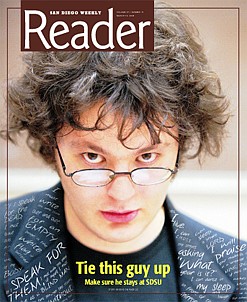
Tie Ilya Kaminsky up, make sure he stays at SDSU
From the land of poets
Odessa: it doesn’t sound like a particularly Russian word. Maybe Spanish, or Italian. Actually, it was named after Odysseus, the hero of Homer’s (if Homer existed) great epic poem, The Odyssey. Any word, when it begins with an open o sound, immediately attracts my attention, probably because I have unusual onomatopoeic pleasure-firings in the synapses of my brain. Metrically, it would scan as an amphibrach, the middle syllable getting the stress. Don’t worry, I’m not gonna get all prosodic on your asses. The word Odessa is tasty, balmy. It’s also a city in Ukraine in the former USSR, about as far south as you can get.
A port city on the legendary Black Sea, it has always been noted (after St. Petersburg and Moscow) for its writers and for its wonderful soup of cultures — Russian, Yiddish, and Ukrainian. It’s long been a center for Russian and Yiddish folklore, out of which comes the indispensable fiction writer Isaac Babel. Here’s a good piece of general wisdom and writing advice from that master: “No iron can stab the heart with such force as a period put just at the right place.”
Alexander Pushkin (who died in a duel in 1837 at age 37) is arguably the greatest 19th-century poet in any language. Though I think our own Walt Whitman, who published the first edition of Leaves of Grass at age 37 in 1855, pound for pound, a few decades Pushkin’s junior, could have gone 15 rounds with him, easy. Pushkin was exiled to Odessa for a little over a year for annoying the czar. This happened often in Russia, well into the 20th Century. A good deal of the 19th and much of the 20th Century was tough for Russian writers. If it wasn’t the czar then it was the gottdamn commies! One could be sent to the gulag for something one had written if it upset the czar, and later, Stalin and his crew. And after that time…
Again, I’m not going to get all Stalin on your asses, but Stalin, unlike most paranoid dictators unencumbered by a conscience, had a soft spot for writers — some of them. There’s the famous story, perhaps apocryphal, very likely not, of Stalin calling up Boris Pasternak (at the time Russia’s greatest living writer) and asking him what he knew about the poet Osip Mandlestam, who had written negatively of Stalin. The poem, usually given the imposed title “The Stalin Epigram” in English, didn’t name Stalin directly, and it wasn’t published, only passed from mouth to ear to mouth (two rounds to likely spies). Here are a few lines from that poem: “the ten thick worms of his fingers/ his words like measures of weight,/ the huge laughing cockroaches of his top lip,/ the glitter of his boot rims.”
Stalin was worried about what poets were writing! I remember writing some fairly critical things about Ronald Reagan (though not by name either): not a peep, no FBI agents following me around, I didn’t even get audited by the IRS. The story goes: Stalin wants Pasternak’s opinion of Mandelstam’s poetry. Calls him up at 2:00 a.m. Pasternak’s shaking in his pajamas. Pasternak speaks highly of Mandelstam’s poetry, but not too highly. He knew if he said Mandelstam was a great poet (which he was), Mandelstam was a dead man: he was still young and unknown enough that a bullet could be put in the back of his neck without raising much of a fuss. If he said he was a lousy poet, ditto, likely that night. So, Stalin sends Mandelstam into exile in 1932, first in Voronezh and later, to the Far East where he died, essentially, of starvation and disease. No official account of his death was recorded, but he died around 1940. Man’s a problem? Kill the man. Problem solved. Stalin said something like that. Imagine Pasternak standing there holding the black phone after the line from the Kremlin goes dead. I was happy to read somewhere that as Stalin lay dying he was terrified and kept saying he heard wolves howling.
Mandelstam’s wife, Nadezhda, had memorized all but a handful of her husband’s poems by the time of his first arrest, in case his manuscripts were destroyed, which they were. When asked why she didn’t also memorize that extra handful, she said, “Because he wrote them to another woman.” Her two memoirs of the Stalin years, Hope Against Hope and Hope Abandoned, bear monumental witness to those times.
Anna Akhmatova is another great 20th-century poet associated with Odessa. Born there in 1889, her first long poem, “Near the Sea,” was written about the city. “Anna of all the Russias,” she was called, reverently. She managed to avoid death or the gulag (though her son did not) during the Stalin years but suffered deprivation, constant surveillance, was unable to publish, etc. Her main crime: she wrote personal poems, love poems. It was Soviet Realism or nada. To keep her son alive and get him out of the gulag, she forced herself to write a few poems in praise of Stalin. That must have been a bitter pill to swallow, humiliating for her, but her readers understood.
Before I take us from Stalinist Russia to San Diego, California, and introduce you to the poet Ilya Kaminsky, I want to tell you a bit more of where Kaminsky was born and raised — you guessed it — Odessa — until 1993, when at the age of 16 he came to America. Odessa’s climate is temperate. It ain’t exactly Palm Beach, but compared to the cold associated with most of Russia, it’s pretty close.
It is a city rich in multiculturalism, combining Russian, Ukrainian, and Yiddish influences, particularly in its language and folklore. Russian and Yiddish songs and poems written around or about Odessa abound. The songs often portray a rare city, more impressive than Vienna or Paris. A city that embodies progress, a sense of carefree freedom, but a place that is also dangerous: an ideal place for a poet to be born and raised.
I asked Kaminsky about Odessa. He started by saying, “Russian literati are pretty Nazi in their snobbishness about location. For the last 200 years — pretty much the only years of full-time literary activity in the country — there were only two places where literature happened: St. Petersburg and Moscow. Moscow was the city associated with Tsvetaeva [Marina, another one of Russia’s greatest poets — she hung herself during the Stalin era after years of exile, despair, hunger, and grief], Pasternak, and later Yevtushenko [Yevgeny] and Voznesensky [Andrei]. St. Petersburg was the city of the old lit glory, from Pushkin and Lomonosov to Akhmatova, Blok, Mandelstam, and later Brodsky [Joseph, who came to America in the 1970s after being convicted in the Soviet Union of being a “parasite on society,” i.e., he was a poet]. Moscow and St. Petersburg poets could not stand each other — famously Brodsky and Yevtushenko.” (Yevtushenko visited and toured America several times in the ’70s and ’80s and emmigrated to the U.S. in the ’90s and is on the faculty of the University of Tulsa. Brodsky, not too many years after winning the Nobel prize in literature in 1987, died of heart disease, a chain-smoker to the end.)
After mentioning these literary feuds and squawks, Kaminsky said, “But that sort of thing happens in every country.” Quite right, Professor Kaminsky. My favorite American literary dustup was when Ernest Hemingway (who was wearing pajamas at the time) punched Wallace Stevens in the face. I am also amused by the story of Hart Crane tossing his typewriter out a second-story window because it would not write a letter in perfect Spanish (a language of which he knew about six words) to the president of Mexico because he was hot about something.
Then, when Kaminsky was 16, his father and his family were granted political asylum in the U.S. This is how Kaminsky explains it: “The reason my family got asylum has, to be honest, nothing to do with me. It would be silly of me to claim other people’s medals. I was 16 years old, I was dating girls, so Odessa was a place like any other for a 16-year-old who was discovering the streets and does not know the alternative. It was an exciting time. Yes, it was not fun, to put it mildly, to be a Jewish kid in the Ukrainian high school at that time, or now. But that is how things were then. My brother left for the USA first. He fell in love with a woman who was going to America — they love each other, they must live together, they got married. They wanted to have kids. So, they left. My father said, back then, if you want to go, go, but we are not going. And so at that time my family stayed.”
This was all matter-of-fact, and then he said something that both did and did not surprise me. “My father was pretty well-to-do. He was able to bribe the Soviet police, so being Jewish was not so much of a problem in 1991. The problems began a few years later. USSR fell apart. My father had many friends, some of them from childhood, who were journalists. He was a businessman — involved in things as different as a brush factory to the filmmaking industry — but his friends were mostly writers. He had money, they didn’t.
“They came to our house for parties often, he tried to help them out. It was a feeling of festival, in a way. When USSR fell apart there was an air of freedom, and the journalists and writers were the first who thought everything is permitted, they can now write about any sort of corruption. They thought the pen can win battles, and so on. In Ukraine, more so than in Russia — although it is pretty much the same in Russia now — the old bureaucracy stayed in power, even though they changed party affiliations.
“So when the journalists wrote about corruption, they were killed on the streets. It was pretty shocking. Pretty immediate. My father’s good friend was Boris Derevyanko, a curious man, editor of the major newspaper in Odessa, who was also an opera theater historian. He wrote about corruption. He published a book about opera in Odessa. He was shot.”
I had to think for a moment about those last three short declarative sentences. There’s something about that middle sentence being the middle sentence that contains a knot of truth about being human: we are, some of the time, probably more often than not, failed, miserable, and odious creatures.
Kaminsky: “The problem for my father was that it really looks bad on paper when you are a Jewish man who has friends who write about the government. And he helps them with money. Plus, being Jewish backfired then — when the state collapsed, there was no police to bribe.”
No police to bribe? I had to remind myself I wasn’t in a Kafka story. This past summer I was in Prague, and it happened to be the 75th anniversary of Kafka’s death. There wasn’t a peep about it in the papers. I asked a senior Czech writer about this, and he explained simply, and a little sadly, that the Czech people have mixed feelings about Franz Kafka: even though he lived in Prague most of his life (and wrote all his great books there), he wrote in German (there were hundreds of thousands of ethnic Germans in Czechoslovakia then), and he was a Jew.
Kaminsky again: “It was all in the street. That you are Jewish is written on your face. As they say in Russia, ‘We beat you not in your passport, we beat you in your face.’ ”
I wanted to know more about his coming to America, and he said, “I can only speak for myself, since my family came to a place only a few immigrants ever come to: upstate New York. If we came to Brooklyn, we would be a different story. But in upstate New York, when our plane landed and the cab took us to our apartment, it was snowing, it was Saturday, and there were no people on the streets [emphasis his]. Coming from Odessa, which is pretty cosmopolitan, I honestly never before experienced the situation when you drive down the street in the broad daylight and there is not a single human being walking. My first experience of USA was surreal. Like there is an atom bomb attack and everyone’s just disappeared. It’s a lonely country. Of course, I got used to it.”
Sounds different from most immigrant arrival stories. His mother and his brother now live in Los Angeles. Tragically, his father died about a year after immigrating to the U.S. The causes were natural. If he had stayed in Odessa, the causes might not have been.
Kaminsky is tall (6’3”, at least) and, like many tall people, stoops a little, is a few pounds past lanky and, like many poets I know, somewhat heterodox in his attire — his teaching-day shirt tucked in front, untucked in back, unironed, and open three buttons over a standard white undershirt. His wife buttoned a few of the buttons for him before we left for class, and by the time we got there they were undone again. He was, rightly, oblivious to this. He has a big, slightly goofy grin and somewhat disheveled dark hair. I know a brilliant senior American poet who shaves himself in what one of my friends affectionately refers to as “the crop-rotation method.” In other words, he misses whole swaths of his cheeks and chin, and always in different places. Theodore Roethke once lost a pair of his pants for several weeks. Eventually, he found them on his desk.
Kaminsky lives with his wife, Katie Farris, a fiction writer, whom he met at one of his poetry readings. Their modest apartment, in the North Park area of San Diego, is spare and filled with light. I asked him how he and Katie met, and he said, “You will laugh, but our first conversation was about Kafka. When I read I had much accent, and not many folks at that moment could understand me. But ironically she had been studying Russian for quite some time. So, I thought: here is a beautiful, smart woman who can actually understand what I say? A gift of the gods!” She too is tall, very slim, and lovely. They clearly adore each other. Farris is a vegetarian and served us a delicious vegetarian lunch. I asked Kaminsky if he was a vegetarian. “Only when I eat with her,” he said. He referred to himself at one point as a “really lucky bastard” to have met her.
During my brief visit to his apartment, I failed to ask if I could see his study. Most writers’ studies are filled with books. I love looking at writers’ bookshelves. (Who said this: “Show me a writer’s library and I will tell you his biography”?) I learned later that Kaminsky’s study was in his garage, which made me regret even more not asking to see it.
I asked him how the June gloom was this year. He hadn’t heard of it, or didn’t notice, or it wasn’t so bad. He was also unfamiliar with the grunion run. San Diegans, teach him the lore of the Southland!
By the time you read this, Kaminsky will be 31. The teaching job I alluded to above is at SDSU, where he is an assistant professor of English and creative writing.
He happens to be severely hearing-impaired. “I got the momps [I’m leaving the spelling the way he wrote it, because I think the word should be pronounced and spelled that way — it’s more onomatopoeically accurate. Webster’s take note!] when I was 4. I never really think of myself as hard of hearing. Silly but true. Why? Because I don’t know the alternative, really. What does it mean to fully hear? Does anyone fully hear? What does it mean to be fully deaf? Sign language does not have a word for silence, you know.”
One of the highest compliments a poet can receive is that he or she has a good ear. It means that the music, the rhythms, the cadences of the poetry are strong. All great poetry is musical, and the music of each great poet is distinct, as Mozart is from Beethoven. Kaminsky’s ear is terrific.
I asked Kaminsky if it were possible for him to talk about how he hears his own poems and others’. In his head? His answer could have been given only by a real poet:
“Not in the head so much as in the shoulders, legs, hands, chest, brows, ears, hair. You know. Exactly the same way you feel when you read poems that make you go nuts.” The “go nuts” he is talking about is how Emily knew she had read a great poem: it felt like the top of her head was taken off. A.E. Housman put it a little differently. He said that if he was shaving and he read a real line of poetry, he would cut himself. Me, I have to settle for the old goose bumps and, sometimes, that electric eel running up and down my spine. For people who love poetry it’s like a narcotic. But free. Though usually hidden in objects called books, which are sometimes further hidden in places called bookstores and libraries.
Then Kaminsky said, “I don’t think poems are heard so much as lived through. They are experiences, pieces of life on the page. Elizabeth Bishop wrote ‘One Art’ over 20 years ago. A crunky [again his spelling and, I believe, more accurate for Bishop] old lady. Didn’t like people much. But her poem moves my lips when I wake in the middle of the night. It tells me how to go on when I forget I should. Is that something we hear? Sure. But it is more.”
Indeed it is. Here’s another thing about Kaminsky to keep in mind, particularly when you consider his hearing loss — the reality of his coming to America at 16 and speaking little English. It seems he left a girlfriend or two behind in Odessa, and what that will do to a young man’s heart does not even come close to what we usually call “broken.” I have a theory: all young men’s poetry begins with a broken heart. Kaminsky graduated from high school, college (University of Rochester), and a prestigious (Georgetown) law school, all by the time he was 24. I asked him, on a scale of 1 to 10, how well he spoke English when he first came to the U.S. He said, “When I came to U.S., I did not speak English. So, on a scale of 1 to 10, it is 0.”
He practiced law for a few years in the San Francisco Bay Area. I asked him about that. “Well, let me be honest. My not practicing law is no great loss for the American legal system. I worked as a law clerk for the National Immigration Law Center, and after that for the Bay Area Legal Aid. It was a fantastic experience for me, in many ways. Real people, especially in the time at Legal Aid; real people, with real stories, came in hour after hour, day after day, and everyone’s face had different wrinkles, and they all carried a piece of paper that somehow fucked up something in their days. It was an incredible experience being able to add a piece of paper to another and write up or speak up on someone’s behalf and really see how their day was changed.”
As screwy as the American legal system is (there is certainly no duller language on earth), it must have seemed wonderfully workable after growing up in the Soviet system. Though he obviously loved this work and felt he could do some good in it, there were problems:
“Things got a bit complicated for many public-interest organizations when Arnold S. became our governor. He is a lot more liberal right now than he was a few years ago, when he just began. A lot of funds were cut, programs replaced, and so on. I got lucky — I found a teaching job [more specifics about this soon] within a year. Not everyone was that lucky. It pains me to think about these brilliant legal professionals who had to go home and watch TV because a certain program was cut or funds got redirected. But that is what happened. It is better now, I imagine, politically, but a lot of programs that were changed it will take years to streamline again.”
So this is how a Ukrainian poet from the city of Odessa came to live in San Diego. He got his appointment at SDSU because he’s a poet and on the reputation, the strength, of his first book, published when he was only 28, called, appropriately, Dancing in Odessa. It won the Dorset Prize and was published by Tupelo Press, one of the best independent publishers of poetry in the country. It also picked up a couple of other prizes after publication. It’s an astonishingly good book, not just a good first book, or a good book by a young poet, but an astonishingly good book. Period. I could go on about why I think so, but this is not a book review. If it were, the last sentence of the review would be “Read this book!”
A nutshell reiteration: Young man comes to America at 16. Speaks no English. Sits in his high school classes with a Russian/English dictionary, looking up words as fast as he can. He finishes high school, college, and law school in less than a decade. Practices law for a few years. Gets a college teaching job — and I bet there were 300-plus applications for that position. Publishes, in a language other than his mother tongue, a first-rate book of poems.
I attended his class of graduate writing students at SDSU. Before the seminar, Kaminsky and I talked for a while on a balcony off the hallway of his classroom’s building. We were looking over rush-hour traffic on I-8. He teaches an early-evening class because many of his students work and/or have families. Across the highway was a deep canyon and the town of La Mesa. The brush and the trees looked incredibly dry. It was a few weeks before the October fires.
I recently listened to a recording of the class. It was a diverse group, mostly younger people, but also a few older. I refer to students of mine who happen to be, say, over 35, as “full-fledged adults.” I stretch the limit a bit on the age around which one is supposed to reach maturity. When I hit 35, I extended my own schedule to 45. When I hit 45, I extended it to 55. Now, having just turned 61, I’m thinking 65 might be the right age for maturity. That is, after all, when the gummint starts giving you back some of the money they’ve been siphoning from your paycheck since your first paycheck.
I bring up age because I am almost twice as old as Kaminsky. I’ve been teaching poetry reading and writing in colleges and universities for about 35 years. I’ve published 11 books of poetry. Most of my friends are writers and teachers of writing and literature. I’ve taught thousands of classes myself and been in the classroom with many of the best teachers of writing and literature in the country. Point I’m getting to is: Kaminsky’s class was a revelation (I’ve seen it all!) to me. It was a blast, it was relaxed, it was loopy. He sat in a big office chair at the head of the seminar table, swiveling this way and that, tilting back sometimes, leaning forward — he teaches with his whole body.
He’d go out on a limb about something having to do with a particular poem, and just when that branch was about to bend he’d leap up to a higher limb, then another branch, then he’d jump to another tree. It might have seemed random to a civilian, but his teaching mind moved the same way the best poets’ poems move: filled with leaps and turns, surprising yet inevitable. Kaminsky would move from a Polish poet to a Greek poet to an American poet, different decades, different cultures: one poetry.
He said to his students, “It’s a super learning aid to listen to books talking to each other.” Meaning, one poet in one age, one culture, is writing about the same human business as another poet in another age, another culture. In this same context he said, “You can have a conversation with a dead writer.” At one point, he had the whole class stand up and stretch, loosen up. He quoted Theodore Adorno, who said, “After the Holocaust how can there still be poetry?” And then he quoted the former U.S. poet laureate, Mark Strand, who said, “After the Holocaust, how can there be lunch?” I think Strand was saying, after the Holocaust we need poetry to go on, maybe more than ever. Kaminsky mentioned William Carlos Williams’ famous dictum, “No ideas but in things.” I’ve always more or less agreed with that and argue against abstract language, though not abstract thought. Kaminsky does not agree with Williams, believing that “All good poems have ideas.” I think all good poems may not start with ideas, but all good poems end up discovering ideas or what might be called their themes. I don’t like to use the word “idea” or “meaning” when talking about poetry. I like Frost’s word for it: “ulteriority.” I want to know what’s human and alive and authentic about a poem. Talking about attentiveness again, Kaminsky said, “You need to look at language like it’s your lover’s body.” I wish I’d had teachers like him.
Given his hearing impairment and his accent, he is remarkably easy to understand, particularly after talking or listening to him for a few minutes. He has a rhythmic style of speaking and reading (more about that in a while), what I’d call a musical voice. He engaged his students fully in the class, asking questions, cajoling, poking, reminding them of what he’d said earlier and did they see the connection? They did. They clearly loved and respected him.
I asked him more about teaching. After all, he is fairly new to it. He was honest. “Despite whatever they all say, teaching does not [emphasis his] have anything to do with one’s own writing.” Note: I’m not sure exactly what he meant by this — probably that it didn’t have a negative effect. A lot of writers who teach complain about teaching. My only response to this is: So don’t teach. Please don’t teach. Kaminsky continued, “It is another art.” I was glad to hear him say that, and it’s true that good teaching (and I don’t mean only college teaching, but all teaching) is an art, probably the most (and that’s saying something) undervalued art in our culture. He also said, “I like teaching because I like people, and because I like to share secrets.” That struck me as absolutely true, but I’d never thought of it exactly like that. A teacher reveals secrets of the craft (I’m talking specifically now about the teaching of poetry by a poet) and also reveals how secrets, the things we discover, what we truly feel, tend to emerge (if we are honest) when we write. I love what Robert Frost said when someone asked him why he wrote poems. He said he wrote to find out what it was he didn’t know he knew. I also love what Randall Jarrell said when people asked him what he wrote about. He said, “The laughter and the tears.”
Kaminsky had a universal complaint made by almost all writer/teachers: “So, it is fun for me. But I also know it takes time from what I need to do most. And yet, such joy when a student gets it, the way they think of their days as changed, the ways ‘making’ enters. [Walt Whitman said: “You say I contradict myself. All right then, I contradict myself!”] Surely, not every student will become a wonderful poet, although I have been lucky so far with students, but there is a great worth, I feel, in teaching them the ‘making’ of craft in itself, of attentiveness. I go with Celan [Paul, German poet] here, who said, beautifully: ‘Attentiveness is the natural prayer of the human soul.’ I love that.”
So do I, and I’ve been quoting it to students for years, although I never could remember who originally said it until Kaminsky reminded me. I also like that he made reference to Horace, the great Latin poet, who said that poetry was a “made” thing, meaning it doesn’t just happen, flow down your arm like an electrical current on a direct line from Mt. Parnassus, it ain’t dreamy automatic bullshit. Kaminsky knew, though it didn’t come up, that the word “poet” derives from the ancient Greek: “maker.”
He continued to speak about teaching at SDSU. “Well, I did not tell them, but I would do it for free. It is a luxury to talk about things you love with students. Sharing lines that can make your days brighter — what can be better?”
As I said, I earn the bulk of my living beneath the leafy shade of academe. I’ve been on committees making decisions re hiring, firing, tenure, etc., many times. If the people who make those decisions at SDSU asked for it, my recommendation would be: Tie this guy up, make sure he stays at SDSU. He will be one of the best poets of his generation. He’s a wonderful teacher. He will bring honor to your university. Come to my grave in 30 years or so, or to the spot where my daughter will tell you she scattered my ashes, and tell me that I was right.
I’ve ended the last class of every semester for years by saying something like, I wish all of you get as lucky as I have as far as finding a way to pay for a roof and feed your child (children) goes. Doing something you love to earn your living is one of the greatest blessings in life. I call the students knuckleheads — by the end of a semester they know this as an endearment — and I tell them I hope they take poetry with them on the journey.
Kaminsky wasn’t finished discussing teaching and the possibility of a greater community of writers. “I am lucky. I have wonderful, attentive students. I hope to find a way to have more of a literary community in San Diego, to bring more people together, to have more readings, conversations. If I am to stay here and live here, it would be really nice to have more of that. And, I think that will happen. We will try, anyway.”
I’ve struggled to find a few words to describe Kaminsky’s overall demeanor, but believe it comes down to something as simple as this: he is a happy man (though every happy man has his dark place), he loves his art, he loves his loved ones, he is filled with a kind of gratitude, and he loves the world — despite a million reasons not to.
Kaminsky and I were invited to give a poetry reading at D.G. Wills Books in La Jolla. I love that store. It’s the only bookstore I’ve ever been in that has a street sign with several large-caliber bullet holes in it hanging on the wall. Not to mention thousands of new and used books. I’d read there several years before. Bookstores are to poets (all writers, almost all of whom are prodigious readers) what barrooms are to rumdums. When we first walked in, Kaminsky went right to the shelves, trying to find something new. People nuts about poetry get to know the poetry shelves of the bookstores they frequent so well they can immediately tell if something’s changed — if there are new books, if books are gone, etc. Kaminsky’s got that eyeball. Within minutes of entering the store, Kaminsky had several books beneath his arm and was reading another with his free hand. At one point, I saw him write a note on his hand.
It was a warm evening, and a wide door in the back opened onto a small patio. To anyone who’s never been to a poetry reading, there are two common stereotypes: 1) it will include finger-snapping and bongos, or 2) a boring old guy will mumble incomprehensible poems incomprehensibly into a page in front of an audience in deep pain, especially the man who was forced to go to the reading by his wife. The former hardly ever happens anymore; the latter, unfortunately, still happens sometimes. Pretty frequently, however, poetry readings are quite lively affairs: funny, rapid, sexy (this gets the attention of students), and intensely alive. A concert without instrumentation.
Although I realize it is a somewhat sexist thing to say, I tell my young male students at Georgia Tech, as a way of getting them to go to the poetry readings we hold on campus, “Chicks dig poetry.” One of my best students at Georgia Tech is also one of the top college linebackers in the country. He’ll be drafted this spring and in the NFL next fall. Another student once told me he wanted to be in my class because there were more girls in it than most classes. I told him to pass that news around and let him in the class for his honesty. If I can get them to the water, lots of them turn out to be thirsty. I got a call recently from a former female student at Tech — she just married a guy she’d met in one of my classes. He isn’t good enough for her (my daughter is about her age; no guy’s good enough), but poetry brought them together. A student of mine, now a widely published poet, fell in love with another poet at my house at a party after a poetry reading. I have lots more anecdotal evidence of the aphrodisiacal properties of poetry. Gentlemen?
I loved hearing Kaminsky read. He passes out copies of his poems for the audience to follow along with as he reads aloud. I had heard his reading style described as operatic, and I guess it is, but it is really impassioned speech, very much in the Russian tradition of declaiming one’s poetry, emphatically. Not theater, not oral interpretation, but excited, intense human speech — he would raise and lower his voice, change his pacing. His voice has the faint echo of bells tolling — joyously.
Poetry has been around at least as long as the cave paintings. Poetry existed before language: the first poets were primitive people dancing around a fire and chanting rhythmically. Their themes were probably the next day’s hunt or regarding their spirit world. Every culture on earth developed poetry on its own, independent of other cultures. Like fire. Like the spear. We’ve always known, because our bodies told us so, that we derive pleasure from the repetition, and the variations of repetition, of certain sounds: music, poetry. Now we know that it is a truly physiological human need, or source of pleasure. There are CAT scan machines that record the brain’s pleasure centers lighting up when listening to music or the cadences of poetry.
Russians love their poetry and their poets. Always have. If you meet a Russian diplomat, or student, or waiter, or, in particular, a Russian cab driver, ask him or her to recite some of their favorite poems. I once got a free, rather lengthy ride in a cab driven by a Russian cabbie in San Diego because he was so delighted that I knew (in English only) many of the Russian poets. Russians say that people who love to read and write poetry have “nightingale fever.” Before the fall of Communism, it was not unusual for poets to draw almost stadium-sized audiences for readings. For poets who were deemed unacceptable to the regime (if they were not exiled, or jailed, or put in phony laughing academies), there were smaller, but no less intense, private gatherings. There was a form of publishing called samizdat, i.e., manuscripts were passed hand to hand between readers.
Truly American and truly Russian literature began at about the same time, give or take. American poets, until Whitman and Dickinson, were really English poets, American poets writing after the English model and in the English tradition, which was only natural. But after America had been around for a while, we started minting our own. See Whitman, whom one critic said established “an absolute discontinuation of the traditions of English verse,” and Dickinson, above. Kaminsky had this to say about Russian poetry in the 19th Century: “Russian literary life…did not begin until the 1820s [okay, so the Russkies were a few decades ahead of us in developing their national literature — we beat them to the moon!] when Pushkin was writing his great Eugene Onegin, Gogol was beginning to write, and in a few years, Lermontov. Pushkin wrote in Russian — not the French language of nobility.” We agreed, generally, on this parallel, but he also reminded me that American poets had, via our literary ancestors, Shakespeare, of whom Emily Dickinson said, “Why do we need anything else?” Kaminsky said Russian poets did not have a Shakespeare. He referred to Shakespeare’s work as our “epic.” Hard to argue. For Russian literature this had a good side though. Kaminsky said, “That absence of the great literary past in the Russian language does explain, to my mind anyway, the abundance of the epic novels — Tolstoy, Dostoevsky — in the late 19th Century.” The gods of literature giveth and they taketh away.
Joseph Brodsky was said to have been asked, after he came to America, what was worse — living in a society where you could be sent to the gulag for writing something that displeased the bosses, or living in a society where a writer can write anything he or she wants, as critical of the bosses as he or she wants, and nobody cares? He said the former. I’m not sure I believe him. First of all, some people do care. And, second, he seemed pretty happy in the U.S. I once saw him drive away from a poetry reading in a BMW.
Another former student of mine, who teaches at a San Diego high school, brought a bunch of his students to the reading at the bookstore. Afterwards, some of the kids wanted us to sign their arms. Not something I’ve ever been asked to do before. I wrote on one: “Give this kid an A!”
Kaminsky signed a few too, in English — American English, because that is the language he writes in now. Stanley Kunitz, the great and beloved American poet, who died at age 100 just a few years ago, said of himself and of other poets, “I have a tribe, but we are scattered.” Yes, true, but we sometimes gather in small groups of two or three, sometimes in much larger confabs. See the annual Dodge Poetry Festival in New Jersey, see the Associated Writing Program’s yearly convention this winter in NYC: 7500 (c’mon, that’s too many; no, that’s not enough!) writers!
It’s not writers that are important anyway. What’s important is the writing, the poems, stories, plays, novels, etc. Immensely important. One of the last things Kaminsky said to me was: “And, about poetry, I am not sure if I had said it before, so I want to say it now — I want to make sure it is clear how joyous the activity of writing is, how wondrous, magical. I don’t want the biographical or historical to cloud that up. Writers’ biography/history, after all, is in their language.”
If you get a chance to read Ilya Kaminsky’s poems or hear him read, do so. His poems will make you feel a little more alive and a little less alone. And if you happen to see him on the street, he will most likely be the best poet you ever see on the street.
Here's something you might be interested in.
Tie Ilya Kaminsky up, make sure he stays at SDSU
From the land of poets

Tie Ilya Kaminsky up, make sure he stays at SDSU
From the land of poets
Odessa: it doesn’t sound like a particularly Russian word. Maybe Spanish, or Italian. Actually, it was named after Odysseus, the hero of Homer’s (if Homer existed) great epic poem, The Odyssey. Any word, when it begins with an open o sound, immediately attracts my attention, probably because I have unusual onomatopoeic pleasure-firings in the synapses of my brain. Metrically, it would scan as an amphibrach, the middle syllable getting the stress. Don’t worry, I’m not gonna get all prosodic on your asses. The word Odessa is tasty, balmy. It’s also a city in Ukraine in the former USSR, about as far south as you can get.
A port city on the legendary Black Sea, it has always been noted (after St. Petersburg and Moscow) for its writers and for its wonderful soup of cultures — Russian, Yiddish, and Ukrainian. It’s long been a center for Russian and Yiddish folklore, out of which comes the indispensable fiction writer Isaac Babel. Here’s a good piece of general wisdom and writing advice from that master: “No iron can stab the heart with such force as a period put just at the right place.”
Alexander Pushkin (who died in a duel in 1837 at age 37) is arguably the greatest 19th-century poet in any language. Though I think our own Walt Whitman, who published the first edition of Leaves of Grass at age 37 in 1855, pound for pound, a few decades Pushkin’s junior, could have gone 15 rounds with him, easy. Pushkin was exiled to Odessa for a little over a year for annoying the czar. This happened often in Russia, well into the 20th Century. A good deal of the 19th and much of the 20th Century was tough for Russian writers. If it wasn’t the czar then it was the gottdamn commies! One could be sent to the gulag for something one had written if it upset the czar, and later, Stalin and his crew. And after that time…
Again, I’m not going to get all Stalin on your asses, but Stalin, unlike most paranoid dictators unencumbered by a conscience, had a soft spot for writers — some of them. There’s the famous story, perhaps apocryphal, very likely not, of Stalin calling up Boris Pasternak (at the time Russia’s greatest living writer) and asking him what he knew about the poet Osip Mandlestam, who had written negatively of Stalin. The poem, usually given the imposed title “The Stalin Epigram” in English, didn’t name Stalin directly, and it wasn’t published, only passed from mouth to ear to mouth (two rounds to likely spies). Here are a few lines from that poem: “the ten thick worms of his fingers/ his words like measures of weight,/ the huge laughing cockroaches of his top lip,/ the glitter of his boot rims.”
Stalin was worried about what poets were writing! I remember writing some fairly critical things about Ronald Reagan (though not by name either): not a peep, no FBI agents following me around, I didn’t even get audited by the IRS. The story goes: Stalin wants Pasternak’s opinion of Mandelstam’s poetry. Calls him up at 2:00 a.m. Pasternak’s shaking in his pajamas. Pasternak speaks highly of Mandelstam’s poetry, but not too highly. He knew if he said Mandelstam was a great poet (which he was), Mandelstam was a dead man: he was still young and unknown enough that a bullet could be put in the back of his neck without raising much of a fuss. If he said he was a lousy poet, ditto, likely that night. So, Stalin sends Mandelstam into exile in 1932, first in Voronezh and later, to the Far East where he died, essentially, of starvation and disease. No official account of his death was recorded, but he died around 1940. Man’s a problem? Kill the man. Problem solved. Stalin said something like that. Imagine Pasternak standing there holding the black phone after the line from the Kremlin goes dead. I was happy to read somewhere that as Stalin lay dying he was terrified and kept saying he heard wolves howling.
Mandelstam’s wife, Nadezhda, had memorized all but a handful of her husband’s poems by the time of his first arrest, in case his manuscripts were destroyed, which they were. When asked why she didn’t also memorize that extra handful, she said, “Because he wrote them to another woman.” Her two memoirs of the Stalin years, Hope Against Hope and Hope Abandoned, bear monumental witness to those times.
Anna Akhmatova is another great 20th-century poet associated with Odessa. Born there in 1889, her first long poem, “Near the Sea,” was written about the city. “Anna of all the Russias,” she was called, reverently. She managed to avoid death or the gulag (though her son did not) during the Stalin years but suffered deprivation, constant surveillance, was unable to publish, etc. Her main crime: she wrote personal poems, love poems. It was Soviet Realism or nada. To keep her son alive and get him out of the gulag, she forced herself to write a few poems in praise of Stalin. That must have been a bitter pill to swallow, humiliating for her, but her readers understood.
Before I take us from Stalinist Russia to San Diego, California, and introduce you to the poet Ilya Kaminsky, I want to tell you a bit more of where Kaminsky was born and raised — you guessed it — Odessa — until 1993, when at the age of 16 he came to America. Odessa’s climate is temperate. It ain’t exactly Palm Beach, but compared to the cold associated with most of Russia, it’s pretty close.
It is a city rich in multiculturalism, combining Russian, Ukrainian, and Yiddish influences, particularly in its language and folklore. Russian and Yiddish songs and poems written around or about Odessa abound. The songs often portray a rare city, more impressive than Vienna or Paris. A city that embodies progress, a sense of carefree freedom, but a place that is also dangerous: an ideal place for a poet to be born and raised.
I asked Kaminsky about Odessa. He started by saying, “Russian literati are pretty Nazi in their snobbishness about location. For the last 200 years — pretty much the only years of full-time literary activity in the country — there were only two places where literature happened: St. Petersburg and Moscow. Moscow was the city associated with Tsvetaeva [Marina, another one of Russia’s greatest poets — she hung herself during the Stalin era after years of exile, despair, hunger, and grief], Pasternak, and later Yevtushenko [Yevgeny] and Voznesensky [Andrei]. St. Petersburg was the city of the old lit glory, from Pushkin and Lomonosov to Akhmatova, Blok, Mandelstam, and later Brodsky [Joseph, who came to America in the 1970s after being convicted in the Soviet Union of being a “parasite on society,” i.e., he was a poet]. Moscow and St. Petersburg poets could not stand each other — famously Brodsky and Yevtushenko.” (Yevtushenko visited and toured America several times in the ’70s and ’80s and emmigrated to the U.S. in the ’90s and is on the faculty of the University of Tulsa. Brodsky, not too many years after winning the Nobel prize in literature in 1987, died of heart disease, a chain-smoker to the end.)
After mentioning these literary feuds and squawks, Kaminsky said, “But that sort of thing happens in every country.” Quite right, Professor Kaminsky. My favorite American literary dustup was when Ernest Hemingway (who was wearing pajamas at the time) punched Wallace Stevens in the face. I am also amused by the story of Hart Crane tossing his typewriter out a second-story window because it would not write a letter in perfect Spanish (a language of which he knew about six words) to the president of Mexico because he was hot about something.
Then, when Kaminsky was 16, his father and his family were granted political asylum in the U.S. This is how Kaminsky explains it: “The reason my family got asylum has, to be honest, nothing to do with me. It would be silly of me to claim other people’s medals. I was 16 years old, I was dating girls, so Odessa was a place like any other for a 16-year-old who was discovering the streets and does not know the alternative. It was an exciting time. Yes, it was not fun, to put it mildly, to be a Jewish kid in the Ukrainian high school at that time, or now. But that is how things were then. My brother left for the USA first. He fell in love with a woman who was going to America — they love each other, they must live together, they got married. They wanted to have kids. So, they left. My father said, back then, if you want to go, go, but we are not going. And so at that time my family stayed.”
This was all matter-of-fact, and then he said something that both did and did not surprise me. “My father was pretty well-to-do. He was able to bribe the Soviet police, so being Jewish was not so much of a problem in 1991. The problems began a few years later. USSR fell apart. My father had many friends, some of them from childhood, who were journalists. He was a businessman — involved in things as different as a brush factory to the filmmaking industry — but his friends were mostly writers. He had money, they didn’t.
“They came to our house for parties often, he tried to help them out. It was a feeling of festival, in a way. When USSR fell apart there was an air of freedom, and the journalists and writers were the first who thought everything is permitted, they can now write about any sort of corruption. They thought the pen can win battles, and so on. In Ukraine, more so than in Russia — although it is pretty much the same in Russia now — the old bureaucracy stayed in power, even though they changed party affiliations.
“So when the journalists wrote about corruption, they were killed on the streets. It was pretty shocking. Pretty immediate. My father’s good friend was Boris Derevyanko, a curious man, editor of the major newspaper in Odessa, who was also an opera theater historian. He wrote about corruption. He published a book about opera in Odessa. He was shot.”
I had to think for a moment about those last three short declarative sentences. There’s something about that middle sentence being the middle sentence that contains a knot of truth about being human: we are, some of the time, probably more often than not, failed, miserable, and odious creatures.
Kaminsky: “The problem for my father was that it really looks bad on paper when you are a Jewish man who has friends who write about the government. And he helps them with money. Plus, being Jewish backfired then — when the state collapsed, there was no police to bribe.”
No police to bribe? I had to remind myself I wasn’t in a Kafka story. This past summer I was in Prague, and it happened to be the 75th anniversary of Kafka’s death. There wasn’t a peep about it in the papers. I asked a senior Czech writer about this, and he explained simply, and a little sadly, that the Czech people have mixed feelings about Franz Kafka: even though he lived in Prague most of his life (and wrote all his great books there), he wrote in German (there were hundreds of thousands of ethnic Germans in Czechoslovakia then), and he was a Jew.
Kaminsky again: “It was all in the street. That you are Jewish is written on your face. As they say in Russia, ‘We beat you not in your passport, we beat you in your face.’ ”
I wanted to know more about his coming to America, and he said, “I can only speak for myself, since my family came to a place only a few immigrants ever come to: upstate New York. If we came to Brooklyn, we would be a different story. But in upstate New York, when our plane landed and the cab took us to our apartment, it was snowing, it was Saturday, and there were no people on the streets [emphasis his]. Coming from Odessa, which is pretty cosmopolitan, I honestly never before experienced the situation when you drive down the street in the broad daylight and there is not a single human being walking. My first experience of USA was surreal. Like there is an atom bomb attack and everyone’s just disappeared. It’s a lonely country. Of course, I got used to it.”
Sounds different from most immigrant arrival stories. His mother and his brother now live in Los Angeles. Tragically, his father died about a year after immigrating to the U.S. The causes were natural. If he had stayed in Odessa, the causes might not have been.
Kaminsky is tall (6’3”, at least) and, like many tall people, stoops a little, is a few pounds past lanky and, like many poets I know, somewhat heterodox in his attire — his teaching-day shirt tucked in front, untucked in back, unironed, and open three buttons over a standard white undershirt. His wife buttoned a few of the buttons for him before we left for class, and by the time we got there they were undone again. He was, rightly, oblivious to this. He has a big, slightly goofy grin and somewhat disheveled dark hair. I know a brilliant senior American poet who shaves himself in what one of my friends affectionately refers to as “the crop-rotation method.” In other words, he misses whole swaths of his cheeks and chin, and always in different places. Theodore Roethke once lost a pair of his pants for several weeks. Eventually, he found them on his desk.
Kaminsky lives with his wife, Katie Farris, a fiction writer, whom he met at one of his poetry readings. Their modest apartment, in the North Park area of San Diego, is spare and filled with light. I asked him how he and Katie met, and he said, “You will laugh, but our first conversation was about Kafka. When I read I had much accent, and not many folks at that moment could understand me. But ironically she had been studying Russian for quite some time. So, I thought: here is a beautiful, smart woman who can actually understand what I say? A gift of the gods!” She too is tall, very slim, and lovely. They clearly adore each other. Farris is a vegetarian and served us a delicious vegetarian lunch. I asked Kaminsky if he was a vegetarian. “Only when I eat with her,” he said. He referred to himself at one point as a “really lucky bastard” to have met her.
During my brief visit to his apartment, I failed to ask if I could see his study. Most writers’ studies are filled with books. I love looking at writers’ bookshelves. (Who said this: “Show me a writer’s library and I will tell you his biography”?) I learned later that Kaminsky’s study was in his garage, which made me regret even more not asking to see it.
I asked him how the June gloom was this year. He hadn’t heard of it, or didn’t notice, or it wasn’t so bad. He was also unfamiliar with the grunion run. San Diegans, teach him the lore of the Southland!
By the time you read this, Kaminsky will be 31. The teaching job I alluded to above is at SDSU, where he is an assistant professor of English and creative writing.
He happens to be severely hearing-impaired. “I got the momps [I’m leaving the spelling the way he wrote it, because I think the word should be pronounced and spelled that way — it’s more onomatopoeically accurate. Webster’s take note!] when I was 4. I never really think of myself as hard of hearing. Silly but true. Why? Because I don’t know the alternative, really. What does it mean to fully hear? Does anyone fully hear? What does it mean to be fully deaf? Sign language does not have a word for silence, you know.”
One of the highest compliments a poet can receive is that he or she has a good ear. It means that the music, the rhythms, the cadences of the poetry are strong. All great poetry is musical, and the music of each great poet is distinct, as Mozart is from Beethoven. Kaminsky’s ear is terrific.
I asked Kaminsky if it were possible for him to talk about how he hears his own poems and others’. In his head? His answer could have been given only by a real poet:
“Not in the head so much as in the shoulders, legs, hands, chest, brows, ears, hair. You know. Exactly the same way you feel when you read poems that make you go nuts.” The “go nuts” he is talking about is how Emily knew she had read a great poem: it felt like the top of her head was taken off. A.E. Housman put it a little differently. He said that if he was shaving and he read a real line of poetry, he would cut himself. Me, I have to settle for the old goose bumps and, sometimes, that electric eel running up and down my spine. For people who love poetry it’s like a narcotic. But free. Though usually hidden in objects called books, which are sometimes further hidden in places called bookstores and libraries.
Then Kaminsky said, “I don’t think poems are heard so much as lived through. They are experiences, pieces of life on the page. Elizabeth Bishop wrote ‘One Art’ over 20 years ago. A crunky [again his spelling and, I believe, more accurate for Bishop] old lady. Didn’t like people much. But her poem moves my lips when I wake in the middle of the night. It tells me how to go on when I forget I should. Is that something we hear? Sure. But it is more.”
Indeed it is. Here’s another thing about Kaminsky to keep in mind, particularly when you consider his hearing loss — the reality of his coming to America at 16 and speaking little English. It seems he left a girlfriend or two behind in Odessa, and what that will do to a young man’s heart does not even come close to what we usually call “broken.” I have a theory: all young men’s poetry begins with a broken heart. Kaminsky graduated from high school, college (University of Rochester), and a prestigious (Georgetown) law school, all by the time he was 24. I asked him, on a scale of 1 to 10, how well he spoke English when he first came to the U.S. He said, “When I came to U.S., I did not speak English. So, on a scale of 1 to 10, it is 0.”
He practiced law for a few years in the San Francisco Bay Area. I asked him about that. “Well, let me be honest. My not practicing law is no great loss for the American legal system. I worked as a law clerk for the National Immigration Law Center, and after that for the Bay Area Legal Aid. It was a fantastic experience for me, in many ways. Real people, especially in the time at Legal Aid; real people, with real stories, came in hour after hour, day after day, and everyone’s face had different wrinkles, and they all carried a piece of paper that somehow fucked up something in their days. It was an incredible experience being able to add a piece of paper to another and write up or speak up on someone’s behalf and really see how their day was changed.”
As screwy as the American legal system is (there is certainly no duller language on earth), it must have seemed wonderfully workable after growing up in the Soviet system. Though he obviously loved this work and felt he could do some good in it, there were problems:
“Things got a bit complicated for many public-interest organizations when Arnold S. became our governor. He is a lot more liberal right now than he was a few years ago, when he just began. A lot of funds were cut, programs replaced, and so on. I got lucky — I found a teaching job [more specifics about this soon] within a year. Not everyone was that lucky. It pains me to think about these brilliant legal professionals who had to go home and watch TV because a certain program was cut or funds got redirected. But that is what happened. It is better now, I imagine, politically, but a lot of programs that were changed it will take years to streamline again.”
So this is how a Ukrainian poet from the city of Odessa came to live in San Diego. He got his appointment at SDSU because he’s a poet and on the reputation, the strength, of his first book, published when he was only 28, called, appropriately, Dancing in Odessa. It won the Dorset Prize and was published by Tupelo Press, one of the best independent publishers of poetry in the country. It also picked up a couple of other prizes after publication. It’s an astonishingly good book, not just a good first book, or a good book by a young poet, but an astonishingly good book. Period. I could go on about why I think so, but this is not a book review. If it were, the last sentence of the review would be “Read this book!”
A nutshell reiteration: Young man comes to America at 16. Speaks no English. Sits in his high school classes with a Russian/English dictionary, looking up words as fast as he can. He finishes high school, college, and law school in less than a decade. Practices law for a few years. Gets a college teaching job — and I bet there were 300-plus applications for that position. Publishes, in a language other than his mother tongue, a first-rate book of poems.
I attended his class of graduate writing students at SDSU. Before the seminar, Kaminsky and I talked for a while on a balcony off the hallway of his classroom’s building. We were looking over rush-hour traffic on I-8. He teaches an early-evening class because many of his students work and/or have families. Across the highway was a deep canyon and the town of La Mesa. The brush and the trees looked incredibly dry. It was a few weeks before the October fires.
I recently listened to a recording of the class. It was a diverse group, mostly younger people, but also a few older. I refer to students of mine who happen to be, say, over 35, as “full-fledged adults.” I stretch the limit a bit on the age around which one is supposed to reach maturity. When I hit 35, I extended my own schedule to 45. When I hit 45, I extended it to 55. Now, having just turned 61, I’m thinking 65 might be the right age for maturity. That is, after all, when the gummint starts giving you back some of the money they’ve been siphoning from your paycheck since your first paycheck.
I bring up age because I am almost twice as old as Kaminsky. I’ve been teaching poetry reading and writing in colleges and universities for about 35 years. I’ve published 11 books of poetry. Most of my friends are writers and teachers of writing and literature. I’ve taught thousands of classes myself and been in the classroom with many of the best teachers of writing and literature in the country. Point I’m getting to is: Kaminsky’s class was a revelation (I’ve seen it all!) to me. It was a blast, it was relaxed, it was loopy. He sat in a big office chair at the head of the seminar table, swiveling this way and that, tilting back sometimes, leaning forward — he teaches with his whole body.
He’d go out on a limb about something having to do with a particular poem, and just when that branch was about to bend he’d leap up to a higher limb, then another branch, then he’d jump to another tree. It might have seemed random to a civilian, but his teaching mind moved the same way the best poets’ poems move: filled with leaps and turns, surprising yet inevitable. Kaminsky would move from a Polish poet to a Greek poet to an American poet, different decades, different cultures: one poetry.
He said to his students, “It’s a super learning aid to listen to books talking to each other.” Meaning, one poet in one age, one culture, is writing about the same human business as another poet in another age, another culture. In this same context he said, “You can have a conversation with a dead writer.” At one point, he had the whole class stand up and stretch, loosen up. He quoted Theodore Adorno, who said, “After the Holocaust how can there still be poetry?” And then he quoted the former U.S. poet laureate, Mark Strand, who said, “After the Holocaust, how can there be lunch?” I think Strand was saying, after the Holocaust we need poetry to go on, maybe more than ever. Kaminsky mentioned William Carlos Williams’ famous dictum, “No ideas but in things.” I’ve always more or less agreed with that and argue against abstract language, though not abstract thought. Kaminsky does not agree with Williams, believing that “All good poems have ideas.” I think all good poems may not start with ideas, but all good poems end up discovering ideas or what might be called their themes. I don’t like to use the word “idea” or “meaning” when talking about poetry. I like Frost’s word for it: “ulteriority.” I want to know what’s human and alive and authentic about a poem. Talking about attentiveness again, Kaminsky said, “You need to look at language like it’s your lover’s body.” I wish I’d had teachers like him.
Given his hearing impairment and his accent, he is remarkably easy to understand, particularly after talking or listening to him for a few minutes. He has a rhythmic style of speaking and reading (more about that in a while), what I’d call a musical voice. He engaged his students fully in the class, asking questions, cajoling, poking, reminding them of what he’d said earlier and did they see the connection? They did. They clearly loved and respected him.
I asked him more about teaching. After all, he is fairly new to it. He was honest. “Despite whatever they all say, teaching does not [emphasis his] have anything to do with one’s own writing.” Note: I’m not sure exactly what he meant by this — probably that it didn’t have a negative effect. A lot of writers who teach complain about teaching. My only response to this is: So don’t teach. Please don’t teach. Kaminsky continued, “It is another art.” I was glad to hear him say that, and it’s true that good teaching (and I don’t mean only college teaching, but all teaching) is an art, probably the most (and that’s saying something) undervalued art in our culture. He also said, “I like teaching because I like people, and because I like to share secrets.” That struck me as absolutely true, but I’d never thought of it exactly like that. A teacher reveals secrets of the craft (I’m talking specifically now about the teaching of poetry by a poet) and also reveals how secrets, the things we discover, what we truly feel, tend to emerge (if we are honest) when we write. I love what Robert Frost said when someone asked him why he wrote poems. He said he wrote to find out what it was he didn’t know he knew. I also love what Randall Jarrell said when people asked him what he wrote about. He said, “The laughter and the tears.”
Kaminsky had a universal complaint made by almost all writer/teachers: “So, it is fun for me. But I also know it takes time from what I need to do most. And yet, such joy when a student gets it, the way they think of their days as changed, the ways ‘making’ enters. [Walt Whitman said: “You say I contradict myself. All right then, I contradict myself!”] Surely, not every student will become a wonderful poet, although I have been lucky so far with students, but there is a great worth, I feel, in teaching them the ‘making’ of craft in itself, of attentiveness. I go with Celan [Paul, German poet] here, who said, beautifully: ‘Attentiveness is the natural prayer of the human soul.’ I love that.”
So do I, and I’ve been quoting it to students for years, although I never could remember who originally said it until Kaminsky reminded me. I also like that he made reference to Horace, the great Latin poet, who said that poetry was a “made” thing, meaning it doesn’t just happen, flow down your arm like an electrical current on a direct line from Mt. Parnassus, it ain’t dreamy automatic bullshit. Kaminsky knew, though it didn’t come up, that the word “poet” derives from the ancient Greek: “maker.”
He continued to speak about teaching at SDSU. “Well, I did not tell them, but I would do it for free. It is a luxury to talk about things you love with students. Sharing lines that can make your days brighter — what can be better?”
As I said, I earn the bulk of my living beneath the leafy shade of academe. I’ve been on committees making decisions re hiring, firing, tenure, etc., many times. If the people who make those decisions at SDSU asked for it, my recommendation would be: Tie this guy up, make sure he stays at SDSU. He will be one of the best poets of his generation. He’s a wonderful teacher. He will bring honor to your university. Come to my grave in 30 years or so, or to the spot where my daughter will tell you she scattered my ashes, and tell me that I was right.
I’ve ended the last class of every semester for years by saying something like, I wish all of you get as lucky as I have as far as finding a way to pay for a roof and feed your child (children) goes. Doing something you love to earn your living is one of the greatest blessings in life. I call the students knuckleheads — by the end of a semester they know this as an endearment — and I tell them I hope they take poetry with them on the journey.
Kaminsky wasn’t finished discussing teaching and the possibility of a greater community of writers. “I am lucky. I have wonderful, attentive students. I hope to find a way to have more of a literary community in San Diego, to bring more people together, to have more readings, conversations. If I am to stay here and live here, it would be really nice to have more of that. And, I think that will happen. We will try, anyway.”
I’ve struggled to find a few words to describe Kaminsky’s overall demeanor, but believe it comes down to something as simple as this: he is a happy man (though every happy man has his dark place), he loves his art, he loves his loved ones, he is filled with a kind of gratitude, and he loves the world — despite a million reasons not to.
Kaminsky and I were invited to give a poetry reading at D.G. Wills Books in La Jolla. I love that store. It’s the only bookstore I’ve ever been in that has a street sign with several large-caliber bullet holes in it hanging on the wall. Not to mention thousands of new and used books. I’d read there several years before. Bookstores are to poets (all writers, almost all of whom are prodigious readers) what barrooms are to rumdums. When we first walked in, Kaminsky went right to the shelves, trying to find something new. People nuts about poetry get to know the poetry shelves of the bookstores they frequent so well they can immediately tell if something’s changed — if there are new books, if books are gone, etc. Kaminsky’s got that eyeball. Within minutes of entering the store, Kaminsky had several books beneath his arm and was reading another with his free hand. At one point, I saw him write a note on his hand.
It was a warm evening, and a wide door in the back opened onto a small patio. To anyone who’s never been to a poetry reading, there are two common stereotypes: 1) it will include finger-snapping and bongos, or 2) a boring old guy will mumble incomprehensible poems incomprehensibly into a page in front of an audience in deep pain, especially the man who was forced to go to the reading by his wife. The former hardly ever happens anymore; the latter, unfortunately, still happens sometimes. Pretty frequently, however, poetry readings are quite lively affairs: funny, rapid, sexy (this gets the attention of students), and intensely alive. A concert without instrumentation.
Although I realize it is a somewhat sexist thing to say, I tell my young male students at Georgia Tech, as a way of getting them to go to the poetry readings we hold on campus, “Chicks dig poetry.” One of my best students at Georgia Tech is also one of the top college linebackers in the country. He’ll be drafted this spring and in the NFL next fall. Another student once told me he wanted to be in my class because there were more girls in it than most classes. I told him to pass that news around and let him in the class for his honesty. If I can get them to the water, lots of them turn out to be thirsty. I got a call recently from a former female student at Tech — she just married a guy she’d met in one of my classes. He isn’t good enough for her (my daughter is about her age; no guy’s good enough), but poetry brought them together. A student of mine, now a widely published poet, fell in love with another poet at my house at a party after a poetry reading. I have lots more anecdotal evidence of the aphrodisiacal properties of poetry. Gentlemen?
I loved hearing Kaminsky read. He passes out copies of his poems for the audience to follow along with as he reads aloud. I had heard his reading style described as operatic, and I guess it is, but it is really impassioned speech, very much in the Russian tradition of declaiming one’s poetry, emphatically. Not theater, not oral interpretation, but excited, intense human speech — he would raise and lower his voice, change his pacing. His voice has the faint echo of bells tolling — joyously.
Poetry has been around at least as long as the cave paintings. Poetry existed before language: the first poets were primitive people dancing around a fire and chanting rhythmically. Their themes were probably the next day’s hunt or regarding their spirit world. Every culture on earth developed poetry on its own, independent of other cultures. Like fire. Like the spear. We’ve always known, because our bodies told us so, that we derive pleasure from the repetition, and the variations of repetition, of certain sounds: music, poetry. Now we know that it is a truly physiological human need, or source of pleasure. There are CAT scan machines that record the brain’s pleasure centers lighting up when listening to music or the cadences of poetry.
Russians love their poetry and their poets. Always have. If you meet a Russian diplomat, or student, or waiter, or, in particular, a Russian cab driver, ask him or her to recite some of their favorite poems. I once got a free, rather lengthy ride in a cab driven by a Russian cabbie in San Diego because he was so delighted that I knew (in English only) many of the Russian poets. Russians say that people who love to read and write poetry have “nightingale fever.” Before the fall of Communism, it was not unusual for poets to draw almost stadium-sized audiences for readings. For poets who were deemed unacceptable to the regime (if they were not exiled, or jailed, or put in phony laughing academies), there were smaller, but no less intense, private gatherings. There was a form of publishing called samizdat, i.e., manuscripts were passed hand to hand between readers.
Truly American and truly Russian literature began at about the same time, give or take. American poets, until Whitman and Dickinson, were really English poets, American poets writing after the English model and in the English tradition, which was only natural. But after America had been around for a while, we started minting our own. See Whitman, whom one critic said established “an absolute discontinuation of the traditions of English verse,” and Dickinson, above. Kaminsky had this to say about Russian poetry in the 19th Century: “Russian literary life…did not begin until the 1820s [okay, so the Russkies were a few decades ahead of us in developing their national literature — we beat them to the moon!] when Pushkin was writing his great Eugene Onegin, Gogol was beginning to write, and in a few years, Lermontov. Pushkin wrote in Russian — not the French language of nobility.” We agreed, generally, on this parallel, but he also reminded me that American poets had, via our literary ancestors, Shakespeare, of whom Emily Dickinson said, “Why do we need anything else?” Kaminsky said Russian poets did not have a Shakespeare. He referred to Shakespeare’s work as our “epic.” Hard to argue. For Russian literature this had a good side though. Kaminsky said, “That absence of the great literary past in the Russian language does explain, to my mind anyway, the abundance of the epic novels — Tolstoy, Dostoevsky — in the late 19th Century.” The gods of literature giveth and they taketh away.
Joseph Brodsky was said to have been asked, after he came to America, what was worse — living in a society where you could be sent to the gulag for writing something that displeased the bosses, or living in a society where a writer can write anything he or she wants, as critical of the bosses as he or she wants, and nobody cares? He said the former. I’m not sure I believe him. First of all, some people do care. And, second, he seemed pretty happy in the U.S. I once saw him drive away from a poetry reading in a BMW.
Another former student of mine, who teaches at a San Diego high school, brought a bunch of his students to the reading at the bookstore. Afterwards, some of the kids wanted us to sign their arms. Not something I’ve ever been asked to do before. I wrote on one: “Give this kid an A!”
Kaminsky signed a few too, in English — American English, because that is the language he writes in now. Stanley Kunitz, the great and beloved American poet, who died at age 100 just a few years ago, said of himself and of other poets, “I have a tribe, but we are scattered.” Yes, true, but we sometimes gather in small groups of two or three, sometimes in much larger confabs. See the annual Dodge Poetry Festival in New Jersey, see the Associated Writing Program’s yearly convention this winter in NYC: 7500 (c’mon, that’s too many; no, that’s not enough!) writers!
It’s not writers that are important anyway. What’s important is the writing, the poems, stories, plays, novels, etc. Immensely important. One of the last things Kaminsky said to me was: “And, about poetry, I am not sure if I had said it before, so I want to say it now — I want to make sure it is clear how joyous the activity of writing is, how wondrous, magical. I don’t want the biographical or historical to cloud that up. Writers’ biography/history, after all, is in their language.”
If you get a chance to read Ilya Kaminsky’s poems or hear him read, do so. His poems will make you feel a little more alive and a little less alone. And if you happen to see him on the street, he will most likely be the best poet you ever see on the street.
Comments