

Here's something you might be interested in.
Ask a Hipster — Advice you didn't know you needed
Big Screen — Movie commentary
Blurt — Music's inside track
Booze News — San Diego spirits
Classical Music — Immortal beauty
Classifieds — Free and easy
Cover Stories — Front-page features
Drinks All Around — Bartenders' drink recipes
Excerpts — Literary and spiritual excerpts
Feast! — Food & drink reviews
Feature Stories — Local news & stories
Fishing Report — What’s getting hooked from ship and shore
From the Archives — Spotlight on the past
Golden Dreams — Talk of the town
The Gonzo Report — Making the musical scene, or at least reporting from it
Letters — Our inbox
Movies@Home — Local movie buffs share favorites
Movie Reviews — Our critics' picks and pans
Musician Interviews — Up close with local artists
Neighborhood News from Stringers — Hyperlocal news
News Ticker — News & politics
Obermeyer — San Diego politics illustrated
Outdoors — Weekly changes in flora and fauna
Overheard in San Diego — Eavesdropping illustrated
Poetry — The old and the new
Reader Travel — Travel section built by travelers
Reading — The hunt for intellectuals
Roam-O-Rama — SoCal's best hiking/biking trails
San Diego Beer — Inside San Diego suds
SD on the QT — Almost factual news
Sheep and Goats — Places of worship
Special Issues — The best of
Street Style — San Diego streets have style
Surf Diego — Real stories from those braving the waves
Theater — On stage in San Diego this week
Tin Fork — Silver spoon alternative
Under the Radar — Matt Potter's undercover work
Unforgettable — Long-ago San Diego
Unreal Estate — San Diego's priciest pads
Your Week — Daily event picks
Arm wrestling nation here in San Diego
You wanna pull?
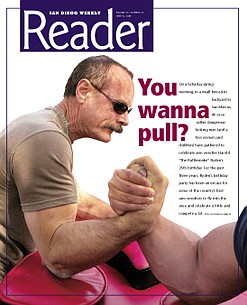
On a Saturday spring morning, in a small fenced-in backyard in San Marcos, 40 or so rather dangerous-looking men (and a few women and children) have gathered to celebrate arm wrestler Harold “the Rattlesnake” Ryden’s 35th birthday. For the past three years, Ryden’s birthday party has been an excuse for some of the country’s best arm wrestlers to fly into the area and celebrate a little and compete a lot.
Not every guy at Ryden’s party is particularly muscular, but they all seem tough. Not a metrosexual male in the crowd. Probably not even a single guy who knows what “metrosexual” means. Tattoos coil out from under the sleeves of muscle shirts. Hair isn’t brushed or combed. No one’s wearing any cologne. And though it isn’t particularly bright beneath the one leafy tree in Ryden’s yard, at least half of these men are wearing dark sunglasses. There might be enough testosterone here to fuel the international steroid business.
The Rydens have ordered six enormous pizzas to feed everyone, and multiple coolers are filled with soda and beer. A box is being passed around for contributions to cover Ryden’s present, a new iPhone.
But hardly anyone is eating, or even drinking. Instead, they’re all “pulling.”
“Ya wanna pull a little bit?”
“Yeah. Sure. You pull?”
“Pulling” is arm-wrestling vernacular for “engaging in an arm-wrestling match.” No fewer than seven arm-wrestling tables stand in Ryden’s yard. In the crowded little space, at least three or four matches are going on at any one time.
Finally, Ryden and another fellow don official black-and-white-striped referees’ shirts. “Everybody ready for the supermatch?” Ryden calls out.
For the main attraction of this year’s party, the lightweight arm-wrestling world champion, Vazgen Soghoyan, from Armenia, has challenged the great Allen Fisher.
Soghoyan, 25, is very short and very broad. He seems almost as big across his chest as he is tall. “We call him Popeye,” says one man, pointing to Soghoyan’s right forearm. From wrist to elbow his arm is bulbous, like some kind of huge fish, so big that despite the size of his chest and shoulders it doesn’t seem to fit with the rest of him.
But what’s Soghoyan thinking? Why is he challenging Allen Fisher?
“Harold ask me to challenge him,” Soghoyan admits, in his thick Armenian accent. “And anyway, Harold don’t ask, I challenge him myself.”
And why is that?
“Because,” he says, “it always good to arm wrestle the best.”
Soghoyan and Fisher chalk their hands and elbows and line up across from each other, with an arm-wrestling table between them. Ryden and the other referee watch closely as the two men come to grips.
No one’s laughing, or even smiling. This is serious stuff.
Fisher doesn’t go crazy or anything, pounding on the table and yelling, not the way he might in a real competition, but he does have a severe and determined look on his face. The entire crowd of partygoers turns completely silent. One man calls out, “Come on, Fish,” using Fisher’s most common nickname.
Finally, the competitors have a grip that satisfies the referees.
“Ready. Go!”
And that’s it. In less time than it took for the ref to say, “Ready, go,” Fisher pins Soghoyan.
“Match!” the ref says.
“Nice hit, Allen,” yells one of the partygoers, with admiration.
And then, someone else says, sarcastically, “You’ve got to work on your start, Allen,” and everyone laughs. Fisher’s start is devastating and flawless.
The two men line up again and come to grips again, and then, again, Fisher wins in less than one second. It’s almost ridiculous. What’s going on?
“Get in a hook,” someone calls out.
“Yeah, let him hook you,” says someone else.
They’re calling for a third match, and they’re telling Fisher to let Soghoyan hook him. Apparently, a hook is Soghoyan’s signature move, his strength.
So Fisher obliges. They start a third match with their wrists bent into hooks.
“Ready. Go!”
And this time, it’s just about even. They pull back and forth for over 30 seconds. The crowd’s shouting and calling over their shoulders. But, ultimately, Fisher wins this one, too.
“Show-off,” someone says. And more people laugh.
How has Fisher made such short work of the lightweight world champion?
“I swept through him,” he says matter-of-factly, sipping a bottle of water. “And I wouldn’t let him have control.”
The Beginning
Flash back 32 years, to the back room of a North Hollywood Alpha Beta supermarket in 1976, where a scrawny, 20-year-old clerk’s helper and an older, brawnier deliveryman have put their elbows on the opposite sides of a narrow table, leaned forward, and gripped each other hand-in-hand.
The supermarket manager had heard that the youngster thought he was pretty strong.
“You want to arm wrestle, Al?” he’d asked.
Al, the deliveryman, outweighed him by 60 or 70 pounds, but the clerk’s helper was game. “Why not,” he’d answered. “Sure.” And at closing time one evening, just about everyone who worked at the Alpha Beta gathered in the back room to see who was stronger: big Al or the little clerk’s helper.
All of a sudden, right before the match, Al started to transform into a wild beast. He pounded his chest and rolled his eyes and yelled at the top of his lungs. “Whoa,” thought the younger man. “What’s with this guy?”
And then the two of them went at it.
They pulled.
And pulled.
And pulled.
One minute, two minutes, till no one had any strength left.
And nobody won. They had stood each other up.
Turns out Al the deliveryman was Al Raney, one of the top-ranked heavyweight arm wrestlers in the United States in 1976. And he couldn’t beat this little 150-pound clerk’s helper, this upstart kid by the name of Allen Fisher.
The Myth
Fast forward to the present day, and you could almost say that Allen Fisher of little Spring Valley, California, is to arm wrestling what Kobe Bryant is to basketball or Tom Brady is to football. He’s arguably the best. A 26-time world champion. Over 50 national titles.
“What makes Allen a champion is this,” says his wife Carolyn affectionately. “One, he’s got a heart of gold for the arm wrestlers. Two, his consistency. Three, his ability to draw up his energy from somewhere. And then, four, his incredible speed and strength. And on top of all that, he’s 52, and he beats guys half his age who are on top of their game.”
Fisher himself estimates that he’s won over 1300 professional matches, against maybe 40 or 50 losses. You might say, instead, that Kobe Bryant is the Allen Fisher of basketball, or Tom Brady is the Allen Fisher of the NFL.
“The thing about Allen is, he beats guys half his age and twice his weight,” says Jake Smith, a training partner. “And he doesn’t just beat them, he crushes them.”
How does Fisher do it? Technique? Strength? Experience?
“God’s blessing,” says Carolyn.
“Intimidation,” says Robert Campbell, another of Fisher’s training partners.
“It’s a combination of everything,” concludes Smith. “He’s got it all.”
Smith, Campbell, and the Fishers are chatting before the start of an evening session of arm-wrestling practice. They’re standing in a circle, talking about Allen Fisher as though he weren’t even there. Even Allen Fisher is talking about himself as if his arm-wrestling persona is some different, mythic human being.
“When I’m in a competition,” he says, “it’s like I go to this whole other level. And when somebody pulls me, I can actually feel where they want to go, and then I can take control of that. It’s very odd. When I first got in the sport, I had the same thing. As soon as somebody grabbed my hand, I was trying to figure them out. I was watching where their elbow was, where their feet were, where their shoulders were positioned. I’d look at everything. And it just got to a point where I could actually feel where people’s power is and where their weaknesses are. So I think it’s just a matter of feeling, and knowing where and how to pull, and then waiting for that transition, when someone goes from one position to another. There’s always a split second in there where you can attack, and you have to know when that is and how to make it work.”
Does Fisher have any weaknesses?
“No,” says Carolyn decisively. “There aren’t any.”
But Allen’s thinking about the question.
“You know what his weakness is?” Smith asks rhetorically. “Overtraining. Most guys will take two weeks before a tournament and back it down. But Allen will be here a week before a major tournament, going just as hard.”
Fisher smiles, but he looks as if he’s not sure he agrees with Smith. He’s still thinking about the question.
“Having an off day,” he says, finally.
The plan in Fisher’s mind is that he wants to retire in two years. He wants to go out on top, at the 2010 world championships in Las Vegas.
“Every guy there is going to want to beat Allen Fisher in his last tournament,” says Carolyn. “It’s like he’s been the king of the castle for so long. So, will he go out the same way? Or can somebody else take it from him? It’s going to be exciting.”
The Man
Allen Fisher may be ultracompetitive and even periodically insane (in a cultivated, arm wrestler’s way), but he’s also deeply religious and doesn’t cuss. The man went to Bible college for two years.
How’s that for contrast? Brutally physical, yet sincerely spiritual. That contrast seems to pull the man taut.
If you had to pick one word to describe Allen Fisher, the best choice might be “taut.” Fisher’s skin is pulled taut over his muscles, and his intensity pulls his personality taut over his character. He’ll never snap at you in conversation and seldom loses his temper, but he does seem like a kind of tension spring, ready to pounce. There’s nothing slack about him, nothing loose. There’s no give.
But that isn’t to say that Fisher isn’t giving. In fact, his generosity within the sport of arm wrestling is a thing of renown.
People will fly to San Diego from all over the country — and even from other countries — just to train with Allen Fisher. And he and Carolyn often host these visitors to lunch or dinner.
“He’s the kind of guy who’d help you out in any way he can,” says one acquaintance. “He’ll go out of his way to do you a favor.”
“He’s the nicest guy you’d ever meet,” says another. “Of course, all that changes when it’s time for competition.”
“The coolest thing about training with Allen,” Jake Smith acknowledges, “isn’t necessarily what I learn from him, although I’ve learned a lot. The coolest thing is all the respect I get just for training with him.”
“Allen’s probably the most loved icon in the sport,” Carolyn Fisher says. “Because he’s a people’s people. He’s like the Roosevelt of arm wrestling. He’s there for everyone. You know, you see all these big guys with their heads this big and they’re all full of themselves, and then you’ll see Allen giving his time to some schmo who just wants to learn the basics. It’s in his heart. He’s very well respected. We had his 50th birthday party a couple of years ago, and 300 people showed up. Because they just like him.”
The Woman behind the Man
Carolyn Fisher isn’t just the wife of world-champion arm wrestler Allen Fisher. Carolyn Fisher is, herself, a world-champion arm wrestler.
“My first tournament ever, a friend of mine paid the $10 entry fee for me,” Carolyn says, “and they called my name, and I tripped going up the stairs. I carried my coat with me. I didn’t know what I was doing. And the first ten matches, they thought I was fouling, because it was so fast. It was just ‘Ready. G–,’ and they were down. And then that got me a free trip to the Canadian nationals, and I won lightweight, heavyweight, left arm, and right arm. And that got me a ticket to the world championships, where I met Allen. So it was all kind of like it was meant to be. I was only 19 at that first tournament.”
She and Allen met at the world championships in 1985, corresponded for a year, and then met up again at the 1986 nationals. They got engaged 11 days after that, and now they’ve been married for 22 years.
“He’s choleric,” Carolyn says of Allen. “There’s two ways of doing things. His way and the wrong way.”
“Freight-train mentality,” Allen adds, of himself. “Get on the train, or I’m leaving you behind.”
“And I’m a drama queen,” smiles Carolyn. “So we’ve got a very exciting household.”
Yet they’ve made it work for over two decades.
“We know where the low blows are, and we don’t go there,” Carolyn says. “We just respect it. We’d be hurt. And we have a lot in common. The arm wrestling. We love to travel. And we like our kids.”
The Fishers have two bright, energetic, and athletic children. Megan, 18, is a sophomore at Grossmont College, and Austin, 16, attends Heartland Christian private school.
Tonight, Carolyn has cooked a big, healthy dinner for her family. The Fishers seem like a happy bunch, laughing a lot, telling stories, and ribbing each other good-naturedly.
“I was a soccer mom,” says Carolyn, putting her dinner fork down as she tells the story. “But I couldn’t just rest on the sidelines. I had to be the assistant coach, even though I’d never played a day of soccer in my life. But then, come game-time, Megan would run around the field and get distracted by butterflies. And when the ball would come to Austin, instead of kicking it, he’d make his fingers into guns and pretend to shoot at it.”
The whole family laughs together, remembering these stories. “So both of them busted my chops,” Carolyn concludes. “One of them by being Type B and the other by being…Type…W.”
But it must be awfully tough for Austin and Megan, having two parents who are world champions.
“It’s always been a challenge for me,” says Austin, over a hearty bowl of his mom’s salad, “because I always have to win. No matter if it’s computer games, video games, outside with friends: I always have to win.”
Why does he have to win? If he loses, won’t his parents let him sleep in his own bed at night?
He laughs. “No! No,” he says. “I won’t let myself sleep. It’s like they’re world champions, so why can’t I be that good? And that’s why I don’t get into arm wrestling. Everybody would expect me to be some prodigy child.”
Carolyn teaches physical education part-time at Heartland Christian School. And Allen was an architectural metal and glass worker for 22 years. Now both of them are in business with a company called National Safety Associates. They market and sell fruits and vegetables in capsules, in a product called Juice Plus+.
“The interesting thing is,” Carolyn is telling the story of how the two champions first went to arm-wrestling competitions together, “before we were married, I was going to tournaments by myself and doing my own thing, and he was, too. And when we got married, and we were going in the same hotel room for the first time, it was very weird. Because I pull right in quiet, and he gets all fired up. And we got into this weird thing, you know? Do we sit by each other? Do we not? So, after a while, we just let each other go, and then I’d bump into him and say, ‘Hey, how you doing?’ But I do want him there when I’m setting up with a girl. I need him to help me get ready for a match. It’s almost like I hear his eyes.”
At the highest levels of arm wrestling, the women are just as much machines as the men are. “Those women from Belarus and Germany are built for this,” Carolyn says. “They mortgage their houses to be arm wrestlers.”
But for Carolyn’s part, she consciously tries to maintain a balance between femininity and masculinity. “I love competition and I love strength,” she says. “But I also love to make people feel special.”
Carolyn’s formidable musculature is natural; she never lifts weights. So she doesn’t look like some female musclehead. But she tips the scales around 160, and there isn’t an ounce of fat on her. She stands about 5’7’’. And she’s 46 years old, but you’d think she’s at least ten years younger.
“A lot of times, I’ll be arm wrestling a man,” Carolyn says, “because he’ll hear that I’m a world champion. And when they hear that, they’re like, ‘Oh, yeah?’ And then we’ll go, and I’ll beat him. But I’ll also feel his ego is really big, so I’ll try to make jokes to defuse it.”
Jake Smith remembers a time when Carolyn was challenged by a wide receiver for the San Diego Chargers. “She pinned him in about two seconds,” he says. “And he was, like, ‘Oh, okay.’ And he wanted a rematch. So she pinned him in, like, two seconds again.”
After a long arm-wrestling practice one evening, after Fisher’s training partners have left, Allen and Carolyn spar a little. They lock into arm-wrestling positions, and Allen spots her two fingers: she uses her full hand against 60 percent of his. They’re about even with this handicapping, and they tug and pull at each other with all their might. Neither one of them is really trying to win, but it’s apparent that neither of them wants to lose either. After a minute or so of this, they give each other a nice big hug. It’s a beautiful moment, and it encapsulates their relationship perfectly: competing to a standstill on a leveled playing field and then hugging it out in the end.
The Movie
In 1986, Allen and Carolyn Fisher were both extras in the Sylvester Stallone arm-wrestling movie Over the Top.
The film centered around the largest arm-wrestling event of the time, which was held in Las Vegas. During the tournament, Allen Fisher never slept. He was too amped up. “I pinned the last guy at 6 a.m. the second day,” he says.
Adds Carolyn, “It was a long shoot. Like, 21 hours. And there were a thousand people there. They filmed it at a real tournament. And we’d pull while they were filming, and then they’d bring in some actors, and they’d film some more. Allen won first place, $5000, and that was our down payment for our first house.”
Over the Top shows one of Fisher’s matches in its entirety. He pins a guy in about two seconds flat, maybe less. If you pause your DVD and watch this two-second clip in super-slow motion, you’ll witness the full arm-wrestling transformation of Allen Fisher.
He had a thin beard back then, and a good deal more hair, but otherwise Fisher looks pretty much the same. Except for this: in the movie, Fisher’s face is fixed into an open-mouthed, jaw-jutting, nostril-flaring, wide-eyed, unblinking, shivering, shaking mask of sheer intensity. He looks terrifying.
Then he pins his man in a flash — even in super-slow motion — and you watch that mask relax ever so slightly. He lets his breath go and blinks, and his jaw releases its jut a little.
Allen Fisher’s game face and his regular face couldn’t be any more different if one were chiseled out of stone and the other molded out of clay.
“I asked Stallone which sport he liked more, boxing or arm wrestling,” Carolyn remembers. “And he said, ‘Arm wrestling is way harder.’ ”
The History
The history of arm wrestling dates back to ancient times. You can find stories of arm-wrestling matches to the death, or at least matches until grave injury occurs: scorpions or nails would be waiting on the table for the loser’s pinned hand.
Modern arm wrestling’s popularity can be traced to Charles Schultz’s Peanuts comic strip, believe it or not. In 1968, Schultz did 11 strips where Snoopy was traveling to Petaluma, California, to win the world’s wrist-wrestling championships. ABC’s Wide World of Sports followed suit, showing real matches from Petaluma for the next 16 years.
The longest match in modern arm-wrestling history lasted 27 minutes. It was between Steve Lusby and Earl Moffner. Their match was shown live on ABC, and they had to cut to commercial in the middle of it. When Lusby and Moffner were finished, they both fainted. Paramedics immediately attended to both men.
In the end, Snoopy was disqualified because you’re supposed to lock thumbs with your opponent, and Snoopy had no thumbs. And the sport of arm wrestling receded to sporadic late-night showings on ESPN.
The Hand
It curls into a fist that’s over 13 inches around. The measurement from wrist to tip of the middle finger is 9 full inches. The width of the palm is 6 inches. The five fingers look like a collection of babies’ wrists.
The right hand of Allen Fisher is like a massive slab of beef. It’s bigger than his left. You might think you could beat this guy arm wrestling, until that hand engulfs yours.
“There’s really no one in the world who has a bigger hand in his weight class,” Jake Smith says. “That’s the hand of a heavyweight.”
“I’ve never let him spank the kids,” Carolyn laughs.
Fisher wears a size 11 ring on his left hand. Very large. But his ring size on his right hand is a 13. Huge. “It costs too much to buy him a ring for his right hand,” says Carolyn. “It takes too much gold.”
Even the filmmakers of Over the Top were taken with Allen Fisher’s mythic, monstrous hand. That right hand gets a few seconds of exclusive screen time. It dominates the scene.
Part of the reason why Fisher’s right hand and arm are so much bigger than his left is because of an injury he sustained almost 30 years ago. He was working on a construction site, and a plate of glass severed all five of the tendons in his left wrist. He has a scar that winds nearly seven inches up the inside of his left forearm. This is the reason why Fisher doesn’t compete left-handed.
“This would be a normal-sized hand.” Jake Smith holds up his own very thick and muscular fist. “And I weigh even more than he does.” Then, grabbing Fisher by the wrist, he says, “But look at this thing. It’s all girthy and big. Jeez.”
The Head
“There’s more than just arm-wrestling training,” Carolyn says. “There’s in your head, too, to be a professional. If you get distracted, you’re not going to win.”
Adds Allen, “When you’re in a competition, you don’t hear the people screaming. I shut off everything, and I’m just there in the moment. I’m listening for ‘Ready, g-.’ I don’t even hear the whole word ‘go.’ I train for ‘g-.’ ”
When it comes to Allen Fisher’s competition-head, the psychological change he undergoes is as extreme as Jekyll becoming Hyde. He becomes a raging storm with a massive arm. You’ve really got to see how much Allen Fisher, the man, transforms when he becomes Allen Fisher, the arm wrestler. Check ESPN’s listings. Or go look up his name on YouTube. It’ll give you a sense of how Fisher becomes this other entity entirely. It’s a cultivated insanity. His eyes turn wild. He yells and claps his hands and flexes and pounds on the table. It’s intimidating, even when you’re watching in your living room, much less standing there across from him and getting ready to do battle.
Carolyn says, “Someone said, ‘If I had Mike Tyson or Allen Fisher in a dark alley, I’d rather meet Mike Tyson.’ Because Allen just changes. It’s his professionalism, his ability to turn it on when he needs it and then turn it off.”
Says Allen, “You have to train your mental state all the time. It’s like how muscles have memory, and they know what you do. So you have to do things over and over until they become second nature. Well, your mind is the same thing. You have to train your mind to know your move, to not go into second thoughts, and to think like a champion. Mentally, you’ve got to be beyond everything. You’ve got to stay totally focused.”
The Match
An official arm-wrestling table looks like some kind of strange puzzle on four legs. It’s got pegs and circles on it, and pads, and if you saw one out of context, you might wonder what on earth it’s for.
Competitive arm wrestlers must stand on either side of one of these tables, grip the pegs, put their elbows in the pads, and have at least one foot on the floor. The other foot is often wrapped around one leg of the arm-wrestling table. Shorter competitors may wear boots or thick-soled shoes or even stand on a riser to counter a height disadvantage. The arm wrestlers will grasp each other’s hand, and they have up to a minute to straighten their wrists and achieve a grip that satisfies the referee, who then says, “Ready, go!” The match is over when one competitor’s hand is pinned against the table with the winner’s hand over the loser’s.
“In an arm-wrestling match, people will be yelling and screaming,” Carolyn says. “The crowd’s going wild, and no one wants to see a foul. They’re, like, ‘Don’t foul out.’ But one little slip of an elbow…And sometimes these silly little assistant referees are on the side. They’re looking for every little thing. And if they so much as see daylight, they call the foul. It’s like they’re anxious to call it. And most people are saying, ‘Just let ’em run!’ ”
Fouls are assessed for various penalties, such as false starts, elbows leaving the table, or trying to escape a pin by breaking out of a grip. Each contestant gets one foul, but on the second foul, he or she is disqualified.
Allen Fisher is one of the quickest arm wrestlers in the sport. He’s known for pouncing first and winning fast. Most of his matches last under five seconds, and the majority of those are much shorter than that. The longest he’s ever stayed locked up with an opponent in an official match was about two minutes.
But, despite this quickness, Fisher has only been called for fouls a few times in his whole career.
“There’s nothing worse than Allen getting called for a foul that he didn’t commit,” Carolyn says. “That gets him so mad. Then all the guys that are arm wrestling him afterwards get scared.”
Robert Campbell laughs at this and says, “Yeah, I liked when you arm wrestled Cobra at Mohegan, and he thought you’d fouled, and he goes, ‘Tell him you did it, Allen,’ and you were, like, ‘Oh? You want to go again? Okay.’ And then you just beat him the same way again.”
The Practice
Two or three times a week, around dusk, they meet in a permanent tent that’s set up in the side yard of the Fisher household in Spring Valley. Muscular men in jeans and T-shirts who just got off work. They park their pickups in the weedy driveway beside the beige two-story house, and then, by the buzz of a single hanging shop light, they start.
Twenty-one arm curls with a 20-pound bar as fast as possible. That’s 21 curls in about seven or eight seconds.
“Not fast enough!” Allen Fisher barks good-naturedly. “Blink. Blink again and again. You see? You’ve got fast-twitch muscles. Now do the curls that fast.”
After a few fast curls, Fisher and his training partners warm up by locking into arm-wrestling postures and pushing at each other with graduating pressure. After a few minutes, they’re gasping and straining.
Tonight, Fisher’s working out with Jake Smith, 28, and Robert Campbell, 29. Fisher’s wife Carolyn is here, too.
“Both Robert and Jake have natural strength because of their employment,” Carolyn comments.
Campbell is a contractor, and Smith delivers bottled water.
“Arm wrestlers are meat cutters and bricklayers and hay balers,” Carolyn says, only half facetiously. In Over the Top, most of the arm wrestlers were truck drivers.
Smith, Campbell, and Allen Fisher are alternating in a sort of arm-wrestling tango, with neither opponent trying to win. Instead, they’re pushing each other into vulnerable spots and then trying to fight out of those positions. Real arm-wrestling matches usually last a few seconds, but these warm-up tangos will often go on for over a minute.
“In a real tournament, there’s so much intensity in the stable starting position,” Campbell says. “And then it’s ‘Ready. Go!’ And then it’s done. It’s over with. But this is a totally different thing. We’re using all the same power and technique, but it’s like it’s in slow motion.”
The difference between arm wrestling in a bar or in a workout and arm wrestling in a competition is even more marked than one might imagine. “People will brag, ‘Oh, I beat Allen Fisher,’ ” says Carolyn. “And then you say, ‘Oh? At a workout? Or in a competition?’ Nobody beats Allen in a competition.”
In a competition, Fisher wants to get through each match as quickly as possible, and for a good reason. “When I got started in the sport, it was all inside moves. Hook and drag. Hook and press. We’d get set up inside and we’d both just turn in, and we’d sit there, and we’d hold each other. But I never went that route. People kept telling me that I was so strong inside, so why didn’t I use that move? Well, I knew if I kept going inside, then I’d get locked up for a long time. But I’m looking ahead. I don’t want to just win that match. I want first place. So I don’t want to get locked up with anyone. My idea, instead, was to pull someone out of their power. So when I would pull, I would turn my body and start to pull away. And it kind of developed. I’d go over the top of his hand and turn my wrist, and it was so easy to hold people, even if the guy weighs 500 pounds.”
Carolyn describes the classic Allen Fisher move like this. “He’ll get popped out,” she says, “and you’ll see him look over at the other guy. And you can see him watching and waiting for him to move. And then he’ll just lay in or roll out. It’s classic. For him to be in a hook for a second and then to look at the other guy and wait for him to move — he waits for the transition — and then he just beats him to the spot and comes in or pulls out, but either way, he pins the guy, like, a split second after that.”
Transitions are the important and minute changes in position that occur throughout an arm-wrestling match. It could be finger pressure, a pronating or supinating wrist, an opening of the bicep, elbow position, tricep pressure, positioning of the legs and body, and on and on. The thing is to feel where your opponent’s pressure is coming from, and then, before he or she can change from one move to the next, to counterattack in precisely the best way. That’s why Fisher counsels his charges to “keep the pressure, no matter what,” because if you let up at all through your transitions, you’re going to get beaten.
“You never let your opponent have control,” he says. “You want control, no matter what. And no matter how he’s exerting pressure, you have to know there’s a weakness, and you have to attack that. Going high, out the back door, sweeping, cutting, pulling him apart, or just going sideways, if he’s not used to that kind of thing.”
After an hour or so of working out, Allen reflects on how his practices prepare him for tournaments.
“In sports, you have to be there in the moment,” he says. “And not just in competition, but all the time. Because the thing is, muscles have memory. Like these guys, just now, they were forcing me into a hook, and then we were just pulling. But I would never do that a few weeks prior to a competition. Because I’ll get in competition, and my muscles will be saying, ‘This is what you’re going to do in competition.’ But that’s not what I want to do. I want to do my move.”
“It’s kind of like thinking negative thoughts,” adds Carolyn. “So if he comes to a tournament, he wants to be training in such a way that all he’s doing is his move. Over and over, just doing his move, so his muscles remember it. If he does end up in a hook, then he’ll cover that when he gets to it. But, chances are, he’s creating a 90 percent possibility he’s going to do his move.”
The Injuries
Two unusual injuries suffered by arm wrestlers are fat lips and bruised bellies. The belly bruises come from leaning in hard against the arm-wrestling table. Allen Fisher wears a towel wrapped in his waistband to guard against this. And fat lips can occur when an arm wrestler slips out of the grip of his opponent and then punches himself in the face.
“Those injuries have happened to just about everyone at some point or another,” says Carolyn.
But about the more serious arm-wrestling injuries — broken bones and torn ligaments — Allen Fisher says, “You’d rather give some ground than find yourself in a bad position. Better to lose, or have to come from a long way behind, than to break something or pull something.”
This is a lesson that many arm wrestlers will learn the hard way.
Robert Campbell’s here at the Fishers’ place training, but just three months ago, he broke his humerus, which wasn’t very funny. He broke it arm wrestling.
“Just using poor technique,” Campbell says. His boyish face creases into a sheepish grin.
Jake Smith was there when Campbell’s arm broke.
“He was just messing around after a tournament,” Smith says. “And I was right there. And I heard what sounded like a broomstick breaking.”
“And I was, like, ‘Uh-oh,’ ” says Campbell. “It broke, and my arm flew back, and this ref that was watching us arm wrestle said, ‘Ooh, you just broke your arm! Sit down! Sit down!’ And I was, like, ‘Oh, okay,’ And then I realized I could move my hand okay, but when I tried to lift my arm, it wasn’t happening.”
Spiral fractures of the humerus are just one of the common hazards of arm wrestling. You get your shoulder going one way and you push your hand in the other, and the strain across your arm bone can become too great.
“It only takes about 10 to 12 pounds of pressure to break a bone,” Carolyn says.
There can be an upside, however.
“A lot of times when you break a bone, you come back stronger,” she adds.
“That’s what the doctor told me,” agrees Campbell. “He said it will be 20 percent stronger once it heals.”
The Money (Or Lack Thereof)
Within the coterie of arm wrestlers, Allen Fisher is a legend. But how is it that he isn’t rich, or more famous? Why isn’t he a household name?
“He’s never promoted himself," Carolyn practically whispers, sounding incredulous. Then she adds, “He doesn’t know how to do that.”
There’s also the problem of nonunification within the sport. No strong central governing body promotes arm wrestling the way the NBA or NFL bring basketball and football into everyone’s living room. That’s probably the main reason why you haven’t heard of Fisher, or John Brzenk, or Steve Bye, or Dave Patton.
And what’s the prize money like in professional arm wrestling?
“It’s nothing,” Carolyn says. “It costs you $500 to get to a tournament. And it’s $500 or $600 for first place. Sometimes we drive somewhere, and we’ll go three weight classes each. We’ll clean up, and we’ll make $1500 or $2000. But that’s it.”
How would that work?
“I’d weigh in for lightweight,” Carolyn says. “Of course, this was when I weighed 140. And then I’d enter middleweight and heavyweight. Because you can go higher; you just can’t go down. So we’d both do the same thing, and we’d be, like, ‘How much did you get?’ ”
How much do the Fishers make nowadays from arm wrestling?
“Nothing!” they say, almost simultaneously, laughing.
“How much is Mohegan Sun?” asks Allen, referring to one of the country’s bigger tournaments. “A thousand bucks?”
The most he’s ever won for a tournament was $5000 during the filming of Over the Top, but payouts anywhere near that large are rarer than rare.
“The only ones making money are guys with sponsors,” adds Jake Smith.
“Guys with sponsors, and guys who travel every weekend to some event,” says Carolyn.
But no one in the United States — and probably not anyone in the world — makes a living solely by arm wrestling.
The Simple Fact: Size Doesn’t Matter
Arm wrestlers run anywhere from 16 years old to well into their 60s. They can be big or small, athletic or portly, muscular or wiry. It seems that body type doesn’t necessarily translate into failure or success.
“It’s anybody’s game,” says Carolyn.
Allen Fisher’s training partners, Jake Smith and Robert Campbell, are both made of muscle: huge chests, thick shoulders, and rounded biceps. Smith weighs 177, and Campbell goes about 185. But Fisher himself isn’t all that big. The thing about Allen Fisher is that he gets larger in your memory. Maybe it’s something about his intensity. You see him, and you size him up, and then you see him in action, and you form an impression of Allen Fisher. In your imagination, the man becomes enormous. Then you see him again, and it seems that he’s lost weight. He’s only 5’11’’ and 168 pounds. Did he shrink?
Says Fisher, “You really don’t know who you’re up against, at a competition, based on how a guy looks. Sometimes the thinnest, most wiry guy will just kill you, where the big bodybuilder is easy to beat.”
“You take Allen,” Smith says. “He’s never lifted a weight in his life. I promise you, I’d take Allen to the gym, I’m going to destroy him in everything. Except maybe wrist curls. Bench press, kill him. Squats, kill him. But get me on the [arm-wrestling] table with him, and he owns me. And that’s just the way it is. He can destroy someone who’s 400 pounds like nothing.”
Here's something you might be interested in.
Arm wrestling nation here in San Diego
You wanna pull?

Arm wrestling nation here in San Diego
You wanna pull?
On a Saturday spring morning, in a small fenced-in backyard in San Marcos, 40 or so rather dangerous-looking men (and a few women and children) have gathered to celebrate arm wrestler Harold “the Rattlesnake” Ryden’s 35th birthday. For the past three years, Ryden’s birthday party has been an excuse for some of the country’s best arm wrestlers to fly into the area and celebrate a little and compete a lot.
Not every guy at Ryden’s party is particularly muscular, but they all seem tough. Not a metrosexual male in the crowd. Probably not even a single guy who knows what “metrosexual” means. Tattoos coil out from under the sleeves of muscle shirts. Hair isn’t brushed or combed. No one’s wearing any cologne. And though it isn’t particularly bright beneath the one leafy tree in Ryden’s yard, at least half of these men are wearing dark sunglasses. There might be enough testosterone here to fuel the international steroid business.
The Rydens have ordered six enormous pizzas to feed everyone, and multiple coolers are filled with soda and beer. A box is being passed around for contributions to cover Ryden’s present, a new iPhone.
But hardly anyone is eating, or even drinking. Instead, they’re all “pulling.”
“Ya wanna pull a little bit?”
“Yeah. Sure. You pull?”
“Pulling” is arm-wrestling vernacular for “engaging in an arm-wrestling match.” No fewer than seven arm-wrestling tables stand in Ryden’s yard. In the crowded little space, at least three or four matches are going on at any one time.
Finally, Ryden and another fellow don official black-and-white-striped referees’ shirts. “Everybody ready for the supermatch?” Ryden calls out.
For the main attraction of this year’s party, the lightweight arm-wrestling world champion, Vazgen Soghoyan, from Armenia, has challenged the great Allen Fisher.
Soghoyan, 25, is very short and very broad. He seems almost as big across his chest as he is tall. “We call him Popeye,” says one man, pointing to Soghoyan’s right forearm. From wrist to elbow his arm is bulbous, like some kind of huge fish, so big that despite the size of his chest and shoulders it doesn’t seem to fit with the rest of him.
But what’s Soghoyan thinking? Why is he challenging Allen Fisher?
“Harold ask me to challenge him,” Soghoyan admits, in his thick Armenian accent. “And anyway, Harold don’t ask, I challenge him myself.”
And why is that?
“Because,” he says, “it always good to arm wrestle the best.”
Soghoyan and Fisher chalk their hands and elbows and line up across from each other, with an arm-wrestling table between them. Ryden and the other referee watch closely as the two men come to grips.
No one’s laughing, or even smiling. This is serious stuff.
Fisher doesn’t go crazy or anything, pounding on the table and yelling, not the way he might in a real competition, but he does have a severe and determined look on his face. The entire crowd of partygoers turns completely silent. One man calls out, “Come on, Fish,” using Fisher’s most common nickname.
Finally, the competitors have a grip that satisfies the referees.
“Ready. Go!”
And that’s it. In less time than it took for the ref to say, “Ready, go,” Fisher pins Soghoyan.
“Match!” the ref says.
“Nice hit, Allen,” yells one of the partygoers, with admiration.
And then, someone else says, sarcastically, “You’ve got to work on your start, Allen,” and everyone laughs. Fisher’s start is devastating and flawless.
The two men line up again and come to grips again, and then, again, Fisher wins in less than one second. It’s almost ridiculous. What’s going on?
“Get in a hook,” someone calls out.
“Yeah, let him hook you,” says someone else.
They’re calling for a third match, and they’re telling Fisher to let Soghoyan hook him. Apparently, a hook is Soghoyan’s signature move, his strength.
So Fisher obliges. They start a third match with their wrists bent into hooks.
“Ready. Go!”
And this time, it’s just about even. They pull back and forth for over 30 seconds. The crowd’s shouting and calling over their shoulders. But, ultimately, Fisher wins this one, too.
“Show-off,” someone says. And more people laugh.
How has Fisher made such short work of the lightweight world champion?
“I swept through him,” he says matter-of-factly, sipping a bottle of water. “And I wouldn’t let him have control.”
The Beginning
Flash back 32 years, to the back room of a North Hollywood Alpha Beta supermarket in 1976, where a scrawny, 20-year-old clerk’s helper and an older, brawnier deliveryman have put their elbows on the opposite sides of a narrow table, leaned forward, and gripped each other hand-in-hand.
The supermarket manager had heard that the youngster thought he was pretty strong.
“You want to arm wrestle, Al?” he’d asked.
Al, the deliveryman, outweighed him by 60 or 70 pounds, but the clerk’s helper was game. “Why not,” he’d answered. “Sure.” And at closing time one evening, just about everyone who worked at the Alpha Beta gathered in the back room to see who was stronger: big Al or the little clerk’s helper.
All of a sudden, right before the match, Al started to transform into a wild beast. He pounded his chest and rolled his eyes and yelled at the top of his lungs. “Whoa,” thought the younger man. “What’s with this guy?”
And then the two of them went at it.
They pulled.
And pulled.
And pulled.
One minute, two minutes, till no one had any strength left.
And nobody won. They had stood each other up.
Turns out Al the deliveryman was Al Raney, one of the top-ranked heavyweight arm wrestlers in the United States in 1976. And he couldn’t beat this little 150-pound clerk’s helper, this upstart kid by the name of Allen Fisher.
The Myth
Fast forward to the present day, and you could almost say that Allen Fisher of little Spring Valley, California, is to arm wrestling what Kobe Bryant is to basketball or Tom Brady is to football. He’s arguably the best. A 26-time world champion. Over 50 national titles.
“What makes Allen a champion is this,” says his wife Carolyn affectionately. “One, he’s got a heart of gold for the arm wrestlers. Two, his consistency. Three, his ability to draw up his energy from somewhere. And then, four, his incredible speed and strength. And on top of all that, he’s 52, and he beats guys half his age who are on top of their game.”
Fisher himself estimates that he’s won over 1300 professional matches, against maybe 40 or 50 losses. You might say, instead, that Kobe Bryant is the Allen Fisher of basketball, or Tom Brady is the Allen Fisher of the NFL.
“The thing about Allen is, he beats guys half his age and twice his weight,” says Jake Smith, a training partner. “And he doesn’t just beat them, he crushes them.”
How does Fisher do it? Technique? Strength? Experience?
“God’s blessing,” says Carolyn.
“Intimidation,” says Robert Campbell, another of Fisher’s training partners.
“It’s a combination of everything,” concludes Smith. “He’s got it all.”
Smith, Campbell, and the Fishers are chatting before the start of an evening session of arm-wrestling practice. They’re standing in a circle, talking about Allen Fisher as though he weren’t even there. Even Allen Fisher is talking about himself as if his arm-wrestling persona is some different, mythic human being.
“When I’m in a competition,” he says, “it’s like I go to this whole other level. And when somebody pulls me, I can actually feel where they want to go, and then I can take control of that. It’s very odd. When I first got in the sport, I had the same thing. As soon as somebody grabbed my hand, I was trying to figure them out. I was watching where their elbow was, where their feet were, where their shoulders were positioned. I’d look at everything. And it just got to a point where I could actually feel where people’s power is and where their weaknesses are. So I think it’s just a matter of feeling, and knowing where and how to pull, and then waiting for that transition, when someone goes from one position to another. There’s always a split second in there where you can attack, and you have to know when that is and how to make it work.”
Does Fisher have any weaknesses?
“No,” says Carolyn decisively. “There aren’t any.”
But Allen’s thinking about the question.
“You know what his weakness is?” Smith asks rhetorically. “Overtraining. Most guys will take two weeks before a tournament and back it down. But Allen will be here a week before a major tournament, going just as hard.”
Fisher smiles, but he looks as if he’s not sure he agrees with Smith. He’s still thinking about the question.
“Having an off day,” he says, finally.
The plan in Fisher’s mind is that he wants to retire in two years. He wants to go out on top, at the 2010 world championships in Las Vegas.
“Every guy there is going to want to beat Allen Fisher in his last tournament,” says Carolyn. “It’s like he’s been the king of the castle for so long. So, will he go out the same way? Or can somebody else take it from him? It’s going to be exciting.”
The Man
Allen Fisher may be ultracompetitive and even periodically insane (in a cultivated, arm wrestler’s way), but he’s also deeply religious and doesn’t cuss. The man went to Bible college for two years.
How’s that for contrast? Brutally physical, yet sincerely spiritual. That contrast seems to pull the man taut.
If you had to pick one word to describe Allen Fisher, the best choice might be “taut.” Fisher’s skin is pulled taut over his muscles, and his intensity pulls his personality taut over his character. He’ll never snap at you in conversation and seldom loses his temper, but he does seem like a kind of tension spring, ready to pounce. There’s nothing slack about him, nothing loose. There’s no give.
But that isn’t to say that Fisher isn’t giving. In fact, his generosity within the sport of arm wrestling is a thing of renown.
People will fly to San Diego from all over the country — and even from other countries — just to train with Allen Fisher. And he and Carolyn often host these visitors to lunch or dinner.
“He’s the kind of guy who’d help you out in any way he can,” says one acquaintance. “He’ll go out of his way to do you a favor.”
“He’s the nicest guy you’d ever meet,” says another. “Of course, all that changes when it’s time for competition.”
“The coolest thing about training with Allen,” Jake Smith acknowledges, “isn’t necessarily what I learn from him, although I’ve learned a lot. The coolest thing is all the respect I get just for training with him.”
“Allen’s probably the most loved icon in the sport,” Carolyn Fisher says. “Because he’s a people’s people. He’s like the Roosevelt of arm wrestling. He’s there for everyone. You know, you see all these big guys with their heads this big and they’re all full of themselves, and then you’ll see Allen giving his time to some schmo who just wants to learn the basics. It’s in his heart. He’s very well respected. We had his 50th birthday party a couple of years ago, and 300 people showed up. Because they just like him.”
The Woman behind the Man
Carolyn Fisher isn’t just the wife of world-champion arm wrestler Allen Fisher. Carolyn Fisher is, herself, a world-champion arm wrestler.
“My first tournament ever, a friend of mine paid the $10 entry fee for me,” Carolyn says, “and they called my name, and I tripped going up the stairs. I carried my coat with me. I didn’t know what I was doing. And the first ten matches, they thought I was fouling, because it was so fast. It was just ‘Ready. G–,’ and they were down. And then that got me a free trip to the Canadian nationals, and I won lightweight, heavyweight, left arm, and right arm. And that got me a ticket to the world championships, where I met Allen. So it was all kind of like it was meant to be. I was only 19 at that first tournament.”
She and Allen met at the world championships in 1985, corresponded for a year, and then met up again at the 1986 nationals. They got engaged 11 days after that, and now they’ve been married for 22 years.
“He’s choleric,” Carolyn says of Allen. “There’s two ways of doing things. His way and the wrong way.”
“Freight-train mentality,” Allen adds, of himself. “Get on the train, or I’m leaving you behind.”
“And I’m a drama queen,” smiles Carolyn. “So we’ve got a very exciting household.”
Yet they’ve made it work for over two decades.
“We know where the low blows are, and we don’t go there,” Carolyn says. “We just respect it. We’d be hurt. And we have a lot in common. The arm wrestling. We love to travel. And we like our kids.”
The Fishers have two bright, energetic, and athletic children. Megan, 18, is a sophomore at Grossmont College, and Austin, 16, attends Heartland Christian private school.
Tonight, Carolyn has cooked a big, healthy dinner for her family. The Fishers seem like a happy bunch, laughing a lot, telling stories, and ribbing each other good-naturedly.
“I was a soccer mom,” says Carolyn, putting her dinner fork down as she tells the story. “But I couldn’t just rest on the sidelines. I had to be the assistant coach, even though I’d never played a day of soccer in my life. But then, come game-time, Megan would run around the field and get distracted by butterflies. And when the ball would come to Austin, instead of kicking it, he’d make his fingers into guns and pretend to shoot at it.”
The whole family laughs together, remembering these stories. “So both of them busted my chops,” Carolyn concludes. “One of them by being Type B and the other by being…Type…W.”
But it must be awfully tough for Austin and Megan, having two parents who are world champions.
“It’s always been a challenge for me,” says Austin, over a hearty bowl of his mom’s salad, “because I always have to win. No matter if it’s computer games, video games, outside with friends: I always have to win.”
Why does he have to win? If he loses, won’t his parents let him sleep in his own bed at night?
He laughs. “No! No,” he says. “I won’t let myself sleep. It’s like they’re world champions, so why can’t I be that good? And that’s why I don’t get into arm wrestling. Everybody would expect me to be some prodigy child.”
Carolyn teaches physical education part-time at Heartland Christian School. And Allen was an architectural metal and glass worker for 22 years. Now both of them are in business with a company called National Safety Associates. They market and sell fruits and vegetables in capsules, in a product called Juice Plus+.
“The interesting thing is,” Carolyn is telling the story of how the two champions first went to arm-wrestling competitions together, “before we were married, I was going to tournaments by myself and doing my own thing, and he was, too. And when we got married, and we were going in the same hotel room for the first time, it was very weird. Because I pull right in quiet, and he gets all fired up. And we got into this weird thing, you know? Do we sit by each other? Do we not? So, after a while, we just let each other go, and then I’d bump into him and say, ‘Hey, how you doing?’ But I do want him there when I’m setting up with a girl. I need him to help me get ready for a match. It’s almost like I hear his eyes.”
At the highest levels of arm wrestling, the women are just as much machines as the men are. “Those women from Belarus and Germany are built for this,” Carolyn says. “They mortgage their houses to be arm wrestlers.”
But for Carolyn’s part, she consciously tries to maintain a balance between femininity and masculinity. “I love competition and I love strength,” she says. “But I also love to make people feel special.”
Carolyn’s formidable musculature is natural; she never lifts weights. So she doesn’t look like some female musclehead. But she tips the scales around 160, and there isn’t an ounce of fat on her. She stands about 5’7’’. And she’s 46 years old, but you’d think she’s at least ten years younger.
“A lot of times, I’ll be arm wrestling a man,” Carolyn says, “because he’ll hear that I’m a world champion. And when they hear that, they’re like, ‘Oh, yeah?’ And then we’ll go, and I’ll beat him. But I’ll also feel his ego is really big, so I’ll try to make jokes to defuse it.”
Jake Smith remembers a time when Carolyn was challenged by a wide receiver for the San Diego Chargers. “She pinned him in about two seconds,” he says. “And he was, like, ‘Oh, okay.’ And he wanted a rematch. So she pinned him in, like, two seconds again.”
After a long arm-wrestling practice one evening, after Fisher’s training partners have left, Allen and Carolyn spar a little. They lock into arm-wrestling positions, and Allen spots her two fingers: she uses her full hand against 60 percent of his. They’re about even with this handicapping, and they tug and pull at each other with all their might. Neither one of them is really trying to win, but it’s apparent that neither of them wants to lose either. After a minute or so of this, they give each other a nice big hug. It’s a beautiful moment, and it encapsulates their relationship perfectly: competing to a standstill on a leveled playing field and then hugging it out in the end.
The Movie
In 1986, Allen and Carolyn Fisher were both extras in the Sylvester Stallone arm-wrestling movie Over the Top.
The film centered around the largest arm-wrestling event of the time, which was held in Las Vegas. During the tournament, Allen Fisher never slept. He was too amped up. “I pinned the last guy at 6 a.m. the second day,” he says.
Adds Carolyn, “It was a long shoot. Like, 21 hours. And there were a thousand people there. They filmed it at a real tournament. And we’d pull while they were filming, and then they’d bring in some actors, and they’d film some more. Allen won first place, $5000, and that was our down payment for our first house.”
Over the Top shows one of Fisher’s matches in its entirety. He pins a guy in about two seconds flat, maybe less. If you pause your DVD and watch this two-second clip in super-slow motion, you’ll witness the full arm-wrestling transformation of Allen Fisher.
He had a thin beard back then, and a good deal more hair, but otherwise Fisher looks pretty much the same. Except for this: in the movie, Fisher’s face is fixed into an open-mouthed, jaw-jutting, nostril-flaring, wide-eyed, unblinking, shivering, shaking mask of sheer intensity. He looks terrifying.
Then he pins his man in a flash — even in super-slow motion — and you watch that mask relax ever so slightly. He lets his breath go and blinks, and his jaw releases its jut a little.
Allen Fisher’s game face and his regular face couldn’t be any more different if one were chiseled out of stone and the other molded out of clay.
“I asked Stallone which sport he liked more, boxing or arm wrestling,” Carolyn remembers. “And he said, ‘Arm wrestling is way harder.’ ”
The History
The history of arm wrestling dates back to ancient times. You can find stories of arm-wrestling matches to the death, or at least matches until grave injury occurs: scorpions or nails would be waiting on the table for the loser’s pinned hand.
Modern arm wrestling’s popularity can be traced to Charles Schultz’s Peanuts comic strip, believe it or not. In 1968, Schultz did 11 strips where Snoopy was traveling to Petaluma, California, to win the world’s wrist-wrestling championships. ABC’s Wide World of Sports followed suit, showing real matches from Petaluma for the next 16 years.
The longest match in modern arm-wrestling history lasted 27 minutes. It was between Steve Lusby and Earl Moffner. Their match was shown live on ABC, and they had to cut to commercial in the middle of it. When Lusby and Moffner were finished, they both fainted. Paramedics immediately attended to both men.
In the end, Snoopy was disqualified because you’re supposed to lock thumbs with your opponent, and Snoopy had no thumbs. And the sport of arm wrestling receded to sporadic late-night showings on ESPN.
The Hand
It curls into a fist that’s over 13 inches around. The measurement from wrist to tip of the middle finger is 9 full inches. The width of the palm is 6 inches. The five fingers look like a collection of babies’ wrists.
The right hand of Allen Fisher is like a massive slab of beef. It’s bigger than his left. You might think you could beat this guy arm wrestling, until that hand engulfs yours.
“There’s really no one in the world who has a bigger hand in his weight class,” Jake Smith says. “That’s the hand of a heavyweight.”
“I’ve never let him spank the kids,” Carolyn laughs.
Fisher wears a size 11 ring on his left hand. Very large. But his ring size on his right hand is a 13. Huge. “It costs too much to buy him a ring for his right hand,” says Carolyn. “It takes too much gold.”
Even the filmmakers of Over the Top were taken with Allen Fisher’s mythic, monstrous hand. That right hand gets a few seconds of exclusive screen time. It dominates the scene.
Part of the reason why Fisher’s right hand and arm are so much bigger than his left is because of an injury he sustained almost 30 years ago. He was working on a construction site, and a plate of glass severed all five of the tendons in his left wrist. He has a scar that winds nearly seven inches up the inside of his left forearm. This is the reason why Fisher doesn’t compete left-handed.
“This would be a normal-sized hand.” Jake Smith holds up his own very thick and muscular fist. “And I weigh even more than he does.” Then, grabbing Fisher by the wrist, he says, “But look at this thing. It’s all girthy and big. Jeez.”
The Head
“There’s more than just arm-wrestling training,” Carolyn says. “There’s in your head, too, to be a professional. If you get distracted, you’re not going to win.”
Adds Allen, “When you’re in a competition, you don’t hear the people screaming. I shut off everything, and I’m just there in the moment. I’m listening for ‘Ready, g-.’ I don’t even hear the whole word ‘go.’ I train for ‘g-.’ ”
When it comes to Allen Fisher’s competition-head, the psychological change he undergoes is as extreme as Jekyll becoming Hyde. He becomes a raging storm with a massive arm. You’ve really got to see how much Allen Fisher, the man, transforms when he becomes Allen Fisher, the arm wrestler. Check ESPN’s listings. Or go look up his name on YouTube. It’ll give you a sense of how Fisher becomes this other entity entirely. It’s a cultivated insanity. His eyes turn wild. He yells and claps his hands and flexes and pounds on the table. It’s intimidating, even when you’re watching in your living room, much less standing there across from him and getting ready to do battle.
Carolyn says, “Someone said, ‘If I had Mike Tyson or Allen Fisher in a dark alley, I’d rather meet Mike Tyson.’ Because Allen just changes. It’s his professionalism, his ability to turn it on when he needs it and then turn it off.”
Says Allen, “You have to train your mental state all the time. It’s like how muscles have memory, and they know what you do. So you have to do things over and over until they become second nature. Well, your mind is the same thing. You have to train your mind to know your move, to not go into second thoughts, and to think like a champion. Mentally, you’ve got to be beyond everything. You’ve got to stay totally focused.”
The Match
An official arm-wrestling table looks like some kind of strange puzzle on four legs. It’s got pegs and circles on it, and pads, and if you saw one out of context, you might wonder what on earth it’s for.
Competitive arm wrestlers must stand on either side of one of these tables, grip the pegs, put their elbows in the pads, and have at least one foot on the floor. The other foot is often wrapped around one leg of the arm-wrestling table. Shorter competitors may wear boots or thick-soled shoes or even stand on a riser to counter a height disadvantage. The arm wrestlers will grasp each other’s hand, and they have up to a minute to straighten their wrists and achieve a grip that satisfies the referee, who then says, “Ready, go!” The match is over when one competitor’s hand is pinned against the table with the winner’s hand over the loser’s.
“In an arm-wrestling match, people will be yelling and screaming,” Carolyn says. “The crowd’s going wild, and no one wants to see a foul. They’re, like, ‘Don’t foul out.’ But one little slip of an elbow…And sometimes these silly little assistant referees are on the side. They’re looking for every little thing. And if they so much as see daylight, they call the foul. It’s like they’re anxious to call it. And most people are saying, ‘Just let ’em run!’ ”
Fouls are assessed for various penalties, such as false starts, elbows leaving the table, or trying to escape a pin by breaking out of a grip. Each contestant gets one foul, but on the second foul, he or she is disqualified.
Allen Fisher is one of the quickest arm wrestlers in the sport. He’s known for pouncing first and winning fast. Most of his matches last under five seconds, and the majority of those are much shorter than that. The longest he’s ever stayed locked up with an opponent in an official match was about two minutes.
But, despite this quickness, Fisher has only been called for fouls a few times in his whole career.
“There’s nothing worse than Allen getting called for a foul that he didn’t commit,” Carolyn says. “That gets him so mad. Then all the guys that are arm wrestling him afterwards get scared.”
Robert Campbell laughs at this and says, “Yeah, I liked when you arm wrestled Cobra at Mohegan, and he thought you’d fouled, and he goes, ‘Tell him you did it, Allen,’ and you were, like, ‘Oh? You want to go again? Okay.’ And then you just beat him the same way again.”
The Practice
Two or three times a week, around dusk, they meet in a permanent tent that’s set up in the side yard of the Fisher household in Spring Valley. Muscular men in jeans and T-shirts who just got off work. They park their pickups in the weedy driveway beside the beige two-story house, and then, by the buzz of a single hanging shop light, they start.
Twenty-one arm curls with a 20-pound bar as fast as possible. That’s 21 curls in about seven or eight seconds.
“Not fast enough!” Allen Fisher barks good-naturedly. “Blink. Blink again and again. You see? You’ve got fast-twitch muscles. Now do the curls that fast.”
After a few fast curls, Fisher and his training partners warm up by locking into arm-wrestling postures and pushing at each other with graduating pressure. After a few minutes, they’re gasping and straining.
Tonight, Fisher’s working out with Jake Smith, 28, and Robert Campbell, 29. Fisher’s wife Carolyn is here, too.
“Both Robert and Jake have natural strength because of their employment,” Carolyn comments.
Campbell is a contractor, and Smith delivers bottled water.
“Arm wrestlers are meat cutters and bricklayers and hay balers,” Carolyn says, only half facetiously. In Over the Top, most of the arm wrestlers were truck drivers.
Smith, Campbell, and Allen Fisher are alternating in a sort of arm-wrestling tango, with neither opponent trying to win. Instead, they’re pushing each other into vulnerable spots and then trying to fight out of those positions. Real arm-wrestling matches usually last a few seconds, but these warm-up tangos will often go on for over a minute.
“In a real tournament, there’s so much intensity in the stable starting position,” Campbell says. “And then it’s ‘Ready. Go!’ And then it’s done. It’s over with. But this is a totally different thing. We’re using all the same power and technique, but it’s like it’s in slow motion.”
The difference between arm wrestling in a bar or in a workout and arm wrestling in a competition is even more marked than one might imagine. “People will brag, ‘Oh, I beat Allen Fisher,’ ” says Carolyn. “And then you say, ‘Oh? At a workout? Or in a competition?’ Nobody beats Allen in a competition.”
In a competition, Fisher wants to get through each match as quickly as possible, and for a good reason. “When I got started in the sport, it was all inside moves. Hook and drag. Hook and press. We’d get set up inside and we’d both just turn in, and we’d sit there, and we’d hold each other. But I never went that route. People kept telling me that I was so strong inside, so why didn’t I use that move? Well, I knew if I kept going inside, then I’d get locked up for a long time. But I’m looking ahead. I don’t want to just win that match. I want first place. So I don’t want to get locked up with anyone. My idea, instead, was to pull someone out of their power. So when I would pull, I would turn my body and start to pull away. And it kind of developed. I’d go over the top of his hand and turn my wrist, and it was so easy to hold people, even if the guy weighs 500 pounds.”
Carolyn describes the classic Allen Fisher move like this. “He’ll get popped out,” she says, “and you’ll see him look over at the other guy. And you can see him watching and waiting for him to move. And then he’ll just lay in or roll out. It’s classic. For him to be in a hook for a second and then to look at the other guy and wait for him to move — he waits for the transition — and then he just beats him to the spot and comes in or pulls out, but either way, he pins the guy, like, a split second after that.”
Transitions are the important and minute changes in position that occur throughout an arm-wrestling match. It could be finger pressure, a pronating or supinating wrist, an opening of the bicep, elbow position, tricep pressure, positioning of the legs and body, and on and on. The thing is to feel where your opponent’s pressure is coming from, and then, before he or she can change from one move to the next, to counterattack in precisely the best way. That’s why Fisher counsels his charges to “keep the pressure, no matter what,” because if you let up at all through your transitions, you’re going to get beaten.
“You never let your opponent have control,” he says. “You want control, no matter what. And no matter how he’s exerting pressure, you have to know there’s a weakness, and you have to attack that. Going high, out the back door, sweeping, cutting, pulling him apart, or just going sideways, if he’s not used to that kind of thing.”
After an hour or so of working out, Allen reflects on how his practices prepare him for tournaments.
“In sports, you have to be there in the moment,” he says. “And not just in competition, but all the time. Because the thing is, muscles have memory. Like these guys, just now, they were forcing me into a hook, and then we were just pulling. But I would never do that a few weeks prior to a competition. Because I’ll get in competition, and my muscles will be saying, ‘This is what you’re going to do in competition.’ But that’s not what I want to do. I want to do my move.”
“It’s kind of like thinking negative thoughts,” adds Carolyn. “So if he comes to a tournament, he wants to be training in such a way that all he’s doing is his move. Over and over, just doing his move, so his muscles remember it. If he does end up in a hook, then he’ll cover that when he gets to it. But, chances are, he’s creating a 90 percent possibility he’s going to do his move.”
The Injuries
Two unusual injuries suffered by arm wrestlers are fat lips and bruised bellies. The belly bruises come from leaning in hard against the arm-wrestling table. Allen Fisher wears a towel wrapped in his waistband to guard against this. And fat lips can occur when an arm wrestler slips out of the grip of his opponent and then punches himself in the face.
“Those injuries have happened to just about everyone at some point or another,” says Carolyn.
But about the more serious arm-wrestling injuries — broken bones and torn ligaments — Allen Fisher says, “You’d rather give some ground than find yourself in a bad position. Better to lose, or have to come from a long way behind, than to break something or pull something.”
This is a lesson that many arm wrestlers will learn the hard way.
Robert Campbell’s here at the Fishers’ place training, but just three months ago, he broke his humerus, which wasn’t very funny. He broke it arm wrestling.
“Just using poor technique,” Campbell says. His boyish face creases into a sheepish grin.
Jake Smith was there when Campbell’s arm broke.
“He was just messing around after a tournament,” Smith says. “And I was right there. And I heard what sounded like a broomstick breaking.”
“And I was, like, ‘Uh-oh,’ ” says Campbell. “It broke, and my arm flew back, and this ref that was watching us arm wrestle said, ‘Ooh, you just broke your arm! Sit down! Sit down!’ And I was, like, ‘Oh, okay,’ And then I realized I could move my hand okay, but when I tried to lift my arm, it wasn’t happening.”
Spiral fractures of the humerus are just one of the common hazards of arm wrestling. You get your shoulder going one way and you push your hand in the other, and the strain across your arm bone can become too great.
“It only takes about 10 to 12 pounds of pressure to break a bone,” Carolyn says.
There can be an upside, however.
“A lot of times when you break a bone, you come back stronger,” she adds.
“That’s what the doctor told me,” agrees Campbell. “He said it will be 20 percent stronger once it heals.”
The Money (Or Lack Thereof)
Within the coterie of arm wrestlers, Allen Fisher is a legend. But how is it that he isn’t rich, or more famous? Why isn’t he a household name?
“He’s never promoted himself," Carolyn practically whispers, sounding incredulous. Then she adds, “He doesn’t know how to do that.”
There’s also the problem of nonunification within the sport. No strong central governing body promotes arm wrestling the way the NBA or NFL bring basketball and football into everyone’s living room. That’s probably the main reason why you haven’t heard of Fisher, or John Brzenk, or Steve Bye, or Dave Patton.
And what’s the prize money like in professional arm wrestling?
“It’s nothing,” Carolyn says. “It costs you $500 to get to a tournament. And it’s $500 or $600 for first place. Sometimes we drive somewhere, and we’ll go three weight classes each. We’ll clean up, and we’ll make $1500 or $2000. But that’s it.”
How would that work?
“I’d weigh in for lightweight,” Carolyn says. “Of course, this was when I weighed 140. And then I’d enter middleweight and heavyweight. Because you can go higher; you just can’t go down. So we’d both do the same thing, and we’d be, like, ‘How much did you get?’ ”
How much do the Fishers make nowadays from arm wrestling?
“Nothing!” they say, almost simultaneously, laughing.
“How much is Mohegan Sun?” asks Allen, referring to one of the country’s bigger tournaments. “A thousand bucks?”
The most he’s ever won for a tournament was $5000 during the filming of Over the Top, but payouts anywhere near that large are rarer than rare.
“The only ones making money are guys with sponsors,” adds Jake Smith.
“Guys with sponsors, and guys who travel every weekend to some event,” says Carolyn.
But no one in the United States — and probably not anyone in the world — makes a living solely by arm wrestling.
The Simple Fact: Size Doesn’t Matter
Arm wrestlers run anywhere from 16 years old to well into their 60s. They can be big or small, athletic or portly, muscular or wiry. It seems that body type doesn’t necessarily translate into failure or success.
“It’s anybody’s game,” says Carolyn.
Allen Fisher’s training partners, Jake Smith and Robert Campbell, are both made of muscle: huge chests, thick shoulders, and rounded biceps. Smith weighs 177, and Campbell goes about 185. But Fisher himself isn’t all that big. The thing about Allen Fisher is that he gets larger in your memory. Maybe it’s something about his intensity. You see him, and you size him up, and then you see him in action, and you form an impression of Allen Fisher. In your imagination, the man becomes enormous. Then you see him again, and it seems that he’s lost weight. He’s only 5’11’’ and 168 pounds. Did he shrink?
Says Fisher, “You really don’t know who you’re up against, at a competition, based on how a guy looks. Sometimes the thinnest, most wiry guy will just kill you, where the big bodybuilder is easy to beat.”
“You take Allen,” Smith says. “He’s never lifted a weight in his life. I promise you, I’d take Allen to the gym, I’m going to destroy him in everything. Except maybe wrist curls. Bench press, kill him. Squats, kill him. But get me on the [arm-wrestling] table with him, and he owns me. And that’s just the way it is. He can destroy someone who’s 400 pounds like nothing.”
Comments