

Here's something you might be interested in.
Ask a Hipster — Advice you didn't know you needed
Big Screen — Movie commentary
Blurt — Music's inside track
Booze News — San Diego spirits
Classical Music — Immortal beauty
Classifieds — Free and easy
Cover Stories — Front-page features
Drinks All Around — Bartenders' drink recipes
Excerpts — Literary and spiritual excerpts
Feast! — Food & drink reviews
Feature Stories — Local news & stories
Fishing Report — What’s getting hooked from ship and shore
From the Archives — Spotlight on the past
Golden Dreams — Talk of the town
The Gonzo Report — Making the musical scene, or at least reporting from it
Letters — Our inbox
Movies@Home — Local movie buffs share favorites
Movie Reviews — Our critics' picks and pans
Musician Interviews — Up close with local artists
Neighborhood News from Stringers — Hyperlocal news
News Ticker — News & politics
Obermeyer — San Diego politics illustrated
Outdoors — Weekly changes in flora and fauna
Overheard in San Diego — Eavesdropping illustrated
Poetry — The old and the new
Reader Travel — Travel section built by travelers
Reading — The hunt for intellectuals
Roam-O-Rama — SoCal's best hiking/biking trails
San Diego Beer — Inside San Diego suds
SD on the QT — Almost factual news
Sheep and Goats — Places of worship
Special Issues — The best of
Street Style — San Diego streets have style
Surf Diego — Real stories from those braving the waves
Theater — On stage in San Diego this week
Tin Fork — Silver spoon alternative
Under the Radar — Matt Potter's undercover work
Unforgettable — Long-ago San Diego
Unreal Estate — San Diego's priciest pads
Your Week — Daily event picks
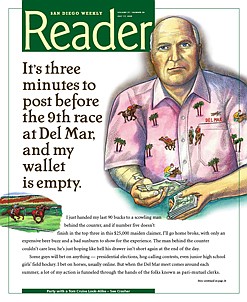
It’s three minutes to post before the 9th race at Del Mar, and my wallet is empty.
I just handed my last 90 bucks to a scowling man behind the counter, and if number five doesn’t finish in the top three in this $25,000 maiden claimer, I’ll go home broke, with only an expensive beer buzz and a bad sunburn to show for the experience. The man behind the counter couldn’t care less; he’s just hoping like hell his drawer isn’t short again at the end of the day.
Some guys will bet on anything — presidential elections, hog-calling contests, even junior high school girls’ field hockey. I bet on horses, usually online. But when the Del Mar meet comes around each summer, a lot of my action is funneled through the hands of the folks known as pari-mutuel clerks.
If you’ve been to Del Mar — or for that matter, to any Thoroughbred racetrack or offtrack betting joint — you’ve seen them. (For the record, you’ll also see them at places where quarter horses, Standardbreds, and other breeds race.) At Del Mar, pari-mutuel clerks are clad in pastel Hawaiian-style shirts with a tropical/equine motif. Although you may have seen them, perhaps exchanged a handicapping insight or two with them, the odds are good — probably less than one to five — that you don’t know much about them other than they’re usually dour, occasionally surly, and not infrequently sporting wraps on their wrists and forearms.
Kentucky’s Churchill Downs notwithstanding, Southern California and New York are home to Thoroughbred racing’s most important tracks, the ovals where the best horses run for the biggest purses. In Southern California, Del Mar — with its 43-day boutique meet — is one of three major venues, along with Santa Anita and Hollywood Park.
Of course, as most punters know, Thoroughbred racing isn’t limited to the majors, and neither is the work of the pari-mutuel clerk. Unless you bring a laptop computer or other device to wager online or use a voucher kiosk, if you place a bet — and why the hell else would you go to the track? — you’ll need to deal with a pari-mutuel clerk, or teller. This holds true not only for the overdressed, underinformed tourists at opening-day Del Mar but for the hard-core players leaning on the rail at Los Alamitos, the guys who just blew their last 10 bucks on a $5000 claiming race.
The word “pari-mutuel,” like many an arcane term of sport, is French and refers to the fact that in horse racing, one plays against other bettors rather than the house; roughly speaking, one’s chances of winning and the size of any potential payout depend on how the other players have wagered. Few horseplayers have heard of Pierre Oller, and fewer still have taken a whiff of his fragrances. But in the 1860s, Oller, a Parisian perfume-maker, devised the pari-mutuel wagering system used today by those who wager on horse racing, dog racing, and jai alai. However, it took the pari-mutuel machine, first seen in Australia in 1913 and introduced to the United States in 1933, to make Thoroughbred wagering practical on a large scale. Best known by the brand name Totalizer, the device enabled betting pools, odds, and probable payouts to be calculated rapidly. In recent years, advances in computer technology have goosed the speed even more; nowadays, the totalizer can instantly mix, stir, and blend wagering funds coming in from thousands of places and conduits — from online, from offtrack betting facilities, and, of course, from the track — directing each dollar to the appropriate pool. But even after the advent of the totalizer, live human beings were needed to facilitate wagering and are needed today, albeit in diminished numbers; in this, the age of online wagering, most horseplayers remain familiar with the admonition “hold all tickets.”
Obviously, before you can hold your tickets (or, more likely, wad them up in disgust and hurl them), you’ve got to shell out cash to get them, and that’s where the pari-mutuel clerk comes in; his (or, increasingly, her) job is to take your cash as quickly as possible, before you change your mind and decide to put that Benjamin toward the mortgage or your kid’s braces. In order to accomplish this sleight of hand, this transformation of Federal Reserve notes to usually worthless slips of paper, the clerk must learn not only the menu of available wagers but — and this is often the madness-inducing part for the clerk — how to decipher the bets called out by the bettors. Notwithstanding the importance of rapidity, accuracy always trumps speed at the clerk’s window.
Say you love Del Mar, think you’d look groovy in one of those official Hawaiian-style shirts or long to hear Trevor Denman’s lilting calls right from the loudspeaker, or maybe you just can’t shake the afterglow from the rush you got when your $36 trifecta part wheel returned $958.35. For whatever reason, you’ve decided to become a pari-mutuel clerk — often shortened to “mutuel clerk” by insiders. It’s not enough that you enjoy hanging out at the track, although many clerks start with that mind-set.
Back in the 1950s or 1960s, it helped an aspiring mutuel clerk to have relatives in the business — Dad was a clerk, brother-in-law a hot walker, whatever. Nepotism was the fast track, sometimes the only track. Nowadays, the way through the tunnel is more democratic, more straightforward. First off, you’ve got to get trained. No college offers a major in pari-mutuel clerking, and there is no Idiot’s Guide for self-learners. Instead, you must first go through a 12-hour training class in early July. After that, if your desire to descend to pari-mutuel purgatory persists, you’ll apply for a license from the California Horse Racing Board. Providing you’re not a capo in the Gotti organization or a member of the Manson clan, you’ll then get a license that — among other things — will entitle you to free admission to every wagering facility in the state.
Don Barth doesn’t scowl behind the window. Perhaps he’s atypical, but he loves the business. He’s been in it for over 40 years. When Barth started as a pari-mutuel clerk in 1967, California tracks offered only three traditional wagers — win, place, and show; most of the exotic wagers that dominate today’s action were years, if not decades, away. As horseplayers from that era recall, even the most basic innovation, e.g., the daily double (which entails picking the winner in two consecutive races and at first offered only once per race card), was seen as revolutionary. As for the exacta — where one must pick the first two finishers of a given race in order — that was considered blasphemous by folks like Tom Ainslie, the legendary handicapping author who regarded the wager as gambling, not Thoroughbred handicapping.
Barth speaks of his early years with a tone of tolerant amusement; not only were the wagers different, so were the clerks. In those days, the folks behind the windows were mostly men and, not infrequently, indistinguishable from the carnies at the county fair. Over the course of decades and a million losing tickets fluttering in the wind, the face of the pari-mutuel clerk has changed; Barth describes the atmosphere these days as more “civilized.” But despite an influx of women and perhaps a class upgrade, other characteristics remain: now, as then, the archetypal pari-mutuel guy is a nomadic horseplayer who hates to get up any earlier than he has to in the morning.
I asked Barth what the appeal is; after all, pari-mutuel clerks don’t make a lot of money, and the work can be not only spotty but suffused with pressure. He replied, “It’s the unconstructed life.” He elaborated that for the pari-mutuel clerk, the flexibility of schedules — and perhaps the opportunity to be at the track frequently — are paramount. He used the term “lifestyle,” seeming to imply that for some clerks hanging out at a place like Del Mar is more than a job; it’s a calling, perhaps like the priesthood. Spiritual references aside — and what horseplayer hasn’t prayed to one deity or another as his horse hit the stretch — the racetrack, as Barth puts it, “isn’t church.” As much as he loves horse racing, he admits that wherever a lot of cash is floating around there are bound to be a few “unsavory characters” afoot, which takes us straight to the California Horse Racing Board.
In California, just about everything pleasurable (cigars, booze, fast driving) is controlled, licensed, taxed, and micromanaged by the daddy state and its unelected bureaucrats. Horse racing is no different. If you want to run a horse (or for that matter, a mule) on a California track for a purse, the racing board, in its 225-page rule book, will tell you, in unstinting detail, what you must and mustn’t do. Everything is covered, from the size of a jockey’s whip to the rules for calculating a massive pick-six carryover. For the pari-mutuel clerk, perhaps the most important role of the racing board is its sanctioning of racetracks and allocation of racing dates around the calendar — the live meets that, along with their offtrack simulcast companions, constitute the office and office hours, if you will, of the clerk.
Del Mar’s summer meet, which runs from mid-July to early September, is considered by many pari-mutuel clerks to be the best venue in California for selling tickets because that’s where the bettors are. Although the clerks I interviewed noted the festive atmosphere and the potential for large tips from wealthy tourists, they told me that it’s Del Mar’s healthy ontrack attendance that makes it the place to man the windows. As anyone who’s ever been to Santa Anita or Hollywood Park can attest, a huge, nearly empty grandstand, populated by a scattering of old people and the occasional inveterate horseplayer burnout, is the norm at any weekday racing program. Fewer patrons mean fewer windows open, fewer hours for pari-mutuel clerks, especially those without seniority.
According to the racing board, there are approximately 1900 licensed clerks. Given the number of horse races Californians can wager on year-round (including numerous Thoroughbred and harness races in other states), one might think that pari-mutuel clerks are perpetually busy. In truth, the ascendancy of online wagering, handheld PDA devices, and voucher kiosks (the latter pushed by Del Mar management) has cut into the need for live tellers. Coupled with an overall decline in horse racing as a first-tier gaming option — courtesy of Indian casinos — technological advances have rendered the pari-mutuel clerk a dying subculture. And there’s the seniority issue.
At Del Mar, and every other wagering facility in California, a pari-mutuel clerk — unless he’s content to ply his trade only occasionally — will have to join the union, namely the Pari-Mutuel Employees Guild Local 280. Affiliated with the Service Employees International Union and part of the AFL-CIO, the Local 280 represents pari-mutuel workers in contract negotiations and sets out a passel of policies, practices, and procedures that govern every aspect of the clerk’s workday. In order to make a career of it as Don Barth has — or merely take a stab at covering your weekly wagering habit — you’ll not only need to join the union but also learn to play the game according to its rules. To be fair, many of those rules are aimed at maximizing the income opportunities for clerks in an industry that’s stagnant at best; to that end, union members are assigned seniority numbers — the higher the better.
A seniority number close to 2000 guarantees a choice of workdays; clerks with decades-plus of experience can work as many days as they want, capped only by the limit set in the union’s collective bargaining agreement. The old-timers also get first choice of locations, allowing them, for example, to work at a nearby offtrack betting facility if that’s their preference. (Because Don Barth has a vested guild pension and is considered semiretired, his workdays are limited.) At the other end of the continuum are the lowly nonunion permit holders. These clerks, licensed by the racing board but without numbers, are allowed to work only the busiest days. You’ll find them on Saturdays and Sundays, including the day of the Pacific Classic (Del Mar’s richest race — the meet’s crown jewel) as well as the insanely crowded opening day. Eventually, most pari-mutuel clerks join the union, shelling out an initiation fee of $250 and yearly dues of $526; it’s a lot a money in a gig that pays $80 to $140 a day. It’s evident that many clerks resent the compulsory membership and stiff dues. In turn, the guild’s officers respond defensively; in an online newsletter, the union’s officers write that the pari-mutuel clerks should be filled with “gratitude” for their collective bargaining agreements.
When Don Barth started at age 20, there was nothing anachronistic about the term “guild” in horse racing; most racetrackers learned their skills from parents, uncles, older brothers, close family friends — folks some would term “mentors” nowadays.
Whatever the skill — grooming a horse, fitting a horseshoe, or interpreting a horseplayer’s requests at the window — it was always passed down, never formally taught. As Barth recalls, he felt strongly that, back in ’67, he’d entered into an almost old-world tradition, just as his father had decades before.
One of the first things Barth learned was the curious, old-fashioned argot — track speak, if you will — that delineates the functions of those who toil at the track. The most basic classification used by racetrack insiders is “frontside” versus “backside”: the former consists of pari-mutuel clerks, concession workers, front-office types — people most likely to be seen by and interact with patrons; the latter includes trainers, grooms, valets, exercise riders, hot walkers, veterinarians, and perhaps jockeys.
In the horse-racing industry, it is common to find people who’ve worn many hats during their equine-related careers — sometimes simultaneously. Although you’re not likely to see Thoroughbred superstars like jockey Garrett Gomez or trainer Bobby Frankel punching $2 win tickets at Del Mar, you may run across those who work as hot walkers or exercise riders in the early morning and hang out to man the windows in the afternoon. They need the money. This is the glamourless side of horse racing, the side you won’t notice — and track management hopes you won’t think about — as matrons from La Jolla and Rancho Santa Fe show off their $1000 bonnets on opening day and their husbands, sporting Zegna suits and Rolex Presidential watches, swagger into the Turf Club and other places where commoners are as welcome as a cannon bone fracture in a Derby prospect.
For every high roller at the large-transaction window, every Ferrari in the valet parking lot, there are dozens of anonymous workers, some of whom sit for six hours, cranking out tickets behind those windows. If at times they appear ill-tempered, a bit curt, well, they have every right to be, goddammit. But much of what passes for a surly mug is no more than a “game face.” That’s how Don Barth explains it. To begin with, at least in the grandstand and adjacent clubhouse, there’s the noise, the roar of a boisterous crowd echoing across concrete floors, decibels rising as post time nears.
Then there’s the heat and humidity. No chamber-of-commerce spin can persuade me that there aren’t days during the Del Mar meet when swampy, subtropical air imported from Mexico doesn’t render the place a bit sultry. And there are the patrons pressing forward to the windows as the clerks — behind gray masks of stoicism — keep pushing buttons, keep saying the perfunctory “good luck” after each little slip of hope is handed over. Perhaps it’s hyperbole, but Barth likens it to a beleaguered “Custer surrounded by the Indians.” Nevertheless, despite a siege mentality, most of the clerks attempt to present an outward visage of, at least, neutrality. Some, like Don Barth, go further.
In a voice too measured, too sincere to invite scrutiny, Barth told me that he attempts to treat horseplayers at his window as he would want to be treated. Considering what Barth and the other pari-mutuel clerks endure, sullenness now and then might be justified. But the face you’ll see on Barth and his like-minded colleagues isn’t one of anger or even annoyance; it’s just a way to tune out the tumult, defuse the pressure. I asked him about the pressure; I chided him, thinking, “Aren’t you where the turf meets the surf?” I mean, “Isn’t this the carefree, seaside haven where horseplayers flock to forget the winters at Aqueduct and the four-horse fields at Bay Meadows?” But whenever money is at stake, there is pressure, never more than when you’re trying to whittle down the line of a dozen horseplayers, all of them antsy, as the minutes to post dwindle and the odds of getting shut out rise.
Getting shut out is in some sense the nadir of a handicapper’s day. Barring technical malfunction, there’s scant risk of it happening when wagering online; unless a bettor cuts it too close, looking at last-minute odds changes, he’ll get his wagers in. But things are dicier when a bettor is standing behind a line of people, some of whom are placing a large number of bets, including complex (to the novice, at least) intra-race, or vertical, wagers like trifectas and superfectas or perhaps a long series of inter-race tickets in the pick four or pick six. Veteran pari-mutuel clerks know how to accurately punch out the various boxes, wheels, and other methods used by horseplayers; they’re also adept at switching the computer screens at the terminals so that bettors can place wagers at other tracks. (For the uninitiated, boxes and wheels are two ways in which a bettor may construct a vertical wager in a single race; that is, a bet whose object is to pick the first finishers in order.)
Of course, even the best clerk has no control over who gets in his line. While some patrons call out their wagers quickly and clearly, others simply don’t know how to wager and need a microseminar of sorts, which invariably annoys the hell out of experienced players behind them. While we’re at it, throw in bettors with nearly unintelligible foreign accents and those who are almost too drunk to stand, as well as folks who change their minds at the window. Now toss into the mix a few guys who start lobbing epithets at the players ahead of them for being “too slow.”
The net result is a frazzled clerk who doesn’t show it — and an enraged horseplayer who does; the shit-outta-luck guy, Mr. Shut-Out, is sure that the man behind the window and the last tyro to wager have conspired to deny him the score of a lifetime. But if the clerk cares, he doesn’t let on; as Don Barth explains, “The only customer who counts, the only one I see, is the one at my window now. I give that guy my full attention.” Still, a pari-mutuel clerk will do his damnedest to get every player in before the totalizer locks, preventing any more wagers. But it’s not under his control. At a preset juncture, after Trevor Denman announces, in clipped South African tones, that the “horses have now reached the gate,” but well before “and away they go,” every terminal locks automatically. No matter how lucrative they might’ve been, no matter how much handicapping sweat went into them, some wagers won’t be made. The man behind the window doesn’t care. Why should he?
There’s a good chance that before a pari-mutuel clerk’s days behind the windows are up, he’ll file a workers’ compensation claim. The repetitive motions of punching out wagers at the terminal, coupled with the non-ergonomic design of the chairs, lead to carpal tunnel syndrome as well as shoulder and neck injuries. Although Barth estimates that around 70 percent of the clerks will file claims by career’s end, he’s concluded that Del Mar management would rather pay the claims than make changes at the workstations; it’s cheaper.
Ergonomics notwithstanding, Barth characterizes the folks who run Del Mar as being the “most enlightened” of racetrack employers. This is a sentiment echoed by most of the clerks with whom I spoke. Although many aspects of the clerk’s job, including pay rates, are the same at every track, the consensus seems to be that the intangible things — dignity, respect — are best realized at Del Mar. But no matter where one is, working the mutuels is a tough way to make a buck.
The 1987 introduction of offtrack betting in California reduced clerks’ travel somewhat; however, for many pari-mutuel clerks, the day in the unconstructed life is a long one, bracketed on both ends by tedious commutes to the track and home again. At the end of a shift, after the diehards have trudged out to the parking lot and only seagulls sit in the stands, the luckier pari-mutuelistas hit the 5 freeway, headed to a home somewhere in or about America’s Finest. Few are as fortunate as Don Barth, who bought a house in Cardiff in the late ’70s and whose union pension is vested. By contrast, the typical Del Mar pari-mutuel clerk can’t afford to live anywhere near the San Dieguito Valley. Unlike the $300,000 two-year-old colt purchased at the Keeneland auction in Kentucky, or even the five-year-old mare just claimed for $40,000, the typical pari-mutuel clerk doesn’t hit the hay in North County — he couldn’t even dream of it. Instead, he lives in a place like Arcadia, Duarte, Pasadena, or Sierra Madre, where all roads lead to Santa Anita.
Not all pari-mutuel clerks live at the edge of subsistence; some are retirees from other fields, including teachers, engineers, even the odd attorney or two. But most live closer to other racetracks. Quite a few Southern California pari-mutuel clerks regard Santa Anita, in Arcadia, as a home office of sorts; with live racing late December through mid-April, as well as the month of October, Santa Anita offers the most daytime racing action. (Although Hollywood Park has a comparable number of dates — with meets mid-April to mid-July and November through late December — its Inglewood location, in the heart of L.A. gangsta land, dissuades clerks from living nearby.) For clerks who want summer work at the track but can’t deal with the late nights at Los Alamitos (which operates Thursday through Sunday all year), the action is at Del Mar.
Del Mar is also where the short-term rental action is. A number of pari-mutuel clerks — along with jockeys, trainers, and well-heeled out-of-state owners and handicappers — live near the track, or as close as they can get, for the season. In the case of the top jocks, marquee conditioners, high rollers, and big-time owners, ocean-view lodging in Olde Del Mar is the way to go, often accompanied by (riders excepted) the lavish fare served up at places like Pamplemousse or Market.
In the case of the clerks and other low-paid workers, the digs are more modest. For decades, a seasonal cottage industry has flourished in coastal North County, where spare bedrooms have housed racetrack nomads. At an average rate of $1200 for seven weeks, it’s symbiotic: homeowners, many of whom are elderly women, supplement their income, while the clerks are spared the hellish commute at a price that’s just low enough to avoid rendering the whole exercise futile.
Dotte Bordin, whose strong, youthful voice belies her 77 years, is one of the cheerful widows who make the arrangement possible. Working with Lisa Iaria of Horsemen’s Services — a sort of in-house social service agency at the Del Mar Thoroughbred Club — she places seasonal workers with locals. For Bordin, a real estate broker and owner of a geriatric matchmaking service, the main motivator isn’t money but the experience. “I’ve really enjoyed a lot of the people who’ve stayed with me over the years. Most of them are very pleasant.” When I asked her if she had any preferences among boarders, she told me that she doesn’t care whether they work frontside or back, handle tickets or hooves. She did admit gently, however, that the distaff clerks are harder to deal with than the men. “They’re mostly divorcées,” Bordin quipped, “so they tend to have issues — they’re bitter. Also, they leave hair in my sink.”
For those clerks who can’t find a reasonably priced room or who’d rather not deal with the angst of displacement for nearly two months, there’s always the old Southern California standby, the freeway. I spoke with several clerks, men and women with 10 to 15 years in the Local 280. For them, it’s a steady gig, typically four or five days of Del Mar’s Wednesday-to-Monday race week; but there’s no easy way of getting to Bing Crosby’s old haunts from the San Gabriel Valley. Although first post at Del Mar isn’t until 2:00 p.m. on most afternoons, for those who commute, it’s a 12-hour day, nearly half of it spent on a bus that picks up workers at Santa Anita and Los Alamitos in the morning and brings them back each night. At $110 per day, $95 after bus fare, a clerk’s wages work out to around eight bucks an hour — unless it’s a very good day or a very bad day. The very good days are infrequent, as hard to predict as a five-year-old maiden, an 0 for 25 ridgeling, who suddenly pops up at 30 to 1 to win his first race; the very bad days, well, they’re as frequent as the guy who gives you a 50 but takes change for a 100 and runs off to the Cinch Bar for a Del Margarita.
Perhaps more than anything else, drawer shortages at the end of a pari-mutuel clerk’s day are the bane of his existence; the money taken in at a given window must match the amount paid out. If he’s short, the difference comes out of his pocket; in extreme cases, the hapless clerk has just worked for free, or worse. Occasionally, perhaps in 10 percent of drawer discrepancies, there’s an overage, and if a bettor doesn’t step forward to claim the funds within 30 days, the clerk will receive a check in the mail. But there aren’t many windfalls there.
There are no tip jars at the windows. While racing board rules don’t expressly bar clerks from accepting tips, soliciting them is considered taboo. The underlying reason presumably has something to do with the prohibition against touting by clerks; while a pari-mutuel clerk can tell you how to place a wager, he’s not allowed to promote or tout a horse. But just because clerks can’t, in effect, accept a tip for a “tip,” that doesn’t mean a gratuity is unwelcome. When, in a moment of supreme naïveté, I asked Don Barth whether clerks routinely accept tips at Del Mar, he replied in an astonished tone, “Wouldn’t you?” Indeed, there remains a certain level of expectation (or, at least, fervent hope) among many clerks that bettors who buy big winning tickets at their windows will share the lucre, and there are even some clerks who’ll consider a “keep the change” tip, especially if it’s coins-only, to be a serious insult.
To no one’s surprise, pari-mutuel clerks are often horse-racing fans and handicappers; indeed, if clerks couldn’t watch the races from their own monitors, it would be harder to attract them. At Del Mar, many not only watch but wager as well. When not otherwise occupied with “official” horseplayers, some clerks — as many as one in four — will place their own wagers during their shifts. It’s against the rules, but, says Barth (who’s never been tempted himself), there’s no way to get caught. On the other hand, wagering by clerks who aren’t on the clock is done openly and — much to the chagrin of union bosses — often via the voucher kiosks.
In addition to allowing the clerk to indulge efficiently in his wagering habit, the position has other, less tangible emoluments. Some are obvious and intrinsic to Thoroughbred racing: what equine fan wouldn’t want to check out these impeccably groomed, well-bred horses as they emerge from the tunnel? Some are more subtle, e.g., the feel of the gentle sea breeze at Del Mar, the sight of snow-capped peaks behind Santa Anita on a smogless day. Still other benefits are social, opportunities to rub elbows with racing’s royalty.
Unlike their counterparts in the NFL and NBA, the athletes of horse racing — excepting the occasional, ill-tempered four-legged ones — are famously accessible, humble, and down-to-earth. In contrast to the infantile, belligerent thugs of pro basketball and the steroid freaks of football, jockeys come across as nice, decent people, imbued with politeness. Hell, they don’t even refer to themselves in the third person — and show me a jockey who dances like a buffoon after winning a Grade 1 stakes race with a $500,000 purse. A number of the pari-mutuel workers I contacted spoke fondly of meeting top-tier jockeys, people like Eddie Delahoussaye, Laffit Pincay, and Gary Stevens — guys at the top of their profession but free of arrogance, unaccompanied by crews, posses, entourages, groupies, or other hangers-on. To a person, the clerks told me that pleasant, albeit brief, interactions with the jockeys, as well as with the trainers, make their work bearable, help take the edge off the annoyance that comes from dealing with assholes.
Who are the assholes at the track? Well, it’s subjective, but the clerks told me — the anonymous ones, that is — that the most obnoxious customers are typically in their 20s, overdressed and arrogant, people who don’t know jack shit about horse racing but who come out once or twice a season to be seen. They’re easy to spot, I was told: just look for the plastic guys wearing shiny suits on a humid, 88-degree day, usually with gals who look like high-priced hookers. You’ll see them, just as I did when I made the mistake of going to Del Mar on opening day one year.
As annoying as the self-anointed, self-appointed might be, they’re only one part of (and I hate to use this term) a diverse group. From the clerk’s perspective, there are the regulars — low-key, veteran horseplayers, people who can explain the difference, say, between an N1X allowance race at one mile on the dirt and a $50,000 claimer at six furlongs on the turf. “The track” (readers of Charles Bukowski need no elaboration) also draws the characters, some of whom may also be regulars. The characters — colorful, weird, bizarre, perhaps just eccentric — generate some of the best anecdotes and stories from behind the windows.
When I asked Don Barth about these life snippets, he said there was one patron he’d never forget — Suitcase Man. Back in the late 1960s or early 1970s, when Barth still regularly worked the hot, dusty Central and Northern California fair circuit — short meets that make up the minor leagues of California horse racing — a man sidled up to a window at Fresno with a battered suitcase. Inside the case were 20 bundles of $100 bills, each bundle holding 100 C-notes — $200,000 in all — which were used to lay down show bets on a single mule race. Apparently, the story goes, Suitcase Man was an acquaintance of a trainer who had three of the six runners in the field. As one would expect, his wagers, though successful, overwhelmed the otherwise minuscule pool, leaving the guy — who turned out to be a disbarred attorney from Philadelphia — with a 5 percent profit.
Things are more prosaic now; there’s less color, less mystery at the track. Perhaps there are too many families, not enough grifters, too many cell phones and not enough cigars. Maybe there aren’t enough horseplayers, period. Where are they? For all we know, they could be playing video poker online or at an Indian reservation; they might even be wagering, God forbid, on the outcome of some phony Ultimate Fighting Championship match in Vegas. For all the touches of archaic gentility and old-timey blue-collar grit and majestic horses, for all the humility of the jockeys and the stoicism of the clerks, the pastime of going to the track is largely passé and, in most places, a dying one. But for 43 days each summer, Del Mar is a bright exception, an escapist anachronism where, if nothing else, one should heed the advice: “Please hold all tickets.”
Here's something you might be interested in.
It’s three minutes to post before the 9th race at Del Mar, and my wallet is empty.

It’s three minutes to post before the 9th race at Del Mar, and my wallet is empty.
I just handed my last 90 bucks to a scowling man behind the counter, and if number five doesn’t finish in the top three in this $25,000 maiden claimer, I’ll go home broke, with only an expensive beer buzz and a bad sunburn to show for the experience. The man behind the counter couldn’t care less; he’s just hoping like hell his drawer isn’t short again at the end of the day.
Some guys will bet on anything — presidential elections, hog-calling contests, even junior high school girls’ field hockey. I bet on horses, usually online. But when the Del Mar meet comes around each summer, a lot of my action is funneled through the hands of the folks known as pari-mutuel clerks.
If you’ve been to Del Mar — or for that matter, to any Thoroughbred racetrack or offtrack betting joint — you’ve seen them. (For the record, you’ll also see them at places where quarter horses, Standardbreds, and other breeds race.) At Del Mar, pari-mutuel clerks are clad in pastel Hawaiian-style shirts with a tropical/equine motif. Although you may have seen them, perhaps exchanged a handicapping insight or two with them, the odds are good — probably less than one to five — that you don’t know much about them other than they’re usually dour, occasionally surly, and not infrequently sporting wraps on their wrists and forearms.
Kentucky’s Churchill Downs notwithstanding, Southern California and New York are home to Thoroughbred racing’s most important tracks, the ovals where the best horses run for the biggest purses. In Southern California, Del Mar — with its 43-day boutique meet — is one of three major venues, along with Santa Anita and Hollywood Park.
Of course, as most punters know, Thoroughbred racing isn’t limited to the majors, and neither is the work of the pari-mutuel clerk. Unless you bring a laptop computer or other device to wager online or use a voucher kiosk, if you place a bet — and why the hell else would you go to the track? — you’ll need to deal with a pari-mutuel clerk, or teller. This holds true not only for the overdressed, underinformed tourists at opening-day Del Mar but for the hard-core players leaning on the rail at Los Alamitos, the guys who just blew their last 10 bucks on a $5000 claiming race.
The word “pari-mutuel,” like many an arcane term of sport, is French and refers to the fact that in horse racing, one plays against other bettors rather than the house; roughly speaking, one’s chances of winning and the size of any potential payout depend on how the other players have wagered. Few horseplayers have heard of Pierre Oller, and fewer still have taken a whiff of his fragrances. But in the 1860s, Oller, a Parisian perfume-maker, devised the pari-mutuel wagering system used today by those who wager on horse racing, dog racing, and jai alai. However, it took the pari-mutuel machine, first seen in Australia in 1913 and introduced to the United States in 1933, to make Thoroughbred wagering practical on a large scale. Best known by the brand name Totalizer, the device enabled betting pools, odds, and probable payouts to be calculated rapidly. In recent years, advances in computer technology have goosed the speed even more; nowadays, the totalizer can instantly mix, stir, and blend wagering funds coming in from thousands of places and conduits — from online, from offtrack betting facilities, and, of course, from the track — directing each dollar to the appropriate pool. But even after the advent of the totalizer, live human beings were needed to facilitate wagering and are needed today, albeit in diminished numbers; in this, the age of online wagering, most horseplayers remain familiar with the admonition “hold all tickets.”
Obviously, before you can hold your tickets (or, more likely, wad them up in disgust and hurl them), you’ve got to shell out cash to get them, and that’s where the pari-mutuel clerk comes in; his (or, increasingly, her) job is to take your cash as quickly as possible, before you change your mind and decide to put that Benjamin toward the mortgage or your kid’s braces. In order to accomplish this sleight of hand, this transformation of Federal Reserve notes to usually worthless slips of paper, the clerk must learn not only the menu of available wagers but — and this is often the madness-inducing part for the clerk — how to decipher the bets called out by the bettors. Notwithstanding the importance of rapidity, accuracy always trumps speed at the clerk’s window.
Say you love Del Mar, think you’d look groovy in one of those official Hawaiian-style shirts or long to hear Trevor Denman’s lilting calls right from the loudspeaker, or maybe you just can’t shake the afterglow from the rush you got when your $36 trifecta part wheel returned $958.35. For whatever reason, you’ve decided to become a pari-mutuel clerk — often shortened to “mutuel clerk” by insiders. It’s not enough that you enjoy hanging out at the track, although many clerks start with that mind-set.
Back in the 1950s or 1960s, it helped an aspiring mutuel clerk to have relatives in the business — Dad was a clerk, brother-in-law a hot walker, whatever. Nepotism was the fast track, sometimes the only track. Nowadays, the way through the tunnel is more democratic, more straightforward. First off, you’ve got to get trained. No college offers a major in pari-mutuel clerking, and there is no Idiot’s Guide for self-learners. Instead, you must first go through a 12-hour training class in early July. After that, if your desire to descend to pari-mutuel purgatory persists, you’ll apply for a license from the California Horse Racing Board. Providing you’re not a capo in the Gotti organization or a member of the Manson clan, you’ll then get a license that — among other things — will entitle you to free admission to every wagering facility in the state.
Don Barth doesn’t scowl behind the window. Perhaps he’s atypical, but he loves the business. He’s been in it for over 40 years. When Barth started as a pari-mutuel clerk in 1967, California tracks offered only three traditional wagers — win, place, and show; most of the exotic wagers that dominate today’s action were years, if not decades, away. As horseplayers from that era recall, even the most basic innovation, e.g., the daily double (which entails picking the winner in two consecutive races and at first offered only once per race card), was seen as revolutionary. As for the exacta — where one must pick the first two finishers of a given race in order — that was considered blasphemous by folks like Tom Ainslie, the legendary handicapping author who regarded the wager as gambling, not Thoroughbred handicapping.
Barth speaks of his early years with a tone of tolerant amusement; not only were the wagers different, so were the clerks. In those days, the folks behind the windows were mostly men and, not infrequently, indistinguishable from the carnies at the county fair. Over the course of decades and a million losing tickets fluttering in the wind, the face of the pari-mutuel clerk has changed; Barth describes the atmosphere these days as more “civilized.” But despite an influx of women and perhaps a class upgrade, other characteristics remain: now, as then, the archetypal pari-mutuel guy is a nomadic horseplayer who hates to get up any earlier than he has to in the morning.
I asked Barth what the appeal is; after all, pari-mutuel clerks don’t make a lot of money, and the work can be not only spotty but suffused with pressure. He replied, “It’s the unconstructed life.” He elaborated that for the pari-mutuel clerk, the flexibility of schedules — and perhaps the opportunity to be at the track frequently — are paramount. He used the term “lifestyle,” seeming to imply that for some clerks hanging out at a place like Del Mar is more than a job; it’s a calling, perhaps like the priesthood. Spiritual references aside — and what horseplayer hasn’t prayed to one deity or another as his horse hit the stretch — the racetrack, as Barth puts it, “isn’t church.” As much as he loves horse racing, he admits that wherever a lot of cash is floating around there are bound to be a few “unsavory characters” afoot, which takes us straight to the California Horse Racing Board.
In California, just about everything pleasurable (cigars, booze, fast driving) is controlled, licensed, taxed, and micromanaged by the daddy state and its unelected bureaucrats. Horse racing is no different. If you want to run a horse (or for that matter, a mule) on a California track for a purse, the racing board, in its 225-page rule book, will tell you, in unstinting detail, what you must and mustn’t do. Everything is covered, from the size of a jockey’s whip to the rules for calculating a massive pick-six carryover. For the pari-mutuel clerk, perhaps the most important role of the racing board is its sanctioning of racetracks and allocation of racing dates around the calendar — the live meets that, along with their offtrack simulcast companions, constitute the office and office hours, if you will, of the clerk.
Del Mar’s summer meet, which runs from mid-July to early September, is considered by many pari-mutuel clerks to be the best venue in California for selling tickets because that’s where the bettors are. Although the clerks I interviewed noted the festive atmosphere and the potential for large tips from wealthy tourists, they told me that it’s Del Mar’s healthy ontrack attendance that makes it the place to man the windows. As anyone who’s ever been to Santa Anita or Hollywood Park can attest, a huge, nearly empty grandstand, populated by a scattering of old people and the occasional inveterate horseplayer burnout, is the norm at any weekday racing program. Fewer patrons mean fewer windows open, fewer hours for pari-mutuel clerks, especially those without seniority.
According to the racing board, there are approximately 1900 licensed clerks. Given the number of horse races Californians can wager on year-round (including numerous Thoroughbred and harness races in other states), one might think that pari-mutuel clerks are perpetually busy. In truth, the ascendancy of online wagering, handheld PDA devices, and voucher kiosks (the latter pushed by Del Mar management) has cut into the need for live tellers. Coupled with an overall decline in horse racing as a first-tier gaming option — courtesy of Indian casinos — technological advances have rendered the pari-mutuel clerk a dying subculture. And there’s the seniority issue.
At Del Mar, and every other wagering facility in California, a pari-mutuel clerk — unless he’s content to ply his trade only occasionally — will have to join the union, namely the Pari-Mutuel Employees Guild Local 280. Affiliated with the Service Employees International Union and part of the AFL-CIO, the Local 280 represents pari-mutuel workers in contract negotiations and sets out a passel of policies, practices, and procedures that govern every aspect of the clerk’s workday. In order to make a career of it as Don Barth has — or merely take a stab at covering your weekly wagering habit — you’ll not only need to join the union but also learn to play the game according to its rules. To be fair, many of those rules are aimed at maximizing the income opportunities for clerks in an industry that’s stagnant at best; to that end, union members are assigned seniority numbers — the higher the better.
A seniority number close to 2000 guarantees a choice of workdays; clerks with decades-plus of experience can work as many days as they want, capped only by the limit set in the union’s collective bargaining agreement. The old-timers also get first choice of locations, allowing them, for example, to work at a nearby offtrack betting facility if that’s their preference. (Because Don Barth has a vested guild pension and is considered semiretired, his workdays are limited.) At the other end of the continuum are the lowly nonunion permit holders. These clerks, licensed by the racing board but without numbers, are allowed to work only the busiest days. You’ll find them on Saturdays and Sundays, including the day of the Pacific Classic (Del Mar’s richest race — the meet’s crown jewel) as well as the insanely crowded opening day. Eventually, most pari-mutuel clerks join the union, shelling out an initiation fee of $250 and yearly dues of $526; it’s a lot a money in a gig that pays $80 to $140 a day. It’s evident that many clerks resent the compulsory membership and stiff dues. In turn, the guild’s officers respond defensively; in an online newsletter, the union’s officers write that the pari-mutuel clerks should be filled with “gratitude” for their collective bargaining agreements.
When Don Barth started at age 20, there was nothing anachronistic about the term “guild” in horse racing; most racetrackers learned their skills from parents, uncles, older brothers, close family friends — folks some would term “mentors” nowadays.
Whatever the skill — grooming a horse, fitting a horseshoe, or interpreting a horseplayer’s requests at the window — it was always passed down, never formally taught. As Barth recalls, he felt strongly that, back in ’67, he’d entered into an almost old-world tradition, just as his father had decades before.
One of the first things Barth learned was the curious, old-fashioned argot — track speak, if you will — that delineates the functions of those who toil at the track. The most basic classification used by racetrack insiders is “frontside” versus “backside”: the former consists of pari-mutuel clerks, concession workers, front-office types — people most likely to be seen by and interact with patrons; the latter includes trainers, grooms, valets, exercise riders, hot walkers, veterinarians, and perhaps jockeys.
In the horse-racing industry, it is common to find people who’ve worn many hats during their equine-related careers — sometimes simultaneously. Although you’re not likely to see Thoroughbred superstars like jockey Garrett Gomez or trainer Bobby Frankel punching $2 win tickets at Del Mar, you may run across those who work as hot walkers or exercise riders in the early morning and hang out to man the windows in the afternoon. They need the money. This is the glamourless side of horse racing, the side you won’t notice — and track management hopes you won’t think about — as matrons from La Jolla and Rancho Santa Fe show off their $1000 bonnets on opening day and their husbands, sporting Zegna suits and Rolex Presidential watches, swagger into the Turf Club and other places where commoners are as welcome as a cannon bone fracture in a Derby prospect.
For every high roller at the large-transaction window, every Ferrari in the valet parking lot, there are dozens of anonymous workers, some of whom sit for six hours, cranking out tickets behind those windows. If at times they appear ill-tempered, a bit curt, well, they have every right to be, goddammit. But much of what passes for a surly mug is no more than a “game face.” That’s how Don Barth explains it. To begin with, at least in the grandstand and adjacent clubhouse, there’s the noise, the roar of a boisterous crowd echoing across concrete floors, decibels rising as post time nears.
Then there’s the heat and humidity. No chamber-of-commerce spin can persuade me that there aren’t days during the Del Mar meet when swampy, subtropical air imported from Mexico doesn’t render the place a bit sultry. And there are the patrons pressing forward to the windows as the clerks — behind gray masks of stoicism — keep pushing buttons, keep saying the perfunctory “good luck” after each little slip of hope is handed over. Perhaps it’s hyperbole, but Barth likens it to a beleaguered “Custer surrounded by the Indians.” Nevertheless, despite a siege mentality, most of the clerks attempt to present an outward visage of, at least, neutrality. Some, like Don Barth, go further.
In a voice too measured, too sincere to invite scrutiny, Barth told me that he attempts to treat horseplayers at his window as he would want to be treated. Considering what Barth and the other pari-mutuel clerks endure, sullenness now and then might be justified. But the face you’ll see on Barth and his like-minded colleagues isn’t one of anger or even annoyance; it’s just a way to tune out the tumult, defuse the pressure. I asked him about the pressure; I chided him, thinking, “Aren’t you where the turf meets the surf?” I mean, “Isn’t this the carefree, seaside haven where horseplayers flock to forget the winters at Aqueduct and the four-horse fields at Bay Meadows?” But whenever money is at stake, there is pressure, never more than when you’re trying to whittle down the line of a dozen horseplayers, all of them antsy, as the minutes to post dwindle and the odds of getting shut out rise.
Getting shut out is in some sense the nadir of a handicapper’s day. Barring technical malfunction, there’s scant risk of it happening when wagering online; unless a bettor cuts it too close, looking at last-minute odds changes, he’ll get his wagers in. But things are dicier when a bettor is standing behind a line of people, some of whom are placing a large number of bets, including complex (to the novice, at least) intra-race, or vertical, wagers like trifectas and superfectas or perhaps a long series of inter-race tickets in the pick four or pick six. Veteran pari-mutuel clerks know how to accurately punch out the various boxes, wheels, and other methods used by horseplayers; they’re also adept at switching the computer screens at the terminals so that bettors can place wagers at other tracks. (For the uninitiated, boxes and wheels are two ways in which a bettor may construct a vertical wager in a single race; that is, a bet whose object is to pick the first finishers in order.)
Of course, even the best clerk has no control over who gets in his line. While some patrons call out their wagers quickly and clearly, others simply don’t know how to wager and need a microseminar of sorts, which invariably annoys the hell out of experienced players behind them. While we’re at it, throw in bettors with nearly unintelligible foreign accents and those who are almost too drunk to stand, as well as folks who change their minds at the window. Now toss into the mix a few guys who start lobbing epithets at the players ahead of them for being “too slow.”
The net result is a frazzled clerk who doesn’t show it — and an enraged horseplayer who does; the shit-outta-luck guy, Mr. Shut-Out, is sure that the man behind the window and the last tyro to wager have conspired to deny him the score of a lifetime. But if the clerk cares, he doesn’t let on; as Don Barth explains, “The only customer who counts, the only one I see, is the one at my window now. I give that guy my full attention.” Still, a pari-mutuel clerk will do his damnedest to get every player in before the totalizer locks, preventing any more wagers. But it’s not under his control. At a preset juncture, after Trevor Denman announces, in clipped South African tones, that the “horses have now reached the gate,” but well before “and away they go,” every terminal locks automatically. No matter how lucrative they might’ve been, no matter how much handicapping sweat went into them, some wagers won’t be made. The man behind the window doesn’t care. Why should he?
There’s a good chance that before a pari-mutuel clerk’s days behind the windows are up, he’ll file a workers’ compensation claim. The repetitive motions of punching out wagers at the terminal, coupled with the non-ergonomic design of the chairs, lead to carpal tunnel syndrome as well as shoulder and neck injuries. Although Barth estimates that around 70 percent of the clerks will file claims by career’s end, he’s concluded that Del Mar management would rather pay the claims than make changes at the workstations; it’s cheaper.
Ergonomics notwithstanding, Barth characterizes the folks who run Del Mar as being the “most enlightened” of racetrack employers. This is a sentiment echoed by most of the clerks with whom I spoke. Although many aspects of the clerk’s job, including pay rates, are the same at every track, the consensus seems to be that the intangible things — dignity, respect — are best realized at Del Mar. But no matter where one is, working the mutuels is a tough way to make a buck.
The 1987 introduction of offtrack betting in California reduced clerks’ travel somewhat; however, for many pari-mutuel clerks, the day in the unconstructed life is a long one, bracketed on both ends by tedious commutes to the track and home again. At the end of a shift, after the diehards have trudged out to the parking lot and only seagulls sit in the stands, the luckier pari-mutuelistas hit the 5 freeway, headed to a home somewhere in or about America’s Finest. Few are as fortunate as Don Barth, who bought a house in Cardiff in the late ’70s and whose union pension is vested. By contrast, the typical Del Mar pari-mutuel clerk can’t afford to live anywhere near the San Dieguito Valley. Unlike the $300,000 two-year-old colt purchased at the Keeneland auction in Kentucky, or even the five-year-old mare just claimed for $40,000, the typical pari-mutuel clerk doesn’t hit the hay in North County — he couldn’t even dream of it. Instead, he lives in a place like Arcadia, Duarte, Pasadena, or Sierra Madre, where all roads lead to Santa Anita.
Not all pari-mutuel clerks live at the edge of subsistence; some are retirees from other fields, including teachers, engineers, even the odd attorney or two. But most live closer to other racetracks. Quite a few Southern California pari-mutuel clerks regard Santa Anita, in Arcadia, as a home office of sorts; with live racing late December through mid-April, as well as the month of October, Santa Anita offers the most daytime racing action. (Although Hollywood Park has a comparable number of dates — with meets mid-April to mid-July and November through late December — its Inglewood location, in the heart of L.A. gangsta land, dissuades clerks from living nearby.) For clerks who want summer work at the track but can’t deal with the late nights at Los Alamitos (which operates Thursday through Sunday all year), the action is at Del Mar.
Del Mar is also where the short-term rental action is. A number of pari-mutuel clerks — along with jockeys, trainers, and well-heeled out-of-state owners and handicappers — live near the track, or as close as they can get, for the season. In the case of the top jocks, marquee conditioners, high rollers, and big-time owners, ocean-view lodging in Olde Del Mar is the way to go, often accompanied by (riders excepted) the lavish fare served up at places like Pamplemousse or Market.
In the case of the clerks and other low-paid workers, the digs are more modest. For decades, a seasonal cottage industry has flourished in coastal North County, where spare bedrooms have housed racetrack nomads. At an average rate of $1200 for seven weeks, it’s symbiotic: homeowners, many of whom are elderly women, supplement their income, while the clerks are spared the hellish commute at a price that’s just low enough to avoid rendering the whole exercise futile.
Dotte Bordin, whose strong, youthful voice belies her 77 years, is one of the cheerful widows who make the arrangement possible. Working with Lisa Iaria of Horsemen’s Services — a sort of in-house social service agency at the Del Mar Thoroughbred Club — she places seasonal workers with locals. For Bordin, a real estate broker and owner of a geriatric matchmaking service, the main motivator isn’t money but the experience. “I’ve really enjoyed a lot of the people who’ve stayed with me over the years. Most of them are very pleasant.” When I asked her if she had any preferences among boarders, she told me that she doesn’t care whether they work frontside or back, handle tickets or hooves. She did admit gently, however, that the distaff clerks are harder to deal with than the men. “They’re mostly divorcées,” Bordin quipped, “so they tend to have issues — they’re bitter. Also, they leave hair in my sink.”
For those clerks who can’t find a reasonably priced room or who’d rather not deal with the angst of displacement for nearly two months, there’s always the old Southern California standby, the freeway. I spoke with several clerks, men and women with 10 to 15 years in the Local 280. For them, it’s a steady gig, typically four or five days of Del Mar’s Wednesday-to-Monday race week; but there’s no easy way of getting to Bing Crosby’s old haunts from the San Gabriel Valley. Although first post at Del Mar isn’t until 2:00 p.m. on most afternoons, for those who commute, it’s a 12-hour day, nearly half of it spent on a bus that picks up workers at Santa Anita and Los Alamitos in the morning and brings them back each night. At $110 per day, $95 after bus fare, a clerk’s wages work out to around eight bucks an hour — unless it’s a very good day or a very bad day. The very good days are infrequent, as hard to predict as a five-year-old maiden, an 0 for 25 ridgeling, who suddenly pops up at 30 to 1 to win his first race; the very bad days, well, they’re as frequent as the guy who gives you a 50 but takes change for a 100 and runs off to the Cinch Bar for a Del Margarita.
Perhaps more than anything else, drawer shortages at the end of a pari-mutuel clerk’s day are the bane of his existence; the money taken in at a given window must match the amount paid out. If he’s short, the difference comes out of his pocket; in extreme cases, the hapless clerk has just worked for free, or worse. Occasionally, perhaps in 10 percent of drawer discrepancies, there’s an overage, and if a bettor doesn’t step forward to claim the funds within 30 days, the clerk will receive a check in the mail. But there aren’t many windfalls there.
There are no tip jars at the windows. While racing board rules don’t expressly bar clerks from accepting tips, soliciting them is considered taboo. The underlying reason presumably has something to do with the prohibition against touting by clerks; while a pari-mutuel clerk can tell you how to place a wager, he’s not allowed to promote or tout a horse. But just because clerks can’t, in effect, accept a tip for a “tip,” that doesn’t mean a gratuity is unwelcome. When, in a moment of supreme naïveté, I asked Don Barth whether clerks routinely accept tips at Del Mar, he replied in an astonished tone, “Wouldn’t you?” Indeed, there remains a certain level of expectation (or, at least, fervent hope) among many clerks that bettors who buy big winning tickets at their windows will share the lucre, and there are even some clerks who’ll consider a “keep the change” tip, especially if it’s coins-only, to be a serious insult.
To no one’s surprise, pari-mutuel clerks are often horse-racing fans and handicappers; indeed, if clerks couldn’t watch the races from their own monitors, it would be harder to attract them. At Del Mar, many not only watch but wager as well. When not otherwise occupied with “official” horseplayers, some clerks — as many as one in four — will place their own wagers during their shifts. It’s against the rules, but, says Barth (who’s never been tempted himself), there’s no way to get caught. On the other hand, wagering by clerks who aren’t on the clock is done openly and — much to the chagrin of union bosses — often via the voucher kiosks.
In addition to allowing the clerk to indulge efficiently in his wagering habit, the position has other, less tangible emoluments. Some are obvious and intrinsic to Thoroughbred racing: what equine fan wouldn’t want to check out these impeccably groomed, well-bred horses as they emerge from the tunnel? Some are more subtle, e.g., the feel of the gentle sea breeze at Del Mar, the sight of snow-capped peaks behind Santa Anita on a smogless day. Still other benefits are social, opportunities to rub elbows with racing’s royalty.
Unlike their counterparts in the NFL and NBA, the athletes of horse racing — excepting the occasional, ill-tempered four-legged ones — are famously accessible, humble, and down-to-earth. In contrast to the infantile, belligerent thugs of pro basketball and the steroid freaks of football, jockeys come across as nice, decent people, imbued with politeness. Hell, they don’t even refer to themselves in the third person — and show me a jockey who dances like a buffoon after winning a Grade 1 stakes race with a $500,000 purse. A number of the pari-mutuel workers I contacted spoke fondly of meeting top-tier jockeys, people like Eddie Delahoussaye, Laffit Pincay, and Gary Stevens — guys at the top of their profession but free of arrogance, unaccompanied by crews, posses, entourages, groupies, or other hangers-on. To a person, the clerks told me that pleasant, albeit brief, interactions with the jockeys, as well as with the trainers, make their work bearable, help take the edge off the annoyance that comes from dealing with assholes.
Who are the assholes at the track? Well, it’s subjective, but the clerks told me — the anonymous ones, that is — that the most obnoxious customers are typically in their 20s, overdressed and arrogant, people who don’t know jack shit about horse racing but who come out once or twice a season to be seen. They’re easy to spot, I was told: just look for the plastic guys wearing shiny suits on a humid, 88-degree day, usually with gals who look like high-priced hookers. You’ll see them, just as I did when I made the mistake of going to Del Mar on opening day one year.
As annoying as the self-anointed, self-appointed might be, they’re only one part of (and I hate to use this term) a diverse group. From the clerk’s perspective, there are the regulars — low-key, veteran horseplayers, people who can explain the difference, say, between an N1X allowance race at one mile on the dirt and a $50,000 claimer at six furlongs on the turf. “The track” (readers of Charles Bukowski need no elaboration) also draws the characters, some of whom may also be regulars. The characters — colorful, weird, bizarre, perhaps just eccentric — generate some of the best anecdotes and stories from behind the windows.
When I asked Don Barth about these life snippets, he said there was one patron he’d never forget — Suitcase Man. Back in the late 1960s or early 1970s, when Barth still regularly worked the hot, dusty Central and Northern California fair circuit — short meets that make up the minor leagues of California horse racing — a man sidled up to a window at Fresno with a battered suitcase. Inside the case were 20 bundles of $100 bills, each bundle holding 100 C-notes — $200,000 in all — which were used to lay down show bets on a single mule race. Apparently, the story goes, Suitcase Man was an acquaintance of a trainer who had three of the six runners in the field. As one would expect, his wagers, though successful, overwhelmed the otherwise minuscule pool, leaving the guy — who turned out to be a disbarred attorney from Philadelphia — with a 5 percent profit.
Things are more prosaic now; there’s less color, less mystery at the track. Perhaps there are too many families, not enough grifters, too many cell phones and not enough cigars. Maybe there aren’t enough horseplayers, period. Where are they? For all we know, they could be playing video poker online or at an Indian reservation; they might even be wagering, God forbid, on the outcome of some phony Ultimate Fighting Championship match in Vegas. For all the touches of archaic gentility and old-timey blue-collar grit and majestic horses, for all the humility of the jockeys and the stoicism of the clerks, the pastime of going to the track is largely passé and, in most places, a dying one. But for 43 days each summer, Del Mar is a bright exception, an escapist anachronism where, if nothing else, one should heed the advice: “Please hold all tickets.”