

Here's something you might be interested in.
Ask a Hipster — Advice you didn't know you needed
Big Screen — Movie commentary
Blurt — Music's inside track
Booze News — San Diego spirits
Classical Music — Immortal beauty
Classifieds — Free and easy
Close to Home — What it’s like on the street where you live
Cover Stories — Front-page features
Drinks All Around — Bartenders' drink recipes
Excerpts — Literary and spiritual excerpts
Feast! — Food & drink reviews
Feature Stories — Local news & stories
Fishing Report — What’s getting hooked from ship and shore
From the Archives — Spotlight on the past
Golden Dreams — Talk of the town
The Gonzo Report — Making the musical scene, or at least reporting from it
Letters — Our inbox
Movies@Home — Local movie buffs share favorites
Movie Reviews — Our critics' picks and pans
Musician Interviews — Up close with local artists
Neighborhood News from Stringers — Hyperlocal news
News Ticker — News & politics
Obermeyer — San Diego politics illustrated
Outdoors — Weekly changes in flora and fauna
Overheard in San Diego — Eavesdropping illustrated
Poetry — The old and the new
Reader Travel — Travel section built by travelers
Reading — The hunt for intellectuals
Roam-O-Rama — SoCal's best hiking/biking trails
San Diego Beer — Inside San Diego suds
SD on the QT — Almost factual news
Sheep and Goats — Places of worship
Special Issues — The best of
Street Style — San Diego streets have style
Surf Diego — Real stories from those braving the waves
Theater — On stage in San Diego this week
Tin Fork — Silver spoon alternative
Under the Radar — Matt Potter's undercover work
Unforgettable — Long-ago San Diego
Unreal Estate — San Diego's priciest pads
Your Week — Daily event picks
The Rise and Fall of the Copley Press
A history of San Diego on the shoulders of the Union-Tribune
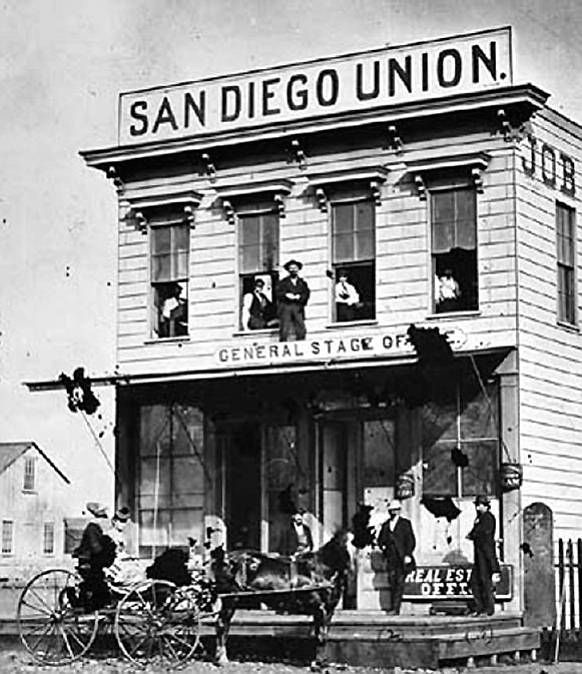
San Diego Union building, 4th Street, south of Broadway, 1872
When Ira Clifton Copley of Aurora, Illinois, first saw San Diego on a trip with his ailing brother to the Hotel del Coronado in 1891, it was a dingy town on the southern fringe of California, a quick stopover on runs to the Mexican border, a bordello-filled paradise for Pacific Fleet sailors, a dead end for the railroad, a place of palm trees, whitewashed wood-frame cottages, and a blinding sun.
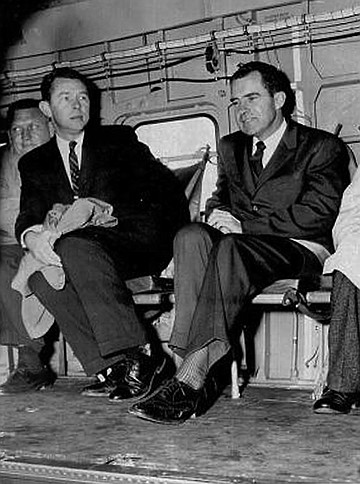
Herb Klein and Vice President Richard Nixon, 1959. Klein could be seen hovering in the background as the failed candidate uttered his famous line in 1962, “You won’t have Nixon to kick around anymore."
Copley himself was no shrinking violet. A gas and power company magnate and ex-congressman from the 11th district in northern Illinois, he was targeted by George William Norris, a populist U.S. senator from Nebraska, as an enemy of the people. In June of 1929, Norris hauled Copley before a senate committee and charged, as reported by TIME magazine, that Copley’s growing chain of 29 small-town daily newspapers, which he founded in 1905 when he purchased the Aurora Beacon, had been financed by “power trust” money and “connected with the interests of Samuel Insull, public utility pope of Chicago.”
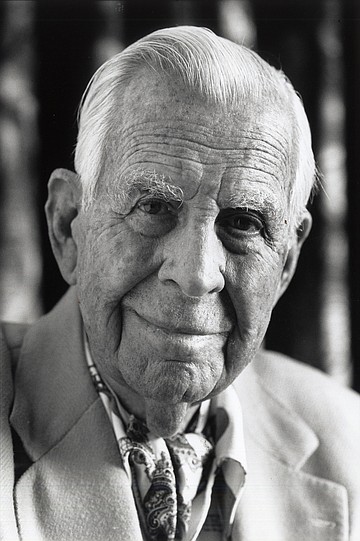
C. Arnholt Smith was Nixon's first big contributor back in 1946 and was alone with him on election night in 1968.
Copley threatened to sue. “If he will state this outside the Senate,” Copley said about Norris and his accusations, “I will bring him promptly before a Court of Justice,” adding: “A Senator of the United States or an agency of the government of the United States has no right to injure my reputation or my business by making or publishing reckless and baseless charges affecting me and my business integrity…I have no securities whatever in public utilities. There is not a dollar of utility money invested in my newspapers.”
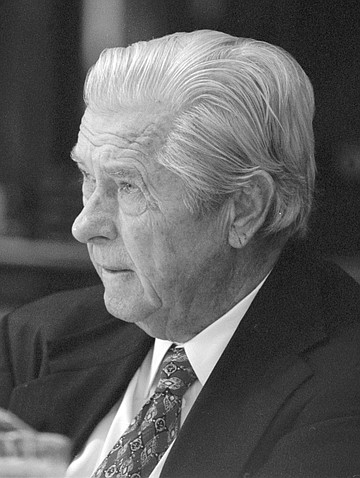
In 1980 Helen hired back Herb Klein, Nixon’s old political operative, giving him the title Editor in Chief of the Copley Newspapers.
Whether or not he was guilty as Norris charged, the publisher was used to playing hardball. He had gotten into the newspaper business in the first place to settle a political score, according to an account in The Thin Gold Watch, a friendly history of the Copley Press written in 1964 by ex-Copley editor Walter J. Swanson: “In December, 1905, I bought my first newspaper and used that pretty vigorously to write ‘ex’ in front of a United States senator who lived in my precinct,” Copley said in a letter to a friend.
For Copley, promotion of commerce and favored politicians, rather than the reporting of uncomfortable facts, was what newspapers were good for. “Believing that the people of Aurora will always boost a booster and knock a knocker,” he editorialized in 1905, “The Aurora Beacon will constantly pursue the policy of shouting for Aurora, first, last, and all the time.
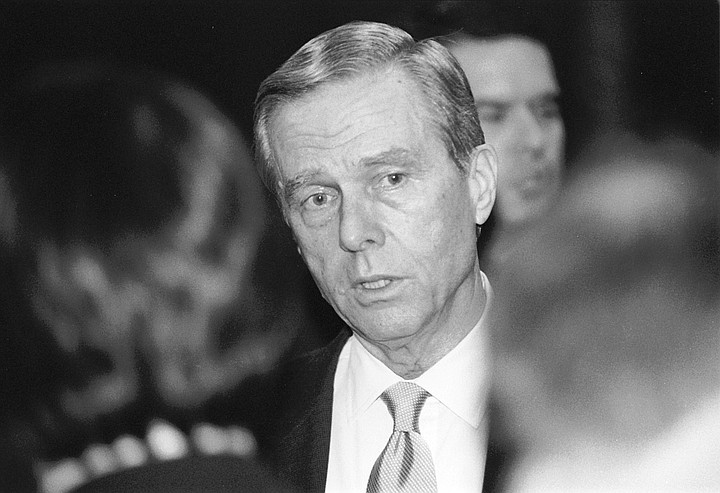
Pete Wilson was Helen Copley’s Richard Nixon.
“The Beacon is here to boost and not to knock. This position cannot fail to meet with the favor of every citizen who holds the welfare of Aurora in his heart. Here’s the slogan: ‘Boost with the Beacon.’ ”
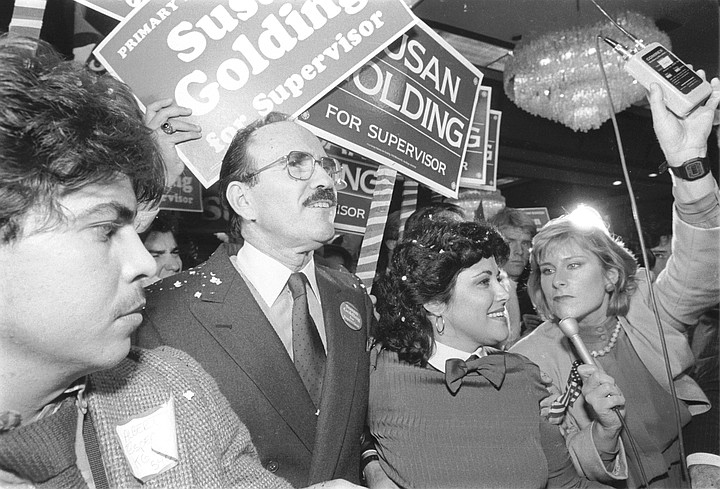
Richard Silberman and Susan Golding. Golding's campaign for county supervisor was financed by her husband, Silberman, Helen Copley’s steady date of a decade before.
Copley purchased both the San Diego Union and the Evening Tribune in 1928. Not all that much had changed about San Diego during the intervening three decades since his original visit. It was still a rough-hewn Podunk place, catering to vice-seekers, hooch-smugglers, Mexican money-launderers, and real-estate speculators, with little in the way of legitimate industry aside from the U.S. Navy and a nascent airplane business that had crafted the Spirit of St. Louis out of simple wood, fiber, and tubular steel.
The brothers John D. and Adolph Spreckels, heirs to a San Francisco sugar beet and shipping fortune, had owned the Union since 1890 and the Tribune since 1901. They treated San Diego as a division of the family conglomerate; in addition to banks, hotels, theaters, and the Mission Beach bathhouse and dancing casino, they also owned the city’s streetcar line and some of its water supply. After Adolph died in 1924, and John followed in 1926, Copley patiently awaited his turn in their seat of power.
Shortly after he purchased the two San Diego papers, a dinner was arranged in Copley’s honor at the Hotel del Coronado. He rose to speak, assuring the crowd that his operating style was far different from that of the Spreckelses: “These papers are not to be personal organs of myself or anyone else. I have no political ambitions. I have no connection with any public utility anywhere and no connection with any other business than the newspaper business anywhere.”
But Copley quickly began to consolidate his hold over the city and its politics. Within months, he purchased and shuttered the Independent, a competing newspaper established by local businessmen George Marston and Ed Fletcher in an attempt to counter the power of the Spreckelses’ interests. Copley also bought the 20-room Spreckels mansion in Coronado.
The Great Depression that soon engulfed the nation was tough on San Diego, but not for Ira Copley, whose personal fortune allowed him to buy up county real estate for pennies on the dollar. No matter how hard up they were, people still had to read the newspapers, gladly paying a few nickels a day to catch up on the city’s crime, politics, marriages, and deaths.
Without television or the Internet to compete, advertisers flocked to purchase ads in the big broadsheets of the Union and Tribune to flog their department stores, subdivisions, car dealerships, gas stations, and other offerings. And there was other business: during the height of the Depression, the list of county property-tax delinquencies grew to 64 pages.
Like the Spreckels family before him, Copley gained a stranglehold over the city’s media and never let go, forging a profitable alliance with landowners and developers. Copley and his newspapers became the oxygen that the town’s businesses needed to breathe; without his say-so, they would suffocate. San Diego was a much smaller and more parochial town than Los Angeles, which made it all the easier for Copley to rule. In 1930, L.A. boasted a population of 1,238,048; that of San Diego was just 147,897.
When author Upton Sinclair ran for governor in the 1934 Democratic primary on a progressive platform he labeled “End Poverty in California,” he took San Diego County by 3000 votes. After the Copley papers repeatedly savaged him during the general election, he lost the county by 10,000 votes. It was just one of many moves Copley made to keep the lid on the city’s radicals and reformers during hard times.
In 1939, Copley targeted the Sun, a scrappy, left-leaning evening daily founded by E.W. Scripps, the wealthy and eccentric Ohio newspaper magnate who had adopted the county at the turn of the previous century and built a sprawling family compound on thousands of acres he called Miramar Ranch. A muckraker at heart, Scripps used the Sun to attack the Spreckelses’ interests, including their 1910 bid for a 50-year city streetcar monopoly.
“We look John D. Spreckels squarely in the eyes and say: We defy you!” wrote the Sun. “Upon that issue there can be no middle ground. Either you are the master and hold in your hand the welfare of every man, woman and child in this town, or the people are their own masters, and will know how to deal with your insolent challenge.”
But Scripps died in 1926 on his yacht off the west coast of Africa, and the Sun had since struggled against the Copley onslaught. “The days of the crusading newspaper and of poorly nourished multiple newspapers were drawing to a close,” observed Union editor emeritus Richard F. Pourade in The Rising Tide, part of a seven-volume San Diego history commissioned by the Copley Press in the 1960s. “The Sun, with its excess of reformist zeal and its occasional support of socialistic causes, had lost much of the confidence of the community.”
As war raged in Europe, Copley bought the Sun and merged it with the Evening Tribune in 1939. With Pearl Harbor only two years in the future, San Diego was poised on the brink of explosive economic growth that would make the Depression and the reformers and revolutionaries it spawned a distant memory. As Copley’s Pourade dismissively noted, “The fever of social change was running down.”
As it turned out, there would be one more San Diego newspaper left for Copley’s heirs to vanquish. The Daily Journal was founded in March 1944 by 37-year-old Clinton Dotson McKinnon, a San Diego Democrat “little bigger than an outsize jockey,” reported TIME magazine that month.
“Newspaper competition comes next week to war-big San Diego (estimated pop. 390,000; 1940 pop. 203,341),” TIME said. “The Journal will break the San Diego general newspaper monopoly of rich, myopic, 79-year-old Colonel Ira Clifton Copley, owner of the arch-Republican morning Union (circ. 44,359) and evening Tribune-Sun (circ. 74,954).
“Turned down by War Manpower’s production urgency committee on a plea to lift his employment ceiling from 42, McKinnon won an appeal to the local War Manpower Commission. His argument, backed by Mayor Harley Knox, labor, religious and other groups: there was ‘community hardship,’ in that freedom of the press existed only for Colonel Copley’s papers.”
Ira Copley died at 83 in November 1947, bequeathing control of the small newspaper empire to his adopted sons Jim and Bill. The same year, McKinnon sold the Journal to an investor from West Virginia and ran for Congress.
As Pourade noted in his San Diego history, “The Union-Tribune Publishing Company, freed of wartime newsprint restrictions which had been imposed on The San Diego Union and Evening Tribune, moved vigorously against its new competitor.” Three years later, the Copley brothers bought the paper and administered the coup de grace.
It was the start of the Cold War, the beginning of a long reign of success for the ever more powerful and prosperous Copley Press. But it would not last forever.
Edith Copley had borne her husband Ira three children; all died in infancy, the last in 1910. Ten years later, they decided to adopt. The story was recounted in 1980 by J.R. “Bud” Fitzpatrick, of Springfield, Illinois, who once ran the Citizens Tribune, a competitor to Copley’s State Journal-Register:
“They went to an institution in New York and saw an orphan baby that they liked. And went home to think about it, and when they came back they were told the baby was gone, adopted by another family. And the lady told her, the superintendent told her, ‘These things don’t last very long. You’ve got to make a quick decision.’ And said, ‘The one you want here now, decide right quick. They decided and they picked the boy and they named him James. And they gave him a good education.”
Another variation of the legend had it that Ira Copley had stalked into the orphanage and demanded to be given the weakest boy there, so that he might build him into a man in his own image. Shortly after adopting Jim, Ira and his wife adopted another boy, William.
“I grew up in Illinois until I was about ten,” Bill told an interviewer in 1968. “And then when my mother died my father moved to California. And I got sent to…Andover and Yale.” Jim also went to Yale, and when war came, both Copley boys served their country, Jim as a deskbound Navy lieutenant in Washington, DC, Bill as a private in the Army.
“I started off in an anti-aircraft outfit,” Bill recalled. “And then I managed to break my arm, and I got put in an MP company. And that bored me so much I volunteered for combat and got sent to Italy. And finally got rotated home because I had gone overseas so early and I had been drafted so early. So I got rotated home and got out of the Army.”
Ira left equal shares in the Copley Press in trust to each of the brothers. They were expected to run the company as equals, but the partnership was short-lived. In the late 1940s, Bill wrote a weekly op-ed column in which he expressed his admiration for progressive causes and attacked the Republican Party. “I worked for the paper for about a year,” Bill said. “The whole idea was that I was going to start at the bottom and work up and sort of take over with my brother. But, well, our politics differed.
“We weren’t really terribly close,” Bill said. “None of us were blood-related. Though we had more or less an identical environment. There wasn’t any real closeness.” The ideological rift between them only widened: “Well, he went right and I went further left. You know, we never really came to any agreement. So it was impossible to think of working together on the newspapers. I got out of that very early.”
Bill, a friend of Man Ray, the avant-garde artist who worked in Hollywood from 1940 to 1951, moved east and became a painter and a contemporary art collector. In the mid ’50s, he sued Jim to liquidate the Copley empire; after a bitter legal battle, the permanently estranged brothers reached an agreement to buy Bill out of the company. Bill’s departure from the scene, coupled with the postwar demise of Clinton McKinnon’s Daily Journal, meant that Jim was now freer than ever to impose his will on San Diego and its politics.
As Jim began to consolidate his hold on the Copley Press, the nation’s politics were veering sharply to the right. The death of Franklin D. Roosevelt and the end of his New Deal, coupled with the defeat in 1947 of U.S.-backed Chiang Kai-shek by the Communist Chinese forces of Mao Zedong, gave Republicans the upper hand. The GOP blamed Harry Truman and the Democrats for “losing China” and claimed that Communist spies had infiltrated every level of the federal government.
In 1946, 130 or so miles north of San Diego, a young Navy veteran named Richard M. Nixon ran for Congress from a semirural district centered in Yorba Linda. He had been handpicked by the “Candidate and Fact Finding Committee,” a group of Republican businessmen, to take on incumbent Jerry Voorhis, a New Deal Democrat who had gotten his first taste of politics as a volunteer in the 1934 gubernatorial campaign of Upton Sinclair. Nixon ousted Voorhis and four years later ran for U.S. Senate.
He beat incumbent Democratic Sen. Helen Gahagan Douglas, calling her “pink right down to her underwear.” Two years after that, Nixon was elected vice president. It was a stunningly rapid rise to power. Copley was not a member of Nixon’s innermost circle, but his zeal and willingness to put the services of his newspaper empire at Nixon’s disposal caught the attention of the future president. Their go-between was Herbert G. Klein, a former sports editor of the Daily Trojan, the student newspaper of the University of Southern California, his alma mater.
Klein first signed on with the Copley Press as a $13-a-week copyboy at the Alhambra Post-Advocate. He was the paper’s news editor when he first met Nixon at the outset of his 1946 congressional campaign. In each of Nixon’s subsequent campaigns, Klein was given a leave of absence by Jim Copley to serve as Nixon’s publicist and press secretary.
“The newspaper paid Klein’s salary during the campaign,” writes Nixon scholar Irwin F. Gellman in The Contender, a 1999 chronicle of Nixon’s eight years in Congress. When the campaign was over, Klein would return directly to his editorial duties for Copley. It was only a convenient fiction, of course; the arrangement meant that there was never any doubt about how the Copley papers felt about Richard Nixon or how far they were willing to slant the news for his benefit. It was to become a hallowed Copley tradition.
Over the years, Nixon repeatedly wrote to Copley expressing his gratitude; the correspondence is now in the National Archives.
“Dear Jim,” began one letter from then-Vice President Nixon to Copley, dated November 19, 1954, following the Congressional midterm elections. “I can’t tell you how much I appreciated the wonderful job the Copley papers did for our cause in the last campaign. Your Washington staff, as always, just couldn’t have been more cooperative.
“I saw the San Diego paper the morning after I spoke there and I could hardly believe my eyes when I noted the extent of the coverage. No wonder San Diego was one of the bright spots in the whole California picture.”
In September 1959, upon his return from the famous Moscow “kitchen debate” with Premier Nikita Khrushchev, Nixon wrote, “Dear Jim: The complete and generous coverage by the Copley Press both editorially and in the news columns was most gratifying, I can assure you.”
Copley took a proprietary interest in Nixon’s career, using his editor Klein — embedded in the campaign, as always during political season — to relay suggestions and ideas to the candidate. After Nixon’s first televised debate with John F. Kennedy in September 1960, Copley fired off a message to Klein: “As a personal letter to you, I wish to say that I think Dick came out second best in the ‘debate’ last night. I think the cameras played up Kennedy. Kennedy looked fresher; Dick looked tired, and I thought it was a shame that his suit did not appear too well on the set that I was looking at.
“Also, Kennedy’s expression seemed to indicate that he was ready for anything, whereas Dick’s expression was very studious, but to the point where it looked almost like he was mad or disturbed. I certainly hope we can do better in future exchanges.”
Copley wrote Nixon himself a few days later: “Dear Dick: As you know, I am going to do everything possible through the Copley Newspapers to assist you in your campaign. I feel so vehemently that we need you as the next President of the United States.
“I wish you Godspeed, and am rooting for your election in November. Please do not hesitate to call on my organization if we can help you.”
Nixon responded the next month: “The all-out assistance you are giving us — ranging from the loan of Herb Klein and [San Diego Union reporter] Peter Kaye to the help on the San Diego programs — is most gratifying. I only wish we had more like you!” Copley was proud of his contribution, later noting, “In 1960, California went for Nixon by 23,000 votes and an interesting comment on that is that San Diego gave him a margin of 53,000.”
There have been allegations that Copley’s assistance was not limited to Nixon’s campaigns. In December 1977, writers Joe Trento, a San Diego freelancer, and Dave Roman wrote a piece for Penthouse magazine in which they accused Copley of collaborating with the Central Intelligence Agency during the Eisenhower administration, using the Copley News Service and its reporters as fronts for intelligence gathering.
Though their story has become gospel for many CIA critics, the Copley Newspapers have consistently denied its truth, and records that might back up the accusations remain classified, locked away or perhaps destroyed, by the CIA. But as the correspondence in the Nixon archives make clear, there was little doubt that Copley was willing to do almost anything the vice president asked of him.
Nixon narrowly lost the 1960 presidential race to Kennedy, along with his 1962 “comeback” campaign against incumbent California Gov. Edmund G. “Pat” Brown, after which the ever-present Herb Klein could be seen hovering in the background as the failed candidate uttered his famous line, “You won’t have Nixon to kick around anymore, because, gentlemen, this is my last press conference.”
But Copley never wavered, even during the lowest point of Nixon’s “desert years,” when the ex–vice president moved away from California, joined a Manhattan law firm, and sat out the 1964 debacle of Barry Goldwater’s landslide loss to Lyndon Johnson.
Four years later, Nixon beat Hubert Humphrey, and Copley, accompanied by his young second wife Helen, made a triumphant return to Washington to celebrate at the White House. It was a heady time. An era of peace, prosperity, and Republican domination seemed to beckon: Nixon said he had a “secret plan” to end the war in Vietnam.
As during all previous conflicts of the 20th Century, San Diego was vital to the war effort. Coronado-based warships plied the Vietnamese coast and deltas. Miramar-trained fighter squadrons dueled with MIGs over Hanoi. Ironworkers labored in the bowels of the Navy Rework Facility. Much of the local economy still depended heavily on the Navy payroll.
When sailors came home from the sea, they spent their liberty at the peep shows and honky-tonks strung out along downtown’s lower Broadway. When they were killed in action, they were put to rest at Fort Rosecrans National Cemetery on Point Loma. To Copley and many of the readers of the Union and Evening Tribune, waging the war until absolute victory over the Vietnamese Communists was a matter of faith.
By the mid-1960s, however, there was something new in the town’s political mix. True to the booster roots of his father, Copley had led the crusade to build a new University of California campus on Torrey Pines mesa. The growing city owned thousands of acres of open space remaining from a Spanish land grant. After a Copley-backed referendum campaign in 1958, the city’s voters easily approved ceding a big chunk of the coveted property to the state in exchange for the promised economic and cultural riches the university would bring.
UC delivered the promised material wealth; it also brought to town something else Copley and his conservative business allies had not bargained for. Antiwar radicals, led by German philosopher Herbert Marcuse, a scholar of Hegel and Marx, took up residence there and began talking revolution.
As resistance to the war grew, so did San Diego street protests. The city had seen nothing like them since the darkest days of the Great Depression, when radicals clashed with nightstick-wielding policemen, and the Copley papers railed against the “vicious Reds” besieging the city.
In the 1960s, Copley photographers recall being dispatched to the rallies at UCSD and taking thousands of pictures of the student demonstrators; few if any of the photographs ever made the paper. The rest, the old-timers believed, were being sent to the FBI for analysis.
Among the protestors were many of Marcuse’s graduate students. In 1966 one of them was 24-year-old Lowell Bergman, the future muckraker and 60 Minutes producer, who decided to start an underground newspaper.
“The spark was the incessant appearance of editorials in the San Diego Union-Tribune demanding that the University of California regents fire Marcuse,” Bergman recalled to an interviewer for Britannica.com in August 2000. “This came after students in Europe ran around in 1968 chanting ‘Marx, Mao, Marcuse!’ Someone drove by and fired at his garage door. There were phone threats. The tension was mounting. San Diego had an active right-wing vigilante movement, which I encountered later when I got into journalism.
“San Diego was not only the largest staging area for the Vietnam War; it was also home to a large military retirement community and politics that made parts of the Deep South look liberal. Thus was born the San Diego Free Press, which a year later was renamed the San Diego Street Journal.
“Our focus became the wealthiest and most powerful members of the community. And so it was that number one was a gentleman by the name of C. Arnholt Smith — Mr. San Diego of the Century. Number two was one John Alessio — Mr. San Diego for 1969.
“In the tightly controlled world of San Diego, they reigned with undisputed power. We told the story of how Alessio used his political clout (in the Democratic Party) to get the Navy to give in to building a bridge to nearby Coronado Island and his new renovated hotel, the Del Coronado.
“Then Smith, Alessio’s mentor and partner, used his own political clout (in the Republican Party) to garner all kinds of favors from his favorite politician, Richard Nixon. Smith was his first big contributor back in 1946 and was alone with him on election night in 1968. Suffice it to say that Smith and his bank and conglomerate were heavily involved in dealing with and influencing city politicians and the police bureaucracy.
“All this started appearing in detail in our pages, which resulted in all kinds of vigilante attacks, harassment, and fire bombs, with a few arrests sprinkled in. We survived; the two gentlemen — and a cast of other characters — wound up going to jail. It just took a couple of years and a lot of harassment.”
Bergman may have overstated the role of San Diego’s nascent underground press in bringing about the end of the Smith era. TIME magazine reported in March 1970 that the Street Journal’s October 1969 piece on Smith that triggered the violence against the paper was “essentially a rehash of a Wall Street Journal story.”
The protracted war, the revelations of Watergate, a powerful Democratic Congress, and the Washington press corps, especially columnist Jack Anderson — who blew the whistle on the administration’s corrupt financing of San Diego’s aborted bid for the 1972 GOP convention, personally orchestrated by Nixon and Copley — all finally combined to bring down the roof on San Diego’s old-boy establishment.
One fact could not be disputed: Jim Copley and his newspapers, ignoring the avalanche of national coverage, protected Smith and his friends virtually until the very day in October 1973 when federal agents marched into Smith’s office at the United States National Bank and shut him down. At the time, it was the biggest bank collapse in American history.
Four months later, on October 6, 1973, Jim Copley died of a brain tumor, the same night the first copies of the Union rolled off the presses of the paper’s new printing plant in Mission Valley. He was just 57. The Copley newspapers had hidden his lengthy illness from the public, and even his closest executives had little clue to the succession plan. Copley CEO Robert Letts Jones, Stanford alum and all-around good old boy who had been a loyal company stalwart since the mid-1950s, was confident he had been chosen by Jim to carry on.
No outsider can say what really happened during that epic transition. Jim’s letters and papers are still locked away in the vaults of the Copley Library in La Jolla. But what later became clear through legal records was that, as Jim lay dying at Scripps Memorial Hospital, his second wife Helen engineered a bedside coup.
Before his death, Copley signed a revised will and a trust agreement, effectively giving Helen complete control over the estate and casting his two children, adopted during his first marriage, into a gilded wilderness. Jones was dumped, and the spin machine of the Copley Press went to work for its new master.
It became a national story. Nixon was soon to fall, feminism was on the rise, and East Coast magazine editors — as always, tantalized by San Diego’s small-town reputation for sun and sin — devised a Horatio Alger angle. Iowa-born Helen Copley, née Hunt, came to San Diego to escape the Midwest stigma of single, working motherhood, joined Copley’s secretarial pool, got lucky, and married the boss.
According to the national magazines, Jim Copley’s tutelage had transformed his second wife into a brilliant newspaper executive, ready and able to revolutionize the sleepy, right-wing, hidebound media company she’d inherited. No less a journalistic light than Gail Sheehy, later author of the best-seller Passages, was dispatched from Manhattan to produce a glowing profile of Helen Copley for New West, the West Coast spin-off of Clay Felker’s New York magazine.
Helen was already reforming the Union and Evening Tribune, Sheehy reported; the San Diego Zoo was no longer a “sacred cow,” the Copley term for those local institutions shielded by the papers from unflattering coverage in years past. From now on, the coverage of the papers would be straight, free of the taint of boosterism and politics that up until that point had been a hallmark of the Copleys.
It was a myth, of course, similar to earlier tales about Ira and Jim Copley being noble stewards of the public good. Helen was street-smart, but that was about it. She knew next to nothing about actually running newspapers; in fact she proved best at getting rid of one. She dumped the Sacramento Union, one of Jim’s ego ventures, a financially disastrous attempt to go head-to-head with the dominant Bee, owned by the liberal McClatchy family. She also sold off Ira Copley’s mansion in Aurora, along with the company airplane.
Helen’s pick to edit the San Diego Union was Jerry Warren, a former Copley editor who had gone to Washington to become Nixon’s assistant press secretary, reporting to the infamous Ron Ziegler. She hired back Herb Klein, Nixon’s old political operative, giving him the title Editor in Chief of the Copley Newspapers. The predicted breath of fresh air smelled more like stale West Wing deodorizer.
Not that there weren’t a few interesting moments. When the late Otis Chandler of the Los Angeles Times strode down Broadway in the late 1970s and proclaimed that the newly minted San Diego edition of the Times would soon conquer the local newspaper market, the Union and Tribune went on a hiring spree, bringing in J.D. Alexander from the Washington Post to become managing editor of the Union and snapping up local writers from a small alternative weekly called the Reader.
But Chandler’s bet that his brand of aggressive journalism could sell newspapers in San Diego went bad; circulation proved to be miserably low, and he began gradually folding his tent. When the San Diego operation was finally shut down in December 1992, the Times had a total circulation of 60,000 versus the Union’s 380,000, the New York Times reported that month. “Our study of the long-term prospects showed we could continue to grow, but in small numbers,” Phyllis Pfieffer, the San Diego edition’s general manager, told the New York paper. “Otis Chandler’s dream of being a newspaper from Santa Barbara to Tijuana isn’t going to happen in this economy.”
“The view in 1978 was that there was an opportunity there,” L.A. Times publisher David Laventhol told the New York Times. “It turned out to be less so than we thought.” Well before that, the Copley papers had reverted to form; Alexander quit to work for the Hearst paper in Seattle, and vaunted young lights, such as Carl Cannon, son of Reagan biographer Lou Cannon, returned to Washington.
For more than a decade, Helen Copley had stuck like glue to Pete Wilson, the so-called reform mayor elected in 1971, after his predecessor was indicted during the city’s infamous Yellow Cab taxi scandal. Wilson’s aspirations reached far beyond the city limits, all the way to the White House.
In many ways, Republican Wilson was Helen Copley’s Richard Nixon. Her editors backed his every move, with the exception of his so-called growth-management program, which he watered down to meet Copley’s objections. As Herb Klein under Jim Copley had performed for Nixon, the Union’s city hall reporter Otto Bos, a hulking native of Holland, was the paper’s go-between with the Wilson camp during Helen’s time.
Bos, who once proclaimed that his only religion was “Pete Wilson,” wrote reams of Wilson-friendly coverage before becoming the mayor’s press secretary in 1977; he remained a top Wilson staffer and Copley intermediary until dying of a massive heart attack while playing soccer in 1991.
When Wilson beat California Gov. Jerry Brown for the U.S. Senate in 1982, Copley wanted another of her friends to replace Wilson as mayor. Democrat Maureen O’Connor, the tomboy daughter of a Mission Hills bootlegger, had been elected to the San Diego City Council in 1971 with cash from Robert O. Peterson, founder of the Jack in the Box fast-food chain. She later married him and announced she would spend virtually unlimited amounts of Peterson’s personal fortune on her mayoral campaign.
Copley was not just friendly with Peterson and O’Connor, they were investors together in Gustaf Anders, a La Jolla Shores restaurant heavily promoted by the Copley papers. Copley also dated Democrat Dick Silberman, Peterson’s Jack in the Box partner. Though their relationship later faltered for reasons never stated, the unlikely pair turned up frequently at La Jolla social and political events.
In the spring of 1983, Copley editors girded for battle. Their enemy: Roger Hedgecock, a self-styled progressive Republican who cast himself several degrees to the left of Wilson. He had assembled a battle-ready campaign force, run by young aide-de-camp Tom Shepard. Campaign contributors included J. David Dominelli, a remarkably successful La Jolla–based financial guru who claimed to be making making millions of dollars for his investors through mysterious foreign currency trades.
Despite her husband’s wealth and Copley’s backing, O’Connor seemed unprepared for the juggernaut that was the Hedgecock campaign. Though the Copley papers ignored the story, Hedgecock’s handlers whispered about the personal ties between Copley and O’Connor, helping to undercut the credibility of the paper’s endorsement. He beat O’Connor handily.
By the beginning of 1984, the odds had changed. Dominelli’s vaunted investment genius was discovered to be a Ponzi scheme, a house of cards the collapse of which robbed investors of their life savings. Revelations that Dominelli and his girlfriend, Del Mar mayor Nancy Hoover, had secretly financed Hedgecock’s 1983 special election victory drew Dick Carlson, an ex-TV anchorman married to a Swanson frozen-food heiress from La Jolla, into the regular election battle.
With O’Connor sitting out the race, the Copley papers swung behind Carlson with a vengeance. On April 20, the Union ran a story on its front page reporting that the county grand jury had heard testimony that $400,000 of unexplained funds had been found in secret bank accounts controlled by the mayor. It looked like curtains for Hedgecock. Except the story wasn’t true.
In May, Hedgecock filed a libel suit against the newspaper for $3 million, alleging that the Union had run the story “to impair and prevent” his reelection bid. “Just as I support the role of an aggressive and independent press as critical to the continued health of our democratic institutions,” Hedgecock said in a statement, “I also believe that when an individual member of the media abuses his or her very considerable power and steps over the line that divides thorough, independent scrutiny from intentional, malicious, unfair attack, someone must stand up and speak out.
“Not only did the editors of the Union refuse to correct their original errors, they continued to republish them, with the apparent objective of causing me and my family as much damage as possible.”
At first, Union editor Jerry Warren stuck to his guns, disputing Hedgecock’s repeated charge that the paper was out to get him and was using its news pages to do it. “From the very start, we approached this story on a professional journalistic basis,” Warren said. “The mayor apparently is approaching a suit as a political matter…We’re not running for anything…Of course we stand by the story.”
Added Herb Klein: “The suit by the mayor is not unexpected. He suggests motives which are contrary to fact. The timing of the action and statements and innuendos by the mayor clearly indicate the purely political aspects of his suit.”
Then, on July 25, the paper issued a full retraction. It ran on the front page under Warren’s byline. “The San Diego Union reported on April 20 and 21, relying on statements of sources close to the investigation, that the grand jury was probing allegations about Mayor Roger Hedgecock’s personal and campaign finances. The Union has since learned that key aspects of these stories were incorrect.”
Though the election was three months away, the race for mayor effectively ended that morning. In November, Hedgecock — by then under indictment in the money-laundering case — easily bested Carlson. At the same time, a swath of Copley clout and credibility was laid low.
Hedgecock was convicted in December 1985 and forced to resign, but the fallen mayor ever afterwards maintained that Helen Copley’s newspapers had railroaded him, and many believed him; the Union’s clumsy attempt to wield the J. David scandal as a cudgel had backfired badly. Once challenged so blantantly, the Copley papers found it hard to regain their bearings.
In June 1986, with Hedgecock vanquished, O’Connor was elected mayor. A high point of her tenure came when she appeared on a 1989 segment of NBC’s Today Show with Helen Copley and McDonald’s heiress Joan Kroc. The three women expressed admiration for one another and inspected a million-dollar Fabergé egg Kroc had contributed to the mayor’s Russian Arts Festival. Host Jane Pauley gushed that the trio ran the city, and in some ways she was right. But, even then, time was running out for Copley Newspapers.
Evening Tribune circulation was falling rapidly — down from a 1979 peak of 133,711 to 116,694 — when Helen Copley announced in September 1991 that she was closing the paper down. “The Tribune is a wonderful newspaper and it’s not that we haven’t tried hard to maintain it as a separate and independent paper,” said a quote ascribed to Copley by the Tribune. Herb Klein, still Copley editor in chief, chimed in, “It was a difficult decision and one she has given days and hours and months to.”
In 1992, O’Connor declined to run for reelection and was succeeded by Susan Golding, whose earlier campaign for county supervisor was financed by her husband, Richard Silberman, Copley’s steady date of a decade before. By the time Golding became mayor, Silberman had been convicted of money laundering and the couple was divorced.
With no personal friends remaining in public office and her health beginning to fail, Copley, nearing 80, adopted a receding profile during the ensuing Golding years. In the summer of 1996, she made no public appearances when San Diego finally hosted the Republican National Convention, Jim Copley’s long-held ambition.
To commemorate the event, Copley commissioned an enormous sand sculpture of a dancing elephant and threw a lavish outdoor party in Embarcadero Park near Seaport Village for thousands of invited guests, presided over by her son David, who greeted visitors while seated in a throne-like chair under a tent.
Only a decade later did the Union-Tribune report that the city had fudged the numbers of its growing pension obligation in order to free up enough cash to subsidize the Republicans. The pension debt would later threaten to bankrupt the city.
Helen Copley died on August 25, 2004, at Foxhill, the sprawling French Provincial estate in La Jolla built by her late husband Jim. She was 81. Her only child David, then 52, was born after Helen fled to San Diego following a quickie marriage and divorce from his father in Iowa, apparently to give the child a name; Jim Copley adopted David in 1965, immediately after marrying Helen.
At the time of her death, Helen had long since settled her legal disagreement with Jim Copley’s two adopted children from his first marriage, who sued for fraud, claiming she raided their trust fund. The agreement was secret, but it was clear they were out of the company for good. David was his mother’s only apparent heir. She named him chairman and chief executive of the Copley Press and publisher of the Union-Tribune in 1997.
For years, rumors swirled through the Union-Tribune about the state of his health. A huge man with a baby face, Copley was famous for his drinking bouts and the extravagant parties he threw. He had been repeatedly arrested for drunk driving, in one case doing a week at a county labor camp after being picked up weaving down a street near his La Jolla mansion in his Porsche.
In 1999, Vanity Fair contributor Maureen Orth wrote “Vulgar Favors,” in which she chronicled the history of Andrew Cunanan, the 27-year-old gay serial killer from Hillcrest who murdered fashion icon Gianni Versace in 1997. Orth wrote that Cunanan had been seen at Copley’s parties and went on to note that the Union-Tribune had been suspiciously slow to report on Cunanan and his relationships with wealthy La Jolla men.
“The San Diego Union-Tribune did not write about Andrew Cunanan at all for weeks,” Orth said in a 1999 interview. “The very first mention, as I recall, was an obituary of his third victim, Lee Miglin, and never mentioned Andrew Cunanan.
“And the first several stories they did were off wire copy and talking to people in Minneapolis and never once asked anybody in Hillcrest nor anybody Cunanan knew to comment. I thought that was just kind of amazing. I mean, you've got national reporters coming out from all over the country to do major stories about this guy, and he's never mentioned in his local newspaper. That's odd.”
Though it wasn’t acknowledged by the paper, the U-T rumor mill had it that Copley’s heart was bad, caused by his weight and indulgence in food, drink, and perhaps other substances. Then, almost a year after Helen’s death, the U-T announced in July 2005 that he’d had a heart transplant.
“For me, of course, this is wonderful news,” said an email message attributed to him by the paper. “The surgeons and their team at Sharp Hospital in San Diego did a magnificent job. Indeed, over the last two years, they literally have saved my life several times. Thanks to their skill and the scientific advances that make their work possible, I can look forward to many years of renewed vigor and productivity.” Copley did recover, but the same could not be said for his newspapers. Circulation continued to fall and advertising fled, a typical American newspaper story made worse by the Copley chain’s reputation for spinning facts, relentless boosterism, and history of conducting political wars on behalf of its owners.
In early 2006, Union-Tribune editor Karin Winner wrote a page-one story about the importance of the state’s Public Records Act, in which she said, “We shine white-hot spotlights on your government — local, state and national — so you can scrutinize and evaluate the actions of the people you elect and the way they spend your tax dollars.” For many readers, accustomed to years of slanted coverage — as well as strategic lack of coverage — clearly designed to protect Copley’s preferred candidates or promote the city’s latest taxpayer-subsidized stadium proposal, the idea that Union-Tribune reporters had started turning over rocks in search of civic evildoing seemed preposterous.
But there were a few signs of change, viewed by cynics as the financially flagging newspaper’s last-gasp attempt to recruit new subscribers by building its credibility. In 2005, Winner launched the “Watchdog Report,” a series of investigative stories that delved into long-unreported municipal scandals involving city land sales, lobbying violations, and — at long last — the “money mess” that was the city’s underfunded pension fund. Many of the stories were clearly derived from the work of others; a Watchdog Report about slum property owned by Nick Inzunza, brother of ex-San Diego city councilman Ralph Inzunza, convicted in the Cheetahs strip-club bribery case, had already been done elsewhere.
But the mere fact that the stories ran at all seemed to show that Winner was serious about her new direction. In June 2005, the U-T broke the story, reported by Marcus Stern of the Copley News Service, of GOP Congressman Randy “Duke” Cunningham’s sale of his Del Mar house to a lobbyist for whom he’d done repeated favors. Within months, Cunningham, a fighter-pilot hero of the war in Vietnam who had long been a Copley favorite, resigned his seat; he pleaded guilty to multiple bribery counts and was sentenced to eight years and four months in federal prison. In 2006 the coverage was awarded a Pulitzer Prize, exorcising the old ghost of the San Diego Union, which had never received the coveted award.
(The late Evening Tribune had been given two: one for its deadline coverage of the 1978 crash of a Pacific Southwest Airlines 727 into North Park and the other for an editorial series about illegal immigration.)
But the Cunningham prize proved a high-water mark for the Union-Tribune. Last fall Marcus Stern announced he was leaving the Copley News Service after taking a buyout offer by the company, which was seeking to radically downsize. Forty-three editorial workers were also targeted for separation under the plan. Watchdog Reports became less frequent, and the paper returned to more familiar territory, settling political scores and promoting expansion of the convention center.
Of late, the paper has taken to relentlessly bashing its current archenemy, San Diego city attorney Mike Aguirre, much in the way it went after Hedgecock.
In its all-out assault on Aguirre, beginning after he was elected in 2004, the newspaper became the strange bedfellow of the big labor unions it had long professed to abhor. Labor didn’t like Aguirre’s focus on the city’s troubled pension fund; the U-T feared he would foil the newspaper’s long-running effort to build a $1 billion-plus stadium for Alex Spanos and his San Diego Chargers, who almost certainly would demand a large public subsidy in the form of cash or real estate.
Leading the charge was sports columnist Nick Canepa, who repeatedly mocked Aguirre. “All along, the Chargers have insisted they basically have given up on a new stadium within the San Diego city limits because of one man — City Attorney Mike Aguirre,” Canepa wrote last month. “And Aguirre, as we all know, can swat, although he whiffs now and then, such as seeking an evacuation during the fires and jumping in like a porch climber during the La Jolla landslide.
“So I'm wondering. This is an election year, and Aguirre is being challenged by viable candidates. Would the Chargers consider holding back their current efforts to secure a new joint in Chula Vista and wait for the outcome of the city election?”
The voluble Aguirre was more easily rattled by the U-T than media-savvy Hedgecock and stopped returning the newspaper’s calls, a tactical blunder. He publicly berated one of its reporters, who most observers saw as just doing his job in the tradition of the Copley Press, a simple journeyman carrying out his assignment to dig up as much negative information as he could on the quixotic city attorney. It was far from the first time that the U-T had ignored the faults of its favorites and played up the foibles of its foes. The troubling question for the paper was whether it would be the last.
By early 2008, it seemed clear that the U-T was on the verge of building enough momentum to unseat Aguirre in the June primary. The irony was that Aguirre’s prospective political demise, like that of Hedgecock’s before him, was unlikely to stem the paper’s diminishing circulation or bolster its credibility and indeed might have exactly the opposite effect. Adding to the pain for Copley, the U-T’s successful efforts to get city voters to approve big stadium subsidies for the Padres and the Chargers — using the argument that pro sports teams are good for business — haven’t paid off in hoped-for circulation and revenue gains for the paper.
Editor Karin Winner moved on to yet another circulation-boosting project, a new section called “Our San Diego.” It has nothing to do with investigative reporting. “We will give you useful information, including home sales by address, ideas for free activities for you and your children, and voices of newsmakers in your area,” said a front-page editorial note from her in January. Meanwhile, readership and revenue continue to tumble, and there are growing signs that the end of the Copley empire may finally be at hand.
Last March, after years of saying he would never part with his mother’s legacy, David Copley sold off the nine Copley newspapers in Ohio and Illinois, almost 103 years after Ira Clifton Copley purchased the Aurora Beacon. The proceeds of $380 million were said to be needed for inheritance taxes on Helen’s estate. In December 2006, Copley sold the Torrance Daily Breeze for a reported $25 million. The Copley-owned Casa del Zorro, the posh resort in Borrego Springs purchased by Jim Copley in 1960, was sold in December of last year.
Over the last several months, David Copley, now 56, has been a frequent passenger at Jimsair, the private aviation terminal on the north side of Lindbergh Field. He arrives in a compact black limousine with tan curtains concealing the rear passenger seat from curious stares of airport workers who happen by. Followed by their eyes, the car slips through a gate in the airport’s chain-link security fence and glides to a stop beside a sleek Gulfstream IV executive jet, painted blue and white, the official Copley colors, and emblazoned with the tail number 700CN, for Copley Newspapers. (These days, the remaining newspapers consist of the Union-Tribune and the biweekly Borrego Sun.)
Copley is considerably slimmer since his heart transplant; wearing a black sport coat over an embroidered silk vest, he labors up the airplane’s small stairway as a member of the Jimsair ground squad loads his small rollaway suitcase into the rear hatch. Sometimes a sturdy male aide-de-camp accompanies him, but more often Copley and the plane’s two-man crew are all alone in the 22-seat Gulfstream on their four-hour-plus trip to New York City.
Why does he go there with such regularity? Nobody outside a very small circle of friends and associates has any idea. Some speculate that he is producing a Broadway play, something he has told friends he aspires to do. Others think he may be negotiating a deal with a Wall Street mogul to unload the Union-Tribune, the last of the Copley family jewels. Another theory has it that he is an outpatient at a Manhattan hospital, but all of that is mere speculation.
What does he think about on those lone journeys east? There are many ghosts to be considered. Twenty-five minutes into its flight, after making a sweeping U-turn over the Pacific, the jet is high over Borrego Springs, where Jim Copley handed out his “Ring of Truth” medals in the banquet hall of Casa del Zorro.
There he honored reporters and editors who hewed the party line and churned out reams of copy in tribute to Richard Nixon and C. Arnholt Smith; David’s mother Helen rewarded staffers who paid homage to Pete Wilson, Maureen O’Connor, and Susan Golding. Later, sportswriters were celebrated for championing the downtown baseball stadium, subsidized by taxpayers.
Two and a half hours later on the way to Manhattan, David can look down on Aurora, Illinois, the birthplace of the chain founded by Ira Copley nearly 103 years ago.
What will happen to the last remaining daily newspaper of the Copley Press? At latest report, in November of last year, audited daily circulation at the Union-Tribune had plunged 8.5 percent, from 304,334 to 278,379. Sunday’s numbers tumbled 7.93 percent, from 390,310 to 359,355. Both were also dramatically down from seven years earlier, when daily circulation stood at 370,395 and Sunday was 439,367. Some say the operation is hemorrhaging cash, despite the employee buyouts of recent months.
Almost all American newspapers are suffering in the Internet age, but the Union-Tribune is among the most prominent of the walking wounded. The decades-long decay in its circulation, beginning years before the advent of broadband, owes as much to its peculiar heritage of warped coverage and irregular stewardship as it does to the threat posed by the Web. Droves of San Diegans tuned out long ago, and David Copley, cruising at 40,000 feet over the heartland that spawned Ira’s once-mighty Copley Press, seems to have done the same.
Sooner or later, the Union-Tribune will be in different hands. Copley, with no wife, children, or other apparent legal heirs, may sell it for cash, or perhaps bequeath it to charity, in the way that Nelson Poynter gave his stock in the Times Publishing Company, publisher of Florida’s St. Petersburg Times, to his Modern Media Institute (now known as the Poynter Institute for Media Studies). No one yet knows, maybe not even David Copley himself.
Here's something you might be interested in.
The Rise and Fall of the Copley Press
A history of San Diego on the shoulders of the Union-Tribune

The Rise and Fall of the Copley Press
A history of San Diego on the shoulders of the Union-Tribune
San Diego Union building, 4th Street, south of Broadway, 1872
When Ira Clifton Copley of Aurora, Illinois, first saw San Diego on a trip with his ailing brother to the Hotel del Coronado in 1891, it was a dingy town on the southern fringe of California, a quick stopover on runs to the Mexican border, a bordello-filled paradise for Pacific Fleet sailors, a dead end for the railroad, a place of palm trees, whitewashed wood-frame cottages, and a blinding sun.
Herb Klein and Vice President Richard Nixon, 1959. Klein could be seen hovering in the background as the failed candidate uttered his famous line in 1962, “You won’t have Nixon to kick around anymore."
Copley himself was no shrinking violet. A gas and power company magnate and ex-congressman from the 11th district in northern Illinois, he was targeted by George William Norris, a populist U.S. senator from Nebraska, as an enemy of the people. In June of 1929, Norris hauled Copley before a senate committee and charged, as reported by TIME magazine, that Copley’s growing chain of 29 small-town daily newspapers, which he founded in 1905 when he purchased the Aurora Beacon, had been financed by “power trust” money and “connected with the interests of Samuel Insull, public utility pope of Chicago.”
C. Arnholt Smith was Nixon's first big contributor back in 1946 and was alone with him on election night in 1968.
Copley threatened to sue. “If he will state this outside the Senate,” Copley said about Norris and his accusations, “I will bring him promptly before a Court of Justice,” adding: “A Senator of the United States or an agency of the government of the United States has no right to injure my reputation or my business by making or publishing reckless and baseless charges affecting me and my business integrity…I have no securities whatever in public utilities. There is not a dollar of utility money invested in my newspapers.”
In 1980 Helen hired back Herb Klein, Nixon’s old political operative, giving him the title Editor in Chief of the Copley Newspapers.
Whether or not he was guilty as Norris charged, the publisher was used to playing hardball. He had gotten into the newspaper business in the first place to settle a political score, according to an account in The Thin Gold Watch, a friendly history of the Copley Press written in 1964 by ex-Copley editor Walter J. Swanson: “In December, 1905, I bought my first newspaper and used that pretty vigorously to write ‘ex’ in front of a United States senator who lived in my precinct,” Copley said in a letter to a friend.
For Copley, promotion of commerce and favored politicians, rather than the reporting of uncomfortable facts, was what newspapers were good for. “Believing that the people of Aurora will always boost a booster and knock a knocker,” he editorialized in 1905, “The Aurora Beacon will constantly pursue the policy of shouting for Aurora, first, last, and all the time.
Pete Wilson was Helen Copley’s Richard Nixon.
“The Beacon is here to boost and not to knock. This position cannot fail to meet with the favor of every citizen who holds the welfare of Aurora in his heart. Here’s the slogan: ‘Boost with the Beacon.’ ”
Richard Silberman and Susan Golding. Golding's campaign for county supervisor was financed by her husband, Silberman, Helen Copley’s steady date of a decade before.
Copley purchased both the San Diego Union and the Evening Tribune in 1928. Not all that much had changed about San Diego during the intervening three decades since his original visit. It was still a rough-hewn Podunk place, catering to vice-seekers, hooch-smugglers, Mexican money-launderers, and real-estate speculators, with little in the way of legitimate industry aside from the U.S. Navy and a nascent airplane business that had crafted the Spirit of St. Louis out of simple wood, fiber, and tubular steel.
The brothers John D. and Adolph Spreckels, heirs to a San Francisco sugar beet and shipping fortune, had owned the Union since 1890 and the Tribune since 1901. They treated San Diego as a division of the family conglomerate; in addition to banks, hotels, theaters, and the Mission Beach bathhouse and dancing casino, they also owned the city’s streetcar line and some of its water supply. After Adolph died in 1924, and John followed in 1926, Copley patiently awaited his turn in their seat of power.
Shortly after he purchased the two San Diego papers, a dinner was arranged in Copley’s honor at the Hotel del Coronado. He rose to speak, assuring the crowd that his operating style was far different from that of the Spreckelses: “These papers are not to be personal organs of myself or anyone else. I have no political ambitions. I have no connection with any public utility anywhere and no connection with any other business than the newspaper business anywhere.”
But Copley quickly began to consolidate his hold over the city and its politics. Within months, he purchased and shuttered the Independent, a competing newspaper established by local businessmen George Marston and Ed Fletcher in an attempt to counter the power of the Spreckelses’ interests. Copley also bought the 20-room Spreckels mansion in Coronado.
The Great Depression that soon engulfed the nation was tough on San Diego, but not for Ira Copley, whose personal fortune allowed him to buy up county real estate for pennies on the dollar. No matter how hard up they were, people still had to read the newspapers, gladly paying a few nickels a day to catch up on the city’s crime, politics, marriages, and deaths.
Without television or the Internet to compete, advertisers flocked to purchase ads in the big broadsheets of the Union and Tribune to flog their department stores, subdivisions, car dealerships, gas stations, and other offerings. And there was other business: during the height of the Depression, the list of county property-tax delinquencies grew to 64 pages.
Like the Spreckels family before him, Copley gained a stranglehold over the city’s media and never let go, forging a profitable alliance with landowners and developers. Copley and his newspapers became the oxygen that the town’s businesses needed to breathe; without his say-so, they would suffocate. San Diego was a much smaller and more parochial town than Los Angeles, which made it all the easier for Copley to rule. In 1930, L.A. boasted a population of 1,238,048; that of San Diego was just 147,897.
When author Upton Sinclair ran for governor in the 1934 Democratic primary on a progressive platform he labeled “End Poverty in California,” he took San Diego County by 3000 votes. After the Copley papers repeatedly savaged him during the general election, he lost the county by 10,000 votes. It was just one of many moves Copley made to keep the lid on the city’s radicals and reformers during hard times.
In 1939, Copley targeted the Sun, a scrappy, left-leaning evening daily founded by E.W. Scripps, the wealthy and eccentric Ohio newspaper magnate who had adopted the county at the turn of the previous century and built a sprawling family compound on thousands of acres he called Miramar Ranch. A muckraker at heart, Scripps used the Sun to attack the Spreckelses’ interests, including their 1910 bid for a 50-year city streetcar monopoly.
“We look John D. Spreckels squarely in the eyes and say: We defy you!” wrote the Sun. “Upon that issue there can be no middle ground. Either you are the master and hold in your hand the welfare of every man, woman and child in this town, or the people are their own masters, and will know how to deal with your insolent challenge.”
But Scripps died in 1926 on his yacht off the west coast of Africa, and the Sun had since struggled against the Copley onslaught. “The days of the crusading newspaper and of poorly nourished multiple newspapers were drawing to a close,” observed Union editor emeritus Richard F. Pourade in The Rising Tide, part of a seven-volume San Diego history commissioned by the Copley Press in the 1960s. “The Sun, with its excess of reformist zeal and its occasional support of socialistic causes, had lost much of the confidence of the community.”
As war raged in Europe, Copley bought the Sun and merged it with the Evening Tribune in 1939. With Pearl Harbor only two years in the future, San Diego was poised on the brink of explosive economic growth that would make the Depression and the reformers and revolutionaries it spawned a distant memory. As Copley’s Pourade dismissively noted, “The fever of social change was running down.”
As it turned out, there would be one more San Diego newspaper left for Copley’s heirs to vanquish. The Daily Journal was founded in March 1944 by 37-year-old Clinton Dotson McKinnon, a San Diego Democrat “little bigger than an outsize jockey,” reported TIME magazine that month.
“Newspaper competition comes next week to war-big San Diego (estimated pop. 390,000; 1940 pop. 203,341),” TIME said. “The Journal will break the San Diego general newspaper monopoly of rich, myopic, 79-year-old Colonel Ira Clifton Copley, owner of the arch-Republican morning Union (circ. 44,359) and evening Tribune-Sun (circ. 74,954).
“Turned down by War Manpower’s production urgency committee on a plea to lift his employment ceiling from 42, McKinnon won an appeal to the local War Manpower Commission. His argument, backed by Mayor Harley Knox, labor, religious and other groups: there was ‘community hardship,’ in that freedom of the press existed only for Colonel Copley’s papers.”
Ira Copley died at 83 in November 1947, bequeathing control of the small newspaper empire to his adopted sons Jim and Bill. The same year, McKinnon sold the Journal to an investor from West Virginia and ran for Congress.
As Pourade noted in his San Diego history, “The Union-Tribune Publishing Company, freed of wartime newsprint restrictions which had been imposed on The San Diego Union and Evening Tribune, moved vigorously against its new competitor.” Three years later, the Copley brothers bought the paper and administered the coup de grace.
It was the start of the Cold War, the beginning of a long reign of success for the ever more powerful and prosperous Copley Press. But it would not last forever.
Edith Copley had borne her husband Ira three children; all died in infancy, the last in 1910. Ten years later, they decided to adopt. The story was recounted in 1980 by J.R. “Bud” Fitzpatrick, of Springfield, Illinois, who once ran the Citizens Tribune, a competitor to Copley’s State Journal-Register:
“They went to an institution in New York and saw an orphan baby that they liked. And went home to think about it, and when they came back they were told the baby was gone, adopted by another family. And the lady told her, the superintendent told her, ‘These things don’t last very long. You’ve got to make a quick decision.’ And said, ‘The one you want here now, decide right quick. They decided and they picked the boy and they named him James. And they gave him a good education.”
Another variation of the legend had it that Ira Copley had stalked into the orphanage and demanded to be given the weakest boy there, so that he might build him into a man in his own image. Shortly after adopting Jim, Ira and his wife adopted another boy, William.
“I grew up in Illinois until I was about ten,” Bill told an interviewer in 1968. “And then when my mother died my father moved to California. And I got sent to…Andover and Yale.” Jim also went to Yale, and when war came, both Copley boys served their country, Jim as a deskbound Navy lieutenant in Washington, DC, Bill as a private in the Army.
“I started off in an anti-aircraft outfit,” Bill recalled. “And then I managed to break my arm, and I got put in an MP company. And that bored me so much I volunteered for combat and got sent to Italy. And finally got rotated home because I had gone overseas so early and I had been drafted so early. So I got rotated home and got out of the Army.”
Ira left equal shares in the Copley Press in trust to each of the brothers. They were expected to run the company as equals, but the partnership was short-lived. In the late 1940s, Bill wrote a weekly op-ed column in which he expressed his admiration for progressive causes and attacked the Republican Party. “I worked for the paper for about a year,” Bill said. “The whole idea was that I was going to start at the bottom and work up and sort of take over with my brother. But, well, our politics differed.
“We weren’t really terribly close,” Bill said. “None of us were blood-related. Though we had more or less an identical environment. There wasn’t any real closeness.” The ideological rift between them only widened: “Well, he went right and I went further left. You know, we never really came to any agreement. So it was impossible to think of working together on the newspapers. I got out of that very early.”
Bill, a friend of Man Ray, the avant-garde artist who worked in Hollywood from 1940 to 1951, moved east and became a painter and a contemporary art collector. In the mid ’50s, he sued Jim to liquidate the Copley empire; after a bitter legal battle, the permanently estranged brothers reached an agreement to buy Bill out of the company. Bill’s departure from the scene, coupled with the postwar demise of Clinton McKinnon’s Daily Journal, meant that Jim was now freer than ever to impose his will on San Diego and its politics.
As Jim began to consolidate his hold on the Copley Press, the nation’s politics were veering sharply to the right. The death of Franklin D. Roosevelt and the end of his New Deal, coupled with the defeat in 1947 of U.S.-backed Chiang Kai-shek by the Communist Chinese forces of Mao Zedong, gave Republicans the upper hand. The GOP blamed Harry Truman and the Democrats for “losing China” and claimed that Communist spies had infiltrated every level of the federal government.
In 1946, 130 or so miles north of San Diego, a young Navy veteran named Richard M. Nixon ran for Congress from a semirural district centered in Yorba Linda. He had been handpicked by the “Candidate and Fact Finding Committee,” a group of Republican businessmen, to take on incumbent Jerry Voorhis, a New Deal Democrat who had gotten his first taste of politics as a volunteer in the 1934 gubernatorial campaign of Upton Sinclair. Nixon ousted Voorhis and four years later ran for U.S. Senate.
He beat incumbent Democratic Sen. Helen Gahagan Douglas, calling her “pink right down to her underwear.” Two years after that, Nixon was elected vice president. It was a stunningly rapid rise to power. Copley was not a member of Nixon’s innermost circle, but his zeal and willingness to put the services of his newspaper empire at Nixon’s disposal caught the attention of the future president. Their go-between was Herbert G. Klein, a former sports editor of the Daily Trojan, the student newspaper of the University of Southern California, his alma mater.
Klein first signed on with the Copley Press as a $13-a-week copyboy at the Alhambra Post-Advocate. He was the paper’s news editor when he first met Nixon at the outset of his 1946 congressional campaign. In each of Nixon’s subsequent campaigns, Klein was given a leave of absence by Jim Copley to serve as Nixon’s publicist and press secretary.
“The newspaper paid Klein’s salary during the campaign,” writes Nixon scholar Irwin F. Gellman in The Contender, a 1999 chronicle of Nixon’s eight years in Congress. When the campaign was over, Klein would return directly to his editorial duties for Copley. It was only a convenient fiction, of course; the arrangement meant that there was never any doubt about how the Copley papers felt about Richard Nixon or how far they were willing to slant the news for his benefit. It was to become a hallowed Copley tradition.
Over the years, Nixon repeatedly wrote to Copley expressing his gratitude; the correspondence is now in the National Archives.
“Dear Jim,” began one letter from then-Vice President Nixon to Copley, dated November 19, 1954, following the Congressional midterm elections. “I can’t tell you how much I appreciated the wonderful job the Copley papers did for our cause in the last campaign. Your Washington staff, as always, just couldn’t have been more cooperative.
“I saw the San Diego paper the morning after I spoke there and I could hardly believe my eyes when I noted the extent of the coverage. No wonder San Diego was one of the bright spots in the whole California picture.”
In September 1959, upon his return from the famous Moscow “kitchen debate” with Premier Nikita Khrushchev, Nixon wrote, “Dear Jim: The complete and generous coverage by the Copley Press both editorially and in the news columns was most gratifying, I can assure you.”
Copley took a proprietary interest in Nixon’s career, using his editor Klein — embedded in the campaign, as always during political season — to relay suggestions and ideas to the candidate. After Nixon’s first televised debate with John F. Kennedy in September 1960, Copley fired off a message to Klein: “As a personal letter to you, I wish to say that I think Dick came out second best in the ‘debate’ last night. I think the cameras played up Kennedy. Kennedy looked fresher; Dick looked tired, and I thought it was a shame that his suit did not appear too well on the set that I was looking at.
“Also, Kennedy’s expression seemed to indicate that he was ready for anything, whereas Dick’s expression was very studious, but to the point where it looked almost like he was mad or disturbed. I certainly hope we can do better in future exchanges.”
Copley wrote Nixon himself a few days later: “Dear Dick: As you know, I am going to do everything possible through the Copley Newspapers to assist you in your campaign. I feel so vehemently that we need you as the next President of the United States.
“I wish you Godspeed, and am rooting for your election in November. Please do not hesitate to call on my organization if we can help you.”
Nixon responded the next month: “The all-out assistance you are giving us — ranging from the loan of Herb Klein and [San Diego Union reporter] Peter Kaye to the help on the San Diego programs — is most gratifying. I only wish we had more like you!” Copley was proud of his contribution, later noting, “In 1960, California went for Nixon by 23,000 votes and an interesting comment on that is that San Diego gave him a margin of 53,000.”
There have been allegations that Copley’s assistance was not limited to Nixon’s campaigns. In December 1977, writers Joe Trento, a San Diego freelancer, and Dave Roman wrote a piece for Penthouse magazine in which they accused Copley of collaborating with the Central Intelligence Agency during the Eisenhower administration, using the Copley News Service and its reporters as fronts for intelligence gathering.
Though their story has become gospel for many CIA critics, the Copley Newspapers have consistently denied its truth, and records that might back up the accusations remain classified, locked away or perhaps destroyed, by the CIA. But as the correspondence in the Nixon archives make clear, there was little doubt that Copley was willing to do almost anything the vice president asked of him.
Nixon narrowly lost the 1960 presidential race to Kennedy, along with his 1962 “comeback” campaign against incumbent California Gov. Edmund G. “Pat” Brown, after which the ever-present Herb Klein could be seen hovering in the background as the failed candidate uttered his famous line, “You won’t have Nixon to kick around anymore, because, gentlemen, this is my last press conference.”
But Copley never wavered, even during the lowest point of Nixon’s “desert years,” when the ex–vice president moved away from California, joined a Manhattan law firm, and sat out the 1964 debacle of Barry Goldwater’s landslide loss to Lyndon Johnson.
Four years later, Nixon beat Hubert Humphrey, and Copley, accompanied by his young second wife Helen, made a triumphant return to Washington to celebrate at the White House. It was a heady time. An era of peace, prosperity, and Republican domination seemed to beckon: Nixon said he had a “secret plan” to end the war in Vietnam.
As during all previous conflicts of the 20th Century, San Diego was vital to the war effort. Coronado-based warships plied the Vietnamese coast and deltas. Miramar-trained fighter squadrons dueled with MIGs over Hanoi. Ironworkers labored in the bowels of the Navy Rework Facility. Much of the local economy still depended heavily on the Navy payroll.
When sailors came home from the sea, they spent their liberty at the peep shows and honky-tonks strung out along downtown’s lower Broadway. When they were killed in action, they were put to rest at Fort Rosecrans National Cemetery on Point Loma. To Copley and many of the readers of the Union and Evening Tribune, waging the war until absolute victory over the Vietnamese Communists was a matter of faith.
By the mid-1960s, however, there was something new in the town’s political mix. True to the booster roots of his father, Copley had led the crusade to build a new University of California campus on Torrey Pines mesa. The growing city owned thousands of acres of open space remaining from a Spanish land grant. After a Copley-backed referendum campaign in 1958, the city’s voters easily approved ceding a big chunk of the coveted property to the state in exchange for the promised economic and cultural riches the university would bring.
UC delivered the promised material wealth; it also brought to town something else Copley and his conservative business allies had not bargained for. Antiwar radicals, led by German philosopher Herbert Marcuse, a scholar of Hegel and Marx, took up residence there and began talking revolution.
As resistance to the war grew, so did San Diego street protests. The city had seen nothing like them since the darkest days of the Great Depression, when radicals clashed with nightstick-wielding policemen, and the Copley papers railed against the “vicious Reds” besieging the city.
In the 1960s, Copley photographers recall being dispatched to the rallies at UCSD and taking thousands of pictures of the student demonstrators; few if any of the photographs ever made the paper. The rest, the old-timers believed, were being sent to the FBI for analysis.
Among the protestors were many of Marcuse’s graduate students. In 1966 one of them was 24-year-old Lowell Bergman, the future muckraker and 60 Minutes producer, who decided to start an underground newspaper.
“The spark was the incessant appearance of editorials in the San Diego Union-Tribune demanding that the University of California regents fire Marcuse,” Bergman recalled to an interviewer for Britannica.com in August 2000. “This came after students in Europe ran around in 1968 chanting ‘Marx, Mao, Marcuse!’ Someone drove by and fired at his garage door. There were phone threats. The tension was mounting. San Diego had an active right-wing vigilante movement, which I encountered later when I got into journalism.
“San Diego was not only the largest staging area for the Vietnam War; it was also home to a large military retirement community and politics that made parts of the Deep South look liberal. Thus was born the San Diego Free Press, which a year later was renamed the San Diego Street Journal.
“Our focus became the wealthiest and most powerful members of the community. And so it was that number one was a gentleman by the name of C. Arnholt Smith — Mr. San Diego of the Century. Number two was one John Alessio — Mr. San Diego for 1969.
“In the tightly controlled world of San Diego, they reigned with undisputed power. We told the story of how Alessio used his political clout (in the Democratic Party) to get the Navy to give in to building a bridge to nearby Coronado Island and his new renovated hotel, the Del Coronado.
“Then Smith, Alessio’s mentor and partner, used his own political clout (in the Republican Party) to garner all kinds of favors from his favorite politician, Richard Nixon. Smith was his first big contributor back in 1946 and was alone with him on election night in 1968. Suffice it to say that Smith and his bank and conglomerate were heavily involved in dealing with and influencing city politicians and the police bureaucracy.
“All this started appearing in detail in our pages, which resulted in all kinds of vigilante attacks, harassment, and fire bombs, with a few arrests sprinkled in. We survived; the two gentlemen — and a cast of other characters — wound up going to jail. It just took a couple of years and a lot of harassment.”
Bergman may have overstated the role of San Diego’s nascent underground press in bringing about the end of the Smith era. TIME magazine reported in March 1970 that the Street Journal’s October 1969 piece on Smith that triggered the violence against the paper was “essentially a rehash of a Wall Street Journal story.”
The protracted war, the revelations of Watergate, a powerful Democratic Congress, and the Washington press corps, especially columnist Jack Anderson — who blew the whistle on the administration’s corrupt financing of San Diego’s aborted bid for the 1972 GOP convention, personally orchestrated by Nixon and Copley — all finally combined to bring down the roof on San Diego’s old-boy establishment.
One fact could not be disputed: Jim Copley and his newspapers, ignoring the avalanche of national coverage, protected Smith and his friends virtually until the very day in October 1973 when federal agents marched into Smith’s office at the United States National Bank and shut him down. At the time, it was the biggest bank collapse in American history.
Four months later, on October 6, 1973, Jim Copley died of a brain tumor, the same night the first copies of the Union rolled off the presses of the paper’s new printing plant in Mission Valley. He was just 57. The Copley newspapers had hidden his lengthy illness from the public, and even his closest executives had little clue to the succession plan. Copley CEO Robert Letts Jones, Stanford alum and all-around good old boy who had been a loyal company stalwart since the mid-1950s, was confident he had been chosen by Jim to carry on.
No outsider can say what really happened during that epic transition. Jim’s letters and papers are still locked away in the vaults of the Copley Library in La Jolla. But what later became clear through legal records was that, as Jim lay dying at Scripps Memorial Hospital, his second wife Helen engineered a bedside coup.
Before his death, Copley signed a revised will and a trust agreement, effectively giving Helen complete control over the estate and casting his two children, adopted during his first marriage, into a gilded wilderness. Jones was dumped, and the spin machine of the Copley Press went to work for its new master.
It became a national story. Nixon was soon to fall, feminism was on the rise, and East Coast magazine editors — as always, tantalized by San Diego’s small-town reputation for sun and sin — devised a Horatio Alger angle. Iowa-born Helen Copley, née Hunt, came to San Diego to escape the Midwest stigma of single, working motherhood, joined Copley’s secretarial pool, got lucky, and married the boss.
According to the national magazines, Jim Copley’s tutelage had transformed his second wife into a brilliant newspaper executive, ready and able to revolutionize the sleepy, right-wing, hidebound media company she’d inherited. No less a journalistic light than Gail Sheehy, later author of the best-seller Passages, was dispatched from Manhattan to produce a glowing profile of Helen Copley for New West, the West Coast spin-off of Clay Felker’s New York magazine.
Helen was already reforming the Union and Evening Tribune, Sheehy reported; the San Diego Zoo was no longer a “sacred cow,” the Copley term for those local institutions shielded by the papers from unflattering coverage in years past. From now on, the coverage of the papers would be straight, free of the taint of boosterism and politics that up until that point had been a hallmark of the Copleys.
It was a myth, of course, similar to earlier tales about Ira and Jim Copley being noble stewards of the public good. Helen was street-smart, but that was about it. She knew next to nothing about actually running newspapers; in fact she proved best at getting rid of one. She dumped the Sacramento Union, one of Jim’s ego ventures, a financially disastrous attempt to go head-to-head with the dominant Bee, owned by the liberal McClatchy family. She also sold off Ira Copley’s mansion in Aurora, along with the company airplane.
Helen’s pick to edit the San Diego Union was Jerry Warren, a former Copley editor who had gone to Washington to become Nixon’s assistant press secretary, reporting to the infamous Ron Ziegler. She hired back Herb Klein, Nixon’s old political operative, giving him the title Editor in Chief of the Copley Newspapers. The predicted breath of fresh air smelled more like stale West Wing deodorizer.
Not that there weren’t a few interesting moments. When the late Otis Chandler of the Los Angeles Times strode down Broadway in the late 1970s and proclaimed that the newly minted San Diego edition of the Times would soon conquer the local newspaper market, the Union and Tribune went on a hiring spree, bringing in J.D. Alexander from the Washington Post to become managing editor of the Union and snapping up local writers from a small alternative weekly called the Reader.
But Chandler’s bet that his brand of aggressive journalism could sell newspapers in San Diego went bad; circulation proved to be miserably low, and he began gradually folding his tent. When the San Diego operation was finally shut down in December 1992, the Times had a total circulation of 60,000 versus the Union’s 380,000, the New York Times reported that month. “Our study of the long-term prospects showed we could continue to grow, but in small numbers,” Phyllis Pfieffer, the San Diego edition’s general manager, told the New York paper. “Otis Chandler’s dream of being a newspaper from Santa Barbara to Tijuana isn’t going to happen in this economy.”
“The view in 1978 was that there was an opportunity there,” L.A. Times publisher David Laventhol told the New York Times. “It turned out to be less so than we thought.” Well before that, the Copley papers had reverted to form; Alexander quit to work for the Hearst paper in Seattle, and vaunted young lights, such as Carl Cannon, son of Reagan biographer Lou Cannon, returned to Washington.
For more than a decade, Helen Copley had stuck like glue to Pete Wilson, the so-called reform mayor elected in 1971, after his predecessor was indicted during the city’s infamous Yellow Cab taxi scandal. Wilson’s aspirations reached far beyond the city limits, all the way to the White House.
In many ways, Republican Wilson was Helen Copley’s Richard Nixon. Her editors backed his every move, with the exception of his so-called growth-management program, which he watered down to meet Copley’s objections. As Herb Klein under Jim Copley had performed for Nixon, the Union’s city hall reporter Otto Bos, a hulking native of Holland, was the paper’s go-between with the Wilson camp during Helen’s time.
Bos, who once proclaimed that his only religion was “Pete Wilson,” wrote reams of Wilson-friendly coverage before becoming the mayor’s press secretary in 1977; he remained a top Wilson staffer and Copley intermediary until dying of a massive heart attack while playing soccer in 1991.
When Wilson beat California Gov. Jerry Brown for the U.S. Senate in 1982, Copley wanted another of her friends to replace Wilson as mayor. Democrat Maureen O’Connor, the tomboy daughter of a Mission Hills bootlegger, had been elected to the San Diego City Council in 1971 with cash from Robert O. Peterson, founder of the Jack in the Box fast-food chain. She later married him and announced she would spend virtually unlimited amounts of Peterson’s personal fortune on her mayoral campaign.
Copley was not just friendly with Peterson and O’Connor, they were investors together in Gustaf Anders, a La Jolla Shores restaurant heavily promoted by the Copley papers. Copley also dated Democrat Dick Silberman, Peterson’s Jack in the Box partner. Though their relationship later faltered for reasons never stated, the unlikely pair turned up frequently at La Jolla social and political events.
In the spring of 1983, Copley editors girded for battle. Their enemy: Roger Hedgecock, a self-styled progressive Republican who cast himself several degrees to the left of Wilson. He had assembled a battle-ready campaign force, run by young aide-de-camp Tom Shepard. Campaign contributors included J. David Dominelli, a remarkably successful La Jolla–based financial guru who claimed to be making making millions of dollars for his investors through mysterious foreign currency trades.
Despite her husband’s wealth and Copley’s backing, O’Connor seemed unprepared for the juggernaut that was the Hedgecock campaign. Though the Copley papers ignored the story, Hedgecock’s handlers whispered about the personal ties between Copley and O’Connor, helping to undercut the credibility of the paper’s endorsement. He beat O’Connor handily.
By the beginning of 1984, the odds had changed. Dominelli’s vaunted investment genius was discovered to be a Ponzi scheme, a house of cards the collapse of which robbed investors of their life savings. Revelations that Dominelli and his girlfriend, Del Mar mayor Nancy Hoover, had secretly financed Hedgecock’s 1983 special election victory drew Dick Carlson, an ex-TV anchorman married to a Swanson frozen-food heiress from La Jolla, into the regular election battle.
With O’Connor sitting out the race, the Copley papers swung behind Carlson with a vengeance. On April 20, the Union ran a story on its front page reporting that the county grand jury had heard testimony that $400,000 of unexplained funds had been found in secret bank accounts controlled by the mayor. It looked like curtains for Hedgecock. Except the story wasn’t true.
In May, Hedgecock filed a libel suit against the newspaper for $3 million, alleging that the Union had run the story “to impair and prevent” his reelection bid. “Just as I support the role of an aggressive and independent press as critical to the continued health of our democratic institutions,” Hedgecock said in a statement, “I also believe that when an individual member of the media abuses his or her very considerable power and steps over the line that divides thorough, independent scrutiny from intentional, malicious, unfair attack, someone must stand up and speak out.
“Not only did the editors of the Union refuse to correct their original errors, they continued to republish them, with the apparent objective of causing me and my family as much damage as possible.”
At first, Union editor Jerry Warren stuck to his guns, disputing Hedgecock’s repeated charge that the paper was out to get him and was using its news pages to do it. “From the very start, we approached this story on a professional journalistic basis,” Warren said. “The mayor apparently is approaching a suit as a political matter…We’re not running for anything…Of course we stand by the story.”
Added Herb Klein: “The suit by the mayor is not unexpected. He suggests motives which are contrary to fact. The timing of the action and statements and innuendos by the mayor clearly indicate the purely political aspects of his suit.”
Then, on July 25, the paper issued a full retraction. It ran on the front page under Warren’s byline. “The San Diego Union reported on April 20 and 21, relying on statements of sources close to the investigation, that the grand jury was probing allegations about Mayor Roger Hedgecock’s personal and campaign finances. The Union has since learned that key aspects of these stories were incorrect.”
Though the election was three months away, the race for mayor effectively ended that morning. In November, Hedgecock — by then under indictment in the money-laundering case — easily bested Carlson. At the same time, a swath of Copley clout and credibility was laid low.
Hedgecock was convicted in December 1985 and forced to resign, but the fallen mayor ever afterwards maintained that Helen Copley’s newspapers had railroaded him, and many believed him; the Union’s clumsy attempt to wield the J. David scandal as a cudgel had backfired badly. Once challenged so blantantly, the Copley papers found it hard to regain their bearings.
In June 1986, with Hedgecock vanquished, O’Connor was elected mayor. A high point of her tenure came when she appeared on a 1989 segment of NBC’s Today Show with Helen Copley and McDonald’s heiress Joan Kroc. The three women expressed admiration for one another and inspected a million-dollar Fabergé egg Kroc had contributed to the mayor’s Russian Arts Festival. Host Jane Pauley gushed that the trio ran the city, and in some ways she was right. But, even then, time was running out for Copley Newspapers.
Evening Tribune circulation was falling rapidly — down from a 1979 peak of 133,711 to 116,694 — when Helen Copley announced in September 1991 that she was closing the paper down. “The Tribune is a wonderful newspaper and it’s not that we haven’t tried hard to maintain it as a separate and independent paper,” said a quote ascribed to Copley by the Tribune. Herb Klein, still Copley editor in chief, chimed in, “It was a difficult decision and one she has given days and hours and months to.”
In 1992, O’Connor declined to run for reelection and was succeeded by Susan Golding, whose earlier campaign for county supervisor was financed by her husband, Richard Silberman, Copley’s steady date of a decade before. By the time Golding became mayor, Silberman had been convicted of money laundering and the couple was divorced.
With no personal friends remaining in public office and her health beginning to fail, Copley, nearing 80, adopted a receding profile during the ensuing Golding years. In the summer of 1996, she made no public appearances when San Diego finally hosted the Republican National Convention, Jim Copley’s long-held ambition.
To commemorate the event, Copley commissioned an enormous sand sculpture of a dancing elephant and threw a lavish outdoor party in Embarcadero Park near Seaport Village for thousands of invited guests, presided over by her son David, who greeted visitors while seated in a throne-like chair under a tent.
Only a decade later did the Union-Tribune report that the city had fudged the numbers of its growing pension obligation in order to free up enough cash to subsidize the Republicans. The pension debt would later threaten to bankrupt the city.
Helen Copley died on August 25, 2004, at Foxhill, the sprawling French Provincial estate in La Jolla built by her late husband Jim. She was 81. Her only child David, then 52, was born after Helen fled to San Diego following a quickie marriage and divorce from his father in Iowa, apparently to give the child a name; Jim Copley adopted David in 1965, immediately after marrying Helen.
At the time of her death, Helen had long since settled her legal disagreement with Jim Copley’s two adopted children from his first marriage, who sued for fraud, claiming she raided their trust fund. The agreement was secret, but it was clear they were out of the company for good. David was his mother’s only apparent heir. She named him chairman and chief executive of the Copley Press and publisher of the Union-Tribune in 1997.
For years, rumors swirled through the Union-Tribune about the state of his health. A huge man with a baby face, Copley was famous for his drinking bouts and the extravagant parties he threw. He had been repeatedly arrested for drunk driving, in one case doing a week at a county labor camp after being picked up weaving down a street near his La Jolla mansion in his Porsche.
In 1999, Vanity Fair contributor Maureen Orth wrote “Vulgar Favors,” in which she chronicled the history of Andrew Cunanan, the 27-year-old gay serial killer from Hillcrest who murdered fashion icon Gianni Versace in 1997. Orth wrote that Cunanan had been seen at Copley’s parties and went on to note that the Union-Tribune had been suspiciously slow to report on Cunanan and his relationships with wealthy La Jolla men.
“The San Diego Union-Tribune did not write about Andrew Cunanan at all for weeks,” Orth said in a 1999 interview. “The very first mention, as I recall, was an obituary of his third victim, Lee Miglin, and never mentioned Andrew Cunanan.
“And the first several stories they did were off wire copy and talking to people in Minneapolis and never once asked anybody in Hillcrest nor anybody Cunanan knew to comment. I thought that was just kind of amazing. I mean, you've got national reporters coming out from all over the country to do major stories about this guy, and he's never mentioned in his local newspaper. That's odd.”
Though it wasn’t acknowledged by the paper, the U-T rumor mill had it that Copley’s heart was bad, caused by his weight and indulgence in food, drink, and perhaps other substances. Then, almost a year after Helen’s death, the U-T announced in July 2005 that he’d had a heart transplant.
“For me, of course, this is wonderful news,” said an email message attributed to him by the paper. “The surgeons and their team at Sharp Hospital in San Diego did a magnificent job. Indeed, over the last two years, they literally have saved my life several times. Thanks to their skill and the scientific advances that make their work possible, I can look forward to many years of renewed vigor and productivity.” Copley did recover, but the same could not be said for his newspapers. Circulation continued to fall and advertising fled, a typical American newspaper story made worse by the Copley chain’s reputation for spinning facts, relentless boosterism, and history of conducting political wars on behalf of its owners.
In early 2006, Union-Tribune editor Karin Winner wrote a page-one story about the importance of the state’s Public Records Act, in which she said, “We shine white-hot spotlights on your government — local, state and national — so you can scrutinize and evaluate the actions of the people you elect and the way they spend your tax dollars.” For many readers, accustomed to years of slanted coverage — as well as strategic lack of coverage — clearly designed to protect Copley’s preferred candidates or promote the city’s latest taxpayer-subsidized stadium proposal, the idea that Union-Tribune reporters had started turning over rocks in search of civic evildoing seemed preposterous.
But there were a few signs of change, viewed by cynics as the financially flagging newspaper’s last-gasp attempt to recruit new subscribers by building its credibility. In 2005, Winner launched the “Watchdog Report,” a series of investigative stories that delved into long-unreported municipal scandals involving city land sales, lobbying violations, and — at long last — the “money mess” that was the city’s underfunded pension fund. Many of the stories were clearly derived from the work of others; a Watchdog Report about slum property owned by Nick Inzunza, brother of ex-San Diego city councilman Ralph Inzunza, convicted in the Cheetahs strip-club bribery case, had already been done elsewhere.
But the mere fact that the stories ran at all seemed to show that Winner was serious about her new direction. In June 2005, the U-T broke the story, reported by Marcus Stern of the Copley News Service, of GOP Congressman Randy “Duke” Cunningham’s sale of his Del Mar house to a lobbyist for whom he’d done repeated favors. Within months, Cunningham, a fighter-pilot hero of the war in Vietnam who had long been a Copley favorite, resigned his seat; he pleaded guilty to multiple bribery counts and was sentenced to eight years and four months in federal prison. In 2006 the coverage was awarded a Pulitzer Prize, exorcising the old ghost of the San Diego Union, which had never received the coveted award.
(The late Evening Tribune had been given two: one for its deadline coverage of the 1978 crash of a Pacific Southwest Airlines 727 into North Park and the other for an editorial series about illegal immigration.)
But the Cunningham prize proved a high-water mark for the Union-Tribune. Last fall Marcus Stern announced he was leaving the Copley News Service after taking a buyout offer by the company, which was seeking to radically downsize. Forty-three editorial workers were also targeted for separation under the plan. Watchdog Reports became less frequent, and the paper returned to more familiar territory, settling political scores and promoting expansion of the convention center.
Of late, the paper has taken to relentlessly bashing its current archenemy, San Diego city attorney Mike Aguirre, much in the way it went after Hedgecock.
In its all-out assault on Aguirre, beginning after he was elected in 2004, the newspaper became the strange bedfellow of the big labor unions it had long professed to abhor. Labor didn’t like Aguirre’s focus on the city’s troubled pension fund; the U-T feared he would foil the newspaper’s long-running effort to build a $1 billion-plus stadium for Alex Spanos and his San Diego Chargers, who almost certainly would demand a large public subsidy in the form of cash or real estate.
Leading the charge was sports columnist Nick Canepa, who repeatedly mocked Aguirre. “All along, the Chargers have insisted they basically have given up on a new stadium within the San Diego city limits because of one man — City Attorney Mike Aguirre,” Canepa wrote last month. “And Aguirre, as we all know, can swat, although he whiffs now and then, such as seeking an evacuation during the fires and jumping in like a porch climber during the La Jolla landslide.
“So I'm wondering. This is an election year, and Aguirre is being challenged by viable candidates. Would the Chargers consider holding back their current efforts to secure a new joint in Chula Vista and wait for the outcome of the city election?”
The voluble Aguirre was more easily rattled by the U-T than media-savvy Hedgecock and stopped returning the newspaper’s calls, a tactical blunder. He publicly berated one of its reporters, who most observers saw as just doing his job in the tradition of the Copley Press, a simple journeyman carrying out his assignment to dig up as much negative information as he could on the quixotic city attorney. It was far from the first time that the U-T had ignored the faults of its favorites and played up the foibles of its foes. The troubling question for the paper was whether it would be the last.
By early 2008, it seemed clear that the U-T was on the verge of building enough momentum to unseat Aguirre in the June primary. The irony was that Aguirre’s prospective political demise, like that of Hedgecock’s before him, was unlikely to stem the paper’s diminishing circulation or bolster its credibility and indeed might have exactly the opposite effect. Adding to the pain for Copley, the U-T’s successful efforts to get city voters to approve big stadium subsidies for the Padres and the Chargers — using the argument that pro sports teams are good for business — haven’t paid off in hoped-for circulation and revenue gains for the paper.
Editor Karin Winner moved on to yet another circulation-boosting project, a new section called “Our San Diego.” It has nothing to do with investigative reporting. “We will give you useful information, including home sales by address, ideas for free activities for you and your children, and voices of newsmakers in your area,” said a front-page editorial note from her in January. Meanwhile, readership and revenue continue to tumble, and there are growing signs that the end of the Copley empire may finally be at hand.
Last March, after years of saying he would never part with his mother’s legacy, David Copley sold off the nine Copley newspapers in Ohio and Illinois, almost 103 years after Ira Clifton Copley purchased the Aurora Beacon. The proceeds of $380 million were said to be needed for inheritance taxes on Helen’s estate. In December 2006, Copley sold the Torrance Daily Breeze for a reported $25 million. The Copley-owned Casa del Zorro, the posh resort in Borrego Springs purchased by Jim Copley in 1960, was sold in December of last year.
Over the last several months, David Copley, now 56, has been a frequent passenger at Jimsair, the private aviation terminal on the north side of Lindbergh Field. He arrives in a compact black limousine with tan curtains concealing the rear passenger seat from curious stares of airport workers who happen by. Followed by their eyes, the car slips through a gate in the airport’s chain-link security fence and glides to a stop beside a sleek Gulfstream IV executive jet, painted blue and white, the official Copley colors, and emblazoned with the tail number 700CN, for Copley Newspapers. (These days, the remaining newspapers consist of the Union-Tribune and the biweekly Borrego Sun.)
Copley is considerably slimmer since his heart transplant; wearing a black sport coat over an embroidered silk vest, he labors up the airplane’s small stairway as a member of the Jimsair ground squad loads his small rollaway suitcase into the rear hatch. Sometimes a sturdy male aide-de-camp accompanies him, but more often Copley and the plane’s two-man crew are all alone in the 22-seat Gulfstream on their four-hour-plus trip to New York City.
Why does he go there with such regularity? Nobody outside a very small circle of friends and associates has any idea. Some speculate that he is producing a Broadway play, something he has told friends he aspires to do. Others think he may be negotiating a deal with a Wall Street mogul to unload the Union-Tribune, the last of the Copley family jewels. Another theory has it that he is an outpatient at a Manhattan hospital, but all of that is mere speculation.
What does he think about on those lone journeys east? There are many ghosts to be considered. Twenty-five minutes into its flight, after making a sweeping U-turn over the Pacific, the jet is high over Borrego Springs, where Jim Copley handed out his “Ring of Truth” medals in the banquet hall of Casa del Zorro.
There he honored reporters and editors who hewed the party line and churned out reams of copy in tribute to Richard Nixon and C. Arnholt Smith; David’s mother Helen rewarded staffers who paid homage to Pete Wilson, Maureen O’Connor, and Susan Golding. Later, sportswriters were celebrated for championing the downtown baseball stadium, subsidized by taxpayers.
Two and a half hours later on the way to Manhattan, David can look down on Aurora, Illinois, the birthplace of the chain founded by Ira Copley nearly 103 years ago.
What will happen to the last remaining daily newspaper of the Copley Press? At latest report, in November of last year, audited daily circulation at the Union-Tribune had plunged 8.5 percent, from 304,334 to 278,379. Sunday’s numbers tumbled 7.93 percent, from 390,310 to 359,355. Both were also dramatically down from seven years earlier, when daily circulation stood at 370,395 and Sunday was 439,367. Some say the operation is hemorrhaging cash, despite the employee buyouts of recent months.
Almost all American newspapers are suffering in the Internet age, but the Union-Tribune is among the most prominent of the walking wounded. The decades-long decay in its circulation, beginning years before the advent of broadband, owes as much to its peculiar heritage of warped coverage and irregular stewardship as it does to the threat posed by the Web. Droves of San Diegans tuned out long ago, and David Copley, cruising at 40,000 feet over the heartland that spawned Ira’s once-mighty Copley Press, seems to have done the same.
Sooner or later, the Union-Tribune will be in different hands. Copley, with no wife, children, or other apparent legal heirs, may sell it for cash, or perhaps bequeath it to charity, in the way that Nelson Poynter gave his stock in the Times Publishing Company, publisher of Florida’s St. Petersburg Times, to his Modern Media Institute (now known as the Poynter Institute for Media Studies). No one yet knows, maybe not even David Copley himself.
Comments