

Here's something you might be interested in.
Ask a Hipster — Advice you didn't know you needed
Big Screen — Movie commentary
Blurt — Music's inside track
Booze News — San Diego spirits
Classical Music — Immortal beauty
Classifieds — Free and easy
Cover Stories — Front-page features
Drinks All Around — Bartenders' drink recipes
Excerpts — Literary and spiritual excerpts
Feast! — Food & drink reviews
Feature Stories — Local news & stories
Fishing Report — What’s getting hooked from ship and shore
From the Archives — Spotlight on the past
Golden Dreams — Talk of the town
The Gonzo Report — Making the musical scene, or at least reporting from it
Letters — Our inbox
Movies@Home — Local movie buffs share favorites
Movie Reviews — Our critics' picks and pans
Musician Interviews — Up close with local artists
Neighborhood News from Stringers — Hyperlocal news
News Ticker — News & politics
Obermeyer — San Diego politics illustrated
Outdoors — Weekly changes in flora and fauna
Overheard in San Diego — Eavesdropping illustrated
Poetry — The old and the new
Reader Travel — Travel section built by travelers
Reading — The hunt for intellectuals
Roam-O-Rama — SoCal's best hiking/biking trails
San Diego Beer — Inside San Diego suds
SD on the QT — Almost factual news
Sheep and Goats — Places of worship
Special Issues — The best of
Street Style — San Diego streets have style
Surf Diego — Real stories from those braving the waves
Theater — On stage in San Diego this week
Tin Fork — Silver spoon alternative
Under the Radar — Matt Potter's undercover work
Unforgettable — Long-ago San Diego
Unreal Estate — San Diego's priciest pads
Your Week — Daily event picks
The facts of life for homeless San Diego kids
If there are families here, I'd like to find one
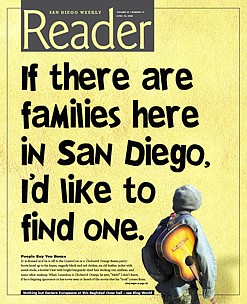
People Buy You Booze
D. is dressed as if he is off to the ComicCon or a Clockwork Orange theme party: boots laced up to his knees, raggedy black and red clothes, an old leather jacket with metal studs, a bowler hat with bright burgundy-dyed hair sticking out, eyeliner, and some other makeup. When I mention A Clockwork Orange, he says, “Huh?” I don’t know if he is feigning ignorance or has never seen or heard of the movie that his “look” comes from.
I know that D., as I talk to him, is sizing me up, trying to figure out if I am telling him the truth or playing him, trying to decide if he can physically overcome me and rob me, or beat me up for the hell of it. More than once he tells me how much he loves utilizing his “shitkicker boots” to break ribs and smash faces in. I have a feeling it’s all boast — he wants me to think he’s a badass, that he’s tough and knows how to survive on the streets.
He is scared.
D. says he’s 16 and he’s been on the street for two years, finding his way to San Diego from Tempe, Arizona. “I tried L.A. and Orange County for a while,” he says, but he did not care for the “scene” there. “Cardiff, P.B., O.B., they’re cool,” he says. “I like to be by the water.”
“What do you mean by ‘scene’?” I ask.
He juggles three rocks as he speaks, hoping to catch some attention, maybe some money from the people who walk by us on the boardwalk. “Too many peeps,” he says, “too much competition. Too much violence. Hate.”
“What violence?”
He gives me this look: he’s not going to talk about that; he doesn’t want to, doesn’t care to — what does it have to do with him?
D. has plenty to say about all the “domestic tranquility,” as he calls it, in Tempe, Arizona. “Since I was eight or nine, I used to share a drink with my mom,” he says. “Maybe before, I don’t know. But the first time I got really drunk, it was on Bailey’s. I threw up. I must have had half the bottle. It was sweet shit; I liked it. I never liked beer or red wine; that’s what I tried before, and even tequila. I like tequila now but not then. I ralphed on the Bailey’s and my mom’s boyfriend, what’s-his-name, he just laughed about it. My mom wiped my mouth with a towel — we were in the bathroom, I’d just lost my junk in the toilet — and she said something like, ‘Hey, sleep on your belly, okay, so you won’t choke if it happens again.’ So she sent me to my room and made sure I was on my stomach. I didn’t ralph again, but I woke up with this shitty bad hangover. I can’t smell Bailey’s or anything like it without getting this sick feeling. Beer, tequila, that’s my drink if I drink.”
“How do you get booze?”
“Easy. Dudes always have it. People buy it for you. That’s why I like hanging at the beaches. People aren’t so uptight, not even the cops. It’s not like in the city, or even up in L.A. Things are more mellow here.”
“Does your mother know where you are?”
“I write to her…sometimes.”
“Does she ask you to come back?”
“Not really, I don’t know.” D. seems uncomfortable. “Sometimes she sends a couple $20 bills in the mail. I think I missed some of her letters because of my moving around. Like, last letter she wrote, ‘Why haven’t you answered me about…’ such-and-such, this, whatever, she must have asked me something and she’s mad I didn’t answer, but I didn’t get any letter. Either she didn’t send it and thinks she did, because she’s a drunk, you know, or the letter didn’t reach me.”
“Do you ever call her?”
“It’s long distance. Why waste the money? I called once. Some guy answered. Don’t know who. Didn’t recognize the voice. So I hung up. Some new boyfriend. She switches boyfriends every four months. Every ten minutes!” He finishes his juggling. “Every ten, a new gentleman.”
“How long was she with your father?”
“Couple years. She was 20 when I was born. And a drunk.”
“Do you speak with your father?”
“Not really.” He looks at some people down the block. “Used to. I told him about getting wasted on Bailey’s, and he wasn’t happy about that, but he was, like, ‘That’s your mother for you.’ ”
“You couldn’t go stay with your father?”
“Do I wanna? He’s been in jail a lot. He’s better. No more crazy-making trouble. But he got married and then he moved to Seattle because the chick he married, her family is loaded, I guess. As a wedding present her mom and dad bought them a house, any house they wanted in any city, so they decided to live in Seattle and that’s what they did. Some luck. I wish I can marry a chick like that; like, her mom and dad will buy us a house, but I wouldn’t pick Seattle. I’d pick San Diego, Solana Beach, or Oceanside. Or Montana, out in the wilderness and stuff. I’ve heard about Montana. I’d like to check it out.
“I was going to check out Seattle once,” he says, “maybe even drop in on the bio-dad. But I never made it up that far. Only got as far as L.A., and then I went back down this way.”
I ask him about street families, made of homeless and runaway kids; these “families” have become a part of many urban myths and extend from city to city across the country. I want to know if there are such families in San Diego.
D. acts as though he doesn’t know what I mean. I can tell he doesn’t want to bother with the question. “I’ve heard about families,” he says. “Plenty in L.A. There were some in Arizona, and I know of some in, like, Nevada and such, but I don’t know of any families. I’ve never been in one.”
He says he’s in a program, “a group home thing,” but he doesn’t elaborate and I don’t want to push it. He’s acting as if he wants to go; he doesn’t want to talk to me. His eyes go cold and hard.
“What’s your story?” he asks.
“I ran away from home when I was 15,” I say. “I hung around Hollywood and Venice Beach.”
He nods. Have I impressed him?
I don’t tell him that I didn’t run away because of a bad family; I ran away because I was a young neophyte writer who was reading Jack Kerouac and Jack London and listening to the Doors, so I thought running away and wandering the streets would give me material to write about.
“Did you hook?” D. asks.
“No,” I say. “Did some good Dumpster diving.”
He laughs. “Yeah.”
“Tell me about what you want to do, say, when you’re 20. Twenty-five.”
“Be in a band.” He says he can play the drums and the keyboards; he’s played on them but doesn’t own any. “I suck!” In punk rock terms, that means he’s good.
He looks at some people down the block again. A group of kids, dressed as colorfully as he, are coming this way.
“I gotta go,” he says.
“It’s okay,” I tell him.
“Not okay for you. They shouldn’t see you talking to me, and I wouldn’t try to talk to them if I were you. They might hurt you.”
“They” were the kids coming this way. Are they a gang, I wonder, gatekeepers of information? Will “they” find it strange that D. is talking to a regular, older person like me? I am amused, but also touched in a way, that he is concerned about my safety. I am also curious about just how dangerous “the dangerous streets” are.
The approaching kids disperse; I guess I will not find out.
Before I can ask D. about it, he walks away, juggling the three rocks.
No One Declares Himself Old School
Finding street kids and runaways in San Diego was easy; there are certain areas they converge on in Ocean Beach, Pacific Beach, downtown, and in East County, such as El Cajon and Lemon Grove, or in North County, in Oceanside and Carlsbad. Getting them to speak to me proved trickier. Approaching them at their hangouts with the news that I was researching an article caused nervous and angry laughter, skepticism, and distrust. My press badge did not impress them and made them even more cautious since it had been issued by the San Diego Police Department. They thought I was a pervert looking for a young trick, or a cop, or maybe I was a parent trying to find his runaway child. If I bought them food (pizza, burritos, hot dogs), however, they would warm up and talk to me; or I had to “make a donation” for their time. Seventy-five percent of those I sought out for interviews flat-out refused me, politely or with contempt, spitting on the sidewalk or eyeing me as if they were ready to hit me with their fists or their skateboards, which does eventually happen.
One evening I was talking to four young males with skateboards, and two of them hit me with their skateboards, assaulting me from behind; when I went down, all four kicked me with their shoes or boots and searched through my pockets. This was my own fault; I did not report the incident to the police because I saw no point in creating another statistic for a crime that would never be solved. It was dark out, I was not paying attention, I would not be able to come up with a reliable description or to point them out in daylight as they all had a generic “look” — very short hair, baggy jeans, flannel shirts; all were holding skateboards. (In late February 2008, an Australian man was beaten by two males with skateboards in the Point Loma/Ocean Beach area, leaving him in a temporary coma; I wondered if these were the same assailants, but when the police issued photos of the suspects, I realized they were too old to be my muggers.)
When I crossed paths with these four, I was walking home from the store. I was recovering from a nine-day bout with the flu and was not thinking clearly. I have been mugged twice previously in my life — once while driving a taxi cab, and once at the 12th and Imperial trolley station on Christmas Eve — experiences that have taught me to be aware of who is standing behind me or getting too close into my personal space. Twice, I was not paying attention and was mugged from behind — now it’s three times. Exciting? No. Stupid is a better word. I should have known better than to let two of the young men stand behind me. And I should not have attempted an interview at night on a dark side of the street. I wasn’t even out looking for interview subjects, although sometimes interviewees show up; the term is “random samples.” They only got away with $21.50; I have deemed this the price of admission, the price (along with a few bruises and a cut lip) of a reminder always to be cautious…the price for being dumb enough not to remember my own rules of safety when “in the field.”
The Rules, the Names
There is a general code among them, four rules, I was to learn:
- Don’t narc or tattle. (That is, don’t be a rat.)
- Keep your mouth shut. (Don’t talk to the cops.)
- Old school rules. When a street kid becomes old school (over age 22, in most cases), you have to do what he or she says.
- No one declares himself or herself old school. You have to earn it.
Breaking the rules, I was told by several kids, could result in being ostracized or beaten up — “paying a tax,” it’s called. So, every kid that did talk to me was running the risk of breaking rules one and two, no matter how much I assured them I was not out to get anyone in trouble, only trying to understand their reality. Breaking rules one and two could incur the wrath of those listed in three and four or hinder someone from gaining the respect and status of “old school.”
Many went by nicknames — Glitter, Souleater, Highlander, Dalmatian, Trucker, Princess, Shoulderblade, Sabretooth, etc., like handles on instant messaging or in a video game. I’ve taken care to change names and locations to disguise where each interview subject is located in the city. It’s not my intention to get anyone “taxed” for “talking.” As the TV show says, “The names have been changed to protect the innocent.”
Mom Was on Meth and Other Crap
Glamour’s street name was chosen for sheer irony, and she thinks it’s funny. She was born with fetal alcohol syndrome, which has left her face with some “less than pretty” features. “My mother was 80 proof the whole time I was in her,” she says. She doesn’t know the medical term, or much about the condition, but I do — if the mother drinks heavily between days 15 and 22 of her pregnancy, when the facial features of the fetus are forming, there can be detrimental results. Glamour’s eyes don’t line up, her mouth is crooked, and she has unusual bone structure in her cheeks. You have to look closely to see it because she wears very heavy makeup to help cover her flaws. “Guys tell me I’m pretty,” she says, “when they want something.” She admits to occasional hooking when she needs money.
She doesn’t tell me how old she is; I am guessing between 14 and 16. She wears thick, warm clothing, although it is not cold out and the sky is clear; the sun is bright and warm. “I have very thin blood so I’m always cold,” she tells me. “I’m not sure if I have my mom to thank for that too.”
Not only was her mother — who gave birth at 42 — an alcoholic, Glamour says, her mother was also on “meth and other crap.”
“She is a whore,” Glamour says with obvious distaste. “A barfly type, a whore for a drink.”
Glamour does not drink; she says she likes to smoke pot because it makes her feel “at peace with the world. Everything seems as if it’s calm and cool. I close my eyes and listen hard.”
To what?
“I listen,” she says.
She spent much of her childhood in and out of foster homes. “My mother couldn’t deal with me. She only wanted to drink. Why did she even have me? I’ll never figure that one out. I asked her once and she just…I dunno. That’s when I lived with her when I was 11. For a while my grandparents [took care of me], but they were in their 70s, and then my grandfather died and my grandmother went into a home. I don’t remember that. I was, like, 3.”
This was in Denver, Colorado.
“How did you wind up in San Diego?”
“To go to Hollywood and be a star, baby!” she says and laughs loudly. “Oh, I’m kidding,” she says. She lights a cigarette. “I hitched out. Read about it on this website.”
“What website?”
“Digihitch.com. It’s cool. About hitching, road travel and all, where to go to get food, services and all, meet people, all that crap.”
I ask her about street families, and she says, “I was in a family in Denver. Mom, Dad, six or seven kids. We set up tents. I didn’t like it.”
“Why?”
“Just didn’t like it,” she says.
HomelessTeens.com
Several kids I talk to, as a means of finding out information for living on the road, on the street, and on the beach, mention Digihitch.com. There is also hippy.com. “The Internet is easy to use,” D. says. “You go into any library, or you use someone’s connection, or if you have a laptop you can sit in a lot of places and pick up some Wi-Fi.”
Are You Pimping Your Girl Out?
I had heard rumors of young women working the beach scene or getting money out of men who “pick them up.” I live in Ocean Beach. Prostitution is common. I was unaware of this until one day in 2005. I was walking home from the grocery store and was approached by a young woman in ripped jeans. I had spotted her walking with a man who was her age up ahead of me; they both could not have been older than 19. He veered off as she walked up to me and asked if I had a dollar. I do not care to be panhandled and usually ignore those who try, but she looked hungry and scared, so I gave her all the change I had in my pocket.
Then she asked, “You wouldn’t know where I could make $20 to $40, would you?”
“What?” I said.
“You know,” she said, raising her eyebrows.
I knew. “How long have you been doing this?” I asked.
“What?”
“Is that your boyfriend there? Is he pimping you out? Hey, you!” I yelled at him.
“Please,” she said, “no.” She was embarrassed now.
“YOU! YEAH YOU! COME OVER HERE NOW!”
Sheepishly, he joined us.
“Yeah?” he said. They both had accents — Southern, of some type.
“Are you pimping your girl out?”
He glared at me. “She likes sex,” he said.
She nodded when I looked at her.
“We need money,” he said.
“Hungry,” she said.
“We haven’t eaten in almost a day,” he said.
He was playing me. His words were rehearsed. He was better at it than she was. I had no sympathy, but I did have a lot of curiosity. So I invited them into my apartment for lunch. They probably thought a sexual transaction was going to transpire; money would be made. They weren’t 19; they were younger. I imagined them being lovers on the run, a modern Romeo and Juliet. I wanted to created something mythical and romantic and sugarcoat their truth, but they were just two destitute kids who were having a hard time surviving.
I made them hot dogs, gave them chips and sodas, and asked about their story. They were from Kentucky, and that explained the accents. They had driven out to the West Coast in search of Hollywood (I didn’t tell them they were in the wrong city). They were broke and living by the beach in their car, an old station wagon that, he said, “was on the verge of falling apart.”
“How long have you been hooking?” I asked the girl.
“Two weeks.”
“How many tricks have you done?”
She shrugged. “Not many. Four or five.”
“Why did you single me out?”
She shrugged. “You were there.”
“You were checking her out,” the boyfriend said, defiant. “So why not,” he said, “she likes sex.”
She didn’t say anything.
“Why not make some money?” he said.
I asked her, “What was your first john like?”
“John?” She didn’t understand the term.
“Trick,” I said. “Customer.”
She shrugged again. “I was drunk. Just some guy. In his car. It was okay. He gave me $40.”
“Do you see yourself going pro? Doing porn movies? Stripping?”
“No,” she said. “I’m not a stripper.”
“Then what are you?”
“What are you?” she said, softly.
“Why all the questions?” the guy said. He was pissed off. He stood up. “So you fed us, so thanks. No reason to be mean.”
“I’m just trying to understand,” I said.
“Understand what?”
“Why people do this.”
“Do what?”
“Why what?” the girl said. “What is there to understand? People do stuff.”
“You’re just an asshole,” the guy said.
Was it as simple as that? Now I was feeling uncomfortable. I was asking very personal questions, and I had no right.
I wanted them to leave. The sight of their skin and clothes started to nauseate me. I didn’t want to hear their accents; I didn’t want to hear another word out of their mouths. I gave them $20 and told them to go away. That night, I became paranoid, because they knew where I lived. I tried to remember if either of them was casing my apartment out, how to get in. I thought about them waiting for me to leave, maybe watching from their car, so they could rob me. I looked for station wagons that were filled with possessions, as if someone lived in them. You can find these cars on any block in Ocean Beach. I looked for Kentucky license plates, on my block and down at the beach. I never saw them again.
Three years later, I think about them now and then. Are they still together? Did she go pro? Where are they, how are they, what happened?
You Don’t Talk About Street Families
I am sitting at an outdoor table at a local taco shop in Ocean Beach, waiting for my food. At the table next to me are two teenage girls. Both are very thin and their clothes are dirty, their hair unwashed. They are counting out the change they have on the table — a pile of dimes, nickels, pennies, a few quarters. I listen to them talk about how to get more money, some party that was happening tomorrow night, something about “this jerk.”
One of them looks at me. She is smoking a cigarette. She walks over and asks if I have any change. I tell her I’ll buy the food they want if they’ll talk to me and tell me about their lives. They are both dubious, of course, and they should be on their guard, for their own safety. I explain the article I’m working on. One girl doesn’t want to have anything to do with me. But the other, the one who is talking to me — I’ll call her Kimmy — figures, why not, I’m buying lunch. “You buy, I’ll fly,” she says.
When their food is ready, Kimmy sits at the table with me; her friend stays at the other table but keeps looking at us out of the corner of her eye.
Kimmy says she and her friend are in a certain school, an “at-risk youth” school that I have heard of, but they haven’t been in almost three weeks, nor have they been at the “home” where they both lived. “Too many rules and sketchers,” she says, but doesn’t explain. “I don’t like being told what to do, and my friend, she doesn’t either. We’re tight. We’ll kill for each other.”
“Looks like she wants to kill me now,” I say.
“She doesn’t trust people. She’s been…” Kimmy doesn’t explain. Her friend stares at her.
“So where have you two been staying?”
“Here and there, there are places,” she says, blowing smoke out of her mouth and toward me in what seems like an action she saw in a movie or on TV. “Guys,” she says, “there are guys to stay with if we need to.”
I nod.
“I’m out.” She holds up her pack of American Spirits. “Buy me one, we can keep talking.”
I give her a $10 bill to get cigarettes. She goes to the gas station next to the taco shop. I almost expect her friend to stand up and they’ll both run off — they’ve eaten half their food. But Kimmy comes back with a new pack. She even gives me change.
“How do you get cigarettes?” I ask. “Don’t they ask for ID?”
“Oh come on,” she says.
“You’re not 18.”
“Oh, get real,” she says, and looks at her friend. “Cigs are the easiest things to get.”
“Where are your parents?”
“I don’t know, probably in jail.”
“Probably?”
“I haven’t talked to them in three years or so. They fought all the time. All the time,” and I see it in her eyes, hear it in her voice: remembering. “The cops would come. They kept the neighbors up. One night the cops arrested my daddy. But you know what’s funny? My mommy was the one beating up my daddy, she could always take him, but they arrested him and they were asking her if she was okay, did she want to get a restraining order, did she need counseling. When the cops left she just laughed about it. The next time the cops came, they were both arrested because there were drugs around the place, and I got put in a fucking foster home.”
It was the first of many. “I would get fed up with the shit there and jet,” she says. “Then I’d get picked up and put in another foster home, then I’d jet. Then I did some time in juvie. Four months in juvie.” She adds, “Ugh.”
“What for?”
“Solicitation.”
“What?”
“Hooking.”
I nod.
“You don’t believe me,” she says.
“I believe you,” I say.
She leans forward. “That’s right.”
“So you were in juvie…”
“Also for getting in this fight. Messed this bitch up.”
“Four months,” I say.
“It sucked,” she says.
“I bet.”
“Bad shit in there.”
“I bet.”
“You have no fucking idea.”
“I don’t,” I say.
“So back to another foster home, then this other home, where I met her [her friend at the next table] there, and we were sent to this stupid fucking school, and we left that shit and now we’re here.”
“Where were all these foster homes?”
“Everywhere,” she says. “El Cajon, Spring Valley, Encanto, even one in La Jolla, and that was the worst. These people,” and she shakes her head.
“What people? The foster parents?”
“They think they can save the world and shit,” she says. “They think they know how shit is, but they don’t know shit about shit.”
I ask about street families.
“That’s something you don’t talk about.”
“Why?”
“Because.” She blows smoke my way. “You just don’t.”
I walk by a bus stop and see D. there with a group of kids, eight of them. They’re all waiting for the bus. I know he sees me, but he acts as though he doesn’t. I don’t look at him or say anything.
How Does It Feel to Get Your Old Ass Whupped by a Kid?
Ryan is 15 and tells me that he has a home, but he hardly goes there; he stays with friends, or at the beach if it’s warm, and he only goes to school if he’s forced to, but he finds school to be a waste of time. “The kids don’t want to be there, and the teachers don’t want to be there,” he says, “so what’s the point? You got a bunch of people sitting in this room and none of them like it, they’d all rather be somewhere else, and the government tells them they gotta be there and the teachers gotta be there because they want to get paid by the government to babysit us.”
He says his mother is a “wannabe hippie.” She had him when she was 22 and married. She got divorced, and she then got involved with an older guy. This guy is in his late 50s, a Vietnam vet. “She wants to be a hippie so bad, she wishes she was around back then, so she hooks up with this stupid old guy who I guess was in ’Nam. ’Nam,” he says and spits on the ground, symbolic of bad memories. “What’s with these dudes? They’re all so fucked up.”
“What do you mean?”
“Like my mom’s old man,” he says. He refuses to refer to this guy as his “stepdad,” and he isn’t sure if his mother ever married him for real or not. “Sometimes she says she is married, sometimes she says it never happened, sometimes she says they were married in Las Vegas, and sometimes that they went down to City Hall.” He’s not sure what the truth is and now he doesn’t care, but he will never call the guy his stepfather. “He’s a mean little fucker with a chip on his shoulder,” Ryan says. “He’s usually quiet and stares at the TV, but when he starts drinking and doing speed, he goes nuts. He takes it out on my mom. Starts hitting her and hurting her and shit. And the neighbors call the cops and sometimes they take him away or sometimes they don’t do shit, and when the cops leave he laughs and says the cops are stupid and starts hitting my mom again.”
“And she stays with him?”
“Ten years,” he says.
He says he decided to do something about it. He started to lift weights at the gym in school and at a friends’, getting muscles. He shows me his biceps, flexes them with pride. “When I knew I could, I took him,” Ryan says. “I wailed on his ass and said, ‘How do you like it, huh, how do you like it when someone hits you?’ My mom had to pull me off him, she said I was gonna kill him, and I wanted to kill him, and the pussy was just there on the floor and crying like a baby or something. He was crying, and I said, ‘Look at the big bad tough guy now!’
“My mom, she says, it’s the same thing always, she says to me, like she says to the cops, she says to me, ‘It’s not his fault. He saw some bad things in Vietnam and did bad things and it’s messed him up bad, it’s not his fault.’ She always says, ‘He’s a combat vet and he has issues.’ She always says, ‘It’s the Agent Orange, it’s not him, it’s the Agent Orange.’ I’m, like, dude, that was so long ago, that was a million years ago, get over it, will you. Don’t take your fuck out on other people and just get a grip, it was a zillion years ago.
“He wasn’t so big a talker now that I could whup his ass. He was quiet for a time. Couple days. Then he gets drunk again and thinks he’s bad and he wants a rematch. He comes into my room, he breaks open the door because I have it locked, and he comes in and says, ‘I’m gonna kick your ass now,’ because he wants revenge. He wants revenge because I whupped his ass, so what do I do,” Ryan says proudly, “what do I do, but I whup his fucking little ass again! Old man! Stupid old man! You think you can take me? Big badass ‘combat vet’ —- how does it feel to get your old ass whupped by a kid, huh? You like hitting women — well, how does it feel when you get hit? How do my fists feel on your face?”
Ryan is riled up, punching at the air, his face red. He is reliving the experience, the feelings, the hate, the fear.
His violence worries me.
He calms down.
“Well, shit,” he says, grinding his teeth a bit, “the old man wasn’t feeling too good about getting his assed kicked. I kicked his ass three times. I worked out even more for the next time. But he tells my mom, ‘He goes or I go.’ He says, ‘We should be in the bedroom.’ ”
Ryan explains that the three of them lived in a one-bedroom; he had the bedroom, and they had the living room with a fold-out couch. The arrangement was to appease Ryan’s father, who sent child-care payments each month that went to rent.
“So you know what my mom does?” he says.
“She took his side?”
“She says, ‘Maybe you should go to your dad’s for a while.’ ”
“Where is he?”
“Up by San Francisco, he has this job in computers. Walnut Creek. Can you get that? Can you see me in a place called Walnut Creek?”
“Been there,” I tell him. “Isn’t so bad.”
“It sounds bad,” Ryan says. “She calls my dad and they argue a lot. He sends money, I see him maybe two times a year. He always comes down here. But he has another wife, he has three kids, a girl and two boys, brothers and sisters I never met and I don’t wanna meet and they don’t wanna meet me. I can’t go up there and I’m not gonna go up there, so I say fuck it, fuck it, I’ll move out, I’ll go. You wanna stay with this buttwipe who beats on you all the time, you can stay with the little creep and you let him hit you, you do what you want, I tried. I tried to stop him, you do what you want, but I swear, if he ever hurts her bad I will cut his eyes out. He kills her, I’m gonna kill him three times over. I’ll kill him for days.”
Ryan’s best friend, who is a year younger than him, has a dad who was in the “Gulf War, and he’s messed up something bad too,” Ryan says. “None of that ‘Agent Orange,’ but he says, I mean my friend says his dad saw some bad shit like the ’Nams. But my buddy’s dad, he doesn’t get mean and angry when he drinks. He gets quiet, he’s like, he sits there on the couch and just cries. Or he walks around the neighborhood and talks to trees. So that’s where I stay a lot, I can crash there with my buddy, his dad doesn’t care. I don’t think his dad notices really. I don’t stay there all the time, half the week like, and there’s couches to crash on, or I can take the sleeping bag out to the beach. My mom keeps trying to get me to come back. I say yeah, well, I’ll just kick her husband’s ass if I do.”
He’s facing a choice, however, because his mother says she plans to move to Idaho by midyear. “Get this, the little angry man comes into some land and money. His own mom dies and leaves him this property up in Idaho and money. All he talks about is how he will use the money to sue everyone who ever messed with him.”
His mother says he can move to Idaho with them.
“No way” is Ryan’s response.
He wants his mother to emancipate him when he turns 16, so he can legally be on his own.
“Will she do it?” I ask.
“She has to,” he says.
Next, I ask if he knows about the street families.
“I’ve known some kids in them.”
“Here?”
“Not here, I don’t think, but places.”
“Other cities.”
“Yeah,” he says, “it’s some freaky shit.”
“How so?”
“Well,” he says, thinking, “I don’t get it. They trade one family for another. They have rules and laws. You break the rules, you get your ass whupped or have to pay money or you get kicked out.”
“There’s a ‘mom’ and a ‘dad’ in the families.”
“Yeah, they say that. That’s freaky shit. Don’t know…”
“Know what?”
“Are they that desperate to have some kind of real family that they make up shit like that? Mommy and Daddy and brothers and sisters.”
“Some people like the order of things,” I say. “The security.”
“Of what?”
“Belonging.”
“Don’t they know they’ll just get hurt? Every kid I know who has been in one of these families, they just get hurt. It happens.”
“Hurt in what way?”
“Every way.”
“If there are families here in San Diego, I’d like to find one.”
“Why?”
“To learn from them.”
“Learn what?”
“I’d just like to talk to them, the ‘mom’ and ‘dad.’ ”
“Not a good idea. They wouldn’t talk to you, for one. They’d probably attack you. They’d probably whup on you thinking you’re out to get them. Or they’ll just lie to you.”
“Why would they do that?”
“Everyone lies. Like the weekend warriors.” The weekend warriors, he explains, are kids who have homes, have families, but like to slum with the street kids on Saturday and Sunday, pretending they’re down and out. “They think it makes them bad,” he says, “and they panhandle. They come up with these sob stories and they tell people. They dress all ratty and make people feel sorry for them and people give them money, or the church people come by and give them food and clothes and shit, and later they laugh about it. They say these church people are so stupid, everyone is stupid. They get all this stuff, and they maybe make $40 or $50 a day from panhandling when they don’t really need it.”
I ask Ryan where he sees himself in five or ten years, what would he like to be doing.
“An assassin,” he goes.
“C’mon.”
“Sure. A contract killer, for the Mob or the government or anybody. I’ll kill people. For the right price. Maybe I’ve already done it, how would you know?”
He’s serious.
“Maybe I’ll be married,” he says.
All over San Diego — from El Cajon Boulevard to Newport Avenue to Market Street to Highway 101 in North County, I find flyers posted by the “Outreach Team” of the Storefront, with a phone number. I call and leave a message, saying there are some questions I’d like to ask about local runaways and street youth. They don’t return my call.
Sex Is Stupid
Rhonda is 16 and has a part-time job at a deli that she says she is going to quit because her friend was fired from the place. “If they don’t bring him back, I’m going to say, ‘Later, dudes.’ ” She says the owners are Arabic. “These foreigners don’t get it, they don’t understand what being tight with a friend is like. I can always get another job. It’s not like I really like those sandwiches. They don’t help you lose weight, they make you gain. I gained six pounds since working there, eating sandwiches all the time. I hate that stuff now. I can get a better job. I need to make more money if I wanna get a place with my homies.”
She is still in school; she knows she needs a diploma. “Maybe I might go to college too,” she says. “There’s all kinds of scholarships. I can get a free ride. My grades are good. I don’t know. Maybe.”
I meet her at the bus stop, and we take the same bus to get the trolley at Old Town. I have seen her before on the bus, have overheard her talking to people about foster homes and the system and how she lived in a shelter with her mother for half a year when she was ten. “I’ll never go back.” She is short, perhaps just barely over five feet tall; she wears baggy jeans and a large T-shirt and a beanie cap. She talks and speaks the tough-chick act well and has acquired the attitude and look.
I also overheard her, a month ago, talking about getting in a fight with another girl over a guy they were both sleeping with and how she won the fight, but the guy picked the other girl to “be with,” and that pissed her off so bad “that I kicked this guy’s ass too.” It was a tall story on the bus to a captive audience of three other kids. Who knows if it is true? I am tempted to ask her about it but don’t; she might find it strange that I know more about her life than she thinks.
She also thinks I am trying to pick her up. “I don’t really date older guys,” she says, “not really.”
“That’s not what I want,” I say.
“What do you want?”
I try to assure her I am not a bad guy. She looks me over. “You’re harmless,” she says. “I’m pretty good at telling. I can read a person. I’m kinda psychic.”
“What makes you say that?”
“Sometimes I just know what people are thinking. I know what’s going on in their hearts, if something bad happened or if they are sad or happy or are lying.”
She has a brother who lives with his father; his father is not her father. “My dad is some guy, somewhere,” she says. “My mom, she had me when she was 14. Fourteen! Dude. I can’t even think about what it would be like if I got knocked up at 14. Like, right now if I had a kid that was 2, the way it was with my mom, oh God.”
Her mother has health problems. “She’s all messed up on pills and doctor stuff; she has problems with something, her intestines. She’s sick a lot. Probably from the booze, but she doesn’t drink anymore. I know I’d be a better mom. I’d try to be. But that ain’t gonna happen. I ain’t gonna get knocked up. No glove, no love.”
She says she really likes her friend who got fired, but he wants to sleep with her and she doesn’t want to do that. “We’re too close and I like just that,” she says. “If we did it, it would only ruin us being friends. That happens a lot. I don’t want to lose my friend over sex, which is just stupid anyway.”
“Sex is stupid?”
“All it ever does is cause trouble. Look around. Sex always messes all kinds of stuff up. It’s stupid. People can’t mess around and be fun and leave it at that. There is always all this drama. I’ve had enough drama in my life.”
She is now an emancipated minor, the way Ryan wants to be. She’s been in foster families, and she was recently sleeping at a special shelter for girls. “Too many lesbians there,” she says, “not my thing.” She now rents a room out from a family, but she and some friends want to pool their money together and rent out a house. “A real house,” she says, “a real home.”
“Are you and your friends like the street families?”
“No. We’re just homies.”
I start to think that these street families are an urban myth, propagated by the media, like in the episode of Law and Order about a street family led by a homicidal maniac. In fact, portrayals of makeshift street families in Dickens and Doyle (the Baker Street Irregulars who help Sherlock Holmes in his cases) are violent criminal gangs, not a loving substitute for Mom and Dad and domestic bliss.
While in the area of Solana Beach, a couple of teens smoking a joint point out a group of people gathered on the beach and tell me that they are a street family known in this area. I squint at them; the group is mostly teens in worn clothes. I spot what looks like an older man and woman — could this be the “mom” and “dad”? There are 11 in all. I decide to find out.
They notice me approach. The older male says something, and the group disperses, breaking off into couples, or going off alone, everyone headed in a different direction.
Fred Wants a Dollar, Man
J., who has long brown dreadlocks and smells as if she hasn’t bathed in a week, doesn’t have any shoes. Her feet are caked in dirt. She hates shoes. She says it is “the lifestyle.” She tells me she has just turned 17 and instead of prostitution, she makes money with her dog. The dog she holds by a leash is scrawny, dirty, and has desperate eyes. I think it may be some kind of Labrador mix. His name is Fred. Fred wants to lick me and for me to pet him.
“Man, he likes you,” J. says. “He usually doesn’t like guys.”
“Fred smells my cats on me is all.”
“Fred wants a dollar, man. Give him a dollar. Just hold it out. Watch.”
I hold out a dollar. Fred takes it in his mouth, whimpering, tail wagging, and turns to J., his mistress. She takes the dollar and pockets it.
“Great trick,” I say.
“No trick,” she says. “Business. Me and Fred, we’re partners.”
Fred looks to me, wagging his tail. He wants more dollars.
“People won’t give money to you when you hustle, not you alone usually,” she says. “But you got the dog, they become these humanitarians all of a sudden like. ‘Oh, look at that poor hungry dog,’ and they give you money to feed it. Me and Fred here can make $200 over a weekend. Man, if I had a baby, I’d make twice as much. You see these folks with their baby, ‘my baby need to eat,’ ‘my baby need clothes,’ and people get all generous and shit. Almost makes me want to have a kid. We’d be business partners the way me and Fred here be partners. Oh, look, he heard that, Fred is jealous.”
They Separated Me from My Sisters and My Mom
Anna is 16, five and a half months pregnant. She lives with a “good” foster family. “They don’t judge me or nothing like that,” she says, “they are kind people. Their own kids are grown up and live in other cities. I know they just need someone around to take care of, and it makes them feel good.”
She’s in school, and she takes an after-school course about prenatal care and how to take care of her baby when the child is born. This is not the first time she’s been pregnant. Another time was two years ago. “But it just wasn’t meant to be,” she says, not explaining further.
“Where is the father?” I ask.
“He’s ‘not in the picture,’ ” she says, making finger quotes. “Maybe someday he will be. Depends. It would be nice. It doesn’t matter. I can do this alone. I used to take care of my sisters. I know how to take care of babies.”
She says she’s been homeless since she was 12. Her father was killed in a fight at a bar. “He left the bar and someone shot him. So we were alone. Me, my mama, my two little sisters. We got evicted and went from friends to aunts and uncles and kept moving. I remember for a while we were living in this abandoned house in Golden Hill, no lights, no water, nothing, just some sleeping bags. The four of us. We were there for a few months, until the person who owned the place found out and called the cops and got some court papers. There I was, going to school, trying to act normal, living in this house that wasn’t ours, and I’d take care of my sisters while my mom was out working or looking for work.”
“Was there a lack of work?”
“She worked, but it never paid much. We ate, we had food, we had clothes, we just couldn’t get a place or a home.”
Next, they went to the shelters.
“The shelters welcomed us. There were several. There were programs. But the State people, the family people, wanted to separate us. They said it would be for a while, until things were better. They separated me from my sisters and my mom.”
“Where are your sisters?”
“Foster home, the same one at least, they are together.”
“Your mother?”
She hesitates. “She’s with some guy now. She’s not happy that I’m pregnant. She wasn’t the other time. I wasn’t going to have no abortion. That’s just wrong. I won’t ever kill some small life. It’s not their fault. And I want my baby. No one will ever take my baby from me. No one can ever take that love from me, and they can’t, they never will, no. If she’s a girl, she will be my best friend. We’ll be more like sisters than mama and baby. Even if she’s a boy. If she’s a boy, he’ll be my best friend too.”
She says, “My mama had me when she was 17, so I don’t see where she has call to judge me.”
She says, “No one does. They don’t know me.”
“She’ll change her mind when she sees her grandchild,” I say.
Anna smiles. “She will. I know she will.”
I ask her about the street families — does she know about them, has she ever crossed paths with them?
“Just talk,” she goes. “I would never join one.”
Why not?
Anna touches her stomach and says, “I have my own family; I don’t need to find no fake one.”
Here's something you might be interested in.
The facts of life for homeless San Diego kids
If there are families here, I'd like to find one

The facts of life for homeless San Diego kids
If there are families here, I'd like to find one
People Buy You Booze
D. is dressed as if he is off to the ComicCon or a Clockwork Orange theme party: boots laced up to his knees, raggedy black and red clothes, an old leather jacket with metal studs, a bowler hat with bright burgundy-dyed hair sticking out, eyeliner, and some other makeup. When I mention A Clockwork Orange, he says, “Huh?” I don’t know if he is feigning ignorance or has never seen or heard of the movie that his “look” comes from.
I know that D., as I talk to him, is sizing me up, trying to figure out if I am telling him the truth or playing him, trying to decide if he can physically overcome me and rob me, or beat me up for the hell of it. More than once he tells me how much he loves utilizing his “shitkicker boots” to break ribs and smash faces in. I have a feeling it’s all boast — he wants me to think he’s a badass, that he’s tough and knows how to survive on the streets.
He is scared.
D. says he’s 16 and he’s been on the street for two years, finding his way to San Diego from Tempe, Arizona. “I tried L.A. and Orange County for a while,” he says, but he did not care for the “scene” there. “Cardiff, P.B., O.B., they’re cool,” he says. “I like to be by the water.”
“What do you mean by ‘scene’?” I ask.
He juggles three rocks as he speaks, hoping to catch some attention, maybe some money from the people who walk by us on the boardwalk. “Too many peeps,” he says, “too much competition. Too much violence. Hate.”
“What violence?”
He gives me this look: he’s not going to talk about that; he doesn’t want to, doesn’t care to — what does it have to do with him?
D. has plenty to say about all the “domestic tranquility,” as he calls it, in Tempe, Arizona. “Since I was eight or nine, I used to share a drink with my mom,” he says. “Maybe before, I don’t know. But the first time I got really drunk, it was on Bailey’s. I threw up. I must have had half the bottle. It was sweet shit; I liked it. I never liked beer or red wine; that’s what I tried before, and even tequila. I like tequila now but not then. I ralphed on the Bailey’s and my mom’s boyfriend, what’s-his-name, he just laughed about it. My mom wiped my mouth with a towel — we were in the bathroom, I’d just lost my junk in the toilet — and she said something like, ‘Hey, sleep on your belly, okay, so you won’t choke if it happens again.’ So she sent me to my room and made sure I was on my stomach. I didn’t ralph again, but I woke up with this shitty bad hangover. I can’t smell Bailey’s or anything like it without getting this sick feeling. Beer, tequila, that’s my drink if I drink.”
“How do you get booze?”
“Easy. Dudes always have it. People buy it for you. That’s why I like hanging at the beaches. People aren’t so uptight, not even the cops. It’s not like in the city, or even up in L.A. Things are more mellow here.”
“Does your mother know where you are?”
“I write to her…sometimes.”
“Does she ask you to come back?”
“Not really, I don’t know.” D. seems uncomfortable. “Sometimes she sends a couple $20 bills in the mail. I think I missed some of her letters because of my moving around. Like, last letter she wrote, ‘Why haven’t you answered me about…’ such-and-such, this, whatever, she must have asked me something and she’s mad I didn’t answer, but I didn’t get any letter. Either she didn’t send it and thinks she did, because she’s a drunk, you know, or the letter didn’t reach me.”
“Do you ever call her?”
“It’s long distance. Why waste the money? I called once. Some guy answered. Don’t know who. Didn’t recognize the voice. So I hung up. Some new boyfriend. She switches boyfriends every four months. Every ten minutes!” He finishes his juggling. “Every ten, a new gentleman.”
“How long was she with your father?”
“Couple years. She was 20 when I was born. And a drunk.”
“Do you speak with your father?”
“Not really.” He looks at some people down the block. “Used to. I told him about getting wasted on Bailey’s, and he wasn’t happy about that, but he was, like, ‘That’s your mother for you.’ ”
“You couldn’t go stay with your father?”
“Do I wanna? He’s been in jail a lot. He’s better. No more crazy-making trouble. But he got married and then he moved to Seattle because the chick he married, her family is loaded, I guess. As a wedding present her mom and dad bought them a house, any house they wanted in any city, so they decided to live in Seattle and that’s what they did. Some luck. I wish I can marry a chick like that; like, her mom and dad will buy us a house, but I wouldn’t pick Seattle. I’d pick San Diego, Solana Beach, or Oceanside. Or Montana, out in the wilderness and stuff. I’ve heard about Montana. I’d like to check it out.
“I was going to check out Seattle once,” he says, “maybe even drop in on the bio-dad. But I never made it up that far. Only got as far as L.A., and then I went back down this way.”
I ask him about street families, made of homeless and runaway kids; these “families” have become a part of many urban myths and extend from city to city across the country. I want to know if there are such families in San Diego.
D. acts as though he doesn’t know what I mean. I can tell he doesn’t want to bother with the question. “I’ve heard about families,” he says. “Plenty in L.A. There were some in Arizona, and I know of some in, like, Nevada and such, but I don’t know of any families. I’ve never been in one.”
He says he’s in a program, “a group home thing,” but he doesn’t elaborate and I don’t want to push it. He’s acting as if he wants to go; he doesn’t want to talk to me. His eyes go cold and hard.
“What’s your story?” he asks.
“I ran away from home when I was 15,” I say. “I hung around Hollywood and Venice Beach.”
He nods. Have I impressed him?
I don’t tell him that I didn’t run away because of a bad family; I ran away because I was a young neophyte writer who was reading Jack Kerouac and Jack London and listening to the Doors, so I thought running away and wandering the streets would give me material to write about.
“Did you hook?” D. asks.
“No,” I say. “Did some good Dumpster diving.”
He laughs. “Yeah.”
“Tell me about what you want to do, say, when you’re 20. Twenty-five.”
“Be in a band.” He says he can play the drums and the keyboards; he’s played on them but doesn’t own any. “I suck!” In punk rock terms, that means he’s good.
He looks at some people down the block again. A group of kids, dressed as colorfully as he, are coming this way.
“I gotta go,” he says.
“It’s okay,” I tell him.
“Not okay for you. They shouldn’t see you talking to me, and I wouldn’t try to talk to them if I were you. They might hurt you.”
“They” were the kids coming this way. Are they a gang, I wonder, gatekeepers of information? Will “they” find it strange that D. is talking to a regular, older person like me? I am amused, but also touched in a way, that he is concerned about my safety. I am also curious about just how dangerous “the dangerous streets” are.
The approaching kids disperse; I guess I will not find out.
Before I can ask D. about it, he walks away, juggling the three rocks.
No One Declares Himself Old School
Finding street kids and runaways in San Diego was easy; there are certain areas they converge on in Ocean Beach, Pacific Beach, downtown, and in East County, such as El Cajon and Lemon Grove, or in North County, in Oceanside and Carlsbad. Getting them to speak to me proved trickier. Approaching them at their hangouts with the news that I was researching an article caused nervous and angry laughter, skepticism, and distrust. My press badge did not impress them and made them even more cautious since it had been issued by the San Diego Police Department. They thought I was a pervert looking for a young trick, or a cop, or maybe I was a parent trying to find his runaway child. If I bought them food (pizza, burritos, hot dogs), however, they would warm up and talk to me; or I had to “make a donation” for their time. Seventy-five percent of those I sought out for interviews flat-out refused me, politely or with contempt, spitting on the sidewalk or eyeing me as if they were ready to hit me with their fists or their skateboards, which does eventually happen.
One evening I was talking to four young males with skateboards, and two of them hit me with their skateboards, assaulting me from behind; when I went down, all four kicked me with their shoes or boots and searched through my pockets. This was my own fault; I did not report the incident to the police because I saw no point in creating another statistic for a crime that would never be solved. It was dark out, I was not paying attention, I would not be able to come up with a reliable description or to point them out in daylight as they all had a generic “look” — very short hair, baggy jeans, flannel shirts; all were holding skateboards. (In late February 2008, an Australian man was beaten by two males with skateboards in the Point Loma/Ocean Beach area, leaving him in a temporary coma; I wondered if these were the same assailants, but when the police issued photos of the suspects, I realized they were too old to be my muggers.)
When I crossed paths with these four, I was walking home from the store. I was recovering from a nine-day bout with the flu and was not thinking clearly. I have been mugged twice previously in my life — once while driving a taxi cab, and once at the 12th and Imperial trolley station on Christmas Eve — experiences that have taught me to be aware of who is standing behind me or getting too close into my personal space. Twice, I was not paying attention and was mugged from behind — now it’s three times. Exciting? No. Stupid is a better word. I should have known better than to let two of the young men stand behind me. And I should not have attempted an interview at night on a dark side of the street. I wasn’t even out looking for interview subjects, although sometimes interviewees show up; the term is “random samples.” They only got away with $21.50; I have deemed this the price of admission, the price (along with a few bruises and a cut lip) of a reminder always to be cautious…the price for being dumb enough not to remember my own rules of safety when “in the field.”
The Rules, the Names
There is a general code among them, four rules, I was to learn:
- Don’t narc or tattle. (That is, don’t be a rat.)
- Keep your mouth shut. (Don’t talk to the cops.)
- Old school rules. When a street kid becomes old school (over age 22, in most cases), you have to do what he or she says.
- No one declares himself or herself old school. You have to earn it.
Breaking the rules, I was told by several kids, could result in being ostracized or beaten up — “paying a tax,” it’s called. So, every kid that did talk to me was running the risk of breaking rules one and two, no matter how much I assured them I was not out to get anyone in trouble, only trying to understand their reality. Breaking rules one and two could incur the wrath of those listed in three and four or hinder someone from gaining the respect and status of “old school.”
Many went by nicknames — Glitter, Souleater, Highlander, Dalmatian, Trucker, Princess, Shoulderblade, Sabretooth, etc., like handles on instant messaging or in a video game. I’ve taken care to change names and locations to disguise where each interview subject is located in the city. It’s not my intention to get anyone “taxed” for “talking.” As the TV show says, “The names have been changed to protect the innocent.”
Mom Was on Meth and Other Crap
Glamour’s street name was chosen for sheer irony, and she thinks it’s funny. She was born with fetal alcohol syndrome, which has left her face with some “less than pretty” features. “My mother was 80 proof the whole time I was in her,” she says. She doesn’t know the medical term, or much about the condition, but I do — if the mother drinks heavily between days 15 and 22 of her pregnancy, when the facial features of the fetus are forming, there can be detrimental results. Glamour’s eyes don’t line up, her mouth is crooked, and she has unusual bone structure in her cheeks. You have to look closely to see it because she wears very heavy makeup to help cover her flaws. “Guys tell me I’m pretty,” she says, “when they want something.” She admits to occasional hooking when she needs money.
She doesn’t tell me how old she is; I am guessing between 14 and 16. She wears thick, warm clothing, although it is not cold out and the sky is clear; the sun is bright and warm. “I have very thin blood so I’m always cold,” she tells me. “I’m not sure if I have my mom to thank for that too.”
Not only was her mother — who gave birth at 42 — an alcoholic, Glamour says, her mother was also on “meth and other crap.”
“She is a whore,” Glamour says with obvious distaste. “A barfly type, a whore for a drink.”
Glamour does not drink; she says she likes to smoke pot because it makes her feel “at peace with the world. Everything seems as if it’s calm and cool. I close my eyes and listen hard.”
To what?
“I listen,” she says.
She spent much of her childhood in and out of foster homes. “My mother couldn’t deal with me. She only wanted to drink. Why did she even have me? I’ll never figure that one out. I asked her once and she just…I dunno. That’s when I lived with her when I was 11. For a while my grandparents [took care of me], but they were in their 70s, and then my grandfather died and my grandmother went into a home. I don’t remember that. I was, like, 3.”
This was in Denver, Colorado.
“How did you wind up in San Diego?”
“To go to Hollywood and be a star, baby!” she says and laughs loudly. “Oh, I’m kidding,” she says. She lights a cigarette. “I hitched out. Read about it on this website.”
“What website?”
“Digihitch.com. It’s cool. About hitching, road travel and all, where to go to get food, services and all, meet people, all that crap.”
I ask her about street families, and she says, “I was in a family in Denver. Mom, Dad, six or seven kids. We set up tents. I didn’t like it.”
“Why?”
“Just didn’t like it,” she says.
HomelessTeens.com
Several kids I talk to, as a means of finding out information for living on the road, on the street, and on the beach, mention Digihitch.com. There is also hippy.com. “The Internet is easy to use,” D. says. “You go into any library, or you use someone’s connection, or if you have a laptop you can sit in a lot of places and pick up some Wi-Fi.”
Are You Pimping Your Girl Out?
I had heard rumors of young women working the beach scene or getting money out of men who “pick them up.” I live in Ocean Beach. Prostitution is common. I was unaware of this until one day in 2005. I was walking home from the grocery store and was approached by a young woman in ripped jeans. I had spotted her walking with a man who was her age up ahead of me; they both could not have been older than 19. He veered off as she walked up to me and asked if I had a dollar. I do not care to be panhandled and usually ignore those who try, but she looked hungry and scared, so I gave her all the change I had in my pocket.
Then she asked, “You wouldn’t know where I could make $20 to $40, would you?”
“What?” I said.
“You know,” she said, raising her eyebrows.
I knew. “How long have you been doing this?” I asked.
“What?”
“Is that your boyfriend there? Is he pimping you out? Hey, you!” I yelled at him.
“Please,” she said, “no.” She was embarrassed now.
“YOU! YEAH YOU! COME OVER HERE NOW!”
Sheepishly, he joined us.
“Yeah?” he said. They both had accents — Southern, of some type.
“Are you pimping your girl out?”
He glared at me. “She likes sex,” he said.
She nodded when I looked at her.
“We need money,” he said.
“Hungry,” she said.
“We haven’t eaten in almost a day,” he said.
He was playing me. His words were rehearsed. He was better at it than she was. I had no sympathy, but I did have a lot of curiosity. So I invited them into my apartment for lunch. They probably thought a sexual transaction was going to transpire; money would be made. They weren’t 19; they were younger. I imagined them being lovers on the run, a modern Romeo and Juliet. I wanted to created something mythical and romantic and sugarcoat their truth, but they were just two destitute kids who were having a hard time surviving.
I made them hot dogs, gave them chips and sodas, and asked about their story. They were from Kentucky, and that explained the accents. They had driven out to the West Coast in search of Hollywood (I didn’t tell them they were in the wrong city). They were broke and living by the beach in their car, an old station wagon that, he said, “was on the verge of falling apart.”
“How long have you been hooking?” I asked the girl.
“Two weeks.”
“How many tricks have you done?”
She shrugged. “Not many. Four or five.”
“Why did you single me out?”
She shrugged. “You were there.”
“You were checking her out,” the boyfriend said, defiant. “So why not,” he said, “she likes sex.”
She didn’t say anything.
“Why not make some money?” he said.
I asked her, “What was your first john like?”
“John?” She didn’t understand the term.
“Trick,” I said. “Customer.”
She shrugged again. “I was drunk. Just some guy. In his car. It was okay. He gave me $40.”
“Do you see yourself going pro? Doing porn movies? Stripping?”
“No,” she said. “I’m not a stripper.”
“Then what are you?”
“What are you?” she said, softly.
“Why all the questions?” the guy said. He was pissed off. He stood up. “So you fed us, so thanks. No reason to be mean.”
“I’m just trying to understand,” I said.
“Understand what?”
“Why people do this.”
“Do what?”
“Why what?” the girl said. “What is there to understand? People do stuff.”
“You’re just an asshole,” the guy said.
Was it as simple as that? Now I was feeling uncomfortable. I was asking very personal questions, and I had no right.
I wanted them to leave. The sight of their skin and clothes started to nauseate me. I didn’t want to hear their accents; I didn’t want to hear another word out of their mouths. I gave them $20 and told them to go away. That night, I became paranoid, because they knew where I lived. I tried to remember if either of them was casing my apartment out, how to get in. I thought about them waiting for me to leave, maybe watching from their car, so they could rob me. I looked for station wagons that were filled with possessions, as if someone lived in them. You can find these cars on any block in Ocean Beach. I looked for Kentucky license plates, on my block and down at the beach. I never saw them again.
Three years later, I think about them now and then. Are they still together? Did she go pro? Where are they, how are they, what happened?
You Don’t Talk About Street Families
I am sitting at an outdoor table at a local taco shop in Ocean Beach, waiting for my food. At the table next to me are two teenage girls. Both are very thin and their clothes are dirty, their hair unwashed. They are counting out the change they have on the table — a pile of dimes, nickels, pennies, a few quarters. I listen to them talk about how to get more money, some party that was happening tomorrow night, something about “this jerk.”
One of them looks at me. She is smoking a cigarette. She walks over and asks if I have any change. I tell her I’ll buy the food they want if they’ll talk to me and tell me about their lives. They are both dubious, of course, and they should be on their guard, for their own safety. I explain the article I’m working on. One girl doesn’t want to have anything to do with me. But the other, the one who is talking to me — I’ll call her Kimmy — figures, why not, I’m buying lunch. “You buy, I’ll fly,” she says.
When their food is ready, Kimmy sits at the table with me; her friend stays at the other table but keeps looking at us out of the corner of her eye.
Kimmy says she and her friend are in a certain school, an “at-risk youth” school that I have heard of, but they haven’t been in almost three weeks, nor have they been at the “home” where they both lived. “Too many rules and sketchers,” she says, but doesn’t explain. “I don’t like being told what to do, and my friend, she doesn’t either. We’re tight. We’ll kill for each other.”
“Looks like she wants to kill me now,” I say.
“She doesn’t trust people. She’s been…” Kimmy doesn’t explain. Her friend stares at her.
“So where have you two been staying?”
“Here and there, there are places,” she says, blowing smoke out of her mouth and toward me in what seems like an action she saw in a movie or on TV. “Guys,” she says, “there are guys to stay with if we need to.”
I nod.
“I’m out.” She holds up her pack of American Spirits. “Buy me one, we can keep talking.”
I give her a $10 bill to get cigarettes. She goes to the gas station next to the taco shop. I almost expect her friend to stand up and they’ll both run off — they’ve eaten half their food. But Kimmy comes back with a new pack. She even gives me change.
“How do you get cigarettes?” I ask. “Don’t they ask for ID?”
“Oh come on,” she says.
“You’re not 18.”
“Oh, get real,” she says, and looks at her friend. “Cigs are the easiest things to get.”
“Where are your parents?”
“I don’t know, probably in jail.”
“Probably?”
“I haven’t talked to them in three years or so. They fought all the time. All the time,” and I see it in her eyes, hear it in her voice: remembering. “The cops would come. They kept the neighbors up. One night the cops arrested my daddy. But you know what’s funny? My mommy was the one beating up my daddy, she could always take him, but they arrested him and they were asking her if she was okay, did she want to get a restraining order, did she need counseling. When the cops left she just laughed about it. The next time the cops came, they were both arrested because there were drugs around the place, and I got put in a fucking foster home.”
It was the first of many. “I would get fed up with the shit there and jet,” she says. “Then I’d get picked up and put in another foster home, then I’d jet. Then I did some time in juvie. Four months in juvie.” She adds, “Ugh.”
“What for?”
“Solicitation.”
“What?”
“Hooking.”
I nod.
“You don’t believe me,” she says.
“I believe you,” I say.
She leans forward. “That’s right.”
“So you were in juvie…”
“Also for getting in this fight. Messed this bitch up.”
“Four months,” I say.
“It sucked,” she says.
“I bet.”
“Bad shit in there.”
“I bet.”
“You have no fucking idea.”
“I don’t,” I say.
“So back to another foster home, then this other home, where I met her [her friend at the next table] there, and we were sent to this stupid fucking school, and we left that shit and now we’re here.”
“Where were all these foster homes?”
“Everywhere,” she says. “El Cajon, Spring Valley, Encanto, even one in La Jolla, and that was the worst. These people,” and she shakes her head.
“What people? The foster parents?”
“They think they can save the world and shit,” she says. “They think they know how shit is, but they don’t know shit about shit.”
I ask about street families.
“That’s something you don’t talk about.”
“Why?”
“Because.” She blows smoke my way. “You just don’t.”
I walk by a bus stop and see D. there with a group of kids, eight of them. They’re all waiting for the bus. I know he sees me, but he acts as though he doesn’t. I don’t look at him or say anything.
How Does It Feel to Get Your Old Ass Whupped by a Kid?
Ryan is 15 and tells me that he has a home, but he hardly goes there; he stays with friends, or at the beach if it’s warm, and he only goes to school if he’s forced to, but he finds school to be a waste of time. “The kids don’t want to be there, and the teachers don’t want to be there,” he says, “so what’s the point? You got a bunch of people sitting in this room and none of them like it, they’d all rather be somewhere else, and the government tells them they gotta be there and the teachers gotta be there because they want to get paid by the government to babysit us.”
He says his mother is a “wannabe hippie.” She had him when she was 22 and married. She got divorced, and she then got involved with an older guy. This guy is in his late 50s, a Vietnam vet. “She wants to be a hippie so bad, she wishes she was around back then, so she hooks up with this stupid old guy who I guess was in ’Nam. ’Nam,” he says and spits on the ground, symbolic of bad memories. “What’s with these dudes? They’re all so fucked up.”
“What do you mean?”
“Like my mom’s old man,” he says. He refuses to refer to this guy as his “stepdad,” and he isn’t sure if his mother ever married him for real or not. “Sometimes she says she is married, sometimes she says it never happened, sometimes she says they were married in Las Vegas, and sometimes that they went down to City Hall.” He’s not sure what the truth is and now he doesn’t care, but he will never call the guy his stepfather. “He’s a mean little fucker with a chip on his shoulder,” Ryan says. “He’s usually quiet and stares at the TV, but when he starts drinking and doing speed, he goes nuts. He takes it out on my mom. Starts hitting her and hurting her and shit. And the neighbors call the cops and sometimes they take him away or sometimes they don’t do shit, and when the cops leave he laughs and says the cops are stupid and starts hitting my mom again.”
“And she stays with him?”
“Ten years,” he says.
He says he decided to do something about it. He started to lift weights at the gym in school and at a friends’, getting muscles. He shows me his biceps, flexes them with pride. “When I knew I could, I took him,” Ryan says. “I wailed on his ass and said, ‘How do you like it, huh, how do you like it when someone hits you?’ My mom had to pull me off him, she said I was gonna kill him, and I wanted to kill him, and the pussy was just there on the floor and crying like a baby or something. He was crying, and I said, ‘Look at the big bad tough guy now!’
“My mom, she says, it’s the same thing always, she says to me, like she says to the cops, she says to me, ‘It’s not his fault. He saw some bad things in Vietnam and did bad things and it’s messed him up bad, it’s not his fault.’ She always says, ‘He’s a combat vet and he has issues.’ She always says, ‘It’s the Agent Orange, it’s not him, it’s the Agent Orange.’ I’m, like, dude, that was so long ago, that was a million years ago, get over it, will you. Don’t take your fuck out on other people and just get a grip, it was a zillion years ago.
“He wasn’t so big a talker now that I could whup his ass. He was quiet for a time. Couple days. Then he gets drunk again and thinks he’s bad and he wants a rematch. He comes into my room, he breaks open the door because I have it locked, and he comes in and says, ‘I’m gonna kick your ass now,’ because he wants revenge. He wants revenge because I whupped his ass, so what do I do,” Ryan says proudly, “what do I do, but I whup his fucking little ass again! Old man! Stupid old man! You think you can take me? Big badass ‘combat vet’ —- how does it feel to get your old ass whupped by a kid, huh? You like hitting women — well, how does it feel when you get hit? How do my fists feel on your face?”
Ryan is riled up, punching at the air, his face red. He is reliving the experience, the feelings, the hate, the fear.
His violence worries me.
He calms down.
“Well, shit,” he says, grinding his teeth a bit, “the old man wasn’t feeling too good about getting his assed kicked. I kicked his ass three times. I worked out even more for the next time. But he tells my mom, ‘He goes or I go.’ He says, ‘We should be in the bedroom.’ ”
Ryan explains that the three of them lived in a one-bedroom; he had the bedroom, and they had the living room with a fold-out couch. The arrangement was to appease Ryan’s father, who sent child-care payments each month that went to rent.
“So you know what my mom does?” he says.
“She took his side?”
“She says, ‘Maybe you should go to your dad’s for a while.’ ”
“Where is he?”
“Up by San Francisco, he has this job in computers. Walnut Creek. Can you get that? Can you see me in a place called Walnut Creek?”
“Been there,” I tell him. “Isn’t so bad.”
“It sounds bad,” Ryan says. “She calls my dad and they argue a lot. He sends money, I see him maybe two times a year. He always comes down here. But he has another wife, he has three kids, a girl and two boys, brothers and sisters I never met and I don’t wanna meet and they don’t wanna meet me. I can’t go up there and I’m not gonna go up there, so I say fuck it, fuck it, I’ll move out, I’ll go. You wanna stay with this buttwipe who beats on you all the time, you can stay with the little creep and you let him hit you, you do what you want, I tried. I tried to stop him, you do what you want, but I swear, if he ever hurts her bad I will cut his eyes out. He kills her, I’m gonna kill him three times over. I’ll kill him for days.”
Ryan’s best friend, who is a year younger than him, has a dad who was in the “Gulf War, and he’s messed up something bad too,” Ryan says. “None of that ‘Agent Orange,’ but he says, I mean my friend says his dad saw some bad shit like the ’Nams. But my buddy’s dad, he doesn’t get mean and angry when he drinks. He gets quiet, he’s like, he sits there on the couch and just cries. Or he walks around the neighborhood and talks to trees. So that’s where I stay a lot, I can crash there with my buddy, his dad doesn’t care. I don’t think his dad notices really. I don’t stay there all the time, half the week like, and there’s couches to crash on, or I can take the sleeping bag out to the beach. My mom keeps trying to get me to come back. I say yeah, well, I’ll just kick her husband’s ass if I do.”
He’s facing a choice, however, because his mother says she plans to move to Idaho by midyear. “Get this, the little angry man comes into some land and money. His own mom dies and leaves him this property up in Idaho and money. All he talks about is how he will use the money to sue everyone who ever messed with him.”
His mother says he can move to Idaho with them.
“No way” is Ryan’s response.
He wants his mother to emancipate him when he turns 16, so he can legally be on his own.
“Will she do it?” I ask.
“She has to,” he says.
Next, I ask if he knows about the street families.
“I’ve known some kids in them.”
“Here?”
“Not here, I don’t think, but places.”
“Other cities.”
“Yeah,” he says, “it’s some freaky shit.”
“How so?”
“Well,” he says, thinking, “I don’t get it. They trade one family for another. They have rules and laws. You break the rules, you get your ass whupped or have to pay money or you get kicked out.”
“There’s a ‘mom’ and a ‘dad’ in the families.”
“Yeah, they say that. That’s freaky shit. Don’t know…”
“Know what?”
“Are they that desperate to have some kind of real family that they make up shit like that? Mommy and Daddy and brothers and sisters.”
“Some people like the order of things,” I say. “The security.”
“Of what?”
“Belonging.”
“Don’t they know they’ll just get hurt? Every kid I know who has been in one of these families, they just get hurt. It happens.”
“Hurt in what way?”
“Every way.”
“If there are families here in San Diego, I’d like to find one.”
“Why?”
“To learn from them.”
“Learn what?”
“I’d just like to talk to them, the ‘mom’ and ‘dad.’ ”
“Not a good idea. They wouldn’t talk to you, for one. They’d probably attack you. They’d probably whup on you thinking you’re out to get them. Or they’ll just lie to you.”
“Why would they do that?”
“Everyone lies. Like the weekend warriors.” The weekend warriors, he explains, are kids who have homes, have families, but like to slum with the street kids on Saturday and Sunday, pretending they’re down and out. “They think it makes them bad,” he says, “and they panhandle. They come up with these sob stories and they tell people. They dress all ratty and make people feel sorry for them and people give them money, or the church people come by and give them food and clothes and shit, and later they laugh about it. They say these church people are so stupid, everyone is stupid. They get all this stuff, and they maybe make $40 or $50 a day from panhandling when they don’t really need it.”
I ask Ryan where he sees himself in five or ten years, what would he like to be doing.
“An assassin,” he goes.
“C’mon.”
“Sure. A contract killer, for the Mob or the government or anybody. I’ll kill people. For the right price. Maybe I’ve already done it, how would you know?”
He’s serious.
“Maybe I’ll be married,” he says.
All over San Diego — from El Cajon Boulevard to Newport Avenue to Market Street to Highway 101 in North County, I find flyers posted by the “Outreach Team” of the Storefront, with a phone number. I call and leave a message, saying there are some questions I’d like to ask about local runaways and street youth. They don’t return my call.
Sex Is Stupid
Rhonda is 16 and has a part-time job at a deli that she says she is going to quit because her friend was fired from the place. “If they don’t bring him back, I’m going to say, ‘Later, dudes.’ ” She says the owners are Arabic. “These foreigners don’t get it, they don’t understand what being tight with a friend is like. I can always get another job. It’s not like I really like those sandwiches. They don’t help you lose weight, they make you gain. I gained six pounds since working there, eating sandwiches all the time. I hate that stuff now. I can get a better job. I need to make more money if I wanna get a place with my homies.”
She is still in school; she knows she needs a diploma. “Maybe I might go to college too,” she says. “There’s all kinds of scholarships. I can get a free ride. My grades are good. I don’t know. Maybe.”
I meet her at the bus stop, and we take the same bus to get the trolley at Old Town. I have seen her before on the bus, have overheard her talking to people about foster homes and the system and how she lived in a shelter with her mother for half a year when she was ten. “I’ll never go back.” She is short, perhaps just barely over five feet tall; she wears baggy jeans and a large T-shirt and a beanie cap. She talks and speaks the tough-chick act well and has acquired the attitude and look.
I also overheard her, a month ago, talking about getting in a fight with another girl over a guy they were both sleeping with and how she won the fight, but the guy picked the other girl to “be with,” and that pissed her off so bad “that I kicked this guy’s ass too.” It was a tall story on the bus to a captive audience of three other kids. Who knows if it is true? I am tempted to ask her about it but don’t; she might find it strange that I know more about her life than she thinks.
She also thinks I am trying to pick her up. “I don’t really date older guys,” she says, “not really.”
“That’s not what I want,” I say.
“What do you want?”
I try to assure her I am not a bad guy. She looks me over. “You’re harmless,” she says. “I’m pretty good at telling. I can read a person. I’m kinda psychic.”
“What makes you say that?”
“Sometimes I just know what people are thinking. I know what’s going on in their hearts, if something bad happened or if they are sad or happy or are lying.”
She has a brother who lives with his father; his father is not her father. “My dad is some guy, somewhere,” she says. “My mom, she had me when she was 14. Fourteen! Dude. I can’t even think about what it would be like if I got knocked up at 14. Like, right now if I had a kid that was 2, the way it was with my mom, oh God.”
Her mother has health problems. “She’s all messed up on pills and doctor stuff; she has problems with something, her intestines. She’s sick a lot. Probably from the booze, but she doesn’t drink anymore. I know I’d be a better mom. I’d try to be. But that ain’t gonna happen. I ain’t gonna get knocked up. No glove, no love.”
She says she really likes her friend who got fired, but he wants to sleep with her and she doesn’t want to do that. “We’re too close and I like just that,” she says. “If we did it, it would only ruin us being friends. That happens a lot. I don’t want to lose my friend over sex, which is just stupid anyway.”
“Sex is stupid?”
“All it ever does is cause trouble. Look around. Sex always messes all kinds of stuff up. It’s stupid. People can’t mess around and be fun and leave it at that. There is always all this drama. I’ve had enough drama in my life.”
She is now an emancipated minor, the way Ryan wants to be. She’s been in foster families, and she was recently sleeping at a special shelter for girls. “Too many lesbians there,” she says, “not my thing.” She now rents a room out from a family, but she and some friends want to pool their money together and rent out a house. “A real house,” she says, “a real home.”
“Are you and your friends like the street families?”
“No. We’re just homies.”
I start to think that these street families are an urban myth, propagated by the media, like in the episode of Law and Order about a street family led by a homicidal maniac. In fact, portrayals of makeshift street families in Dickens and Doyle (the Baker Street Irregulars who help Sherlock Holmes in his cases) are violent criminal gangs, not a loving substitute for Mom and Dad and domestic bliss.
While in the area of Solana Beach, a couple of teens smoking a joint point out a group of people gathered on the beach and tell me that they are a street family known in this area. I squint at them; the group is mostly teens in worn clothes. I spot what looks like an older man and woman — could this be the “mom” and “dad”? There are 11 in all. I decide to find out.
They notice me approach. The older male says something, and the group disperses, breaking off into couples, or going off alone, everyone headed in a different direction.
Fred Wants a Dollar, Man
J., who has long brown dreadlocks and smells as if she hasn’t bathed in a week, doesn’t have any shoes. Her feet are caked in dirt. She hates shoes. She says it is “the lifestyle.” She tells me she has just turned 17 and instead of prostitution, she makes money with her dog. The dog she holds by a leash is scrawny, dirty, and has desperate eyes. I think it may be some kind of Labrador mix. His name is Fred. Fred wants to lick me and for me to pet him.
“Man, he likes you,” J. says. “He usually doesn’t like guys.”
“Fred smells my cats on me is all.”
“Fred wants a dollar, man. Give him a dollar. Just hold it out. Watch.”
I hold out a dollar. Fred takes it in his mouth, whimpering, tail wagging, and turns to J., his mistress. She takes the dollar and pockets it.
“Great trick,” I say.
“No trick,” she says. “Business. Me and Fred, we’re partners.”
Fred looks to me, wagging his tail. He wants more dollars.
“People won’t give money to you when you hustle, not you alone usually,” she says. “But you got the dog, they become these humanitarians all of a sudden like. ‘Oh, look at that poor hungry dog,’ and they give you money to feed it. Me and Fred here can make $200 over a weekend. Man, if I had a baby, I’d make twice as much. You see these folks with their baby, ‘my baby need to eat,’ ‘my baby need clothes,’ and people get all generous and shit. Almost makes me want to have a kid. We’d be business partners the way me and Fred here be partners. Oh, look, he heard that, Fred is jealous.”
They Separated Me from My Sisters and My Mom
Anna is 16, five and a half months pregnant. She lives with a “good” foster family. “They don’t judge me or nothing like that,” she says, “they are kind people. Their own kids are grown up and live in other cities. I know they just need someone around to take care of, and it makes them feel good.”
She’s in school, and she takes an after-school course about prenatal care and how to take care of her baby when the child is born. This is not the first time she’s been pregnant. Another time was two years ago. “But it just wasn’t meant to be,” she says, not explaining further.
“Where is the father?” I ask.
“He’s ‘not in the picture,’ ” she says, making finger quotes. “Maybe someday he will be. Depends. It would be nice. It doesn’t matter. I can do this alone. I used to take care of my sisters. I know how to take care of babies.”
She says she’s been homeless since she was 12. Her father was killed in a fight at a bar. “He left the bar and someone shot him. So we were alone. Me, my mama, my two little sisters. We got evicted and went from friends to aunts and uncles and kept moving. I remember for a while we were living in this abandoned house in Golden Hill, no lights, no water, nothing, just some sleeping bags. The four of us. We were there for a few months, until the person who owned the place found out and called the cops and got some court papers. There I was, going to school, trying to act normal, living in this house that wasn’t ours, and I’d take care of my sisters while my mom was out working or looking for work.”
“Was there a lack of work?”
“She worked, but it never paid much. We ate, we had food, we had clothes, we just couldn’t get a place or a home.”
Next, they went to the shelters.
“The shelters welcomed us. There were several. There were programs. But the State people, the family people, wanted to separate us. They said it would be for a while, until things were better. They separated me from my sisters and my mom.”
“Where are your sisters?”
“Foster home, the same one at least, they are together.”
“Your mother?”
She hesitates. “She’s with some guy now. She’s not happy that I’m pregnant. She wasn’t the other time. I wasn’t going to have no abortion. That’s just wrong. I won’t ever kill some small life. It’s not their fault. And I want my baby. No one will ever take my baby from me. No one can ever take that love from me, and they can’t, they never will, no. If she’s a girl, she will be my best friend. We’ll be more like sisters than mama and baby. Even if she’s a boy. If she’s a boy, he’ll be my best friend too.”
She says, “My mama had me when she was 17, so I don’t see where she has call to judge me.”
She says, “No one does. They don’t know me.”
“She’ll change her mind when she sees her grandchild,” I say.
Anna smiles. “She will. I know she will.”
I ask her about the street families — does she know about them, has she ever crossed paths with them?
“Just talk,” she goes. “I would never join one.”
Why not?
Anna touches her stomach and says, “I have my own family; I don’t need to find no fake one.”
Comments