

Here's something you might be interested in.
Ask a Hipster — Advice you didn't know you needed
Big Screen — Movie commentary
Blurt — Music's inside track
Booze News — San Diego spirits
Classical Music — Immortal beauty
Classifieds — Free and easy
Close to Home — What it’s like on the street where you live
Cover Stories — Front-page features
Drinks All Around — Bartenders' drink recipes
Excerpts — Literary and spiritual excerpts
Feast! — Food & drink reviews
Feature Stories — Local news & stories
Fishing Report — What’s getting hooked from ship and shore
From the Archives — Spotlight on the past
Golden Dreams — Talk of the town
The Gonzo Report — Making the musical scene, or at least reporting from it
Letters — Our inbox
Movies@Home — Local movie buffs share favorites
Movie Reviews — Our critics' picks and pans
Musician Interviews — Up close with local artists
Neighborhood News from Stringers — Hyperlocal news
News Ticker — News & politics
Obermeyer — San Diego politics illustrated
Outdoors — Weekly changes in flora and fauna
Overheard in San Diego — Eavesdropping illustrated
Poetry — The old and the new
Reader Travel — Travel section built by travelers
Reading — The hunt for intellectuals
Roam-O-Rama — SoCal's best hiking/biking trails
San Diego Beer — Inside San Diego suds
SD on the QT — Almost factual news
Sheep and Goats — Places of worship
Special Issues — The best of
Street Style — San Diego streets have style
Surf Diego — Real stories from those braving the waves
Theater — On stage in San Diego this week
Tin Fork — Silver spoon alternative
Under the Radar — Matt Potter's undercover work
Unforgettable — Long-ago San Diego
Unreal Estate — San Diego's priciest pads
Your Week — Daily event picks
Barbarella: being fat sucks
Sex wasn't the problem
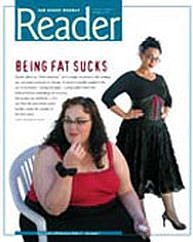
Oprah calls it an "Aha! moment," as if a single occurrence, like waking up, can impel someone to change. A sinner is usually caught in the act of sin before "seeing the light," a drug addict often hits bottom before embarking on recovery; but people are stubborn -- it is rare that the proverbial camel buckles under the weight of the first straw.
If that "Aha! moment," then, is the cherry crowning a misery sundae in which each spoonful of ice cream and shard of almond represents shame and disappointment, my moment would have to be when I fell in my sister's back yard.
It was a warm, sunny afternoon in July, and the entire family, along with Heather's in-laws and a handful of her friends, had turned out for the barbecue. Unseasonably dressed in jeans and a long-sleeved shirt, I had taken respite from the heat with a glass of chilled chardonnay in the shade of the gazebo. As I sat sipping my wine, a motion at the base of the wooden fence caught my eye. I scanned the grass until my eyes fell upon a squirrel, the fur on its head gathered in a miniature mohawk. I rose from my chair to get a closer look. Because my eyes were locked on the hilarious-looking rodent, I missed seeing the three small stairs leading down from the deck. My right ankle turned and I stumbled, after which my left ankle turned, and so on, until finally, after a few seconds that felt like minutes, I landed five steps away -- my cheek against the fence, my legs beneath me, and the glass of wine still clutched aloft in one hand.
The fall wasn't the bad part. At first, I was merely stunned, trying to make sense of what had happened. Then, as heads turned to discover the source of the commotion, as eyes and hands fell upon me to gauge the extent of my injury, it became apparent to everyone that, like that ancient woman in the cheesy commercial, I'd fallen and couldn't get up. I remained on the ground, sniveling and wiping away tears, refusing offers of help, for 15 minutes. My father and David eventually assisted me, all 270 pounds of me, to stand and hobble to the nearest chair.
Being fat sucks. When you're fat, people look at you with pitying glances or, even worse, relief. The alleviated expression on most women's faces wouldn't be easier to read if it were written across their foreheads in bold type: "At least I don't look like that." I don't blame them. It's human nature to seek a short reprieve from feeling bad about yourself, even if achieving this means taking a moment to be happy you're not as bad off as someone else. In an Associated Press article, the director of Yale University's Prevention Research Center, Dr. David Katz, was quoted, "If you're just a little bit heavy and everyone around you is quite heavier, you will feel good when you look in a mirror." There is nothing more comforting to an insecure woman than having a fat girlfriend. Like most corpulent women, to compensate for an unappealing appearance and to protect my psyche, I developed an impenetrable inner strength and an acute sense of humor. Slimmer, emotionally weaker women were drawn to me like squirrels to a birdfeeder -- in one fell swoop, I could make them both laugh and feel better about their thighs.
Conversely, there is nothing more revolting to most men than having a fat girlfriend. Don't get me wrong, I got laid plenty -- guys may be horrified at the idea of dating a fat chick, but they can benefit greatly from befriending one. Devoted, "pretty-'n'-plump" girls make their male friends feel desirable, even cocky, something an ego can get used to. I was the behind-the-scenes gal, the one to call late at night, the friend with privileges on off-peak hours. I was a safe-looking wingman the boys could take dancing when pursuing more socially acceptable partners; the last-resort sex at the end of the night when nothing panned out. I was appreciative for the attention I got, like an untouchable in India who is resigned to her predetermined caste. Sometimes, to see where my body fit into the bigger scheme, I would surf the fat-fetish porn sites to find how other large women negotiated their heft in various positions. Words like "eager" and "grateful" were always used when describing the chubby stars. The unlikely chance of rejection is one of the main draws for men who have a thing for large women. (I'm talking white men here -- in my experience, black men tend to appreciate ladies with a little extra "junk in the trunk.") Even so, sex wasn't the problem.
The most mundane tasks can be daunting for a plus-sizer. For me, the only thing worse than my hundred daily struggles was the possibility that somebody might witness one. When traveling by plane, rather than ask for a seat-belt extender, I would drape what little of the strap would reach around my generous belly and hide the buckle under a book, into which I would stare with exaggerated rapture so as not to be questioned during seat-belt checks. I hated shopping with friends and walking into stores like Express and the Gap, where the largest pants on the rack were at least six sizes smaller than the ones I wore. I once entered a high-end clothing boutique downtown and received a dismissive glance from the size zero salesgirl, a sort of "Sorry, there's nothing for you here." I ended up buying a necklace I couldn't afford, realizing only in retrospect that I'd splurged to save face.
Anybody who tried to help me only made me feel worse. Each time someone offered me advice on slimming down, what I heard was, "You're not adequate." My parents seized the prom as their last opportunity to save me from striding fully fat into the real world. "You know, Barb, you have three whole months before prom," said my well-meaning father, the idea being that if I lost weight, a boy might ask me to go with him. I resented the premise that I didn't stand a chance the way I was, even when it proved true. I attended the dance with a friend's brother, who'd politely accepted my last-minute plea to bring him as my date, granted I pay for the affair, to which I wore the muumuu equivalent of a little black dress.
David and I met online in 2002. Along with my irreverent, sexually forward profile, I'd included a close-up photo of my face. As the day of our first physical meeting drew near, I panicked that once David was confronted by the actuality of my hugeness, our prospective romance would quickly fizzle. I kept mentioning in our e-mails that I was "not small." He ignored such comments until finally, the day before our first date, he wrote, "Look, I know you're overweight. I have no problem with that." Upon meeting him, I was shocked to learn that David was one of those people I had heard about but, like dragons and unicorns, had come to accept did not exist -- a person not half as concerned with appearance as he was with character.
Having somebody treat me like a woman rather than a taken-for-granted friend with privileges boosted my sense of self-worth and gave me a newfound appreciation for life. David made me want to become the woman he made me feel I already was. Within a few months, with the determination and ease of pruning a rosebush in winter, I quit smoking, ceased my recreational drug use, and stopped wasting my time on toxic people.
Losing weight was not as simple. After all, I'd been fat all my life; it was a part of who I was, and I was married to it, for better or worse. People don't "get" fat. It's not something that "happens." You have to work at it. You have to consume a significantly larger number of calories than you burn every day, every week, every month, for years. I had been on the path to morbid obesity since the age of five. "Morbid obesity." Literally translated, it means "so fat as to inspire disgust or horror."
Two days after my embarrassing tumble, both my legs were swollen and bruised from thigh to ankle. I couldn't ambulate without wincing. I realized that this inability to move, and a growing incapacity to experience life the way other people did, would be my fate if I remained fat. I began to fear mortality -- not just my own, but also David's. Though only 35 pounds overweight, David was older than I and had dangerously high blood pressure. I was preoccupied with thoughts of death and loss, with feelings of self-loathing and despair.
Dieting did not sound appealing to either of us. As a foodie, David lived to eat; as a fatty, I couldn't help but assign a stigma to the word "diet." I'd yo-yoed since I was ten, when my mother put me on Richard Simmons's Deal-A-Meal program. Weight Watchers, Jenny Craig, Rader Institute, I'd had a fling with all of them, each time running one step forward to slim only to fall two steps back to stout. I'd often complained that programs don't work. But it wasn't the programs that failed -- it was I. I wanted change to happen without having to do anything, the way I'd allowed myself to believe that getting fat was something that happened without my involvement. I wanted to be instantaneously slim without any discomfort. The truth that I'd refused to accept was that, no matter which method I adopted, there was not going to be anything quick or easy about ending my life as a fatso.
I flirted with the idea of gastric bypass. People close to me had undergone the surgery, and I'd seen firsthand how effective it could be. I also saw how violently invasive it was -- as drastic as having one's jaw wired shut. What turned me away from pursuing it further was my belief that if I underwent surgery I was, in effect, saying, "I am a victim of my behavior and I am unable -- scratch that -- unwilling to change it, so I would rather someone else change it for me by making it impossible, or at the least, very difficult and/or painful, for me to eat the excessive amounts of sugar and fat I somehow can't stop stuffing into my face." Call it a control issue.
The people in my life who'd had bariatric surgery had, as with many fad diets, lost a lot of weight in a short amount of time, then gained a good portion of it back. They were not willing to accept dietary changes, meaning that when their new, shrunken bellies could hold only two ounces, they still chose to fill it with junk. They had done nothing to alter their sedentary ways, which meant most of their muscle, starved of protein, was lost with the fat. This is not the fault of doctors, who explain to their patients the importance of lifestyle changes until they run out of breath.
"So many people think they're going to have bariatric surgery and they're fixed," says George Mueller, a bariatric surgeon for Sharp Memorial Hospital. "We'll be seeing patients doing very well, and then they come back for their yearly visit, and they'll be snacking or won't be exercising. We hammer it over and over and over that this is a lifestyle change. They aren't real hard concepts."
Charles Callery, a surgeon for Pomerado Hospital and Sharp Memorial, has performed around 3000 gastric bypass surgeries since 1991. "We try to educate people and encourage them, but we're not superparents; we can't make [patients] do the right thing," says Callery. "Noncompliant behavior is very frustrating. It's like giving advice to kids -- some follow the advice, some don't, and some are just plain reckless and get themselves into a lot of trouble." No amount of lecturing can penetrate a meticulously crafted shield of denial. For years, doctors had implored me to lose weight, a fact that played no part whatsoever in my decision to do so.
According to Mueller, rapid weight loss can have a negative impact on some organs, like the gall bladder. "When you lose weight rapidly, you oversaturate your bile with cholesterol and excess fats, and you get gallstones," he says. The liver can also be affected. "If there's fatty infiltration on the liver, you can get hepatitis -- not the infection, but inflammation of the liver, steatohepatitis -- you get an inflammatory response, and liver enzymes go up. If a person loses weight, the liver function improves, but if they go up and down, you can get fibrosis, or scarring, in the liver, [which can] compromise the function of the liver."
The National Institutes of Health published a study finding 90 percent of people who lose weight gain it back within five years. The statistics for bypass patients are slightly more encouraging -- two-thirds of patients are able to keep off 60 percent of the weight they lose.
While my legs changed from blue and yellow to purple and green, I scoured the Internet for weight-loss information and tips and came across an article on the Kaiser Permanente website that repeated the phenomenal rate of failure for keeping lost weight off and stressed the importance of gradual lifestyle changes for permanent results. I didn't want to forgo eating -- I wanted to learn how to eat right. I didn't only want to lose fat -- I wanted to be fit. It wasn't about being as skinny as a starlet. It was about being healthy. Surgery held the promise of immediate results -- having chunks of fat sliced off or sucked out of my stomach and thighs had its appeal. But then I came across an article on women's health, in which Monica Persson wrote, "Most people do not know that far more women have died from weight loss surgery than from Toxic Shock Syndrome." If I was going to lose weight, I had to do it the right way, the healthy way, the same way I had gained it -- slowly.
When entering any strange and seemingly treacherous new land, it is wise to solicit the help of a knowledgeable guide. I didn't want a doctor who would hand me pamphlets, like maps, and send me on my way but someone who would walk by my side and guide me along. Someone with a sturdy arm for me to grab in case I stumbled into a deep hole in my resolve.
I Googled "personal trainer San Diego" and got a long list of gyms. I tried to picture myself huffing away on a treadmill in the 24 Hour Fitness in Hillcrest, surrounded by hard bodies and floor-to-ceiling windows. I imagined people passing by on the street, doing a double take and wondering how that hippo had found her way into the meerkat enclosure. It was embarrassing enough to be fat and trying to change (which was in itself an admission of weakness, of discontent with what I was); I didn't need to be on display and scrutinized by skinnies in the process.
One gym, Bodylines Fitness, caught my eye with the phrase "one on one." I perked up when I read, "The fitness industry is becoming synonymous with quick fixes, false advertising, and unrealistic expectations." The rest of the gym's basic philosophy could be summed up, "If you are not willing to work hard and do what we tell you to do in order to get fit, then go somewhere else." These guys sounded serious. Serious was what I needed. Plus, they were offering a special for two. I called and scheduled a free consultation for David and myself for the following week.
"This can't be it," I said to David as I pulled the car into a dilapidated, circa 1970s shopping center off Talbot Street in Point Loma. The "gym" was located in what had previously been a dental office. Just through the entrance was the main, and largest, room, in which were a giant, unintelligible machine, a blue velvet couch, and a coffee table covered with fitness magazines. All was quiet except for soft rock playing through a speaker built into the tiled ceiling. Exercise equipment was arrayed among the six small rooms, each of which was painted a different pastel color. It was dingy, small, and a half hour's drive from our place. I had nearly made up my mind to bail when Charlie Conefrey, the man I'd spoken to on the phone, stepped forward and introduced himself. He had the musculature of a pit bull and wore loose khaki cargo shorts, designer sneakers, and a tank top. His bronze tan was even from his ankles to his shaved head, and I noted a dark blue tattoo of the Star of David on his right calf. We sat on the couch as Charlie, in his heavy Good Will Hunting Boston accent, told us about himself -- he was an amateur competitive bodybuilder, personal trainer, and nutritionist. He had graduated from University of Massachusetts Boston with a degree in exercise science and had recently moved to San Diego from his hometown, Everett, Massachusetts.
When he'd finished explaining his personal fitness philosophies, Charlie sought to understand our needs by asking a series of questions.
"How often do you eat out?"
"Two to three times a day," I answered. Charlie's eyes widened. He made some notes on the paper in his lap.
"How often do you exercise?"
"You mean intentionally?" I joked. David giggled. Charlie remained stoic. "Okay," I said. "Well, we don't, actually."
"Huh." More notes and a furrowed brow. Then he looked me in the eye with an interrogator's determination and said, "What is your goal? What are you hoping to achieve?"
"Health," I answered. "Losing weight will obviously be a side effect, but my number-one goal is health. You know, quality of life and all that."
Charlie smiled and said, "I think I can help you."
I returned his smile and said, "We'd like that."
Charlie gave us instructions regarding food -- how much to eat and when, and from which sources we could obtain low-calorie, nutrient-rich proteins and carbohydrates. We were to write down every morsel that went in our mouths. "Have five small meals a day, each meal less than 300 calories, and containing 40 percent protein, 40 percent carbs, and 20 percent fat," he instructed -- but only those proteins, carbs, and fats that were on the handout he gave us. No more pizza, burritos, or fries. From now on (except on our cheat days, which we were told we could have once a week), it was broccoli, chicken, extra-lean ground turkey, and whole grains. At the end of each week, we were to bring our food journal for Charlie to review. Our first workout would be the following morning.
Directly after our meeting with Charlie, I dragged David to El Zarape for one last hurrah with the chile relleno burrito, a monstrosity the size of my forearm comprising a flour tortilla stuffed with cheese-filled and deep-fried chilies, refried beans, sour cream, and cheese. As I worked my way through the second half with a plastic knife and fork, the words of my college philosophy teacher echoed in my head, "A pig satisfied or Socrates dissatisfied?" I knew that once I learned exactly how bad this burrito was for my body, I would never want to eat it again. I savored the last of my willful ignorance in every calorie-packed bite.
The next day, David and I began counting calories to keep our consumption below 1500 a day. In order to lose one pound of fat, we had to burn 3500 calories more than we consumed. We figured that before we obtained direction from Charlie, we must have been consuming at least 5000 calories a day and burning fewer than 2000. All the medical research on obesity indicated that if we lost more than two pounds a week, we were sure to gain back each of those pounds and more. David agreed that he would do all the cooking and food prep, and I would keep the journal and count our calories. It was up to us to get the food right. For the exercise, however, we would place our bodies in Charlie's hands.
Imagine a manatee using its tiny flippers to drag its massive, flabby body out of the water and onto the shore, and you will have some idea of what I looked like during my first workout with Charlie. I'd never felt so stupid and unglamorous in all my life. Charlie had to teach me that a "crunch" was a kind of half-sit-up, that my hamstrings were at the back of my thighs, my quadriceps at the front. He stared at me in puzzlement when I hopped around in pain the second day because he couldn't figure out how I'd managed to pull my left hamstring while trying to stretch my right quad. Like a Road Runner cartoon, I was comically tragic.
We worked out four days a week. The first month, our previously neglected muscles ached with fatigue; David and I walked around like overacting extras in Shaun of the Dead. Two months after we began, I decided it was time to apply for health insurance -- something I hadn't bothered to do since I'd left my previous job as a full-time office worker. In the seven months away from the bagels, donuts, candy, and other office treats, I'd gone down a size without trying. Now, with regular exercise and the changes in my diet, I was the healthiest I'd ever been.
A week after I sent in my application, I received a rejection letter. It read: "For your height, your weight exceeds the maximum allowed of 200 lbs. Before we can reconsider your coverage, we will need documentation from your physician showing that you have maintained a weight of no more than this weight for at least six consecutive months." I was 240. It didn't matter to the company that I was shrinking rapidly. At first, I was angry. Indignant. I wanted to call them and scream about the unfairness of not looking any further than my height and weight. After I calmed down, I accepted that their decision hadn't been personal. I understood the risk inherent in insuring a morbidly obese person, healthy or not. Of course the company wouldn't take such a risk. By the end of the night, all I felt was shame. I'd lost over 30 pounds. But as I sat, moping and teary-eyed with the words of the letter replaying over and over in my head, I had never felt fatter. I put the letter away, crossed my fingers that nothing catastrophic would happen to me before I qualified, and refocused my attention on the regimen.
It is easy to see why so many people start to diet and then give up. The motivation required to maintain discipline is so fragile that something as simple as a passing comment can cause it to shatter into a million reasons for why any effort is futile.
After six months of eating right and working out (with occasional wine, cheese, and chocolate lapses), I was down two more sizes. David and I attended a party to celebrate the completion of a building project in North Park. While there, an acquaintance said, "Wow, David, you're disappearing!" Ten minutes later, a friend we hadn't seen in months said, "David, you look fantastic!" Upon greeting us, five other people had similar reactions. During each encounter, I stood by David's side and waited for such a comment to be directed at me. Each time my expectation was dashed sharply, like the sting I get when I repeatedly rub my eyes after forgetting I have pepper on my fingers.
The week following the party, I stopped counting calories. Not eating right made me feel guilty; feeling guilty was depressing; and depression left me bereft of motivation. I'd been working my ass off, and though I was down to a size 22, I was still fat. I was so fat that after shedding 40 pounds, no one had noticed. With so many sizes to go, what was the point? Defeated, I knew that I was, and would always be, a fat chick.
Charlie could tell something was off. At the end of the week, he asked me how the diet was going. "Not good," I answered.
"Why?" Like a therapist, Charlie always asked open-ended questions and listened patiently to my answers. Four days a week, I opened up to him in ways I never had to my friends or family; I spoke of deep-seated insecurities and thoughts of self-loathing. Also like a therapist, Charlie did not give answers so much as he guided me to them.
"I've been stressed," I said. "Plus, there were, like, three birthdays I celebrated this month, which means dinners out with friends."
Charlie has no tolerance for excuses. And, in his opinion, anything that gets in the way of health-conscious decisions is an excuse. "Remember why you're here," he said. "Why you're paying money and spending all this time exercising. If your mother was in the hospital dying, you'd make it in to see her, no excuses. If you want something enough, nothing gets in your way."
Did I want it enough? For days the question haunted me. Of course I did, I assured myself. Why else would I suffer restricted calories and four days a week of physical torture? And yet, there was a part of me that didn't want it at all, a part of me that feared success. It wasn't that I was afraid of being slim, healthy, and attractive -- it was that I was petrified of not being me. Who was I if not fat, bubbly Barb? I may not have liked my appearance, but I very much loved myself. I was used to the way things were.
My decision to change my lifestyle had a chilling effect on many of my relationships. While on the phone with a girlfriend, I said that I'd been working out and shedding pounds. "Well, that sucks," she said. "Who am I going to talk to when I'm gaining weight?" Suddenly, my vision cleared, and I wondered how many of my friends saw me as no more than a factor in the equation of their self-esteem.
It was clear from my sisters' reactions that my weight was something they had discussed in my absence. "We hoped you'd come to the realization at some point. We were just wondering when it was going to happen," they said. Weight issues are prevalent in our family; I come from a long line of overweight Italian women. My sisters, though slim, have always been sensitive to the issue -- "fat" was the only forbidden "F-word" in our home. When I said, "I'm fat," a truth no one could deny, they would snap, "Don't say that, that's not true." But speaking the word I'd cowered from all my life had a liberating effect. Embracing the ugly truth of my condition -- that I was heavier than a female gorilla -- was the essential first step in doing something about it.
I was crestfallen when people failed to notice my progress, so I was surprised when I found it irritating rather than flattering when people did make note of my shrinkage. A friend of my mother's said, "Barb, you're losing weight!" I nodded at her, a sort of "Yup, sure am," and she continued, "You actually have a waist!" I found this insulting. I may have lost weight, but I was still fat and therefore still sensitive to comments about my changing shape. This one, in particular, came across as patronizing.
As more people became aware of my quest, I began to feel as if I had recently taken up residence in a petri dish. I knew they only meant to be helpful, but I would cringe when friends would invite me out and say, "I was thinking about going to that new Vietnamese place down the street. Is there anything there that you're allowed to eat?" Allowed? "I am allowed to eat whatever I damn well please," I would sometimes answer, finding it impossible to hide my bitterness. Once, at an afternoon party, I reached for a piece of pizza and felt obliged to explain myself to each pair of appraising eyes that I could have a slice and still shed pounds that week because of the ratio of good choices to bad. That night, David and I bickered over whether or not to add 100 calories' worth of bread to our dinner. "It's hard enough for me to have my own willpower without also having to have yours," he snapped. "You think I wasn't dying to have pizza today?" I was horrified. I convinced myself from his comment that David believed I was an uncontrollable cow and that it was all he could do to keep me on track. When I felt the ache on the roof of my mouth from where the scorching cheese had burned it, I turned my anger inward: That's what you deserve for eating it, you fat pig.
It was enervating to be always on the defensive, to feel as if I had to answer to everyone, to justify myself by explaining to acquaintances that, even though I was fat, I probably worked out more often and ate a more nutritiously balanced diet than anybody in the building. Eventually, I realized the only person I was arguing with was myself. It didn't matter how other people saw me -- what mattered was how I saw me.
After one year, I'd lost over 70 pounds. My clothes were smaller. I could easily lift things I used to find heavy, and I could bound up the stairs two at a time. The scale no longer groaned under my weight. My body had changed, yet my perception of my body remained that of a grotesquely oversized woman. Visiting the home of a friend, I continued to tiptoe lightly across the echoing hardwood floor to avoid calling attention to my girth. I still eyed chairs with arms suspiciously, as they have rarely been able to contain the width of my rear end. David said my self-image was inaccurate. To prove him wrong, while shopping at the mall, I pointed to a woman and said to him, "I'm about her size."
"No, you're not, actually," David responded, eyeing me closely. "You don't really think that, do you? Barb, that woman is 50 percent larger than you." I examined the woman until she disappeared into Macy's and decided that David was trying to be nice.
As I became more fit and the pounds continued to melt away incrementally, I started to get more attention from men on the street, strangers who smiled and said things like, "Good morning, beautiful!" I'd often been told that I had a pretty face, something I assumed people said to make fat women feel better, even though the clarifier emphasized the condition of the compliment: "You have such a pretty face." I'd lost an entire Nicole Richie's worth of weight, but I was still fat, certainly bigger than any of those people tossing me flattery the way one might fling a treat to a schnauzer. So when the word "face" disappeared from the compliments I received, I started tacking it on myself. If a friend said, "You look lovely tonight, Barb," in my head I would hear, "Your face looks lovely tonight, Barb."
As of today, I have lost 100 pounds. But I am far from skinny. I have plenty of padding left on my hips, butt, and thighs that I expect will steadily come off as I continue to eat right and exercise regularly. I try not to worry about how I look so much as how I feel, but every woman knows it is impossible to remain body-positive for long. More often than not, when I stand naked before the mirror prior to going to bed, I see what I've always seen -- a fat chick. But sometimes, walking by the downstairs bathroom, my reflection in the mirror above the sink will catch me off guard. My face will appear more angular than I remember, and I'll wonder if it's a trick of light in the hallway that makes my silhouette so narrow in the waist.
The exact, seeing-the-Matrix moment when I realized that I was no longer supersized occurred a few months ago. I had been sifting through tops in Nordstrom's Encore department, where sizes are marked with a series of Xs. When I couldn't find anything smaller than a 3X in a particular style of shirt, I asked the woman behind the counter if she could check in the back for a 1X. "For you?" she asked. I nodded. "I don't think so, honey, you should check downstairs."
Downstairs.
I had never shopped downstairs. That's where normal people shopped, where skinny women and a wider variety of clothing reigned. Even as my bra size shrank from a 44DD to a 34D, I had continued to shop in the familiar plus-size departments. Dazed, I walked to the escalator and rode it down one level. I tried to look casual as I browsed the racks, certain that every woman who glanced at me was thinking, "What is this imposter doing in our midst?" My heart sank when I located the shirt I'd been seeking and saw an S and M, but no L or XL.
"May I help you?" I tried to hide my trespasser's guilt when I met the gaze of a smiling, well-accessorized woman.
"Uh, no, I'm okay," I said. She didn't move, remained smiling, waiting for me to change my mind. "Well, actually, I was wondering if you had this in a large?"
"I can check," she said. Then, looking me up and down, she added, "But in the meantime, you should try on this medium."
"Yeah, sure," I said, glaring at her. The woman had no concept of size. "Really, it's okay, I can wait here."
"Well, let me just set you up back there, and I'll bring it to you," she insisted. I followed her and entered the dressing room she opened for me. I accepted the shirt and smiled coldly when she said, "Go ahead and try it, just in case, and I'll be right back with that large."
Grumbling, I stripped off my long-sleeved shirt and pulled the black V-neck tee over my head. Once it was on, I stared at myself in the mirror, transfixed, for five minutes. There was a knock on the dressing room door.
"Everything okay in there? I have your large here." Another shirt appeared over my head.
"It's okay, I don't need it," I said, suppressing a sob as the impact of what I was about to say hit me. "This one fits perfectly."
Here's something you might be interested in.
Barbarella: being fat sucks
Sex wasn't the problem

Barbarella: being fat sucks
Sex wasn't the problem
Oprah calls it an "Aha! moment," as if a single occurrence, like waking up, can impel someone to change. A sinner is usually caught in the act of sin before "seeing the light," a drug addict often hits bottom before embarking on recovery; but people are stubborn -- it is rare that the proverbial camel buckles under the weight of the first straw.
If that "Aha! moment," then, is the cherry crowning a misery sundae in which each spoonful of ice cream and shard of almond represents shame and disappointment, my moment would have to be when I fell in my sister's back yard.
It was a warm, sunny afternoon in July, and the entire family, along with Heather's in-laws and a handful of her friends, had turned out for the barbecue. Unseasonably dressed in jeans and a long-sleeved shirt, I had taken respite from the heat with a glass of chilled chardonnay in the shade of the gazebo. As I sat sipping my wine, a motion at the base of the wooden fence caught my eye. I scanned the grass until my eyes fell upon a squirrel, the fur on its head gathered in a miniature mohawk. I rose from my chair to get a closer look. Because my eyes were locked on the hilarious-looking rodent, I missed seeing the three small stairs leading down from the deck. My right ankle turned and I stumbled, after which my left ankle turned, and so on, until finally, after a few seconds that felt like minutes, I landed five steps away -- my cheek against the fence, my legs beneath me, and the glass of wine still clutched aloft in one hand.
The fall wasn't the bad part. At first, I was merely stunned, trying to make sense of what had happened. Then, as heads turned to discover the source of the commotion, as eyes and hands fell upon me to gauge the extent of my injury, it became apparent to everyone that, like that ancient woman in the cheesy commercial, I'd fallen and couldn't get up. I remained on the ground, sniveling and wiping away tears, refusing offers of help, for 15 minutes. My father and David eventually assisted me, all 270 pounds of me, to stand and hobble to the nearest chair.
Being fat sucks. When you're fat, people look at you with pitying glances or, even worse, relief. The alleviated expression on most women's faces wouldn't be easier to read if it were written across their foreheads in bold type: "At least I don't look like that." I don't blame them. It's human nature to seek a short reprieve from feeling bad about yourself, even if achieving this means taking a moment to be happy you're not as bad off as someone else. In an Associated Press article, the director of Yale University's Prevention Research Center, Dr. David Katz, was quoted, "If you're just a little bit heavy and everyone around you is quite heavier, you will feel good when you look in a mirror." There is nothing more comforting to an insecure woman than having a fat girlfriend. Like most corpulent women, to compensate for an unappealing appearance and to protect my psyche, I developed an impenetrable inner strength and an acute sense of humor. Slimmer, emotionally weaker women were drawn to me like squirrels to a birdfeeder -- in one fell swoop, I could make them both laugh and feel better about their thighs.
Conversely, there is nothing more revolting to most men than having a fat girlfriend. Don't get me wrong, I got laid plenty -- guys may be horrified at the idea of dating a fat chick, but they can benefit greatly from befriending one. Devoted, "pretty-'n'-plump" girls make their male friends feel desirable, even cocky, something an ego can get used to. I was the behind-the-scenes gal, the one to call late at night, the friend with privileges on off-peak hours. I was a safe-looking wingman the boys could take dancing when pursuing more socially acceptable partners; the last-resort sex at the end of the night when nothing panned out. I was appreciative for the attention I got, like an untouchable in India who is resigned to her predetermined caste. Sometimes, to see where my body fit into the bigger scheme, I would surf the fat-fetish porn sites to find how other large women negotiated their heft in various positions. Words like "eager" and "grateful" were always used when describing the chubby stars. The unlikely chance of rejection is one of the main draws for men who have a thing for large women. (I'm talking white men here -- in my experience, black men tend to appreciate ladies with a little extra "junk in the trunk.") Even so, sex wasn't the problem.
The most mundane tasks can be daunting for a plus-sizer. For me, the only thing worse than my hundred daily struggles was the possibility that somebody might witness one. When traveling by plane, rather than ask for a seat-belt extender, I would drape what little of the strap would reach around my generous belly and hide the buckle under a book, into which I would stare with exaggerated rapture so as not to be questioned during seat-belt checks. I hated shopping with friends and walking into stores like Express and the Gap, where the largest pants on the rack were at least six sizes smaller than the ones I wore. I once entered a high-end clothing boutique downtown and received a dismissive glance from the size zero salesgirl, a sort of "Sorry, there's nothing for you here." I ended up buying a necklace I couldn't afford, realizing only in retrospect that I'd splurged to save face.
Anybody who tried to help me only made me feel worse. Each time someone offered me advice on slimming down, what I heard was, "You're not adequate." My parents seized the prom as their last opportunity to save me from striding fully fat into the real world. "You know, Barb, you have three whole months before prom," said my well-meaning father, the idea being that if I lost weight, a boy might ask me to go with him. I resented the premise that I didn't stand a chance the way I was, even when it proved true. I attended the dance with a friend's brother, who'd politely accepted my last-minute plea to bring him as my date, granted I pay for the affair, to which I wore the muumuu equivalent of a little black dress.
David and I met online in 2002. Along with my irreverent, sexually forward profile, I'd included a close-up photo of my face. As the day of our first physical meeting drew near, I panicked that once David was confronted by the actuality of my hugeness, our prospective romance would quickly fizzle. I kept mentioning in our e-mails that I was "not small." He ignored such comments until finally, the day before our first date, he wrote, "Look, I know you're overweight. I have no problem with that." Upon meeting him, I was shocked to learn that David was one of those people I had heard about but, like dragons and unicorns, had come to accept did not exist -- a person not half as concerned with appearance as he was with character.
Having somebody treat me like a woman rather than a taken-for-granted friend with privileges boosted my sense of self-worth and gave me a newfound appreciation for life. David made me want to become the woman he made me feel I already was. Within a few months, with the determination and ease of pruning a rosebush in winter, I quit smoking, ceased my recreational drug use, and stopped wasting my time on toxic people.
Losing weight was not as simple. After all, I'd been fat all my life; it was a part of who I was, and I was married to it, for better or worse. People don't "get" fat. It's not something that "happens." You have to work at it. You have to consume a significantly larger number of calories than you burn every day, every week, every month, for years. I had been on the path to morbid obesity since the age of five. "Morbid obesity." Literally translated, it means "so fat as to inspire disgust or horror."
Two days after my embarrassing tumble, both my legs were swollen and bruised from thigh to ankle. I couldn't ambulate without wincing. I realized that this inability to move, and a growing incapacity to experience life the way other people did, would be my fate if I remained fat. I began to fear mortality -- not just my own, but also David's. Though only 35 pounds overweight, David was older than I and had dangerously high blood pressure. I was preoccupied with thoughts of death and loss, with feelings of self-loathing and despair.
Dieting did not sound appealing to either of us. As a foodie, David lived to eat; as a fatty, I couldn't help but assign a stigma to the word "diet." I'd yo-yoed since I was ten, when my mother put me on Richard Simmons's Deal-A-Meal program. Weight Watchers, Jenny Craig, Rader Institute, I'd had a fling with all of them, each time running one step forward to slim only to fall two steps back to stout. I'd often complained that programs don't work. But it wasn't the programs that failed -- it was I. I wanted change to happen without having to do anything, the way I'd allowed myself to believe that getting fat was something that happened without my involvement. I wanted to be instantaneously slim without any discomfort. The truth that I'd refused to accept was that, no matter which method I adopted, there was not going to be anything quick or easy about ending my life as a fatso.
I flirted with the idea of gastric bypass. People close to me had undergone the surgery, and I'd seen firsthand how effective it could be. I also saw how violently invasive it was -- as drastic as having one's jaw wired shut. What turned me away from pursuing it further was my belief that if I underwent surgery I was, in effect, saying, "I am a victim of my behavior and I am unable -- scratch that -- unwilling to change it, so I would rather someone else change it for me by making it impossible, or at the least, very difficult and/or painful, for me to eat the excessive amounts of sugar and fat I somehow can't stop stuffing into my face." Call it a control issue.
The people in my life who'd had bariatric surgery had, as with many fad diets, lost a lot of weight in a short amount of time, then gained a good portion of it back. They were not willing to accept dietary changes, meaning that when their new, shrunken bellies could hold only two ounces, they still chose to fill it with junk. They had done nothing to alter their sedentary ways, which meant most of their muscle, starved of protein, was lost with the fat. This is not the fault of doctors, who explain to their patients the importance of lifestyle changes until they run out of breath.
"So many people think they're going to have bariatric surgery and they're fixed," says George Mueller, a bariatric surgeon for Sharp Memorial Hospital. "We'll be seeing patients doing very well, and then they come back for their yearly visit, and they'll be snacking or won't be exercising. We hammer it over and over and over that this is a lifestyle change. They aren't real hard concepts."
Charles Callery, a surgeon for Pomerado Hospital and Sharp Memorial, has performed around 3000 gastric bypass surgeries since 1991. "We try to educate people and encourage them, but we're not superparents; we can't make [patients] do the right thing," says Callery. "Noncompliant behavior is very frustrating. It's like giving advice to kids -- some follow the advice, some don't, and some are just plain reckless and get themselves into a lot of trouble." No amount of lecturing can penetrate a meticulously crafted shield of denial. For years, doctors had implored me to lose weight, a fact that played no part whatsoever in my decision to do so.
According to Mueller, rapid weight loss can have a negative impact on some organs, like the gall bladder. "When you lose weight rapidly, you oversaturate your bile with cholesterol and excess fats, and you get gallstones," he says. The liver can also be affected. "If there's fatty infiltration on the liver, you can get hepatitis -- not the infection, but inflammation of the liver, steatohepatitis -- you get an inflammatory response, and liver enzymes go up. If a person loses weight, the liver function improves, but if they go up and down, you can get fibrosis, or scarring, in the liver, [which can] compromise the function of the liver."
The National Institutes of Health published a study finding 90 percent of people who lose weight gain it back within five years. The statistics for bypass patients are slightly more encouraging -- two-thirds of patients are able to keep off 60 percent of the weight they lose.
While my legs changed from blue and yellow to purple and green, I scoured the Internet for weight-loss information and tips and came across an article on the Kaiser Permanente website that repeated the phenomenal rate of failure for keeping lost weight off and stressed the importance of gradual lifestyle changes for permanent results. I didn't want to forgo eating -- I wanted to learn how to eat right. I didn't only want to lose fat -- I wanted to be fit. It wasn't about being as skinny as a starlet. It was about being healthy. Surgery held the promise of immediate results -- having chunks of fat sliced off or sucked out of my stomach and thighs had its appeal. But then I came across an article on women's health, in which Monica Persson wrote, "Most people do not know that far more women have died from weight loss surgery than from Toxic Shock Syndrome." If I was going to lose weight, I had to do it the right way, the healthy way, the same way I had gained it -- slowly.
When entering any strange and seemingly treacherous new land, it is wise to solicit the help of a knowledgeable guide. I didn't want a doctor who would hand me pamphlets, like maps, and send me on my way but someone who would walk by my side and guide me along. Someone with a sturdy arm for me to grab in case I stumbled into a deep hole in my resolve.
I Googled "personal trainer San Diego" and got a long list of gyms. I tried to picture myself huffing away on a treadmill in the 24 Hour Fitness in Hillcrest, surrounded by hard bodies and floor-to-ceiling windows. I imagined people passing by on the street, doing a double take and wondering how that hippo had found her way into the meerkat enclosure. It was embarrassing enough to be fat and trying to change (which was in itself an admission of weakness, of discontent with what I was); I didn't need to be on display and scrutinized by skinnies in the process.
One gym, Bodylines Fitness, caught my eye with the phrase "one on one." I perked up when I read, "The fitness industry is becoming synonymous with quick fixes, false advertising, and unrealistic expectations." The rest of the gym's basic philosophy could be summed up, "If you are not willing to work hard and do what we tell you to do in order to get fit, then go somewhere else." These guys sounded serious. Serious was what I needed. Plus, they were offering a special for two. I called and scheduled a free consultation for David and myself for the following week.
"This can't be it," I said to David as I pulled the car into a dilapidated, circa 1970s shopping center off Talbot Street in Point Loma. The "gym" was located in what had previously been a dental office. Just through the entrance was the main, and largest, room, in which were a giant, unintelligible machine, a blue velvet couch, and a coffee table covered with fitness magazines. All was quiet except for soft rock playing through a speaker built into the tiled ceiling. Exercise equipment was arrayed among the six small rooms, each of which was painted a different pastel color. It was dingy, small, and a half hour's drive from our place. I had nearly made up my mind to bail when Charlie Conefrey, the man I'd spoken to on the phone, stepped forward and introduced himself. He had the musculature of a pit bull and wore loose khaki cargo shorts, designer sneakers, and a tank top. His bronze tan was even from his ankles to his shaved head, and I noted a dark blue tattoo of the Star of David on his right calf. We sat on the couch as Charlie, in his heavy Good Will Hunting Boston accent, told us about himself -- he was an amateur competitive bodybuilder, personal trainer, and nutritionist. He had graduated from University of Massachusetts Boston with a degree in exercise science and had recently moved to San Diego from his hometown, Everett, Massachusetts.
When he'd finished explaining his personal fitness philosophies, Charlie sought to understand our needs by asking a series of questions.
"How often do you eat out?"
"Two to three times a day," I answered. Charlie's eyes widened. He made some notes on the paper in his lap.
"How often do you exercise?"
"You mean intentionally?" I joked. David giggled. Charlie remained stoic. "Okay," I said. "Well, we don't, actually."
"Huh." More notes and a furrowed brow. Then he looked me in the eye with an interrogator's determination and said, "What is your goal? What are you hoping to achieve?"
"Health," I answered. "Losing weight will obviously be a side effect, but my number-one goal is health. You know, quality of life and all that."
Charlie smiled and said, "I think I can help you."
I returned his smile and said, "We'd like that."
Charlie gave us instructions regarding food -- how much to eat and when, and from which sources we could obtain low-calorie, nutrient-rich proteins and carbohydrates. We were to write down every morsel that went in our mouths. "Have five small meals a day, each meal less than 300 calories, and containing 40 percent protein, 40 percent carbs, and 20 percent fat," he instructed -- but only those proteins, carbs, and fats that were on the handout he gave us. No more pizza, burritos, or fries. From now on (except on our cheat days, which we were told we could have once a week), it was broccoli, chicken, extra-lean ground turkey, and whole grains. At the end of each week, we were to bring our food journal for Charlie to review. Our first workout would be the following morning.
Directly after our meeting with Charlie, I dragged David to El Zarape for one last hurrah with the chile relleno burrito, a monstrosity the size of my forearm comprising a flour tortilla stuffed with cheese-filled and deep-fried chilies, refried beans, sour cream, and cheese. As I worked my way through the second half with a plastic knife and fork, the words of my college philosophy teacher echoed in my head, "A pig satisfied or Socrates dissatisfied?" I knew that once I learned exactly how bad this burrito was for my body, I would never want to eat it again. I savored the last of my willful ignorance in every calorie-packed bite.
The next day, David and I began counting calories to keep our consumption below 1500 a day. In order to lose one pound of fat, we had to burn 3500 calories more than we consumed. We figured that before we obtained direction from Charlie, we must have been consuming at least 5000 calories a day and burning fewer than 2000. All the medical research on obesity indicated that if we lost more than two pounds a week, we were sure to gain back each of those pounds and more. David agreed that he would do all the cooking and food prep, and I would keep the journal and count our calories. It was up to us to get the food right. For the exercise, however, we would place our bodies in Charlie's hands.
Imagine a manatee using its tiny flippers to drag its massive, flabby body out of the water and onto the shore, and you will have some idea of what I looked like during my first workout with Charlie. I'd never felt so stupid and unglamorous in all my life. Charlie had to teach me that a "crunch" was a kind of half-sit-up, that my hamstrings were at the back of my thighs, my quadriceps at the front. He stared at me in puzzlement when I hopped around in pain the second day because he couldn't figure out how I'd managed to pull my left hamstring while trying to stretch my right quad. Like a Road Runner cartoon, I was comically tragic.
We worked out four days a week. The first month, our previously neglected muscles ached with fatigue; David and I walked around like overacting extras in Shaun of the Dead. Two months after we began, I decided it was time to apply for health insurance -- something I hadn't bothered to do since I'd left my previous job as a full-time office worker. In the seven months away from the bagels, donuts, candy, and other office treats, I'd gone down a size without trying. Now, with regular exercise and the changes in my diet, I was the healthiest I'd ever been.
A week after I sent in my application, I received a rejection letter. It read: "For your height, your weight exceeds the maximum allowed of 200 lbs. Before we can reconsider your coverage, we will need documentation from your physician showing that you have maintained a weight of no more than this weight for at least six consecutive months." I was 240. It didn't matter to the company that I was shrinking rapidly. At first, I was angry. Indignant. I wanted to call them and scream about the unfairness of not looking any further than my height and weight. After I calmed down, I accepted that their decision hadn't been personal. I understood the risk inherent in insuring a morbidly obese person, healthy or not. Of course the company wouldn't take such a risk. By the end of the night, all I felt was shame. I'd lost over 30 pounds. But as I sat, moping and teary-eyed with the words of the letter replaying over and over in my head, I had never felt fatter. I put the letter away, crossed my fingers that nothing catastrophic would happen to me before I qualified, and refocused my attention on the regimen.
It is easy to see why so many people start to diet and then give up. The motivation required to maintain discipline is so fragile that something as simple as a passing comment can cause it to shatter into a million reasons for why any effort is futile.
After six months of eating right and working out (with occasional wine, cheese, and chocolate lapses), I was down two more sizes. David and I attended a party to celebrate the completion of a building project in North Park. While there, an acquaintance said, "Wow, David, you're disappearing!" Ten minutes later, a friend we hadn't seen in months said, "David, you look fantastic!" Upon greeting us, five other people had similar reactions. During each encounter, I stood by David's side and waited for such a comment to be directed at me. Each time my expectation was dashed sharply, like the sting I get when I repeatedly rub my eyes after forgetting I have pepper on my fingers.
The week following the party, I stopped counting calories. Not eating right made me feel guilty; feeling guilty was depressing; and depression left me bereft of motivation. I'd been working my ass off, and though I was down to a size 22, I was still fat. I was so fat that after shedding 40 pounds, no one had noticed. With so many sizes to go, what was the point? Defeated, I knew that I was, and would always be, a fat chick.
Charlie could tell something was off. At the end of the week, he asked me how the diet was going. "Not good," I answered.
"Why?" Like a therapist, Charlie always asked open-ended questions and listened patiently to my answers. Four days a week, I opened up to him in ways I never had to my friends or family; I spoke of deep-seated insecurities and thoughts of self-loathing. Also like a therapist, Charlie did not give answers so much as he guided me to them.
"I've been stressed," I said. "Plus, there were, like, three birthdays I celebrated this month, which means dinners out with friends."
Charlie has no tolerance for excuses. And, in his opinion, anything that gets in the way of health-conscious decisions is an excuse. "Remember why you're here," he said. "Why you're paying money and spending all this time exercising. If your mother was in the hospital dying, you'd make it in to see her, no excuses. If you want something enough, nothing gets in your way."
Did I want it enough? For days the question haunted me. Of course I did, I assured myself. Why else would I suffer restricted calories and four days a week of physical torture? And yet, there was a part of me that didn't want it at all, a part of me that feared success. It wasn't that I was afraid of being slim, healthy, and attractive -- it was that I was petrified of not being me. Who was I if not fat, bubbly Barb? I may not have liked my appearance, but I very much loved myself. I was used to the way things were.
My decision to change my lifestyle had a chilling effect on many of my relationships. While on the phone with a girlfriend, I said that I'd been working out and shedding pounds. "Well, that sucks," she said. "Who am I going to talk to when I'm gaining weight?" Suddenly, my vision cleared, and I wondered how many of my friends saw me as no more than a factor in the equation of their self-esteem.
It was clear from my sisters' reactions that my weight was something they had discussed in my absence. "We hoped you'd come to the realization at some point. We were just wondering when it was going to happen," they said. Weight issues are prevalent in our family; I come from a long line of overweight Italian women. My sisters, though slim, have always been sensitive to the issue -- "fat" was the only forbidden "F-word" in our home. When I said, "I'm fat," a truth no one could deny, they would snap, "Don't say that, that's not true." But speaking the word I'd cowered from all my life had a liberating effect. Embracing the ugly truth of my condition -- that I was heavier than a female gorilla -- was the essential first step in doing something about it.
I was crestfallen when people failed to notice my progress, so I was surprised when I found it irritating rather than flattering when people did make note of my shrinkage. A friend of my mother's said, "Barb, you're losing weight!" I nodded at her, a sort of "Yup, sure am," and she continued, "You actually have a waist!" I found this insulting. I may have lost weight, but I was still fat and therefore still sensitive to comments about my changing shape. This one, in particular, came across as patronizing.
As more people became aware of my quest, I began to feel as if I had recently taken up residence in a petri dish. I knew they only meant to be helpful, but I would cringe when friends would invite me out and say, "I was thinking about going to that new Vietnamese place down the street. Is there anything there that you're allowed to eat?" Allowed? "I am allowed to eat whatever I damn well please," I would sometimes answer, finding it impossible to hide my bitterness. Once, at an afternoon party, I reached for a piece of pizza and felt obliged to explain myself to each pair of appraising eyes that I could have a slice and still shed pounds that week because of the ratio of good choices to bad. That night, David and I bickered over whether or not to add 100 calories' worth of bread to our dinner. "It's hard enough for me to have my own willpower without also having to have yours," he snapped. "You think I wasn't dying to have pizza today?" I was horrified. I convinced myself from his comment that David believed I was an uncontrollable cow and that it was all he could do to keep me on track. When I felt the ache on the roof of my mouth from where the scorching cheese had burned it, I turned my anger inward: That's what you deserve for eating it, you fat pig.
It was enervating to be always on the defensive, to feel as if I had to answer to everyone, to justify myself by explaining to acquaintances that, even though I was fat, I probably worked out more often and ate a more nutritiously balanced diet than anybody in the building. Eventually, I realized the only person I was arguing with was myself. It didn't matter how other people saw me -- what mattered was how I saw me.
After one year, I'd lost over 70 pounds. My clothes were smaller. I could easily lift things I used to find heavy, and I could bound up the stairs two at a time. The scale no longer groaned under my weight. My body had changed, yet my perception of my body remained that of a grotesquely oversized woman. Visiting the home of a friend, I continued to tiptoe lightly across the echoing hardwood floor to avoid calling attention to my girth. I still eyed chairs with arms suspiciously, as they have rarely been able to contain the width of my rear end. David said my self-image was inaccurate. To prove him wrong, while shopping at the mall, I pointed to a woman and said to him, "I'm about her size."
"No, you're not, actually," David responded, eyeing me closely. "You don't really think that, do you? Barb, that woman is 50 percent larger than you." I examined the woman until she disappeared into Macy's and decided that David was trying to be nice.
As I became more fit and the pounds continued to melt away incrementally, I started to get more attention from men on the street, strangers who smiled and said things like, "Good morning, beautiful!" I'd often been told that I had a pretty face, something I assumed people said to make fat women feel better, even though the clarifier emphasized the condition of the compliment: "You have such a pretty face." I'd lost an entire Nicole Richie's worth of weight, but I was still fat, certainly bigger than any of those people tossing me flattery the way one might fling a treat to a schnauzer. So when the word "face" disappeared from the compliments I received, I started tacking it on myself. If a friend said, "You look lovely tonight, Barb," in my head I would hear, "Your face looks lovely tonight, Barb."
As of today, I have lost 100 pounds. But I am far from skinny. I have plenty of padding left on my hips, butt, and thighs that I expect will steadily come off as I continue to eat right and exercise regularly. I try not to worry about how I look so much as how I feel, but every woman knows it is impossible to remain body-positive for long. More often than not, when I stand naked before the mirror prior to going to bed, I see what I've always seen -- a fat chick. But sometimes, walking by the downstairs bathroom, my reflection in the mirror above the sink will catch me off guard. My face will appear more angular than I remember, and I'll wonder if it's a trick of light in the hallway that makes my silhouette so narrow in the waist.
The exact, seeing-the-Matrix moment when I realized that I was no longer supersized occurred a few months ago. I had been sifting through tops in Nordstrom's Encore department, where sizes are marked with a series of Xs. When I couldn't find anything smaller than a 3X in a particular style of shirt, I asked the woman behind the counter if she could check in the back for a 1X. "For you?" she asked. I nodded. "I don't think so, honey, you should check downstairs."
Downstairs.
I had never shopped downstairs. That's where normal people shopped, where skinny women and a wider variety of clothing reigned. Even as my bra size shrank from a 44DD to a 34D, I had continued to shop in the familiar plus-size departments. Dazed, I walked to the escalator and rode it down one level. I tried to look casual as I browsed the racks, certain that every woman who glanced at me was thinking, "What is this imposter doing in our midst?" My heart sank when I located the shirt I'd been seeking and saw an S and M, but no L or XL.
"May I help you?" I tried to hide my trespasser's guilt when I met the gaze of a smiling, well-accessorized woman.
"Uh, no, I'm okay," I said. She didn't move, remained smiling, waiting for me to change my mind. "Well, actually, I was wondering if you had this in a large?"
"I can check," she said. Then, looking me up and down, she added, "But in the meantime, you should try on this medium."
"Yeah, sure," I said, glaring at her. The woman had no concept of size. "Really, it's okay, I can wait here."
"Well, let me just set you up back there, and I'll bring it to you," she insisted. I followed her and entered the dressing room she opened for me. I accepted the shirt and smiled coldly when she said, "Go ahead and try it, just in case, and I'll be right back with that large."
Grumbling, I stripped off my long-sleeved shirt and pulled the black V-neck tee over my head. Once it was on, I stared at myself in the mirror, transfixed, for five minutes. There was a knock on the dressing room door.
"Everything okay in there? I have your large here." Another shirt appeared over my head.
"It's okay, I don't need it," I said, suppressing a sob as the impact of what I was about to say hit me. "This one fits perfectly."
Comments