

Here's something you might be interested in.
Ask a Hipster — Advice you didn't know you needed
Big Screen — Movie commentary
Blurt — Music's inside track
Booze News — San Diego spirits
Classical Music — Immortal beauty
Classifieds — Free and easy
Cover Stories — Front-page features
Drinks All Around — Bartenders' drink recipes
Excerpts — Literary and spiritual excerpts
Feast! — Food & drink reviews
Feature Stories — Local news & stories
Fishing Report — What’s getting hooked from ship and shore
From the Archives — Spotlight on the past
Golden Dreams — Talk of the town
The Gonzo Report — Making the musical scene, or at least reporting from it
Letters — Our inbox
Movies@Home — Local movie buffs share favorites
Movie Reviews — Our critics' picks and pans
Musician Interviews — Up close with local artists
Neighborhood News from Stringers — Hyperlocal news
News Ticker — News & politics
Obermeyer — San Diego politics illustrated
Outdoors — Weekly changes in flora and fauna
Overheard in San Diego — Eavesdropping illustrated
Poetry — The old and the new
Reader Travel — Travel section built by travelers
Reading — The hunt for intellectuals
Roam-O-Rama — SoCal's best hiking/biking trails
San Diego Beer — Inside San Diego suds
SD on the QT — Almost factual news
Sheep and Goats — Places of worship
Special Issues — The best of
Street Style — San Diego streets have style
Surf Diego — Real stories from those braving the waves
Theater — On stage in San Diego this week
Tin Fork — Silver spoon alternative
Under the Radar — Matt Potter's undercover work
Unforgettable — Long-ago San Diego
Unreal Estate — San Diego's priciest pads
Your Week — Daily event picks
Second Life, a 3-D world, gets people away from drudgery
The worlds we’d make if we were gods
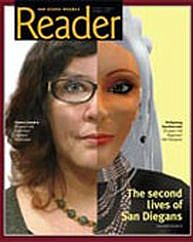
As you read this, 40,000 people in the world are "in-world." This doesn't mean that these people have left our world, the real world. It means that their real bodies are sitting in front of personal computers, and their consciousnesses have embodied an "avatar" who is in another place, in another life. In "Second Life." In their second lives, these people's avatars might be playing games, meeting other people's avatars, listening to music, dancing, reading things, inventing things, teaching classes, buying and selling services and things, sitting around, exploring, discussing business, and even engaging in virtual sexual activities.
Sound creepy?
It might be creepy. But it's also "the next wave of the Internet," "a platform for learning," "an online playground," "a virtual environment," and "a new opportunity to make a whole lot of money" -- depending upon whom you ask.
According to San Francisco-based Linden Labs, the company that created it, "Second Life is a 3-D virtual world entirely built and owned by its Residents."
There's No Difference between My Real Life and My Second Life
One of those residents, Jopsy Pendragon, has long pointy ears that wiggle. He wears hippie clothes and floppy hair, and best of all, he sports a set of removable, multicolored, fully operational dragon wings. The wings are just for show, though, since everyone where Jopsy's from can fly, and also teleport.
Pendragon is an ageless, tall, thin, blond, barefoot elfin lampmaker and lighting-effects creator in the Teal region of Second Life. His particle laboratory there is famous. If you Google the name "Jopsy Pendragon," you get around 400 hits. He's got a video on YouTube. His real person writes a blog.
Pendragon's real person, John P. Crane, is a six-foot-tall, 230-pound, 40-year-old redheaded blue-eyed information technology specialist who lives in Hillcrest and works for a small biotech company in La Jolla.
Crane not only tosses around terms like "VRML" -- which stands for virtual reality modeling language -- he's fluent in it.
"I made Jopsy Pendragon from scratch," Crane tells me. "Pretty much everything except the hair, which I bought from somebody, because I'm terrible at making hair."
Crane doesn't look the part of your average computer geek. For one thing, his clothes and his own hair, and even his condo, are all quite clean. The walls of his living room are hung with bright, abstract artwork that Crane painted himself. As he chats with me, he sits down, turns on his computer, jogs his mouse and clicks it a few times, and there we are, in the castlelike home area of the famous Jopsy Pendragon.
On the screen of Crane's personal computer, Second Life has all the trappings of a good modern video game. Everyone's motions are robotic and herky-jerky, the trees and buildings shine bright and plastic and fantastical, and everything appears realistic enough, if you don't stare at it for too long.
But Jopsy Pendragon doesn't have a gun to shoot or a car to drive; he's got nowhere to go and no enemy to kill; and as far as I can tell, he doesn't have a mission or assignment to carry out. He's just there.
"Meet Jopsy Pendragon," John P. Crane says. "He's my avatar."
In Hindu religion, an avatar was the incarnation of a deity in human form. Nowadays, the word suggests an abstract manifestation or embodiment, as in the sentence, "Approaching the year 2008, Second Life is the most advanced avatar of virtual reality."
Avatars in Second Life have got the life. They can't drown, won't age, don't have to eat (although they can), can't get hurt, don't have to go to the bathroom (although they can). No avatar is born anatomically correct (although -- get this! -- they can have genitalia built for them). Basically, avatars are ideal versions of us. Like pixelated angels or something.
And we are their creators.
Crane started visiting Second Life back near its beginning, in January 2004. He'd heard about the three-dimensional digital world from a friend in L.A. who shares an interest in virtual worlds.
Crane tells me that the earliest interactive computer platforms were bulletin-board systems. You dialed in on your modem to a single phone line, and you left messages, and someone else would call in later and add a few messages of their own. The boards got a little more complicated in the early '80s, with a couple of phone lines, and within a year or two, there was simultaneous text chat where people could type to each other.
The first color graphics (2-D, some even drawn in perspective) and on-screen characters date to the mid-'80s, and point-and-click was invented in 1987.
In 1989, James Aspnes at Carnegie Mellon University invented TinyMUD, an online arrangement of virtual places where users could go and create content for other people to explore. TinyMUD was a big step forward, because it was user created, and the virtual situations would change as the users chose to change them.
Crane himself created a version of TinyMUD, called DragonMUD, by taking the source code, inventing a theme, and inviting players. For a long while, DragonMUD was Crane's main thing on the Internet. The game helped him meet people from all over, including someone who worked at Qualcomm and who helped him get a job there. Crane ended up working at Qualcomm for over eight years.
Throughout the '90s, computer gaming continued to develop, with increasingly realistic graphics, 3-D technologies, and stereo sound.
But discerning computer experts like Crane weren't satisfied. "Even by 2003," he says, "most of the stuff out there in virtual reality was just really flat. It looked artificial, it was slow, clunky, and was really hard to use. But then my friend came down to visit, and we went into the Apple Store in Fashion Valley, and he pulled down the Second Life client right there in the store, and he started running it. So we went in and looked at things and poked around, and I thought it looked pretty cool. I agreed to sign up. At the time, it was a pay service; it cost $10 to sign up. But they've done away with that. Now it's free."
Second Life's parent company, Linden Labs, was founded by Philip Rosedale, 39, in 1999. The site opened to the public in 2003.
So, Second Life is a virtual world and it's free to join. But why would you join? Why would you want to go into a virtual world?
"The hardest thing about Second Life is finding what you're into," Crane says, and he seems to be half-agreeing with me. "You have to bring in a lot of who you are, to find something you enjoy doing. Most people will look around, buy a few things, go to a club, dance a little, and that's about it."
But, Crane says, for some people, there's a whole lot more to Second Life. "If anybody has any degree of programming experience whatsoever, then picking up Second Life is really easy. And people who haven't done any programming can get so into this that they actually learn how. The scripts are pretty basic."
Crane persists, "It's like filling out a tax form, almost. It's trying to figure out what values to put in what blanks to make sure it all looks the way you want it to."
Jopsy Pendragon has been standing around, unattended, preternaturally patient, facing away from us and waiting there on Crane's computer screen while we've been chatting. But as Crane decides to show me an example of coding and scripting, Pendragon's broad-shouldered and dragon-winged form is eclipsed by onscreen windows known as "editing widgets."
As I look on, Crane opens a widget full of fundamental shapes, called "prims," clicks on a box prim, spreads it out, elongates it, and then adds a second, triangular prim, which he places on top of the elongated box. Deft with his clicking mouse, Crane uses subsequent widgets to color in the parts, hollow out the composite prim, and texturize it. He's quick at this, and within a minute, Pendragon is bathing in the light of a homemade virtual lamp.
The funny thing is, there's no real need for lamps in Second Life. If you want light, you click on a command that says "force sun," and you make it noontime. If you want more light still, you turn up the resolution on your computer. But Crane's lamps are beautiful, and they're also necessary if you want to authenticate a city streetscape. So lots of people buy them. That's right. They buy them. With real, first-life money.
The currency in Second Life, or "in-world," as they say, is Linden dollars. The variable exchange rate for Lindens is about L$168 to one U.S. dollar. Jopsy Pendragon's lamps average a few hundred Lindens apiece, or just a couple of U.S. dollars.
Which is to say that many residents of Second Life are making money -- both Lindens and Benjamins. One person even used his avatar to invent a computer game, called Slingo, which the person subsequently sold for millions to Nintendo. Most Second Lifers are making small amounts of money in small transactions, a dollar here, a dollar there. But those numbers do add up. In the past 24 hours, over $1 million has been spent on clothes, hair, "real" estate, and goodness knows what other in-world items.
Crane later informs me that he has friends who've made Second Life their career. "I know a guy on the East Coast who does nothing but make trees," Crane says. "And gardens, and landscaping. And he buys a new computer off the proceeds every year. And I have a friend in Canada who does custom work, mostly costumes, and he's a starving-artist type, but now he buys his groceries and makes rent off his work in Second Life."
Second Life? More like a second job.
In fact, Crane does pretty well for himself in his first life -- owning a Hillcrest condo and driving a convertible, for instance -- but he's also one of the richer residents of Second Life.
"I sell my lamps," he tells me, "but I also have a particular bailiwick. My thing is to teach people how to do scripting for a special kind of special effect. You might call them particle splashes. It's a very dynamic special effect. It's like painting in 3-D with kind of a time element to it. I have a classroom that I built in-world that lets people show up whenever they want. They can go through all the samples on their own. Kind of like the Reuben H. Fleet Science Center, where they have all the little exhibits. And the classroom's been there so long, it's basically spread by word-of-mouth."
Crane shows me a variety of electricity-shooting devices that look as if they belong in Dr. Frankenstein's laboratory.
I'm beginning to understand that the two fundamental actions in Second Life are building and scripting. In essence, building a lamp and scripting how its light shines, and building sunbeams through the leaves in a tree and scripting how those sunbeams glisten, and even building the tree itself and scripting how its leaves move -- all of these objects and actions are designed and created the same way in Second Life. You edit some prims and put them together and write up some code and voila! And if the residents of Second Life didn't build and script these things, then these things wouldn't exist.
"The world has a lot more detail and a lot more craftsmanship than it ever did before," Crane says. "Things used to look a lot more blocky and more plain. But a lot of people have come along who are very good at building things."
He opens a search window, clicks, and teleports to an example of what he's talking about. After a few seconds, Jopsy Pendragon appears in a new spot and begins to fly around. He lands next to the realistic and tragic form of a giant slumped snowman.
"This melting snowman sculpture was made by a fellow named Starax Statosky," Crane says. "He was an infamous sculptor. He's probably one of the most popular artists in Second Life. He created an object called a magic wand that could respond to keywords. If you said 'eye,' a huge eyeball would appear in the air, look around, fall to the ground, and roll away. If you said 'train,' a huge locomotive would appear on the horizon and roll across -- smoke, steam, dust, train sounds, everything. It was an amazing object. Unfortunately, though, Second Life is a world that's constantly changing. And when somebody comes up with a new way to bother other people, Linden Labs has to come up with a way to protect them. Not on an individual basis, but by finding ways to limit how scripts can be annoying. And unfortunately, Starax's magic wand used a lot of the same mechanisms as these scripts that were being used maliciously. So Linden Labs disabled a lot of the scripts that were used by this wand, and it broke really badly. Well, Starax was so upset by his wand breaking -- he used to charge something like $10 of real money for each wand -- and so many people were so upset that their wands broke, because they'd paid real money for this virtual object, and then Starax just vanished. We've never heard from him again. So the few sculptures that are left in the world of his are coveted and quite impressive. They're so distinctive."
Crane tells me that he'd talked to Starax Statosky a few times in-world, but he doesn't know who he is in real life or where he lives.
As Jopsy Pendragon is landing at a shopping mall, a strange repetitive sound like crazy drunken giggling comes over the computer's speakers, and an avatar flies over. A bunch of spinning boxes with creepy smiley faces on them are bumping into the flying avatar. And no matter what evasive actions he takes, the boxes keep bumping into him. It's a bizarre scene and an example of what Crane means when he mentions scripts "being used maliciously."
"That poor guy," Crane says. "Someone's griefing him. For whatever reason, he's being dogged by those boxes and he can't get away, because someone else who was bored or whatever wrote up that malicious script to bother him."
Even though Second Life is an open-ended fantasy land, with expanded possibilities and fewer consequences than in real life, some basic behavioral guidelines do exist to govern the conduct of its members. The six offenses against "community standards" are intolerance, harassment, assault, disclosure, indecency, and disturbing the peace. But Linden Labs engages in no policing and little governing. Instead, they leave it to members to report abuses, and then a dedicated team sits in judgment and looks at each report on a case-by-case basis. The police blotter on the Second Life website lists recent infractions and disciplinary actions such as suspensions and warnings.
The flying avatar who's being griefed by the spinning giggly boxes might well be taking the necessary steps to report his griefer. Or maybe he deserves the grief -- who knows?
At any rate, the beleaguered avatar must have given up trying to get away from the boxes, since he disappears.
"It's easier to come up with something that annoys people than it is to come up with something that impresses people," Crane says.
I ask him to elaborate about the mischievous side of things in Second Life. He sits back in his comfy computer chair and smiles. "Well," he says, "there are entire businesses dedicated to the production of beds, for instance, that are scripted so you can have two or more avatars, um, 'playing with each other' in a variety of ways."
In relation to this, he tells me that lots of businesses specialize in the building and selling of genitalia.
I speculate that building genitalia must be like building a lamp.
"Pretty much," Crane says, laughing. "A cylinder here, a sphere there, another sphere there..."
Crane also tells me that people make real money as virtual prostitutes. "They're not real bodies," Crane says, referring to the pixelated flesh and blood of avatars, "so you can pretty much do whatever you want with them."
Not necessarily. I've read about recent controversies involving age play, or child porn, in Second Life. Sure, it's creepy, but is it illegal? If someone engages in virtual sex with an avatar that looks like a child, but the real person behind the child avatar is an adult, then is a law being broken? Apparently not, since, according to the landmark decision of Ashcroft v. the Free Speech Coalition, "Virtual child pornography is not 'intrinsically related' to the sexual abuse of children." At any rate, age play has been disallowed in Second Life.
Crane also tells me that bondage and S&M are quite popular in Second Life "because so much of it is psychological, it's all power-play between people."
For his own part, Crane doesn't get into any of that. "I don't mind flirting in Second Life," he says, "but that's as far as I go. After that, I feel like I'm playing with puppets. When it's still in the flirting stage, you're in the person-to-person zone. But more than that, I don't know."
Crane sums it up this way: "There's a lot of freedoms in Second Life that people don't have in real life. When Second Life was started, it was meant to be a place that was enabling -- for people to be what they wanted to be, pretty much no strings attached, no consequences. People value that sanctuary. And they don't want it coming back and haunting them. Me, personally, I've been online way too long in my life, and anybody who sees my avatar's name, Jopsy, it's what a lot of people call me in real life. I've had the name since high school. It's kind of my initials run together phonetically, J.P.C. So I've had people who've found me from high school in here. And there's no real difference between my personality in real life and my personality in Second Life. I'm just as reclusive or interactive or playful or silly or argumentative. My political views are the same, etc. But that's not how it is for a lot of people."
It's Not a Game. It's a Place.
Pollywog Gardenvale's lazing and swaying on a hammock in her backyard. By the sound of it, the ocean must be nearby. Gardenvale looks relaxed in her black bathing suit top and a clingy sarong. Her long black hair flairs to the sides in showy braids.
Claire Condra, 55, describes Gardenvale as her "inner, taller, thinner, younger self."
Condra resides in La Mesa. Her 1911 Victorian-into-Craftsman-style house is like a museum of vintage furniture and art. Her laptop rests upon a handmade wooden table that dates back to the 1850s. A lithograph of Alfred E. Neuman hangs over her sofa ("What -- me worry?"). She has straight bangs across her forehead and a big, constant smile, and when her glasses aren't on her face, they hang from a beaded chain. She greets me by calling me "Sweetie."
One of the first things Condra has to do with Pollywog Gardenvale, before we can go anywhere, is change the way she looks. "I was at a beach party the other night," she says. "So I'm still dressed for the beach."
Condra takes a few minutes to change her avatar's boots, pants, and top, using a menu that's chock full of sartorial options.
"Your default avatar is basically like Barbie or Ken," Condra says, "but you can buy all sorts of...um...equipment. For example, I just got some new skin that's a little better. And I have all sorts of hair. This is my fairy hair. But I have purple hair and formal hair too."
Condra has been in the computer industry since the early '80s. She's a self-proclaimed "technology evangelist." She tells me that "real, significant uses" of technology are few and far between but that Second Life is undoubtedly one of these significant advances.
"What is happening," Condra says, "is a migration from the 2-D Web to the 3-D Web. That's what this is about. And five years from now, there's going to be another browser war. All these new, conflicting standards are going to emerge."
Then Condra draws an interesting parallel.
"When you have a 2-D website," she says, "you don't think of other websites as your neighbors. But here, they are your neighbors. And when you want to visit, you knock on a door, come inside, and sit and talk. And that's because, in the 3-D virtual world, you are actually inside the website. Instead of looking at things, you're inside there with those things, interacting with objects. And, the best part, you're interacting with other people who are also visiting the website. That's what this is about. It's so significant. And that's why all these companies are in there right now, trying to figure out, 'What are we going to do with this thing?' "
The way Condra paints the picture, it sounds as though Second Life is preparing us for the next massive leap in human technology: we started with language, then the tool, the wheel, electricity, the combustion engine, relativity, genetics, the telephone, the television, computerization, the Internet... and now the 3-D Web.
As I stare at the computer, I suddenly feel like one of those apes swinging a bone next to the monolith in 2001: A Space Odyssey.
Says Condra, "What's happening is, all of these companies -- who are the movers and shakers in the computer industry -- are in there to define it and to really establish what this thing is. And they're learning from past mistakes, how it messes everybody up when you don't have standards. What Linden Labs has done with this is open it up to individuals and to businesses to develop it. So it's a total open-source platform, and they want people to add on to it and to continue to develop it. So IBM is in there, and they're developing. I think they have something like 13 different islands. They use Second Life for teleconferencing and collaboration and as a development platform for prototyping. They have showrooms."
Condra's whole life has been dedicated to the computer industry, so she has a real interest in this stuff, and she knows what she's talking about. She ran a publishing company in the '90s that specialized in computer books. And she's also worked as a technical writer and a trainer for computer companies. But now she dedicates her time to Second Life.
"It took about three months for me to understand what this is all about," Condra says. "Because there are all these tools in there, 3-D modeling tools, and the programming language. So somebody who's a graphic artist, like I am, and a programmer, like I am, or a writer or artist or musician -- this is a totally creative environment. And you can just do all sorts of stuff. Learning about Second Life was like learning how to play again. It was like going back. I had not used this part of my brain in probably 40 years."
But Condra's not just in Second Life so that she can play. "Remember that I'm working to put out a newspaper," she says.
Together with her childhood friend Greg Campbell, aka Surfdaddy Orca, Condra publishes a monthly in-world newspaper called the Seventh Sun.
Says Condra, "Even though we publish a virtual newspaper for a virtual world, it's basically a real paper. It's every bit as much work as a real paper. I have to research articles and do all the production and distribution. And then, I mean, it's print-ready."
A sampling of nine headlines from recent issues of the Seventh Sun:
Gambling banned in Second Life -- All bets are off in Second Life gambling ban.
Island Scam -- Con man tricks six people into buying one island.
Happy Birthday Governor Linden. Thousands of avatars converged on the Second Life 4th Birthday extravaganza.
Voice comes to Second Life. The SL voice "First Look" client is now available on the main grid.
The MacArthur Foundation in Second Life. Jonathan Fanton, President of The John D. and Catherine T. MacArthur Foundation appeared as an avatar along with Linden Lab CEO Philip (Rosedale) Linden to discuss Philanthropy in Virtual Worlds.
Honorable Land Dealers' Association. Where reputation and fair dealing are as important as making a fast buck.
Bella LaSalle and Arkady Yost unite in virtual nuptial. Avatars find real world romance in virtual world.
Technological Platform Capital. Is investment in technological capital more important than adding new features?
Who ya gonna call? Globetrekker Bob Lane, The Travel Man. No, he's not a ghostbuster, but he can get you to haunted houses with his first ever in-world travel agency.
It reads every bit as detailed and arcane and involving as a list of headlines from the real world.
"Everybody has a different take on what Second Life is," Condra says, "because it's basically whatever you want to make it."
So Pollywog Gardenvale is like the Rupert Murdoch of Second Life.
"Well," she says, "I'm not rich."
Not yet.
But Condra estimates that the time is right for an in-world publication that can cross over into the real world. "It's more than just a novelty," she says. "Enough businesses are in there, spending real money, and they need to get the news."
In the meantime, Condra does have other ways of turning a buck. She owns a hat shop in-world as well. "Hats and newspapers go together," she laughs. "My hat shop is really a newsstand."
Once Pollywog Gardenvale looks a little more presentable, Condra teleports her to a docked luxury cruise liner where her hat shop/newsstand is located. The ship has a conference room and ballrooms and stores and used to have a full working casino onboard before the recent gambling ban came into effect. "Since gambling is illegal now," Condra tells me, "the owner of the casino is thinking of making it into a casino museum."
Almost since the moment when Condra arrived in-world, Second Life has been alerting her that people are saying hello to her. Within ten minutes, a few avatars have already dropped by, and she's gotten dozens of instant messages. She's courteous with everyone, but she lets them all know that she's busy right now because she has a special guest (me). Condra has mastered the valuable computer-user's skill of being able to talk about one thing and type about another at the same time.
When yet another visitor stops in, I ask Condra whether she can show me how to use the newly voice-enabled Second Life software to talk to him instead of typing to him.
"Well, I would," Condra responds, "except that he's deaf."
In the idealized atmosphere of Second Life, of course, it's impossible to tell that anyone might have a real-life disability.
And then it occurs to me: in Second Life, older people don't have to deal with ageism, women can avoid sexism, a person with a physical deformity can keep that deformity a secret, racial differences become undetectable, social class and pedigree are irrelevant, and even language barriers tumble, thanks to powerful online translators.
As residents of Second Life create their all-but-perfect synthetic identities, the playing field is leveled to the point where everyone might be valued solely for the strength of his or her contributions and ideas. In-world, "all (people) created equal" finally means something closer to what it was always supposed to mean. But is there some other kind of inequality at work here? Perhaps based on how interesting or sophisticated or technologically creative the avatars are?
"There are lots of disabled people who are living fuller lives thanks to this," Condra tells me. "I have one friend in here who's legally blind. In real life, she's never been to a concert, never had a boyfriend. And now she builds underwater gardens, and she has a much fuller life thanks to Second Life." She can see enough to type, apparently.
But isn't this problematic from a philosophical or moral point of view? Are you living a fuller life if that life is spent in a fantasyland? Couldn't that distract you from doing what you really need or want to do with your real life, disabilities and all?
Soon, Condra gets a hello from someone who seems important.
"Oh," she says, "now we have to go over there."
And we teleport to Dr. Dobb's Island, where two friends of Condra's/
Gardenvale's are dancing on a stagelike structure.
Dr. Dobb's has been the leading computer-publications press in the world for over 30 years, and it has a major presence in Second Life. And now Condra's avatar is dancing with the avatars of two of Dr. Dobb's major players. In between dance moves, they're typing about business -- impending summit meetings and whatnot.
These are apparently some very big-time people in the computer industry. One lives in Cape Cod, and the other lives in Washington State, but here is up-and-coming Claire Condra in La Mesa being invited to sit on an international panel with them.
I'm starting to see the bigger picture now, as Condra sees it.
"Soon," she says, and her eyes are bright, and her voice conveys a happy exasperation, "online-sales websites like Amazon are going to have 3-D catalogs that tie into 2-D order processing. Or let's say you'll be shopping for a kitchen. You're going to be able to go in, design your own kitchen, try out new countertops, new cabinets, everything. So that's one way this is heading, in terms of e-commerce."
Condra also mentions the concept of distance learning, with virtual classes and students and teachers in different rooms on different computers in different cities. San Diego State has a virtual campus in Second Life already. And then Condra tells me how computer companies are using Second Life to get programmers together to work on projects without having to travel.
"And then there's also the social aspect," she says, "with all these people making friendships. And that's this whole other side of it. So this is a real mix of all of these things. Which is why I don't think of it as a game at all. It's just a place."
Will Diegoland Ever Break Even?
"You're Poetry Tomorrow, right?" I hear Bob Hippen's voice on my telephone.
Hippen, 55, grew up in San Diego but now lives in Oregon. In the real world, he's a divorced radiologist with a 12-year-old son. Claire Condra has been his good friend since grammar school.
"Yes, Poetry Tomorrow," I say. I've created a stock avatar and taken on an only mildly embarrassing name.
"I just sent you an IM," he says. "I'm Champion Valiant. I'm at Diegoland right now."
"So am I," I say. I've already teleported there in anticipation of our meeting.
"Where are you?" he asks.
"I'm standing behind the organ pavilion."
"Hang on. I'm looking for you. Stay in one spot."
I do nothing.
"There you are," he says. "Hello, Poetry Tomorrow."
Our two avatars are standing there in front of each other. "This is bizarre," I mumble. I feel as if my 3-D self should walk up to Hippen's and shake his hand. I've read where people respond to virtual space the same way they respond to real space. For example, if Hippen's avatar comes too close to mine, then I'm supposed to feel like backing up, as though he's entered my personal area.
"I've just added you as a friend," Hippen says. "Anyway. Okay. Let me get my little tour vehicle. Hang on just a sec."
A blue object appears that looks like the simplified interior of a sleigh or pedicab, with benchlike seats. It has a low seat in front and a higher one in back. "You right-click on it," Hippen instructs me, "and choose 'sit.' "
I do so.
"There you go," Hippen says.
Champion Valiant takes the seat in front of mine, and the blue tour vehicle begins to float around, carrying our avatars high above Diegoland, a replica of San Diego that Hippen "visioned" himself and built inside Second Life.
"I fly people around and show them the place," Hippen says. "It's a virtual San Diego. It's by no means a carbon copy or a Xerox of San Diego, of course. But it has elements of San Diego, carefully selected to evoke the sense, the feel, and, I suppose, the nostalgia of San Diego."
Hippen flies our tour vehicle down toward an image hanging on a wall in an office. "If you look right in front of us right now," Hippen tells me, "you'll see that this is a map of Diegoland. We've got Coronado, with the Hotel Del, and the Point Loma lighthouse down here, which is where Champion Valiant lives, by the way. And if you follow the road up north of the lighthouse, you've got Old Town right here, and then Mission Valley up here, which is where I grew up, back when it was mostly farmland. And the beaches are out west, over here, where we have some beach houses for rent."
I notice that Hippen hasn't fully reproduced San Diego. Instead, it looks a lot like a neighborhood at Disneyland.
"Exactly," Hippen says. "Instead of Tomorrowland or Fantasyland, this would be Diegoland."
Hippen shows me the Cabrillo Bridge, a Diegoland Gateway sign that's based on the Hillcrest Gateway sign, the Horton Plaza Fountain, the USS Midway, and the bell tower at Balboa Park.
"What I did was, I got this sim, or private island," Hippen explains, "back in November of 2006, back before the price went up. It used to be $1250 real money for a sim. Now I think it's $1650. And I downloaded a satellite photo of San Diego from Google Earth, and I used it as a template for terraforming the sim. Because the sim, when you get it, is just this, well, you can think of it as a lump of clay that you can manipulate and shape. But I'm not very good at it. I worked really hard on it and followed the directions, but for all the really hard stuff, for the real craftsmanship, I hired other people to do it."
For example, Hippen tells me that the poles on the real Hillcrest Gateway sign in Hillcrest were made by a local sculptor named Christopher Lee. So Hippen went and found Christopher Lee and had him design the Diegoland Gateway sign in Diegoland.
On top of the initial fee, it's another $195 a month to keep a sim. The money is paid directly to Linden Labs. Hippen tells me that the fee for new land is now $295 a month, but he still pays the old amount. "All told, I think I've invested about $10,000 on Diegoland," he says.
How does Hippen justify paying so much on a virtual project?
"Well," he says, "first of all, it's been fun. If it wasn't fun, I wouldn't do it. And secondly, it's been a labor of love. I love San Diego. But this is also a business proposition, really, except, in order to make it work, I mean, as far as the business model, I basically have to try to get people to come to visit. And the reason why you want people to come visit is to spend money. I don't earn money from the people who come to visit. They come for free. But what you're hoping is, they're going to come and shop and buy things. So I charge rent from people who have shops. It's not very much; only about $8 a month."
Hippen tells me that he'd be very happy if he could break even, eventually. "For this to work," he says, "the money I make off rentals really isn't enough. So what's needed is outside sponsorship. And some other sims have actually gotten that."
Hippen says he'll draw the line when it comes to corporate sponsorship. "I'd love to have Qualcomm sponsor Diegoland," he says. "But I don't want to name everything 'Qualcomm.' I don't want this to become 'Qualcomm's Diegoland.' "
Hippen throws live events at Diegoland almost every day, and he likes to be on hand for each one. Usually there will be live music or a DJ, and sometimes even a fashion show. "I get real musicians and real DJs to perform, and we stream their music into Second Life," he says. "A lot of these events have become quite popular."
Hippen even hosted a wedding in Diegoland recently. "That was a huge event," Hippen says. "I mean, the wedding, the rehearsal, and the reception, my God. That whole weekend, the traffic was over 24,000 people."
Hippen tells me that the people in the virtual wedding were from Argentina and Pennsylvania. "They've never met in real life," he says, "but I guess they fell in virtual love."
Then Hippen says something I find very interesting.
He says, "The world is virtual, and the characters are cartoonish and they look virtual, but the feelings are real. You can really feel like you're in love with someone. And you can really feel like you're angry. There can be all sorts of drama. That's not any different from real life."
And just as he's explaining this, we're visited by a shapely female avatar with long braided hair. Elphaba Scheflo is her name.
"Oh," Hippen chuckles. "Here's my fiancée."
His fiancée in-world?
"Yes."
Has he ever met her in real life?
"No," he laughs. "I have not, and I don't think I will."
So?
"It's a long story," Hippen says.
But I persist.
"I met her when I was starting out," he explains. "When I was what they call a 'newbie.' And she was working at a diner, and that's how we met. We became friends."
Hippen instant messages her and tells her that he's having an important business meeting with me. She asks if she can tag along if she keeps quiet. Hippen says okay. And then I have this shapely female avatar with long braided hair sitting next to me on the tour vehicle.
I ask Hippen whether Champion Valiant and his fiancée have consummated their relationship.
He laughs. "I prefer not to answer that."
Hippen does tell me that Champion Valiant has no plans to marry Elphaba Scheflo anytime soon.
I'm reminded of statistics I read in the Wall Street Journal recently, where a national survey at Stanford indicated that 40 percent of men and 53 percent of women who have virtual friends say their virtual friends are better than their real ones.
Another recent study showed that 25 percent of online gamers say that their biggest emotional highlight of the past week occurred in a computer world.
Do people risk spoiling their real lives by fixating on their second ones?
Or, stated more apocalyptically, will Second Life ever replace real life? Are these the first tentative baby steps toward the machine-centric world of The Terminator?
Hippen says he doesn't really think about any of that, but he does tell me that he read in Time magazine that by 2011, 80 percent of people will have at least some involvement in virtual worlds on the Internet.
"But Second Life isn't really quite as popular as the numbers say it is," Hippen tells me.
The numbers say Second Life has now topped nine million members, including almost one million who've logged on at least once in the past month.
"For one thing," Hippen elaborates, "a lot of people think that Second Life is too hard. They say it's too hard to learn how to get around and do things, and the learning curve is too much. I've heard a statistic that only one-third of the people who log into Second Life actually make it through orientation. Most people give up.
"So they say that over nine million people have signed up, but a lot of those are what they call 'alts,' or alternate characters. Including me. I have more than one character."
Why did Hippen need more than one avatar?
"What happens is, people start to know you," Hippen says. "You start to become famous in-world. And you just really can't do much when you get online -- you can't play around and try new things and explore and just have fun -- without a whole bunch of people sending you IMs and really getting in your face, in a way. So you can't get away from it all unless you have an anonymous avatar. It's kind of nice to become known, but it's also inconvenient." And then he adds, "Of course, in real life, nobody knows me from Adam."
At this point, silent and sudden, a winged horse appears next to our tour vehicle and flaps its wings and waits for Elphaba Scheflo to jump up from her seat and hop onto its back. Then the winged horse flies her away. Wherever and whoever Scheflo's real person is, she hasn't heard a word that Hippen and I have been saying to each other on our telephones. Her avatar's just been sitting there next to our avatars in silence.
"There goes Elphaba," Hippen says fondly.
Twenty minutes later, the horse brings her back, and with no other sound than a flapping of wings, she takes her seat beside me again.
"I would say my primary avatar, Champion Valiant, is about two feet taller and about 25 years younger than I am," Hippen chuckles. "He's, like, perfectly buffed and toned, but I'm not. Pretty much most of us in Second Life choose to look like fashion models and athletes. There's a few who choose to look pot-bellied and old and wrinkled and bizarre, but most look like something out of Cosmo or GQ."
Hippen tells me that he logs into Second Life mostly in the evenings and on weekends. And when he's in-world, he's usually doing the same thing. "I typically greet people when they come to Diegoland," he says. "And I take people on tours."
Hippen is full of arcane historical knowledge about San Diego. Along our tour he gives me wonderful in-depth details about everything from the lamp at the lighthouse to stories about the Whaley House and the bells in Balboa Park. It seems as though there's nothing he hasn't learned about the first, material San Diego in his reconstitution of an immaterial one.
I comment that building Diegoland must have been quite a task.
"It was a long, long process," he says, matter-of-factly. Hippen sent hundreds of web links, many from the San Diego Historical Society, to dozens of builders, to help complete the Diegoland project. The place was constructed using over 10,300 prims.
Hippen has plans to expand. "I was thinking about doing the zoo soon," he says, "and San Diego State University, and then some of North County: La Jolla, Del Mar, Legoland, you know, those kinds of places. And then I want to do the Borrego Desert, too. I'm kind of ambitious about it. The problem is, before I do all those things, I really sort of need to figure out how to fund this one."
Here's something you might be interested in.
Second Life, a 3-D world, gets people away from drudgery
The worlds we’d make if we were gods

Second Life, a 3-D world, gets people away from drudgery
The worlds we’d make if we were gods
As you read this, 40,000 people in the world are "in-world." This doesn't mean that these people have left our world, the real world. It means that their real bodies are sitting in front of personal computers, and their consciousnesses have embodied an "avatar" who is in another place, in another life. In "Second Life." In their second lives, these people's avatars might be playing games, meeting other people's avatars, listening to music, dancing, reading things, inventing things, teaching classes, buying and selling services and things, sitting around, exploring, discussing business, and even engaging in virtual sexual activities.
Sound creepy?
It might be creepy. But it's also "the next wave of the Internet," "a platform for learning," "an online playground," "a virtual environment," and "a new opportunity to make a whole lot of money" -- depending upon whom you ask.
According to San Francisco-based Linden Labs, the company that created it, "Second Life is a 3-D virtual world entirely built and owned by its Residents."
There's No Difference between My Real Life and My Second Life
One of those residents, Jopsy Pendragon, has long pointy ears that wiggle. He wears hippie clothes and floppy hair, and best of all, he sports a set of removable, multicolored, fully operational dragon wings. The wings are just for show, though, since everyone where Jopsy's from can fly, and also teleport.
Pendragon is an ageless, tall, thin, blond, barefoot elfin lampmaker and lighting-effects creator in the Teal region of Second Life. His particle laboratory there is famous. If you Google the name "Jopsy Pendragon," you get around 400 hits. He's got a video on YouTube. His real person writes a blog.
Pendragon's real person, John P. Crane, is a six-foot-tall, 230-pound, 40-year-old redheaded blue-eyed information technology specialist who lives in Hillcrest and works for a small biotech company in La Jolla.
Crane not only tosses around terms like "VRML" -- which stands for virtual reality modeling language -- he's fluent in it.
"I made Jopsy Pendragon from scratch," Crane tells me. "Pretty much everything except the hair, which I bought from somebody, because I'm terrible at making hair."
Crane doesn't look the part of your average computer geek. For one thing, his clothes and his own hair, and even his condo, are all quite clean. The walls of his living room are hung with bright, abstract artwork that Crane painted himself. As he chats with me, he sits down, turns on his computer, jogs his mouse and clicks it a few times, and there we are, in the castlelike home area of the famous Jopsy Pendragon.
On the screen of Crane's personal computer, Second Life has all the trappings of a good modern video game. Everyone's motions are robotic and herky-jerky, the trees and buildings shine bright and plastic and fantastical, and everything appears realistic enough, if you don't stare at it for too long.
But Jopsy Pendragon doesn't have a gun to shoot or a car to drive; he's got nowhere to go and no enemy to kill; and as far as I can tell, he doesn't have a mission or assignment to carry out. He's just there.
"Meet Jopsy Pendragon," John P. Crane says. "He's my avatar."
In Hindu religion, an avatar was the incarnation of a deity in human form. Nowadays, the word suggests an abstract manifestation or embodiment, as in the sentence, "Approaching the year 2008, Second Life is the most advanced avatar of virtual reality."
Avatars in Second Life have got the life. They can't drown, won't age, don't have to eat (although they can), can't get hurt, don't have to go to the bathroom (although they can). No avatar is born anatomically correct (although -- get this! -- they can have genitalia built for them). Basically, avatars are ideal versions of us. Like pixelated angels or something.
And we are their creators.
Crane started visiting Second Life back near its beginning, in January 2004. He'd heard about the three-dimensional digital world from a friend in L.A. who shares an interest in virtual worlds.
Crane tells me that the earliest interactive computer platforms were bulletin-board systems. You dialed in on your modem to a single phone line, and you left messages, and someone else would call in later and add a few messages of their own. The boards got a little more complicated in the early '80s, with a couple of phone lines, and within a year or two, there was simultaneous text chat where people could type to each other.
The first color graphics (2-D, some even drawn in perspective) and on-screen characters date to the mid-'80s, and point-and-click was invented in 1987.
In 1989, James Aspnes at Carnegie Mellon University invented TinyMUD, an online arrangement of virtual places where users could go and create content for other people to explore. TinyMUD was a big step forward, because it was user created, and the virtual situations would change as the users chose to change them.
Crane himself created a version of TinyMUD, called DragonMUD, by taking the source code, inventing a theme, and inviting players. For a long while, DragonMUD was Crane's main thing on the Internet. The game helped him meet people from all over, including someone who worked at Qualcomm and who helped him get a job there. Crane ended up working at Qualcomm for over eight years.
Throughout the '90s, computer gaming continued to develop, with increasingly realistic graphics, 3-D technologies, and stereo sound.
But discerning computer experts like Crane weren't satisfied. "Even by 2003," he says, "most of the stuff out there in virtual reality was just really flat. It looked artificial, it was slow, clunky, and was really hard to use. But then my friend came down to visit, and we went into the Apple Store in Fashion Valley, and he pulled down the Second Life client right there in the store, and he started running it. So we went in and looked at things and poked around, and I thought it looked pretty cool. I agreed to sign up. At the time, it was a pay service; it cost $10 to sign up. But they've done away with that. Now it's free."
Second Life's parent company, Linden Labs, was founded by Philip Rosedale, 39, in 1999. The site opened to the public in 2003.
So, Second Life is a virtual world and it's free to join. But why would you join? Why would you want to go into a virtual world?
"The hardest thing about Second Life is finding what you're into," Crane says, and he seems to be half-agreeing with me. "You have to bring in a lot of who you are, to find something you enjoy doing. Most people will look around, buy a few things, go to a club, dance a little, and that's about it."
But, Crane says, for some people, there's a whole lot more to Second Life. "If anybody has any degree of programming experience whatsoever, then picking up Second Life is really easy. And people who haven't done any programming can get so into this that they actually learn how. The scripts are pretty basic."
Crane persists, "It's like filling out a tax form, almost. It's trying to figure out what values to put in what blanks to make sure it all looks the way you want it to."
Jopsy Pendragon has been standing around, unattended, preternaturally patient, facing away from us and waiting there on Crane's computer screen while we've been chatting. But as Crane decides to show me an example of coding and scripting, Pendragon's broad-shouldered and dragon-winged form is eclipsed by onscreen windows known as "editing widgets."
As I look on, Crane opens a widget full of fundamental shapes, called "prims," clicks on a box prim, spreads it out, elongates it, and then adds a second, triangular prim, which he places on top of the elongated box. Deft with his clicking mouse, Crane uses subsequent widgets to color in the parts, hollow out the composite prim, and texturize it. He's quick at this, and within a minute, Pendragon is bathing in the light of a homemade virtual lamp.
The funny thing is, there's no real need for lamps in Second Life. If you want light, you click on a command that says "force sun," and you make it noontime. If you want more light still, you turn up the resolution on your computer. But Crane's lamps are beautiful, and they're also necessary if you want to authenticate a city streetscape. So lots of people buy them. That's right. They buy them. With real, first-life money.
The currency in Second Life, or "in-world," as they say, is Linden dollars. The variable exchange rate for Lindens is about L$168 to one U.S. dollar. Jopsy Pendragon's lamps average a few hundred Lindens apiece, or just a couple of U.S. dollars.
Which is to say that many residents of Second Life are making money -- both Lindens and Benjamins. One person even used his avatar to invent a computer game, called Slingo, which the person subsequently sold for millions to Nintendo. Most Second Lifers are making small amounts of money in small transactions, a dollar here, a dollar there. But those numbers do add up. In the past 24 hours, over $1 million has been spent on clothes, hair, "real" estate, and goodness knows what other in-world items.
Crane later informs me that he has friends who've made Second Life their career. "I know a guy on the East Coast who does nothing but make trees," Crane says. "And gardens, and landscaping. And he buys a new computer off the proceeds every year. And I have a friend in Canada who does custom work, mostly costumes, and he's a starving-artist type, but now he buys his groceries and makes rent off his work in Second Life."
Second Life? More like a second job.
In fact, Crane does pretty well for himself in his first life -- owning a Hillcrest condo and driving a convertible, for instance -- but he's also one of the richer residents of Second Life.
"I sell my lamps," he tells me, "but I also have a particular bailiwick. My thing is to teach people how to do scripting for a special kind of special effect. You might call them particle splashes. It's a very dynamic special effect. It's like painting in 3-D with kind of a time element to it. I have a classroom that I built in-world that lets people show up whenever they want. They can go through all the samples on their own. Kind of like the Reuben H. Fleet Science Center, where they have all the little exhibits. And the classroom's been there so long, it's basically spread by word-of-mouth."
Crane shows me a variety of electricity-shooting devices that look as if they belong in Dr. Frankenstein's laboratory.
I'm beginning to understand that the two fundamental actions in Second Life are building and scripting. In essence, building a lamp and scripting how its light shines, and building sunbeams through the leaves in a tree and scripting how those sunbeams glisten, and even building the tree itself and scripting how its leaves move -- all of these objects and actions are designed and created the same way in Second Life. You edit some prims and put them together and write up some code and voila! And if the residents of Second Life didn't build and script these things, then these things wouldn't exist.
"The world has a lot more detail and a lot more craftsmanship than it ever did before," Crane says. "Things used to look a lot more blocky and more plain. But a lot of people have come along who are very good at building things."
He opens a search window, clicks, and teleports to an example of what he's talking about. After a few seconds, Jopsy Pendragon appears in a new spot and begins to fly around. He lands next to the realistic and tragic form of a giant slumped snowman.
"This melting snowman sculpture was made by a fellow named Starax Statosky," Crane says. "He was an infamous sculptor. He's probably one of the most popular artists in Second Life. He created an object called a magic wand that could respond to keywords. If you said 'eye,' a huge eyeball would appear in the air, look around, fall to the ground, and roll away. If you said 'train,' a huge locomotive would appear on the horizon and roll across -- smoke, steam, dust, train sounds, everything. It was an amazing object. Unfortunately, though, Second Life is a world that's constantly changing. And when somebody comes up with a new way to bother other people, Linden Labs has to come up with a way to protect them. Not on an individual basis, but by finding ways to limit how scripts can be annoying. And unfortunately, Starax's magic wand used a lot of the same mechanisms as these scripts that were being used maliciously. So Linden Labs disabled a lot of the scripts that were used by this wand, and it broke really badly. Well, Starax was so upset by his wand breaking -- he used to charge something like $10 of real money for each wand -- and so many people were so upset that their wands broke, because they'd paid real money for this virtual object, and then Starax just vanished. We've never heard from him again. So the few sculptures that are left in the world of his are coveted and quite impressive. They're so distinctive."
Crane tells me that he'd talked to Starax Statosky a few times in-world, but he doesn't know who he is in real life or where he lives.
As Jopsy Pendragon is landing at a shopping mall, a strange repetitive sound like crazy drunken giggling comes over the computer's speakers, and an avatar flies over. A bunch of spinning boxes with creepy smiley faces on them are bumping into the flying avatar. And no matter what evasive actions he takes, the boxes keep bumping into him. It's a bizarre scene and an example of what Crane means when he mentions scripts "being used maliciously."
"That poor guy," Crane says. "Someone's griefing him. For whatever reason, he's being dogged by those boxes and he can't get away, because someone else who was bored or whatever wrote up that malicious script to bother him."
Even though Second Life is an open-ended fantasy land, with expanded possibilities and fewer consequences than in real life, some basic behavioral guidelines do exist to govern the conduct of its members. The six offenses against "community standards" are intolerance, harassment, assault, disclosure, indecency, and disturbing the peace. But Linden Labs engages in no policing and little governing. Instead, they leave it to members to report abuses, and then a dedicated team sits in judgment and looks at each report on a case-by-case basis. The police blotter on the Second Life website lists recent infractions and disciplinary actions such as suspensions and warnings.
The flying avatar who's being griefed by the spinning giggly boxes might well be taking the necessary steps to report his griefer. Or maybe he deserves the grief -- who knows?
At any rate, the beleaguered avatar must have given up trying to get away from the boxes, since he disappears.
"It's easier to come up with something that annoys people than it is to come up with something that impresses people," Crane says.
I ask him to elaborate about the mischievous side of things in Second Life. He sits back in his comfy computer chair and smiles. "Well," he says, "there are entire businesses dedicated to the production of beds, for instance, that are scripted so you can have two or more avatars, um, 'playing with each other' in a variety of ways."
In relation to this, he tells me that lots of businesses specialize in the building and selling of genitalia.
I speculate that building genitalia must be like building a lamp.
"Pretty much," Crane says, laughing. "A cylinder here, a sphere there, another sphere there..."
Crane also tells me that people make real money as virtual prostitutes. "They're not real bodies," Crane says, referring to the pixelated flesh and blood of avatars, "so you can pretty much do whatever you want with them."
Not necessarily. I've read about recent controversies involving age play, or child porn, in Second Life. Sure, it's creepy, but is it illegal? If someone engages in virtual sex with an avatar that looks like a child, but the real person behind the child avatar is an adult, then is a law being broken? Apparently not, since, according to the landmark decision of Ashcroft v. the Free Speech Coalition, "Virtual child pornography is not 'intrinsically related' to the sexual abuse of children." At any rate, age play has been disallowed in Second Life.
Crane also tells me that bondage and S&M are quite popular in Second Life "because so much of it is psychological, it's all power-play between people."
For his own part, Crane doesn't get into any of that. "I don't mind flirting in Second Life," he says, "but that's as far as I go. After that, I feel like I'm playing with puppets. When it's still in the flirting stage, you're in the person-to-person zone. But more than that, I don't know."
Crane sums it up this way: "There's a lot of freedoms in Second Life that people don't have in real life. When Second Life was started, it was meant to be a place that was enabling -- for people to be what they wanted to be, pretty much no strings attached, no consequences. People value that sanctuary. And they don't want it coming back and haunting them. Me, personally, I've been online way too long in my life, and anybody who sees my avatar's name, Jopsy, it's what a lot of people call me in real life. I've had the name since high school. It's kind of my initials run together phonetically, J.P.C. So I've had people who've found me from high school in here. And there's no real difference between my personality in real life and my personality in Second Life. I'm just as reclusive or interactive or playful or silly or argumentative. My political views are the same, etc. But that's not how it is for a lot of people."
It's Not a Game. It's a Place.
Pollywog Gardenvale's lazing and swaying on a hammock in her backyard. By the sound of it, the ocean must be nearby. Gardenvale looks relaxed in her black bathing suit top and a clingy sarong. Her long black hair flairs to the sides in showy braids.
Claire Condra, 55, describes Gardenvale as her "inner, taller, thinner, younger self."
Condra resides in La Mesa. Her 1911 Victorian-into-Craftsman-style house is like a museum of vintage furniture and art. Her laptop rests upon a handmade wooden table that dates back to the 1850s. A lithograph of Alfred E. Neuman hangs over her sofa ("What -- me worry?"). She has straight bangs across her forehead and a big, constant smile, and when her glasses aren't on her face, they hang from a beaded chain. She greets me by calling me "Sweetie."
One of the first things Condra has to do with Pollywog Gardenvale, before we can go anywhere, is change the way she looks. "I was at a beach party the other night," she says. "So I'm still dressed for the beach."
Condra takes a few minutes to change her avatar's boots, pants, and top, using a menu that's chock full of sartorial options.
"Your default avatar is basically like Barbie or Ken," Condra says, "but you can buy all sorts of...um...equipment. For example, I just got some new skin that's a little better. And I have all sorts of hair. This is my fairy hair. But I have purple hair and formal hair too."
Condra has been in the computer industry since the early '80s. She's a self-proclaimed "technology evangelist." She tells me that "real, significant uses" of technology are few and far between but that Second Life is undoubtedly one of these significant advances.
"What is happening," Condra says, "is a migration from the 2-D Web to the 3-D Web. That's what this is about. And five years from now, there's going to be another browser war. All these new, conflicting standards are going to emerge."
Then Condra draws an interesting parallel.
"When you have a 2-D website," she says, "you don't think of other websites as your neighbors. But here, they are your neighbors. And when you want to visit, you knock on a door, come inside, and sit and talk. And that's because, in the 3-D virtual world, you are actually inside the website. Instead of looking at things, you're inside there with those things, interacting with objects. And, the best part, you're interacting with other people who are also visiting the website. That's what this is about. It's so significant. And that's why all these companies are in there right now, trying to figure out, 'What are we going to do with this thing?' "
The way Condra paints the picture, it sounds as though Second Life is preparing us for the next massive leap in human technology: we started with language, then the tool, the wheel, electricity, the combustion engine, relativity, genetics, the telephone, the television, computerization, the Internet... and now the 3-D Web.
As I stare at the computer, I suddenly feel like one of those apes swinging a bone next to the monolith in 2001: A Space Odyssey.
Says Condra, "What's happening is, all of these companies -- who are the movers and shakers in the computer industry -- are in there to define it and to really establish what this thing is. And they're learning from past mistakes, how it messes everybody up when you don't have standards. What Linden Labs has done with this is open it up to individuals and to businesses to develop it. So it's a total open-source platform, and they want people to add on to it and to continue to develop it. So IBM is in there, and they're developing. I think they have something like 13 different islands. They use Second Life for teleconferencing and collaboration and as a development platform for prototyping. They have showrooms."
Condra's whole life has been dedicated to the computer industry, so she has a real interest in this stuff, and she knows what she's talking about. She ran a publishing company in the '90s that specialized in computer books. And she's also worked as a technical writer and a trainer for computer companies. But now she dedicates her time to Second Life.
"It took about three months for me to understand what this is all about," Condra says. "Because there are all these tools in there, 3-D modeling tools, and the programming language. So somebody who's a graphic artist, like I am, and a programmer, like I am, or a writer or artist or musician -- this is a totally creative environment. And you can just do all sorts of stuff. Learning about Second Life was like learning how to play again. It was like going back. I had not used this part of my brain in probably 40 years."
But Condra's not just in Second Life so that she can play. "Remember that I'm working to put out a newspaper," she says.
Together with her childhood friend Greg Campbell, aka Surfdaddy Orca, Condra publishes a monthly in-world newspaper called the Seventh Sun.
Says Condra, "Even though we publish a virtual newspaper for a virtual world, it's basically a real paper. It's every bit as much work as a real paper. I have to research articles and do all the production and distribution. And then, I mean, it's print-ready."
A sampling of nine headlines from recent issues of the Seventh Sun:
Gambling banned in Second Life -- All bets are off in Second Life gambling ban.
Island Scam -- Con man tricks six people into buying one island.
Happy Birthday Governor Linden. Thousands of avatars converged on the Second Life 4th Birthday extravaganza.
Voice comes to Second Life. The SL voice "First Look" client is now available on the main grid.
The MacArthur Foundation in Second Life. Jonathan Fanton, President of The John D. and Catherine T. MacArthur Foundation appeared as an avatar along with Linden Lab CEO Philip (Rosedale) Linden to discuss Philanthropy in Virtual Worlds.
Honorable Land Dealers' Association. Where reputation and fair dealing are as important as making a fast buck.
Bella LaSalle and Arkady Yost unite in virtual nuptial. Avatars find real world romance in virtual world.
Technological Platform Capital. Is investment in technological capital more important than adding new features?
Who ya gonna call? Globetrekker Bob Lane, The Travel Man. No, he's not a ghostbuster, but he can get you to haunted houses with his first ever in-world travel agency.
It reads every bit as detailed and arcane and involving as a list of headlines from the real world.
"Everybody has a different take on what Second Life is," Condra says, "because it's basically whatever you want to make it."
So Pollywog Gardenvale is like the Rupert Murdoch of Second Life.
"Well," she says, "I'm not rich."
Not yet.
But Condra estimates that the time is right for an in-world publication that can cross over into the real world. "It's more than just a novelty," she says. "Enough businesses are in there, spending real money, and they need to get the news."
In the meantime, Condra does have other ways of turning a buck. She owns a hat shop in-world as well. "Hats and newspapers go together," she laughs. "My hat shop is really a newsstand."
Once Pollywog Gardenvale looks a little more presentable, Condra teleports her to a docked luxury cruise liner where her hat shop/newsstand is located. The ship has a conference room and ballrooms and stores and used to have a full working casino onboard before the recent gambling ban came into effect. "Since gambling is illegal now," Condra tells me, "the owner of the casino is thinking of making it into a casino museum."
Almost since the moment when Condra arrived in-world, Second Life has been alerting her that people are saying hello to her. Within ten minutes, a few avatars have already dropped by, and she's gotten dozens of instant messages. She's courteous with everyone, but she lets them all know that she's busy right now because she has a special guest (me). Condra has mastered the valuable computer-user's skill of being able to talk about one thing and type about another at the same time.
When yet another visitor stops in, I ask Condra whether she can show me how to use the newly voice-enabled Second Life software to talk to him instead of typing to him.
"Well, I would," Condra responds, "except that he's deaf."
In the idealized atmosphere of Second Life, of course, it's impossible to tell that anyone might have a real-life disability.
And then it occurs to me: in Second Life, older people don't have to deal with ageism, women can avoid sexism, a person with a physical deformity can keep that deformity a secret, racial differences become undetectable, social class and pedigree are irrelevant, and even language barriers tumble, thanks to powerful online translators.
As residents of Second Life create their all-but-perfect synthetic identities, the playing field is leveled to the point where everyone might be valued solely for the strength of his or her contributions and ideas. In-world, "all (people) created equal" finally means something closer to what it was always supposed to mean. But is there some other kind of inequality at work here? Perhaps based on how interesting or sophisticated or technologically creative the avatars are?
"There are lots of disabled people who are living fuller lives thanks to this," Condra tells me. "I have one friend in here who's legally blind. In real life, she's never been to a concert, never had a boyfriend. And now she builds underwater gardens, and she has a much fuller life thanks to Second Life." She can see enough to type, apparently.
But isn't this problematic from a philosophical or moral point of view? Are you living a fuller life if that life is spent in a fantasyland? Couldn't that distract you from doing what you really need or want to do with your real life, disabilities and all?
Soon, Condra gets a hello from someone who seems important.
"Oh," she says, "now we have to go over there."
And we teleport to Dr. Dobb's Island, where two friends of Condra's/
Gardenvale's are dancing on a stagelike structure.
Dr. Dobb's has been the leading computer-publications press in the world for over 30 years, and it has a major presence in Second Life. And now Condra's avatar is dancing with the avatars of two of Dr. Dobb's major players. In between dance moves, they're typing about business -- impending summit meetings and whatnot.
These are apparently some very big-time people in the computer industry. One lives in Cape Cod, and the other lives in Washington State, but here is up-and-coming Claire Condra in La Mesa being invited to sit on an international panel with them.
I'm starting to see the bigger picture now, as Condra sees it.
"Soon," she says, and her eyes are bright, and her voice conveys a happy exasperation, "online-sales websites like Amazon are going to have 3-D catalogs that tie into 2-D order processing. Or let's say you'll be shopping for a kitchen. You're going to be able to go in, design your own kitchen, try out new countertops, new cabinets, everything. So that's one way this is heading, in terms of e-commerce."
Condra also mentions the concept of distance learning, with virtual classes and students and teachers in different rooms on different computers in different cities. San Diego State has a virtual campus in Second Life already. And then Condra tells me how computer companies are using Second Life to get programmers together to work on projects without having to travel.
"And then there's also the social aspect," she says, "with all these people making friendships. And that's this whole other side of it. So this is a real mix of all of these things. Which is why I don't think of it as a game at all. It's just a place."
Will Diegoland Ever Break Even?
"You're Poetry Tomorrow, right?" I hear Bob Hippen's voice on my telephone.
Hippen, 55, grew up in San Diego but now lives in Oregon. In the real world, he's a divorced radiologist with a 12-year-old son. Claire Condra has been his good friend since grammar school.
"Yes, Poetry Tomorrow," I say. I've created a stock avatar and taken on an only mildly embarrassing name.
"I just sent you an IM," he says. "I'm Champion Valiant. I'm at Diegoland right now."
"So am I," I say. I've already teleported there in anticipation of our meeting.
"Where are you?" he asks.
"I'm standing behind the organ pavilion."
"Hang on. I'm looking for you. Stay in one spot."
I do nothing.
"There you are," he says. "Hello, Poetry Tomorrow."
Our two avatars are standing there in front of each other. "This is bizarre," I mumble. I feel as if my 3-D self should walk up to Hippen's and shake his hand. I've read where people respond to virtual space the same way they respond to real space. For example, if Hippen's avatar comes too close to mine, then I'm supposed to feel like backing up, as though he's entered my personal area.
"I've just added you as a friend," Hippen says. "Anyway. Okay. Let me get my little tour vehicle. Hang on just a sec."
A blue object appears that looks like the simplified interior of a sleigh or pedicab, with benchlike seats. It has a low seat in front and a higher one in back. "You right-click on it," Hippen instructs me, "and choose 'sit.' "
I do so.
"There you go," Hippen says.
Champion Valiant takes the seat in front of mine, and the blue tour vehicle begins to float around, carrying our avatars high above Diegoland, a replica of San Diego that Hippen "visioned" himself and built inside Second Life.
"I fly people around and show them the place," Hippen says. "It's a virtual San Diego. It's by no means a carbon copy or a Xerox of San Diego, of course. But it has elements of San Diego, carefully selected to evoke the sense, the feel, and, I suppose, the nostalgia of San Diego."
Hippen flies our tour vehicle down toward an image hanging on a wall in an office. "If you look right in front of us right now," Hippen tells me, "you'll see that this is a map of Diegoland. We've got Coronado, with the Hotel Del, and the Point Loma lighthouse down here, which is where Champion Valiant lives, by the way. And if you follow the road up north of the lighthouse, you've got Old Town right here, and then Mission Valley up here, which is where I grew up, back when it was mostly farmland. And the beaches are out west, over here, where we have some beach houses for rent."
I notice that Hippen hasn't fully reproduced San Diego. Instead, it looks a lot like a neighborhood at Disneyland.
"Exactly," Hippen says. "Instead of Tomorrowland or Fantasyland, this would be Diegoland."
Hippen shows me the Cabrillo Bridge, a Diegoland Gateway sign that's based on the Hillcrest Gateway sign, the Horton Plaza Fountain, the USS Midway, and the bell tower at Balboa Park.
"What I did was, I got this sim, or private island," Hippen explains, "back in November of 2006, back before the price went up. It used to be $1250 real money for a sim. Now I think it's $1650. And I downloaded a satellite photo of San Diego from Google Earth, and I used it as a template for terraforming the sim. Because the sim, when you get it, is just this, well, you can think of it as a lump of clay that you can manipulate and shape. But I'm not very good at it. I worked really hard on it and followed the directions, but for all the really hard stuff, for the real craftsmanship, I hired other people to do it."
For example, Hippen tells me that the poles on the real Hillcrest Gateway sign in Hillcrest were made by a local sculptor named Christopher Lee. So Hippen went and found Christopher Lee and had him design the Diegoland Gateway sign in Diegoland.
On top of the initial fee, it's another $195 a month to keep a sim. The money is paid directly to Linden Labs. Hippen tells me that the fee for new land is now $295 a month, but he still pays the old amount. "All told, I think I've invested about $10,000 on Diegoland," he says.
How does Hippen justify paying so much on a virtual project?
"Well," he says, "first of all, it's been fun. If it wasn't fun, I wouldn't do it. And secondly, it's been a labor of love. I love San Diego. But this is also a business proposition, really, except, in order to make it work, I mean, as far as the business model, I basically have to try to get people to come to visit. And the reason why you want people to come visit is to spend money. I don't earn money from the people who come to visit. They come for free. But what you're hoping is, they're going to come and shop and buy things. So I charge rent from people who have shops. It's not very much; only about $8 a month."
Hippen tells me that he'd be very happy if he could break even, eventually. "For this to work," he says, "the money I make off rentals really isn't enough. So what's needed is outside sponsorship. And some other sims have actually gotten that."
Hippen says he'll draw the line when it comes to corporate sponsorship. "I'd love to have Qualcomm sponsor Diegoland," he says. "But I don't want to name everything 'Qualcomm.' I don't want this to become 'Qualcomm's Diegoland.' "
Hippen throws live events at Diegoland almost every day, and he likes to be on hand for each one. Usually there will be live music or a DJ, and sometimes even a fashion show. "I get real musicians and real DJs to perform, and we stream their music into Second Life," he says. "A lot of these events have become quite popular."
Hippen even hosted a wedding in Diegoland recently. "That was a huge event," Hippen says. "I mean, the wedding, the rehearsal, and the reception, my God. That whole weekend, the traffic was over 24,000 people."
Hippen tells me that the people in the virtual wedding were from Argentina and Pennsylvania. "They've never met in real life," he says, "but I guess they fell in virtual love."
Then Hippen says something I find very interesting.
He says, "The world is virtual, and the characters are cartoonish and they look virtual, but the feelings are real. You can really feel like you're in love with someone. And you can really feel like you're angry. There can be all sorts of drama. That's not any different from real life."
And just as he's explaining this, we're visited by a shapely female avatar with long braided hair. Elphaba Scheflo is her name.
"Oh," Hippen chuckles. "Here's my fiancée."
His fiancée in-world?
"Yes."
Has he ever met her in real life?
"No," he laughs. "I have not, and I don't think I will."
So?
"It's a long story," Hippen says.
But I persist.
"I met her when I was starting out," he explains. "When I was what they call a 'newbie.' And she was working at a diner, and that's how we met. We became friends."
Hippen instant messages her and tells her that he's having an important business meeting with me. She asks if she can tag along if she keeps quiet. Hippen says okay. And then I have this shapely female avatar with long braided hair sitting next to me on the tour vehicle.
I ask Hippen whether Champion Valiant and his fiancée have consummated their relationship.
He laughs. "I prefer not to answer that."
Hippen does tell me that Champion Valiant has no plans to marry Elphaba Scheflo anytime soon.
I'm reminded of statistics I read in the Wall Street Journal recently, where a national survey at Stanford indicated that 40 percent of men and 53 percent of women who have virtual friends say their virtual friends are better than their real ones.
Another recent study showed that 25 percent of online gamers say that their biggest emotional highlight of the past week occurred in a computer world.
Do people risk spoiling their real lives by fixating on their second ones?
Or, stated more apocalyptically, will Second Life ever replace real life? Are these the first tentative baby steps toward the machine-centric world of The Terminator?
Hippen says he doesn't really think about any of that, but he does tell me that he read in Time magazine that by 2011, 80 percent of people will have at least some involvement in virtual worlds on the Internet.
"But Second Life isn't really quite as popular as the numbers say it is," Hippen tells me.
The numbers say Second Life has now topped nine million members, including almost one million who've logged on at least once in the past month.
"For one thing," Hippen elaborates, "a lot of people think that Second Life is too hard. They say it's too hard to learn how to get around and do things, and the learning curve is too much. I've heard a statistic that only one-third of the people who log into Second Life actually make it through orientation. Most people give up.
"So they say that over nine million people have signed up, but a lot of those are what they call 'alts,' or alternate characters. Including me. I have more than one character."
Why did Hippen need more than one avatar?
"What happens is, people start to know you," Hippen says. "You start to become famous in-world. And you just really can't do much when you get online -- you can't play around and try new things and explore and just have fun -- without a whole bunch of people sending you IMs and really getting in your face, in a way. So you can't get away from it all unless you have an anonymous avatar. It's kind of nice to become known, but it's also inconvenient." And then he adds, "Of course, in real life, nobody knows me from Adam."
At this point, silent and sudden, a winged horse appears next to our tour vehicle and flaps its wings and waits for Elphaba Scheflo to jump up from her seat and hop onto its back. Then the winged horse flies her away. Wherever and whoever Scheflo's real person is, she hasn't heard a word that Hippen and I have been saying to each other on our telephones. Her avatar's just been sitting there next to our avatars in silence.
"There goes Elphaba," Hippen says fondly.
Twenty minutes later, the horse brings her back, and with no other sound than a flapping of wings, she takes her seat beside me again.
"I would say my primary avatar, Champion Valiant, is about two feet taller and about 25 years younger than I am," Hippen chuckles. "He's, like, perfectly buffed and toned, but I'm not. Pretty much most of us in Second Life choose to look like fashion models and athletes. There's a few who choose to look pot-bellied and old and wrinkled and bizarre, but most look like something out of Cosmo or GQ."
Hippen tells me that he logs into Second Life mostly in the evenings and on weekends. And when he's in-world, he's usually doing the same thing. "I typically greet people when they come to Diegoland," he says. "And I take people on tours."
Hippen is full of arcane historical knowledge about San Diego. Along our tour he gives me wonderful in-depth details about everything from the lamp at the lighthouse to stories about the Whaley House and the bells in Balboa Park. It seems as though there's nothing he hasn't learned about the first, material San Diego in his reconstitution of an immaterial one.
I comment that building Diegoland must have been quite a task.
"It was a long, long process," he says, matter-of-factly. Hippen sent hundreds of web links, many from the San Diego Historical Society, to dozens of builders, to help complete the Diegoland project. The place was constructed using over 10,300 prims.
Hippen has plans to expand. "I was thinking about doing the zoo soon," he says, "and San Diego State University, and then some of North County: La Jolla, Del Mar, Legoland, you know, those kinds of places. And then I want to do the Borrego Desert, too. I'm kind of ambitious about it. The problem is, before I do all those things, I really sort of need to figure out how to fund this one."
Comments