

Here's something you might be interested in.
Ask a Hipster — Advice you didn't know you needed
Big Screen — Movie commentary
Blurt — Music's inside track
Booze News — San Diego spirits
Classical Music — Immortal beauty
Classifieds — Free and easy
Close to Home — What it’s like on the street where you live
Cover Stories — Front-page features
Drinks All Around — Bartenders' drink recipes
Excerpts — Literary and spiritual excerpts
Feast! — Food & drink reviews
Feature Stories — Local news & stories
Fishing Report — What’s getting hooked from ship and shore
From the Archives — Spotlight on the past
Golden Dreams — Talk of the town
The Gonzo Report — Making the musical scene, or at least reporting from it
Letters — Our inbox
Movies@Home — Local movie buffs share favorites
Movie Reviews — Our critics' picks and pans
Musician Interviews — Up close with local artists
Neighborhood News from Stringers — Hyperlocal news
News Ticker — News & politics
Obermeyer — San Diego politics illustrated
Outdoors — Weekly changes in flora and fauna
Overheard in San Diego — Eavesdropping illustrated
Poetry — The old and the new
Reader Travel — Travel section built by travelers
Reading — The hunt for intellectuals
Roam-O-Rama — SoCal's best hiking/biking trails
San Diego Beer — Inside San Diego suds
SD on the QT — Almost factual news
Sheep and Goats — Places of worship
Special Issues — The best of
Street Style — San Diego streets have style
Surf Diego — Real stories from those braving the waves
Theater — On stage in San Diego this week
Tin Fork — Silver spoon alternative
Under the Radar — Matt Potter's undercover work
Unforgettable — Long-ago San Diego
Unreal Estate — San Diego's priciest pads
Your Week — Daily event picks
Up on the Hill
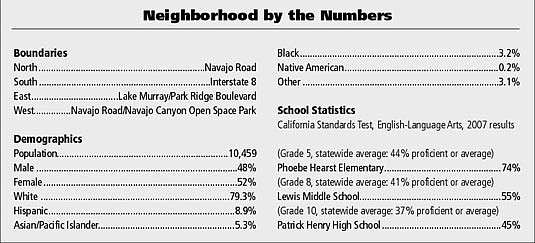
Del Cerro, which is Spanish for “of the hill,” is located just off I-8 at College Avenue. Turn north onto College and there it is, welcoming visitors and residents alike with a small cement sign. Just past the sign is Del Cerro Boulevard, both a main drag and a median-divided residential street. Along this road are a one-block business district, Temple Emanu-El synagogue, Phoebe Hearst Elementary School, and a hidden park and community pool.
The Del Cerro community began in the late '50s, when Jackson Scott, the first developer to come to the area, purchased the flatland south of the hill and began to build houses, most of which remain today.
"My grandparents were working with the developers here when they were first cutting these lots in '57," says Teri Hill, who now owns her family's real estate business, Hill and Hill Realty. Jackson Scott put up houses here and there and sold scattered lots to other developers.
"They didn't build like they do now," Hill says. "They didn't build those big tracts together, and that's why everything looks very custom here. It's a very custom neighborhood."
The first houses, mostly moderate-sized single-stories, were built along horseshoe-shaped streets like Ashland and Meredith, many of them coming off Del Cerro Boulevard. As Hill says, each house is different. Some are wood, some stucco, others faced with brick or stone. They're well tended and clean, driveways sporting new and old cars, campers and motorboats. Cacti rise high in front gardens, Seussian trees and small palms along with them; lawns are tidy, sometimes bordered with stones or fences. The owners of these houses are mixed, some younger families that have moved to the area within the last ten years, while many houses are still occupied by the people who purchased them when they were first built.
"I would say that Del Cerro, number one, has a very low turnover rate," says Hill. "People are buying here to stay. If they do leave their house in a few years, they're usually buying up or buying down in the same neighborhood. But it used to be much older, because a lot of people, the original owners, bought in the '50s and have passed away, and younger families are moving in. There are a lot more kids than there used to be, a lot of younger buyers."
Up on the hill, homes are bigger. They hug the slope as they stair-step up the mountain, decks looking out over the city. A few have fenced off this hillside land, edging it with tiny gardens. Many are single-story ranch-style homes, and all boast well-tended front yards, however small they may be.
"Most of the homes on the hill tend to be 3000 square feet and up," says Hill, "and they have pretty nice views, so the prices can easily be double from down at the lower parts."
While the hill houses are custom homes, there are a few tracts in Del Cerro Heights, on the west side of the hill, guarded from unwanted visitors by automatic gates. These homes are tall, white affairs, standing side by side but on slightly different levels, roofs outfitted in terra-cotta tile. Palms rise to differing heights; hedges and trees are kept impeccably clipped.
It's up here in the Highlands, as the hill is known, that the turnover rate is a bit higher, Hill says.
"Down in the lower parts, since they are simple, one-level homes, the people stayed until they passed away," she explains. "But up on the hill, some of them may have built their home in the late '60s, early '70s, and when their kids went to college, they ended up selling it and moving to something one level."
Young families are buying all over Del Cerro, both at the base of the hill and toward the top, says Hill. With Grossmont and Alvarado hospitals so close, some are doctors with spouses and children. The close-knit feel is what brings many of them in.
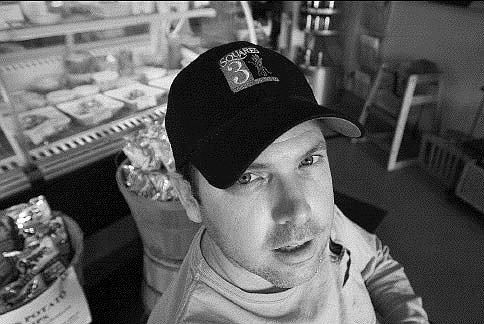
"Del Cerro has a lot of the trappings of a small community," says Clyde Van Arsdall, owner of 3 Squares gourmet bistro, which, along with Windmill Farms grocery store, is located in the shopping center on Del Cerro Boulevard. "It was always a nice neighborhood, but a lot of those people that established this as a nicer neighborhood years ago have retired and are on fixed incomes, so the neighborhood is changing from older to younger as we sit here."
Van Arsdall moved to Del Cerro, where his wife was raised, from Coronado and has had his business in Del Cerro for three and a half years. He has a five-year-old son and "one on the way," who, he tells me, is due in a week.
"Being a business owner here I see young couples coming to the neighborhood constantly that are coming here for the first time," he says, "and our presence here is sort of a work in progress. Our price points and the kinds of food that we offer are geared toward a more affluent, younger crowd. The older people in the neighborhood don't get us as much as the younger people. People come in and say, 'Oh, this place reminds me of some place you might see back East or in San Francisco.' The older people come in here and say, 'Eight dollars for a sandwich? That's ridiculous,' you know?"
But the times are changing, as more and more homes have been built up in the Highlands.
Donna Dose, a resident of the area since 1957 and manager of Del Cerro Park, remembers when her children had the run of the land, riding their bikes from her back yard three miles north to the foot of Cowles Mountain, now part of Mission Trails Regional Park. "There were no houses," she remembers, "there was nothing. Empty." Mary Baton, another 50-year resident, remembers that time. "When my children went to school, we knew virtually everybody in the community," she recalls, "and if we didn't know them, we knew about them. Now you don't know as many people because the community has tripled--quadrupled--in size."
And the community may grow even more; looming on the horizon is a housing project called Adobe Falls, which San Diego State University wants to build for graduate students and faculty. The project, to be completed in stages, was originally proposed as a 540-unit complex at the end of Adobe Falls Road, which winds down the hill in the western section of Del Cerro, across College Avenue from the Highlands.
The Adobe Falls project became a topic of debate, with the Del Cerro Action Council leading a campaign, called Save Del Cerro, against it.
"Del Cerro's principal concerns arise from the fact that the only ingress and egress for the large Adobe Falls Apartment/Townhome complex will run through the Del Cerro community," reads the Save Del Cerro website. "This will add thousands of cars every day on quiet, winding residential streets (some of which are currently cul-de-sacs) and which can only enter the community by passing between two elementary schools."
The support for Save Del Cerro is considerable, including several state senators and assemblymembers. In October 2005, the Del Cerro Action Council, Alvarado Hospital, and the City of San Diego each filed lawsuits, later consolidated, against the California State University trustees under the California Environmental Quality Act.
There have been some victories. In September 2006, after a California Supreme Court decision on a case concerning a different campus, the university decided to decertify its Adobe Falls environmental impact report. In addition, the Del Cerro Action Council has had its attorneys' fees covered in full. But this fight is far from over. The Save Del Cerro website reports that SDSU has put forth a new master plan and environmental impact report, proposing 48 units to be accessed from Mill Peak Road, up the hill, and 124 units to be built at the end of Adobe Falls Road, or a greater number if an alternative road can be developed.
While residents may suffer as a result of Adobe Falls development, local businesses will likely see a rise in consumer traffic. Van Arsdall, as both a resident and a business owner, sees both sides.
"As someone who lives on Del Cerro Boulevard, I'm not really thrilled about the San Diego State project going in, because it means more cars going down my street," he says. "However, as a business owner, I've got to say that it's a nice prospect having somebody come in here that would be new to the community. It's going to be condo-style living, and the new residents might utilize my shop, so I try to put a good spin on it as well."
Impending Adobe Falls condos aside, Del Cerro remains a small community, family-oriented and safe. The Chevron gas station, on the corner of College and Del Cerro Boulevard, has been passed from father to son to grandson. Del Cerro Liquor and Robert's Coiffures of Del Cerro have been in the area for decades. Other businesses have not lasted so long. Before the popular Windmill Farms, there had been a slew of failed grocery stores.
"There have been so many businesses that come and go, come and go, come and go," says Baton, who rattles off a list of what has passed through: a five-anddime, a video store, a jeweler, a bank, and a TV repair shop.
But one landmark has outlasted them all; this is Del Cerro Park and, with it, the Del Cerro pool. Hidden behind a thicket of cacti, the private four-acre park stretches down a small hill to a couple of tennis courts, shaded cabanas, and the pool.
The pool is one of the oldest structures in Del Cerro. The land was given to the community by one of the early developers in the late '50s under the condition that it would be returned if Del Cerro residents could not raise the money to build the pool. Everyone swung into action. Dose, who has been the manager of the pool for the past ten years, remembers when it was still in its planning stages. "A group of men went door-to-door and asked people if they would be willing to donate, I believe it was $250 then, which was a lot more money than it is today," she says, "and that's the way it began."
For the next 23 years, everything went well until, in the early '80s, the pool came under fire.
"In 1983, we received a letter that this property was no longer ours and that we had so long to leave," Dose recalls.
It happened like this, says Dose: when the developer who had initially given the community the land decided to retire, he donated the pool site to a Jewish Community Center in the area. The center rapidly informed the pool caretakers, Del Cerro Park's board of directors, that they had very little time to pack their things and leave: the land had been sold.
It was then that Dose and the board took charge.
"I was involved with them in going to see one of their very prominent real estate attorneys about the problem," she says. "He informed us that we might as well forget it. We didn't stand a chance here."
Dose and her posse were not about to give up, and they hired a lawyer and filed suit.
"We went to court," says Dose. "We had an older judge that reviewed all this information, and he said, 'I'm not going to make a decision right now. I want to take time to do this. It will take me some time.' After six months, the decision was made by him that [the Del Cerro community] had worked very hard to establish this, and he felt there was something illegal that had been done." She smiles.
"So the property is now ours."
Del Cerro Park boasts 250 member families, most from Del Cerro but some from surrounding communities.
As the Del Cerro community formed in the late '50s, so did the Del Cerro Community Association. "The community association was formed just because in new communities, there are lots of needs in the community," says Baton, who is president of the Del Cerro Park board. "Everyone's interested in the community, so it was just essentially a group of people that formed an association for the betterment of the community, and I would say virtually everybody in the community probably belonged in the initial stages."
But since then the community association has died down some.
"We were a much smaller community then," Dose, who is on the board, explains, "and as time went on, the Del Cerro Community Association was dying out because unless there's a big issue, if you don't have a big issue, what is it? So we combined the Del Cerro Community Association with the Del Cerro Park. And we have the same board. So this is what really kept it alive."
For all their hard work, however, there is one "big issue" the community association cannot tackle: the SDSU Adobe Falls development.
"If there's anything that happens in Del Cerro, the Del Cerro Community Association will take part in it," says Dose. "We cannot on this issue, because we have several members who are professors. So we can't take sides on this at all."
"The community association and the pool association are apolitical," adds Baton. "To my knowledge, we have never taken a political stand. And because we are a membership organization, obviously our members could have very diverse views on any particular issue."
Whatever may happen in and to Del Cerro--a change in demographics, a bulge in population--the appeal has, if anything, grown.
"I think one of the more positive things you can say about Del Cerro is that, as a community, I know numbers of people who are on their second and third homes within Del Cerro," says Mary Baton. "I know numbers of people who have added on to their homes so that they could stay here, and we have a number of second-generation families moving in."
She pauses.
"So all of that, I think, speaks well for a community."
Here's something you might be interested in.
Up on the Hill

Up on the Hill
Del Cerro, which is Spanish for “of the hill,” is located just off I-8 at College Avenue. Turn north onto College and there it is, welcoming visitors and residents alike with a small cement sign. Just past the sign is Del Cerro Boulevard, both a main drag and a median-divided residential street. Along this road are a one-block business district, Temple Emanu-El synagogue, Phoebe Hearst Elementary School, and a hidden park and community pool.
The Del Cerro community began in the late '50s, when Jackson Scott, the first developer to come to the area, purchased the flatland south of the hill and began to build houses, most of which remain today.
"My grandparents were working with the developers here when they were first cutting these lots in '57," says Teri Hill, who now owns her family's real estate business, Hill and Hill Realty. Jackson Scott put up houses here and there and sold scattered lots to other developers.
"They didn't build like they do now," Hill says. "They didn't build those big tracts together, and that's why everything looks very custom here. It's a very custom neighborhood."
The first houses, mostly moderate-sized single-stories, were built along horseshoe-shaped streets like Ashland and Meredith, many of them coming off Del Cerro Boulevard. As Hill says, each house is different. Some are wood, some stucco, others faced with brick or stone. They're well tended and clean, driveways sporting new and old cars, campers and motorboats. Cacti rise high in front gardens, Seussian trees and small palms along with them; lawns are tidy, sometimes bordered with stones or fences. The owners of these houses are mixed, some younger families that have moved to the area within the last ten years, while many houses are still occupied by the people who purchased them when they were first built.
"I would say that Del Cerro, number one, has a very low turnover rate," says Hill. "People are buying here to stay. If they do leave their house in a few years, they're usually buying up or buying down in the same neighborhood. But it used to be much older, because a lot of people, the original owners, bought in the '50s and have passed away, and younger families are moving in. There are a lot more kids than there used to be, a lot of younger buyers."
Up on the hill, homes are bigger. They hug the slope as they stair-step up the mountain, decks looking out over the city. A few have fenced off this hillside land, edging it with tiny gardens. Many are single-story ranch-style homes, and all boast well-tended front yards, however small they may be.
"Most of the homes on the hill tend to be 3000 square feet and up," says Hill, "and they have pretty nice views, so the prices can easily be double from down at the lower parts."
While the hill houses are custom homes, there are a few tracts in Del Cerro Heights, on the west side of the hill, guarded from unwanted visitors by automatic gates. These homes are tall, white affairs, standing side by side but on slightly different levels, roofs outfitted in terra-cotta tile. Palms rise to differing heights; hedges and trees are kept impeccably clipped.
It's up here in the Highlands, as the hill is known, that the turnover rate is a bit higher, Hill says.
"Down in the lower parts, since they are simple, one-level homes, the people stayed until they passed away," she explains. "But up on the hill, some of them may have built their home in the late '60s, early '70s, and when their kids went to college, they ended up selling it and moving to something one level."
Young families are buying all over Del Cerro, both at the base of the hill and toward the top, says Hill. With Grossmont and Alvarado hospitals so close, some are doctors with spouses and children. The close-knit feel is what brings many of them in.
"Del Cerro has a lot of the trappings of a small community," says Clyde Van Arsdall, owner of 3 Squares gourmet bistro, which, along with Windmill Farms grocery store, is located in the shopping center on Del Cerro Boulevard. "It was always a nice neighborhood, but a lot of those people that established this as a nicer neighborhood years ago have retired and are on fixed incomes, so the neighborhood is changing from older to younger as we sit here."
Van Arsdall moved to Del Cerro, where his wife was raised, from Coronado and has had his business in Del Cerro for three and a half years. He has a five-year-old son and "one on the way," who, he tells me, is due in a week.
"Being a business owner here I see young couples coming to the neighborhood constantly that are coming here for the first time," he says, "and our presence here is sort of a work in progress. Our price points and the kinds of food that we offer are geared toward a more affluent, younger crowd. The older people in the neighborhood don't get us as much as the younger people. People come in and say, 'Oh, this place reminds me of some place you might see back East or in San Francisco.' The older people come in here and say, 'Eight dollars for a sandwich? That's ridiculous,' you know?"
But the times are changing, as more and more homes have been built up in the Highlands.
Donna Dose, a resident of the area since 1957 and manager of Del Cerro Park, remembers when her children had the run of the land, riding their bikes from her back yard three miles north to the foot of Cowles Mountain, now part of Mission Trails Regional Park. "There were no houses," she remembers, "there was nothing. Empty." Mary Baton, another 50-year resident, remembers that time. "When my children went to school, we knew virtually everybody in the community," she recalls, "and if we didn't know them, we knew about them. Now you don't know as many people because the community has tripled--quadrupled--in size."
And the community may grow even more; looming on the horizon is a housing project called Adobe Falls, which San Diego State University wants to build for graduate students and faculty. The project, to be completed in stages, was originally proposed as a 540-unit complex at the end of Adobe Falls Road, which winds down the hill in the western section of Del Cerro, across College Avenue from the Highlands.
The Adobe Falls project became a topic of debate, with the Del Cerro Action Council leading a campaign, called Save Del Cerro, against it.
"Del Cerro's principal concerns arise from the fact that the only ingress and egress for the large Adobe Falls Apartment/Townhome complex will run through the Del Cerro community," reads the Save Del Cerro website. "This will add thousands of cars every day on quiet, winding residential streets (some of which are currently cul-de-sacs) and which can only enter the community by passing between two elementary schools."
The support for Save Del Cerro is considerable, including several state senators and assemblymembers. In October 2005, the Del Cerro Action Council, Alvarado Hospital, and the City of San Diego each filed lawsuits, later consolidated, against the California State University trustees under the California Environmental Quality Act.
There have been some victories. In September 2006, after a California Supreme Court decision on a case concerning a different campus, the university decided to decertify its Adobe Falls environmental impact report. In addition, the Del Cerro Action Council has had its attorneys' fees covered in full. But this fight is far from over. The Save Del Cerro website reports that SDSU has put forth a new master plan and environmental impact report, proposing 48 units to be accessed from Mill Peak Road, up the hill, and 124 units to be built at the end of Adobe Falls Road, or a greater number if an alternative road can be developed.
While residents may suffer as a result of Adobe Falls development, local businesses will likely see a rise in consumer traffic. Van Arsdall, as both a resident and a business owner, sees both sides.
"As someone who lives on Del Cerro Boulevard, I'm not really thrilled about the San Diego State project going in, because it means more cars going down my street," he says. "However, as a business owner, I've got to say that it's a nice prospect having somebody come in here that would be new to the community. It's going to be condo-style living, and the new residents might utilize my shop, so I try to put a good spin on it as well."
Impending Adobe Falls condos aside, Del Cerro remains a small community, family-oriented and safe. The Chevron gas station, on the corner of College and Del Cerro Boulevard, has been passed from father to son to grandson. Del Cerro Liquor and Robert's Coiffures of Del Cerro have been in the area for decades. Other businesses have not lasted so long. Before the popular Windmill Farms, there had been a slew of failed grocery stores.
"There have been so many businesses that come and go, come and go, come and go," says Baton, who rattles off a list of what has passed through: a five-anddime, a video store, a jeweler, a bank, and a TV repair shop.
But one landmark has outlasted them all; this is Del Cerro Park and, with it, the Del Cerro pool. Hidden behind a thicket of cacti, the private four-acre park stretches down a small hill to a couple of tennis courts, shaded cabanas, and the pool.
The pool is one of the oldest structures in Del Cerro. The land was given to the community by one of the early developers in the late '50s under the condition that it would be returned if Del Cerro residents could not raise the money to build the pool. Everyone swung into action. Dose, who has been the manager of the pool for the past ten years, remembers when it was still in its planning stages. "A group of men went door-to-door and asked people if they would be willing to donate, I believe it was $250 then, which was a lot more money than it is today," she says, "and that's the way it began."
For the next 23 years, everything went well until, in the early '80s, the pool came under fire.
"In 1983, we received a letter that this property was no longer ours and that we had so long to leave," Dose recalls.
It happened like this, says Dose: when the developer who had initially given the community the land decided to retire, he donated the pool site to a Jewish Community Center in the area. The center rapidly informed the pool caretakers, Del Cerro Park's board of directors, that they had very little time to pack their things and leave: the land had been sold.
It was then that Dose and the board took charge.
"I was involved with them in going to see one of their very prominent real estate attorneys about the problem," she says. "He informed us that we might as well forget it. We didn't stand a chance here."
Dose and her posse were not about to give up, and they hired a lawyer and filed suit.
"We went to court," says Dose. "We had an older judge that reviewed all this information, and he said, 'I'm not going to make a decision right now. I want to take time to do this. It will take me some time.' After six months, the decision was made by him that [the Del Cerro community] had worked very hard to establish this, and he felt there was something illegal that had been done." She smiles.
"So the property is now ours."
Del Cerro Park boasts 250 member families, most from Del Cerro but some from surrounding communities.
As the Del Cerro community formed in the late '50s, so did the Del Cerro Community Association. "The community association was formed just because in new communities, there are lots of needs in the community," says Baton, who is president of the Del Cerro Park board. "Everyone's interested in the community, so it was just essentially a group of people that formed an association for the betterment of the community, and I would say virtually everybody in the community probably belonged in the initial stages."
But since then the community association has died down some.
"We were a much smaller community then," Dose, who is on the board, explains, "and as time went on, the Del Cerro Community Association was dying out because unless there's a big issue, if you don't have a big issue, what is it? So we combined the Del Cerro Community Association with the Del Cerro Park. And we have the same board. So this is what really kept it alive."
For all their hard work, however, there is one "big issue" the community association cannot tackle: the SDSU Adobe Falls development.
"If there's anything that happens in Del Cerro, the Del Cerro Community Association will take part in it," says Dose. "We cannot on this issue, because we have several members who are professors. So we can't take sides on this at all."
"The community association and the pool association are apolitical," adds Baton. "To my knowledge, we have never taken a political stand. And because we are a membership organization, obviously our members could have very diverse views on any particular issue."
Whatever may happen in and to Del Cerro--a change in demographics, a bulge in population--the appeal has, if anything, grown.
"I think one of the more positive things you can say about Del Cerro is that, as a community, I know numbers of people who are on their second and third homes within Del Cerro," says Mary Baton. "I know numbers of people who have added on to their homes so that they could stay here, and we have a number of second-generation families moving in."
She pauses.
"So all of that, I think, speaks well for a community."
Comments