

Here's something you might be interested in.
Ask a Hipster — Advice you didn't know you needed
Big Screen — Movie commentary
Blurt — Music's inside track
Booze News — San Diego spirits
Classical Music — Immortal beauty
Classifieds — Free and easy
Cover Stories — Front-page features
Drinks All Around — Bartenders' drink recipes
Excerpts — Literary and spiritual excerpts
Feast! — Food & drink reviews
Feature Stories — Local news & stories
Fishing Report — What’s getting hooked from ship and shore
From the Archives — Spotlight on the past
Golden Dreams — Talk of the town
The Gonzo Report — Making the musical scene, or at least reporting from it
Letters — Our inbox
Movies@Home — Local movie buffs share favorites
Movie Reviews — Our critics' picks and pans
Musician Interviews — Up close with local artists
Neighborhood News from Stringers — Hyperlocal news
News Ticker — News & politics
Obermeyer — San Diego politics illustrated
Outdoors — Weekly changes in flora and fauna
Overheard in San Diego — Eavesdropping illustrated
Poetry — The old and the new
Reader Travel — Travel section built by travelers
Reading — The hunt for intellectuals
Roam-O-Rama — SoCal's best hiking/biking trails
San Diego Beer — Inside San Diego suds
SD on the QT — Almost factual news
Sheep and Goats — Places of worship
Special Issues — The best of
Street Style — San Diego streets have style
Surf Diego — Real stories from those braving the waves
Theater — On stage in San Diego this week
Tin Fork — Silver spoon alternative
Under the Radar — Matt Potter's undercover work
Unforgettable — Long-ago San Diego
Unreal Estate — San Diego's priciest pads
Your Week — Daily event picks
Voice & Viewpoint's William Thompson murder – what did it tell about San Diego's black homosexual underground?
Dig a little deeper
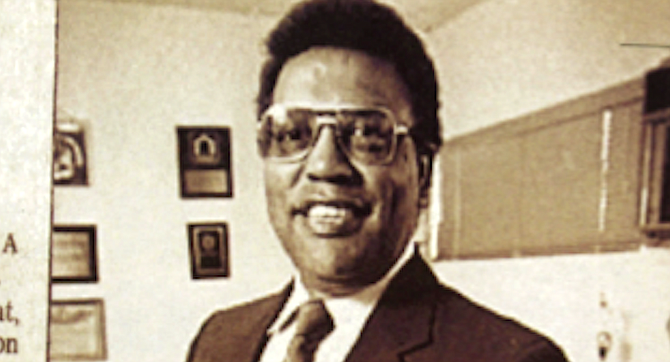
William Thompson. In the 1970s and 1980s, the men would run into each other at pickup spots: Ferris and Ferris, a 24-hour drugstore; Prixie's Coffee Shop; Fifth Avenue's Pleasureland. According to Brown, Thompson "was looking for the same thing I was. Young boys."
In September 2003, Brian Burritt rode the elevator down to the basement of the San Diego Police Department where the "murder books," the binders of the department's cold cases, many decades old, are kept in cool, dry storage. The books are paper tombs, weighted with hundreds of pages -- evidence lists, crime-scene diagrams and photos, lab reports, autopsy reports, witness statements, and more. Each begins with a one-page synopsis of the crime. Over several weeks, Burritt, whose title is criminalist, checked out binders and quick-read the synopses, looking for mention of liquid evidence, typically swatches of blood or semen he might use to establish a DNA profile of a perpetrator. Most of the cases contain such testable evidence, which Burritt, the forensic lab, and the cold-case team would eventually investigate.
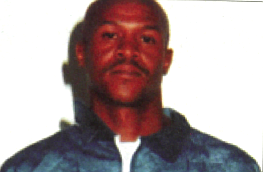
The DNA profile matched that of a 38-year-old African American at Centinela State Prison. His name was Stanley Ray Clayton.
But one case caught his eye. A murder from 1987, whose crime scene was documented by Lieutenant Dick Carey and whose thick binder signaled much physical evidence and a detailed inquiry. There were fingerprints, 11 usable "latent lifts." The majority belonged to the victim; 2 or 3 were from an unidentified person. "It took me less than two minutes," Brian Burritt told me nearly three years after his discovery, "to see the evidence I wanted to test. There's a blood trail leading from the body in the house to the stolen car -- and the blood was in the car." He read on.
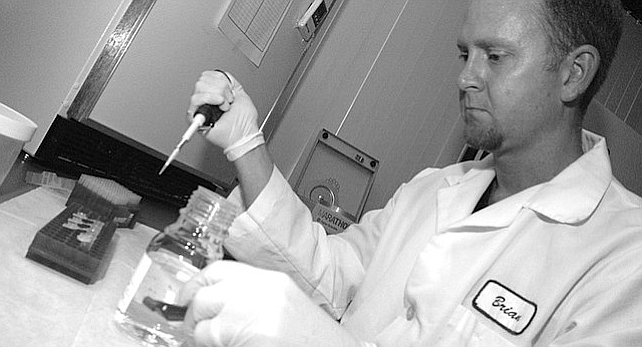
Brian Burritt. Within a month, Burritt got the results he wanted. The hallway bloodstain came back as "an unknown male," which "excluded the victim."
The victim was William H. Thompson, an African American real estate developer, 61. Thompson had been stabbed 55 times in a bedroom of his Emerald Hills home. Not only was blood evidence retained; so, too, were the knives used in the stabbing, the victim's clothing, and liquid swabs taken from his orifices. The case had a high degree of "solvability," a bit of clunky jargon favored by detectives and district attorneys. A blood trail also meant there was a "bleeder," from which Burritt hoped he could identify DNA that might lead to the killer. Intrigued, he went to the Central Library and consulted the newspaper bank. He read that Thompson was the owner and publisher of the San Diego Voice and Viewpoint, the only black-oriented daily in the city, whose size and circulation Thompson had doubled within two years of buying the paper in 1984; he read that the victim ran W.H. Thompson and Associates, which built and managed low-income apartment units in Southeast San Diego; he read that Thompson's funeral at Calvary Baptist Church, a great wooden bowl of worship, attracted 500 people, among them San Diego's black political and business elites. The pallbearers included city councilmember William Jones and county supervisor Leon Williams. A woman sang the Negro spiritual, "Soona Will Be Done the Troubles of This World." Even the day itself was special, the newly proclaimed federal holiday, Martin Luther King Jr. Day, a sign not lost on Dr. W.P. Cooke, pastor emeritus of the Shiloh Baptist Church in Sacramento, who gave the eulogy. Thompson was a "great humanitarian," Cooke thundered from the Calvary pulpit, a man being honored "on the celebrated birthday of another great humanitarian, Dr. Martin Luther King, each a tragic waste, a loss to the world." "Wow," Burritt recalled thinking, "this guy was an important businessman. This would be a great case to crack." The Thompson murder book had also told Burritt that after a thorough processing of the crime scene and flatfoot inquiries, the case had gone ghostly quiet. The binder lay closed -- no witnesses, no suspects, no leads -- for 16 years.
Burritt, 37, has a widow's peak, close-clipped red hair, and a soul patch, a neat triangle of hair, under his lower lip. The UCSD grad savors long and winding explanations; he mixes testimony and fact, revealing a passion for helping families and victims find closure. His specialty is DNA-profiling -- the genetic identification of criminal perpetrators -- which, he said, is now the "keystone evidence" in thawing out these crimes. In 11 years with the forensic biology lab, Burritt has seen changes in DNA technology since 2000 that have made his job "unrecognizable" from the system it was, even in the 1990s. Though the technology is commonplace and often incontrovertible at trial, people should, he counseled, resist the claims of the CSI TV dramas (which he admits to watching) -- the idea that DNA-profiling sprouts sudden case-ending results. Bingo! as the cocky or babe TV criminalist says. Nothing in police work, he noted, is quick or foolproof.
When the cold-case unit was first formed in 1995, DNA analysis was in its infancy. We all remember O.J. Simpson's murder trial that year as the first big DNA case. Although Simpson's blood was found at the crime scene (the probability was, only 1 person in 57 billion could match his DNA), the defense successfully argued that the Los Angeles Police Department had mishandled that blood or contaminated the scene. By 2000, however, DNA profiling was the rage, the best murder-cracking tool since Sherlock Holmes's deductions. In San Diego, there are some 600 unsolved murders; a few are more than 40 years old. Initially, when Burritt and the cold-case unit took stock of this backlog, they prioritized the homicides by method and by liquid evidence: sex-related murders, then death by stabbing, strangulation, and bludgeoning. With strangled victims, Burritt said he seeks "fingernail scrapings; hopefully, the person dug in and took some flesh out." He scours the murder books for evidence of blood, semen, sweat, or saliva that might adhere to a cap, a pair of sunglasses, a condom, a beer can. The largest number of unsolved cases are firearm-related homicides. Drive-by shootings leave scant, if any, clues -- that's why they're a popular way to terrorize and kill.
By 2003, there was a standardized method for collecting and profiling DNA, which was bolstered by easily searchable and widening national databases. Managed by the FBI, CODIS, or Combined DNA Index System, is the storehouse of criminal DNA profiles. There are two indices. The first is the offender index, comprising DNA profiles from nearly 3.5 million felons. The second is the forensic index, which houses, to date, 148,000 DNA profiles from unsolved cases. In the forensic index are some 1500 profiles of San Diego crimes. Every day, new DNA profiles are added to the forensic index. Every Monday, the forensic index compares all its own profiles for duplication and compares its profiles to those in the offender index. The hope is that a new forensic profile can be matched to a prisoner or an ex-prisoner.
To work Thompson's murder, Burritt first retrieved the brown paper bags of evidence -- clothing, knives, and blood -- collected at the 1987 crime scene, also stored in the department's basement. Burritt's work space is a corner office on the sixth floor of the downtown blue-and-white police headquarters. There, he donned plastic gloves and cleaned his counter. He scissors-opened the sealed bags and pulled out the evidence he would examine for DNA. He first had to establish Thompson's DNA profile. Using a moistened Q-Tip, Burritt ran the cotton swab along a swatch containing saliva taken from Thompson's mouth at the autopsy. He put that in a vial. Next, he ran a wet Q-Tip over a blood swatch from a bloodstain that was found on Thompson's hallway floor. He put that in another vial. These vials were cycled through the DNA-profiling process in the department's forensic lab. Within a month, Burritt got the results he wanted. The hallway bloodstain came back as "an unknown male," which "excluded the victim." Was this the perpetrator?
With this DNA profiling success, the job of re-opening the investigation fell to homicide detective Bob Donaldson, who supervises the cold-case unit. The 27-year police veteran told me that he was drawn in by the rare "overkill" of Thompson's death. Why all those stab wounds? "If it's hatred," he said, "a killer will go for the upper torso or the face. Shoot them in the face. Bludgeon them to death in the face type of thing, if it's hatred, versus 'I'm just going to burglarize you and shoot you in the chest.' It's the amount of stab wounds that's a red flag. Why would you stab someone 55 times versus stab somebody once or twice? Think to yourself, 'What is going to cause somebody to do that?' " Donaldson, whose brown eyes are lusterless and no-nonsense, also said that in his experience it's "not uncommon" for a stabber to cut himself. Pushing a knife to the hilt, his hand often slips onto the blade.
Donaldson refused to guess why Thompson was stabbed so many times. But he compared this case to another, in which a son killed his parents. The son killed the father by hitting him on the head just once. The son "hated" the mother "so badly that he beat her about the head until, basically, she had no face left." But in Thompson's demise, Donaldson saw that the investigating detectives found no such familial anger. Never married, Thompson had an elderly male cousin in Detroit and an elderly female cousin, Sadie Craft, who lived across the street from Thompson in a home he had just purchased for her. Thompson had wielded his power as a publisher and a politically savvy developer in Southeast to rail against drug pushers, so someone from that underworld might have wanted him silenced. But during their search, the police apparently found no one who wanted to silence him that bad.
It was an enigma -- the viciousness of the murder and its freakish intimacy. But in the late 1980s, there simply wasn't time for investigators to ponder that or any enigma. With San Diego's murder rate racing higher, detectives were called to the next drive-by shooting, drug hit, domestic murder. In 1987, Thompson's slaying would be one of 106. The killings only got worse. In 1988, 144 murders; in 1990, the highest ever, 159. Up to 50 percent of these crimes in the first year of inquiry would go unsolved.
The Murder
Sunday evening, January 11, 1987, William Thompson arrived home in San Diego at 6:00 p.m. from a weekend retreat of the West Coast Black Publishers Association in Monterey, California. There, he had been elected secretary, another post to add to those he already held in building organizations and at the local chapter of the National Association for the Advancement of Colored People. According to Anna Brown, a business associate and friend, Thompson spent part of Monday, the 12th, collecting rents from tenants. She said that, as usual, he had a pouch full of cash and checks, which he took home with him that evening, preferring to make a deposit the next day. How did she know? She telephoned Thompson at least three times that evening at his home, and she said later, he told her that he had some $6000. Her last call was around 9:00 p.m.
The units that Thompson owned were, according to Charles Davis, a man who worked for Thompson at the time, "low-grade apartments on Euclid and Imperial, and 28th and Imperial." At 50, Davis is an ebulliently friendly and community-oriented developer who speaks with a trebly excitement in his voice. He runs Urban-West Development and oversees projects for the Jacobs Family Foundation, a Southeast-based philanthropic group that serves underinvested neighborhoods. Davis attributes his success to a long apprenticeship with Thompson, whom he recalls as "a father figure and a role model." Fresh out of UCLA in 1979, Davis wanted to learn business development and Thompson took him on. Right off, Thompson's sloppiness showed itself "when we'd collect rent, have cash, and then go to his house. In any community business, things leak out. Your habits get known. Your money habits. Taking the rents home rather than leaving the money in the office -- I thought there was danger in that for Bill."
The money on his person was one thing. But something else bothered Charles Davis. Thompson rented his units to low-income people, a few of whom dealt drugs. They'd dispense the highly addictive crack cocaine out the front door "like a pharmacy," Davis said. It was a time when the cheap drug was taking over America's poor communities -- crack pipes and free-basing and crazy-ass highs: Len Bias's overdose and Richard Pryor's self-immolation. Thompson "despised junkies," Anna Brown said. He began publishing the names of convicted drug dealers in the Voice and Viewpoint. During the summer of 1986, according to the San Diego Union, he "led a group of landowners in evicting known drug dealers from apartments and gave police the names, addresses and license numbers of drug dealers working the street." In Barrio Sherman, one resident said, "I would come out and go to work at 5 in the morning and there would be 10 or 15 people in the streets" selling dope. "From this corner to that corner, it was chaos." The resident and other neighbors praised Thompson as "instrumental" in keeping the drug merchants at bay.
Once names appeared, the staff of the newspaper received threatening calls. Gloria Vinson, the paper's office manager, said that the staff debated the wisdom of publishing these names and persuaded Thompson to stop the practice. "I just felt that was too dangerous," Vinson told the San Diego Evening Tribune. "We're a newspaper; we shouldn't be sitting ducks for a crime." In 1988, Anna Brown recalled to the Evening Tribune that the car and the home of a staff member at Thompson and Associates had been shot at. She also said that the cops "supported the newspaper war against drugs, until 'it got too hot in the kitchen.' " According to the paper, "Thompson himself gave up the campaign after he realized he would not get the kind of police protection he had expected."
Things got so bad that Thompson put Charles Davis, along with three other employees -- Charles Harrington, Dmitri Glover, and Stanley Phillips -- on "drug watch." Thompson would tell them to undertake a "constructive eviction." With a golf club, Davis would announce himself, bang on the door (the addresses came from the neighbors' complaints), and wait ten seconds. Then he'd open the door with his set of keys. First thing he'd hear was the toilet flushing. Club aloft, he'd order, Get out! Sure, he called the police. But the cops wouldn't show, he said. They wanted proof, or they told him to follow the law: serve them 30 days' notice. Thompson approved of the vigilantism. Problem solved, for the time being.
That Monday evening, January 12, 1987, after Thompson had finished his rounds, after dinner and a drink at the Chee-Chee Club or at another bar he frequented downtown, he went home. Sometime he had put a load of clothes in the washer but hadn't started the cycle. It's possible that he'd been driven around by one of his young male drivers, who, according to one friend, "he treated like servants." Thompson's home at 5298 Roswell Street in Emerald Hills was a hill topper, with a stellar view of the San Diego shipyards, the high-stepping Coronado bridge, and the Pacific. His home had just been added onto -- a two-car garage, two new upstairs bedrooms, and a west-facing deck -- by Charles Davis. Davis had left Thompson to pursue his own development interests but had returned to help his mentor after Thompson had undergone quadruple bypass surgery in 1986.
During the remodel, Thompson requested that Davis install a state-of-the-art alarm system as well as several steel security doors on the outside and the inside of his home. To enter the residence, one needed to ring the bell beside an outdoor security gate. Thompson, Davis said, "wanted to open his front door and see who was out there." If he knew the visitor, he would buzz him into a small porchlike stoop, or entryway. The front door and the kitchen door were security doors. Davis also put in a steel door on Thompson's bedroom at the bottom of the stairs inside the house. "I thought it was a little strange," Davis continued, "that he'd be overly conscious about security -- but he was right." Charles Wilson lives three houses away from Thompson's former house on a street perpendicular to Thompson's. Wilson is an insomniac. From his porch, 'round midnight, he'd see Thompson hold what Wilson called "political meetings," all night. Men came and went from his house regularly, Wilson said. He didn't think it strange; this was how the wheeler-dealers worked. He did think it strange that Thompson told him in late 1986 that if he, Wilson, ever saw anything suspicious-looking at the house to call the police immediately.
Charles Davis knew something else about Thompson that only his male friends knew and his female friends may have suspected. Bill Thompson was gay. Not quietly gay, not closeted, but active. By most accounts, relentlessly, daringly active. "I knew he liked boys," Davis said. Boys? I asked. "Young men," Davis clarified. "I'm not going to say boys. Seventeen to 22. I knew about it, but I was kind of distant from it. I would see him with young men at his home." It was a predilection for the boyish type. Trolled for them at pickup sites. Asked them to stay the night or a few days. Grew tired of them and moved on. Every man I spoke with who knew Thompson said his desire was hidden in plain sight: Thompson liked the danger -- he employed guys to chauffeur him during the day and sleep with him at night; he frequented the peep shows on Fifth Avenue to proposition the young ones; he not only paid good money for sex but also carried a cash-packed wallet or kept a money pouch at home. As much as Thompson could be hustled, he was a hustler himself, liking his sex both ways -- what was done to him, he did to others. According to his friends, Thompson never talked about his penchant. He maintained a straight persona, entering a nightclub or a charity event with a woman on his arm. But in the right venues, he made it known he was available. Almost daily.
It was sometime in the early evening, certainly before eight, when Thompson arrived home. Either someone or a group came home with him or someone or a group called on him that night and he let them in. In either scenario, the alarm system was off. He knew those he allowed in. That evening, Anna Brown called him three times, hanging up the last time around 9:00 p.m. Stanley Phillips called Thompson around 8:00 p.m. One police report noted that "Phillips asked Thompson if there was anything he wanted him to do in the morning. Phillips stated he got the feeling someone was at Thompson's house when Phillips was talking to him." The word someone has become the most crucial word in the saga of Thompson's murder.
Near 10:00 p.m., Thompson went into the downstairs bedroom. The bed was made, un-slept-in, as Thompson had another bed for sleeping. He flipped on the overhead light, then the nightstand lamp with its red bulb. He turned the overhead off. He dumped his car keys on a dresser, beside other rings packed with keys, extra sets for his rentals. He turned on the TV. A portly 202 pounds, he was dressed in a short-sleeve dark blue nylon shirt, dark brown pants with a black belt, brown socks, and light tan leisure shoes. He had on a pair of dark blue jockey shorts. In his rear pants pocket was a key ring with eight keys. In his front pocket, a handkerchief. In his shirt pocket, business cards and a pen. On his wrist was a Timex watch. Into the bathroom he carried a toothbrush case and a brown vinyl toilet kit, plus a light-colored towel. His dress, his accoutrements, his routine, and the unlocked security door to this room, added up -- Thompson was getting himself ready for sex. Setting and situation also said he was unsuspecting. In the drawer beside the bed were packets of Dentyne and Juicy Fruit gum as well as three jars of Vaseline. Plus a package of Zig-Zag rolling papers. For him? For his liaisons? (He wouldn't be the first to indulge a vice he hated in others.) In the bathroom, he brushed his teeth, washed up, added a dash of cologne. He was still attractive, his bearing regal, underscored by the fine hands and the large gold ring. Coming out, he was surprised. The toilet kit and toothbrush case and towel flew to the floor. Some group or someone came at him with a knife.
Thompson put his hands up to defend himself. A knife slashed at his hands, then at his face. They-he -- came at him. He was stabbed or cut once in the eyebrow, four times in the right cheek, once in the jaw, twice in the chin. In the right lower lip. In the ear. In the neck. In the clavicle. He plunged back into the nightstand. The lamp crashed to the floor and broke; the bulb survived intact. He was stabbed three times on the scalp, three times on the right shoulder, one perforated all the way to the lung, eight inches deep.
They-he -- kept coming. He fell onto a blue upholstered swivel chair to the right of the bathroom's entrance. The chair upended and his blood stained its back and cushion. He was stabbed three times in the chest beneath the right clavicle, three times in the right anterior lateral chest, once in the right lateral chest, six inches deep, then in the left anterior inferior chest, six inches deep. Someone was turning him over or he was flailing about, trying to get up. They-he-they-he. Wanted him dead. He defended himself: he was cut or sliced on the left wrist, twice in the forearm, on the second right finger, third right finger, right thumb. He was down. He couldn't get up. He was struck again in the back. In the biceps. He was bleeding badly, his strength ebbing. He slumped to the floor, his head landing on the cracked lamp base, his toupee unhinged and flopped to the side inelegantly. Give in and it'll stop. His right arm curled under him. The blood soaked into the carpet and stained his toupee.
The autopsy, from which most of the preceding is taken and which was completed the next day by Dr. Lee Bockhacker, a pathologist with the San Diego County medical examiner's office, detailed each of the 55 wounds. In sum, the knives were of different sizes, some
1/16
inch thick, some
1/8
inch thick. The length of the wounds varied from
1/16
inch to 1 7/8
inch, the depth, superficial to 8 inches. At the end, Bockhacker listed the two fatal wounds.
- Fatal stab wound No. 40 with perforation of right chest wall, diaphragm, liver, retroperitoneum, and head of pancreas.
1 7/8
by less than
1/16
wound. Four inches deep.
- Fatal stab wound No. 42 with perforation of left chest diaphragm, retroperitoneum, abdominal aorta, and penetration of lumbar vertebrae,
1 5/8
by less than
1/16
wound. Six inches deep.
- Massive hemoperitoneum and retroperitoneum hemorrhage.
In other words, these thrusts tore into Thompson's internal organs from which rivulets of blood flowed. For the next 11 hours, as Thompson lay on his chest, his position may have slightly slowed the blood seeping inside and out of his chest. But once his aorta was lacerated and the hemorrhaging had begun, he would have gone unconscious within a minute. If there was a final agonal event, he would not have been aware of it.
The attack was furious, bestial, angry beyond degree. Only the stillness of his dead body on the floor countered the unimaginable horror of such an attack, its brutality, its evidence of the killers' or a killer's savage perversity. This wasn't a mere robbery or burglary, although the $6000 that Anna Brown says Thompson told her he had collected that day was never found. This killing had a motivation: to murder slowly, with extreme pain and terror. It was the rare insane death-by-stabbing in which 53 of the 55 cuts or stabs weren't fatal; only two deep piercings were. To be stabbed until he was dead or at least until he stopped trying to live.
But there was something else, a final degradation, bordering on the ritualistic. One knife, from a right trajectory, went into his neck. It remained sticking up. Another knife, from a left trajectory, went into his neck, beside the first knife. It remained sticking up. Then a barbecue fork went in, three inches from the two knives. It remained sticking up. All three implements stuck up like banderillas, applied by a matador in the neck of a bull. And left in.
About 11 hours later, Charles Wilson was backing his car out of Sadie Craft's driveway; he was taking Thompson's cousin to a 10:00 a.m. doctor's appointment. Both noticed that Thompson's porch light was still on. Wilson parked in Thompson's driveway and entered the partially open kitchen door at 9:35 a.m. He saw three things he would never forget. First was "blood droppings from the kitchen all the way to his bedroom." Second was Thompson's slumped body on the floor with the knives and fork sticking out. And third was a box set of cutlery, overturned and lying on the corner of the bed, the bedspread pulled back. Some of the knives were still in their paper sheaths; others were stained with blood. Wilson rushed upstairs, plugged in the phone, and called 911. Within the hour, after homicide detectives Dick Carey, Arthur Beaudry, and Lieutenant Phil Jarvis arrived, a question was born, in Wilson's mind and in the minds of the detectives: What in the killer or killers triggered such madness?
Which invited a second question. If Thompson had turned off the alarm system, answered routine phone calls, switched on the TV, and readied himself for an encounter or an evening he thought benign, then what did he miss in the visage of this man or group of men whom he knew and allowed into his home?
The Victim
Aside from sports sensations Marshall Faulk and Tony Gwynn, William Henry Thompson is San Diego's most famous African American. During the 1980s, he was lionized in the black community as a latter-day Alonzo Horton. Thompson was Southeast San Diego's most prominent businessman. He ran Thompson and Associates, a diversified land and real estate development firm, located at 4671 Market Street; he owned a few Popeye's Famous Fried Chicken and Biscuits franchises, one in Mission Valley; his antidrug campaign and low-income building projects are still remembered as visionary; and he was the organizer of Gateway, a project that would have been Southeast's first large black-owned shopping center.
Willie Morrow was one of Thompson's oldest friends, meeting him when Thompson arrived here in 1968. Morrow is a longtime San Diego hairdresser and businessman who once owned the popular radio station 92.5. Today, Morrow works out of a shop in Lemon Grove, Bobby's Diversified Products. There, he sells hair-care products under the name California Curl as well as publishes the San Diego Monitor News. At 66, Morrow retains his trademark long braids, though there are photos scattered around his office of a debonair man in a blue tux with curly short hair from a different era.
Morrow, who speaks with a refined Southern accent, said that Thompson was "a genius of a man and a great community leader." In the late 1960s, "The first wave of black success here came through the Economic Opportunity Commission, when blacks got into the poverty movement. Bill was part of that block-grant money -- free money that you could upgrade black communities with. Bill believed you should milk the system for all it's worth." Thompson "could do something I could never do -- mortgage himself up to the ying-ying." To indicate, Morrow held a hand at eye level. "I would be scared to death to mortgage my soul. Not Bill. He was a master with juggling things. Bill enjoyed paperwork, the process, the chase. Pursuing it" gave him a thrill.
In San Diego, "Businessmen and political leaders gravitated to him because he was brilliant. He loved the politics, he loved the public relations. He was a great lobbyist." Morrow recalled the mid-1980s golden era of black enterprise, when Thompson was spearheading development. A city-owned parcel in Southeast was designated commercial property and called Gateway. At that time there was still no big-box food store in Southeast; the community was dominated by corner groceries and liquor stores, high-markup retailers. If anyone wanted better prices, they had to drive -- or take a bus -- elsewhere. Thompson believed he could change that. Using his good credit with Great American First Savings Bank (formerly San Diego Federal), which had loaned Thompson $26 million over a period of 15 years, Thompson applied for the right to spearhead Gateway. In 1984, at a packed meeting of cheering supporters, Thompson and Great American Development Company, a subsidiary of Great American bank, won exclusive negotiating rights to bring in a supermarket chain. Now all the developer needed was a Safeway to sign up.
Thompson spent two years trying, but no chain came forward. Even the editors of the San Diego Union were, they confessed in an editorial, "mystified" as to why no store signed on, particularly since Southeast's population had reached 100,000. Though property values were low, the crime rate remained high; Thompson's hopes sank. By the summer of 1986, he had given up.
Just before Thompson's death, the Southeast Economic Development Corporation, with funding from Sol Price, took over the development. Gateway Marketplace, a retail store, opened as the 50,000-square-foot anchor tenant. But the community did not support it, and the store closed in 1988. Within months, a members-only Price Club (today, Costco) replaced Gateway Marketplace. According to Morrow, Thompson had promised him 40,000 square feet for his various businesses at Gateway. "He factored us in," Morrow said, "because it was going to be a black redevelopment." According to Morrow, "The SEDC changed their concept and said, 'We don't want a black tenant in there. Because whites won't come. So let us get our white anchor tenants in there, and then we'll bring the blacks in.' " In 1990, three years after Thompson's death, Morrow was told at last that he could build something modest on the site. But by then "the real estate market was in the sewer. How is a poor little black boy ever going to be successful when they deal me that hand? You've got to help the little guy: that's the foundation of America. To this day, there is not one black business, even in the industrial park" that surrounds Gateway.
During the 1980s, Morrow said, "Bill was making friends, he was making progress, but he wasn't making money. Bill had a way of going to the bank and getting the bank to refinance a property" on which he owed debt, "but he had this much wealth," a hand hovered over the desk, and "this much debt," that hand rose a couple of feet in the air.
Charles Davis recalled that Thompson's "air of success" always preceded him, whether it was playing the dozens at the barbershop or reporting to a city council. He attracted the small-guy and good-friend investor with oral agreements or handshakes. He "may have taken some money," Davis said, "from so-called partners. That was his M.O. He may have promised certain things. He had a history of that kind of stuff. Some of his relationships were pretty explosive -- that was kind of a weakness."
Thompson's "weakness" did indeed have a history, his criminal past. In 1968, Thompson came to San Diego when he was hired as the deputy director of the city's Economic Opportunity Commission. The following year, the San Diego Independent profiled him with banner headlines: "The Amazing Double Life of William H. Thompson." Thompson was a federal parolee, having done time for "theft of government property." The saga began in Sacramento, where Thompson had moved after being released from the Army in 1954. He'd become well-connected in Sacramento's black community: an organizer and leader of the Voice of Inspiration Choir (a boys' choir), a Baptist church official, a candidate for the Sacramento board of education, and a consultant to a state education committee. For the last job, he was hired ($800 a month) to study the high school dropout problem. But Thompson had a rival undertaking that countered his public persona: with several accomplices, beginning in 1960, he was smuggling electronic equipment -- electron tubes, walkie-talkies, field radios -- out of the Sacramento Army Depot. For five years, Thompson fenced the goods through "an intricate network of outlets." The stuff came out in garbage trucks: the driver and a man on the inside of the base were on the take. Thompson bought the material, then sold it out of a friend's garage in Los Angeles. The demand was high because Thompson's prices were cheap. Prosecutors said that he received $200,000, which was one-fifth of the $1 million that the government had paid for the items.
Thompson was convicted on two counts of theft and receipt of stolen government property; he was sentenced in April 1965 to ten years in prison; he was released from McNeil penitentiary two years later, in June 1967. He carried a restitution order for $200,000, which he was, read the profile, "paying off by the month." Apparently many thought he'd been rehabilitated: he was hired first by the Sacramento Economic Development Agency at $600 a month. One year later, in 1968, he got the San Diego job. Chosen from seven applicants, he was given a $13,500 salary. The San Diego Independent snooped some more and found that Charles Reid, chairman of the board of San Diego's Economic Opportunity Commission, knew about Thompson's past. "The EOC," he said at the time, "makes an attempt to get back into the mainstream those who have been in trouble." Even Governor Ronald Reagan's office was "aware that Thompson had had some problems."
A few years later, Thompson became the executive director of the San Diego Neighborhood Development Corporation, an affordable-housing agency. This new employer may have also dug into his past, because in 1973 Thompson went on trial, with two others, for embezzlement. Only Thompson was convicted. His sentencing was delayed when three men broke into his home and one of them shot him. The Union reported that "the bullet entered Thompson's left chest, struck and broke a rib, and exited through the back." (It seems that shooting was never solved.) Later that year, Thompson served six months.
Upon his release, Thompson devoted himself to building back his empire, which, over the next ten years, would make him a paper millionaire. His image also needed a makeover. This showed itself in the elegant suits and silk handkerchiefs he wore. His image was also stoked by what seemed a newfound magnanimity at church, especially with the boys.
To get back into the good graces of the community he had embezzled from, Thompson became an active member of Calvary Baptist Church in Logan Heights. Barbara Andrews, now 75, was a churchgoing friend of Thompson's. She said that he managed the youth choir at Calvary Baptist. The ages were 13 to 18, and "Bill would show up at all the rehearsals and concerts," be a kind of "sponsor, keeping attendance, things like that." One of the boys in that choir is today Reverend Michael Wilson, of the New Bethel Baptist Church. In the 1980s, at its peak, Calvary Baptist had 3000 members; the youth choir, 170 voices. Wilson remembered that Thompson "was always there," active with the Sunday school and with the choir: he gave money and acted as an "escort" on singing engagements. To be homosexual "in those days was not cool," he said. "It was kind of like 'don't ask, don't tell.' But I never seen the man in any type of inappropriate behavior."
What kind of man was Bill Thompson during his heyday in San Diego? Willie Morrow never thought of his friend as being tortured by his double life: he enjoyed his persona and his real self where appropriate. "I was Bill's hairstylist. Bill wore a toupee. I didn't come cheap. I do a very prestigious hairpiece. I don't glue it on; I sew it on. I put the hairpiece on his bald spot, then I sew it, all the way around, to his hair. Like surgical stitches. Naturally, I could determine Bill's lifestyle." Typically, Morrow would check a client's toupee every 30 days; the natural hair would have grown in and loosened the piece. "But with Bill there were times when I did his hairpiece and two days later it would be loose, real loose. I would say, 'You're really abusing this.' "
The Tuesday morning Thompson's body was found, Morrow drove by the house before 9:00 a.m. He saw the kitchen door was wide open. He noticed that the porch light was on and that Thompson's blue Oldsmobile Toronado was gone. Later that morning, Morrow heard from Sadie Craft that Thompson had been murdered. He believes that sometime that day or the next the police let him into the bedroom, where he saw the blood and the crime scene, though by then Thompson's body had been removed.
The first thing that Morrow felt was anger: What in the world had his friend got himself involved in? He said that Thompson's death "wasn't high crime; it wasn't a Mafia hit. It was down here," and he lowered his hand to a foot above the floor to show how low. "Come on, man. You're an intelligent man. You don't play at that level. And you certainly don't get yourself locked into emotions that lead to this kind of thing."
Next, a wave of guilt rose in Morrow, guilt at his own negligence. He and his pals in the barbershop had played along with Thompson's bravado with the ladies. "We were making him feel that he was snowing us -- and he knew that he wasn't snowing us neither. Bill was too polished. He would say, 'Now, Brother Morrow, did you see that fine lady that gave that award last night on the stage?' This was his favorite word: catery [coterie]. 'A whole catery of fine ladies were there last night.' Bill was always having you look this way to keep you from looking that way." Some people, he said, "knew Bill's lifestyle well and knew the type of individuals he was attracted to. But as long as he didn't do it around our house, we really endorsed it. We were saying it was okay. So long as he wasn't fishing in our pond, it was okay. And that's what's shameful about it now. The male community was in denial, and most of the female community didn't know. We all turned our heads and looked the other way."
It's complex, what Morrow has understood in the 20 years since his friend's murder. For one, the irony of being his friend's hairdresser is not lost on him: by making Thompson look good, he may have inadvertently drawn in the man who killed him. For another, he believes that "those small apartments Bill was renting on Imperial led to his demise." How so? "The kind of neighborhood players, the kind of traffic that other folk wouldn't rent to -- Bill rented to them. Those guys got followings. Guys who hang out, don't work, work half-time, gamble at night, come out in the dark. They weren't necessarily drug peddlers."
That morning, when Morrow peered in the bedroom, "I saw anger, madness, hurt. When I went to prepare his hair for the funeral, when I looked at his arms, I became very angry. Because he was cut. He was just cut up. Sliced. Gashed." Morrow's hand fast-cut the air with slices -- swish, swish, swish -- the scythe of the reaper. "I saw a mad situation there. I began to put two and two together. Me and numerous other guys that I had discussed Bill with -- men I care not to name...but we all knew. When he was killed, we all suspected. When I stood there, in the mortuary, and looked at his body" -- Morrow's eyes riveted, then his head shook momentarily -- "there was anger, not robbery."
The Match
When Brian Burritt got the DNA results in October 2003, they indicated that he had an "unknown male," whose profile was "foreign to the victim." The only way to know the bleeder's identity was to put his DNA profile into the forensic index of the CODIS database. Burritt did so, then hoped for a hit. As the months wore on, he worked on other cases. He's had success in matching suspects with those in the convicted offender base. A few have been arrested and convicted and sent back to prison, now with longer sentences. The genius of CODIS is that it allows criminalists to match DNA from crime scenes to more than three million felons, who are far more likely than nonfelons to have committed the crimes that remain unsolved.
A criminalist like Burritt does not need to know every gene in my DNA in order to identify me. All he needs is a specific set of markers, 15 in fact. These 15 markers are located at different places on the person's DNA. The 15 markers are the standard test used in forensic analysis.
Once Burritt has swabbed evidence, he adds a chemical that breaks open the DNA from the cell. The DNA is then multiplied via a procedure called polymerase chain reaction. In 1983, Kary B. Mullis, who later moved to San Diego, developed the process, which won him the Nobel Prize for Chemistry in 1993. The polymerase chain reaction procedure allows the police department's forensic biology lab to make millions of copies of specific regions of a person's DNA. Millions of copies may sound like a lot, but it's all contained in a small vial, floating in a solution the size of a raindrop.
An individual's DNA is revealed by the ABI 310 genetic analyzer. (Gone is the old familiar sheet of dark bar-code-like banded patterns produced by autoradiography.) The sample is placed in the analyzer, and an electric field is applied. The electric field causes the DNA, which has a negative charge, to scoot through a tube, smaller than the thickness of a human hair. Inside the tube is a liquid polymer. Its mesh separates the 15 markers by size. A laser detector reads the markers and displays them on a computer screen. The 15 markers are shown as electroluminescent waveforms that track to the right. On the graph, each waveform shows a flat line, then a peak, the marker's measurement. That measurement is given a number, say 12. Because everyone has two copies of DNA, measuring each copy of the 15 markers produces a sequence of 30 numbers; the result is a forensic genetic profile, the identity of a human being.
When a person's genetic profile matches that of a piece of evidence, the last part of Burritt's analysis is to compute the probability that someone would match that profile by chance alone. This is called the random match probability. (Such information can be used at trial, where Burritt sometimes testifies.) The match probability for the profile is calculated by multiplying the match probabilities for the individual markers. For instance, if the match probabilities for the first 3 markers are 1 in 5, 1 in 20, and 1 in 10, the combined match probability for these three markers is 1 in 1000. Multiplying the match probabilities for all 15 markers can produce profile match probabilities of 1 in trillions or greater.
On August 12, 2004, Burritt received word that the CODIS database had a match: the DNA profile from the blood evidence taken from the Thompson crime scene matched that of a 38-year-old African American who had been swabbed at Centinela State Prison. He was serving 35 years to life for a third-strike burglary. His name was Stanley Ray Clayton. Burritt computed that "the approximate probability that a randomly selected person would have the same DNA profile as the bloodstain is 1 in 110 sextillion." A sextillion is a 1 followed by 21 zeros. Did that prove that Clayton did it? No, but it established that his blood was at the crime scene.
Burritt again perused the blood samples. The trail of blood was substantial. Blood was inside Thompson's right front pants pocket, on the hallway floor, on the door stoop at the kitchen door, on the driveway, on the steering wheel of Thompson's car, on papers and a plastic bag on the front floor of the driver's side of the car. "From the body, through the home, to the vehicle," multiple bloodstains continued to match Clayton.
Investigating Clayton, detective Bob Donaldson found that he was neither in jail nor prison at the time Thompson was killed. So he wrote up a warrant, which a superior court judge signed, and drove to Centinela in February 2005 and arrested Clayton for William Thompson's murder.
The Killer
Born October 28, 1965, 40 years after Thompson's birth, Stanley Ray Clayton Jr. was raised in chaotic and tragic family circumstances in Southeast San Diego. His father was uninvolved while his mother raised Stanley and five other children, his two brothers and three sisters. The mother remarried, but then she and Stanley's father died while Stanley was still young. The stepfather, who cared for the boy, said that Stanley was lost but was "still a good kid at heart." By the time Clayton was a teenager, his older sister had died at 28 of a drug overdose while in Las Colinas, the women's jail. (Today, one brother is an alcoholic, the other is in prison. His other two sisters are doing well: one is a legal clerk.) The stepfather couldn't counter the lure of gangs, drugs, and burglary. According to court records and Clayton's defense attorney, Carl Arensen, between 1977 and 1983 Clayton committed a string of crimes. He began at age 12 with a burglary; at 13, a battery at a juvenile camp where he punched another kid, telling the boy to "call me Daddy"; at 15, a charge for being drunk in public; at 16, another burglary; and at 17, a charge for car theft with others who went joyriding. A short time later, he and some buddies robbed two taxi drivers of their fares. In one incident, he used a knife to threaten the cabbie. Clayton and his partner were sentenced to four-year terms at the California Youth Authority. It's unknown whether he took part in any education programs while in juvenile lockup. He was "dishonorably discharged" from the Youth Authority in fall 1986.
On April 2, 1987, almost three months after the Thompson murder -- for which Clayton was not a suspect -- he was arrested for possession for sale of rock cocaine. He pleaded guilty and served three years. In 1992, he knocked down a woman and stole her purse, then later pushed a man into a wall and fled with his wallet. (A charge from 1991 of receiving stolen property was added on.) Clayton got an eight-year term. He was out in four years and on parole. A probation officer quoted Clayton as saying, "[I] just go up there [to prison] and lift weights, [I'm] getting big.... You know, for some reason I do better in fucking jail than on the streets." One court document contends that Clayton had a "pattern of criminality."
In July 1997, he was charged with burglary in a case for which he maintained his innocence. That year, Clayton and his stepfather had a neighbor, a Hispanic couple, who sold candy and kept their supply in their apartment. One day, Clayton got angry with these neighbors for parking their car in his stepfather's space. A fight ensued: he began cursing the woman as a "stupid Mexican." That evening, according to the woman, two black men broke into their apartment around 2:00 a.m., stealing candy and cash. The woman identified one of them as Clayton: she recognized the striped shirt he had been wearing earlier. Clayton's defense attorney, Peter Liss, said that "there was bad blood between Stanley and the woman. It was a racial issue, according to him. He's black, she's Latina. She basically blamed him for the burglary."
When the cops found him at 3:00 a.m., Clayton was outside, "huffing and puffing." He said he was tired from climbing the stairs; he had been moving that day and night to another apartment. A girlfriend corroborated his story. Clayton was searched: no candy, no money. In his booking photo, we see a man seemingly surprised by the event: the lone pearl earring, the thick neck, the long rapierlike line on the forehead suggest putative toughness.
The presiding judge was Richard M. Murphy, who, three years later, would be San Diego's mayor. During the trial, the woman's husband testified that he, too, saw Clayton run from the scene. Liss fought back. He put a woman on the stand who said the victim told her that she couldn't identify the man by face, only by clothing. And that she hated "fucking blacks" and thought "they should all die or at least be locked up." Still, the jury convicted Clayton. "I was crushed by his conviction and by his sentence," Liss said. "I had serious doubts as to his guilt. I spent many sleepless nights thinking that an innocent guy had been convicted. He took it in stride; he thanked me. We had a great relationship. The guy that I knew was not a hothead. He was very level-headed. A cool customer." Was he violent? "I didn't see him in that light." Liss, who's had experience with murderers, said that Clayton "was a softer, kinder person." Violence "didn't fit the personality I knew." In one motion to the court, Liss wrote that "Mr. Clayton has a lengthy and serious record, but his crimes do not involve injuring other people." Liss did admit that "people do things impulsively on drugs."
Murphy sentenced Clayton, under California's three-strikes law, to 35 years to life.
Just before Thompson's murder, in fall 1986, Clayton turned 21 and was fresh out of the California Youth Authority. In San Diego, he stayed briefly with his stepfather but also began hanging out with a gang of older men, drug peddlers in the neighborhood. Clayton now had his own habit to support -- crack cocaine.
One man who knew William Thompson in San Diego's underground (and may have known Stanley Clayton) at this time is David Ray Brown. Brown, now 64, first arrived in San Diego in 1956 as a teenager after growing up with a sexually abusive stepfather; when he complained to his mother, she stabbed him, her son, with a butcher knife. To survive, Brown, a homosexual, became a street hustler in San Diego, and he's been a part of the black gay underground ever since. By 1959, he was a drag queen and a male prostitute. Brown told me about his colorful history with San Diego cops: "picked up, manhandled, assaulted by the police, resisting arrest, prostitution, man wearing a woman's clothes, disorderly conduct -- until they finally set me up for selling marijuana." For years he was in and out of jail, in and out of prison, once for attempted murder, a charge that was later overturned. In 1981, when he got out of prison, he said, "To hell with this bullshit." He quit hustling and settled down.
Brown, a fragile man whose curly hair is now a yellowy white, recalled Thompson well from gay bars and peep shows. In the 1970s and 1980s, the men would run into each other at pickup spots: Ferris and Ferris, a 24-hour drugstore; Prixie's Coffee Shop; Fifth Avenue's Pleasureland, with its magazines and 25-cent arcade that catered to straight men but where gay men or the occasional young hustler nodded to one another. According to Brown, Thompson "was looking for the same thing I was. Young boys." How young? "Anywhere from 18 to 26," Brown said. "Not no teenagers. Maybe there was teenagers involved, but we didn't know because they were out hustling. They wouldn't tell you their true age. There was probably some who were 16 or 17."
I wondered whether Brown thought Thompson, because of his high profile, was wary about being at the peep show. "He was nervous to a degree," Brown said. "He was secretive. Late at night, he'd come out." Brown saw Thompson as "really strange. I wasn't used to being around people who weren't for 'real.' Everybody knew everybody. We didn't try and hide anything. We accepted him but didn't accept him."
In 1978, Brown had a boyfriend named Robert Ray Davis, who was 17. One day the two had a fight and Davis said he was going to stay with Thompson. A week later, Davis told police that Brown shot at him with a gun. Brown was arrested and incarcerated but later released: no spent cartridge was ever found because, his lawyer discovered, Brown had used a toy gun. Robert Ray Davis had at least one brief and tumultuous affair with Thompson, Brown recalled. In the 1980s, Davis was in and out of prison on a series of convictions. (Today, he's serving 25 years to life on a third strike, an $87 heist of cigarettes from Kmart.) Brown also said that he got involved with Davis again in the mid-1980s. One day Davis, who was also a drug addict, tried to strangle Brown, though Brown never reported the incident. It was because of this murder attempt that Brown told the police in 1987 that he thought Robert Ray Davis was Thompson's killer.
Did Brown know Stanley Clayton in 1987? Brown said, "I'm quite sure I remember him because when I talked to the police about him" -- in 2005 -- "and they showed me a picture," taken in 1997, "I remember seeing him at the time down there by the peep show, near Fifth and Market Street or up on Market Street and 47th, in that area," the site of Thompson's office. "He was just hanging out. He wasn't gay -- not that I know." Brown is certain of his memory because he recalled sensing Clayton's untrustworthiness. "If this is the same person, and I had run into him, I remember a young man who was very shifty. You know, you get those vibes. You don't trust him."
Brown has a profile of Clayton, or one like him, which befits the hustler. "You take him home and the next thing you know," a day or two later, "everything in your house is gone." Most of the young guys would "pretend to be gay; they'd say they'd do this, they'd do that, to get you to take them home. They'd scope your place out. Steal it then or come back later with a partner." What if Clayton wasn't gay? How did he get out of sex? Hustlers "would hike the price up. They might quote one price at the park, but once you get home, they might say, 'If I have to do that, I want more money.' Or they would say, 'I can't do anything without drugs. I have to have crystal.' "
Was it possible that Clayton was Thompson's driver and had stayed with him? "Mr. Thompson was the kind of person," Brown said, "who, when he found someone nice-looking like Robert Ray Davis or Stanley Clayton, he would let him come up in his home and stay with him for two or three days."
Brown insisted to the police in 1987 that they needed to look into the black homosexual underground for the killer. Did they? If Thompson's murder went cold within a year, did a lack of inquiry into that milieu -- of which Thompson, David Brown, Robert Ray Davis, and, perhaps, Stanley Clayton were members -- have anything to do with why it went cold? Shouldn't a hustler like Clayton have been on the police's radar?
What the police have said about the investigation in 1987 and immediately after is this. There were 11 fingerprints taken from the crime scene. These were "usable," though most belonged to Thompson. A few -- 2 or 3 -- belonged to someone else who has never been identified, at least publicly. Detectives checked out 29 people between 1987 and 1993, possible suspects who were linked to Thompson; all were fingerprinted. Clayton was fingerprinted when he was arrested on April 2, 1987, for possession of cocaine, but it's not known whether those prints were compared to the ones from the Thompson crime scene. Clayton's blood was typed, but it's also not known whether his blood was matched with the droppings collected at the scene.
Why does this matter? Clayton was a young black man, handsome, a loner, lost. Arrested in the wake of Thompson's murder, he fit Thompson's predilection to a T -- a relevant fact only if the police were focused on Thompson's sexual proclivities. Did they create a profile of a person who might have been allowed, even encouraged, into Thompson's home? Clayton's "San Diego County Central Intake" form from April 2, 1987, reveals a kid who is so doped up that he may have been hustling for drug money. He's just been released from the California Youth Authority; he can't recall his Social Security number; he has no address; he's jobless; he lives with a guy he thinks is named Ben; he gives police a made-up phone number. Did the police contact his parole officer to discover whether Clayton had a sexual or violent history that might make him a suspect?
What about Robert Ray Davis? Was he a suspect after what his former boyfriend David Brown had said: He's the man who killed Thompson? Davis had a history of resisting arrest, of violent assaults and robberies with a gun and, allegedly, with a knife. Were his prints run?
Bob Donaldson's arrest warrant for Clayton, filed in February 2005, stated flatly that in 1987 initial leads were investigated by detectives who "continued with numerous other witnesses and interviews. No additional leads and/or possible suspects were identified. All leads had been exhausted and had been followed up on."
The Thompson case went cold fast. In 1988, 15 months after the killing, the Evening Tribune ran a follow-up: "William Thompson murder still open, and troubling." Lieutenant Arthur Beaudry said the case, now in a three-inch-thick binder, was ongoing. The police had no names, but they had hunches about the killer (no one used the word killers). The killer, Beaudry said, was "frightened away" or "didn't intend to take anything...as there didn't appear to be anything missing." It was true that the next day Thompson's car was found less than three miles away, with bloodstains inside. It was also true that the home's alarm system was off and that Beaudry believed Thompson must have known the killer. Beaudry admitted to following up on connections between Thompson and his anti-drug crusade. But he wouldn't comment on whether the murder had resulted from a "random sexual encounter." (No sperm was found at the crime scene.)
That was it, apparently, for the case's solvability in 1988. Needless to say, it didn't satisfy the black community at the time, nor has it since.
In the mind of Thompson protégé Charles Davis, the case went cold for political reasons. "I thought that there was a conspiracy because they didn't want Bill's background to come out. He was a prominent citizen. At the time, Thompson and Associates had deals with Great American, Gordon Luce, Jim Schmidt -- big local leaders, close friends, allies, and partners of ours. We did deals with Home Capital; we had contact with the movers and shakers. Thompson was very close friends with Leon Williams and William Jones," the former, a county supervisor; the latter, a city councilman. "In terms of the city structure and the community -- here was this prominent developer, restaurateur, newspaper publisher: maybe they didn't want that part" -- his sexual life -- "to come out in order to catch the killer. It might have been in the best interest of the city -- I don't know; San Diego's a little bit conservative. That's my take on it, not confirmed by anybody."
According to Charles Davis, one of his friends, Charles Harrington, had heard that there was a "guy down on Imperial" who said he knew "who had killed Bill. I gave Harrington's name to" one of the detectives. "After I pass that name on and nobody wants to talk about it, I understand. What can I do? I'm not going to jump up and make a noise." Davis also recalled the "tension" between the black community and the police during the trial of Sagon Penn, a 23-year-old black man who was acquitted of killing policeman Tom Riggs (and shooting two others) in a 1985 traffic stop. Penn's attorneys argued that the officers, both white, had used excessive force. Penn believed his life was in danger, so the shooting was justified. The jury at the second trial agreed. The case widened the already gaping divide between the police department and the black community. "Maybe the powers that be just didn't want to deal with Thompson's murder," said Davis. "I heard those kinds of rumors come up from the street."
Pastor Michael Wilson said that the big rumor about Thompson's murder in 1987 was that it "was a lover's thing. But no one could verify or document it." Hairdresser Willie Morrow agreed with Davis that the police "didn't press because of his lifestyle. It opened up too many other things. If you're looking for a killer, you open up lifestyles; if you open up lifestyles, the community starts screaming that by dirtying up the man, you're dirtying up the grave. So they stayed away from there."
The Killer's Tale
In February 2005, after Stanley Ray Clayton was charged with murdering William Thompson, he was assigned a defense attorney, Carl Arensen. Arensen, whose nickname, Rusty, barely fits his darkening red hair and graying beard, has been with the public defender's office for 18 years and represented thousands of defendants, most of whom never go to trial. He helps work out a plea deal with the district attorney's office. But this case, he figured, was headed for trial. District Attorney Bonnie Dumanis appointed deputy district attorney Jeff Dusek to prosecute the case. Arensen, not knowing whether they would seek the death penalty or not, had to believe it was an option. For his part, Dusek believed he could convince a jury that Clayton had done the murder with the "special circumstance" of burglary, which carried the lethal end.
What's more, the prosecution had a star witness, Vickie Curry, Thompson's housekeeper in 1986 and 1987. Curry, who is the sister of Thompson's friend Charles Davis, was going to testify at trial that she had seen Clayton at Thompson's home several times before the murder. During the media storm that swirled when Clayton's arrest was made public, Curry saw Clayton's 1997 photo (taken ten years after the murder) on television. She remembered him and contacted the police. According to a police report, she saw Clayton (untidy and probably homeless) in Thompson's home at least three times in December 1986. One time, he and Thompson exchanged words. Curry told Thompson that she thought Clayton was "angry" and "evil." The investigator wrote, "She believes that Clayton was one of the men that Thompson paid to have sex with." She also said that "during the time she cleaned house for Thompson, she saw four men she believed were involved sexually with Thompson. But she doesn't remember anyone other than Clayton." For his part, Clayton denied what Curry alleged about his being at Thompson's home prior to the murder. The real oddity, however, about Vickie Curry is that she was not questioned by the police in 1987.
A pending capital trial was a lot for Arensen to contend with, so he got busy. To marshal a defense, he asked Clayton to tell him what he remembered. Why was his blood at the scene? As Clayton confessed, he became uncomfortable, recalling something he had, in Arensen's words, "put out of his mind." Arensen heard Clayton's tale in several sittings, he spent time studying the police files and the autopsy reports, and he interviewed Clayton's family. He was working on many levels as a more and more fantastic story unfolded from his client. Arensen told me that Clayton's story was sometimes clear, sometimes blurry, both to Arensen as he heard it and to Clayton as he told it. The blur, Arensen speculated, was due to Clayton's longtime drug use, jail time, and the revisioning process of memory itself. As the 39-year-old Clayton, who'd spent the majority of his adolescent and adult life in lockup, described that January night in 1987, Arensen wondered whether Clayton was fabricating the whole thing or he was telling a secret that had been buried in him for 18 years.
In December 1986, Stanley, two months out of the California Youth Authority, had just turned 21. He was at loose ends. He had no job, and he started hanging out with a group of men he called "older gang members." Stanley may have been in a gang as early as 12, but, Arensen said, he didn't seem like a dedicated member. He was more of a gofer, a tagalong. One night in January, a couple of guys picked up Stanley and told him they were going to Bill Thompson's house. Stanley asked who that was. They told him: a man whose door is always open and who's got loads of cash. Stanley figured "door open" and "money" meant they were going to rob him. But he didn't say anything; he just went along. When the three arrived, Stanley noticed a blue Oldsmobile in the driveway and that the porch light was on. The men rang the bell, and Thompson invited them in.
Stanley said he remembered that he was sitting in the living room watching television. He wasn't sure if it was then or later that he and the others -- including Thompson, he noted -- shared marijuana. The phone rang several times, and Thompson answered it. The two men who brought Stanley also used the phone. The pot put Stanley half out of it. He wasn't sure how long he sat there watching TV. He smoked a cigarette. The other men went with Thompson to another room in the house. He waited.
Suddenly, Stanley awoke to commotion; they were arguing. He headed toward the sounds and heard a scream. Inside the bedroom, he could see: Thompson was on the floor, being stabbed. One of the men was using a knife, which seemed to have come from a box of knives, scattered on the corner of the bed. The other was using his own knife. Stanley said both men had switchblades and both wore gloves. He thought that at that moment he got involved in the melee -- Thompson was fighting for his life, being sliced in the arms, flailing in a chair, lurching for a curtain against the window, going down and getting up and being cut down again. Was that when Stanley put a hand to his face and one of the guys cut him? (Arensen reported a scar on Clayton's hand.) It wasn't clear if that's when he was cut; maybe it was later. Stanley staggered to the living room and lit a cigarette. He smoked a bit and put it out. Something pushed him to leave. He thought: Thompson's car in the driveway. Stanley said he ran back to find Thompson on the floor moaning. The two men had left the room, apparently done. On his knees, Stanley frisked Thompson's trouser pocket. No keys. Pulling his hand out, the pocket everted, leaving his blood on the fabric. The men came in and confronted him. They told him to stick a knife -- or was it the barbecue fork? -- into Thompson's neck. Why? "To prove you're with us." Stick it, they told him. If you don't, you're a dead man too. He couldn't remember. He told Arensen that he thought he stuck the fork in and the men stuck knives in. He said that maybe that was the moment he resisted and got cut on his hand. Much later, he wondered whether that was why he'd been brought. The stooge. Leave his prints on a knife handle in the man's neck.
Stanley was terrified. His hand was badly cut. He panicked. He ran through the house, cupping his hand, looking for the keys. He pulled out drawers. He ran into the living room, to the front door, but it was locked. This fact -- recalled during the moment of his confession to Arensen -- piqued his memory, helped him crystallize the scene. Why was it locked from the inside? More came back to him. He hustled into the kitchen. Hustled outside. To the car. No keys. Back inside, he searched, finally found keys on the dresser in Thompson's bedroom. He ran out the kitchen door and froze. He heard the two men. They were inside the security gate, on the enclosed stoop, talking with each other. Stanley raced across the yard and jumped into the Olds. The key worked. He drove down the hill, then two miles west along Imperial to the 3000 block (near one of Thompson's rentals). He left the car beside a convenience store, the keys in it, and ran.
The next day, Stanley said, he left town. He thought the killers would target him next; he was a witness, he might squeal, especially since he wasn't a killer. Or was he? Since he was there, he was an accomplice, a killer in the eyes of the law. On the run, feeding his crack habit, he began a jagged rumination about why they had involved him. The men were going to Thompson's because he was "generous with his money," one of them had said. Thompson liked giving to underdogs, especially ex-prisoners. After all, Thompson himself was an ex-con, one said. Had they brought Stanley along as a lookout or to drive the getaway car? He wasn't sure. Another possibility. Were they blackmailing Thompson and Thompson wouldn't pay? Is that why they killed him?
Two months later, in March, Stanley told Arensen, he phoned his sister. She said that some older guys were asking about him. They had a message. (The sister didn't know of her brother's involvement in the crime.) The message was: that little mishap Stanley had with them, well, they weren't angry about it anymore. He was forgiven. There was no problem. It was all right for him to come back. So Stanley came back to San Diego. Soon the two killers found him. One of them, a man in his late 20s, said that it wasn't smart for Stanley to have left the scene on his own before they all got their stories straight. Stanley said nothing. The man laughed. "Come on, Stanley," he said, "you shouldn't be afraid of us. We're your friends." The man said that he was loyal to Stanley, that he would never tell a soul what happened -- and Stanley felt the same, didn't he?
The man said that he also understood why Stanley was frightened, because Stanley didn't know the truth. What truth was that? The reason -- the reasons -- Thompson needed to be killed. They were angry with Thompson for snitching to the police about drug peddlers, printing names in his newspaper. He was threatening their livelihood. And that had to be dealt with. But far worse -- morally worse -- was Thompson's preference for boys, for young men. This, Stanley told Arensen, was the first he'd heard about Thompson's homosexuality. Not long ago, the man continued, Thompson had gotten too friendly with the son of one of the gang members. Thompson had taken advantage of the boy, and that, Stanley recalled the man saying, "was the last straw." That's why he had to be cornered like prey, hacked to the floor, left dying, knowing what he'd done, feeling the wound that sexually molested boy and others like him lived with every day of their lives.
That was it. That was the truth, Stanley told Arensen. It had all come back to him now in a rush, triggered by Arensen's asking questions so he could build a defense. Arensen told me that Stanley had spent years in prison thinking about that night, January 12, 1987, but until that moment had never told anyone. Arensen said Stanley wondered why he was enlisted. Was he being used as bait? Maybe the two older gang members were negotiating with Thompson so that he could have sex with Stanley? And why didn't he run when Thompson screamed?
The day Arensen got the whole story from Clayton he concluded that Stanley was not guilty of the actual killing. Why? I asked. "Because I believed him." Arensen continued his study of the murder book, the autopsy report, the crime-scene photos. "There was more than one person involved. Probably three." For one, Arensen thought that the knives found in the home "did not necessarily kill him. When I looked at the wounds, it was obvious that there were different knives used. The wounds were all over the body. So unless one person was stabbing Mr. Thompson, then rolled him over and stabbed him some more, rolled him over and stabbed him some more -- it had to be more than one person. At least two, maybe three." Only a couple of stab wounds were fatal, while the rest of the stabbing was ritualistic, especially the knives and fork stuck in the neck. "I believe that to have been a message that there were three people involved. It was also a message to Clayton -- you better be involved and stick one in there too." Multiple killers and a reason to conspire better explained the murder than a single killer and an unaccountable rage. This squared with Clayton's lack of anger, Arensen recalled, a personality trait noted in his prison psych records.
With the story in hand, and the threat of the death penalty, Arensen searched for evidence of Thompson's sexual history with minors. He found a Sacramento journalist who once investigated allegations of Thompson's sexual misconduct with a youth choir in Sacramento. He read the San Diego police reports from 1987. The reports said that the police followed up with some young men who had been sexually involved with Thompson. They looked for suspects at the peep show where he used to hang out. But they didn't dig into Thompson's lifestyle. Arensen read in another police report that there was a female friend of Thompson's who said, in 1987, that she believed the killer was the parent of one of the choirboy members at Calvary Baptist. She told Arensen that she told the police it should be obvious why Thompson was killed. He was a molester. All the "information tended to show," Arensen told me, "that someone other than Stanley had a reason to kill Mr. Thompson." In Arensen's review of the case, Clayton's name never came up. Why would it? His client wasn't a homosexual. The housekeeper, Vickie Curry, who was not interviewed in 1987, had been mistaken. Arensen would build a strong defense were they to go to trial, Dumanis's probable course. He would explode the whole predatory angle, which, he thought, the prosecution feared more than anything.
As for telling a reporter Clayton's story -- Clayton told Arensen that it was all right with him that Arensen speak once the case had been adjudicated. Those who killed Thompson, Clayton said, are serving their own life sentences for other crimes. So long as Clayton doesn't name the others -- he never will, he said -- he won't have to fear for his life in prison. Clayton told Arensen that he would "die a lot sooner if I point the finger at anybody. I won't point a finger at anyone. I'd take the death penalty because I'd live longer."
The most nagging question is what reason would Clayton have had to kill Thompson? A cocaine high? A come-on by Thompson that Clayton indulged and felt ashamed of? Even if he had hustled Thompson and felt dirty afterwards, why stab him 55 times? Arensen said that such viciousness was not in Clayton. Nor was there any sexual intimacy with Thompson or any man that Arensen was aware of. And yet, in terms of Clayton's fate, all this didn't amount to anything. Stanley Ray Clayton bled at the scene; his blood trail was in at least six spots inside and outside Thompson's home and inside Thompson's car. So he would have to plead to that charge. No matter who else was there or may have been there, the prosecution had him nailed.
The Plea
In late March 2005, Arensen set up a meeting with Bonnie Dumanis, assistant district attorney Jessie Rodriguez, and Jeff Dusek to explore a plea deal for Clayton. Before arriving, Arensen had told Clayton that because of the DNA match the best he could do was to talk prosecutors "out of going death." It was best for Clayton to plead guilty and accept life in prison without parole. The prosecution would go for it, Arensen thought. Without a jury trial, they could avoid having to prove that Clayton acted alone, avoid spending the money, and avoid having Thompson's lifestyle put on display.
At the meeting, Arensen said that "when I told them that there was more than one killer, Bonnie seemed very surprised. 'More than one person?' she said." Dusek said that he didn't buy it. In fact, said Arensen, none of the three seemed interested in pursuing other killers. Since there was no evidence except what they had on Clayton, who would they be looking for? If there were other killers, Dusek said, let's have their names. Arensen said his client refused: sooner or later, he'd be killed in prison. So he's lying. He's not lying. That discussion went nowhere. In the end, Dumanis "decided not to go death and Stanley decided to plead guilty," said Arensen. That was the deal.
I asked Dumanis what she remembered, especially about Arensen's claim that there was more than one killer. By phone she said that she never dissects her "thought process" while or after she reviews any case. When defense attorneys and prosecutors present their findings, it's important that "I listen and don't comment." Other elements are crucial before she proceeds with a plea deal: that she consult the family about the penalty; that she weigh the heinous nature of the crime; that she consider the degree of the victim's innocence, if he or she is a child or a senior. In making a determination, "I don't care whether the victim is a prostitute or a priest, I never go forward with a death-penalty case unless I'm sure we have the killer." In Clayton's case, "There was no evidence to indicate that anyone other than this defendant was responsible for the crime." He "acted alone," she said. "I'm sure of that."
Still, Dumanis decided that by not putting Clayton on trial and by taking Arensen's deal to put him away for life, the plea was sufficient. That's as much as she would say.
Jeff Dusek, on the other hand, had plenty to say. In his immaculately clean and tidy office there is a photograph of Dusek and Steven Feldman, attorney for David Westerfield. San Diegans remember the nightly TV updates in the 2003 trial of Westerfield, who was found guilty of killing Danielle van Dam. In the lone wall-mounted photo (beside his diplomas and awards) Dusek and Feldman are captured in profile, their faces a foot apart, breathing the one air of juristic disputation.
What did Dusek think of Clayton's possible defense, the other-killers theory? Dusek argued against Clayton's tale, beginning with the two knives and the barbecue fork left in his neck as a ritual sign. "I wasn't going to speculate as to what it meant," he said. Dusek has a trial-loud voice and a hooklike barb in every sentence. "He's the only one who knows what it means. To guess or wonder what was going through his mind when this murder went down is folly. Unless we can prove motive or he tells us what the motive is, it's something we don't know."
For Dusek, Clayton's story to explain the crime was a lie. "He refused to talk. We're not privy to what he told his lawyer and whether or not that's the truth. In our interpretation, he did not want to give the cops that information so we could challenge it, if it's challengeable, and he certainly didn't trust giving it to a jury for them to hear it and for me to ask him questions about it.
"I'm convinced he was a killer and he's guilty of what he pled to. Whether there are other killers out there, only he knows that for sure; we can't prove it one way or the other, and only he can help us. With his history, there's some concern about whether or not he's telling the truth or he's just easing his conscience. Only he knows that."
Dusek finger-listed Clayton's lengthy rap sheet. Then he said, "I'm not sure what is there that doesn't say this guy is capable of a robbery, burglary, murder. I'm not sure what you'd look for." Was he violent? Was he capable of murder in 1987? Dusek said he was, while Arensen held that Clayton was not: "There was nothing in his prison psych records to indicate that."
As for a drug hit, this was checked out during the investigation, and "no specifics came up," Dusek said. "We found it difficult to believe that Mr. Thompson was going to let three thugs into his house, invite them into the bedroom, have a smoke, watch TV, and then get slaughtered. The damage in the bedroom doesn't look like four people were fighting it out. He's slaughtered, but it looked like he was attacked in his chair while watching TV. One lamp was broken. The other lamps were still upright. The bedspread was pulled back. The knives were there. He was fully dressed. No signs of sex being involved. Shoes on, pants on. Everything's appropriate. It looks like a sneak attack, in his bedroom. With no damage anywhere else in the house. Are you going to let three thugs into your house?
"I'm a prosecutor; I've never been a defense attorney. So I don't know what [suspects] say. But you gotta tell your attorney something. If they ask. Sometimes they don't ask because they don't want to know. But if they ask, they [the defendants] gotta come up with a story. 'How I'm going to defend you on this case.' "
One reason Clayton may have made up his story, Dusek surmised, was to make himself look good, to others and himself. Maybe he was saving himself from the shame, "from not looking like a cold-blooded 55-times stabber." Clayton's tale lessens the guilt and explains the unexplainable -- his own rage. But what Dusek really believes is that "there's no credibility to his story. Why tell half the story that somebody else is involved? Those people, if they exist, can come to him and say, 'Hey, why'd you front me off?' 'Oh, I didn't give your name.' 'How do I know that?' But if they don't exist and he doesn't like living with what he did -- 'I didn't do it. Manny, Moe, and Jack did it.' " Criminals lie all the time, Dusek said. That's their nature. In capital cases, they invent what they need to invent in order to escape the death penalty.
In the end, on July 27, 2005, Clayton pleaded guilty. He signed the plea that he had "aided and abetted the commission of a murder while I was an accomplice in the commission of a burglary of a residence, involving the entry into the residence with the specific intent to commit a felony in the residence." Cold case closed. He was driven back to Centinela.
When I described the murder to clinical psychologist Dr. L.C. Miccio-Fonseca, who works with a variety of pedophiliac disorders, her assessment was necessarily limited. She could say only so much without knowing about Clayton's early life. In general, she said, adolescents confined in the California Youth Authority are "virginal meat," especially those, like Clayton, who go in at 17 and stay a few years. If he was sexually traumatized there, he may have emerged with terrible shame; paradoxically, hustling may become a way to deal with that shame. In a victim's acting out, there's often a pattern. First, he would have a history of violent behavior: a knife wielder who knows how to use a knife, possessing what she called "a certain skill to his killing." Second, if he killed out of sexual self-loathing, he would mutilate the victim's genitals. In Thompson's case, the killer or killers seemed to have murdered without knife skills, without direction, without sexual mania, without mutilation. But with what? Generic madness? It is possible that Clayton had not been sexually abused in prison. Dr. Miccio-Fonseca said that he may have killed Thompson because he was a crack addict: he could not get high, he started withdrawing, and he went berserk. Or drug intoxication could have pushed him to commit the murder. We will never know why, at least from Clayton, as long as he maintains he's not the killer.
At one point, I asked Charles Wilson, who testified at Clayton's preliminary hearing in early 2005, what he noticed about Clayton. "When I saw him, it was as if he wasn't there. He had that faraway look." Before I left Arensen's office, he showed me a recent photo of Clayton. In his life, Clayton, who will soon turn 41, has oscillated from fat to skinny to buff. Trim today, the photo shows him in a blue plastic parachute-cloth jumpsuit, taken at his arraignment. His hands are out of the cuffs-and-chain that encircle his waist. This is not a photo of "a monster," Arensen told me, someone who 20 years earlier had, in the thrusts of a knife, such fury in his heart. Clayton is a good six foot two, close to 200 pounds, hair black, eyes brown. In the picture he stares with indifference or challenge or spite, seeming to say to the viewer, You cannot see into my soul, you cannot see my guilt or innocence. I know what happened and that's enough for me.
I am reminded, finally, of what the young Stanley Clayton once told his parole officer: "For some reason I do better in fucking jail than on the streets." Life in prison makes perfect sense for Clayton, something that his accomplice tale may have brought about. In fucking jail may have been where he wanted to be all along.
Here's something you might be interested in.
Voice & Viewpoint's William Thompson murder – what did it tell about San Diego's black homosexual underground?
Dig a little deeper

Voice & Viewpoint's William Thompson murder – what did it tell about San Diego's black homosexual underground?
Dig a little deeper
William Thompson. In the 1970s and 1980s, the men would run into each other at pickup spots: Ferris and Ferris, a 24-hour drugstore; Prixie's Coffee Shop; Fifth Avenue's Pleasureland. According to Brown, Thompson "was looking for the same thing I was. Young boys."
In September 2003, Brian Burritt rode the elevator down to the basement of the San Diego Police Department where the "murder books," the binders of the department's cold cases, many decades old, are kept in cool, dry storage. The books are paper tombs, weighted with hundreds of pages -- evidence lists, crime-scene diagrams and photos, lab reports, autopsy reports, witness statements, and more. Each begins with a one-page synopsis of the crime. Over several weeks, Burritt, whose title is criminalist, checked out binders and quick-read the synopses, looking for mention of liquid evidence, typically swatches of blood or semen he might use to establish a DNA profile of a perpetrator. Most of the cases contain such testable evidence, which Burritt, the forensic lab, and the cold-case team would eventually investigate.
The DNA profile matched that of a 38-year-old African American at Centinela State Prison. His name was Stanley Ray Clayton.
But one case caught his eye. A murder from 1987, whose crime scene was documented by Lieutenant Dick Carey and whose thick binder signaled much physical evidence and a detailed inquiry. There were fingerprints, 11 usable "latent lifts." The majority belonged to the victim; 2 or 3 were from an unidentified person. "It took me less than two minutes," Brian Burritt told me nearly three years after his discovery, "to see the evidence I wanted to test. There's a blood trail leading from the body in the house to the stolen car -- and the blood was in the car." He read on.
Brian Burritt. Within a month, Burritt got the results he wanted. The hallway bloodstain came back as "an unknown male," which "excluded the victim."
The victim was William H. Thompson, an African American real estate developer, 61. Thompson had been stabbed 55 times in a bedroom of his Emerald Hills home. Not only was blood evidence retained; so, too, were the knives used in the stabbing, the victim's clothing, and liquid swabs taken from his orifices. The case had a high degree of "solvability," a bit of clunky jargon favored by detectives and district attorneys. A blood trail also meant there was a "bleeder," from which Burritt hoped he could identify DNA that might lead to the killer. Intrigued, he went to the Central Library and consulted the newspaper bank. He read that Thompson was the owner and publisher of the San Diego Voice and Viewpoint, the only black-oriented daily in the city, whose size and circulation Thompson had doubled within two years of buying the paper in 1984; he read that the victim ran W.H. Thompson and Associates, which built and managed low-income apartment units in Southeast San Diego; he read that Thompson's funeral at Calvary Baptist Church, a great wooden bowl of worship, attracted 500 people, among them San Diego's black political and business elites. The pallbearers included city councilmember William Jones and county supervisor Leon Williams. A woman sang the Negro spiritual, "Soona Will Be Done the Troubles of This World." Even the day itself was special, the newly proclaimed federal holiday, Martin Luther King Jr. Day, a sign not lost on Dr. W.P. Cooke, pastor emeritus of the Shiloh Baptist Church in Sacramento, who gave the eulogy. Thompson was a "great humanitarian," Cooke thundered from the Calvary pulpit, a man being honored "on the celebrated birthday of another great humanitarian, Dr. Martin Luther King, each a tragic waste, a loss to the world." "Wow," Burritt recalled thinking, "this guy was an important businessman. This would be a great case to crack." The Thompson murder book had also told Burritt that after a thorough processing of the crime scene and flatfoot inquiries, the case had gone ghostly quiet. The binder lay closed -- no witnesses, no suspects, no leads -- for 16 years.
Burritt, 37, has a widow's peak, close-clipped red hair, and a soul patch, a neat triangle of hair, under his lower lip. The UCSD grad savors long and winding explanations; he mixes testimony and fact, revealing a passion for helping families and victims find closure. His specialty is DNA-profiling -- the genetic identification of criminal perpetrators -- which, he said, is now the "keystone evidence" in thawing out these crimes. In 11 years with the forensic biology lab, Burritt has seen changes in DNA technology since 2000 that have made his job "unrecognizable" from the system it was, even in the 1990s. Though the technology is commonplace and often incontrovertible at trial, people should, he counseled, resist the claims of the CSI TV dramas (which he admits to watching) -- the idea that DNA-profiling sprouts sudden case-ending results. Bingo! as the cocky or babe TV criminalist says. Nothing in police work, he noted, is quick or foolproof.
When the cold-case unit was first formed in 1995, DNA analysis was in its infancy. We all remember O.J. Simpson's murder trial that year as the first big DNA case. Although Simpson's blood was found at the crime scene (the probability was, only 1 person in 57 billion could match his DNA), the defense successfully argued that the Los Angeles Police Department had mishandled that blood or contaminated the scene. By 2000, however, DNA profiling was the rage, the best murder-cracking tool since Sherlock Holmes's deductions. In San Diego, there are some 600 unsolved murders; a few are more than 40 years old. Initially, when Burritt and the cold-case unit took stock of this backlog, they prioritized the homicides by method and by liquid evidence: sex-related murders, then death by stabbing, strangulation, and bludgeoning. With strangled victims, Burritt said he seeks "fingernail scrapings; hopefully, the person dug in and took some flesh out." He scours the murder books for evidence of blood, semen, sweat, or saliva that might adhere to a cap, a pair of sunglasses, a condom, a beer can. The largest number of unsolved cases are firearm-related homicides. Drive-by shootings leave scant, if any, clues -- that's why they're a popular way to terrorize and kill.
By 2003, there was a standardized method for collecting and profiling DNA, which was bolstered by easily searchable and widening national databases. Managed by the FBI, CODIS, or Combined DNA Index System, is the storehouse of criminal DNA profiles. There are two indices. The first is the offender index, comprising DNA profiles from nearly 3.5 million felons. The second is the forensic index, which houses, to date, 148,000 DNA profiles from unsolved cases. In the forensic index are some 1500 profiles of San Diego crimes. Every day, new DNA profiles are added to the forensic index. Every Monday, the forensic index compares all its own profiles for duplication and compares its profiles to those in the offender index. The hope is that a new forensic profile can be matched to a prisoner or an ex-prisoner.
To work Thompson's murder, Burritt first retrieved the brown paper bags of evidence -- clothing, knives, and blood -- collected at the 1987 crime scene, also stored in the department's basement. Burritt's work space is a corner office on the sixth floor of the downtown blue-and-white police headquarters. There, he donned plastic gloves and cleaned his counter. He scissors-opened the sealed bags and pulled out the evidence he would examine for DNA. He first had to establish Thompson's DNA profile. Using a moistened Q-Tip, Burritt ran the cotton swab along a swatch containing saliva taken from Thompson's mouth at the autopsy. He put that in a vial. Next, he ran a wet Q-Tip over a blood swatch from a bloodstain that was found on Thompson's hallway floor. He put that in another vial. These vials were cycled through the DNA-profiling process in the department's forensic lab. Within a month, Burritt got the results he wanted. The hallway bloodstain came back as "an unknown male," which "excluded the victim." Was this the perpetrator?
With this DNA profiling success, the job of re-opening the investigation fell to homicide detective Bob Donaldson, who supervises the cold-case unit. The 27-year police veteran told me that he was drawn in by the rare "overkill" of Thompson's death. Why all those stab wounds? "If it's hatred," he said, "a killer will go for the upper torso or the face. Shoot them in the face. Bludgeon them to death in the face type of thing, if it's hatred, versus 'I'm just going to burglarize you and shoot you in the chest.' It's the amount of stab wounds that's a red flag. Why would you stab someone 55 times versus stab somebody once or twice? Think to yourself, 'What is going to cause somebody to do that?' " Donaldson, whose brown eyes are lusterless and no-nonsense, also said that in his experience it's "not uncommon" for a stabber to cut himself. Pushing a knife to the hilt, his hand often slips onto the blade.
Donaldson refused to guess why Thompson was stabbed so many times. But he compared this case to another, in which a son killed his parents. The son killed the father by hitting him on the head just once. The son "hated" the mother "so badly that he beat her about the head until, basically, she had no face left." But in Thompson's demise, Donaldson saw that the investigating detectives found no such familial anger. Never married, Thompson had an elderly male cousin in Detroit and an elderly female cousin, Sadie Craft, who lived across the street from Thompson in a home he had just purchased for her. Thompson had wielded his power as a publisher and a politically savvy developer in Southeast to rail against drug pushers, so someone from that underworld might have wanted him silenced. But during their search, the police apparently found no one who wanted to silence him that bad.
It was an enigma -- the viciousness of the murder and its freakish intimacy. But in the late 1980s, there simply wasn't time for investigators to ponder that or any enigma. With San Diego's murder rate racing higher, detectives were called to the next drive-by shooting, drug hit, domestic murder. In 1987, Thompson's slaying would be one of 106. The killings only got worse. In 1988, 144 murders; in 1990, the highest ever, 159. Up to 50 percent of these crimes in the first year of inquiry would go unsolved.
The Murder
Sunday evening, January 11, 1987, William Thompson arrived home in San Diego at 6:00 p.m. from a weekend retreat of the West Coast Black Publishers Association in Monterey, California. There, he had been elected secretary, another post to add to those he already held in building organizations and at the local chapter of the National Association for the Advancement of Colored People. According to Anna Brown, a business associate and friend, Thompson spent part of Monday, the 12th, collecting rents from tenants. She said that, as usual, he had a pouch full of cash and checks, which he took home with him that evening, preferring to make a deposit the next day. How did she know? She telephoned Thompson at least three times that evening at his home, and she said later, he told her that he had some $6000. Her last call was around 9:00 p.m.
The units that Thompson owned were, according to Charles Davis, a man who worked for Thompson at the time, "low-grade apartments on Euclid and Imperial, and 28th and Imperial." At 50, Davis is an ebulliently friendly and community-oriented developer who speaks with a trebly excitement in his voice. He runs Urban-West Development and oversees projects for the Jacobs Family Foundation, a Southeast-based philanthropic group that serves underinvested neighborhoods. Davis attributes his success to a long apprenticeship with Thompson, whom he recalls as "a father figure and a role model." Fresh out of UCLA in 1979, Davis wanted to learn business development and Thompson took him on. Right off, Thompson's sloppiness showed itself "when we'd collect rent, have cash, and then go to his house. In any community business, things leak out. Your habits get known. Your money habits. Taking the rents home rather than leaving the money in the office -- I thought there was danger in that for Bill."
The money on his person was one thing. But something else bothered Charles Davis. Thompson rented his units to low-income people, a few of whom dealt drugs. They'd dispense the highly addictive crack cocaine out the front door "like a pharmacy," Davis said. It was a time when the cheap drug was taking over America's poor communities -- crack pipes and free-basing and crazy-ass highs: Len Bias's overdose and Richard Pryor's self-immolation. Thompson "despised junkies," Anna Brown said. He began publishing the names of convicted drug dealers in the Voice and Viewpoint. During the summer of 1986, according to the San Diego Union, he "led a group of landowners in evicting known drug dealers from apartments and gave police the names, addresses and license numbers of drug dealers working the street." In Barrio Sherman, one resident said, "I would come out and go to work at 5 in the morning and there would be 10 or 15 people in the streets" selling dope. "From this corner to that corner, it was chaos." The resident and other neighbors praised Thompson as "instrumental" in keeping the drug merchants at bay.
Once names appeared, the staff of the newspaper received threatening calls. Gloria Vinson, the paper's office manager, said that the staff debated the wisdom of publishing these names and persuaded Thompson to stop the practice. "I just felt that was too dangerous," Vinson told the San Diego Evening Tribune. "We're a newspaper; we shouldn't be sitting ducks for a crime." In 1988, Anna Brown recalled to the Evening Tribune that the car and the home of a staff member at Thompson and Associates had been shot at. She also said that the cops "supported the newspaper war against drugs, until 'it got too hot in the kitchen.' " According to the paper, "Thompson himself gave up the campaign after he realized he would not get the kind of police protection he had expected."
Things got so bad that Thompson put Charles Davis, along with three other employees -- Charles Harrington, Dmitri Glover, and Stanley Phillips -- on "drug watch." Thompson would tell them to undertake a "constructive eviction." With a golf club, Davis would announce himself, bang on the door (the addresses came from the neighbors' complaints), and wait ten seconds. Then he'd open the door with his set of keys. First thing he'd hear was the toilet flushing. Club aloft, he'd order, Get out! Sure, he called the police. But the cops wouldn't show, he said. They wanted proof, or they told him to follow the law: serve them 30 days' notice. Thompson approved of the vigilantism. Problem solved, for the time being.
That Monday evening, January 12, 1987, after Thompson had finished his rounds, after dinner and a drink at the Chee-Chee Club or at another bar he frequented downtown, he went home. Sometime he had put a load of clothes in the washer but hadn't started the cycle. It's possible that he'd been driven around by one of his young male drivers, who, according to one friend, "he treated like servants." Thompson's home at 5298 Roswell Street in Emerald Hills was a hill topper, with a stellar view of the San Diego shipyards, the high-stepping Coronado bridge, and the Pacific. His home had just been added onto -- a two-car garage, two new upstairs bedrooms, and a west-facing deck -- by Charles Davis. Davis had left Thompson to pursue his own development interests but had returned to help his mentor after Thompson had undergone quadruple bypass surgery in 1986.
During the remodel, Thompson requested that Davis install a state-of-the-art alarm system as well as several steel security doors on the outside and the inside of his home. To enter the residence, one needed to ring the bell beside an outdoor security gate. Thompson, Davis said, "wanted to open his front door and see who was out there." If he knew the visitor, he would buzz him into a small porchlike stoop, or entryway. The front door and the kitchen door were security doors. Davis also put in a steel door on Thompson's bedroom at the bottom of the stairs inside the house. "I thought it was a little strange," Davis continued, "that he'd be overly conscious about security -- but he was right." Charles Wilson lives three houses away from Thompson's former house on a street perpendicular to Thompson's. Wilson is an insomniac. From his porch, 'round midnight, he'd see Thompson hold what Wilson called "political meetings," all night. Men came and went from his house regularly, Wilson said. He didn't think it strange; this was how the wheeler-dealers worked. He did think it strange that Thompson told him in late 1986 that if he, Wilson, ever saw anything suspicious-looking at the house to call the police immediately.
Charles Davis knew something else about Thompson that only his male friends knew and his female friends may have suspected. Bill Thompson was gay. Not quietly gay, not closeted, but active. By most accounts, relentlessly, daringly active. "I knew he liked boys," Davis said. Boys? I asked. "Young men," Davis clarified. "I'm not going to say boys. Seventeen to 22. I knew about it, but I was kind of distant from it. I would see him with young men at his home." It was a predilection for the boyish type. Trolled for them at pickup sites. Asked them to stay the night or a few days. Grew tired of them and moved on. Every man I spoke with who knew Thompson said his desire was hidden in plain sight: Thompson liked the danger -- he employed guys to chauffeur him during the day and sleep with him at night; he frequented the peep shows on Fifth Avenue to proposition the young ones; he not only paid good money for sex but also carried a cash-packed wallet or kept a money pouch at home. As much as Thompson could be hustled, he was a hustler himself, liking his sex both ways -- what was done to him, he did to others. According to his friends, Thompson never talked about his penchant. He maintained a straight persona, entering a nightclub or a charity event with a woman on his arm. But in the right venues, he made it known he was available. Almost daily.
It was sometime in the early evening, certainly before eight, when Thompson arrived home. Either someone or a group came home with him or someone or a group called on him that night and he let them in. In either scenario, the alarm system was off. He knew those he allowed in. That evening, Anna Brown called him three times, hanging up the last time around 9:00 p.m. Stanley Phillips called Thompson around 8:00 p.m. One police report noted that "Phillips asked Thompson if there was anything he wanted him to do in the morning. Phillips stated he got the feeling someone was at Thompson's house when Phillips was talking to him." The word someone has become the most crucial word in the saga of Thompson's murder.
Near 10:00 p.m., Thompson went into the downstairs bedroom. The bed was made, un-slept-in, as Thompson had another bed for sleeping. He flipped on the overhead light, then the nightstand lamp with its red bulb. He turned the overhead off. He dumped his car keys on a dresser, beside other rings packed with keys, extra sets for his rentals. He turned on the TV. A portly 202 pounds, he was dressed in a short-sleeve dark blue nylon shirt, dark brown pants with a black belt, brown socks, and light tan leisure shoes. He had on a pair of dark blue jockey shorts. In his rear pants pocket was a key ring with eight keys. In his front pocket, a handkerchief. In his shirt pocket, business cards and a pen. On his wrist was a Timex watch. Into the bathroom he carried a toothbrush case and a brown vinyl toilet kit, plus a light-colored towel. His dress, his accoutrements, his routine, and the unlocked security door to this room, added up -- Thompson was getting himself ready for sex. Setting and situation also said he was unsuspecting. In the drawer beside the bed were packets of Dentyne and Juicy Fruit gum as well as three jars of Vaseline. Plus a package of Zig-Zag rolling papers. For him? For his liaisons? (He wouldn't be the first to indulge a vice he hated in others.) In the bathroom, he brushed his teeth, washed up, added a dash of cologne. He was still attractive, his bearing regal, underscored by the fine hands and the large gold ring. Coming out, he was surprised. The toilet kit and toothbrush case and towel flew to the floor. Some group or someone came at him with a knife.
Thompson put his hands up to defend himself. A knife slashed at his hands, then at his face. They-he -- came at him. He was stabbed or cut once in the eyebrow, four times in the right cheek, once in the jaw, twice in the chin. In the right lower lip. In the ear. In the neck. In the clavicle. He plunged back into the nightstand. The lamp crashed to the floor and broke; the bulb survived intact. He was stabbed three times on the scalp, three times on the right shoulder, one perforated all the way to the lung, eight inches deep.
They-he -- kept coming. He fell onto a blue upholstered swivel chair to the right of the bathroom's entrance. The chair upended and his blood stained its back and cushion. He was stabbed three times in the chest beneath the right clavicle, three times in the right anterior lateral chest, once in the right lateral chest, six inches deep, then in the left anterior inferior chest, six inches deep. Someone was turning him over or he was flailing about, trying to get up. They-he-they-he. Wanted him dead. He defended himself: he was cut or sliced on the left wrist, twice in the forearm, on the second right finger, third right finger, right thumb. He was down. He couldn't get up. He was struck again in the back. In the biceps. He was bleeding badly, his strength ebbing. He slumped to the floor, his head landing on the cracked lamp base, his toupee unhinged and flopped to the side inelegantly. Give in and it'll stop. His right arm curled under him. The blood soaked into the carpet and stained his toupee.
The autopsy, from which most of the preceding is taken and which was completed the next day by Dr. Lee Bockhacker, a pathologist with the San Diego County medical examiner's office, detailed each of the 55 wounds. In sum, the knives were of different sizes, some
1/16
inch thick, some
1/8
inch thick. The length of the wounds varied from
1/16
inch to 1 7/8
inch, the depth, superficial to 8 inches. At the end, Bockhacker listed the two fatal wounds.
- Fatal stab wound No. 40 with perforation of right chest wall, diaphragm, liver, retroperitoneum, and head of pancreas.
1 7/8
by less than
1/16
wound. Four inches deep.
- Fatal stab wound No. 42 with perforation of left chest diaphragm, retroperitoneum, abdominal aorta, and penetration of lumbar vertebrae,
1 5/8
by less than
1/16
wound. Six inches deep.
- Massive hemoperitoneum and retroperitoneum hemorrhage.
In other words, these thrusts tore into Thompson's internal organs from which rivulets of blood flowed. For the next 11 hours, as Thompson lay on his chest, his position may have slightly slowed the blood seeping inside and out of his chest. But once his aorta was lacerated and the hemorrhaging had begun, he would have gone unconscious within a minute. If there was a final agonal event, he would not have been aware of it.
The attack was furious, bestial, angry beyond degree. Only the stillness of his dead body on the floor countered the unimaginable horror of such an attack, its brutality, its evidence of the killers' or a killer's savage perversity. This wasn't a mere robbery or burglary, although the $6000 that Anna Brown says Thompson told her he had collected that day was never found. This killing had a motivation: to murder slowly, with extreme pain and terror. It was the rare insane death-by-stabbing in which 53 of the 55 cuts or stabs weren't fatal; only two deep piercings were. To be stabbed until he was dead or at least until he stopped trying to live.
But there was something else, a final degradation, bordering on the ritualistic. One knife, from a right trajectory, went into his neck. It remained sticking up. Another knife, from a left trajectory, went into his neck, beside the first knife. It remained sticking up. Then a barbecue fork went in, three inches from the two knives. It remained sticking up. All three implements stuck up like banderillas, applied by a matador in the neck of a bull. And left in.
About 11 hours later, Charles Wilson was backing his car out of Sadie Craft's driveway; he was taking Thompson's cousin to a 10:00 a.m. doctor's appointment. Both noticed that Thompson's porch light was still on. Wilson parked in Thompson's driveway and entered the partially open kitchen door at 9:35 a.m. He saw three things he would never forget. First was "blood droppings from the kitchen all the way to his bedroom." Second was Thompson's slumped body on the floor with the knives and fork sticking out. And third was a box set of cutlery, overturned and lying on the corner of the bed, the bedspread pulled back. Some of the knives were still in their paper sheaths; others were stained with blood. Wilson rushed upstairs, plugged in the phone, and called 911. Within the hour, after homicide detectives Dick Carey, Arthur Beaudry, and Lieutenant Phil Jarvis arrived, a question was born, in Wilson's mind and in the minds of the detectives: What in the killer or killers triggered such madness?
Which invited a second question. If Thompson had turned off the alarm system, answered routine phone calls, switched on the TV, and readied himself for an encounter or an evening he thought benign, then what did he miss in the visage of this man or group of men whom he knew and allowed into his home?
The Victim
Aside from sports sensations Marshall Faulk and Tony Gwynn, William Henry Thompson is San Diego's most famous African American. During the 1980s, he was lionized in the black community as a latter-day Alonzo Horton. Thompson was Southeast San Diego's most prominent businessman. He ran Thompson and Associates, a diversified land and real estate development firm, located at 4671 Market Street; he owned a few Popeye's Famous Fried Chicken and Biscuits franchises, one in Mission Valley; his antidrug campaign and low-income building projects are still remembered as visionary; and he was the organizer of Gateway, a project that would have been Southeast's first large black-owned shopping center.
Willie Morrow was one of Thompson's oldest friends, meeting him when Thompson arrived here in 1968. Morrow is a longtime San Diego hairdresser and businessman who once owned the popular radio station 92.5. Today, Morrow works out of a shop in Lemon Grove, Bobby's Diversified Products. There, he sells hair-care products under the name California Curl as well as publishes the San Diego Monitor News. At 66, Morrow retains his trademark long braids, though there are photos scattered around his office of a debonair man in a blue tux with curly short hair from a different era.
Morrow, who speaks with a refined Southern accent, said that Thompson was "a genius of a man and a great community leader." In the late 1960s, "The first wave of black success here came through the Economic Opportunity Commission, when blacks got into the poverty movement. Bill was part of that block-grant money -- free money that you could upgrade black communities with. Bill believed you should milk the system for all it's worth." Thompson "could do something I could never do -- mortgage himself up to the ying-ying." To indicate, Morrow held a hand at eye level. "I would be scared to death to mortgage my soul. Not Bill. He was a master with juggling things. Bill enjoyed paperwork, the process, the chase. Pursuing it" gave him a thrill.
In San Diego, "Businessmen and political leaders gravitated to him because he was brilliant. He loved the politics, he loved the public relations. He was a great lobbyist." Morrow recalled the mid-1980s golden era of black enterprise, when Thompson was spearheading development. A city-owned parcel in Southeast was designated commercial property and called Gateway. At that time there was still no big-box food store in Southeast; the community was dominated by corner groceries and liquor stores, high-markup retailers. If anyone wanted better prices, they had to drive -- or take a bus -- elsewhere. Thompson believed he could change that. Using his good credit with Great American First Savings Bank (formerly San Diego Federal), which had loaned Thompson $26 million over a period of 15 years, Thompson applied for the right to spearhead Gateway. In 1984, at a packed meeting of cheering supporters, Thompson and Great American Development Company, a subsidiary of Great American bank, won exclusive negotiating rights to bring in a supermarket chain. Now all the developer needed was a Safeway to sign up.
Thompson spent two years trying, but no chain came forward. Even the editors of the San Diego Union were, they confessed in an editorial, "mystified" as to why no store signed on, particularly since Southeast's population had reached 100,000. Though property values were low, the crime rate remained high; Thompson's hopes sank. By the summer of 1986, he had given up.
Just before Thompson's death, the Southeast Economic Development Corporation, with funding from Sol Price, took over the development. Gateway Marketplace, a retail store, opened as the 50,000-square-foot anchor tenant. But the community did not support it, and the store closed in 1988. Within months, a members-only Price Club (today, Costco) replaced Gateway Marketplace. According to Morrow, Thompson had promised him 40,000 square feet for his various businesses at Gateway. "He factored us in," Morrow said, "because it was going to be a black redevelopment." According to Morrow, "The SEDC changed their concept and said, 'We don't want a black tenant in there. Because whites won't come. So let us get our white anchor tenants in there, and then we'll bring the blacks in.' " In 1990, three years after Thompson's death, Morrow was told at last that he could build something modest on the site. But by then "the real estate market was in the sewer. How is a poor little black boy ever going to be successful when they deal me that hand? You've got to help the little guy: that's the foundation of America. To this day, there is not one black business, even in the industrial park" that surrounds Gateway.
During the 1980s, Morrow said, "Bill was making friends, he was making progress, but he wasn't making money. Bill had a way of going to the bank and getting the bank to refinance a property" on which he owed debt, "but he had this much wealth," a hand hovered over the desk, and "this much debt," that hand rose a couple of feet in the air.
Charles Davis recalled that Thompson's "air of success" always preceded him, whether it was playing the dozens at the barbershop or reporting to a city council. He attracted the small-guy and good-friend investor with oral agreements or handshakes. He "may have taken some money," Davis said, "from so-called partners. That was his M.O. He may have promised certain things. He had a history of that kind of stuff. Some of his relationships were pretty explosive -- that was kind of a weakness."
Thompson's "weakness" did indeed have a history, his criminal past. In 1968, Thompson came to San Diego when he was hired as the deputy director of the city's Economic Opportunity Commission. The following year, the San Diego Independent profiled him with banner headlines: "The Amazing Double Life of William H. Thompson." Thompson was a federal parolee, having done time for "theft of government property." The saga began in Sacramento, where Thompson had moved after being released from the Army in 1954. He'd become well-connected in Sacramento's black community: an organizer and leader of the Voice of Inspiration Choir (a boys' choir), a Baptist church official, a candidate for the Sacramento board of education, and a consultant to a state education committee. For the last job, he was hired ($800 a month) to study the high school dropout problem. But Thompson had a rival undertaking that countered his public persona: with several accomplices, beginning in 1960, he was smuggling electronic equipment -- electron tubes, walkie-talkies, field radios -- out of the Sacramento Army Depot. For five years, Thompson fenced the goods through "an intricate network of outlets." The stuff came out in garbage trucks: the driver and a man on the inside of the base were on the take. Thompson bought the material, then sold it out of a friend's garage in Los Angeles. The demand was high because Thompson's prices were cheap. Prosecutors said that he received $200,000, which was one-fifth of the $1 million that the government had paid for the items.
Thompson was convicted on two counts of theft and receipt of stolen government property; he was sentenced in April 1965 to ten years in prison; he was released from McNeil penitentiary two years later, in June 1967. He carried a restitution order for $200,000, which he was, read the profile, "paying off by the month." Apparently many thought he'd been rehabilitated: he was hired first by the Sacramento Economic Development Agency at $600 a month. One year later, in 1968, he got the San Diego job. Chosen from seven applicants, he was given a $13,500 salary. The San Diego Independent snooped some more and found that Charles Reid, chairman of the board of San Diego's Economic Opportunity Commission, knew about Thompson's past. "The EOC," he said at the time, "makes an attempt to get back into the mainstream those who have been in trouble." Even Governor Ronald Reagan's office was "aware that Thompson had had some problems."
A few years later, Thompson became the executive director of the San Diego Neighborhood Development Corporation, an affordable-housing agency. This new employer may have also dug into his past, because in 1973 Thompson went on trial, with two others, for embezzlement. Only Thompson was convicted. His sentencing was delayed when three men broke into his home and one of them shot him. The Union reported that "the bullet entered Thompson's left chest, struck and broke a rib, and exited through the back." (It seems that shooting was never solved.) Later that year, Thompson served six months.
Upon his release, Thompson devoted himself to building back his empire, which, over the next ten years, would make him a paper millionaire. His image also needed a makeover. This showed itself in the elegant suits and silk handkerchiefs he wore. His image was also stoked by what seemed a newfound magnanimity at church, especially with the boys.
To get back into the good graces of the community he had embezzled from, Thompson became an active member of Calvary Baptist Church in Logan Heights. Barbara Andrews, now 75, was a churchgoing friend of Thompson's. She said that he managed the youth choir at Calvary Baptist. The ages were 13 to 18, and "Bill would show up at all the rehearsals and concerts," be a kind of "sponsor, keeping attendance, things like that." One of the boys in that choir is today Reverend Michael Wilson, of the New Bethel Baptist Church. In the 1980s, at its peak, Calvary Baptist had 3000 members; the youth choir, 170 voices. Wilson remembered that Thompson "was always there," active with the Sunday school and with the choir: he gave money and acted as an "escort" on singing engagements. To be homosexual "in those days was not cool," he said. "It was kind of like 'don't ask, don't tell.' But I never seen the man in any type of inappropriate behavior."
What kind of man was Bill Thompson during his heyday in San Diego? Willie Morrow never thought of his friend as being tortured by his double life: he enjoyed his persona and his real self where appropriate. "I was Bill's hairstylist. Bill wore a toupee. I didn't come cheap. I do a very prestigious hairpiece. I don't glue it on; I sew it on. I put the hairpiece on his bald spot, then I sew it, all the way around, to his hair. Like surgical stitches. Naturally, I could determine Bill's lifestyle." Typically, Morrow would check a client's toupee every 30 days; the natural hair would have grown in and loosened the piece. "But with Bill there were times when I did his hairpiece and two days later it would be loose, real loose. I would say, 'You're really abusing this.' "
The Tuesday morning Thompson's body was found, Morrow drove by the house before 9:00 a.m. He saw the kitchen door was wide open. He noticed that the porch light was on and that Thompson's blue Oldsmobile Toronado was gone. Later that morning, Morrow heard from Sadie Craft that Thompson had been murdered. He believes that sometime that day or the next the police let him into the bedroom, where he saw the blood and the crime scene, though by then Thompson's body had been removed.
The first thing that Morrow felt was anger: What in the world had his friend got himself involved in? He said that Thompson's death "wasn't high crime; it wasn't a Mafia hit. It was down here," and he lowered his hand to a foot above the floor to show how low. "Come on, man. You're an intelligent man. You don't play at that level. And you certainly don't get yourself locked into emotions that lead to this kind of thing."
Next, a wave of guilt rose in Morrow, guilt at his own negligence. He and his pals in the barbershop had played along with Thompson's bravado with the ladies. "We were making him feel that he was snowing us -- and he knew that he wasn't snowing us neither. Bill was too polished. He would say, 'Now, Brother Morrow, did you see that fine lady that gave that award last night on the stage?' This was his favorite word: catery [coterie]. 'A whole catery of fine ladies were there last night.' Bill was always having you look this way to keep you from looking that way." Some people, he said, "knew Bill's lifestyle well and knew the type of individuals he was attracted to. But as long as he didn't do it around our house, we really endorsed it. We were saying it was okay. So long as he wasn't fishing in our pond, it was okay. And that's what's shameful about it now. The male community was in denial, and most of the female community didn't know. We all turned our heads and looked the other way."
It's complex, what Morrow has understood in the 20 years since his friend's murder. For one, the irony of being his friend's hairdresser is not lost on him: by making Thompson look good, he may have inadvertently drawn in the man who killed him. For another, he believes that "those small apartments Bill was renting on Imperial led to his demise." How so? "The kind of neighborhood players, the kind of traffic that other folk wouldn't rent to -- Bill rented to them. Those guys got followings. Guys who hang out, don't work, work half-time, gamble at night, come out in the dark. They weren't necessarily drug peddlers."
That morning, when Morrow peered in the bedroom, "I saw anger, madness, hurt. When I went to prepare his hair for the funeral, when I looked at his arms, I became very angry. Because he was cut. He was just cut up. Sliced. Gashed." Morrow's hand fast-cut the air with slices -- swish, swish, swish -- the scythe of the reaper. "I saw a mad situation there. I began to put two and two together. Me and numerous other guys that I had discussed Bill with -- men I care not to name...but we all knew. When he was killed, we all suspected. When I stood there, in the mortuary, and looked at his body" -- Morrow's eyes riveted, then his head shook momentarily -- "there was anger, not robbery."
The Match
When Brian Burritt got the DNA results in October 2003, they indicated that he had an "unknown male," whose profile was "foreign to the victim." The only way to know the bleeder's identity was to put his DNA profile into the forensic index of the CODIS database. Burritt did so, then hoped for a hit. As the months wore on, he worked on other cases. He's had success in matching suspects with those in the convicted offender base. A few have been arrested and convicted and sent back to prison, now with longer sentences. The genius of CODIS is that it allows criminalists to match DNA from crime scenes to more than three million felons, who are far more likely than nonfelons to have committed the crimes that remain unsolved.
A criminalist like Burritt does not need to know every gene in my DNA in order to identify me. All he needs is a specific set of markers, 15 in fact. These 15 markers are located at different places on the person's DNA. The 15 markers are the standard test used in forensic analysis.
Once Burritt has swabbed evidence, he adds a chemical that breaks open the DNA from the cell. The DNA is then multiplied via a procedure called polymerase chain reaction. In 1983, Kary B. Mullis, who later moved to San Diego, developed the process, which won him the Nobel Prize for Chemistry in 1993. The polymerase chain reaction procedure allows the police department's forensic biology lab to make millions of copies of specific regions of a person's DNA. Millions of copies may sound like a lot, but it's all contained in a small vial, floating in a solution the size of a raindrop.
An individual's DNA is revealed by the ABI 310 genetic analyzer. (Gone is the old familiar sheet of dark bar-code-like banded patterns produced by autoradiography.) The sample is placed in the analyzer, and an electric field is applied. The electric field causes the DNA, which has a negative charge, to scoot through a tube, smaller than the thickness of a human hair. Inside the tube is a liquid polymer. Its mesh separates the 15 markers by size. A laser detector reads the markers and displays them on a computer screen. The 15 markers are shown as electroluminescent waveforms that track to the right. On the graph, each waveform shows a flat line, then a peak, the marker's measurement. That measurement is given a number, say 12. Because everyone has two copies of DNA, measuring each copy of the 15 markers produces a sequence of 30 numbers; the result is a forensic genetic profile, the identity of a human being.
When a person's genetic profile matches that of a piece of evidence, the last part of Burritt's analysis is to compute the probability that someone would match that profile by chance alone. This is called the random match probability. (Such information can be used at trial, where Burritt sometimes testifies.) The match probability for the profile is calculated by multiplying the match probabilities for the individual markers. For instance, if the match probabilities for the first 3 markers are 1 in 5, 1 in 20, and 1 in 10, the combined match probability for these three markers is 1 in 1000. Multiplying the match probabilities for all 15 markers can produce profile match probabilities of 1 in trillions or greater.
On August 12, 2004, Burritt received word that the CODIS database had a match: the DNA profile from the blood evidence taken from the Thompson crime scene matched that of a 38-year-old African American who had been swabbed at Centinela State Prison. He was serving 35 years to life for a third-strike burglary. His name was Stanley Ray Clayton. Burritt computed that "the approximate probability that a randomly selected person would have the same DNA profile as the bloodstain is 1 in 110 sextillion." A sextillion is a 1 followed by 21 zeros. Did that prove that Clayton did it? No, but it established that his blood was at the crime scene.
Burritt again perused the blood samples. The trail of blood was substantial. Blood was inside Thompson's right front pants pocket, on the hallway floor, on the door stoop at the kitchen door, on the driveway, on the steering wheel of Thompson's car, on papers and a plastic bag on the front floor of the driver's side of the car. "From the body, through the home, to the vehicle," multiple bloodstains continued to match Clayton.
Investigating Clayton, detective Bob Donaldson found that he was neither in jail nor prison at the time Thompson was killed. So he wrote up a warrant, which a superior court judge signed, and drove to Centinela in February 2005 and arrested Clayton for William Thompson's murder.
The Killer
Born October 28, 1965, 40 years after Thompson's birth, Stanley Ray Clayton Jr. was raised in chaotic and tragic family circumstances in Southeast San Diego. His father was uninvolved while his mother raised Stanley and five other children, his two brothers and three sisters. The mother remarried, but then she and Stanley's father died while Stanley was still young. The stepfather, who cared for the boy, said that Stanley was lost but was "still a good kid at heart." By the time Clayton was a teenager, his older sister had died at 28 of a drug overdose while in Las Colinas, the women's jail. (Today, one brother is an alcoholic, the other is in prison. His other two sisters are doing well: one is a legal clerk.) The stepfather couldn't counter the lure of gangs, drugs, and burglary. According to court records and Clayton's defense attorney, Carl Arensen, between 1977 and 1983 Clayton committed a string of crimes. He began at age 12 with a burglary; at 13, a battery at a juvenile camp where he punched another kid, telling the boy to "call me Daddy"; at 15, a charge for being drunk in public; at 16, another burglary; and at 17, a charge for car theft with others who went joyriding. A short time later, he and some buddies robbed two taxi drivers of their fares. In one incident, he used a knife to threaten the cabbie. Clayton and his partner were sentenced to four-year terms at the California Youth Authority. It's unknown whether he took part in any education programs while in juvenile lockup. He was "dishonorably discharged" from the Youth Authority in fall 1986.
On April 2, 1987, almost three months after the Thompson murder -- for which Clayton was not a suspect -- he was arrested for possession for sale of rock cocaine. He pleaded guilty and served three years. In 1992, he knocked down a woman and stole her purse, then later pushed a man into a wall and fled with his wallet. (A charge from 1991 of receiving stolen property was added on.) Clayton got an eight-year term. He was out in four years and on parole. A probation officer quoted Clayton as saying, "[I] just go up there [to prison] and lift weights, [I'm] getting big.... You know, for some reason I do better in fucking jail than on the streets." One court document contends that Clayton had a "pattern of criminality."
In July 1997, he was charged with burglary in a case for which he maintained his innocence. That year, Clayton and his stepfather had a neighbor, a Hispanic couple, who sold candy and kept their supply in their apartment. One day, Clayton got angry with these neighbors for parking their car in his stepfather's space. A fight ensued: he began cursing the woman as a "stupid Mexican." That evening, according to the woman, two black men broke into their apartment around 2:00 a.m., stealing candy and cash. The woman identified one of them as Clayton: she recognized the striped shirt he had been wearing earlier. Clayton's defense attorney, Peter Liss, said that "there was bad blood between Stanley and the woman. It was a racial issue, according to him. He's black, she's Latina. She basically blamed him for the burglary."
When the cops found him at 3:00 a.m., Clayton was outside, "huffing and puffing." He said he was tired from climbing the stairs; he had been moving that day and night to another apartment. A girlfriend corroborated his story. Clayton was searched: no candy, no money. In his booking photo, we see a man seemingly surprised by the event: the lone pearl earring, the thick neck, the long rapierlike line on the forehead suggest putative toughness.
The presiding judge was Richard M. Murphy, who, three years later, would be San Diego's mayor. During the trial, the woman's husband testified that he, too, saw Clayton run from the scene. Liss fought back. He put a woman on the stand who said the victim told her that she couldn't identify the man by face, only by clothing. And that she hated "fucking blacks" and thought "they should all die or at least be locked up." Still, the jury convicted Clayton. "I was crushed by his conviction and by his sentence," Liss said. "I had serious doubts as to his guilt. I spent many sleepless nights thinking that an innocent guy had been convicted. He took it in stride; he thanked me. We had a great relationship. The guy that I knew was not a hothead. He was very level-headed. A cool customer." Was he violent? "I didn't see him in that light." Liss, who's had experience with murderers, said that Clayton "was a softer, kinder person." Violence "didn't fit the personality I knew." In one motion to the court, Liss wrote that "Mr. Clayton has a lengthy and serious record, but his crimes do not involve injuring other people." Liss did admit that "people do things impulsively on drugs."
Murphy sentenced Clayton, under California's three-strikes law, to 35 years to life.
Just before Thompson's murder, in fall 1986, Clayton turned 21 and was fresh out of the California Youth Authority. In San Diego, he stayed briefly with his stepfather but also began hanging out with a gang of older men, drug peddlers in the neighborhood. Clayton now had his own habit to support -- crack cocaine.
One man who knew William Thompson in San Diego's underground (and may have known Stanley Clayton) at this time is David Ray Brown. Brown, now 64, first arrived in San Diego in 1956 as a teenager after growing up with a sexually abusive stepfather; when he complained to his mother, she stabbed him, her son, with a butcher knife. To survive, Brown, a homosexual, became a street hustler in San Diego, and he's been a part of the black gay underground ever since. By 1959, he was a drag queen and a male prostitute. Brown told me about his colorful history with San Diego cops: "picked up, manhandled, assaulted by the police, resisting arrest, prostitution, man wearing a woman's clothes, disorderly conduct -- until they finally set me up for selling marijuana." For years he was in and out of jail, in and out of prison, once for attempted murder, a charge that was later overturned. In 1981, when he got out of prison, he said, "To hell with this bullshit." He quit hustling and settled down.
Brown, a fragile man whose curly hair is now a yellowy white, recalled Thompson well from gay bars and peep shows. In the 1970s and 1980s, the men would run into each other at pickup spots: Ferris and Ferris, a 24-hour drugstore; Prixie's Coffee Shop; Fifth Avenue's Pleasureland, with its magazines and 25-cent arcade that catered to straight men but where gay men or the occasional young hustler nodded to one another. According to Brown, Thompson "was looking for the same thing I was. Young boys." How young? "Anywhere from 18 to 26," Brown said. "Not no teenagers. Maybe there was teenagers involved, but we didn't know because they were out hustling. They wouldn't tell you their true age. There was probably some who were 16 or 17."
I wondered whether Brown thought Thompson, because of his high profile, was wary about being at the peep show. "He was nervous to a degree," Brown said. "He was secretive. Late at night, he'd come out." Brown saw Thompson as "really strange. I wasn't used to being around people who weren't for 'real.' Everybody knew everybody. We didn't try and hide anything. We accepted him but didn't accept him."
In 1978, Brown had a boyfriend named Robert Ray Davis, who was 17. One day the two had a fight and Davis said he was going to stay with Thompson. A week later, Davis told police that Brown shot at him with a gun. Brown was arrested and incarcerated but later released: no spent cartridge was ever found because, his lawyer discovered, Brown had used a toy gun. Robert Ray Davis had at least one brief and tumultuous affair with Thompson, Brown recalled. In the 1980s, Davis was in and out of prison on a series of convictions. (Today, he's serving 25 years to life on a third strike, an $87 heist of cigarettes from Kmart.) Brown also said that he got involved with Davis again in the mid-1980s. One day Davis, who was also a drug addict, tried to strangle Brown, though Brown never reported the incident. It was because of this murder attempt that Brown told the police in 1987 that he thought Robert Ray Davis was Thompson's killer.
Did Brown know Stanley Clayton in 1987? Brown said, "I'm quite sure I remember him because when I talked to the police about him" -- in 2005 -- "and they showed me a picture," taken in 1997, "I remember seeing him at the time down there by the peep show, near Fifth and Market Street or up on Market Street and 47th, in that area," the site of Thompson's office. "He was just hanging out. He wasn't gay -- not that I know." Brown is certain of his memory because he recalled sensing Clayton's untrustworthiness. "If this is the same person, and I had run into him, I remember a young man who was very shifty. You know, you get those vibes. You don't trust him."
Brown has a profile of Clayton, or one like him, which befits the hustler. "You take him home and the next thing you know," a day or two later, "everything in your house is gone." Most of the young guys would "pretend to be gay; they'd say they'd do this, they'd do that, to get you to take them home. They'd scope your place out. Steal it then or come back later with a partner." What if Clayton wasn't gay? How did he get out of sex? Hustlers "would hike the price up. They might quote one price at the park, but once you get home, they might say, 'If I have to do that, I want more money.' Or they would say, 'I can't do anything without drugs. I have to have crystal.' "
Was it possible that Clayton was Thompson's driver and had stayed with him? "Mr. Thompson was the kind of person," Brown said, "who, when he found someone nice-looking like Robert Ray Davis or Stanley Clayton, he would let him come up in his home and stay with him for two or three days."
Brown insisted to the police in 1987 that they needed to look into the black homosexual underground for the killer. Did they? If Thompson's murder went cold within a year, did a lack of inquiry into that milieu -- of which Thompson, David Brown, Robert Ray Davis, and, perhaps, Stanley Clayton were members -- have anything to do with why it went cold? Shouldn't a hustler like Clayton have been on the police's radar?
What the police have said about the investigation in 1987 and immediately after is this. There were 11 fingerprints taken from the crime scene. These were "usable," though most belonged to Thompson. A few -- 2 or 3 -- belonged to someone else who has never been identified, at least publicly. Detectives checked out 29 people between 1987 and 1993, possible suspects who were linked to Thompson; all were fingerprinted. Clayton was fingerprinted when he was arrested on April 2, 1987, for possession of cocaine, but it's not known whether those prints were compared to the ones from the Thompson crime scene. Clayton's blood was typed, but it's also not known whether his blood was matched with the droppings collected at the scene.
Why does this matter? Clayton was a young black man, handsome, a loner, lost. Arrested in the wake of Thompson's murder, he fit Thompson's predilection to a T -- a relevant fact only if the police were focused on Thompson's sexual proclivities. Did they create a profile of a person who might have been allowed, even encouraged, into Thompson's home? Clayton's "San Diego County Central Intake" form from April 2, 1987, reveals a kid who is so doped up that he may have been hustling for drug money. He's just been released from the California Youth Authority; he can't recall his Social Security number; he has no address; he's jobless; he lives with a guy he thinks is named Ben; he gives police a made-up phone number. Did the police contact his parole officer to discover whether Clayton had a sexual or violent history that might make him a suspect?
What about Robert Ray Davis? Was he a suspect after what his former boyfriend David Brown had said: He's the man who killed Thompson? Davis had a history of resisting arrest, of violent assaults and robberies with a gun and, allegedly, with a knife. Were his prints run?
Bob Donaldson's arrest warrant for Clayton, filed in February 2005, stated flatly that in 1987 initial leads were investigated by detectives who "continued with numerous other witnesses and interviews. No additional leads and/or possible suspects were identified. All leads had been exhausted and had been followed up on."
The Thompson case went cold fast. In 1988, 15 months after the killing, the Evening Tribune ran a follow-up: "William Thompson murder still open, and troubling." Lieutenant Arthur Beaudry said the case, now in a three-inch-thick binder, was ongoing. The police had no names, but they had hunches about the killer (no one used the word killers). The killer, Beaudry said, was "frightened away" or "didn't intend to take anything...as there didn't appear to be anything missing." It was true that the next day Thompson's car was found less than three miles away, with bloodstains inside. It was also true that the home's alarm system was off and that Beaudry believed Thompson must have known the killer. Beaudry admitted to following up on connections between Thompson and his anti-drug crusade. But he wouldn't comment on whether the murder had resulted from a "random sexual encounter." (No sperm was found at the crime scene.)
That was it, apparently, for the case's solvability in 1988. Needless to say, it didn't satisfy the black community at the time, nor has it since.
In the mind of Thompson protégé Charles Davis, the case went cold for political reasons. "I thought that there was a conspiracy because they didn't want Bill's background to come out. He was a prominent citizen. At the time, Thompson and Associates had deals with Great American, Gordon Luce, Jim Schmidt -- big local leaders, close friends, allies, and partners of ours. We did deals with Home Capital; we had contact with the movers and shakers. Thompson was very close friends with Leon Williams and William Jones," the former, a county supervisor; the latter, a city councilman. "In terms of the city structure and the community -- here was this prominent developer, restaurateur, newspaper publisher: maybe they didn't want that part" -- his sexual life -- "to come out in order to catch the killer. It might have been in the best interest of the city -- I don't know; San Diego's a little bit conservative. That's my take on it, not confirmed by anybody."
According to Charles Davis, one of his friends, Charles Harrington, had heard that there was a "guy down on Imperial" who said he knew "who had killed Bill. I gave Harrington's name to" one of the detectives. "After I pass that name on and nobody wants to talk about it, I understand. What can I do? I'm not going to jump up and make a noise." Davis also recalled the "tension" between the black community and the police during the trial of Sagon Penn, a 23-year-old black man who was acquitted of killing policeman Tom Riggs (and shooting two others) in a 1985 traffic stop. Penn's attorneys argued that the officers, both white, had used excessive force. Penn believed his life was in danger, so the shooting was justified. The jury at the second trial agreed. The case widened the already gaping divide between the police department and the black community. "Maybe the powers that be just didn't want to deal with Thompson's murder," said Davis. "I heard those kinds of rumors come up from the street."
Pastor Michael Wilson said that the big rumor about Thompson's murder in 1987 was that it "was a lover's thing. But no one could verify or document it." Hairdresser Willie Morrow agreed with Davis that the police "didn't press because of his lifestyle. It opened up too many other things. If you're looking for a killer, you open up lifestyles; if you open up lifestyles, the community starts screaming that by dirtying up the man, you're dirtying up the grave. So they stayed away from there."
The Killer's Tale
In February 2005, after Stanley Ray Clayton was charged with murdering William Thompson, he was assigned a defense attorney, Carl Arensen. Arensen, whose nickname, Rusty, barely fits his darkening red hair and graying beard, has been with the public defender's office for 18 years and represented thousands of defendants, most of whom never go to trial. He helps work out a plea deal with the district attorney's office. But this case, he figured, was headed for trial. District Attorney Bonnie Dumanis appointed deputy district attorney Jeff Dusek to prosecute the case. Arensen, not knowing whether they would seek the death penalty or not, had to believe it was an option. For his part, Dusek believed he could convince a jury that Clayton had done the murder with the "special circumstance" of burglary, which carried the lethal end.
What's more, the prosecution had a star witness, Vickie Curry, Thompson's housekeeper in 1986 and 1987. Curry, who is the sister of Thompson's friend Charles Davis, was going to testify at trial that she had seen Clayton at Thompson's home several times before the murder. During the media storm that swirled when Clayton's arrest was made public, Curry saw Clayton's 1997 photo (taken ten years after the murder) on television. She remembered him and contacted the police. According to a police report, she saw Clayton (untidy and probably homeless) in Thompson's home at least three times in December 1986. One time, he and Thompson exchanged words. Curry told Thompson that she thought Clayton was "angry" and "evil." The investigator wrote, "She believes that Clayton was one of the men that Thompson paid to have sex with." She also said that "during the time she cleaned house for Thompson, she saw four men she believed were involved sexually with Thompson. But she doesn't remember anyone other than Clayton." For his part, Clayton denied what Curry alleged about his being at Thompson's home prior to the murder. The real oddity, however, about Vickie Curry is that she was not questioned by the police in 1987.
A pending capital trial was a lot for Arensen to contend with, so he got busy. To marshal a defense, he asked Clayton to tell him what he remembered. Why was his blood at the scene? As Clayton confessed, he became uncomfortable, recalling something he had, in Arensen's words, "put out of his mind." Arensen heard Clayton's tale in several sittings, he spent time studying the police files and the autopsy reports, and he interviewed Clayton's family. He was working on many levels as a more and more fantastic story unfolded from his client. Arensen told me that Clayton's story was sometimes clear, sometimes blurry, both to Arensen as he heard it and to Clayton as he told it. The blur, Arensen speculated, was due to Clayton's longtime drug use, jail time, and the revisioning process of memory itself. As the 39-year-old Clayton, who'd spent the majority of his adolescent and adult life in lockup, described that January night in 1987, Arensen wondered whether Clayton was fabricating the whole thing or he was telling a secret that had been buried in him for 18 years.
In December 1986, Stanley, two months out of the California Youth Authority, had just turned 21. He was at loose ends. He had no job, and he started hanging out with a group of men he called "older gang members." Stanley may have been in a gang as early as 12, but, Arensen said, he didn't seem like a dedicated member. He was more of a gofer, a tagalong. One night in January, a couple of guys picked up Stanley and told him they were going to Bill Thompson's house. Stanley asked who that was. They told him: a man whose door is always open and who's got loads of cash. Stanley figured "door open" and "money" meant they were going to rob him. But he didn't say anything; he just went along. When the three arrived, Stanley noticed a blue Oldsmobile in the driveway and that the porch light was on. The men rang the bell, and Thompson invited them in.
Stanley said he remembered that he was sitting in the living room watching television. He wasn't sure if it was then or later that he and the others -- including Thompson, he noted -- shared marijuana. The phone rang several times, and Thompson answered it. The two men who brought Stanley also used the phone. The pot put Stanley half out of it. He wasn't sure how long he sat there watching TV. He smoked a cigarette. The other men went with Thompson to another room in the house. He waited.
Suddenly, Stanley awoke to commotion; they were arguing. He headed toward the sounds and heard a scream. Inside the bedroom, he could see: Thompson was on the floor, being stabbed. One of the men was using a knife, which seemed to have come from a box of knives, scattered on the corner of the bed. The other was using his own knife. Stanley said both men had switchblades and both wore gloves. He thought that at that moment he got involved in the melee -- Thompson was fighting for his life, being sliced in the arms, flailing in a chair, lurching for a curtain against the window, going down and getting up and being cut down again. Was that when Stanley put a hand to his face and one of the guys cut him? (Arensen reported a scar on Clayton's hand.) It wasn't clear if that's when he was cut; maybe it was later. Stanley staggered to the living room and lit a cigarette. He smoked a bit and put it out. Something pushed him to leave. He thought: Thompson's car in the driveway. Stanley said he ran back to find Thompson on the floor moaning. The two men had left the room, apparently done. On his knees, Stanley frisked Thompson's trouser pocket. No keys. Pulling his hand out, the pocket everted, leaving his blood on the fabric. The men came in and confronted him. They told him to stick a knife -- or was it the barbecue fork? -- into Thompson's neck. Why? "To prove you're with us." Stick it, they told him. If you don't, you're a dead man too. He couldn't remember. He told Arensen that he thought he stuck the fork in and the men stuck knives in. He said that maybe that was the moment he resisted and got cut on his hand. Much later, he wondered whether that was why he'd been brought. The stooge. Leave his prints on a knife handle in the man's neck.
Stanley was terrified. His hand was badly cut. He panicked. He ran through the house, cupping his hand, looking for the keys. He pulled out drawers. He ran into the living room, to the front door, but it was locked. This fact -- recalled during the moment of his confession to Arensen -- piqued his memory, helped him crystallize the scene. Why was it locked from the inside? More came back to him. He hustled into the kitchen. Hustled outside. To the car. No keys. Back inside, he searched, finally found keys on the dresser in Thompson's bedroom. He ran out the kitchen door and froze. He heard the two men. They were inside the security gate, on the enclosed stoop, talking with each other. Stanley raced across the yard and jumped into the Olds. The key worked. He drove down the hill, then two miles west along Imperial to the 3000 block (near one of Thompson's rentals). He left the car beside a convenience store, the keys in it, and ran.
The next day, Stanley said, he left town. He thought the killers would target him next; he was a witness, he might squeal, especially since he wasn't a killer. Or was he? Since he was there, he was an accomplice, a killer in the eyes of the law. On the run, feeding his crack habit, he began a jagged rumination about why they had involved him. The men were going to Thompson's because he was "generous with his money," one of them had said. Thompson liked giving to underdogs, especially ex-prisoners. After all, Thompson himself was an ex-con, one said. Had they brought Stanley along as a lookout or to drive the getaway car? He wasn't sure. Another possibility. Were they blackmailing Thompson and Thompson wouldn't pay? Is that why they killed him?
Two months later, in March, Stanley told Arensen, he phoned his sister. She said that some older guys were asking about him. They had a message. (The sister didn't know of her brother's involvement in the crime.) The message was: that little mishap Stanley had with them, well, they weren't angry about it anymore. He was forgiven. There was no problem. It was all right for him to come back. So Stanley came back to San Diego. Soon the two killers found him. One of them, a man in his late 20s, said that it wasn't smart for Stanley to have left the scene on his own before they all got their stories straight. Stanley said nothing. The man laughed. "Come on, Stanley," he said, "you shouldn't be afraid of us. We're your friends." The man said that he was loyal to Stanley, that he would never tell a soul what happened -- and Stanley felt the same, didn't he?
The man said that he also understood why Stanley was frightened, because Stanley didn't know the truth. What truth was that? The reason -- the reasons -- Thompson needed to be killed. They were angry with Thompson for snitching to the police about drug peddlers, printing names in his newspaper. He was threatening their livelihood. And that had to be dealt with. But far worse -- morally worse -- was Thompson's preference for boys, for young men. This, Stanley told Arensen, was the first he'd heard about Thompson's homosexuality. Not long ago, the man continued, Thompson had gotten too friendly with the son of one of the gang members. Thompson had taken advantage of the boy, and that, Stanley recalled the man saying, "was the last straw." That's why he had to be cornered like prey, hacked to the floor, left dying, knowing what he'd done, feeling the wound that sexually molested boy and others like him lived with every day of their lives.
That was it. That was the truth, Stanley told Arensen. It had all come back to him now in a rush, triggered by Arensen's asking questions so he could build a defense. Arensen told me that Stanley had spent years in prison thinking about that night, January 12, 1987, but until that moment had never told anyone. Arensen said Stanley wondered why he was enlisted. Was he being used as bait? Maybe the two older gang members were negotiating with Thompson so that he could have sex with Stanley? And why didn't he run when Thompson screamed?
The day Arensen got the whole story from Clayton he concluded that Stanley was not guilty of the actual killing. Why? I asked. "Because I believed him." Arensen continued his study of the murder book, the autopsy report, the crime-scene photos. "There was more than one person involved. Probably three." For one, Arensen thought that the knives found in the home "did not necessarily kill him. When I looked at the wounds, it was obvious that there were different knives used. The wounds were all over the body. So unless one person was stabbing Mr. Thompson, then rolled him over and stabbed him some more, rolled him over and stabbed him some more -- it had to be more than one person. At least two, maybe three." Only a couple of stab wounds were fatal, while the rest of the stabbing was ritualistic, especially the knives and fork stuck in the neck. "I believe that to have been a message that there were three people involved. It was also a message to Clayton -- you better be involved and stick one in there too." Multiple killers and a reason to conspire better explained the murder than a single killer and an unaccountable rage. This squared with Clayton's lack of anger, Arensen recalled, a personality trait noted in his prison psych records.
With the story in hand, and the threat of the death penalty, Arensen searched for evidence of Thompson's sexual history with minors. He found a Sacramento journalist who once investigated allegations of Thompson's sexual misconduct with a youth choir in Sacramento. He read the San Diego police reports from 1987. The reports said that the police followed up with some young men who had been sexually involved with Thompson. They looked for suspects at the peep show where he used to hang out. But they didn't dig into Thompson's lifestyle. Arensen read in another police report that there was a female friend of Thompson's who said, in 1987, that she believed the killer was the parent of one of the choirboy members at Calvary Baptist. She told Arensen that she told the police it should be obvious why Thompson was killed. He was a molester. All the "information tended to show," Arensen told me, "that someone other than Stanley had a reason to kill Mr. Thompson." In Arensen's review of the case, Clayton's name never came up. Why would it? His client wasn't a homosexual. The housekeeper, Vickie Curry, who was not interviewed in 1987, had been mistaken. Arensen would build a strong defense were they to go to trial, Dumanis's probable course. He would explode the whole predatory angle, which, he thought, the prosecution feared more than anything.
As for telling a reporter Clayton's story -- Clayton told Arensen that it was all right with him that Arensen speak once the case had been adjudicated. Those who killed Thompson, Clayton said, are serving their own life sentences for other crimes. So long as Clayton doesn't name the others -- he never will, he said -- he won't have to fear for his life in prison. Clayton told Arensen that he would "die a lot sooner if I point the finger at anybody. I won't point a finger at anyone. I'd take the death penalty because I'd live longer."
The most nagging question is what reason would Clayton have had to kill Thompson? A cocaine high? A come-on by Thompson that Clayton indulged and felt ashamed of? Even if he had hustled Thompson and felt dirty afterwards, why stab him 55 times? Arensen said that such viciousness was not in Clayton. Nor was there any sexual intimacy with Thompson or any man that Arensen was aware of. And yet, in terms of Clayton's fate, all this didn't amount to anything. Stanley Ray Clayton bled at the scene; his blood trail was in at least six spots inside and outside Thompson's home and inside Thompson's car. So he would have to plead to that charge. No matter who else was there or may have been there, the prosecution had him nailed.
The Plea
In late March 2005, Arensen set up a meeting with Bonnie Dumanis, assistant district attorney Jessie Rodriguez, and Jeff Dusek to explore a plea deal for Clayton. Before arriving, Arensen had told Clayton that because of the DNA match the best he could do was to talk prosecutors "out of going death." It was best for Clayton to plead guilty and accept life in prison without parole. The prosecution would go for it, Arensen thought. Without a jury trial, they could avoid having to prove that Clayton acted alone, avoid spending the money, and avoid having Thompson's lifestyle put on display.
At the meeting, Arensen said that "when I told them that there was more than one killer, Bonnie seemed very surprised. 'More than one person?' she said." Dusek said that he didn't buy it. In fact, said Arensen, none of the three seemed interested in pursuing other killers. Since there was no evidence except what they had on Clayton, who would they be looking for? If there were other killers, Dusek said, let's have their names. Arensen said his client refused: sooner or later, he'd be killed in prison. So he's lying. He's not lying. That discussion went nowhere. In the end, Dumanis "decided not to go death and Stanley decided to plead guilty," said Arensen. That was the deal.
I asked Dumanis what she remembered, especially about Arensen's claim that there was more than one killer. By phone she said that she never dissects her "thought process" while or after she reviews any case. When defense attorneys and prosecutors present their findings, it's important that "I listen and don't comment." Other elements are crucial before she proceeds with a plea deal: that she consult the family about the penalty; that she weigh the heinous nature of the crime; that she consider the degree of the victim's innocence, if he or she is a child or a senior. In making a determination, "I don't care whether the victim is a prostitute or a priest, I never go forward with a death-penalty case unless I'm sure we have the killer." In Clayton's case, "There was no evidence to indicate that anyone other than this defendant was responsible for the crime." He "acted alone," she said. "I'm sure of that."
Still, Dumanis decided that by not putting Clayton on trial and by taking Arensen's deal to put him away for life, the plea was sufficient. That's as much as she would say.
Jeff Dusek, on the other hand, had plenty to say. In his immaculately clean and tidy office there is a photograph of Dusek and Steven Feldman, attorney for David Westerfield. San Diegans remember the nightly TV updates in the 2003 trial of Westerfield, who was found guilty of killing Danielle van Dam. In the lone wall-mounted photo (beside his diplomas and awards) Dusek and Feldman are captured in profile, their faces a foot apart, breathing the one air of juristic disputation.
What did Dusek think of Clayton's possible defense, the other-killers theory? Dusek argued against Clayton's tale, beginning with the two knives and the barbecue fork left in his neck as a ritual sign. "I wasn't going to speculate as to what it meant," he said. Dusek has a trial-loud voice and a hooklike barb in every sentence. "He's the only one who knows what it means. To guess or wonder what was going through his mind when this murder went down is folly. Unless we can prove motive or he tells us what the motive is, it's something we don't know."
For Dusek, Clayton's story to explain the crime was a lie. "He refused to talk. We're not privy to what he told his lawyer and whether or not that's the truth. In our interpretation, he did not want to give the cops that information so we could challenge it, if it's challengeable, and he certainly didn't trust giving it to a jury for them to hear it and for me to ask him questions about it.
"I'm convinced he was a killer and he's guilty of what he pled to. Whether there are other killers out there, only he knows that for sure; we can't prove it one way or the other, and only he can help us. With his history, there's some concern about whether or not he's telling the truth or he's just easing his conscience. Only he knows that."
Dusek finger-listed Clayton's lengthy rap sheet. Then he said, "I'm not sure what is there that doesn't say this guy is capable of a robbery, burglary, murder. I'm not sure what you'd look for." Was he violent? Was he capable of murder in 1987? Dusek said he was, while Arensen held that Clayton was not: "There was nothing in his prison psych records to indicate that."
As for a drug hit, this was checked out during the investigation, and "no specifics came up," Dusek said. "We found it difficult to believe that Mr. Thompson was going to let three thugs into his house, invite them into the bedroom, have a smoke, watch TV, and then get slaughtered. The damage in the bedroom doesn't look like four people were fighting it out. He's slaughtered, but it looked like he was attacked in his chair while watching TV. One lamp was broken. The other lamps were still upright. The bedspread was pulled back. The knives were there. He was fully dressed. No signs of sex being involved. Shoes on, pants on. Everything's appropriate. It looks like a sneak attack, in his bedroom. With no damage anywhere else in the house. Are you going to let three thugs into your house?
"I'm a prosecutor; I've never been a defense attorney. So I don't know what [suspects] say. But you gotta tell your attorney something. If they ask. Sometimes they don't ask because they don't want to know. But if they ask, they [the defendants] gotta come up with a story. 'How I'm going to defend you on this case.' "
One reason Clayton may have made up his story, Dusek surmised, was to make himself look good, to others and himself. Maybe he was saving himself from the shame, "from not looking like a cold-blooded 55-times stabber." Clayton's tale lessens the guilt and explains the unexplainable -- his own rage. But what Dusek really believes is that "there's no credibility to his story. Why tell half the story that somebody else is involved? Those people, if they exist, can come to him and say, 'Hey, why'd you front me off?' 'Oh, I didn't give your name.' 'How do I know that?' But if they don't exist and he doesn't like living with what he did -- 'I didn't do it. Manny, Moe, and Jack did it.' " Criminals lie all the time, Dusek said. That's their nature. In capital cases, they invent what they need to invent in order to escape the death penalty.
In the end, on July 27, 2005, Clayton pleaded guilty. He signed the plea that he had "aided and abetted the commission of a murder while I was an accomplice in the commission of a burglary of a residence, involving the entry into the residence with the specific intent to commit a felony in the residence." Cold case closed. He was driven back to Centinela.
When I described the murder to clinical psychologist Dr. L.C. Miccio-Fonseca, who works with a variety of pedophiliac disorders, her assessment was necessarily limited. She could say only so much without knowing about Clayton's early life. In general, she said, adolescents confined in the California Youth Authority are "virginal meat," especially those, like Clayton, who go in at 17 and stay a few years. If he was sexually traumatized there, he may have emerged with terrible shame; paradoxically, hustling may become a way to deal with that shame. In a victim's acting out, there's often a pattern. First, he would have a history of violent behavior: a knife wielder who knows how to use a knife, possessing what she called "a certain skill to his killing." Second, if he killed out of sexual self-loathing, he would mutilate the victim's genitals. In Thompson's case, the killer or killers seemed to have murdered without knife skills, without direction, without sexual mania, without mutilation. But with what? Generic madness? It is possible that Clayton had not been sexually abused in prison. Dr. Miccio-Fonseca said that he may have killed Thompson because he was a crack addict: he could not get high, he started withdrawing, and he went berserk. Or drug intoxication could have pushed him to commit the murder. We will never know why, at least from Clayton, as long as he maintains he's not the killer.
At one point, I asked Charles Wilson, who testified at Clayton's preliminary hearing in early 2005, what he noticed about Clayton. "When I saw him, it was as if he wasn't there. He had that faraway look." Before I left Arensen's office, he showed me a recent photo of Clayton. In his life, Clayton, who will soon turn 41, has oscillated from fat to skinny to buff. Trim today, the photo shows him in a blue plastic parachute-cloth jumpsuit, taken at his arraignment. His hands are out of the cuffs-and-chain that encircle his waist. This is not a photo of "a monster," Arensen told me, someone who 20 years earlier had, in the thrusts of a knife, such fury in his heart. Clayton is a good six foot two, close to 200 pounds, hair black, eyes brown. In the picture he stares with indifference or challenge or spite, seeming to say to the viewer, You cannot see into my soul, you cannot see my guilt or innocence. I know what happened and that's enough for me.
I am reminded, finally, of what the young Stanley Clayton once told his parole officer: "For some reason I do better in fucking jail than on the streets." Life in prison makes perfect sense for Clayton, something that his accomplice tale may have brought about. In fucking jail may have been where he wanted to be all along.
Comments