

Here's something you might be interested in.
Ask a Hipster — Advice you didn't know you needed
Big Screen — Movie commentary
Blurt — Music's inside track
Booze News — San Diego spirits
Classical Music — Immortal beauty
Classifieds — Free and easy
Close to Home — What it’s like on the street where you live
Cover Stories — Front-page features
Drinks All Around — Bartenders' drink recipes
Excerpts — Literary and spiritual excerpts
Feast! — Food & drink reviews
Feature Stories — Local news & stories
Fishing Report — What’s getting hooked from ship and shore
From the Archives — Spotlight on the past
Golden Dreams — Talk of the town
The Gonzo Report — Making the musical scene, or at least reporting from it
Letters — Our inbox
Movies@Home — Local movie buffs share favorites
Movie Reviews — Our critics' picks and pans
Musician Interviews — Up close with local artists
Neighborhood News from Stringers — Hyperlocal news
News Ticker — News & politics
Obermeyer — San Diego politics illustrated
Outdoors — Weekly changes in flora and fauna
Overheard in San Diego — Eavesdropping illustrated
Poetry — The old and the new
Reader Travel — Travel section built by travelers
Reading — The hunt for intellectuals
Roam-O-Rama — SoCal's best hiking/biking trails
San Diego Beer — Inside San Diego suds
SD on the QT — Almost factual news
Sheep and Goats — Places of worship
Special Issues — The best of
Street Style — San Diego streets have style
Surf Diego — Real stories from those braving the waves
Theater — On stage in San Diego this week
Tin Fork — Silver spoon alternative
Under the Radar — Matt Potter's undercover work
Unforgettable — Long-ago San Diego
Unreal Estate — San Diego's priciest pads
Your Week — Daily event picks
Indian-American Barry Lall left secure doctor's job at Kaiser for a small Coronado motel
The guest is like God
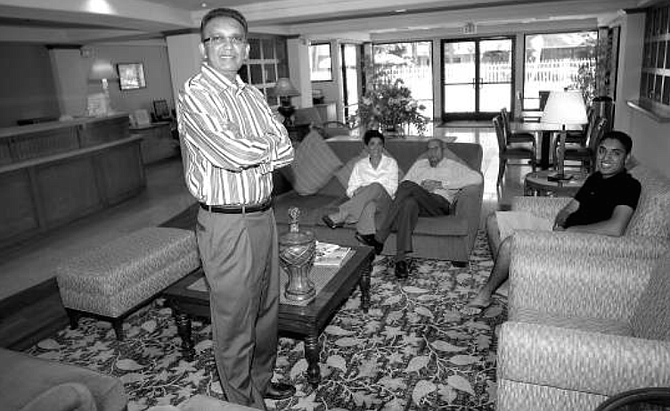
Barry, Hema, Lalbhai, and Arjun Lall. From 1993 to 2000, Naresh and the family saved $40,000. They saved on rent by living in the motel; and, when the whole family works for the family business, labor costs are nil.

One Sunday in November 1989, Barry Lall, an Indian-American doctor, was driving over the Coronado Bridge with his wife Hema, their four-year-old son Arjun, Lall's father and mother, and a real estate broker. They were on their way to inspect a 12-room motel for sale at the corner of Third Street and Orange Avenue, which, if priced right, Lall hoped to buy. Beneath them was the beautiful blue and iridescent channel, the port of San Diego where ships off-load containers from as far away as Hong Kong. At the time, Lall, who was practicing family medicine at Kaiser Hospital in Chula Vista, was not yet a citizen. He was here by way of a transnational diaspora common to many Indian immigrants. Lall's route had begun when his parents left the state of Gujarat, India, for the East African country of Nyasaland, where Lall was born; later, after medical studies in England and Scotland and an arranged marriage, he, his wife, and his parents ("she married them, too") emigrated to the United States in 1980, settled first in Georgia and then in San Diego.
Lall wanted to believe that the long geographical road that he and his family had traveled to get to America had prepared him for the longer personal road he was now on in America. Pulling the Lalls, Barry more than Hema, was the Holiday Motel. An ad in Sunday's San Diego Union offered under "Business Opportunity": Beach Motel, Coronado, priced to sell. Lall had pretty much decided that he would buy the place, fix it up, staff the front desk after work, if necessary, and make the beds himself. Owning a property was one thing; managing it another, a sore point between him and Hema. Hema, a petite woman with a boy's haircut, wanted no part of it. One of six daughters of a hotelier in San Francisco's Tenderloin, she grew up "on property," changing sheets and checking in guests. "I hated it," she recalls. "All I wanted was to get an education" -- which she did, a degree in accounting from UC Berkeley -- "and not marry a hotelier." Lall's father, whose name is Lalbhai, was opposed to Barry's dream, too. It was, after all, his hard work, savings, and relocation to four continents that helped insure his son's future as a doctor. But Lall was restless. While he hoped to leave medicine for what he calls the "risky world of business," he didn't want the family's security to suffer.
Today, much of his struggle is past. At 56, the millionaire motel mogul is flanked by his family in their La Jolla home. Lall sits beside a picture window, a Santa Ana-clear view of La Jolla Shores and the sandy coastal cliffs beyond, and discusses his life. "I had a yearning," he says. "I wanted to do something. I'd come to America, the land of opportunity. I was ready to go!" His son in college, his wife an employee, his father a homebody, Lall is revered like a chieftain, his venture capitalism having birthed agency in him and approbation in his family.
Seventeen years earlier at the Holiday Motel, Lall examined every room, pulling shower curtains aside and plunking onto beds. He recalls that Sunday with zeal: "It was like giving birth to a child." But the others who saw the motel were unimpressed: it was "a real dive," "totally dilapidated bathrooms and carpets and furniture, no telephones." The family conferred. Lalbhai wasn't sure what his son wanted. His son, he says now, has an intuition for the organizational. But he doesn't tell people what he wants to do. Lalbhai, who is 80 and a mathematical savant, remembers that, at the time, "inside his wishes, my son is regretting something, but he also has a vision. When he decides, he decides soon."
Going from room to room, Lall was guided by a past moment's imprint, the day he stepped off the plane in Dallas in 1980. "That day I felt free," he remembers. "I felt like this is my country. I never felt like that in Africa, England, or Scotland. And that freedom was tremendous. Maybe it was psychological, but I came to the country that offered me freedom." Lall knew he'd have to risk something to make good on that feeling. It had been nearly ten years, and this motel was his first real personal foray into what could happen if he'd only act on his gut. He'd done something like it before. In 1984, after being hired by Kaiser Permanente in San Diego, he bought a house in Clairemont, which neither his parents nor his wife had yet seen. "I first took my parents and my wife down Interstate 8 to Mission Bay, showed them how beautiful San Diego was. And then took them to the house [in Clairemont], and they said, 'Huh? Oh my gosh, what did you buy?' But they got used to it."
A half-hour spent perusing the motel and Lall realized this was it: "I got excited. Here's my opportunity to own my own motel!" Today, these words burst from him with lottery-winning laughter. He's otherwise a careful, unruffled man; a receding hairline gives him a pronounced forehead and a near-perfectly round face. He wears a black leather jacket; he sticks to a strict exercise regimen (undertaken because he was scared at turning 50). Standing next to him, one feels his impatience; he's still the distracted doctor who has a dozen more people to see before lunch.
Financing the Holiday wouldn't be easy. "Motels are considered very high risk by financial markets," Lall says. "They're not just real estate, they're also a business." During the 1980s, he made money on property; a condo sale netted him $40,000. He was itching to invest a couple hundred thousand dollars, but he needed twice that: the Holiday was $450,000. On Monday, he called a vice president he knew at Sumitomo Bank. The woman (who prefers anonymity) was his patient at Kaiser and had already gotten Dr. Lall to open an account at Sumitomo. Lall had once confided to her that he wanted to invest in commercial properties. One day, high blood pressure and a regimen of pills, prescribed by another doctor, brought her into his office. She was tired of the side effects, the tiredness, and the headaches. He recommended that instead of medication, she try exercise to control the hypertension. Every day for one month, she should take a morning walk and stop by his office to be monitored. Weeks later, her blood pressure was back to normal. "He saved my life," she says.
The woman at Sumitomo consulted with Ron Chapman, another loan officer. She argued that Lall's honesty made him "creditworthy." Chapman says he "wasn't wild about the deal. The economics for 12 units are very challenging -- more units mean you spread your overhead over more revenue points." Besides, Lall had no business experience, nothing like managing a motel. On the other hand, the motel's location, blocks from the Navy base, meant steady customers, families of service members who'd like the motel's basic rates. Better still, Lall could benefit from the late-1980s savings-and-loan crisis. Ever since the government stepped in, bank-owned properties, including many motels, had glutted the market. "Even good properties were going for a song," Chapman recalls.
And then there was Lall's promise, in Chapman's phrase, "of leveraging his family's resources." Family money and family labor pledged was good enough for Chapman. He said yes. Lall got the loan and bought the Holiday Motel. He hired workers to replace the windows, paint the walls, and relandscape the grounds. New carpet and furnishings were added. Lall moved in. "By now," he remembers, "we had a very nice home overlooking Mission Bay, in Bay Ho, and I left the home and my family to stay at this junky motel. My hours were such that I could do both jobs. At nighttime, I would rent you a room, and by day, I would treat your high blood pressure. Honest to God. If I do something, I have to do it well. That's what my parents taught me -- be fully committed." At the corner, Navy personnel late for curfew, racing off the bridge toward the base, screeched to a halt at the Third Street stoplight. Some nights the street noise -- and the noise in his heart that he missed his family -- rattled him.
His wife and his father remember backing him in the motel purchase, albeit "reluctantly." Lall's memory is that "neither of them supported me. They wanted me to stick to medicine." Lall says that he wanted for once in his life to make a decision on his own. His single regret was that "I had forced myself to become a doctor only because I said I would." He reasoned that because he was unhappy in medicine he could, therefore, leave the profession: in fact, that's exactly what being in America was commanding him to do.
After Lall had moved into the motel, his cleaning person sometimes called in sick. So he'd rush over midafternoon, run a load of wash, and clean the toilets himself. An Indian-American cousin from Canada came in, at a small salary, to staff the desk during the day. Every morning when his shift began, the man saw a pile of torn cards in the trash can, the previous night's receipts. The cousin told Lall, "Look, this is a business. You can't be throwing your records away. You've got to have proof for taxes." Lall had no idea about taxes and balance sheets, overhead and cash flow. He figured he'd learn everything as he went along. And yet he needed help. Which meant making his "inside" wishes known, lowering his financial risk by letting his father and mother assist. The road was still long, but the path was clear: to be free he would have to depend on his family, the way of an Indian, as much as he would have to depend on himself, the way of an American.
II.
And yet, as Lall may or may not have known, he was not alone in his desire to own a motel. Underpinning his dream is a cultural and commercial empire of Indian-American hoteliers, the clan of the motel people. Today, Indian-Americans (sometimes called South Asians) own more than 20,000 hotels in America, more than half of the economy properties, and nearly 37 percent of all hotels. (There is an Asian American Hotel Owners Association, whose membership is 8700 and whose annual confabs have featured President Bush and Senator John McCain.) Not only have Indian-Americans dominated U.S. hotel ownership as an ethnic group, but they've done so by sponsoring and installing immigrant relatives in the properties as managers. Chances are you have stopped at a TraveLodge in Winslow, Arizona, tired of the great desert drive, all chaparral to Albuquerque. You may have smelled curry or wondered at the shrine to Krishna in the lobby. An overbusy Indian man no doubt rented you a room. He seemed (if you noticed) American and Indian and to be everything and everywhere at once: owner, manager, night clerk, housekeeper, maintenance man, plus husband and father of a family you may have glimpsed in the apartment behind the front desk. Chances are the Indian and his brood (his wife in a sari) were recent arrivals, having waited 10 or 15 years to get in, and now here, work this opportunity 24/7 with the efficiency of a short-order cook.
How is it that Indian-Americans, who are roughly one percent of America's population, not only own these hotels and motels in such high numbers but also are niched into the hospitality business as managers? The phenomenon begins with the security of family-based immigration to America and in the subtle changes in immigration policy over the past century.
The two most critical years in American immigration policy are 1924 and 1965. In 1924, following the unregulated tide of foreign arrivals between 1880 and 1920, the government passed the National Origins Act, ostensibly to check the tide, but, as Gordon Clanton, sociology professor at San Diego State University says, actually to "keep out the Czechs, the Poles, the Jews, and the Italians -- who were considered undesirable. The clever strategy of that law was no particular national quota, except calculated as a fraction of your population already in the country. And that went back to the 1910 census: take the number of Italians in the country, and the annual percent of Italians allowed into the country will be something like one percent of that number." In effect, Clanton says, there was "a quota of zero for any group that had not come into the country substantially by 1910. So, after 1924, if you were from England, it was easy to get in because there were a whole lot of English descendants. For Poland there was a very low quota, maybe 20 times smaller than the quota for England."
The 1924 law regulated the influx. But it was, Clanton suggests, "a racist exclusionary system." Indians were already classified as nonwhites, denied citizenship and the right to own land. It wasn't until the Indian Immigration Bill of 1946 that Indians were given an annual quota of 100,000. By 1965, with advances in civil rights at home, things changed on par for foreigners: a new law allowed immigrants in based on economic viability, family reunification, or refugee status. Indian-Americans took immediate advantage. They had money and a few relatives here who began sponsoring countrymen to emigrate. They also showed that they would employ those new arrivals, often in hospitality. Of course, other groups from Eastern Europe, Central America, the Caribbean, and Asia have also benefited from the new rules. In fact, the law has not changed but refined the human-relocating system of chain migration, in which families help family members emigrate. One result is the continued solidarity and organizational drive of ethnic groups, evident in such businesses as the Vietnamese nail salons and the Korean corner markets.
Chain migration means clustering. For example, Clanton says, "Iraqis are concentrated in Detroit and San Diego, more than other cities. I had an Iraqi student, whom I asked, 'How did your family get over here?' -- and I've heard this so many times -- she said, 'My uncle Ben was already here and had a jewelry store in Palm Springs.' I should add that there's been a new measure added on -- in the same spirit as the 1965 law. In the late 1980s, when Bush Senior was president, we added a footnote, a Republican version of economic viability. It says, 'If you come into the country with a million dollars to spend on a business that will employ at least some Americans, you move right to the head of the line.' " In contrast to the late-1970s' "boat people" from southeast Asia, such millionaire or highly skilled immigrants are called "yacht people."
These days what America wants in its immigrants, beyond the service worker, is to be educated already. "The new 1965 law," Clanton says, "is better than the old law, but it's certainly a self-interested law. We can congratulate ourselves that it's not as implicitly racist and religiously discriminatory as the old law. But what we've basically said is, 'We don't want "the huddled masses yearning to be free" anymore. What we want is Sayyid with an M.A.' This creates significant problems in the sending country -- basically a brain drain. Who leaves Pakistan? Not some poor guy named Ali who sweeps up down at the barbershop. It's going to be somebody with a master's degree or enough money to start a business in this country or, at least, education of the sort that gives them viability."
The dynamics of chain migration are fascinating. For a couple of decades after 1965, most Indian arrivals were professional and technical workers in medicine, technology, engineering. This has changed. Two factors are reconfiguring the diaspora: one, a new law requires that, before applying immigrants need a job offer in writing, be it in hotels or circuit boards; and two, the outsourcing of jobs to India has slowed the exodus: many educated Indians are staying put, answering phones for Dell in Mumbai. But because of the desire for family reunification and because of the need for cheap labor in service sectors, foreigners, mostly brown-skinned, keep streaming in, legal or not. After all, who will do the jobs — field-picking, bed-making, cab-driving -- we lazy, fat natives won't? One argument made by those who study the less-than-benign aspects of transnational migration is that over the last century, American immigration law has never been about fairness but, rather, rotating the supply of indentured workers from one poor country to another—- China to Eastern and Southern Europe to Mexico -- as economically necessary. Indian-Americans seem to have scripted their own part in this play, in part because they have built, based on their families' and the law's largess, what is an efficiently managed, highly profitable, and kinfolk-dependable ethnic niche.
III.
What the sociologist studies, Barry Lall's father, Lalbhai Patel, has lived. It was he who began the family's odyssey, as thousands of others before him had, by leaving his home in the Indian state of Gujarat. (Gujarat — a people, a language, a place — did not become a state until 1960.) With its long coastline at the western edge of India, Gujarat borders the Arabian Sea to the west and Pakistan to the north. It is renowned for three things: its lowland agricultural fertility; its strong economy of merchants and farmers, making Gujarat the second most prosperous state in India; and its birth home of Mahatma Gandhi. Originally, the Gujarati came from northern India, moving over the centuries by ox and cart to escape the ravages of war. During the time of the Moguls and Sultans, Gujarati port cities were bustling stops on oceanic trading routes. From 1818 to 1947, the year of Indian independence, the British East India Company administered much of Gujarat's business. A major change occurred with the Indian Mutiny of 1859, after which the Gujarat area became a British suzerainty -- a feudal-like enclave controlled by England but with some domestic sovereignty. Limited self-direction may have been the origin of the hospitality business, at least in India, where a domestic class housed and profited off of the British intruders.
Gandhi was one of the first to leave, emigrating to London in 1888, at 19, to study law. Many have followed. It is often the westernized or entrepreneurial Gujarati who leave India for business or education. Also spurring flight in the last 50 years are conflicts along the border with Pakistan and internal fights between Hindus and Muslims. Today, several generations of successful Indian hoteliers have built a family pipeline from Gujarat to run hotels and motels throughout the United States, Canada, and Europe.
Lalbhai Patel has the most common surname in Gujarat. Just as Smith, the English surname of a "maker," is very common, so, too, is Patel, a name that came from pat or "log book," whose bearer was the village record keeper. Lalbhai says that Patel is a "community surname." The Patels are members of the third of the four Hindu castes, the Vaishyas, who are merchants, traders, and farmers. Most Patels were originally farmers and landowners, a "semi-educated people," as Lalbhai says, who, over time, grew to dominate Gujarati life by employing the Sudra caste, the lowest caste and the one beneath theirs, as laborers. Today, the Patel name is common among American innkeepers. One writer estimates that nearly 70 percent of all Indian motel owners are Patels. One-third of the nearly 2 million Indian-Americans are Patel -- one reason why Barry Patel became Barry Lall.
Lalbhai, who was a farmer and an English teacher in Gujarat, left in 1949 for Nyasaland, a British Colony in east-central Africa. Leaving his relatives behind, he emigrated to establish himself, to help his extended family, and to pursue his own sense of adventure, the male prerogative. He was following other Gujarati who went to East Africa to work on the railroads, to open banks or, like Gandhi in South Africa, to practice law. (Lalbhai, an acolyte of Gandhi, spun cotton daily from which his hand-woven clothing was made.) Secured by England's commercial and educational presence, East Africa for Indians was as the American West once was, though limited in its opportunities. Lalbhai began teaching elementary school and sending money home. In 1950, his son Barry was born; a daughter soon followed. Fourteen years later, Nyasaland became Malawi, in the independence movement that swept Africa. When black Malawians took over most professions, Lalbhai was fired. He wasn't expelled from the country, as 50,000 South Asians would be in nearby Uganda, after Idi Amin's coup. But Lalbhai saw the writing on the wall. He moved the family to Zambia where, pooling his savings with other out-of-work Indians, he opened a clothing store.
Barry Lall remembers that in his father's Zambian store "is where it all begins -- the entrepreneurial spirit. Even as a 12-year-old, I remember working in his store, selling to customers, and when my father went to India for a vacation, he left me in charge with my mom. I enjoyed that. For me it was not a pain, a chore, you know, how children think, 'I've got to help Dad in his business.' For me it was fun." Lalbhai's business venture expanded with his importing and distributing other items for Zambian retailers. "His true affinity," his son recalls, "may have been in business, making one customer at a time feel good." Lalbhai says, "When the customer wants a small thing, it's a big thing for me."
Soon Lalbhai saw that his son and daughter had no educational future in Zambia. He insisted they attend college in England. "When we were growing up in Africa," Lall says, "we weren't aware of many careers to go into. The options I thought I had were being a lawyer, an engineer, or a physician. Business was out of the question. We didn't know you could study business in college or get an MBA. Still, to go to college was imprinted in us from a very early age. It's not an option; it just has to be." It took two years before his parents joined him in England. "That two-year separation was very hard for them, more than for us. I knew growing up that my parents would continue to live with me, even when we were grown. My father and I used to exchange letters two or three times a week. Two or three times a week. Maybe that's pathological. I used to give him every detail of my life. We were just so close." In London, while Lall studied pre-med, his parents arrived and started a grocery store. He remembers that his father, a Hindu and lifelong vegetarian, had to butcher meat. There he was, "cutting the meat and selling it and learning everything about the business."
Lall eventually enrolled in medical school, in Glasgow, Scotland, graduating in 1979. It was time, so Lalbhai counseled, that he and his son "make a marriage," meaning, per tradition, the father would assist. He arranged for Barry to meet several potential brides; some were flown in from India. None worked out. Unbeknownst to Barry, he was being "tracked" by one of his father's good friends, a man who had known Lalbhai and his son in Zambia and who had become a hotel owner in San Francisco. At the time, Lalbhai remembered, the man had wanted doctors for his six daughters. So the two fathers set up a meeting in London for Barry and Hema, who both agreed. Lall says that "we liked each other right away." Part of the attraction -- during his "interview" with her, she "gave me all the right answers" -- was that she knew English and she seemed "Western," which he liked. But it wasn't for love that they married. "It's not like we were in love with each other; the romance didn't come before our decision to get married." After three weeks of interviewing, they tied the knot. "Thank goodness 26 years later, we're still married. It's worked out."
In 1981, Lall began a medical internship in Augusta, Georgia, where he and Hema moved. (In his pocket was $74,000, a gift from his father, an investment egg for buying a home.) The Lalls also did what most Indian families do -- they had his parents move with him. Lall says that for his father, "We're his India." Lalbhai, whose wife died several years ago, calls his son "brother," a term of endearment Indian families use.
In 1990, when Lall was 40, he realized that he was feeling the same pull away from his profession (medicine) and toward business that his father had felt when he was 40, pulled away from his profession (teaching) and toward business. Both were in the "nurturing" professions, and both left. Meditating on this attraction to risk, Lall thinks it's "something in the blood. How can a teacher like my father become a businessman?"
The answer is, the blood and the family. When Lall asked his parents for help in running the Holiday Motel, they moved right in and managed it. They were thrilled to still be a part of their son's dream. During 1991 and 1992, they ran the motel, freeing up Barry to invest its profits in other properties. Now cash-fat, Lall had a realization. To be a success, he saw the imperative of the Indian model: to spread the risk throughout his family. At the same time, he saw that he had to chase down new opportunities himself, the American plan. So he told his family that he would leave medicine and invest all their money - and all his time — in motels. They agreed, this time without reservation. Hema "bought into it," as did Lall's parents, who also threw in their savings.
Lall points to two things that brought about his career change. The first is cultural. "I talk to a lot of my fellow physicians; they're desperate to get out, but most of them can't think of a way to get out. Business? Most of them can't think of it as an option. It's too great a risk. There's something that I inherited, something about me — and about a lot of Indians, I shouldn't just say myself — that allows us to take the risk and be successful. That's crucial." Lall's second reason is personal. In medicine, he says, making a brilliant diagnosis and saving a person's life is gratifying. "But with that one success in medicine, there are multiple other experiences that are average. If I were a neurosurgeon, I probably wouldn't have left. Family medicine wasn't challenging for me after a while. There wasn't much for me to do; eight out of ten patients were normal. But there's no doubt: When I've stabilized a hotel and made it successful — and success is not necessarily about finances — that gave me a great deal of satisfaction."
In 1993, Lall and two Indian friends, one of whom was unhappy as an engineer, formed a hotel company. Riding the recession of the early 1990s, they pursued distressed hotels, many in foreclosure. "We were like the Three Stooges, who didn't know much about big-time development and hotel management. But who cares? I didn't care." Buying hotels throughout the west, each partner was responsible for a different region; Lall's was New Mexico and Arizona. Lall bought a Days Inn, with 115 rooms and a restaurant, in Tucson, and moved in by himself (going east now as his father had once gone west). Hema, their young son, and his parents soon joined him. They carved out three rooms for their apartment and lived there for two years. He recalls their tenure as the "sacrifice the whole family was willing to make to help my dream succeed." That first year, "I bought myself a BMW 740i -- I could never afford that as a doctor." He recalls watching the San Diego Chargers in the Super Bowl on a tiny TV in their apartment and being "so happy." Hema didn't mind, she says. Growing up she had to clean; now she managed, eventually joining Lall's company as an accountant. During the 1990s, Lall and his partners reinvested continuously; within three years, they "were running 35 underperforming hotels. When we took over, we had to spend significant capital to renovate these hotels -- change the laissez-faire attitude of the local management, most of the general managers, and the brand or affiliation of the hotel. By doing these things, we were immediately able to make these hotels successful."
Out and about with Lall today in his Mercedes S500, we drive by squalid or plain motels that he describes as "having no love. Nobody has shown that property any love." Loving a motel, Lall says, striding into corporate-speak, is "not about numbers. It's about taking pride in every asset we own. It's about the satisfaction that we get from our guests being happy with their stay with us." Since 1997, Lall has been co-owner, with Suresh Patel, of Pinnacle Hotels, a company of 420 employees with 15 people at their corporate office in Kearny Mesa. Pinnacle has built or bought 20 midscale hotels — Hilton Garden Inns, Marriott Courtyards, Fairfields, Holiday Inns, and more – in Ohio, Arizona, and California. Their annual revenue is $40 million, and their property holdings total $200 million.
IV.
For the new immigrant it's all about who's here and who's established themselves before you came to America. Which is to say that the 1965 reform described what was self-evident -- the ethnic niche business, in which extended families and countrymen are concentrated, is the conduit from homeland to newland. An ethnic niche is an enclave in which newly arriving ethnic groups organize their livelihood: Chinese laundries, Jewish sweatshops, Portuguese tuna boats. Indian immigrants have flowered in high-tech jobs, in medicine, and in hospitality. Today, notes University of California at San Diego sociologist Tomás Jiménez, "They are by no means poor. They come here and make six figures. They're economic migrants, but not in the same way as Mexicans or Central Americans."
By phone Jiménez tells me that ethnic niches develop "when a handful of pioneering migrants come to an area for reasons that are random. They end up in a particular job. They become respected workers and trusted employees. They are relied upon to bring over other employees whom the employers hope are also pioneering migrants. There's a sort of ethnic recruiting that takes place." Once the initial phase happens, new arrivals, many thrice-migrants, look for work not because they have an affinity for picking cotton or cleaning rooms but because that's where their ethnic brethren are established.
But Americans, whether recent immigrants or from immigrant families themselves, too often believe the counterintuitive claim about the other, namely, that there's something about the work itself that fits the ethnicity. Jiménez debunks this notion: "A common misperception is that people come to the U.S. and do jobs that are familiar to them because of where they come from. They come seeking economic opportunity in whatever form they can find it. Mexicans, for example, dominate in beef-packing in the Midwest. It's highly unlikely they were beef-packers in Mexico. It was also believed that Italians came to the West Coast because they were familiar with the climate and then worked in garbage-collecting. These folks weren't garbage-collectors in Italy. They also didn't come because of the climate but because there was already a substantial Italian population that could plug them into various social, political, and economic opportunities," only one of which was the trash business.
Needless to say, the next group of questions is delicate. What about "innateness" and long-term success? Is there some centuries-old aspect of Gujarati sensibility that allows him to come to America without a background in hotel-motel management, knowing instinctively that the niche exists and how best to take advantage of it? Can one quantify a kind of pioneering spirit among Indians that has come from their parents by way of Africa and pushed the idea of opportunity upon the most adventuresome of the bunch? Does hotel-motel management demand one be thrifty in order to succeed, or is that thrift-mindedness built into the people who become hoteliers?
"I'm wary of those interpretations," Jiménez says. "In a similar way, people have made arguments about why Chinese and Japanese workers were so good at agriculture or things that required fine motor skills. They were docile; tiny hands allowed them to do certain things." Such stereotypes are half-truths for Jiménez. At times, he believes, certain groups can bring advantages from the home country. "It might be that Indians who emigrate from India are better educated relative to other groups. Rather than having a cultural predisposition to entrepreneurship, it might be their level of education that allows them to navigate their opportunities."
Jiménez thinks that the genotypical argument -- Mexicans are predisposed to pick lettuce, Koreans to overcharge for basic goods, Indians to manage motels -- is spurious. People, he says, get "racially coded, identified with a particular group. Work gets labeled immigrant work, for example, Vietnamese work. People think about races in hierarchies. They rank people in these jobs accordingly, by work and by race. When those jobs get coded, their status gets knocked down. Some people call it a psychological wage. The psychological wage which that job carries is lessened. Americans are less apt to do that type of work not only because the pay is low and there's a supply of willing workers but also because there's a psychological wage that American-born individuals are not willing to accept." Jiménez cites the "classic case of construction. At one time those jobs were unionized and paid well; now you see at any construction site Mexican immigrants working. Construction work gets ranked accordingly."
What happens intergenerationally to immigrant families?
As much as the parents may be identified with the job, Jiménez notes, the children, more susceptible to assimilation into American culture, do not identify themselves with the job. They reject the notion that immigrant families wear uniform badges. Owning hotels is a lucrative business; the capital earned means parents can afford elite colleges or provide their offspring with cash to start their own businesses. Most children of Indian-American hoteliers will go to universities because of the family's stress on education; the kids, who must work in the motels, are under their parents' thumbs and usually stay out of trouble.
An eclectic American culture steadily alters the culture of immigrant sons and daughters. "The kids," Jiménez says, "have a lot to do with that -- they are moving outside the ethnically specific circles, hanging out with kids who are not Indian. And these are the folks among whom we see intermarriage, friendships across racial and ethnic lines, movement out of ethnically concentrated neighborhoods. We'll see a lot of intermarriage in the next 25 years. Particularly if the kids are doing well." In the process, immigrant children become invisible as they blend into the middle class. Which is also to say that they move out of the job where their ethnicity has been branded and they move into the professions or trades that appear open to all.
Sociologists make two claims, Jiménez says, about niches. "The more recent one is that niches are advantageous, precisely because they are launching pads. Ethnic solidarity may allow a newly arrived individual to find a job and be shielded from the harmful effects of discrimination in the labor market. Niches also allow a social and economic base in the new society that ultimately leads to economic ascendancy." This laddering is often seen in those Indian-Americans who court a relationship between their hotel/motel ownership here and their relatives who come here, often willingly. In a sense, the owners know where to get labor — cheap labor — to run their motels. To work for one's in-laws might be more family than many of us would ever want.
Which brings up the other, older claim. "The class divisions within these communities," Jiménez says, "are just as pernicious as the racial discrimination they might encounter outside their niches. Thus, hotel owners might exploit their own just as any other owner would. Some sociologists really tout this idea of ethnic niches and enclaves; some say newly arrived people get exploited in these niches. In other words, niches are not a panacea." Exploitation is hard to measure: the poverty rate for Indian-Americans, for example, is significantly less than the U.S. average, so, in economic terms, Indian immigrants may be less victimized than they would be in jobs outside the niche.
V.
Seventy-five miles east of Los Angeles, Interstate 10 bisects Banning, a town most of us miss as part of the no-there-there between Riverside and Palm Springs. And yet changes are afoot. A new Native American casino, in gravity-defying postmodern design, interrupts the commercial thoroughfare, making Banning more destination than drive-by. The Days Inn is docked beside the on-ramp, across the street from All Star Dodge and a Frisbee toss from Subway. From the parking lot, the freeway noise is unrelenting. On the second story of the property, maids from Mexico, who speak very little English, push carts from standard room to standard room, all 42 identical. They tidy and scrub for Naresh Patel and his wife, Prabha, the motel owners, who are from Gujarat, India, and who also speak very little English. From owner to help go the commands: clean this room, sweep these stairs, launder these sheets. The Gujarati and the Spanish speakers know, billowed on the sameness of days, what needs communicating.
Lall and I have come to visit the Patels and their motel. Naresh, Prabha, and three of his four children live on-site, in the family room behind the front desk where a visitor, guided to a cushy couch and given chai tea, hears the frequent ding of the bell, calling for service. (Made welcome, one recalls the Sanskrit proverb, Atithi Devo Bhava — "The guest is like God.") There's a smell of curry, a Panasonic TV broadcasting college basketball, and a heavy silver shrine to Krishna, too big for its end table. Mornings and evenings Naresh and Prabha (and sometimes the kids) sing a devotional song to Krishna. As they sing, Naresh shakes a small bell and stirs the air with a candle flame. The song is finished after a praying-hands, waist-bowing prayer and Naresh's prostration on the floor to the deity. (Worship for Hindus is typically an individual rather than a communal experience.) The Patels are devoted to India, where their hearts are, but they are in America, where the money — and the future — lies.
Since 1993, the Patels have settled only in tight quarters in several modest motels. The eldest sister, Rina, is married and gone, but the three younger kids, Pharmisha, Bhavika, and Kevin, live at home (at the motel) and help out. In India, Naresh used to farm sugarcane and rice and polish diamonds. He owned land and employed many workers. But he brought his family to America, so his children could be educated and so he could establish himself in business. Even with a cousin in Philadelphia who sponsored them, it took 11 years before the Patels' application to emigrate to America was approved. The children went to live with a relative and began school in Florida, while Naresh and his wife headed for Sacramento.
In Sacramento, Naresh and Prabha were housekeepers at a Patel-(cousin)-managed motel. Before getting off the plane, they thought their hard work would be rewarded with money, down one of America's many streets of gold. Naresh, a chiseled-featured man who, nearing 60, seems eternally fit, wasn't prepared for what he found. (Lall translates Naresh's words from Gujarati.) "In India, I am the boss. In America, I am the peon. Psychologically, I didn't like it, but I didn't complain and I didn't cry." Naresh says he would "die" before cleaning rooms in India. Partly because of his caste, but also because a willing "staff" for the merchant class (seen sometimes as a "leisure" class) was abundant: plenty of people would work because they needed money. Soon after their arrival, Naresh's wife became bedridden with a severe back problem that meant Naresh had to clean rooms and make meals.
The family finally reunited at a motel in Bentonville, Arkansas, where Naresh and Prabha did the housekeeping. Without knowing English, the kids were thrust into various grades, sank, then swam. Kevin, who now speaks perfect English and is a promising high school basketball player, says that "everywhere" they went in Arkansas and, later, at motels in Memphis and Hernando, Mississippi, "There was racism. They looked at you dirty. You didn't know if they were talking about you, making fun of you, or being nice -- it was a confusing feeling." Bhavika recalls that much of the racism was due to her Indian accent. "Why can't I talk like they do? I know what I'm saying, but why doesn't it come out right?" Not an English speaker in Gujarat, she felt weird talking in English. She didn't say much.
Typically, the two parents and four kids would live in two rooms with a kitchen. The family of six made $2000 a month, augmented by a side-business: daily preparation of a dozen tiffins, or Indian meals (at $6 each), for a family of Indian professionals. These earnings were augmented by jobs the kids had as teenagers. "It's not the Indian way," Lall says, "for kids to earn and keep their own money." Bhavika echoes this: "Because of the stuff we went through as a family, it was never yours, mine, his. It's always been ours. Even until today." The kids helped cook and deliver the tiffins and assisted in motel duties on the busier weekends. Naresh saved. Something better, he felt, was coming.
One year there was a family get-together in Florida. Naresh and his family came from Memphis, as did relatives from other parts of America. Among them was Barry Lall, who was the talk of the family because of his success as a hotelier out west. That day Naresh's father, a man whose austere portrait hangs above the living-room shrine, grasped Lall's arm with both hands and whispered to him in Gujarat a sentence of intense softness: Will you do something for my son, Naresh? "That's how he asked me, and I said, 'I will.' He couldn't stand his son cleaning rooms after all these years," Lall remembers. "I took it to my heart. I didn't go out specifically looking for a motel for them. But I had them in my mind. When the right opportunity came up — I wanted a property small enough, with a small enough down payment, where they could have a substantial investment."
Lall found the Banning Days Inn, which he says looked "terribly distressed." Lall called Naresh. He put one condition on letting Naresh invest in the property as a part-owner. "I will allow you to join me on this adventure only if your daughter sacrifices at least one year of college." (She was at San Diego State and had to commute every week.) "I wanted someone who spoke English to take charge of the business. He was excited. He didn't ask me where the town was, how big or little it was, or do they have any Indian restaurants." The family was very happy. Today Naresh says, "Barry did well for us."
From 1993 to 2000, Naresh and the family saved $40,000, largely from housekeeping. Of course, they saved on rent by living in the motel; and, when the whole family works for the family business, labor costs are nil. Still, the family seldom went to a movie, seldom ate out. "Eating at Taco Bell," Kevin says, "was like eating at a five-star hotel." The kids wore hand-me-downs. They shopped at Wal-Mart, never the mall. An aunt gave them an old car. Except for living expenses, the family saved everything they earned.
Naresh borrowed $100,000 from relatives. Short-term loans are common in the Indian community: cash, delivered to friends, with no contracts or interest timetables. Just a handshake. And then that money, banded and stacked in a suitcase, is delivered in person to a bank's loan officer as the down payment: Yes, sir, I'd like to buy a motel. So common is this practice of bypassing banks that Lall was approached after Hurricane Katrina by a cousin from a small town near New Orleans. Her motel was heavily damaged, and she needed money to make it viable — a place for workers to stay during the rebuilding. Lall asked no questions, just sent a check. A few weeks later, once the woman's insurance money came through, he got a check back, payment in full.
At the Banning Days Inn, Lall's corporation financed immediate improvements -- blacktopped the parking lot, added landscaping, painted the exterior a creamy beige, changed the sign, repainted all the rooms, replaced the carpets and the mattresses. The motel was a steal, Lall says. In 2000, it was $1.4 million; today the value is $3 million. Lall makes money on the front end. The day this property closed, he recalls, he knew it was worth more than he paid for it. "If I buy right, I make a lot of money." For the past five years, he has averaged, by his account, between 12 and 15 percent annualized returns for his investors. He has more investors than he can accommodate. "I'm awash in capital."
As for "going home" to India, Kevin says no, he can only visit. "Their thinking is completely different from ours." Arriving for his sister's wedding, he was descended on by people helping him with his bags. "I couldn't adapt to the farm life there, driving tractors." From across the room, Lall asks, "Is India your country? Do you have any feeling for it?" The question stirs nothing, apparently, in Kevin or Bhavika. They were born there, they come from there, but "that's it." America is their country. "That," Lall laughs, "is a good thing."
Bhavika is studying accounting in college. She wants a job as a CPA and hopes to leave the motel business behind. "I would invest, but I'd prefer not to work in management. If all fails, yes, I could run a motel." Ditto for Kevin. He says they've achieved the motel dream; the next dream is to buy a house. As a family. "My parents and I will be living together," he comments, packing his bag for a Saturday afternoon basketball game, "for a long time." Until he marries an Indian girl, probably by arrangement, probably a Patel, probably an acquaintance in the world of hospitality -- all things his culture, his family, maybe his Gujarati blood, have prescribed.
Driving back to San Diego through the Riverside smog, Lall points at fields with signs that read available. Soon, he's reflecting on Naresh, who, he says, has paid back most of what he borrowed for the Days Inn. He's now the official owner. Some days, Naresh is excited; he wants to invest more money. But Lall cautions him. There's nothing on the horizon right now. "I've got to be careful," he says. "Only one in ten properties," as a potential purchase, "ever pans out."
Naresh fascinates Lall. He says that the man has "two personalities." In India, he is "outgoing and confident," but in America, missing his caste and family and never having learned English, he's "lost the assertiveness that used to define him as an employer and as a man. Despite his success," Lall says, "Naresh feels stymied. He'd probably like to go back to India but not until he's accomplished what he came here to do. Still, he feels stymied."
Lall's cell phone rings. It's his son. He's on the road, too. Driving home from college, Claremont McKenna, a business major. "It'll be so good to see him." The family -- Arjun and Lalbhai, Hema and Barry -- will have a short, packed weekend together, a few meals with store-bought Indian food around the dinette. Flipping the phone shut, Lall returns to a question that stirs, sometimes noisily, in his own mind, whether anyone asks or not. "No," he says, "my father has no desire to live in India again. His place is here, at home, with us. Which is strange when you consider that we don't expect our son to live with us nor us to live with him."
Something only an American would say.
Here's something you might be interested in.
Indian-American Barry Lall left secure doctor's job at Kaiser for a small Coronado motel
The guest is like God

Indian-American Barry Lall left secure doctor's job at Kaiser for a small Coronado motel
The guest is like God
Barry, Hema, Lalbhai, and Arjun Lall. From 1993 to 2000, Naresh and the family saved $40,000. They saved on rent by living in the motel; and, when the whole family works for the family business, labor costs are nil.
One Sunday in November 1989, Barry Lall, an Indian-American doctor, was driving over the Coronado Bridge with his wife Hema, their four-year-old son Arjun, Lall's father and mother, and a real estate broker. They were on their way to inspect a 12-room motel for sale at the corner of Third Street and Orange Avenue, which, if priced right, Lall hoped to buy. Beneath them was the beautiful blue and iridescent channel, the port of San Diego where ships off-load containers from as far away as Hong Kong. At the time, Lall, who was practicing family medicine at Kaiser Hospital in Chula Vista, was not yet a citizen. He was here by way of a transnational diaspora common to many Indian immigrants. Lall's route had begun when his parents left the state of Gujarat, India, for the East African country of Nyasaland, where Lall was born; later, after medical studies in England and Scotland and an arranged marriage, he, his wife, and his parents ("she married them, too") emigrated to the United States in 1980, settled first in Georgia and then in San Diego.
Lall wanted to believe that the long geographical road that he and his family had traveled to get to America had prepared him for the longer personal road he was now on in America. Pulling the Lalls, Barry more than Hema, was the Holiday Motel. An ad in Sunday's San Diego Union offered under "Business Opportunity": Beach Motel, Coronado, priced to sell. Lall had pretty much decided that he would buy the place, fix it up, staff the front desk after work, if necessary, and make the beds himself. Owning a property was one thing; managing it another, a sore point between him and Hema. Hema, a petite woman with a boy's haircut, wanted no part of it. One of six daughters of a hotelier in San Francisco's Tenderloin, she grew up "on property," changing sheets and checking in guests. "I hated it," she recalls. "All I wanted was to get an education" -- which she did, a degree in accounting from UC Berkeley -- "and not marry a hotelier." Lall's father, whose name is Lalbhai, was opposed to Barry's dream, too. It was, after all, his hard work, savings, and relocation to four continents that helped insure his son's future as a doctor. But Lall was restless. While he hoped to leave medicine for what he calls the "risky world of business," he didn't want the family's security to suffer.
Today, much of his struggle is past. At 56, the millionaire motel mogul is flanked by his family in their La Jolla home. Lall sits beside a picture window, a Santa Ana-clear view of La Jolla Shores and the sandy coastal cliffs beyond, and discusses his life. "I had a yearning," he says. "I wanted to do something. I'd come to America, the land of opportunity. I was ready to go!" His son in college, his wife an employee, his father a homebody, Lall is revered like a chieftain, his venture capitalism having birthed agency in him and approbation in his family.
Seventeen years earlier at the Holiday Motel, Lall examined every room, pulling shower curtains aside and plunking onto beds. He recalls that Sunday with zeal: "It was like giving birth to a child." But the others who saw the motel were unimpressed: it was "a real dive," "totally dilapidated bathrooms and carpets and furniture, no telephones." The family conferred. Lalbhai wasn't sure what his son wanted. His son, he says now, has an intuition for the organizational. But he doesn't tell people what he wants to do. Lalbhai, who is 80 and a mathematical savant, remembers that, at the time, "inside his wishes, my son is regretting something, but he also has a vision. When he decides, he decides soon."
Going from room to room, Lall was guided by a past moment's imprint, the day he stepped off the plane in Dallas in 1980. "That day I felt free," he remembers. "I felt like this is my country. I never felt like that in Africa, England, or Scotland. And that freedom was tremendous. Maybe it was psychological, but I came to the country that offered me freedom." Lall knew he'd have to risk something to make good on that feeling. It had been nearly ten years, and this motel was his first real personal foray into what could happen if he'd only act on his gut. He'd done something like it before. In 1984, after being hired by Kaiser Permanente in San Diego, he bought a house in Clairemont, which neither his parents nor his wife had yet seen. "I first took my parents and my wife down Interstate 8 to Mission Bay, showed them how beautiful San Diego was. And then took them to the house [in Clairemont], and they said, 'Huh? Oh my gosh, what did you buy?' But they got used to it."
A half-hour spent perusing the motel and Lall realized this was it: "I got excited. Here's my opportunity to own my own motel!" Today, these words burst from him with lottery-winning laughter. He's otherwise a careful, unruffled man; a receding hairline gives him a pronounced forehead and a near-perfectly round face. He wears a black leather jacket; he sticks to a strict exercise regimen (undertaken because he was scared at turning 50). Standing next to him, one feels his impatience; he's still the distracted doctor who has a dozen more people to see before lunch.
Financing the Holiday wouldn't be easy. "Motels are considered very high risk by financial markets," Lall says. "They're not just real estate, they're also a business." During the 1980s, he made money on property; a condo sale netted him $40,000. He was itching to invest a couple hundred thousand dollars, but he needed twice that: the Holiday was $450,000. On Monday, he called a vice president he knew at Sumitomo Bank. The woman (who prefers anonymity) was his patient at Kaiser and had already gotten Dr. Lall to open an account at Sumitomo. Lall had once confided to her that he wanted to invest in commercial properties. One day, high blood pressure and a regimen of pills, prescribed by another doctor, brought her into his office. She was tired of the side effects, the tiredness, and the headaches. He recommended that instead of medication, she try exercise to control the hypertension. Every day for one month, she should take a morning walk and stop by his office to be monitored. Weeks later, her blood pressure was back to normal. "He saved my life," she says.
The woman at Sumitomo consulted with Ron Chapman, another loan officer. She argued that Lall's honesty made him "creditworthy." Chapman says he "wasn't wild about the deal. The economics for 12 units are very challenging -- more units mean you spread your overhead over more revenue points." Besides, Lall had no business experience, nothing like managing a motel. On the other hand, the motel's location, blocks from the Navy base, meant steady customers, families of service members who'd like the motel's basic rates. Better still, Lall could benefit from the late-1980s savings-and-loan crisis. Ever since the government stepped in, bank-owned properties, including many motels, had glutted the market. "Even good properties were going for a song," Chapman recalls.
And then there was Lall's promise, in Chapman's phrase, "of leveraging his family's resources." Family money and family labor pledged was good enough for Chapman. He said yes. Lall got the loan and bought the Holiday Motel. He hired workers to replace the windows, paint the walls, and relandscape the grounds. New carpet and furnishings were added. Lall moved in. "By now," he remembers, "we had a very nice home overlooking Mission Bay, in Bay Ho, and I left the home and my family to stay at this junky motel. My hours were such that I could do both jobs. At nighttime, I would rent you a room, and by day, I would treat your high blood pressure. Honest to God. If I do something, I have to do it well. That's what my parents taught me -- be fully committed." At the corner, Navy personnel late for curfew, racing off the bridge toward the base, screeched to a halt at the Third Street stoplight. Some nights the street noise -- and the noise in his heart that he missed his family -- rattled him.
His wife and his father remember backing him in the motel purchase, albeit "reluctantly." Lall's memory is that "neither of them supported me. They wanted me to stick to medicine." Lall says that he wanted for once in his life to make a decision on his own. His single regret was that "I had forced myself to become a doctor only because I said I would." He reasoned that because he was unhappy in medicine he could, therefore, leave the profession: in fact, that's exactly what being in America was commanding him to do.
After Lall had moved into the motel, his cleaning person sometimes called in sick. So he'd rush over midafternoon, run a load of wash, and clean the toilets himself. An Indian-American cousin from Canada came in, at a small salary, to staff the desk during the day. Every morning when his shift began, the man saw a pile of torn cards in the trash can, the previous night's receipts. The cousin told Lall, "Look, this is a business. You can't be throwing your records away. You've got to have proof for taxes." Lall had no idea about taxes and balance sheets, overhead and cash flow. He figured he'd learn everything as he went along. And yet he needed help. Which meant making his "inside" wishes known, lowering his financial risk by letting his father and mother assist. The road was still long, but the path was clear: to be free he would have to depend on his family, the way of an Indian, as much as he would have to depend on himself, the way of an American.
II.
And yet, as Lall may or may not have known, he was not alone in his desire to own a motel. Underpinning his dream is a cultural and commercial empire of Indian-American hoteliers, the clan of the motel people. Today, Indian-Americans (sometimes called South Asians) own more than 20,000 hotels in America, more than half of the economy properties, and nearly 37 percent of all hotels. (There is an Asian American Hotel Owners Association, whose membership is 8700 and whose annual confabs have featured President Bush and Senator John McCain.) Not only have Indian-Americans dominated U.S. hotel ownership as an ethnic group, but they've done so by sponsoring and installing immigrant relatives in the properties as managers. Chances are you have stopped at a TraveLodge in Winslow, Arizona, tired of the great desert drive, all chaparral to Albuquerque. You may have smelled curry or wondered at the shrine to Krishna in the lobby. An overbusy Indian man no doubt rented you a room. He seemed (if you noticed) American and Indian and to be everything and everywhere at once: owner, manager, night clerk, housekeeper, maintenance man, plus husband and father of a family you may have glimpsed in the apartment behind the front desk. Chances are the Indian and his brood (his wife in a sari) were recent arrivals, having waited 10 or 15 years to get in, and now here, work this opportunity 24/7 with the efficiency of a short-order cook.
How is it that Indian-Americans, who are roughly one percent of America's population, not only own these hotels and motels in such high numbers but also are niched into the hospitality business as managers? The phenomenon begins with the security of family-based immigration to America and in the subtle changes in immigration policy over the past century.
The two most critical years in American immigration policy are 1924 and 1965. In 1924, following the unregulated tide of foreign arrivals between 1880 and 1920, the government passed the National Origins Act, ostensibly to check the tide, but, as Gordon Clanton, sociology professor at San Diego State University says, actually to "keep out the Czechs, the Poles, the Jews, and the Italians -- who were considered undesirable. The clever strategy of that law was no particular national quota, except calculated as a fraction of your population already in the country. And that went back to the 1910 census: take the number of Italians in the country, and the annual percent of Italians allowed into the country will be something like one percent of that number." In effect, Clanton says, there was "a quota of zero for any group that had not come into the country substantially by 1910. So, after 1924, if you were from England, it was easy to get in because there were a whole lot of English descendants. For Poland there was a very low quota, maybe 20 times smaller than the quota for England."
The 1924 law regulated the influx. But it was, Clanton suggests, "a racist exclusionary system." Indians were already classified as nonwhites, denied citizenship and the right to own land. It wasn't until the Indian Immigration Bill of 1946 that Indians were given an annual quota of 100,000. By 1965, with advances in civil rights at home, things changed on par for foreigners: a new law allowed immigrants in based on economic viability, family reunification, or refugee status. Indian-Americans took immediate advantage. They had money and a few relatives here who began sponsoring countrymen to emigrate. They also showed that they would employ those new arrivals, often in hospitality. Of course, other groups from Eastern Europe, Central America, the Caribbean, and Asia have also benefited from the new rules. In fact, the law has not changed but refined the human-relocating system of chain migration, in which families help family members emigrate. One result is the continued solidarity and organizational drive of ethnic groups, evident in such businesses as the Vietnamese nail salons and the Korean corner markets.
Chain migration means clustering. For example, Clanton says, "Iraqis are concentrated in Detroit and San Diego, more than other cities. I had an Iraqi student, whom I asked, 'How did your family get over here?' -- and I've heard this so many times -- she said, 'My uncle Ben was already here and had a jewelry store in Palm Springs.' I should add that there's been a new measure added on -- in the same spirit as the 1965 law. In the late 1980s, when Bush Senior was president, we added a footnote, a Republican version of economic viability. It says, 'If you come into the country with a million dollars to spend on a business that will employ at least some Americans, you move right to the head of the line.' " In contrast to the late-1970s' "boat people" from southeast Asia, such millionaire or highly skilled immigrants are called "yacht people."
These days what America wants in its immigrants, beyond the service worker, is to be educated already. "The new 1965 law," Clanton says, "is better than the old law, but it's certainly a self-interested law. We can congratulate ourselves that it's not as implicitly racist and religiously discriminatory as the old law. But what we've basically said is, 'We don't want "the huddled masses yearning to be free" anymore. What we want is Sayyid with an M.A.' This creates significant problems in the sending country -- basically a brain drain. Who leaves Pakistan? Not some poor guy named Ali who sweeps up down at the barbershop. It's going to be somebody with a master's degree or enough money to start a business in this country or, at least, education of the sort that gives them viability."
The dynamics of chain migration are fascinating. For a couple of decades after 1965, most Indian arrivals were professional and technical workers in medicine, technology, engineering. This has changed. Two factors are reconfiguring the diaspora: one, a new law requires that, before applying immigrants need a job offer in writing, be it in hotels or circuit boards; and two, the outsourcing of jobs to India has slowed the exodus: many educated Indians are staying put, answering phones for Dell in Mumbai. But because of the desire for family reunification and because of the need for cheap labor in service sectors, foreigners, mostly brown-skinned, keep streaming in, legal or not. After all, who will do the jobs — field-picking, bed-making, cab-driving -- we lazy, fat natives won't? One argument made by those who study the less-than-benign aspects of transnational migration is that over the last century, American immigration law has never been about fairness but, rather, rotating the supply of indentured workers from one poor country to another—- China to Eastern and Southern Europe to Mexico -- as economically necessary. Indian-Americans seem to have scripted their own part in this play, in part because they have built, based on their families' and the law's largess, what is an efficiently managed, highly profitable, and kinfolk-dependable ethnic niche.
III.
What the sociologist studies, Barry Lall's father, Lalbhai Patel, has lived. It was he who began the family's odyssey, as thousands of others before him had, by leaving his home in the Indian state of Gujarat. (Gujarat — a people, a language, a place — did not become a state until 1960.) With its long coastline at the western edge of India, Gujarat borders the Arabian Sea to the west and Pakistan to the north. It is renowned for three things: its lowland agricultural fertility; its strong economy of merchants and farmers, making Gujarat the second most prosperous state in India; and its birth home of Mahatma Gandhi. Originally, the Gujarati came from northern India, moving over the centuries by ox and cart to escape the ravages of war. During the time of the Moguls and Sultans, Gujarati port cities were bustling stops on oceanic trading routes. From 1818 to 1947, the year of Indian independence, the British East India Company administered much of Gujarat's business. A major change occurred with the Indian Mutiny of 1859, after which the Gujarat area became a British suzerainty -- a feudal-like enclave controlled by England but with some domestic sovereignty. Limited self-direction may have been the origin of the hospitality business, at least in India, where a domestic class housed and profited off of the British intruders.
Gandhi was one of the first to leave, emigrating to London in 1888, at 19, to study law. Many have followed. It is often the westernized or entrepreneurial Gujarati who leave India for business or education. Also spurring flight in the last 50 years are conflicts along the border with Pakistan and internal fights between Hindus and Muslims. Today, several generations of successful Indian hoteliers have built a family pipeline from Gujarat to run hotels and motels throughout the United States, Canada, and Europe.
Lalbhai Patel has the most common surname in Gujarat. Just as Smith, the English surname of a "maker," is very common, so, too, is Patel, a name that came from pat or "log book," whose bearer was the village record keeper. Lalbhai says that Patel is a "community surname." The Patels are members of the third of the four Hindu castes, the Vaishyas, who are merchants, traders, and farmers. Most Patels were originally farmers and landowners, a "semi-educated people," as Lalbhai says, who, over time, grew to dominate Gujarati life by employing the Sudra caste, the lowest caste and the one beneath theirs, as laborers. Today, the Patel name is common among American innkeepers. One writer estimates that nearly 70 percent of all Indian motel owners are Patels. One-third of the nearly 2 million Indian-Americans are Patel -- one reason why Barry Patel became Barry Lall.
Lalbhai, who was a farmer and an English teacher in Gujarat, left in 1949 for Nyasaland, a British Colony in east-central Africa. Leaving his relatives behind, he emigrated to establish himself, to help his extended family, and to pursue his own sense of adventure, the male prerogative. He was following other Gujarati who went to East Africa to work on the railroads, to open banks or, like Gandhi in South Africa, to practice law. (Lalbhai, an acolyte of Gandhi, spun cotton daily from which his hand-woven clothing was made.) Secured by England's commercial and educational presence, East Africa for Indians was as the American West once was, though limited in its opportunities. Lalbhai began teaching elementary school and sending money home. In 1950, his son Barry was born; a daughter soon followed. Fourteen years later, Nyasaland became Malawi, in the independence movement that swept Africa. When black Malawians took over most professions, Lalbhai was fired. He wasn't expelled from the country, as 50,000 South Asians would be in nearby Uganda, after Idi Amin's coup. But Lalbhai saw the writing on the wall. He moved the family to Zambia where, pooling his savings with other out-of-work Indians, he opened a clothing store.
Barry Lall remembers that in his father's Zambian store "is where it all begins -- the entrepreneurial spirit. Even as a 12-year-old, I remember working in his store, selling to customers, and when my father went to India for a vacation, he left me in charge with my mom. I enjoyed that. For me it was not a pain, a chore, you know, how children think, 'I've got to help Dad in his business.' For me it was fun." Lalbhai's business venture expanded with his importing and distributing other items for Zambian retailers. "His true affinity," his son recalls, "may have been in business, making one customer at a time feel good." Lalbhai says, "When the customer wants a small thing, it's a big thing for me."
Soon Lalbhai saw that his son and daughter had no educational future in Zambia. He insisted they attend college in England. "When we were growing up in Africa," Lall says, "we weren't aware of many careers to go into. The options I thought I had were being a lawyer, an engineer, or a physician. Business was out of the question. We didn't know you could study business in college or get an MBA. Still, to go to college was imprinted in us from a very early age. It's not an option; it just has to be." It took two years before his parents joined him in England. "That two-year separation was very hard for them, more than for us. I knew growing up that my parents would continue to live with me, even when we were grown. My father and I used to exchange letters two or three times a week. Two or three times a week. Maybe that's pathological. I used to give him every detail of my life. We were just so close." In London, while Lall studied pre-med, his parents arrived and started a grocery store. He remembers that his father, a Hindu and lifelong vegetarian, had to butcher meat. There he was, "cutting the meat and selling it and learning everything about the business."
Lall eventually enrolled in medical school, in Glasgow, Scotland, graduating in 1979. It was time, so Lalbhai counseled, that he and his son "make a marriage," meaning, per tradition, the father would assist. He arranged for Barry to meet several potential brides; some were flown in from India. None worked out. Unbeknownst to Barry, he was being "tracked" by one of his father's good friends, a man who had known Lalbhai and his son in Zambia and who had become a hotel owner in San Francisco. At the time, Lalbhai remembered, the man had wanted doctors for his six daughters. So the two fathers set up a meeting in London for Barry and Hema, who both agreed. Lall says that "we liked each other right away." Part of the attraction -- during his "interview" with her, she "gave me all the right answers" -- was that she knew English and she seemed "Western," which he liked. But it wasn't for love that they married. "It's not like we were in love with each other; the romance didn't come before our decision to get married." After three weeks of interviewing, they tied the knot. "Thank goodness 26 years later, we're still married. It's worked out."
In 1981, Lall began a medical internship in Augusta, Georgia, where he and Hema moved. (In his pocket was $74,000, a gift from his father, an investment egg for buying a home.) The Lalls also did what most Indian families do -- they had his parents move with him. Lall says that for his father, "We're his India." Lalbhai, whose wife died several years ago, calls his son "brother," a term of endearment Indian families use.
In 1990, when Lall was 40, he realized that he was feeling the same pull away from his profession (medicine) and toward business that his father had felt when he was 40, pulled away from his profession (teaching) and toward business. Both were in the "nurturing" professions, and both left. Meditating on this attraction to risk, Lall thinks it's "something in the blood. How can a teacher like my father become a businessman?"
The answer is, the blood and the family. When Lall asked his parents for help in running the Holiday Motel, they moved right in and managed it. They were thrilled to still be a part of their son's dream. During 1991 and 1992, they ran the motel, freeing up Barry to invest its profits in other properties. Now cash-fat, Lall had a realization. To be a success, he saw the imperative of the Indian model: to spread the risk throughout his family. At the same time, he saw that he had to chase down new opportunities himself, the American plan. So he told his family that he would leave medicine and invest all their money - and all his time — in motels. They agreed, this time without reservation. Hema "bought into it," as did Lall's parents, who also threw in their savings.
Lall points to two things that brought about his career change. The first is cultural. "I talk to a lot of my fellow physicians; they're desperate to get out, but most of them can't think of a way to get out. Business? Most of them can't think of it as an option. It's too great a risk. There's something that I inherited, something about me — and about a lot of Indians, I shouldn't just say myself — that allows us to take the risk and be successful. That's crucial." Lall's second reason is personal. In medicine, he says, making a brilliant diagnosis and saving a person's life is gratifying. "But with that one success in medicine, there are multiple other experiences that are average. If I were a neurosurgeon, I probably wouldn't have left. Family medicine wasn't challenging for me after a while. There wasn't much for me to do; eight out of ten patients were normal. But there's no doubt: When I've stabilized a hotel and made it successful — and success is not necessarily about finances — that gave me a great deal of satisfaction."
In 1993, Lall and two Indian friends, one of whom was unhappy as an engineer, formed a hotel company. Riding the recession of the early 1990s, they pursued distressed hotels, many in foreclosure. "We were like the Three Stooges, who didn't know much about big-time development and hotel management. But who cares? I didn't care." Buying hotels throughout the west, each partner was responsible for a different region; Lall's was New Mexico and Arizona. Lall bought a Days Inn, with 115 rooms and a restaurant, in Tucson, and moved in by himself (going east now as his father had once gone west). Hema, their young son, and his parents soon joined him. They carved out three rooms for their apartment and lived there for two years. He recalls their tenure as the "sacrifice the whole family was willing to make to help my dream succeed." That first year, "I bought myself a BMW 740i -- I could never afford that as a doctor." He recalls watching the San Diego Chargers in the Super Bowl on a tiny TV in their apartment and being "so happy." Hema didn't mind, she says. Growing up she had to clean; now she managed, eventually joining Lall's company as an accountant. During the 1990s, Lall and his partners reinvested continuously; within three years, they "were running 35 underperforming hotels. When we took over, we had to spend significant capital to renovate these hotels -- change the laissez-faire attitude of the local management, most of the general managers, and the brand or affiliation of the hotel. By doing these things, we were immediately able to make these hotels successful."
Out and about with Lall today in his Mercedes S500, we drive by squalid or plain motels that he describes as "having no love. Nobody has shown that property any love." Loving a motel, Lall says, striding into corporate-speak, is "not about numbers. It's about taking pride in every asset we own. It's about the satisfaction that we get from our guests being happy with their stay with us." Since 1997, Lall has been co-owner, with Suresh Patel, of Pinnacle Hotels, a company of 420 employees with 15 people at their corporate office in Kearny Mesa. Pinnacle has built or bought 20 midscale hotels — Hilton Garden Inns, Marriott Courtyards, Fairfields, Holiday Inns, and more – in Ohio, Arizona, and California. Their annual revenue is $40 million, and their property holdings total $200 million.
IV.
For the new immigrant it's all about who's here and who's established themselves before you came to America. Which is to say that the 1965 reform described what was self-evident -- the ethnic niche business, in which extended families and countrymen are concentrated, is the conduit from homeland to newland. An ethnic niche is an enclave in which newly arriving ethnic groups organize their livelihood: Chinese laundries, Jewish sweatshops, Portuguese tuna boats. Indian immigrants have flowered in high-tech jobs, in medicine, and in hospitality. Today, notes University of California at San Diego sociologist Tomás Jiménez, "They are by no means poor. They come here and make six figures. They're economic migrants, but not in the same way as Mexicans or Central Americans."
By phone Jiménez tells me that ethnic niches develop "when a handful of pioneering migrants come to an area for reasons that are random. They end up in a particular job. They become respected workers and trusted employees. They are relied upon to bring over other employees whom the employers hope are also pioneering migrants. There's a sort of ethnic recruiting that takes place." Once the initial phase happens, new arrivals, many thrice-migrants, look for work not because they have an affinity for picking cotton or cleaning rooms but because that's where their ethnic brethren are established.
But Americans, whether recent immigrants or from immigrant families themselves, too often believe the counterintuitive claim about the other, namely, that there's something about the work itself that fits the ethnicity. Jiménez debunks this notion: "A common misperception is that people come to the U.S. and do jobs that are familiar to them because of where they come from. They come seeking economic opportunity in whatever form they can find it. Mexicans, for example, dominate in beef-packing in the Midwest. It's highly unlikely they were beef-packers in Mexico. It was also believed that Italians came to the West Coast because they were familiar with the climate and then worked in garbage-collecting. These folks weren't garbage-collectors in Italy. They also didn't come because of the climate but because there was already a substantial Italian population that could plug them into various social, political, and economic opportunities," only one of which was the trash business.
Needless to say, the next group of questions is delicate. What about "innateness" and long-term success? Is there some centuries-old aspect of Gujarati sensibility that allows him to come to America without a background in hotel-motel management, knowing instinctively that the niche exists and how best to take advantage of it? Can one quantify a kind of pioneering spirit among Indians that has come from their parents by way of Africa and pushed the idea of opportunity upon the most adventuresome of the bunch? Does hotel-motel management demand one be thrifty in order to succeed, or is that thrift-mindedness built into the people who become hoteliers?
"I'm wary of those interpretations," Jiménez says. "In a similar way, people have made arguments about why Chinese and Japanese workers were so good at agriculture or things that required fine motor skills. They were docile; tiny hands allowed them to do certain things." Such stereotypes are half-truths for Jiménez. At times, he believes, certain groups can bring advantages from the home country. "It might be that Indians who emigrate from India are better educated relative to other groups. Rather than having a cultural predisposition to entrepreneurship, it might be their level of education that allows them to navigate their opportunities."
Jiménez thinks that the genotypical argument -- Mexicans are predisposed to pick lettuce, Koreans to overcharge for basic goods, Indians to manage motels -- is spurious. People, he says, get "racially coded, identified with a particular group. Work gets labeled immigrant work, for example, Vietnamese work. People think about races in hierarchies. They rank people in these jobs accordingly, by work and by race. When those jobs get coded, their status gets knocked down. Some people call it a psychological wage. The psychological wage which that job carries is lessened. Americans are less apt to do that type of work not only because the pay is low and there's a supply of willing workers but also because there's a psychological wage that American-born individuals are not willing to accept." Jiménez cites the "classic case of construction. At one time those jobs were unionized and paid well; now you see at any construction site Mexican immigrants working. Construction work gets ranked accordingly."
What happens intergenerationally to immigrant families?
As much as the parents may be identified with the job, Jiménez notes, the children, more susceptible to assimilation into American culture, do not identify themselves with the job. They reject the notion that immigrant families wear uniform badges. Owning hotels is a lucrative business; the capital earned means parents can afford elite colleges or provide their offspring with cash to start their own businesses. Most children of Indian-American hoteliers will go to universities because of the family's stress on education; the kids, who must work in the motels, are under their parents' thumbs and usually stay out of trouble.
An eclectic American culture steadily alters the culture of immigrant sons and daughters. "The kids," Jiménez says, "have a lot to do with that -- they are moving outside the ethnically specific circles, hanging out with kids who are not Indian. And these are the folks among whom we see intermarriage, friendships across racial and ethnic lines, movement out of ethnically concentrated neighborhoods. We'll see a lot of intermarriage in the next 25 years. Particularly if the kids are doing well." In the process, immigrant children become invisible as they blend into the middle class. Which is also to say that they move out of the job where their ethnicity has been branded and they move into the professions or trades that appear open to all.
Sociologists make two claims, Jiménez says, about niches. "The more recent one is that niches are advantageous, precisely because they are launching pads. Ethnic solidarity may allow a newly arrived individual to find a job and be shielded from the harmful effects of discrimination in the labor market. Niches also allow a social and economic base in the new society that ultimately leads to economic ascendancy." This laddering is often seen in those Indian-Americans who court a relationship between their hotel/motel ownership here and their relatives who come here, often willingly. In a sense, the owners know where to get labor — cheap labor — to run their motels. To work for one's in-laws might be more family than many of us would ever want.
Which brings up the other, older claim. "The class divisions within these communities," Jiménez says, "are just as pernicious as the racial discrimination they might encounter outside their niches. Thus, hotel owners might exploit their own just as any other owner would. Some sociologists really tout this idea of ethnic niches and enclaves; some say newly arrived people get exploited in these niches. In other words, niches are not a panacea." Exploitation is hard to measure: the poverty rate for Indian-Americans, for example, is significantly less than the U.S. average, so, in economic terms, Indian immigrants may be less victimized than they would be in jobs outside the niche.
V.
Seventy-five miles east of Los Angeles, Interstate 10 bisects Banning, a town most of us miss as part of the no-there-there between Riverside and Palm Springs. And yet changes are afoot. A new Native American casino, in gravity-defying postmodern design, interrupts the commercial thoroughfare, making Banning more destination than drive-by. The Days Inn is docked beside the on-ramp, across the street from All Star Dodge and a Frisbee toss from Subway. From the parking lot, the freeway noise is unrelenting. On the second story of the property, maids from Mexico, who speak very little English, push carts from standard room to standard room, all 42 identical. They tidy and scrub for Naresh Patel and his wife, Prabha, the motel owners, who are from Gujarat, India, and who also speak very little English. From owner to help go the commands: clean this room, sweep these stairs, launder these sheets. The Gujarati and the Spanish speakers know, billowed on the sameness of days, what needs communicating.
Lall and I have come to visit the Patels and their motel. Naresh, Prabha, and three of his four children live on-site, in the family room behind the front desk where a visitor, guided to a cushy couch and given chai tea, hears the frequent ding of the bell, calling for service. (Made welcome, one recalls the Sanskrit proverb, Atithi Devo Bhava — "The guest is like God.") There's a smell of curry, a Panasonic TV broadcasting college basketball, and a heavy silver shrine to Krishna, too big for its end table. Mornings and evenings Naresh and Prabha (and sometimes the kids) sing a devotional song to Krishna. As they sing, Naresh shakes a small bell and stirs the air with a candle flame. The song is finished after a praying-hands, waist-bowing prayer and Naresh's prostration on the floor to the deity. (Worship for Hindus is typically an individual rather than a communal experience.) The Patels are devoted to India, where their hearts are, but they are in America, where the money — and the future — lies.
Since 1993, the Patels have settled only in tight quarters in several modest motels. The eldest sister, Rina, is married and gone, but the three younger kids, Pharmisha, Bhavika, and Kevin, live at home (at the motel) and help out. In India, Naresh used to farm sugarcane and rice and polish diamonds. He owned land and employed many workers. But he brought his family to America, so his children could be educated and so he could establish himself in business. Even with a cousin in Philadelphia who sponsored them, it took 11 years before the Patels' application to emigrate to America was approved. The children went to live with a relative and began school in Florida, while Naresh and his wife headed for Sacramento.
In Sacramento, Naresh and Prabha were housekeepers at a Patel-(cousin)-managed motel. Before getting off the plane, they thought their hard work would be rewarded with money, down one of America's many streets of gold. Naresh, a chiseled-featured man who, nearing 60, seems eternally fit, wasn't prepared for what he found. (Lall translates Naresh's words from Gujarati.) "In India, I am the boss. In America, I am the peon. Psychologically, I didn't like it, but I didn't complain and I didn't cry." Naresh says he would "die" before cleaning rooms in India. Partly because of his caste, but also because a willing "staff" for the merchant class (seen sometimes as a "leisure" class) was abundant: plenty of people would work because they needed money. Soon after their arrival, Naresh's wife became bedridden with a severe back problem that meant Naresh had to clean rooms and make meals.
The family finally reunited at a motel in Bentonville, Arkansas, where Naresh and Prabha did the housekeeping. Without knowing English, the kids were thrust into various grades, sank, then swam. Kevin, who now speaks perfect English and is a promising high school basketball player, says that "everywhere" they went in Arkansas and, later, at motels in Memphis and Hernando, Mississippi, "There was racism. They looked at you dirty. You didn't know if they were talking about you, making fun of you, or being nice -- it was a confusing feeling." Bhavika recalls that much of the racism was due to her Indian accent. "Why can't I talk like they do? I know what I'm saying, but why doesn't it come out right?" Not an English speaker in Gujarat, she felt weird talking in English. She didn't say much.
Typically, the two parents and four kids would live in two rooms with a kitchen. The family of six made $2000 a month, augmented by a side-business: daily preparation of a dozen tiffins, or Indian meals (at $6 each), for a family of Indian professionals. These earnings were augmented by jobs the kids had as teenagers. "It's not the Indian way," Lall says, "for kids to earn and keep their own money." Bhavika echoes this: "Because of the stuff we went through as a family, it was never yours, mine, his. It's always been ours. Even until today." The kids helped cook and deliver the tiffins and assisted in motel duties on the busier weekends. Naresh saved. Something better, he felt, was coming.
One year there was a family get-together in Florida. Naresh and his family came from Memphis, as did relatives from other parts of America. Among them was Barry Lall, who was the talk of the family because of his success as a hotelier out west. That day Naresh's father, a man whose austere portrait hangs above the living-room shrine, grasped Lall's arm with both hands and whispered to him in Gujarat a sentence of intense softness: Will you do something for my son, Naresh? "That's how he asked me, and I said, 'I will.' He couldn't stand his son cleaning rooms after all these years," Lall remembers. "I took it to my heart. I didn't go out specifically looking for a motel for them. But I had them in my mind. When the right opportunity came up — I wanted a property small enough, with a small enough down payment, where they could have a substantial investment."
Lall found the Banning Days Inn, which he says looked "terribly distressed." Lall called Naresh. He put one condition on letting Naresh invest in the property as a part-owner. "I will allow you to join me on this adventure only if your daughter sacrifices at least one year of college." (She was at San Diego State and had to commute every week.) "I wanted someone who spoke English to take charge of the business. He was excited. He didn't ask me where the town was, how big or little it was, or do they have any Indian restaurants." The family was very happy. Today Naresh says, "Barry did well for us."
From 1993 to 2000, Naresh and the family saved $40,000, largely from housekeeping. Of course, they saved on rent by living in the motel; and, when the whole family works for the family business, labor costs are nil. Still, the family seldom went to a movie, seldom ate out. "Eating at Taco Bell," Kevin says, "was like eating at a five-star hotel." The kids wore hand-me-downs. They shopped at Wal-Mart, never the mall. An aunt gave them an old car. Except for living expenses, the family saved everything they earned.
Naresh borrowed $100,000 from relatives. Short-term loans are common in the Indian community: cash, delivered to friends, with no contracts or interest timetables. Just a handshake. And then that money, banded and stacked in a suitcase, is delivered in person to a bank's loan officer as the down payment: Yes, sir, I'd like to buy a motel. So common is this practice of bypassing banks that Lall was approached after Hurricane Katrina by a cousin from a small town near New Orleans. Her motel was heavily damaged, and she needed money to make it viable — a place for workers to stay during the rebuilding. Lall asked no questions, just sent a check. A few weeks later, once the woman's insurance money came through, he got a check back, payment in full.
At the Banning Days Inn, Lall's corporation financed immediate improvements -- blacktopped the parking lot, added landscaping, painted the exterior a creamy beige, changed the sign, repainted all the rooms, replaced the carpets and the mattresses. The motel was a steal, Lall says. In 2000, it was $1.4 million; today the value is $3 million. Lall makes money on the front end. The day this property closed, he recalls, he knew it was worth more than he paid for it. "If I buy right, I make a lot of money." For the past five years, he has averaged, by his account, between 12 and 15 percent annualized returns for his investors. He has more investors than he can accommodate. "I'm awash in capital."
As for "going home" to India, Kevin says no, he can only visit. "Their thinking is completely different from ours." Arriving for his sister's wedding, he was descended on by people helping him with his bags. "I couldn't adapt to the farm life there, driving tractors." From across the room, Lall asks, "Is India your country? Do you have any feeling for it?" The question stirs nothing, apparently, in Kevin or Bhavika. They were born there, they come from there, but "that's it." America is their country. "That," Lall laughs, "is a good thing."
Bhavika is studying accounting in college. She wants a job as a CPA and hopes to leave the motel business behind. "I would invest, but I'd prefer not to work in management. If all fails, yes, I could run a motel." Ditto for Kevin. He says they've achieved the motel dream; the next dream is to buy a house. As a family. "My parents and I will be living together," he comments, packing his bag for a Saturday afternoon basketball game, "for a long time." Until he marries an Indian girl, probably by arrangement, probably a Patel, probably an acquaintance in the world of hospitality -- all things his culture, his family, maybe his Gujarati blood, have prescribed.
Driving back to San Diego through the Riverside smog, Lall points at fields with signs that read available. Soon, he's reflecting on Naresh, who, he says, has paid back most of what he borrowed for the Days Inn. He's now the official owner. Some days, Naresh is excited; he wants to invest more money. But Lall cautions him. There's nothing on the horizon right now. "I've got to be careful," he says. "Only one in ten properties," as a potential purchase, "ever pans out."
Naresh fascinates Lall. He says that the man has "two personalities." In India, he is "outgoing and confident," but in America, missing his caste and family and never having learned English, he's "lost the assertiveness that used to define him as an employer and as a man. Despite his success," Lall says, "Naresh feels stymied. He'd probably like to go back to India but not until he's accomplished what he came here to do. Still, he feels stymied."
Lall's cell phone rings. It's his son. He's on the road, too. Driving home from college, Claremont McKenna, a business major. "It'll be so good to see him." The family -- Arjun and Lalbhai, Hema and Barry -- will have a short, packed weekend together, a few meals with store-bought Indian food around the dinette. Flipping the phone shut, Lall returns to a question that stirs, sometimes noisily, in his own mind, whether anyone asks or not. "No," he says, "my father has no desire to live in India again. His place is here, at home, with us. Which is strange when you consider that we don't expect our son to live with us nor us to live with him."
Something only an American would say.
Comments