

Here's something you might be interested in.
Ask a Hipster — Advice you didn't know you needed
Big Screen — Movie commentary
Blurt — Music's inside track
Booze News — San Diego spirits
Classical Music — Immortal beauty
Classifieds — Free and easy
Close to Home — What it’s like on the street where you live
Cover Stories — Front-page features
Drinks All Around — Bartenders' drink recipes
Excerpts — Literary and spiritual excerpts
Feast! — Food & drink reviews
Feature Stories — Local news & stories
Fishing Report — What’s getting hooked from ship and shore
From the Archives — Spotlight on the past
Golden Dreams — Talk of the town
The Gonzo Report — Making the musical scene, or at least reporting from it
Letters — Our inbox
Movies@Home — Local movie buffs share favorites
Movie Reviews — Our critics' picks and pans
Musician Interviews — Up close with local artists
Neighborhood News from Stringers — Hyperlocal news
News Ticker — News & politics
Obermeyer — San Diego politics illustrated
Outdoors — Weekly changes in flora and fauna
Overheard in San Diego — Eavesdropping illustrated
Poetry — The old and the new
Reader Travel — Travel section built by travelers
Reading — The hunt for intellectuals
Roam-O-Rama — SoCal's best hiking/biking trails
San Diego Beer — Inside San Diego suds
SD on the QT — Almost factual news
Sheep and Goats — Places of worship
Special Issues — The best of
Street Style — San Diego streets have style
Surf Diego — Real stories from those braving the waves
Theater — On stage in San Diego this week
Tin Fork — Silver spoon alternative
Under the Radar — Matt Potter's undercover work
Unforgettable — Long-ago San Diego
Unreal Estate — San Diego's priciest pads
Your Week — Daily event picks
Enrique Morones puts out jugs of water in Otay Mesa, in Ocotillo, in Jacumba, in Campo
Border angels
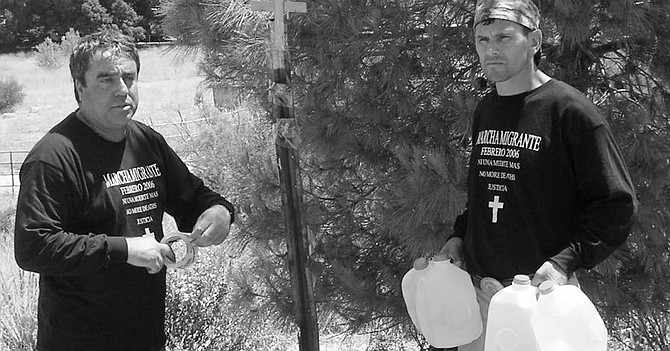
Enrique Morones, Carlos Arredondo. Enrique led opposition to keep San Diego from erecting a statue of Pete Wilson because of Wilson's support for Proposition 187. Enrique was then notified his position with the Padres was no longer necessary.
A five-year-old boy was asking his father why he wouldn't turn on the light or give him some water or give him some air. And the reason his father didn't respond was because he was dead, along with 17 other men in the back of a semi-truck.
"We know the kind of people we catch here. They're horrible people." The Border Patrol agent's tone was no more than blandly informative. It was 7:00 p.m. July 16, and we were at the edge of the hill above the beach in Border Field State Park, in an area once called Friendship Park, now called Monument Mesa. Twenty feet away ran the fence dividing Mexico from the United States. To the left was the crowded Tijuana beach, to the right the nearly empty U.S. beach. Down by the water three Border Patrol jeeps had stopped as two agents questioned a group of four Hispanics. A nearby sign warned of "sewerage contaminated water," rip tides, and no lifeguards. Along the beach to the north a man on horseback ambled his way through a Sunday afternoon. The Border Patrol agent was talking to a pretty, dark-haired woman sitting cross-legged on a stone wall. On either side of him two other agents nodded their heads in agreement or added a word or two of clarification, but they never disagreed. I stood nearby.
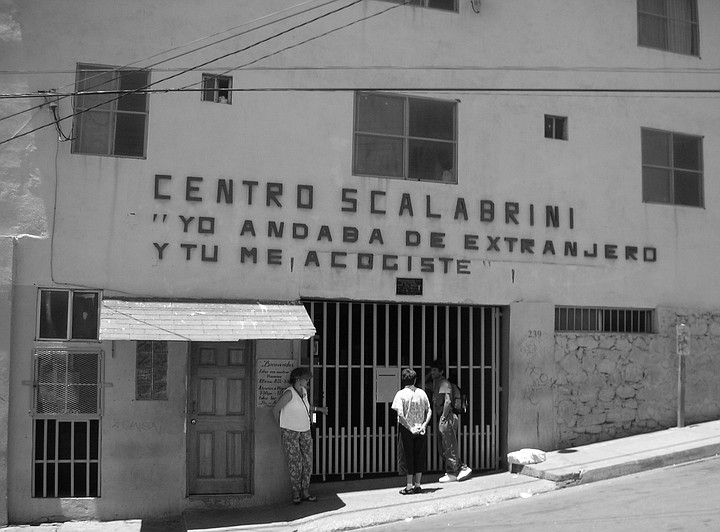
Casa del Migrante in Tijuana, run by the Scalabrini Missionaries, opened in 1987 and houses about 200 men for 15-day periods.
About a dozen people were scattered across the park, including two family groups situated along the fence having picnics with friends and family members on the other side. They had lawn chairs, coolers, and umbrellas and passed food through small holes. On the Mexican side a row of parked cars lined the street by the bullring. Further to the right was a crowded street running parallel to the beach. The fence extended into the water less than 30 feet and consisted of upright metal strips with gaps wide enough for skinny kids to squeeze through and tease the agents to chase them.
"We have no leadership at the top," the Border Patrol agent said. "From the president on down, it's a vacuum. Politicians are afraid of the Latino vote. Eighty-eight percent of the American people want something done about immigration, and they won't do it." He explained that President Bush's plan to deal with illegal immigration, as well as the Senate and House plans, were too soft and would only make more problems. "They should militarize the whole border." This was a phrase he said several times, along with "We have no leadership at the top." The officers didn't realize the young woman was Olivia Schoeller, Washington bureau chief for the Berliner Zeitung. She had spent many years in the United States, having attended Bard College in the 1980s, and her accent was slight. Nor did they know that I was a reporter.
I'd come to Border Field State Park an hour earlier and wandered around talking to people. Only one Border Patrol agent had been in evidence, sitting in his jeep by the wall and near the pavilion so he could watch the park and beach at the same time. Then I had driven away. On my way out along the dirt road, four Border Patrol vehicles had sped past me, heading toward the beach. So I had turned around to follow them.
The agent said that when only one officer was on duty at the park, he sometimes had to drive down the hill to the beach. When this happened, "illegals" jumped the fence and hid in the men's bathroom. After a while, they would come out and mingle with people in the park. Consequently, every hour or so "a bunch of us come down here to check everyone's ID."
The agent continued to give his view of the situation to Olivia as his companions nodded in agreement. "They say we have 12 million undocumented aliens in this country. We think it's more like 20 million. They are bankrupting the states, draining the social services. They get welfare and free health care. They don't work. They don't contribute to the economy. They don't support our country or have our values. They're not Americans, even when they have citizenship. You see them at rallies waving Mexican flags. Amnesty was a terrible idea. These people who come over here each eventually bring over five family members. In ten years there will be 75 million of them, more than one quarter of the country. We must stop this right now. We all think that."
He went on to praise Operation Wetback, which he said President Truman had established in 1950. Actually, it began under President Eisenhower in 1954, when the Border Patrol, aided by municipal, county, state, and federal authorities swept through agricultural areas and Hispanic neighborhoods with a goal of 1000 arrests a day. Those detained were transported far into Mexico before being freed; many were put aboard ships that took them from Port Isabel, Texas, to Veracruz. After a year, the Immigration and Naturalization Service claimed that 1.3 million illegal aliens had left the country, with half going voluntarily. Other sources put the number from less than a million to as high as 3.8 million. After opponents in the U.S. and Mexico protested "police state" tactics, Operation Wetback ended. Perhaps the INS ran out of money, or perhaps it was the outcry that arose when a few immigrants jumped ship and drowned. Stories differ. Whatever the cause, the agent said that many in the Border Patrol want to revive Operation Wetback. A Google search finds a similar call among a variety of white chauvinist and anti-immigration groups.
"What is a 'wetback'?" asked Olivia.
The Border Patrol officer's misinformation included more than the dates for Operation Wetback. The Pew Hispanic Research Center has shown that undocumented immigrants, about 56 percent coming from Mexico, make up 4.9 percent of the civilian labor force, or 7.2 million workers. Immigrants -- legal and illegal -- send $18 billion a year back to Mexico, making it the country's second largest source of income after its oil industry. Huge amounts of money are also sent to El Salvador, Guatemala, Honduras, and the Caribbean. In addition, illegal immigrants contribute about $7 billion a year in Social Security payments, and most will never see a penny in return. Billions more are withheld from their paychecks in taxes.
Nearly all 7.2 million workers use fraudulent Social Security numbers, which is a reason for the high incidence of identity theft each year: 10 million cases, according to the Federal Trade Commission. Yearly, the Social Security Administration receives eight to nine million earning reports from the IRS filed under names that don't match the Social Security numbers, according to the New York Times. The true owner of a number doesn't benefit, and the IRS has issued no penalties for mismatched numbers, though it is a felony to use a Social Security number falsely.
"It's basically a subsidy from migrant workers to the aggregate of American taxpayers," Douglas Massey, a Princeton sociology professor, told the Times.
Nor do these 7.2 million illegal workers take jobs away from U.S. citizens. A 2006 Pew Research Center study of 14 states with high immigration rates after 1990 showed "no consistent link between surging growth in immigration and declines in employment for Americans."
Many see hypocrisy in the immigration issue. Testifying before the House Subcommittee on International Terrorism and Nonproliferation in San Diego on July 5, Los Angeles Sheriff Leroy Baca said the American economy was "largely supported by guest-worker-type labor." To make it a felony to cross the border illegally "would double to triple the cost of everything we eat." The industries hiring the most illegal immigrants are agriculture, construction, and food services. The expense of paying for illegal immigration is the expense of keeping down the cost of food. In late September, the Republican senator from Idaho, Larry Craig, complained that tightening the border hurts growers in the West. "Fruit is not being picked; vegetables are not being harvested," he told the Times.
And so food prices will rise.
But the Border Patrol agent's arguments weren't vulnerable to logic, because everything arose from his single claim: "They're horrible people."
My visit to Border Field State Park came at the end of a ten-day period of looking into border issues, and everything I learned became filtered in memory through the agent's statement. Clearly, his beliefs weren't those of the entire Border Patrol, though it was distressing to see the agreement of the other two agents. What it emphasized for me was the complexity and divisiveness of the issue. A figure published in the Los Angeles Times several years ago indicated that Hispanics made up 40 percent of the Border Patrol. I expect many would dispute the officer's claim: "They're horrible people."
I wanted to learn about a group called Border Angels that, among other things, sets out water in the desert areas of the 66-mile San Diego sector. Another group, Water Station, takes care of 340 water stations in the El Centro sector, while the group Humane Border sees to more than 80 water stations in Arizona. Usually, gallon bottles of water are placed in blue plastic barrels topped with a blue flag at the end of a 30-foot pole or with a flashing red light like those used on bikes. Beginning in January 2002, the Border Angels also set up cold-weather stations in Cleveland National Forest in East County, with blankets, sleeping bags, clothing, food, and water. The water stations tend to be along power lines or paths that migrants have taken in the past. In Imperial Valley about 40 are located at the edge of the desert along Route 98 between Calexico and Interstate 8.
Placing water stations in the desert to help migrants became an issue after the Border Patrol's Operation Hold the Line in El Paso in 1993 and Operation Gatekeeper in San Diego in October 1994. In the early '90s San Diego and El Paso had 70 percent of arrests along the 1952-mile southwest border, peaking at 800,000 in 1992. In Operation Gatekeeper, 14 miles of corrugated-steel panels were welded into a nearly continuous fence between the beach and Otay Mesa, supplemented in some areas by a bollard fence -- thick concrete poles five inches apart -- and a high steel fence bent back toward Mexico at the top to keep people from climbing over. In addition to the fencing, stadium lights were erected and motion-detecting sensors set in the ground. More Border Patrol agents were hired. In the San Diego sector, between 1994 and 1998, the number of agents increased from 1000 to 2200. Then the number was allowed to fall below 1400. Now it has increased again to about 1500, with more coming. President Bush promises to add 6000 agents by 2008. Of the 11,000 existing Border Patrol agents, 89 percent work along the U.S.-Mexican border. Agents in the San Diego sector are supplemented by about 500 National Guardsmen -- 1000 are promised -- who are meant to supply support services. At this date 74.8 miles of fence exists along the southern border. House Bill 4437, passed in December 2005, calls for 700 miles of new fencing, while a Senate proposal approved in May calls for 370.
The first year of Operation Gatekeeper saw 524,231 apprehensions in the San Diego sector. Five years later the number had dropped to 182,267. Fiscal year 2005 had 126,913 apprehensions. But the decrease in the San Diego and El Paso sectors didn't mean fewer illegal crossings, only that migrants were crossing elsewhere. The nine sectors of the southwest border in 1999 had a combined 1.5 million apprehensions, an increase of 20 percent over the first year of Gatekeeper, while in 2000 there were 1.64 million.
Nor is it certain how many people are involved, since it is hard to tell how many cross successfully or how many cross again after being deported. A study by Wayne A. Cornelius, director of the Center for Comparative Immigration Studies at the University of California, San Diego, showed that 92 percent of Mexicans trying to enter the U.S. illegally eventually succeed, while Sheriff Baca testified before the House committee that 73 percent of the "deported alien criminals" from Los Angeles come back a second time and that "well over 50 percent" return a third time. A computerized fingerprinting system of all ten digits called IDENT was introduced in the mid-1990s but isn't always used.
When access to the U.S. through urban areas was made difficult by Border Patrol operations in the mid-'90s, migrants began crossing through more dangerous terrain, which in San Diego meant East County. One exposure death occurred in the county in 1994, 4 in '95, 27 in '96, and 29 in 1999. The El Centro sector had similar increases, while the Tucson sector -- the most dangerous -- had ten times the number. And these numbers have risen. Fiscal year 2005 saw 473 migrant deaths, the highest so far, with 216 within the Tucson sector. Between October 1, 2005, and the beginning of August 2006 about 350 have died, about a quarter from heat exposure and slightly more than a third from drowning and in motor vehicle incidents. These numbers have risen even though the Patrol has beefed up its efforts to help migrants in trouble. The Border Patrol's figures indicate a record of 2570 migrant rescues in fiscal year 2005, nearly double the number of 2004.
Since the start of Operation Gatekeeper, the official death count is slightly over 4000. Human-rights workers say the number is closer to 11,000, that hundreds of bodies in the desert have never been found though the Border Patrol and human-rights volunteers regularly search the desert. More than half of recorded fatalities occur in Arizona, and about half of those die of heat exposure. Others might die in the desert from heart attacks, snakebites, accidents, a variety of causes that would never have occurred if the victims hadn't been trying to cross the desert.
Recently, the number of deaths from heat exposure has decreased as more agents are stationed along the border. But traffic fatalities involving migrants have more than doubled since 2003 as coyotes, or polleros -- the guides leading migrants across the border -- try other methods. On August 7, nine migrants died in a crash in the Yuma sector when the driver of a Chevrolet Suburban -- in which 21 Mexicans were "stacked like cordwood" -- lost control after crossing a Border Patrol spike strip at high speed. This year the number killed in traffic accidents during illegal crossings is about 50.
My interest in an issue so polarized was to reduce my focus to a single drink of water, the water needed to keep a person from dying in the desert. Yet even that single drink isn't free from politics, since volunteer border-protection groups such as the Minutemen have called putting out water aiding and abetting a criminal activity. Officially, the Border Patrol permits the water stations, although for me such statements are now filtered through the unofficial claim: "They're horrible people."
The head of Border Angels is Enrique Morones, a 49-year-old radio talk-show host and former Padres executive who was born in San Diego. His parents moved here from Mexico in 1954.
When I told my friend Rex, a part-time radio journalist, that I wanted to talk to Enrique, he mildly cautioned me, "He's a walking sound bite," meaning I'd hear nothing that Enrique hadn't said to a thousand others. Duly warned, I called Enrique, who was in Mexico City talking with the Mexican foreign minister about human-rights issues, and we agreed to meet at 9:00 a.m. on Saturday morning, July 8, downtown at Pantoja Park on G Street, then we would go out and "put water in the canyons." I had no idea what this meant. Later, when I told Enrique of my friend's remark, he said, "We have to have sound bites just like the Republicans have."
On Saturday, Enrique was in a rush to meet a small group at the University of San Diego who wanted to accompany us. I left my rental car at his condo and climbed into a dark blue Ford Explorer decorated inside and out with bumper stickers attacking the war and racism and an Aztlan bumper sticker supporting Chicano nationalism. Enrique described that particular sticker as a joke and said he didn't support the return of land lost in the Mexican defeat of 1848. This is political teasing. He flaunts the bumper sticker because it upsets the Minutemen, among others. Otherwise, the SUV serves as his office and is crammed with papers, Border Angel T-shirts, flyers, disposable cameras, health bar wrappers, and a Bible.
"I think I lost my address book," he said. "I thought it was under my seat."
Enrique is a big man with graying black hair, a "former athlete with two blown knees" cresting 225 pounds who speaks of the need to get back in shape. He has a squarish, soft face, dark eyes with a yellowish tint, and a mealsack body, but in his movements he reminded me of the Boston slugger Manny Ramirez, a muscular slouch and ducked head so he looks up at you from under his eyebrows and then looks away. He ran track and cross-country at USD, where he studied international marketing, then transferred to San Diego State, from which he graduated in 1979. Afterward he played soccer and football in local leagues and ran for the San Diego Track Club. He received an M.A. degree in executive leadership from USD in 2002.
Enrique never gives a short answer. Articulate and fast-talking, he presented me with a steady wall of sound. His sentences were like extended press releases, many quoted verbatim from his website, and most devoid of personal commentary, though he is proud of the important people he has met and what he has done. Behind the rapid-fire talk, he struck me as a shy man who used his work to obscure his shyness, as if he would like to change himself from a human being, beset by frailty and difficulty, into a sort of civic statue. On the driver's visor was a photograph of his ex-girlfriend, Stephanie, who is a missionary in Latin America. They broke up over two years ago, but Enrique has been trying to get her back. "The hardest thing," he said, "is not to spread myself too thin. That's what my doctor has told me and my girlfriend too. I try to do too many things. But so many things are blossoming it's hard to stop and arrange them properly. I expect I need to focus more. It's such a big issue I can get distracted by different parts. All the time something comes up. I meant to work on the plane and ended up talking to the person next to me, telling him about what I'm doing and the Border Angels. But I don't believe in coincidences. There's nothing that doesn't happen for a reason."
Enrique began bringing water and food to migrants in San Diego's North County with a church group in the mid-1980s. This work expanded after the advent of Operation Gatekeeper to taking water into the deserts and mountains of East County. Then in 2001 he founded Border Angels as a nonprofit organization. A deeply religious man -- "I did the Catholic school route the whole way" -- Enrique takes his motto and mantra from Matthew 25:35, "When I was hungry, who gave me to eat? -- when I was thirsty, who gave me to drink?" More than 1200 volunteers have joined Border Angels in supplying the water stations and taking water into the canyons. Enrique uses these trips to educate people about the fact that thousands are dying in their attempts to cross the border. His job as a human-rights worker is not just to help the sick and suffering but to educate others as to the plight of the sick and suffering.
And what good does it do? At least ten times in my hearing, Enrique repeated his story about a boy who rescues a starfish on the beach by tossing it back in the ocean. When the boy's father says there are millions of starfish and hundreds of beaches and there's no way he can save them all, the boy replies, "Yes, but I can save this starfish." The mawkishness of the story doesn't diminish its truth for Enrique, who feels that his duty as a Christian and a human being is to bring water, to bring assistance to at least one other human being, and ideally many more, one at a time. Secondly, he sees his job as telling people about the human predicament and cost, and perhaps also about his particular role and his various successes.
As for the water, he says, "Yes, it makes a difference. I've met people who got the water, and they've told me so." He showed me appreciative letters from people who came upon Desert Angel water stations. "The Border Patrol calls Operation Gatekeeper a success. I would like you to ask the mothers of the people who have died crossing the desert and see if they call it a success."
But Enrique's larger work is as a human-rights advocate, and one of his greatest teachers was Roberto Martinez, who from 1982 until his retirement in 2002 was director of the Border Project for the American Friends Service. Enrique called Martinez his mentor, adding, "He's the man!"
For 30 years Martinez hammered the Border Patrol with allegations of improper detentions and use of excessive force as he defended the rights of migrants. He became for the Border Patrol what Enrique would like to become: a constant pain in the neck. Though Martinez started out as an industrial engineer with a degree from Grossmont College, his interest in human rights led him to accept a job in the early '70s with a community-service agency in Logan Heights. That interest had taken seed years earlier ironically because of Operation Wetback, so highly praised by Border Patrol agents. Despite being a fifth-generation U.S. citizen, Martinez was often targeted during sweeps of Hispanics in 1954. "When I was walking home from high school," he told me, "the police or Border Patrol would pick me up and try to send me to Mexico."
His sense of personal injury grew into a sense of social indignation, and by the 1970s he was organizing against police and Ku Klux Klan violence. "I couldn't remain quiet. I couldn't just stand there while the police and Border Patrol were violent. No one taught me anything. It was on-the-job training."
Operation Gatekeeper brought Enrique and Martinez together in 1995. "The wall is responsible for pushing migrants into dangerous areas," Martinez said. "Now they want a triple wall from the ocean to Otay Mesa. The walls are largely symbolic, since migrants can go around them, but they've led to many deaths. I believe two or three people die every day trying to cross the border. Instead of 4000, it could easily be 11,000 who've died in the past 11 years. For every body that's found, there are two or three that are not found."
Martinez has worked with Enrique in arranging events at the border, giving talks and offering help in writing grants. "Most of Enrique's influence comes from setting out the water stations," he said. "This has motivated him to get involved with civil rights and border rights. Throughout it all, I think he's maintained his humility. He doesn't take credit. Putting out water has had a tremendous effect, but the larger effect of Border Angels is to keep the issue out in front and expose the Minutemen and border violence. Enrique is very good at working with young people and involving students. One of his strengths is his eloquence on TV. Enrique can present the issues, and he's probably on the news two or three times a week."
Enrique's professional life developed side by side with his human-rights work. The same year that he met Roberto Martinez, 1995, Enrique was hired by Larry Lucchino to join the San Diego Padres, where he established a department of Hispanic marketing, and in 2000 he was named the Padres' vice president of International and Hispanic Marketing. In 1996 and 1997, Enrique was president of the San Diego County Hispanic Chamber of Commerce. During his tenure, membership increased from 100 to 850 businesses. In 2001 he began work to establish the Casa Mexico Pavilion in Balboa Park. The project was completed in 2003. By then Enrique had a talk show five days a week with the Pacific Spanish network and was involved in a Hispanic marketing venture with several partners.
But in 2001 Larry Lucchino left the Padres to join the Red Sox. Shortly after, Enrique's department and position were eliminated. Many said he was fired for political activism, but Enrique chooses not to use the term "fired." He told me he had greatly increased the Hispanic market, and because of this he was notified his position was no longer necessary. He added that Lucchino had invited him to come to Boston, but he chose not to go. The termination of Enrique's job led to wide protest in the Hispanic community, but he himself has never criticized the Padres. On the other hand, he hasn't gone to a Padres game since.
Enrique's human-rights work doesn't always sit well with the business community. When he was establishing Casa Mexico, the approval committee nearly blocked his proposal by presenting a dossier of his political activities. Enrique has also led the opposition to keep San Diego from erecting a statue of former mayor and governor Pete Wilson because of Wilson's support for Proposition 187, which, among other things, cut aid to undocumented immigrants, including health care and education. "When I see Pete Wilson," said Enrique, "the first thing I think of is racism."
So it was inevitable that Enrique's business career would suffer from his human rights work, which grew even busier after he left the Padres. Sought out as a speaker for human rights and political gatherings in San Diego, he also began to show up on national television. The Border Angels website lists appearances on ABC, BBC, CBS, CNN, HBO, NBC, NPR, the Today show, Univision's Don Francisco Presenta, Televisa Nacional, Rocio en Telemundo, panel discussion programs with Lou Dobbs and Bill O'Reilly, and other programs.
In 1998 Enrique was the first person to apply for and be granted dual citizenship with Mexico. This led to his founding Mexico's Border Institute, an advisory group to the Mexican president and part of Mexico's Institute of Mexico Abroad. In 2000 the Mexican government chose him to monitor the Chiapas gubernatorial election and the presidential election in Mexico City. When I asked whom he supported in the recent presidential election in Mexico, he refused to say, though he told me he'd spoken about human rights and border issues at rallies for all three candidates.
In May of 2005 Enrique founded Gente Unida, a U.S. and Mexican coalition of 65 human-rights groups active in protesting against and interfering with the operations of the Minutemen and other border-protection groups, as well as coming together to demonstrate about a wide range of border issues.
"I believe the Minutemen shot four people, killing one, in the areas they were patrolling," he said. "The investigation is ongoing. The temperament of this country under Bush has allowed those groups to exist. A Minutemen leader told me that thousands of terrorists had crossed the southern border. I told him to name one. He said, 'I can't, there have been so many.' " Enrique laughed. I asked if the Minutemen had ever interfered with the water stations.
"Oh yeah, absolutely," he said, "they damage our stuff. They sabotage our stations and threaten me personally."
Enrique's activities make a long list, and he seems busy from morning till night, which he says was something his former girlfriend complained about. Impressed by the important people he has met, he is something of a name-dropper, but his vanity seemed tinged with humility. He was flattered that the Mexican foreign minister saw him during a busy election period in July -- "He's the Mexican Condoleezza Rice," he said more than once. Yet he always brings the matter back to human rights: it's wrong that people should die attempting to cross the border.
Enrique's outrage has led him to a variety of protest. Here he describes one particular death. "Guillermo Martinez Rodríguez was a young man who tried to cross the border last December here in San Diego, because January 5 is the Day of the Epiphany, the day when the three kings bring the gifts to the baby Jesús, and we celebrate that in Mexico more than here. So he was coming over to work a few extra days so he could buy gifts for his two small kids. He jumped one of the fences of Operation Gatekeeper with his brother Augustín and was about to jump the second when he sees the Border Patrol has spotted him. So Augustín runs back and so does Guillermo, except Guillermo didn't make it, because the agent decided to take out his gun and shoot him in the back, and he killed Guillermo Martinez Rodríguez. And I think that's enough. We need to go across the country and tell people that we don't want any more deaths."
In other places, Enrique talks about the "assassination" of Guillermo Martinez Rodríguez. He organized protests in San Diego in response to the death, and he said it was "one of the sparks" that led him to organize a march on Washington in February when he and a small caravan -- joined by more people at various locations -- visited 40 cities in 27 days to protest against House Bill 4437 and to place 4000 small crosses at the Capital, representing those who died trying to cross the border since the inception of Operation Gatekeeper. In each city there were rallies, speeches, and religious services. Much was said about Guillermo Martinez Rodríguez's attempt to buy presents for his two small children.
Looking at the articles about Martinez on the Internet, one finds greater complexity. Authorities in San Diego and Tijuana have described him as a coyote. His neighbors have said the same. His mother said he was trying to reach Fresno to get a job picking fruit. The Border Patrol agent, identified by San Diego homicide investigator Lt. Kevin Rooney as Fausto Campos, claimed that Martinez was throwing rocks at him and that he shot once in self-defense. He thought he had shot Martinez in the arm. But Martinez was shot in the back -- one report said the bullet had exited through his neck, another said his chest. Augustín Martinez Rodríguez helped his brother across the fence and took him to Cruz Roja Hospital in Tijuana, where he died the next day. Of the 52 shootings by San Diego Border Patrol agents between the beginning of Gatekeeper and 2003, almost half occurred during rock attacks. In fiscal year 2005, Border Patrol figures state there were 259 "assaults on Federal Agents" in the San Diego Sector.
Of course, it is possible that Guillermo Martinez Rodríguez never threw any rocks. But authorities say he was arrested and deported on at least 12 occasions, though never charged with smuggling migrants. His brother, Augustín, was previously convicted of smuggling migrants and served a jail sentence in the U.S. Augustín denied that he and his brother were smuggling migrants on the night of the shooting.
So on one hand we have Guillermo Martinez Rodríguez with 12 previous deportations and the charge that he was a coyote, and on the other is Enrique's claim that Martinez was assassinated on his way into the U.S. to buy toys for his children. What disappears here is Guillermo himself. Saint or a sinner, it's a shame he was killed, just as it is a shame that 473 men and women died crossing the border in 2005. I don't doubt that Enrique grieves for the ones who die, but they are also useful to him in his cause and he seems to exaggerate the details surrounding a particular death, as perhaps is the case with Guillermo Martinez Rodríguez. Is that common? I'm sure it happens on all sides of the issue, but it can muddy the water.
Enrique told me about Martinez the morning we drove to USD to meet with the volunteers, and he told me about other deaths as well. His website gives a long list of the names of people who have died crossing the border. Often I felt slightly irritated by his rhetoric. But I hadn't as yet had a Border Patrol agent tell me, "They're horrible people."
When we drove up to the campus, Enrique spotted a young woman in a short-sleeved blouse and shorts looking nervously at her watch. This was Sister Elizabeth Brinkman, who teaches in the Religious Studies Department at the College of New Rochelle and had been visiting at USD for a week. During the mid-1960s I spent a year working at a college in Kalamazoo run by the Sisters of Saint Joseph, all of whom wore the traditional black habit, so I was surprised by nuns in shorts, even though they were very decorous shorts.
We met up with another car and headed out to North County. Altogether there were three nuns, in shorts two men, and a young female student. Sister Brinkman rode with us. Enrique told us about the shooting of Oscar Abraham Garcia Barrios, 22, by customs and border officers on May 18 on Interstate 5 about 50 yards north of the border, an incident that closed the border for eight and a half hours and created a huge traffic jam. Enrique said he discussed the incident with the Mexican foreign secretary and that the Tijuana police had said on their police radios that the customs agents had shot the wrong man. This, according to news reports, appeared to be mistaken. He didn't tell us that Oscar Abraham Garcia Barrios was accused of being a smuggler.
The incident began shortly after 3:00 p.m. when someone called the Border Patrol to report seeing four possible illegal immigrants getting into a black Dodge Durango near the Otay Mesa Port of Entry. The Durango was spotted on Route 905, and authorities began following it. When the driver, Garcia, realized this, he sped toward southbound Interstate 5, intending to recross the border at San Ysidro, according to another man in the car, José Adolfo Gonzales Fabéan, 26, who was later charged in federal court with smuggling immigrants. Heavy traffic forced the driver to pull over to the far right lane, where authorities were waiting. Witnesses said that Garcia had his hands in the air. A U.S. Customs and Border Protection officer knocked on the driver's window but said he got no response. Finding the door locked, he broke the window with his baton. At this point the Durango, now partly surrounded by authorities, lurched forward, and the officer and a Border Patrol agent fired three shots into the car, killing Garcia instantly. Gonzales said that he had been yelling, "Stop, stop!" But another man in the car said that Gonzales had shouted, "Go, go, go!" Authorities first said that officers were in danger of being pinned by the Durango, but that turned out not to be the case. It was also suggested that Garcia had accidentally hit the gas rather than the brake, but the man who said Gonzalez had shouted, "Go, go, go!" also testified, according to the Union-Tribune, that he saw Garcia "placing the vehicle into gear by shifting the lever in a downward motion."
Enrique's version of the story suggested trigger-happy border agents, possible misidentification and a cover-up, and no mention of smuggling. A U.S. Immigration and Customs Enforcement spokesperson said that Gonzalez had been "arrested several times as a suspected human smuggler," but on each occasion he was deported rather than prosecuted. Reading about the event, I felt it was a pity that Garcia had been killed, and I certainly wasn't convinced that his death was necessary. No weapons were found in the Durango, and two of the passengers were juveniles. But policemen, in my 40 years of journalistic experience, always tell stories about cops killed by waiting too long, by giving the suspect an extra moment. Maybe that's true, maybe not, but it's part of their lore. For Enrique the issue is always the border and the failings of the present system. The death of Garcia -- in his telling -- becomes further evidence. It's also possible Enrique was correct in his description of the event, but in retrospect, what he didn't say seemed equally significant. Enrique doesn't want an open border but "humane and comprehensive border reform," though he didn't tell me what that might be.
We stopped at a shopping center off the Ted Williams expressway, and the group bought 50 gallons of water. A clerk helped carry the plastic jugs to the cars. "You guys must really be thirsty," he said.
The canyon's rim was lined with the pricey houses and condos of Torrey Highlands, built in 2003, while in the brush below illegal immigrants had been living for decades. Enrique said there could be as many as 200 at the campsites. One of the men with us, a San Diego lawyer, asked about liability, but Enrique said he didn't know who owned the land. "I don't know the legality of some of these issues. They just turn a blind eye to migrants living in camps on an owner's land."
"They" seemed to be the authorities. The Border Patrol and the U.S. Immigration and Customs Enforcement, or ICE, are both part of the Department of Homeland Security but have different but sometimes overlapping duties. Both can apprehend illegal immigrants, but Border Patrol agents are confined to border areas and points of entry into the U.S. Immigrants tend to lump them together under the term "la migra," from the Spanish word migración, or "immigration" or "migration" in English. So uncertainty exists about who is being referred to.
We drove a narrow dirt road to the bottom of the canyon, then turned south, passing under a highway bridge. Among the brush were cacti with blue flowers. An old Toyota was parked by the trees, but I saw no people. Enrique said that often a few migrants chip in to buy an old car, leading sometimes to deportations when they were stopped by police and asked for ID.
We parked and began unloading about half the water. I spoke to Sister Barbara Quinn, director of the Center of Christian Spirituality at the University of San Diego, who had known Enrique for years. "Enrique works out of his deepest values," she said. She called him "a staunch USD grad."
Sister Quinn and Sister Brinkman had been on a Border Patrol tour of the fence the previous day and also visited Casa del Migrante in Tijuana, run by the Scalabrini Missionaries, which opened in 1987 and houses about 200 men for 15-day periods. About 40 percent have been recently deported, and most of the others plan to cross into the U.S. My friend Rex told me he had visited Casa del Migrante and said the director, Padre Luís, tried to discourage people from crossing but also gave them advice on what to do and not do if they persisted. For instance, he warned the men not to drive. Down the street from the Casa is Centro Madre Assunta, an institution for migrant women and children run by Scalabrini nuns.
Both sisters were told, "The Border Patrol has an agreement with growers not to go into their fields." Sister Quinn said the Patrol has admitted turning a blind eye to migrants working in fields and will give 24 hours' notice before going in to apprehend anyone.
I later asked Roberto Martinez about this. He agreed that Border Patrol and ICE agents are told not to go into the fields. "We have a $30 billion-a-year agribusiness that wouldn't exist without cheap labor." He added that agents were also told not to go into the racetracks where migrants might be working. "I've talked to people who were let through the border when they said they were going to work in the fields. It's nothing but a big game up and down the border. The Patrol says the same thing."
For years the federal government hardly bothered to prosecute employers of illegal migrants, but that has changed in 2006. In 2002 agents of the Department of Homeland Security arrested 25 employers in workplace raids; in the first seven months of 2006 they arrested 445. About 2700 people seized in those raids were deported. Not all are Mexican or Hispanic. On July 21, ICE agents shut down a Chinese restaurant in Fairfield, Ohio, and arrested its owner, Jing Fei Jiang, charging him with importing illegal Asian workers who were living in the basement of his home.
The nuns had also learned the U.S. military was recruiting young men in Mexico, promising money and a path to citizenship for Mexicans who join up and are sent to fight in Iraq. They questioned the morality of this.
Enrique said, "Because of their economic level, many young Mexicans would never get a visa and so they try to cross illegally. The military offers another way into the U.S."
We walked over a hill carrying gallons of water. Enrique told what he calls "Henny Youngman-type jokes," for instance, that nuns in shorts are a bad habit, which elicited groans. "I don't joke around about the work that I do," he said, "but I joke about other stuff. Sometimes I'll break out laughing in an elevator."
On the other side of the hill an outdoor chapel had been built among the trees and beside a running brook. Pews and tables could accommodate about 50 people, and a pretty, peach-colored altar with green tiles stood in front surrounded by flowers. Enrique said that Mass was held here every Sunday morning. After placing water jugs by the altar, Enrique sat on a pew to tell the others about Border Angels. He sees these as educational opportunities, and it was why the volunteers were there.
"I want to talk about the immigration debate," he said, "framing it from a different point of view, and something that is my passion, which is human rights. As this debate continues two to three people are dying every day. Before Operation Gatekeeper, two to three people would die, maybe, every month. And it's really sad because the people who are dying are Marco Antonio Villaseñor, a five-year-old boy, who was asking his father why he wouldn't turn on the light or give him some water or give him some air. And the reason his father didn't respond was because he was dead, along with 17 other men in the back of a semi-truck in Victoria, Texas, in 2003. Marco Antonio Villaseñor didn't survive that ride either. Or Victoria Sánchez, a young lady in San Diego who had already crossed, who was being chased by the Border Patrol, although they said they weren't chasing them. The car tipped over, and Victoria Sánchez, who was 17 years old, died, as did three others. We did a press conference announcing it, and a witness showed up and said the Border Patrol was absolutely chasing them. They could see the car was packed, and people fell out when it tipped over. Like Lucrecia Dominguez, who was coming here because her husband was already here, and she brought two of her three children, Nora, 7 years old, and Jesús, 15. They had come over with a group of people and a smuggler. But she slowed the group down a little bit, and they left her behind in the Arizona desert. Well, she stayed with her two children, and she died in the arms of her 15-year-old son. I cannot imagine being 15 and having my mother die in my arms. So Jesús and his sister wander around, and fortunately the Border Patrol picked them up and deported them back to Mexico. Then Lucrecia's father said, 'I want to bury my daughter in Mexico, where they were from.' He's told that he'll never find her because the bodies decompose quickly. The temperature can get up to 127 degrees. When we're out with the Border Angels, we have cell phones and water and cars waiting for us, but these people who are out there don't know if they're going to get attacked by somebody on the Mexican or U.S. side of the border or if they're going to be bit by a snake or a scorpion, etc. Well, Lucrecia died and her father, Rosario, went out into the Arizona desert, where 52 percent of the deaths are taking place. He finds a body out there, but it's not Lucrecia, and then he finds another body. He finds three bodies before he finds his daughter. And the only reason he was able to recognize her was because of a ring on her left hand, and he had the body sent back to Mexico. So if he found three bodies before he found his own daughter, how many are really out there? We think ten thousand people have died, but whether it's ten thousand, three thousand, or one, people should not be dying because they're coming here to do the work that nobody else will do or because they're trying to improve their economic situation."
We left the chapel to deliver the rest of the water, driving back along the dirt road. Within the brush and rows of small trees, I saw campsites and clotheslines draped with pants and shirts. The campsites reminded me of the homeless campsites I had seen along the San Diego River near Morena Boulevard, but while those had been surrounded by trash, the migrant campsites were relatively tidy. A few people glanced out from the trees. Enrique said they were nervous about ICE agents and even the Minutemen. Much of his work with Gente Unida tries to frustrate Minutemen attempts to patrol the border. This ranges from following them to the border and playing loud music or using a PA system to warn migrants against crossing, to playing volleyball over the fence with a group of Mexican human-rights workers on the other side.
Our two vehicles drew to a stop by the trees, and Enrique and the others began to unload the water. I spoke to Sister Brinkman about her visit to Casa del Migrante. She said that the casa had been visited by other groups, making quite a crowd, and she had been embarrassed by the contrast between the visitors' apparent wealth and the residents' obvious poverty.
"Does it matter what you do? Does it make a difference?" She said that even as a nun she could take a shower after working all day, but even that luxury was denied these people. "My own level of privilege and comfort is so much better that it makes me uncomfortable." She admitted that visiting the casa was educational and she would carry this message to others. "The hope is that it will change the way we live." But the economic difference between visitors and residents had left her feeling somewhat depressed.
Four Mexicans emerged from among the trees after Enrique told them we were human-rights workers and not la migra. Three were from Oaxaca, two brothers in their early 30s and a 65-year-old man. They were polite and soft-spoken. None had been here before. Each paid a coyote $800, which Enrique said was very little. The usual price was $1500 and more. The men had been here two weeks but hadn't found work. They said they stood on the road hoping to find construction work or hung around Home Depot. One mentioned Mexico's recent loss in the World Cup. "It's too bad they lost. We'll have to learn how to lose too."
Enrique assured them two weeks was not long to wait, and they probably would find something in a few days. He gave them laminated cards from the Mexican consulate in San Diego entitled, in Spanish, "Mexicans: Know your rights." He also passed out copies of prayers in Spanish. The 25 gallons of water had been left in the sun, and one of the brothers moved it to the shade as several visitors took pictures. Enrique took out a disposable camera and took pictures as well.
"I like to document everything," he said, adding, "The Oaxacans are the most durable and toughest in crossing the border. They survive better out there than anyone. The migrants who cross used to stay seven or eight months and then go home. But now it's harder to get across, so they stay longer and even ask their wives and kids to come across, which is dangerous. We need workers, but the guest-worker program that President Bush advocates is basically a rented-slave program."
The water, the prayers, the photographs, everybody shaking hands -- the Mexicans seemed to find it strange, but they remained friendly, politely answering questions without being particularly talkative. Enrique said that cars come to take the migrants to work and to Mass. On one occasion doctors from USD held a one-day clinic down here, and Enrique hoped to do something like that again.
Before we left the canyon, Enrique asked the volunteers if any would like to buy a T-shirt from the February migrant march on Washington. They are black, long-sleeved, and extra large -- no other styles or colors.
"Don't you have any short-sleeved?" someone asked. It was a hot day.
No, these were winter T-shirts. The man looked in his wallet, then forked out $25. Enrique told me that so far he had sold between 800 and 1000 T-shirts, maybe as many as 1500.
As we drove away, the four Mexicans sitting on the ground by the water jugs waved till we were out of sight.
"This year and last year the Border Patrol has been much more aggressive," said Enrique as he maneuvered his Ford Explorer up the hill. Of all the law enforcement agencies, the Border Patrol has the smallest education requirement. Whenever there is a push to hire a large number of agents it results in problems.
Roberto Martinez told me the same thing. "They have a very weak system of weeding out potentially bad agents. There's not enough supervision and accountability. How many agents have been arrested for smuggling drugs, guns, and people and for accepting bribes? The last four arrests have been supervisors and spokesmen of the Border Patrol."
Two weeks after I spoke to Martinez, on July 28, Border Patrol agent Oscar Antonio Ortiz was sentenced to five years in San Diego after admitting he had smuggled at least 100 illegal immigrants into the country, sometimes hiding them in the back of his Border Patrol truck. In the first eight months of 2006, 25 Customs and Border Patrol workers were arrested on corruption charges, and 8 were convicted. In early July, two Border Patrol supervisory agents pled guilty to accepting nearly $200,000 to release smugglers and illegal immigrants, and in June two agents who were brothers apparently fled to Mexico while under investigation for smuggling drugs and immigrants. The size of the Border Patrol has tripled in the past ten years. With more than 11,000 personnel, it is the country's largest law enforcement agency, and it is due to double in size over the next six years. This raises concerns that standards are being lowered. Though 90 percent of the nation's law enforcement agencies use psychological and polygraph testing in recruiting officers, the Border Patrol does not.
Several days later I went to Tijuana with Micaela Saucedo, one of the most active Border Angel volunteers. She had participated in the march on Washington in February. But Micaela, who turned 61 on October 1, has been busy with human-rights issues for over 40 years.
"I started with César Chávez in 1962," she said. "I picked oranges and lemons in Delano. We worked in the fields to talk to the workers about the Farm Workers Association. I was born in Guadalajara, but I grew up between San Diego and Tijuana. When I was a kid, the border was just a wire on the ground and we'd walk across it to go shopping. They never asked for our ID or papers. We'd do our shopping and go home. This was in the late '50s and through the '60s."
As a young woman Micaela went to nursing school, then worked at White Memorial Hospital in Los Angeles and for Paradise Valley Hospital in National City. Starting in 1982, she worked full time as a volunteer social worker in Tijuana, while still nursing full time at night. This continued until 2000, when "my brain got tired," and she was hospitalized for depression. "I said, 'I've been helping people and now I have to help myself.' I had no energy. It takes a lot of energy to fix yourself. And in the hospital I gained 80 pounds because of the medication, and that made me feel even worse."
But slowly she got better. Three years later, she saw Enrique Morones on the news. "I told myself, 'One day, when I have my energy, I will go and join Enrique's organization.' And the time came when I went to Chicano Park in Logan Heights where there were 35-40 volunteers. We went to check out the Minutemen and to plan a march in Salcedo. Enrique's a very humane man, a very honest man, and he really likes to help people. He's always on the run. When someone calls him, he goes right there, and for his girlfriend this was too much. You do this sort of work, it's better to stay single. That's what I tell Enrique. He's always busy, but he still finds time to put water out every weekend. After Gatekeeper began, there was a lot of business for coyotes and a lot of deaths. They'd cross through Jacumba and Otay Mesa. It could be a long walk, up to 13 days. And it's a desert. We put out water in Jacumba, Campo, and Ocotillo. We even camped out for a month near Jacumba to watch the Minutemen. Some others put out water in Otay Mesa. We put water under the freeway bridges in Ocotillo. I'd talk to the migrants about how much they needed and where they crossed, and so we put water in those places. Enrique also puts out a big box with snacks and jackets. When we see that things have been taken, we replace them. Yes, the water makes a difference. I've met people who have gotten water, and they say what a difference it has made. Some people have vandalized the water stations. We don't know who, but Border Patrol agents told us it was the Minutemen. The Border Patrol doesn't interfere with the water stations. One time they had arrested two people who needed water, and we gave it to them. The Minutemen are really bad people. They have no humanity. One time they tried to block an ambulance taking migrants to the hospital. How do the Minutemen have so much money? Who gives it to them? House Bill 4437 would criminalize immigrants, and humanitarians putting out water would be charged with aiding and abetting. We would still put out water. We don't care what the law says. We're responding to God's law, and as a nurse I've seen much life and death. In my heart I cannot leave someone dying. I don't care what the law says. I think the solution is not more walls and to bring in the National Guard. They need a bigger Border Patrol, but they should also give amnesty to people who are already here. But Mexico also has to raise the level of its economy."
A small, attractive woman with dark hair and eyes, Micaela was able to lose weight and get through the depression with the help of a doctor in Tijuana who put her on a strict diet. She retired from nursing but has put more time into her human-rights work with help from her two sons, both corrections officers, who pay her car insurance and help with rent. Modest and unassuming, it would be easy to overlook Micaela. But she exudes sympathy and interest without seeming nosy or pushy. She gives the impression of being someone to whom one can tell everything. I saw her begin conversations with total strangers with a gentleness that made it seem she had known them for years.
We drove to Tijuana in her older-model Saturn. A dark hole and protruding wires indicated where the radio used to be. Someone had broken into the car when she left it parked on the street in Tijuana. "My fault," she said. "I should never have left it there."
I asked Micaela what she had done as a volunteer social worker in Tijuana.
"I used to work close to the government, to the mayor's office. The migrants in Tijuana had no money to pay rent, and so we saw to it that the government got land for the homeless." She said she would study the city budget and learn what amount was available to help people. Then she would go lobby the mayor. "Some communities needed light, water, pavement. We took a list to the government and the government provided. I also used to teach the girls in prison in Tijuana how to cut hair. These were women who had been arrested for transporting drugs -- mulas. Some had to stay in jail from five to ten years before their trial. So I would help getting them to trial. I taught hair-cutting, other volunteers taught sewing."
She showed me a snapshot of herself surrounded by a half-dozen hefty women who had been her students. When she first started teaching the women to cut hair, men and women were housed together, so she worked to get the government to open a separate prison for the women.
Micaela drove across the border at San Ysidro. There was little traffic entering the country, and she hardly slowed. On the other side, four lanes were backed up for over a mile. Three hundred thousand Mexicans cross back and forth from Tijuana legally every day. In fiscal year 2004 there was an average of 660,000 daily crossings along the entire southern border. In addition, an average of 12,338 trucks cross each day, of which only a tiny proportion can be searched.
As we moved into the city, the temperature seemed to increase ten degrees. I'm always struck by how many risky shortcuts poverty entails. An outlet on the side of a building had at least 20 wires going into it. Micaela spoke of having bought a new apartment in a Tijuana apartment complex that quickly began to fall apart because the contractor used cheap concrete. Building and electrical inspections that we take for granted in the States are often a luxury here. The streets were crowded, and the traffic had a jittery quality, as if the local gasoline had been spiked with caffeine.
On the way to the beach we took a closer look at the fence: rusted corrugated metal sheets originally used by the U.S. military as temporary landing strips. Enrique told me they were used during Operation Desert Storm, New York Times reporters have dated them from Vietnam, while an L.A. Times reporter wrote they were used in World War II. Whatever the case, they have seen a lot of use. Looking through the fence into no-man's-land, I saw the sleek bollard fence about 20 yards away and then a third fence farther on. A Border Patrol jeep was parked between them, functioning as a human scarecrow. "Sitting on an X," the agents call it.
Ten minutes later we arrived at the hill above the beach and parked by the Tijuana bullring. In the backseat, Micaela had a box of 15 small brown paper bags, each containing a ham and cheese sandwich, an orange or apple, and a can of orange juice. She gets the bread cheaply at a Chula Vista bakery near home and told me that each time she crosses the border, she brings these bags to give to hungry migrants. She said this casually, as if it was perfectly natural, but the expense and time involved must be considerable.
Through the fence, Border Field State Park was deserted, since it is only open on the weekend, but the beach on the Tijuana side was crowded and streets were busy. Above the beach was a small square where people can admire the ocean view. Beneath it were restrooms and an outdoor shower. Six men sat on a bench, and Micaela said they were waiting to cross. Several had been washing clothes and hanging them on branches to dry. She went to talk to them, taking six lunch bags with her. She asked the men if they had eaten and then gave each a bag. Nearby was a truncated obelisk pressed against the fence, a monument erected in 1851 to commemorate the 1848 treaty of Guadalupe Hidalgo, by which Mexico lost half its territory.
"It used to be real nice here," said Micaela. "People brought groceries to people on the other side, but no more."
She talked to a man washing his clothes who had been deported with two others five days ago. He had crossed at the beach, going around the end of the wall. The other two had crossed again, and this man was waiting for his chance. He hadn't eaten, and Micaela gave him two bags. He was from Puebla and worked construction in San Diego, but had been seized by la migra at the construction site. Tonight or tomorrow night he would try again. The best time, he said, was during the Border Patrol's shift change. Guard dogs ran free on the U.S. side, so he would have to take food to distract them. Micaela tried to discourage him from crossing, stressing the danger, but he said he needed to send money to his family back home.
After an hour, we drove across town to Casa de Migrante. The traffic was terrible because of a bus-driver protest against corrupt officials who overcharged for permits. In front of City Hall dozens of buses were double-parked.
Micaela said she went to Tijuana nearly every day and often more than once. She tried to make sure she was at the border every night at 10:00, when people caught by the Border Patrol were released.
"Mainly I worry about the women and children deported at night who don't know where to go. If I can't drive them, I give directions on how to get to the Centro Madre Assunta or Casa del Migrante, or if I have money I'll get them a cab." She praised the Chilean Don Francisco, host of the TV variety show Sábado Gigante, who donated $125,000 to the two shelters in 2005. She was impressed that a man born of German-Jewish immigrants would give so much to a Roman Catholic charity.
While at the border at night, Micaela also identifies men and women who have been deported on other occasions, to try to determine what percentage of the people in the Border Patrol's figures have been apprehended more than once. "Many of those arrested have been caught maybe three times, and this inflates their statistics."
She described two with whom she had recently talked. "One man had been here for 20 years picking fruit. He was driving and the police stopped him. He didn't have a license. He said he would have to come back because he had family in the States, and after a week I learned he had crossed again. Another man had crossed through Arizona, walked for six days, and was then caught on his way to L.A. Some become disheartened after being caught several times, and I try to collect money to send them to their homes in Mexico. The polleros are at the border recruiting people who have just been returned to take them back. There can be as many as five polleros working together: one pollero recruits, the second keeps a house in Tijuana where they wait to cross, the third guides them across the border, the fourth has a house on the American side, and the fifth takes them to a destination." It was $4000-$5000 to take someone to Miami and around $2000 to Los Angeles. Some polleros, she said, brag about working with the Border Patrol.
"When I see the polleros at the border, I talk to the police and identify them and say, 'Hey, why aren't you doing anything?' The police question them and might take them to jail. It gets dangerous, because the polleros get angry with me. But I never feel afraid. I always ask God to help me. Some nights the polleros will stare at me when I help people who are being deported. I worry a little, but not much. Some of the deported men are gang members, probably from Los Angeles. I'm not against deporting them. Many of the criminals stay in Tijuana, but the Tijuana authorities aren't even notified when the criminals are deported."
We ascended the steep hill of Avenida Baja California and turned right on Calle Galileo, where the Casa del Migrante was located. The street was empty except for six men on a corner. Micaela identified several as drug addicts with whom she had spoken at other times. They were hoping someone would hire them, thinking they were migrants. They ran toward our car but stopped when they recognized Micaela. One followed and said he was hungry. He promised to give food to the others. She gave him six bags, but instead of sharing he ran off down the street, keeping them for himself. Micaela shrugged. "They're sick," she said. "They can't help it."
We parked by the Casa, a concrete building with a locked gate through which was visible a patio. In red letters above the gate it said Centro Scalabrini and, in Spanish, "I wandered as a foreigner and you took me in." A woman came to tell us that Padre Luís was in retreat and no one was allowed inside. Two migrants stood, waiting to enter. Micaela gave each a bag with a sandwich, the last of the food. Tomorrow she would bring more. I guessed that she probably brought several thousand bags a year. She shrugged it off as one more small thing.
One of the men was a skinny fellow with a tattoo. A tag around his neck identified him as a worker in the presidential campaign of Andrés Manuel López Obrador, the former Mexico City mayor. He said he had tried to cross the border in the state of Coahuila, across the Rio Grande to Texas, fording the river at night with a group strung out in a line all holding hands. When it got too deep, they let go and swam, but he couldn't swim and almost drowned. One of the others came back and saved him, but he still couldn't cross. Next he had taken a bus to Tijuana and had already stayed at the Casa for 15 days, which was the limit. He said that for a number of years he worked construction in Anaheim, where he had been an electrician, but then he had been deported. His family still lived in Anaheim, and he hoped to rejoin them. He said he worked with López Obrador's campaign, explaining López Obrador's program to people, for which he had been paid $30 a week. Micaela warned him not to wear the Obrador tag, that López Obrador was no longer popular now that he was contesting the election against the apparent winner, Felipe Calderón. But the man said he had lost his ID, and the tag was the only ID that remained to him. He hoped that someone in the Casa could help him get new ID.
Micaela said she didn't particularly like López Obrador. "Whenever he loses an election he contests it. He has huge demonstrations."
The second man had recently arrived from Oaxaca. He was surprised and grateful for the bag of food. He hoped to get into Casa when the doors opened at 4:00. The men ate their sandwiches and spoke of their troubles. The Oaxacan had unsuccessfully tried to cross two days before. Now he wasn't sure what to do. Micaela suggested that it might be better to return home, but he said he needed money for his family.
Micaela had to make another stop before going back to Chula Vista, and instead of waiting to enter Casa del Migrante later, I decided to go with her. Her unassuming character mixed with her quiet passion to help others made her remarkable in my experience. She was nearly invisible as she went about her work, yet for 43 years she had dedicated herself to improving the lives of others.
She drove to what appeared to be an old garage on Calle Dolores, down the hill from the Casa del Migrante, which housed El Centro de Información para Trabajadoras y Trabajadores (CITTAC) and two other groups. CITTAC helped Mexican workers, mostly in the maquiladora industry, with job-related human-rights issues, provided free legal advice in labor matters and helped workers create democratic labor organizations and collective-bargaining contracts and also ran the small monthly newspaper Boletín Maquilero.
More than 2700 maquiladoras are located in Mexican border states, representing 71 percent of the maquiladoras in Mexico. Tijuana has over 600 with over 1000 in Baja California. At one point the city was nicknamed TVjuana for all the electronics companies that assembled TVs, but many also produced medical products for hospitals, doctors' offices, and laboratories, like medical masks, tubing, and beakers. About half the maquiladoras are American owned.
Workers earn as little as $5 for a 12-hour day in an environment often unprotected by the labor, safety, health, and environmental regulations found in the U.S. This results in a high number of on-the-job injuries, while exposure to chemicals and radiation has caused serious health issues. I had assumed that even though $5 a day wasn't much for 12 hours of work, the cost of living in Tijuana was lower than in the U.S. -- but this was only partly true.
"Beans, tortillas, and potatoes are cheaper in San Diego than in Tijuana," said Micaela. "Mexicans come across the border to shop at Wal-Mart."
The office had one large room with high ceilings and concrete walls, with a smaller office in back. It was cooler than outside but stuffy, though a fan was blowing. One window was situated high on the wall, and the room was dim. Many chairs were scattered around, giving evidence of meetings held late in the day, and the walls were covered with labor posters and announcements. A battered desk supported an old computer, telephone, and stacks of pamphlets; other desks were also stacked with pamphlets. Against the wall a white sink had a bucket, rather than a pipe, beneath the drain. A pretty woman in her mid-20s, with shoulder-length black hair, who I'll call María, came out of the smaller office to talk. She and Micaela greeted each other warmly.
Micaela had brought two dolls, each over two feet tall and wearing elaborate gowns, still in their boxes. They were brand new and expensive; she'd gotten them from her sister. She suggested that CITTAC hold a raffle, selling tickets for ten pesos each as a way to raise money for the association.
Micaela also carried a grocery bag filled with partially used bottles of prescription medicine collected from people in her apartment complex and other places, medication no longer needed. This would go to a clinic to care for people without insurance. For me, the dolls and medication were further examples of how Micaela's mind was constantly focused on socially useful projects.
María seemed smart, eager, and energetic. She said she was from the state of Puebla in central Mexico, where she had worked in the fields. She had come to Tijuana four years earlier because she felt that working in a maquiladora, being in a building rather than in the fields, was glamorous and sophisticated. The experience soon disabused her of this idea. She had been at her first maquiladora for eight months, working in fabrics, for $5 a day. Often she had to work more than 12 hours -- once for 20 hours -- with no overtime pay. There was no toilet paper in the bathroom and no safety masks for the dust except when the inspectors came. Afterward, the masks and toilet paper were taken away. Thirty minutes were allowed for lunch and 45 minutes of rest for every 12 hours of work. Often in the maquiladoras, the lunchroom had only two or three microwaves for use between 200 and 1000 workers.
After eight months María learned that by law ten percent of the profits had to be shared with the workers, and she asked where the money was. The company responded by telling her to resign. María refused. So she was locked in a room and told she wouldn't be let out till she signed a letter of resignation. They also threatened to punish her family. María still refused to sign, and after a day of being locked up, she was let loose and they fired her.
After that, she was blacklisted and could only get another job by saying she had never worked. Over the next three years she had jobs in five factories -- not maquiladoras -- but in each she was considered a troublemaker and was let go. She went on to speak of the dangers of the maquiladoras, exposure to chemicals, and a story of a woman dying of cancer. Despite her rhetoric of moral indignation, the mass of anecdotal evidence was daunting. In the office she counseled and advised workers who had been injured, or fired, who had not been paid, or allowed vacation time, who had been forced to work more than 12 hours a day, or had been sexually harassed, a multitude of charges that might result in lawsuits.
She said the long hours made it difficult for workers to improve their lot by going to school or even looking for another job, meaning they were forced to live in marginal poverty, while surveillance cameras, security guards, and a variety of threats kept them quiet and apprehensive. It began to make sense that someone would sneak across the border to work all day picking lettuce, when the money earned was more than he or she would earn in a maquiladora. In the same way that illegal workers kept food prices low in the U.S., so did poor working conditions and low wages keep down the price of everything from automobiles to syringes. One often hears the regulations placed on industries and the workplace in the U.S. should be softened, since, after all, the owners are humane people and no one would suffer. But as María spoke of the maquiladoras, I felt glad for every regulation we have in place, while feeling we could use a few more.
Leaving the CITTAC office, Micaela wound her way toward the border until joining a long line of cars. We inched forward in the heat as vendors hawked everything from ice cream to life-size statues of the saints. An enterprising dentist could set up a practice by the side of the road and have the time to crown several teeth before his patient reached the crossing. It took two hours, less than usual, Micaela said.
The day before, I'd gotten a phone call from Enrique, who had been kicked out of a luncheon in Los Angeles that was part of the National Council of La Raza's (NCLR) annual conference. The guest speaker was Karl Rove, the president's deputy chief of staff. Enrique had stood up and shouted something like "I protest the presence of the architect of death and destruction on two continents. He is no friend to Hispanics."
Later, listening to Rove's speech online -- he spoke about being the grandson of Norwegian immigrants -- I heard the muttering of Enrique's protest in the background, but Rove never paused in his delivery. I expect he has been interrupted before. Originally, Enrique told me that Rove had been an "unannounced" speaker, but it was clear from the NCLR's news release two weeks earlier that Rove was scheduled, presumably to balance out former President Bill Clinton, whose speech had opened the conference Saturday morning. Enrique told me, "Somebody gave me a lunch ticket." And later: "The NCLR has been getting too moderate and has lost a lot of appeal with Latinos."
Micaela said that Enrique knew perfectly well that Rove was going to speak. She had also been invited to the convention. "We were invited to go and protest. Enrique meant to stand up and protest. He had a ticket. He knew he'd be thrown out. We've never had to bail him out, but we're always prepared for it."
As we inched through the heat, Micaela struck up conversations with vendors she recognized, and some she didn't. I thought about how she differed from Enrique. He was always a presence, stating and sometimes overstating his case. He was assuming, where Micaela was unassuming. She would rather pass out sandwiches to migrants in Tijuana and give away dolls to be raffled at CITTAC than make a ruckus at the NCLR's convention, though in over 40 years she had taken part in many protests and demonstrations. I expect it was Micaela and a few others who kept the Border Angels focused on maintaining the water stations. Enrique seemed involved in a dozen different projects, and the water stations were a way of telling people about the border, while for Micaela, it was a simple matter of giving water to the thirsty, just as she gave sandwiches to the hungry. Certainly, this was also important to Enrique, but at times it got lost in the politics of the situation.
At one point as we were waiting in line, Micaela said, "Mexicans are harassed in the United States all the time, but we're friends, we're family. We never harass Americans in Mexico."
At another point she talked about her two sons and seven grandchildren. She was to see one granddaughter the next day. "My sons say, 'Mama, how long are you going to do this? You said you were doing it for us, but now we have good jobs.' And I say, 'Now I'm doing it for my grandchildren.' "
A day or so later I rode out to Border Field State Park with Enrique to visit Smuggler's Gulch, an area popular with migrants attempting to cross the fence. With us came Ricardo Aguirre, a 49-year-old telejournalist who ran America En Español, which creates programs and supplies video footage to Ecuador and other South American countries. A citizen of Ecuador, Ricardo lives in northern New Jersey, close to New York. He was a benign figure with a slight pear shape and a mild, cheerful demeanor. He had flown to San Diego to film a piece on the border, accompanied by his girlfriend and his poodle, Lucky, who he called "my baby." The seat for Lucky had cost $160. Ricardo wore a black polo shirt and light blue slacks. Besides his equipment, he carried a supply of souvenir New York City key chains as gifts. Mine had representations of the Brooklyn Bridge, Statue of Liberty, Empire State Building, and World Trade Center.
Enrique took Monument Road to the park and then turned left into Smuggler's Gulch, telling us he had earlier called the Border Patrol to say he was bringing two journalists into the area. "Although we're not necessarily friends, we have a working relationship. They know me." He said the Border Patrol wanted the Army Corps of Engineers to fill in the gulch with 2.2 million cubic yards of dirt, cut off the tops of Spooner's and Lichty Mesas on either side, and build a 90-foot-wide all-weather road along the top. The reserve contains about 2500 acres of parkland and a few parcels of privately owned land. Laurels and tamarisks bordered the road, while to the north were horse ranches.
Enrique told Ricardo about how the Secret Service had removed him from the La Raza luncheon during Karl Rove's speech. He regretted being unable to protest Governor Schwarzenegger's appearance as well, since he felt the governor supported the Minutemen and has argued that the border should be closed.
He parked near the fence -- constructed from rusted steel landing mats -- and we climbed out. Ricardo brought his video camera. The fence didn't go all the way up the steep sides of the mesas, and even the clumsiest climber could go around it. Two Border Patrol jeeps were parked near the top of Spooner's Mesa. It was a 310-foot drop to the floor of the gulch where we were standing. The sand was covered with footprints and bits of trash. We looked through holes in the fence to the brush beyond, where Enrique said migrants were probably hiding.
Shortly, a Border Patrol supervisor arrived, a lieutenant with a Hispanic surname that he asked me not to use. He said he had been in the Patrol for 14 years and covered the area between San Ysidro and the beach. He and Enrique had known one another for some time. He was friendly, though with a slightly ironic manner.
I said that it appeared rather easy to get around the fence.
"If it were really easy," he said, "the coyotes wouldn't charge so much money to lead people across. Besides the lights, there are old Vietnam-era sensors in the ground. They have little antennae sticking up which pick up vibrations. But dogs and horseback riders also set them off. Why don't you guys try running through here and see how long it takes before someone shows up. You've got about a quarter-mile, and then you're home free."
I later learned that the border area was also watched by 48 infrared video cameras working 24 hours a day.
Enrique asked when they would start filling in the gulch, but the supervisor said the plan had been put on hold. Environmentalists with Border Field State Park have said the plan would be an ecological disaster and violate California's coastal-protection law.
Enrique told the supervisor about the march on Washington and what he had been doing. The supervisor seemed politely interested but not forthcoming. Ricardo filmed the fence and then panned to the jeeps on the mesa. When the supervisor left, Enrique spotted someone in the chaparral on the other side and called to him.
Soon a thin man in dungarees made his way to a six-inch gap in the fence. He said his name was Isabel Cienfuegos. He was 30 and from the state of Guerrero, where he lived with his wife, three kids, and his parents. He hoped to do agricultural work in California and send money home. He was quiet and good-natured. Enrique gave him $4 for water. The man said he was with a group of six people that would try to cross during the night. But I expected the stadium lights on the poles above us would make the gulch as bright at midnight as at noon. The man said he had tried to cross the week before in Tecate with a coyote but had been caught, held in detention for about six hours, and then released at the San Ysidro crossing. He'd tried to find work in Tijuana, but it was very hard unless you knew someone. Enrique gave him a printed prayer, told him about the Border Angels and the march on Washington. Ricardo filmed the whole business.
Enrique had on one of his black, long-sleeved March-on-Washington T-shirts. Wanting to give it to Isabel Cienfuegos, he walked back to his Ford Explorer to change, "so you don't see my white body." He put on a yellow T-shirt, then layered the black T-shirt over the yellow one, rejoined us by the fence, and again removed the black T-shirt and gave it to the man on the other side. Ricardo was still filming.
Ricardo gave the man $20, also for water, and had his picture taken with him, as did Enrique. Isabel Cienfuegos must have thought we were completely nuts, and I didn't believe he had much chance of sneaking across through Smuggler's Gulch, no matter what time he tried it. On the other hand, he had just received nearly $25, a week's wages at a maquiladora.
Enrique apologized he couldn't spend more time with Ricardo and me, but once a year he had to take his nephew -- now ten -- to Legoland, and today was the day. Because Enrique disliked the rides -- "They terrify me" -- he had also invited his nephew's best friend.
Ricardo Aguirre had an appointment at Border Patrol headquarters in eastern Chula Vista with a public information officer, Wendi Lee, so I drove him. As it turned out, I interviewed Ms. Lee and Ricardo filmed it. We talked in a meeting room off the lobby. Attractive, energetic, and charming, Ms. Lee was about 30 and had been in the Border Patrol for four years and with the public information section since February. Prior to that she worked undercover for a year and a half. She was Hispanic and bilingual, speaking both languages with no hint of an accent, according to Ricardo. Before joining, she worked at an orphanage, but she had family members "in police work." She rattled off figures from her information packet -- 117,000 people apprehended in the San Diego sector in 2006 as of July, but "those arrested could have been arrested more than once." She told us the landing mats used to make the fence dated from World War II.
Rescues were up this year, she said, with 99 between October 1 and mid-July, as opposed to 91 for the entire previous year. "We have three paramedics out in the field. We carry water, and if someone needs water we'll give them water. We're not against putting out water, and we don't support it."
I asked her about the possibility of unfound bodies in the desert and mountain regions.
"I think the number is insignificant," she said. "We have a good relationship with Grupo Beta. When we hear that someone is missing, we notify them and the families will be called, or they will notify us about someone who is missing."
Begun in Tijuana in 1990, Grupo Beta is a search-and-rescue group operating on Mexico's borders as a branch of the National Migration Institute. It sets up water stations, marked by blue flags, and provides help to migrants in trouble.
I asked Ms. Lee about Enrique's charge that the Minutemen had destroyed Border Angel water stations.
"It's something between them," she said. "We're not against the Minutemen, and we don't support them."
I felt Ms. Lee's background in orphanage work had helped her as an information officer. Pleasant and evenhanded, she was probably used to questions from the hostile, aggrieved, and frustrated. Ricardo filmed our discussion, and I wondered about my chances of becoming a TV personality in Ecuador. As we left, Ricardo gave Wendi Lee one of his New York City souvenir key chains. She mistook it for candy, saying, "Oh, no, I shouldn't, I'm trying to lose weight."
Sunday morning I met Enrique at 8:00 a.m. in Pantejo Park in front of the statue of Benito Juárez, who served as Mexico's president between 1861 and 1872, the only full-blooded Native American ever to hold the job. Enrique said he liked the symbolism of meeting in front of the statue. We were headed to East County to check on Border Angel water stations, but the occasion was another chance to talk about human rights. Along with Ricardo Aguirre were Olivia Schoeller, Washington bureau chief for the Berliner Zeitung; two journalists from the bilingual section of the Sacramento Bee; and two antiwar activists.
Enrique spoke to his audience in front of the Juárez statue, repeating many of his standard remarks: "Instead of two or three dying every month, we have two or three a day. They're chasing people to death. My job is to tell the stories: of Victoria Sánchez, 17 years old, killed with two others when the pickup truck in which they were riding was chased by the Border Patrol and flipped over. And Lucrecia Dominguez, left behind by smugglers in the Arizona desert.... It's a human-rights issue, not a Republican or Democratic issue. That wall is not the answer. We must build bridges of communication." Then he again told the story of the boy throwing the starfish back in the ocean.
A woman in a third-floor condo across G Street called out, "Why don't you turn around and talk from the other side, because you're annoying me!"
Enrique lowered his voice but continued. For Enrique, every occasion is political, an opportunity to repeat the anecdotal history of migrant deaths. People walked by, avoiding us as crazy or too eccentric.
"People attack the migrants, saying, 'We came here legally,' " said Enrique. "I say, 'And what would the millions of Indians you slaughtered say to that?' "
Shortly, we got in two cars and headed out toward East County. I asked Enrique how he had enjoyed Legoland. He laughed. "I never liked any of those rides, not even the slow ones. It was exhausting to follow around two ten-year-olds. My favorite ride is right here." He patted the seat of the Explorer.
During the week, I had seen Enrique at two other functions: an antiwar gathering in Hillcrest sponsored by the Progressive Democrats of America, where Enrique was master of ceremonies, and at the third annual DemocracyFest, a three-day gathering of progressive Democrats on the campus of San Diego State, where he appeared on a panel that discussed how to frame the immigration debate for the November election.
Although DemocracyFest was the larger event, both combined cheerful mockery and moral indignation aimed at the Republicans, the voicing of frustrated compassion, and a lack of understanding as to why compassion wasn't felt by all. The enemy, even more than the administration, seemed to be public complacency, which raised the question of how people can be made to take note of the dreadful things that are happening and do something about them. Conservatives from Bush to the Minutemen were able to jar people from their complacency with fear, warning about terrorism, or that millions of Mexicans were flooding across the border to take our jobs. I asked Enrique about this.
"You have to combat complacency through education," he said. "You talk to one person at a time. Every three weeks I go out and talk to schools, from kindergarten to college. It's necessary to plant the seed. I don't write speeches; I talk from my heart. I make noise about things so people don't forget them. About 85 percent of the news you hear about Latinos and Chicanos is negative, and the Minutemen take advantage of it. We can combat that through education. But it's also a racist issue. If the deaths on the border were Canadians, we wouldn't have so many. We march, we do vigils, and we place water. We'll go to the Yuma desert and place 4000 crosses. I believe things will change."
One of the people who had appeared on the panel with Enrique was Gilbert Cedillo, state senator from the 22nd district in Los Angeles, who said, "We are a nation of immigrants attacking the immigrants. We're worried about immigrants in the way we used to be worried about Communists."
When I asked Cedillo about Enrique, he said, "He's the moral authority of our community. Thousands are dying, and he's the only one who links us all together."
Enrique drove swiftly east on Interstate 8, slowing when the second car lagged too far behind. Olivia Schoeller asked questions and Enrique talked nonstop, gesturing with his hands so that the car swerved. Ricardo Aguirre smiled benignly from the backseat and gave me a wink. Enrique had many plans. He wanted Caltrans to set up water stations along the highway, which Border Angels would keep supplied. He wanted an 800 number, which people in Mexico could call about their loved ones who had disappeared crossing the border. He wanted to set up a house in San Diego staffed with doctors, lawyers, social workers, and educators, where migrants could come for help. He quoted his slogan from Matthew, referred to his starfish story, and said, "You don't see Latinos looking for handouts. When was the last time you saw a Latino standing on a corner with a sign, 'Will work for food'? You'll never see it."
To our left along a high ridge 17 or 18 windmills turned gracefully. Enrique talked about coyotes driving the wrong way on the interstate with their lights off to avoid the Border Patrol checkpoint. Soon he took the exit at the Golden Acorn, the casino owned by the Kumeyaay nation, took 94 to Tierra del Sol Road, and then bumped along Shasta Way near the Campo Indian Reservation.
I asked Enrique how he could continue to make a living with all the time he spent on his human-rights work, and he admitted that his two partners in his Latino marketing company "were losing patience with me."
"I saved quite a bit when I was vice president with the Padres," he continued, "but now I have a lot of debt. When I was in baseball, I had souvenirs, signed baseballs and stuff, and I've been selling it. Border Angels gets some donations, and we sell the T-shirts. It's all little checks; a woman buys two T-shirts and gives me 40 bucks. So yesterday I got 60. Sometimes at the water stations I'll find a dollar, all in pesos. All told it's been about $10."
He also said he would probably return to his radio talk show Morones Por La Tarde on La Tremenda 1030 AM from Tijuana. Enrique had had a two-hour program for several years but had quit or taken a leave when he organized his march on Washington. Now he meant to go back. The only point of contention was that he might occasionally need a guest host if he had to be someplace else. But the money from the show, he said, would go to Border Angels.
We parked the cars and got out, grabbing gallon jugs of water. The heat at over 3000 feet seemed worse than at sea level. The border was about two miles to the south. Trudging up a hill, I saw the green flag of the water station through the brush. The station itself consisted of two cardboard boxes under a small pine. A dog barked near a small house 100 yards away. Taped to a cable supporting a utility pole was a red signal light. Enrique said they replaced the batteries every two weeks. He had a plan to power the lights with solar batteries, which, sad to say, would cost money. He placed a wooden cross on the water barrel "so people won't think it's a trap." Then he told a story about a vandalized water station, where someone had put up signs saying "poison." Ricardo filmed the bunch of us milling around, and the other reporters asked Enrique questions. There were five water stations in this area, each with 20 gallons of water. Enrique pointed to three blue plastic rings on the ground, broken seals indicating that someone had made use of the water. He kicked the box before opening it to scare the spiders. Once he had been bitten or stung by a spider lurking in a water station and had had to stay in bed for six weeks. He warned us to watch out for scorpions and snakes, and we all studied the ground. He decided not to check on the water station near the small house, because of the dog; he doesn't like barking dogs. He described finding two Chinese out here sometime ago and giving them water. They asked him to take them to the bus station, but he refused. "It would be breaking the law," he said.
Enrique's stories were interspersed with his sound bites: "They're chasing people to death" and "We need to build bridges of communication." Apart from wanting Bush and Schwarzenegger defeated, he said this was a free country and people could do what they wanted. "The only rule is to love your neighbor." He wished he had time to take us to Holtville, east of El Centro, and show us the John Doe graves of hundreds of migrants who had died trying to cross, how 400 graves were crammed into a muddy field. On each, the Border Angels had placed a small cross with the words "No Ovidado" or "Not Forgotten." About 30 percent of those who die crossing the border are never identified. Then, the water and batteries replaced and the lecture over, we trudged back to the cars. Enrique had to hurry because he was spending the afternoon with his nephew.
Later that afternoon I visited Border Field State Park and heard the Border Patrol agent say, "We know the kind of people we catch here. They're horrible people." After ten days with Enrique, I had grown tired of the starfish story, but the agent made me rethink that. "I make noise about things so people don't forget them," Enrique had said. Not only did it seem like good work, it seemed like necessary work.
But I don't want to close with the Border Patrol agent. My first day in San Diego, I had driven out to Border Field State Park and was stopped by the locked gate and a sign indicating that Monument Mesa was only open on weekends. As I stood in the parking lot, a little white car drove up and two people got out, a man and an older woman. The man came up to me and said, "Where is the wall?" He had a thick accent.
He told me he was Korean. He had just arrived in San Diego from Seoul, and he wanted to show his mother the wall. I explained that the park was closed and pointed to the rusty landing-mat wall in the distance. He looked at it, shook his head, and laughed.
"You have a wall in your country as well," I said.
"Our wall is between enemies; your wall is between friends." He found this very funny. He laughed all the way back to his car.
Here's something you might be interested in.
Enrique Morones puts out jugs of water in Otay Mesa, in Ocotillo, in Jacumba, in Campo
Border angels

Enrique Morones puts out jugs of water in Otay Mesa, in Ocotillo, in Jacumba, in Campo
Border angels
Enrique Morones, Carlos Arredondo. Enrique led opposition to keep San Diego from erecting a statue of Pete Wilson because of Wilson's support for Proposition 187. Enrique was then notified his position with the Padres was no longer necessary.
A five-year-old boy was asking his father why he wouldn't turn on the light or give him some water or give him some air. And the reason his father didn't respond was because he was dead, along with 17 other men in the back of a semi-truck.
"We know the kind of people we catch here. They're horrible people." The Border Patrol agent's tone was no more than blandly informative. It was 7:00 p.m. July 16, and we were at the edge of the hill above the beach in Border Field State Park, in an area once called Friendship Park, now called Monument Mesa. Twenty feet away ran the fence dividing Mexico from the United States. To the left was the crowded Tijuana beach, to the right the nearly empty U.S. beach. Down by the water three Border Patrol jeeps had stopped as two agents questioned a group of four Hispanics. A nearby sign warned of "sewerage contaminated water," rip tides, and no lifeguards. Along the beach to the north a man on horseback ambled his way through a Sunday afternoon. The Border Patrol agent was talking to a pretty, dark-haired woman sitting cross-legged on a stone wall. On either side of him two other agents nodded their heads in agreement or added a word or two of clarification, but they never disagreed. I stood nearby.
Casa del Migrante in Tijuana, run by the Scalabrini Missionaries, opened in 1987 and houses about 200 men for 15-day periods.
About a dozen people were scattered across the park, including two family groups situated along the fence having picnics with friends and family members on the other side. They had lawn chairs, coolers, and umbrellas and passed food through small holes. On the Mexican side a row of parked cars lined the street by the bullring. Further to the right was a crowded street running parallel to the beach. The fence extended into the water less than 30 feet and consisted of upright metal strips with gaps wide enough for skinny kids to squeeze through and tease the agents to chase them.
"We have no leadership at the top," the Border Patrol agent said. "From the president on down, it's a vacuum. Politicians are afraid of the Latino vote. Eighty-eight percent of the American people want something done about immigration, and they won't do it." He explained that President Bush's plan to deal with illegal immigration, as well as the Senate and House plans, were too soft and would only make more problems. "They should militarize the whole border." This was a phrase he said several times, along with "We have no leadership at the top." The officers didn't realize the young woman was Olivia Schoeller, Washington bureau chief for the Berliner Zeitung. She had spent many years in the United States, having attended Bard College in the 1980s, and her accent was slight. Nor did they know that I was a reporter.
I'd come to Border Field State Park an hour earlier and wandered around talking to people. Only one Border Patrol agent had been in evidence, sitting in his jeep by the wall and near the pavilion so he could watch the park and beach at the same time. Then I had driven away. On my way out along the dirt road, four Border Patrol vehicles had sped past me, heading toward the beach. So I had turned around to follow them.
The agent said that when only one officer was on duty at the park, he sometimes had to drive down the hill to the beach. When this happened, "illegals" jumped the fence and hid in the men's bathroom. After a while, they would come out and mingle with people in the park. Consequently, every hour or so "a bunch of us come down here to check everyone's ID."
The agent continued to give his view of the situation to Olivia as his companions nodded in agreement. "They say we have 12 million undocumented aliens in this country. We think it's more like 20 million. They are bankrupting the states, draining the social services. They get welfare and free health care. They don't work. They don't contribute to the economy. They don't support our country or have our values. They're not Americans, even when they have citizenship. You see them at rallies waving Mexican flags. Amnesty was a terrible idea. These people who come over here each eventually bring over five family members. In ten years there will be 75 million of them, more than one quarter of the country. We must stop this right now. We all think that."
He went on to praise Operation Wetback, which he said President Truman had established in 1950. Actually, it began under President Eisenhower in 1954, when the Border Patrol, aided by municipal, county, state, and federal authorities swept through agricultural areas and Hispanic neighborhoods with a goal of 1000 arrests a day. Those detained were transported far into Mexico before being freed; many were put aboard ships that took them from Port Isabel, Texas, to Veracruz. After a year, the Immigration and Naturalization Service claimed that 1.3 million illegal aliens had left the country, with half going voluntarily. Other sources put the number from less than a million to as high as 3.8 million. After opponents in the U.S. and Mexico protested "police state" tactics, Operation Wetback ended. Perhaps the INS ran out of money, or perhaps it was the outcry that arose when a few immigrants jumped ship and drowned. Stories differ. Whatever the cause, the agent said that many in the Border Patrol want to revive Operation Wetback. A Google search finds a similar call among a variety of white chauvinist and anti-immigration groups.
"What is a 'wetback'?" asked Olivia.
The Border Patrol officer's misinformation included more than the dates for Operation Wetback. The Pew Hispanic Research Center has shown that undocumented immigrants, about 56 percent coming from Mexico, make up 4.9 percent of the civilian labor force, or 7.2 million workers. Immigrants -- legal and illegal -- send $18 billion a year back to Mexico, making it the country's second largest source of income after its oil industry. Huge amounts of money are also sent to El Salvador, Guatemala, Honduras, and the Caribbean. In addition, illegal immigrants contribute about $7 billion a year in Social Security payments, and most will never see a penny in return. Billions more are withheld from their paychecks in taxes.
Nearly all 7.2 million workers use fraudulent Social Security numbers, which is a reason for the high incidence of identity theft each year: 10 million cases, according to the Federal Trade Commission. Yearly, the Social Security Administration receives eight to nine million earning reports from the IRS filed under names that don't match the Social Security numbers, according to the New York Times. The true owner of a number doesn't benefit, and the IRS has issued no penalties for mismatched numbers, though it is a felony to use a Social Security number falsely.
"It's basically a subsidy from migrant workers to the aggregate of American taxpayers," Douglas Massey, a Princeton sociology professor, told the Times.
Nor do these 7.2 million illegal workers take jobs away from U.S. citizens. A 2006 Pew Research Center study of 14 states with high immigration rates after 1990 showed "no consistent link between surging growth in immigration and declines in employment for Americans."
Many see hypocrisy in the immigration issue. Testifying before the House Subcommittee on International Terrorism and Nonproliferation in San Diego on July 5, Los Angeles Sheriff Leroy Baca said the American economy was "largely supported by guest-worker-type labor." To make it a felony to cross the border illegally "would double to triple the cost of everything we eat." The industries hiring the most illegal immigrants are agriculture, construction, and food services. The expense of paying for illegal immigration is the expense of keeping down the cost of food. In late September, the Republican senator from Idaho, Larry Craig, complained that tightening the border hurts growers in the West. "Fruit is not being picked; vegetables are not being harvested," he told the Times.
And so food prices will rise.
But the Border Patrol agent's arguments weren't vulnerable to logic, because everything arose from his single claim: "They're horrible people."
My visit to Border Field State Park came at the end of a ten-day period of looking into border issues, and everything I learned became filtered in memory through the agent's statement. Clearly, his beliefs weren't those of the entire Border Patrol, though it was distressing to see the agreement of the other two agents. What it emphasized for me was the complexity and divisiveness of the issue. A figure published in the Los Angeles Times several years ago indicated that Hispanics made up 40 percent of the Border Patrol. I expect many would dispute the officer's claim: "They're horrible people."
I wanted to learn about a group called Border Angels that, among other things, sets out water in the desert areas of the 66-mile San Diego sector. Another group, Water Station, takes care of 340 water stations in the El Centro sector, while the group Humane Border sees to more than 80 water stations in Arizona. Usually, gallon bottles of water are placed in blue plastic barrels topped with a blue flag at the end of a 30-foot pole or with a flashing red light like those used on bikes. Beginning in January 2002, the Border Angels also set up cold-weather stations in Cleveland National Forest in East County, with blankets, sleeping bags, clothing, food, and water. The water stations tend to be along power lines or paths that migrants have taken in the past. In Imperial Valley about 40 are located at the edge of the desert along Route 98 between Calexico and Interstate 8.
Placing water stations in the desert to help migrants became an issue after the Border Patrol's Operation Hold the Line in El Paso in 1993 and Operation Gatekeeper in San Diego in October 1994. In the early '90s San Diego and El Paso had 70 percent of arrests along the 1952-mile southwest border, peaking at 800,000 in 1992. In Operation Gatekeeper, 14 miles of corrugated-steel panels were welded into a nearly continuous fence between the beach and Otay Mesa, supplemented in some areas by a bollard fence -- thick concrete poles five inches apart -- and a high steel fence bent back toward Mexico at the top to keep people from climbing over. In addition to the fencing, stadium lights were erected and motion-detecting sensors set in the ground. More Border Patrol agents were hired. In the San Diego sector, between 1994 and 1998, the number of agents increased from 1000 to 2200. Then the number was allowed to fall below 1400. Now it has increased again to about 1500, with more coming. President Bush promises to add 6000 agents by 2008. Of the 11,000 existing Border Patrol agents, 89 percent work along the U.S.-Mexican border. Agents in the San Diego sector are supplemented by about 500 National Guardsmen -- 1000 are promised -- who are meant to supply support services. At this date 74.8 miles of fence exists along the southern border. House Bill 4437, passed in December 2005, calls for 700 miles of new fencing, while a Senate proposal approved in May calls for 370.
The first year of Operation Gatekeeper saw 524,231 apprehensions in the San Diego sector. Five years later the number had dropped to 182,267. Fiscal year 2005 had 126,913 apprehensions. But the decrease in the San Diego and El Paso sectors didn't mean fewer illegal crossings, only that migrants were crossing elsewhere. The nine sectors of the southwest border in 1999 had a combined 1.5 million apprehensions, an increase of 20 percent over the first year of Gatekeeper, while in 2000 there were 1.64 million.
Nor is it certain how many people are involved, since it is hard to tell how many cross successfully or how many cross again after being deported. A study by Wayne A. Cornelius, director of the Center for Comparative Immigration Studies at the University of California, San Diego, showed that 92 percent of Mexicans trying to enter the U.S. illegally eventually succeed, while Sheriff Baca testified before the House committee that 73 percent of the "deported alien criminals" from Los Angeles come back a second time and that "well over 50 percent" return a third time. A computerized fingerprinting system of all ten digits called IDENT was introduced in the mid-1990s but isn't always used.
When access to the U.S. through urban areas was made difficult by Border Patrol operations in the mid-'90s, migrants began crossing through more dangerous terrain, which in San Diego meant East County. One exposure death occurred in the county in 1994, 4 in '95, 27 in '96, and 29 in 1999. The El Centro sector had similar increases, while the Tucson sector -- the most dangerous -- had ten times the number. And these numbers have risen. Fiscal year 2005 saw 473 migrant deaths, the highest so far, with 216 within the Tucson sector. Between October 1, 2005, and the beginning of August 2006 about 350 have died, about a quarter from heat exposure and slightly more than a third from drowning and in motor vehicle incidents. These numbers have risen even though the Patrol has beefed up its efforts to help migrants in trouble. The Border Patrol's figures indicate a record of 2570 migrant rescues in fiscal year 2005, nearly double the number of 2004.
Since the start of Operation Gatekeeper, the official death count is slightly over 4000. Human-rights workers say the number is closer to 11,000, that hundreds of bodies in the desert have never been found though the Border Patrol and human-rights volunteers regularly search the desert. More than half of recorded fatalities occur in Arizona, and about half of those die of heat exposure. Others might die in the desert from heart attacks, snakebites, accidents, a variety of causes that would never have occurred if the victims hadn't been trying to cross the desert.
Recently, the number of deaths from heat exposure has decreased as more agents are stationed along the border. But traffic fatalities involving migrants have more than doubled since 2003 as coyotes, or polleros -- the guides leading migrants across the border -- try other methods. On August 7, nine migrants died in a crash in the Yuma sector when the driver of a Chevrolet Suburban -- in which 21 Mexicans were "stacked like cordwood" -- lost control after crossing a Border Patrol spike strip at high speed. This year the number killed in traffic accidents during illegal crossings is about 50.
My interest in an issue so polarized was to reduce my focus to a single drink of water, the water needed to keep a person from dying in the desert. Yet even that single drink isn't free from politics, since volunteer border-protection groups such as the Minutemen have called putting out water aiding and abetting a criminal activity. Officially, the Border Patrol permits the water stations, although for me such statements are now filtered through the unofficial claim: "They're horrible people."
The head of Border Angels is Enrique Morones, a 49-year-old radio talk-show host and former Padres executive who was born in San Diego. His parents moved here from Mexico in 1954.
When I told my friend Rex, a part-time radio journalist, that I wanted to talk to Enrique, he mildly cautioned me, "He's a walking sound bite," meaning I'd hear nothing that Enrique hadn't said to a thousand others. Duly warned, I called Enrique, who was in Mexico City talking with the Mexican foreign minister about human-rights issues, and we agreed to meet at 9:00 a.m. on Saturday morning, July 8, downtown at Pantoja Park on G Street, then we would go out and "put water in the canyons." I had no idea what this meant. Later, when I told Enrique of my friend's remark, he said, "We have to have sound bites just like the Republicans have."
On Saturday, Enrique was in a rush to meet a small group at the University of San Diego who wanted to accompany us. I left my rental car at his condo and climbed into a dark blue Ford Explorer decorated inside and out with bumper stickers attacking the war and racism and an Aztlan bumper sticker supporting Chicano nationalism. Enrique described that particular sticker as a joke and said he didn't support the return of land lost in the Mexican defeat of 1848. This is political teasing. He flaunts the bumper sticker because it upsets the Minutemen, among others. Otherwise, the SUV serves as his office and is crammed with papers, Border Angel T-shirts, flyers, disposable cameras, health bar wrappers, and a Bible.
"I think I lost my address book," he said. "I thought it was under my seat."
Enrique is a big man with graying black hair, a "former athlete with two blown knees" cresting 225 pounds who speaks of the need to get back in shape. He has a squarish, soft face, dark eyes with a yellowish tint, and a mealsack body, but in his movements he reminded me of the Boston slugger Manny Ramirez, a muscular slouch and ducked head so he looks up at you from under his eyebrows and then looks away. He ran track and cross-country at USD, where he studied international marketing, then transferred to San Diego State, from which he graduated in 1979. Afterward he played soccer and football in local leagues and ran for the San Diego Track Club. He received an M.A. degree in executive leadership from USD in 2002.
Enrique never gives a short answer. Articulate and fast-talking, he presented me with a steady wall of sound. His sentences were like extended press releases, many quoted verbatim from his website, and most devoid of personal commentary, though he is proud of the important people he has met and what he has done. Behind the rapid-fire talk, he struck me as a shy man who used his work to obscure his shyness, as if he would like to change himself from a human being, beset by frailty and difficulty, into a sort of civic statue. On the driver's visor was a photograph of his ex-girlfriend, Stephanie, who is a missionary in Latin America. They broke up over two years ago, but Enrique has been trying to get her back. "The hardest thing," he said, "is not to spread myself too thin. That's what my doctor has told me and my girlfriend too. I try to do too many things. But so many things are blossoming it's hard to stop and arrange them properly. I expect I need to focus more. It's such a big issue I can get distracted by different parts. All the time something comes up. I meant to work on the plane and ended up talking to the person next to me, telling him about what I'm doing and the Border Angels. But I don't believe in coincidences. There's nothing that doesn't happen for a reason."
Enrique began bringing water and food to migrants in San Diego's North County with a church group in the mid-1980s. This work expanded after the advent of Operation Gatekeeper to taking water into the deserts and mountains of East County. Then in 2001 he founded Border Angels as a nonprofit organization. A deeply religious man -- "I did the Catholic school route the whole way" -- Enrique takes his motto and mantra from Matthew 25:35, "When I was hungry, who gave me to eat? -- when I was thirsty, who gave me to drink?" More than 1200 volunteers have joined Border Angels in supplying the water stations and taking water into the canyons. Enrique uses these trips to educate people about the fact that thousands are dying in their attempts to cross the border. His job as a human-rights worker is not just to help the sick and suffering but to educate others as to the plight of the sick and suffering.
And what good does it do? At least ten times in my hearing, Enrique repeated his story about a boy who rescues a starfish on the beach by tossing it back in the ocean. When the boy's father says there are millions of starfish and hundreds of beaches and there's no way he can save them all, the boy replies, "Yes, but I can save this starfish." The mawkishness of the story doesn't diminish its truth for Enrique, who feels that his duty as a Christian and a human being is to bring water, to bring assistance to at least one other human being, and ideally many more, one at a time. Secondly, he sees his job as telling people about the human predicament and cost, and perhaps also about his particular role and his various successes.
As for the water, he says, "Yes, it makes a difference. I've met people who got the water, and they've told me so." He showed me appreciative letters from people who came upon Desert Angel water stations. "The Border Patrol calls Operation Gatekeeper a success. I would like you to ask the mothers of the people who have died crossing the desert and see if they call it a success."
But Enrique's larger work is as a human-rights advocate, and one of his greatest teachers was Roberto Martinez, who from 1982 until his retirement in 2002 was director of the Border Project for the American Friends Service. Enrique called Martinez his mentor, adding, "He's the man!"
For 30 years Martinez hammered the Border Patrol with allegations of improper detentions and use of excessive force as he defended the rights of migrants. He became for the Border Patrol what Enrique would like to become: a constant pain in the neck. Though Martinez started out as an industrial engineer with a degree from Grossmont College, his interest in human rights led him to accept a job in the early '70s with a community-service agency in Logan Heights. That interest had taken seed years earlier ironically because of Operation Wetback, so highly praised by Border Patrol agents. Despite being a fifth-generation U.S. citizen, Martinez was often targeted during sweeps of Hispanics in 1954. "When I was walking home from high school," he told me, "the police or Border Patrol would pick me up and try to send me to Mexico."
His sense of personal injury grew into a sense of social indignation, and by the 1970s he was organizing against police and Ku Klux Klan violence. "I couldn't remain quiet. I couldn't just stand there while the police and Border Patrol were violent. No one taught me anything. It was on-the-job training."
Operation Gatekeeper brought Enrique and Martinez together in 1995. "The wall is responsible for pushing migrants into dangerous areas," Martinez said. "Now they want a triple wall from the ocean to Otay Mesa. The walls are largely symbolic, since migrants can go around them, but they've led to many deaths. I believe two or three people die every day trying to cross the border. Instead of 4000, it could easily be 11,000 who've died in the past 11 years. For every body that's found, there are two or three that are not found."
Martinez has worked with Enrique in arranging events at the border, giving talks and offering help in writing grants. "Most of Enrique's influence comes from setting out the water stations," he said. "This has motivated him to get involved with civil rights and border rights. Throughout it all, I think he's maintained his humility. He doesn't take credit. Putting out water has had a tremendous effect, but the larger effect of Border Angels is to keep the issue out in front and expose the Minutemen and border violence. Enrique is very good at working with young people and involving students. One of his strengths is his eloquence on TV. Enrique can present the issues, and he's probably on the news two or three times a week."
Enrique's professional life developed side by side with his human-rights work. The same year that he met Roberto Martinez, 1995, Enrique was hired by Larry Lucchino to join the San Diego Padres, where he established a department of Hispanic marketing, and in 2000 he was named the Padres' vice president of International and Hispanic Marketing. In 1996 and 1997, Enrique was president of the San Diego County Hispanic Chamber of Commerce. During his tenure, membership increased from 100 to 850 businesses. In 2001 he began work to establish the Casa Mexico Pavilion in Balboa Park. The project was completed in 2003. By then Enrique had a talk show five days a week with the Pacific Spanish network and was involved in a Hispanic marketing venture with several partners.
But in 2001 Larry Lucchino left the Padres to join the Red Sox. Shortly after, Enrique's department and position were eliminated. Many said he was fired for political activism, but Enrique chooses not to use the term "fired." He told me he had greatly increased the Hispanic market, and because of this he was notified his position was no longer necessary. He added that Lucchino had invited him to come to Boston, but he chose not to go. The termination of Enrique's job led to wide protest in the Hispanic community, but he himself has never criticized the Padres. On the other hand, he hasn't gone to a Padres game since.
Enrique's human-rights work doesn't always sit well with the business community. When he was establishing Casa Mexico, the approval committee nearly blocked his proposal by presenting a dossier of his political activities. Enrique has also led the opposition to keep San Diego from erecting a statue of former mayor and governor Pete Wilson because of Wilson's support for Proposition 187, which, among other things, cut aid to undocumented immigrants, including health care and education. "When I see Pete Wilson," said Enrique, "the first thing I think of is racism."
So it was inevitable that Enrique's business career would suffer from his human rights work, which grew even busier after he left the Padres. Sought out as a speaker for human rights and political gatherings in San Diego, he also began to show up on national television. The Border Angels website lists appearances on ABC, BBC, CBS, CNN, HBO, NBC, NPR, the Today show, Univision's Don Francisco Presenta, Televisa Nacional, Rocio en Telemundo, panel discussion programs with Lou Dobbs and Bill O'Reilly, and other programs.
In 1998 Enrique was the first person to apply for and be granted dual citizenship with Mexico. This led to his founding Mexico's Border Institute, an advisory group to the Mexican president and part of Mexico's Institute of Mexico Abroad. In 2000 the Mexican government chose him to monitor the Chiapas gubernatorial election and the presidential election in Mexico City. When I asked whom he supported in the recent presidential election in Mexico, he refused to say, though he told me he'd spoken about human rights and border issues at rallies for all three candidates.
In May of 2005 Enrique founded Gente Unida, a U.S. and Mexican coalition of 65 human-rights groups active in protesting against and interfering with the operations of the Minutemen and other border-protection groups, as well as coming together to demonstrate about a wide range of border issues.
"I believe the Minutemen shot four people, killing one, in the areas they were patrolling," he said. "The investigation is ongoing. The temperament of this country under Bush has allowed those groups to exist. A Minutemen leader told me that thousands of terrorists had crossed the southern border. I told him to name one. He said, 'I can't, there have been so many.' " Enrique laughed. I asked if the Minutemen had ever interfered with the water stations.
"Oh yeah, absolutely," he said, "they damage our stuff. They sabotage our stations and threaten me personally."
Enrique's activities make a long list, and he seems busy from morning till night, which he says was something his former girlfriend complained about. Impressed by the important people he has met, he is something of a name-dropper, but his vanity seemed tinged with humility. He was flattered that the Mexican foreign minister saw him during a busy election period in July -- "He's the Mexican Condoleezza Rice," he said more than once. Yet he always brings the matter back to human rights: it's wrong that people should die attempting to cross the border.
Enrique's outrage has led him to a variety of protest. Here he describes one particular death. "Guillermo Martinez Rodríguez was a young man who tried to cross the border last December here in San Diego, because January 5 is the Day of the Epiphany, the day when the three kings bring the gifts to the baby Jesús, and we celebrate that in Mexico more than here. So he was coming over to work a few extra days so he could buy gifts for his two small kids. He jumped one of the fences of Operation Gatekeeper with his brother Augustín and was about to jump the second when he sees the Border Patrol has spotted him. So Augustín runs back and so does Guillermo, except Guillermo didn't make it, because the agent decided to take out his gun and shoot him in the back, and he killed Guillermo Martinez Rodríguez. And I think that's enough. We need to go across the country and tell people that we don't want any more deaths."
In other places, Enrique talks about the "assassination" of Guillermo Martinez Rodríguez. He organized protests in San Diego in response to the death, and he said it was "one of the sparks" that led him to organize a march on Washington in February when he and a small caravan -- joined by more people at various locations -- visited 40 cities in 27 days to protest against House Bill 4437 and to place 4000 small crosses at the Capital, representing those who died trying to cross the border since the inception of Operation Gatekeeper. In each city there were rallies, speeches, and religious services. Much was said about Guillermo Martinez Rodríguez's attempt to buy presents for his two small children.
Looking at the articles about Martinez on the Internet, one finds greater complexity. Authorities in San Diego and Tijuana have described him as a coyote. His neighbors have said the same. His mother said he was trying to reach Fresno to get a job picking fruit. The Border Patrol agent, identified by San Diego homicide investigator Lt. Kevin Rooney as Fausto Campos, claimed that Martinez was throwing rocks at him and that he shot once in self-defense. He thought he had shot Martinez in the arm. But Martinez was shot in the back -- one report said the bullet had exited through his neck, another said his chest. Augustín Martinez Rodríguez helped his brother across the fence and took him to Cruz Roja Hospital in Tijuana, where he died the next day. Of the 52 shootings by San Diego Border Patrol agents between the beginning of Gatekeeper and 2003, almost half occurred during rock attacks. In fiscal year 2005, Border Patrol figures state there were 259 "assaults on Federal Agents" in the San Diego Sector.
Of course, it is possible that Guillermo Martinez Rodríguez never threw any rocks. But authorities say he was arrested and deported on at least 12 occasions, though never charged with smuggling migrants. His brother, Augustín, was previously convicted of smuggling migrants and served a jail sentence in the U.S. Augustín denied that he and his brother were smuggling migrants on the night of the shooting.
So on one hand we have Guillermo Martinez Rodríguez with 12 previous deportations and the charge that he was a coyote, and on the other is Enrique's claim that Martinez was assassinated on his way into the U.S. to buy toys for his children. What disappears here is Guillermo himself. Saint or a sinner, it's a shame he was killed, just as it is a shame that 473 men and women died crossing the border in 2005. I don't doubt that Enrique grieves for the ones who die, but they are also useful to him in his cause and he seems to exaggerate the details surrounding a particular death, as perhaps is the case with Guillermo Martinez Rodríguez. Is that common? I'm sure it happens on all sides of the issue, but it can muddy the water.
Enrique told me about Martinez the morning we drove to USD to meet with the volunteers, and he told me about other deaths as well. His website gives a long list of the names of people who have died crossing the border. Often I felt slightly irritated by his rhetoric. But I hadn't as yet had a Border Patrol agent tell me, "They're horrible people."
When we drove up to the campus, Enrique spotted a young woman in a short-sleeved blouse and shorts looking nervously at her watch. This was Sister Elizabeth Brinkman, who teaches in the Religious Studies Department at the College of New Rochelle and had been visiting at USD for a week. During the mid-1960s I spent a year working at a college in Kalamazoo run by the Sisters of Saint Joseph, all of whom wore the traditional black habit, so I was surprised by nuns in shorts, even though they were very decorous shorts.
We met up with another car and headed out to North County. Altogether there were three nuns, in shorts two men, and a young female student. Sister Brinkman rode with us. Enrique told us about the shooting of Oscar Abraham Garcia Barrios, 22, by customs and border officers on May 18 on Interstate 5 about 50 yards north of the border, an incident that closed the border for eight and a half hours and created a huge traffic jam. Enrique said he discussed the incident with the Mexican foreign secretary and that the Tijuana police had said on their police radios that the customs agents had shot the wrong man. This, according to news reports, appeared to be mistaken. He didn't tell us that Oscar Abraham Garcia Barrios was accused of being a smuggler.
The incident began shortly after 3:00 p.m. when someone called the Border Patrol to report seeing four possible illegal immigrants getting into a black Dodge Durango near the Otay Mesa Port of Entry. The Durango was spotted on Route 905, and authorities began following it. When the driver, Garcia, realized this, he sped toward southbound Interstate 5, intending to recross the border at San Ysidro, according to another man in the car, José Adolfo Gonzales Fabéan, 26, who was later charged in federal court with smuggling immigrants. Heavy traffic forced the driver to pull over to the far right lane, where authorities were waiting. Witnesses said that Garcia had his hands in the air. A U.S. Customs and Border Protection officer knocked on the driver's window but said he got no response. Finding the door locked, he broke the window with his baton. At this point the Durango, now partly surrounded by authorities, lurched forward, and the officer and a Border Patrol agent fired three shots into the car, killing Garcia instantly. Gonzales said that he had been yelling, "Stop, stop!" But another man in the car said that Gonzales had shouted, "Go, go, go!" Authorities first said that officers were in danger of being pinned by the Durango, but that turned out not to be the case. It was also suggested that Garcia had accidentally hit the gas rather than the brake, but the man who said Gonzalez had shouted, "Go, go, go!" also testified, according to the Union-Tribune, that he saw Garcia "placing the vehicle into gear by shifting the lever in a downward motion."
Enrique's version of the story suggested trigger-happy border agents, possible misidentification and a cover-up, and no mention of smuggling. A U.S. Immigration and Customs Enforcement spokesperson said that Gonzalez had been "arrested several times as a suspected human smuggler," but on each occasion he was deported rather than prosecuted. Reading about the event, I felt it was a pity that Garcia had been killed, and I certainly wasn't convinced that his death was necessary. No weapons were found in the Durango, and two of the passengers were juveniles. But policemen, in my 40 years of journalistic experience, always tell stories about cops killed by waiting too long, by giving the suspect an extra moment. Maybe that's true, maybe not, but it's part of their lore. For Enrique the issue is always the border and the failings of the present system. The death of Garcia -- in his telling -- becomes further evidence. It's also possible Enrique was correct in his description of the event, but in retrospect, what he didn't say seemed equally significant. Enrique doesn't want an open border but "humane and comprehensive border reform," though he didn't tell me what that might be.
We stopped at a shopping center off the Ted Williams expressway, and the group bought 50 gallons of water. A clerk helped carry the plastic jugs to the cars. "You guys must really be thirsty," he said.
The canyon's rim was lined with the pricey houses and condos of Torrey Highlands, built in 2003, while in the brush below illegal immigrants had been living for decades. Enrique said there could be as many as 200 at the campsites. One of the men with us, a San Diego lawyer, asked about liability, but Enrique said he didn't know who owned the land. "I don't know the legality of some of these issues. They just turn a blind eye to migrants living in camps on an owner's land."
"They" seemed to be the authorities. The Border Patrol and the U.S. Immigration and Customs Enforcement, or ICE, are both part of the Department of Homeland Security but have different but sometimes overlapping duties. Both can apprehend illegal immigrants, but Border Patrol agents are confined to border areas and points of entry into the U.S. Immigrants tend to lump them together under the term "la migra," from the Spanish word migración, or "immigration" or "migration" in English. So uncertainty exists about who is being referred to.
We drove a narrow dirt road to the bottom of the canyon, then turned south, passing under a highway bridge. Among the brush were cacti with blue flowers. An old Toyota was parked by the trees, but I saw no people. Enrique said that often a few migrants chip in to buy an old car, leading sometimes to deportations when they were stopped by police and asked for ID.
We parked and began unloading about half the water. I spoke to Sister Barbara Quinn, director of the Center of Christian Spirituality at the University of San Diego, who had known Enrique for years. "Enrique works out of his deepest values," she said. She called him "a staunch USD grad."
Sister Quinn and Sister Brinkman had been on a Border Patrol tour of the fence the previous day and also visited Casa del Migrante in Tijuana, run by the Scalabrini Missionaries, which opened in 1987 and houses about 200 men for 15-day periods. About 40 percent have been recently deported, and most of the others plan to cross into the U.S. My friend Rex told me he had visited Casa del Migrante and said the director, Padre Luís, tried to discourage people from crossing but also gave them advice on what to do and not do if they persisted. For instance, he warned the men not to drive. Down the street from the Casa is Centro Madre Assunta, an institution for migrant women and children run by Scalabrini nuns.
Both sisters were told, "The Border Patrol has an agreement with growers not to go into their fields." Sister Quinn said the Patrol has admitted turning a blind eye to migrants working in fields and will give 24 hours' notice before going in to apprehend anyone.
I later asked Roberto Martinez about this. He agreed that Border Patrol and ICE agents are told not to go into the fields. "We have a $30 billion-a-year agribusiness that wouldn't exist without cheap labor." He added that agents were also told not to go into the racetracks where migrants might be working. "I've talked to people who were let through the border when they said they were going to work in the fields. It's nothing but a big game up and down the border. The Patrol says the same thing."
For years the federal government hardly bothered to prosecute employers of illegal migrants, but that has changed in 2006. In 2002 agents of the Department of Homeland Security arrested 25 employers in workplace raids; in the first seven months of 2006 they arrested 445. About 2700 people seized in those raids were deported. Not all are Mexican or Hispanic. On July 21, ICE agents shut down a Chinese restaurant in Fairfield, Ohio, and arrested its owner, Jing Fei Jiang, charging him with importing illegal Asian workers who were living in the basement of his home.
The nuns had also learned the U.S. military was recruiting young men in Mexico, promising money and a path to citizenship for Mexicans who join up and are sent to fight in Iraq. They questioned the morality of this.
Enrique said, "Because of their economic level, many young Mexicans would never get a visa and so they try to cross illegally. The military offers another way into the U.S."
We walked over a hill carrying gallons of water. Enrique told what he calls "Henny Youngman-type jokes," for instance, that nuns in shorts are a bad habit, which elicited groans. "I don't joke around about the work that I do," he said, "but I joke about other stuff. Sometimes I'll break out laughing in an elevator."
On the other side of the hill an outdoor chapel had been built among the trees and beside a running brook. Pews and tables could accommodate about 50 people, and a pretty, peach-colored altar with green tiles stood in front surrounded by flowers. Enrique said that Mass was held here every Sunday morning. After placing water jugs by the altar, Enrique sat on a pew to tell the others about Border Angels. He sees these as educational opportunities, and it was why the volunteers were there.
"I want to talk about the immigration debate," he said, "framing it from a different point of view, and something that is my passion, which is human rights. As this debate continues two to three people are dying every day. Before Operation Gatekeeper, two to three people would die, maybe, every month. And it's really sad because the people who are dying are Marco Antonio Villaseñor, a five-year-old boy, who was asking his father why he wouldn't turn on the light or give him some water or give him some air. And the reason his father didn't respond was because he was dead, along with 17 other men in the back of a semi-truck in Victoria, Texas, in 2003. Marco Antonio Villaseñor didn't survive that ride either. Or Victoria Sánchez, a young lady in San Diego who had already crossed, who was being chased by the Border Patrol, although they said they weren't chasing them. The car tipped over, and Victoria Sánchez, who was 17 years old, died, as did three others. We did a press conference announcing it, and a witness showed up and said the Border Patrol was absolutely chasing them. They could see the car was packed, and people fell out when it tipped over. Like Lucrecia Dominguez, who was coming here because her husband was already here, and she brought two of her three children, Nora, 7 years old, and Jesús, 15. They had come over with a group of people and a smuggler. But she slowed the group down a little bit, and they left her behind in the Arizona desert. Well, she stayed with her two children, and she died in the arms of her 15-year-old son. I cannot imagine being 15 and having my mother die in my arms. So Jesús and his sister wander around, and fortunately the Border Patrol picked them up and deported them back to Mexico. Then Lucrecia's father said, 'I want to bury my daughter in Mexico, where they were from.' He's told that he'll never find her because the bodies decompose quickly. The temperature can get up to 127 degrees. When we're out with the Border Angels, we have cell phones and water and cars waiting for us, but these people who are out there don't know if they're going to get attacked by somebody on the Mexican or U.S. side of the border or if they're going to be bit by a snake or a scorpion, etc. Well, Lucrecia died and her father, Rosario, went out into the Arizona desert, where 52 percent of the deaths are taking place. He finds a body out there, but it's not Lucrecia, and then he finds another body. He finds three bodies before he finds his daughter. And the only reason he was able to recognize her was because of a ring on her left hand, and he had the body sent back to Mexico. So if he found three bodies before he found his own daughter, how many are really out there? We think ten thousand people have died, but whether it's ten thousand, three thousand, or one, people should not be dying because they're coming here to do the work that nobody else will do or because they're trying to improve their economic situation."
We left the chapel to deliver the rest of the water, driving back along the dirt road. Within the brush and rows of small trees, I saw campsites and clotheslines draped with pants and shirts. The campsites reminded me of the homeless campsites I had seen along the San Diego River near Morena Boulevard, but while those had been surrounded by trash, the migrant campsites were relatively tidy. A few people glanced out from the trees. Enrique said they were nervous about ICE agents and even the Minutemen. Much of his work with Gente Unida tries to frustrate Minutemen attempts to patrol the border. This ranges from following them to the border and playing loud music or using a PA system to warn migrants against crossing, to playing volleyball over the fence with a group of Mexican human-rights workers on the other side.
Our two vehicles drew to a stop by the trees, and Enrique and the others began to unload the water. I spoke to Sister Brinkman about her visit to Casa del Migrante. She said that the casa had been visited by other groups, making quite a crowd, and she had been embarrassed by the contrast between the visitors' apparent wealth and the residents' obvious poverty.
"Does it matter what you do? Does it make a difference?" She said that even as a nun she could take a shower after working all day, but even that luxury was denied these people. "My own level of privilege and comfort is so much better that it makes me uncomfortable." She admitted that visiting the casa was educational and she would carry this message to others. "The hope is that it will change the way we live." But the economic difference between visitors and residents had left her feeling somewhat depressed.
Four Mexicans emerged from among the trees after Enrique told them we were human-rights workers and not la migra. Three were from Oaxaca, two brothers in their early 30s and a 65-year-old man. They were polite and soft-spoken. None had been here before. Each paid a coyote $800, which Enrique said was very little. The usual price was $1500 and more. The men had been here two weeks but hadn't found work. They said they stood on the road hoping to find construction work or hung around Home Depot. One mentioned Mexico's recent loss in the World Cup. "It's too bad they lost. We'll have to learn how to lose too."
Enrique assured them two weeks was not long to wait, and they probably would find something in a few days. He gave them laminated cards from the Mexican consulate in San Diego entitled, in Spanish, "Mexicans: Know your rights." He also passed out copies of prayers in Spanish. The 25 gallons of water had been left in the sun, and one of the brothers moved it to the shade as several visitors took pictures. Enrique took out a disposable camera and took pictures as well.
"I like to document everything," he said, adding, "The Oaxacans are the most durable and toughest in crossing the border. They survive better out there than anyone. The migrants who cross used to stay seven or eight months and then go home. But now it's harder to get across, so they stay longer and even ask their wives and kids to come across, which is dangerous. We need workers, but the guest-worker program that President Bush advocates is basically a rented-slave program."
The water, the prayers, the photographs, everybody shaking hands -- the Mexicans seemed to find it strange, but they remained friendly, politely answering questions without being particularly talkative. Enrique said that cars come to take the migrants to work and to Mass. On one occasion doctors from USD held a one-day clinic down here, and Enrique hoped to do something like that again.
Before we left the canyon, Enrique asked the volunteers if any would like to buy a T-shirt from the February migrant march on Washington. They are black, long-sleeved, and extra large -- no other styles or colors.
"Don't you have any short-sleeved?" someone asked. It was a hot day.
No, these were winter T-shirts. The man looked in his wallet, then forked out $25. Enrique told me that so far he had sold between 800 and 1000 T-shirts, maybe as many as 1500.
As we drove away, the four Mexicans sitting on the ground by the water jugs waved till we were out of sight.
"This year and last year the Border Patrol has been much more aggressive," said Enrique as he maneuvered his Ford Explorer up the hill. Of all the law enforcement agencies, the Border Patrol has the smallest education requirement. Whenever there is a push to hire a large number of agents it results in problems.
Roberto Martinez told me the same thing. "They have a very weak system of weeding out potentially bad agents. There's not enough supervision and accountability. How many agents have been arrested for smuggling drugs, guns, and people and for accepting bribes? The last four arrests have been supervisors and spokesmen of the Border Patrol."
Two weeks after I spoke to Martinez, on July 28, Border Patrol agent Oscar Antonio Ortiz was sentenced to five years in San Diego after admitting he had smuggled at least 100 illegal immigrants into the country, sometimes hiding them in the back of his Border Patrol truck. In the first eight months of 2006, 25 Customs and Border Patrol workers were arrested on corruption charges, and 8 were convicted. In early July, two Border Patrol supervisory agents pled guilty to accepting nearly $200,000 to release smugglers and illegal immigrants, and in June two agents who were brothers apparently fled to Mexico while under investigation for smuggling drugs and immigrants. The size of the Border Patrol has tripled in the past ten years. With more than 11,000 personnel, it is the country's largest law enforcement agency, and it is due to double in size over the next six years. This raises concerns that standards are being lowered. Though 90 percent of the nation's law enforcement agencies use psychological and polygraph testing in recruiting officers, the Border Patrol does not.
Several days later I went to Tijuana with Micaela Saucedo, one of the most active Border Angel volunteers. She had participated in the march on Washington in February. But Micaela, who turned 61 on October 1, has been busy with human-rights issues for over 40 years.
"I started with César Chávez in 1962," she said. "I picked oranges and lemons in Delano. We worked in the fields to talk to the workers about the Farm Workers Association. I was born in Guadalajara, but I grew up between San Diego and Tijuana. When I was a kid, the border was just a wire on the ground and we'd walk across it to go shopping. They never asked for our ID or papers. We'd do our shopping and go home. This was in the late '50s and through the '60s."
As a young woman Micaela went to nursing school, then worked at White Memorial Hospital in Los Angeles and for Paradise Valley Hospital in National City. Starting in 1982, she worked full time as a volunteer social worker in Tijuana, while still nursing full time at night. This continued until 2000, when "my brain got tired," and she was hospitalized for depression. "I said, 'I've been helping people and now I have to help myself.' I had no energy. It takes a lot of energy to fix yourself. And in the hospital I gained 80 pounds because of the medication, and that made me feel even worse."
But slowly she got better. Three years later, she saw Enrique Morones on the news. "I told myself, 'One day, when I have my energy, I will go and join Enrique's organization.' And the time came when I went to Chicano Park in Logan Heights where there were 35-40 volunteers. We went to check out the Minutemen and to plan a march in Salcedo. Enrique's a very humane man, a very honest man, and he really likes to help people. He's always on the run. When someone calls him, he goes right there, and for his girlfriend this was too much. You do this sort of work, it's better to stay single. That's what I tell Enrique. He's always busy, but he still finds time to put water out every weekend. After Gatekeeper began, there was a lot of business for coyotes and a lot of deaths. They'd cross through Jacumba and Otay Mesa. It could be a long walk, up to 13 days. And it's a desert. We put out water in Jacumba, Campo, and Ocotillo. We even camped out for a month near Jacumba to watch the Minutemen. Some others put out water in Otay Mesa. We put water under the freeway bridges in Ocotillo. I'd talk to the migrants about how much they needed and where they crossed, and so we put water in those places. Enrique also puts out a big box with snacks and jackets. When we see that things have been taken, we replace them. Yes, the water makes a difference. I've met people who have gotten water, and they say what a difference it has made. Some people have vandalized the water stations. We don't know who, but Border Patrol agents told us it was the Minutemen. The Border Patrol doesn't interfere with the water stations. One time they had arrested two people who needed water, and we gave it to them. The Minutemen are really bad people. They have no humanity. One time they tried to block an ambulance taking migrants to the hospital. How do the Minutemen have so much money? Who gives it to them? House Bill 4437 would criminalize immigrants, and humanitarians putting out water would be charged with aiding and abetting. We would still put out water. We don't care what the law says. We're responding to God's law, and as a nurse I've seen much life and death. In my heart I cannot leave someone dying. I don't care what the law says. I think the solution is not more walls and to bring in the National Guard. They need a bigger Border Patrol, but they should also give amnesty to people who are already here. But Mexico also has to raise the level of its economy."
A small, attractive woman with dark hair and eyes, Micaela was able to lose weight and get through the depression with the help of a doctor in Tijuana who put her on a strict diet. She retired from nursing but has put more time into her human-rights work with help from her two sons, both corrections officers, who pay her car insurance and help with rent. Modest and unassuming, it would be easy to overlook Micaela. But she exudes sympathy and interest without seeming nosy or pushy. She gives the impression of being someone to whom one can tell everything. I saw her begin conversations with total strangers with a gentleness that made it seem she had known them for years.
We drove to Tijuana in her older-model Saturn. A dark hole and protruding wires indicated where the radio used to be. Someone had broken into the car when she left it parked on the street in Tijuana. "My fault," she said. "I should never have left it there."
I asked Micaela what she had done as a volunteer social worker in Tijuana.
"I used to work close to the government, to the mayor's office. The migrants in Tijuana had no money to pay rent, and so we saw to it that the government got land for the homeless." She said she would study the city budget and learn what amount was available to help people. Then she would go lobby the mayor. "Some communities needed light, water, pavement. We took a list to the government and the government provided. I also used to teach the girls in prison in Tijuana how to cut hair. These were women who had been arrested for transporting drugs -- mulas. Some had to stay in jail from five to ten years before their trial. So I would help getting them to trial. I taught hair-cutting, other volunteers taught sewing."
She showed me a snapshot of herself surrounded by a half-dozen hefty women who had been her students. When she first started teaching the women to cut hair, men and women were housed together, so she worked to get the government to open a separate prison for the women.
Micaela drove across the border at San Ysidro. There was little traffic entering the country, and she hardly slowed. On the other side, four lanes were backed up for over a mile. Three hundred thousand Mexicans cross back and forth from Tijuana legally every day. In fiscal year 2004 there was an average of 660,000 daily crossings along the entire southern border. In addition, an average of 12,338 trucks cross each day, of which only a tiny proportion can be searched.
As we moved into the city, the temperature seemed to increase ten degrees. I'm always struck by how many risky shortcuts poverty entails. An outlet on the side of a building had at least 20 wires going into it. Micaela spoke of having bought a new apartment in a Tijuana apartment complex that quickly began to fall apart because the contractor used cheap concrete. Building and electrical inspections that we take for granted in the States are often a luxury here. The streets were crowded, and the traffic had a jittery quality, as if the local gasoline had been spiked with caffeine.
On the way to the beach we took a closer look at the fence: rusted corrugated metal sheets originally used by the U.S. military as temporary landing strips. Enrique told me they were used during Operation Desert Storm, New York Times reporters have dated them from Vietnam, while an L.A. Times reporter wrote they were used in World War II. Whatever the case, they have seen a lot of use. Looking through the fence into no-man's-land, I saw the sleek bollard fence about 20 yards away and then a third fence farther on. A Border Patrol jeep was parked between them, functioning as a human scarecrow. "Sitting on an X," the agents call it.
Ten minutes later we arrived at the hill above the beach and parked by the Tijuana bullring. In the backseat, Micaela had a box of 15 small brown paper bags, each containing a ham and cheese sandwich, an orange or apple, and a can of orange juice. She gets the bread cheaply at a Chula Vista bakery near home and told me that each time she crosses the border, she brings these bags to give to hungry migrants. She said this casually, as if it was perfectly natural, but the expense and time involved must be considerable.
Through the fence, Border Field State Park was deserted, since it is only open on the weekend, but the beach on the Tijuana side was crowded and streets were busy. Above the beach was a small square where people can admire the ocean view. Beneath it were restrooms and an outdoor shower. Six men sat on a bench, and Micaela said they were waiting to cross. Several had been washing clothes and hanging them on branches to dry. She went to talk to them, taking six lunch bags with her. She asked the men if they had eaten and then gave each a bag. Nearby was a truncated obelisk pressed against the fence, a monument erected in 1851 to commemorate the 1848 treaty of Guadalupe Hidalgo, by which Mexico lost half its territory.
"It used to be real nice here," said Micaela. "People brought groceries to people on the other side, but no more."
She talked to a man washing his clothes who had been deported with two others five days ago. He had crossed at the beach, going around the end of the wall. The other two had crossed again, and this man was waiting for his chance. He hadn't eaten, and Micaela gave him two bags. He was from Puebla and worked construction in San Diego, but had been seized by la migra at the construction site. Tonight or tomorrow night he would try again. The best time, he said, was during the Border Patrol's shift change. Guard dogs ran free on the U.S. side, so he would have to take food to distract them. Micaela tried to discourage him from crossing, stressing the danger, but he said he needed to send money to his family back home.
After an hour, we drove across town to Casa de Migrante. The traffic was terrible because of a bus-driver protest against corrupt officials who overcharged for permits. In front of City Hall dozens of buses were double-parked.
Micaela said she went to Tijuana nearly every day and often more than once. She tried to make sure she was at the border every night at 10:00, when people caught by the Border Patrol were released.
"Mainly I worry about the women and children deported at night who don't know where to go. If I can't drive them, I give directions on how to get to the Centro Madre Assunta or Casa del Migrante, or if I have money I'll get them a cab." She praised the Chilean Don Francisco, host of the TV variety show Sábado Gigante, who donated $125,000 to the two shelters in 2005. She was impressed that a man born of German-Jewish immigrants would give so much to a Roman Catholic charity.
While at the border at night, Micaela also identifies men and women who have been deported on other occasions, to try to determine what percentage of the people in the Border Patrol's figures have been apprehended more than once. "Many of those arrested have been caught maybe three times, and this inflates their statistics."
She described two with whom she had recently talked. "One man had been here for 20 years picking fruit. He was driving and the police stopped him. He didn't have a license. He said he would have to come back because he had family in the States, and after a week I learned he had crossed again. Another man had crossed through Arizona, walked for six days, and was then caught on his way to L.A. Some become disheartened after being caught several times, and I try to collect money to send them to their homes in Mexico. The polleros are at the border recruiting people who have just been returned to take them back. There can be as many as five polleros working together: one pollero recruits, the second keeps a house in Tijuana where they wait to cross, the third guides them across the border, the fourth has a house on the American side, and the fifth takes them to a destination." It was $4000-$5000 to take someone to Miami and around $2000 to Los Angeles. Some polleros, she said, brag about working with the Border Patrol.
"When I see the polleros at the border, I talk to the police and identify them and say, 'Hey, why aren't you doing anything?' The police question them and might take them to jail. It gets dangerous, because the polleros get angry with me. But I never feel afraid. I always ask God to help me. Some nights the polleros will stare at me when I help people who are being deported. I worry a little, but not much. Some of the deported men are gang members, probably from Los Angeles. I'm not against deporting them. Many of the criminals stay in Tijuana, but the Tijuana authorities aren't even notified when the criminals are deported."
We ascended the steep hill of Avenida Baja California and turned right on Calle Galileo, where the Casa del Migrante was located. The street was empty except for six men on a corner. Micaela identified several as drug addicts with whom she had spoken at other times. They were hoping someone would hire them, thinking they were migrants. They ran toward our car but stopped when they recognized Micaela. One followed and said he was hungry. He promised to give food to the others. She gave him six bags, but instead of sharing he ran off down the street, keeping them for himself. Micaela shrugged. "They're sick," she said. "They can't help it."
We parked by the Casa, a concrete building with a locked gate through which was visible a patio. In red letters above the gate it said Centro Scalabrini and, in Spanish, "I wandered as a foreigner and you took me in." A woman came to tell us that Padre Luís was in retreat and no one was allowed inside. Two migrants stood, waiting to enter. Micaela gave each a bag with a sandwich, the last of the food. Tomorrow she would bring more. I guessed that she probably brought several thousand bags a year. She shrugged it off as one more small thing.
One of the men was a skinny fellow with a tattoo. A tag around his neck identified him as a worker in the presidential campaign of Andrés Manuel López Obrador, the former Mexico City mayor. He said he had tried to cross the border in the state of Coahuila, across the Rio Grande to Texas, fording the river at night with a group strung out in a line all holding hands. When it got too deep, they let go and swam, but he couldn't swim and almost drowned. One of the others came back and saved him, but he still couldn't cross. Next he had taken a bus to Tijuana and had already stayed at the Casa for 15 days, which was the limit. He said that for a number of years he worked construction in Anaheim, where he had been an electrician, but then he had been deported. His family still lived in Anaheim, and he hoped to rejoin them. He said he worked with López Obrador's campaign, explaining López Obrador's program to people, for which he had been paid $30 a week. Micaela warned him not to wear the Obrador tag, that López Obrador was no longer popular now that he was contesting the election against the apparent winner, Felipe Calderón. But the man said he had lost his ID, and the tag was the only ID that remained to him. He hoped that someone in the Casa could help him get new ID.
Micaela said she didn't particularly like López Obrador. "Whenever he loses an election he contests it. He has huge demonstrations."
The second man had recently arrived from Oaxaca. He was surprised and grateful for the bag of food. He hoped to get into Casa when the doors opened at 4:00. The men ate their sandwiches and spoke of their troubles. The Oaxacan had unsuccessfully tried to cross two days before. Now he wasn't sure what to do. Micaela suggested that it might be better to return home, but he said he needed money for his family.
Micaela had to make another stop before going back to Chula Vista, and instead of waiting to enter Casa del Migrante later, I decided to go with her. Her unassuming character mixed with her quiet passion to help others made her remarkable in my experience. She was nearly invisible as she went about her work, yet for 43 years she had dedicated herself to improving the lives of others.
She drove to what appeared to be an old garage on Calle Dolores, down the hill from the Casa del Migrante, which housed El Centro de Información para Trabajadoras y Trabajadores (CITTAC) and two other groups. CITTAC helped Mexican workers, mostly in the maquiladora industry, with job-related human-rights issues, provided free legal advice in labor matters and helped workers create democratic labor organizations and collective-bargaining contracts and also ran the small monthly newspaper Boletín Maquilero.
More than 2700 maquiladoras are located in Mexican border states, representing 71 percent of the maquiladoras in Mexico. Tijuana has over 600 with over 1000 in Baja California. At one point the city was nicknamed TVjuana for all the electronics companies that assembled TVs, but many also produced medical products for hospitals, doctors' offices, and laboratories, like medical masks, tubing, and beakers. About half the maquiladoras are American owned.
Workers earn as little as $5 for a 12-hour day in an environment often unprotected by the labor, safety, health, and environmental regulations found in the U.S. This results in a high number of on-the-job injuries, while exposure to chemicals and radiation has caused serious health issues. I had assumed that even though $5 a day wasn't much for 12 hours of work, the cost of living in Tijuana was lower than in the U.S. -- but this was only partly true.
"Beans, tortillas, and potatoes are cheaper in San Diego than in Tijuana," said Micaela. "Mexicans come across the border to shop at Wal-Mart."
The office had one large room with high ceilings and concrete walls, with a smaller office in back. It was cooler than outside but stuffy, though a fan was blowing. One window was situated high on the wall, and the room was dim. Many chairs were scattered around, giving evidence of meetings held late in the day, and the walls were covered with labor posters and announcements. A battered desk supported an old computer, telephone, and stacks of pamphlets; other desks were also stacked with pamphlets. Against the wall a white sink had a bucket, rather than a pipe, beneath the drain. A pretty woman in her mid-20s, with shoulder-length black hair, who I'll call María, came out of the smaller office to talk. She and Micaela greeted each other warmly.
Micaela had brought two dolls, each over two feet tall and wearing elaborate gowns, still in their boxes. They were brand new and expensive; she'd gotten them from her sister. She suggested that CITTAC hold a raffle, selling tickets for ten pesos each as a way to raise money for the association.
Micaela also carried a grocery bag filled with partially used bottles of prescription medicine collected from people in her apartment complex and other places, medication no longer needed. This would go to a clinic to care for people without insurance. For me, the dolls and medication were further examples of how Micaela's mind was constantly focused on socially useful projects.
María seemed smart, eager, and energetic. She said she was from the state of Puebla in central Mexico, where she had worked in the fields. She had come to Tijuana four years earlier because she felt that working in a maquiladora, being in a building rather than in the fields, was glamorous and sophisticated. The experience soon disabused her of this idea. She had been at her first maquiladora for eight months, working in fabrics, for $5 a day. Often she had to work more than 12 hours -- once for 20 hours -- with no overtime pay. There was no toilet paper in the bathroom and no safety masks for the dust except when the inspectors came. Afterward, the masks and toilet paper were taken away. Thirty minutes were allowed for lunch and 45 minutes of rest for every 12 hours of work. Often in the maquiladoras, the lunchroom had only two or three microwaves for use between 200 and 1000 workers.
After eight months María learned that by law ten percent of the profits had to be shared with the workers, and she asked where the money was. The company responded by telling her to resign. María refused. So she was locked in a room and told she wouldn't be let out till she signed a letter of resignation. They also threatened to punish her family. María still refused to sign, and after a day of being locked up, she was let loose and they fired her.
After that, she was blacklisted and could only get another job by saying she had never worked. Over the next three years she had jobs in five factories -- not maquiladoras -- but in each she was considered a troublemaker and was let go. She went on to speak of the dangers of the maquiladoras, exposure to chemicals, and a story of a woman dying of cancer. Despite her rhetoric of moral indignation, the mass of anecdotal evidence was daunting. In the office she counseled and advised workers who had been injured, or fired, who had not been paid, or allowed vacation time, who had been forced to work more than 12 hours a day, or had been sexually harassed, a multitude of charges that might result in lawsuits.
She said the long hours made it difficult for workers to improve their lot by going to school or even looking for another job, meaning they were forced to live in marginal poverty, while surveillance cameras, security guards, and a variety of threats kept them quiet and apprehensive. It began to make sense that someone would sneak across the border to work all day picking lettuce, when the money earned was more than he or she would earn in a maquiladora. In the same way that illegal workers kept food prices low in the U.S., so did poor working conditions and low wages keep down the price of everything from automobiles to syringes. One often hears the regulations placed on industries and the workplace in the U.S. should be softened, since, after all, the owners are humane people and no one would suffer. But as María spoke of the maquiladoras, I felt glad for every regulation we have in place, while feeling we could use a few more.
Leaving the CITTAC office, Micaela wound her way toward the border until joining a long line of cars. We inched forward in the heat as vendors hawked everything from ice cream to life-size statues of the saints. An enterprising dentist could set up a practice by the side of the road and have the time to crown several teeth before his patient reached the crossing. It took two hours, less than usual, Micaela said.
The day before, I'd gotten a phone call from Enrique, who had been kicked out of a luncheon in Los Angeles that was part of the National Council of La Raza's (NCLR) annual conference. The guest speaker was Karl Rove, the president's deputy chief of staff. Enrique had stood up and shouted something like "I protest the presence of the architect of death and destruction on two continents. He is no friend to Hispanics."
Later, listening to Rove's speech online -- he spoke about being the grandson of Norwegian immigrants -- I heard the muttering of Enrique's protest in the background, but Rove never paused in his delivery. I expect he has been interrupted before. Originally, Enrique told me that Rove had been an "unannounced" speaker, but it was clear from the NCLR's news release two weeks earlier that Rove was scheduled, presumably to balance out former President Bill Clinton, whose speech had opened the conference Saturday morning. Enrique told me, "Somebody gave me a lunch ticket." And later: "The NCLR has been getting too moderate and has lost a lot of appeal with Latinos."
Micaela said that Enrique knew perfectly well that Rove was going to speak. She had also been invited to the convention. "We were invited to go and protest. Enrique meant to stand up and protest. He had a ticket. He knew he'd be thrown out. We've never had to bail him out, but we're always prepared for it."
As we inched through the heat, Micaela struck up conversations with vendors she recognized, and some she didn't. I thought about how she differed from Enrique. He was always a presence, stating and sometimes overstating his case. He was assuming, where Micaela was unassuming. She would rather pass out sandwiches to migrants in Tijuana and give away dolls to be raffled at CITTAC than make a ruckus at the NCLR's convention, though in over 40 years she had taken part in many protests and demonstrations. I expect it was Micaela and a few others who kept the Border Angels focused on maintaining the water stations. Enrique seemed involved in a dozen different projects, and the water stations were a way of telling people about the border, while for Micaela, it was a simple matter of giving water to the thirsty, just as she gave sandwiches to the hungry. Certainly, this was also important to Enrique, but at times it got lost in the politics of the situation.
At one point as we were waiting in line, Micaela said, "Mexicans are harassed in the United States all the time, but we're friends, we're family. We never harass Americans in Mexico."
At another point she talked about her two sons and seven grandchildren. She was to see one granddaughter the next day. "My sons say, 'Mama, how long are you going to do this? You said you were doing it for us, but now we have good jobs.' And I say, 'Now I'm doing it for my grandchildren.' "
A day or so later I rode out to Border Field State Park with Enrique to visit Smuggler's Gulch, an area popular with migrants attempting to cross the fence. With us came Ricardo Aguirre, a 49-year-old telejournalist who ran America En Español, which creates programs and supplies video footage to Ecuador and other South American countries. A citizen of Ecuador, Ricardo lives in northern New Jersey, close to New York. He was a benign figure with a slight pear shape and a mild, cheerful demeanor. He had flown to San Diego to film a piece on the border, accompanied by his girlfriend and his poodle, Lucky, who he called "my baby." The seat for Lucky had cost $160. Ricardo wore a black polo shirt and light blue slacks. Besides his equipment, he carried a supply of souvenir New York City key chains as gifts. Mine had representations of the Brooklyn Bridge, Statue of Liberty, Empire State Building, and World Trade Center.
Enrique took Monument Road to the park and then turned left into Smuggler's Gulch, telling us he had earlier called the Border Patrol to say he was bringing two journalists into the area. "Although we're not necessarily friends, we have a working relationship. They know me." He said the Border Patrol wanted the Army Corps of Engineers to fill in the gulch with 2.2 million cubic yards of dirt, cut off the tops of Spooner's and Lichty Mesas on either side, and build a 90-foot-wide all-weather road along the top. The reserve contains about 2500 acres of parkland and a few parcels of privately owned land. Laurels and tamarisks bordered the road, while to the north were horse ranches.
Enrique told Ricardo about how the Secret Service had removed him from the La Raza luncheon during Karl Rove's speech. He regretted being unable to protest Governor Schwarzenegger's appearance as well, since he felt the governor supported the Minutemen and has argued that the border should be closed.
He parked near the fence -- constructed from rusted steel landing mats -- and we climbed out. Ricardo brought his video camera. The fence didn't go all the way up the steep sides of the mesas, and even the clumsiest climber could go around it. Two Border Patrol jeeps were parked near the top of Spooner's Mesa. It was a 310-foot drop to the floor of the gulch where we were standing. The sand was covered with footprints and bits of trash. We looked through holes in the fence to the brush beyond, where Enrique said migrants were probably hiding.
Shortly, a Border Patrol supervisor arrived, a lieutenant with a Hispanic surname that he asked me not to use. He said he had been in the Patrol for 14 years and covered the area between San Ysidro and the beach. He and Enrique had known one another for some time. He was friendly, though with a slightly ironic manner.
I said that it appeared rather easy to get around the fence.
"If it were really easy," he said, "the coyotes wouldn't charge so much money to lead people across. Besides the lights, there are old Vietnam-era sensors in the ground. They have little antennae sticking up which pick up vibrations. But dogs and horseback riders also set them off. Why don't you guys try running through here and see how long it takes before someone shows up. You've got about a quarter-mile, and then you're home free."
I later learned that the border area was also watched by 48 infrared video cameras working 24 hours a day.
Enrique asked when they would start filling in the gulch, but the supervisor said the plan had been put on hold. Environmentalists with Border Field State Park have said the plan would be an ecological disaster and violate California's coastal-protection law.
Enrique told the supervisor about the march on Washington and what he had been doing. The supervisor seemed politely interested but not forthcoming. Ricardo filmed the fence and then panned to the jeeps on the mesa. When the supervisor left, Enrique spotted someone in the chaparral on the other side and called to him.
Soon a thin man in dungarees made his way to a six-inch gap in the fence. He said his name was Isabel Cienfuegos. He was 30 and from the state of Guerrero, where he lived with his wife, three kids, and his parents. He hoped to do agricultural work in California and send money home. He was quiet and good-natured. Enrique gave him $4 for water. The man said he was with a group of six people that would try to cross during the night. But I expected the stadium lights on the poles above us would make the gulch as bright at midnight as at noon. The man said he had tried to cross the week before in Tecate with a coyote but had been caught, held in detention for about six hours, and then released at the San Ysidro crossing. He'd tried to find work in Tijuana, but it was very hard unless you knew someone. Enrique gave him a printed prayer, told him about the Border Angels and the march on Washington. Ricardo filmed the whole business.
Enrique had on one of his black, long-sleeved March-on-Washington T-shirts. Wanting to give it to Isabel Cienfuegos, he walked back to his Ford Explorer to change, "so you don't see my white body." He put on a yellow T-shirt, then layered the black T-shirt over the yellow one, rejoined us by the fence, and again removed the black T-shirt and gave it to the man on the other side. Ricardo was still filming.
Ricardo gave the man $20, also for water, and had his picture taken with him, as did Enrique. Isabel Cienfuegos must have thought we were completely nuts, and I didn't believe he had much chance of sneaking across through Smuggler's Gulch, no matter what time he tried it. On the other hand, he had just received nearly $25, a week's wages at a maquiladora.
Enrique apologized he couldn't spend more time with Ricardo and me, but once a year he had to take his nephew -- now ten -- to Legoland, and today was the day. Because Enrique disliked the rides -- "They terrify me" -- he had also invited his nephew's best friend.
Ricardo Aguirre had an appointment at Border Patrol headquarters in eastern Chula Vista with a public information officer, Wendi Lee, so I drove him. As it turned out, I interviewed Ms. Lee and Ricardo filmed it. We talked in a meeting room off the lobby. Attractive, energetic, and charming, Ms. Lee was about 30 and had been in the Border Patrol for four years and with the public information section since February. Prior to that she worked undercover for a year and a half. She was Hispanic and bilingual, speaking both languages with no hint of an accent, according to Ricardo. Before joining, she worked at an orphanage, but she had family members "in police work." She rattled off figures from her information packet -- 117,000 people apprehended in the San Diego sector in 2006 as of July, but "those arrested could have been arrested more than once." She told us the landing mats used to make the fence dated from World War II.
Rescues were up this year, she said, with 99 between October 1 and mid-July, as opposed to 91 for the entire previous year. "We have three paramedics out in the field. We carry water, and if someone needs water we'll give them water. We're not against putting out water, and we don't support it."
I asked her about the possibility of unfound bodies in the desert and mountain regions.
"I think the number is insignificant," she said. "We have a good relationship with Grupo Beta. When we hear that someone is missing, we notify them and the families will be called, or they will notify us about someone who is missing."
Begun in Tijuana in 1990, Grupo Beta is a search-and-rescue group operating on Mexico's borders as a branch of the National Migration Institute. It sets up water stations, marked by blue flags, and provides help to migrants in trouble.
I asked Ms. Lee about Enrique's charge that the Minutemen had destroyed Border Angel water stations.
"It's something between them," she said. "We're not against the Minutemen, and we don't support them."
I felt Ms. Lee's background in orphanage work had helped her as an information officer. Pleasant and evenhanded, she was probably used to questions from the hostile, aggrieved, and frustrated. Ricardo filmed our discussion, and I wondered about my chances of becoming a TV personality in Ecuador. As we left, Ricardo gave Wendi Lee one of his New York City souvenir key chains. She mistook it for candy, saying, "Oh, no, I shouldn't, I'm trying to lose weight."
Sunday morning I met Enrique at 8:00 a.m. in Pantejo Park in front of the statue of Benito Juárez, who served as Mexico's president between 1861 and 1872, the only full-blooded Native American ever to hold the job. Enrique said he liked the symbolism of meeting in front of the statue. We were headed to East County to check on Border Angel water stations, but the occasion was another chance to talk about human rights. Along with Ricardo Aguirre were Olivia Schoeller, Washington bureau chief for the Berliner Zeitung; two journalists from the bilingual section of the Sacramento Bee; and two antiwar activists.
Enrique spoke to his audience in front of the Juárez statue, repeating many of his standard remarks: "Instead of two or three dying every month, we have two or three a day. They're chasing people to death. My job is to tell the stories: of Victoria Sánchez, 17 years old, killed with two others when the pickup truck in which they were riding was chased by the Border Patrol and flipped over. And Lucrecia Dominguez, left behind by smugglers in the Arizona desert.... It's a human-rights issue, not a Republican or Democratic issue. That wall is not the answer. We must build bridges of communication." Then he again told the story of the boy throwing the starfish back in the ocean.
A woman in a third-floor condo across G Street called out, "Why don't you turn around and talk from the other side, because you're annoying me!"
Enrique lowered his voice but continued. For Enrique, every occasion is political, an opportunity to repeat the anecdotal history of migrant deaths. People walked by, avoiding us as crazy or too eccentric.
"People attack the migrants, saying, 'We came here legally,' " said Enrique. "I say, 'And what would the millions of Indians you slaughtered say to that?' "
Shortly, we got in two cars and headed out toward East County. I asked Enrique how he had enjoyed Legoland. He laughed. "I never liked any of those rides, not even the slow ones. It was exhausting to follow around two ten-year-olds. My favorite ride is right here." He patted the seat of the Explorer.
During the week, I had seen Enrique at two other functions: an antiwar gathering in Hillcrest sponsored by the Progressive Democrats of America, where Enrique was master of ceremonies, and at the third annual DemocracyFest, a three-day gathering of progressive Democrats on the campus of San Diego State, where he appeared on a panel that discussed how to frame the immigration debate for the November election.
Although DemocracyFest was the larger event, both combined cheerful mockery and moral indignation aimed at the Republicans, the voicing of frustrated compassion, and a lack of understanding as to why compassion wasn't felt by all. The enemy, even more than the administration, seemed to be public complacency, which raised the question of how people can be made to take note of the dreadful things that are happening and do something about them. Conservatives from Bush to the Minutemen were able to jar people from their complacency with fear, warning about terrorism, or that millions of Mexicans were flooding across the border to take our jobs. I asked Enrique about this.
"You have to combat complacency through education," he said. "You talk to one person at a time. Every three weeks I go out and talk to schools, from kindergarten to college. It's necessary to plant the seed. I don't write speeches; I talk from my heart. I make noise about things so people don't forget them. About 85 percent of the news you hear about Latinos and Chicanos is negative, and the Minutemen take advantage of it. We can combat that through education. But it's also a racist issue. If the deaths on the border were Canadians, we wouldn't have so many. We march, we do vigils, and we place water. We'll go to the Yuma desert and place 4000 crosses. I believe things will change."
One of the people who had appeared on the panel with Enrique was Gilbert Cedillo, state senator from the 22nd district in Los Angeles, who said, "We are a nation of immigrants attacking the immigrants. We're worried about immigrants in the way we used to be worried about Communists."
When I asked Cedillo about Enrique, he said, "He's the moral authority of our community. Thousands are dying, and he's the only one who links us all together."
Enrique drove swiftly east on Interstate 8, slowing when the second car lagged too far behind. Olivia Schoeller asked questions and Enrique talked nonstop, gesturing with his hands so that the car swerved. Ricardo Aguirre smiled benignly from the backseat and gave me a wink. Enrique had many plans. He wanted Caltrans to set up water stations along the highway, which Border Angels would keep supplied. He wanted an 800 number, which people in Mexico could call about their loved ones who had disappeared crossing the border. He wanted to set up a house in San Diego staffed with doctors, lawyers, social workers, and educators, where migrants could come for help. He quoted his slogan from Matthew, referred to his starfish story, and said, "You don't see Latinos looking for handouts. When was the last time you saw a Latino standing on a corner with a sign, 'Will work for food'? You'll never see it."
To our left along a high ridge 17 or 18 windmills turned gracefully. Enrique talked about coyotes driving the wrong way on the interstate with their lights off to avoid the Border Patrol checkpoint. Soon he took the exit at the Golden Acorn, the casino owned by the Kumeyaay nation, took 94 to Tierra del Sol Road, and then bumped along Shasta Way near the Campo Indian Reservation.
I asked Enrique how he could continue to make a living with all the time he spent on his human-rights work, and he admitted that his two partners in his Latino marketing company "were losing patience with me."
"I saved quite a bit when I was vice president with the Padres," he continued, "but now I have a lot of debt. When I was in baseball, I had souvenirs, signed baseballs and stuff, and I've been selling it. Border Angels gets some donations, and we sell the T-shirts. It's all little checks; a woman buys two T-shirts and gives me 40 bucks. So yesterday I got 60. Sometimes at the water stations I'll find a dollar, all in pesos. All told it's been about $10."
He also said he would probably return to his radio talk show Morones Por La Tarde on La Tremenda 1030 AM from Tijuana. Enrique had had a two-hour program for several years but had quit or taken a leave when he organized his march on Washington. Now he meant to go back. The only point of contention was that he might occasionally need a guest host if he had to be someplace else. But the money from the show, he said, would go to Border Angels.
We parked the cars and got out, grabbing gallon jugs of water. The heat at over 3000 feet seemed worse than at sea level. The border was about two miles to the south. Trudging up a hill, I saw the green flag of the water station through the brush. The station itself consisted of two cardboard boxes under a small pine. A dog barked near a small house 100 yards away. Taped to a cable supporting a utility pole was a red signal light. Enrique said they replaced the batteries every two weeks. He had a plan to power the lights with solar batteries, which, sad to say, would cost money. He placed a wooden cross on the water barrel "so people won't think it's a trap." Then he told a story about a vandalized water station, where someone had put up signs saying "poison." Ricardo filmed the bunch of us milling around, and the other reporters asked Enrique questions. There were five water stations in this area, each with 20 gallons of water. Enrique pointed to three blue plastic rings on the ground, broken seals indicating that someone had made use of the water. He kicked the box before opening it to scare the spiders. Once he had been bitten or stung by a spider lurking in a water station and had had to stay in bed for six weeks. He warned us to watch out for scorpions and snakes, and we all studied the ground. He decided not to check on the water station near the small house, because of the dog; he doesn't like barking dogs. He described finding two Chinese out here sometime ago and giving them water. They asked him to take them to the bus station, but he refused. "It would be breaking the law," he said.
Enrique's stories were interspersed with his sound bites: "They're chasing people to death" and "We need to build bridges of communication." Apart from wanting Bush and Schwarzenegger defeated, he said this was a free country and people could do what they wanted. "The only rule is to love your neighbor." He wished he had time to take us to Holtville, east of El Centro, and show us the John Doe graves of hundreds of migrants who had died trying to cross, how 400 graves were crammed into a muddy field. On each, the Border Angels had placed a small cross with the words "No Ovidado" or "Not Forgotten." About 30 percent of those who die crossing the border are never identified. Then, the water and batteries replaced and the lecture over, we trudged back to the cars. Enrique had to hurry because he was spending the afternoon with his nephew.
Later that afternoon I visited Border Field State Park and heard the Border Patrol agent say, "We know the kind of people we catch here. They're horrible people." After ten days with Enrique, I had grown tired of the starfish story, but the agent made me rethink that. "I make noise about things so people don't forget them," Enrique had said. Not only did it seem like good work, it seemed like necessary work.
But I don't want to close with the Border Patrol agent. My first day in San Diego, I had driven out to Border Field State Park and was stopped by the locked gate and a sign indicating that Monument Mesa was only open on weekends. As I stood in the parking lot, a little white car drove up and two people got out, a man and an older woman. The man came up to me and said, "Where is the wall?" He had a thick accent.
He told me he was Korean. He had just arrived in San Diego from Seoul, and he wanted to show his mother the wall. I explained that the park was closed and pointed to the rusty landing-mat wall in the distance. He looked at it, shook his head, and laughed.
"You have a wall in your country as well," I said.
"Our wall is between enemies; your wall is between friends." He found this very funny. He laughed all the way back to his car.
Comments