

Here's something you might be interested in.
Ask a Hipster — Advice you didn't know you needed
Big Screen — Movie commentary
Blurt — Music's inside track
Booze News — San Diego spirits
Classical Music — Immortal beauty
Classifieds — Free and easy
Cover Stories — Front-page features
Drinks All Around — Bartenders' drink recipes
Excerpts — Literary and spiritual excerpts
Feast! — Food & drink reviews
Feature Stories — Local news & stories
Fishing Report — What’s getting hooked from ship and shore
From the Archives — Spotlight on the past
Golden Dreams — Talk of the town
The Gonzo Report — Making the musical scene, or at least reporting from it
Letters — Our inbox
Movies@Home — Local movie buffs share favorites
Movie Reviews — Our critics' picks and pans
Musician Interviews — Up close with local artists
Neighborhood News from Stringers — Hyperlocal news
News Ticker — News & politics
Obermeyer — San Diego politics illustrated
Outdoors — Weekly changes in flora and fauna
Overheard in San Diego — Eavesdropping illustrated
Poetry — The old and the new
Reader Travel — Travel section built by travelers
Reading — The hunt for intellectuals
Roam-O-Rama — SoCal's best hiking/biking trails
San Diego Beer — Inside San Diego suds
SD on the QT — Almost factual news
Sheep and Goats — Places of worship
Special Issues — The best of
Street Style — San Diego streets have style
Surf Diego — Real stories from those braving the waves
Theater — On stage in San Diego this week
Tin Fork — Silver spoon alternative
Under the Radar — Matt Potter's undercover work
Unforgettable — Long-ago San Diego
Unreal Estate — San Diego's priciest pads
Your Week — Daily event picks
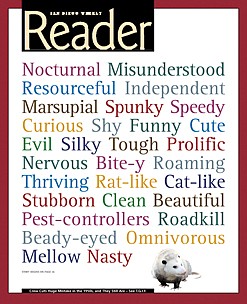
Project Wildlife looks for San Diego neighborhoods to re-locate our nocturnal marsupials.
Our friend the opossum
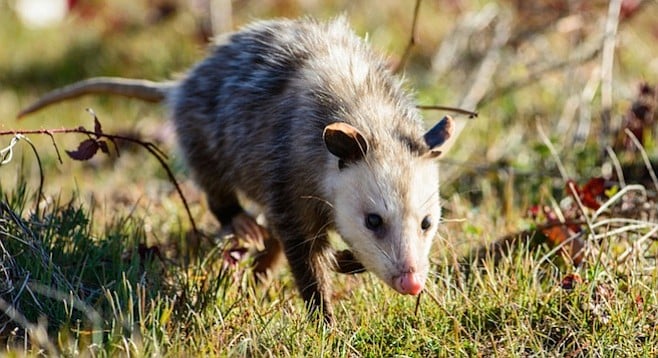
Shawn Powell and I are driving south on Jackson Drive, carrying three opossums in Powell's Hyundai Santa Fe. Our mission is to liberate them. We could stop and dump them out on the sidewalk, but that would be injudicious. They'd be apt to wander into the road and become roadkill.
"Raccoons are way more work than the possums."
A volunteer for Project Wildlife, the local animal-rescue group, the 34-year-old Powell expends an extraordinary amount of time and energy nursing young and injured opossums to where they're fit to survive in the wild, so she likes to give them the kindest possible launch. She has a spot in mind for the two juveniles contained in one of the plastic kennels on her back seat: a park abutting Lake Murray. It's dusk when we reach it, and Powell scans the grassy expanse to see who else might be using the area. "This doesn't look too bad," she says. "Usually I come here when it's a little darker, but I think this is okay."
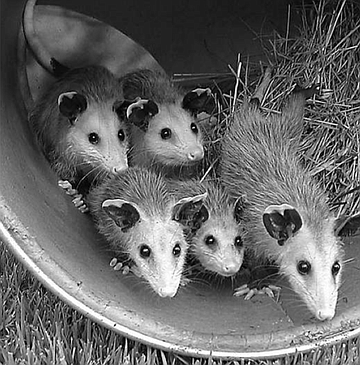
In the wild, opossum babies usually stay within their mother's pouch for roughly two months before venturing out.
In the distance Powell and I make out the figures of a dog accompanied by its owner. Dogs are everywhere, Powell points out with a shrug. "When I first started doing this, I thought the farther away from people and dogs, the better, but I've changed that view 180 degrees over the years. Now I think [the opossums] do better around people because there's more garbage. There's more food. There's water sources." She also likes "anyplace along the river anywhere in San Diego, because you've got that immediate water source. I also really like canyons. If there's landscaping where I can see it's being cared for and watered, I'm okay with releasing them."
As an animal rescuer, "You're dealing with a lot of death."
Powell told me she thought the two opossums inside the kennel were around seven or eight months old. The little male had been rescued from a swimming pool. He'd almost doubled in size in the ten days he'd been in Powell's care. His female companion had been picked up from a house near El Cajon Boulevard and 50th Street. "She just had a lot of fleas on her," Powell said. Otherwise, her only problem was her small size, but a steady diet of opossum formula and cat kibble had fixed that.
Now Powell grasped the carrier and strode to the edge of a thicket where the land sloped downward. Within a few steps, we found ourselves at the base of a huge eucalyptus tree, amidst a cluster of palms. Powell sprinkled a Baggie containing cat food into the litter of fallen leaves underfoot, confessing that she had no idea whether the opossums would linger to eat it. "It just makes me feel better," she said. Then she opened the carrier. The lighter-colored female streaked down the slope, but the little male stayed close, sniffing the air.
The jangling collar of the dog, along with the voice of its owner talking, grew louder. Powell and I and the male opossum froze, hoping to remain unnoticed. But with a confidence that seemed almost psychic, the dog, a German shepherd, made a beeline for our hiding spot. As soon as its owner realized her pet was about to confront us, she called it away. But her curiosity had been aroused, and when Powell and I returned to the car, the duo circled back to where we'd just released the two opossums.
"I'm gonna go talk to her," Powell said, leaping out of the driver's seat. When she returned, she reported that she'd told the woman she was a Project Wildlife volunteer who had just released some young rabbits. "A lot of people don't like possums. So I tell people bunnies, and they're, like, 'Oh, cute little bunnies!' " The ploy seemed to work on the German shepherd's owner, who returned to her car with the dog and drove off.
Powell said that one of the hardest parts of doing the animal-rescue work was not knowing what happens to the animals after they're released. "Everyone always asks me, 'Well, how do they do?' But we don't know." Project Wildlife doesn't have the resources to put radio collars on the animals to track what happens to them, but Powell said she wished some local biology students would decide to study opossums and share the information.
Some already have. Back in the early 1970s, a San Diego State professor named Don Hunsaker was one of the world's leading experts on opossums, and his laboratory on the SDSU campus was a hotbed of marsupial-related activities. Hunsaker edited and contributed two chapters to The Biology of Marsupials, a 1977 book that still ranks as one of the most thorough scientific discussions of New World marsupials ever published. He later retired from teaching to become a fellow at the Hubbs-SeaWorld Research Institute and today spends most of his time studying the effects of human activities on the endangered California gnatcatcher and least Bell's vireo. But he sounded delighted when I told him I wanted to learn more about why he'd worked with opossums and what he had learned about them.
In Texas, where Hunsaker grew up, "It was Possum City," but it was reptiles and lizards that initially fascinated him, and he resolved to become a herpetologist. While studying zoology at the University of Texas, he was the first to discover that the "push-ups" performed by certain lizards are a form of body language that tells other lizards what species they are, what sex they are, and if they're feeling aggressive or amorous. He got his doctorate in 1960, then moved west to join the faculty at San Diego State University, where he turned his attention to geckos. While researching the local lizard and snake populations, he founded the San Diego Herpetological Society and became its first president. "I get all involved in whatever I'm doing, but after a while, I answer the questions I'm interested in, and I move on."
By the late 1960s, Hunsaker felt he'd demonstrated that reptiles -- driven primarily by instincts rather than what they've learned -- were "a real good model" for studying animal behavior. He was ready to study creatures that were less instinctual yet still primitive. He spent time at the San Diego Zoo pondering various possibilities, and the kangaroo and wallaby colonies caught his eye, in part because the marsupials' reproductive systems are considered to be more primitive than those of placental mammals, and their social systems also aren't very advanced. (Although they congregate in groups, membership within those groups appears to be fluid.)
The only problem was that studying wild kangaroos and wallabies would have required more long-distance commuting than Hunsaker found appealing. So he started to reflect upon the marsupials closer at hand. Geological evidence indicates that the first marsupials developed in North America about 100 to 120 million years ago. For the most part, mammals out-competed them here, but one species that appeared around 50,000 years ago, Didelphis virginiana, was a tenacious little survivor. (Its correct common name is the Virginia opossum; the word "possum" is slang, if commonplace.) Hunsaker says topological and climatic barriers confined the Virginia opossum to the Southeast for most of its history. It took a human being to transport at least a couple of them across the Rockies and the great Southwestern deserts around 1890. Once here, the opossums thrived. "A basic rule of thumb is that all species expand to the limits of their environment, and the possum's a good example of that," Hunsaker says. "Today they're one of the most common mammals in the state."
Hunsaker thinks whoever imported them into California was dreaming about dinner fare -- he can't imagine anyone wanting an opossum for a pet. "They're mean. They bite," he says. In the years when he was studying the animals, he was nipped so many times he became allergic to opossum saliva. "And they've got extremely strong jaws." Backing up that chomping power are more teeth than found in the mouths of any other American land mammal (50, as opposed to 42 for coyotes, foxes, and bears), and "they can snap real quick at you." But he could imagine working with them as research subjects.
These reflections coincided with an opportunity to work in South America, home to more than 70 species of opossums (as opposed to North America, where the Virginia opossum is now the sole remaining marsupial). As part of a U.S. State Department technology-transfer project, he was assigned to the Colombian Department of the Interior, and over a two-year period he observed a number of the South American marsupials in the wild. Some of them looked like otters or squirrels, bright-eyed and inquisitive. "That's where I got the idea that these marsupials were much more sophisticated than anybody had ever thought."
Hunsaker wound up buying land in Colombia and using it as a research station. After his stint with the State Department project ended, he continued traveling with graduate students from SDSU to do more research in South America, encouraging other American scientists to follow suit. He set up a New World marsupial laboratory on the San Diego State campus, and for a number of years, he and his students conducted experiments involving both the Virginia opossum and its South American cousins. "We did a lot of behavioral work," he recalls. "But the field work was easiest to do on the [North American] opossum, because they're local."
Some were living on the campus, so Hunsaker taught his students how to set up wire traps that would detain the animals without injuring them. (The open ends snapped shut when the animal stepped on a treadle in the center of the device.) "We'd put a little notch in their ears or put a tag on them or just paint a big number on their backs," he says. After releasing the opossums, "We'd see if we could find them again." More often than not, they couldn't. The professor and his students also trapped and released opossums in the Santa Margarita River valley (south of Temecula) over a period of years, and that work confirmed that the local marsupials are almost constantly on the move. They do build nests out of leaves (which they can carry by coiling up their prehensile tails) but normally don't use any den for more than a few nights. "They're very opportunistic animals," Hunsaker says. "They eat everything, and they don't have really well-defined territories like some other animals do. They just kind of work the area." To anyone who frets about spotting an opossum in the back yard, Hunsaker offers this advice: "Wait a week, and it'll be gone."
The only time males and females interact is during the 36 or so hours when the female is in heat, a state in which she might find herself between one and three times per year. Mates find each other by following scents laid down in urine and saliva. The males "have a very characteristic reaction to a marked object," Hunsaker has written. Among the more bizarre stories published about the Virginia opossum's sex life have been reports of the species copulating through the nose by using the male's two-pronged penis and, later, babies being "expelled into the pouch of the mother by an explosive sneeze." The truth, according to Hunsaker, is more mundane. Males court the females by nuzzling and following them, and "Receptive females are very passive and allow the male to approach closely, [and] sniff the genital region...." The Virginia opossum male mounts "the female on the back, grasping her neck in his jaws and her shoulder region with his forefoot," while restraining her hind legs with his hind feet. "The complete act of copulation lasts for approximately 20 minutes, with a range of 5 to 30 minutes.... Ejaculation apparently occurs about 15 minutes after intromission, since the thrusts increase in force and then cease." The female disentangles herself from the male's embrace and then toddles off, never to lay eyes upon him again.
Hunsaker says he continued his work on opossums for a short while after the publication of The Biology of Marsupials. But violence springing from the Colombian cocaine traffic was growing so intense "it got to the point where I couldn't take a graduate student down there, and I would have been nuts to go myself." He'd also reached a point where he felt he'd learned most of what he had wanted to know about the North American opossum. He'd concluded that the animal's behavior was more reptilian than originally expected. With vocalizations limited to just four distinct sounds (a lip-clicking, a hiss, a growl, and a screech), the animal instead relies upon "a lot of chemical communication." Opossums "don't live in social hierarchies or family groups, and that's very typical of what we find with the reptiles." Furthermore, he'd come to suspect that "whatever IQ means, there are some lizards that probably have an ability to learn that's as good or better than an opossum's."
Hunsaker concedes that the question of intelligence can be a thorny one. When one researcher in the early 1950s devised a way of comparing the ability of various animals to negotiate a maze with that of human subjects, he found that Virginia opossums scored 58.9 percent as well as the humans did, compared with 47.5 percent for pigs and 45.3 percent for dogs (the two next most successful animals). Hunsaker thinks this is understandable in the context of the opossum's nomadic natural behavior.
In other research situations, opossums have demonstrated extraordinary obtuseness. One researcher found, for example, that in 300 trials of shocking opossums' forelegs, the animals never learned to move their limbs to avoid the unpleasant stimulus nor, in a separate experiment, did they ever learn to run away as a way of avoiding shocks. Unlike the higher vertebrates with their bigger brains, which can figure out appropriate responses to threats, "With these things, everything is: Open your mouth, hiss at it, and if it's too close, bite it. Otherwise run, and if you can't run, then you sometimes just fall over and play dead."
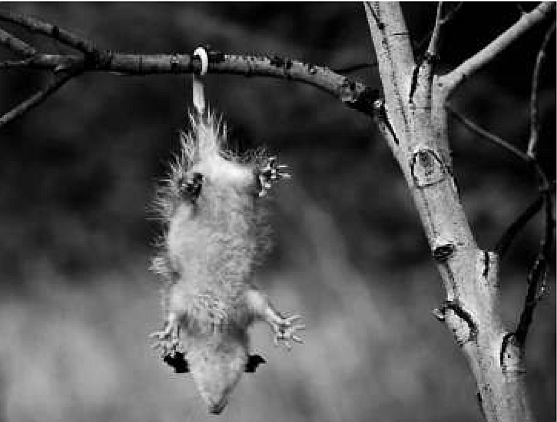
"Death-feigning" is rare among opossums, Hunsaker adds; he believes it's a response that occurs when the animal's nervous system gets overloaded. Paradoxically, when scientists record the brain waves and heart patterns of death-feigning opossums, they've been almost indistinguishable from those of normal, active animals. Even weirder is the fact that death-feigning Virginia opossums always assume the same pose: eyes open, mouths open and drooling, bodies positioned on their sides with the tail curling up between the legs. Hunsaker has written, "It appears that the animal has definite opinions as to what a dead opossum is supposed to look like, and will assume these positions if changed by an investigator." If the researcher closes the animal's eyes, the "dead" opossum will open them. If it's shifted into a position where its tail is straight and belly is on the ground, it will roll back onto its side and recurve its tail.
What explains this? "That's one of those mysteries of animals that make things so fascinating to me," Hunsaker says. He doesn't think anyone has solved it, and it may well be that no one is trying. Most biological research funds today are going into biochemical investigations. "If I were in charge of distributing money and I was really objective about it, would I want to throw $500,000 into a study [of opossum death-feigning] instead of a cancer cure, or work on an endangered species or a national park creation or something like that?"
Endangered species also tend to attract research money, but the Virginia opossum isn't endangered or even threatened. It's faring so well that you might think no one would care if local opossum babies were being left to die in the street because their mothers had been struck by cars or attacked by dogs. But the volunteers for Project Wildlife would prove you wrong. Since Hunsaker and his students stopped studying opossums, it's these volunteers who know more about the animals than anyone else in San Diego County.
Of all the local opossum-rescuers, it's hard to find one more knowledgeable than April Bauer. A relaxed, efficient woman who lives with her husband in an immaculate house in a semirural section of Vista, she found herself with spare time on her hands ten years ago. When she saw a brief television report about Project Wildlife, she volunteered at the organization's animal-care center near the foot of Linda Vista Road in San Diego. At first she cleaned cages and fed baby birds, but she soon joined the opossum team and began to care for local marsupials in her home. She thought the exposure to animals would be good for her two 12-year-old twin sons. "But they lost interest after a year," she says. "I stuck with it."
That's an understatement. About three years ago, Bauer became the head of the opossum team. As such, she directs the efforts of roughly two dozen volunteers while caring for up to 200 opossums a year herself. All together the team aids between 850 to 1200 opossums annually, one of the largest such efforts in the country. "We have a real high survival rate," Bauer boasts. "They do very well. They've been around for a long time."
Bauer says opossums will eat just about anything -- mice, rats, snails, slugs, insects, and dog and cat food, not to mention fruits and vegetables. But before the winter rains begin, Bauer points out, "the pickings are slim." From October through December, the opossums rescued by Project Wildlife tend to be starving and anemic and loaded with fleas. "They look gnarly. The fleas suck them dry and chew up all their hair." Some animals die from the infestations.
As winter progresses and baby mice are born and the rains boost the snail population, opossums fare better. Males move around more, looking for mates. But some are injured, like the two animals caged in Bauer's back yard when I visited her in early January. The older, a mature male, had been shot in the head with a pellet gun. A veterinarian had extracted one of the pellets, but five remained lodged in the animal's skull. "Hello, honey," Bauer crooned to a dark form curled up and sleeping on a shelf at the back of the enclosure. "C'mon, sweetheart. Turn around." The furry form stirred, then swiveled its head around to stare at us. "Possums are so mellow," Bauer murmured.
A moment later the gunshot victim bared his teeth at us. "See, now he's mad." Bauer sounded delighted. The animal would need to rely on its defensive instincts to survive in the wild. Bauer pointed out that the opossum's lip drooped, a sign of nerve damage suffered as a result of his injury. That and a lack of aggressiveness had made some of her fellow rescuers doubt it would be possible to turn this animal loose. If he couldn't be released, he would have to be euthanized, since state law prohibits individuals from owning wild animals. But Bauer was hopeful about avoiding that grim alternative. As if to confirm her optimism, the animal started trembling. "See, he's getting nervous. That's good." Another positive sign was that "at night he seems fearful of me. He wants out. He's been pacing. And he's been eating well. Mostly he eats kibble, but also chicken wings, and some avocadoes and vegetables. I left him a mouse last night."
Bauer secured the door of his cage, then took me to another enclosure. "Someone found this one here on the street," she said about the young male hidden within a cardboard box. A car had hit the animal and fractured its skull, an injury from which recovery is often unlikely. Although this opossum appeared to have suffered some mild brain damage, it had otherwise rebounded, and Bauer thought it might make a good "education possum" -- useful for taking to schools and other public forums (an activity for which Project Wildlife has special permits).
"Do you want to come out?" she asked the automotive victim. When it reacted by opening its mouth to display its incisors, Bauer again exclaimed like a mother presented with her preschooler's handiwork. Gently, she reached into the box. I asked if she ever got bit. "I have. But it's no big deal."
Did the animals ever draw blood? I pressed. "Oh, I've been bit pretty bad," she admitted, adding that it was possible to get "a pretty good infection." But opossums never carry rabies, parvo, or distemper because "their body temperature is lower than those diseases need."
Once within Bauer's grasp, the little male seemed docile. Bauer settled him on a clean white towel upon her lap, and he stayed calm, wafting his long white snout as if to better take in his surroundings. Adult opossums have faces that are almost perfect triangles, and this one's was pure white except for a thin brown strip running down the middle of his broad forehead. Two leathery ear flaplets marked two corners of the triangle, while the palest pink knob of a nose occupied the third. Halfway between the nose and the ears, the animal's close-set eyes looked too small for its countenance. It didn't flinch when I reached out to stroke its back. The fur surprised me in its soft luxuriance.
"Normally, I would never do this with [an opossum] that didn't have a head injury," Bauer said. Handling the animals can inure them to human contact, a potential death sentence out in the world but not a bad thing in an education opossum. Bauer also let me touch the hairless dirty-pink tail. When I commented on how snakelike it felt, she said, "That's why a lot of people don't like them. But I love it. I think it's beautiful."
Bauer was taking care of one other adult opossum that day, and after she settled the young male back in its cage, she offered to show it. She led me into a well-organized workroom off her garage where a number of plastic kennels were arranged against the wall. One harbored a female opossum that had broken her arm while being attacked by a dog. The arm was healing, but what worried Bauer was the fact that the female's pouch was filled with babies, "and it's only January." Normally, baby opossums didn't start appearing until March. "Then it gets busy -- April, May, June, July, August." Although the weather in San Diego allows for year-round mating, Bauer was hoping that a couple of good rainfalls would wash away the opossum scent and forestall an early population explosion.
The mother opossum had burrowed under a towel, and when Bauer lifted it, the animal showed her teeth, then a moment later emitted a crackling hiss, followed by a low growl. "She's tough," Bauer remarked. "But mamas always are." We couldn't glimpse the tiny creatures inside her pouch, and Bauer didn't want to disturb the animals further. I understood. But I also felt disappointed. Few things about the Virginia opossum are more amazing than the beginning of its existence. For the first seven days after an opossum ovum is fertilized, all that develops is, in the words of one writer, "a hollow vesicle lined with three cell layers...only a tiny rudiment of the embryo." Yet six days later, the babies are born.
They're still little more than embryos. About a centimeter long, they weigh about .13 grams -- less than a paperclip and one-28,000th of their adult size. (One researcher has noted that "if a human infant was born at a comparable stage, it would weigh as much as a U.S. nickel.") But the newborn opossums can breathe and digest opossum milk -- assuming they can crawl across the five-centimeter distance between their mother's vagina and her pouch (a journey she does not facilitate). They also must survive a race against death inside the pouch, as they compete against typically 20 to 30 birthmates to find one of their mother's 13 teats. Only when each victor has latched onto a teat do the surviving embryos get a break. Barbs on their tongues fit into tiny grooves on the nipples, which also swell, ensuring a secure attachment. For about two months, the babies remain locked on, with the nipples stretching out to accommodate the growing animals over time.
In the wild, opossum babies usually stay within their mother's pouch for roughly two months before venturing out. But lots of things can disrupt that timetable. "During baby season, a lot of moms are out wandering, and some get hit by cars," Bauer told me. "And if there's a dead possum in the street, people will stop and look." Any babies in her pouch may well be alive, and it's common for Project Wildlife to get calls to go out and pick them up. "Or we get a lot of calls about mamas dropping their babies. Maybe the mom hasn't been getting enough nutrition, and some of the babies aren't nursing that well. Or maybe they just weren't paying attention when mom decided to get up and take off. They didn't have a good enough grip, you know. Sometimes people will find tiny little babies on the concrete that have fallen out of her pouch. So we end up with lots of those."
Bauer predicted that in a few months she'd have plenty of opossum babies, and when I returned on a sunny April morning, she counted about 40 in her care. Only two other members of her team were comfortable taking care of the smallest opossums and the tube-feeding they require, she said. When I arrived, Bauer was at her kitchen sink, adding water to a commercial formula powder that's made especially for the marsupials. After she stirred it to a milky consistency, we headed once more for the room adjoining her garage.
She opened the lid of a large plastic tub sitting on a counter, revealing a mess within: sodden newspapers splattered with opossum formula and ground-up cat-food gruel. At one end of the box lay a blue fleece-lined sack. Most of the babies within it came from a mother who was attacked by a dog in a yard, Bauer said. The man in the family had thrown the animal's body into the trash, only later to discover the babies. (The couple then brought the entire trash bag to Bauer.) It's a common scenario, she claims. "People will throw them in the trash, and then three or four days later, they'll go out to dump another bag and the possum will be sitting there looking at them. Because it will just have been playing possum, you know."
This particular group of babies had begun eating on their own two days before, but Bauer was still keeping a close eye on their weights. She likes to see them weighing at least 80 grams before she stops supplementing their nutrition. "If anyone dips below that, I'll feed them," she said. She reached into the cloth pouch and extracted a little male whose ears and eyes looked huge, relative to his tiny face. He made a series of high-pitched chirps -- a call for his mother, according to Bauer. She placed him in the dish of a scale and pronounced, "He's only 68 grams." So she filled a syringe with formula and connected it to an orange-colored tube as thin as a spaghetti strand. She held the tube against the animal's body to gauge how much of it to insert, then with a swift, deft motion, threaded it into his mouth and down through his gullet. He didn't squirm but moved his mouth as if to chew on the tube. "He'd like to be nursing still," Bauer remarked, as she pushed down on the syringe plunger. A second later, she popped the tube out.
"And then we potty him," she said. Grasping the little fellow in one hand, she rubbed his genital area with a ball of cotton, producing a bloom of yellow urine on the cotton. "They're pooping on their own," she said. "But they're not peeing real well on their own." In the wild, the mother opossum would lick her offspring to stimulate their urination and defecation. "Sometimes I pick them up and they feel like little grapes," Bauer said. "They just still aren't old enough." A mother dog would do the same thing for her puppies, Bauer said.
She placed the male in a holding container, then pulled one of his siblings out of the pouch and weighed her. "She's a little fatty. She's 86 grams. She needs to poop, though." As Bauer rubbed the animal with the cotton, she pointed out the faint outline of her pouch. I commented on how passive the babies seemed as Bauer helped them to eliminate their body wastes. "I'm sure they would relax for their mom, or she'd give them what-for."
Bauer continued to weigh each of the other babies from the artificial pouch, as well as others that she had in other containers, and as she worked, she talked about the challenges involved in tubing the animals. It was no big deal, once you learned how to do it, she said, but the procedure held pitfalls for newcomers. "You can put it in their lungs by accident and kill them. And also with some of the tiny ones, you can poke through [tissue or organs], if you force it. Sometimes the tube gets under their tongue, or you can go through the back of their throat." Most unnerving is that "the animals never complain," she said. They just die. That's why many volunteers shrink from the tube-feeding. But Bauer claims the procedure has saved the lives of more opossums than it has injured.
She says that when she first started volunteering, the opossum team members used to tube any baby, no matter how small it was. Yet for the tiniest animals the outcomes were usually grim. "They would live for, like, two weeks and die. Or maybe one of them would live, and it would be kind of a little oddball. Sometimes they would be blind. It's just like a premature baby. They have problems." So in recent years, the opossum team had decided to euthanize any babies under 25 grams, rather than tube-feed them. More recently, the team members have been thinking of increasing the limit again, to 30. "But that's real hard to do," Bauer said. "And it depends on the condition of the mom. It also depends on how swamped we are. You've got to take care of the ones that are going to do best."
In the main part of the garage, Bauer walked over to a two-by-four-foot wire cage containing a hamster wheel and an overturned shoebox with a door cut into it. The nine opossums asleep within the makeshift house had come from Escondido. "Their mom was impaled on a sprinkler head for days before anybody found her," Bauer said. "It went through her pouch and out her side. Somebody found her and cut the sprinkler head off and brought her in to the Humane Society." When Bauer had collected her from there, "I thought, 'Oh wow, it's just her pouch. She'll be fine.' But she died on the way to the vet." The babies were doing well, though. Most were approaching 90 grams, and "They aren't even getting up in the daytime," Bauer said. "They're perfectly nocturnal. Last night there were, like, six of them on the wheel. It was going around, and they were just hanging. It was really cute." With practiced, economical movements, she changed the newspaper lining the bottom of the cage. When she lifted up the shoebox, all the babies within it opened their mouths to show their teeth. Their tails curved and wriggled like fat pink worms.
In a day or two, Bauer planned to move this bunch to another member of the opossum team who would keep them in an outdoor cage. "Then after that, once they're 250 grams, we move them into a run." Typically four feet wide by eight feet long by six feet high, the runs help prepare the animals for life in the open and make them less likely to attack or even cannibalize each other. They're usually released once they weigh about a pound. Bauer says not enough of the team members have opossum runs. Because she has three large ones, she often winds up getting the animals back during the last month or so of their captivity, and then the stressful job of releasing the animals falls on her shoulders.
"It's hard to find places to release them," she explained. "I don't know where to go most of the time." Bauer says her favorite spot is an older neighborhood like hers, "where there are some shacks and broken-down cars. I prefer that. At least I know there's cat and dog food out for them." But she doesn't want to release too many opossums in the same area, lest their presence attract predators. "So I drive around. I used to be able to find empty lots in the older neighborhoods on the coast. But now there's hardly any empty lots anymore. So I drive around Vista and look. It's just hard."
Bauer told me that a lot of people ask why she bothers with all this. " 'There are a million possums,' they say. 'Who cares?' " The animals' lifespan out in nature is estimated to be only about two years on average. But Bauer says she and the other opossum team members all feel their actions matter to the individual animals they're helping. "I'm happy to take care of them," Bauer said. "I don't mind at all."
She urged me to talk to some of the other team members, so a few days later I met with Wendy Millard. She's the leader of Project Wildlife's raccoon team, but she also takes care of opossums. You might guess that if you walked into Millard's home in Sabre Springs. There's a raccoon statue in front of her fireplace and an image of a raccoon on the living-room rug. Paintings and sketches of opossums and raccoons hang in almost every room. I got the impression that Millard's an easy friend to buy presents for -- that a nice opossum or raccoon knickknack always makes her happy.
Tall and thin, with long auburn hair, Millard works out of her home, managing commercial properties owned by her family. She first started helping to rescue animals in need when she volunteered at the Fund for Animals in Ramona. "I learned a lot up there." She says she helped care for coyotes and raptors, along with nonpredatory animals such as opossums and raccoons. Dozens of domestic cats also inhabited the property. "And then I got pregnant when I was working up there," Millard recalls, "so I didn't want to work around the cats. That's why I left." Her pregnancy "didn't work out," however, so a year or so later, she joined Project Wildlife. She'd seen a newspaper article about it and liked the idea of helping to rehabilitate animals in her own home, instead of having to make the daily drive to Ramona. "I started out with one cage of five baby possums." That was nine years ago.
She added the raccoon responsibilities about four years later. Millard notes that the two species differ markedly. The raccoons are "more intense. They're harder to work with." For one thing, "You have to worry about more diseases." They can catch rabies and distemper, and they're capable of harboring "a parasite that's unfriendly to people. So you have to be real careful. You have to be really clean."
Raccoons "like to interact with people, unfortunately," she says. "They're highly intelligent, and they're full of personality." It's hard to bottle-feed the babies without inadvertently taming them to the point that they lose their aversion for humans. But they never learn to comport themselves like cats or dogs. "If you let a raccoon in your house, you might as well kiss everything goodbye," Millard warns. "They're very destructive. They get on everything. They're out of control." After about two years, when they reach their sexual maturity, "They start getting bite-y and nasty." While the opossums are easier to handle than raccoons, they "don't like to be cuddled," Millard says. "They're way more independent than cats. They don't want to interact with you."
Working with the animals throughout the years has changed her, she reflects. "I've come a long way. When I was young, if I saw an animal on the side of the road, I'd fall to pieces. Now I'm way past that." As an animal rescuer, "You're dealing with a lot of death. At the busiest times, it can be almost daily. And a lot of people can't handle that. There are a lot of rewards, but you also see a lot of bad things. We're not picking up healthy animals, and that's what you've kind of signed on to do. But I don't think you realize it until you get into it."
The work also tied her down. "When the raccoons are here, it's literally impossible for me to go anywhere. Raccoons are way more work than the possums." But Millard, still childless, sounded serene about this. Her husband also enjoyed the animals and had built elaborate shelters for them. "It's really a full-time nonpaying job, and we do it for the animals."
Asked why, she laughed self-consciously. "It just gives me a good feeling to know that if we didn't do it, these animals would die. Or they'd be out there, suffering. That's why." She also gets a lot of personal pleasure out of caring for the mothers and babies. "I think it's just part of my balance of life."
I asked how other people react when they learn that she rescues opossums. "The reaction usually is: 'Why possums?' They're the most misunderstood animals. People think they're just big rodents. They're dirty. They carry disease. They're vicious. None of that is true. That's why when I do go out and educate people, it's my favorite animal to talk about. 'Cause they're so misunderstood! I mean, they're very good for the environment. They eat all those things you don't want in your garden -- the snails and slugs and rats and mice. They're not aggressive. They don't carry disease. They groom a lot. After they eat, they wash their little faces. They spit on their feet, and then they clean themselves. It's very cute.... I'm constantly preaching."
Millard also has mentored a number of other opossum team members over the years, including Shawn Powell. "Wendy was my angel the first year," Powell said on the afternoon I first met with her. We were talking in her condo, just south of Mission Trails Regional Park. Although her training at the Project Wildlife care center covered a lot -- reading syringes, giving antibiotics, administering subcutaneous fluids, and more -- Powell said that "when you rescue an animal that's been attacked by a dog, it's still difficult to know what to do. So I think I called Wendy almost every day for a while. She was so nice, and it made a huge difference to me."
Outspoken and gregarious, Powell joined Project Wildlife in the spring of 2002. She was hoping to work with wild raptors. "That was what really intrigued me." As it turned out, however, the volunteer organization didn't need any more raptor-team members in that area at that time, so Powell had to pick something else. She says she selected opossums for no reason she could identify. Only later did various members of her family point out that her grandfather had raised a couple of litters of orphaned baby opossums on the 40-acre orange and olive ranch in central California where Powell grew up. "It must have been when I was really small, because I don't remember it at all," she said. "I mean, my connection with possums when I was growing up was seeing them smushed on the side of the road. Or my grandpa would take us for what he called possum hunts out in the olive grove. He would take a flashlight and go out at dark and shine it up in the trees, and sometimes we'd see a possum there. And now I just love them. Go figure."
Powell's introduction to the opossum team "was sort of a trial by fire. Because that was right in prime baby season." Before she'd even finished her apprenticeship, she got a call asking if she could go out on a rescue. "I said, 'Well, I don't know if I'm allowed to go on rescues yet.' And whoever it was said, 'Well, here's your first chance,' so I said okay. It was down in a part of town I'd never been to before, kind of Southeast San Diego. The possum had crawled under a deck where there was a hot tub in the back yard." Powell peered at the animal, which had made its way to the very back of the foot-high crawlspace. "The girl who was there said, 'Are you the only one here? Where's your team?' And I said, 'I'm the only one.' And she said, 'Well, I don't see how you're going to get it.' "
Powell wasn't sure herself. "There were all these bugs and spiders. I didn't know what to do, and I had no frame of reference. But I knew I'd been sent out there to get that possum, so I'd better get that possum." Somehow, she wriggled all the way under the deck. "They had told us never to pull a possum by the tail if you suspect a back injury, and I did suspect a back injury. But that was the only part of that animal I could get. So I pulled it out, and it ended up having a broken back. It had to be euthanized. I felt really good about the fact that I saved that animal a lot of suffering. It would have died a long, yucky death under that deck." But retrieving the animal was "a nasty experience. I mean, the girl could not believe I did it." Powell could hardly believe it herself, but she says, "Compared to that, every rescue since has been a piece of cake."
Powell told me that only twice had she rescued dead mother opossums that still had live babies in their pouches. In both instances, the babies were too tiny to be rehabilitated. "They were itty-bitty, still pink," she says. "So I had to have them euthanized." The first time this happened, last year, she says the veterinarian from whom she sought help refused to comply with her request. Powell then consulted with April Bauer, who advised her to wrap the mother up and put it in the freezer, a humane way to kill the babies. The only problem, according to Powell, was her husband. "He's not a real animal lover, okay? He's a possum tolerator. He's a good husband, so he lets me do it. But he looks disgusted most of the time. And where he draws the line is that anything having to do with the possums cannot go in or near our refrigerator. He even bought me a little refrigerator to put all my food for them in -- even if it's just cat food." This sits in Powell's crowded kitchen, with stuffed toy opossums perched on top of it. But its freezer was too tiny to accommodate the baby-filled mother opossum's corpse. Powell says she wound up using the big freezer at Project Wildlife's care center. But making all these arrangements took a couple of days. "It was awful. I was so worried about it." When another dead mother with tiny babies came into her hands again more recently, she says her vet agreed to put the babies to sleep. "They know me now, so they'll take my word for things, whereas before, they weren't sure."
I asked Powell to tell me about her daily schedule. When she only has older animals, she refrains from feeding them until the evening. "They're nocturnal, and you don't want to encourage them to be out eating during the day. But right now, several of the groups I have are so small they need food available whenever they want to eat." At such times, she has to rise every morning at 4:30, in order to get everything done before going to her job as an underwriter for a local mortgage company. The Powells' condominium has only one bathroom, and she and her husband share it with his three daughters from a previous marriage. They're 9, 13, and 14. "So we're on a strict schedule. I have to be in the shower at 5:30 every morning, 'cause the girls need the bathroom at 6:20." In the hour before she showers, "I have to change all the newspaper in the cages. I have to wash all the dishes, because [the opossums] poop in their water dishes." (Powell eschews using water bottles because she thinks, "Well, they're not going to drink out of a water bottle in the wild, so I'm not going to give them one here.") Every morning, "I have to make new formula for them and feed them all. And they like different things. Some of them want mushed-up cat food. Some want formula." Other enticements might be yogurt or baby food. "I have to remember who wants what."
When all the animals are healthy, the evening chores take no more than 20 or 30 minutes. "But where it gets really hairy is when I have injured ones or ones that require additional care." Sometimes adults require fluids, and for that Powell uses an intravenous bag that hangs up in her kitchen. She warms the electrolyte solution and inserts a needle connected to the bag under the animal's skin. "It just drips in there," she says, a process that can consume 10 or 15 minutes. "You have to make sure the animals stay still, so you have to stand there over them the whole time." Wounded animals may require multiple daily applications of disinfectant or antibiotics. All that extra attention requires extra time.
Powell has a ready explanation for why she does all this. She says she thinks about what would happen to the animals if she and the other Project Wildlife volunteers didn't step forward to take care of them. "That's really what keeps me doing it. I hate getting up at four in the morning or being called on three rescues in a row and getting home late. But what would happen to the animal if I wasn't doing that? You know? If it needed to be euthanized, it would have died an awful death." At least when she responds, "I can kind of ease its suffering a little bit." Or she can give a second chance to the babies that would have died because their mother was killed.
More than altruism drives her actions, she says. Sometimes she stands on the patio and watches the babies in their cages the way some folks watch TV. "They're so funny. They climb all over everything. They're just so cute. One group are the biggest pigs. They eat and eat and eat. They don't walk around the cage. They don't get on the wheel. You pick them up and their stomachs are always full." Others have different personalities. "I mean, you have some that are really evil that hate you and want to bite your head off. Others are curious, like cats. They want to come up and sniff you, and they know you bring them their food, so they get all excited."
Besides the babies, "The other great feeling is when you bring an animal back that was badly injured. I think that's probably the most rewarding thing of all." She recalls one animal she came to call Frankenpossum. The survivor of a vicious dog attack, he "had a shunt coming out of his side. He had stitches everywhere." But Powell nursed him back to health over the course of a month and developed a special fondness for his spunkiness. Another opossum that stands out in her memory had sustained a major head trauma when a car hit him. "I had him for three days, and he just kept going downhill, downhill." On the third day, Powell thought, "Oh, he's really suffering. I'm not seeing any improvement." She took him to a local veterinary office to be euthanized, but one of the doctors on duty asked if she wanted to see if some steroids might improve his condition. "I said, 'Of course!' So she gave me some steroids and suggested we try it for two or three days to see what happens. Boy, those steroids made a huge difference. I mean, total turnaround. He ended up healing completely." After a day or two, the male opossum was so anxious to escape his cage that Powell grew afraid he might hurt himself. "So I was getting up every four hours in the middle of the night and letting him run around on the patio for a half hour, then putting him back in the cage. Because otherwise I was afraid he might tear the cage up. But I couldn't let him go until he finished his medicine." Once he did, Powell released the opossum near Lake Murray. She says that experience taught her how fast opossums can move, when they're motivated. After she let him out of his cage, she tossed a piece of apple a few feet away from the animal. "He pounced on it like a snake. That fast! And I thought, 'Oh my God!' That's when I started to feel much better about releasing them. Because I saw a capability that I hadn't known was there."
On the evening that we released the two young opossums next to Lake Murray, Powell said again that she enjoys setting free adult opossums, like the occupant of the other carrier we were transporting. Powell drove for a few minutes to a spot where a broad gulley intersected Lake Shore Drive in San Carlos. By the time she parked, the sky had darkened to a deep azure, a sumptuous backdrop for the waxing moon. We walked away from the road along a dirt path lined with banks of wild daisies, and Powell told me about this third opossum we were about to set free. "I wouldn't call her an old girl, but I wouldn't call her a young girl either. She's probably a year and a half." She'd been cornered by a dog in someone's back yard, and someone had taken her to a county animal services office, even though there was nothing wrong with her. Since she had room, Powell kept her for a couple of days. "The only treatment I gave her was a dose of Advantage for the fleas and as much food as she could eat." She expected her to disappear the instant she opened the carrier door.
Powell commented that one of her worst releases ever had taken place at the very spot where we were walking now. It involved a group of four juveniles that she thought had seemed "a little on the tame side." Indeed, when she dropped them off, "They just kind of stood there, and I thought, 'Oh, brother,' " Powell recalled. As she was walking away, "This huge owl flew overhead. Oh my God. But what can you do? The owl's there." She says she always tries to encourage the opossums to run under some bushes when she drops them off, "but they're gonna do what they're gonna do. I can't stay out there with them." Still, Powell worried about that group all night long.
Only once was she forced to abort a release attempt. That involved an adult male who'd been on antibiotics for several weeks in the wake of an injury. Life in the wild is hard, Powell notes, and it seemed to her this fellow found it "a bit of a vacation to live in a little cage and have people bring him food and clean up after him." Whatever the reason, as soon as she tried to let him go, he fell to the ground and assumed the Dead Possum position. "I'm like, well, okay, I can't leave him here," Powell said. "This was along the San Diego River. So I had to pick him up and take him back home again. It took me two more tries before he would finally stop doing that and go. Some of them are such scaredy-cats, and he was the scaredest one I've ever seen."
For a moment, it seemed as if Powell might have another sissy on her hands. When we stopped and she unlatched the cage and tilted it downward, no opossum emerged. Powell and I listened to the night sounds: the soft shushing of a nearby sprinkler, the rhythmic creak of a cricket, the occasional whir of a ground bird. The air smelled moist and fecund. "She knows we're out here," Powell whispered, lifting the cage higher in an attempt to dump the animal out. The opossum's head finally emerged, tentative, and after another nudge from Powell, it dropped gracefully to the ground, then slunk away from us, catlike. Six feet away, her motion was all that caught my eye; within another six feet, she had disappeared.
Powell told me she'd come to have a lot of respect for the opossums' resourcefulness. If they could make it through the first couple of nights, they'd probably be fine, she told herself. They would know -- by instinct -- that it was okay to eat crickets. They'd know how to search for water. With any luck, they'd avoid wandering into the path of a car or a coyote. She couldn't help worrying, Powell confided, but she could remind herself that Project Wildlife's motto isn't "Long Lives Guaranteed for All Wild Animals." It's "A Second Chance," and for both the opossums and their rescuers, that has to be enough.
Here's something you might be interested in.
Project Wildlife looks for San Diego neighborhoods to re-locate our nocturnal marsupials.
Our friend the opossum

Project Wildlife looks for San Diego neighborhoods to re-locate our nocturnal marsupials.
Our friend the opossum
Shawn Powell and I are driving south on Jackson Drive, carrying three opossums in Powell's Hyundai Santa Fe. Our mission is to liberate them. We could stop and dump them out on the sidewalk, but that would be injudicious. They'd be apt to wander into the road and become roadkill.
"Raccoons are way more work than the possums."
A volunteer for Project Wildlife, the local animal-rescue group, the 34-year-old Powell expends an extraordinary amount of time and energy nursing young and injured opossums to where they're fit to survive in the wild, so she likes to give them the kindest possible launch. She has a spot in mind for the two juveniles contained in one of the plastic kennels on her back seat: a park abutting Lake Murray. It's dusk when we reach it, and Powell scans the grassy expanse to see who else might be using the area. "This doesn't look too bad," she says. "Usually I come here when it's a little darker, but I think this is okay."
In the wild, opossum babies usually stay within their mother's pouch for roughly two months before venturing out.
In the distance Powell and I make out the figures of a dog accompanied by its owner. Dogs are everywhere, Powell points out with a shrug. "When I first started doing this, I thought the farther away from people and dogs, the better, but I've changed that view 180 degrees over the years. Now I think [the opossums] do better around people because there's more garbage. There's more food. There's water sources." She also likes "anyplace along the river anywhere in San Diego, because you've got that immediate water source. I also really like canyons. If there's landscaping where I can see it's being cared for and watered, I'm okay with releasing them."
As an animal rescuer, "You're dealing with a lot of death."
Powell told me she thought the two opossums inside the kennel were around seven or eight months old. The little male had been rescued from a swimming pool. He'd almost doubled in size in the ten days he'd been in Powell's care. His female companion had been picked up from a house near El Cajon Boulevard and 50th Street. "She just had a lot of fleas on her," Powell said. Otherwise, her only problem was her small size, but a steady diet of opossum formula and cat kibble had fixed that.
Now Powell grasped the carrier and strode to the edge of a thicket where the land sloped downward. Within a few steps, we found ourselves at the base of a huge eucalyptus tree, amidst a cluster of palms. Powell sprinkled a Baggie containing cat food into the litter of fallen leaves underfoot, confessing that she had no idea whether the opossums would linger to eat it. "It just makes me feel better," she said. Then she opened the carrier. The lighter-colored female streaked down the slope, but the little male stayed close, sniffing the air.
The jangling collar of the dog, along with the voice of its owner talking, grew louder. Powell and I and the male opossum froze, hoping to remain unnoticed. But with a confidence that seemed almost psychic, the dog, a German shepherd, made a beeline for our hiding spot. As soon as its owner realized her pet was about to confront us, she called it away. But her curiosity had been aroused, and when Powell and I returned to the car, the duo circled back to where we'd just released the two opossums.
"I'm gonna go talk to her," Powell said, leaping out of the driver's seat. When she returned, she reported that she'd told the woman she was a Project Wildlife volunteer who had just released some young rabbits. "A lot of people don't like possums. So I tell people bunnies, and they're, like, 'Oh, cute little bunnies!' " The ploy seemed to work on the German shepherd's owner, who returned to her car with the dog and drove off.
Powell said that one of the hardest parts of doing the animal-rescue work was not knowing what happens to the animals after they're released. "Everyone always asks me, 'Well, how do they do?' But we don't know." Project Wildlife doesn't have the resources to put radio collars on the animals to track what happens to them, but Powell said she wished some local biology students would decide to study opossums and share the information.
Some already have. Back in the early 1970s, a San Diego State professor named Don Hunsaker was one of the world's leading experts on opossums, and his laboratory on the SDSU campus was a hotbed of marsupial-related activities. Hunsaker edited and contributed two chapters to The Biology of Marsupials, a 1977 book that still ranks as one of the most thorough scientific discussions of New World marsupials ever published. He later retired from teaching to become a fellow at the Hubbs-SeaWorld Research Institute and today spends most of his time studying the effects of human activities on the endangered California gnatcatcher and least Bell's vireo. But he sounded delighted when I told him I wanted to learn more about why he'd worked with opossums and what he had learned about them.
In Texas, where Hunsaker grew up, "It was Possum City," but it was reptiles and lizards that initially fascinated him, and he resolved to become a herpetologist. While studying zoology at the University of Texas, he was the first to discover that the "push-ups" performed by certain lizards are a form of body language that tells other lizards what species they are, what sex they are, and if they're feeling aggressive or amorous. He got his doctorate in 1960, then moved west to join the faculty at San Diego State University, where he turned his attention to geckos. While researching the local lizard and snake populations, he founded the San Diego Herpetological Society and became its first president. "I get all involved in whatever I'm doing, but after a while, I answer the questions I'm interested in, and I move on."
By the late 1960s, Hunsaker felt he'd demonstrated that reptiles -- driven primarily by instincts rather than what they've learned -- were "a real good model" for studying animal behavior. He was ready to study creatures that were less instinctual yet still primitive. He spent time at the San Diego Zoo pondering various possibilities, and the kangaroo and wallaby colonies caught his eye, in part because the marsupials' reproductive systems are considered to be more primitive than those of placental mammals, and their social systems also aren't very advanced. (Although they congregate in groups, membership within those groups appears to be fluid.)
The only problem was that studying wild kangaroos and wallabies would have required more long-distance commuting than Hunsaker found appealing. So he started to reflect upon the marsupials closer at hand. Geological evidence indicates that the first marsupials developed in North America about 100 to 120 million years ago. For the most part, mammals out-competed them here, but one species that appeared around 50,000 years ago, Didelphis virginiana, was a tenacious little survivor. (Its correct common name is the Virginia opossum; the word "possum" is slang, if commonplace.) Hunsaker says topological and climatic barriers confined the Virginia opossum to the Southeast for most of its history. It took a human being to transport at least a couple of them across the Rockies and the great Southwestern deserts around 1890. Once here, the opossums thrived. "A basic rule of thumb is that all species expand to the limits of their environment, and the possum's a good example of that," Hunsaker says. "Today they're one of the most common mammals in the state."
Hunsaker thinks whoever imported them into California was dreaming about dinner fare -- he can't imagine anyone wanting an opossum for a pet. "They're mean. They bite," he says. In the years when he was studying the animals, he was nipped so many times he became allergic to opossum saliva. "And they've got extremely strong jaws." Backing up that chomping power are more teeth than found in the mouths of any other American land mammal (50, as opposed to 42 for coyotes, foxes, and bears), and "they can snap real quick at you." But he could imagine working with them as research subjects.
These reflections coincided with an opportunity to work in South America, home to more than 70 species of opossums (as opposed to North America, where the Virginia opossum is now the sole remaining marsupial). As part of a U.S. State Department technology-transfer project, he was assigned to the Colombian Department of the Interior, and over a two-year period he observed a number of the South American marsupials in the wild. Some of them looked like otters or squirrels, bright-eyed and inquisitive. "That's where I got the idea that these marsupials were much more sophisticated than anybody had ever thought."
Hunsaker wound up buying land in Colombia and using it as a research station. After his stint with the State Department project ended, he continued traveling with graduate students from SDSU to do more research in South America, encouraging other American scientists to follow suit. He set up a New World marsupial laboratory on the San Diego State campus, and for a number of years, he and his students conducted experiments involving both the Virginia opossum and its South American cousins. "We did a lot of behavioral work," he recalls. "But the field work was easiest to do on the [North American] opossum, because they're local."
Some were living on the campus, so Hunsaker taught his students how to set up wire traps that would detain the animals without injuring them. (The open ends snapped shut when the animal stepped on a treadle in the center of the device.) "We'd put a little notch in their ears or put a tag on them or just paint a big number on their backs," he says. After releasing the opossums, "We'd see if we could find them again." More often than not, they couldn't. The professor and his students also trapped and released opossums in the Santa Margarita River valley (south of Temecula) over a period of years, and that work confirmed that the local marsupials are almost constantly on the move. They do build nests out of leaves (which they can carry by coiling up their prehensile tails) but normally don't use any den for more than a few nights. "They're very opportunistic animals," Hunsaker says. "They eat everything, and they don't have really well-defined territories like some other animals do. They just kind of work the area." To anyone who frets about spotting an opossum in the back yard, Hunsaker offers this advice: "Wait a week, and it'll be gone."
The only time males and females interact is during the 36 or so hours when the female is in heat, a state in which she might find herself between one and three times per year. Mates find each other by following scents laid down in urine and saliva. The males "have a very characteristic reaction to a marked object," Hunsaker has written. Among the more bizarre stories published about the Virginia opossum's sex life have been reports of the species copulating through the nose by using the male's two-pronged penis and, later, babies being "expelled into the pouch of the mother by an explosive sneeze." The truth, according to Hunsaker, is more mundane. Males court the females by nuzzling and following them, and "Receptive females are very passive and allow the male to approach closely, [and] sniff the genital region...." The Virginia opossum male mounts "the female on the back, grasping her neck in his jaws and her shoulder region with his forefoot," while restraining her hind legs with his hind feet. "The complete act of copulation lasts for approximately 20 minutes, with a range of 5 to 30 minutes.... Ejaculation apparently occurs about 15 minutes after intromission, since the thrusts increase in force and then cease." The female disentangles herself from the male's embrace and then toddles off, never to lay eyes upon him again.
Hunsaker says he continued his work on opossums for a short while after the publication of The Biology of Marsupials. But violence springing from the Colombian cocaine traffic was growing so intense "it got to the point where I couldn't take a graduate student down there, and I would have been nuts to go myself." He'd also reached a point where he felt he'd learned most of what he had wanted to know about the North American opossum. He'd concluded that the animal's behavior was more reptilian than originally expected. With vocalizations limited to just four distinct sounds (a lip-clicking, a hiss, a growl, and a screech), the animal instead relies upon "a lot of chemical communication." Opossums "don't live in social hierarchies or family groups, and that's very typical of what we find with the reptiles." Furthermore, he'd come to suspect that "whatever IQ means, there are some lizards that probably have an ability to learn that's as good or better than an opossum's."
Hunsaker concedes that the question of intelligence can be a thorny one. When one researcher in the early 1950s devised a way of comparing the ability of various animals to negotiate a maze with that of human subjects, he found that Virginia opossums scored 58.9 percent as well as the humans did, compared with 47.5 percent for pigs and 45.3 percent for dogs (the two next most successful animals). Hunsaker thinks this is understandable in the context of the opossum's nomadic natural behavior.
In other research situations, opossums have demonstrated extraordinary obtuseness. One researcher found, for example, that in 300 trials of shocking opossums' forelegs, the animals never learned to move their limbs to avoid the unpleasant stimulus nor, in a separate experiment, did they ever learn to run away as a way of avoiding shocks. Unlike the higher vertebrates with their bigger brains, which can figure out appropriate responses to threats, "With these things, everything is: Open your mouth, hiss at it, and if it's too close, bite it. Otherwise run, and if you can't run, then you sometimes just fall over and play dead."
"Death-feigning" is rare among opossums, Hunsaker adds; he believes it's a response that occurs when the animal's nervous system gets overloaded. Paradoxically, when scientists record the brain waves and heart patterns of death-feigning opossums, they've been almost indistinguishable from those of normal, active animals. Even weirder is the fact that death-feigning Virginia opossums always assume the same pose: eyes open, mouths open and drooling, bodies positioned on their sides with the tail curling up between the legs. Hunsaker has written, "It appears that the animal has definite opinions as to what a dead opossum is supposed to look like, and will assume these positions if changed by an investigator." If the researcher closes the animal's eyes, the "dead" opossum will open them. If it's shifted into a position where its tail is straight and belly is on the ground, it will roll back onto its side and recurve its tail.
What explains this? "That's one of those mysteries of animals that make things so fascinating to me," Hunsaker says. He doesn't think anyone has solved it, and it may well be that no one is trying. Most biological research funds today are going into biochemical investigations. "If I were in charge of distributing money and I was really objective about it, would I want to throw $500,000 into a study [of opossum death-feigning] instead of a cancer cure, or work on an endangered species or a national park creation or something like that?"
Endangered species also tend to attract research money, but the Virginia opossum isn't endangered or even threatened. It's faring so well that you might think no one would care if local opossum babies were being left to die in the street because their mothers had been struck by cars or attacked by dogs. But the volunteers for Project Wildlife would prove you wrong. Since Hunsaker and his students stopped studying opossums, it's these volunteers who know more about the animals than anyone else in San Diego County.
Of all the local opossum-rescuers, it's hard to find one more knowledgeable than April Bauer. A relaxed, efficient woman who lives with her husband in an immaculate house in a semirural section of Vista, she found herself with spare time on her hands ten years ago. When she saw a brief television report about Project Wildlife, she volunteered at the organization's animal-care center near the foot of Linda Vista Road in San Diego. At first she cleaned cages and fed baby birds, but she soon joined the opossum team and began to care for local marsupials in her home. She thought the exposure to animals would be good for her two 12-year-old twin sons. "But they lost interest after a year," she says. "I stuck with it."
That's an understatement. About three years ago, Bauer became the head of the opossum team. As such, she directs the efforts of roughly two dozen volunteers while caring for up to 200 opossums a year herself. All together the team aids between 850 to 1200 opossums annually, one of the largest such efforts in the country. "We have a real high survival rate," Bauer boasts. "They do very well. They've been around for a long time."
Bauer says opossums will eat just about anything -- mice, rats, snails, slugs, insects, and dog and cat food, not to mention fruits and vegetables. But before the winter rains begin, Bauer points out, "the pickings are slim." From October through December, the opossums rescued by Project Wildlife tend to be starving and anemic and loaded with fleas. "They look gnarly. The fleas suck them dry and chew up all their hair." Some animals die from the infestations.
As winter progresses and baby mice are born and the rains boost the snail population, opossums fare better. Males move around more, looking for mates. But some are injured, like the two animals caged in Bauer's back yard when I visited her in early January. The older, a mature male, had been shot in the head with a pellet gun. A veterinarian had extracted one of the pellets, but five remained lodged in the animal's skull. "Hello, honey," Bauer crooned to a dark form curled up and sleeping on a shelf at the back of the enclosure. "C'mon, sweetheart. Turn around." The furry form stirred, then swiveled its head around to stare at us. "Possums are so mellow," Bauer murmured.
A moment later the gunshot victim bared his teeth at us. "See, now he's mad." Bauer sounded delighted. The animal would need to rely on its defensive instincts to survive in the wild. Bauer pointed out that the opossum's lip drooped, a sign of nerve damage suffered as a result of his injury. That and a lack of aggressiveness had made some of her fellow rescuers doubt it would be possible to turn this animal loose. If he couldn't be released, he would have to be euthanized, since state law prohibits individuals from owning wild animals. But Bauer was hopeful about avoiding that grim alternative. As if to confirm her optimism, the animal started trembling. "See, he's getting nervous. That's good." Another positive sign was that "at night he seems fearful of me. He wants out. He's been pacing. And he's been eating well. Mostly he eats kibble, but also chicken wings, and some avocadoes and vegetables. I left him a mouse last night."
Bauer secured the door of his cage, then took me to another enclosure. "Someone found this one here on the street," she said about the young male hidden within a cardboard box. A car had hit the animal and fractured its skull, an injury from which recovery is often unlikely. Although this opossum appeared to have suffered some mild brain damage, it had otherwise rebounded, and Bauer thought it might make a good "education possum" -- useful for taking to schools and other public forums (an activity for which Project Wildlife has special permits).
"Do you want to come out?" she asked the automotive victim. When it reacted by opening its mouth to display its incisors, Bauer again exclaimed like a mother presented with her preschooler's handiwork. Gently, she reached into the box. I asked if she ever got bit. "I have. But it's no big deal."
Did the animals ever draw blood? I pressed. "Oh, I've been bit pretty bad," she admitted, adding that it was possible to get "a pretty good infection." But opossums never carry rabies, parvo, or distemper because "their body temperature is lower than those diseases need."
Once within Bauer's grasp, the little male seemed docile. Bauer settled him on a clean white towel upon her lap, and he stayed calm, wafting his long white snout as if to better take in his surroundings. Adult opossums have faces that are almost perfect triangles, and this one's was pure white except for a thin brown strip running down the middle of his broad forehead. Two leathery ear flaplets marked two corners of the triangle, while the palest pink knob of a nose occupied the third. Halfway between the nose and the ears, the animal's close-set eyes looked too small for its countenance. It didn't flinch when I reached out to stroke its back. The fur surprised me in its soft luxuriance.
"Normally, I would never do this with [an opossum] that didn't have a head injury," Bauer said. Handling the animals can inure them to human contact, a potential death sentence out in the world but not a bad thing in an education opossum. Bauer also let me touch the hairless dirty-pink tail. When I commented on how snakelike it felt, she said, "That's why a lot of people don't like them. But I love it. I think it's beautiful."
Bauer was taking care of one other adult opossum that day, and after she settled the young male back in its cage, she offered to show it. She led me into a well-organized workroom off her garage where a number of plastic kennels were arranged against the wall. One harbored a female opossum that had broken her arm while being attacked by a dog. The arm was healing, but what worried Bauer was the fact that the female's pouch was filled with babies, "and it's only January." Normally, baby opossums didn't start appearing until March. "Then it gets busy -- April, May, June, July, August." Although the weather in San Diego allows for year-round mating, Bauer was hoping that a couple of good rainfalls would wash away the opossum scent and forestall an early population explosion.
The mother opossum had burrowed under a towel, and when Bauer lifted it, the animal showed her teeth, then a moment later emitted a crackling hiss, followed by a low growl. "She's tough," Bauer remarked. "But mamas always are." We couldn't glimpse the tiny creatures inside her pouch, and Bauer didn't want to disturb the animals further. I understood. But I also felt disappointed. Few things about the Virginia opossum are more amazing than the beginning of its existence. For the first seven days after an opossum ovum is fertilized, all that develops is, in the words of one writer, "a hollow vesicle lined with three cell layers...only a tiny rudiment of the embryo." Yet six days later, the babies are born.
They're still little more than embryos. About a centimeter long, they weigh about .13 grams -- less than a paperclip and one-28,000th of their adult size. (One researcher has noted that "if a human infant was born at a comparable stage, it would weigh as much as a U.S. nickel.") But the newborn opossums can breathe and digest opossum milk -- assuming they can crawl across the five-centimeter distance between their mother's vagina and her pouch (a journey she does not facilitate). They also must survive a race against death inside the pouch, as they compete against typically 20 to 30 birthmates to find one of their mother's 13 teats. Only when each victor has latched onto a teat do the surviving embryos get a break. Barbs on their tongues fit into tiny grooves on the nipples, which also swell, ensuring a secure attachment. For about two months, the babies remain locked on, with the nipples stretching out to accommodate the growing animals over time.
In the wild, opossum babies usually stay within their mother's pouch for roughly two months before venturing out. But lots of things can disrupt that timetable. "During baby season, a lot of moms are out wandering, and some get hit by cars," Bauer told me. "And if there's a dead possum in the street, people will stop and look." Any babies in her pouch may well be alive, and it's common for Project Wildlife to get calls to go out and pick them up. "Or we get a lot of calls about mamas dropping their babies. Maybe the mom hasn't been getting enough nutrition, and some of the babies aren't nursing that well. Or maybe they just weren't paying attention when mom decided to get up and take off. They didn't have a good enough grip, you know. Sometimes people will find tiny little babies on the concrete that have fallen out of her pouch. So we end up with lots of those."
Bauer predicted that in a few months she'd have plenty of opossum babies, and when I returned on a sunny April morning, she counted about 40 in her care. Only two other members of her team were comfortable taking care of the smallest opossums and the tube-feeding they require, she said. When I arrived, Bauer was at her kitchen sink, adding water to a commercial formula powder that's made especially for the marsupials. After she stirred it to a milky consistency, we headed once more for the room adjoining her garage.
She opened the lid of a large plastic tub sitting on a counter, revealing a mess within: sodden newspapers splattered with opossum formula and ground-up cat-food gruel. At one end of the box lay a blue fleece-lined sack. Most of the babies within it came from a mother who was attacked by a dog in a yard, Bauer said. The man in the family had thrown the animal's body into the trash, only later to discover the babies. (The couple then brought the entire trash bag to Bauer.) It's a common scenario, she claims. "People will throw them in the trash, and then three or four days later, they'll go out to dump another bag and the possum will be sitting there looking at them. Because it will just have been playing possum, you know."
This particular group of babies had begun eating on their own two days before, but Bauer was still keeping a close eye on their weights. She likes to see them weighing at least 80 grams before she stops supplementing their nutrition. "If anyone dips below that, I'll feed them," she said. She reached into the cloth pouch and extracted a little male whose ears and eyes looked huge, relative to his tiny face. He made a series of high-pitched chirps -- a call for his mother, according to Bauer. She placed him in the dish of a scale and pronounced, "He's only 68 grams." So she filled a syringe with formula and connected it to an orange-colored tube as thin as a spaghetti strand. She held the tube against the animal's body to gauge how much of it to insert, then with a swift, deft motion, threaded it into his mouth and down through his gullet. He didn't squirm but moved his mouth as if to chew on the tube. "He'd like to be nursing still," Bauer remarked, as she pushed down on the syringe plunger. A second later, she popped the tube out.
"And then we potty him," she said. Grasping the little fellow in one hand, she rubbed his genital area with a ball of cotton, producing a bloom of yellow urine on the cotton. "They're pooping on their own," she said. "But they're not peeing real well on their own." In the wild, the mother opossum would lick her offspring to stimulate their urination and defecation. "Sometimes I pick them up and they feel like little grapes," Bauer said. "They just still aren't old enough." A mother dog would do the same thing for her puppies, Bauer said.
She placed the male in a holding container, then pulled one of his siblings out of the pouch and weighed her. "She's a little fatty. She's 86 grams. She needs to poop, though." As Bauer rubbed the animal with the cotton, she pointed out the faint outline of her pouch. I commented on how passive the babies seemed as Bauer helped them to eliminate their body wastes. "I'm sure they would relax for their mom, or she'd give them what-for."
Bauer continued to weigh each of the other babies from the artificial pouch, as well as others that she had in other containers, and as she worked, she talked about the challenges involved in tubing the animals. It was no big deal, once you learned how to do it, she said, but the procedure held pitfalls for newcomers. "You can put it in their lungs by accident and kill them. And also with some of the tiny ones, you can poke through [tissue or organs], if you force it. Sometimes the tube gets under their tongue, or you can go through the back of their throat." Most unnerving is that "the animals never complain," she said. They just die. That's why many volunteers shrink from the tube-feeding. But Bauer claims the procedure has saved the lives of more opossums than it has injured.
She says that when she first started volunteering, the opossum team members used to tube any baby, no matter how small it was. Yet for the tiniest animals the outcomes were usually grim. "They would live for, like, two weeks and die. Or maybe one of them would live, and it would be kind of a little oddball. Sometimes they would be blind. It's just like a premature baby. They have problems." So in recent years, the opossum team had decided to euthanize any babies under 25 grams, rather than tube-feed them. More recently, the team members have been thinking of increasing the limit again, to 30. "But that's real hard to do," Bauer said. "And it depends on the condition of the mom. It also depends on how swamped we are. You've got to take care of the ones that are going to do best."
In the main part of the garage, Bauer walked over to a two-by-four-foot wire cage containing a hamster wheel and an overturned shoebox with a door cut into it. The nine opossums asleep within the makeshift house had come from Escondido. "Their mom was impaled on a sprinkler head for days before anybody found her," Bauer said. "It went through her pouch and out her side. Somebody found her and cut the sprinkler head off and brought her in to the Humane Society." When Bauer had collected her from there, "I thought, 'Oh wow, it's just her pouch. She'll be fine.' But she died on the way to the vet." The babies were doing well, though. Most were approaching 90 grams, and "They aren't even getting up in the daytime," Bauer said. "They're perfectly nocturnal. Last night there were, like, six of them on the wheel. It was going around, and they were just hanging. It was really cute." With practiced, economical movements, she changed the newspaper lining the bottom of the cage. When she lifted up the shoebox, all the babies within it opened their mouths to show their teeth. Their tails curved and wriggled like fat pink worms.
In a day or two, Bauer planned to move this bunch to another member of the opossum team who would keep them in an outdoor cage. "Then after that, once they're 250 grams, we move them into a run." Typically four feet wide by eight feet long by six feet high, the runs help prepare the animals for life in the open and make them less likely to attack or even cannibalize each other. They're usually released once they weigh about a pound. Bauer says not enough of the team members have opossum runs. Because she has three large ones, she often winds up getting the animals back during the last month or so of their captivity, and then the stressful job of releasing the animals falls on her shoulders.
"It's hard to find places to release them," she explained. "I don't know where to go most of the time." Bauer says her favorite spot is an older neighborhood like hers, "where there are some shacks and broken-down cars. I prefer that. At least I know there's cat and dog food out for them." But she doesn't want to release too many opossums in the same area, lest their presence attract predators. "So I drive around. I used to be able to find empty lots in the older neighborhoods on the coast. But now there's hardly any empty lots anymore. So I drive around Vista and look. It's just hard."
Bauer told me that a lot of people ask why she bothers with all this. " 'There are a million possums,' they say. 'Who cares?' " The animals' lifespan out in nature is estimated to be only about two years on average. But Bauer says she and the other opossum team members all feel their actions matter to the individual animals they're helping. "I'm happy to take care of them," Bauer said. "I don't mind at all."
She urged me to talk to some of the other team members, so a few days later I met with Wendy Millard. She's the leader of Project Wildlife's raccoon team, but she also takes care of opossums. You might guess that if you walked into Millard's home in Sabre Springs. There's a raccoon statue in front of her fireplace and an image of a raccoon on the living-room rug. Paintings and sketches of opossums and raccoons hang in almost every room. I got the impression that Millard's an easy friend to buy presents for -- that a nice opossum or raccoon knickknack always makes her happy.
Tall and thin, with long auburn hair, Millard works out of her home, managing commercial properties owned by her family. She first started helping to rescue animals in need when she volunteered at the Fund for Animals in Ramona. "I learned a lot up there." She says she helped care for coyotes and raptors, along with nonpredatory animals such as opossums and raccoons. Dozens of domestic cats also inhabited the property. "And then I got pregnant when I was working up there," Millard recalls, "so I didn't want to work around the cats. That's why I left." Her pregnancy "didn't work out," however, so a year or so later, she joined Project Wildlife. She'd seen a newspaper article about it and liked the idea of helping to rehabilitate animals in her own home, instead of having to make the daily drive to Ramona. "I started out with one cage of five baby possums." That was nine years ago.
She added the raccoon responsibilities about four years later. Millard notes that the two species differ markedly. The raccoons are "more intense. They're harder to work with." For one thing, "You have to worry about more diseases." They can catch rabies and distemper, and they're capable of harboring "a parasite that's unfriendly to people. So you have to be real careful. You have to be really clean."
Raccoons "like to interact with people, unfortunately," she says. "They're highly intelligent, and they're full of personality." It's hard to bottle-feed the babies without inadvertently taming them to the point that they lose their aversion for humans. But they never learn to comport themselves like cats or dogs. "If you let a raccoon in your house, you might as well kiss everything goodbye," Millard warns. "They're very destructive. They get on everything. They're out of control." After about two years, when they reach their sexual maturity, "They start getting bite-y and nasty." While the opossums are easier to handle than raccoons, they "don't like to be cuddled," Millard says. "They're way more independent than cats. They don't want to interact with you."
Working with the animals throughout the years has changed her, she reflects. "I've come a long way. When I was young, if I saw an animal on the side of the road, I'd fall to pieces. Now I'm way past that." As an animal rescuer, "You're dealing with a lot of death. At the busiest times, it can be almost daily. And a lot of people can't handle that. There are a lot of rewards, but you also see a lot of bad things. We're not picking up healthy animals, and that's what you've kind of signed on to do. But I don't think you realize it until you get into it."
The work also tied her down. "When the raccoons are here, it's literally impossible for me to go anywhere. Raccoons are way more work than the possums." But Millard, still childless, sounded serene about this. Her husband also enjoyed the animals and had built elaborate shelters for them. "It's really a full-time nonpaying job, and we do it for the animals."
Asked why, she laughed self-consciously. "It just gives me a good feeling to know that if we didn't do it, these animals would die. Or they'd be out there, suffering. That's why." She also gets a lot of personal pleasure out of caring for the mothers and babies. "I think it's just part of my balance of life."
I asked how other people react when they learn that she rescues opossums. "The reaction usually is: 'Why possums?' They're the most misunderstood animals. People think they're just big rodents. They're dirty. They carry disease. They're vicious. None of that is true. That's why when I do go out and educate people, it's my favorite animal to talk about. 'Cause they're so misunderstood! I mean, they're very good for the environment. They eat all those things you don't want in your garden -- the snails and slugs and rats and mice. They're not aggressive. They don't carry disease. They groom a lot. After they eat, they wash their little faces. They spit on their feet, and then they clean themselves. It's very cute.... I'm constantly preaching."
Millard also has mentored a number of other opossum team members over the years, including Shawn Powell. "Wendy was my angel the first year," Powell said on the afternoon I first met with her. We were talking in her condo, just south of Mission Trails Regional Park. Although her training at the Project Wildlife care center covered a lot -- reading syringes, giving antibiotics, administering subcutaneous fluids, and more -- Powell said that "when you rescue an animal that's been attacked by a dog, it's still difficult to know what to do. So I think I called Wendy almost every day for a while. She was so nice, and it made a huge difference to me."
Outspoken and gregarious, Powell joined Project Wildlife in the spring of 2002. She was hoping to work with wild raptors. "That was what really intrigued me." As it turned out, however, the volunteer organization didn't need any more raptor-team members in that area at that time, so Powell had to pick something else. She says she selected opossums for no reason she could identify. Only later did various members of her family point out that her grandfather had raised a couple of litters of orphaned baby opossums on the 40-acre orange and olive ranch in central California where Powell grew up. "It must have been when I was really small, because I don't remember it at all," she said. "I mean, my connection with possums when I was growing up was seeing them smushed on the side of the road. Or my grandpa would take us for what he called possum hunts out in the olive grove. He would take a flashlight and go out at dark and shine it up in the trees, and sometimes we'd see a possum there. And now I just love them. Go figure."
Powell's introduction to the opossum team "was sort of a trial by fire. Because that was right in prime baby season." Before she'd even finished her apprenticeship, she got a call asking if she could go out on a rescue. "I said, 'Well, I don't know if I'm allowed to go on rescues yet.' And whoever it was said, 'Well, here's your first chance,' so I said okay. It was down in a part of town I'd never been to before, kind of Southeast San Diego. The possum had crawled under a deck where there was a hot tub in the back yard." Powell peered at the animal, which had made its way to the very back of the foot-high crawlspace. "The girl who was there said, 'Are you the only one here? Where's your team?' And I said, 'I'm the only one.' And she said, 'Well, I don't see how you're going to get it.' "
Powell wasn't sure herself. "There were all these bugs and spiders. I didn't know what to do, and I had no frame of reference. But I knew I'd been sent out there to get that possum, so I'd better get that possum." Somehow, she wriggled all the way under the deck. "They had told us never to pull a possum by the tail if you suspect a back injury, and I did suspect a back injury. But that was the only part of that animal I could get. So I pulled it out, and it ended up having a broken back. It had to be euthanized. I felt really good about the fact that I saved that animal a lot of suffering. It would have died a long, yucky death under that deck." But retrieving the animal was "a nasty experience. I mean, the girl could not believe I did it." Powell could hardly believe it herself, but she says, "Compared to that, every rescue since has been a piece of cake."
Powell told me that only twice had she rescued dead mother opossums that still had live babies in their pouches. In both instances, the babies were too tiny to be rehabilitated. "They were itty-bitty, still pink," she says. "So I had to have them euthanized." The first time this happened, last year, she says the veterinarian from whom she sought help refused to comply with her request. Powell then consulted with April Bauer, who advised her to wrap the mother up and put it in the freezer, a humane way to kill the babies. The only problem, according to Powell, was her husband. "He's not a real animal lover, okay? He's a possum tolerator. He's a good husband, so he lets me do it. But he looks disgusted most of the time. And where he draws the line is that anything having to do with the possums cannot go in or near our refrigerator. He even bought me a little refrigerator to put all my food for them in -- even if it's just cat food." This sits in Powell's crowded kitchen, with stuffed toy opossums perched on top of it. But its freezer was too tiny to accommodate the baby-filled mother opossum's corpse. Powell says she wound up using the big freezer at Project Wildlife's care center. But making all these arrangements took a couple of days. "It was awful. I was so worried about it." When another dead mother with tiny babies came into her hands again more recently, she says her vet agreed to put the babies to sleep. "They know me now, so they'll take my word for things, whereas before, they weren't sure."
I asked Powell to tell me about her daily schedule. When she only has older animals, she refrains from feeding them until the evening. "They're nocturnal, and you don't want to encourage them to be out eating during the day. But right now, several of the groups I have are so small they need food available whenever they want to eat." At such times, she has to rise every morning at 4:30, in order to get everything done before going to her job as an underwriter for a local mortgage company. The Powells' condominium has only one bathroom, and she and her husband share it with his three daughters from a previous marriage. They're 9, 13, and 14. "So we're on a strict schedule. I have to be in the shower at 5:30 every morning, 'cause the girls need the bathroom at 6:20." In the hour before she showers, "I have to change all the newspaper in the cages. I have to wash all the dishes, because [the opossums] poop in their water dishes." (Powell eschews using water bottles because she thinks, "Well, they're not going to drink out of a water bottle in the wild, so I'm not going to give them one here.") Every morning, "I have to make new formula for them and feed them all. And they like different things. Some of them want mushed-up cat food. Some want formula." Other enticements might be yogurt or baby food. "I have to remember who wants what."
When all the animals are healthy, the evening chores take no more than 20 or 30 minutes. "But where it gets really hairy is when I have injured ones or ones that require additional care." Sometimes adults require fluids, and for that Powell uses an intravenous bag that hangs up in her kitchen. She warms the electrolyte solution and inserts a needle connected to the bag under the animal's skin. "It just drips in there," she says, a process that can consume 10 or 15 minutes. "You have to make sure the animals stay still, so you have to stand there over them the whole time." Wounded animals may require multiple daily applications of disinfectant or antibiotics. All that extra attention requires extra time.
Powell has a ready explanation for why she does all this. She says she thinks about what would happen to the animals if she and the other Project Wildlife volunteers didn't step forward to take care of them. "That's really what keeps me doing it. I hate getting up at four in the morning or being called on three rescues in a row and getting home late. But what would happen to the animal if I wasn't doing that? You know? If it needed to be euthanized, it would have died an awful death." At least when she responds, "I can kind of ease its suffering a little bit." Or she can give a second chance to the babies that would have died because their mother was killed.
More than altruism drives her actions, she says. Sometimes she stands on the patio and watches the babies in their cages the way some folks watch TV. "They're so funny. They climb all over everything. They're just so cute. One group are the biggest pigs. They eat and eat and eat. They don't walk around the cage. They don't get on the wheel. You pick them up and their stomachs are always full." Others have different personalities. "I mean, you have some that are really evil that hate you and want to bite your head off. Others are curious, like cats. They want to come up and sniff you, and they know you bring them their food, so they get all excited."
Besides the babies, "The other great feeling is when you bring an animal back that was badly injured. I think that's probably the most rewarding thing of all." She recalls one animal she came to call Frankenpossum. The survivor of a vicious dog attack, he "had a shunt coming out of his side. He had stitches everywhere." But Powell nursed him back to health over the course of a month and developed a special fondness for his spunkiness. Another opossum that stands out in her memory had sustained a major head trauma when a car hit him. "I had him for three days, and he just kept going downhill, downhill." On the third day, Powell thought, "Oh, he's really suffering. I'm not seeing any improvement." She took him to a local veterinary office to be euthanized, but one of the doctors on duty asked if she wanted to see if some steroids might improve his condition. "I said, 'Of course!' So she gave me some steroids and suggested we try it for two or three days to see what happens. Boy, those steroids made a huge difference. I mean, total turnaround. He ended up healing completely." After a day or two, the male opossum was so anxious to escape his cage that Powell grew afraid he might hurt himself. "So I was getting up every four hours in the middle of the night and letting him run around on the patio for a half hour, then putting him back in the cage. Because otherwise I was afraid he might tear the cage up. But I couldn't let him go until he finished his medicine." Once he did, Powell released the opossum near Lake Murray. She says that experience taught her how fast opossums can move, when they're motivated. After she let him out of his cage, she tossed a piece of apple a few feet away from the animal. "He pounced on it like a snake. That fast! And I thought, 'Oh my God!' That's when I started to feel much better about releasing them. Because I saw a capability that I hadn't known was there."
On the evening that we released the two young opossums next to Lake Murray, Powell said again that she enjoys setting free adult opossums, like the occupant of the other carrier we were transporting. Powell drove for a few minutes to a spot where a broad gulley intersected Lake Shore Drive in San Carlos. By the time she parked, the sky had darkened to a deep azure, a sumptuous backdrop for the waxing moon. We walked away from the road along a dirt path lined with banks of wild daisies, and Powell told me about this third opossum we were about to set free. "I wouldn't call her an old girl, but I wouldn't call her a young girl either. She's probably a year and a half." She'd been cornered by a dog in someone's back yard, and someone had taken her to a county animal services office, even though there was nothing wrong with her. Since she had room, Powell kept her for a couple of days. "The only treatment I gave her was a dose of Advantage for the fleas and as much food as she could eat." She expected her to disappear the instant she opened the carrier door.
Powell commented that one of her worst releases ever had taken place at the very spot where we were walking now. It involved a group of four juveniles that she thought had seemed "a little on the tame side." Indeed, when she dropped them off, "They just kind of stood there, and I thought, 'Oh, brother,' " Powell recalled. As she was walking away, "This huge owl flew overhead. Oh my God. But what can you do? The owl's there." She says she always tries to encourage the opossums to run under some bushes when she drops them off, "but they're gonna do what they're gonna do. I can't stay out there with them." Still, Powell worried about that group all night long.
Only once was she forced to abort a release attempt. That involved an adult male who'd been on antibiotics for several weeks in the wake of an injury. Life in the wild is hard, Powell notes, and it seemed to her this fellow found it "a bit of a vacation to live in a little cage and have people bring him food and clean up after him." Whatever the reason, as soon as she tried to let him go, he fell to the ground and assumed the Dead Possum position. "I'm like, well, okay, I can't leave him here," Powell said. "This was along the San Diego River. So I had to pick him up and take him back home again. It took me two more tries before he would finally stop doing that and go. Some of them are such scaredy-cats, and he was the scaredest one I've ever seen."
For a moment, it seemed as if Powell might have another sissy on her hands. When we stopped and she unlatched the cage and tilted it downward, no opossum emerged. Powell and I listened to the night sounds: the soft shushing of a nearby sprinkler, the rhythmic creak of a cricket, the occasional whir of a ground bird. The air smelled moist and fecund. "She knows we're out here," Powell whispered, lifting the cage higher in an attempt to dump the animal out. The opossum's head finally emerged, tentative, and after another nudge from Powell, it dropped gracefully to the ground, then slunk away from us, catlike. Six feet away, her motion was all that caught my eye; within another six feet, she had disappeared.
Powell told me she'd come to have a lot of respect for the opossums' resourcefulness. If they could make it through the first couple of nights, they'd probably be fine, she told herself. They would know -- by instinct -- that it was okay to eat crickets. They'd know how to search for water. With any luck, they'd avoid wandering into the path of a car or a coyote. She couldn't help worrying, Powell confided, but she could remind herself that Project Wildlife's motto isn't "Long Lives Guaranteed for All Wild Animals." It's "A Second Chance," and for both the opossums and their rescuers, that has to be enough.
Comments