

Here's something you might be interested in.
Ask a Hipster — Advice you didn't know you needed
Big Screen — Movie commentary
Blurt — Music's inside track
Booze News — San Diego spirits
Classical Music — Immortal beauty
Classifieds — Free and easy
Close to Home — What it’s like on the street where you live
Cover Stories — Front-page features
Drinks All Around — Bartenders' drink recipes
Excerpts — Literary and spiritual excerpts
Feast! — Food & drink reviews
Feature Stories — Local news & stories
Fishing Report — What’s getting hooked from ship and shore
From the Archives — Spotlight on the past
Golden Dreams — Talk of the town
The Gonzo Report — Making the musical scene, or at least reporting from it
Letters — Our inbox
Movies@Home — Local movie buffs share favorites
Movie Reviews — Our critics' picks and pans
Musician Interviews — Up close with local artists
Neighborhood News from Stringers — Hyperlocal news
News Ticker — News & politics
Obermeyer — San Diego politics illustrated
Outdoors — Weekly changes in flora and fauna
Overheard in San Diego — Eavesdropping illustrated
Poetry — The old and the new
Reader Travel — Travel section built by travelers
Reading — The hunt for intellectuals
Roam-O-Rama — SoCal's best hiking/biking trails
San Diego Beer — Inside San Diego suds
SD on the QT — Almost factual news
Sheep and Goats — Places of worship
Special Issues — The best of
Street Style — San Diego streets have style
Surf Diego — Real stories from those braving the waves
Theater — On stage in San Diego this week
Tin Fork — Silver spoon alternative
Under the Radar — Matt Potter's undercover work
Unforgettable — Long-ago San Diego
Unreal Estate — San Diego's priciest pads
Your Week — Daily event picks
Buried in San Diego: Jonas Salk, Ray Kroc, Joseph Coors, Andrew Cunanan, Pete Rozelle, Archie Moore, Raymond Chandler
Underground with the celebrity dead
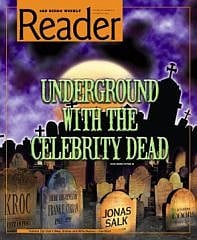
Whether you're goth or you just dig celebrity graves (that's "dig" as in "enjoy"), you might be interested to know of these famous former neighbors entombed at a gravesite near you.
BOBBY DRISCOLL (1937-1968) starred as the plantation boy in Song Of The South (1946), becoming the first child actor signed to an exclusive contract by the Disney studio. After winning a special Oscar for his role in the thriller The Window (1949) and voicing Disney's Peter Pan (1953), he left show business in the mid-fifties. In later years, he was arrested for drug possession, assault, and forgery, serving six months in prison and spending time in a mental institution. He died from complications related to hepatitis (heart attack from liver failure and advanced arteriosclerosis) and was found by children playing in an abandoned New York City tenement building. He was buried in an anonymous grave in Potter's Field on Hart Island until his identity was discovered a year later. His family removed his remains and interred them next to his father (who died in 1969) at Eternal Hills Memorial Park in Oceanside (Calvary section, block 243, lot 7).
AMELITA GALLI-CURCI (1882-1963), born in Italy, was a leading soprano of her day. She specialized in coloratura (singing elaborate ornamentation with improvised or written-out passages), earning up to $2,500 per performance by 1920. Discovered by famed composer Pietro Mascagni, she sang opposite Enrico Caruso and Beniamino Gigli before developing a throat tumor in 1935 (surgeons removed a six-and-a-half-ounce goiter) and retiring. Fondly recalling San Diego and her performances at the Savoy Theater on 236 C Street, she moved to Rancho Santa Fe with her husband in 1949. They hoped the local air would help her mate's asthma, though he died in 1956. Moving to La Jolla in 1961, she designed her home to resemble a Tuscan villa and told friends she liked to "converse with and caress trees." After developing an interest in occult subjects like palm reading, she became friends with Paramahansa Yogananda, leader of Encinitas' Self Realization Fellowship. She died of respiratory failure and was cremated, with her ashes interred at Cypress View Mausoleum and Crematory (Imperial Avenue at 40th Street).
ERNESTINE SCHUMANN-HEINK (1861-1936), born in Prague, also sang with Caruso and was considered a virtuoso contralto (lowest pitched female voice) singer. She was best known for American performances of "Stille Nacht" ("Silent Night" by Joseph Mohr and Franz Gruber) and Brahms' "Wiegenlied" which popularized those songs in the States. Up until the year of her death, she performed in concerts, operas, and on vaudeville stages as well as releasing several albums for Victor Records and appearing in one movie, 1935's Here's to Romance. While touring California in January 1910, she paid $20,000 for 500 acres of land in Grossmont and El Cajon, building a house on one of the Grossmont lots. At the 1915 San Diego Panama-California Exposition, she performed for over 27,000 people at the Balboa Park Organ Pavilion. When the Exposition closed at midnight, January 1, 1917, she sang "Auld Lang Syne" for the crowd. On Christmas Eve 1918, she performed dual shows at San Diego City Plaza and at Camp Kearny; both audiences wore face masks due to an influenza outbreak. In 1922, she bought a three-story, gray stucco mansion in Coronado from John D. Spreckels. She died of leukemia and is buried at Greenwood Memorial Park on Imperial Avenue (Cathedral Mausoleum, Corridor Of Sunshine). Her son Ferdinand Schumann-Heink, an actor who appeared in around 65 films, including Hell's Angels and Blonde Venus, is buried next to her.
BUM, THE TOWN DOG (1886-1898) was a community-pet St. Bernard who lived downtown circa the late 1800s. A puppy when he stowed away on a steamer in San Francisco, he disembarked in San Diego and quickly became a local celeb of sorts. He fled all attempts to adopt him, preferring to sleep on the sidewalks and forcing pedestrians to step over or around him. He made daily rounds among butchers and restaurants for scraps and was so well known that many eateries displayed signs reading "Bum eats here." He often rode with firemen in fire wagons and appeared in parades, drawing cheers with each public appearance. When San Diego began requiring dogs to be licensed with fees, the City Council declared Bum exempt and even imprinted his image on the earliest licenses manufactured. As he grew older, he suffered from rheumatism, becoming so crippled that the city Board Of Supervisors granted him a home at the now-defunct County Hospital, located at the end of Front Street on "Pill Hill," where he died a few months later. He was buried on the grounds, but no memorial plaque was made and his gravesite is now covered in cement.
BILLY VAUGHN (1919-1991), born in Glasgow, was a jazz and classical musician known for playing two saxophones at the same time. Starting out as a singer for the vocal quartet the Hilltoppers ("P.S. I Love You") in 1952, he went on to serve as music director for Dot Records, arranging dozens of pop music hits in the '50s and early '60s, including many "cleaned-up" rock-and-roll songs for Pat Boone. The multi-instrumentalist released many albums of orchestral and easy-listening instrumental music, scoring a number-two hit in 1954 with "Melody of Love" and seeing 36 of his records enter the U.S. album charts between 1958 and 1970, when his last album was released. In all, he received 11 gold and two platinum records; it says so right on his tombstone. He died in Palomar and is buried at Oak Hill Memorial Park in Escondido (section 11, lot 437, grave 3).
JACK DALTON HOGG, aka "CURLY" HOGG (1915-1974) was a member of the Americana/cowboy music group the Sons Of The Pioneers and acted in several bit roles on TV and in films. He's buried at Glen Abbey Memorial Park Cemetery in Bonita (section 72, lot 3, grave 123).
VICTOR BUONO (1938-1982) was born in San Diego, graduating from St. Augustine High School. Taking up acting, he spent his 18th summer onstage at the Old Globe Theatre. He made his first network TV appearance at age 21, playing hip beatnik "Bongo Benny" on 77 Sunset Strip. Best known for Whatever Happened To Baby Jane? (1962) and playing King Tut on the Batman TV series, he also released a record album in 1972 (Heavy, Dore Records LP-325) with titles like "Someday When I'm Skinny," "Fat Man's Prayer," and "You Don't Have to Be Fat to Hate Rome." Buono was overweight most of his life and he died of a heart attack at his ranch in Apple Valley and is buried at Greenwood Memorial Park on Imperial Avenue (Lily Lake crypt 1, tier A).
ANDREW PHILLIP CUNANAN (1969-1997) graduated from La Jolla's Bishop's School in 1986 with his yearbook photo captioned "most likely to be remembered." He briefly studied history at UCSD and worked at California Cuisine on University Avenue. A gay gigolo who frequented Hillcrest bars, he became the subject of a nationwide manhunt after killing four people (the first two were former lovers of his who'd hooked up and moved to Minneapolis). He was the first person from San Diego to be placed on the FBI's "Ten Most Wanted" list and organizers of the 1997 Gay Pride Parade in Hillcrest held a public forum to discuss additional security measures, in case Cunanan were to show up. While hiding out in Florida, he took a fifth victim, Italian designer Gianni Versace. It's now believed there may have been an earlier victim too -- Cunanan was linked in a recent FBI report to the June 1992 death of Todd Loren, founder of Revolutionary Comics. Cunanan shot himself to death on a Florida houseboat and is buried at Holy Cross Cemetery on Hilltop Drive (Rosary Chapel 6, upper, niche area, unmarked).
TODD S. LOREN (1960-1992), real name Stuart Shapiro, founded Revolutionary Comics in 1989, published out of Hillcrest. His best known title Rock 'N' Roll Comics broke indie comic book sales records in the early 90s. When not being sued by the New Kids On The Block and other celebrities over his unauthorized illustrated biographies, he managed to release around 200 comic books. The New Kids lawsuit, which he won, established (for the first time) First Amendment rights for comic books. His murder was unsolved for many years -- however, Loren was apparently (according to friends, family, and a recent FBI report) romantically involved with future serial killer Andrew Cunanan. Loren was stabbed and his head bludgeoned in the bedroom of his Hillcrest condo, and his car was stolen, fitting the M.O. Cunanan later established. His headstone in the Mount Shalom section of El Camino Memorial Park on Carroll Canyon Road reads "Beloved Son, Infinite One."
KATE MORGAN (1868-1892), whose ghost allegedly haunts room 302 (now 3312) of the Hotel Del Coronado, was a pretty 24-year-old woman when she checked in alone (as "Lottie A. Bernard" from Detroit, Michigan) on Thursday, November 24, 1892. Five days later, she was found dead on an outside staircase leading to the beach, of an apparent self-inflicted gunshot wound, though some speculate that she was murdered by her gambler husband. Many hotel guests claim they've seen objects move by themselves, lights flicker, and TVs turning themselves on and off in the room where Morgan stayed. She's buried at Mount Hope Cemetery on Market Street.
BEST PAL (1988-1998) was the most winning California-bred racehorse ever. In six years of racing, he earned over $5.5 million dollars for his owners at Golden Eagle Farm in Ramona. In his first race in May 1990 at Hollywood Park, his odds were 9-2 and he won by a half-length. He went on to win the first Pacific Classic at Del Mar in 1991 (a million dollar purse), finished second at the 1991 Kentucky Derby and won the 1993 California Gold Cup at Hollywood Park. In all, he won 18 of 47 starts until he retired in 1996, third on the all-time racehorse money-earners list. Best Pal died of apparent heart failure two years later while being ridden at a Ramona training track. He's buried at Golden Eagle Farm, in a plot near the ranch office building. A pyramidal boulder marks the grave with an inset plaque reading "Best Pal 1988-1998."
RAYMOND CHANDLER (1888-1959) popularized the detective story, first in pulp magazines and then with his first novel in 1939, The Big Sleep. Creator of the "Philip Marlowe" character, he also wrote screenplays for films like The Blue Dahlia (1946), The Big Sleep (1946), and Strangers On A Train (1951). He and his wife Cissy moved to La Jolla in 1946, settling into a white stucco cottage he called Camino de la Costa, where he lived out most of the rest of his life. Cissy died in 1954, the same year he completed his last novel, The Long Goodbye. Chandler began drinking heavily and spent time in a Chula Vista sanitarium after trying to commit suicide, in what friends characterized as an attempt to join his wife in death. "Anything else I did in life," he once wrote, "was just the fire for her to warm her hands at." He died of pneumonia while hospitalized at Scripps Clinic. Several of his letters and smoking pipes are on display at the La Jolla Library. He's buried at Mount Hope Cemetery on Market Street (division 8, section 3).
DICK WESSEL (1913-1965) was an actor on stage, screen, and television who spent World War II as a Marine. Between 1933 and 1965, he appeared in dozens of films, including the Marx Brothers' Duck Soup (1933), Yankee Doodle Dandy (1942), An American in Paris (1951), Gentlemen Prefer Blondes (1953), and the monster classic Them! (1954). He's best known as the titular bald villain in Dick Tracy VS. Cueball (1946), and he played "Carney" on the 1959 TV show Riverboat. Wessel's last role was as the frenetic delivery man in Disney's The Ugly Dachshund (1965). He died of a heart attack and is buried at Fort Rosecrans National Cemetery (section PS-3, lot 370-E).
JOSEPH COORS, SR. (1917-2003) was born in Colorado into the family who owned the Coors Brewing company, founded by his grandfather. He began working at the plant as technical director in 1946, becoming Executive Vice President in 1975 and President in 1977. While serving as Chief Operating Officer from 1985 to1987, he bitterly fought labor leaders over unionization of the plant. A staunch conservative, he was friends with Ronald Reagan and became a member of the President's so-called "kitchen cabinet" advisory board. He died of cancer (lymphoma) in Rancho Mirage in Riverside County and is buried in El Camino Memorial Park in La Jolla, with his gravestone reading "His vision lives on through his works."
MARIE MAROLDO (1901-1979), born in France, was a singer and actress who used her stature as a "little person" to lands gigs on vaudeville stages (where she performed a reportedly disturbing burlesque act) and in several movies, most notably in The Wizard Of Oz (1939) as one of the singing Munchkins. Sometimes billed as "Lady Little," she married fellow midget Johnny Winters and retired to live near downtown, where she worked for a time in a bookstore. She's interred at Greenwood Memorial Park on Imperial Avenue (Cathedral Mausoleum, Sanctuary of Dawn, crypt 25, tier D).
JOSEPH FREDERICK RUTHERFORD (1869-1942) was a member of a religious group called the Russellites -- they eventually were known as Jehovah's Witnesses. He rose in the ranks to lead the group after the death of founder Charles T. Russell in 1916, becoming the second president of the Watchtower Bible and Tract Society. Deciding to give himself the title of "judge," he moved to San Diego in 1919 after contracting pneumonia, hoping the climate would improve his delicate health. In 1929, he commissioned construction of a lavish ten-room mansion on Braeburn Road in Kensington called Beth Sarim ("House of Princes" in Hebrew), deeded to none other than King David of Israel, Moses, Abraham, Gideon, Isaac, Barak, Joseph, Samson, Jacob, Jephthae, Samuel, and various other ancient Biblical figures mentioned in Hebrews chapter 11, all of whom Rutherford insisted would return from the dead to live at Beth Sarim. The deed specified that Rutherford could live in the house until they arrived. Of course, the ancient prophets never showed up, and so Judge Rutherford resided in the mansion until his death, while his followers lived in poverty during the Great Depression of the 1930s. Jehovah's Witnesses quietly ceased teaching of the imminent return of their Hebrew heroes after the house was sold in 1948. Judge Rutherford is said to have been illegally buried on the property, at least according to many Jehovah's Witnesses, though this has never been proven.
FRANK EARL CURRAN (1912-1992) was Mayor of San Diego from 1963 to 1971. His election was earmarked by a contentious civic struggle over city planning. During his terms, he was responsible for building City College's Curran Plaza and walkway, constructed so students wouldn't have to cross the busy street between classes. He was re-elected in 1967, but in 1970 he and seven current or former city council members were indicted for bribery and conspiracy over allegedly taking bribes in exchange for supporting a rate increase for the Yellow Cab company. Curran was acquitted, but he lost his bid for re-election. Eight years after his 1992 death, when his wife Florence passed away in 2000, it was discovered he'd left their estate -- worth approximately $1 million dollars -- as a surprise bequest to City College, where he'd taken classes when it was called San Diego Junior College. He's buried with his wife at Eternal Hills Memorial Park in Oceanside.
BILLY DANIELS (1915-1988), real name William Boone Daniels, had his own 1952 TV show on ABC, The Billy Daniels Show. The 15-minute Sunday night show was the first network TV variety program hosted by an African American. During every episode, he sang "That Old Black Magic" by Harold Arlen and Johnny Mercer. The show only lasted thirteen weeks but he turned up often on other variety programs like The Colgate Comedy Hour. He later became a Broadway actor, co-starring in Golden Boy with Sammy Davis, Jr., beginning in 1964 (the show ran for 568 performances, not counting previews), and receiving second billing behind Pearl Bailey in a revival of Hello, Dolly! He's buried at El Camino Memorial Park in La Jolla (Madonna lawn section, lot 360-D).
JOHNNY MOREY DOWNS(1913-1994) appeared as "Johnny" in around two dozen of Hal Roach's Our Gang comedies between 1923 and 1927. As he grew older, he began singing and dancing on vaudeville stages and on Broadway before returning to Hollywood in 1934. He appeared in several "college musical" films, usually playing jocks in movies like Hal Roach's All American Co-Ed (1941). He returned to Broadway in the hit play Are You With It but found roles becoming scarce. After moving to San Diego, he hosted regional kiddie shows on TV but eventually retired and launched a successful career as a real-estate investor. He died of cancer and was cremated, with his ashes interred at Holy Cross Cemetery on Hilltop Drive (St. Elizabeth Urn Garden, plot 278, grave 3-G).
ULYSSES S. GRANT, JR. (1852-1929) was the second son of the eighteenth U.S. President. Born when his father was an Army lieutenant in the Fourth Regiment, Junior became a New York lawyer in 1876. In the early 1880s, he was a partner in the investment firm of Grant and Ward, a company he convinced his father to invest capital in. Unfortunately, the firm was a swindle sham cooked up by one Ferdinand Ward. When it collapsed in 1884, the entire Grant family became impoverished. After doctors recommended he live in a warmer climate, he moved to San Diego in 1893 with his wife Fannie Josephine and their young children, getting involved in local real estate. Among his construction projects was the U.S. Grant Hotel on Broadway, downtown, which opened in 1910. He worked for his father as a secretary for 18 months during the senior Grant's second term and ran for U.S. senator in 1904 (he lost). A heavy smoker, he died from throat cancer (which also killed his father) shortly after returning from a trip abroad. Grant's tomb, or at least his gravesite, is at Greenwood Memorial Park on Imperial Avenue. Fannie and his second wife, America, are buried next to him, while his and Fannie's children (and the childrens' spouses) surround them.
ALONZO HORTON (1813-1909) arrived in San Diego at age 54 with his fourth wife, Sarah Babe Horton, in 1867. With an investment partner, the former lumberjack, basket maker, grocer, cattle dealer, and furniture-shop owner purchased roughly 900 acres of waterfront land for around thirty cents an acre. After having the land surveyed, he mapped out planned city blocks 300 x 200 feet, with lots 50 x 100 feet. Two years later, he paid $4,000 for another 160-acre parcel needed to fully own the part of town he decided to call the Horton Addition. In 1869, he spent about $50,000 to build a wharf at the end of 5th Avenue. By 1870, he'd constructed the town's first public theater -- Horton Hall at 6th and F -- as well as its first bank (which he became president of). In 1894, he sold to the city the half-block area now known as Horton Plaza Park, with the stipulation that it must forever remain a park. Surviving into his mid-nineties, he ended up losing most of his properties through tax sales and foreclosures, after a depression hit the area and the population dropped from around 40,000 to about 16,000. He was married five times, though most published records only mention three or four of his wives. He did not have any children. Horton died at the Agnew Sanitarium and is buried at Mount Hope Cemetery on Market Street (division 1, section 1).
NATHAN HARRISON (1823-1920) was born a slave in Kentucky, eventually becoming California's first known black business proprietor. Around 1848, he traveled to California to mine with his master, Lysander Utt. In 1850, when California became part of the Union as a free state, Utt could no longer legally keep a slave. Now a free man, Harrison moved to Temecula and raised sheep near the Agua Tibia ranch. As he became more accomplished, he took to herding sheep and cattle for ranchers in Doane Valley near Palomar Mountain. He also worked as a cook and baker until deciding to become a homesteader. Building a cabin on the mountain near a freshwater spring, he opened a way station for travelers along the winding wagon road connecting Pauma and Doane Valley. Besides offering trade goods, he later provided water to early motorists whose radiators overheated from the climb, as well as selling fruit from his own garden and cooking meals for passing patrons. Becoming ill in 1920, he traveled to San Diego to see a doctor and died of pulmonary congestion at age 97. In 1955, at the site of his cabin, a U.S. Historical Monument bronze plaque was mounted, the first one ever dedicated to a black man. The County of San Diego named the east Palomar Mountain byway "Nathan Harrison Grade Road." He's buried at Mount Hope Cemetery on Market Street, with his gravestone reading "Born a slave, died a pioneer."
ELISHA BABCOCK, JR. (1848-1922), born in Chicago, was a civil engineer responsible for the construction of the Hotel del Coronado. He moved to San Diego in 1884 on doctor's orders, hoping the climate would stave off symptoms of tuberculosis, along with wife Isabella and a friend named Hampton L. Story, whose family manufactured pianos. Well-off from railroad investments, Babcock and Story bought 4,185.46 acres of land on Coronado and North Island for $110,000, hoping to attract residential buyers and raise money to build a world-class hotel. Six thousand people showed up for the pair's first land auction on November 13, 1886, with buyers paying an average of $1,000 per lot. Every deed included a stipulation that "no liquors shall ever be sold or drunk on the premises," meaning anyone who wanted to get drunk legally had to do so at the (still unbuilt) hotel. Land sales eventually earned the duo $2.2 million dollars, enabling them to break ground on the hotel in March 1887. Thomas Edison came in to advise on installing a power generator, and 399 bedrooms were available by opening day, February 19, 1888. Soon, John D. Spreckels bought out Story and then paid Babcock more than one million dollars for his share of the hotel, retaining him as hotel manager. Babcock later built the city's first electric-lighting network in 1904 and developed over 4000 acres of San Diego property. However, he ended up nearly bankrupt after a flood ruined many of his businesses in 1916 and his enterprise, the Western Salt Company, failed. Babcock is buried with his wife at Mount Hope Cemetery on Market Street (division 3, section 6).
RAY KROC (1902-1984) became a partner in the McDonald's fast-food chain (then consisting of eight southern California locales) with its founders Richard and Maurice McDonald in 1954. Operating on their behalf, Kroc sold restaurant franchises around the country, keeping 1.9% of each store's gross receipts for himself. In 1961, the McDonald brothers sold their interest in the company to Kroc for $2.7 million dollars, though they retained ownership of the chain's very first outlet in San Bernadino at 1398 North E Street (14th and E). In his autobiography Grinding It Out, Kroc later wrote: "What a goddamn rotten trick...I opened a McDonald's across the street from that store, which they had renamed The Big M, and it ran them out of business." In actuality, Kroc's store was a block north, but the Big M did close two years later. He stepped down as McDonalds' CEO in 1974 (instead becoming Chairman and then, in 1977, Senior Chairman) and used his riches to purchase the San Diego Padres baseball team the same year. The ruthless businessman was once quoted, "If my competitor were drowning, I'd stick a hose in his mouth and turn on the water." He died of heart failure and is buried with his wife Joan at El Camino Memorial Park in La Jolla (Sunset Couches area, section D, bay 2).
JOAN B. KROC (1928-2003), billionaire widow of Ray Kroc, inherited the Padres from her husband in 1984 (the team made it to its first World Series that season, though they lost). She sold the team in 1990 for $75 million dollars. Born Joan Beverly Mansfield, she married Ray Kroc (her second husband) in 1969. An avid humanitarian and proponent of world peace and nuclear disarmament, her first major philanthropic endeavor in 1976 was funding Operation Cork, a La Jolla based alcoholism educational program. In 1985, she gave $3.3 million dollars to the San Diego Zoo, and she later donated $25 million dollars to found the Joan B. Kroc Institute for Peace and Justice at UCSD (opened 1991). One of her biggest area contributions, late in life, was $87 million dollars given to the Salvation Army to develop the Ray and Joan Kroc Corps Community Center for arts and recreation in east San Diego. The center opened in 2002 and includes an indoor ice skating rink, three swimming pools, a library, and a $15 million dollar theater. She died of cancer at her home in Rancho Santa Fe, leaving in her will over $200 million dollars to National Public Radio, including $5 million for local NPR station KPBS. She's buried with her husband at El Camino Memorial Park in La Jolla.
DICK (RICHARD) W. SIMMONS (1913-2003), born in Minnesota, was an actor whose career spanned forty years. Between 1937 and 1977, he performed in over 60 films and nearly two dozen TV shows. After moving to L.A. in the 1930s, he was signed to MGM Studios as a contract player and appeared in movies like A Million To One (1937), Lady In The Lake (1947), and The Three Musketeers (1948), though he left Hollywood for the military to serve in World War II. In later years, he took roles in flicks like Rear Window (1954), Rat Pack films Sergeants Three (1962) and Robin and the Seven Hoods (1964), and Lassie's Great Adventure (1965). He's best known as Sergeant Frank Preston on the half-hour syndicated TV series Sgt. Preston Of The Yukon (1955-1958), playing a Canadian Mountie who caught criminals with the aid of his Husky dog Yukon King and his horse Rex. He ended each episode by hugging his dog and saying, "Well, King, it looks like this case is closed." Later TV appearances included roles on Leave It To Beaver, I Spy, Brady Bunch and Dragnet 1967. Simmons died of Alzheimer's disease and is buried at Eternal Hills Memorial Park in Oceanside (Sanctuary Of Hope, niche 40, plot D).
JONAS SALK (1914-1995) became the head of the Virus Research Lab at the University of Pittsburgh in 1947 and began studying the polio virus. In 1952, he tested the lab's new vaccine (developed by he and many other scientists) by injecting volunteers, including himself, his wife, and their three sons. They all began producing antibodies to the disease, and he published these results in the Journal of the American Medical Association as nationwide testing began. Salk became a public hero, not just for his part in nearly eradicating a deadly disease but for his altruism in refusing to patent the vaccine. The injected vaccine was eventually replaced by an oral variation developed by Albert Sabin, as Salk found himself accused by scientists he'd worked with of hogging all the glory for the initial successes. In 1960, San Diego Mayor Charles Dail, who'd had polio, invited Salk to move to San Diego by offering him seventy acres of land just west of the proposed site for UCSD, on which he could build a center for medical and scientific research. In 1963, he founded the Salk Institute for Biological Sciences in La Jolla, saying at the time, "I couldn't possibly have become a member of this institute if I hadn't founded it myself." With initial financial support from the National Foundation/March of Dimes, the architecturally unique structure housing the Institute was finished in 1967 -- the original Institute buildings were declared an historic landmark in 1991. Salk's last years were spent searching for a vaccine against AIDS. He died of congestive heart failure and is buried at El Camino Memorial Park in La Jolla (Mount Shalom section, lot 386-A).
RICHARD T. GARRICK (1878-1962), born in Ireland, was an actor whose real name was Richard T. O'Brien. He changed his name to appear less ethnic to casting agents. Besides serving in the 26th Regiment Infantry, he performed in around three dozen films between 1912 and 1956 including Green Grass of Wyoming (1948), A Streetcar Named Desire (1951), Viva Zapata (1952), Stars and Stripes Forever (1952), and High Society (1956). He also directed around two dozen silent films, beginning with Exposed by the Dictograph in 1912. In the early to mid-fifties, he turned up on TV shows like Cavalcade Of America, Dragnet, and My Friend Flicka. He's buried at Fort Rosecrans National Cemetery (section Y, grave 59).
LLOYD HAYNES (1934-1987), real name Samuel Lloyd Haynes, was an African American Marine commander who served in Korea. Later turning to show business, he became a TV crewman until a casting agent decided he was too charismatic to waste behind the camera. As an actor, he's best known for playing Mr. Dixon, the with-it history teacher on ABC's topical TV show Room 222 (1969-1974). He also appeared in films like Ice Station Zebra (1968) and The Greatest (1977). One of his last roles was as Mayor Morgan on the TV soap General Hospital. He died of lung cancer and is buried at Eternal Hills Memorial Park in Oceanside (Folded Flags block, lot 3).
MILBURN STONE (1904-1980) was best known for playing Dr. Galen Adams ("Doc") on the TV show Gunsmoke. He started his career in vaudeville as half of the song-'n-joke team of Stone and Strain. After settling in Hollywood in 1935, he became a contract player for Universal Studios, later appearing in films such as The Atomic City (1952) and Invaders From Mars (1953). A Gunsmoke cast member from 1955 through 1972, he retired from the show due to poor health and settled in San Diego with wife Jane Garrison Stone, but not before winning an Emmy for his role in 1968 and earning a star on Hollywood's Walk Of Fame. His brother Joe Stone was for many years a columnist for the San Diego Evening Tribune and later the San Diego Union until retiring in 1977. Stone died of a heart attack in La Jolla and was inducted posthumously in 1981 into the Western Performers Hall of Fame at the National Cowboy & Western Heritage Museum in Oklahoma City. He's buried at El Camino Memorial Park, his headstone reading "Lord I Am With You Above" (Vista del Lago section, lot 401-D).
JOHN ALEXANDER "BID" MCPHEE (1859-1943) was inducted into the National Baseball Hall Of Fame in March 2000, though his career unfolded a century previously. Considered the top second baseman of his day, he played for the Cincinnati Red Stockings (1882-1889) and the Cincinnati Reds (1890-1899) in both the American Association and the National League. McPhee remains the all-time leader among second basemen in putouts (6,545), and his 529 putouts in 1886 is the single-season major league record. He never wore a fielder's glove until late in his career, choosing to instead toughen up the skin on his hands by soaking them in salt water. He told the Cincinnati Enquirer in 1890 "I cannot hold a thrown ball if there is anything on my hands. The glove business has gone a little too far." After injuring a finger, he finally put on a glove for the 1896 season. He retired as a player after the 1899 season but returned to manage the Reds to a last-place finish in 1901. In 1902, he resigned after only 65 games but continued to scout for the team until 1909, when he quit baseball altogether and moved to Ocean Beach, where he lived for over thirty years. He died at home and is interred at Cypress View Mausoleum and Crematory on Imperial Avenue (Shepherd Lane, corridor 4, niche 98).
CHRIS-PIN MARTIN (1893-1953), real name Ysabel Ponciana Chris-Pin Martin Piaz, appeared in around 125 films, beginning with The Gold Rush (1925) and ending with Mesa Of Lost Women (1953). Born in the Arizona territory to Mexican parents, he usually played comically dim-witted Hispanic characters named Pepe, Pancho, Poncho, Pedro, Paco, or Pico in films like Billy The Kid (1930), The Gay Desperado (1936), and The Ox-Bow Incident (1943). He's best known as sidekick Pancho in several "Cisco Kid" movies, opposite screen swashbucklers Cesar Romero, Gilbert Roland, Warner Baxter, and Duncan Renaldo. He essentially played the same role as sidekick Gordito in several "Zorro" films of the 1930s and '40s. He died of a heart attack in Montebello and is buried at the Odd Fellows Cemetery in Fallbrook (avenue 25, lot 46, grave 12).
DOROTHY HELEN KELLY (1918-1969) was an actress who appeared in films like Yankee Doodle Dandy (1942), The Falcon And The Co-Eds (1943), and The Sky's The Limit (1943). She burned to death in a La Jolla fire and is buried at El Camino Memorial Park (Loma Siesta section, lot 132-C, grave 2).
WILLIAM KETTNER (1864-1930) was a U.S. Congressman, elected in 1913 as a Democrat representing California's 11th District in the U.S. House of Representatives. He served four terms, until 1921, the same year Kettner Boulevard (formerly Arctic Street) was named after him. He moved to San Diego in 1907 to establish an insurance agency but ended up being talked into running for Congress. On his election, realizing the strategic value of having Naval and Marine bases in San Diego, he made it happen by talking with Navy officials about dredging the harbor so that large ships could dock. After spending an evening at the Army and Navy Club in Washington discussing the matter with the General Board of the Navy Department, the Senate Commerce Committee appropriated $249,000 for San Diego to accomplish this. He played such a large role in making San Diego home to the Panama-California Exposition (celebrating the completion of the Panama Canal) that organizers declared May 13, 1915, "Kettner Day." Kettner was also involved in the beginnings of the North Island Naval Air Station and, under his sponsorship, the Navy built the Naval Hospital in the Balboa Park area in 1919. In 1921, he stepped down as Congressman due to poor health and a financial downturn in his insurance business. Kettner died at Mercy Hospital and was buried in a Masonic service at Greenwood Memorial Park on Imperial Avenue.
REED HOWES (1900-1964), real name Hermon Reed Howes, was a Harvard graduate and former Arrow shirt model who made his mark in Hollywood as a dashing silent-film hero. He played in over 150 films between 1923 and 1961, the majority westerns, taking on more villainous roles after the advent of movie sound. He appeared in serials and films, including The Lone Ranger (1938), Buck Rogers (1940), The Cheyenne Kid (1940), The Stork Club (1945), Superman (1948), and Hangman's Knott (1952). Among the TV shows he appeared in during the '50s were Wild Bill Hickock, The Gene Autry Show, and Cisco Kid. His last film role was in Ed Wood, Jr.'s The Sinister Urge (1961). The one-time Navy recruit is buried at Fort Rosecrans National Cemetery (section X, lot 2163).
THOMAS J. HIGGINS (1923-2000) was a cartoonist and trivia buff who drew a record 487 comics for the daily syndicated strip Ripley's Believe it or Not. He was drafted into the Army in 1943, serving as an aircraft mechanic stationed in the Philippines and then being assigned to Japan as a staff sergeant. On his return to civilian life, aside from drawing for Ripley's, he created cartoon strips for trade publication like Auto-Oddities for a car dealer, Mutual Mirror for an insurance agent, Matter of Fact for dairy products, and Electrivia for an electrical wholesaler. In 1981, when his 100th contribution to Ripley's was published, his own cartoon likeness was included in the panel. In 1984, he and his wife Teresa moved to San Diego, hoping the climate would alleviate complications he endured from scarred lungs suffered during the post-World War II occupation of Japan (he'd spent two years in an Army hospital). He joined the Southern California Cartoon Society and, as a hobby, began carving birdhouses and walking sticks out of driftwood he found on local beaches. Higgins died of pulmonary failure at Veterans Affairs Medical Center, with his memorial service held at St. Mark's United Methodist Church in Clairemont. He was cremated and his ashes interred at Fort Rosecrans National Cemetery.
DAN BRODERICK (1944-1989) and LINDA BRODERICK (1961-1989) were murdered by Dan's ex-wife Betty. Dan met Betty while attending Notre Dame as a pre-med student, marrying her in April 1969. Deciding to become a medical malpractice lawyer, he enrolled at Harvard Law School while Betty worked to support the two of them. On graduation, he got a well-paying job (over a million dollars yearly) as an attorney in San Diego. Over the next few years, the couple had four children. After hiring a new secretary in 1983, 21-year-old Linda Kolkena, Dan began an affair with her. Dan and Betty were legally separated in 1985, but Betty didn't take it well, harassing the new couple so much that she was jailed twice for violating restraining orders against her and was committed for several days to a mental institution. Upon their January 1989 divorce, Dan got custody of their children, and Betty received a $30,000 lump sum and $9,000 in monthly alimony (she'd petitioned for a million dollars and $25,000 a month). On November 5, 1989, Betty entered the new couple's house with a key she'd stolen from her daughter and shot Dan and Linda to death as they slept in their bed. Dan and Linda Broderick are buried at Greenwood Memorial Park on Imperial Avenue (Olive section, near the roadway).
ARCHIE MOORE (1913-1998) moved to southeast San Diego in 1938, two years into his boxing career. Nicknamed "The Old Mongoose," he held the Light Heavyweight title for 11 of the 27 years he boxed. He scored more knockouts than anyone -- between 136 and 145, depending on the scoring method used. His 1958 title defense against Yvon Durelle is often cited as one of boxing's greatest fights, and he's the only boxer to fight both Rocky Marciano (1955) and Muhammad Ali (1962, when he was still called Cassius Clay). Ali/Clay predicted for reporters at the time, in typical rhyme, "Archie Moore must fall in four." Moore was indeed beaten by a knockout in the fourth round. He retired in 1963 with a final record of 181 wins, 24 losses, 9 draws, and a single no contest. In later years, he established a local sporting program for underprivileged kids called "Any Boy Can" and was granted a ceremonial "Key To The City" by San Diego officials in 1965. A road in Ramona was named after him, and he was inducted into the International Boxing Hall of Fame in 1990. Moore died of heart failure and was cremated, with his remains interred in an urn at Cypress View Mausoleum And Crematory on Imperial Avenue (Apostle Gallery, niche 401).
NAT PENDLETON (1895-1967) was an actor and Olympic athlete. While attending Columbia University, he was a two-time Eastern Intercollegiate Wresting Association champion (1914 and 1915). At the 1920 Olympics in Belgium, he won the silver medal in wrestling. He briefly turned to professional wrestling before going Hollywood to play strongman Sandow in The Great Ziegfeld (1936) with William Powell. He'd work with Powell again, playing Detective John Guild in several "Thin Man" movies, and he appeared in Bela Lugosi's only color film, Scared To Death (1947). In conjunction with his acting career, he wrote a film in 1933, Deception, in which he played -- what else? -- a wrestler. After winding down his career with roles on TV shows like Dr. Kildare, he died of a heart attack and was cremated, with his ashes interred at Cypress View Mausoleum and Crematory on Imperial Avenue (corridor A NW, number 9 -- inside of door frame on left side).
LADY'S SECRET (1982-2003) was a racehorse nicknamed "The Iron Lady." The daughter of champion racer Secretariat, she had 25 wins out of 45 starts, in addition to winning nine places and three shows with total earnings of over $3 million dollars. She won the 1986 Breeders' Cup Distaff (G1), Whitney Handicap (G1), and Beldame Stakes (G1) and was named 1986 "Horse Of The Year." She was inducted into the Thoroughbred Hall of Fame in 1992. In March 2003, she died of complications from foaling and was buried under an oak tree in the pasture where she romped each day with her friend, Superb Dawn, at Valley Creek Farm in Valley Center.
BARBARA PAYTON (1927-1967), real name Barbara Lee Redfield, left her husband in Minnesota in 1945 to attempt a Hollywood career and was later signed to Universal as a contract player for $100 a week. She debuted in the comedy Once More, My Darling (1949) and quickly gained a reputation as a party girl and "queen of the casting couch," as one columnist referred to her. Eventually going public about her affairs with Howard Hughes, John Ireland, George Raft, and Bob Hope, she told Confidential Magazine of the latter: "We only knew each other a few hours before we knew each other as well as a boy and girl ever can." Universal dropped her, but Warner Brothers picked up the beautiful 5' 4" blonde on contract at $5,000 a week. Among her best roles were Trapped (1949), Kiss Tomorrow Goodbye with James Cagney (1950), Only the Valiant (1951) with Gregory Peck, and later B-movie backburners Bride of the Gorilla (1951) and her final film Murder Is My Beat (1955). Warner Brothers eventually dropped her under her contract's "morals" clause, and she slid into obscurity with Bad Blonde (Hammer Films, 1953) and Terence Fisher's sci-fi bomb Four-Sided Triangle (1953). She earned headlines in the mid-fifties after giving two of her fur coats (valued at over $12,000) to the owner of an L.A. bar in lieu of her $200 bar tab, losing her Beverly Hills mansion over unpaid bills and getting arrested for passing bad checks at Hollywood's Liquor Locker. In February 1962, she was arrested for prostitution after propositioning an undercover cop -- for $10 -- in a Sunset Boulevard bar. She was arrested several more times for public drunkenness, culminating with a 1965 heroin bust. In February 1967, trash workers found her passed out in a dumpster bin, and she was admitted as an indigent at L.A. County General Hospital, diagnosed with "chronic alcoholic psychosis." A county social worker delivered her to her parents' home on Titus Street in Mission Hills, San Diego. On April 25, 1967, Payton drove a car into a parked vehicle at Fort Stockton Drive and Stephens Road but escaped being charged in the incident. Thirteen days later, her mother found her slumped over a toilet in their home. Payton died of heart and liver failure before an ambulance could arrive. Her ashes are interred at Cypress View Mausoleum and Crematory on Imperial Avenue (Chapel of Promise, downstairs, niche 28, middle section near top right side).
THOMAS WHALEY (1823-1890), the son of a New York merchant family that owned the land now known as Central Park, moved to San Diego in 1851 and built what's now the oldest still-extant brick structure in Southern California, located in Old Town. Constructed in 1856-1857 and originally intended as a home, it also served as a granary, billiard hall, theater, and one of the city's earliest courthouses. Among Whaley's endeavors was brick-making in Mission Valley (the first burnt bricks made in San Diego), serving as city clerk from 1881 to 1882 and becoming city trustee in 1886. His off-and-on residence, now known as the Whaley House Museum, is one of only two homes in California to be officially recognized as haunted (certified in the early '60s) by the U.S. Department Of Commerce. Whaley wrote in his journal that he often heard the heavy, spurred footsteps of 6'4" "Yankee" Jim Robinson, who'd been hanged on that plot of land before the house was built. Whaley himself is also said to haunt the house, with visitors claiming to have seen his apparition in the master bedroom or at the top of the stairs, wearing a long coat and top hat. Others claim to smell his Cuban cigar smoke or to hear his speaking voice, albeit addressed to an unseen third person. In addition, the ghost of his wife Anna is said to haunt the premises, and some visitors claim to have seen a ghostly child, presumed to be either Whaley's 17-month-old son who died of scarlet fever or a neighbor's daughter who died after slicing her neck on Anna Whaley's clothesline. Thomas Whaley is buried at Mount Hope Cemetery on Market Street (division 9, section 1).
ANNA WHALEY (1837-1913), whose maiden name was Anna Eloise De Launay, was born in France and married Thomas Whaley in 1853. Her ghost reportedly haunts Old Town's Whaley House Museum, sometimes seen outside at dusk watering the California pepper trees she planted in 1856. An accomplished pianist while alive, she's also been reported to materialize in a ball of light and float down the stairs into the music room, where the piano is sometimes heard playing while nobody is in the room. Most manifestations are said to include the smell of her lavender perfume. She's buried with her husband at Mount Hope Cemetery.
JAMES W. ROBINSON (unknown-1852), aka "Yankee" Jim Robinson, was a French-Canadian western outlaw and alleged horse thief who was tried and publicly hanged after being caught in the San Diego Bay trying to steal a schooner, the Plutus, worth $6500, along with two accomplices (who only got a year in prison). Robinson was hit in the head with a sword by a law officer and subsequently sentenced to hang from a crude cross-bar gallows constructed by the Army during the Indian uprising of January 1952. Robinson, at 6' 4", was too tall for the gallows and ended up slowly suffocating with his toes touching the ground. One man who witnessed his execution, Thomas Whaley, bought the land Robinson was hanged on and built a home. The hanging took place from the freestanding archway between what later became the house's music room and its living room. Visitors to the Whaley house say they've heard Robinson's heavy footsteps and sometimes report feeling a choking sensation when walking under the archway where he was hung. He is buried at Old Town Catholic Cemetery (aka El Campo Santo Cemetery) on San Diego Avenue.
SIEGFRIED "SIG" RUMAN (1884-1967), real name Siegfried Albon Rumann, was a German-born character actor who was equally adept at playing Russians, gypsies, Slavs, Frenchmen, and all sorts of ethnic types. He was a stage actor in Germany who, after a stint in the Army in World War I, immigrated to the U.S. with help from American servicemen he'd made friends with in a prison camp. After several Broadway roles, he made his Hollywood debut in The Royal Box (1929). He went on to appear in over 100 movies, including the Marx Brothers' films A Night at the Opera (1935, as the blustery company director Mr. Gottleib) and A Day at the Races (1937, as Dr. Leopold X. Steinberg). Other notable appearances include Heidi (1937), Ninotchka (1939), Tarzan Triumphs (1943), The Emperor Waltz (1948), Houdini (1953), and White Christmas (1954). He also guest-starred on TV shows like The Addams Family, Daniel Boone, and Petticoat Junction. Ruman retired in Julian and lived there until dying of a heart attack. He's buried at Julian Cemetery on Farmer's Road (first section on the right, end of first row).
PETE ALVIN ROZELLE (1926-1996) spent 29 years as Commissioner of the NFL (National Football League) and played a major role in the launch of TV's Monday Night Football. Between 1960 and 1989, he led the NFL through expansion from 12 teams to 28. In 1962, he persuaded Congress to grant the NFL an exemption from the Sherman Anti-Trust Act, enabling him to meld the NFL with the American Football League to form one large business. This diffused competition between individual teams for what little money television then offered, while forming a giant corporation that could demand increasing amounts of cash to air games. After spearheading the launch of Monday Night Football, he guided professional football into a more popular -- and more profitable -- sport than the so-called "national pastime" of baseball. When Rozelle became the NFL Commissioner in 1960, the league's income was less than $20 million per year; on his 1989 retirement, the NFL was earning around $4 billion annually. He died of brain cancer and is buried at El Camino Memorial Park in La Jolla.
CHARLOTTE HENRY (1914-1980) played the lead in the 1933 version of Alice in Wonderland, winning the role over 6,800 hopefuls who auditioned. A child model, she landed her first role in the 1928 Broadway play Courage, also appearing in the 1930 Hollywood film version. Enrolling at Lawlors, a school for professional children, she befriended classmates like Bette Grable, Frankie Darro and Anita Louise. She went on to appear in Huckleberry Finn (1931) and Lena Rivers (1932), as well as playing Little Bo Peep in Laurel & Hardy's Babes In Toyland (1934). After retiring from motion pictures in 1942, she moved to San Diego to run an employment agency with her mother and worked for fifteen years as an executive secretary for Charles F. Buddy, the Roman Catholic Bishop of San Diego. She married area doctor James J. Dempsey and played occasional roles at the Old Globe Theatre, driving around town in a car with a license plate that saluted her Through-The-Looking-Glass claim to fame: "ECILA" ("Alice" spelled backwards). She died of cancer and is buried at Holy Cross Cemetery on Hilltop Drive (Calvary section, plot 108).
Here's something you might be interested in.
Buried in San Diego: Jonas Salk, Ray Kroc, Joseph Coors, Andrew Cunanan, Pete Rozelle, Archie Moore, Raymond Chandler
Underground with the celebrity dead

Buried in San Diego: Jonas Salk, Ray Kroc, Joseph Coors, Andrew Cunanan, Pete Rozelle, Archie Moore, Raymond Chandler
Underground with the celebrity dead
Whether you're goth or you just dig celebrity graves (that's "dig" as in "enjoy"), you might be interested to know of these famous former neighbors entombed at a gravesite near you.
BOBBY DRISCOLL (1937-1968) starred as the plantation boy in Song Of The South (1946), becoming the first child actor signed to an exclusive contract by the Disney studio. After winning a special Oscar for his role in the thriller The Window (1949) and voicing Disney's Peter Pan (1953), he left show business in the mid-fifties. In later years, he was arrested for drug possession, assault, and forgery, serving six months in prison and spending time in a mental institution. He died from complications related to hepatitis (heart attack from liver failure and advanced arteriosclerosis) and was found by children playing in an abandoned New York City tenement building. He was buried in an anonymous grave in Potter's Field on Hart Island until his identity was discovered a year later. His family removed his remains and interred them next to his father (who died in 1969) at Eternal Hills Memorial Park in Oceanside (Calvary section, block 243, lot 7).
AMELITA GALLI-CURCI (1882-1963), born in Italy, was a leading soprano of her day. She specialized in coloratura (singing elaborate ornamentation with improvised or written-out passages), earning up to $2,500 per performance by 1920. Discovered by famed composer Pietro Mascagni, she sang opposite Enrico Caruso and Beniamino Gigli before developing a throat tumor in 1935 (surgeons removed a six-and-a-half-ounce goiter) and retiring. Fondly recalling San Diego and her performances at the Savoy Theater on 236 C Street, she moved to Rancho Santa Fe with her husband in 1949. They hoped the local air would help her mate's asthma, though he died in 1956. Moving to La Jolla in 1961, she designed her home to resemble a Tuscan villa and told friends she liked to "converse with and caress trees." After developing an interest in occult subjects like palm reading, she became friends with Paramahansa Yogananda, leader of Encinitas' Self Realization Fellowship. She died of respiratory failure and was cremated, with her ashes interred at Cypress View Mausoleum and Crematory (Imperial Avenue at 40th Street).
ERNESTINE SCHUMANN-HEINK (1861-1936), born in Prague, also sang with Caruso and was considered a virtuoso contralto (lowest pitched female voice) singer. She was best known for American performances of "Stille Nacht" ("Silent Night" by Joseph Mohr and Franz Gruber) and Brahms' "Wiegenlied" which popularized those songs in the States. Up until the year of her death, she performed in concerts, operas, and on vaudeville stages as well as releasing several albums for Victor Records and appearing in one movie, 1935's Here's to Romance. While touring California in January 1910, she paid $20,000 for 500 acres of land in Grossmont and El Cajon, building a house on one of the Grossmont lots. At the 1915 San Diego Panama-California Exposition, she performed for over 27,000 people at the Balboa Park Organ Pavilion. When the Exposition closed at midnight, January 1, 1917, she sang "Auld Lang Syne" for the crowd. On Christmas Eve 1918, she performed dual shows at San Diego City Plaza and at Camp Kearny; both audiences wore face masks due to an influenza outbreak. In 1922, she bought a three-story, gray stucco mansion in Coronado from John D. Spreckels. She died of leukemia and is buried at Greenwood Memorial Park on Imperial Avenue (Cathedral Mausoleum, Corridor Of Sunshine). Her son Ferdinand Schumann-Heink, an actor who appeared in around 65 films, including Hell's Angels and Blonde Venus, is buried next to her.
BUM, THE TOWN DOG (1886-1898) was a community-pet St. Bernard who lived downtown circa the late 1800s. A puppy when he stowed away on a steamer in San Francisco, he disembarked in San Diego and quickly became a local celeb of sorts. He fled all attempts to adopt him, preferring to sleep on the sidewalks and forcing pedestrians to step over or around him. He made daily rounds among butchers and restaurants for scraps and was so well known that many eateries displayed signs reading "Bum eats here." He often rode with firemen in fire wagons and appeared in parades, drawing cheers with each public appearance. When San Diego began requiring dogs to be licensed with fees, the City Council declared Bum exempt and even imprinted his image on the earliest licenses manufactured. As he grew older, he suffered from rheumatism, becoming so crippled that the city Board Of Supervisors granted him a home at the now-defunct County Hospital, located at the end of Front Street on "Pill Hill," where he died a few months later. He was buried on the grounds, but no memorial plaque was made and his gravesite is now covered in cement.
BILLY VAUGHN (1919-1991), born in Glasgow, was a jazz and classical musician known for playing two saxophones at the same time. Starting out as a singer for the vocal quartet the Hilltoppers ("P.S. I Love You") in 1952, he went on to serve as music director for Dot Records, arranging dozens of pop music hits in the '50s and early '60s, including many "cleaned-up" rock-and-roll songs for Pat Boone. The multi-instrumentalist released many albums of orchestral and easy-listening instrumental music, scoring a number-two hit in 1954 with "Melody of Love" and seeing 36 of his records enter the U.S. album charts between 1958 and 1970, when his last album was released. In all, he received 11 gold and two platinum records; it says so right on his tombstone. He died in Palomar and is buried at Oak Hill Memorial Park in Escondido (section 11, lot 437, grave 3).
JACK DALTON HOGG, aka "CURLY" HOGG (1915-1974) was a member of the Americana/cowboy music group the Sons Of The Pioneers and acted in several bit roles on TV and in films. He's buried at Glen Abbey Memorial Park Cemetery in Bonita (section 72, lot 3, grave 123).
VICTOR BUONO (1938-1982) was born in San Diego, graduating from St. Augustine High School. Taking up acting, he spent his 18th summer onstage at the Old Globe Theatre. He made his first network TV appearance at age 21, playing hip beatnik "Bongo Benny" on 77 Sunset Strip. Best known for Whatever Happened To Baby Jane? (1962) and playing King Tut on the Batman TV series, he also released a record album in 1972 (Heavy, Dore Records LP-325) with titles like "Someday When I'm Skinny," "Fat Man's Prayer," and "You Don't Have to Be Fat to Hate Rome." Buono was overweight most of his life and he died of a heart attack at his ranch in Apple Valley and is buried at Greenwood Memorial Park on Imperial Avenue (Lily Lake crypt 1, tier A).
ANDREW PHILLIP CUNANAN (1969-1997) graduated from La Jolla's Bishop's School in 1986 with his yearbook photo captioned "most likely to be remembered." He briefly studied history at UCSD and worked at California Cuisine on University Avenue. A gay gigolo who frequented Hillcrest bars, he became the subject of a nationwide manhunt after killing four people (the first two were former lovers of his who'd hooked up and moved to Minneapolis). He was the first person from San Diego to be placed on the FBI's "Ten Most Wanted" list and organizers of the 1997 Gay Pride Parade in Hillcrest held a public forum to discuss additional security measures, in case Cunanan were to show up. While hiding out in Florida, he took a fifth victim, Italian designer Gianni Versace. It's now believed there may have been an earlier victim too -- Cunanan was linked in a recent FBI report to the June 1992 death of Todd Loren, founder of Revolutionary Comics. Cunanan shot himself to death on a Florida houseboat and is buried at Holy Cross Cemetery on Hilltop Drive (Rosary Chapel 6, upper, niche area, unmarked).
TODD S. LOREN (1960-1992), real name Stuart Shapiro, founded Revolutionary Comics in 1989, published out of Hillcrest. His best known title Rock 'N' Roll Comics broke indie comic book sales records in the early 90s. When not being sued by the New Kids On The Block and other celebrities over his unauthorized illustrated biographies, he managed to release around 200 comic books. The New Kids lawsuit, which he won, established (for the first time) First Amendment rights for comic books. His murder was unsolved for many years -- however, Loren was apparently (according to friends, family, and a recent FBI report) romantically involved with future serial killer Andrew Cunanan. Loren was stabbed and his head bludgeoned in the bedroom of his Hillcrest condo, and his car was stolen, fitting the M.O. Cunanan later established. His headstone in the Mount Shalom section of El Camino Memorial Park on Carroll Canyon Road reads "Beloved Son, Infinite One."
KATE MORGAN (1868-1892), whose ghost allegedly haunts room 302 (now 3312) of the Hotel Del Coronado, was a pretty 24-year-old woman when she checked in alone (as "Lottie A. Bernard" from Detroit, Michigan) on Thursday, November 24, 1892. Five days later, she was found dead on an outside staircase leading to the beach, of an apparent self-inflicted gunshot wound, though some speculate that she was murdered by her gambler husband. Many hotel guests claim they've seen objects move by themselves, lights flicker, and TVs turning themselves on and off in the room where Morgan stayed. She's buried at Mount Hope Cemetery on Market Street.
BEST PAL (1988-1998) was the most winning California-bred racehorse ever. In six years of racing, he earned over $5.5 million dollars for his owners at Golden Eagle Farm in Ramona. In his first race in May 1990 at Hollywood Park, his odds were 9-2 and he won by a half-length. He went on to win the first Pacific Classic at Del Mar in 1991 (a million dollar purse), finished second at the 1991 Kentucky Derby and won the 1993 California Gold Cup at Hollywood Park. In all, he won 18 of 47 starts until he retired in 1996, third on the all-time racehorse money-earners list. Best Pal died of apparent heart failure two years later while being ridden at a Ramona training track. He's buried at Golden Eagle Farm, in a plot near the ranch office building. A pyramidal boulder marks the grave with an inset plaque reading "Best Pal 1988-1998."
RAYMOND CHANDLER (1888-1959) popularized the detective story, first in pulp magazines and then with his first novel in 1939, The Big Sleep. Creator of the "Philip Marlowe" character, he also wrote screenplays for films like The Blue Dahlia (1946), The Big Sleep (1946), and Strangers On A Train (1951). He and his wife Cissy moved to La Jolla in 1946, settling into a white stucco cottage he called Camino de la Costa, where he lived out most of the rest of his life. Cissy died in 1954, the same year he completed his last novel, The Long Goodbye. Chandler began drinking heavily and spent time in a Chula Vista sanitarium after trying to commit suicide, in what friends characterized as an attempt to join his wife in death. "Anything else I did in life," he once wrote, "was just the fire for her to warm her hands at." He died of pneumonia while hospitalized at Scripps Clinic. Several of his letters and smoking pipes are on display at the La Jolla Library. He's buried at Mount Hope Cemetery on Market Street (division 8, section 3).
DICK WESSEL (1913-1965) was an actor on stage, screen, and television who spent World War II as a Marine. Between 1933 and 1965, he appeared in dozens of films, including the Marx Brothers' Duck Soup (1933), Yankee Doodle Dandy (1942), An American in Paris (1951), Gentlemen Prefer Blondes (1953), and the monster classic Them! (1954). He's best known as the titular bald villain in Dick Tracy VS. Cueball (1946), and he played "Carney" on the 1959 TV show Riverboat. Wessel's last role was as the frenetic delivery man in Disney's The Ugly Dachshund (1965). He died of a heart attack and is buried at Fort Rosecrans National Cemetery (section PS-3, lot 370-E).
JOSEPH COORS, SR. (1917-2003) was born in Colorado into the family who owned the Coors Brewing company, founded by his grandfather. He began working at the plant as technical director in 1946, becoming Executive Vice President in 1975 and President in 1977. While serving as Chief Operating Officer from 1985 to1987, he bitterly fought labor leaders over unionization of the plant. A staunch conservative, he was friends with Ronald Reagan and became a member of the President's so-called "kitchen cabinet" advisory board. He died of cancer (lymphoma) in Rancho Mirage in Riverside County and is buried in El Camino Memorial Park in La Jolla, with his gravestone reading "His vision lives on through his works."
MARIE MAROLDO (1901-1979), born in France, was a singer and actress who used her stature as a "little person" to lands gigs on vaudeville stages (where she performed a reportedly disturbing burlesque act) and in several movies, most notably in The Wizard Of Oz (1939) as one of the singing Munchkins. Sometimes billed as "Lady Little," she married fellow midget Johnny Winters and retired to live near downtown, where she worked for a time in a bookstore. She's interred at Greenwood Memorial Park on Imperial Avenue (Cathedral Mausoleum, Sanctuary of Dawn, crypt 25, tier D).
JOSEPH FREDERICK RUTHERFORD (1869-1942) was a member of a religious group called the Russellites -- they eventually were known as Jehovah's Witnesses. He rose in the ranks to lead the group after the death of founder Charles T. Russell in 1916, becoming the second president of the Watchtower Bible and Tract Society. Deciding to give himself the title of "judge," he moved to San Diego in 1919 after contracting pneumonia, hoping the climate would improve his delicate health. In 1929, he commissioned construction of a lavish ten-room mansion on Braeburn Road in Kensington called Beth Sarim ("House of Princes" in Hebrew), deeded to none other than King David of Israel, Moses, Abraham, Gideon, Isaac, Barak, Joseph, Samson, Jacob, Jephthae, Samuel, and various other ancient Biblical figures mentioned in Hebrews chapter 11, all of whom Rutherford insisted would return from the dead to live at Beth Sarim. The deed specified that Rutherford could live in the house until they arrived. Of course, the ancient prophets never showed up, and so Judge Rutherford resided in the mansion until his death, while his followers lived in poverty during the Great Depression of the 1930s. Jehovah's Witnesses quietly ceased teaching of the imminent return of their Hebrew heroes after the house was sold in 1948. Judge Rutherford is said to have been illegally buried on the property, at least according to many Jehovah's Witnesses, though this has never been proven.
FRANK EARL CURRAN (1912-1992) was Mayor of San Diego from 1963 to 1971. His election was earmarked by a contentious civic struggle over city planning. During his terms, he was responsible for building City College's Curran Plaza and walkway, constructed so students wouldn't have to cross the busy street between classes. He was re-elected in 1967, but in 1970 he and seven current or former city council members were indicted for bribery and conspiracy over allegedly taking bribes in exchange for supporting a rate increase for the Yellow Cab company. Curran was acquitted, but he lost his bid for re-election. Eight years after his 1992 death, when his wife Florence passed away in 2000, it was discovered he'd left their estate -- worth approximately $1 million dollars -- as a surprise bequest to City College, where he'd taken classes when it was called San Diego Junior College. He's buried with his wife at Eternal Hills Memorial Park in Oceanside.
BILLY DANIELS (1915-1988), real name William Boone Daniels, had his own 1952 TV show on ABC, The Billy Daniels Show. The 15-minute Sunday night show was the first network TV variety program hosted by an African American. During every episode, he sang "That Old Black Magic" by Harold Arlen and Johnny Mercer. The show only lasted thirteen weeks but he turned up often on other variety programs like The Colgate Comedy Hour. He later became a Broadway actor, co-starring in Golden Boy with Sammy Davis, Jr., beginning in 1964 (the show ran for 568 performances, not counting previews), and receiving second billing behind Pearl Bailey in a revival of Hello, Dolly! He's buried at El Camino Memorial Park in La Jolla (Madonna lawn section, lot 360-D).
JOHNNY MOREY DOWNS(1913-1994) appeared as "Johnny" in around two dozen of Hal Roach's Our Gang comedies between 1923 and 1927. As he grew older, he began singing and dancing on vaudeville stages and on Broadway before returning to Hollywood in 1934. He appeared in several "college musical" films, usually playing jocks in movies like Hal Roach's All American Co-Ed (1941). He returned to Broadway in the hit play Are You With It but found roles becoming scarce. After moving to San Diego, he hosted regional kiddie shows on TV but eventually retired and launched a successful career as a real-estate investor. He died of cancer and was cremated, with his ashes interred at Holy Cross Cemetery on Hilltop Drive (St. Elizabeth Urn Garden, plot 278, grave 3-G).
ULYSSES S. GRANT, JR. (1852-1929) was the second son of the eighteenth U.S. President. Born when his father was an Army lieutenant in the Fourth Regiment, Junior became a New York lawyer in 1876. In the early 1880s, he was a partner in the investment firm of Grant and Ward, a company he convinced his father to invest capital in. Unfortunately, the firm was a swindle sham cooked up by one Ferdinand Ward. When it collapsed in 1884, the entire Grant family became impoverished. After doctors recommended he live in a warmer climate, he moved to San Diego in 1893 with his wife Fannie Josephine and their young children, getting involved in local real estate. Among his construction projects was the U.S. Grant Hotel on Broadway, downtown, which opened in 1910. He worked for his father as a secretary for 18 months during the senior Grant's second term and ran for U.S. senator in 1904 (he lost). A heavy smoker, he died from throat cancer (which also killed his father) shortly after returning from a trip abroad. Grant's tomb, or at least his gravesite, is at Greenwood Memorial Park on Imperial Avenue. Fannie and his second wife, America, are buried next to him, while his and Fannie's children (and the childrens' spouses) surround them.
ALONZO HORTON (1813-1909) arrived in San Diego at age 54 with his fourth wife, Sarah Babe Horton, in 1867. With an investment partner, the former lumberjack, basket maker, grocer, cattle dealer, and furniture-shop owner purchased roughly 900 acres of waterfront land for around thirty cents an acre. After having the land surveyed, he mapped out planned city blocks 300 x 200 feet, with lots 50 x 100 feet. Two years later, he paid $4,000 for another 160-acre parcel needed to fully own the part of town he decided to call the Horton Addition. In 1869, he spent about $50,000 to build a wharf at the end of 5th Avenue. By 1870, he'd constructed the town's first public theater -- Horton Hall at 6th and F -- as well as its first bank (which he became president of). In 1894, he sold to the city the half-block area now known as Horton Plaza Park, with the stipulation that it must forever remain a park. Surviving into his mid-nineties, he ended up losing most of his properties through tax sales and foreclosures, after a depression hit the area and the population dropped from around 40,000 to about 16,000. He was married five times, though most published records only mention three or four of his wives. He did not have any children. Horton died at the Agnew Sanitarium and is buried at Mount Hope Cemetery on Market Street (division 1, section 1).
NATHAN HARRISON (1823-1920) was born a slave in Kentucky, eventually becoming California's first known black business proprietor. Around 1848, he traveled to California to mine with his master, Lysander Utt. In 1850, when California became part of the Union as a free state, Utt could no longer legally keep a slave. Now a free man, Harrison moved to Temecula and raised sheep near the Agua Tibia ranch. As he became more accomplished, he took to herding sheep and cattle for ranchers in Doane Valley near Palomar Mountain. He also worked as a cook and baker until deciding to become a homesteader. Building a cabin on the mountain near a freshwater spring, he opened a way station for travelers along the winding wagon road connecting Pauma and Doane Valley. Besides offering trade goods, he later provided water to early motorists whose radiators overheated from the climb, as well as selling fruit from his own garden and cooking meals for passing patrons. Becoming ill in 1920, he traveled to San Diego to see a doctor and died of pulmonary congestion at age 97. In 1955, at the site of his cabin, a U.S. Historical Monument bronze plaque was mounted, the first one ever dedicated to a black man. The County of San Diego named the east Palomar Mountain byway "Nathan Harrison Grade Road." He's buried at Mount Hope Cemetery on Market Street, with his gravestone reading "Born a slave, died a pioneer."
ELISHA BABCOCK, JR. (1848-1922), born in Chicago, was a civil engineer responsible for the construction of the Hotel del Coronado. He moved to San Diego in 1884 on doctor's orders, hoping the climate would stave off symptoms of tuberculosis, along with wife Isabella and a friend named Hampton L. Story, whose family manufactured pianos. Well-off from railroad investments, Babcock and Story bought 4,185.46 acres of land on Coronado and North Island for $110,000, hoping to attract residential buyers and raise money to build a world-class hotel. Six thousand people showed up for the pair's first land auction on November 13, 1886, with buyers paying an average of $1,000 per lot. Every deed included a stipulation that "no liquors shall ever be sold or drunk on the premises," meaning anyone who wanted to get drunk legally had to do so at the (still unbuilt) hotel. Land sales eventually earned the duo $2.2 million dollars, enabling them to break ground on the hotel in March 1887. Thomas Edison came in to advise on installing a power generator, and 399 bedrooms were available by opening day, February 19, 1888. Soon, John D. Spreckels bought out Story and then paid Babcock more than one million dollars for his share of the hotel, retaining him as hotel manager. Babcock later built the city's first electric-lighting network in 1904 and developed over 4000 acres of San Diego property. However, he ended up nearly bankrupt after a flood ruined many of his businesses in 1916 and his enterprise, the Western Salt Company, failed. Babcock is buried with his wife at Mount Hope Cemetery on Market Street (division 3, section 6).
RAY KROC (1902-1984) became a partner in the McDonald's fast-food chain (then consisting of eight southern California locales) with its founders Richard and Maurice McDonald in 1954. Operating on their behalf, Kroc sold restaurant franchises around the country, keeping 1.9% of each store's gross receipts for himself. In 1961, the McDonald brothers sold their interest in the company to Kroc for $2.7 million dollars, though they retained ownership of the chain's very first outlet in San Bernadino at 1398 North E Street (14th and E). In his autobiography Grinding It Out, Kroc later wrote: "What a goddamn rotten trick...I opened a McDonald's across the street from that store, which they had renamed The Big M, and it ran them out of business." In actuality, Kroc's store was a block north, but the Big M did close two years later. He stepped down as McDonalds' CEO in 1974 (instead becoming Chairman and then, in 1977, Senior Chairman) and used his riches to purchase the San Diego Padres baseball team the same year. The ruthless businessman was once quoted, "If my competitor were drowning, I'd stick a hose in his mouth and turn on the water." He died of heart failure and is buried with his wife Joan at El Camino Memorial Park in La Jolla (Sunset Couches area, section D, bay 2).
JOAN B. KROC (1928-2003), billionaire widow of Ray Kroc, inherited the Padres from her husband in 1984 (the team made it to its first World Series that season, though they lost). She sold the team in 1990 for $75 million dollars. Born Joan Beverly Mansfield, she married Ray Kroc (her second husband) in 1969. An avid humanitarian and proponent of world peace and nuclear disarmament, her first major philanthropic endeavor in 1976 was funding Operation Cork, a La Jolla based alcoholism educational program. In 1985, she gave $3.3 million dollars to the San Diego Zoo, and she later donated $25 million dollars to found the Joan B. Kroc Institute for Peace and Justice at UCSD (opened 1991). One of her biggest area contributions, late in life, was $87 million dollars given to the Salvation Army to develop the Ray and Joan Kroc Corps Community Center for arts and recreation in east San Diego. The center opened in 2002 and includes an indoor ice skating rink, three swimming pools, a library, and a $15 million dollar theater. She died of cancer at her home in Rancho Santa Fe, leaving in her will over $200 million dollars to National Public Radio, including $5 million for local NPR station KPBS. She's buried with her husband at El Camino Memorial Park in La Jolla.
DICK (RICHARD) W. SIMMONS (1913-2003), born in Minnesota, was an actor whose career spanned forty years. Between 1937 and 1977, he performed in over 60 films and nearly two dozen TV shows. After moving to L.A. in the 1930s, he was signed to MGM Studios as a contract player and appeared in movies like A Million To One (1937), Lady In The Lake (1947), and The Three Musketeers (1948), though he left Hollywood for the military to serve in World War II. In later years, he took roles in flicks like Rear Window (1954), Rat Pack films Sergeants Three (1962) and Robin and the Seven Hoods (1964), and Lassie's Great Adventure (1965). He's best known as Sergeant Frank Preston on the half-hour syndicated TV series Sgt. Preston Of The Yukon (1955-1958), playing a Canadian Mountie who caught criminals with the aid of his Husky dog Yukon King and his horse Rex. He ended each episode by hugging his dog and saying, "Well, King, it looks like this case is closed." Later TV appearances included roles on Leave It To Beaver, I Spy, Brady Bunch and Dragnet 1967. Simmons died of Alzheimer's disease and is buried at Eternal Hills Memorial Park in Oceanside (Sanctuary Of Hope, niche 40, plot D).
JONAS SALK (1914-1995) became the head of the Virus Research Lab at the University of Pittsburgh in 1947 and began studying the polio virus. In 1952, he tested the lab's new vaccine (developed by he and many other scientists) by injecting volunteers, including himself, his wife, and their three sons. They all began producing antibodies to the disease, and he published these results in the Journal of the American Medical Association as nationwide testing began. Salk became a public hero, not just for his part in nearly eradicating a deadly disease but for his altruism in refusing to patent the vaccine. The injected vaccine was eventually replaced by an oral variation developed by Albert Sabin, as Salk found himself accused by scientists he'd worked with of hogging all the glory for the initial successes. In 1960, San Diego Mayor Charles Dail, who'd had polio, invited Salk to move to San Diego by offering him seventy acres of land just west of the proposed site for UCSD, on which he could build a center for medical and scientific research. In 1963, he founded the Salk Institute for Biological Sciences in La Jolla, saying at the time, "I couldn't possibly have become a member of this institute if I hadn't founded it myself." With initial financial support from the National Foundation/March of Dimes, the architecturally unique structure housing the Institute was finished in 1967 -- the original Institute buildings were declared an historic landmark in 1991. Salk's last years were spent searching for a vaccine against AIDS. He died of congestive heart failure and is buried at El Camino Memorial Park in La Jolla (Mount Shalom section, lot 386-A).
RICHARD T. GARRICK (1878-1962), born in Ireland, was an actor whose real name was Richard T. O'Brien. He changed his name to appear less ethnic to casting agents. Besides serving in the 26th Regiment Infantry, he performed in around three dozen films between 1912 and 1956 including Green Grass of Wyoming (1948), A Streetcar Named Desire (1951), Viva Zapata (1952), Stars and Stripes Forever (1952), and High Society (1956). He also directed around two dozen silent films, beginning with Exposed by the Dictograph in 1912. In the early to mid-fifties, he turned up on TV shows like Cavalcade Of America, Dragnet, and My Friend Flicka. He's buried at Fort Rosecrans National Cemetery (section Y, grave 59).
LLOYD HAYNES (1934-1987), real name Samuel Lloyd Haynes, was an African American Marine commander who served in Korea. Later turning to show business, he became a TV crewman until a casting agent decided he was too charismatic to waste behind the camera. As an actor, he's best known for playing Mr. Dixon, the with-it history teacher on ABC's topical TV show Room 222 (1969-1974). He also appeared in films like Ice Station Zebra (1968) and The Greatest (1977). One of his last roles was as Mayor Morgan on the TV soap General Hospital. He died of lung cancer and is buried at Eternal Hills Memorial Park in Oceanside (Folded Flags block, lot 3).
MILBURN STONE (1904-1980) was best known for playing Dr. Galen Adams ("Doc") on the TV show Gunsmoke. He started his career in vaudeville as half of the song-'n-joke team of Stone and Strain. After settling in Hollywood in 1935, he became a contract player for Universal Studios, later appearing in films such as The Atomic City (1952) and Invaders From Mars (1953). A Gunsmoke cast member from 1955 through 1972, he retired from the show due to poor health and settled in San Diego with wife Jane Garrison Stone, but not before winning an Emmy for his role in 1968 and earning a star on Hollywood's Walk Of Fame. His brother Joe Stone was for many years a columnist for the San Diego Evening Tribune and later the San Diego Union until retiring in 1977. Stone died of a heart attack in La Jolla and was inducted posthumously in 1981 into the Western Performers Hall of Fame at the National Cowboy & Western Heritage Museum in Oklahoma City. He's buried at El Camino Memorial Park, his headstone reading "Lord I Am With You Above" (Vista del Lago section, lot 401-D).
JOHN ALEXANDER "BID" MCPHEE (1859-1943) was inducted into the National Baseball Hall Of Fame in March 2000, though his career unfolded a century previously. Considered the top second baseman of his day, he played for the Cincinnati Red Stockings (1882-1889) and the Cincinnati Reds (1890-1899) in both the American Association and the National League. McPhee remains the all-time leader among second basemen in putouts (6,545), and his 529 putouts in 1886 is the single-season major league record. He never wore a fielder's glove until late in his career, choosing to instead toughen up the skin on his hands by soaking them in salt water. He told the Cincinnati Enquirer in 1890 "I cannot hold a thrown ball if there is anything on my hands. The glove business has gone a little too far." After injuring a finger, he finally put on a glove for the 1896 season. He retired as a player after the 1899 season but returned to manage the Reds to a last-place finish in 1901. In 1902, he resigned after only 65 games but continued to scout for the team until 1909, when he quit baseball altogether and moved to Ocean Beach, where he lived for over thirty years. He died at home and is interred at Cypress View Mausoleum and Crematory on Imperial Avenue (Shepherd Lane, corridor 4, niche 98).
CHRIS-PIN MARTIN (1893-1953), real name Ysabel Ponciana Chris-Pin Martin Piaz, appeared in around 125 films, beginning with The Gold Rush (1925) and ending with Mesa Of Lost Women (1953). Born in the Arizona territory to Mexican parents, he usually played comically dim-witted Hispanic characters named Pepe, Pancho, Poncho, Pedro, Paco, or Pico in films like Billy The Kid (1930), The Gay Desperado (1936), and The Ox-Bow Incident (1943). He's best known as sidekick Pancho in several "Cisco Kid" movies, opposite screen swashbucklers Cesar Romero, Gilbert Roland, Warner Baxter, and Duncan Renaldo. He essentially played the same role as sidekick Gordito in several "Zorro" films of the 1930s and '40s. He died of a heart attack in Montebello and is buried at the Odd Fellows Cemetery in Fallbrook (avenue 25, lot 46, grave 12).
DOROTHY HELEN KELLY (1918-1969) was an actress who appeared in films like Yankee Doodle Dandy (1942), The Falcon And The Co-Eds (1943), and The Sky's The Limit (1943). She burned to death in a La Jolla fire and is buried at El Camino Memorial Park (Loma Siesta section, lot 132-C, grave 2).
WILLIAM KETTNER (1864-1930) was a U.S. Congressman, elected in 1913 as a Democrat representing California's 11th District in the U.S. House of Representatives. He served four terms, until 1921, the same year Kettner Boulevard (formerly Arctic Street) was named after him. He moved to San Diego in 1907 to establish an insurance agency but ended up being talked into running for Congress. On his election, realizing the strategic value of having Naval and Marine bases in San Diego, he made it happen by talking with Navy officials about dredging the harbor so that large ships could dock. After spending an evening at the Army and Navy Club in Washington discussing the matter with the General Board of the Navy Department, the Senate Commerce Committee appropriated $249,000 for San Diego to accomplish this. He played such a large role in making San Diego home to the Panama-California Exposition (celebrating the completion of the Panama Canal) that organizers declared May 13, 1915, "Kettner Day." Kettner was also involved in the beginnings of the North Island Naval Air Station and, under his sponsorship, the Navy built the Naval Hospital in the Balboa Park area in 1919. In 1921, he stepped down as Congressman due to poor health and a financial downturn in his insurance business. Kettner died at Mercy Hospital and was buried in a Masonic service at Greenwood Memorial Park on Imperial Avenue.
REED HOWES (1900-1964), real name Hermon Reed Howes, was a Harvard graduate and former Arrow shirt model who made his mark in Hollywood as a dashing silent-film hero. He played in over 150 films between 1923 and 1961, the majority westerns, taking on more villainous roles after the advent of movie sound. He appeared in serials and films, including The Lone Ranger (1938), Buck Rogers (1940), The Cheyenne Kid (1940), The Stork Club (1945), Superman (1948), and Hangman's Knott (1952). Among the TV shows he appeared in during the '50s were Wild Bill Hickock, The Gene Autry Show, and Cisco Kid. His last film role was in Ed Wood, Jr.'s The Sinister Urge (1961). The one-time Navy recruit is buried at Fort Rosecrans National Cemetery (section X, lot 2163).
THOMAS J. HIGGINS (1923-2000) was a cartoonist and trivia buff who drew a record 487 comics for the daily syndicated strip Ripley's Believe it or Not. He was drafted into the Army in 1943, serving as an aircraft mechanic stationed in the Philippines and then being assigned to Japan as a staff sergeant. On his return to civilian life, aside from drawing for Ripley's, he created cartoon strips for trade publication like Auto-Oddities for a car dealer, Mutual Mirror for an insurance agent, Matter of Fact for dairy products, and Electrivia for an electrical wholesaler. In 1981, when his 100th contribution to Ripley's was published, his own cartoon likeness was included in the panel. In 1984, he and his wife Teresa moved to San Diego, hoping the climate would alleviate complications he endured from scarred lungs suffered during the post-World War II occupation of Japan (he'd spent two years in an Army hospital). He joined the Southern California Cartoon Society and, as a hobby, began carving birdhouses and walking sticks out of driftwood he found on local beaches. Higgins died of pulmonary failure at Veterans Affairs Medical Center, with his memorial service held at St. Mark's United Methodist Church in Clairemont. He was cremated and his ashes interred at Fort Rosecrans National Cemetery.
DAN BRODERICK (1944-1989) and LINDA BRODERICK (1961-1989) were murdered by Dan's ex-wife Betty. Dan met Betty while attending Notre Dame as a pre-med student, marrying her in April 1969. Deciding to become a medical malpractice lawyer, he enrolled at Harvard Law School while Betty worked to support the two of them. On graduation, he got a well-paying job (over a million dollars yearly) as an attorney in San Diego. Over the next few years, the couple had four children. After hiring a new secretary in 1983, 21-year-old Linda Kolkena, Dan began an affair with her. Dan and Betty were legally separated in 1985, but Betty didn't take it well, harassing the new couple so much that she was jailed twice for violating restraining orders against her and was committed for several days to a mental institution. Upon their January 1989 divorce, Dan got custody of their children, and Betty received a $30,000 lump sum and $9,000 in monthly alimony (she'd petitioned for a million dollars and $25,000 a month). On November 5, 1989, Betty entered the new couple's house with a key she'd stolen from her daughter and shot Dan and Linda to death as they slept in their bed. Dan and Linda Broderick are buried at Greenwood Memorial Park on Imperial Avenue (Olive section, near the roadway).
ARCHIE MOORE (1913-1998) moved to southeast San Diego in 1938, two years into his boxing career. Nicknamed "The Old Mongoose," he held the Light Heavyweight title for 11 of the 27 years he boxed. He scored more knockouts than anyone -- between 136 and 145, depending on the scoring method used. His 1958 title defense against Yvon Durelle is often cited as one of boxing's greatest fights, and he's the only boxer to fight both Rocky Marciano (1955) and Muhammad Ali (1962, when he was still called Cassius Clay). Ali/Clay predicted for reporters at the time, in typical rhyme, "Archie Moore must fall in four." Moore was indeed beaten by a knockout in the fourth round. He retired in 1963 with a final record of 181 wins, 24 losses, 9 draws, and a single no contest. In later years, he established a local sporting program for underprivileged kids called "Any Boy Can" and was granted a ceremonial "Key To The City" by San Diego officials in 1965. A road in Ramona was named after him, and he was inducted into the International Boxing Hall of Fame in 1990. Moore died of heart failure and was cremated, with his remains interred in an urn at Cypress View Mausoleum And Crematory on Imperial Avenue (Apostle Gallery, niche 401).
NAT PENDLETON (1895-1967) was an actor and Olympic athlete. While attending Columbia University, he was a two-time Eastern Intercollegiate Wresting Association champion (1914 and 1915). At the 1920 Olympics in Belgium, he won the silver medal in wrestling. He briefly turned to professional wrestling before going Hollywood to play strongman Sandow in The Great Ziegfeld (1936) with William Powell. He'd work with Powell again, playing Detective John Guild in several "Thin Man" movies, and he appeared in Bela Lugosi's only color film, Scared To Death (1947). In conjunction with his acting career, he wrote a film in 1933, Deception, in which he played -- what else? -- a wrestler. After winding down his career with roles on TV shows like Dr. Kildare, he died of a heart attack and was cremated, with his ashes interred at Cypress View Mausoleum and Crematory on Imperial Avenue (corridor A NW, number 9 -- inside of door frame on left side).
LADY'S SECRET (1982-2003) was a racehorse nicknamed "The Iron Lady." The daughter of champion racer Secretariat, she had 25 wins out of 45 starts, in addition to winning nine places and three shows with total earnings of over $3 million dollars. She won the 1986 Breeders' Cup Distaff (G1), Whitney Handicap (G1), and Beldame Stakes (G1) and was named 1986 "Horse Of The Year." She was inducted into the Thoroughbred Hall of Fame in 1992. In March 2003, she died of complications from foaling and was buried under an oak tree in the pasture where she romped each day with her friend, Superb Dawn, at Valley Creek Farm in Valley Center.
BARBARA PAYTON (1927-1967), real name Barbara Lee Redfield, left her husband in Minnesota in 1945 to attempt a Hollywood career and was later signed to Universal as a contract player for $100 a week. She debuted in the comedy Once More, My Darling (1949) and quickly gained a reputation as a party girl and "queen of the casting couch," as one columnist referred to her. Eventually going public about her affairs with Howard Hughes, John Ireland, George Raft, and Bob Hope, she told Confidential Magazine of the latter: "We only knew each other a few hours before we knew each other as well as a boy and girl ever can." Universal dropped her, but Warner Brothers picked up the beautiful 5' 4" blonde on contract at $5,000 a week. Among her best roles were Trapped (1949), Kiss Tomorrow Goodbye with James Cagney (1950), Only the Valiant (1951) with Gregory Peck, and later B-movie backburners Bride of the Gorilla (1951) and her final film Murder Is My Beat (1955). Warner Brothers eventually dropped her under her contract's "morals" clause, and she slid into obscurity with Bad Blonde (Hammer Films, 1953) and Terence Fisher's sci-fi bomb Four-Sided Triangle (1953). She earned headlines in the mid-fifties after giving two of her fur coats (valued at over $12,000) to the owner of an L.A. bar in lieu of her $200 bar tab, losing her Beverly Hills mansion over unpaid bills and getting arrested for passing bad checks at Hollywood's Liquor Locker. In February 1962, she was arrested for prostitution after propositioning an undercover cop -- for $10 -- in a Sunset Boulevard bar. She was arrested several more times for public drunkenness, culminating with a 1965 heroin bust. In February 1967, trash workers found her passed out in a dumpster bin, and she was admitted as an indigent at L.A. County General Hospital, diagnosed with "chronic alcoholic psychosis." A county social worker delivered her to her parents' home on Titus Street in Mission Hills, San Diego. On April 25, 1967, Payton drove a car into a parked vehicle at Fort Stockton Drive and Stephens Road but escaped being charged in the incident. Thirteen days later, her mother found her slumped over a toilet in their home. Payton died of heart and liver failure before an ambulance could arrive. Her ashes are interred at Cypress View Mausoleum and Crematory on Imperial Avenue (Chapel of Promise, downstairs, niche 28, middle section near top right side).
THOMAS WHALEY (1823-1890), the son of a New York merchant family that owned the land now known as Central Park, moved to San Diego in 1851 and built what's now the oldest still-extant brick structure in Southern California, located in Old Town. Constructed in 1856-1857 and originally intended as a home, it also served as a granary, billiard hall, theater, and one of the city's earliest courthouses. Among Whaley's endeavors was brick-making in Mission Valley (the first burnt bricks made in San Diego), serving as city clerk from 1881 to 1882 and becoming city trustee in 1886. His off-and-on residence, now known as the Whaley House Museum, is one of only two homes in California to be officially recognized as haunted (certified in the early '60s) by the U.S. Department Of Commerce. Whaley wrote in his journal that he often heard the heavy, spurred footsteps of 6'4" "Yankee" Jim Robinson, who'd been hanged on that plot of land before the house was built. Whaley himself is also said to haunt the house, with visitors claiming to have seen his apparition in the master bedroom or at the top of the stairs, wearing a long coat and top hat. Others claim to smell his Cuban cigar smoke or to hear his speaking voice, albeit addressed to an unseen third person. In addition, the ghost of his wife Anna is said to haunt the premises, and some visitors claim to have seen a ghostly child, presumed to be either Whaley's 17-month-old son who died of scarlet fever or a neighbor's daughter who died after slicing her neck on Anna Whaley's clothesline. Thomas Whaley is buried at Mount Hope Cemetery on Market Street (division 9, section 1).
ANNA WHALEY (1837-1913), whose maiden name was Anna Eloise De Launay, was born in France and married Thomas Whaley in 1853. Her ghost reportedly haunts Old Town's Whaley House Museum, sometimes seen outside at dusk watering the California pepper trees she planted in 1856. An accomplished pianist while alive, she's also been reported to materialize in a ball of light and float down the stairs into the music room, where the piano is sometimes heard playing while nobody is in the room. Most manifestations are said to include the smell of her lavender perfume. She's buried with her husband at Mount Hope Cemetery.
JAMES W. ROBINSON (unknown-1852), aka "Yankee" Jim Robinson, was a French-Canadian western outlaw and alleged horse thief who was tried and publicly hanged after being caught in the San Diego Bay trying to steal a schooner, the Plutus, worth $6500, along with two accomplices (who only got a year in prison). Robinson was hit in the head with a sword by a law officer and subsequently sentenced to hang from a crude cross-bar gallows constructed by the Army during the Indian uprising of January 1952. Robinson, at 6' 4", was too tall for the gallows and ended up slowly suffocating with his toes touching the ground. One man who witnessed his execution, Thomas Whaley, bought the land Robinson was hanged on and built a home. The hanging took place from the freestanding archway between what later became the house's music room and its living room. Visitors to the Whaley house say they've heard Robinson's heavy footsteps and sometimes report feeling a choking sensation when walking under the archway where he was hung. He is buried at Old Town Catholic Cemetery (aka El Campo Santo Cemetery) on San Diego Avenue.
SIEGFRIED "SIG" RUMAN (1884-1967), real name Siegfried Albon Rumann, was a German-born character actor who was equally adept at playing Russians, gypsies, Slavs, Frenchmen, and all sorts of ethnic types. He was a stage actor in Germany who, after a stint in the Army in World War I, immigrated to the U.S. with help from American servicemen he'd made friends with in a prison camp. After several Broadway roles, he made his Hollywood debut in The Royal Box (1929). He went on to appear in over 100 movies, including the Marx Brothers' films A Night at the Opera (1935, as the blustery company director Mr. Gottleib) and A Day at the Races (1937, as Dr. Leopold X. Steinberg). Other notable appearances include Heidi (1937), Ninotchka (1939), Tarzan Triumphs (1943), The Emperor Waltz (1948), Houdini (1953), and White Christmas (1954). He also guest-starred on TV shows like The Addams Family, Daniel Boone, and Petticoat Junction. Ruman retired in Julian and lived there until dying of a heart attack. He's buried at Julian Cemetery on Farmer's Road (first section on the right, end of first row).
PETE ALVIN ROZELLE (1926-1996) spent 29 years as Commissioner of the NFL (National Football League) and played a major role in the launch of TV's Monday Night Football. Between 1960 and 1989, he led the NFL through expansion from 12 teams to 28. In 1962, he persuaded Congress to grant the NFL an exemption from the Sherman Anti-Trust Act, enabling him to meld the NFL with the American Football League to form one large business. This diffused competition between individual teams for what little money television then offered, while forming a giant corporation that could demand increasing amounts of cash to air games. After spearheading the launch of Monday Night Football, he guided professional football into a more popular -- and more profitable -- sport than the so-called "national pastime" of baseball. When Rozelle became the NFL Commissioner in 1960, the league's income was less than $20 million per year; on his 1989 retirement, the NFL was earning around $4 billion annually. He died of brain cancer and is buried at El Camino Memorial Park in La Jolla.
CHARLOTTE HENRY (1914-1980) played the lead in the 1933 version of Alice in Wonderland, winning the role over 6,800 hopefuls who auditioned. A child model, she landed her first role in the 1928 Broadway play Courage, also appearing in the 1930 Hollywood film version. Enrolling at Lawlors, a school for professional children, she befriended classmates like Bette Grable, Frankie Darro and Anita Louise. She went on to appear in Huckleberry Finn (1931) and Lena Rivers (1932), as well as playing Little Bo Peep in Laurel & Hardy's Babes In Toyland (1934). After retiring from motion pictures in 1942, she moved to San Diego to run an employment agency with her mother and worked for fifteen years as an executive secretary for Charles F. Buddy, the Roman Catholic Bishop of San Diego. She married area doctor James J. Dempsey and played occasional roles at the Old Globe Theatre, driving around town in a car with a license plate that saluted her Through-The-Looking-Glass claim to fame: "ECILA" ("Alice" spelled backwards). She died of cancer and is buried at Holy Cross Cemetery on Hilltop Drive (Calvary section, plot 108).
Comments