

Here's something you might be interested in.
Ask a Hipster — Advice you didn't know you needed
Big Screen — Movie commentary
Blurt — Music's inside track
Booze News — San Diego spirits
Classical Music — Immortal beauty
Classifieds — Free and easy
Close to Home — What it’s like on the street where you live
Cover Stories — Front-page features
Drinks All Around — Bartenders' drink recipes
Excerpts — Literary and spiritual excerpts
Feast! — Food & drink reviews
Feature Stories — Local news & stories
Fishing Report — What’s getting hooked from ship and shore
From the Archives — Spotlight on the past
Golden Dreams — Talk of the town
The Gonzo Report — Making the musical scene, or at least reporting from it
Letters — Our inbox
Movies@Home — Local movie buffs share favorites
Movie Reviews — Our critics' picks and pans
Musician Interviews — Up close with local artists
Neighborhood News from Stringers — Hyperlocal news
News Ticker — News & politics
Obermeyer — San Diego politics illustrated
Outdoors — Weekly changes in flora and fauna
Overheard in San Diego — Eavesdropping illustrated
Poetry — The old and the new
Reader Travel — Travel section built by travelers
Reading — The hunt for intellectuals
Roam-O-Rama — SoCal's best hiking/biking trails
San Diego Beer — Inside San Diego suds
SD on the QT — Almost factual news
Sheep and Goats — Places of worship
Special Issues — The best of
Street Style — San Diego streets have style
Surf Diego — Real stories from those braving the waves
Theater — On stage in San Diego this week
Tin Fork — Silver spoon alternative
Under the Radar — Matt Potter's undercover work
Unforgettable — Long-ago San Diego
Unreal Estate — San Diego's priciest pads
Your Week — Daily event picks
Challenge X: how San Diego State may build your next car
War on the internal combustion engine.
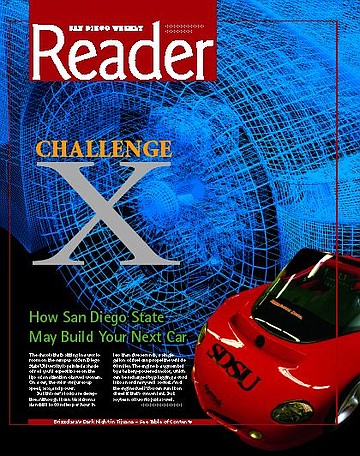
The chassis that’s sitting in a workroom on the campus of San Diego State University is painted a shade of red you’d expect to see on the lips of an attention-starved woman. On a car, the color conjures up speed, sass, and power. But this car’s looks are deceptive. Although it can blast from a standstill to 60 miles per hour in less than five seconds, a single gallon of fuel can propel the vehicle 80 miles. The engine is augmented by a battery-powered motor, which can be recharged by plugging a cord into an ordinary wall socket. And the engine fuel? You can run it on diesel if that’s convenient. But soybean oil works just as well.
San Diego State University Professor Jim Burns says people have asked him where they could buy a car like this. "Nowhere," he has to say. When Burns and his team of engineering students designed and built the car -- which they called the "Enigma" -- they weren't trying to develop a commercial product. Instead they wanted to prove that it was possible to make an automobile that used no fossil fuels, got phenomenal mileage, and looked and performed like a race car. Four years later, Burns and a new team of students are attempting to transform Chevrolet's Equinox into the kind of SUV even an environmentalist could love. Their work is part of the Challenge X competition, which is being cosponsored by General Motors and the Department of Energy. Theirs is one of 17 teams, and hardly among the front-runners.
"There are teams with $5 million research labs devoted to automotive design and manufacturing," Burns told me recently. "And there are teams that are near major metropolitan centers that have the full support of everybody involved." At Mississippi State University, one hundred students and a half-dozen faculty members have pitched in to work on that school's entry. At San Diego State, Burns and one other professor are directing about a dozen young people. Much to their dismay, neither the university nor the larger San Diego community has offered much in the way of financial support.
Nevertheless, Burns's efforts have commanded the admiration of America's alternative-vehicle cognoscenti. "What Burns is doing is equal to or better than 75 or 80 percent of the other guys," Andrew Frank told me. A professor at the University of California, Davis, who's been building hybrid vehicles for more than 30 years, Frank is leading his own Challenge X team. "They're in the ball game," he says of Burns's team.
Jim Burns is a tall, trim man, 42 and balding. He sometimes looks tired and harassed, but all signs of fatigue disappear when he talks about cars, especially hybrids. As a teenager, Burns moved to Pennsylvania to live with his father, who worked as an auto mechanic. "He owned his own car-repair business in the shop below our house," Burns explains. With his father's help, Burns rebuilt the engine of his first car and helped his dad "figure out electrical problems" in customers' vehicles.
Later, Burns enrolled at Pennsylvania State. "Composite materials were the hot topic," Burns recalls, and after graduation, he worked for General Dynamics in Texas, developing composite materials for military aircraft. But Burns never forgot his first love: In his spare time, he bought a kit and started building a replica of the silver Porsche 550 Spyder James Dean took his last drive in. Burns was still working on it when he decided to leave the aerospace world and return to academia.
"Working in a big place like that I saw a lot of complacency," Burns says. "It just seemed like I would fossilize there. It wasn't the bold challenge that I wanted."
Burns entered the University of Delaware Ph.D. program in engineering in 1989, and he was finishing up his doctorate when he got an offer to join the mechanical engineering faculty at San Diego State, where he expected to continue his work with composite materials. But a few months after his arrival on campus, he heard a lecture by the Oxford don and experimental physicist Amory B. Lovins and had an epiphany. Lovins, who was known as "the father of the hydrogen economy" for his role in promoting fuel-cell research, spoke about composite materials carmakers could use to build lighter cars and argued that, if carmakers supplemented or replaced gasoline engines with electric motors, a 200-mile-per-gallon vehicle was possible. "It was inspiring," Burns recalls.
Another person who felt galvanized by Lovins's message was Preston Lowrey, the new chairman of San Diego State's mechanical engineering department, who started talking to faculty members about forming a team to develop vehicles with higher fuel economy and lower emissions. Because of Burns's background in composite materials and his automotive interests, the young professor was invited to participate.
But in August of 1996, a bizarre tragedy derailed those plans: Lowrey and two other San Diego State professors had gathered in a laboratory on campus to hear a 36-year-old graduate student named Frederick Martin Davidson defend his master's thesis. Unbeknownst to them, Davidson had become convinced that the professors were conspiring against him. As the session was beginning, Davidson, who had once served in the Army, walked over to a first-aid kit hanging on the wall, removed a nine-millimeter pistol he had hidden there earlier that day, and opened fire, killing the 44-year-old Lowrey and two colleagues from the engineering department.
"I knew him," Burns says of Davidson, who would receive three consecutive life terms in prison without possibility of parole. "He seemed a bit volatile, but no more so than other people under the stress of trying to become educated."
"Our plans, our visions got put on hold for a while," Burns continues. But after about a year and a half, an urge "to do something meaningful in the wake of such senselessness" stirred a group of students and faculty members back into action. Burns started "to think deeply about what we could do as a university to make a difference," and continuing the vehicle-development project seemed like a fitting memorial to his fallen colleagues. One thing that seemed clear was, "We had to have some lofty goals."
The first one embraced by Burns and the students was to build a car that got at least 80 miles per gallon. "That was three times the corporate average fuel economy at the time," the professor says. "This was the goal that drove battery research and fuel-efficient vehicle design and engine research for most of the '90s."
Burns says he never gave serious consideration to building a car that would run solely on battery power, but, in fact, there were precedents for such a vehicle. All-electric cars were invented in the late 1830s; by the end of the century, they'd become the best-selling vehicles in America. The cars were easier to drive than early gasoline-powered cars, which had to be started with hand cranks and required frequent gear changes, and, unlike steam-powered vehicles, they were ready to go instantly on cold mornings. Electric cars could also be fast: In 1899, a Belgian-built model set a world land speed record of 68 miles per hour. And because they didn't burn fuel, electric cars were clean, quiet, smooth-riding, and easy to maintain. They were limited, however, by how far they could travel and how quickly and easily they could be refueled.
"Cars had replaced bicycles as the means for affluent urbanites who could afford them to get out to enjoy the countryside," Alan P. Loeb, of the Argonne National Laboratory, wrote in a proceeding from the 1995 Business History Conference.
"Had motorists intended to drive only in urban areas, electrics might have served just as well, if not better. But urban motorists could not take a country drive in an electric [car] without the risk of becoming stranded."
With an internal combustion engine, a driver could carry enough fuel to guard against that risk. By 1904, an internal combustion-powered Oldsmobile had become the best-selling car in the United States, and in the years that followed, industrial and technological innovations further widened the gap between gas-powered automobiles and their rivals. Ford introduced the gas-powered Model T in 1908 and started mass-producing it in 1913, causing prices to plunge and sales to skyrocket. By then, a brilliant and charismatic engineer named Charles "Boss" Kettering had invented a self-starter and done away with the daunting hand-crank. And in 1923, General Motors (which employed Kettering as its vice president for research) began selling the world's first leaded gasoline -- an innovation that opened the door to the development of far more powerful engines. In 1924, the 24-year-old National Auto Show failed to exhibit a single electric or steam-powered car.
It took concerns about air pollution and shrinking petroleum supplies to bring talk about electric-powered vehicles back into automotive engineering offices. The process, which began in the 1960s and picked up steam in the '90s, as government actions put additional pressures on automakers, seemed to culminate in 1996, when General Motors started manufacturing its all-electric EV1. Designed from the ground up, this teardrop-shaped coupe was powered by a liquid-cooled alternating-current motor and lead-acid batteries. GM boasted that the EV1 had a top speed of 80 miles per hour and a range of 70 to 90 miles, accelerating from zero to 60 in less than 8 seconds.
The vehicle "had a significant following," Burns acknowledges. "It represented 20 or 30 years of utopian dreams of what efficient transportation should be: Essentially, nonpolluting at the source. Quiet. All-electric." But the car's fatal flaw was its battery, which could take up to eight hours to recharge and required a special charging paddle. "The EV1 batteries didn't last long enough, so there were warranty issues," Burns says. (Indeed, only about 800 people ever leased EV1s, which the carmaker never sold, and after spending more than a billion dollars, GM announced in 2000 that the line would be discontinued.)
Burns says even back in 1997 it was clear that the problems troubling the EV1 were formidable. "Range is the big issue," Burns says. "People may only drive 50 miles a day, but they want the ability to drive 300.... It's that feeling that they can do what they want. It's that freedom."
If GM wasn't solving those problems, "we probably couldn't," the professor reasoned. Hybrid technology, on the other hand, seemed much more promising, he says, an arena where a team of upstarts might be able to come up with some breakthroughs.
The basic idea of using both a gasoline-powered engine and a battery-powered motor to propel an automobile was not a novel one: An assortment of French, Austrian, German, Canadian, and American manufacturers had offered hybrid creations a century ago. Back then, engines weren't very powerful, and cars that employed them exclusively took as long as 30 seconds to reach the speed of 25 miles per hour.
Adding an electric motor provided a way to boost acceleration. But, the advent of leaded gasoline allowed carmakers to begin making engines that were so muscular they didn't need the added power. Of course, these bigger engines used more fuel and pumped more pollutants into the atmosphere. But at the time, skies over America were still clear, fossil fuel seemed unlimited, and cars had just solved the major pollution issue of the day -- ubiquitous horse dung.
When the limits of our petroleum supply did become apparent, automotive engineers started to reconsider the question of engine size: As it happens, even the smallest gasoline automobile engine -- one that provides as little as 15 horsepower -- is big enough to propel the average car along a freeway at a speed of 60 miles per hour. And, of course, smaller engines use less fuel. What small engines can't do is accelerate quickly, tow, and climb hills without slowing down. For that, you need gas-guzzling horsepower -- or assistance from an electric motor.
In October of 1997 Toyota announced that the hybrid Prius would soon become available in Japan. The Prius "certainly had fuel-economy targets to shoot for -- a claim of around 58 miles per gallon," Burns says.
But, to Burns's way of thinking, the Japanese car had a few significant limitations. The Prius had so little battery power it could only travel at 35 miles an hour for three or four minutes before switching over to its gasoline engine. Freeway speeds on electric power alone would be impossible. And, Burns believed, the Prius "was a somewhat homely, underperforming car, not really in tune with the desires of a majority of American drivers." Burns believed he could do better and proposed to build a light, hybrid "test bed," a vehicle "we could use to test out different technologies." This would be a fully functional car, "but one designed in such a way that you could swap out many of the drive-train components and test different ones. You could put a fuel cell in, if you needed to. And there would be enough room to store lots of fuel or hydrogen or different engine/motor combinations." Moreover, Burns was convinced he and his team could come up with a design that was both "flexible enough to permit these future alterations, yet at the same time exquisitely styled, attractive, lightweight...representative of what a car should be if it were available for sale."
Burns submitted his proposal to the California Energy Commission (CEC), which suggested that he do "something entirely different from what I'd proposed. They wanted to see us put together a package-delivery vehicle, like a UPS truck or something like that." The CEC pointed out that, unlike the average individual car buyer, "People who are buying fleet vehicles are looking at the bottom line" and might be more receptive to a radical new design that got much better gas mileage. And while Burns conceded the point, he couldn't imagine getting a group of students to work on a UPS truck. The compromise he offered was to equip his test vehicle with a power plant robust enough so that the lessons learned in developing it could later be applied to a heavier vehicle. "It helped me justify the fact that we were going to develop a hot rod," Burns explains.
In the end, the CEC awarded Burns's team about $285,000; less than half what Burns had asked for, but enough to proceed. The commission also gave a half-million-dollar grant to Andrew Frank's team at UC Davis, which planned to retrofit a Ford Taurus to make it more fuel-efficient. Burns disapproved of the approach. "It was wrong to use public money to help fix the flaws in a vehicle that a billion-dollar company couldn't get right the first time," he said. "Why would I want to do that? I can't really design the vehicle to do its best work."
Burns knew that starting from scratch on the hybrid car would mean he and his students would have to solve more problems. "But then you learn the real things you need to learn, the things no one can teach you," he believed. "The things that only the complete system engineering can give back to you."
Burns says it wouldn't have been possible for him and his students to handle the challenge without a powerful computer program that enabled the San Diego State team to design their car on a computer, then evaluate, analyze, and modify ideas before the students ever began buying and assembling components in the real world. "We used techniques that at the time many large companies still had not adopted," Burns says. "That gave us advance knowledge of whether there was any chance our designs would work and where the real difficulties were going to be. We could make sure we could afford things. Make sure everything fit. Perform lots of checks, like: Where is the center of gravity of this vehicle?" On a computer, Burns's team could assess how the car would behave and handle. Before the advent of such software, automotive engineers had to build their creations first and then see how they drove: "Some really bad vehicles have been built that way. And they had to take the torch to them and try to make them better. We never had to go through that because we managed the process with the best professional tools and technologies -- extraordinary for a university at the time."
As the design process unfolded, Burns and his students began shopping for key components. They needed a fuel-efficient engine with enough power to cruise down the freeway while turning a motor that regenerated electricity in the batteries. Those two tasks would require about 35 to 40 horsepower. They wanted an engine that was being mass-produced, so that they wouldn't have to worry about availability or reliability. "That narrowed the choice down," the professor says. "There were only three candidates."
One was a marine diesel engine. A second was being produced for an experimental aircraft. The final possibility was a turbo-charged direct-injection diesel engine being developed by Volkswagen, which had resolved to produce a vehicle that could go one hundred kilometers on just three liters of fuel. "That works out to be 79.92 miles per gallon," Burns says, "almost the same as what we were working toward."
Burns knew of "people who would say the emissions from diesel engines are something we couldn't live with." Diesels produce more oxides of nitrogen and particulate matter than do gasoline engines, and in the U.S., oxides of nitrogen and particulates are the pollutants people have most deplored, "especially air-resource-board members who run the air policy in urban areas." (Outside of the United States, automakers had focused their attentions on carbon-dioxide emissions, which are thought to be a major cause of global warming.) Burns was confident that the new designs would soon make diesel engines far cleaner. "We said to ourselves, 'There will be people in Europe who are going to solve some of the [diesel] emissions issues.' " He explains, "And in fact the Europeans are solving those problems as we speak."
It was important to Burns that the car use a fuel "that you could get at a pump -- because the majority of people won't buy a vehicle that you can't readily obtain fuel for." But one of his team members "made it her mission to remind us that there were biofuels out there, and they were going to come on strong." As a result, the team began to count on using a biofuel (such as soybean oil) at least part of the time. No modification of the diesel engine would be necessary to do that. "Most oil crops will burst into flame if you compress them and heat them up. And that's all you're doing. That's what an engine does."
Having settled on VW's new technology, the San Diego State team had to order an entire Lupo (as the German vehicle had been christened). It cost $15,000, "Relatively expensive for the kinds of benefits it gives you in fuel economy," Burns says, adding that the "square, funky-looking microcompact" accelerated like a turtle. "We've got those kinds of cars around, and Americans don't want to buy them. They're not fun to look at. They're not fun to drive. They don't go fast." Still, the team hoped that, once they'd extracted it from the Lupo and transplanted it into their car, the German engine would have a different life.
Next, Burns and the students had to make a decision about the type of electric motor they would use. Since electric cars have traditionally gotten their electricity from batteries, and batteries produce direct current (DC), electric cars traditionally have used DC motors. These have some drawbacks when compared to motors that run on alternating current (the kind that comes out of wall sockets). For one thing, direct-current motors have permanent magnets that add significantly to their mass. The magnets also stop working above a certain temperature, "so you have to limit the power that's being put through them, because a certain amount of power becomes heat," the professor explains. A third drawback is that direct-current motors have only two modes of operation. They're either consuming electricity or they're generating it -- and recharging the batteries slows down the car.
Electric-car makers were stuck with DC motors until the late 1980s, when someone finally developed an efficient way of transforming the DC current from batteries into alternating current. Motors that use this technology have three modes of operation. They can be drawing electricity from the batteries while propelling the car. They can be charging up the batteries during braking. Or, according to Burns, they can also be turned off in such a way that they spin, "just like a flywheel." That third, neutral mode is especially desirable, Burns says: "We like to let the motor freewheel sometimes. The batteries might already be full. So what do you do then? Do you have to go back to driving electric?" The lighter weight and higher power produced by an alternating-current motor were additional enticements.
Having identified the motor and engine they wanted to use, Burns and his team had to figure out how to get the machines to work together and turn the car's wheels. In a standard gasoline-engine-powered automobile, the engine's crankshaft connects to a transmission and drivetrain. Thus, normal transmissions only accommodate one input -- from the engine. "Methods for mechanically combining motor torque and engine torque were very limited," Burns says. One solution was to let the engine drive the front axle, while having the motor drive the rear one. "This is called a ground-coupled hybrid," Burns explains. "You combine the thrust that each produces by having it drive separate sets of wheels." But having two separate drivetrains makes the whole car much heavier (and less fuel efficient), and the car's traction can be trickier to control.
Instead Burns and the team opted to develop a transmission that would take the two input torques and create one output torque. "That creates a true parallel hybrid," Burns says. In this arrangement, the electric motor can also act as a starter and a generator, eliminating the need for separate components. "It's a simpler design overall."
Designing the transmission was a fairly straightforward engineering problem. "It's not an amazing concept," Burns says. "There have been devices on farm tractors and other heavy equipment for eons that would take engine power and split it into two outputs: one to drive the vehicle and one to turn a piece of equipment." Designing a device that did the opposite (combining two inputs into one output) hadn't been done before because there had never been a need, but it wasn't that difficult.
Transforming the computer-based design for the transmission into a physical object was, however, another matter. "We didn't have the equipment to do it right," Burns recalls. The university did possess a computer-controlled mill, which Burns and his engineering students were able to use to carve the four quadrants of the transmission case out of chunks of solid aluminum. "But the bed travel of our mill wasn't big enough to handle each of the pieces at one time. We had to set up and run four times per side [of each quadrant], then flip it over, and do it again." Instead of 8 machining operations, the process required 32. "That was a lot of work. But we still got it done."
Luckily, the transmission was one of the few items in the car Burns and his students had to make from scratch. They were able to buy brakes and a steering system and other parts -- just as big carmakers do. "They're assemblers," Burns says. "They buy components from other companies that make those things cheaper."
But no carmaker today is equipping its production cars with high voltage, and finding the right batteries for their high-voltage creation bedeviled Burns and his students, who wanted their hybrid to be able to travel for 20 or 30 minutes on batteries alone. That's what the consumer wanted, they believed, and moreover, "as battery storage goes up, fuel economy increases." Lead-acid batteries, the workhorse of the industrial world since 1859 (when French physicist Gaston Planté first dunked lead plates in diluted sulfuric acid and showed that current was flowing between them), could provide sufficient power -- but they would burden the vehicle with a lot of extra weight. Burns believes experimental nickel-metal hydride batteries would have been much lighter, but since they weren't commercially available, they would have cost at least $30,000. "That would have been more than ten percent of our entire budget," Burns says -- too big a bite, given the team's limited means. So he and the students resigned themselves to stringing 28 of the lead-acids into a ponderous 360-volt package.
And yet, of all the challenges Burns and his team faced, the greatest was fitting all the parts they'd assembled into the sports-car-sized vehicle they'd envisioned. They began by looking for the best position for the batteries: Since the voltage would be dangerous to anyone coming in contact with it, Burns and his students liked the idea of confining the batteries to an "energy-storage pod" that could be sealed shut. If any problems with the electrical system developed, the pod could be unbolted and replaced with a substitute while the package needing servicing was attended to, making the car far easier to maintain.
But where to put the 650-pound energy-storage pod? "Plenty of vehicles have gotten built with so much battery mass in them in such unlikely places that they handle like a tank," Burns says. The professor cringed at the thought of such a compromise. "Some people look for excellence in one thing, but a vehicle is not just one thing," he says. "To be credible, it has to do well in many categories. If a compromise is going to be made, you make the smallest one you can. You don't take a whole category and not meet it. In our case, if it was going to have 250 horsepower, we wanted it to handle well and be fun to drive."
To deliver the handling Burns demanded, the development team had to keep the mass of the car low, which Burns and his students accomplished by placing the engine, transmission, and motor over the rear axle -- the standard location for engines in exotic sports cars. The bulky battery pack could then be built into the base of the front of the car, a position that would optimize the handling while minimizing the batteries' undesirable properties. "They're heavy, and they take up a lot of volume, and they're lethal, and in a crash you don't want them flying up in your face."
Next, the team had to get a body for the car. They settled upon a kit-car builder in El Cajon who manufactured bodies and frames for people to put their own engines in. "He was willing to build us a custom body variant of something he was already building," Burns says. "It was called the Riot." It had an open top, a design that wouldn't deliver the best handling. But the team members figured they could make the structural frame stiff enough to compensate for that.
The students modeled the Riot's body on their computer-aided design system, then restyled it. "We made it wider and changed the headlight treatment, put cuts in different places, and put doors in it. We added some other visual details that were useful to us." While the manufacturer made those changes, the students continued to work on fitting everything into the geometric volume represented in their digital models. "We had to grow the rest of the frame and subsystems into that space," Burns says. "And of course a driver had to fit in there, and the wheels had to be a certain distance apart, and we were planning for tires of a certain width, and the engine and transmission module and motor had to fit in there." Room also had to be reserved for adding the other experimental components Burns wanted to test in the future, and the team had to ensure that the car would be functional and structurally sound without the body, so that they could start building it before the completion of the eye-catching outer shell. "We just wanted [the body] to look good and be racy and be ready when we were ready."
In the end, Burns was disappointed on two of these three points. Although the body that the kit-car builder delivered was racy, it wasn't ready until nine months after it had been promised. "Only after major yelling and screaming did he actually get on the job," Burns says. He was also disappointed with the finish. According to Burns, the builder told him, "Well, you asked for it in gel-coat. It's in gel-coat."
"No," Burns replied. "I specifically said I wanted it paintable."
"It's paintable."
"No, I don't think you get it. It's not good-enough quality. It looks like crap. If I paint that, it's going to be wavy and bubbly."
The professor says some workers at an auto body specialty shop in El Cajon finally helped him and some students refinish the surface. "We had to do a lot of painstaking work to make it look beautiful."
By that time, other problems had surfaced. Volkswagen was wrangling with the German government over tax credits for its fuel-efficient new car, so the Lupo's introduction was delayed for six months, and the vehicle Burns ordered didn't arrive until the end of 1999. "As far as we know, we had the first one imported by anyone who was not affiliated with Volkswagen." The Lupo's late arrival threw the whole effort off schedule. Burns had used up the last of the $285,000 he'd received from the state energy commission by March of 2000, but the car was far from complete.
To make matters worse, most of the students who had started on the project when it began had drifted away. Only one, Norm Lamar -- the student who had served as the chief designer -- refused to abandon the car-development effort. In the end, Lamar moved into the professor's house. "He didn't want to leave the project, and it wasn't done. He and I gutted it out for nine months. We worked on this the rest of that year, all through the summer and into the fall." The car ran for the first time on electric power on the first day of classes in January of 2001.
But for the next nine months, the engine itself refused to work. In October, Burns finally trucked the car up to Fontana and raced it in the Michelin Challenge at the California Speedway. He'd recruited a few more student volunteers by then, but one inadvertently switched the wires that fed the fan that cooled the motor. "So during the Michelin Challenge, our motor inexplicably overheated and shut down. Five or six times. A couple weeks later, the motor controller caught fire.
"These things happen," Burns adds.
By May of 2002, the car was fixed and ready to compete once again, this time in a multiday road race called the Tour de Sol that began in Washington, D.C., and ended in New York. But in this race, water sabotaged the Enigma's chances, when rain pouring through the open top caused some of the onboard computer equipment to fail.
A triumph of sorts finally came a few weeks later, when Burns took the car to Sacramento. "Originally we were going to meet with two or three people from the California Energy Commission," he recalls. "They wanted to look at it. In the end there were, like, 45 people on the street, blocking traffic. We've got pictures of people randomly pulling up, stopping their big, gas-guzzling SUVs, and saying, 'Wow! Where can I get one of those?' " Ironically, the Enigma, as it by then had been dubbed, still wasn't legal to drive on any California streets or freeways. Because the value of the car was $300,000 and the registration fees were based on that value, "I would have had to come up with, like, $800 to register it," Burns says. "But there was no money for that."
By then the state was embroiled in an electric energy crisis, and Burns felt demoralized. "Who wouldn't be?" he asks, then amends the statement: "Every time I would get down about it, there'd be some new student or new volunteer who would get so excited by the concept of a real solution that they could be part of." That would rekindle his enthusiasm, he says. "That made it worth it."
Early in 2004, a colleague told Burns about the Challenge X competition, which sounded like a perfect project to work on with a new group of students. He submitted a proposal to the U.S. Department of Energy in which he argued that San Diego State should be allowed to participate. The structure of the contest would make it a different enterprise than the one his students had engaged in while designing the sports car. Instead of a blank sheet of paper, they would start with a computer model of a 2005 Chevrolet Equinox. It has an average EPA fuel-economy rating of 23 miles per gallon, so part of the challenge would be to boost that to at least 32 miles per gallon, a 9-mile-per-gallon increase. Teams would also be awarded points for minimizing harmful emissions.
They could try to achieve those goals using any technology they wanted. "In the hopes of getting high fuel economy or really low emissions or both, other people might be putting a fuel cell in their vehicle or have a ground-coupled hybrid or be working on a mild hybrid [like the Honda Insight]," Burns says. He knew that the other teams would include a number of engineering powerhouses, and Burns couldn't imagine competing head-to-head for the highest possible fuel economy. But in poring over GM's rules for the competition, he detected "a real premium for amazing performance."
The prejudice made sense to Burns. "GM has made their stock in trade putting horsepower under hoods, right? I saw the sensibilities [of the contest organizers] being much more attuned to a high-horsepower version of the Equinox." Burns's own passion was "to help push the market open for vehicles that have the power and performance people want to buy. If you put an anemic, slow, stodgy power plant in one of these vehicles, maybe you could get 45 or 50 miles per gallon." That would be impressive, Burns acknowledges. "But I wouldn't buy the thing. There'd be no purpose in me going to the showroom to look at a car like that. Zero to 60 in 17 seconds would not do it for me." Instead he believed he and his students could transform the Equinox into a machine that would get at least the minimum amount of additional fuel efficiency required but would also have triple the horsepower it started with. "We want to go from zero to 60 in just under 5 seconds."
In early May of 2004, Burns learned that the local campus had been selected, and he flew to Washington to pick up a check for $10,000. "I was told point-blank that the reason we were included was because of what we'd done with the Enigma," he says. He and his students had already demonstrated that they could deliver a high-performance, high-horsepower but fuel-efficient vehicle. They had also modeled and tested their ideas on a computer, which GM was requiring. "The program asks all the teams to go through a process very similar to the way in which GM designs its own vehicles," Burns explains. "They have a structured method for bringing ideas to reality." The professor points out one consequence of GM's requiring this from the contest participants is "they get to recruit people to come work for GM. They're already kind of ready to walk the GM walk. Which is not a bad thing. If you put two or three million dollars into something, you want some return. And this is a multimillion-dollar commitment from GM."
During the past 18 months, much of the SDSU team's work has taken place behind the keyboard, at computers set up in a cluttered laboratory Burns's students have dubbed the "X Cave."
"It's been a lot of planning -- and proving to General Motors that we have the skills to succeed," says the team's student leader, Frank Falcone. "They said, 'Give us the specification of the vehicle you're going to build.' That's a document that basically outlines: This is a car that weighs this much, goes this fast, gets this much fuel economy, and so on." Later, Falcone says, the teams will be graded on how closely they hit their specified targets.
"We've had to explain how our component selection will live up to our vehicle technical specification," the student leader continues. "We've also had to show them proficiency in the tools they've given us -- everything from the [computer-aided design] tools to the vehicle-simulation tools to the programming tools. For example, they've said, 'Show us you know how to program an engine controller, that you understand the logic it takes to operate this.' " Throughout the year, the students provided this documentation in a series of reports that culminated in a megareport on May 23. Falcone describes it as "the report that says, 'When you give us a car, this is what we're going to do and how all this is going to be accomplished.' "
Tall, and powerfully built, Falcone has an air of authority that seems remarkable in a college student -- until he tells you that he's 31. It took a while for him to find his calling. Although he studied auto mechanics at Vista High and rebuilt countless engines, he also loved playing guitar. After graduating from high school in 1992, he got a job working for a Carlsbad company that builds robotic fluid dispensers for the electronics industry, first as an assembler, then as a technical writer, and finally as a laboratory technician in the company's research and development department. He took music classes at night at the community colleges and formed a band, the Lobster Tank Divers. "I thought about being a business major, but I was tinkering with stuff in the lab and tinkering with my cars. One day I went [he slaps his head], 'What am I thinking? I'm an engineer!' "
He switched majors and started taking math and science classes.
One day, an engineering instructor from Palomar took Falcone on a tour of San Diego State, and Falcone saw Burns's sexy red sports car. "It peeled out, and I was, like, 'Wow. That's plain cool.' The deal was sealed. That's when I said, 'I don't care what it takes -- somehow I'm going to work on that car.' "
Falcone enrolled full-time at SDSU in the spring of 2002, but by then all the development work on the car had been completed. Furthermore, "I was an underclassman," Falcone says. "You have to get up to the junior or senior level before you know enough to do anything with it." But when he heard about the Challenge X, he volunteered to help out, and he's become so caught up in the project that he decided to pursue a master's degree in mechanical engineering, in order to stay at State after his May 2005 graduation. "I want to see it through to the end."
According to Falcone's estimate, he's been devoting at least 30 hours a week to the Challenge X project. "It's almost a full-time job for me," he says. "Sometimes it's 40 or 50 hours. When the work has to get done, those of us like myself are here to get it done, no matter how long it takes to do it." But, "It's fun, to be honest," he adds. He looks a little sheepish but plows on. "I just like it. Here you're working on something that's cutting edge, so everything you do is new. It's creative. You're constantly solving problems that you're encountering for the very first time. You are actually working on something that can make a real-world, positive difference."
Falcone thinks some of the other students he's working with may be inspired by other factors. "Some are car guys. They like it because they're working on a car. They just like engines." For others, though, the idea of "writing fossil fuels out of the energy equation" is a powerful incentive, he says. "Everyone's got their niche."
The team's morale received a boost in June, when Burns journeyed to Detroit and received word that the group would be proceeding to the next phase of the competition. In August, they took delivery of the Equinox. In year two, Falcone says, the goal is to get a mock-up of the reengineered vehicle running. "It doesn't have to be pretty," he adds. Because the SDSU team hasn't managed to raise much money to support the project, it may have to use heavy lead-acid batteries (like the ones in the Enigma), and the added weight might force the team to do without four-wheel-drive capacity. "We'll leave out the air conditioning," says Burns. "We might take the windows out. We might take the seats out. We really need to shed mass." But all of this won't matter, Falcone says. In the second year, "We can try to fund-raise like crazy, and then in year three, we can get better batteries. Year three is about making it look like a finished product."
Money will be the grease that lubricates whatever work remains to be done. Burns says the engineering college has promised at least to match the $10,000 in seed money provided by GM last year. And GM is also giving each team $25,000 worth of parts from the company's stock inventory. "But often the components that you want are not GM components," Burns says.
"I've been on TV three times asking for help. But not much has happened," he complains. "I mean, surfing's great, but it's not a job base. This is one of the hottest places in America for aftermarket automotive activity. Speed shops and race shops and engine builders -- they're all over the place in this county." A few donations have trickled in, but nothing approaching the $150,000 that other teams are raising.
Compounding the team's difficulties, Burns says, San Diego State's engineering department has forbidden Burns and his students from contacting a number of potential sponsors. "There are larger programs. Bigger fish," he explains. "I feel like an army commander who's holding the gun with the bayonet but no bullets and being told, 'Go slay the enemy.' Sure, we have a chance. We could get lucky. But I don't like to be lucky. We have the ability to win this competition, but it will take the investment and involvement of other people to make it happen."
To spark that involvement, Burns's students are pinning a lot of their hopes on the Enigma. They've rebuilt the transmission to strengthen it and replaced its aging batteries. "A decision was made that this car would be put back together and put on the road the right way," says Falcone. "When it's running up and down the freeway and people can see it, that's what'll make an investor say, 'Wow! Maybe it's worthwhile to open that wallet up a little.' We need to be able to take someone for a ride. That's what sells cars." Falcone says the students have even been talking about taking it on a coast-to-coast ride without stopping for gasoline. There's room in the back to store extra fuel. It would be a stunt, Burns says, but it might be an attention-grabbing one.
Burns reflects for only one or two beats when he's asked what difference it will make if the San Diego State team wins or loses the Challenge X competition. "There are people who won't buy a hybrid until an American car company makes one," he says. "There are people who will not buy a hybrid until it meets their power requirements. There are people who won't buy a hybrid because they've never seen one that they would be caught dead in." Winning the contest would work toward eliminating all three hurdles to hybrids winning wider acceptance, he argues. It could demonstrate "the power potential is there." That in turn may get "people to think and react and move towards a solution, and that pressure will allow the people who run bigger car companies to respond to it. If there's no demand, it's hard to come up with a supply. But if you can artificially create demand by informing, educating, and thrilling the public, that has some influence. It's the only influence that I feel we can have right now."
The likelihood of hybrids becoming commonplace on the roads of America is something that's "driven by politics," the professor reflects. "It's driven by the price of fuel. And I suppose in some sense it's driven by the mythical practicality of fuel-cell vehicles." He thinks if fuel-cell vehicles ever become a reality, the first ones that will go on the market will resemble the Volkswagen Beetle or Rabbit, in terms of performance. "And most people wouldn't take that," Burns predicts. Making them more powerful won't be a simple matter either, like making the cylinders bigger in a gasoline engine. "You'll really have to redesign them for higher power. It will be like having to do the job over again." Until that happens, if cars are going to be hot rods, they're going to be hybrids," he says. If you want excellent fuel economy and "you're still going to pursue the American dream of free and easy driving on the highway with gumption under your right foot, you're going to need a hybrid."
Here's something you might be interested in.
Challenge X: how San Diego State may build your next car
War on the internal combustion engine.

Challenge X: how San Diego State may build your next car
War on the internal combustion engine.
The chassis that’s sitting in a workroom on the campus of San Diego State University is painted a shade of red you’d expect to see on the lips of an attention-starved woman. On a car, the color conjures up speed, sass, and power. But this car’s looks are deceptive. Although it can blast from a standstill to 60 miles per hour in less than five seconds, a single gallon of fuel can propel the vehicle 80 miles. The engine is augmented by a battery-powered motor, which can be recharged by plugging a cord into an ordinary wall socket. And the engine fuel? You can run it on diesel if that’s convenient. But soybean oil works just as well.
San Diego State University Professor Jim Burns says people have asked him where they could buy a car like this. "Nowhere," he has to say. When Burns and his team of engineering students designed and built the car -- which they called the "Enigma" -- they weren't trying to develop a commercial product. Instead they wanted to prove that it was possible to make an automobile that used no fossil fuels, got phenomenal mileage, and looked and performed like a race car. Four years later, Burns and a new team of students are attempting to transform Chevrolet's Equinox into the kind of SUV even an environmentalist could love. Their work is part of the Challenge X competition, which is being cosponsored by General Motors and the Department of Energy. Theirs is one of 17 teams, and hardly among the front-runners.
"There are teams with $5 million research labs devoted to automotive design and manufacturing," Burns told me recently. "And there are teams that are near major metropolitan centers that have the full support of everybody involved." At Mississippi State University, one hundred students and a half-dozen faculty members have pitched in to work on that school's entry. At San Diego State, Burns and one other professor are directing about a dozen young people. Much to their dismay, neither the university nor the larger San Diego community has offered much in the way of financial support.
Nevertheless, Burns's efforts have commanded the admiration of America's alternative-vehicle cognoscenti. "What Burns is doing is equal to or better than 75 or 80 percent of the other guys," Andrew Frank told me. A professor at the University of California, Davis, who's been building hybrid vehicles for more than 30 years, Frank is leading his own Challenge X team. "They're in the ball game," he says of Burns's team.
Jim Burns is a tall, trim man, 42 and balding. He sometimes looks tired and harassed, but all signs of fatigue disappear when he talks about cars, especially hybrids. As a teenager, Burns moved to Pennsylvania to live with his father, who worked as an auto mechanic. "He owned his own car-repair business in the shop below our house," Burns explains. With his father's help, Burns rebuilt the engine of his first car and helped his dad "figure out electrical problems" in customers' vehicles.
Later, Burns enrolled at Pennsylvania State. "Composite materials were the hot topic," Burns recalls, and after graduation, he worked for General Dynamics in Texas, developing composite materials for military aircraft. But Burns never forgot his first love: In his spare time, he bought a kit and started building a replica of the silver Porsche 550 Spyder James Dean took his last drive in. Burns was still working on it when he decided to leave the aerospace world and return to academia.
"Working in a big place like that I saw a lot of complacency," Burns says. "It just seemed like I would fossilize there. It wasn't the bold challenge that I wanted."
Burns entered the University of Delaware Ph.D. program in engineering in 1989, and he was finishing up his doctorate when he got an offer to join the mechanical engineering faculty at San Diego State, where he expected to continue his work with composite materials. But a few months after his arrival on campus, he heard a lecture by the Oxford don and experimental physicist Amory B. Lovins and had an epiphany. Lovins, who was known as "the father of the hydrogen economy" for his role in promoting fuel-cell research, spoke about composite materials carmakers could use to build lighter cars and argued that, if carmakers supplemented or replaced gasoline engines with electric motors, a 200-mile-per-gallon vehicle was possible. "It was inspiring," Burns recalls.
Another person who felt galvanized by Lovins's message was Preston Lowrey, the new chairman of San Diego State's mechanical engineering department, who started talking to faculty members about forming a team to develop vehicles with higher fuel economy and lower emissions. Because of Burns's background in composite materials and his automotive interests, the young professor was invited to participate.
But in August of 1996, a bizarre tragedy derailed those plans: Lowrey and two other San Diego State professors had gathered in a laboratory on campus to hear a 36-year-old graduate student named Frederick Martin Davidson defend his master's thesis. Unbeknownst to them, Davidson had become convinced that the professors were conspiring against him. As the session was beginning, Davidson, who had once served in the Army, walked over to a first-aid kit hanging on the wall, removed a nine-millimeter pistol he had hidden there earlier that day, and opened fire, killing the 44-year-old Lowrey and two colleagues from the engineering department.
"I knew him," Burns says of Davidson, who would receive three consecutive life terms in prison without possibility of parole. "He seemed a bit volatile, but no more so than other people under the stress of trying to become educated."
"Our plans, our visions got put on hold for a while," Burns continues. But after about a year and a half, an urge "to do something meaningful in the wake of such senselessness" stirred a group of students and faculty members back into action. Burns started "to think deeply about what we could do as a university to make a difference," and continuing the vehicle-development project seemed like a fitting memorial to his fallen colleagues. One thing that seemed clear was, "We had to have some lofty goals."
The first one embraced by Burns and the students was to build a car that got at least 80 miles per gallon. "That was three times the corporate average fuel economy at the time," the professor says. "This was the goal that drove battery research and fuel-efficient vehicle design and engine research for most of the '90s."
Burns says he never gave serious consideration to building a car that would run solely on battery power, but, in fact, there were precedents for such a vehicle. All-electric cars were invented in the late 1830s; by the end of the century, they'd become the best-selling vehicles in America. The cars were easier to drive than early gasoline-powered cars, which had to be started with hand cranks and required frequent gear changes, and, unlike steam-powered vehicles, they were ready to go instantly on cold mornings. Electric cars could also be fast: In 1899, a Belgian-built model set a world land speed record of 68 miles per hour. And because they didn't burn fuel, electric cars were clean, quiet, smooth-riding, and easy to maintain. They were limited, however, by how far they could travel and how quickly and easily they could be refueled.
"Cars had replaced bicycles as the means for affluent urbanites who could afford them to get out to enjoy the countryside," Alan P. Loeb, of the Argonne National Laboratory, wrote in a proceeding from the 1995 Business History Conference.
"Had motorists intended to drive only in urban areas, electrics might have served just as well, if not better. But urban motorists could not take a country drive in an electric [car] without the risk of becoming stranded."
With an internal combustion engine, a driver could carry enough fuel to guard against that risk. By 1904, an internal combustion-powered Oldsmobile had become the best-selling car in the United States, and in the years that followed, industrial and technological innovations further widened the gap between gas-powered automobiles and their rivals. Ford introduced the gas-powered Model T in 1908 and started mass-producing it in 1913, causing prices to plunge and sales to skyrocket. By then, a brilliant and charismatic engineer named Charles "Boss" Kettering had invented a self-starter and done away with the daunting hand-crank. And in 1923, General Motors (which employed Kettering as its vice president for research) began selling the world's first leaded gasoline -- an innovation that opened the door to the development of far more powerful engines. In 1924, the 24-year-old National Auto Show failed to exhibit a single electric or steam-powered car.
It took concerns about air pollution and shrinking petroleum supplies to bring talk about electric-powered vehicles back into automotive engineering offices. The process, which began in the 1960s and picked up steam in the '90s, as government actions put additional pressures on automakers, seemed to culminate in 1996, when General Motors started manufacturing its all-electric EV1. Designed from the ground up, this teardrop-shaped coupe was powered by a liquid-cooled alternating-current motor and lead-acid batteries. GM boasted that the EV1 had a top speed of 80 miles per hour and a range of 70 to 90 miles, accelerating from zero to 60 in less than 8 seconds.
The vehicle "had a significant following," Burns acknowledges. "It represented 20 or 30 years of utopian dreams of what efficient transportation should be: Essentially, nonpolluting at the source. Quiet. All-electric." But the car's fatal flaw was its battery, which could take up to eight hours to recharge and required a special charging paddle. "The EV1 batteries didn't last long enough, so there were warranty issues," Burns says. (Indeed, only about 800 people ever leased EV1s, which the carmaker never sold, and after spending more than a billion dollars, GM announced in 2000 that the line would be discontinued.)
Burns says even back in 1997 it was clear that the problems troubling the EV1 were formidable. "Range is the big issue," Burns says. "People may only drive 50 miles a day, but they want the ability to drive 300.... It's that feeling that they can do what they want. It's that freedom."
If GM wasn't solving those problems, "we probably couldn't," the professor reasoned. Hybrid technology, on the other hand, seemed much more promising, he says, an arena where a team of upstarts might be able to come up with some breakthroughs.
The basic idea of using both a gasoline-powered engine and a battery-powered motor to propel an automobile was not a novel one: An assortment of French, Austrian, German, Canadian, and American manufacturers had offered hybrid creations a century ago. Back then, engines weren't very powerful, and cars that employed them exclusively took as long as 30 seconds to reach the speed of 25 miles per hour.
Adding an electric motor provided a way to boost acceleration. But, the advent of leaded gasoline allowed carmakers to begin making engines that were so muscular they didn't need the added power. Of course, these bigger engines used more fuel and pumped more pollutants into the atmosphere. But at the time, skies over America were still clear, fossil fuel seemed unlimited, and cars had just solved the major pollution issue of the day -- ubiquitous horse dung.
When the limits of our petroleum supply did become apparent, automotive engineers started to reconsider the question of engine size: As it happens, even the smallest gasoline automobile engine -- one that provides as little as 15 horsepower -- is big enough to propel the average car along a freeway at a speed of 60 miles per hour. And, of course, smaller engines use less fuel. What small engines can't do is accelerate quickly, tow, and climb hills without slowing down. For that, you need gas-guzzling horsepower -- or assistance from an electric motor.
In October of 1997 Toyota announced that the hybrid Prius would soon become available in Japan. The Prius "certainly had fuel-economy targets to shoot for -- a claim of around 58 miles per gallon," Burns says.
But, to Burns's way of thinking, the Japanese car had a few significant limitations. The Prius had so little battery power it could only travel at 35 miles an hour for three or four minutes before switching over to its gasoline engine. Freeway speeds on electric power alone would be impossible. And, Burns believed, the Prius "was a somewhat homely, underperforming car, not really in tune with the desires of a majority of American drivers." Burns believed he could do better and proposed to build a light, hybrid "test bed," a vehicle "we could use to test out different technologies." This would be a fully functional car, "but one designed in such a way that you could swap out many of the drive-train components and test different ones. You could put a fuel cell in, if you needed to. And there would be enough room to store lots of fuel or hydrogen or different engine/motor combinations." Moreover, Burns was convinced he and his team could come up with a design that was both "flexible enough to permit these future alterations, yet at the same time exquisitely styled, attractive, lightweight...representative of what a car should be if it were available for sale."
Burns submitted his proposal to the California Energy Commission (CEC), which suggested that he do "something entirely different from what I'd proposed. They wanted to see us put together a package-delivery vehicle, like a UPS truck or something like that." The CEC pointed out that, unlike the average individual car buyer, "People who are buying fleet vehicles are looking at the bottom line" and might be more receptive to a radical new design that got much better gas mileage. And while Burns conceded the point, he couldn't imagine getting a group of students to work on a UPS truck. The compromise he offered was to equip his test vehicle with a power plant robust enough so that the lessons learned in developing it could later be applied to a heavier vehicle. "It helped me justify the fact that we were going to develop a hot rod," Burns explains.
In the end, the CEC awarded Burns's team about $285,000; less than half what Burns had asked for, but enough to proceed. The commission also gave a half-million-dollar grant to Andrew Frank's team at UC Davis, which planned to retrofit a Ford Taurus to make it more fuel-efficient. Burns disapproved of the approach. "It was wrong to use public money to help fix the flaws in a vehicle that a billion-dollar company couldn't get right the first time," he said. "Why would I want to do that? I can't really design the vehicle to do its best work."
Burns knew that starting from scratch on the hybrid car would mean he and his students would have to solve more problems. "But then you learn the real things you need to learn, the things no one can teach you," he believed. "The things that only the complete system engineering can give back to you."
Burns says it wouldn't have been possible for him and his students to handle the challenge without a powerful computer program that enabled the San Diego State team to design their car on a computer, then evaluate, analyze, and modify ideas before the students ever began buying and assembling components in the real world. "We used techniques that at the time many large companies still had not adopted," Burns says. "That gave us advance knowledge of whether there was any chance our designs would work and where the real difficulties were going to be. We could make sure we could afford things. Make sure everything fit. Perform lots of checks, like: Where is the center of gravity of this vehicle?" On a computer, Burns's team could assess how the car would behave and handle. Before the advent of such software, automotive engineers had to build their creations first and then see how they drove: "Some really bad vehicles have been built that way. And they had to take the torch to them and try to make them better. We never had to go through that because we managed the process with the best professional tools and technologies -- extraordinary for a university at the time."
As the design process unfolded, Burns and his students began shopping for key components. They needed a fuel-efficient engine with enough power to cruise down the freeway while turning a motor that regenerated electricity in the batteries. Those two tasks would require about 35 to 40 horsepower. They wanted an engine that was being mass-produced, so that they wouldn't have to worry about availability or reliability. "That narrowed the choice down," the professor says. "There were only three candidates."
One was a marine diesel engine. A second was being produced for an experimental aircraft. The final possibility was a turbo-charged direct-injection diesel engine being developed by Volkswagen, which had resolved to produce a vehicle that could go one hundred kilometers on just three liters of fuel. "That works out to be 79.92 miles per gallon," Burns says, "almost the same as what we were working toward."
Burns knew of "people who would say the emissions from diesel engines are something we couldn't live with." Diesels produce more oxides of nitrogen and particulate matter than do gasoline engines, and in the U.S., oxides of nitrogen and particulates are the pollutants people have most deplored, "especially air-resource-board members who run the air policy in urban areas." (Outside of the United States, automakers had focused their attentions on carbon-dioxide emissions, which are thought to be a major cause of global warming.) Burns was confident that the new designs would soon make diesel engines far cleaner. "We said to ourselves, 'There will be people in Europe who are going to solve some of the [diesel] emissions issues.' " He explains, "And in fact the Europeans are solving those problems as we speak."
It was important to Burns that the car use a fuel "that you could get at a pump -- because the majority of people won't buy a vehicle that you can't readily obtain fuel for." But one of his team members "made it her mission to remind us that there were biofuels out there, and they were going to come on strong." As a result, the team began to count on using a biofuel (such as soybean oil) at least part of the time. No modification of the diesel engine would be necessary to do that. "Most oil crops will burst into flame if you compress them and heat them up. And that's all you're doing. That's what an engine does."
Having settled on VW's new technology, the San Diego State team had to order an entire Lupo (as the German vehicle had been christened). It cost $15,000, "Relatively expensive for the kinds of benefits it gives you in fuel economy," Burns says, adding that the "square, funky-looking microcompact" accelerated like a turtle. "We've got those kinds of cars around, and Americans don't want to buy them. They're not fun to look at. They're not fun to drive. They don't go fast." Still, the team hoped that, once they'd extracted it from the Lupo and transplanted it into their car, the German engine would have a different life.
Next, Burns and the students had to make a decision about the type of electric motor they would use. Since electric cars have traditionally gotten their electricity from batteries, and batteries produce direct current (DC), electric cars traditionally have used DC motors. These have some drawbacks when compared to motors that run on alternating current (the kind that comes out of wall sockets). For one thing, direct-current motors have permanent magnets that add significantly to their mass. The magnets also stop working above a certain temperature, "so you have to limit the power that's being put through them, because a certain amount of power becomes heat," the professor explains. A third drawback is that direct-current motors have only two modes of operation. They're either consuming electricity or they're generating it -- and recharging the batteries slows down the car.
Electric-car makers were stuck with DC motors until the late 1980s, when someone finally developed an efficient way of transforming the DC current from batteries into alternating current. Motors that use this technology have three modes of operation. They can be drawing electricity from the batteries while propelling the car. They can be charging up the batteries during braking. Or, according to Burns, they can also be turned off in such a way that they spin, "just like a flywheel." That third, neutral mode is especially desirable, Burns says: "We like to let the motor freewheel sometimes. The batteries might already be full. So what do you do then? Do you have to go back to driving electric?" The lighter weight and higher power produced by an alternating-current motor were additional enticements.
Having identified the motor and engine they wanted to use, Burns and his team had to figure out how to get the machines to work together and turn the car's wheels. In a standard gasoline-engine-powered automobile, the engine's crankshaft connects to a transmission and drivetrain. Thus, normal transmissions only accommodate one input -- from the engine. "Methods for mechanically combining motor torque and engine torque were very limited," Burns says. One solution was to let the engine drive the front axle, while having the motor drive the rear one. "This is called a ground-coupled hybrid," Burns explains. "You combine the thrust that each produces by having it drive separate sets of wheels." But having two separate drivetrains makes the whole car much heavier (and less fuel efficient), and the car's traction can be trickier to control.
Instead Burns and the team opted to develop a transmission that would take the two input torques and create one output torque. "That creates a true parallel hybrid," Burns says. In this arrangement, the electric motor can also act as a starter and a generator, eliminating the need for separate components. "It's a simpler design overall."
Designing the transmission was a fairly straightforward engineering problem. "It's not an amazing concept," Burns says. "There have been devices on farm tractors and other heavy equipment for eons that would take engine power and split it into two outputs: one to drive the vehicle and one to turn a piece of equipment." Designing a device that did the opposite (combining two inputs into one output) hadn't been done before because there had never been a need, but it wasn't that difficult.
Transforming the computer-based design for the transmission into a physical object was, however, another matter. "We didn't have the equipment to do it right," Burns recalls. The university did possess a computer-controlled mill, which Burns and his engineering students were able to use to carve the four quadrants of the transmission case out of chunks of solid aluminum. "But the bed travel of our mill wasn't big enough to handle each of the pieces at one time. We had to set up and run four times per side [of each quadrant], then flip it over, and do it again." Instead of 8 machining operations, the process required 32. "That was a lot of work. But we still got it done."
Luckily, the transmission was one of the few items in the car Burns and his students had to make from scratch. They were able to buy brakes and a steering system and other parts -- just as big carmakers do. "They're assemblers," Burns says. "They buy components from other companies that make those things cheaper."
But no carmaker today is equipping its production cars with high voltage, and finding the right batteries for their high-voltage creation bedeviled Burns and his students, who wanted their hybrid to be able to travel for 20 or 30 minutes on batteries alone. That's what the consumer wanted, they believed, and moreover, "as battery storage goes up, fuel economy increases." Lead-acid batteries, the workhorse of the industrial world since 1859 (when French physicist Gaston Planté first dunked lead plates in diluted sulfuric acid and showed that current was flowing between them), could provide sufficient power -- but they would burden the vehicle with a lot of extra weight. Burns believes experimental nickel-metal hydride batteries would have been much lighter, but since they weren't commercially available, they would have cost at least $30,000. "That would have been more than ten percent of our entire budget," Burns says -- too big a bite, given the team's limited means. So he and the students resigned themselves to stringing 28 of the lead-acids into a ponderous 360-volt package.
And yet, of all the challenges Burns and his team faced, the greatest was fitting all the parts they'd assembled into the sports-car-sized vehicle they'd envisioned. They began by looking for the best position for the batteries: Since the voltage would be dangerous to anyone coming in contact with it, Burns and his students liked the idea of confining the batteries to an "energy-storage pod" that could be sealed shut. If any problems with the electrical system developed, the pod could be unbolted and replaced with a substitute while the package needing servicing was attended to, making the car far easier to maintain.
But where to put the 650-pound energy-storage pod? "Plenty of vehicles have gotten built with so much battery mass in them in such unlikely places that they handle like a tank," Burns says. The professor cringed at the thought of such a compromise. "Some people look for excellence in one thing, but a vehicle is not just one thing," he says. "To be credible, it has to do well in many categories. If a compromise is going to be made, you make the smallest one you can. You don't take a whole category and not meet it. In our case, if it was going to have 250 horsepower, we wanted it to handle well and be fun to drive."
To deliver the handling Burns demanded, the development team had to keep the mass of the car low, which Burns and his students accomplished by placing the engine, transmission, and motor over the rear axle -- the standard location for engines in exotic sports cars. The bulky battery pack could then be built into the base of the front of the car, a position that would optimize the handling while minimizing the batteries' undesirable properties. "They're heavy, and they take up a lot of volume, and they're lethal, and in a crash you don't want them flying up in your face."
Next, the team had to get a body for the car. They settled upon a kit-car builder in El Cajon who manufactured bodies and frames for people to put their own engines in. "He was willing to build us a custom body variant of something he was already building," Burns says. "It was called the Riot." It had an open top, a design that wouldn't deliver the best handling. But the team members figured they could make the structural frame stiff enough to compensate for that.
The students modeled the Riot's body on their computer-aided design system, then restyled it. "We made it wider and changed the headlight treatment, put cuts in different places, and put doors in it. We added some other visual details that were useful to us." While the manufacturer made those changes, the students continued to work on fitting everything into the geometric volume represented in their digital models. "We had to grow the rest of the frame and subsystems into that space," Burns says. "And of course a driver had to fit in there, and the wheels had to be a certain distance apart, and we were planning for tires of a certain width, and the engine and transmission module and motor had to fit in there." Room also had to be reserved for adding the other experimental components Burns wanted to test in the future, and the team had to ensure that the car would be functional and structurally sound without the body, so that they could start building it before the completion of the eye-catching outer shell. "We just wanted [the body] to look good and be racy and be ready when we were ready."
In the end, Burns was disappointed on two of these three points. Although the body that the kit-car builder delivered was racy, it wasn't ready until nine months after it had been promised. "Only after major yelling and screaming did he actually get on the job," Burns says. He was also disappointed with the finish. According to Burns, the builder told him, "Well, you asked for it in gel-coat. It's in gel-coat."
"No," Burns replied. "I specifically said I wanted it paintable."
"It's paintable."
"No, I don't think you get it. It's not good-enough quality. It looks like crap. If I paint that, it's going to be wavy and bubbly."
The professor says some workers at an auto body specialty shop in El Cajon finally helped him and some students refinish the surface. "We had to do a lot of painstaking work to make it look beautiful."
By that time, other problems had surfaced. Volkswagen was wrangling with the German government over tax credits for its fuel-efficient new car, so the Lupo's introduction was delayed for six months, and the vehicle Burns ordered didn't arrive until the end of 1999. "As far as we know, we had the first one imported by anyone who was not affiliated with Volkswagen." The Lupo's late arrival threw the whole effort off schedule. Burns had used up the last of the $285,000 he'd received from the state energy commission by March of 2000, but the car was far from complete.
To make matters worse, most of the students who had started on the project when it began had drifted away. Only one, Norm Lamar -- the student who had served as the chief designer -- refused to abandon the car-development effort. In the end, Lamar moved into the professor's house. "He didn't want to leave the project, and it wasn't done. He and I gutted it out for nine months. We worked on this the rest of that year, all through the summer and into the fall." The car ran for the first time on electric power on the first day of classes in January of 2001.
But for the next nine months, the engine itself refused to work. In October, Burns finally trucked the car up to Fontana and raced it in the Michelin Challenge at the California Speedway. He'd recruited a few more student volunteers by then, but one inadvertently switched the wires that fed the fan that cooled the motor. "So during the Michelin Challenge, our motor inexplicably overheated and shut down. Five or six times. A couple weeks later, the motor controller caught fire.
"These things happen," Burns adds.
By May of 2002, the car was fixed and ready to compete once again, this time in a multiday road race called the Tour de Sol that began in Washington, D.C., and ended in New York. But in this race, water sabotaged the Enigma's chances, when rain pouring through the open top caused some of the onboard computer equipment to fail.
A triumph of sorts finally came a few weeks later, when Burns took the car to Sacramento. "Originally we were going to meet with two or three people from the California Energy Commission," he recalls. "They wanted to look at it. In the end there were, like, 45 people on the street, blocking traffic. We've got pictures of people randomly pulling up, stopping their big, gas-guzzling SUVs, and saying, 'Wow! Where can I get one of those?' " Ironically, the Enigma, as it by then had been dubbed, still wasn't legal to drive on any California streets or freeways. Because the value of the car was $300,000 and the registration fees were based on that value, "I would have had to come up with, like, $800 to register it," Burns says. "But there was no money for that."
By then the state was embroiled in an electric energy crisis, and Burns felt demoralized. "Who wouldn't be?" he asks, then amends the statement: "Every time I would get down about it, there'd be some new student or new volunteer who would get so excited by the concept of a real solution that they could be part of." That would rekindle his enthusiasm, he says. "That made it worth it."
Early in 2004, a colleague told Burns about the Challenge X competition, which sounded like a perfect project to work on with a new group of students. He submitted a proposal to the U.S. Department of Energy in which he argued that San Diego State should be allowed to participate. The structure of the contest would make it a different enterprise than the one his students had engaged in while designing the sports car. Instead of a blank sheet of paper, they would start with a computer model of a 2005 Chevrolet Equinox. It has an average EPA fuel-economy rating of 23 miles per gallon, so part of the challenge would be to boost that to at least 32 miles per gallon, a 9-mile-per-gallon increase. Teams would also be awarded points for minimizing harmful emissions.
They could try to achieve those goals using any technology they wanted. "In the hopes of getting high fuel economy or really low emissions or both, other people might be putting a fuel cell in their vehicle or have a ground-coupled hybrid or be working on a mild hybrid [like the Honda Insight]," Burns says. He knew that the other teams would include a number of engineering powerhouses, and Burns couldn't imagine competing head-to-head for the highest possible fuel economy. But in poring over GM's rules for the competition, he detected "a real premium for amazing performance."
The prejudice made sense to Burns. "GM has made their stock in trade putting horsepower under hoods, right? I saw the sensibilities [of the contest organizers] being much more attuned to a high-horsepower version of the Equinox." Burns's own passion was "to help push the market open for vehicles that have the power and performance people want to buy. If you put an anemic, slow, stodgy power plant in one of these vehicles, maybe you could get 45 or 50 miles per gallon." That would be impressive, Burns acknowledges. "But I wouldn't buy the thing. There'd be no purpose in me going to the showroom to look at a car like that. Zero to 60 in 17 seconds would not do it for me." Instead he believed he and his students could transform the Equinox into a machine that would get at least the minimum amount of additional fuel efficiency required but would also have triple the horsepower it started with. "We want to go from zero to 60 in just under 5 seconds."
In early May of 2004, Burns learned that the local campus had been selected, and he flew to Washington to pick up a check for $10,000. "I was told point-blank that the reason we were included was because of what we'd done with the Enigma," he says. He and his students had already demonstrated that they could deliver a high-performance, high-horsepower but fuel-efficient vehicle. They had also modeled and tested their ideas on a computer, which GM was requiring. "The program asks all the teams to go through a process very similar to the way in which GM designs its own vehicles," Burns explains. "They have a structured method for bringing ideas to reality." The professor points out one consequence of GM's requiring this from the contest participants is "they get to recruit people to come work for GM. They're already kind of ready to walk the GM walk. Which is not a bad thing. If you put two or three million dollars into something, you want some return. And this is a multimillion-dollar commitment from GM."
During the past 18 months, much of the SDSU team's work has taken place behind the keyboard, at computers set up in a cluttered laboratory Burns's students have dubbed the "X Cave."
"It's been a lot of planning -- and proving to General Motors that we have the skills to succeed," says the team's student leader, Frank Falcone. "They said, 'Give us the specification of the vehicle you're going to build.' That's a document that basically outlines: This is a car that weighs this much, goes this fast, gets this much fuel economy, and so on." Later, Falcone says, the teams will be graded on how closely they hit their specified targets.
"We've had to explain how our component selection will live up to our vehicle technical specification," the student leader continues. "We've also had to show them proficiency in the tools they've given us -- everything from the [computer-aided design] tools to the vehicle-simulation tools to the programming tools. For example, they've said, 'Show us you know how to program an engine controller, that you understand the logic it takes to operate this.' " Throughout the year, the students provided this documentation in a series of reports that culminated in a megareport on May 23. Falcone describes it as "the report that says, 'When you give us a car, this is what we're going to do and how all this is going to be accomplished.' "
Tall, and powerfully built, Falcone has an air of authority that seems remarkable in a college student -- until he tells you that he's 31. It took a while for him to find his calling. Although he studied auto mechanics at Vista High and rebuilt countless engines, he also loved playing guitar. After graduating from high school in 1992, he got a job working for a Carlsbad company that builds robotic fluid dispensers for the electronics industry, first as an assembler, then as a technical writer, and finally as a laboratory technician in the company's research and development department. He took music classes at night at the community colleges and formed a band, the Lobster Tank Divers. "I thought about being a business major, but I was tinkering with stuff in the lab and tinkering with my cars. One day I went [he slaps his head], 'What am I thinking? I'm an engineer!' "
He switched majors and started taking math and science classes.
One day, an engineering instructor from Palomar took Falcone on a tour of San Diego State, and Falcone saw Burns's sexy red sports car. "It peeled out, and I was, like, 'Wow. That's plain cool.' The deal was sealed. That's when I said, 'I don't care what it takes -- somehow I'm going to work on that car.' "
Falcone enrolled full-time at SDSU in the spring of 2002, but by then all the development work on the car had been completed. Furthermore, "I was an underclassman," Falcone says. "You have to get up to the junior or senior level before you know enough to do anything with it." But when he heard about the Challenge X, he volunteered to help out, and he's become so caught up in the project that he decided to pursue a master's degree in mechanical engineering, in order to stay at State after his May 2005 graduation. "I want to see it through to the end."
According to Falcone's estimate, he's been devoting at least 30 hours a week to the Challenge X project. "It's almost a full-time job for me," he says. "Sometimes it's 40 or 50 hours. When the work has to get done, those of us like myself are here to get it done, no matter how long it takes to do it." But, "It's fun, to be honest," he adds. He looks a little sheepish but plows on. "I just like it. Here you're working on something that's cutting edge, so everything you do is new. It's creative. You're constantly solving problems that you're encountering for the very first time. You are actually working on something that can make a real-world, positive difference."
Falcone thinks some of the other students he's working with may be inspired by other factors. "Some are car guys. They like it because they're working on a car. They just like engines." For others, though, the idea of "writing fossil fuels out of the energy equation" is a powerful incentive, he says. "Everyone's got their niche."
The team's morale received a boost in June, when Burns journeyed to Detroit and received word that the group would be proceeding to the next phase of the competition. In August, they took delivery of the Equinox. In year two, Falcone says, the goal is to get a mock-up of the reengineered vehicle running. "It doesn't have to be pretty," he adds. Because the SDSU team hasn't managed to raise much money to support the project, it may have to use heavy lead-acid batteries (like the ones in the Enigma), and the added weight might force the team to do without four-wheel-drive capacity. "We'll leave out the air conditioning," says Burns. "We might take the windows out. We might take the seats out. We really need to shed mass." But all of this won't matter, Falcone says. In the second year, "We can try to fund-raise like crazy, and then in year three, we can get better batteries. Year three is about making it look like a finished product."
Money will be the grease that lubricates whatever work remains to be done. Burns says the engineering college has promised at least to match the $10,000 in seed money provided by GM last year. And GM is also giving each team $25,000 worth of parts from the company's stock inventory. "But often the components that you want are not GM components," Burns says.
"I've been on TV three times asking for help. But not much has happened," he complains. "I mean, surfing's great, but it's not a job base. This is one of the hottest places in America for aftermarket automotive activity. Speed shops and race shops and engine builders -- they're all over the place in this county." A few donations have trickled in, but nothing approaching the $150,000 that other teams are raising.
Compounding the team's difficulties, Burns says, San Diego State's engineering department has forbidden Burns and his students from contacting a number of potential sponsors. "There are larger programs. Bigger fish," he explains. "I feel like an army commander who's holding the gun with the bayonet but no bullets and being told, 'Go slay the enemy.' Sure, we have a chance. We could get lucky. But I don't like to be lucky. We have the ability to win this competition, but it will take the investment and involvement of other people to make it happen."
To spark that involvement, Burns's students are pinning a lot of their hopes on the Enigma. They've rebuilt the transmission to strengthen it and replaced its aging batteries. "A decision was made that this car would be put back together and put on the road the right way," says Falcone. "When it's running up and down the freeway and people can see it, that's what'll make an investor say, 'Wow! Maybe it's worthwhile to open that wallet up a little.' We need to be able to take someone for a ride. That's what sells cars." Falcone says the students have even been talking about taking it on a coast-to-coast ride without stopping for gasoline. There's room in the back to store extra fuel. It would be a stunt, Burns says, but it might be an attention-grabbing one.
Burns reflects for only one or two beats when he's asked what difference it will make if the San Diego State team wins or loses the Challenge X competition. "There are people who won't buy a hybrid until an American car company makes one," he says. "There are people who will not buy a hybrid until it meets their power requirements. There are people who won't buy a hybrid because they've never seen one that they would be caught dead in." Winning the contest would work toward eliminating all three hurdles to hybrids winning wider acceptance, he argues. It could demonstrate "the power potential is there." That in turn may get "people to think and react and move towards a solution, and that pressure will allow the people who run bigger car companies to respond to it. If there's no demand, it's hard to come up with a supply. But if you can artificially create demand by informing, educating, and thrilling the public, that has some influence. It's the only influence that I feel we can have right now."
The likelihood of hybrids becoming commonplace on the roads of America is something that's "driven by politics," the professor reflects. "It's driven by the price of fuel. And I suppose in some sense it's driven by the mythical practicality of fuel-cell vehicles." He thinks if fuel-cell vehicles ever become a reality, the first ones that will go on the market will resemble the Volkswagen Beetle or Rabbit, in terms of performance. "And most people wouldn't take that," Burns predicts. Making them more powerful won't be a simple matter either, like making the cylinders bigger in a gasoline engine. "You'll really have to redesign them for higher power. It will be like having to do the job over again." Until that happens, if cars are going to be hot rods, they're going to be hybrids," he says. If you want excellent fuel economy and "you're still going to pursue the American dream of free and easy driving on the highway with gumption under your right foot, you're going to need a hybrid."
Comments